Saturday, May 4, 2019

"Money and trust. Amsterdam moneylenders and the rise of the modern state..."

It has always been about trust.
From the smallest group, immediate family, up through larger and larger populations, clans, tribes etc,  to the nation state, and, some hope, transnational and global agglomerations.
When trust is lost people instinctively pull back to the group or even the individuals they believe they can trust.

From Medievalists.net:

Money and trust. Amsterdam moneylenders and the rise of the modern state, 1478-1794
XIV International Economic History Congress (2006)
Synopsis: The aim of this paper is to establish how trust came about between the investing public and the central (aka provincial) rulers in the Netherlands, and how the settings of the state loans evolved over time. Throughout the late medieval and early modern period, particular loans and their investors are investigated. In correspondence with the models from the studies of urban public debt, the following characteristics are of interest:

1) were investors a small, typical ethnical or occupational elite, specialised in financial services in general (bankers, banking houses, goldsmiths, Lombards/Italian, Jews), or were they dispersed over several communities
2) did they belong to a close circle around the government centre (in our case usually The Hague) or were investors not directly tied to the bureaucracy of the emerging state

3) did loans come predominantly from societal institutions, such as orphanages or church boards or town governments, or were the investors operating individually
4) did the subscribers belong to the richest layers in society only (top-merchants, urban political elites) or were they broadly dispersed over society....MORE
And from the paper's introduction:
Trust is one of the main constituents for a good-functioning society. Trust is also essential for efficient state-institutions. This has been established for our twenty-first century communities: trust reinforces social cohesion and furthers the workings of democratic mechanisms. Yet in the past trust was by no means a matter-of-course. Numerous societies were confronted with uncertainties and threats, not least caused by their own authorities or by competing elites. Trust was always highest in relatively small, preferably ethnic or religious homogeneous communities.
To establish trust that surpassed the level of those communities, such as for inhabitants and authorities of larger territories and countries, was difficult to realise and is a rare phenomenon in history. In the more commercialised societies, the study of money and monetary transactions isone of the available tools to gather information as to the degree of trust. An even better tool is the study of state loans that are subscribed by domestic creditors.

Interest rates are to somedegree reflecting the level of trust. Also, the study of these loans allows us to establish the timing and extent of this trust (increasing over time? significant leaps? how widespread? which categories of the population?).

As the same loans contributed to the rise of a long-term public debt, they strengthened the emerging state. The creation of that public debt was never a conscious strategy from the start. The contracting of loans was usually a solution to a pressing problem experienced by the rulers: rising expenditures, mainly caused by war.

The emergence of a long-term public debt was thus an-unintended-consequence with another-unintended-consequence: it furthered state formation, whereas at the same time the promise of interest-payments upon the bonds constituted one of the major binding factors between the state and the investing public. The trust between rulers and ruled was high when interest rates were low and when the group of investors were drawn from a broad section of the population.

In the historiography on public debts the recent trend has been geared strongly to urban finances. All in all, two general models seemed to have existed in urban debt systems: a‘democratic’ model, in which a large section of the public was able to profit from the debt service payments upon public loans, and an ‘aristocratic’ model, in which only a small elite invested in state funds (and hence only a limited group was ‘rewarded’ by the interest instalments)....
...MUCH MORE (25 page PDF)

Friday, May 3, 2019

"North Korea faces food crisis after poor harvest, U.N. says"

From Reuters:
Four in ten North Koreans are chronically short of food and further cuts to already minimal rations are expected after the worst harvest in a decade, the United Nations said on Friday.

Official rations are down to 300 grammes - under 11 ounces - per person per day, the lowest ever for this time of year, the U.N. said following a food security assessment it carried out at Pyongyang’s request from March 29 to April 12.
It found that 10.1 million people were suffering from severe food insecurity, “meaning they do not have enough food till the next harvest,” U.N. World Food Program spokesman Herve Verhoosel said.
North Korea’s population is around 25.2 million, according to its Central Bureau of Statistics, the report said.

Verhoosel said the word “famine” was not being used in the current crisis, but it might come to that in a few months or years. “The situation is very serious today - that’s a fact.”

The country suffered a famine in the mid-1990s believed to have killed as many as 3 million people....
...MUCH MORE

In other NorK news, from The Truth About Cars
Daimler Has ‘Absolutely No Idea’ How North Korea Got Its Mercedes-Maybach Limos

More details at NK Pro:
Kim Jong Un seen with new Mercedes-Maybach S 600 in recent appearance

Fed’s QE Unwind Continued at Full Speed in April

Our boilerplate for Fed QT:
...note: the transmission effect of allowing the instruments to mature is not nearly as instantaneous as the opposite action of open-market purchases. In the case of a roll-off the treasury (or Fannie and Freddie) simply pay the Fed cash for the maturing amount. It is not as if the Fed is selling into the market.
The actual effect would come in later Treasury (or agency) debt offerings when the size of subsequent auctions would be increased to fund maturing debt, interest due and new deficits.... 
From Wolf Street, May 3: 

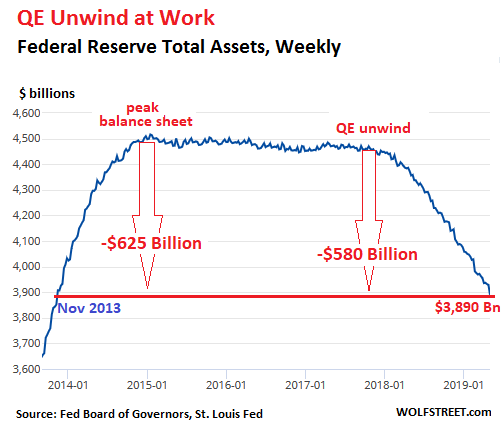
Fed sheds $46 Billion, Total QE Unwind Reaches $580 Billion. Assets drop to lowest level since Nov 2013.
In April, total assets on the Fed’s balance sheet fell by $46 billion, as of the balance sheet for the week ended May 1, released Thursday afternoon. This drop reduced the assets to $3,890 billion, the lowest since November 2013. Since the beginning of the “balance sheet normalization” process, the Fed has shed $580 billion. Since peak-QE in January 2015, the Fed has shed $625 billion:
According to the Fed’s old “balance sheet normalization” plan, which was still on autopilot in April, the QE-unwind would shed “up to” $30 billion in Treasuries and “up to” $20 billion in mortgage-backed securities (MBS) a month for a total of “up to” $50 billion a month, depending on the amounts of bonds that mature that month.

Treasury Securities
The Fed doesn’t actually sell its Treasury securities but allows them to “roll off” without replacement when they mature at mid-month or at the end of the month.
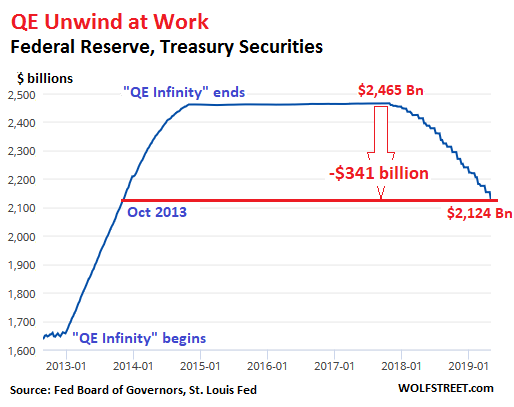
On April 15, $10 million in Treasury Inflation-Protected Securities (TIPS) and $169 million in Treasury securities in the Fed’s portfolio matured. On April 30, two issues of Treasuries matured, totaling $28 billion. Since all of it combined was below the $30-billion “cap,” all of it rolled off without replacement. This brought the Fed’s Treasury holdings down to $2,124 billion, the lowest since October 2013:

Mortgage-Backed Securities (MBS)The residential MBS that the Fed still holds were issued and guaranteed by Fannie Mae, Freddie Mac, and Ginnie Mae. All holders of MBS, including the Fed, receive pass-through principal payments as the underlying mortgages are paid down on a monthly basis with each mortgage payment, or are paid off when the house is sold or the mortgage is refinanced. The remaining principal is paid off at maturity....
...MUCH MORE

"You should be skeptical of current attempts to make a quantum computer that enhances artificial intelligence"

Tiernan Ray at ZD Net:

All that glitters is not quantum AI
Why hasn't the field of artificial intelligence created the equivalent of human intelligence? Is it because the problem, "artificial general intelligence," isn't well understood, or is it because we just need much faster computers, specifically quantum computers?

The latter view is the source of a vibrant field of research, "Quantum Machine Learning," or QML. 
But a bit of skepticism is warranted.

"We need to look through a skeptical eye at the idea that quantum makes things faster and therefore can make machine learning advances," says Jennifer Fernick, the head of research at NCC Group-North America, a cyber-security firm based in Manchester, U.K.
Fernick was a keynote speaker a week ago at the O'Reilly A.I. conference in New York. She sat down this week to tell ZDNet why she's skeptical about all the hype that's emerging in the pairing of quantum and A.I.

"Right now, if we look at work in QML, people are experimenting with things such as, could we build a Support Vector Machine (SVM) or a Boltzmann Machine — can we build these existing canonical machine learning models — in the quantum machine," observes Fernick. She is referring to two older models of machine learning that emerged in the 1980s and the 1990s, prior to today's deep learning systems.
 
Indeed, recent research by IBM has attempted to show that even today's simple quantum systems, such as a 2-qubit model, can theoretically go well beyond what "classical" computers using the flow of electrons can compute.  

The IBM work is part of a recent craze to find uses for quantum computing before large systems are commercially viable. The trends is known as "shallow quantum circuits," also referred to as "Noisy Intermediate-Scale Quantum Devices," or "NISQ."

However, attempts in NISQ to speed up a shallow machine learning task, such as SVM or Boltzmann Machines, may not really be achieving much, she reflected. 

"Quantum computing can make certain things faster if the underlying math has a structure that is exploitable via quantum and we have the right quantum algorithms," she says. "Before we jump on the bandwagon, we need to ask, What are the true algorithmic innovations?" 
In the case of cryptography, one of Fernick's areas of focus as a security specialist, quantum computing is "clearly worth it," she says. 

A quantum computer can render trivial the operation of "factoring" a given number into its component prime numbers where a classical computer would find it impossible....
....MORE

"SoftBank mulls IPO of $100 billion Vision Fund"

Crap. As we've said on these pages a few times, a cash crunch to force the re-listing of ARM Holdings would have been nice.
From Reuters:
Japan’s SoftBank Group Corp is considering an initial public offering of its $100 billion Vision Fund, a source familiar with the matter said on Friday.

The fund was set up in 2017 and has become the world’s largest technology investment fund. Its investments include ride-hailing pioneer Uber, chip designer ARM and shared workspace firm WeWork.

The company has publicly stated it plans to set up a second investment fund. The senior banking source said Softbank was now talking to banks about helping it raise money, confirming an earlier report in the Wall Street Journal.
Softbank has spoken to half a dozen banks over the last month about a potential listing of the Vision Fund but has yet to start a formal process, the source said, adding he was not expecting such a process in the near term.
“They asked banks questions on how they could possibly do it. It is still very much in exploration mode,” the source said, adding that Softbank had been possibly given the idea by fellow tech investor Naspers, which plans to list some of its assets.

“The big difference is that the biggest asset in the Naspers portfolio is Tencent, which is listed, whereas the portfolio of the Vision Fund is all private,” the source said.

China’s Tencent Holdings Ltd is a social media and gaming company listed in Hong Kong.
A spokesman for Softbank declined to comment when contacted by Reuters....MORE
The RCEWA should have figured out how to designate ARM as an Object of Cultural Interest pursuant to the 2002 Export Control Act.
Or something.

Oh well, the RCEWA did keep T.L Lawrence's dagger in British Hands.

Geopolitics: "Pig ‘Ebola’ Virus Sends Shock Waves Through Global Food Chain"

Not to put too fine a point on it but this is a huge story.
From the price of soybeans in Chicago to inflation in Beijing and currency relationships around the world to...it's big.
From Bloomberg, May 2:
  • African swine fever in China will impact global food supply
  • Virus will move markets, may influence geopolitics: Rabobank
What started with a few dozen dead pigs in northeastern China is sending shock waves through the global food chain.
Last August, a farm with fewer than 400 hogs on the outskirts of Shenyang was found to harbor African swine fever, the first ever occurrence of the contagious viral disease in the country with half the world’s pigs. Forty-seven head had died, triggering emergency measures including mass culling and a blockade to stop the transportation of livestock. Within days, a government notice proclaimed the outbreak “effectively controlled.”


It was too late. By then, the disease had literally gone viral, dispersed across hundreds of miles in sickened animals, contaminated food, and in dirt and dust on truck tires and clothing. Nine months later, the contagion has spread nationwide, crossed borders to Mongolia, Vietnam and Cambodia, and bolstered meat markets globally.
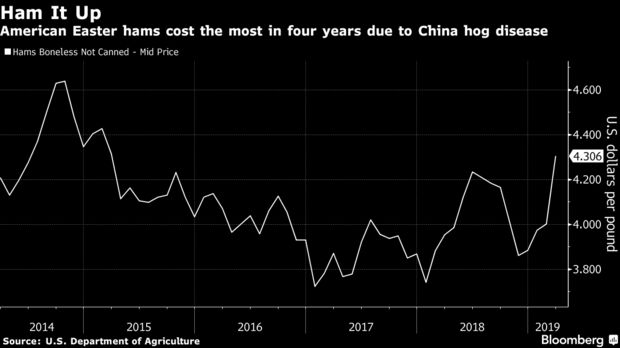
https://assets.bwbx.io/images/users/iqjWHBFdfxIU/itMhzj.YTR9Q/v2/620x-1.png
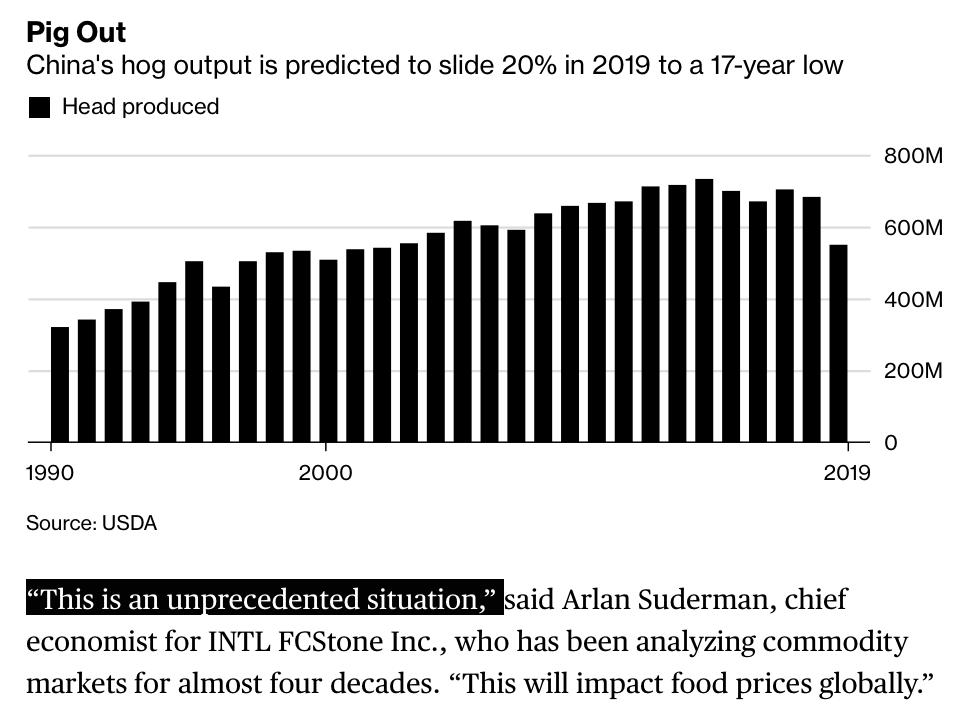
While official estimates count 1 million culled hogs, slaughter data suggest 100 times more will be removed from China’s 440 million-strong swine herd in 2019, the Chinese zodiac’s “year of the pig.” The U.S. Department of Agriculture forecast in April a decline of 134 million head -- equivalent to the entire annual output of American pigs -- and the worst slump since the department began counting China’s pigs in the mid 1970s.
https://pbs.twimg.com/media/D5pR2LjX4AY_gTH.jpg

...MUCH MORE

Raghuram Rajan: "When the Interests of Monopolists and Authoritarians Coalesce"

What if they're authoritarian monopolists?
From the University of Chicago's Stigler Center ProMarket blog:
It is when the behemoth of monopoly enterprise consorts with the leviathan of the authoritarian state that both are likely to achieve permanence, writes Raghuram Rajan.

Power prefers permanence. Unregulated markets tend toward concentration as the successful try and entrench themselves by pulling up behind them the ladder of competition that they themselves climbed. Equally, the politically powerful are tempted to suppress any competitive threat to their future posed by democracy. James Madison was persuaded that democracy would work in the United States because in a large country with many different competing political interests, it would be hard for any specific interest to dominate. Yet interests can coalesce.

It is when the behemoth of monopoly enterprise consorts with the leviathan of the authoritarian state that both are likely to achieve permanence. History is strewn with examples of these collusive arrangements, some of which we have already encountered. Communism brought all business enterprise under government planning and control, with the state dominated by the Communist Party, the self-appointed representatives of the proletariat. Business and the state were united under the proletarians. Fascism was different only in the language of the dominant group and its stated aims, which was national supremacy instead of the communist paradise of the universal brotherhood of workers. In practice, fascism too involved permanent party dominance of the state, and state control of industry. Today, we have milder versions of these totalitarian regimes, with state-controlled capitalism in countries like China and Russia, and authoritarian capitalism in Turkey.

While the nomenclatures vary, at the heart of such regimes is a pact between the cartelized market and the state, leaving little room for economic or political competition, or the community. Such arrangements are examples of what political economists Douglass North, John Wallis, and Barry Weingast call limited-access societies.

In contrast, the liberal market democracies in developed countries are what they call open-access societies, combining free and open markets with vibrant democratic control over the government. Implicit in the work of a number of political scientists is the belief that open-access societies are the desirable pinnacle of social development, and they will not regress back to limited- access societies because of the strong institutions that protect them. They are probably right in believing that open- access societies are the best we can do for now, but they are mistaken in thinking that open-access societies cannot regress.

To prevent regression, it is critical that the balance be maintained. As we will see now, communities of citizens, expressing their interests through democracy, played an important role in the United States in preventing a corrupt compact between the state and the markets....
...MORE

I don't think we're out of the woods quite yet.

On another topic, the good Professor (and former RBI head) has written on the farm economy crisis of the 1920's that was the trial run for the Great Depression of a few years later. I've been meaning to link to one of his papers and with the currently unfolding rural econ disaster gaining momentum should probably get it on the blog sooner rather than later. Maybe this weekend.

Capital Markets: "Ahead of US Jobs Report, the Greenback Remains Firm"

From Marc to Market:
Overview: The US April jobs data stand before the weekend, and the greenback is holding on to most of yesterday's gains as participants wait for the report. Equities in the Asia Pacific region were mixed without leadership from China and Japan, where the markets remain closed for the extended holiday. On the week, Australia's ASX was the worst performing. It lost 0.8%. Hong Kong was the best with a 1.6% gain, followed closely by Singapore's 1.3% rise. European shares advanced through the morning and pared the week's loss to 0.4% to snap a two-week gain. The S&P 500 reversed lower on Wednesday after setting a new record a little below 2955. It saw follow-through selling yesterday but found bid near 2900 and looks technically set to recovery further, depending on the US employment report. Benchmark 10-year yields are firmer today and adding to the week's increase. US 10-year yields are up three basis points on the week ahead of the jobs data. The UK yield is up five basis points and Germany up four this week. Italian and Spanish yields are slightly softer on the week. The dollar gained broadly yesterday and is holding on to most of these gains today. The Scandis and the Antipodean currencies are the heaviest on the week. Sweden's Riksbank tilted dovish, and the Norwegian krone has been sold on softer manufacturing data and the drop in oil prices. Brent has fallen for six of the past eight sessions. Around $70.20, Brent for July delivery is off a little more than 2.0% for the week, ending a five-week advance.

Asia Pacific
The Reserve Bank of Australia and New Zealand meet next week
. Both meetings are live in the sense that a change of policy is possible. In New Zealand, the market thinks it is likely and discounted a little more than a 50% chance. In Australia, despite the plunge in building approvals reported earlier today (-27.3% year-over-year, after February's 12.3% drop), the RBA is seen waiting a little longer. There is about a one-in-three chance of a cut discounted.

Without Japanese and Chinese markets open, investors have to look for regional clues elsewhere. Today, Malaysia reported March trade data that suggest that while still challenged, the slowdown is easing. Malaysian exports slipped 0.5% year-over-year. They had fallen 5.3% in February and economists did not expect the magnitude of this improvement. Similarly, imports eased 0.1% after a 9.4% drop in February.

With the extended holiday in Japan
, the market has been reluctant to move the yen very far. The dollar was on the JPY111-handle all week, and net-net is virtually unchanged on the week around JPY111.50. The Australian dollar is trading heavily. In late April, it dipped below $0.6990 but bounced back to close above $0.7000. It ran out of steam early this week near $0.7070 and closed at $0.7000 yesterday. Earlier today, it made a new marginal low since the January 3 flash crash (~$0.6085). There is a roughly A$870 mln option at $0.7000 that will be cut today.

Europe
The results from the local elections in the UK are not all counted yet, but the overall results are clear.
The Tories, who had the most seats on the line, were punished severely. With less than half the councils reporting, the Conservative lost about 440 seats. Labour was also punished. With the partial results, Labour lost near 80 seats. The big winner for the Liberal Democrats, who picked up over 300 seats, and Independents. Small parties with a clear anti-Brexit message also did well, according to the early results. Many observers see even these partial results as likely adding to the pressure for the Tories and Labour to reach an agreement. On the other hand, some argue that Labour was punished for not being more supportive of a second referendum or being "strategically ambivalent." At the same time, there is speculation that after losing the Conservatives parliamentary majority and now this drubbing, pressure on May to leave may increase. This is not good for sterling as it appears to renew the risk of leaving without an agreement....
...MORE  

"...Best And Worst Performing Assets In April And YTD"

From ZeroHedge:
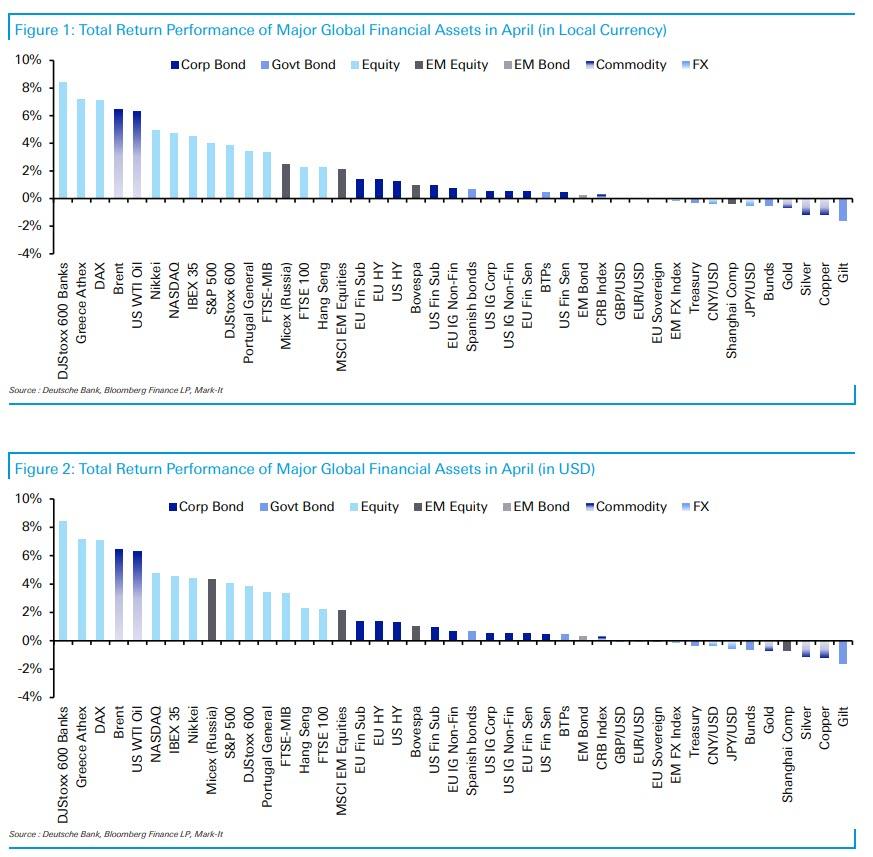
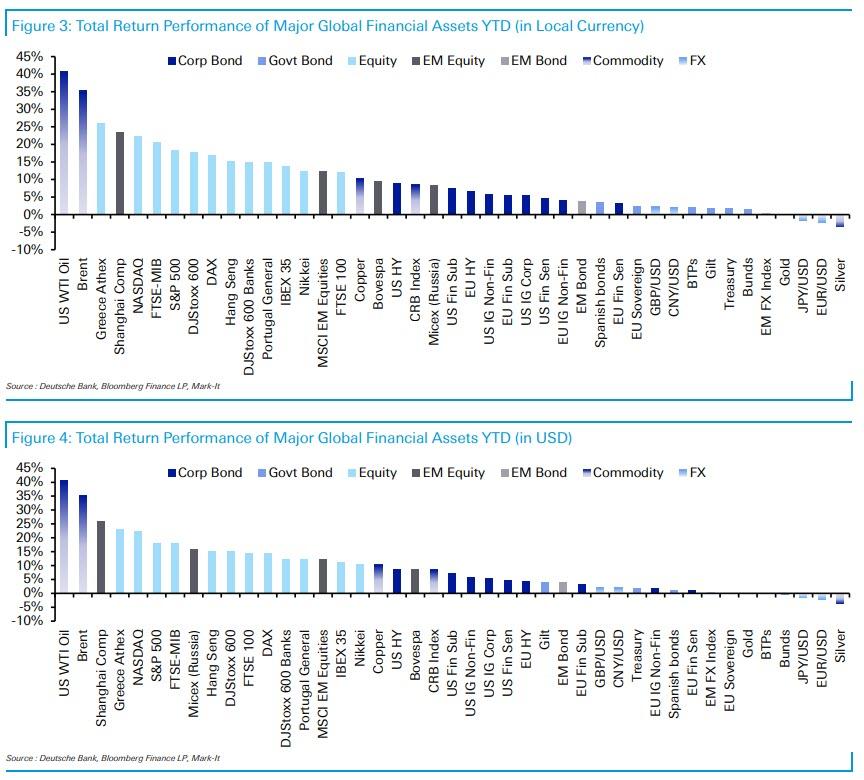
For stocks, April was certainly not the cruelest month, as the risk-on rally continued with the S&P 500 posting 4.0% total returns following the strong 13.6% rally in 1Q. The month ended with a mini meltup, as the S&P set record highs four times in April on a closing basis, three of them in the last three trading days of the month. Overall, the S&P 500 is up 18.2% YTD, 26% since the December low, and sits 2% above its prior high in September 2018.

As BofA notes, the April rally was led by mega-cap stocks - the largest 50 stocks outperformed the overall market by 50bps, while the equal-weight S&P 500 index lagged by 30bps. Global equities also posted strong gains (but lagged the S&P), rising 3.7% in local currency terms and 3.4% in USD, with all MSCI regions gaining. US stocks outperformed other asset classes including bonds (LT Treasuries -1.7% / IG corp. +0.6%) and cash (+0.2%). The VIX index fell 4% (down 48% YTD), while gold slipped for the second straight month (-1.0% in April).

It wasn't just the US, however, and as Deutsche Bank writes, there were strong returns across the board for most equity markets globally as shown below. Central banks falling into a dovish line one-by-one, data continuing to favor this goldilocks environment, earnings season so far being taken positively, trade headlines by and large incrementally more positive and a continued lack of volatility all contributed to the favorable backdrop for risk assets, according to the bank's Craig Nicol.

And while returns weren’t quite so spectacular for rates and commodities, which lagged the broader rally, however, by the end of the month, 30 of the 38 assets in Deutsche Bank's sample still finished with a positive total return in local currency terms and also dollar-adjusted terms. This means that YTD, we’re now at 37 out of 38 assets up in local currency terms and 35 in dollar terms. In local currency terms, this is now the strongest start to a year through the first four months since 2007....MORE
https://www.zerohedge.com/s3/files/inline-images/DB%20april%202019.jpg?itok=H7_aBWMI

https://www.zerohedge.com/s3/files/inline-images/DB%20YTD%202019.jpg?itok=Ycx_UpmF

Go North Young Man: "Kazakhstan Looks To The Arctic For A New Trade Route"

From High North News:

Kazakhstan aims to use the vast Ob’-Irtysh river system to gain access the world’s oceans via the Arctic port of Sabetta. Russian President Putin and Kazakh President Nazarbayev are scheduled to discuss the project this Fall in Omsk
The landlocked central-Asian country is furthering its efforts to develop new transport routes by utilizing Russia’s largest river system. Kazakhstan hopes to benefit from the rapid growth of Arctic shipping and piggyback along these newly developing trade routes. However, it must tread carefully as both Russia and China have vested interests in the region, including the latter’s Belt and Road Initiative.

Access via the Arctic
Kazakhstan’s existing infrastructure and trade routes are oriented in an east-west fashion connecting the country to Europe and Asia via land. With Russia developing Sabetta at the mouth of the Ob’ into a large-scale port, Kazakhstan now hopes to add a much-needed north-south dimension to its trade routes and utilize inland waterways to overcome the hurdle of not having direct access to the world’s oceans. The feasibility of this type of corridor was proven in 2016 when two large petrochemical reactors, each weighing in at over 500 tons, were delivered from South Korea via the Northern Sea Route and along 2,000 kilometers of the Ob’-Irtysh to Pavlodar.

Since 2016 Sabetta has developed into the largest port along the Northern Sea Route, with cargo volume growing more than five-fold to 17.4 million tons last year. In addition to a vast terminal to export up to 18 million tons of liquefied natural gas (LNG) per year from the South Tambeyskoye natural gas field, the port is adding multimodal containerized cargo capacity. A railroad connecting the harbor to Bovanenkovo to the southwest is also in the final planning stages.

“Initially, the seaport was meant as a dedicated gas off-loading port. But now, it has effectively become Ural’s gate to the sea,” explains the head of the Ural’s Customs Directorate Vyacheslav Goloskov. “It will open a completely new page in the history of the whole logistics of the Urals."

Importance of Russia’s Rivers
The Ob’-Irtysh is the world’s seventh-longest river and the westernmost of the three great Siberian rivers that discharge into the Arctic Ocean. The river is navigable for ocean-going vessels for more than 1,200 kilometers and navigable by cargo barges for thousands of kilometers more. In 2018 more than six million tons of cargo and around one million people were transported along the river.
Russia’s Siberian rivers have long been central to carrying goods for those living along their banks. In total more than 18 million tons of cargo and five million people are transported annually. “There is no alternative to the Amur, Yenisei, Lena and Ob river routes. The lives of people settled by the rivers' banks totally depends on them,” explains Nikolai Patrushev, secretary of the Security Council of Russia....
https://www.highnorthnews.com/sites/default/files/styles/media_image/public/2019-03/kazakhstan-01.png?itok=VZNALTiY
The Ob’-Irtysh river system and the Northern Sea Route. (Source: Author’s own work)

...MORE

Thursday, May 2, 2019

Congestion Pricing Be Damned: Moving New York Cargo Off Trucks And Onto Ships

From gCaptain:

New York’s $40+ Million Short Sea Shipping Prize
A perfect storm of new challenges and spiraling cost for truck drivers in New York City has resulted in a tsunami of political support for Short Sea Shipping (SSS) initiatives to move cargo off trucks and onto local waterways. In just the past six months government officials in New York have pledged highly valuable waterfront land, over $40M in grant money and permits to any company that can make SSS work. But can a solution be found?
 
Industry stalwarts like 150 year old McAllister Towing, Harley Marine Services, Red Hook Terminals and Weeks Marine believe that new economic pressure on trucking and government grant money will soon make small container-based barge services profitable but new, innovative, maritime startups are emerging with new ideas.

Three new companies – gShip, Blue Line Logistics and Harbor Harvest –  are sprinting to meet grant deadlines and sign-up customers and they share one important trait, all three will move freight without containers, rather, they will focus on a much smaller standardized unit; shipping pallets.

To understand the new opportunities in New York we first need to answer two fundemental questions:
Why is the cost of trucking in New York escalating at such a rapid rate?
Why are the newest, smallest and most innovative short sea shipping companies not using shipping containers?

City Congestion – The Perfect Storm
Our nations highways are at a critical stage. Containerized shipping, extremely efficient at moving cargo across oceans, onto trucks, and over our nations interstates, has pushed our roadways to maximum capacity. Congestion at critical bottlenecks has reached a breaking point, especially in cities. Large trucks do not move well through local streets. They sit all day in traffic, delaying deliveries, polluting the atmosphere and getting into accidents. 

Pollution and accidents come with high costs too. New emissions requirements coupled with electronic safety devices and driver monitoring have doubled the cost of purchasing a truck. Drivers can no longer get away with illegal overtime exacerbating a nationwide driver shortage.
New roads can not be built because transportation budgets are already strained repairing existing infrastructure, repairs that are compounding the problem with road closures throughout the transportation network.  In 2018 congestion costs topped $4.9 Billion in the NY/NJ metro area. A demographic shift to urban areas, and an increase in online shopping mean these problems will only get worse. 

There is, however, a catch. Not all of our nations highways are congested and many highways, especially those moving long distances East and West, experience little traffic. The most critical problem areas are for trucks moving in and around cities or through traffic choke points like New York’s George Washington bridge. Moving cargo short distances around these choke points could solve the problem but container handling time and slow tug speeds make short moves less effective.

Regulations
“Five years ago government regulations made short sea shipping difficult in New York” said Andrew Genn – NYCEDC SVP of Ports & Transportation – at a SSS conference last year. “We are now working to support rather than block SSS activity.”...
...MORE

"Texas building gold depository with $100B capacity and security that rivals Fort Knox"

From Mining.com:
Texas lawmakers created a new storage option for miners when they signed off on building America’s first state-backed gold depository in 2015.

The Texas Bullion Depository, currently under construction and with the capacity to house physical gold valued in excess of $100 billion will be the most secure facility outside of Fort Knox, will have the full protection of the state of Texas, and is insured by Lloyds of London.

Texas will have a lot of gold to protect — Governor Greg Abbott said when the project was announced last year that it would allow Texas to “repatriate” its gold from New York. The University of Texas/Texas A&M Investment Management Company holds $1 billion worth of gold bullion at the HSBC Bank in New York City, the Texas Tribune reported.

“This goes back to the precious metals storage industry here in the US. Most of the depositories are in the east coast. I say why don’t we have more depositories in Texas? So, the legislature ultimately decided this was something that they wanted to do,” Texas Comptroller Glenn Hegar told MINING.com.

“This is an opportunity for people to store precious metals in a variety of different options, another tool for those in the mining industry. This would also provide that additional oversight, that additional security, accountability, whether it is a short term or long term storage,” Hegar said....MORE

Remember DARPA's Plan For An All-Seeing AI?

It was back in January. Here's the version at TechCrunch:

DARPA wants to build an AI to find the patterns hidden in global chaos
That most famous characterization of the complexity causality, a butterfly beating its wings and causing a hurricane on the other side of the world, is thought-provoking but ultimately not helpful. What we really need is to look at a hurricane and figure out which butterfly caused it — or perhaps stop it before it takes flight in the first place. DARPA thinks AI should be able to do just that.

A new program at the research agency is aimed at creating a machine learning system that can sift through the innumerable events and pieces of media generated every day and identify any threads of connection or narrative in them. It’s called KAIROS: Knowledge-directed Artificial Intelligence Reasoning Over Schemas.

“Schema” in this case has a very specific meaning. It’s the idea of a basic process humans use to understand the world around them by creating little stories of interlinked events. For instance when you buy something at a store, you know that you generally walk into the store, select an item, bring it to the cashier, who scans it, then you pay in some way, and then leave the store. This “buying something” process is a schema we all recognize, and could of course have schemas within it (selecting a product; payment process) or be part of another schema (gift giving; home cooking).
...MORE

Here's the FedBizOps solicitation.

Well I must have seen something back then because when this press release arrived on Monday there was a flash of recognition:
Kairos Announces Beta Launch of Liveness Detection, Reducing Identity Fraud for Digital Transactions
Unrelated to the DARPA project but the same name. Odd eh?

"The New Silk Roads reach the next level"

From the Asia Times:

The Beijing leadership seems to be aware that transparency is key for the global success of BRI, which is now supported by over 120 states and territories 
The Belt and Road Forum in Beijing was a graphic demonstration of how tactical adjustments are essential to enhance the appeal of a complex overall strategy. Talk about a turbo-charged 4.0 version of the legendary Deng Xiaoping maxim “crossing the river while feeling the stones.”

For all the somewhat straitjacket approach of Chinese official pronouncements, President Xi Jinping stressed a sort of “three musts” for the advance of the New Silk Roads, or Belt and Road Initiative (BRI) – debt sustainability, protection of the environment (or “green growth”), and no tolerance for corruption.

Add to that a growing battle against trade protectionism, more bilateral free-trade deals, more financing or investments, cooperation on third-party markets, and even a plan to sell Silk Road bonds. 

In his keynote speech, Xi stressed how multilateral cooperation on “six corridors and six channels serving multiple countries and ports” is all go. He was referring to BRI’s six major connectivity corridors spanning Eurasia – and the fact that BRI is still in its planning stage; implementation actually starts in 2021. 

The devil, of course, is in the details on multiple Chinese promises – further opening-up of the Chinese market to foreign investment; the possibility of majority equity in more industrial sectors; no more imposed technology transfers; more protection of intellectual property rights; and last but not least, no devaluation of the yuan. 

And yet Beijing is learning fast. The final joint communique, emphasizing governance as much as economic development, was signed by Xi and 37 heads of state – from Italy, Greece and Portugal to Singapore and Thailand, not to mention new members such as Luxembourg, Peru, Cyprus and Yemen.

BRI is now supported by no less than 126 states and territories, plus a host of international organizations. This is the new, truthful, realistic face of the “international community” – way bigger, diversified and more representative than the G20.

The Beijing leadership seems to be aware that transparency is key for the global success of BRI. On the opening day of the forum, Finance Minister Liu Kun presented a 15-page debt sustainability framework based on similar standards applied by the Bretton Woods system – the IMF and the World Bank. 

And the governor of the People’s Bank of China (PBOC), Yi Gang, stressed how long-term debt sustainability should be evaluated in relation to better infrastructure, better productivity, raising standards of living and reducing poverty. The PBOC has financed as much as $440 billion in BRI projects so far. 

It’s all about Russia-China....

TIL: The Goblin Shark Is One Creepy Critter

From National Geographic Kids:
OVERVIEW
Swishing through the deep sea, a goblin shark notices a small, yummy-looking squid. The animal inches toward its prey. But as the fish closes in, the snack starts to dart away. So the shark thrusts its jaw three inches out of its mouth! (The jaw is connected to three-inch-long flaps of skin that can unfold from its snout.) The predator then grabs the squid in its teeth. After scarfing down the meal, the shark fits its jaw back into its mouth and swims off....MORE
https://kids.nationalgeographic.com/content/dam/kids/photos/animals/Mammals/A-G/goblin-shark-jaw.adapt.945.1.jpg

As the man said, "Once seen, it cannot be unseen."

Sweet dreams kids.

Packaged Goods: "Kellogg to replace CFO, earnings dive 36.5 percent; shares drop" (K; GIS); KHC

One of our favorite stories of the last ten years is the decline of the packaged food companies.
More after the jump.
Via CNBC:
Kellogg Co said on Thursday it will replace its chief financial officer, and the cereal, breakfast foods and snacks maker reported a 36.5 percent decline in first-quarter earnings, citing a strong U.S. dollar and higher costs.

Shares were down about 5 percent in premarket trading for the maker of Pop Tarts, Eggo Waffles, Pringles snacks and a wide range of cereals including Rice Krispies and Froot Loops.
Battle Creek, Michigan-based Kellogg said CFO Fareed Khan will be replaced on July 1 by Amit Banati, who heads the company’s Asia Pacific, Africa and Middle East business.

In addition to the stronger dollar, quarterly earnings were hit by higher spending on divestitures, transportation and commodities costs. Excluding items, Kellogg’s results beat analyst estimates.
Packaged food companies have struggled to grow for years as consumers have shifted to healthier foods and trendier upstart brands. Intense pricing pressure has hurt sales too, as grocery stores compete aggressively against Amazon.com Inc.

Foreign exchange fluctuations and rising commodity and transportation costs have recently eaten into profits across the industry....MUCH MORE
The stock is off 4% on the news. Over the last couple years Kellogg is down 19.4% while the S&P 500 is up 22.3%. General Mills is down 8.9% over the same period.
Over the last five years the comparison to the broader market is even worse, S&P 500 up 55.6% General Mills and Kellogg down 6% and 15% respectively. Campbell's is down 16% over five years.

Previously:
Nov. 13, 2018 
Packaged Foods: The Guy Shorting Kellogg's (K; GIS; CPB)
With Campbell Soup, and their Dan Loeb-activist drama, reporting earnings tomorrow it appears the brand-name food companies are drawing attention.
We have some experience with theses things....


March 7, 2017
M&A In European Food
I'm not sure that consumer packaged goods is the area to be in, at least not in the U.S. and not based on names like Kellogg or General Mills.
For a quarter-century those manufacturers ratcheted prices as though they were tobacco companies but people find it easier to give up their Cheerios than their cigarettes.
The managements milked that approach for pretty much all it was worth so, as operating entities, they aren't all that attractive but someone will decide the only thing left to do is to asset strip or dividend recap the life out of the former cash cows.
Top o'the market to ya.... 
Sept. 7, 2018
Packaged Goods: So, What's New at Campbell Soup? (CPB)
August 30
Packaged Goods: ""Why 149 year-old Campbell Soup is at a crossroads" (CPB)
May 18, 2018
More Trouble In U.S. Packaged Food: Campbell Soup Down 12% (CPB; GIS; K)
For the last couple years we've been using Kellogg and General Mills as proxies for the group...
May 3
The Disaster That Is American Packaged Food (K; GIS)
Not talking nutrition here, just shareholder wealth destruction.
We've been posting on the profit potential on the short side for the last couple years and things have only gotten worse for the former giants over the last few months:...
The David Says Eat More Packaged Food (and short the stocks)
Packaged Goods: "...America's Venerable Food Brands Are Struggling"
Nine of the World's Biggest Packaged Food Companies Have Launched Venture Capital Units
"Hungry for Investment: Big Food Races Toward Startups"
Dealflow: "New Investors Flock To Food"

And many more. Use the 'Search blog' box if interested.

ICYMI "Twitter Has Stopped Disclosing its Monthly Active User Count" (TWTR)

Hey! we've seen this movie before!
It was on all the better blogs, after the close November 1, 2018:
Apple will stop reporting unit sales for iPhone, iPad, and Mac starting next quarter, as CFO says units sold isn't representative of the state of business (AAPL)

And reprised in January 2's "Was Apple's Decision to Stop Reporting Unit Volume Last November A Tell?":
I vaguely remember reading about it at Markets Live, but the images are jumbled.

Bryce was delayed getting to the Markets Live desk, but unlike a day earlier, not complaining that ML cut into his actual work. He seemed oddly resigned to his task of keeping the Rabble on the Right on a short leash.
Cue dream sequence:


Bryce Elder

 
BE What?

The stock did not take the November 1 decision to stop reporting at all well

AAPL Apple Inc. daily Stock Chart

And although it was somewhat obscured by the overall market decline, the fact of the matter is that despite yesterday's 4.91% up move to $210.52 AAPL has yet to recover its Nov 1, 2018 closing price, $222.22, much less the Oct. 3 all-time high, $233.47.

Enough history, here's the headline story from Statista, April 24 (referring to the February announcement):

Has Twitter Reached Its Natural Growth Limit?
For the last time, Twitter publicly disclosed its monthly active user count on Tuesday, revealing that an average of 330 million people a month used its service in the first quarter of 2019. While that's a slight improvement compared to the previous two quarters, it still marks a net loss of six million users compared to the same period of 2018. Over the past three years, Twitter has now added just 20 million monthly active users, with its user count hovering around 330 million for the better part of that period, indicating that the platform may have reached its growth limit.

To address the problem at hand, Twitter is taking a page out of Apple’s playbook. Just like the iPhone-maker will no longer reveal unit sales figures for its products, presumably because they don't look as impressive as they used to, Twitter will simply stop reporting monthly active users going forward, presumably to avoid uncomfortable questions about its lackluster growth.

Going forward, Twitter will focus on "monetizable daily active users"...
...MORE

Also at the New York Post, Feb. 7, 2019.
$39.29  down 0.62 (-1.55%) at the close Monday May 1.

Looking back in the archive I see we've already linked to a brilliant Twitter/Apple mashup, in beat poetry style no less:

Reworking Allen Ginsberg To Comment About Twitter
Stay off Twitter. No good can come of it.
Use it, if you must, to highlight something you've done or seen but for God's sake don't use it for conversation.
Better yet, stay off twitter.

And where, wary reader asks, is this rant coming from?

A first rate pastiche of Ginsberg's 'Howl':


...MORE

Capital Markets: "Dollar Consolidates Fed-Inspired Recovery"

From Marc to Market:
Overview: The US dollar is consolidating yesterday's post-Fed rally, and this is giving it a slightly heavier tone today. Equities are mostly lower and Europe's Dow Jones Stoxx 600 is off about 0.5% in late morning turnover, which if sustained would be the largest decline in three weeks. The S&P 500 posted a potential key reversal yesterday by setting new record highs and then closing below the previous session's low. Benchmark 10-year bond yields are mostly a couple basis points firmer, though Italian bonds are the exception. A stronger than expected manufacturing PMI appeared to spur demand. Meanwhile, press reports seem to be playing up the possibility that a Brexit agreement between Labour and the government and a US-China trade deal may be struck in a week.

Asia Pacific
Chinese and Japanese markets are closed and will remain so tomorrow
. China's markets reopen on after the weekend while Japan's markets will be closed on Monday. Heightened speculation that the Reserve Bank of New Zealand may deliver a rate cut next week appeared to lift local shares 1.2% to lead the region. The manufacturing PMI among developing Asia were mixed. Of note, South Korea's reading rose to 50.2 from 48.8, while Taiwan's eased to 48.2 from 49.0. Indonesia reported a tick up in inflation (2.83% from 2.67%), but the focus on the MSCI decision to drop PT Bank Danamon Indonesia from its index, which triggered a sell-off that push the Jakarta Composite (-1.2%). Note that Japan's Mitsubishi UFJ has a majority stake in the bank. On the other hand, S&P upgraded the Philippines credit rating one-notch to BBB+. The benchmark 10-year bond yield fell six basis points (to ~5.80%). The currency edged higher and as did shares.

In recent days, reports have suggested that the US has softened its position in trade talks with China on patents for biologics and on cyber espionage. Reports also indicated that if a deal is not wrapped up later this month, President Trump may lose his interest. The reports give a sense that the Trump Administration wants a deal and soon. China's Vice Premier will be in Washington next week. There is the hope that this is the last round before a date for a meeting between Trump and Xi is announced. The media built up market expectations in the past for such an announcement, but now the timeframe may be a bit more compelling.

Today is the first session in six that the dollar has risen above the previous day's high against the Japanese yen. It has traded a little through JPY111.65. So far, it has stopped shy of the 20-day moving average and the 50% retracement of the drop since the year's high was recorded (~JPY112.40) on March 25. Both are found near JPY111.70, and above there, another push on JPY112.00 is likely. Before that though, the JPY111.50 level houses an $850 mln expiring option and may be sticky. The Australian dollar fell back to nearly $0.7000 in the greenback's post-Fed rally yesterday. Last week's low was set slightly below $0.6990. It would make a technically more compelling case of a resumption of the US dollar's uptrend if the Aussie were sold through there. Without the break, near-term consolidation is likely. The week's high was set just below resistance we identified near $0.7070.

Europe

Three of the four largest eurozone countries reported stronger than expected April manufacturing PMI. German was the exception. France's flash PMI of 49.6 was revised to 50.0, and this follows a 49.7 reading in March. Spain's PMI increased to 51.8 from 50.9, and Italy's rose to 49.1 from 47.4. For the EMU as a whole, the PMI ticked up to 47.9 from the 47.8 flash report. It was at 47.5 in March. It is the first increase since last July, which was the only time it increased in 2018....
...MUCH MORE

Wednesday, May 1, 2019

Insurance/Shipping: "Lloyd’s of London Plots New Course as Storm Clouds Gather"

From Reuters via gCaptain:
Lloyd’s of London, the world’s oldest insurer of seafaring vessels, is facing its own perfect storm.
Old-fashioned business practices, exposure to natural disasters, competition from rival centers and Brexit are all threatening Lloyd’s reputation as the place to insure anything from ships to sculptures to soccer stars’ legs.

Stung by combined losses of 3 billion pounds ($3.9 billion) over the last two years, John Neal, the new chief executive of an insurance market founded in a London coffee house in 1688, is under growing pressure to drag Lloyd’s into the 21st century.

Following a six-month review, Neal will unveil a new strategy next week expected to include a push to automate arcane processes, a shift away from risky catastrophe insurance, a hard look at the middlemen who drive up the cost of doing business at Lloyd’s and ways to attract new sources of capital.

It is also looking to improve inclusion at a time when the culture at Lloyd’s is in the spotlight following a report by Bloomberg News about sexual harassment and day-time drinking.
But in a market where shipwrecks are still recorded by some insurers with a quill and paperwork is lugged around Lloyd’s futuristic 14-story building in slipcases, some brokers and underwriters are resisting innovation.

“Lloyd’s has to change, it’s like an old man dancing – a bit awkward and embarrassing,” said one insurance company chief executive, who declined to be named. “We do not have a great track record in modernisation.”....
...MORE

The referenced Bloomberg Businessweek story was the very extensive March 21 "The Old Daytime-Drinking, Sexual-Harassing Ways Are Thriving at Lloyd’s".

"Is China Really Becoming a Current Account Deficit Country? (Part 1 of 2)"

If China is ever to have a reserve currency they will have to run large enough deficits to get a volume of renminbi in foreign hands and that's the long and short of reserve currency dreams.

From Macro Polo, April 29:
For 25 years, China has been running a current account surplus, and the world grew accustomed to “China the exporter” of last resort. So when The Economist recently made the case that China would soon become a current account deficit country, eyebrows were raised. The implications of the end of such an era are significant, piquing market interest and engendering debate.

That debate has centered on the relationship between savings and investment, since a country’s trade balance is simply the difference between the two. So what happens to China’s trade balance depends entirely on whether savings or investment declines faster.

On the one hand, economists have emphasized the impact of China’s declining savings rate on its trade balance. They argue that as savings continue to dwindle, a current account deficit will become a permanent feature of the Chinese economy.

On the other, observers believe a sudden drop in China’s high investment rate should be a pressing concern. They argue that should Beijing stop stimulating domestic investment, its collapse would lead to a spike in China’s trade surplus at a time of weak global demand. Since there won’t be sufficient demand to absorb China’s surplus, it will likely crowd out demand elsewhere and potentially jumpstart a global recession.

Both arguments have some merit, but they are also flawed. Here I’ll first make the case for why a collapse of domestic investment is unlikely and therefore will have little impact on the trade balance. Then Part 2 will examine the declining savings issue and provide my outlook on China’s trade balance.

Financial Resilience
The International Monetary Fund (IMF) has put China’s excessive investment—meaning the returns cannot cover the costs—at around 10% of GDP. Assuming these loss-making investments are only worth 25% of the cost and are all financed by borrowing, that would reduce China’s GDP by 7.5%, with creditors facing an equivalent amount of losses.

Such a situation certainly seems untenable. The estimates above imply that China’s banking sector would become insolvent after just two years of over-investment (Chinese banks’ total equity is only about 15% of GDP based on market valuation).

But they are not insolvent. So what gives?

One main reason is that the cost of over-investment is not concentrated in the banking system but distributed among two key borrowers: local government financing vehicles (LGFVs) and state-owned enterprises (SOEs), which together constitute nearly all of the excessive investment. Both of these borrowers have alternative sources of funding, namely land sales and state subsidies.

First, LGFVs are controlled by local governments that have access to land, with annual income from land sales equal to at least 2% of GDP (assuming gross land sale is 5% of GDP and net income is 40% of gross sales). Second, based on flow of funds data, the Chinese government has been subsidizing SOE investments by around 1% of GDP annually for the past decade.

Additionally, it is common practice for state banks to use their profits to cross-subsidize bad loans. On average, financial sector profit has been around 3% of GDP, and more than 90% of the profit has been recycled to absorb bad loans.(In contrast, US banks usually pay out around 30% of their profits as dividends.) Accounting for these factors, China’s annual net loss from over-investment is reduced from 10% to around 2% of GDP, a much more manageable figure....MORE
I still bristle at the Paulson Institute, based at the University of Chicago, I still bristle at their use of "Macro Polo".
I came up with the term, me, independently, to describe this:
Macro Polo: "King's Cup Charity Elephant Polo Tournament kicks off in Bangkok"
You don't get any more macro in the polo world. 

Worst-Case Wednesday: How to Make an Effective Tinfoil Hat

This as a subject upon which we have done some...ahhh...research. No particular reason, just...ahhh...curiosity.
From Quirkbooks:
Do you want aliens or the government reading your thoughts? No? That's what I figured. Better safe than sorry, pal. The Worst-Case Scenario Survival Handbook: Paranormal teaches you how to protect what's in your head from an unwanted invasion.

1. Measure your head.
Gather the dimensions of your scalp using a soft tape measure, measuring from the middle of your forehead to the base of your skull.

2. Unroll tinfoil.
Using clean, premium-brand foil that has not been used to wrap food, measure double the length from your forehead to skull, plus four inches. Detach the foil using the serrated edge of the box and fold the foil in half, shiny side facing out.

3. Mold the hat to your head.
Carefully place the sheet of foil over your head and scrunch it down to follow the shape of your skull, as would a shower cap or helmet. If any exposed scalp remains, attach additional pieces of foil to cover; adhere using clear tape.

4. At each temple, poke a quarter-inch hold on either side of the foil....
...MORE

See also:

MIT: "On the Effectiveness of Tin-Foil Helmets: An Empirical Study"
Being MIT they called them helmets rather than hats.
And since no-one seems to manufacture tin-foil for consumer use they use aluminum foil despite the accepted tin-foil nomenclature.

A repost from July 2011.

MIT: "On the Effectiveness of Aluminium Foil Helmets: An Empirical Study" 
I was just told that the post immediately below, "Uh oh: The DJIA's Highest Priced Components Are the Ones That Are Up (IBM; DIA)" sounded "a little tin-foil hat-ish".
Ha!

From MIT via Moses Moore:
 Ali Rahimi1, Ben Recht 2, Jason Taylor 2, Noah Vawter 2
17 Feb 2005
1: Electrical Engineering and Computer Science department, MIT.
2: Media Laboratory, MIT. 
[aluhelmet.jpg]
[scientist - note electronicy looking stuff]

Abstract

Among a fringe community of paranoids, aluminum helmets serve as the protective measure of choice against invasive radio signals. We investigate the efficacy of three aluminum helmet designs on a sample group of four individuals. Using a $250,000 network analyser, we find that although on average all helmets attenuate invasive radio frequencies in either directions (either emanating from an outside source, or emanating from the cranium of the subject), certain frequencies are in fact greatly amplified. These amplified frequencies coincide with radio bands reserved for government use according to the Federal Communication Commission (FCC). Statistical evidence suggests the use of helmets may in fact enhance the government's invasive abilities. We speculate that the government may in fact have started the helmet craze for this reason.

Introduction
It has long been suspected that the government has been using satellites to read and control the minds of certain citizens. The use of aluminum helmets has been a common guerrilla tactic against the government's invasive tactics [1]. Surprisingly, these helmets can in fact help the government spy on citizens by amplifying certain key frequency ranges reserved for government use. In addition, none of the three helmets we analyzed provided significant attenuation to most frequency bands. We describe our experimental setup, report our results, and conclude with a few design guidelines for constructing more effective helmets.

Experimental Setup
We evaluated the performance of three different helmet designs, commonly referred to as the Classical, the Fez, and the Centurion. These designs are portrayed in Figure 1. The helmets were made of Reynolds aluminium foil. As per best practices, all three designs were constructed with the double layering technique described elsewhere [2].

A radio-frequency test signal sweeping the ranges from 10 Khz to 3 Ghz was generated using an omnidirectional antenna attached to the Agilent 8714ET's signal generator....

...Results

For all helmets, we noticed a 30 db amplification at 2.6 Ghz and a 20 db amplification at 1.2 Ghz, regardless of the position of the antenna on the cranium. In addition, all helmets exhibited a marked 20 db attenuation at around 1.5 Ghz, with no significant attenuation beyond 10 db anywhere else.

Conclusion

The helmets amplify frequency bands that coincide with those allocated to the US government between 1.2 Ghz and 1.4 Ghz. According to the FCC, These bands are supposedly reserved for ''radio location'' (ie, GPS), and other communications with satellites (see, for example, [3]). The 2.6 Ghz band coincides with mobile phone technology. Though not affiliated by government, these bands are at the hands of multinational corporations.

It requires no stretch of the imagination to conclude that the current helmet craze is likely to have been propagated by the Government, possibly with the involvement of the FCC. We hope this report will encourage the paranoid community to develop improved helmet designs to avoid falling prey to these shortcomings....MORE
Rebuttal From ZPi:
A recent MIT study [1] calls into question the effectiveness of Aluminum Foil Deflector Beanies. However, there are serious flaws in this study, not the least of which is a complete mischaracterization of the process of psychotronic mind control. I theorize that the study is, in fact, NWO propaganda designed to spread FUD against deflector beanie technology, and aluminum shielding in general, in order to disembeanie paranoids, leaving them open to mind control.

First and foremost, Rahimi et al. only considered simple radio frequencies. As I explained in detail in chapter 4 ("Psychotronic and AFDB Theory") of my book [2], only psychotronic energy can affect the brain in any coherent manner. Simple EM fields have only trivial effects -- such as causing indistinct sensations of a supernatural presence [3] -- over short distances. Only by converting electromagnetic energy into psychotronic energy using a psychotron-based device can the forces of mind control access from afar the neural network of a brain to both implant and extract thought complexes.
Figure 1
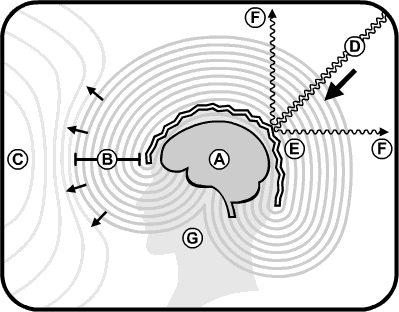
FIGURE 1: An AFDB-covered brain (A) is shielded by a repulsive resonance buffer (B), which deflects psychotronic fields (C). Coherent psychotronic rays (D) are defected at the aluminum surface (E) and decoherently scattered (F). The resonance buffer encapsulates the brain (G), providing basal protection against fields and glancing rays.
As illustrated in Figure 1, unlike with the mere attenuation of EM fields, aluminum deflects psychotronic fields and coherent psychotronic rays. The operational modalities of AFDBs for EM and psychotronic energies are completely different, and thus the experiment conducted by Rahimi et al. is inappropriate to test the effectiveness of deflector beanie technology in stopping mind control.

Besides the experiment's unsuitability, the experimental procedures themselves appear flawed. The measuring of the signal was described by Rahimi et al. as follows:
The receiver antenna was placed at various places on the cranium of 4 different subjects: the frontal, occipital and parietal lobes. Once with the helmet off and once with the helmet on.
Figure 2
FIGURE 2: (A) Excessively pointy omnidirectional antenna. (B) Chef's Pride brand foil (photo enhanced).
But the antenna shown in Figure 2 on their site would not possibly be able to fit under the helmets while on a head, at least not without awk­wardly balancing the helmet counter to best practices or punc­turing the foil. If the antenna was instead placed on the outside of the helmets, as seems most likely from the description, then that calls into question the entire conclusion: If the amp­lifi­cation effect is measured only on the helmet outside, then that suggests that the helmet is reflecting the EM radiation away from the wearer's brain.

Oddly, Rahimi et al. make a great deal about the price of their equipment, noting the US$250,000 price tag of their Agilent 8714ET network analyser three times in their short paper. What relevance is this to the conclusion? I believe its a subtle way of discouraging people from replicating the experiment at home....MORE

Silver Is Now Just 82 Cents Above Its Multi-Year Low

Front futures $14.72 down 0.265:


The double bottom in 2018 and December 2015 at $13.90 is the last line of support for bulls.

Warren Buffet Is Not Buying Into That Whole "Cashless Economy" Thing (BRK)

From Yahoo Finance:

Warren Buffett carries an American Express card and about $400 in cash
Warren Buffett is worth $89.1 billion. But how much does he keep in his wallet?
“I probably carry, maybe, $400,” he said. “My wife likes to use cash.”
That’s not to say he pays for everything in cash.
“I've got an American Express (AXP) card which I got in 1964,” he said. “But I pay cash 98% of the time. If I'm in a restaurant, I always pay cash. It's just easier.”...MORE
Because that's just the way he rolls.

Climateer Line of the Day: Apple Edition (AAPL)

Today's winner of the prestigious CLoD is analyst Neil Campling, delivered to us by FT Alphaville's Markets Live:
"...Thought: Don’t look over there… look over there. 65% of the business might rely on one key driver (aka iPhones) which is in severe decline (iPhone sales fell 17% YoY in the quarter) so the company has been trying to divert attention to services as the key high growth driver of the future. But these other services of app sales, streaming sales etc. only grew 16% YoY. It isn’t at the hyper growth level it needs to be...."
Just in case anyone missed the magician's misdirection move, Apple headlined their earnings press release:
Services Revenue Reaches New All-Time High of $11.5 Billion 
The entire ML discussion of Apple's results is first rate with guest appearances by Goldman and Credit Suisse as well as running commentary by Bryce and Jamie (and the rabble)
Markets Live Wednesday, 1st May 2019
As Apple is a component of the Dow Jones Industrials, its $10.35 (5.16%) pre-market uptick, to $211.02, is worth around 70 points to the DJIA.

"Apple Is Telling Lawmakers People Will Hurt Themselves if They Try to Fix iPhones" (AAPL)

Following up on Sunday's "U.S. Farmers Are Being Bled by the Tractor Monopoly" (DE).

And also March 2018's "The Right to Repair Battle Has Come to Silicon Valley"
You didn't thinks all those posts on John Deere and "Kirtsaeng v. John Wiley & Sons, Inc." were simply about tractors and textbooks did you? I mean, sure they were, but they were also about whether you own the stuff you buy and if the Supreme Court would uphold the First Sale Doctrine.

From Motherboard:
An Apple lobbyist brought an iPhone to meetings with California lawmakers and said consumers could hurt themselves by puncturing a lithium-ion battery.
In recent weeks, an Apple representative and a lobbyist for CompTIA, a trade organization that represents big tech companies, have been privately meeting with legislators in California to encourage them to kill legislation that would make it easier for consumers to repair their electronics, Motherboard has learned.
According to two sources in the California State Assembly, the lobbyists have met with members of the Privacy and Consumer Protection Committee, which is set to hold a hearing on the bill Tuesday afternoon. The lobbyists brought an iPhone to the meetings and showed lawmakers and their legislative aides the internal components of the phone. The lobbyists said that if improperly disassembled, consumers who are trying to fix their own iPhone could hurt themselves by puncturing the lithium-ion battery, the sources, who Motherboard is not naming because they were not authorized to speak to the media, said.

The argument is similar to one made publicly by Apple executive Lisa Jackson in 2017 at TechCrunch Disrupt, when she said the iPhone is “too complex” for normal people to repair them.
In the past, Apple has lobbied against so-called right to repair legislation—which would require Apple and other electronics companies to sell repair parts and tools, and make diagnostic and repair information available to the general public. In 2017, New York State records showed that the company hired a lobbyist to push against the issue there, and an Apple lobbyist in Nebraska told a lawmaker there that passing a right to repair bill would turn the state into a “Mecca for bad actors,” criminals, and hackers. Following media coverage of Apple lobbying in those two states, the company has been much quieter. Rather than lobbying on its own behalf, the company has relied on CompTIA, an organization funded by tech companies like Apple, Microsoft, and Samsung, to testify against the legislation at hearings and meet with lawmakers.

The in-person meetings in California came a few weeks after CompTIA and 18 other trade organizations associated with big tech companies—including CTIA and the Entertainment Software Association—sent letters in opposition of the legislation to members of the Assembly’s Privacy and Consumer Protection Committee. One copy of the letter, addressed to committee chairperson Ed Chau and obtained by Motherboard, urges the chairperson “against moving forward with this legislation.” CTIA represents wireless carriers including Verizon, AT&T, and T-Mobile, while the Entertainment Software Association represents Nintendo, Sony, Microsoft, and other video game manufacturers....MUCH MORE
The 'ol "our customers are idiots" pitch. 

Capital Markets: "No Help on May Day, which is also Fed Day"

Something about typing "capital" on May Day just feels right.
From Marc to Markets:

No Help on May Day, which is also Fed Day 
Overview: The May Day holiday has shut most markets in Asia and Europe, making for subdued market action. Equity markets that are open, like Australia and the UK, advanced and US shares are trading higher helped by Apple's upbeat forecasts and sales that beat expectations. Indeed, there is a risk that the S&P 500 gaps higher at the open after closing on the highs of the day, which were a new record. The US dollar is narrowly mixed but mostly softer. The New Zealand dollar is a notable exception. Disappointing employment growth boosts the chances of a rate cut next week. The Federal Reserve though is the central bank of the day. President Trump's demand for a rate, where he says a 100 bp would see growth surge, is likely to fall on deaf ears. The market hardly flinched at the latest tweets.

Asia Pacific
Many were already looking for a rate cut next week by the Reserve Bank of New Zealand
and the weaker employment report fans such expectations. The decline in the unemployment rate (4.2% vs. 4.3%) was the result of a sharp decline in the participation rate (70.4% vs. 70.9%). The most important takeaway was the 0.2% decline in Q1 employment. The median forecast in the Bloomberg survey called for a 0.5% gains after a 0.1% increase in Q4 18. Private wages, with and without bonus payments increased by 0.3%, which were also slower than expected (0.5%). Both the forward market and the OIS imply that about a 60% chance of a cut next week has been discounted.

South Korean exports fell for the fifth consecutive month in March, but the 2% year-over-year decline was almost a third of the decline that the median forecast anticipated. Weakness in semiconductors (-0.9%) continued, but there were a small uptick memory chip exports. Imports were also stronger than expected, rising 2.4% compared with forecasts of a 1.0% decline.

US-China trade talks are thought to be entering the final stages, and there is still hope that an agreement can be reached in the coming weeks and that a meeting between the two presidents is possible toward the end of the month. The Financial Times reports today that Trump has softened the language demanding that China stop its commercial cyber theft. This plays into fears that Trump is mostly interested in transactional (short-term) benefits rather than deeper structural reforms. Reports indicate that China is resistance US demands to change its industrial policy, including its industry subsidies. Recall that at the end of last week, FBI Director Wray warned that China had "pioneered a societal approach to stealing innovations and that all of the 56 FBI field offices are conducting economic espionage investigations across most industries that almost invariably lead to China. Separately, China announced its intention to remove limits on foreign ownership of local banks and make it easier for foreign insurance firms to enter the on-shore market.

The dollar has been confined to a less than a fifth of a yen range within the ranges seen yesterday. The five-day average slipped below the 20-day average yesterday for the first time in a month. The greenback is holding above JPY111.25, and below there support is seen near JPY110.80. There is a $380 mln options at JPY111.35, which expires today, but is very much in play. A move above JPY111.60 would help lift the tone. The Australian dollar is also trading inside yesterday's ranges with the help of mixed PMI readings and the lack of much participation. Initial resistance is pegged near $0.7070, while support is seen ahead of $0.7030. Note that Japanese and Chinese markets are closed for the rest of the week.

Europe
The UK's manufacturing sector slowed according to the Purchasing Managers Index. Slower inventory accumulation and weaker exports pushed the manufacturing PMI off of 13-month highs see in March (55.1) to 53.1. Note it averaged 53.6 in Q1 and 52.9 in Q4 18. Separately, Nationwide's house price index rose 0.4% in April for a 0.9% year-over-year rise. Both were sequentially stronger than March. The Bank of England meets tomorrow and updates its economic forecasts in its Quarterly Inflation Report. There is practically no chance of a change in policy....
...MORE