Talk about your "big if true"/"big if, true". The numbers are just so mindbending.
From SemiAnalysis, August 7:
SpaceX 10GW in 2027 – Why It’s Real, Will Drive $300B ARR for SpaceX, and Why Microsoft Will Be the Largest Offtaker
Inference at 100B/GW/year, SpaceX's stellar pace, Microsoft's 10GW 2026 Awakening, Azure Can Grow Triple-Digits
Elon Musk shocked the world, once again, when he announced on SpaceX’s first earnings his Gigawatt ambitions for next year. He “conservatively” aims to build & deliver an incremental 6-8GW in 2027 alone, with potential for that number to be well above +10GW. At 50B per GW, that’s $300-500B in capex in 2027, on par with what we expect from AWS and Google – an unbelievable number for a company significantly less profitable than rival hyperscalers.
Yet, we believe that the number is real. We see SpaceX on track to build about 10GW by year-end 2027. We’ve evaluated all sites suitable for SpaceX and provided the list to our Datacenter Model subscribers. Our Energy Model subscribers also have the precise list of gas generation equipment available, quarter by quarter, by 30+ turbine, engine, fuel cell suppliers. We provided much of this data, before the market woke up to it. Below, we discuss how Elon bypasses typical datacenter construction constraints.
As explained in our Meta Compute deep dive, large-scale + near-term compute is a remarkably scarce combination, and it’s priced at a huge premium – up to $50B/GW/year. However, AI labs can handle it and make a good living off it.
Our Tokenomics Model and our Inference Simulator demonstrate that at realistic performance levels (e.g. tokens/sec per GPU), both OpenAI and Anthropic can generate over $100B/GW/year of revenue when selling API inference on a GB300 cluster. This is significantly more than the costs of renting a GB300 cluster for a year at current neocloud prices.
Serving inference tokens is unbelievably profitable for the frontier model companies.
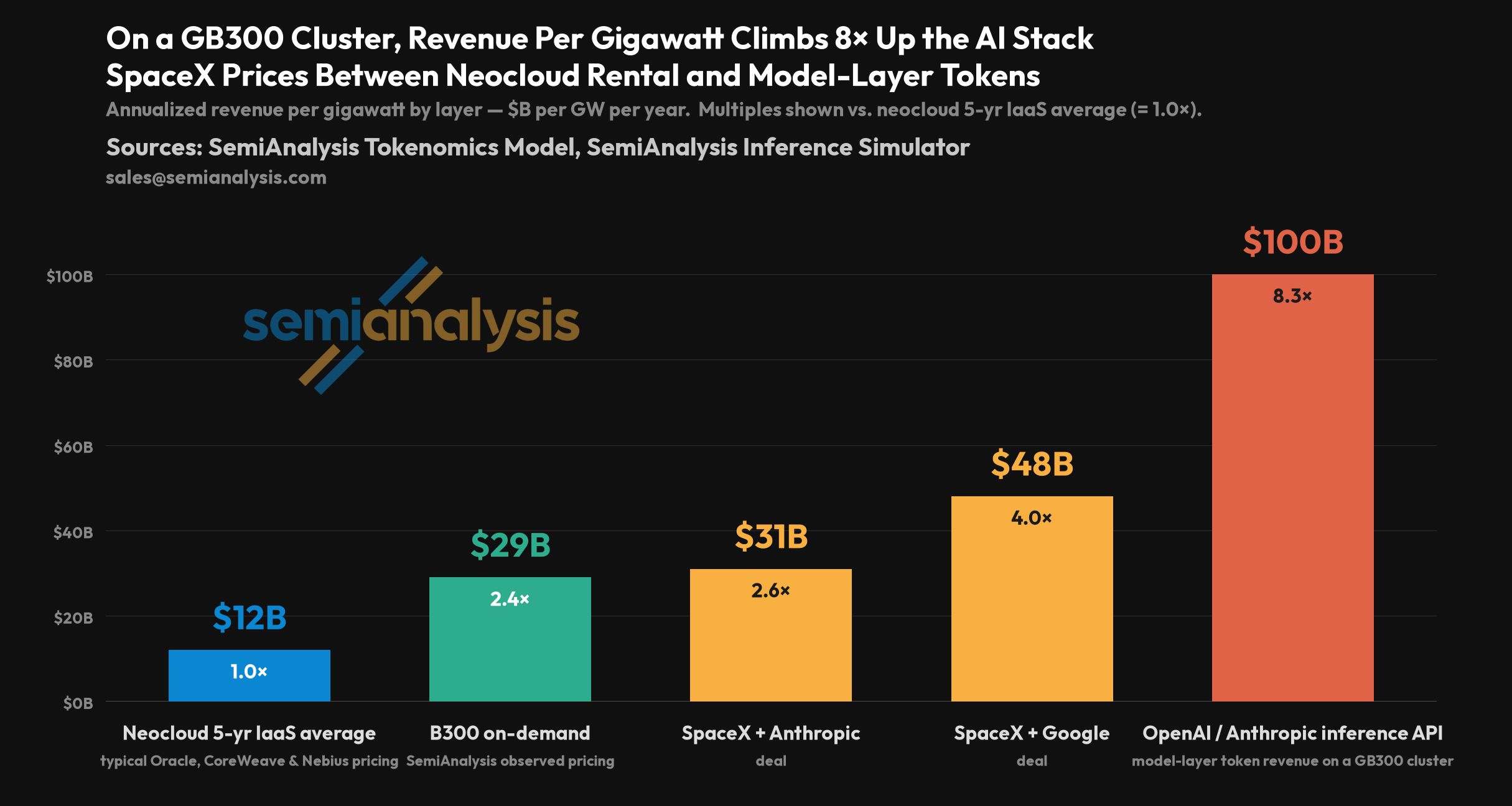
Source: SemiAnalysis Tokenomics Model, SemiAnalysis Inference Simulator
We assume around $12B/GW/year of cost per year, using a conservative rental pricing rate of $3/GPU-hr, and make a token production estimate using our Inference Simulator with a frontier-class model architecture and our agentic coding benchmark, AgentX (part of InferenceX), which is built by collecting real production coding traces. We blend that token production rate between input, cache-read, cache-write, and output token costs at our real workload ratios, and produce the final estimate, exceeding $100B/GW/year.
For background, our Inference Simulator is built from the ground up with a fundamental understanding of how modern AI accelerators work. We build a roofline and realistic performance model for how frontier models work during inference, with timings for every operation and a real trace output. It is an end-to-end simulation of the actual workload executing on the actual silicon. We have validated the simulators fidelity on a wide range of accelerators and workloads and continue to improve its ability to accurately forecast performance of future accelerators based on design specifications....
*****
...Please reach out to sales@semianalysis.com for more information on how we apply the Inference Simulator for custom research and analysis.Beyond OpenAI and Anthropic, there is actually a third company in the world capable of printing such economics per GW: Microsoft. Having full access to OpenAI models, they can generate the exact same revenue and margin per MW, while paying none of the training costs. Satya nailed the negotiations with OpenAI: the deal reworked in April 2026 dropped the old 20% revenue share from the equation. Put simply, Microsoft has a giant incentive to procure as many MWs as possible, as fast as possible. While much of their datacenter capacity currently goes to OpenAI at ~14M/MW/year, they have the opportunity to improve that mix. The potential impact is Microsoft Azure accelerating revenue growth from ~42% to over 100% by next year. A once-in-a-generation opportunity, that SpaceX is incredibly well positioned to serve.
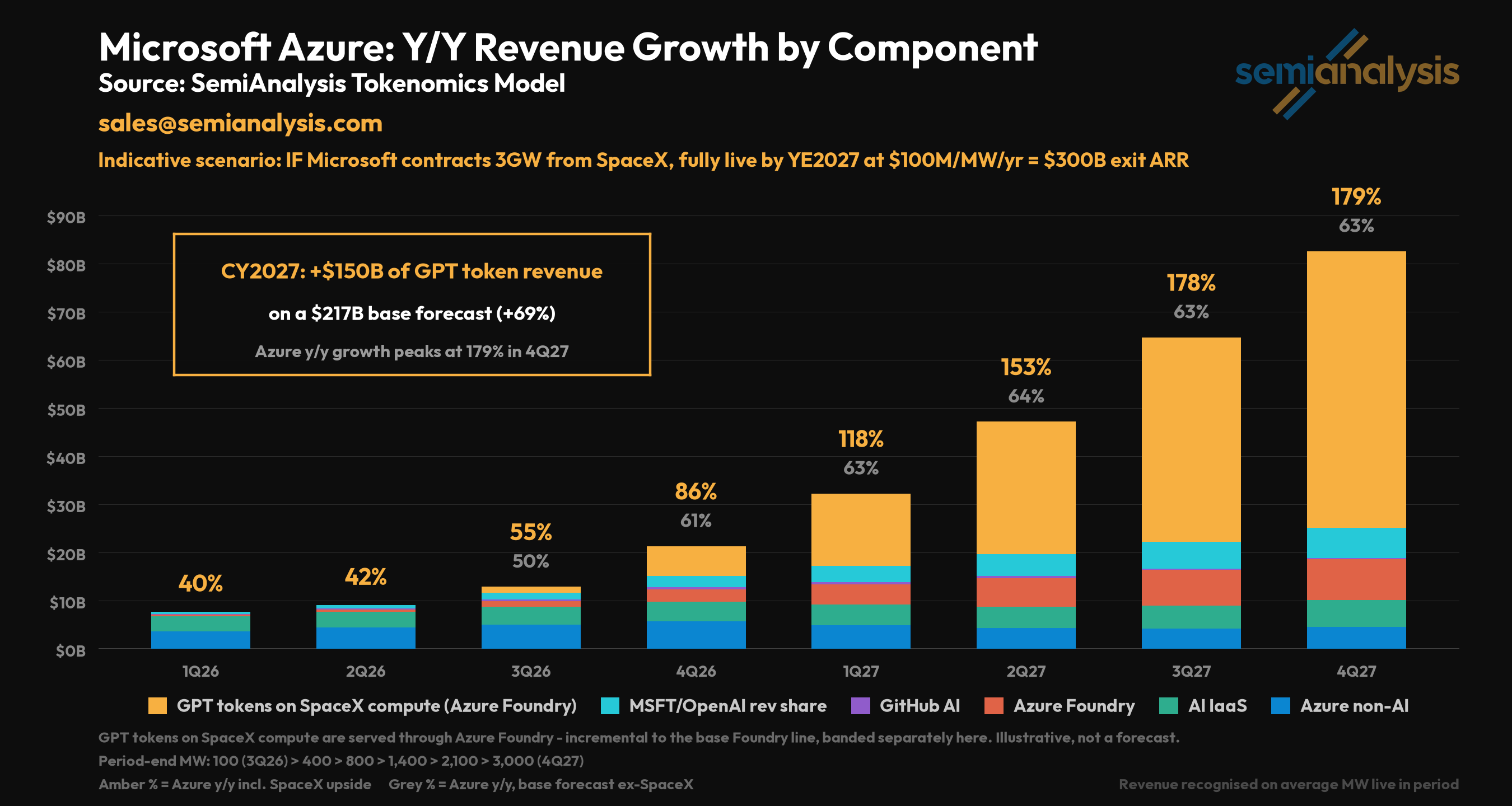
Source: SemiAnalysis Tokenomics Model
While Microsoft signing 3GW with SpaceX for 50B/GW/year sounds insane, we view it as possible for two reasons:
1/ Microsoft is already preparing for an epic datacenter ramp. As discussed below, they’ve signed 10GW of contracts year-to-date, for over $300B of total contract value (not including the GPU cost). We expect much more to be signed. Caveat: these contracts contribute to late 2027 and 2028 capacity. There is a near-term gap to fill.
2/ With a 90-day cancellation policy, akin to the SpaceX deals with Anthropic and Google, there is zero balance sheet risk. This is remarkably easy for Amy Hood to sign off, given the revenue opportunity.
For SpaceX, the next natural question is financing. How can Elon afford to pay so much CapEx without the balance sheet of the leading hyperscalers? We expect a combination of the two following items:
1/ Support from Nvidia, in the form of vendor financing to lower the upfront cash cost. This is likely why Elon declared to be Nvidia exclusive on the earnings call! As our Accelerator Model has repeatedly explained, xAI/SpaceX have actively evaluated alternatives like TPU and AMD – so the financial argument likely made them abandon these and focus on Nvidia.
2/ Operating cash-flow financing led by industry-high pricing, enabled by fastest timelines: SpaceX will continue to sell large-scale compute with 3-5 months lead time, an unbeatable offering, and price it accordingly at 30-50M/MW/year. That pays back the capex in less than a year. We dived into this in our Meta Compute article.
The implications of this are a path to $300B of ARR by the end of 2027 for SpaceX. This assumes only 50% of their 2027 incremental compute is monetized, the reminder being for the Grok & Cursor teams for training (no inference revenue modelled)....
....MUCH MORE
We've chronicled much of the Elon - Jensen frenemy relationship in real-time for over a decade. On August 4 Musk said SPCX would use NVDA's platforms exclusively.
It wasn't always apparent that this is how things would turn out but the two centi-billionaires seem to get along. From a July 2023 post, "CORRECTED—Earnings - Tesla Reports, Stock Slides, Elon's Buying A Supercomputer (TSLA)":
Before we get to the headline story, some background. Tesla and Nvidia have a history.
In 2015 - 2016 when everyone thought that autonomous driving was just around the corner, the challenge was seen as both a sensor issue, for example: LIDAR vs cameras, and a machine learning/artificial intelligence problem which boils down to training the AI 'puters with as much data as you can so that out in the real world the autonomous vehicle can say to itself: "Yeah, I've seen this situation before, here's the response that worked best. Both the training and the on-the-road-recall, if they are to be anywhere near efficient, require the fastest chips you can find. Tesla had a whole bunch of data from a few billion miles of actual driving for computers to train on, and, combined with Nvidia's fastest-in-the-world GPU chips, it was a match made in heaven.
Except it wasn't.
The challenge of autonomous driving on open roads alongside non-autonomous vehicles was bigger than anyone in that simple, optimistic time ever envisioned, even in their nightmares. Here's one example about Waymo from a 2017 post:
"When Google was training its self-driving car on the streets of Mountain View, California, the car rounded a corner and encountered a woman in a wheelchair, waving a broom, chasing a duck. The car hadn’t encountered this before so it stopped and waited."
In May 2015 we were posting " Nvidia Wants to Be the Brains Of Your Autonomous Car (NVDA)" and seven months later the more declarative "Class Act: Nvidia Will Be The Brains Of Your Autonomous Car (NVDA)"
Then in October 2016, what was probably the high-water mark for the relationship "Nvidia Could Make $1B From Tesla's Self-Driving Decree: Analyst (TSLA, NVDA)"
Sadly, the task was just too difficult but Mr. Musk thought it was doable if only he could get even faster chips than Nvidia had on offer:
NVIDIA Partner Tesla Reportedly Developing Chip With AMD (TSLA; NVDA; AMD)
Today in leveraged WTFs....
The only reason for Tesla to do this is that NVIDIA's chips are general purpose whereas specialized chips are making inroads in stuff like crypto mining (ASICs), Google's Tensor Processing Units (TPUs) for machine learning and Facebook's hardware efforts.
We've said NVIDIA probably has a couple year head start but this bears watching, so to speak....
Culminating in August 2018's
"Nvidia CEO is 'more than happy to help' if Tesla's A.I. chip doesn't pan out" (NVDA; TSLA)
And possibly related July 13:
Elon Musk's x.AI Launches
The company was formed in March so it's valuation is probably around a hundred billion or so.
Just
kidding. I have no idea what sort of valuation it has been assigned.
x.AI is a Nevada corporation which, as our corporate attorney readers
well know, is handy as hell for a privately-held stealth company. As
part of the company's coming-out I think they dropped the period in the
name on the original incorporation papers.
Mr. Musk was one of the founder/funders ($100 million gift not equity) of ChatGPT parent OpenAI when it was a .org (non-profit) and seemed a bit miffed when Sam Alman hooked up with Microsoft to the tune of $10 billion.
So Elon went out and bought a garage-full of GPUs.
Here's a twofer, first up TechCrunch, July 12:....

