From M&G's Bond Vigilantes, August 17:
Why aren’t we talking more about El Niño?
After an exceptionally hot, dry summer in Western Europe and elsewhere, climate discussions proliferate. But neither mainstream media nor markets seem to be seriously discussing the risks and opportunities presented by what scientists appear to agree will be a “super El Niño”.
In a world where food supplies have already been curtailed by the Russia-Ukraine conflict (especially wheat and sunflower oil), and where next year’s crop yields could be hit by the high price and/or scarcity of fertiliser due to the closure of the Strait of Hormuz – through which 30% of global nitrogen and 50% of sulphur traditionally flow – a particularly strong El Niño seems bound to have a substantial impact on the economies of various South Pacific nations, and food-price inflation globally.
It will also increase the price of logistics. As quoted in the FT on 11th August, raising the cost and decreasing the frequency of transits of the Panama Canal (whose water levels have already dropped dangerously low) will also be inflationary. As food-price inflation has a significant effect on emerging markets, these circumstances should lead to rising rates and currency volatility. We would anticipate plenty of investment opportunities for fixed-income, currency and (agricultural) commodity investors.
The first point to make is that we are facing – yet again – a climate event of historic proportions. The US National Oceanic and Atmospheric Administration (NOAA) forecasts an 81% likelihood of a “very strong El Niño” (see graph), defined as one where the Pacific warms more than 2°C above the seasonal average and the highest classification they use. This event, however, seems set to be particularly dramatic. Australia’s Bureau of Meteorology predicts temperatures rising to 3.5°C above average. Considering that the previous peak in November 2015 came in at +2.6°C, we seem set for a profound climate event that smashes all previous records.
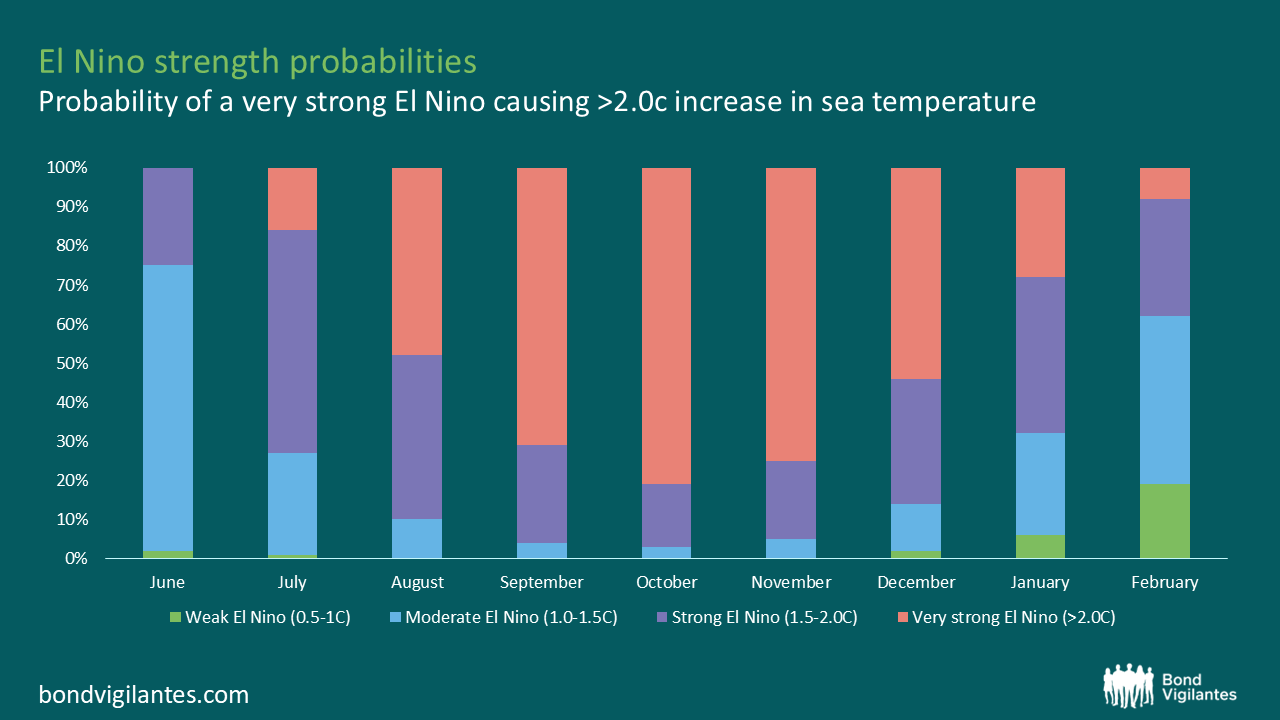
Source: US National Oceanic and Atmospheric Administration (NOAA) July 2026
One of the countries most heavily affected by El Niño is Peru, whose GDP growth can be reduced by over one percentage point by its impact. Extreme weather causes disruption, whether by flooding roads, impacting supply chains or affecting crop yields. Knowing El Niño is coming often deters economic activity and investment as people hunker down for a tough year. But it is quite amazing how the effect of El Niño on even a relatively small country like Peru can have a global impact in certain areas. For instance, Peru is the world’s largest exporter of blueberries (over $2.5bn in 2025), so a substantial reduction in blueberry production will affect the availability and price of this fruit globally. Next, consider the humble anchovy, which is fished for in great numbers off Peru’s shores. In fact, Peru’s anchovy fishery is considered the largest in the world by volume. During El Niño, the warm waters stress the fish and render them infertile, driving them deeper down to find cooler currents. Peru therefore seems likely to miss out on at least one of its two fishing seasons, with obvious implications for the local fishing industry. What is less well known is that Peruvian anchovies are used to produce 20% of the world’s fishmeal, which is fed to farmed fish, other aquaculture and livestock. It therefore seems likely that people across the globe will notice the cost of fish rising in supermarkets next year.
Those are just a couple of examples of local effects rippling across the world. But of course the warming of the Pacific Ocean will have a tremendous impact on crop production everywhere. The table below shows the scale of what may well hit us next year. To highlight a few stark examples, Australian wheat yields could collapse by up to 60%, global cocoa and coffee output could fall by 15% and we could see 10% declines in Brazilian corn....
....MUCH MORE
Earlier today:
El Niño—"ENSO Forecast: August 2026 Quick Look"

