The key concept, that post-journalism is written to confirm the reader's biases is almost a truism, for it can be no other way. The economics of the business will not allow a platform to constantly challenge and make uncomfortable the reader who pays the bills.
From Andrey Mir at Human-as-Media, December 30, 2025:
Postjournalism: The reversal of the media from news supply to news validation
“If the news is important, it will find me,” said Brian Stelter in 2008. People inevitably learnthe news that matters to them. Neither effort nor payment is required. When the scarcity ofcontent reverses to abundance, people no longer hunt for news—news hunts for people.A chapter from The Digital Reversal. Thread-Saga of Media Evolution.
With the internet, news reliability might have degraded, but overall, people became better informed. This flipped the value in content production: news stopped being a commodity and became bait to attract users for other purposes—mainly engagement.
It wasn’t a tragedy for the news media yet, as they had always used news to attract audiences and sell them to advertisers. The real issue was that advertisers moved to digital platforms too, where they were provided with much better service than the media could ever offer.
First, classifieds moved to digital, taking a third of newspapers’ revenue with them. Corporate ads followed. By 2014, ad revenue in newspapers had dropped below 1950 levels. The entire economic foundation of the press vanished in just a decade.
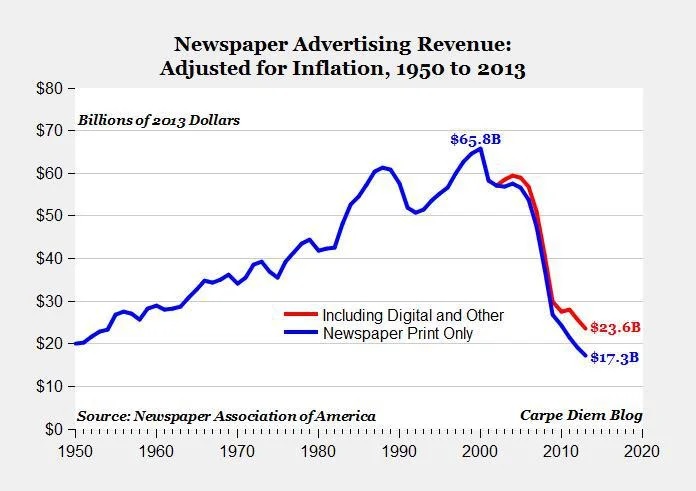
The collapse of advertising was a catastrophe. Throughout the 20th century, the media were 70–80% funded by ads. Journalism was built on the advertising model. When ad revenue dropped below what the media could survive on, further reversals became inevitable.
The first was the reversal of the business model itself. In 2014-2015, newspapers’ ad revenue dropped below circulation revenue. Not because subscriptions or copy sales grew—they stalled or declined as well. But ad revenue declined faster.
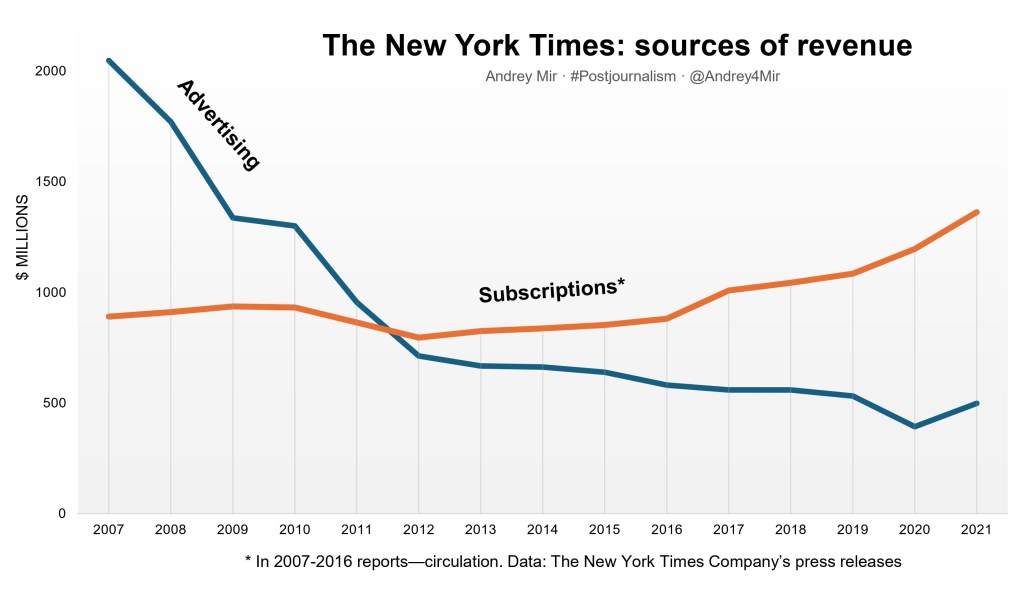
(Experts know that later the New York Times demonstrated subscription growth unmatched in the industry, but it had little to do with subscriptions to news. Most of the growth came from other products and packages.)Similar dynamics hit TV and radio—ad money was diverted to digital platforms. As a result, the business model of news media flipped from predominantly relying on ads to relying more on readers/viewers. The flip happened in the early 2010s everywhere.
***
Unrecognized by the public and the industry, the business reversal changed newsrooms’ approaches and mentality. After some awkward attempts to replace lost revenue with auxiliary businesses, the media returned to their point of origin: the readers.
As everything was moving online—it was the period of the Digital Rush—the media tried to keep up. They started chasing digital audiences, which at the time consisted mostly of the educated, urban, young, and progressive. Most MSM targeted them as potential digital subscribers.
This is where another unnoticed reversal happened: instead of covering news for a broad audience, as they did under the advertising model, news media started catering to a narrow group of digital progressives. The reversal in business model led to an ideological reversal.
Attempts to attract early digital audiences radically changed news coverage, but no business came out of it. Progressives were truly progressive—they didn’t consume news from old media. Most paywalls, a popular trend in the industry in 2011–12, failed.
However, if something worrisome happened, people still needed someone authoritative to confirm how bad it was. Old media suited the role of bad-news notaries very well. They got the prompt and flipped news supply into news validation....
....MUCH MORE
Previous visits with Mir:- "The news media: manufacturing anger, not consent. Herman-Chomsky’s Propaganda model revised"
- "Academic Activism as an Effect of Digital Media"
Over the years we've linked to some of Mir's own writing with most links embedded in:
Andrey Mir: "How the Media Polarized Us"
...Having read a lot* of Mr. Mir's words I think he is too facile in timing the polarization; that he is shoehorning the facts into his mental matrix. To be clear, this piece is far, far from as egregious an example as some of the books that were popular a decade or two ago: "Business Lessons From Attilla the Hun," where an author might have one decent insight but then tries to stretch it out for two hundred pages, jamming as many square pegs into round holes as necessary to get the needed word count.Rather, in Mr. Mir's case it's just that he doesn't put as much emphasis on the fact that American media has always been partisan, and that in the half-decade 1985 -1990 it went hyper-partisan.However, even if that observation is true (it may not be, who knows?), Mir knows more about media ecology than just about anyone writing on the topic. period.*Previous links to Andrey Mir:
- "Postjournalism and the death of newspapers" + "Factoids and Fake News"
- "Slouching Toward Post-Journalism"
I'll get off this Andrey Mir, post-journalism kick, I promise. But not yet. (shades of St Augustine)
The reason for my borderline obsession is the fact that mass media has changed so dramatically over the last five or ten years, which makes it imperative to understand and possibly channel the forces that attempt to shape our everyday view of reality. And it really is getting close to the point that the call to arms "If it isn't censored, it's a lie" is a description of what is going on.
And that would be a shame, we like journalists and, among other reasons, get some of our best ideas from them.
- "Elites have lost control of the information agenda..."
- "The Algorithm—The media's new business model is propaganda."
- Imagine That: Earliest Surviving Secular Song Is An English Guy Talking About The Weather
- Media: How Newspapers Are Like Resort Photographers
- Media: "Whoever will pay for journalism, they will pay not for journalism"
- "Reuters Institute 2022 Digital News Report is out - a lot of useful data."
- "Ubiquitous digital media offer potent rewards—but at the price of eroding our sensory and social capacities."
- Mir: "The news media: watchdogs prefer the paywalled garden"
- "Jeff Bezos’s Next Monopoly: The Press"
- That Time Marshall McLuhan Predicted Social Media

