Exactly the areas, along with healthcare, that government money has most distorted (read: inflated)
From The Hill, January 26:
A new poll shows that more Americans view education and housing as unaffordable relative to other necessities.
The survey from The New York Times and the Siena Research Institute, released Monday, found that 58 percent of respondents view education as unaffordable, with 26 percent saying it is somewhat affordable and just 8 percent saying it is mostly affordable.
A slightly lower share of respondents, 54 percent, said they cannot afford housing, with 31 percent saying it is somewhat affordable and 13 percent saying it is mostly affordable.
Education and housing were the two items viewed as unaffordable by the largest shares of respondents, with 47 percent saying health care is unaffordable, 44 percent saying having a family is unaffordable, and less than 30 percent saying groceries, food, utilities and transportation individually are unaffordable.
In November, the Education Data Initiative reported that the average annual costs of tuition at four-year public and private colleges was 40 and 35 times higher, respectively, than they were in 1963.
The cost of shelter, meanwhile, increased 3.2 percent year-over-year in December, outpacing the overall inflation rate of 2.7 percent, according to the Bureau of Labor Statistics.
The Treasury Department said in 2024 that more than 90 percent of Americans lived in counties where median rents and house prices increased faster than median incomes from 2000 to 2020. The department cited housing demand outpacing housing supply this century....
....MUCH MORE
Speaking of government money, you could crash the housing market with a program to build a million starter homes per year for a half-decade but that probably isn't politically palatable.
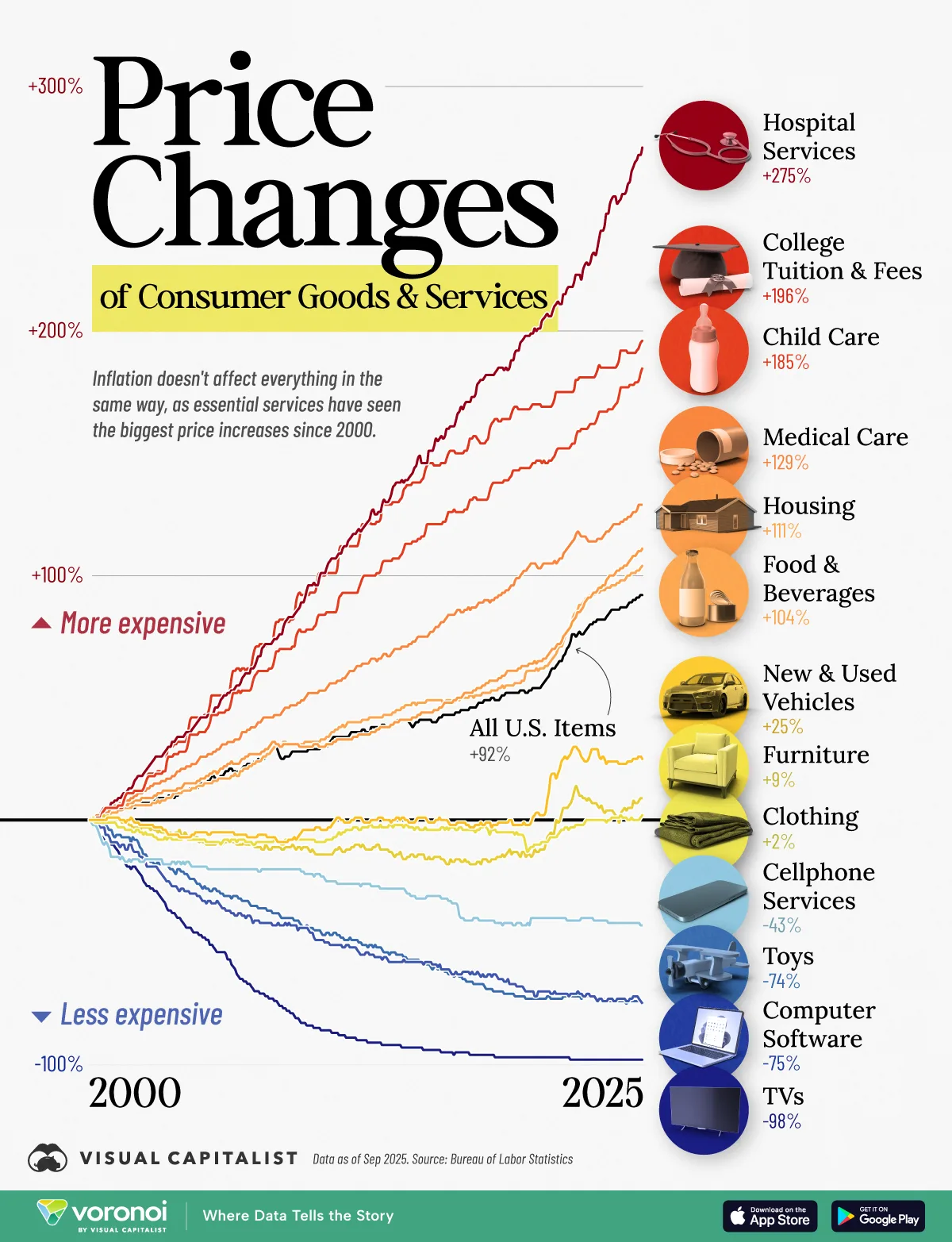
And from Visual Capitalist, January 13, an update of the famous AEI graph:
Charted: Where Inflation Has Hit the Hardest (2000–2025)
....MUCH MORE

