Monday, December 29, 2025

Government: "‘We wasted a lot of time’: The next shutdown deadline will be here sooner than you think"

From Politico, December 22:

No tangible progress toward funding the government was made before lawmakers left for the holidays. 

Congress has adjourned for the holidays having made no tangible progress toward funding the government ahead of a shutdown looming less than six weeks away.

The most conspicuous sign that Congress faces real obstacles before the Jan. 30 funding deadline came late Thursday, when Senate leaders gave up on passing a spending package and sent members home for two weeks, despite working for more than a month to appease senators who had objections.

But the impediments to reaching a deal that can pass both chambers are more extensive, starting with the fact that Republicans and Democrats on both ends of the Capitol have yet to start negotiating the details of the nine pending funding bills. The lack of bipartisan offer-trading is raising the likelihood of another short-term punt — or another shutdown.

“We wasted a lot of time because the Senate’s not negotiating yet,” House Appropriations Chair Tom Cole (R-Okla.) said in an interview last week. “When they’re ready to negotiate, we can move fast.”

Cole and his counterpart, Senate Appropriations Chair Susan Collins (R-Maine), just reached an agreement over the weekend on overall totals for the remaining spending bills Congress needs to pass. Lawmakers already passed three as part of the package that ended the shutdown last month — funding veterans and agriculture agencies, federal food aid and the Food and Drug Administration, along with Congress itself, through Sept. 30.

For more than a month Cole and Collins had been trying to bridge differences on key numbers while Senate leaders tried to advance a funding package that reflects consensus from only their side of the Capitol. Last week’s heave failed, but senators expect to try again in early January.

“We have different dynamics in our caucuses that we need to deal with,” Collins said this month as she left a meeting with Cole.

Democrats have been growing impatient. “They wasted all that time during the summer,” said Connecticut Rep. Rosa DeLauro, the House’s top Democratic appropriator, about House Republicans spending the better part of this year crafting partisan funding bills.

Then Democrats had to wait for their GOP counterparts to strike the “majority to majority” deal on funding totals that finally arrived Saturday.

“Democrats are prepared. We’re ready to move. Let’s go,” DeLauro said.

Even if top appropriators can manage to agree on the nine remaining funding bills, other thorny dynamics threaten to complicate final passage in each chamber. The pitfalls include the mismatch between what appropriators want to spend and the demands of House fiscal hawks seeking flat funding for agencies — as well as the fact that Democrats will need to help pass any spending bills in the Senate, as they acutely illustrated with this fall’s record 43-day shutdown.

The totals top Republican appropriators just agreed upon are not public. But Cole said the deal will ensure overall funding would be below the level laid out in the stopgap funding patch enacted last month....

....MUCH MORE 

"The most unbelievable cyber statistic of 2025?"

From Biometric Update, December 26:

It’s look-back season again. Time to dust off old favourites like the World’s Most Surveilled Cities along with some seasonal newcomers like the Best Law of the Year (my vote goes to robot chicken fights).  

Compiling the end-of-year list has become a perennial cross-cultural ritual. Even if they’re factually dubious or arithmetically suspect, the whole point of these mostly pointless tables is that they change. The entertainment is in their revelation. But one ranked list comes out every year – and every year it’s the same list. In fact, it’s scarcely changed for decades. And here it is again. With over 21.5 million appearances, the world’s most used security password for 2025 was (drum roll):  “123456”. The runner up was – once again – “admin” having reportedly been used by more than 21 million accounts last year.

This is simply staggering, and not just because the passwords are so guessable. Most unbelievable is not the list itself but the fact that it doesn’t change. Every year it’s the same ‘winners’, despite billions of dollars’ investment in the tech and acres of column inches and advice against using weak passwords, or passwords at all.

At the close of a year when the audacious heist at the Louvre was assisted by the security system’s password being ‘Password’, the annual Nordpass survey shouldn’t come as a surprise to many.

Subscribers to Biometric Update get to learn of the latest risks to digital security and the leading-edge technology being developed to combat it. We hear daily from cyber-genius thought leaders and biometric tech wizards about how they are designing, developing and deploying countermeasures to hold back the tide of cyber and phishing attacks. With ever more fiendishly inventive scams, hostile state penetration and common vulnerabilities and exposures (CVE) leaving the person in the street aghast, experts harness their intellectual and technological horsepower to protect us year-round.

And yet the 2025 Most Used Password list brings only glad tidings to the most hapless hackers. The Nordpass statistics show how the Hollywood image of an evil genius hunched over a screen running fiendish ‘dictionary attacks’ isn’t even close to our biggest threat – and why a teenager with a first-gen laptop still has a better-than-even chance of hitting a digital jackpot. With text-based passwords like “Demo@123” still at the top of the year’s lists globally, from India, the USA, Germany and Australia, would-be cyber criminals don’t need to be John the Ripper sifting salting protocols in order to succeed. And our continued use of one password across multiple devices and accounts makes their life easier still.....

....About the author

Fraser Sampson, former UK Biometrics & Surveillance Camera Commissioner, is Professor of Governance and National Security at CENTRIC (Centre for Excellence in Terrorism, Resilience, Intelligence & Organised Crime Research) and a non-executive director at Facewatch.

....MUCH MORE 

I was not aware the UK had a camera commissar. 

"SoftBank Nears Deal for Data Center Investment Firm DigitalBridge"

 From Bloomberg, December 28/29:

SoftBank Group Corp. is in advanced talks to acquire DigitalBridge Group Inc., a private equity firm that invests in assets such as data centers, according to people with knowledge of the matter.

The Japanese conglomerate could announce an agreement as soon as Monday for New York-listed DigitalBridge, the people said, asking not to be identified because the information is private. Terms of the transaction, part of SoftBank’s campaign to take advantage of an AI-driven boom in digital infrastructure, couldn’t be learned.

Shares in DigitalBridge rose as much as 54% in premarket New York trading Monday. They were already up 23% this year through Friday, giving the company a market value of about $2.5 billion and an enterprise value of $3.8 billion including debt at the last close, according to data compiled by Bloomberg.

A final agreement hasn’t been reached and details, including the timing, could still change, the people said. Representatives for SoftBank and DigitalBridge declined to comment.

SoftBank’s billionaire founder Masayoshi Son is trying to capitalize on soaring demand for the computing capacity that underpins artificial intelligence applications.

DigitalBridge, led by Chief Executive Officer Marc Ganzi, had about $108 billion of assets under management at the end of September, according to its website. Its portfolio includes digital infrastructure operators such as AIMS, AtlasEdge, DataBank, Switch, Vantage Data Centers and Yondr Group....

....MUCH MORE 

 Related:

February 2024 - The Infrastructure Theme Is For Real (PWR) 

June 2024 - Everyone Wants Asia-Pacific Data Centers: BlackRock's GIP Joins Blackstone, Others, Bidding For Australia's AirTrunk

March 2025 - "Money Managers Rush to Invest in The World’s ‘Essential Plumbing’"

And dozens more. If interested, the 'search blog' box often delivers what one desires. 

"Data Center Surge Reaches India as American Tech Giants Invest Billions"

 Following on December 10's "Amazon, Microsoft pledge mega AI investments in India" (AMZN; MSFT).

From the New York Times, December 26: 

Megacities in southern India are attracting enormous investments to help build artificial intelligence infrastructure to serve the world’s most data-hungry country.

Satya Nadella, Microsoft’s chief executive, was striding across a stage in New Delhi, extolling his company’s $17.5 billion investment in artificial intelligence and the benefits it would bring to his native country’s 1.4 billion people. While he was speaking, Amazon made a rival announcement, promising to throw $35 billion into A.I.-driven projects across India.

A flood of money for data centers, cloud computing and other hardware has come to India. Two months before the near-simultaneous Microsoft-Amazon announcements, Google committed $15 billion to data centers in partnerships with two of India’s biggest conglomerates, the Adani Group and Bharti Airtel.

That $67.5 billion, to be spent over the next five years, is just the crest of a wave. A fourth American tech giant, Meta, is having a plant built near Google’s, as are India’s other biggest industrial houses, Reliance and Tata.

“This is going to be one of the largest single-sector investments that India’s ever seen,” said Somnath Mukherjee, chief investment officer at ASK Wealth Advisors in Mumbai.

These investments are vast in proportion to everything except for other A.I.-related investments. Trillions of dollars are at stake in this boom worldwide. In India, companies see a market with lots of room to run.

India hosts nearly 20 percent of the world’s data but only 3 percent of its storage. The United States has vastly more data centers than India, but India’s population, already the largest on the planet, is still growing, and its economy is expanding even faster.

“India is the largest consumer of data in the world, but with barely 5 percent of American data capacity,” Mr. Mukherjee said.

The enormous bets on India by Microsoft, Amazon, Google and Meta underscore the seemingly limitless reaches of the A.I. boom. President Trump stunned India with 50 percent tariffs this summer, casting a pall over the friendly and longstanding economic relationship between the countries. Negotiators from Washington and New Delhi are still trying to find some accommodation on trade. Yet artificial intelligence money plows ahead.

India’s economic strengths and weaknesses look like a mismatch for the A.I. investments. The data centers will require cheap land, abundant electricity and water. India’s whole territory is packed with farmland, and much of it suffers from unreliable power grids and scarce water supply. It does need jobs for a huge and semi-idle labor force, but data centers require minimal staffing.

But India doesn’t want to miss out on the A.I. gold rush. It also doesn’t want to rely on data servers overseas. 

Since 2018, India has been weighing laws that would require digital functions to be based on servers in India. For national security’s sake, the government already insists that banks and WhatsApp, which Meta owns, keep their data local. Mr. Mukherjee said the possibility of officials’ widening those demands was motivating foreign companies to install servers within India.

Another reason to keep the data centers closer to the people who will be using them is that data slows the farther it has to travel. Delays of even milliseconds between faraway servers can pile up during complex processing, causing whole systems to lag. Until a few years ago, most of India’s data was stored on servers in Singapore, 1,800 miles away across the Bay of Bengal.

The data centers for Google, Microsoft, Amazon and Meta will join a growing number of smaller centers spread between India’s biggest urban areas. Most are along the coasts, where they can be connected to undersea cables.

Luring giant plants to Hyderabad, an inland city of 11 million, required a feat of salesmanship on the part of the local government. That job fell to Jayesh Ranjan, a special secretary in charge of tech and investment for the state who devised India’s first data-center policy in 2016.

Hyderabad’s first data centers, which were built before A.I. started demanding more capacity, are already saturated. Now there are four.

Industrial-grade electricity is hard to come by in most of India. But Hyderabad’s data parks are connected to multiple energy sources and flooded with abundant power at wholesale prices. India’s electricity grid is balky, but in the aggregate it now generates more power than it needs and most of it is renewable. American electricity costs an average of 18 cents a kilowatt-hour, but Hyderabad’s data centers pay only 7 cents....

....MORE

Now would be an excellent time to unleash thorium's potential. 

September 2025 - "India May Finally Be Ready for Its Atomic Age"

September 2025 - "This American nuclear company could help India’s thorium dream"

July 2013 - Nuclear: "Bill Gates Is Beginning to Dream the Thorium Dream"

The promise of thorium has been a siren song for the last couple decades, back in 2008 I dropped this comment at the WSJ's Environmental Capital blog:
    • C’mon guys, get with it!
      Global warming is so last year.
      Everybody, from Al Gore to the blogs you link to are reinventing themselves and talking energy.
      Energy production
      Energy cost.
      Energy security.
      It’s all about framing and re-framing.
      Low impact man’s time has come and gone. The eco-soirée has moved on to erudite discussions of thorium between nibbles at the canapés.
      By this winter the only references to carbon among the salon crowd might be Carbonic acid (H2CO3).
      You watch.
Okay, so I was early.

And earlier:

10:09 am May 30, 2007 
Climateer wrote:
I was just told I was a bit cryptic in the comment above.
If you want to know more about thorium you can catch the poet at http://www.corneliastreetcafe.com/
Here’s some awards he’s collected:
* Nobel Prize
* Priestley Medal
* Arthur C. Cope Award in Organic Chemistry
* Inorganic Chemistry Award (American Chemical Society)
* Pimentel Award in Chemical Education
* Award in Pure Chemistry
* Monsanto Award
* National Medal of Science
* National Academy of Sciences
* American Academy of Arts and Sciences Fellow
* American Philosophical Society Fellow
* Foreign Member, Royal Society

September 2021 - "Experimental reactor could hand China the holy grail of nuclear energy"

 This article is a bit hyperbolic but the fact China is getting close to firing it up is a pretty big deal.

I wish India were still pressing ahead. Fifteen years ago I would have bet on thorium reactors tripling India's GDP over a few decades but they decided to stick with coal....

 And many, many more.

However, as noted introducing September 2021's "Experimental reactor could hand China the holy grail of nuclear energy":

 This article is a bit hyperbolic but the fact China is getting close to firing it up is a pretty big deal.

I wish India were still pressing ahead. Fifteen years ago I would have bet on thorium reactors tripling India's GDP over a few decades but they decided to stick with coal....

"China industrial profits plunge at record pace: What’s driving slump"

From Pakistan's The News, December 27:

In November the profit fell 13.1 percent from a year earlier after a 5.5 percent decline in October

China’s industrial sector has witnessed the steepest fall in profits at a record pace over a year, indicating the signs of weakening domestic demand and persistent deflation.

According to statistical data released by the National Bureau of Statistics, in November the profit fell 13.1 percent from a year earlier after a 5.5 percent decline in October. However, Bloomberg Economics had predicted a decline of 15 percent.

Xu Tianchen, senior economist at the Economist Intelligence Unit said the profit numbers align with broad-spectrum cooling in the fourth quarter’s economic activity.

While discussing cautiously optimistic economic outlook, Xu said, “Profitability will improve under 'anti-involution' as firms scale back investment over time, adding that companies could also earn more profits overseas, at the cost of their global peers.”

While talking about sectors, the profits in the automotive industry rose by 7.5 percent due to resilience and acceleration. High-tech manufacturing witnessed the rise in 10 percent profits on a year-on-year basis.

Factors responsible for profit slump

Weak domestic demand

Soft household consumption is considered the primary factor for slowing down the profit surge, thereby outshining gains made from the exports.

Factory-gate deflation

Persistent deflation at factory level continues to squeeze profit levels, making it hard for industrial firms to maintain profitability despite significant output.

Decline in fixed-asset investment

According to data, the significant decline in investment during the second half of 2025 is also responsible for slowing down economic activity.

Rhodium Group think tank suggests that China's economy grew by 2.5 to 3 percent in 2025 driven by a collapse in fixed-asset investment.

Sector-specific decline....

....MORE 

"AI Already Acting As Co-founder And Causing Growth Of Small Firms, Suggests Paper"

From India's OfficeChai, December 19:

Some in tech had predicted that the rise of single-person AI-enabled unicorns, and while that hasn’t quite yet materialized, there seems to be some sort of a thrust in the general direction.

A new working paper titled “AI as “Co-founder”: GenAI for Entrepreneurship” supports this sentiment, presenting evidence that the diffusion of Generative Artificial Intelligence is fundamentally reshaping the entrepreneurial landscape. The research posits that GenAI is effectively acting as a digital co-founder, automating core tasks and lowering the entry barriers for new ventures. To establish a causal link between GenAI diffusion and firm creation, the researchers employed a difference-in-differences framework, exploiting the unexpected November 2022 release of ChatGPT as a singular, global technological shock that sharply reduced start-up costs. Their methodology involved analyzing universal data on over 12 million firm registrations across China from 2021 through 2024, comparing changes in firm entry between hyper-local geo-coded grid cells—at a spatial resolution of roughly 5 square kilometers—that either had high or low pre-existing AI-specific human capital.

The study’s results demonstrated a striking asymmetry in new firm growth by size, validating the hypothesis that AI enables leaner ventures. Geographic grids with stronger AI-specific human capital experienced a pronounced rise in new firm entry following the launch of ChatGPT, a trend driven entirely by small firms. Conversely, the entry rate of large firms actually declined in these same high-AI areas, consistent with a structural shift toward organizational models that require less upfront capital. Further mechanisms explored in the paper revealed that these new firms were created with smaller amounts of capital, fewer shareholders, and smaller founding teams. The effect was strongest among first-time entrepreneurs, indicating that GenAI substitutes for the experience and managerial know-how typically possessed by serial founders. The growth was concentrated in AI-downstream sectors, such as retail, business services, online platforms, and digital-service industries, where GenAI tools can be readily applied for information-processing and customer-facing activities....

....MORE 

OfficeChai home. The current front page is just loaded with stuff you you won't see gathered together anywhere else.

e.g.  Ben Horowitz On Why The Best CEOs Are Decisive

Inspiration Is Perishable, Act On It Immediately: Naval Ravikant 

Sunday, December 28, 2025

Jobs: "The highest paid entry-level engineers in the world are at Hudson River Trading and Jane Street"

From eFinancial Careers, December 19: 

OpenAI might be paying exorbitant fees to poach quants and traders from prop trading firms, but it's a different story when it comes to engineering talent. Levels.fyi has released its annual compensation report which shows that the two best companies for entry-level engineering roles are Hudson River Trading and Jane Street.

Jane Street has historically won in this category but, this year, Hudson River took the crown. It bumped up pay to an eye-watering $400k on average, while Jane Street stayed flat at $350k. 3rd place OpenAI, in comparison, paid just $300k.

Five of the top 7 firms for level-1 engineers were finance firms in one way or another. Quant hedge fund Two Sigma came fourth, New York fintech Ramp came fifth, and Dutch prop trading firm Optiver came sixth; each paid between $255k-265k on average. Rounding out the list was data infrastructure firm Databricks....

....MUCH MORE 

Also at eFinancial Careers:

Citi's most stylish repo trader is now on the beach 

Artificial Intelligence: Large Language Models Are Not The Be-All And End-All Of AI

A quick hit from MIT Technology Review's Hype Correction series:

....01: LLMs are not everything

In some ways, it is the hype around large language models, not AI as a whole, that needs correcting. It has become obvious that LLMs are not the doorway to artificial general intelligence, or AGI, a hypothetical technology that some insist will one day be able to do any (cognitive) task a human can.

Even an AGI evangelist like Ilya Sutskever, chief scientist and cofounder at the AI startup Safe Superintelligence and former chief scientist and cofounder at OpenAI, now highlights the limitations of LLMs, a technology he had a huge hand in creating. LLMs are very good at learning how to do a lot of specific tasks, but they do not seem to learn the principles behind those tasks, Sutskever said in an interview with Dwarkesh Patel in November.

It’s the difference between learning how to solve a thousand different algebra problems and learning how to solve any algebra problem. “The thing which I think is the most fundamental is that these models somehow just generalize dramatically worse than people,” Sutskever said.

It’s easy to imagine that LLMs can do anything because their use of language is so compelling. It is astonishing how well this technology can mimic the way people write and speak. And we are hardwired to see intelligence in things that behave in certain ways—whether it’s there or not. In other words, we have built machines with humanlike behavior and cannot resist seeing a humanlike mind behind them.

That’s understandable. LLMs have been part of mainstream life for only a few years. But in that time, marketers have preyed on our shaky sense of what the technology can really do, pumping up expectations and turbocharging the hype. As we live with this technology and come to understand it better, those expectations should fall back down to earth.  

02: AI is not a quick fix to all your problems....

....MUCH MORE 

If interested see also December 20's "AI: "A brief history of Sam Altman’s hype" (MIT Technology Review's Hype Correction series)". 

The intro to and outro from December 20, 2024's "What is an AI agent? A computer scientist explains the next wave of artificial intelligence tools" 

We've been saying it (sometimes literally*) for quite a while, chatbots are not the be-all and end-all of artificial intelligence.... 

AI: Chatbots Are Sooo 2023; Here Comes Interactive AI

"ChatBots Are Not The Be-All And End-All Of Artificial Intelligence":

Far from it.
And all the focus on ChatBots and LLMs are more than just a distraction, they are a perverse representation of what AI is doing and will do and could potentially cost you money or opportunity or both....

ChatBots Are For Children: "What’s Ahead for OpenAI? Project Strawberry, Orion, and GPT Next"

IEEE Spectrum - "What Are AI Agents?" 

"First impressions of ChatGPT o1: An AI designed to overthink it"

CoinTelegraph has developed an artisanal, homebrew AI specialty. Here's one of our previous visits:

AI Use Case: Biological Immortality By 2030
This would be a pretty good answer to the question "What is the use case for AI?"

But I don't buy it. AI will be like the nanotech revolution that never was, never that is, in the sense of a nanotech industry. Instead, as with nanotech, AI will be embedded in the processes and protocols of every facet of human existence and we won't even notice it.

 "AI agents are the 'next frontier' and will change our working lives forever"

 Former Google CEO Schmidt On The Ever-Increasing Tempo Of AI

Also:

Where Is Artificial Intelligence Going From Here: One Of The Gurus Speaks

Related, October 2025:

Can AI Identify An AI Bubble?

Google AI says no:

While AI can be a powerful tool for detecting patterns that might indicate a bubble, it cannot definitively determine if a bubble exists
. The complexity of human behavior and unpredictable events means AI models are best used as a component of analysis, not a replacement for human judgment...

"A Wealth Tax Floated in California Has Billionaires Thinking of Leaving"

From the New York Times, December 26:

It’s uncertain whether the proposal will reach the statewide ballot in November, but some billionaires like Peter Thiel and Larry Page may be unwilling to take the risk.

Billionaires including Peter Thiel, the tech venture capitalist, and Larry Page, a co-founder of Google, are considering cutting or reducing their ties to California by the end of the year because of a proposed ballot measure that could tax the state’s wealthiest residents, according to five people familiar with their thinking.

Mr. Thiel, 58, who owns a home in the Hollywood Hills and operates a personal investment firm from Los Angeles, has explored opening an office for that firm, Thiel Capital, in another state and spending more time outside California, three of the people said.

Other billionaires who appear to be making moves to decrease their presence in California include Mr. Page, 52, a longtime resident of Palo Alto. He has discussed leaving the state by the end of the year, according to two people briefed on the talks. In mid-December, three limited liability companies associated with Mr. Page filed documents to incorporate in Florida, according to state records.

The moves are being driven by a potential California ballot measure from the health care union, Service Employees International Union-United Healthcare Workers West, the people said. The proposal calls for California residents worth more than $1 billion to be taxed the equivalent of 5 percent of their assets.

If the measure gains enough signatures to reach the state ballot in November and wins approval, it will retroactively apply to anyone who lived in California as of Jan. 1, 2026. Those with $20 billion in assets who resided in the state on that date would face a one-time tax of $1 billion and have five years to pay it, according to the terms of the measure.

Whether the proposal will reach California’s ballot is far from certain, but some billionaires may be unwilling to take the risk. For Mr. Page, whose net worth is estimated at $258 billion, the measure could result in a one-time tax of more than $12 billion. The tax bill for Mr. Thiel, whose net worth is around $27.5 billion, could be more than $1.2 billion.

Representatives for Mr. Page and Mr. Thiel did not respond to requests for comment.

The potential wealth tax is under debate as the income divide in the United States becomes increasingly stark. Recent data from the Congressional Budget Office showed that income inequality increased over a 33-year period ending in 2022, with the share of wealth held by families in the top 10 percent at around 69 percent, while the share held by families in the bottom 50 percent at just 3 percent.

In California, the S.E.I.U.-U.H.W. has said the proposed tax measure could raise up to $100 billion from about 200 billionaires. The money could be used to offset federal budget cuts, the union has said.

Suzanne Jimenez, the chief of staff at S.E.I.U.-U.H.W., said the organization was trying to fill a funding gap for the state’s health care industry. “We looked at how could we generate the revenue to fix this kind of hole, and this group of folks just made sense,” she said, adding that California billionaires were the “most fortunate people in this state.”....

....MUCH MORE 

I'll use the intro to a mid-November post as the outro from this one:

“the art of taxation consists in so plucking the goose as to obtain the largest 
possible amount of feathers with the smallest possible amount of hissing.”

—attributed to  Jean-Baptiste Colbert, Controller-General of Finance (1668-83) under Louis XIV of France.

As seen in November 17's "Norway's Wealth Tax Unchains a Capital Exodus". 

Looking ahead, it might be nice to find a case to bring to the Supreme Court to overturn Citizens United and get unions and other corporations out of politics.

"Family Offices Have Become the New Power Players on Wall Street"

From the Wall Street Journal, December 26:

Wealthy families are launching offices to manage their money at a record clip and are getting a seat at the table in significant deals 

Family offices are the new power players on Wall Street.

A growing number of wealthy Americans are launching family offices, firms that do everything from investing money for the superrich to managing their personal affairs. They are huge and secretive, and their influence on Wall Street and Main Street is only growing.

Families with these offices recently oversaw about $5.5 trillion in wealth, a 67% jump from five years ago, according to Deloitte. The firm expects that figure to rise to $6.9 trillion this year and top $9 trillion by 2030. It estimates that in coming years, these offices will manage more money than hedge-fund firms. 

Banks and other firms are hungry to cater to family offices’ every need, while entrepreneurs and investment managers are clamoring to land a slice of these families’ immense wealth. 

“It’s not just growing, it’s exploding,” said Hendrik Jordaan, a partner at Nelson Mullins who works exclusively with family offices. “I really think about the family office world being the next private equity.”

Launching a family office is in vogue. While the biggest ones have long managed billions of dollars on behalf of titans such as Jeff Bezos, Michael Dell and Bill Gates, many families with hundreds or tens of millions of dollars in wealth are launching them, too, or turning to so-called multifamily offices to manage their fortunes. There are more than 8,000 single-family offices globally today, up roughly a third from 6,130 in 2019, according to Deloitte. The firm expects that figure to top 10,000 by 2030.

“It’s kind of become the word for ultrahigh-net-worth families. Do you or don’t you have a family office?” said Justin Flach, managing director of wealth strategy for Ascent Private Capital Management at U.S. Bank, who typically works with families with net worths topping $75 million. 

“There’s some status assigned to that. You’re at a cocktail party talking about it,” Flach said. 

How the superrich deploy their firepower has vast implications for the fortunes of businesses in almost every U.S. industry, global philanthropy and the broader economy. As this money trickles through the economy, it stands to transform the fate of businesses tied to everything from artificial intelligence and data centers to dental offices and medical spas. 

Given the sums they can invest, big family offices can sometimes compete against large institutional investors on deals, putting them up against behemoths such as Apollo Global Management and Blackstone. 

Family offices can find their way into public-company merger deals, too. The offices of late Pequot Capital founder Arthur Samberg and Addison Fischer are among the backers of fusion-energy company TAE Technologies, which struck a deal this month valued at $6 billion to merge with Trump Media and Technology Group. 

Unlike public pension-fund managers, who answer to local teachers and firefighters, or hedge-fund firms, which regularly provide financials to investors, family-office leaders don’t answer to anyone but themselves. That gives them vast latitude to hold investments for decades and ride out periods of stomach-churning volatility, or make large and concentrated wagers. Traders and advisers say that family offices often have little interest in hedging their bets through tools such as derivatives....

....MUCH MORE 

 A topic near and dear.

Among dozens and dozens of posts on the subject:

Competitive Intelligence Macquarie Style: First Establish a Fake Family Office...

Family Office/Outside Managers Not Quite Cutting It? Maybe What You Need Is A Family Bank

"Are You Fit to Be a Family Office CEO? Work on These Must-Have Qualities"

The most important character trait expected of a family office leader is discretion. And it is only mentioned in passing in this article, which focuses on nuts-and-bolts issues.

You also have to have the mindset of a principal while simultaneously psychologically embracing of the humility to subservient yourself to the needs of the family, including, if need be, running a concierge service....

...Our package: complete Family Office services including concierge and butler, art appraisal, succession and estate counseling and life-coaching.

Or, for the truly discriminating, ask about our Luxe programme with unbiased private equity ROI analysis.
(includes party planning option)
Also the dynasty series:

News Your Dynasty Can Use: How The Habsburgs Stayed So Powerful For So Long
Tips on playing the long game....

Should you be contemplating establishing a dynasty, you have come to the right place.
You are going to want a seat of power and Construction Physics has a primer on "How To Design A House To Last 1000 Years."

Finally, how to pay for it all without risking everything on that dissolute great-grandchild that is sure to pop up:
Anti-Piketty: Merrill Lynch's Tips on Creating a Financial Dynasty

I've always liked the Wikipedia entry on the Habsburgs:
The progenitor of the House of Habsburg may have been Guntram the Rich, a count in the Breisgau who lived in the 10th century....
Yup, having someone with the honorific "The Rich" in the fam. is always a running start to your dynastic ambitions.
Oh Crap, I Almost Forgot Karl, The Last of the Habsburgs
And finally:
Why Real Estate Ownership Is Required For Intergenerational Wealth
We've looked at the importance of housing as a cornerstone of intergenerational wealth a few times, and not just for piles like this:

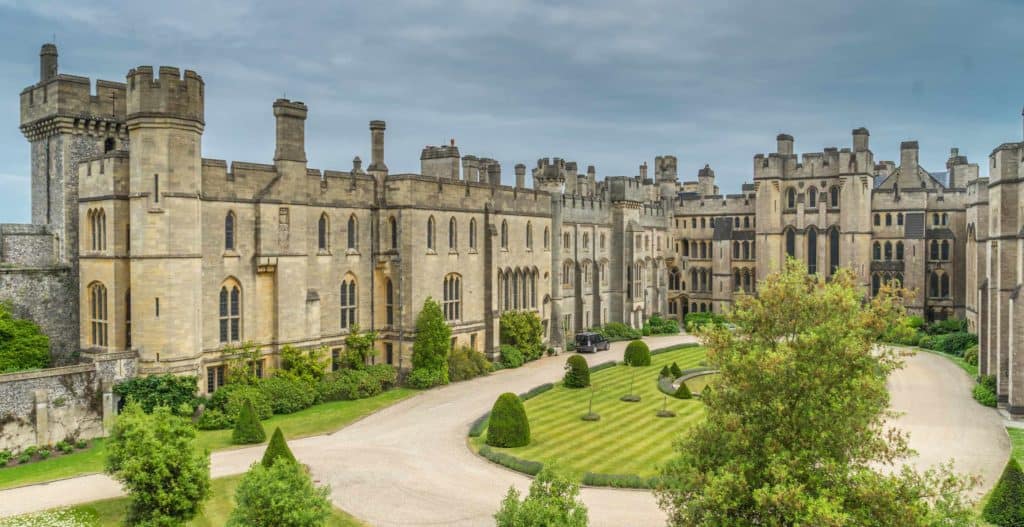
https://www.historic-uk.com/wp-content/uploads/2017/01/arundel-west-sussex-1024x527.jpg

That's the courtyard of Arundel Castle, it's been in the fam (Fitzalans; Howards; Fitzalan-Howards) since the mid-1200's (with a few reversions to the Crown). More after the jump....


Saturday, December 27, 2025

"Tech Wrapped 2025"

From the San Francisco Standard, December 21:

996 workweeks, vanishing entry-level jobs, and an engineer with 44 employers: Here’s a roundup of Silicon Valley by the numbers. 

This year kicked off with an image straight out of “The Godfather”: tech titans Mark Zuckerberg, Elon Musk, and Jeff Bezos in the front row at the presidential inauguration, kissing the ring. 

It’s not a scene many would have predicted in 2017 — or even 2021. And things only got crazier from there.

This was the year of an unfettered, exuberant (dare we say bubbly?) AI goldrush, with fortune-seeking college dropouts packing into hacker houses to grind from 9 a.m. to 9 p.m. Startup founders struggled to hire engineers, and several even got scammed into hiring the same coder at the same time. Recruiting started to look like the NBA, with AI researchers jumping between companies, sometimes lured by packages worth hundreds of millions of dollars (opens in new tab). 

Rage-baiting became a legitimate marketing strategy, and founders began hiring etiquette coaches and attending finishing school to know which soup spoon to use. Longevity went mainstream, and illegal Chinese peptide injections became the latest productivity hack. 

All to say that it was a wacky year in Silicon Valley, worth one last look in the rearview mirror. Here are the most eye-popping factoids from 2025. 

Secondary sales went gangbusters

Secondary sales — wherein employees and investors sell shares in a private company to outside buyers or back to the company as a way to turn paper wealth into big bucks — began ripping in 2025. 

In October, OpenAI closed a $6.6 billion secondary sale (opens in new tab) for current and former employees, while SpaceX, Databricks, ByteDance, and other companies offered similar opportunities for staff to cash out their millions. 

Many began using those windfalls to buy Bay Area homes — interior designers, real estate agents, and contractors said they’ve never been busier. The influx of secondary-sale millions into the housing market prompted grim jokes that San Francisco renters are being pushed into a permanent underclass (opens in new tab) as nouveau riche techies snap up all available inventory. 

***

A Gen Z job-apocalypse

For new grads, the job prospects in Silicon Valley turned grim in 2025, as Big Tech and startups leaned into automation and hired more seasoned workers.Hiring of new grads by the 15 largest tech companies has fallen 55% since 2019, according to VC firm SignalFire. The gap between the overall unemployment level and that of recent college grads reached an all-time high, according to census data.

“It used to be the land of milk and honey, where students had considerable choice,” Paul Ganting, director of career services at San Francisco State’s business school, told The Standard earlier this year. “But that abundance just isn’t there anymore.”

Waymo and the circle of life....

"NVIDIA’s Christmas Eve 'Hackquisition' Miracle" (NVDA; GOOG)

From Spyglass, December 25:

NVIDIA gets a creator of the TPU, access to inference tech & IP, and stops anyone else from getting such things. All for a mere $20B...  

Twas the night before Christmas and all through the house, not a creature was stirring, not even a... wait. What's that? Is that Jensen Huang scurrying around doing deals over the holidays?!

It sure is!

Well, presumably he had been working on the deal with the specialized AI chip startup Groq before the holidays started. But I also wouldn't rule out that this deal came together in a hurry given what we know about how he's operated in the past with some mega deals, such as the um, (up to) $100B investment in OpenAI. A deal which came together quickly, perhaps on a trip with a certain President, and perhaps right after the rumors of OpenAI potentially looking at a deal with Google to use their TPUs – we'll come back to that. It was also a deal which was announced three months ago but apparently still has not been finalized, by the way, so there's that.

Anyway, you can't help but wonder if the real key for the timing here may have been to bury it under the spirit of Christmas. Because boy is it a doozy.

CNBC first broke the news with the headline: "Nvidia buying AI chip startup Groq for about $20 billion in its largest acquisition on record". But as it turns out, that wasn't quite right. And actually, it was NVIDIA that wanted to make that clear. They weren't buying Groq, they were merely paying Groq that $20B for a "non-exclusive licensing agreement".

Oh, you've heard that terminology before? Of course you have. It's the magical incantation one must cite in order to summon the spirits of the "hackquisition".

With this deal, NVIDIA is following their Big Tech brethren down this now well-trodden path. Microsoft, Amazon, Google, Meta, and NVIDIA have done deals which aren't technically acquisitions, but effectively are. Because they allow the acquiring – sorry, non-acquiring – company to sort of pick and choose what they want from the acquired – sorry, non-acquired – company in exchange for considerations that can go to... well, sort of anyone they choose. Certainly the investors to get them to sign off on such deals, and often the key employees at those companies. Sometimes the other employees of the companies too, but that's mainly so they don't feel bad and/or raise a stink about the faux-deal. Because when they do that, all hell tends to break loose, at least from a PR-perspective.

Anyway, the first wave of "hackquisitions" were almost more like "hackquihires" because they were simply a way to get access to key talent at those companies and any licensing agreements were seemingly an excuse to make it all a little less blatant. But as such deals have grown in size, they've grown to look even more like actual acquisitions. For example, Meta's nearly-$15B deal with Scale.ai bought them 49% of that company alongside their key talent, namely CEO Alexandr Wang. Why? Presumably Meta wanted more for that amount of money and they thought Scale, a hot company at the time, might still give them some upside. Of course, they were also effectively gutting said company and it seems decidedly less hot now – especially since many of their customers were Meta competitors who no longer wanted to send their data to Scale – shocking, I know. Still, Meta also likely believed they could use Scale's service to help with their future model training – efforts which were rebooting alongside bringing Wang on board.

NVIDIA's Groq deal seemingly has similarities. Namely, the key was clearly to bring CEO Jonathan Ross on board. And every story also points to company president Sunny Madra being crucial as well. But beyond that, it sounds like NVIDIA may actually care about some of the IP rights here (which they're presumably getting a license to with their "non-exclusive licensing agreement"), to be able to leverage Groq's techniques in would-be future chips.

In that way, "non-exclusive" feels less important here – that's another framing to make it seem less like an acquisition, but is anyone else really getting access to this IP now? Regardless, NVIDIA probably feels confident that with Ross and Madra – not to mention their own in-house prowess – they'll be able to implement it and execute upon it far better than anyone else. And they're undoubtedly not wrong.

And that points to another layer to this as well. Ross is not just a co-founder of Groq, he's also the creator of the TPU – something which he cites in his own bio. You may recall the TPU was last a part of a major news cycle when Jensen Huang was "delighted" about Google's success with their AI chips. How do I know that NVIDIA is actually not so "delighted" about Google's success here and is in fact sweating the rise of the TPU? Well, this deal, for one!....

....MUCH MORE 

Recently:

And on the TPU:

November 25 - CHIPS: Google's Tensor Processing Unit (Finally) A Viable Competitor For Nvidia (GOOG; NVDA)

....While we've been tracking the GOOG's TPU progress for a decade, this morning Zerohedge found a dandy little write-up on the chips that we'll go with rather than use back-links.... 

European Carmakers Needn't Focus On China On Their Home Turf, They Will Be Crushed In Emerging Markets

From Robin J Brooks' substack, Dec. 9:

China's invasion of EM car markets 
China's massive ramp-up in vehicle production mostly targets emerging markets

China is plowing massive resources into becoming a global player in cars. A lot of this push is happening in electric vehicles (EV), which is why you hear so much buzz about electrification in China. As I discussed on Sunday, this isn’t about being “green.” After all, 70 percent of China’s electricity production uses fossil fuels. Instead, this is mostly about the same old mercantilism that’s driven every other decision in recent decades. For whatever reason, China’s leadership decided that it needs to be a global player in cars, especially EVs. Lots of cheap electricity and the infrastructure that comes with that are necessary conditions for this.
***
China’s race to dominate the EV sector represents a major threat to European car makers. As I noted in yesterday’s post, cars imported from China are rising as a total share of car imports into the Euro zone, but what’s playing out in Europe is peanuts compared to what’s happening across emerging markets (EM). The left chart above shows the value of imports into the Euro zone from China in percent of total car imports. This number is up to 14 percent currently from around four percent back in 2019, i.e. just before COVID. The right chart shows the same ratio for Brazil, where it’s gone from 10 percent before COVID to 36 percent now. The threat to European car makers is twofold: (i) the threat of direct exports from China into the EU; (ii) a big increase in competition across EM as China floods these markets with cars....

....MUCH MORE 

Friday, December 26, 2025

"Nvidia's Groq deal underscores how the AI chip giant uses its massive balance sheet to 'maintain dominance'" (NVDA)

From Yahoo Finance, December 26: 

Nvidia’s (NVDA) licensing deal with chip startup Groq (GROQ.PVT) shows how the tech giant is leveraging its massive cash pile to sustain its preeminence in the AI market.

Nvidia this week said it struck a non-exclusive deal with Groq to license its technology and hired the startup’s founder and CEO Jonathan Ross, its president, and other employees. CNBC reported the agreement to be worth $20 billion, marking Nvidia’s largest-ever deal. (The company declined a request for comment on the figure.)

Bernstein analyst Stacy Rasgon said in a note to clients Thursday that the Nvidia-Groq deal “appears strategic in nature for NVDA as they leverage their increasingly powerful balance sheet to maintain dominance in key areas.” Nvidia’s cash inflow climbed more than 30% from the previous year to $22 billion in its most recent quarter.

"This transaction is ... essentially an acquisition of Groq without being labeled one (to avoid the regulators' scrutiny)," added Hedgeye Risk Management analysts in a note Friday....

....MUCH MORE 

Earlier today:
"The economic divide between big and small companies is growing"

"Nvidia Licenses Groq's AI Chip Tech, Grabs Top Execs In Not-Quite Takeover" (NVDA)

It's something unpredictable, but in the end is right
I hope you had the time of your life...

—Billie Joe Armstrong

"The economic divide between big and small companies is growing"

But you knew that.* 

From the Wall Street Journal via MSN, December 25: 

It has been a good year for most of America’s biggest companies, with surging profits and enthusiasm for artificial intelligence propelling stocks to record highs. But for many small businesses, it has been just the opposite.

At small businesses, which are unable to withstand economic headwinds as easily as their larger counterparts, years of high inflation, increasingly cautious consumers and tariffs are weighing on earnings and prompting cutbacks. Over the past six months, private firms with fewer than 50 workers have steadily shed jobs, according to payroll processor ADP, cutting 120,000 in November alone. Midsize and, especially, large firms have continued to add jobs.

Cumulative change in employment since Dec. 2024, by firm size

Typically, in early December, Almost Famous Popcorn would have been staffing up for the holiday rush, when the gourmet popcorn company does 60% of its sales.

“In a normal year we’d hire 10 to 15, and this year we’re closer to four or five,” said Sydney Rieckhoff, chief executive of the Cedar Rapids, Iowa-based company. “We’re definitely seeing more thoughtful spending,” she said, with companies placing smaller orders for client and staff gifts.

The growing divide between the fortunes of small and large businesses mirrors the divide that has emerged over the past year between low-income Americans and their high-income counterparts. That split among categories of consumers is exacerbating, according to the Federal Reserve’s latest compilation of economic anecdotes from around the country, known as the beige book. “Overall consumer spending declined further, while higher-end retail spending remained resilient,” it said.

The growing divides are also related: Workers at small businesses tend to earn less than those at large companies. And the increases in stock-market wealth stemming from the rally in shares of large, public companies accrue mostly to the rich.

“We’re seeing two different economic realities on both the consumer and the business landscape,” said Bank of America Institute economist Taylor Bowley.

Giant, well-capitalized businesses such as Amazon.com and Nvidia generally have had a very good year. Net income for the large, publicly traded companies in the S&P 500 was up 12.9% from a year earlier in the third quarter, according to LSEG..... 

....MUCH MORE
*
This dynamic has been one of our guiding principles for investing in the 2020's. 

April 2023 - HBR—From Pareto To Hyper-Pareto: "AI Is Going to Change the 80/20 Rule"

This type of information advantage is more and more accruing to the biggest and richest of corporations. It is a type of rich-get-richer advantage akin to the flywheel effect.

And related, now that we see what is happening, what, if anything, should society do about it?

...Much more important than the direct monetization of big data is the strategic advantage it can bestow over time.
In a winner-take-all economy, as in a horse race, small differences in superiority are rewarded all out of proportion to the actual advantage. A top thoroughbred may only be a couple fifths of a second faster than the field but those two lengths over the course of a season can mean triple the earnings for #1 vs. #2.
In commerce the results can be even more dramatic because rather than the 60%/20%/10% purse structure of the racetrack the winning vendor will often get 100% of a customer's business.....
February 2024 - The Hyper-Pareto Distribution Of Profits Is Happening Right Now (plus an anniversary)

It's not some cutesy management* fad or pop insight like "Business secrets of Genghis Khan."

To the rich go the profits and internalizing that fact makes the rest of this portfolio construction/fund management/investing stuff easier to conceptualize and execute.

And AI is accelerating the already extant dynamic....

Just to reiterate, every incremental advantage that a company can afford does not affect income production in isolation. They accrete in sometimes unforeseeable combinations:

How to Think About Companies: "Advantage Flywheels"
A very handy conceptual framework first posted after the start of the U.S. lockdowns, April 2020. Schools were closed so it seemed natural to link to a superb mini-MBA module.  
Eat your heat out HBR....

 *****

As artificial intelligence comes more and more to the fore, the advantages accruing to those companies that can afford to make use of their data and custom train the machines will act as advantage flywheels that shift the distribution of profits from the normal Pareto: 80% of the loot goes to the top 20% of businesses to perhaps as much as 95% of all the profits going to the top 5% of businesses.

I didn't really mean the "eat your heart out HBR" line.

Here's the Harvard Business Review on this very point:
HBR—From Pareto To Hyper-Pareto: "AI Is Going to Change the 80/20 Rule"

July 2025 - "The 'new normal' of growth stock dominance"

What our five years of blather regarding advantage flywheels is all about.....

***** 

"Analyzing the deepening divide in learning capabilities between a few corporate giants and the rest of the world." (plus advantage flywheels)

"America's Biggest Firms' Moat Is Becoming Impregnable" (TSLA; NVDA; GOOG)
The announcement at the end of August that Tesla was going live with their supercomputer — Elon Got Himself A Supercomputer: "Tesla's $300 Million AI Cluster Is Going Live Today" (TSLA)—reminded me of this piece at ZeroHedge, last month. We'll be back with more on Morgan Stanley's Tesla note later today but for now the TL;dr is "To the victor go the spoils" or "The rich get richer" or "Those who can afford a supercomputer will get closer to discovering the profitability (if any) of AI than those who can't afford a supercomputer."
In Nvidia's World, If You (and your company) Don't Have Money You Will Not Be Able To Compete (NVDA)

The advantage flywheels keep spinning and reinforcing each other to the point that the Pareto distribution of profits - 20% of companies reap 80% of the profits - is becoming Super-Pareto where 5% of the companies reap 95% of the profits and is approaching Hyper-Pareto at maybe 2% of companies reaping 98% of profits.

It all comes down to having the resources to keep up. 

I watched Mr. Huang give the keynote and it's all a bit much to digest before firing out comments that would make any sense at all so here are some of today's headlines to give a taste of what the intro paragraph is based on.

These are Nvidia's press releases via GlobeNewswire....

"Elon Musk says any company that isn’t spending $10 billion on AI this year like Tesla won’t be able to compete" (TSLA)

This.

This is such an important concept to grasp. It's the advantage flywheels, the rich get richer, winner-take-all reality of business in 2024....

And many, many more. 

Again: