Someone may have to do an intervention, or at minimum a welfare check, on Mr. Son.
From ZeroHedge, October 9:
The scramble for AI cash is on (or rather, accelerating).
Just hours after the FT reported that OpenAI's annualized revenue is roughly $20 billion lower than the figure that had been making the rounds previously, the same paper reported that Masayoshi Son is trying to raise up to $100 billion from Gulf investors, and has spent recent weeks holding talks with senior figures in the UAE. That would be roughly the size of the original Vision Fund, which is either a sign of ambition or of how much more money the AI trade now needs just to stand still. Clearly, in a world of $1.5 trillion in 2027 capex, the answer is the latter.
**(denotes tweet at ZH)
Regular readers will not be surprised: we have been warning that the AI buildout runs on debt since exactly one year ago today, and SoftBank, which has committed some $65 billion to OpenAI, has spent most of 2026 as the poster child for that thesis. Over the past nine months Son has tapped bridge loans, margin loans on Arm and OpenAI shares, Japanese retail savers and, most recently, the largest junk bond on record. Now that the usual spigots have been opened all the way, it's time to call the sovereigns.
Below we walk through what Son is pitching to Abu Dhabi, how the money machine got here, why Thursday's OpenAI revenue "clarification" matters so much for SoftBank's balance sheet, and why the Gulf has quietly become the AI trade's lender of last resort.
"What Happened To Abu Dhabi?"
According to the FT, the new money would go into a vehicle that buys companies and then uses AI and other advanced technology to run them more efficiently: a private-equity roll-up with a robotics twist. Roze, SoftBank's robotics and physical AI unit, which Son hopes to take public at a lofty valuation (press reports have floated $100 billion), is expected to play a central role. The people cautioned that there is no guarantee the talks succeed, and SoftBank declined to comment.
The playbook is familiar. Saudi Arabia's PIF and the UAE's Mubadala anchored the first $100 billion Vision Fund in 2017; per the FT, that fund has generated about $29 billion in cumulative investment gains through June, while Vision Fund 2 (backed primarily by SoftBank itself, and home to the OpenAI stake) is up $20.5 billion. Not exactly WeWork, but not exactly the "information revolution" either for a fund that took nearly a decade to get there.
What is new is the timing. Just this week, OpenAI itself was shopping a $30 billion round to a group of UAE sovereign funds led by MGX (alongside BlackRock) at a $1.4 trillion pre-money valuation set by OpenAI itself. Which means that in the span of four days, both the biggest AI lab and its biggest backer have shown up at the same Abu Dhabi door with their hands out. Back in February, when OpenAI's record $110 billion round closed without a Gulf name on the cap table, we asked the obvious question:
**
Now we know: it was waiting to be asked.
It's not the first time the emirate has come to the rescue of the AI trade, either. Last December, as Oracle CDS blew out and Blue Owl walked away from Oracle, it was Abu Dhabi that may have delivered the Santa Rally when OpenAI went to sovereign wealth funds for up to $100 billion (a dependence we explored at length in "Dollar Supremacy Strategy Or All-Time Grift? American AI Imperialism's Reliance On The Middle East"). Abu Dhabi, through MGX and G42, has become one of the world's biggest AI spenders, as the FT notes. The difference this time is that there is now a war next door, Brent is above $100, and Gulf petrodollars are being asked to fund two of the biggest AI fundraises of the year at once.
Masa's Money Machine
To appreciate why Son needs the Gulf, look at what he has already done this year. The chart below tallies the headline size of every major facility SoftBank has lined up in 2026 to fund its AI ambitions (some refinance others, so this is not a cumulative total, but you get the idea):
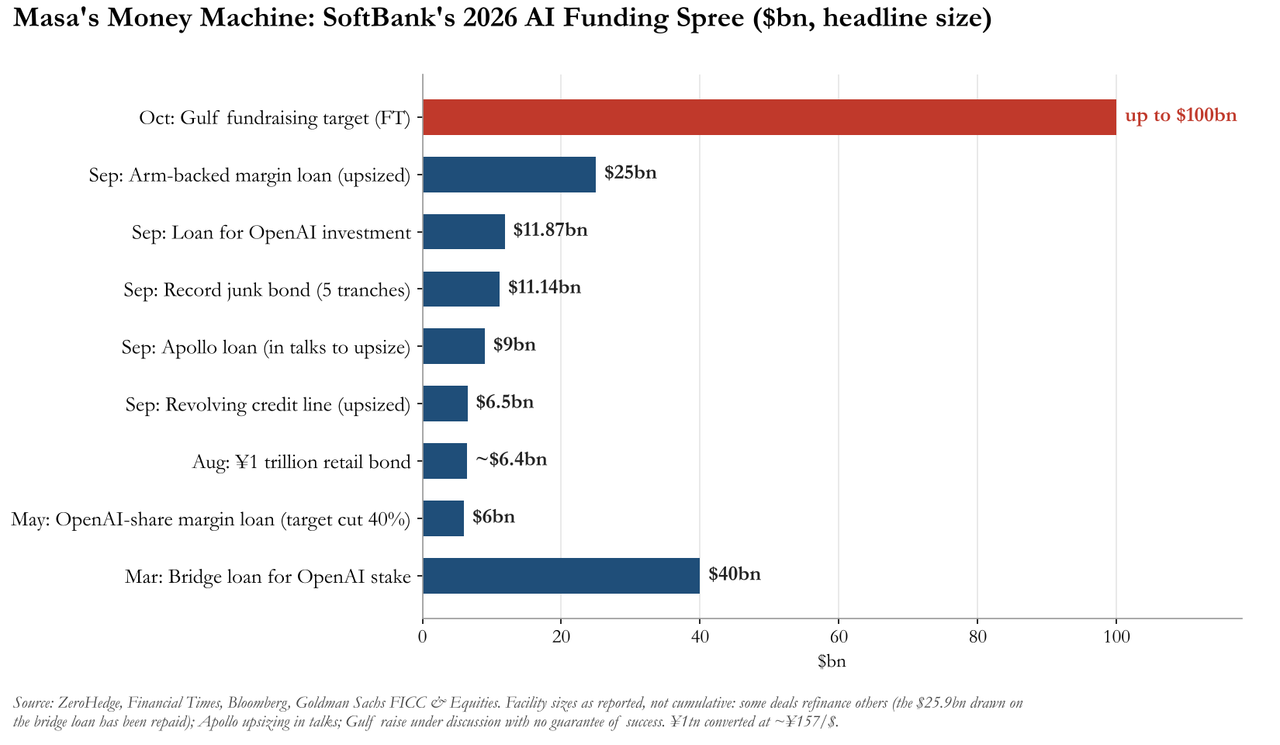
In March, days after SoftBank's CFO warned that its loan-to-value ratio may temporarily exceed the 25% ceiling (to which we responded "chatbots gonna take down masa son"), it lined up a record $40 billion bridge loan for the OpenAI stake. In May, SoftBank had to cut the target for its OpenAI-backed margin loan by 40% to $6 billion,p and by June even the downsized loan had stalled, as lenders balked at taking private OpenAI shares as collateral. Then came a ¥1 trillion bond sold to Japanese retail investors at a 4.75% coupon, an Arm-backed margin loan upsized to $25 billion, a $6.5 billion credit line, an $11.87 billion loan and talks with Apollo to upsize another to $9 billion.
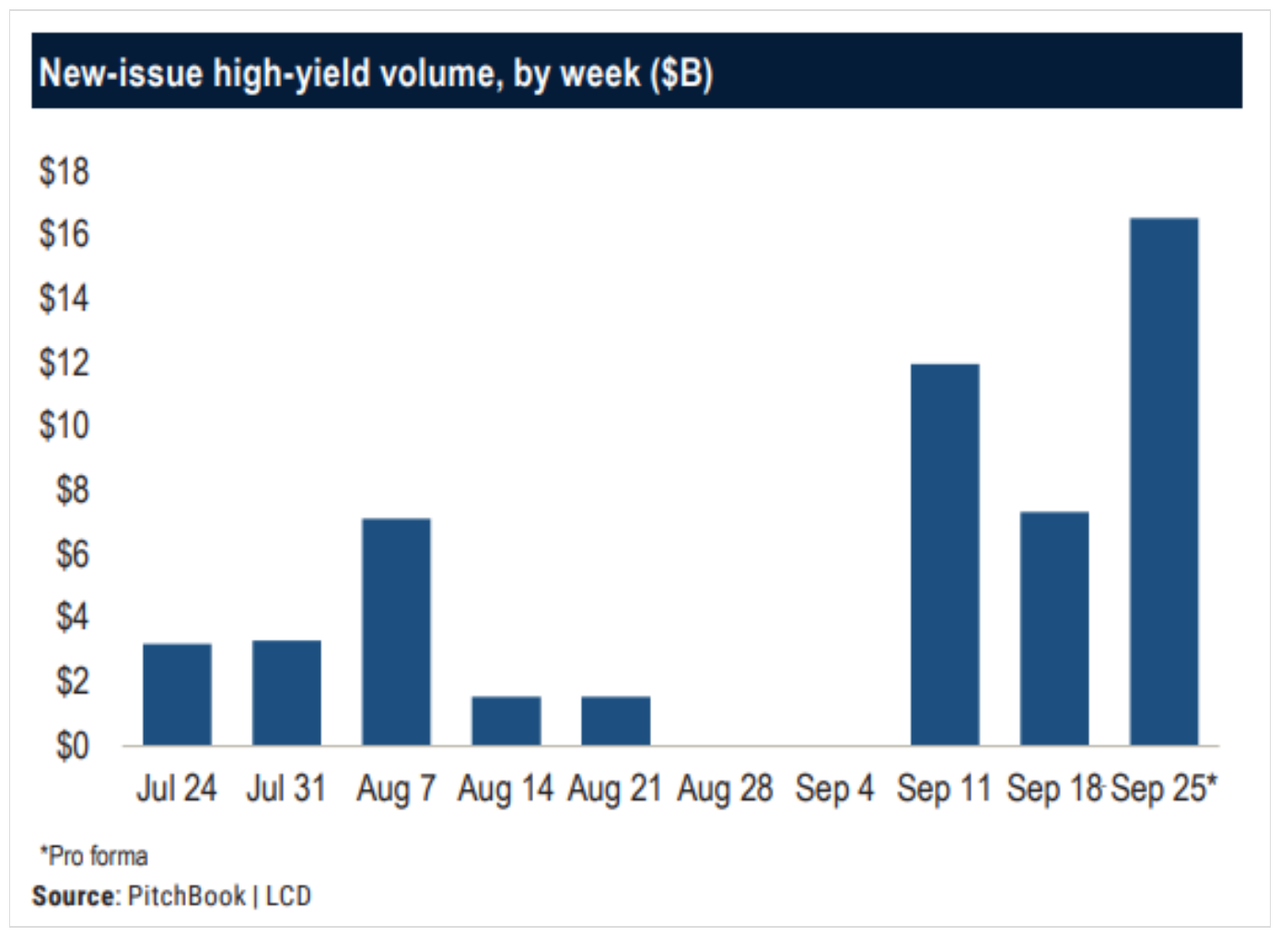
And then, the grand finale: a five-tranche, $11 billion-plus junk bond to fund the next OpenAI check, which the FT says paid yields as high as 9.75%. Goldman's credit sales desk confirmed in Adam Crook's latest AI issuance pulsecheck (available to pro subs) that the $11.14 billion deal was the largest non-investment grade bond sale on record, and it single-handedly made the week of Sept 25 the biggest for new HY issuance in Goldman's chart, which goes back to late July (chart source PitchBook LCD via Goldman):
Naturally, we called this one back in January, when the WSJ first reported that Son was in talks to pour another $30 billion into OpenAI:
**
Nine months later, SoftBank is the biggest junk issuer in history, so we'll allow ourselves a modest victory lap. The credit market got the message too: within a week of the jumbo deal, SoftBank's 5Y CDS had blown out to the widest levels since the Iran war began, as we flagged in real time:
**
Put differently, when you have already pledged your crown jewel (Arm), your largest asset (OpenAI), Japanese retail savers and the high-yield market's patience, the only pocket left is a sovereign one.
The $20 Billion Hole
Which brings us to why the timing of the Gulf push is so delicate. On Thursday afternoon the FT reported that OpenAI had told investors its annualized revenue was approaching $50 billion at the end of September, far short of the ~$70 billion figure that had been circulating since Dev Day. Nasdaq promptly tumbled more than 1%, Oracle slid 5-6%, and SoftBank's Tokyo-listed shares fell 5% on Friday. They are still up 25% this year, but have now dropped more than 30% from their June peak, when SoftBank briefly became Japan's most valuable company.
According to Goldman's TMT specialist sales team (available to pro subs), the gap is mostly a matter of accounting rather than collapsing demand: OpenAI reports revenue net of what flows through its cloud partners, while Anthropic reports something closer to gross. Investors who "grossed up" OpenAI to compare the two arrived at roughly $40 billion in August and $70 billion in September; on OpenAI's own net basis, the progression was more like $30 billion to $50 billion. That is still around 70% growth, Goldman notes, just not the growth everyone had priced in. Goldman's desk said it caught a heavy wave of long-only and hedge fund supply in megacap tech after the headline, over $1 billion in net selling of semis, AI and megacaps.
On Friday morning, right on schedule, came the spin: Bloomberg reported that OpenAI now expects to hit or top $70 billion of annualized revenue by year-end, and blamed the confusion on differences in how OpenAI and Anthropic calculate revenue. Futures bounced, and Goldman's TMT desk filed it under the whiplash sentiment swings that have become a defining feature of AI investing this year. So the $70 billion number didn't disappear; it was just moved three months into the future. Which, considering OpenAI is on the hook for some $1.5 trillion in compute commitments, is not quite the reassurance it was meant to be....
....MUCH MORE
If interested see also an oldie but goodie:
From the Wall Street Journal:
Old Pros Size Up the GameThorp and Pimco's Gross Open Up on Dangers
Of Over-Betting, How to Play the Bond Market
Setting aside the whole stealing your client's money thing, which has been covered by other commenters, one of the lessons of the FTX/Alameda Trading blowup is maximizing your gains while minimizing the risk of gamblers ruin.
SoftBank’s problems aren’t so surprising if you understand this one thing about the company
Throughout the manic phase of SoftBank and the Vision fund there was almost no mention of the fact that at the start of this century Masayoshi Son was the richest person in the world:
"But Son’s fairytale didn’t last long. After the dot-com bubble burst, his company Softbank’s shares plunged 75 percent in two months and was 93 percent lower by the end of 2000.
The business almost went bankrupt and Son ended up losing USD 70 billion, the highest ever recorded financial loss for a person in history."
—MoneyControl, October 13, 2017
"Is semi-variance a more useful measure of downside risk than standard deviation?"
"The Equation that Will Change Finance"
What Proportion of Your Bankroll Should You Bet? "A New Interpretation of Information Rate"
Gambler's Ruin and Bet Sizing
Repost: Dreamtime Finance (and the Kelly Criterion)
I've been meaning to write about Kelly for a couple years and keep forgetting. Today I forget no more.
In probability theory the Kelly Criterion is a bet sizing technique used when the player has a quantifiable edge.
(When there is no edge the optimal bet size is $0.00)
The criterion will deliver the fastest growth rate balanced by reduced risk of ruin.
You can grow your pile faster but you increase the risk of ending up broke should you, for example bet 100% of your net worth in a situation where you have anything less than a 100% chance of winning.
The criterion says bet roughly your advantage as a percentage of your current bankroll divided by the variance of the game/market/sports book etc..
Variance is the standard deviation of the game squared. In blackjack the s.d. is 1.15 so the square is 1.3225.
As blackjack is played in the U.S. the most a card counter can hope for is a 1/2% to 1% average advantage with much of that average accruing from the fact that you can get up from a negative table.
Divide by 1.3225 and you've got your bet size.
It's a tough way to grind out a living but hopefully this exercise will stop you from pulling a Leeson, betting all of Barings money and destroying the 233 year old bank.

