"Kai-Fu Lee: China Will Win the AI Race for Reach"
One of the big dogs.
From Bloomberg, September 3:
The former Google China chief and longtime AI investor on Beijing’s open-model advantage, the future of work and why CEOs still underestimate AI.
Chinese AI companies are rapidly closing the gap with US rivals, even after years of restrictions on their access to advanced chips. But the race between the world’s two AI superpowers is only one part of a much bigger transformation — of companies, jobs and even how people think about work. Few have watched it unfold from as many vantage points as AI pioneer and investor Kai-Fu Lee, who has worked at Apple and led Microsoft and Google teams in China. His backing of dozens of tech startups has helped create billion-dollar Chinese companies, while his own AI company is 01.ai.
This conversation has been edited for length and clarity. You can listen to an extended version on The Mishal Husain Show podcast.
We’ve turned to you because there are so many headlines on AI in the US and China. You know both these countries. You have seen the development of this technology over 40 years. What do you think is still underappreciated?
The speed of improvement and reduction of costs. Most people do not realize that AI is solving tasks 10 times longer than it was a year ago. If AI solved a four-minute task [then], now it can solve a 40-minute task. The acceleration is going to drive adoption like no technology ever has before. More than the steam engine, the internet [and] Moore’s Law.
AI improving that fast means our companies, enterprises, society [and] governments will need to consider the drastic changes it will bring about. In my view, the CEO is currently one of the least aware of how important this technology is. 1
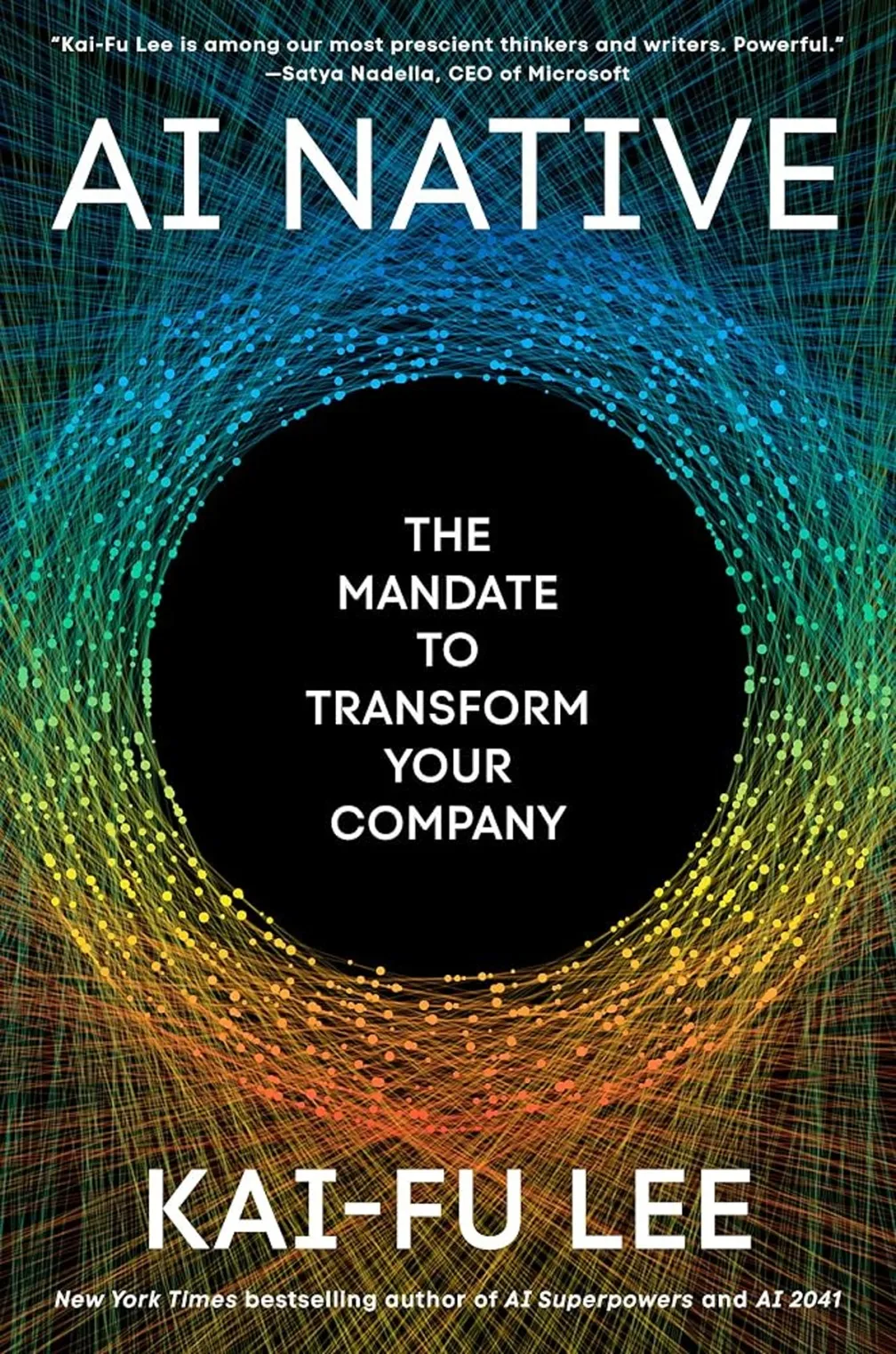
1This is quite a statement on CEOs, given how many make a point of publicizing their use of AI, and their penchant for hiring $25,000-a-day “AI gurus.” In a preview of Lee’s new book, AI Native: The Mandate to Transform Your Company, he dismisses most AI programs in use as “theater.” Note-takers and departmental chatbots are useful, he writes, but “irrelevant to the real value at stake … if your AI program hasn’t moved a single number on your earnings call, you didn’t transform anything.”
Jobs are going to change. In five years, the typical company’s organizational chart will be different; people who occupy the most important places will look different. AI workers are becoming better, cheaper [and] faster. In order to make that work effectively in an organization, it cannot be retrofitted into a hierarchy intended to manage people. AI workers don’t need hierarchies. What they need is people who know how to design the right problem to solve, organize AI to solve it, and — importantly — be accountable if anything goes wrong. AI can’t be accountable.
What are the qualifications that would put people in these positions? What should people study?
I suggest they study how to solve problems, come up with new problems, and command armies of AI to parallel-solve complex problems — show your mastery of AI. This is not coding. This does not require any engineering background; a humanities student can easily do this. Hard requirements can be learned, even [by] an older, non-tech-background person; that’s the good thing.
Good to know. [Laughs] Can I put a real-world example to you? We are a small team — myself and a handful of producers. I would hate to think of a future where it’s me and essentially an AI team.
I am not saying the [team] is one person and all AI. It’s as many as needed to ensure that the people connection part is worked out.
I don’t know enough about your business so using my business as an example: maybe a unit of 20 people and 100 AI to begin with. Over time, if the business is flat, then probably fewer people and more AI. If the business is growing, there may be more people and more AI.
Look at the protests that have just happened in India, the frustrations of so many young people that entry-level jobs aren’t there anymore. There are very serious social implications. Unless you’re saying there will be enough jobs in other fields for those people. 2
2India’s Gen Z movement, which forced the resignation of a cabinet minister, has tapped into widespread unhappiness at the limited availability of jobs for recent graduates. India’s economy remains fast-growing, but hiring in the customer support and tech-services industry has dropped in recent years.
Graduates Rise, Jobs Lag in India
The number of young graduates has increased 13 times since 1983 to 63 million, while those unable to find work have grown 16-fold to 11 million as of 2023.
Source: State of Working India 2026, Azim Premji University
There will be jobs in certain new industries.
Our whole society needs to rethink how much we depend on jobs. AI will generate a lot of wealth, and I think we can find ways of redistribution so people can work fewer hours and be paid for activities that were not economically important. But I think this is very hard to communicate to someone who couldn’t find a job, or lost [their] job.
You were at the forefront of Microsoft and Google’s foundations in China. How much of a challenge do Chinese AI companies like DeepSeek and Moonshot represent to US companies like OpenAI and Anthropic?
They represent a significant challenge, especially if they continue to keep up at recent levels. OpenAI and Anthropic always stayed at number one or two by most metrics on AI quality, but their models are closed. The Chinese models have been largely open source.
If you are OpenAI or Anthropic, you have a product you sell for a very high price, with an open-source version equivalent to your best model six months ago. Would you pay $50,000 for a [new] Tesla, or $15,000 [for a] Tesla that’s six months old? Obviously, the second is a strong value proposition. 3
3What Lee refers to as “open source” is described by most analysts as “open weight,” meaning that the AI model can be downloaded and potentially modified or redistributed; unlike in open-source software, the code used to train the model is typically not released. While US labs have mostly maintained closed-weight models, Nvidia, Microsoft and Meta were among firms recently warning US policymakers against “premature” restrictions on open-weight models, saying that they “expand access to the AI economy.” Anthropic and OpenAI were not among the signatories.
In the long run, are the Chinese companies more likely to make a profit?
No, the American companies will make more money.
Anthropic and OpenAI have built the iPhone. The Chinese companies are more like the way Google felt. Okay, you got the best product; we’ll build something that’s almost as good, sell it cheaply and win the larger share.
Like Android, the open-source models will have more share, more footprint, more usage. But people will pay very little. In some cases, they just copy the model, pay for the servers on which it’s run [and] don’t pay the Chinese companies anything.
Anthropic and OpenAI have the American system — selling enterprise products that are very highly priced....
Back
in May we thumbnailed Lee Kai-fu as "Sometimes the competition is just
plain intimidating/scary/resistance-is-futile, smart." Followed by his mini-bio from Edge.org:
"KAI-FU LEE, the founder of the Beijing-based Sinovation Ventures, is ranked #1 in technology in China by Forbes.
Educated as a computer scientist at Columbia and Carnegie Mellon, his
distinguished career includes working as a research scientist at
Apple; Vice President of the Web Products Division at Silicon Graphics;
Corporate Vice President at Microsoft and founder of Microsoft Research
Asia in Beijing, one of the world’s top research labs; and then Google
Corporate President and President of Google Greater China. As an
Internet celebrity, he has fifty million+ followers on the Chinese
micro-blogging website Weibo. As
an author, among his seven bestsellers in the Chinese language, two
have sold more than one million copies each. His first book in English
is AI Superpowers: China, Silicon Valley, and the New World Order (forthcoming, September)
Yes,
yes, in the headline I am mixing-and-matching two ancient Asian
cultures but, despite his having been born on Taiwan Dr. Lee really is a
sensei in the Japanese meaning of being both master and teacher....
That seems a lofty target but it also seems the whole country is mobilized to extract value out of the entire AI ecosystem, from chips to software to use cases so maybe 1/3 of the pie isn't so lofty.