Showing posts sorted by date for query nvidia supercomputer. Sort by relevance Show all posts

Tuesday, September 1, 2026

"Nvidia is building an IP licensing empire on the back of NVLink" (NVDA)

From The Register, August 31:

Even when you think you're not buying Nvidia, you might still be buying Nvidia 

The proliferation of custom AI ASICs, or XPUs, from OpenAI, Meta, Microsoft, and others has led many to question Nvidia's grip on the market. After all, if everybody's building their own, who needs the GPUs the AI arms dealer has made its fortune on?

But Nvidia isn't concerned in the least and has instead invited its competition to raid – or, rather, license – the GPU giant's IP holdings, particularly those related to networking.

On Monday, MediaTek became the latest to embrace Nvidia's NVLink Fusion high-speed interconnect technology for its fledgling datacenter XPU offering. In exchange, Nvidia has invested $3.5 billion in convertible bonds issued by MediaTek. The GPU giant will also continue to license the Taiwanese SoC provider's own designs for use in future DGX and RTX Spark systems.

If you're curious, we explored MediaTek's datacenter ambitions last month. But the designer, best known for its Arm-based smartphone and tablet processors, is only one of several high-profile chip designers that plan to integrate the tech. Amazon, Fujitsu, Qualcomm, Arm, and Marvell are all on the same list.

NVLink Fusion started as a commercialized version of Nvidia's high-speed inter-GPU interconnect, introduced early last year. Initially, it was offered in two varieties: a chip-to-chip (C2C) variant for connecting CPUs to GPUs (or XPUs) in a memory coherent fabric, and a switched fabric used to stitch together multiple accelerators into one big logical rack-scale chip. It's since expanded to become the blanket offering by which Nvidia licenses its semiconductor IP.

Given how long it's taken Broadcom and others to develop competitive alternatives to NVLink, it's not surprising companies like MediaTek would license the tech, rather than reinventing the wheel, or piping alternative interconnects, like UALink, over regular old Ethernet.

By licensing Nvidia's NVLink Fusion tech, companies can focus on building competitive accelerators without worrying about how they're going to scale in production.

And because Nvidia's MGX rack designs are part of the Open Compute Project, MediaTek and its partners not only benefit from Nvidia's scale-up networking tech, but also can essentially take existing NVL72 racks and slot in their compute blades. This should dramatically reduce the system design and mechanical engineering experience required to go from silicon to AI racks.

And this isn't theoretical. Amazon is doing just that with its Trainium series of AI accelerators. As we wrote at the time, Amazon used Nvidia's MGX NVL72 reference design for its Trainium3-based rack systems launched last year. Meanwhile Trainium4, expected late this year, will ditch Amazon's in-house NeuronLink interconnect tech for NVLink Fusion.

Nvidia's cut
So, what does Nvidia get from letting rival chip designers piggyback off its hard-won networking tech?

A lot more than licensing fees: It's also a way to keep companies hooked on its other products....

....MUCH MORE 

Connecting it all together, very important. 

Previously:

May 2015 - "Nvidia Wants to Be the Brains Of Your Autonomous Car (NVID)":

Among the fastest processors in the business are the one's originally developed for video games and known as Graphics Processing Units or GPU's. Since Nvidia released their Tesla hardware in 2008 hobbyists (and others) have used GPU's to build personal supercomputers.
Here's Nvidias Build your Own page.
Or have your tech guy build one for you.

In addition Nvidia has very fast connectors they call NVLink.
Using a hybrid combination of IBM Central Processing Units (CPU's) and Nvidia's GPU's, all hooked together with NVIDIA's NVLink, Oak Ridge National Laboratory is building what will be the world's fastest supercomputer when it debuts in 2018.

As your kid plays Grand Theft Auto.... 

March 2018 - "Connecting The Dots On Why Nvidia Is Buying Mellanox" (NVDA)

March 2026 - Connecting it all together: "Nvidia to invest $4 billion in two photonics companies" (NVDA; LITE; COHR)

Mr. Huang has said he wants to connect entire data centers together into one gigantic chip.

To do that you have to get latency between chips and then between servers as close to zero as possible.

June 2026 - "Nvidia Takes the Lead in Another AI Market Beyond Chips...." (NVDA)

From TipRanks, June 18:

Story Highlights

  • Nvidia became the top vendor in data center Ethernet switching for the first time.
  • IDC said Nvidia’s switching revenue jumped 193% year-over-year in the first quarter.
  • The gain shows Nvidia is expanding beyond GPUs into a larger share of AI infrastructure spending....

If there is any money to be made from artificial intelligence Mr. Huang seems bound-and-determined that it go to Nvidia. 
In other news, the move to optical and photonics from wires is real and accelerating.
From Nvidia's blog, June 16...

....MUCH MORE  

Sunday, August 30, 2026

"Late Victorian Holocausts: El Niño Famines and the Making of the Third World"

From the New York Times archive, an extended excerpt from the book by Mike Davis used as the introduction to the review by Nobel Laureate (economics) Amartya Sen, February 18, 2001: 

Victoria's Ghosts

The more one hears about this famine, the more one feels that such a hideous record of human suffering and destruction the world has never seen before.
—Florence Nightingale, 1877

"Here's the northeast monsoon at last," said Hon. Robert Ellis, C.B., junior member of the Governor's Council, Madras, as a heavy shower of rain fell at Coonoor, on a day towards the end of October 1876, when the members of the Madras Government were returning from their summer sojourn on the hills.

    "I am afraid that is not the monsoon," said the gentleman to whom the remark was made.

    "Not the monsoon?" rejoined Mr. Ellis. "Good God! It must be the monsoon. If it is not, and if the monsoon does not come, there will be an awful famine."

The British rulers of Madras had every reason to be apprehensive. The life-giving southwest monsoon had already failed much of southern and central India the previous summer. The Madras Observatory would record only 6.3 inches of precipitation for all of 1876 in contrast to the annual average of 27.6 inches during the previous decade. The fate of millions now hung on the timely arrival of generous winter rains. Despite Ellis's warning, the governor of Madras, Richard Grenville, the Duke of Buckingham and Chandos, who was a greenhorn to India and its discontents, sailed away on a leisurely tour of the Andaman Islands, Burma and Ceylon. When he finally reached Colombo, he found urgent cables detailing the grain riots sweeping the so-called Ceded Districts of Kurnool, Cuddapah and Bellary in the wake of another monsoon failure. Popular outbursts against impossibly high prices were likewise occurring in the Deccan districts of the neighboring Bombay Presidency, especially in Ahmednagar and Sholapur. Having tried to survive on roots while awaiting the rains, multitudes of peasants and laborers were now on the move, fleeing a slowly dying countryside.

As the old-hands at Fort St. George undoubtedly realized, the semi-arid interior of India was primed for disaster. The worsening depression in world trade had been spreading misery and igniting discontent throughout cotton-exporting districts of the Deccan, where in any case forest enclosures and the displacement of gram by cotton had greatly reduced local food security. The traditional system of household and village grain reserves regulated by complex networks of patrimonial obligation had been largely supplanted since the Mutiny by merchant inventories and the cash nexus. Although rice and wheat production in the rest of India (which now included bonanzas of coarse rice from the recently conquered Irrawaddy delta) had been above average for the past three years, much of the surplus had been exported to England. Londoners were in effect eating India's bread. "It seems an anomaly," wrote a troubled observer, "that, with her famines on hand, India is able to supply food for other parts of the world."

There were other "anomalies." The newly constructed railroads, lauded as institutional safeguards against famine, were instead used by merchants to ship grain inventories from outlying drought-stricken districts to central depots for hoarding (as well as protection from rioters). Likewise the telegraph ensured that price hikes were coordinated in a thousand towns at once, regardless of local supply trends. Moreover, British antipathy to price control invited anyone who had the money to join in the frenzy of grain speculation. "Besides regular traders," a British official reported from Meerut in late 1876, "men of all sorts embarked in it who had or could raise any capital; jewelers and cloth dealers pledging their stocks, even their wives' jewels, to engage in business and import grain." Buckingham, not a free-trade fundamentalist, was appalled by the speed with which modern markets accelerated rather than relieved the famine:

The rise [of prices] was so extraordinary, and the available supply, as compared with well-known requirements, so scanty that merchants and dealers, hopeful of enormous future gains, appeared determined to hold their stocks for some indefinite time and not to part with the article which was becoming of such unwonted value. It was apparent to the Government that facilities for moving grain by the rail were rapidly raising prices everywhere, and that the activity of apparent importation and railway transit, did not indicate any addition to the food stocks of the Presidency ... retail trade up-country was almost at standstill. Either prices were asked which were beyond the means of the multitude to pay, or shops remained entirely closed.

As a result, food prices soared out of the reach of outcaste labourers, displaced weavers, sharecroppers and poor peasants. "The dearth," as The Nineteenth Century pointed out a few months later, "was one of money and of labour rather than of food." The earlier optimism of mid-Victorian observers — Karl Marx as well as Lord Salisbury — about the velocity of economic transformation in India, especially the railroad revolution, had failed to adequately discount for the fiscal impact of such "modernization." The taxes that financed the railroads had also crushed the ryots. Their inability to purchase subsistence was further compounded by the depreciation of the rupee due to the new international Gold Standard (which India had not adopted), which steeply raised the cost of imports. Thanks to the price explosion, the poor began to starve to death even in well-watered districts like Thanjavur in Tamil Nadu, "reputed to be immune to food shortages." Sepoys meanwhile encountered increasing difficulty in enforcing order in the panic-stricken bazaars and villages as famine engulfed the vast Deccan plateau. Roadblocks were hastily established to stem the flood of stick-thin country people into Bombay and Poona, while in Madras the police forcibly expelled some 25,000 famine refugees.

India's Nero 
The central government under the leadership of Queen Victoria's favorite poet, Lord Lytton, vehemently opposed efforts by Buckingham and some of his district officers to stockpile grain or otherwise interfere with market forces. All through the autumn of 1876, while the vital kharif crop was withering in the fields of southern India, Lytton had been absorbed in organizing the immense Imperial Assemblage in Delhi to proclaim Victoria Empress of India (Kaiser-i-Hind). As The Times's special correspondent described it, "The Viceroy seemed to have made the tales of Arabian fiction true ... nothing was too rich, nothing too costly." "Lytton put on a spectacle," adds a biographer of Lord Salisbury (the secretary of state for India), "which achieved the two criteria Salisbury had set him six months earlier, of being `gaudy enough to impress the orientals' ... and furthermore a pageant which hid `the nakedness of the sword on which we really rely.'" Its "climacteric ceremonial" included a week-long feast for 68,000 officials, satraps and maharajas: the most colossal and expensive meal in world history. An English journalist later estimated that 100,000 of the Queen-Empress's subjects starved to death in Madras and Mysore in the course of Lytton's spectacular durbar. Indians in future generations justifiably would remember him as their Nero.

    Following this triumph, the viceroy seemed to regard the growing famine as a tiresome distraction from the Great Game of preempting Russia in Central Asia by fomenting war with the blameless Sher Ali, the Emir of Afghanistan. Lytton, according to Salisbury, was "burning with anxiety to distinguish himself in a great war." Serendipitously for him, the Czar was on a collision course with Turkey in the Balkans, and Disraeli and Salisbury were eager to show the Union Jack on the Khyber Pass. Lytton's warrant, as he was constantly reminded by his chief budgetary adviser, Sir John Strachey, was to ensure that Indian, not English, taxpayers paid the costs of what Radical critics later denounced as "a war of deliberately planned aggression." The depreciation of the rupee made strict parsimony in the non-military budget even more urgent.

    The 44-year-old Lytton, the former minister to Lisbon, had replaced the Earl of Northbrook after the latter had honorably refused to acquiesce in Disraeli's machiavellian "forward" policy on the northwest frontier. He was a strange and troubling choice (actually, only fourth on Salisbury's short list) to exercise paramount authority over a starving subcontinent of 250 million people. A writer, seemingly admired only by Victoria, who wrote "vast, stale poems" and ponderous novels under the nom de plume of Owen Meredith, he had been accused of plagiarism by both Swinburne and his own father, Bulwer-Lytton (author of The Last Days of Pompeii). Moreover, it was widely suspected that the new viceroy's judgement was addled by opium and incipient insanity. Since a nervous breakdown in 1868, Lytton had repeatedly exhibited wild swings between megalomania and self-lacerating despair.

    Although his possible psychosis ("Lytton's mind tends violently to exaggeration" complained Salisbury to Disraeli) was allowed free rein over famine policy, it became a cabinet scandal after he denounced his own government in October 1877 for "allegedly attempting to create an Anglo-Franco-Russian coalition against Germany." As one of Salisbury's biographers has emphasized, this was "about as absurd a contention as it was possible to make at the time, even from the distance of Simla," and it produced an explosion inside Whitehall. "Salisbury explained the Viceroy's ravings by admitting that he was `a little mad'. It was known that both Lytton and his father had used opium, and when Derby read the `inconceivable' memorandum, he concluded that Lytton was dangerous and should resign: `When a man inherits insanity from one parent, and limitless conceit from the other, he has a ready-made excuse for almost any extravagance which he may commit.'"

    But in adopting a strict laissez-faire approach to famine, Lytton, demented or not, could claim to be extravagance's greatest enemy. He clearly conceived himself to be standing on the shoulders of giants, or, at least, the sacerdotal authority of Adam Smith, who a century earlier in The Wealth of Nations had asserted (vis-à-vis the terrible Bengal drought-famine of 1770) that "famine has never arisen from any other cause but the violence of government attempting, by improper means, to remedy the inconvenience of dearth." Smith's injunction against state attempts to regulate the price of grain during famine had been taught for years in the East India Company's famous college at Haileybury. Thus the viceroy was only repeating orthodox curriculum when he lectured Buckingham that high prices, by stimulating imports and limiting consumption, were the "natural saviours of the situation." He issued strict, "semi-theological" orders that "there is to be no interference of any kind on the part of Government with the object of reducing the price of food," and "in his letters home to the India Office and to politicians of both parties, he denounced `humanitarian hysterics'." "Let the British public foot the bill for its `cheap sentiment,' if it wished to save life at a cost that would bankrupt India." By official dictate, India like Ireland before it had become a Utilitarian laboratory where millions of lives were wagered against dogmatic faith in omnipotent markets overcoming the "inconvenience of dearth." Grain merchants, in fact, preferred to export a record 6.4 million cwt. of wheat to Europe in 1877-78 rather than relieve starvation in India.

    Lytton, to be fair, probably believed that he was in any case balancing budgets against lives that were already doomed or devalued of any civilized human quality. The grim doctrines of Thomas Malthus, former Chair of Political Economy at Haileybury, still held great sway over the white rajas. Although it was bad manners to openly air such opinions in front of the natives in Calcutta, Malthusian principles, updated by Social Darwinism, were regularly invoked to legitimize Indian famine policy at home in England. Lytton, who justified his stringencies to the Legislative Council in 1877 by arguing that the Indian population "has a tendency to increase more rapidly than the food it raises from the soil," most likely subscribed to the melancholy viewpoint expressed by Sir Evelyn Baring (afterwards Lord Cromer), the finance minister, in a later debate on the government's conduct during the 1876-79 catastrophe. "[E]very benevolent attempt made to mitigate the effects of famine and defective sanitation serves but to enhance the evils resulting from overpopulation." In the same vein, an 1881 report "concluded that 80% of the famine mortality were drawn from the poorest 20% of the population, and if such deaths were prevented this stratum of the population would still be unable to adopt prudential restraint. Thus, if the government spent more of its revenue on famine relief, an even larger proportion of the population would become penurious." As in Ireland thirty years before, those with the power to relieve famine convinced themselves that overly heroic exertions against implacable natural laws, whether of market prices or population growth, were worse than no effort at all.

    His recent biographers claim that Salisbury, the gray eminence of Indian policy, was privately tormented by these Malthusian calculations. A decade earlier, during his first stint as secretary of state for India, he had followed the advice of the Council in Calcutta and refused to intervene in the early stages of a deadly famine in Orissa. "I did nothing for two months," he later confessed. "Before that time the monsoon had closed the ports of Orissa — help was impossible — and — it is said — a million people died. The Governments of India and Bengal had taken in effect no precautions whatever.... I never could feel that I was free from all blame for the result." Accordingly, he harbored a lifelong distrust of officials who "worshipped political economy as a sort of `fetish'" as well as Englishmen in India who accepted "famine as a salutary cure for over-population." Yet, whatever his private misgivings, Salisbury had urged appointment of the laissez-faire fanatic Lytton and publicly congratulated Disraeli for repudiating "the growing idea that England ought to pay tribute to India for having conquered her." Indeed, when his own advisers later protested the repeal of cotton duties in the face of the fiscal emergency of the famine, Salisbury denounced as a "species of International Communism" the idea "that a rich Britain should consent to penalize her trade for the sake of a poor India."

    Like other architects of the Victorian Raj, Salisbury was terrified of setting any precedent for the permanent maintenance of the Indian poor. As the Calcutta Review pointed out in 1877, "In India there is no legal provision made for the poor, either in British territory, or in the native states; [although] the need for it is said by medical men and others, to be exceedingly great." Both Calcutta and London feared that "enthusiastic prodigality" like Buckingham's would become a trojan horse for an Indian Poor Law. In its final report, the Famine Commission of 1878-80 approvingly underscored Lord Lytton's skinflint reasoning: "The doctrine that in time of famine the poor are entitled to demand relief ... would probably lead to the doctrine that they are entitled to such relief at all times, and thus the foundation would be laid of a system of general poor relief, which we cannot contemplate without serious apprehension...." None of the principal players on either side of the House of Commons disagreed with the supreme principle that India was to be governed as a revenue plantation, not an almshouse.

The `Temple Wage' 
Over the next year, the gathering horror of the drought-famine spread from the Madras Presidency through Mysore, the Bombay Deccan and eventually into the North Western Provinces. The crop losses in many districts of the Deccan plateau and Tamilnad plains (see Table 1.2) were nothing short of catastrophic. Ryots in district after district sold their "bullocks, field implements, the thatch of the roofs, the frames of their doors and windows" to survive the terrible first year of the drought. Without essential means of production, however, they were unable to take advantage of the little rain that fell in April-May 1877 to sow emergency crops of rape and cumboo. As a result they died in their myriads in August and September.

    Millions more had reached the stage of acute malnutrition, characterized by hunger edema and anemia, that modern health workers call skeletonization. Village officers wrote to their superiors from Nellore and other ravaged districts of the Madras Deccan that the only well-fed part of the local population were the pariah dogs, "fat as sheep," that feasted on the bodies of dead children:

[A]fter a couple of minutes' search, I came upon two dogs worrying over the body of a girl about eight years old. They had newly attacked it, and had only torn one of the legs a little, but the corpse was so enormously bloated that it was only from the total length of the figure one could tell it was a child's. The sight and smell of the locality were so revolting, and the dogs so dangerous, that I did not stay to look for a second body; but I saw two skulls and a backbone which had been freshly picked.

Officials, however, were not eager to share such horrors with the English or educated Indian publics, and the vernacular press charged that starvation deaths were being deliberately misreported as cholera or dysentery mortality in order to disguise the true magnitude of the famine.

    Conditions were equally desperate across the linguistic and administrative boundary in the Bombay Deccan. Almost two-thirds of the harvest was lost in nine Maharashtran districts affecting 8 million people, with virtually no crop at all in Sholapur and Kaladgi. The disaster befell a peasantry already ground down by exorbitant taxation and extortionate debt. In the Ahmednagar region officials reported that no less than three-fifths of the peasantry was "hopelessly indebted," while in Sholapur the district officer had warned his superiors in May 1875: "I see no reason to doubt the fact stated to me by many apparently trustworthy witnesses and which my own personal observation confirms, that in many cases the assessments are only paid by selling ornaments or cattle." (As Jairus Banaji comments, "A household without cattle was a household on the verge of extinction.") Ahmednagar with Poona had been the center of the famous Deccan Riots in May-June 1875, when ryots beat up moneylenders and destroyed debt records....

....MUCH MORE

And the review by Mr. Sen: 

Apocalypse Then

The little-known story of drought, famine and pestilence that killed millions at the turn of the last century. 

Most recently on the Monsoon:

May 29 - "India forecasts monsoon rains at 11-year low in 2026, fanning inflation risk" (90% of average forecast)

May 15 - Agriculture: "Monsoon rains to hit southern Indian coast early, spurring crop planting"

It is hard/impossible to overstate just how important* the monsoon is....

And as noted exiting May 2025's "Can India use AI to predict extreme weather events?":

....On a much more serious note, the December 2000 book  Late Victorian holocausts : El Niño famines and the making of the third world examines how the crop failures combined with British administrative mismanagement resulted in the deaths of some 60 million people.

The fact is that since the 1866 -1869 famines in Sweden and Finland famine is a political decision or lack of decision. The technology exists to move food to where it is needed.

Actually, in many respects the Irish famine years of the 1840's, two decades earlier,  were the first of the political famines.

*How important? June 2018:

India to Build Supercomputer To Better Forecast Monsoon
Complex chaotic systems are some of the toughest things for the human mind to understand and one of the biggest challenges for model makers. (another of the big challenges is model makers recognizing their own biases)

On a related subject, the current trend in supercomputer construction is to use a combination of CPUs and GPUs connected by superfast links which puts the Graphics Processing Unit manufacturers such as NVIDIA in an enviable position. Both the planned-to-be-fastest-in-the-world 'puter at Oak Ridge and the current 2nd fastest at ORNL use this approach as does the just upgraded Swiss machine (7th fastest)....
Also July 2009's "Naked girls and gold demand". 
A failure of the rainy phase of the monsoon cycle combined with crop failures in any one of the world's breadbaskets, Australia, Brazil, Canada, USA, Ukraine would lead to higher prices if it lasted one year, malnutrition if the combination lasted two years and outright starvation if it got to three growing seasons. 

On the other hand a rainy season that is too intense can kill thousands/tens of thousands across south Asia.

Sunday, August 23, 2026

"Nvidia Bets on the Classical Side of Quantum Computing" (NVDA)

From EE|Times, August 17:

On the ground floor of the Barcelona Supercomputing Center (BSC), MareNostrum 5 sits alongside three new quantum computers housed in an adjoining deconsecrated chapel. The supercomputer, equipped with thousands of Nvidia GPUs, is now connected to the quantum systems. The arrangement puts Nvidia’s role in the emerging hybrid-computing architecture into view.

https://www.eetimes.com/wp-content/uploads/low-260527_capilla_cuantico_04_dsc05683-2.jpg?resize=640%2C427

MareNostrum Ona, the quantum computing partition of MareNostrum 5, is housed in the 
Torre Girona chapel at the Barcelona Supercomputing Center. The red and blue systems 
are the digital quantum computers; the green system in the center is the newly 
inaugurated analog quantum computer. (Source: BSC)

“We don’t build a quantum computer,” said Sam Stanwyck, director of quantum products at Nvidia, in an interview with EE Times. “But Nvidia is fundamentally an accelerated computing platform company, and quantum computing is a part of the future of accelerated computing that we are extremely excited about.”

Nvidia is not developing its own quantum processing units (QPUs). Instead, it is focusing on the classical computing infrastructure around quantum hardware, including software, libraries, interconnects, and control systems that enable hybrid quantum-classical computing. 

Stanwyck compared the company’s hands-off hardware approach to its strategies in other capital-intensive markets. “We don’t build our own robot, but we work with every company that does; we don’t build our own self-driving car, but we work with every company that does; we don’t build our own quantum computer, but we’re working with every company that does to make them successful.”

Integration imperative 
Nvidia’s approach reflects a practical limitation of quantum computing: Quantum processors cannot operate independently. Qubits, the basic units of quantum information, are highly sensitive to noise and errors, requiring classical computing systems to control the hardware, process measurement data, perform error correction, and coordinate workloads....

....MUCH MORE 

Friday, August 21, 2026

"Artificial intelligence boosts automated biolabs"

This is the stuff that Nvidia's Jensen Huang has been pitching* for the last half-decade or so. 
It's also why we saw this in October 2024:

Nobel Prize in Chemistry 2024
From Knowable Magazine, August 18:

AI and machine learning are kicking synthetic biology up to new levels of innovation. Researchers see huge potential for novel drugs and other chemicals; some also see risks.  

James Field believes his automated laboratory is closing in on a powerful new drug to kill cancer cells with unprecedented precision. Yet the drug wasn’t created by any of the biologists working in his lab — it was generated by artificial intelligence.

Field is a protein engineer working in synthetic biology, a discipline that uses the latest technology to engineer novel cells or biological components. In his world, researchers often talk about a cycle known as DBTL — design, build, test, learn — an iterative process where the end product, whether it is a molecule or a new strain of bacteria, is repeatedly optimized until it has the traits scientists seek. Field’s company, LabGenius, is one of a group of startups that is at the forefront of a revolution in which AI increasingly runs the DBTL cycle from beginning to end.

The work takes place at the company’s sophisticated automated laboratory in a former biscuit factory in south London. Such laboratories, known as biofoundries, first emerged in the 2010s as gene editing technology, combined with “high-throughput” machines — which can conduct hundreds of experiments at once — accelerated the DBTL cycle by many orders of magnitude.

Experiments using biofoundries often involve adapting a piece of DNA that is then added to a host organism — frequently the bacterium Escherichia coli or yeast — to get it to produce a desired molecule, which can be anything from an antibody to an ingredient for sustainable plastic.

Algorithms have been integral to biofoundries from the start in managing the operation of high-throughput machines. But the industry is now approaching a point where AI models are becoming sophisticated enough to program DNA to produce new medicines and industrial chemicals, an emerging field known as SynBioxAI.

Rather than helping only to run the machinery, AI can now work iteratively, learning from results and suggesting new avenues of experimentation, reducing the development time for new drugs or industrial chemicals from years to months.

According to Paul Freemont, who heads synthetic biology at Imperial College London, we are approaching a powerful point of “convergence of automation, data and machine learning and AI.” He was the founding chair of the Global Biofoundries Alliance, an international group of publicly funded biofoundries that launched in 2019 in Kobe, Japan, with 16 members. The group has now grown to over 40 members across the world, spread from China to Mexico.

Since that launch, countries have been rapidly investing in biofoundry capacity. The United States, for example, is spending $75 million on the development of five new biofoundries, while China has named biomanufacturing and synthetic biology as core strategic priorities for its 2026-2030 five-year plan.

The objective is to engineer biology, programming cells to produce new drugs and industrial products, a technology that Freemont says is going to “become essential for mankind.”

However, he believes the field hasn’t fully reached this point of convergence. “I think there’s a massive amount of technical work that needs to be done to achieve the vision of what people are trying to do,” he says....

....MUCH MORE
*
Some previous posts:

July 2021 - NVIDIA Opens UK's Fastest Supercomputer To Outside Researchers, Academic and Commercial

NVIDIA Claims Install of UK’s Top Supercomputer, for Research in AI and Healthcare

Announced last October, NVIDIA today launched Cambridge-1, calling it the United Kingdom’s most powerful supercomputer. Enabling scientists and healthcare experts to use the combination of AI and simulation to accelerate the digital biology revolution, Cambridge-1 represents a $100 million investment by NVIDIA.....

March 2023 - "The Biorevolution: Its Implications for U.S. National Security, Economic Competitiveness, and National Power"
The author of this piece, Dr. Tara O'Toole is Senior Vice-President of the CIA's venture capital arm, In-Q-Tel.

January 2024 - Boston Consulting Group: "Synthetic Biology Is Getting Closer to Industrial Scale" 

January 2024 - We Are Going To Hear More And More About Digital Biology (NVDA)

February 2024 - Taking Nvidia's Jensen Huang Seriously: Paris-Based "Bioptimus primed with $35m to unravel disease biology using AI"

Two pitches that Nvidia's CEO will be making at next month's NVDA lovefest (Nvidia GTC Conference, March 17 - 21, 300,000 attendees in-person and online) are 1) sovereign AI, every country, even every city needs its own supercomputer powered by Nvidia chips and its own Large Language Model trained on those supercomputers and 2) digital biology - everything from rapid drug discovery to individually tailored gene therapy.*

February 2024 - "17 key takeaways from the 2024 J.P. Morgan Healthcare Conference"

April 2024 - "RAND: 'Artificial Intelligence and Biotechnology: Risks and Opportunities"

October 2024 - Paris-based baCta Is Using Engineered Bacteria to Grow Natural Rubber and Slash CO2 Emissions
AI-powered synthetic biology is so hot right now.

April 2026 - "Genomics Has Revealed An Age Undreamed Of"

This piece was published at Palladium magazine in 2023, so a few years after Nvidia's Jensen Huang started talking about AI and medicine and artificial biology*, but before the possibilities really started to become apparent. Now genomics looks to be very investable.**

In many ways the vibe feels similar to the zeitgeist around chips and training AI a dozen years ago.

I don't know if it is going to work out as well as 2013's "Why Is Machine Learning (CS 229) The Most Popular Course At Stanford?"—which was followed by 2014's Deep Learning is VC Worthy—which was followed by 2015-to-date: "Saaaay, this Nvidia may be on to something."

But we shall see.

Sunday, August 9, 2026

SemiAnalysis Looks At SpaceX (SPCX; MSFT; NVDA)

Talk about your "big if true"/"big if, true". The numbers are just so mindbending. 

From SemiAnalysis, August 7:

SpaceX 10GW in 2027 – Why It’s Real, Will Drive $300B ARR for SpaceX, and Why Microsoft Will Be the Largest Offtaker
Inference at 100B/GW/year, SpaceX's stellar pace, Microsoft's 10GW 2026 Awakening, Azure Can Grow Triple-Digits

Elon Musk shocked the world, once again, when he announced on SpaceX’s first earnings his Gigawatt ambitions for next year. He “conservatively” aims to build & deliver an incremental 6-8GW in 2027 alone, with potential for that number to be well above +10GW. At 50B per GW, that’s $300-500B in capex in 2027, on par with what we expect from AWS and Google – an unbelievable number for a company significantly less profitable than rival hyperscalers.

Yet, we believe that the number is real. We see SpaceX on track to build about 10GW by year-end 2027. We’ve evaluated all sites suitable for SpaceX and provided the list to our Datacenter Model subscribers. Our Energy Model subscribers also have the precise list of gas generation equipment available, quarter by quarter, by 30+ turbine, engine, fuel cell suppliers. We provided much of this data, before the market woke up to it. Below, we discuss how Elon bypasses typical datacenter construction constraints.

As explained in our Meta Compute deep dive, large-scale + near-term compute is a remarkably scarce combination, and it’s priced at a huge premium – up to $50B/GW/year. However, AI labs can handle it and make a good living off it.

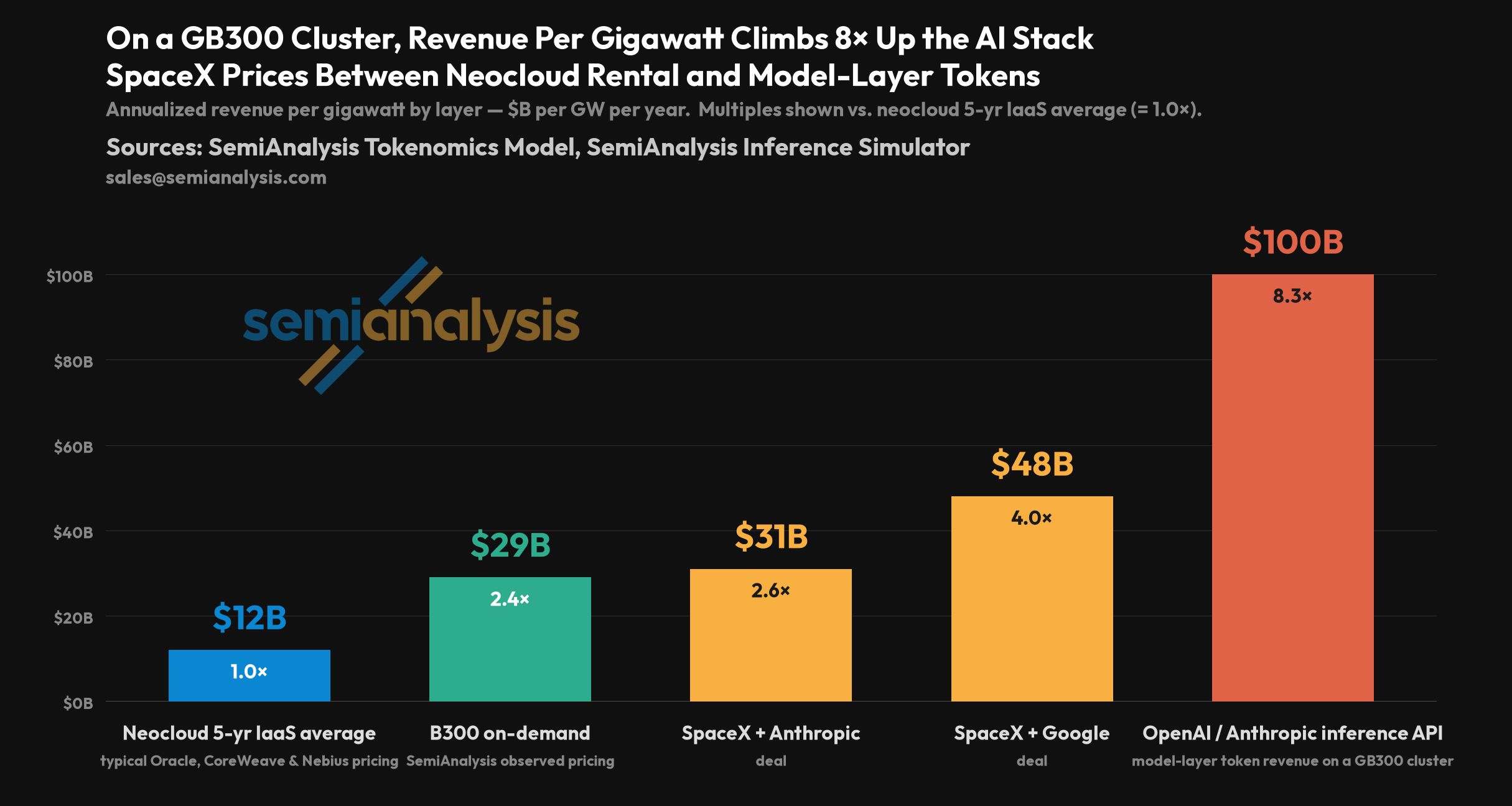
Our Tokenomics Model and our Inference Simulator demonstrate that at realistic performance levels (e.g. tokens/sec per GPU), both OpenAI and Anthropic can generate over $100B/GW/year of revenue when selling API inference on a GB300 cluster. This is significantly more than the costs of renting a GB300 cluster for a year at current neocloud prices.

Serving inference tokens is unbelievably profitable for the frontier model companies.


Source: SemiAnalysis Tokenomics Model, SemiAnalysis Inference Simulator

We assume around $12B/GW/year of cost per year, using a conservative rental pricing rate of $3/GPU-hr, and make a token production estimate using our Inference Simulator with a frontier-class model architecture and our agentic coding benchmark, AgentX (part of InferenceX), which is built by collecting real production coding traces. We blend that token production rate between input, cache-read, cache-write, and output token costs at our real workload ratios, and produce the final estimate, exceeding $100B/GW/year.

For background, our Inference Simulator is built from the ground up with a fundamental understanding of how modern AI accelerators work. We build a roofline and realistic performance model for how frontier models work during inference, with timings for every operation and a real trace output. It is an end-to-end simulation of the actual workload executing on the actual silicon. We have validated the simulators fidelity on a wide range of accelerators and workloads and continue to improve its ability to accurately forecast performance of future accelerators based on design specifications....

***** 

...Please reach out to sales@semianalysis.com for more information on how we apply the Inference Simulator for custom research and analysis.

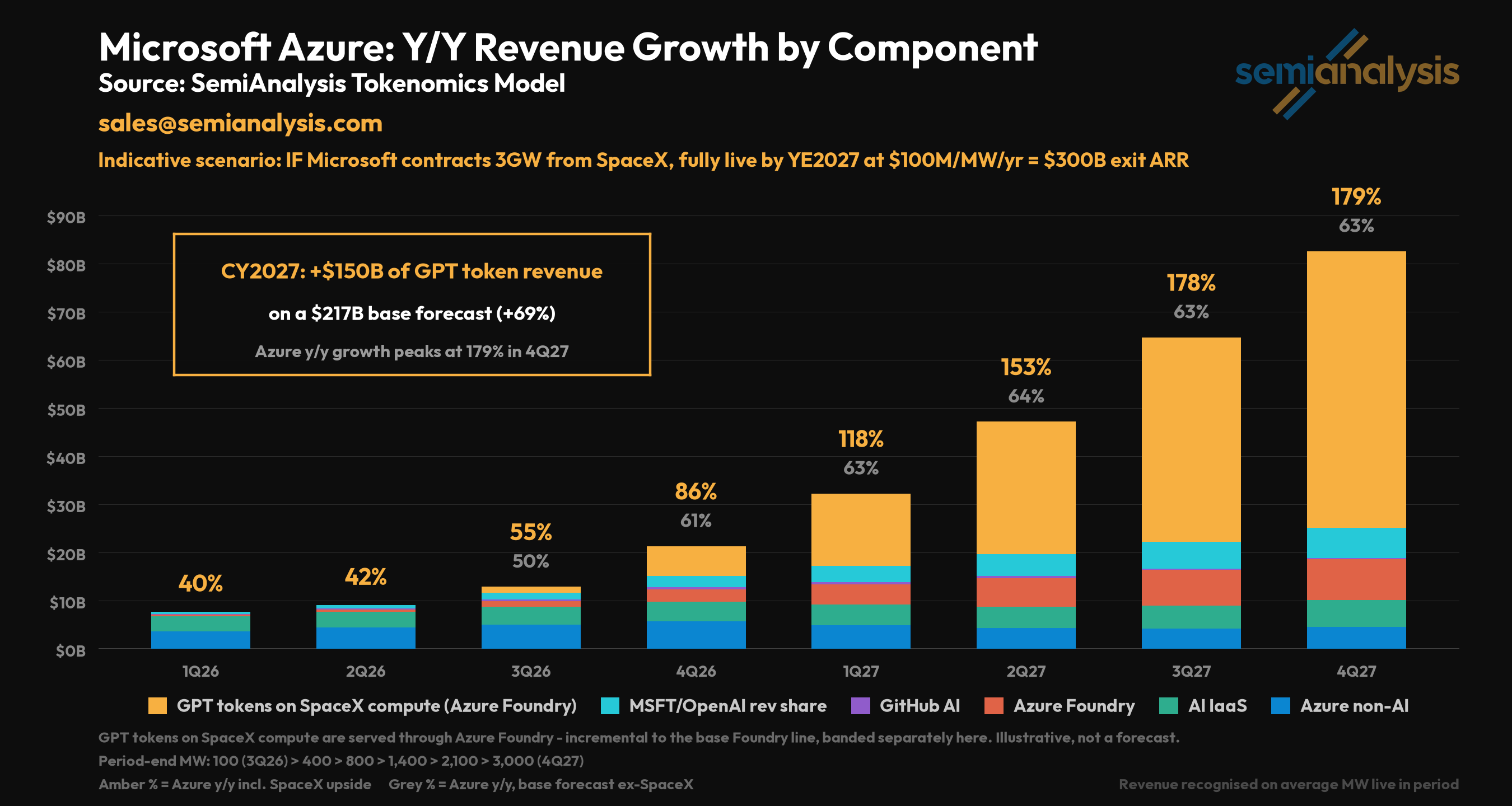
Beyond OpenAI and Anthropic, there is actually a third company in the world capable of printing such economics per GW: Microsoft. Having full access to OpenAI models, they can generate the exact same revenue and margin per MW, while paying none of the training costs. Satya nailed the negotiations with OpenAI: the deal reworked in April 2026 dropped the old 20% revenue share from the equation. Put simply, Microsoft has a giant incentive to procure as many MWs as possible, as fast as possible. While much of their datacenter capacity currently goes to OpenAI at ~14M/MW/year, they have the opportunity to improve that mix. The potential impact is Microsoft Azure accelerating revenue growth from ~42% to over 100% by next year. A once-in-a-generation opportunity, that SpaceX is incredibly well positioned to serve.


Source: SemiAnalysis Tokenomics Model

While Microsoft signing 3GW with SpaceX for 50B/GW/year sounds insane, we view it as possible for two reasons:

  • 1/ Microsoft is already preparing for an epic datacenter ramp. As discussed below, they’ve signed 10GW of contracts year-to-date, for over $300B of total contract value (not including the GPU cost). We expect much more to be signed. Caveat: these contracts contribute to late 2027 and 2028 capacity. There is a near-term gap to fill.

  • 2/ With a 90-day cancellation policy, akin to the SpaceX deals with Anthropic and Google, there is zero balance sheet risk. This is remarkably easy for Amy Hood to sign off, given the revenue opportunity.

For SpaceX, the next natural question is financing. How can Elon afford to pay so much CapEx without the balance sheet of the leading hyperscalers? We expect a combination of the two following items:

  • 1/ Support from Nvidia, in the form of vendor financing to lower the upfront cash cost. This is likely why Elon declared to be Nvidia exclusive on the earnings call! As our Accelerator Model has repeatedly explained, xAI/SpaceX have actively evaluated alternatives like TPU and AMD – so the financial argument likely made them abandon these and focus on Nvidia.

  • 2/ Operating cash-flow financing led by industry-high pricing, enabled by fastest timelines: SpaceX will continue to sell large-scale compute with 3-5 months lead time, an unbeatable offering, and price it accordingly at 30-50M/MW/year. That pays back the capex in less than a year. We dived into this in our Meta Compute article.

The implications of this are a path to $300B of ARR by the end of 2027 for SpaceX. This assumes only 50% of their 2027 incremental compute is monetized, the reminder being for the Grok & Cursor teams for training (no inference revenue modelled)....

....MUCH MORE 

We've chronicled much of the Elon - Jensen frenemy relationship in real-time for over a decade. On August 4 Musk said SPCX would use NVDA's platforms exclusively.

It wasn't always apparent that this is how things would turn out but the two centi-billionaires seem to get along. From a July 2023 post, "CORRECTED—Earnings - Tesla Reports, Stock Slides, Elon's Buying A Supercomputer (TSLA)":

....For some background on Tesla and AI here is our introduction to June 9's "Elon Musk Predicts Nvidia’s Monopoly in A.I. Chips Won’t Last" (NVDA; TSLA)":

Before we get to the headline story, some background. Tesla and Nvidia have a history.

In 2015 - 2016 when everyone thought that autonomous driving was just around the corner, the challenge was seen as both a sensor issue, for example: LIDAR vs cameras, and a machine learning/artificial intelligence problem which boils down to training the AI 'puters with as much data as you can so that out in the real world the autonomous vehicle can say to itself: "Yeah, I've seen this situation before, here's the response that worked best. Both the training and the on-the-road-recall, if they are to be anywhere near efficient, require the fastest chips you can find. Tesla had a whole bunch of data from a few billion miles of actual driving for computers to train on, and, combined with Nvidia's fastest-in-the-world GPU chips, it was a match made in heaven.

Except it wasn't.

The challenge of autonomous driving on open roads alongside non-autonomous vehicles was bigger than anyone in that simple, optimistic time ever envisioned, even in their nightmares. Here's one example about Waymo from a 2017 post:

"When Google was training its self-driving car on the streets of Mountain View, California, the car rounded a corner and  encountered a woman in a wheelchair, waving a broom, chasing a duck. The car hadn’t encountered this before so it stopped and waited."

In May 2015 we were posting " Nvidia Wants to Be the Brains Of Your Autonomous Car (NVDA)" and seven months later the more declarative "Class Act: Nvidia Will Be The Brains Of Your Autonomous Car (NVDA)"

Then in October 2016, what was probably the high-water mark for the relationship "Nvidia Could Make $1B From Tesla's Self-Driving Decree: Analyst (TSLA, NVDA)"

Sadly, the task was just too difficult but Mr. Musk thought it was doable if only he could get even faster chips than Nvidia had on offer:

NVIDIA Partner Tesla Reportedly Developing Chip With AMD (TSLA; NVDA; AMD) 
Today in leveraged WTFs....

"During a talk at a private party, Elon Musk said Tesla is developing specialized AI hardware "'That we think will be the best in the world;" (TSLA)  

"Tesla says it’s dumping Nvidia chips for a homebrew alternative" (TSLA)
The only reason for Tesla to do this is that NVIDIA's chips are general purpose whereas specialized chips are making inroads in stuff like crypto mining (ASICs), Google's Tensor Processing Units (TPUs) for machine learning and Facebook's hardware efforts. 
 
 Watch Out NVIDIA: "Google Details Tensor Chip Powers" (GOOG; NVDA)
We've said NVIDIA probably has a couple year head start but this bears watching, so to speak....

Culminating in August 2018's
"Nvidia CEO is 'more than happy to help' if Tesla's A.I. chip doesn't pan out" (NVDA; TSLA)

And now on to the headliner, from Observer, June 8:
Elon Musk Predicts Nvidia’s Monopoly in A.I. Chips Won’t Last....

And possibly related July 13:
Elon Musk's x.AI Launches
The company was formed in March so it's valuation is probably around a hundred billion or so.

Just kidding. I have no idea what sort of valuation it has been assigned. x.AI is a Nevada corporation which, as our corporate attorney readers well know, is handy as hell for a privately-held stealth company. As part of the company's coming-out I think they dropped the period in the name on the original incorporation papers.

Mr. Musk was one of the founder/funders ($100 million gift not equity) of ChatGPT parent OpenAI when it was a .org (non-profit) and seemed a bit miffed when Sam Alman hooked up with Microsoft to the tune of $10 billion.

So Elon went out and bought a garage-full of GPUs.

Here's a twofer, first up TechCrunch, July 12:....

Friday, July 17, 2026

"Airbus migrating 70 critical apps from AWS to France's Scaleway amid digital sovereignty push"

From The Register, July 17:

Total of 900 applications including ERP, CRM, and manufacturing systems going to be kept 'under European control' 

Airbus is migrating its most critical applications for sensitive workloads from AWS to French cloud provider Scaleway's under a drive to increase digital sovereignty. 

As exclusively revealed by The Register in December, the European-based aerospace manufacturer, said it needed to guarantee the data remained “under European control" and was launching a tender at the start of 2026. 

Catherine Jestin, head of digital at Airbus, told us on Thursday: "The selection of Scaleway is a combination of a very strong technical answer and a very strong commercial offer making it competitive compared to hyperscalers' public cloud offerings. In addition, Scaleway is committed to involving Airbus in the definition of its future product roadmap."

"The objective is to host Airbus's most critical applications (those required for the Minimum Viable Company). This represents 900 applications and we will start with 70 of them today hosted on AWS." 

Applications being sent to Scaleway include ERP, manufacturing execution systems, CRM, and product lifecycle management. Finding a cloud provider to host its most sensitive applications for defense and industrial workloads was not a certainty when the process began, Airbus told us last year, because European cloud providers do not have the scale of their US rivals. 

Jestin said Airbus will continue to work with AWS. Skywise, a platform that aggregates and analyzes aviation data, and Case Management Assistant for customers' technical queries will continue to be hosted by AWS. 

In a statement, she said: “By integrating a trusted, high performance, cloud environment that keeps our critical data assets shielded from foreign extraterritorial laws, we are ensuring that our digital infrastructure keeps pace with our aerospace innovation, while maintaining control and resilience of our industrial operations.” 

Since President Donald Trump came to power for a second term, his antagonistic approach to allies - some of them now former allies - has created economic and geopolitical tensions between the US and Europe

This has heightened concern about the US Cloud Act, which allows the American government to request data held in overseas datacenters owned by US businesses, and only served to reinforce calls for digital sovereignty....

....MORE, plus previous articles. 

Here at the Sun King Group we're all for French sovereign AI, France was one of the first major markets to which Nvidia made the sovereignty pitch:

December 2023 - Nvidia CEO Jensen Huang Says AI to See ‘Major Second Wave (NVDA)

AI to See ‘Major Second Wave,’ NVIDIA CEO Says in Fireside Chat With iliad Group Exec
NVIDIA’s Jensen Huang says sovereign AI a growing need for countries to reflect unique cultural, linguistic, industrial characteristics
European startups will get a massive boost from a new generation of AI infrastructure, NVIDIA founder and CEO Jensen Huang said Friday in a fireside chat with iliad Group Deputy CEO Aude Durand — and it’s coming just in time.

February 2024 - "Nvidia chief sees rise of ‘sovereign AI’ infrastructure across nations, driving demand for company’s advanced chips" 

March 2024 - Here's Nvidia's "Sovereign AI" Pitch (NVDA)

June 2024 - France's "Mistral AI warns of lack of data centres and training capacity in Europe"  

October 2024 - "Parlez-vous AI? Francophone scholars warn against English language dominating AI"  

January 2025 - "Jensen Huang Wants to Make AI the New World Infrastructure" (NVDA)

This sovereign AI you speak of, I have heard of it.  

I have heard wondrous tales of immense wealth,

Of amazing deeds performed as if by magic.
Yes I have heard of all of this...*

February 2026 - French Tech: "Mistral CEO Arthur Mensch’s $1.4B Data Center Push Powers Europe’s A.I. Autonomy"

May 2026 - "Europe built sovereign clouds to escape US control. Then forgot about the processors"

May 2026 -  FrenchTech: "Mistral AI's CEO says Europe has 2 years to stop becoming America's AI 'vassal state'"

And many more, albeit with a few diversions: 

.... This is terrible. I now have Jensen Huang speaking in Dr. Martin Luther King's cadences as he repurposes the penultimate paragraph of "I have a Dream":

Let AI ring from Stone Mountain of Georgia.
Let AI ring from Lookout Mountain of Tennessee.
Let AI ring from every hill and molehill of Mississippi.
From every mountainside, let AI ring. 
I may have to go lie down.
 
...Every, town, every village, every hamlet, every wide spot in the road, should have their own (NVDA-powered) supercomputer.

Tuesday, June 2, 2026

"3 things businesses need to know from Nvidia’s Computex 2026 keynote" (NVDA)

Well, among other things ARM Holdings stock was up 15.7% yesterday, bringing the one-month gain to 96.32%:


TradingView 

And Marvell was up $14.43 (+7.04%) to $219.43 and another $48.64 (+22.17%) in this morning's pre-market trade after Mr. Huang said MRVL would achieve a trillion-dollar market cap.

Nvidia's CEO says a lot of things.*

From TechFinitive, June 1:

Nvidia CEO Jensen Huang kicked off Computex 2026 with a sonic boom of a bang this morning by claiming that it is going to reinvent the PC in exactly the same way that Apple reinvented the phone.

“Remember, 15, 20 years ago, we used to have an idea called a phone,” said Huang during the two-hour keynote speech. “Today, when you think about your phone, the one thing you don’t do with it is make phone calls. You do just about everything else. So that phone means something very different to you than a phone of the past.

“I am certain that what is going to happen here is that the PC ten years from now, and the PC you think about today… is going to be completely different,” he said. “Here’s my theory. [Just as] many houses have home theatres, lawnmowers, dishwashers, I can totally imagine that someday there’s an AI supercomputer in your house.”

Naturally, an AI supercomputer that will be running on Nvidia silicon. It’s no coincidence that Huang also announced RTX Spark, an AI-focused chip that will run Windows. More of that later in this article.

Huang’s vision is that rather than our current idea of a PC that you sit in front of, clicking and typing, in this future world the PC will be “running all of your agents, it’s running all of your assistants, and it’s doing all kinds of things for you all the time”.

But that’s the future, one that sets the direction of travel for Nvidia and perhaps the entire PC industry. Against that backdrop, here’s a run-through of five immediate announcements that we think businesses, enterprises and large organisations should take note of.

AI supercomputer on every enterprise desk

While Huang’s vision of an AI supercomputer in every house seems a little distant, it has already announced an AI supercomputer for every desk in an enterprise. This echoes Bill Gates’ successful prediction, made in 1993, of a computer in every home.

The enterprise AI supercomputer in question is the Nvidia DGX Station for Windows. Based on the Nvidia GB300 Grace Blackwell Ultra Desktop Superchip (Nvidia is not afraid of superlatives) it can pack up to 748GB of memory and provides up to 20 petaflops of FP4 performance....

....MUCH MORE 

In March 2024 Huang literally shone the spotlight on Michael Dell at the March GTC confab. It took a while for the market to catch on but catch on it did:


5 years—TradingView 

As the old-timers used to say: "Pay attention or pay the offer." 

Sunday, May 24, 2026

"Lockheed Martin CEO unveils AI-powered warfare tech built to stop drone swarms" (LMT; NVDA)

The further out you can detect the threat, the better chance you have of neutralizing it. 

From Fox Business, May 21:

CEO Jim Taiclet says the company partnered with Nvidia to power its AI-driven national security missions 

A top U.S. defense contractor pulled back the curtain on next-generation AI-powered systems designed to hunt down and destroy swarms of enemy drones as the U.S. rapidly expands its next-generation warfighting capabilities.

"We are inserting technology of all types into our systems," Lockheed Martin CEO Jim Taiclet told FOX Business on Thursday, detailing the company's AI-powered counter-drone system, Sanctum.

Taiclet said the system uses artificial intelligence to detect incoming drones, determine whether they pose a threat and predict where they are headed before they can be intercepted or disabled.

"This technology alone is fantastic in being able to essentially hit a bullet with a bullet in space and destroy an incoming ballistic missile that's threatening our people, threatening our bases, threatening our allies," he said.

"But along with that, we've got to match — with technology — other threats, and we want to match the threat to the cost of our counterthreat."

The company is also focusing on a device called MORFIUS, a system capable of flying close to small enemy drones and "zapping" them with high-powered microwave pulses before moving on to the next target.

"This drone that we're building with the help of AI will enable us to attack 50 different drones with one mission without firing any weaponry," he shared.

Taiclet also spoke about the company's investment in an internal AI center in 2020 and credited a pipeline partnership with chipmaker Nvidia, which supplies the graphics processing units, or GPUs, used to support such national security missions....

....MUCH MORE 

Bringing to mind a February 2014 post, "Drone Meet DroneShield": 

From Voice of Russia:

DroneShield warns of low-flying UAVs with 18 nations demanding the device - inventor

DroneShield warns of low-flying UAVs with 18 nations demanding the device - inventor
In a matter of a few years, tons of drones could be whizzing around residential zones, taking away tiny pieces of privacy people once had. DroneShield is a fresh new concept that alerts of nearby low-flying UAV devices in the area. John Franklin, one of the developers, told the Voice of Russia that 18 countries, including Russia, have already put in orders for the gadget and has been creating buzz ever since.
Less than seven years from now there be up to 10,000 privately owned and operated drones gliding through the air in the US alone, according to the Federal Aviation Administration’s forecast. Though, the most recent device on the market promises to alert residents of when a small-sized drone has dropped by to visit.

DroneShield is an idea that has been brought to life thanks to crowd-funded resources and the designer of the device aerospace engineer John Franklin along with co-inventor Brian Hearing. The uniqueness in the $99 device is due to the super sensitive microphone it uses to pick up on a drone’s acoustic signature. It then takes in the sound data and it undergoes processing with a cheaply made, mini Raspberry Pi computer. 

Afterward, the shield device clarifies what the noise is by selecting from an internal list of drone sounds.

One incident sparked Franklin to create such a tool to empower the public during a test drive of his own drone he had purchased in a store. The very first time he used his unmanned device was to scope out debris or pool water that might have been collecting on the rooftop of his row house. Instead, it crashed into his neighbors’ yard. Although Franklin saw it as a nifty looking toy, the expression on his neighbor’s face left a different kind of impression.

"My neighbors’ reaction changed my perspective totally," Franklin said to the Voice of Russia and then went on, "For them, the drone represented the disembodied eyes of a stranger." That very experience ignited a fuse in the aerospace engineer and motivated him into launching up a drone campaign with Heading, the other co-founder of the company, with the campaign via Indiegogo. It seems to be a success story in the making....MORE
We've had a couple posts on the Rasberry Pi single board computer: 

The writer of the DroneShield piece is a bit effusive with "The uniqueness...".

In mid-World War I, i.e. pre-radar, Britain's Royal Engineers were trying to figure out how to detect the terror weapon of the day, The Zeppelin, at a distance. They came up with what they called Acoustical Mirrors which gathered the sound of the Zeppelin's motors and concentrated it on a spot where a trumpet shaped microphone was placed:

Kilnsea acoustic mirror BA Education

 4.5 metre high WW1 concrete acoustic mirror near Kilnsea Grange, East Yorkshire, UK. 
The pipe which held the 'collector head' (microphone) can be seen in front of the structure

A minder would hear the sound of the gasbags approaching and telephone a warning.
Here's the one at Redcar via Andrew Grantham's Sound Mirrors blog:
The sound mirror at Redcar on the Yorkshire coast was built in about 1916, during the First World War.
These pictures were taken in December 2002. Click on a picture to see a bigger version.

[Picture of the mirror]
The mirror at redcar has a modern plaque explaining what it is. The base for the listening apparatus has survived, about four feet in front of the main structure.
[Picture of the sound mirror]
[Picture of the sound mirror]
The mirror is now surrounded by a modern housing estate.
[Plaque in front of mirror]
A close up of the plaque. This reads:

REDCAR EARLY WARNING STATION

This structure is a Sound Mirror or detector, built by the Royal Engineers in 1916. It was part of an extensive Zeppelin and enemy aircraft detection system deployed down the East Coast of Britain druring the First World War. Zeppelins raided the North East Coast 15 times between April 1915 and November 1917.
The sound of approaching aircraft was reflected off the concave ‘mirror’ surface and received into a trumpet mounted on a steel column.
The trumpet was connected to a stethoscope used by the operator or ‘listener’, and the part of the dish that produced the most sound indicated the direction of the approaching aircraft. Advanced warning of an imminent attack could then be given to local people.
By the early 1940′s sound detection technology was being replaced by ‘reflective detection finding’ now known as radar.

Thursday, May 21, 2026

FrenchTech: Airbus Rents Supercomputers-as--Service From Bull

From The Register, May 19:

Airbus gets HPC-as-a-service supercomputer from Bull
Aerospace giant rents new system over 5 years to help develop new aircraft 

Airbus has inaugurated new supercomputing infrastructure from Bull to help the firm develop future aircraft, but is being coy about revealing how powerful the overall system is.

The European aerospace giant had already taken delivery of the hardware, spread across two sites – at Toulouse in December last year and Hamburg in April this year – but today (Tuesday) marks the official inauguration of the system, with 3x the performance of its previous supercomputer.

That’s according to Bull, the high-performance compute biz the French state acquired from Atos a few months ago, as Airbus declined to put forward a spokesperson to answer our questions.

The new system is based on a modular design, where kit was pre-assembled inside containers before being shipped to the Airbus sites. It is based on the firm’s BullSequana XH3000 rack infrastructure with a mix of compute blades configured with AMD’s Genoa and Turin versions of the Epyc processors, plus Nvidia GPU blades.

Also part of the hardware manifest is IBM Spectrum Scale storage using Storage Scale System appliances from the firm, and the interconnect used is Nvidia’s InfiniBand NDR (Next Data Rate), supporting 400 Gbps per port.

However, Bull wouldn’t tell us exactly how much of all this infrastructure it has delivered, as Airbus regards this as confidential information. 

What it did say is that the supercomputer is being supplied and supported on a “HPC-as-a-service” model, whereby Airbus is paying close to €100 million ($116 million) over five years for an all-inclusive deal....

....MUCH MORE 

And if they upgrade to the Luxe conciergerie option, Airbus will also receive two boxes at the Paris Opera plus access to the complete party-planning package.

Wednesday, May 20, 2026

Hyper-Pareto: "75% of gains, 80% of profits, 90% of capex—AI’s grip on the S&P is total and Morgan Stanley’s top analyst is ‘very concerned’"

This isn't news, the article is six months old, but I pulled it out of the link-vault not because of the scary warning but because the point it illustrates, the concentration of profits in the largest companies is key to understanding the economic and investment landscape. 
(plus, as the kids say, it validates our priors) 

From Fortune, October 7, 2025:  

A top Wall Street analyst has sounded an alarm over the U.S. equity bull market, warning that its remarkable run is built on a precariously narrow foundation: a surge in spending on, and optimistic assumptions about, infrastructure for artificial intelligence (AI). This spending has fueled a boom in the shares of most of the so-called Magnificent 7 and a few dozen related businesses, which have now come to account for roughly 75% of the S&P 500’s returns since the rally of the last few years began. 

The commentary on September 29 by Morgan Stanley Wealth Management’s chief investment officer, Lisa Shalett, frames the current market boom as a “one-note narrative” almost entirely dependent on massive capital expenditures in generative AI, raising questions about its durability as economic and competitive risks start to mount. Shalett’s critique came squarely in the middle of some people in the AI field — and many financial commentators around Wall Street —fretting at market exuberance and beginning to talk openly about a bubble.

In an interview with Fortune, Shalett said she was “very concerned” about this theme in markets, saying her office had broadened from a belief that the market would only bid up seven or 10 stocks to roughly 40. “At the end of the day … this is not going to be pretty” if and when the generative AI capital expenditure story falters, she said. 

Shalett said she’s worried about a “Cisco moment” like when the dotcom bubble burst in 2000, referring to the company that was briefly the most valuable company in the world before an 80% stock plunge. When asked how close we are to such a moment, Shalett said probably not in the next nine months, but very possibly in the next 24. When you look at the actual spending and the amount of capital coming into the space, “we’re a lot closer to the seventh inning than the first or second inning,” she said.

‘Starting to do what all ultimate bad actors do’

Shalett’s comments centered on several recent multibillion-dollar deals to scale up data-center infrastructure. As notable substacker and former Atlantic writer Derek Thompson recently noted in a post titled “This is how the AI bubble will pop,” so much money is being spent to support AI’s energy-consumption needs that it’s the equivalent of a new Apollo space mission every 10 months. (Tech companies are spending roughly $400 billion this year alone on data-center infrastructure, while the Apollo program allocated about $300 billion in today’s dollars to get to the moon from the 1960s to the ’70s.)

What’s more than a little concerning to Shalett is that one company alone, Nvidia—the most valuable company in the history of the world, with an over $4.5 trillion market cap—is at the center of a significant number of these deals. In September alone, Nvidia invested $100 billion in OpenAI in a massive deal, just days after pledging $5 billion to Intel (the Intel agreement was tied to chips, not data-center infrastructure, per se).

Fortune‘s Jeremy Kahn reported in late September on significant concerns about “circular” financing, or Nvidia’s cash essentially being recycled throughout the AI industry. Shalett sees this as a major concern and a major sign that the business cycle is headed toward some kind of endgame. “The guy at the epicenter, Nvidia, is basically starting to do what all ultimate bad actors do in the final inning, which is extending financing, they’re buying their investors.”

Shalett expanded on her concerns by saying that companies around Nvidia “are starting to become interwoven.” She noted that OpenAI is partially owned by Microsoft, but now Nvidia has also made an investment in the startup, while Oracle and AMD each have their own purchasing agreements with OpenAI. But OpenAI also has a data-center deal with tech giant Oracle, with the “bad news,” Shalett notes, that this deal is “totally debt-financed.” OpenAI also struck a deal in October with chip-maker AMD that allows OpenAI to buy up to 10% of AMD. “Essentially, Nvidia’s main competitor is going to be partially owned by OpenAI, which is partially owned by Nvidia. So, Nvidia can ‘own’ a piece of its largest competitor. It is totally circular and increases systemic risk.”

When reached for comment, a spokesperson for Nvidia said, “We do not require any of the companies we invest in to use Nvidia technology.”

Nvidia CEO Jensen Huang discussed the OpenAI investment in an appearance on the Bg2 podcast with Brad Gerstner and Clark Tang on September 25, calling it an “opportunity to invest” and part of a partnership geared toward helping OpenAI build their own AI infrastructure. When asked about the allegation of circular financing in general and the Cisco precedent in particular, Huang talked about how OpenAI will fund the deal, arguing that it will have to be funded by OpenAI’s future revenues, or “offtake,” which he pointed out are “growing exponentially,” and by its future capital, whether it’s raised by a sale of equity or debt. That will depend on investors’ confidence in OpenAI, he said, and beyond that, it’s “their company, it’s not my business. And of course, we have to stay very close to them to make sure that we build in support of their continued growth.”....

....MUCH MORE 

And our priors? From a bit before the Fortune piece was published, July 9, 2025. 

"The 'new normal' of growth stock dominance"
What our five years of blather regarding advantage flywheels is all about.

*****

This is a corollary of the basic framework for understanding businesses and investing that we've been pitching for the last six or seven years.

If interested see:

Why Do the Biggest Companies Keep Getting Bigger? It’s How They Spend on Tech" 

...Much more important than the direct monetization of big data is the strategic advantage it can bestow over time.
In a winner-take-all economy, as in a horse race, small differences in superiority are rewarded all out of proportion to the actual advantage. A top thoroughbred may only be a couple fifths of a second faster than the field but those two lengths over the course of a season can mean triple the earnings for #1 vs. #2.
In commerce the results can be even more dramatic because rather than the 60%/20%/10% purse structure of the racetrack the winning vendor will often get 100% of a customer's business.....

Competitive Advantage and Feedback Loops

How to Think About Companies: 'Advantage Flywheels'
A very handy conceptual framework first posted after the start of the U.S. lockdowns, April 2020. Schools were closed so it seemed natural to link to a superb mini-MBA module.
Eat your heat out HBR....
****  
....As artificial intelligence comes more and more to the fore, the advantages accruing to those companies that can afford to make use of their data and custom train the machines will act as advantage flywheels that shift the distribution of profits from the normal Pareto: 80% of the loot goes to the top 20% of businesses to perhaps as much as 95% of all the profits going to the top 5% of businesses.
I didn't really mean the "eat your heart out HBR" line.

Here's the Harvard Business Review on this very point:
HBR—From Pareto To Hyper-Pareto: "AI Is Going to Change the 80/20 Rule"

Flywheel Effect: Why Positive Feedback Loops are a Meta-Competitive Advantage

"Analyzing the deepening divide in learning capabilities between a few corporate giants and the rest of the world." (plus advantage flywheels)

"America's Biggest Firms' Moat Is Becoming Impregnable" (TSLA; NVDA; GOOG)
The announcement at the end of August that Tesla was going live with their supercomputer — Elon Got Himself A Supercomputer: "Tesla's $300 Million AI Cluster Is Going Live Today" (TSLA)—reminded me of this piece at ZeroHedge, last month. We'll be back with more on Morgan Stanley's Tesla note later today but for now the TL;dr is "To the victor go the spoils" or "The rich get richer" or "Those who can afford a supercomputer will get closer to discovering the profitability (if any) of AI than those who can't afford a supercomputer."
In Nvidia's World, If You (and your company) Don't Have Money You Will Not Be Able To Compete (NVDA)

The advantage flywheels keep spinning and reinforcing each other to the point that the Pareto distribution of profits - 20% of companies reap 80% of the profits - is becoming Super-Pareto where 5% of the companies reap 95% of the profits and is approaching Hyper-Pareto at maybe 2% of companies reaping 98% of profits.

It all comes down to having the resources to keep up. 

I watched Mr. Huang give the keynote and it's all a bit much to digest before firing out comments that would make any sense at all so here are some of today's headlines to give a taste of what the intro paragraph is based on.

These are Nvidia's press releases via GlobeNewswire....

"Elon Musk says any company that isn’t spending $10 billion on AI this year like Tesla won’t be able to compete" (TSLA)

This.

This is such an important concept to grasp. It's the advantage flywheels, the rich get richer, winner-take-all reality of business in 2024....

The Hyper-Pareto Distribution Of Profits Is Happening Right Now (plus an anniversary)
It's not some cutesy management* fad or pop insight like "Business secrets of Genghis Khan."

To the rich go the profits and internalizing that fact makes the rest of this portfolio construction/fund management/investing stuff easier to conceptualize and execute.

And AI is accelerating the already extant dynamic....
*****

*Although people had been observing and discussing "rich get richer" and "winner-take-all" dynamics for over a century, one of our favorite pointers toward the current situation did come out of a business school. We've been hammering on this for so long that I start to bore myself. Here's a recapitulation from last year, linking to an article that was published seven years ago today:

HBR—From Pareto To Hyper-Pareto: "AI Is Going to Change the 80/20 Rule"

A prescient article from the Harvard Business Review, February 28, 2017:....

*****

Just to reiterate, every incremental advantage that a company can afford does not affect income production in isolation. They accrete in sometimes unforeseeable combinations:

AI: Tesla Installing Second Dojo Supercomputer In New York Gigafactory (TSLA; NVDA)

AI: "Inside Tesla’s Innovative And Homegrown 'Dojo' AI Supercomputer" (TSLA)

It really is a big deal that a company can afford to spend over a billion dollars to build their own supercomputer and it really is a big deal that the same company has all the training data from the billions of miles of real-world driving and it really is a great example of the concept of advantage flywheels and hyper-pareto distribution of rewards, i.e. the rich get richer.

Whether it is going to open-up the $10 trillion addressable market and add the $500 billion of market cap that Morgan Stanley foresees is still an open question....

....As artificial intelligence comes more and more to the fore, the advantages accruing to those companies that can afford to make use of their data and custom train the machines will act as advantage flywheels that shift the distribution of profits from the normal Pareto: 80% of the loot goes to the top 20% of businesses to perhaps as much as 95% of all the profits going to the top 5% of businesses.

I didn't really mean the "eat your heart out HBR" line.

Here's the Harvard Business Review on this very point:
HBR—From Pareto To Hyper-Pareto: "AI Is Going to Change the 80/20 Rule"

And many more. If interested use the 'search blog' box, upper left.