Showing posts sorted by date for query google quantum. Sort by relevance Show all posts

Sunday, September 6, 2026

"Social scientists cling to simple models of reality – with disastrous results. Instead they must embrace chaos theory"

Two quick notes as introduction:

A couple of the author's early examples of sociological phenomena, especially the Arab Spring, appear in hindsight to have been propagated and possibly instigated by nefarious actors.  

Because we try to be fashion-forward by adopting and incorporating (or at least linking to) academic research, we have a number of posts that may be 1) relevant in re: our headliner and 2) of interest to our readers. Links after the jump.

From Aeon Magazine, October 29, 2024:

Brian Klaas is an associate professor in global politics at University College London, an affiliate researcher at the University of Oxford, and a contributing writer for The Atlantic. His most recent book is Fluke: Chance, Chaos, and Why Everything We Do Matters (2024). He writes The Garden of Forking Paths Substack and created the Power Corrupts podcast.

The social world doesn’t work how we pretend it does. Too often, we are led to believe it is a structured, ordered system defined by clear rules and patterns. The economy, apparently, runs on supply-and-demand curves. Politics is a science. Even human beliefs can be charted, plotted, graphed. And using the right regression we can tame even the most baffling elements of the human condition. Within this dominant, hubristic paradigm of social science, our world is treated as one that can be understood, controlled and bent to our whims. It can’t.

Our history has been an endless but futile struggle to impose order, certainty and rationality onto a Universe defined by disorder, chance and chaos. And, in the 21st century, this tendency seems to be only increasing as calamities in the social world become more unpredictable. From 9/11 to the financial crisis, the Arab Spring to the rise of populism, and from a global pandemic to devastating wars, our modern world feels more prone to disastrous ‘shocks’ than ever before. Though we’ve got mountains of data and sophisticated models, we haven’t gotten much better at figuring out what looms around the corner. Social science has utterly failed to anticipate these bolts from the blue. In fact, most rigorous attempts to understand the social world simply ignore its chaotic quality – writing it off as ‘noise’ – so we can cram our complex reality into neater, tidier models. But when you peer closer at the underlying nature of causality, it becomes impossible to ignore the role of flukes and chance events. Shouldn’t our social models take chaos more seriously?

The problem is that social scientists don’t seem to know how to incorporate the nonlinearity of chaos. For how can disciplines such as psychology, sociology, economics and political science anticipate the world-changing effects of something as small as one consequential day of sightseeing or as ephemeral as passing clouds?

On 30 October 1926, Henry and Mabel Stimson stepped off a steam train in Kyoto, Japan and set in motion an unbroken chain of events that, two decades later, led to the deaths of 140,000 people in a city more than 300 km away.

The American couple began their short holiday in Japan’s former imperial capital by walking from the railway yard to their room at the nearby Miyako Hotel. It was autumn. The maples had turned crimson, and the ginkgo trees had burst into a golden shade of yellow. Henry chronicled a ‘beautiful day devoted to sightseeing’ in his diary.

Nineteen years later, he had become the United States Secretary of War, the chief civilian overseeing military operations in the Second World War, and would soon join a clandestine committee of soldiers and scientists tasked with deciding how to use the first atomic bomb. One Japanese city ticked several boxes: the former imperial capital. The Target Committee agreed that Kyoto must be destroyed. They drew up a tactical bombing map and decided to aim for the city’s railway yard, just around the corner from the Miyako Hotel where the Stimsons had stayed in 1926.

Stimson pleaded with the president Harry Truman not to bomb Kyoto. He sent cables in protest. The generals began referring to Kyoto as Stimson’s ‘pet city’. Eventually, Truman acquiesced, removing Kyoto from the list of targets. On 6 August 1945, Hiroshima was bombed instead.

If such random events could lead to so many deaths, how are we to predict the fates of human society?

The next atomic bomb was intended for Kokura, a city at the tip of Japan’s southern island of Kyushu. On the morning of 9 August, three days after Hiroshima was destroyed, six US B-29 bombers were launched, including the strike plane Bockscar. Around 10:45am, Bockscar prepared to release its payload. But, according to the flight log, the target ‘was obscured by heavy ground haze and smoke’. The crew decided not to risk accidentally dropping the atomic bomb in the wrong place.

Bockscar then headed for the secondary target, Nagasaki. But it, too, was obscured. Running low on fuel, the plane prepared to return to base, but a momentary break in the clouds gave the bombardier a clear view of the city. Unbeknown to anyone below, Nagasaki was bombed due to passing clouds over Kokura. To this day, the Japanese refer to ‘Kokura’s luck’ when one unknowingly escapes disaster.

Roughly 200,000 people died in the attacks on Hiroshima and Nagasaki – and not Kyoto and Kokura – largely due to one couple’s vacation two decades earlier and some passing clouds. But if such random events could lead to so many deaths and change the direction of a globally destructive war, how are we to understand or predict the fates of human society? Where, in the models of social change, are we supposed to chart the variables for travel itineraries and clouds?

In the 1970s, the British mathematician George Box quipped that ‘all models are wrong, but some are useful’. But today, many of the models we use to describe our social world are neither right nor useful. There is a better way. And it doesn’t entail a futile search for regular patterns in the maddening complexity of life. Instead, it involves learning to navigate the chaos of our social worlds.

Before the scientific revolution, humans had few ways of understanding why things happened to them. ‘Why did that storm sink our fleet?’ was a question that could be answered only with reference to gods or, later, to God. Then, in the 17th century, Isaac Newton introduced a framework where such events could be explained through natural laws. With the discovery of gravity, science turned the previously mysterious workings of the physical Universe – the changing of the tides, celestial movements, falling objects – into problems that could be investigated. Newtonian physics helped push human ideas about causality from the unknowable into the merely unknown. A world ruled by gods is fundamentally unknowable to mere mortals, but, with Newton’s equations, it became possible to imagine that our ignorance was temporary. Uncertainty could be slain with intellectual ingenuity. In 1814, for example, the French scholar Pierre-Simon Laplace published an essay that imagined the possible implications of Newton’s ideas on the limits of knowledge. Laplace used the concept of an all-knowing demon, a hypothetical entity who always knew the positions and velocities of every particle in Newton’s deterministic universe. Using this power, Laplace’s demon could process the full enormity of reality and see the future as clearly as the past.

These ideas changed how we conceived of the fundamental nature of our world. If we are the playthings of gods, then the world is fundamentally and unavoidably unruly, swayed by unseen machinations, the whims of trickster deities and their seemingly random shocks unleashed like bolts of lightning from above. But if equations are our true lords, then the world is defined by an elegant, albeit elusive, order. Unlocking the secrets of those equations would be the key to taming what only seemed unruly due to our human ignorance. And in that world of equations, reality would inevitably converge toward a series of general laws. As scientific progress advanced in the 19th and 20th centuries, Laplace’s demon became increasingly plausible. Better equations, perhaps, could lead to godlike foresight.

‘Small differences in the initial conditions produce very great ones in the final phenomena’

The search for patterns, rules and laws wasn’t limited only to the realm of physics. In biology, Darwinian principles provided a novel guide to the rise and fall of species: evolution by natural selection acted like an ordered guardrail for all life. And as the successes of the natural sciences spread, scholars who studied the dynamics of culture began to believe that the rules of biology and physics could also be used to describe the patterns of human behaviour. If there was a theoretical law for something as mysterious as gravity, perhaps there were similar rules that could be applied to the mysteries of human behaviour, too? One scholar who put such an idea in motion was the French social theorist Henri de Saint-Simon. Believing that scientific laws underpinned social behaviour, Saint-Simon proposed a more systematic, scientific approach to social organisation and governance. Social reform, he believed, would flow inexorably from scientific research. The French philosopher Auguste Comte, a contemporary of Saint-Simon and founder of the discipline of sociology, even referred to the study of human societies as ‘social physics’. It was only a matter of time, it seemed, for the French Revolution to be understood as plainly as the revolutions of the planets.

But there were wrinkles in this world of measurement and prediction, which the French mathematician Henri PoincarĂ© anticipated in 1908: ‘it may happen that small differences in the initial conditions produce very great ones in the final phenomena. A small error in the former will produce an enormous error in the latter.’

The first of those wrinkles was discovered by the US mathematician and meteorologist Edward Norton Lorenz. Born in 1917, Lorenz was fascinated by the weather as a young boy, but he left that interest behind in the mid-1930s when he began studying mathematics at Harvard University. During these studies, the Second World War broke out and Lorenz spotted a flyer recruiting for a weather forecasting unit. He jumped at the chance to return to his childhood fascination. As the war neared its end in 1945, Lorenz began forecasting cloud cover for bombing runs over Japan. Through this work, he started to understand the severe limitations of weather prediction – forecasting was not an exact science. And so, after the war, he returned to his mathematical studies, working on predictive weather models in the hope of giving humanity a means of more accurately glimpsing the future.

One day in 1961, while modelling the weather using a small set of variables on a simple, premodern computer, Lorenz decided to save time by restarting a simulation that had been stopped halfway through. The same simulation had been run previously, and Lorenz was running it again as part of his research. He printed the variables out, then programmed the numbers back into the machine and waited for the simulation to unfold as it had before.

At first, everything looked identical, but over time the weather patterns began to diverge dramatically. He assumed there must have been an error with the computer. After much chin-scratching and scowling over the data, Lorenz made a discovery that forever upended our understanding of systemic change. He realised that the computer printouts he had used to run the simulation were truncating the values after three decimal points: a value of 0.506127 would be printed as 0.506. His astonishing revelation was that the tiniest measurement differences – seemingly infinitesimal, meaningless rounding errors – could radically change how a weather system evolved over time. Tempests could emerge from the sixth decimal point. If Laplace’s demon were to exist, his measurements couldn’t just be nearly perfect; they would need to be flawless. Any error, even a trillionth of a percentage point off on any part of the system, would eventually make any predictions about the future futile. Lorenz had discovered chaos theory....

....MUCH MORE 

Previously:

March 2013 -  "The Joy of Randomness: Central Bank Strategy, Management Technique and Stock Selection":

...Ya see, ya got your complex systems and ya got your chaotic systems and then ya got your complex-chaotic systems like weather or the economy or the stock market and when you endeavor at those levels of sophistication you realize:
"Nobody knows anything"
-William Goldman 
Complex systems are not to be confused with "the Caulk/Putty/Grout Complex" which was a post on trading the energy-efficiency aspects of the stimulus and is, actually, a different meaning of the word "complex".
 
And yes, contrary to the quote above, some people do know something, it's just that it is damn hard making money off it. 

May 2013 - Marking the 50th Anniversary of Chaos Theory  

October 2013 - "Physicists and the financial markets"

Markets are both complex systems and chaotic systems that have been modeled to a granularity analogous to Newton's physics. That is, the models work most of the time.
However the models based on that level of math are very, very far from emulating the real world and from time to time we are reminded of this fact.
We're still shooting for what might be called 'quantum' models but we sure aren't there yet....

November 2013 - "Using Chaos Theory to Predict and Prevent Catastrophic ‘Dragon King’ Events" 

July 2014 - How to Choose With Less Than Perfect Information 

October 2015 -  Chaos Theory and Ecology: "A Twisted Path to Equation-Free Prediction"

Complex-chaotic systems are the shoals upon which all the models run aground....

June 2016 - Youth, Age and Fractal Complexity

July 2017 -  Coin Flips and Fractals: At the Boundary Between Chaos and Order, Order Rules (eventually)

Say what? Entropy rules, dude.

April 2018 - "Machine Learning’s ‘Amazing’ Ability to Predict Chaos"

When you have one complex-chaotic system, say an ag or energy derivatives market overlaid on another complex-chaotic system, say, for example, weather; the ability to foretell the progression from the initial condition of one, or better yet both, systems would have some pecuniary advantage*

https://www.quantamagazine.org/wp-content/uploads/2018/04/Fire_2880x1220.gif 
Researchers have used machine learning to predict the chaotic evolution of a model flame front. 

Hey, I've made that bet! It's called "The ol' just light large-denomination banknotes on fire to avoid the hassle of feigning any type of skill or expertise in  weird instruments you don't understand trade."**

May 2018 - "Google's Chaos Theory" (GOOG) 

November 2019 - "Three Examples Of How Chaos Theory Affects Financial Markets"

December 2024 - "Weather Derivatives Are Booming in an Unpredictable Climate"

For when you're jonesin' for some complex/chaotic action but just can't seem to scratch that itch, superimpose one complex/chaotic system, markets, on top of another complex/chaotic system, weather, and away you go.... 


And one last example of what happens when you cross a butterfly flapping its wings with blogger short-sightedness/hubris, November 2019: 

Ag Prices: "Disaster Avoided? Reviewing the 2019 Grain Ending Stocks Situation"
There were so many moving parts in play this year that just keeping track of things was difficult, much less forecasting.
From the wet, cold spring weather to the trade disputes to the swine fever crushing soybean demand [crushing: bean complex joke] the interplay of factors that pop-out a single end result, price, was really almost mind-boggling.

Talk about your complex-chaotic system, politics, overlaid on your complex-chaotic system, weather, overlaid on your complex-chaotic system, markets and I'm sure a few ag econ and market folks were left in the fetal position, drooling in the corner of the office....

Little did the blogger know, at that very moment, a new coronavirus was already spreading in a place called Wuhan, in China.  

Saturday, May 2, 2026

"Goldman, JPMorgan Show Wall Street’s Split in Quantum Computing Race"

From Bloomberg, April 26:

As a breakthrough proves elusive in the quest to deploy the nascent technology and boost earnings, global finance is divided on how to proceed. 

Roughly three years ago, Goldman Sachs Group Inc. looked like it had an edge in Wall Street’s race to master quantum computing.

The banking giant had assembled a handful of highly specialized scientists and partnered with Amazon.com to figure out how the nascent technology could be used to juice better returns for its raft of wealthy clients. They were shocked by what they found.

Goldman’s researchers discovered they would have to run an algorithm for millions of years in order to solve the problem. What’s more, the processor would need to have at least 8 million so-called logical qubits — a set of quantum bits that form the building blocks of quantum computers. Current machines consist of fewer than 100.

Shortly after, Goldman’s quantum team evaporated amid the bank’s widespread cost cutting program. While it now employs next to none, its rival JPMorgan Chase & Co., on the other hand, has persisted with a team of well over 50 physicists, computer scientists and mathematicians, exploring applications in optimization problems, machine learning and cryptography.

The contrast between the two of the world’s largest lenders is emblematic of the split among global financial firms debating ways to harness what’s touted to be the next big thing after artificial intelligence. Experts say quantum computing can reshape areas ranging from new drug discovery to machine learning and risk modeling in finance, with the potential to add billions of dollars in revenue. But it’s also thought to be still years away from offering many practical solutions, raising questions about its near-term value.

Unlike pharmaceutical, defense or material sciences firms — which appear to have a clearer understanding of where they would like to use quantum computing — banks, insurers and asset managers are chasing fixes to a myriad of complex problems: transaction fraud, risk management, how to maximize returns from a portfolio and asset price prediction, to name just a few. The wide array of issues they want to tackle and the limitations imposed by currently available hardware have made it more difficult for them to pinpoint potential benefits.

Wary of these challenges, many financial firms have largely stayed on the sidelines, happy to let others take the lead in exploring these machines that are exponentially more powerful than existing supercomputers. But some like JPMorgan are pouring resources in the hope that one day the technology would give them an edge over competitors.

“We’re positioning ourselves so we can take advantage by understanding what the problem space is across our portfolio,” said Rob Otter, JPMorgan’s head of global technology applied research who earlier ran State Street Corp.’s digital technology department, including quantum research.

While JPMorgan declined to reveal the exact size of the team, Otter said his crew is seeking ways to resolve performance issues and bottlenecks using a quantum computer across the business — including the investment bank — working with colleagues covering portfolio analytics, asset and mortgage pricing.

In November, the bank said it had developed a method to process and analyze large, fast-arriving datasets more efficiently using Quantinuum Ltd.’s Helios processor, which would enable the bank to perform complex tasks like anomaly detection, fraud monitoring, or network analysis quicker. In March last year, it demonstrated an algorithm on a quantum processor with Amazon.com that could make portfolio selection easier by identifying large sets of uncorrelated assets, enhancing diversification and risk management.

Otter said his team may be able to start running useful algorithms on a quantum processing unit in the next couple of years. Now, “we’re waiting for the hardware to be more commercially viable in order to use them,” he said.

Still largely in the domain of academic research, the technology is based on the complex principles underpinning quantum mechanics. Just like traditional computers, quantum computers also use tiny circuits to perform calculations, but they do that simultaneously, rather than in sequence. That allows for complex problems to be solved at vastly faster speeds than those of classical processors.

Business consultants even have some early estimates for its potential. Research by McKinsey & Co. last year said revenue from quantum computing is likely to surge to as much as $72 billion by 2035, from about $4 billion in 2024, fueled by developments in industries such as chemicals, life sciences and finance.

Read More: Quantum Computing Is Finally Here. But What Is It?

Given the stakes, others in the world of finance — besides JPMorgan and Goldman — have been poking around as well, but with varying intensity.

UBS Group AG is upskilling around 50 of their quant analysts in the basics of quantum computing. Spanish lender BBVA SA has worked with Multiverse Computing SL on speeding up ways to optimize portfolio management, and also with other firms. Credit Agricole SA has looked at how quantum algorithms can anticipate credit downgrades better. Many lenders are also racing to upgrade their cryptography, wary that the immense power of the emerging technology may enable it to break encryption standards.

But most of the action is currently led by tech titans including Alphabet Inc.’s Google and International Business Machines Corp., plus a raft of startups, as they build and test software and hardware, like Google’s Willow and IBM’s Heron processors. Though current models are too small and unreliable to be useful, they have been collaborating with companies across industries to explore potential applications by offering their services on the cloud.

Read More: Google’s Quantum Computer Solves Septillion-Year Task in Minutes

For instance, BMW is working with Nvidia Corp. and quantum software firm Classiq to find ways to improve drivetrains and cooling systems; Novo Nordisk A/S and Roche Holding AG are looking at modeling molecular interactions for new discoveries; and, Exxon Mobil Corp. is working with IBM to map the most efficient routes for its tanker fleets.

But for financial firms, developing solutions for risk tolerance and portfolio diversification gets trickier.

Plus, when it comes to applications for finance, “there’s a lot of confusion” about the direction, further complicated by differences in system architectures and technologies used to build them, said Subodh Kulkarni, chief executive of quantum computer builders Rigetti Computing Inc. — one of a growing number of listed companies in this area. That could mean one bank may have to work with multiple quantum computing companies to meet its needs instead of just one.

“We certainly see increased interest from various different higher-end financial companies,” Kulkarni said. “We certainly see them hiring quantum physicists, exploring algorithms and doing research with companies like us, IBM and a few others.”....

....MUCH MORE 

Monday, April 27, 2026

"Quantum photonics roadmap — how Xanadu and PsiQuantum are looking to transfer qubits through beams of light"

From Tom's Hardware, April 16:

How two companies are using novel approaches to transfer quantum Qubits. 

This article is part of a series documenting quantum computing technologies and their ecosystem – the differing approaches, the key players behind them, and the key technologies that are driving us towards a quantum future. Part one looked at superconducting qubits (materialized in key industry giants such as IBM and Google) and trapped ion qubits (through IonQ and Quantinuum).

In this second part, we’ll be looking at quantum photonics – a light-based technique of defining the quantum unit of computation, the qubit. We’ll take a brief look at the what and the why of quantum photonics, and then materialize it by focusing on two particular companies, their roadmaps, and their technologies: Toronto-based Xanadu Quantum Technologies (which is making a play for public Nasdaq listing this first quarter of 2026 at an estimated 3.6B$ enterprise valuation through a SPAC deal); and the Palo Alto, California-headquartered PsiQuantum (PSIQ.PVT, with an estimated 7B$ valuation buoyed by a 1$ billion worth Series E funding round in late 2025).

Like our previous roadmap analysis, this won’t be a technical article; it’s a technology and roadmap analysis that brings understandable bites on the underlying technologies, their roadmap evolution, current state, and expected next steps. For a better understanding of what quantum computing is all about, Tom’s Hardware has a more explanatory quantum computing article you can familiarize yourself with first.

What is Quantum Photonics?
To answer what quantum photonics actually is, we have to start with the most basic: photonics is the use of light to transmit encoded information. The most widespread application of photonics that’s already a part of our infrastructure today materializes through fiber optic cables: within them, light travels at its speed (which matters for latency) and crucially, without energy losses to electrical resistance.

Because light can contain multiple wavelengths (think colors, ranging through the visible spectrum and beyond), information in fiber optic cables can be encoded in multiple paths within the same ray (a technique known as multiplexing) for increased bandwidth.

This classical approach to photonics uses billions of photons (the essential unit of light) in coherent beams, using other elements such as phase and polarization as data carriers. Classical photonics is already a well-known quantity, with multiple applications in both intercontinental information transit, data center interconnects, and more specifically, inter-chip communication.

The transition towards the quantum realm occurs when you stop looking at light as a beam and focus on the singular elements that compose it: photons. Quantum photonics, then, makes use of single-photon sources and single-photon detectors to encode and decode information through the specific strengths of quantum properties: entanglement (where two entangled photons become a coherent system) and superposition (where the universe of possible information values can be contained in a single qubit until interfered with).

This brings us to the great differentiator in current quantum photonics: the way operations are run on individual photons, and how information is encoded within them. PsiQuantum uses what’s known as a dual-rail encoding approach: informational states are derived from looking at a photon’s “choice” between path A (0) and path B (1) (these paths being known as waveguides). Xanadu approaches it through the lens of continuous-variable encoding: instead of looking at the photon itself, it looks at the photon’s light field and how it’s distributed (across properties like amplitude and phase), ‘squeezing’ them (reducing uncertainty in the amplitude variable at the cost of increased uncertainty in phase) to encode data.

These are two fundamentally different ways of obtaining the result of a photonics-based, large-scale, error-corrected quantum computer, each with its own set of engineering problems. The end-goal, however, is the same: when you can generate, manipulate, and measure individual photons, light stops being a mere transmission medium, and individual particles become the computational substrate itself.

Advantages, challenges, and the mechanics of photonic qubits
Quantum photonics is claimed to have some operational advantages over other approaches: unlike superconducting qubits, photons can be operated on at room temperature, theoretically reducing both installation, running, and maintenance costs.

The natural physical makeup of photons also means that photonic qubits are less susceptible to environmental interference, such as electromagnetic noise and thermal fluctuations. Scaling-wise, photonics-based chips can leverage semiconductor manufacturing infrastructure, and the natural speed of light means that gate times (gate operations being the result of inter-qubit operations towards a useful result) should have a higher operational limit compared to other approaches, such as trapped ions.

There’s always an opportunity cost in each quantum approach, however. In PsiQuantum’s dual-rail approach, identical photons that can be reliably entangled are very hard to generate: minute differences in wavelength, polarization, and spatial modes destroy systemic equilibrium and reliability. Photon generation (which is usually accomplished by shining a laser through a crystal) is a probabilistic operation: sometimes no photon is generated; sometimes, one is; and sometimes, more than that.

All of this leads us to the harsh truth that in quantum photonics - particularly in its dual-rail design - it’s easy to lose more than 90% of the generated photonic qubits (at generation or collection) before they ever get a chance to perform a useful computation. This means that to generate a 100-qubit photonic system, upwards of 10,000 photons must be generated. Everything else is lost.

PsiQuantum’s way of operating on individual photons means there’s no informational backup, such as what you’d get when operating on classical light beams: when the photon is lost, everything is. You can amplify billions of photons when they are a beam, but you can’t do the same for a single photon (a quirk of quantum mechanics known as the no-cloning theorem). And being incredibly small particles, a minute error in the photon’s directionality means that the emitted particle can easily fail to be detected on the other end (think of how a small angular difference at a bullet’s exit compounds on missing the bullseye).

Xanadu’s approach, on the other hand, sidesteps the requirement for photonic “perfection” at generation and is more tolerant to photon loss (the light fields don’t completely vanish on individual photon loss). But it does introduce different error correction challenges – errors are continuous (noise is present in amplitude and phase measurements), while PsiQuantum’s issues are discrete (photon present vs photon absent, resulting in discrete bit flips in calculations).

Clearly, the base technology of photonics can serve very different approaches. PsiQuantum bets that silicon photonics manufacturing can overcome the drawbacks of their dual-rail approach through scale and engineering precision to reduce errors and improve photon measurement reliability, while Xanadu’s intrinsically higher tolerance to process imperfections enables a faster timeline to quantum advantage, or so they hope....

....MUCH MORE, they go deep. 

Possibly also of interest, at Barron's:

"...How to Pretend You Understand Quantum Computing."

Sunday, February 15, 2026

"Google's year in review: 8 areas with research breakthroughs in 2025" (GOOG)

This was posted on December 23, 2025 so some of the points made have already been superseded by events but it is a good overview of what Google wishes to share/highlight.

From the Google blog, The Keyword:

This was a year of AI agents, reasoning and scientific discovery. 

Delivering breakthroughs on world-class models
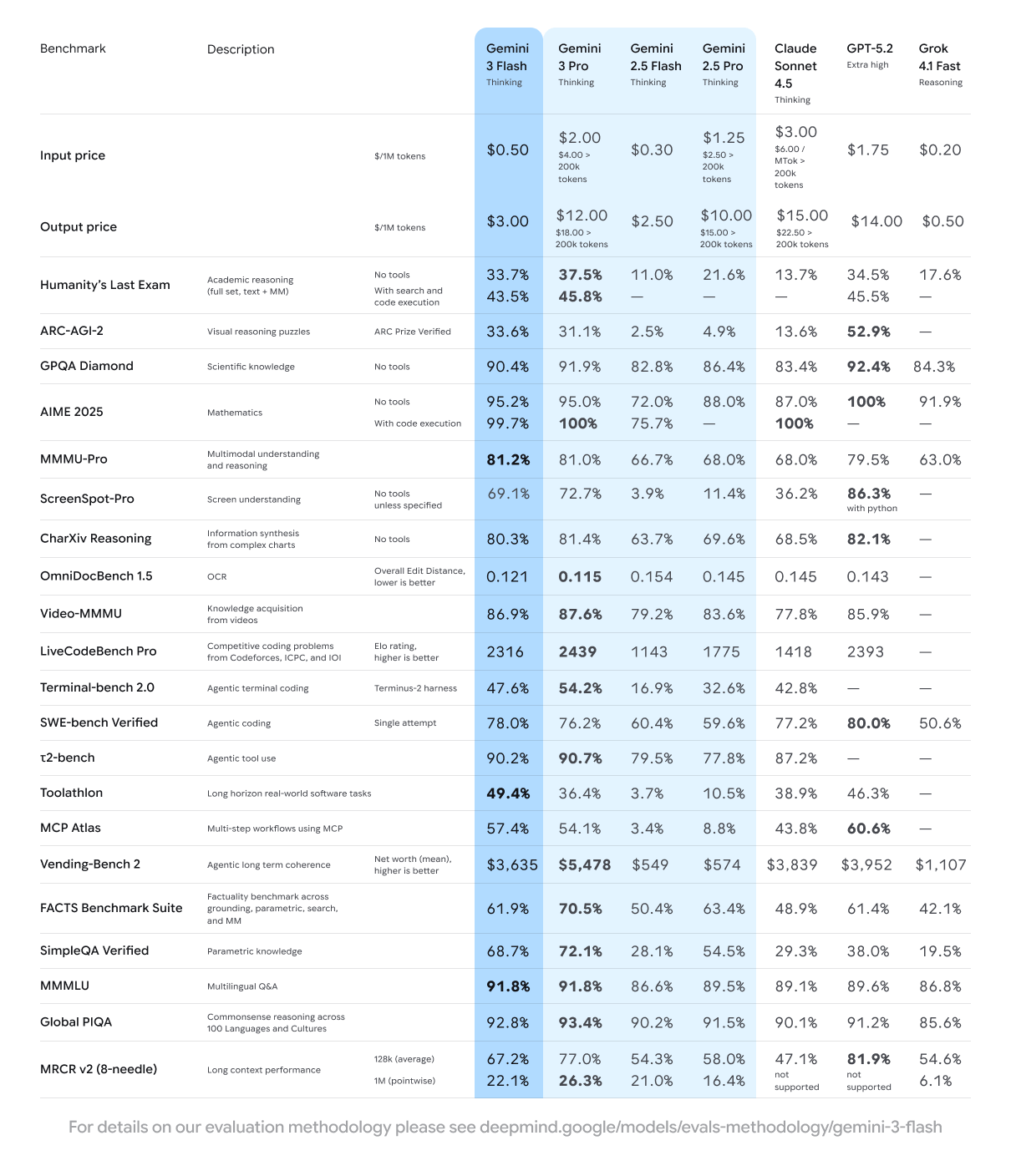
This year, we significantly advanced our model capabilities with breakthroughs on reasoning, multimodal understanding, model efficiency, and generative capabilities, beginning with the release of Gemini 2.5 in March and culminating in the November launch of Gemini 3 and the December launch of Gemini 3 Flash.

Built on a foundation of state-of-the-art reasoning, Gemini 3 Pro is our most powerful model to date, designed to help you bring any idea to life. It topped the LMArena Leaderboard and redefined multimodal reasoning with breakthrough scores on benchmarks like Humanity’s Last Exam — a fiendishly hard test for AI models to see if AI can truly think and reason like humans — and GPQA Diamond. It also set a new standard for frontier models in mathematics, achieving a new state-of-the-art of 23.4% on MathArena Apex. We followed shortly with Gemini 3 Flash, which combines Gemini 3's Pro-grade reasoning with Flash-level latency, efficiency and cost, making it the most performant model for its size. Gemini 3 Flash's quality surpasses our previous Gemini 2.5 Pro-scale model's capabilities at a fraction of the price and substantially better latency, continuing our Gemini-era trend of 'the next generation's Flash model is better than the previous generation's Pro model'.

Learn more about our progress on our world-class AI models this year:

Gemini 3 Flash price & benchmark table. 

....MUCH MORE 

Tuesday, January 27, 2026

"These are the European startups Nvidia backed in 2025, as it ramped up investing in the continent’s AI companies" (NVDA)

From CNBC, January 26:

  • In 2025, Nvidia hugely upped its investments in European tech companies, taking part in 14 funding rounds, compared to seven in 2024.
  • The chip giant invested in leading European startups, including Mistral, Revolut and Lovable.
  • The investments “mirror its broader, global strategy of taking its excess cash and reinvesting in the AI ecosystem across a host of startups,” an analyst told CNBC. 

Nvidia has become something of an AI kingmaker as hyperscalers rush to build out AI capacity. It’s also got cash to burn and has ratcheted up its investments in European startups.

Last year, Nvidia participated in 14 rounds for European tech companies, according to deal-counting platform Dealroom, compared to seven in 2024, five in 2023, one in 2022 and none in 2021 or 2020.

The 14 European investments were among the 86 startup rounds it invested in globally that year. 

https://image.cnbcfm.com/api/v1/image/108252128-1768378877210-Screenshot_2026-01-14_082044.png?v=1768378929&ffmt=webp&vtcrop=y

Nvidia has been on a charm offensive within the industry as it looks to deepen its ties to some of the world’s most promising companies, offering technical expertise and supply chain assistance, alongside hard cash.

The trend has continued in 2026, with British AI startup Synthesia announcing on Monday that Nvidia had participated in the company’s $200 million Series E.

The chip giant’s spending spree is part of a wider push to deepen its ties to the world’s most promising startups as it looks to consolidate its position as AI leader. 

“Nvidia’s investments in European AI firms appear to mirror its broader, global strategy of taking its excess cash and reinvesting in the AI ecosystem across a host of startups,” Brian Colello, senior equity analyst at Morningstar, told CNBC.

These are all the European tech companies Nvidia, or its venture arm NVentures, invested in last year and the total size of the round it participated in, per Dealroom.

Mistral

Round: 1.7 billion euros, September

One of Europe’s leading AI labs, French startup Mistral is building models aiming to rival those produced by the likes of OpenAI and Google. Before participating in Mistral’s 1.7 billion euro Series C funding round in September, which valued the company at 11.7 billion euros ($13.6 billion), the chip giant invested in the AI company’s Series B in 2024. 

Nscale

Rounds: $1.1 billion, September and $433 million, October

Nscale, which is building data centers and provides AI cloud computing services, courted Nvidia throughout 2025, with the chip giant’s CEO, Jensen Huang, announcing in September it would invest £500 million into the company. The UK-based startup promptly announced two rounds, both featuring Nvidia, at the end of September and the start of October. 

Quantinuum

Round: $600 million, September

Quantum computing company Quantinuum announced a fresh funding round, backed by Nvidia, in September which saw it valued at $10 billion. The raise will support continued progress toward the upcoming launch of the company’s next-generation quantum computing system Helios....

....MUCH MORE 

Wednesday, December 31, 2025

Wedbush's Technology Uber-Bull Dan Ives' 2026 Tech Predictions

Via the LinkedIn of  Todd Rosen:


If the image doesn't appear on our blog here is the LinkedIn page:

https://www.linkedin.com/posts/toddarosen_top-10-tech-predictions-for-2026-from-dan-activity-7407823251218853889-yEX9 

And a quick rephrasing of Mr. Ives' points:

  1. Tech stocks +20% in 2026:AI-driven growth (software, chips, infrastructure) pushes tech markets higher.
  2. Tesla:Launches Robotaxis in 30+ cities; starts large-scale Cybercab production.
  3. Apple + Google AI partnership:Joint work on Gemini AI to create Apple’s formal AI strategy.
  4. AI infrastructure M&A:Nebius seen as the top acquisition target by a hyperscaler (Microsoft, Alphabet, Amazon).
  5. Cybersecurity boom:One of the best performing subsectors.
  6. Oracle:Expands data centers, converts AI backlog, targets $250/share in 2026.
  7. Quantum tech funding:U.S. government (Trump administration) invests in quantum companies (likely IonQ, Rigetti) for national security reasons.
  8. Microsoft:Hits peak AI productivity via Azure and Copilot ecosystem.
  9. Nvidia dominance continues:Expands global AI chip lead; gains further China access via U.S.-China trade deals.
  10. Palantir:Expands AI platform (AIP) success; valued at $1T within 2–3 years.

Friday, December 26, 2025

"The economic divide between big and small companies is growing"

But you knew that.* 

From the Wall Street Journal via MSN, December 25: 

It has been a good year for most of America’s biggest companies, with surging profits and enthusiasm for artificial intelligence propelling stocks to record highs. But for many small businesses, it has been just the opposite.

At small businesses, which are unable to withstand economic headwinds as easily as their larger counterparts, years of high inflation, increasingly cautious consumers and tariffs are weighing on earnings and prompting cutbacks. Over the past six months, private firms with fewer than 50 workers have steadily shed jobs, according to payroll processor ADP, cutting 120,000 in November alone. Midsize and, especially, large firms have continued to add jobs.

Cumulative change in employment since Dec. 2024, by firm size

Typically, in early December, Almost Famous Popcorn would have been staffing up for the holiday rush, when the gourmet popcorn company does 60% of its sales.

“In a normal year we’d hire 10 to 15, and this year we’re closer to four or five,” said Sydney Rieckhoff, chief executive of the Cedar Rapids, Iowa-based company. “We’re definitely seeing more thoughtful spending,” she said, with companies placing smaller orders for client and staff gifts.

It has been a good year for most of America’s biggest companies, with surging profits and enthusiasm for artificial intelligence propelling stocks to record highs. But for many small businesses, it has been just the opposite.

At small businesses, which are unable to withstand economic headwinds as easily as their larger counterparts, years of high inflation, increasingly cautious consumers and tariffs are weighing on earnings and prompting cutbacks. Over the past six months, private firms with fewer than 50 workers have steadily shed jobs, according to payroll processor ADP, cutting 120,000 in November alone. Midsize and, especially, large firms have continued to add jobs.

Cumulative change in employment since Dec. 2024, by firm size

Typically, in early December, Almost Famous Popcorn would have been staffing up for the holiday rush, when the gourmet popcorn company does 60% of its sales.

“In a normal year we’d hire 10 to 15, and this year we’re closer to four or five,” said Sydney Rieckhoff, chief executive of the Cedar Rapids, Iowa-based company. “We’re definitely seeing more thoughtful spending,” she said, with companies placing smaller orders for client and staff gifts.

The growing divide between the fortunes of small and large businesses mirrors the divide that has emerged over the past year between low-income Americans and their high-income counterparts. That split among categories of consumers is exacerbating, according to the Federal Reserve’s latest compilation of economic anecdotes from around the country, known as the beige book. “Overall consumer spending declined further, while higher-end retail spending remained resilient,” it said.

The growing divides are also related: Workers at small businesses tend to earn less than those at large companies. And the increases in stock-market wealth stemming from the rally in shares of large, public companies accrue mostly to the rich.

“We’re seeing two different economic realities on both the consumer and the business landscape,” said Bank of America Institute economist Taylor Bowley.

Giant, well-capitalized businesses such as Amazon.com and Nvidia generally have had a very good year. Net income for the large, publicly traded companies in the S&P 500 was up 12.9% from a year earlier in the third quarter, according to LSEG..... 

....MUCH MORE
*
This dynamic has been one of our guiding principles for investing in the 2020's. 

April 2023 - HBR—From Pareto To Hyper-Pareto: "AI Is Going to Change the 80/20 Rule"

This type of information advantage is more and more accruing to the biggest and richest of corporations. It is a type of rich-get-richer advantage akin to the flywheel effect.

And related, now that we see what is happening, what, if anything, should society do about it?

...Much more important than the direct monetization of big data is the strategic advantage it can bestow over time.
In a winner-take-all economy, as in a horse race, small differences in superiority are rewarded all out of proportion to the actual advantage. A top thoroughbred may only be a couple fifths of a second faster than the field but those two lengths over the course of a season can mean triple the earnings for #1 vs. #2.
In commerce the results can be even more dramatic because rather than the 60%/20%/10% purse structure of the racetrack the winning vendor will often get 100% of a customer's business.....
February 2024 - The Hyper-Pareto Distribution Of Profits Is Happening Right Now (plus an anniversary)

It's not some cutesy management* fad or pop insight like "Business secrets of Genghis Khan."

To the rich go the profits and internalizing that fact makes the rest of this portfolio construction/fund management/investing stuff easier to conceptualize and execute.

And AI is accelerating the already extant dynamic....

Just to reiterate, every incremental advantage that a company can afford does not affect income production in isolation. They accrete in sometimes unforeseeable combinations:

How to Think About Companies: "Advantage Flywheels"
A very handy conceptual framework first posted after the start of the U.S. lockdowns, April 2020. Schools were closed so it seemed natural to link to a superb mini-MBA module.  
Eat your heat out HBR....

 *****

As artificial intelligence comes more and more to the fore, the advantages accruing to those companies that can afford to make use of their data and custom train the machines will act as advantage flywheels that shift the distribution of profits from the normal Pareto: 80% of the loot goes to the top 20% of businesses to perhaps as much as 95% of all the profits going to the top 5% of businesses.

I didn't really mean the "eat your heart out HBR" line.

Here's the Harvard Business Review on this very point:
HBR—From Pareto To Hyper-Pareto: "AI Is Going to Change the 80/20 Rule"

July 2025 - "The 'new normal' of growth stock dominance"

What our five years of blather regarding advantage flywheels is all about.....

***** 

"Analyzing the deepening divide in learning capabilities between a few corporate giants and the rest of the world." (plus advantage flywheels)

"America's Biggest Firms' Moat Is Becoming Impregnable" (TSLA; NVDA; GOOG)
The announcement at the end of August that Tesla was going live with their supercomputer — Elon Got Himself A Supercomputer: "Tesla's $300 Million AI Cluster Is Going Live Today" (TSLA)—reminded me of this piece at ZeroHedge, last month. We'll be back with more on Morgan Stanley's Tesla note later today but for now the TL;dr is "To the victor go the spoils" or "The rich get richer" or "Those who can afford a supercomputer will get closer to discovering the profitability (if any) of AI than those who can't afford a supercomputer."
In Nvidia's World, If You (and your company) Don't Have Money You Will Not Be Able To Compete (NVDA)

The advantage flywheels keep spinning and reinforcing each other to the point that the Pareto distribution of profits - 20% of companies reap 80% of the profits - is becoming Super-Pareto where 5% of the companies reap 95% of the profits and is approaching Hyper-Pareto at maybe 2% of companies reaping 98% of profits.

It all comes down to having the resources to keep up. 

I watched Mr. Huang give the keynote and it's all a bit much to digest before firing out comments that would make any sense at all so here are some of today's headlines to give a taste of what the intro paragraph is based on.

These are Nvidia's press releases via GlobeNewswire....

"Elon Musk says any company that isn’t spending $10 billion on AI this year like Tesla won’t be able to compete" (TSLA)

This.

This is such an important concept to grasp. It's the advantage flywheels, the rich get richer, winner-take-all reality of business in 2024....

And many, many more. 

Again: 

Saturday, November 22, 2025

"The Godmother of AI Didn’t Expect It to Be This Massive"

From Bloomberg, November 21:

Stanford scientist Fei-Fei Li talks about teaching machines to see as humans do, the US-China AI arms race, and what worries her about a more automated future. 

AI is now so present in our lives that the story of how it came to be so is receding — that is, if we ever absorbed it properly. It’s a tale of scientists laboring for years in the hope of one day making machines intelligent, and breaking down the components of human intelligence in order to get there.

Stanford University professor Fei-Fei Li was at the forefront of that quest, which is why she has been called the “godmother of AI.” In 2006 she released her academic work on a visual database containing millions of images, and the idea of training computers to “see” as humans do sparked a wave of AI development.

Behind this breakthrough is a woman with an unusual background, one that plays a role in how she sees the world. Li arrived in the US at age 15 when her parents emigrated from China. She spoke little English and had to adjust academically, socially and financially to a new environment; after her parents set up a small dry-cleaning business to make ends meet, she ran it through her college years.

When Li came into Bloomberg headquarters in London, we talked about her personal and professional history, and I found in her a deep sensitivity. Excited about the potential of technology she’s helped create, she also emphasizes human agency — you’ll find her message to parents towards the end. 

This conversation has been edited for length and clarity. You can listen to an extended version in the latest episode of The Mishal Husain Show podcast. 

May I start with this remarkable period for your industry? It’s been three years since ChatGPT was released to the public. Since then there have been new vehicles, new apps and huge amounts of investment. How does this moment feel to you?

AI is not new to me. I’ve been in this field for 25 years. I’ve lived and breathed it every day since the beginning of my career. Yet this moment is still daunting and almost surreal to me, in terms of its massive, profound impact.

This is a civilizational technology. I’m part of the group of scientists that made this happen and I did not expect it to be this massive. 1

1 Li spoke to us while in London to receive the 2025 Queen Elizabeth Prize for Engineering, alongside Nvidia CEO Jensen Huang and five others. Li has previously written and spoken about what she’s called “the AI winter” of the early 21st century, when those working in the field were getting no attention.

When was the moment it changed? Is it because of the pace of developments or because the world has woken up and therefore turned the spotlight on people like you?

I think it’s intertwined, right? But for me to define this as a civilizational technology is not about the spotlight. It’s not even about how powerful it is. It is about how many people it impacts.

Everyone’s life, work, wellbeing, future, will somehow be touched by AI.

AI Investment Surge
Capital spending on AI-related activities exceeds half of all investment...
*** 

In bad ways as well as good?

Well, technology is a double-edged sword, right? Since the dawn of human civilization, we have created tools we call technologies, and these tools are meant, in general, for doing good things. Along the way we might intentionally use them in the wrong way, or they might have unintended consequences.

In bad ways as well as good?

Well, technology is a double-edged sword, right? Since the dawn of human civilization, we have created tools we call technologies, and these tools are meant, in general, for doing good things. Along the way we might intentionally use them in the wrong way, or they might have unintended consequences.

You said the word powerful. The power of this technology is in the hands of a very small number of companies, most of them American. How does that sit with you?

You are right. The major tech companies — through their products — are impacting our society the most. I would personally like to see this technology being much more democratized.

No matter who builds, or holds, the profound impact of this technology: Do it in a responsible way.

I also believe every individual should feel they have the agency to impact this technology.

You are a tech CEO as well as an academic. Your very young company, little more than a year old, is reportedly already worth a billion dollars.

Yes! [Laughs]

I am co-founder and CEO of World Labs. We are building the next frontier of AI — spatial intelligence — which people don’t hear too much about today because we’re all about large language models. I believe spatial intelligence is as critical [as] — and complementary to — language intelligence. 2

2 World Labs raised more than $200 million ahead of its launch in 2024. In a TED Talk she delivered that year, Li said: “If we want to advance AI beyond its current capabilities, we want more than AI that can see and talk. We want AI that can do.”

I know that your first academic love was physics.

Yes.

What was it in the life or work of the physicists you most admired that made you think beyond that particular field?

I grew up in a small, or less well known, city in China. And I come from a small family. So you could say life was small, in a sense. My childhood was fairly simple and isolated. I was the only child. 3

3 Li grew up in Chengdu in China’s Sichuan Province; her mother was a teacher and her father worked in the computer department of a chemicals factory. In her book The Worlds I See: Curiosity, Exploration and Discovery at the Dawn of AI, she linked her professional path to her early years: “Research triggered the same feeling I got as a child exploring the mountains surrounding Chengdu with my father, when we’d spot a butterfly we’d never seen before, or happen upon a new variety of stick insect.”

Physics is almost the opposite — it’s vast, it’s audacious. The imagination is unbounded. You look up in the sky, you can ponder the beginning of the universe. You look at a snowflake, you can zoom into the molecular structure of matter. You think about time, magnetic fields, nuclear.

It takes my imagination to places that you can never be in this world. What fascinates me to this day about physics is to not be afraid of asking the boldest, [most] audacious questions about our physical world, our universe [and] where we come from.

But your own audacious question, I think, was What is intelligence?

Yes. Each physicist I admire, I look at their audacious question, right from [Isaac] Newton to [James Clerk] Maxwell to [Erwin] Schrödinger to Einstein — my favorite physicist.

I wanted to find my own audacious question. Somewhere in the middle of college, my audacious question shifted from physical matters to intelligence. What is it? How does it come about? And most fascinatingly, How do we build intelligent machines? That became my quest, my north star.

And that’s a quantum leap because, from machines that were doing calculations and computations, you’re talking about machines that learn, that are constantly learning.

I like [that] you use the physics pun, the quantum leap.

Around us right now, there are multiple objects. We know what they are. The ability that humans have to recognize objects is foundational. My PhD dissertation was to build machine algorithms to recognize as many objects as possible.

What I found really interesting about your background is that you were reading very widely. And your ultimate breakthrough was possible when you started thinking about what psychologists and linguists were saying that was related to your field.

That’s the beauty of doing science at the forefront. It’s new, no one knows how to do it.

It’s pretty natural to look at the human brain and human mind and try to understand, or be inspired by, what humans can do. One of the inspirations in my early days of trying to unlock this visual intelligence problem was to look at how our visual semantic space is structured. There are so many tens and thousands, millions, of objects in the world. How are they organized? Are they organized by alphabet, or by size or colors? 4

4 While doing her PhD at Caltech, Li became convinced that larger datasets would be crucial to AI progress. Later, she was influenced by neuroscientist and psychologist Irving Biederman’s paper on human image understanding, which estimated that the average person recognizes around 30,000 different kinds of objects....

....MUCH MORE 

Earlier on Professor Li:
"Fei-Fei Li’s Startup Allows You to Walk in the 3D World of Edward Hopper Paintings"

The godmother of AI.

From Observer, December 4:

The new startup is working to develop A.I. models with so-called "spatial intelligence."

https://observer.com/wp-content/uploads/sites/2/2024/12/GettyImages-455615214.jpg?resize=970,647

The startup is turning images of famous artworks like Edward Hopper’s Nighthawks into 3D worlds. 
Scott Olson/Getty Images
World Labs, a startup co-founded by Stanford A.I. pioneer Fei-Fei Li earlier this year that quickly grabbed the attention of high-profile investors, has remained relatively quiet on its products—until now. The startup yesterday (Dec. 3) provided a glimpse of one of its early projects, which takes the form of virtual 3D scenes generated from a 2D image. “This will change how we make movies, games, simulators and other digital manifestations of our physical worlds,” said World Labs in a blog post accompanied by interactive examples of its 3D worlds. The preview shines a light on Li’s larger efforts to develop A.I. models that have “spatial intelligence” and can understand and interact with the real world....

....MUCH MORE

 Ha, that's nothin'. Iowahawk (David Burge) has been inserting himself into Nighthawks for years.

https://pbs.twimg.com/profile_banners/149913262/1603379184/1080x360

Previously on the good Professor:

Fei-Fei Li is a big deal in the world of AI....

May 2024 - "‘Godmother of A.I.’ Fei-Fei Li On Why You Shouldn’t Trust Any A.I. Company"
It's not the technology that should be feared it is the people using the technology.

In March 2016 this seemed noteworthy:
The Hottest PhD Market In the World
From The .Plan: A Quasi-Blog:
Fei-Fei Li, a Stanford University professor who is an expert in computer vision, said one of her Ph.D. candidates had an offer for a job paying more than $1 million a year, and that was only one of four from big and small companies.
--John Markoff and Steve Lohr, NYT, on the brains arms race in artificial intelligence

And in May 2024 this did:
Former Google CEO Schmidt On The Ever-Increasing Tempo Of AI

Gardels: One thing that worries Fei-Fei Li of the Stanford Institute on Human-Centered AI is the asymmetry of research funding between the Microsofts and Googles of the world and even the top universities. As you point out, there are hundreds of billions invested in compute power to climb up the capability ladder in the private sector, but scarce resources for safe development at research institutes, no less the public sector....
....Eventually, in both the U.S. and China, I suspect there will be a small number of extremely powerful computers with the capability for autonomous invention that will exceed what we want to give either to our own citizens without permission or to our competitors.  They will be housed in an army base, powered by some nuclear power source and surrounded by barbed wire and machine guns..... 

Again, only those with massive amounts of cash will be able to maximize the benefits of AI.

See advantage flywheels and hyper-Pareto distribution of profits if interested.

And possibly most important:

March 18 - In Nvidia's World, If You (and your company) Don't Have Money You Will Not Be Able To Compete (NVDA)

So:
"'AI godmother' Fei-Fei Li raises $230 million to launch AI startup"