Two from International Banker. First up, August 24:
On Chinese social media, the word neijuan—involution—has become shorthand for the grinding sense that everyone is racing harder but getting nowhere. State media officially refers to it as “rat race-style irrational competition”. The symptoms are everywhere: Parents scramble to buy tutoring hours for preschoolers, young professionals log “996” workweeks (9 AM to 9 PM, six days a week) to show commitment, and startups pour money into user-acquisition contests in which winners are decided by who can lose the most. The result, in public conversation and private life, is pervasive exhaustion: more effort, smaller returns.
Neijuan isn’t just a mood; it is the visible product of structural forces that push people and firms into escalating, largely zero-sum competition. Four dynamics in particular combine to make involution unusually widespread in contemporary China: a vast pool of entrepreneurial aspiration, a “copy-and-scale” business culture, state-enabled production and subsidies, and a credential-driven labor market.
Too many founders chasing too few distinct opportunities
China is an entrepreneurial country. Whether driven by necessity, opportunity or cultural prestige, an unusually large absolute number of people want to start businesses or be their own bosses. Entrepreneurship rates in China—particularly early-stage activity among young people—are elevated compared with many advanced economies. Data from the Global Entrepreneurship Monitor shows that up to 2019, entrepreneurial intention—defined as the percentage of the 18-64 population who are latent entrepreneurs and intend to start a business within three years—was in the double digits (see Figure 1). Multiply even modestly higher entrepreneurial intention by a population of roughly 1.4 billion, and the result is an enormous number of would-be founders. By the early 2020s, cumulative registrations of market entities in China exceeded 100 million, with millions of new firms registering every year.

This high level of aspiration is reflected in data from the World Values Survey (WVS), which reveals a distinct Wealth Value Gap (Figure 2). While populations in the United Kingdom and France largely reject “being rich” as a core personal value, the Chinese show a much broader acceptance of wealth as a primary goal. This is paired with a significantly more positive outlook on market rivalry. Echoing President Xi Jinping’s repeated assertions that “China is not afraid of competition”, the data also shows that the Chinese lean heavily toward viewing competition as a beneficial force, whereas their Western and Japanese cohorts remain far more skeptical....
....Copy, iterate, scale: when imitation becomes a race to the bottom...
....MUCH MORE
And August 10:
China’s Banking Problem of Unwanted Credit
At the end of June, rediscount rates on Chinese commercial bills—short-term payment instruments that banks can buy as credit assets—fell to 0.01 percent as lenders rushed to meet quarter-end targets. Regulators subsequently imposed a 0.5-percent floor and, on July 22, extended it to both bid and ask quotes from all market participants. The episode showed how aggressively banks were competing for assets while demand for ordinary loans remained weak.
That imbalance is concentrated rather than economy-wide. Strategic industries, state-linked borrowers and some exporters continue to absorb substantial credit, while households and many domestically exposed private firms remain cautious. Pressuring banks to increase lending volumes can therefore weaken underwriting standards and create future bad loans without producing much additional consumption or private investment.
Chinese banks extended 1.61 trillion yuan in new loans in June, up from 520 billion yuan in May but below the 1.95-trillion yuan expected by economists surveyed by the Wall Street Journal. June normally produces a firm quarter-end increase as banks strive to meet lending targets, making the shortfall particularly revealing.
Such weakness reflects the wider slowdown in China’s economy. Gross domestic product (GDP) grew by 4.3 percent year-on-year in the second quarter, down from 5 percent in the previous quarter and the slowest pace since late 2022. Industrial production expanded by 5.3 percent in June, supported by exports and high-technology manufacturing, while retail sales rose by only 1 percent. Fixed-asset investment excluding rural households fell by 5.7 percent during the first half, including an 18-percent decline in real-estate development investment. Private fixed-asset investment fell by 8.5 percent, or 4.9 percent after excluding real estate.
This divergence helps explain uneven credit demand. Exporters and technology firms benefit from external demand, industrial policy and several financing channels. Households and companies dependent on the domestic economy face a far weaker environment. Dan Wang, China director at Eurasia Group, described export performance as “quite stellar”, but added that it “doesn’t really trickle down to any of the domestic demand”. Much of that strength comes from capital-intensive, highly automated manufacturing, limiting the benefits to household incomes and employment....
....MUCH MORE
There was a time when China's credit impulse was the most important number on the monthly data calendar. Now, not so much:
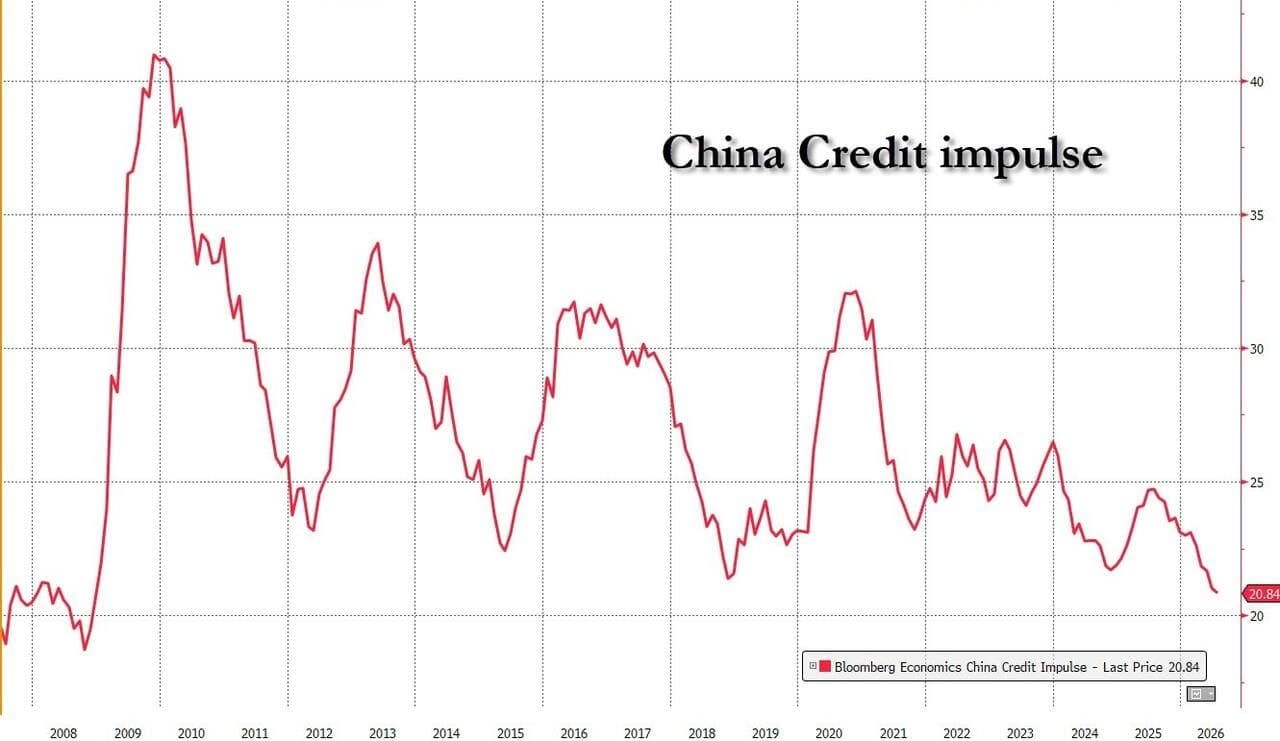
Via Dark Side of the Boom, September 8
Still going down.
If interested here is an older (2024) Bloomberg article:
China’s Once-Mighty Credit Cycle Is a Fading Force on World Markets

