Showing posts sorted by relevance for query advantage flywheels. Sort by date Show all posts

Wednesday, July 9, 2025

"The 'new normal' of growth stock dominance"

What our five years of blather regarding advantage flywheels is all about.* 

From Yahoo Finance, July 8:

It pays to be big. And it's a good time to be on team growth.

A key insight from recent years — from the pandemic crisis through the "Liberation Day" turmoil — is that the most well-capitalized and growth-oriented names are outperforming their counterparts.

Investors who tend to favor small-cap and value stocks, because of their time horizon, risk appetite, or other preferences, might point to earlier periods of trading to show the merits of their strategy.

Last year notably featured glimmers of a small-cap revival.

A broadening of the stock market rally, optimistic economic forecasts, and expectations of Fed rate cuts bolstered the case for the double-A and triple-A tickers that don't always get the major league limelight.

But the call for small caps turned out to be short-lived, ill-suited for the trade conflicts of 2025 and the wait-and-see posturing of the central bank.

In fact, the performance gap between US large and small caps has widened considerably over the last two-and-a-half years, according to a new analysis by DataTrek co-founder Nicholas Colas, who wrote in a recent note to clients that the duration of the relative outperformance suggests it's structural rather than cyclical.

"Relative return data suggests that there is a 'new normal' at play in US stock markets, one where large caps and Growth have the upper hand versus small caps and Value," he wrote. "Moreover, enough time has passed that these differences look durable rather than being temporary anomalies."

Big Tech's steadfast march to higher valuations has played a major role in the stock market's lopsided behavior.

But the growth of the Magnificent Seven is only part of the story....
*** 
...While a broadening rally hasn't unfolded in the way small-cap proponents had hoped, the spoils of AI excitement have flowed to many other players aside from the mega-rich tech platforms. As my colleague Josh Schafer has reported in this newsletter, AI chip and data center trades not named Nvidia (NVDA) have posted some of the highest gains in the S&P 500 (^GSPC). Investments in AI energy and cloud tickers have payed off too....

This is a corollary of the basic framework for understanding businesses and investing that we've been pitching for the last six or seven years.

If interested see:

Why Do the Biggest Companies Keep Getting Bigger? It’s How They Spend on Tech" 

...Much more important than the direct monetization of big data is the strategic advantage it can bestow over time.
In a winner-take-all economy, as in a horse race, small differences in superiority are rewarded all out of proportion to the actual advantage. A top thoroughbred may only be a couple fifths of a second faster than the field but those two lengths over the course of a season can mean triple the earnings for #1 vs. #2.
In commerce the results can be even more dramatic because rather than the 60%/20%/10% purse structure of the racetrack the winning vendor will often get 100% of a customer's business.....

Competitive Advantage and Feedback Loops

How to Think About Companies: 'Advantage Flywheels'
A very handy conceptual framework first posted after the start of the U.S. lockdowns, April 2020. Schools were closed so it seemed natural to link to a superb mini-MBA module.
Eat your heat out HBR....
****  
....As artificial intelligence comes more and more to the fore, the advantages accruing to those companies that can afford to make use of their data and custom train the machines will act as advantage flywheels that shift the distribution of profits from the normal Pareto: 80% of the loot goes to the top 20% of businesses to perhaps as much as 95% of all the profits going to the top 5% of businesses.
I didn't really mean the "eat your heart out HBR" line.

Here's the Harvard Business Review on this very point:
HBR—From Pareto To Hyper-Pareto: "AI Is Going to Change the 80/20 Rule"

Flywheel Effect: Why Positive Feedback Loops are a Meta-Competitive Advantage

"Analyzing the deepening divide in learning capabilities between a few corporate giants and the rest of the world." (plus advantage flywheels)

"America's Biggest Firms' Moat Is Becoming Impregnable" (TSLA; NVDA; GOOG)
The announcement at the end of August that Tesla was going live with their supercomputer — Elon Got Himself A Supercomputer: "Tesla's $300 Million AI Cluster Is Going Live Today" (TSLA)—reminded me of this piece at ZeroHedge, last month. We'll be back with more on Morgan Stanley's Tesla note later today but for now the TL;dr is "To the victor go the spoils" or "The rich get richer" or "Those who can afford a supercomputer will get closer to discovering the profitability (if any) of AI than those who can't afford a supercomputer."
In Nvidia's World, If You (and your company) Don't Have Money You Will Not Be Able To Compete (NVDA)

The advantage flywheels keep spinning and reinforcing each other to the point that the Pareto distribution of profits - 20% of companies reap 80% of the profits - is becoming Super-Pareto where 5% of the companies reap 95% of the profits and is approaching Hyper-Pareto at maybe 2% of companies reaping 98% of profits.

It all comes down to having the resources to keep up. 

I watched Mr. Huang give the keynote and it's all a bit much to digest before firing out comments that would make any sense at all so here are some of today's headlines to give a taste of what the intro paragraph is based on.

These are Nvidia's press releases via GlobeNewswire....

"Elon Musk says any company that isn’t spending $10 billion on AI this year like Tesla won’t be able to compete" (TSLA)

This.

This is such an important concept to grasp. It's the advantage flywheels, the rich get richer, winner-take-all reality of business in 2024....

The Hyper-Pareto Distribution Of Profits Is Happening Right Now (plus an anniversary)
It's not some cutesy management* fad or pop insight like "Business secrets of Genghis Khan."

To the rich go the profits and internalizing that fact makes the rest of this portfolio construction/fund management/investing stuff easier to conceptualize and execute.

And AI is accelerating the already extant dynamic....
*****

*Although people had been observing and discussing "rich get richer" and "winner-take-all" dynamics for over a century, one of our favorite pointers toward the current situation did come out of a business school. We've been hammering on this for so long that I start to bore myself. Here's a recapitulation from last year, linking to an article that was published seven years ago today:

HBR—From Pareto To Hyper-Pareto: "AI Is Going to Change the 80/20 Rule"

A prescient article from the Harvard Business Review, February 28, 2017:....

*****

Just to reiterate, every incremental advantage that a company can afford does not affect income production in isolation. They accrete in sometimes unforeseeable combinations:

AI: Tesla Installing Second Dojo Supercomputer In New York Gigafactory (TSLA; NVDA)

AI: "Inside Tesla’s Innovative And Homegrown 'Dojo' AI Supercomputer" (TSLA)

It really is a big deal that a company can afford to spend over a billion dollars to build their own supercomputer and it really is a big deal that the same company has all the training data from the billions of miles of real-world driving and it really is a great example of the concept of advantage flywheels and hyper-pareto distribution of rewards, i.e. the rich get richer.

Whether it is going to open-up the $10 trillion addressable market and add the $500 billion of market cap that Morgan Stanley foresees is still an open question....

....As artificial intelligence comes more and more to the fore, the advantages accruing to those companies that can afford to make use of their data and custom train the machines will act as advantage flywheels that shift the distribution of profits from the normal Pareto: 80% of the loot goes to the top 20% of businesses to perhaps as much as 95% of all the profits going to the top 5% of businesses.

I didn't really mean the "eat your heart out HBR" line.

Here's the Harvard Business Review on this very point:
HBR—From Pareto To Hyper-Pareto: "AI Is Going to Change the 80/20 Rule"

And many more. If interested use the 'search blog' box, upper left.

Friday, December 26, 2025

"The economic divide between big and small companies is growing"

But you knew that.* 

From the Wall Street Journal via MSN, December 25: 

It has been a good year for most of America’s biggest companies, with surging profits and enthusiasm for artificial intelligence propelling stocks to record highs. But for many small businesses, it has been just the opposite.

At small businesses, which are unable to withstand economic headwinds as easily as their larger counterparts, years of high inflation, increasingly cautious consumers and tariffs are weighing on earnings and prompting cutbacks. Over the past six months, private firms with fewer than 50 workers have steadily shed jobs, according to payroll processor ADP, cutting 120,000 in November alone. Midsize and, especially, large firms have continued to add jobs.

Cumulative change in employment since Dec. 2024, by firm size

Typically, in early December, Almost Famous Popcorn would have been staffing up for the holiday rush, when the gourmet popcorn company does 60% of its sales.

“In a normal year we’d hire 10 to 15, and this year we’re closer to four or five,” said Sydney Rieckhoff, chief executive of the Cedar Rapids, Iowa-based company. “We’re definitely seeing more thoughtful spending,” she said, with companies placing smaller orders for client and staff gifts.

The growing divide between the fortunes of small and large businesses mirrors the divide that has emerged over the past year between low-income Americans and their high-income counterparts. That split among categories of consumers is exacerbating, according to the Federal Reserve’s latest compilation of economic anecdotes from around the country, known as the beige book. “Overall consumer spending declined further, while higher-end retail spending remained resilient,” it said.

The growing divides are also related: Workers at small businesses tend to earn less than those at large companies. And the increases in stock-market wealth stemming from the rally in shares of large, public companies accrue mostly to the rich.

“We’re seeing two different economic realities on both the consumer and the business landscape,” said Bank of America Institute economist Taylor Bowley.

Giant, well-capitalized businesses such as Amazon.com and Nvidia generally have had a very good year. Net income for the large, publicly traded companies in the S&P 500 was up 12.9% from a year earlier in the third quarter, according to LSEG..... 

....MUCH MORE
*
This dynamic has been one of our guiding principles for investing in the 2020's. 

April 2023 - HBR—From Pareto To Hyper-Pareto: "AI Is Going to Change the 80/20 Rule"

This type of information advantage is more and more accruing to the biggest and richest of corporations. It is a type of rich-get-richer advantage akin to the flywheel effect.

And related, now that we see what is happening, what, if anything, should society do about it?

...Much more important than the direct monetization of big data is the strategic advantage it can bestow over time.
In a winner-take-all economy, as in a horse race, small differences in superiority are rewarded all out of proportion to the actual advantage. A top thoroughbred may only be a couple fifths of a second faster than the field but those two lengths over the course of a season can mean triple the earnings for #1 vs. #2.
In commerce the results can be even more dramatic because rather than the 60%/20%/10% purse structure of the racetrack the winning vendor will often get 100% of a customer's business.....
February 2024 - The Hyper-Pareto Distribution Of Profits Is Happening Right Now (plus an anniversary)

It's not some cutesy management* fad or pop insight like "Business secrets of Genghis Khan."

To the rich go the profits and internalizing that fact makes the rest of this portfolio construction/fund management/investing stuff easier to conceptualize and execute.

And AI is accelerating the already extant dynamic....

Just to reiterate, every incremental advantage that a company can afford does not affect income production in isolation. They accrete in sometimes unforeseeable combinations:

How to Think About Companies: "Advantage Flywheels"
A very handy conceptual framework first posted after the start of the U.S. lockdowns, April 2020. Schools were closed so it seemed natural to link to a superb mini-MBA module.  
Eat your heat out HBR....

 *****

As artificial intelligence comes more and more to the fore, the advantages accruing to those companies that can afford to make use of their data and custom train the machines will act as advantage flywheels that shift the distribution of profits from the normal Pareto: 80% of the loot goes to the top 20% of businesses to perhaps as much as 95% of all the profits going to the top 5% of businesses.

I didn't really mean the "eat your heart out HBR" line.

Here's the Harvard Business Review on this very point:
HBR—From Pareto To Hyper-Pareto: "AI Is Going to Change the 80/20 Rule"

July 2025 - "The 'new normal' of growth stock dominance"

What our five years of blather regarding advantage flywheels is all about.....

***** 

"Analyzing the deepening divide in learning capabilities between a few corporate giants and the rest of the world." (plus advantage flywheels)

"America's Biggest Firms' Moat Is Becoming Impregnable" (TSLA; NVDA; GOOG)
The announcement at the end of August that Tesla was going live with their supercomputer — Elon Got Himself A Supercomputer: "Tesla's $300 Million AI Cluster Is Going Live Today" (TSLA)—reminded me of this piece at ZeroHedge, last month. We'll be back with more on Morgan Stanley's Tesla note later today but for now the TL;dr is "To the victor go the spoils" or "The rich get richer" or "Those who can afford a supercomputer will get closer to discovering the profitability (if any) of AI than those who can't afford a supercomputer."
In Nvidia's World, If You (and your company) Don't Have Money You Will Not Be Able To Compete (NVDA)

The advantage flywheels keep spinning and reinforcing each other to the point that the Pareto distribution of profits - 20% of companies reap 80% of the profits - is becoming Super-Pareto where 5% of the companies reap 95% of the profits and is approaching Hyper-Pareto at maybe 2% of companies reaping 98% of profits.

It all comes down to having the resources to keep up. 

I watched Mr. Huang give the keynote and it's all a bit much to digest before firing out comments that would make any sense at all so here are some of today's headlines to give a taste of what the intro paragraph is based on.

These are Nvidia's press releases via GlobeNewswire....

"Elon Musk says any company that isn’t spending $10 billion on AI this year like Tesla won’t be able to compete" (TSLA)

This.

This is such an important concept to grasp. It's the advantage flywheels, the rich get richer, winner-take-all reality of business in 2024....

And many, many more. 

Again: 

Monday, November 4, 2024

"Amazon to cough $75B on capex in 2024, more next year" (AMZN)

From The Register, November 1:

Despite extending server lifespans, AI's power demands drive more datacenter builds

Amazon expects to spend $75 billion on capital expenditure in 2024 and even more in 2025 – mostly on its cloud computing business – due to rising demand for generative AI and as more customers ditch their on-premises workloads.

The web services arm of Amazon (AWS) reported calendar Q3 net sales of $27.45 billion, up 19 percent year-on-year, and operating expenses of $17 billion, up from $16.08 billion. Operating profit jumped almost 50 percent to $10.45 billion.

In a contradiction to the message delivered to the UK's Competition and Markets Authority in its probe into the health of the local cloud market, AWS told investors last night that its business just keeps on expanding.

"We see more enterprises growing their footprint in the cloud, evidenced in part by recent customer deals with the ANZ Banking Group, Booking.com, Capital One, Fast Retailing, Itau Unibanco, National Australia Bank, Sony, T-Mobile, and Toyota," said Amazon CEO Andy Jassy, who previously ran AWS when Jeff Bezos headed Amazon....

....MUCH MORE

What our four years of blather regarding advantage flywheels is all about. 

In Nvidia's World, If You (and your company) Don't Have Money You Will Not Be Able To Compete (NVDA)

The advantage flywheels keep spinning and reinforcing each other to the point that the Pareto distribution of profits - 20% of companies reap 80% of the profits - is becoming Super-Pareto where 5% of the companies reap 95% of the profits and is approaching Hyper-Pareto at maybe 2% of companies reaping 98% of profits.

It all comes down to having the resources to keep up. 

I watched Mr. Huang give the keynote and it's all a bit much to digest before firing out comments that would make any sense at all so here are some of today's headlines to give a taste of what the intro paragraph is based on.

These are Nvidia's press releases via GlobeNewswire....

"Elon Musk says any company that isn’t spending $10 billion on AI this year like Tesla won’t be able to compete" (TSLA)

This.

This is such an important concept to grasp. It's the advantage flywheels, the rich get richer, winner-take-all reality of business in 2024....

The Hyper-Pareto Distribution Of Profits Is Happening Right Now (plus an anniversary)
It's not some cutesy management* fad or pop insight like "Business secrets of Genghis Khan."

To the rich go the profits and internalizing that fact makes the rest of this portfolio construction/fund management/investing stuff easier to conceptualize and execute.

And AI is accelerating the already extant dynamic....
*****

*Although people had been observing and discussing "rich get richer" and "winner-take-all" dynamics for over a century, one of our favorite pointers toward the current situation did come out of a business school. We've been hammering on this for so long that I start to bore myself. Here's a recapitulation from last year, linking to an article that was published seven years ago today:

HBR—From Pareto To Hyper-Pareto: "AI Is Going to Change the 80/20 Rule"

A prescient article from the Harvard Business Review, February 28, 2017:....

*****

Why Do the Biggest Companies Keep Getting Bigger? It’s How They Spend on Tech" 

...Much more important than the direct monetization of big data is the strategic advantage it can bestow over time.
In a winner-take-all economy, as in a horse race, small differences in superiority are rewarded all out of proportion to the actual advantage. A top thoroughbred may only be a couple fifths of a second faster than the field but those two lengths over the course of a season can mean triple the earnings for #1 vs. #2.
In commerce the results can be even more dramatic because rather than the 60%/20%/10% purse structure of the racetrack the winning vendor will often get 100% of a customer's business.....

Just to reiterate, every incremental advantage that a company can afford does not affect income production in isolation. They accrete in sometimes unforeseeable combinations:

How to Think About Companies: "Advantage Flywheels"
A very handy conceptual framework first posted after the start of the U.S. lockdowns, April 2020. Schools were closed so it seemed natural to link to a superb mini-MBA module.  
Eat your heat out HBR....
AI: Tesla Installing Second Dojo Supercomputer In New York Gigafactory (TSLA; NVDA)

AI: "Inside Tesla’s Innovative And Homegrown 'Dojo' AI Supercomputer" (TSLA)

It really is a big deal that a company can afford to spend over a billion dollars to build their own supercomputer and it really is a big deal that the same company has all the training data from the billions of miles of real-world driving and it really is a great example of the concept of advantage flywheels and hyper-pareto distribution of rewards, i.e. the rich get richer.

Whether it is going to open-up the $10 trillion addressable market and add the $500 billion of market cap that Morgan Stanley foresees is still an open question....

....As artificial intelligence comes more and more to the fore, the advantages accruing to those companies that can afford to make use of their data and custom train the machines will act as advantage flywheels that shift the distribution of profits from the normal Pareto: 80% of the loot goes to the top 20% of businesses to perhaps as much as 95% of all the profits going to the top 5% of businesses.

I didn't really mean the "eat your heart out HBR" line.

Here's the Harvard Business Review on this very point:
HBR—From Pareto To Hyper-Pareto: "AI Is Going to Change the 80/20 Rule"

And many more. If interested use the 'search blog' box, upper left.

Wednesday, May 20, 2026

Hyper-Pareto: "75% of gains, 80% of profits, 90% of capex—AI’s grip on the S&P is total and Morgan Stanley’s top analyst is ‘very concerned’"

This isn't news, the article is six months old, but I pulled it out of the link-vault not because of the scary warning but because the point it illustrates, the concentration of profits in the largest companies is key to understanding the economic and investment landscape. 
(plus, as the kids say, it validates our priors) 

From Fortune, October 7, 2025:  

A top Wall Street analyst has sounded an alarm over the U.S. equity bull market, warning that its remarkable run is built on a precariously narrow foundation: a surge in spending on, and optimistic assumptions about, infrastructure for artificial intelligence (AI). This spending has fueled a boom in the shares of most of the so-called Magnificent 7 and a few dozen related businesses, which have now come to account for roughly 75% of the S&P 500’s returns since the rally of the last few years began. 

The commentary on September 29 by Morgan Stanley Wealth Management’s chief investment officer, Lisa Shalett, frames the current market boom as a “one-note narrative” almost entirely dependent on massive capital expenditures in generative AI, raising questions about its durability as economic and competitive risks start to mount. Shalett’s critique came squarely in the middle of some people in the AI field — and many financial commentators around Wall Street —fretting at market exuberance and beginning to talk openly about a bubble.

In an interview with Fortune, Shalett said she was “very concerned” about this theme in markets, saying her office had broadened from a belief that the market would only bid up seven or 10 stocks to roughly 40. “At the end of the day … this is not going to be pretty” if and when the generative AI capital expenditure story falters, she said. 

Shalett said she’s worried about a “Cisco moment” like when the dotcom bubble burst in 2000, referring to the company that was briefly the most valuable company in the world before an 80% stock plunge. When asked how close we are to such a moment, Shalett said probably not in the next nine months, but very possibly in the next 24. When you look at the actual spending and the amount of capital coming into the space, “we’re a lot closer to the seventh inning than the first or second inning,” she said.

‘Starting to do what all ultimate bad actors do’

Shalett’s comments centered on several recent multibillion-dollar deals to scale up data-center infrastructure. As notable substacker and former Atlantic writer Derek Thompson recently noted in a post titled “This is how the AI bubble will pop,” so much money is being spent to support AI’s energy-consumption needs that it’s the equivalent of a new Apollo space mission every 10 months. (Tech companies are spending roughly $400 billion this year alone on data-center infrastructure, while the Apollo program allocated about $300 billion in today’s dollars to get to the moon from the 1960s to the ’70s.)

What’s more than a little concerning to Shalett is that one company alone, Nvidia—the most valuable company in the history of the world, with an over $4.5 trillion market cap—is at the center of a significant number of these deals. In September alone, Nvidia invested $100 billion in OpenAI in a massive deal, just days after pledging $5 billion to Intel (the Intel agreement was tied to chips, not data-center infrastructure, per se).

Fortune‘s Jeremy Kahn reported in late September on significant concerns about “circular” financing, or Nvidia’s cash essentially being recycled throughout the AI industry. Shalett sees this as a major concern and a major sign that the business cycle is headed toward some kind of endgame. “The guy at the epicenter, Nvidia, is basically starting to do what all ultimate bad actors do in the final inning, which is extending financing, they’re buying their investors.”

Shalett expanded on her concerns by saying that companies around Nvidia “are starting to become interwoven.” She noted that OpenAI is partially owned by Microsoft, but now Nvidia has also made an investment in the startup, while Oracle and AMD each have their own purchasing agreements with OpenAI. But OpenAI also has a data-center deal with tech giant Oracle, with the “bad news,” Shalett notes, that this deal is “totally debt-financed.” OpenAI also struck a deal in October with chip-maker AMD that allows OpenAI to buy up to 10% of AMD. “Essentially, Nvidia’s main competitor is going to be partially owned by OpenAI, which is partially owned by Nvidia. So, Nvidia can ‘own’ a piece of its largest competitor. It is totally circular and increases systemic risk.”

When reached for comment, a spokesperson for Nvidia said, “We do not require any of the companies we invest in to use Nvidia technology.”

Nvidia CEO Jensen Huang discussed the OpenAI investment in an appearance on the Bg2 podcast with Brad Gerstner and Clark Tang on September 25, calling it an “opportunity to invest” and part of a partnership geared toward helping OpenAI build their own AI infrastructure. When asked about the allegation of circular financing in general and the Cisco precedent in particular, Huang talked about how OpenAI will fund the deal, arguing that it will have to be funded by OpenAI’s future revenues, or “offtake,” which he pointed out are “growing exponentially,” and by its future capital, whether it’s raised by a sale of equity or debt. That will depend on investors’ confidence in OpenAI, he said, and beyond that, it’s “their company, it’s not my business. And of course, we have to stay very close to them to make sure that we build in support of their continued growth.”....

....MUCH MORE 

And our priors? From a bit before the Fortune piece was published, July 9, 2025. 

"The 'new normal' of growth stock dominance"
What our five years of blather regarding advantage flywheels is all about.* 

*****

This is a corollary of the basic framework for understanding businesses and investing that we've been pitching for the last six or seven years.

If interested see:

Why Do the Biggest Companies Keep Getting Bigger? It’s How They Spend on Tech" 

...Much more important than the direct monetization of big data is the strategic advantage it can bestow over time.
In a winner-take-all economy, as in a horse race, small differences in superiority are rewarded all out of proportion to the actual advantage. A top thoroughbred may only be a couple fifths of a second faster than the field but those two lengths over the course of a season can mean triple the earnings for #1 vs. #2.
In commerce the results can be even more dramatic because rather than the 60%/20%/10% purse structure of the racetrack the winning vendor will often get 100% of a customer's business.....

Competitive Advantage and Feedback Loops

How to Think About Companies: 'Advantage Flywheels'
A very handy conceptual framework first posted after the start of the U.S. lockdowns, April 2020. Schools were closed so it seemed natural to link to a superb mini-MBA module.
Eat your heat out HBR....
****  
....As artificial intelligence comes more and more to the fore, the advantages accruing to those companies that can afford to make use of their data and custom train the machines will act as advantage flywheels that shift the distribution of profits from the normal Pareto: 80% of the loot goes to the top 20% of businesses to perhaps as much as 95% of all the profits going to the top 5% of businesses.
I didn't really mean the "eat your heart out HBR" line.

Here's the Harvard Business Review on this very point:
HBR—From Pareto To Hyper-Pareto: "AI Is Going to Change the 80/20 Rule"

Flywheel Effect: Why Positive Feedback Loops are a Meta-Competitive Advantage

"Analyzing the deepening divide in learning capabilities between a few corporate giants and the rest of the world." (plus advantage flywheels)

"America's Biggest Firms' Moat Is Becoming Impregnable" (TSLA; NVDA; GOOG)
The announcement at the end of August that Tesla was going live with their supercomputer — Elon Got Himself A Supercomputer: "Tesla's $300 Million AI Cluster Is Going Live Today" (TSLA)—reminded me of this piece at ZeroHedge, last month. We'll be back with more on Morgan Stanley's Tesla note later today but for now the TL;dr is "To the victor go the spoils" or "The rich get richer" or "Those who can afford a supercomputer will get closer to discovering the profitability (if any) of AI than those who can't afford a supercomputer."
In Nvidia's World, If You (and your company) Don't Have Money You Will Not Be Able To Compete (NVDA)

The advantage flywheels keep spinning and reinforcing each other to the point that the Pareto distribution of profits - 20% of companies reap 80% of the profits - is becoming Super-Pareto where 5% of the companies reap 95% of the profits and is approaching Hyper-Pareto at maybe 2% of companies reaping 98% of profits.

It all comes down to having the resources to keep up. 

I watched Mr. Huang give the keynote and it's all a bit much to digest before firing out comments that would make any sense at all so here are some of today's headlines to give a taste of what the intro paragraph is based on.

These are Nvidia's press releases via GlobeNewswire....

"Elon Musk says any company that isn’t spending $10 billion on AI this year like Tesla won’t be able to compete" (TSLA)

This.

This is such an important concept to grasp. It's the advantage flywheels, the rich get richer, winner-take-all reality of business in 2024....

The Hyper-Pareto Distribution Of Profits Is Happening Right Now (plus an anniversary)
It's not some cutesy management* fad or pop insight like "Business secrets of Genghis Khan."

To the rich go the profits and internalizing that fact makes the rest of this portfolio construction/fund management/investing stuff easier to conceptualize and execute.

And AI is accelerating the already extant dynamic....
*****

*Although people had been observing and discussing "rich get richer" and "winner-take-all" dynamics for over a century, one of our favorite pointers toward the current situation did come out of a business school. We've been hammering on this for so long that I start to bore myself. Here's a recapitulation from last year, linking to an article that was published seven years ago today:

HBR—From Pareto To Hyper-Pareto: "AI Is Going to Change the 80/20 Rule"

A prescient article from the Harvard Business Review, February 28, 2017:....

*****

Just to reiterate, every incremental advantage that a company can afford does not affect income production in isolation. They accrete in sometimes unforeseeable combinations:

AI: Tesla Installing Second Dojo Supercomputer In New York Gigafactory (TSLA; NVDA)

AI: "Inside Tesla’s Innovative And Homegrown 'Dojo' AI Supercomputer" (TSLA)

It really is a big deal that a company can afford to spend over a billion dollars to build their own supercomputer and it really is a big deal that the same company has all the training data from the billions of miles of real-world driving and it really is a great example of the concept of advantage flywheels and hyper-pareto distribution of rewards, i.e. the rich get richer.

Whether it is going to open-up the $10 trillion addressable market and add the $500 billion of market cap that Morgan Stanley foresees is still an open question....

....As artificial intelligence comes more and more to the fore, the advantages accruing to those companies that can afford to make use of their data and custom train the machines will act as advantage flywheels that shift the distribution of profits from the normal Pareto: 80% of the loot goes to the top 20% of businesses to perhaps as much as 95% of all the profits going to the top 5% of businesses.

I didn't really mean the "eat your heart out HBR" line.

Here's the Harvard Business Review on this very point:
HBR—From Pareto To Hyper-Pareto: "AI Is Going to Change the 80/20 Rule"

And many more. If interested use the 'search blog' box, upper left.

Tuesday, April 15, 2025

The Big Get Bigger: "The trade war uncovers new economies of scale"

From Yahoo Finance, April 15:

It pays to be big.

That's one early takeaway from the tariff drama. Investors momentarily poured back into Big Tech after the administration initiated a temporary levy exemption that covers consumer electronics, networking equipment, GPUs, and servers.

It's essentially another way of saying that Big Tech will probably be OK, as investors also look to the sector as a defensive play. Meanwhile, other sectors and companies still stare down a massive tariff upheaval.

It's a feature of American politics to want to avoid the appearance of picking winners and losers in the market. That phrase is often used as a rhetorical cudgel to attack opponents as bad for the economy.

But one person's favoritism is another's industrial policy.

If the market is consumed by the repercussions of tariffs, exemptions to those taxes can mean everything. The potential special carve-outs for tech, however, initially sparked a rally on Monday, fizzled, then rebounded. Part of this confused response from investors was the White House seemingly sending mixed signals.

After the exclusions from reciprocal tariffs were first unveiled, the president said in a social media post "there was no Tariff 'exception' announced." He later told reporters that his goal was encouraging production to move to the US but added that the administration has to show flexibility.

The tech titans hoping to receive assistance from the White House are showing flexibility too, or rather a willingness to support the president's agenda of bolstering domestic manufacturing and investment.

Nvidia (NVDA) on Monday said it will produce up to $500 billion of AI infrastructure in the US within the next four years. That announcement follows other Big Tech commitments from Apple (AAPL), Microsoft (MSFT), and Meta (META) to spend in the US....

....MUCH MORE

This is a corollary of the basic framework for understanding businesses and investing that we've been pitching for the last six or seven years.

If interested see:

Why Do the Biggest Companies Keep Getting Bigger? It’s How They Spend on Tech" 

...Much more important than the direct monetization of big data is the strategic advantage it can bestow over time.
In a winner-take-all economy, as in a horse race, small differences in superiority are rewarded all out of proportion to the actual advantage. A top thoroughbred may only be a couple fifths of a second faster than the field but those two lengths over the course of a season can mean triple the earnings for #1 vs. #2.
In commerce the results can be even more dramatic because rather than the 60%/20%/10% purse structure of the racetrack the winning vendor will often get 100% of a customer's business.....

Competitive Advantage and Feedback Loops

How to Think About Companies: 'Advantage Flywheels'
A very handy conceptual framework first posted after the start of the U.S. lockdowns, April 2020. Schools were closed so it seemed natural to link to a superb mini-MBA module.
Eat your heat out HBR....
****  
....As artificial intelligence comes more and more to the fore, the advantages accruing to those companies that can afford to make use of their data and custom train the machines will act as advantage flywheels that shift the distribution of profits from the normal Pareto: 80% of the loot goes to the top 20% of businesses to perhaps as much as 95% of all the profits going to the top 5% of businesses.
I didn't really mean the "eat your heart out HBR" line.

Here's the Harvard Business Review on this very point:
HBR—From Pareto To Hyper-Pareto: "AI Is Going to Change the 80/20 Rule"

Flywheel Effect: Why Positive Feedback Loops are a Meta-Competitive Advantage

"Analyzing the deepening divide in learning capabilities between a few corporate giants and the rest of the world." (plus advantage flywheels)

"America's Biggest Firms' Moat Is Becoming Impregnable" (TSLA; NVDA; GOOG)
The announcement at the end of August that Tesla was going live with their supercomputer — Elon Got Himself A Supercomputer: "Tesla's $300 Million AI Cluster Is Going Live Today" (TSLA)—reminded me of this piece at ZeroHedge, last month. We'll be back with more on Morgan Stanley's Tesla note later today but for now the TL;dr is "To the victor go the spoils" or "The rich get richer" or "Those who can afford a supercomputer will get closer to discovering the profitability (if any) of AI than those who can't afford a supercomputer."

In Nvidia's World, If You (and your company) Don't Have Money You Will Not Be Able To Compete (NVDA)

The advantage flywheels keep spinning and reinforcing each other to the point that the Pareto distribution of profits - 20% of companies reap 80% of the profits - is becoming Super-Pareto where 5% of the companies reap 95% of the profits and is approaching Hyper-Pareto at maybe 2% of companies reaping 98% of profits.

It all comes down to having the resources to keep up. 

I watched Mr. Huang give the keynote and it's all a bit much to digest before firing out comments that would make any sense at all so here are some of today's headlines to give a taste of what the intro paragraph is based on.

These are Nvidia's press releases via GlobeNewswire....

"Elon Musk says any company that isn’t spending $10 billion on AI this year like Tesla won’t be able to compete" (TSLA)

This.

This is such an important concept to grasp. It's the advantage flywheels, the rich get richer, winner-take-all reality of business in 2024....

  "Jensen Huang’s extraordinary interview" (NVDA)

And many more, we are playing for keeps.

The Hyper-Pareto Distribution Of Profits Is Happening Right Now (plus an anniversary)
It's not some cutesy management* fad or pop insight like "Business secrets of Genghis Khan."

To the rich go the profits and internalizing that fact makes the rest of this portfolio construction/fund management/investing stuff easier to conceptualize and execute.

And AI is accelerating the already extant dynamic....

Monday, April 20, 2026

Amazon to invest up to another $25 billion in Anthropic; Anthropic To Purchase $100 billion Of Amazon Web Services; Prime Membership To...

It gets complicated.

From CNBC, April 20:

  • Amazon has agreed to invest up to $25 billion in Anthropic, on top of the $8 billion that it has poured into the artificial intelligence startup in recent years.
  • As part of the announcement, Anthropic said it’s committed to spending more than $100 billion on Amazon Web Services technologies over the next 10 years.
  • Amazon said in February that it expects to shell out roughly $200 billion this year on capital expenditures, with most of that money going toward AI infrastructure. 

Amazon has agreed to invest up to $25 billion in Anthropic, on top of the $8 billion that it has poured into the artificial intelligence startup in recent years, as part of an expanded agreement to build out AI infrastructure.

In the announcement on Monday, Anthropic said it’s committed to spending more than $100 billion on Amazon Web Services technologies over the next 10 years, including current and future generations of Trainium, Amazon’s custom AI chips. Anthropic said it’s secured up to 5 gigawatts of capacity for training and deploying its Claude AI models.

“Anthropic’s commitment to run its large language models on AWS Trainium for the next decade reflects the progress we’ve made together on custom silicon, as we continue delivering the technology and infrastructure our customers need to build with generative AI,” Amazon CEO Andy Jassy said in a statement.

Amazon’s investment includes $5 billion into Anthropic now, with up to $20 billion in the future tied to “certain commercial milestones,” according to a release. The initial investment is at Anthropic’s latest valuation of $380 billion.

Anthropic said in the release that it will bring nearly 1 gigawatt total of Trainium2 and Trainium3 capacity online by the end of the year.

With all of the major hyperscalers competing to build out AI capacity as quickly as possible, Amazon said in February that it expects to shell out roughly $200 billion this year on capital expenditures, mostly on AI infrastructure.

Amazon’s investment lands just two months after the e-commerce giant agreed to invest up to $50 billion in OpenAI, Anthropic’s chief rival. The two AI companies have been racing to convince investors of their strengthening positions ahead of potential IPOs that could land as soon as this year. OpenAI executives have been criticizing Anthropic in recent months for making a “strategic misstep to not acquire enough compute.”...

....MUCH MORE 

We're going to have to update the Advantage Flywheels schematic:

 https://fb886.wordpress.com/wp-content/uploads/2019/08/examples.jpg?w=1100

In the meantime here are a few posts that tried to explain what was coming. 

July 2018 - Why Do the Biggest Companies Keep Getting Bigger? It’s How They Spend on Tech"   

May 2025 - "Big techs’ AI empire"  

Figure 1 The AI supply chain 

...As artificial intelligence comes more and more to the fore, the advantages accruing to those companies that can afford to make use of their data and custom train the machines will act as advantage flywheels that shift the distribution of profits from the normal Pareto: 80% of the loot goes to the top 20% of businesses to perhaps as much as 95% of all the profits going to the top 5% of businesses. 

Okay, more than a few:

"The 'new normal' of growth stock dominance"   
The Big Get Bigger: "The trade war uncovers new economies of scale" 
"The economic divide between big and small companies is growing"

Competitive Advantage and Feedback Loops

Flywheel Effect: Why Positive Feedback Loops are a Meta-Competitive Advantage

"Analyzing the deepening divide in learning capabilities between a few corporate giants and the rest of the world." (plus advantage flywheels)

"America's Biggest Firms' Moat Is Becoming Impregnable" (TSLA; NVDA; GOOG)
The announcement at the end of August that Tesla was going live with their supercomputer — Elon Got Himself A Supercomputer: "Tesla's $300 Million AI Cluster Is Going Live Today" (TSLA)—reminded me of this piece at ZeroHedge, last month. We'll be back with more on Morgan Stanley's Tesla note later today but for now the TL;dr is "To the victor go the spoils" or "The rich get richer" or "Those who can afford a supercomputer will get closer to discovering the profitability (if any) of AI than those who can't afford a supercomputer."
In Nvidia's World, If You (and your company) Don't Have Money You Will Not Be Able To Compete (NVDA)

The advantage flywheels keep spinning and reinforcing each other to the point that the Pareto distribution of profits - 20% of companies reap 80% of the profits - is becoming Super-Pareto where 5% of the companies reap 95% of the profits and is approaching Hyper-Pareto at maybe 2% of companies reaping 98% of profits.

It all comes down to having the resources to keep up. 

I watched Mr. Huang give the keynote and it's all a bit much to digest before firing out comments that would make any sense at all so here are some of today's headlines to give a taste of what the intro paragraph is based on.

These are Nvidia's press releases via GlobeNewswire....

"Elon Musk says any company that isn’t spending $10 billion on AI this year like Tesla won’t be able to compete" (TSLA)

This.

This is such an important concept to grasp. It's the advantage flywheels, the rich get richer, winner-take-all reality of business in 2024....

  "Jensen Huang’s extraordinary interview" (NVDA)

And many more, we are playing for keeps.

The Hyper-Pareto Distribution Of Profits Is Happening Right Now (plus an anniversary)
It's not some cutesy management* fad or pop insight like "Business secrets of Genghis Khan."

To the rich go the profits and internalizing that fact makes the rest of this portfolio construction/fund management/investing stuff easier to conceptualize and execute.

And AI is accelerating the already extant dynamic....

Just to reiterate, every incremental advantage that a company can afford does not affect income production in isolation. They accrete in sometimes unforeseeable combinations.

That's it, business, companies and investing in the 21st century. Learn it, love it, live it.

Or not, your call.

Wednesday, May 21, 2025

"Big techs’ AI empire"

Have I mentioned advantage flywheels and super-Pareto/hyper-Pareto distribution of profits?
Why yes, yes I have.*

From VoxEU. May 16:

Authors
Leonardo Gambacorta
Head of Emerging Markets Bank For International Settlements
Vatsala Shreeti
Economist Bank For International Settlements

Advances in AI are transforming the economy. Behind this wave of visible innovation lies a less visible but significant trend: the role of large technology firms – commonly referred to as ‘big techs’ – across the AI supply chain. This column analyses the AI supply chain and the market structure of every input layer, highlighting the economic forces shaping the provision of AI and the role of big techs in each input market. The authors illuminate challenges that big techs pose to consumer choice, innovation, operational resilience, cyber security, and financial stability.

Advances in artificial intelligence (AI) are poised to transform the economy and society. From chatbots and image generators to financial forecasting tools, AI applications are becoming ubiquitous, promising to revolutionise the way we live and work. In particular, generative AI (GenAI) is being adopted at a much faster pace than other transformative technologies (Bick et al. 2024). Recent evidence already points to AI’s wide-ranging impact on labour markets and productivity, local economies, women’s employment, capital markets, public finances, and the broader financial sector (Gambacorta et al. 2024, Aldasoro et al. 2024, Albanesi et al. 2025, Andreadis et al. 2025, Frey and Llanos-Parades 2025, Kelly et al. 2025).

Behind this wave of innovation lies a less visible but significant trend: the growing role of large technology firms – commonly referred to as ‘big techs’ – across the AI supply chain. Big techs have been consistently investing in AI: in 2023, they accounted for 33% of the total capital raised by AI firms and nearly 67% of the capital raised by generative AI firms (Financial Times 2023). While big techs have undoubtedly accelerated the development of AI, their expanding influence over how AI is provided raises critical questions about competition, innovation, operational resilience, and financial stability.

In a recent paper (Gambacorta and Shreeti 2025), we explain the AI supply chain and the market structure of each of its input layers. We highlight the economic forces shaping the provision of AI today, and the role of big tech in each input market. We also outline the potential impact of the current market structure on economic outcomes and highlight challenges for regulation.

Big techs in the AI supply chain

The AI supply chain comprises five key layers: hardware, cloud computing, training data, foundation models, and user-facing AI applications (see Figure 1). Each of these layers is essential to powering the AI systems we use today, and big techs are active in all of them.

Consider cloud computing, the backbone of AI development. AI models require immense computational resources for training and deployment, and cloud platforms provide the infrastructure to make this possible. Globally, the cloud market is dominated by three big techs: Amazon Web Services (AWS), Microsoft Azure, and Google Cloud Platform.

Figure 1 The AI supply chain

Figure 1 The AI supply chain

Source: Gambacorta and Shreeti (2025).

Together, the three big tech firms control nearly 75% of the infrastructure-as-a-service market, the segment most relevant for AI. Their dominance is rooted in both the economic forces shaping the cloud computing market and their strategic actions. High fixed costs, economies of scale, and network effects make it difficult for smaller players to compete in this market. Moreover, cloud providers also charge egress fees to transfer data out of their platforms. The egress fees charged by big techs not only exceed the incremental cost of transferring data but also exceed the fees charged by smaller competitors (Biglaiser et al. 2024). Big techs also provide vertically integrated service ecosystems on their platforms, often at a discount.

But big techs’ influence extends far beyond cloud computing. Training data is the lifeblood of AI, and big tech firms have access to some of the richest pools of user-generated data in the world. Meta has Instagram, Facebook, and WhatsApp; Google has Gmail, Maps, Play Store, and Google Search; Microsoft has Bing; LinkedIn and Microsoft 365 (Hagiu and Wright 2025). To use these data for AI training, big techs have been quietly updating their terms of use and privacy policies. In addition to exploiting their existing data reserves, big tech companies are actively acquiring or partnering with data-rich firms. As the stock of high-quality public data dwindles, such proprietary data sources will become even more valuable. The increasing returns to every additional unit of data can further entrench their influence over the AI supply chain.

The foundation model layer of the AI supply chain – home to large pre-trained models like OpenAI’s GPT-4 or Google’s Gemini – is another area where Big Techs are increasingly active. Foundation models are expensive to develop, with training costs often exceeding $100 million (The Economist 2023). These high fixed costs can create significant barriers to entry, favouring firms with deep pockets and access to computational resources. 1 Unsurprisingly, big tech firms are not only developing their own foundation models but are also integrating them into their consumer-facing products. Microsoft offers its AI-powered Copilot across its suite of applications, while Google embeds its Gemini model into search results. At the same time, they are producing AI hardware (chips) and even securing their own supply of nuclear fuel to power data centres (CNBC 2024). Such vertical integration allows Big Techs to capture value at multiple points in the supply chain.

Figure 2 Big techs in the AI supply chain

Figure 2 Big techs in the AI supply chain

Source: Gambacorta and Shreeti (2025).

This vertical integration can create a self-reinforcing ‘cloud-model-data loop’ (see Figure 2). By controlling cloud computing resources, big tech firms can produce better AI models. These models, in turn, generate more data, which can be fed back into their systems to improve subsequent iterations. The loop is further strengthened if there are substantial network effects associated with AI applications provided by big techs. As more users adopt a particular AI model or platform, its value increases, attracting even more users. The strength of this loop will depend on the quality of big techs’ proprietary data, the extent of network effects arising from AI use, and the returns to scale of each additional unit of data in the AI training process.

Implications for economic and social outcomes....

*That phrase "self-reinforcing 'cloud-model-data-loop'" points the way but it is actually just part of what we've come to refer to as "how to think about business and investing." Here is a jumble of previous posts that when taken together make up a framework to hang incoming data, information, knowledge and hopefully, wisdom, upon. (Our old pal, the DIKW pyramid.)
 
A very handy conceptual framework first posted after the start of the U.S. lockdowns, April 2020. Schools were closed so it seemed natural to link to a superb mini-MBA module.  
Eat your heat out HBR.

 From FutureBlind:

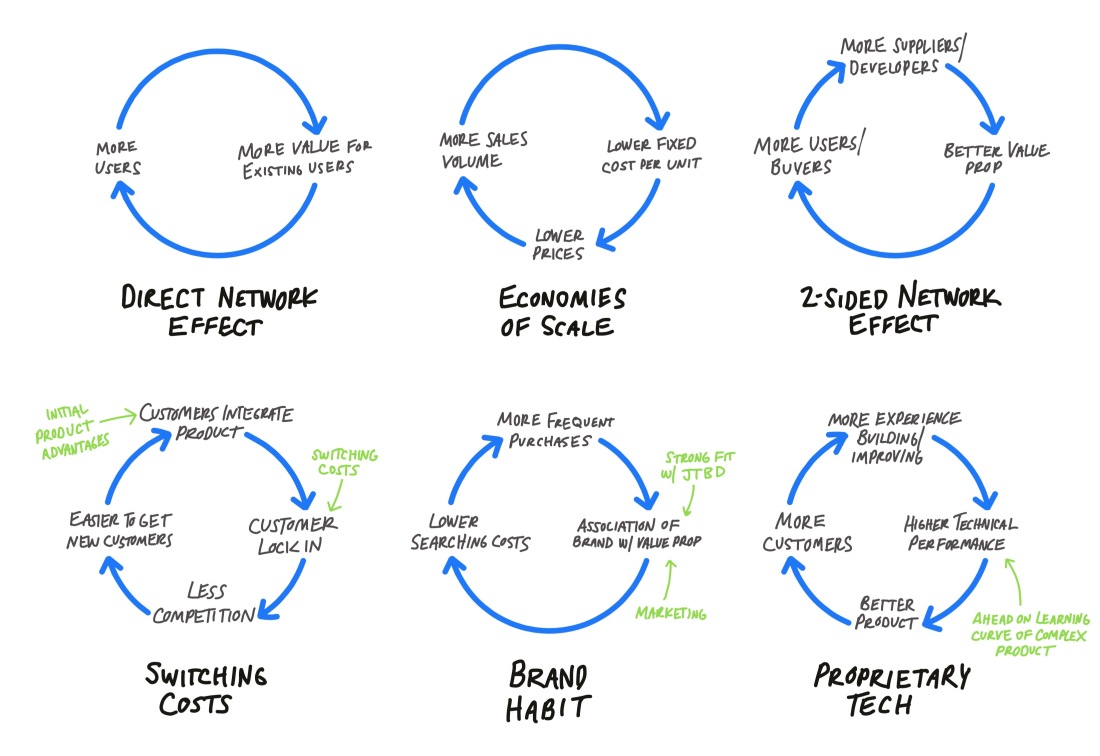
Competitive advantage can be represented visually as 1 or more feedback loops. These create the advantage “flywheel” that maintain and grow a moat over time. Think of a big, heavy wheel that takes some effort to get started but then coasts off its own momentum.
Before continuing, check out Eric Jorgenson’s primer on the flywheel mental model here.

Flywheel archetypes
Here are 6 simple examples of common advantages represented as flywheels (or “causal loops” in systems terminology). These loops are generalized — they’ll be expressed uniquely in every company that has them.
A few examples of how each advantage flywheel can vary:
archetypes.jpg
  • In the Economies of Scale flywheel above, the primary driver of more volume is low prices. This fits for most consumer businesses, but lower prices aren’t always the outcome of lower unit costs. If prices are maintained or increase, scale will yield higher margins → more resources to spend on growth → more sales volume.
  • The Brand Habit flywheel exhibits the typical loop for habit-reinforcing association of a brand with a specific quality or job-to-be-done. Think “thirst quenching happiness” for Coca-Cola and “low prices” for Wal-Mart. Another example of brand advantage is more of a social proof effect: Product has success → the cool kids want it → improved perception of product → …
As Eric discussed in his flywheel post, each wheel needs a push to get started. Written in green on a few of the archetypes above are initial advantages to get the wheels moving. Whether it’s a better user experience, a technical breakthrough, or a bootstrapped network based off of an existing network (college campuses for FB) or a useful utility (Instagram).

Real world examples
The above archetypes can be combined to create more comprehensive flywheels modeling the driving “engines” of each company’s moat:
examples
The most successful moats have multiple flywheels that feed off of each other’s momentum. Google’s technical advantages enable stronger brand allegiance and vice versa. Coca-Cola’s marketing-driven brand feeds off of it’s distributor/bottler based network effects. Facebook’s brands have at least 3 reinforcing network effects: direct (social network), 2-sided aggregator (advertising and developers), and brand-driven social proof....

....MUCH MORE

As artificial intelligence comes more and more to the fore, the advantages accruing to those companies that can afford to make use of their data and custom train the machines will act as advantage flywheels that shift the distribution of profits from the normal Pareto: 80% of the loot goes to the top 20% of businesses to perhaps as much as 95% of all the profits going to the top 5% of businesses.

I didn't really mean the "eat your heart out HBR" line.

Here's the Harvard Business Review on this very point:
HBR—From Pareto To Hyper-Pareto: "AI Is Going to Change the 80/20 Rule"
 
April 15, 2025
The Big Get Bigger: "The trade war uncovers new economies of scale"

From Yahoo Finance, April 15:

It pays to be big.

That's one early takeaway from the tariff drama. Investors momentarily poured back into Big Tech after the administration initiated a temporary levy exemption that covers consumer electronics, networking equipment, GPUs, and servers.

It's essentially another way of saying that Big Tech will probably be OK, as investors also look to the sector as a defensive play. Meanwhile, other sectors and companies still stare down a massive tariff upheaval.

It's a feature of American politics to want to avoid the appearance of picking winners and losers in the market. That phrase is often used as a rhetorical cudgel to attack opponents as bad for the economy.

But one person's favoritism is another's industrial policy.

If the market is consumed by the repercussions of tariffs, exemptions to those taxes can mean everything. The potential special carve-outs for tech, however, initially sparked a rally on Monday, fizzled, then rebounded. Part of this confused response from investors was the White House seemingly sending mixed signals.

After the exclusions from reciprocal tariffs were first unveiled, the president said in a social media post "there was no Tariff 'exception' announced." He later told reporters that his goal was encouraging production to move to the US but added that the administration has to show flexibility.

The tech titans hoping to receive assistance from the White House are showing flexibility too, or rather a willingness to support the president's agenda of bolstering domestic manufacturing and investment.

Nvidia (NVDA) on Monday said it will produce up to $500 billion of AI infrastructure in the US within the next four years. That announcement follows other Big Tech commitments from Apple (AAPL), Microsoft (MSFT), and Meta (META) to spend in the US....

....MUCH MORE

This is a corollary of the basic framework for understanding businesses and investing that we've been pitching for the last six or seven years.

If interested see:

Why Do the Biggest Companies Keep Getting Bigger? It’s How They Spend on Tech" 
...Much more important than the direct monetization of big data is the strategic advantage it can bestow over time.
In a winner-take-all economy, as in a horse race, small differences in superiority are rewarded all out of proportion to the actual advantage. A top thoroughbred may only be a couple fifths of a second faster than the field but those two lengths over the course of a season can mean triple the earnings for #1 vs. #2.
In commerce the results can be even more dramatic because rather than the 60%/20%/10% purse structure of the racetrack the winning vendor will often get 100% of a customer's business.....

Competitive Advantage and Feedback Loops

Flywheel Effect: Why Positive Feedback Loops are a Meta-Competitive Advantage

"Analyzing the deepening divide in learning capabilities between a few corporate giants and the rest of the world." (plus advantage flywheels)

"America's Biggest Firms' Moat Is Becoming Impregnable" (TSLA; NVDA; GOOG)
The announcement at the end of August that Tesla was going live with their supercomputer — Elon Got Himself A Supercomputer: "Tesla's $300 Million AI Cluster Is Going Live Today" (TSLA)—reminded me of this piece at ZeroHedge, last month. We'll be back with more on Morgan Stanley's Tesla note later today but for now the TL;dr is "To the victor go the spoils" or "The rich get richer" or "Those who can afford a supercomputer will get closer to discovering the profitability (if any) of AI than those who can't afford a supercomputer."
In Nvidia's World, If You (and your company) Don't Have Money You Will Not Be Able To Compete (NVDA)

The advantage flywheels keep spinning and reinforcing each other to the point that the Pareto distribution of profits - 20% of companies reap 80% of the profits - is becoming Super-Pareto where 5% of the companies reap 95% of the profits and is approaching Hyper-Pareto at maybe 2% of companies reaping 98% of profits.

It all comes down to having the resources to keep up. 

I watched Mr. Huang give the keynote and it's all a bit much to digest before firing out comments that would make any sense at all so here are some of today's headlines to give a taste of what the intro paragraph is based on.

These are Nvidia's press releases via GlobeNewswire....

"Elon Musk says any company that isn’t spending $10 billion on AI this year like Tesla won’t be able to compete" (TSLA)

This.

This is such an important concept to grasp. It's the advantage flywheels, the rich get richer, winner-take-all reality of business in 2024....

  "Jensen Huang’s extraordinary interview" (NVDA)

And many more, we are playing for keeps.

The Hyper-Pareto Distribution Of Profits Is Happening Right Now (plus an anniversary)
It's not some cutesy management* fad or pop insight like "Business secrets of Genghis Khan."

To the rich go the profits and internalizing that fact makes the rest of this portfolio construction/fund management/investing stuff easier to conceptualize and execute.

And AI is accelerating the already extant dynamic....

Just to reiterate, every incremental advantage that a company can afford does not affect income production in isolation. They accrete in sometimes unforeseeable combinations.

That's it, business, companies and investing in the 21st century. Learn it, love it, live it.

Or not, your call.