Finally, the new aesthetic.
From Bloomberg, September 10:
From anti-drone nets to signal jammers, governments are testing increasingly elaborate ways to protect cities from fast-evolving weapons.

Oleksandr Tolokonnikov has the weary tone of a man explaining life in a nightmare that never seems to end. Under the harsh white lights of a bomb shelter, the Ukrainian government official gives staccato descriptions of the daily Russian drone attacks in his region, the city of Kherson and surrounding villages. They have killed 65 civilians and injured more than 800 people in the first six months of the year.
Behind Tolokonnikov, a glossy poster of watermelons is a jarring reminder that this part of southern Ukraine used to be best known for its fruit; there’s even a watermelon monument further up the river. But today, Kherson is instead famous for the roughly 220 kilometers (137 miles) of green-tinged anti-drone nets draped over its roads.
The mesh canopies, which obscure the sky and fill with leaves in autumn, are a response to the latest evolution of drone warfare — which now ranges from large, purpose-built weapons to cheap commercial models that can be easily ordered online and adapted. Within 48 hours of my conversation with Tolokonnikov, deputy head of the Kherson state administration, Russian drone attacks killed one person and injured two others in the city. He says Kherson was seeing about 2,500 drone attacks per week this time last year; now it’s around 5,500.
The crude nets also embody a much broader challenge: How can you defend an entire city from this new danger? Kherson, a frontline city in a country at war, is an extreme example. But the threat is hanging over cities across Europe and the Middle East. Kyiv is experiencing more air-raid alerts than ever before as Moscow barrages the city with jet-powered drones. Last month, a small drone carrying explosives was found at Leipzig airport, a major cargo hub in Germany, with the country later blaming Russia for the attack. This summer, NATO forces shot down four drones over Romania, following an incident in May in which the country’s military tracked a Russian drone for four minutes before it crashed into an apartment block in the city of Galați, injuring two people.
Iranian drones have struck Gulf cities including Dubai, Kuwait City and Bahrain’s capital, Manama, this year. And along NATO’s eastern border, Estonia, Finland, Lithuania and Poland have all reported repeated incursions of Russian drones in the past 12 months.
Governments and the defense industry are still trying to determine the safest, most efficient and least expensive way to protect urban areas from drones, says Gregory Falco, head of the Aerospace Adversary Lab at Cornell University. “There’s no consensus on this yet.”
The Small Drone Threat
Small, mini and micro drones — defined by NATO as those weighing less than 150 kg (330 pounds) — are a daunting problem for any military. Radar systems, built to spot large planes and fast missiles, often can’t distinguish them from birds. They fly in unpredictable patterns and are difficult to shoot down. Even when radio-frequency jammers do work, tall buildings can interfere with the signal. “Currently there is not a single country that can stop small drones,” says Major Modris Kairišs, head of Latvia’s Autonomous Systems Competence Center.
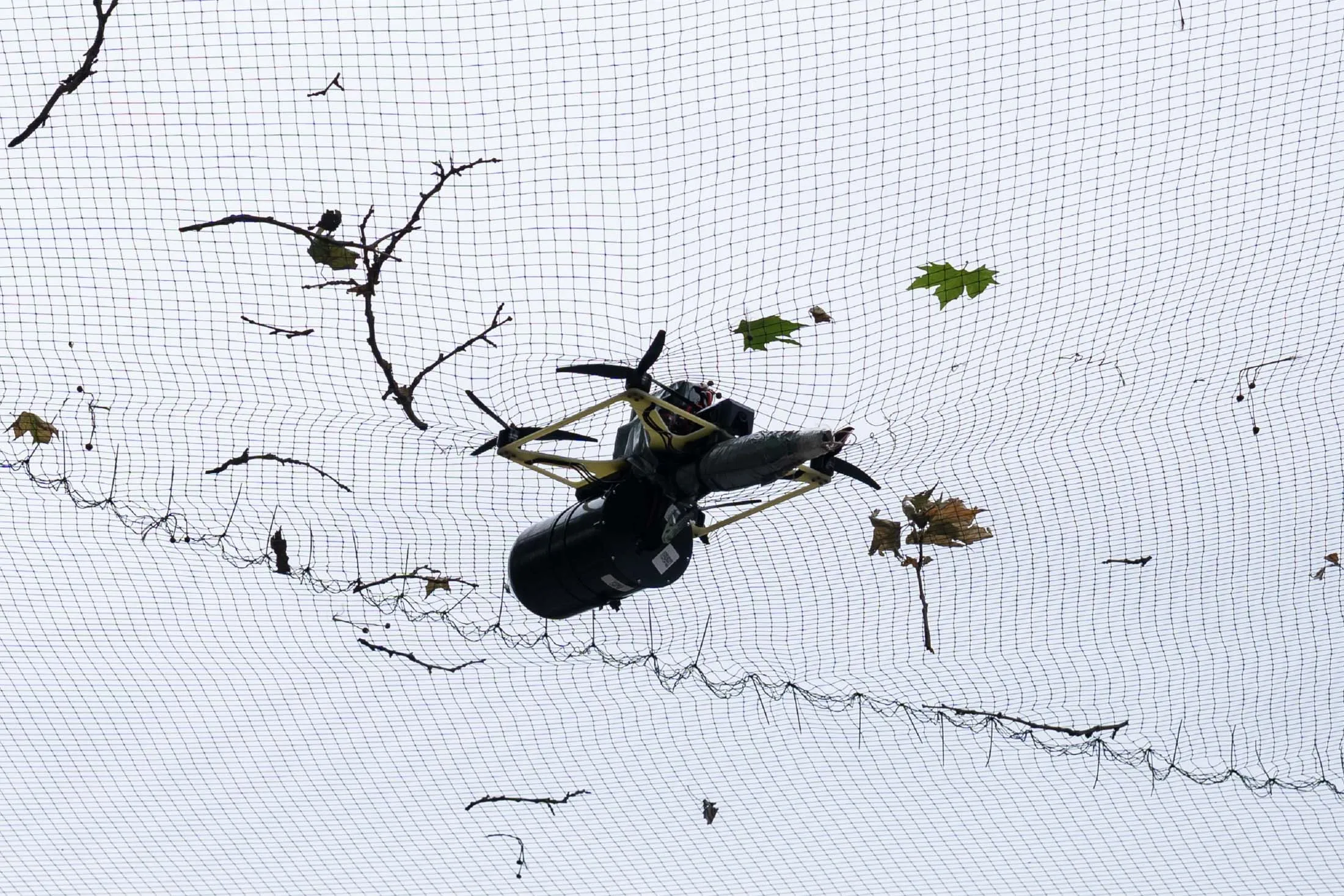
Officials consider Kherson’s nets, which entangle the drones, as the most reliable of all the available solutions. Photographer: Ivan Antypenko/Global Images Ukraine/Getty Images
....MUCH MORE
The story so far:
"Parking Killed Cities"
Why Are Our Buildings So Ugly? Architect Erik Bootsma Posts An Explanation
"Why Pierce Brosnan is leaving his $100M Malibu compound"

