Sunday, April 28, 2019

Each $4,000 of Additional Mid-career Income Correlates With an Extra Year of Life After 55

News you can maybe use.
First posted in 2015:
"The Richer You Are the Older You’ll Get" 

Duh.
However, it wasn't until ca. 1750 that the difference between English aristo lifespans and the general population became really noticeable. See page 82 of this paper.

From Real Time Economics:
Money may not buy love, but it appears to buy years.

Economist Barry Bosworth at the Brookings Institution crunched the numbers and found that the richer you are, the longer you’ll live. And it’s a gap that is widening, particularly among women.
Mr. Bosworth parsed this data from the University of Michigan’s Health and Retirement Study, a survey that tracks the health and work-life of 26,000 Americans as they age and retire. The data is especially valuable as it tracks the same individuals every two years in what’s known as a longitudinal study, to see how their lives unfold.

The good news is that men of all incomes are living longer. Yet the data shows that the life expectancy of the wealthy is growing much faster than the life expectancy of the poor.

Here’s the sort of detail this remarkable data set can show. You can look at a man born in 1940 and see that during the 1980s, the mid-point of his career, his income was in the top 10% for his age group. If that man lives to age 55 he can expect to live an additional 34.9 years, or to the age of 89.9. That’s six years longer than a man whose career followed the same arc, but who was born in 1920.

For men who were in the poorest 10%, they can expect to live another 24 years, only a year and a half longer than his 1920s counterpart....MORE
And 2014:
From The Atlantic:

The Rich Live Longer: So How Much Money 'Buys' 1 More Year of Life?
 Climbing America's income ladder today is truly a game of life and delayed death—and thousands of dollars are separating the rungs.

Richer people live longer lives.

It's true for both men and women. It's true at virtually every income level. And it was the backbone of one of the most striking charts I've seen this year in the Wall Street Journal, based on research by Brookings scholar Barry Bosworth.
And it made me wonder: If more money "buys" more life, how much extra income buys one more year of living?...MORE

Saturday, April 27, 2019

"How Much did the Gothic Churches Cost? An Estimate of Ecclesiastical Building Costs in the Paris Basin between 1100-1250"

From Medievalists.net:
By Amy Denning
Bachelor’s Thesis, Florida Atlantic University (2012)
Abstract: Several scholars have studied the explicit (tangible) costs of the ecclesiastical buildings constructed in the High Middle Ages. However, no scholar has examined the implicit (opportunity) cost of unskilled labor required for their construction, or tried to estimate the total cost of their building as a percentage of regional GDP.
This thesis examines the implicit costs of building the Gothic churches of the Paris Basin built between 1100-1250, and attempts to estimate the percentage of the regional economy that was devoted to build them. I estimate that over this 150-year period, on average, 21.5 percent of the regional economy was devoted to the construction of these Gothic churches, 1.5 percent of which is directly related to the implicit cost of labor....
...MUCH MORE

Some of the buildings:

https://screenshotscdn.firefoxusercontent.com/images/14893483-87db-40f3-86e4-94921a0418a2.png


"How to Create an Institution That Lasts 10,000 Years"

The subject of this interview, Alexander Rose, is executive director of the Long Now Foundation which is perhaps best known for their 10,000 year clocks and for the Long Bet Project to systematize predictions and challenges that take years to decades to centuries to play out.
Some of the bets that have been resolved:
The world will not reach ‘Peak Oil’ by 2010.    (Correct) date of wager/prediction, 2006

There will be a quantum computer with over 100 qubits of processing capability sold either as a hardware system or whose use is made available as a commercial service by Dec 31, 2010    (Yes, if you consider the early D-Wave machine to be a quantum computer. We don't) date of wager/prediction, 2006

A profitable video-on-demand service aimed at consumers will offer 10,000 titles to 5 million subscribers by 2010.   (Yes but still largely DVD focused) date of wager/prediction, 2002
And many more. There are currently 765 'live' long bets.

We've visited one of the co-founders of the Long Now Foundation, Stewart Brand, a few times including in "Climateer Line of the Day: Some Old Hippies Retain Brain Cells, Comment on Big Data Edition" See after the jump for why it was memorable.

And the headliner, from Edge.org:
....We’re also looking at the oldest living companies in the world, most of which are service-based. There are some family-run hotels and things like that, but also a huge amount in the food and beverage industry. Probably a third of the organizations or the companies over 500 or 1,000 years old are all in some way in wine, beer, or sake production. I was intrigued by that crossover.

What’s interesting is that humanity figured out how to ferment things about 10,000 years ago, which is exactly the time frame where people started creating cities and agriculture. It’s unclear if civilization started because we could ferment things, or we started fermenting things and therefore civilization started, but there’s clearly this intertwined link with fermenting beer, wine, and then much later spirits, and how that fits in with hospitality and places that people gather.

All of these things are right now just nascent bits and pieces of trying to figure out some of the ways in which organizations live for a very long time. While some of them, like being a family-run hotel, may not be very portable as an idea, some of them, like some of the natural strategies, we're just starting to understand how they can be of service to humanity. If we broaden the idea of service industry to our customer civilization, how can you make an institution whose customer is civilization and can last for a very long time?.... 
...MUCH MORE

The remarkable Mr. Brand on George Dyson:
March 26, 2013
Climateer Line of the Day: Some Old Hippies Retain Brain Cells, Comment on Big Data Edition
...Dyson is a kayak builder, emulating the wood-scarce Arctic natives to work with minimum frame inside a skin craft. But in the tropics, where there is a surplus of wood, natives make dugout canoes, formed by removing wood. "We're now surrounded by so much information," Dyson concluded, "we have to become dugout canoe builders. The buzzword of last year was 'big data.' Here's my definition of the situation: Big data is what happened when the cost of storing information became less than the cost of throwing it away."
 -- Stewart Brand, The Long Now Seminars About Long-term Thinking

Mr. Brand was one of Ken Kesey's Merry Pranksters described by Tom Wolfe in the The Electric Kool-Aid Acid Test.
Mr. Brand also edited the Whole Earth Catalog.
Drugs may have been involved.

George Dyson is an historian of science.
Wikipedia describes him as:
George Dyson is the son of the theoretical physicist Freeman Dyson and mathematician Verena Huber-Dyson, the brother of Esther Dyson, and the grandson of the British composer Sir George Dyson....

Reuters Exclusive: "Gold worth billions smuggled out of Africa"

From Reuters, April 24:

High prices are luring Africans into prospecting for gold. But huge volumes are smuggled out through the Middle East.
Billions of dollars’ worth of gold is being smuggled out of Africa every year through the United Arab Emirates in the Middle East – a gateway to markets in Europe, the United States and beyond – a Reuters analysis has found. 

Customs data shows that the UAE imported $15.1 billion worth of gold from Africa in 2016, more than any other country and up from $1.3 billion in 2006. The total weight was 446 tonnes, in varying degrees of purity – up from 67 tonnes in 2006. 

Much of the gold was not recorded in the exports of African states. Five trade economists interviewed by Reuters said this indicates large amounts of gold are leaving Africa with no taxes being paid to the states that produce them. 

Previous reports and studies have highlighted the black-market trade in gold mined by people, including children, who have no ties to big business, and dig or pan for it with little official oversight. No-one can put an exact figure on the total value that is leaving Africa. But the Reuters analysis gives an estimate of the scale.

Reuters assessed the volume of the illicit trade by comparing total imports into the UAE with the exports declared by African states. Industrial mining firms in Africa told Reuters they did not send their gold to the UAE – indicating that its gold imports from Africa come from other, informal sources.

Informal methods of gold production, known in the industry as “artisanal” or small-scale mining, are growing globally. They have provided a livelihood to millions of Africans and help some make more money than they could dream of from traditional trades. But the methods leak chemicals into rocks, soil and rivers. And African governments such as Ghana, Tanzania and Zambia complain that gold is now being illegally produced and smuggled out of their countries on a vast scale, sometimes by criminal operations, and often at a high human and environmental cost. 

Artisanal mining began as small-time ventures. But the “romantic” era of individual mining has given way to “large-scale and dangerous” operations run by foreign-controlled criminal syndicates, Ghana’s President Nana Akufo-Addo told a mining conference in February. Ghana is Africa’s second-largest gold producer....MUCH MORE
Also at Reuters: 
Backstory: Tracking Africa’s smuggled gold

Locust Watch: Iran Faces Worst Outbreak In 40 Years

"We watch locusts so you don't have to."
First up, The U.N. FAO Locust Watch:

Desert Locust situation update 24 April 2019
Locusts increasing in spring breeding areas of Southwest Asia and Arabia
Desert Locust breeding is underway in the traditional spring breeding areas in southeast Iran, southwest Pakistan and in the interior of Saudi Arabia.
http://www.fao.org/ag/locusts/common/ecg/75/en/DLrisk486e.jpg
In Iran, groups of adults first arrived on the southern coast in late January from the Arabian Peninsula, about a week after FAO DLIS issued a warning. Additional groups and swarms appeared in February and March, spreading eastwards along the coast where they laid eggs that began to hatch from mid-March onwards. The hoppers formed small groups and a few bands. Although control operations were immediately launched, breeding has continued because of good rains and favourable ecological conditions. Currently, hoppers, adults and groups of hoppers and mature adults are primarily present on the southeast coast between Jask and Chabahar and in the Jaz Murian Basin of the interior. Smaller infestations are present further west along the coast and in interior areas near Bander-e Lengheh. Reports indicate that nearly 12 000 ha have been treated since February.

In Pakistan, a small swarm first appeared on the southwest coast in mid-March followed by several groups of adults that laid eggs. Hatching started in early April, causing small groups of hoppers to form. Control teams have treated more than 600 ha so far. Low numbers of mature solitarious adults are present in the interior of Baluchistan where breeding is expected.

In Saudi Arabia, a second generation of breeding is coming to an end in the winter areas along the Red Sea coast while a first generation of breeding has started in the spring areas of the interior where groups of adults laid eggs between Gassim and Hail. Aerial and ground teams have treated more than 76 000 ha so far this year....MORE
And from the Tasnim News Agency (Iran), April 16:

Locusts from Arabian Peninsula Threatening Iran (+Video)
TEHRAN (Tasnim) – A locust outbreak in the Arabian peninsula has been spreading to Iran, threatening crops and food security in large areas of the coastal province of Hormozgan, an official said.

Director of a department at Horkozgan’s agricultural organization told Tasnim that Iran is facing the worst locust attack in the past 40 years.
He said several swarms of locusts have come from the Arabian peninsula to Iran over the last 10 weeks, some of which have penetrated into farmlands of the province as far as 200 kilometers from the coast.

The UN Food and Agriculture Organization (FAO) said in February that a locust outbreak in Sudan and Eritrea was spreading rapidly along both sides of the Red Sea to Saudi Arabia and Egypt.
The FAO also noted that good rains have allowed generations of locust breeding since October 2018, leading to a substantial increase in locust populations and the formation of highly mobile swarms.
The UN agency had also highlighted the control measures in Iran after at least one swarm arrived on the southern coast at the end of January.

Adult locust swarms can fly up to 150 km a day with the wind and adult insects can consume roughly their own weight in fresh food per day. A very small swarm eats as much in one day as about 35,000 people, posing a devastating threat to crops and food security....
I suppose the Mossad will be taking credit for this as well as the drought ("Israel is stealing our clouds") and then the floods that hit a couple weeks ago.

Locast Watch developments, 2018-2019 season:
October 14, 2018
"Saudi Arabia—Oh Just ^#@&*%^ Great: Now There's A Cyclone Bearing Down That's Going To Jumpstart The Locusts"
December 6, 2018
In Some Positive News, The Desert Locust Situation Remains Calm 
January 13
Locust Watch: Situation Deteriorating Rapidly
February 4
Locust Watch Situation Update: "A Desert Locust outbreak is in progress on the Red Sea coastal plains..."

http://www.fao.org/ag/locusts/common/ecg/75/en/190424DLsit.jpg

An Empire Brought Down By Dust

No, not J.G. Boswell and not some clean room gone awry, this is an honest-to-goodness empire.

From the American Geophysical Union's EOS newspaper:

Chemical measurements of a stalagmite from a cave in Iran reveal a large uptick in dust activity in northern Mesopotamia roughly 4,200 years ago, coincident with the decline of the Akkadian Empire.
https://eos.org/wp-content/uploads/2019/01/stalgmites-cave-budapest-hungary-800x600.jpg
 Stalagmites in a cave in Budapest, Hungary. Credit: iStock.com/Obencem
Forty-two centuries ago, the flourishing Akkadian Empire—spread across modern-day Iraq, Turkey, and Syria—suddenly disappeared. Paleoclimatologists and other geoscientists now have one possible explanation for why. Using precisely age dated chemical measurements from a stalagmite collected in a cave in Iran, researchers found an abrupt uptick in dust at that point in history. This heightened dust activity, which persisted for 300 years, might have made for uncomfortable living conditions and difficulties in farming, the researchers suggest.
  
“Everything Just Disappears”
Archaeologists have long been baffled by the abrupt abandonment of northern Mesopotamian settlements roughly 4,200 years ago. “There’s this specific point in time where everything just disappears [from the archaeological record],” said Stacy Carolin, a paleoclimatologist who led this research while at Oxford University in the United Kingdom and is currently at the University of Innsbruck in Austria. Sediment cores obtained from the Gulf of Oman have suggested that increased dust activity in Mesopotamia might have been the culprit, but the imprecise ages of marine records make it difficult to definitively link the geophysical and archaeological evidence, said Carolin. “Unless you know the exact timing…you can’t say anything about a cause and effect relationship.”

Carolin and her colleagues—including geochemists and members of the Iranian Cave and Speleology Association and the Geological Survey of Iran—have now analyzed the chemical composition of an 18-centimeter-long, semitranslucent stalagmite from Gol-e-Zard (Yellow Flower) cave near Tehran to look for signatures of dust. Because stalagmites slowly build up over time as dissolved minerals percolate through rock and drip from cave ceilings, they’re like clocks recording local environmental conditions. Using uranium-thorium radiogenic age dating, Carolin and her team found that their stalagmite started growing about 5,200 years ago. The researchers estimated an age uncertainty of 31 years for their measurements, far more precise than the centennial-scale resolution of other studies.

Dust for 300 Years
Carolin and her collaborators found an uptick in magnesium, a component of dust, in the stalagmite beginning 4,260 years ago (in a twist of geophysical convention, all dates are referenced as years before 1950). This dust likely derived from the alluvial plains of the Tigris and Euphrates Rivers—that is, the location of the Akkadian Empire—and was transported by prevailing winds, the researchers suggest. High levels of dust might have caused the Akkadian Empire settlements to be abandoned, the team concluded. “Dry, arid conditions could have been detrimental to agricultural settlements,” said Carolin. “The dustiness may have made living conditions unbearable as well.”...
....MORE

HT: BLDGBLOG

"The Invention of the ‘Salvator Mundi’ Or, How to Turn a $1,000 Art-Auction Pickup Into a $450 Million Masterpiece"

From New York Mag's Vulture, April 14:
In 2005, an unusual painting appeared on the website of the New Orleans Auction Gallery, a small operation headquartered on the banks of the Mississippi River. Twenty-six inches tall and 18 and a half inches wide, the painting depicted Christ in Renaissance-era robes, one hand raised in benediction, the other cupping a diaphanous sphere. “After Leonardo da Vinci (Italian 1452–1519),” read the description. “Christ Salvator Mundi. Oil on cradled panel.”

Among the people to click on the listing for Lot 664 was a Rockland County art speculator named Alexander Parish. Parish has spent his entire career in the art world, first as an assistant, later as an adviser to a major European gallery, and now as what’s known as a picker — a dealer who purchases art from minor auction houses and antiques sales and resells it to wealthy clients at a profit. “A major part of what I do,” Parish told me, “is educated gambling. You get a good feeling about a piece of art, and you place a bet that you know more about it than the auctioneer does.”

Parish felt very good about Lot 664. In fact, although he had only a few postage-stamp-size JPEGS to work with, he thought he might be looking at a piece by a student of Leonardo’s — perhaps the Milanese painter Bernardino Luini. That same afternoon, he sent a link to his friend Robert Simon, the owner of an old-master gallery on the Upper East Side, who has a doctorate in art history from Columbia University with a specialty in the art of the Renaissance.

“My first reaction was that it was a very intriguing painting,” Simon recalled. As he knew, the original Salvator Mundi, painted by Leonardo around 1500, possibly for the French king Louis XII, had been one of da Vinci’s most copied works — dozens of replicas hang in museums around the world, but the original had been lost to history. It seemed possible that another period copy dating to the Renaissance would exist. Simon and Parish agreed to invest in the painting together, with a bid ceiling of $10,000; Parish would handle the bidding via phone. “My memory of the auction is that I just sat there waiting for the price to go up,” Parish said. “But it became apparent that no one else was interested.” His winning bid came in at $1,000.

Today, of course, the contents of Lot 664 are worth far more than that: The picture has since sold once for $127.5 million and again, in a record-setting auction at Christie’s, for close to half a billion dollars. It has been held up as the “male Mona Lisa” and the “Holy Grail of old-master paintings” and derided by this magazine’s art critic, Jerry Saltz, as a “two-dimensional ersatz dashboard Jesus.” It has been owned by a Swiss tycoon, a Russian oligarch, and Saudi royalty. Along the way, it has come to illustrate how the interests of dealers, museums, auction houses, and the global rich can conspire to build a masterpiece out of a painting of patchwork provenance and hotly debated authorship. Its rise is both an astonishing tale of restoration and historical sleuthing and — for those inclined to see the world less romantically — a parable of highbrow greed, P. T. Barnum–style salesmanship, and reputation laundering.

But on the day it arrived at Parish’s home in upstate New York, it was still just a painting of unknown origin and questionable condition. Gingerly, the dealer slid the picture from its cardboard container. He noted the gilded frame, likely a 19th-century addition, and the thick layers of paint that had been applied to Christ’s face by a past restorer. Then he placed it back in the box and drove it into Manhattan, where Simon was waiting.

The worth of their latest acquisition would be determined by the dealers’ ability to connect it to Leonardo’s inner circle. If the painting was by Luini or another Leonardo disciple, they could expect to get hundreds of thousands of dollars for it. In 1999, a decent period copy now believed to have come from Leonardo’s workshop had gone for $332,500 at auction at Sotheby’s. But before any real attribution efforts could take place, before the dealers could start piecing together the story of the oil painting and its putative author, it would have to be thoroughly restored.
On April 27, 2005, at 2 p.m., Simon wrapped a trash bag around the Salvator Mundi and took it to the apartment of Dianne Dwyer Modestini, a research professor at New York University and a lauded art restorer. As Simon waited, Modestini placed the painting on her easel. She was unimpressed. Christ’s face, which she’d later learn had been repainted in the 20th century, looked to her like a “clown’s mask”; as for the overall condition of the picture, she told me recently, “it was bad, even allowing for its age.”

“I could recommend a student restorer at NYU,” she said to Simon.
“I think this needs a grown-up,” the dealer shot back.

Opening her supply cabinet, Modestini produced a vial of acetone and mineral spirits and a cotton swab and conducted a preliminary cleaning of the picture. Two things immediately stuck out to her....MUCH MORE
HT: the always interesting Alpha Ideas 

Related, March 31 Inquisitr: 

"Oligarchs Weaponized Cyprus Branch of Ukraine’s Largest Bank to Send $5.5 Billion Abroad"

You know that election Ukraine just held?

From the Organized Crime and Corruption Reporting Project, April 19:

The former chairwoman of Ukraine’s central bank dubbed it one of the biggest financial scandals of the 21st century.
Valeria Hontareva was describing the alleged theft of US$5.5 billion from PrivatBank, once the country’s largest commercial lender. The suspected masterminds are the bank’s two oligarch owners: Ihor Kolomoisky and Hennadiy Boholiubov, who stand accused of absconding with an amount roughly equal to 5 percent of the country’s gross domestic product. According to court records, both men are said to have recently been living in Switzerland, though Kolomoisky appears to be spending time in Israel.

“Large-scale coordinated fraudulent actions of the bank shareholders and management caused a loss to the state of at least $5.5 billion,” Hontareva said in March 2018. “This is 33 percent of the population’s deposits … [and] 40 percent of our country’s monetary base.”
Now, for the first time, OCCRP has traced the mechanism that appears to have allowed Kolomoisky and Boholiubov to funnel such vast wealth out of Ukraine: The money was moved through a PrivatBank subsidiary in Cyprus.

The arrangement helped hide the fact that cash was disappearing because the National Bank of Ukraine treated the Cyprus branch of PrivatBank the same as it would domestic branches. This designation meant officials never detected that cash transferred to Cyprus was leaving Ukraine.
Meanwhile, Cypriot regulators either failed to detect that the various bank transfers totalling $5.5 billion were backed by bogus contracts, or didn’t take the necessary action to stop them.
The system allowed billions of dollars to be pumped through the PrivatBank accounts, which were held in Cyprus by offshore companies.

This account is based on a forensic audit by Kroll, the U.S.-based corporate investigation and risk consulting firm. The report, which is based on PrivatBank’s own records and was obtained exclusively by OCCRP, also reveals that there was little distinction between Kolomoisky and Boholiubov’s corporate and personal accounts.

Ukraine nationalized PrivatBank in December 2016, saddling taxpayers with a $5.9 billion bailout. The nationalization was widely supported by the international community, including the IMF, the European Union, and the United States, which called it a “milestone in economic reform and the fight against corruption.”

Kolomoisky has said he wants $2 billion in PrivatBank capital returned to him. And on April 19, a Kyiv court ruled PrivatBank’s nationalization unlawful, deciding in favor of the oligarch and setting the stage for a prolonged legal battle.
In a letter circulated to the media by Kolomoisky’s Swiss office, the oligarch refuted allegations by the National Bank of Ukraine that Privatbank had engaged in fraudulent lending practices.

“I categorically deny the allegations made by the National Bank of Ukraine,” Kolomoisky said, adding that regulators had all the access they needed to monitor his bank’s activities. He painted the authorities’ nationalization of his lending business as an asset grab.

“Management of the [Ukrainian central bank] had as its main purpose not the support of the country’s largest bank, but its nationalization and the expropriation of the assets provided as security, together with the persecution and pressuring of the former shareholders,” Kolomoisky said.
Boholiubov declined to speak on the record.

The new revelations about how the scheme worked emerge just as Kolomoisky stands to increase his already considerable influence in Ukraine through the country’s presidential election. A candidate favoured by the oligarch — Volodymyr Zelenskiy, a comedian who appears on his television channel 1+1 — won the first round of the election, which may determine whether the country continues its already shaky course of anti-corruption reforms. Zelenskiy will now face off against President Poroshenko in the final round.

An independent analysis funded by the Council of Europe and published Feb. 18 shows that Kolomoisky’s 1+1 channel overwhelmingly favors Zelenskiy in its news coverage. On March 30, the day before the first round of the elections — which by law should be free of campaigning — the channel was scheduled to broadcast 7.5 hours of Zelenskiy’s programs.
The candidate has disputed that he owes Kolomoisky anything.
“He is my business partner, not my boss,” Zelenskiy said in an interview.

Accounting Tricks
Privatbank launched its Cyprus operation in the late 1990s. No other Ukrainian lender is known ever to have received permission from the National Bank of Ukraine to open an overseas branch.
The head of the National Bank of Ukraine, Yakiv Smolii, said PrivatBank’s Cyprus office didn’t materially differ from the lender’s branches in Ukrainian cities such as Kharkiv or Lutsk, so cash being funnelled there didn’t trigger any regulatory action. Ukrainian officials did nothing to stop the money from leaving the country. (Smolii spoke to OCCRP in his capacity as co-author of the book “Private Story: The Rise and Fall of Ukraine’s Largest Private Bank.”)...
....MUCH MORE 

Friday, April 26, 2019

Fire and Ice: Firenadoes and Snowball Earth

Two from Knowable Magazine:

Firenadoes and drifting embers: The secrets of extreme wildfires
Researchers probe the weather-like physics of deadly infernos
Flames begin to rise. Mike Heck jumps back. The tendrils lick upward, wavering in the wind, then coalesce into a vortex of flame, an incandescent tornado writhing in orange and red. “There it goes!” says one onlooker. Another whistles in astonishment.
But nobody is concerned. Heck set the fire deliberately, igniting a pan of liquid on the floor of a room lined with concrete blocks to contain the flames. A suction hood overhead prevents smoke from billowing into nearby classrooms.

Heck’s supervisor, fire scientist Michael Gollner of the University of Maryland in College Park, regularly conjures up such blazing pillars, known as fire whirls, in his lab. (Gollner and colleagues explore the science of these phenomena in the 2018 Annual Review of Fluid Mechanics.) From them, and from other fiery experiments, he aims to learn how flames intensify and spread as cities and landscapes burn. Gollner’s goal is to better understand what drives fire to leap its way from house to house and from tree to tree.

Gathering new insights into fire behavior has become increasingly urgent as wildfires have become more extreme, particularly in western North America. Starting in the mid-1980s, big wildfires suddenly became much more common in western US forests, especially in the northern Rocky Mountains. More recently, forests in the Pacific Northwest have seen the biggest increase in wildfire sizes, with a nearly 5,000 percent increase in burn area from 2003 to 2012 compared with the 1973–1982 average. Nationwide, the average acreage burned in the years since 2000 is nearly double the annual average for the 1990s.

And just in the last two years, several deadly infernos have incinerated parts of California. More than 5,600 buildings burned to the ground in and around Santa Rosa in October 2017. Last July in Redding, a towering plume of hot air and ash spawned a spinning “firenado” like the one in Gollner’s lab — but much bigger, and ferocious enough to kill a firefighter. The same month, fires burned vast acreage in Mendocino and three other counties. Four months later, 85 people died in the Camp Fire in Paradise, many of them incinerated while trying to escape the blaze in their cars....
Warning, very truncated charts ahead.
 (the fires of the 1800's. early 1900's, not shown, were orders of magnitude larger and/or deadlier)

... MUCH MORE

And also from Knowable:

The story of Snowball Earth
Ancient rocks suggest that ice entirely covered our planet on at least two occasions. This theory may help explain the rise of complex life that followed.
The Earth has endured many changes in its 4.5-billion-year history, with some tumultuous twists and turns along the way. One especially dramatic episode appears to have come between 700 million and 600 million years ago, when scientists think ice smothered the entire planet, from the poles to the equator — twice in quick succession.
Drawing on evidence across multiple continents, scientists say these Snowball Earth events may have paved the way for the Cambrian explosion of life that followed — the period when complex, multicellular organisms began to diversify and spread across the planet. 
When Caltech geologist Joe Kirschvink coined the term Snowball Earth in 1989 — merging ideas that some geologists, climate physicists and planetary chemists had been thinking about for decades  — many earth scientists were skeptical that these cataclysmic events could really have occurred. But with mounting evidence in support of the theory and new data that help pin down the timing of events, more scientists have warmed up to the idea.

Paul Hoffman, a geologist at the University of Victoria in British Columbia, has helped pioneer Snowball Earth research over the past 25 years. Among other things, he amassed 50 months’ worth of fieldwork in Namibia, where he gathered evidence of ancient glacial activity in rocks that are interspersed with limestone. Since limestone tends to form in the warmest parts of the ocean, this sandwich-like pattern supports the idea that glaciers covered all of the Earth, cold as well as warm spots, during Snowball Earth episodes. Knowable spoke with Hoffman, who recounts his life work in the Annual Review of Earth and Planetary Sciences, about the evolution of the Snowball Earth theory and what questions remain. This conversation has been edited for length and clarity.

What did the planet look like during Snowball Earth?
The name describes its appearance from outer space — a glistening white ball. The ice surface is mostly coated with frost and tiny ice crystals that settled out of the cold dry air, which is far below freezing everywhere. Gale-force winds howl in low latitudes. Beneath the floating ice shelf, a dark and briny ocean is continually stirred by tides and turbulent eddies generated by geothermal heat slowly entering from the ocean floor.

What first tipped off geologists that this could have happened?
Geologists were struggling to understand what they saw in the geologic record — that not too long before the first appearance of complex life, there was unmistakable evidence of glaciation even in the warmest areas of the Earth. Geologists had a very difficult time understanding how this was possible.
The deposits that glaciers leave behind are very distinctive. They look like cement that has been dumped out of a cement truck. These Snowball ice sheets would have flowed from the continents out onto the ocean, so we have a lot of deposits that formed in the marine environment where you get what are known as dropstones: pebbles or boulders that are out of place. Very often, you see structures related to the impact, as if the stone was somehow dropped and then plunked into the underlying sediment. It’s difficult to imagine what, other than floating ice, could have possibly transported this debris; trees, which can carry soil and stones out to sea in their roots, had not yet evolved....MUCH MORE

"Medieval Innovations: From founding Bern and opening the Saint Gotthard Pass to the rise of Amsterdam"

From Lapham's Quarterly, April 23:
In the High Middle Ages, an era that devotes itself to conjuring up vast churches and palaces and excels at great intellectual and religious movements, it is good to focus first on a couple of small objects. The first is really tiny—a spherical lattice about the size of a Christmas-tree ornament, made in one of the Meuse towns, perhaps Dinant. Made from chiseled brass, it was designed to burn incense. The orb is made up of stylized creatures and foliage, but the note of genius is that there are three tiny people on top, showing eloquent surprise at their situation. These are (in a tumble of charismatic names) Shadrach, Meshach, and Abednego, the Jewish men whose faith was tested in the fiery furnace by King Nebuchadnezzar. It seems sad that these tiny characters should be trapped in a museum case in Lille and unable to continue to carry out their witty, nine-century-old role of having perfumed smoke pour upward and round them. Perhaps somewhere in Lille there is a secret underground movement to liberate them and return them to their true function.

The other, only slightly larger object, that I have also kept coming back to just because it is so mysterious, lurks high on a pillar in Freiburg Minster. This must have once been part of a much larger decorative scheme, long since erased but with these figures kept as a reminder, or—more likely—just because they are so wonderful. The carving shows three human figures engaged with three massive, terrible-jawed animals, two of these wearing human clothing. An enormous ram’s head hovers in space, unrelated to the already confused action, and presumably part of a now missing piece of the frieze. Round the corner is a sadly worn—but fabulous—little fragment of Alexander the Great in a griffin-powered flying machine. I have returned to these monsters over the years, not least because of the strange way they echo the animal masks of the Kwakwaka’wakw of the American northwest. I don’t say this as some borderline insane piece of ethnographic showing-off, but because my wife’s family live on the edge of the Salish Sea and most summers I rush off at the first chance to admire examples of this great artistic tradition.
The Freiburg monsters also appear strangely Disney—the humans unperturbed by them, despite the way the sculptor has given them a terrible sense of muscular power. I had assumed they were just mysterious grotesques, but this turned out merely to be my own ignorance. When last in Freiburg somewhat to my dismay I was cheerfully informed by an official that the figure on the right, seemingly a woman on a monster, was in fact Samson (the long hair for strength) subduing a lion, while the two cowled men with the two clothed monsters were telling two different “frames” from the story of Wolf Inngrim, in which a monk dresses a wolf up in human clothes and tries to educate him (there is a little book and pen) but he keeps being distracted by a nearby sheep. Unable to deny his wolfish nature, he turns from the monk and leaps on the sheep. A bit upset at this overturning of what I had lazily assumed was an ancient mystery, I quickly realized that it made no difference—these were creatures that conveyed brilliantly a universal human dismay and fascination.

The wolves were carved around 1200 in the opening phase of the building of Freiburg Minster. It was sponsored by Duke Berthold V, the last of the Zähringer dynasty, fresh from what would prove the equally lasting triumph of founding the city of Bern. These sorts of initiatives are characteristic of what was in many ways one of the most exciting, cheerful, and entertaining periods in all European history. As usual we could tut-tut about life expectancy, poor hygiene, and the relentless grind of agricultural labor, but this is just to buy into the patronizing and intellectually null idea that, in effect, the entire prior sum of human activity across the planet should be pitied and disregarded for not having had access to broadband.
The founding of Bern is a fine example of medieval mobility and ambition that, so close to old Roman cities such as Basel or Constance, could both build on earlier traditions and also start afresh....MUCH MORE

The United States Has Finally Ordered ONE New Icebreaker

As noted in the introduction to March 2018's "U.S. Navy Releases Proposal Request for Coast Guard’s New Heavy Polar Icebreaker":
If the U.S. were serious the request-for-proposal would be for six ships and they would have been started five to ten years ago.
China, a non-polar nation already has a small fleet of light and medium icebreakers and is rumored to have plans for a new medium with a 3-3.5 meter-thick-ice capability as a stepping-stone to a couple heavy icebreakers by the mid-to-late 2020's. They are serious about their Polar Silk Road.
The American icebreaking fleet consists of three ships, the newest being the USCG Healy, a big boat but only a medium icebreaker, laid down in 1996, and two late '70's heavies, Polar Sea and Polar Star, the former now being cannibalized for parts and the latter falling apart.*

Here's the latest from gCaptain, April, 24:
VT Halter Marine Wins $745 Million Icebreaker Contract 
Yesterday, the U.S. Coast Guard and U.S. Navy awarded VT Halter Marine Inc., Pascagoula, Mississippi, a contract for the Detail Design and Construction of the Coast Guard’s lead Polar Security Cutter (PSC).

The initial award is valued at $745.9 million and supports non-recurring engineering and detail design of the PSC class as well as procurement of long lead-time materials and construction of the first ship.  The contract also includes options for the construction of two additional PSCs.  If all options are exercised, the total contract value is $1.9 billion.

“The Polar Security Cutter is key to our nation’s presence in the polar regions,” said Admiral Karl L. Schultz, Commandant of the Coast Guard. “With the strong support of both the Trump Administration and the United States Congress, this contract award marks an important step towards building the nation’s full complement of six polar icebreakers to meet the unique mission demands that have emerged from increased commerce, tourism, research, and international activities in the Arctic and Antarctic.”

The announcement comes after decades of budget cuts, expanded mission requirements (e.g. the war on terrorism) and a lack of US Navy support for icebreaker funding left the USCG struggling to meet the nation’s most basic needs in the Arctic. The 42 year old Coast Guard Cutter Polar Star is currently the United States’ only operational heavy icebreaker and is suffering from age and a lack of funding. In January the Polar Star, during her annual resupply mission to McMurdo Station in Antarctica, experienced multiple mechanical issues, including ship-wide power outages, all against the backdrop of the partial government shutdown that left Coast Guard personnel temporarily without pay.....MORE
*Previously on the travels and travails of the Polar Star:
March 2019 
An Account of The Voyage Of The Icebreaker USCG Polar Star (It's bad)
January 2019
The Only U.S. Heavy Icebreaker Suffers MULTIPLE Mechanical Problems On Voyage To Antarctica
December 2018
"US Coast Guard Turns Down Arctic Exercise Because 40-year-old Icebreaker Might Break Down And Would Require Russian Help"
September 2018
U.S. Watchdog Warns The Coast Guard To Get Real About Its Plans To Field Critical New Icebreakers

Meanwhile in June 2018 a non-Arctic nation: "China opens bids for first nuclear-powered icebreaker"
And March 2019: "China to Use First Atomic Icebreaker as Test for Future Nuclear Aircraft Carriers":
From High North News:
The country’s first atomic icebreaker will rival Russia’s largest nuclear icebreakers in size. China will become only the second country to operate such a vessel and it will pave the way for the country’s first nuclear aircraft carriers.

Enterprise Rent-A-Car Is Jumping Into IIs Own Car Subscription Service

From c|net:
This is the first time we've seen a more traditional rental service make a move on the new car subscription industry.

Plenty of vehicle manufacturers and third-party companies are getting into the car subscription service game. One group we haven't seen test the waters here, and one that is arguably the best set up for it, are car rental companies. That's changing though, according to a Wednesday announcement from Enterprise.

So, how does a car rental company want to do the subscription thing? Well, to start, like other subscription services Enterprises will be based around an inclusive monthly fee. This means that outside of fuel, members won't have to pay for things like maintenance, registration or insurance.

"Our new vehicle-subscription service will offer consumers another innovative mobility alternative, without the long-term financial burden or commitment typically associated with traditional leases or purchases," said Randal Narike, executive vice president of operations for Enterprise, in a statement.

Enterprise's plan will allow users to swap vehicles up to four times per month, and they can choose from around 20 makes and models within six tiers of vehicles. If that sounds kind of like the menu you'd see at a car rental location, then congratulations, you're starting to get it....MORE

"How Amazon became a profit machine — and why it might not last" (AMZN)

From Seattle's own, GeekWire:
Amazon is on a record run of profits, crushing its previous high mark again with $3.6 billion in net income in the first quarter. But it hasn’t always been that way.
For much of the tech giant’s existence as a public company, it ran slim profits or posted losses as it plowed whatever money it had back into growing the business. However, in the fourth quarter of 2017, when it posted more than $1 billion in net income for the first time, the company began a trend of skyrocketing profits that continues today.
Here are the key numbers behind the trend.
  • The simple math behind the Amazon’s rapidly rising profits is that revenue is outpacing spending. Revenue barely beat expectations in the first quarter, through it grew at a healthy 17 percent year-over-year clip to $59.7 billion. Meanwhile, Amazon’s operating expenses grew by 12 percent to $55.1 billion.
  • Amazon’s $3.6 billion in net income in the first quarter represents a rise of 118 percent over the prior year. Amazon posted earnings of $7.09 per share, shattering analyst expectations of $4.72 per share.
  • Despite these record increases, Amazon remains well behind fellow tech giants in the profit department. Earlier this week, Microsoft reported net income of $8.8 billion, more than double Amazon’s record this quarter on about half the revenue of its rival.
Amazon Web Services is an important factor, as it is responsible for a huge chunk of the company’s overall profits and revenue, and that isn’t likely to change any time soon....MORE
Also at GeekWire:
AWS revenue approaches $8 billion in Q1, up 41 percent compared to last year
Amazon profits more than double to $3.6B, setting another record
Amazon earnings preview: Tech giant aims for another record quarter

Having dated for a while, Xilinx gets serious and buys Solarflare to raise its networking game (XLNX)

The fact that Xilinx did not have a reflexive day-after bounce says the stock may not be out of the woods yet with a retest of this morning's $110.31 low being quite possible. However...this is a class act company and trying to get too cute on timing could leave one watching rather than riding.
$116.54 up $0.68 on a day with sometime competitor NVIDIA down $10.89 (-5.83%) and Obergruppenführer Intel down 10.57% (-$6.09) at $51.52


XLNX Xilinx, Inc. daily Stock Chart

Over there, on the right.

From The Register:
FPGA daddy Xilinx is buying California-based silicon design startup Solarflare Communications to improve its networking credentials.

Solarflare uses field-programmable gate arrays to build SmartNICs – network interface cards that run network, storage and compute acceleration using specialised on-board chips, eliminating the need to run these workloads on CPUs. This can simultaneously improve server performance and enable 10Gb Ethernet connectivity.

Solarflare also develops application acceleration software that helps customers take full advantage of the cards. Historically, the company's products have been aimed at the financial services industry, where minimising latency is paramount.

Solarflare is headquartered in Irvine, California, with R&D facilities in the US, UK and India.
Xilinx said the deal fits into its "data centre first" strategy, unveiled last year and intended to transform it from a chip vendor into a platform company – like Intel, Nvidia or Arm.
The financial details of the acquisition have not been disclosed.

Xilinx invented the first commercial FPGA back in 1985 and is considered a pioneer of the fabless semiconductor production model – since it has never owned any manufacturing facilities. The company counts Huawei, SK Telecom and Microsoft among its customers, with more than half of Azure servers reportedly containing some form of Xilinx wizardry.

Xilinx has been working with Solarflare since 2017 and participated in its latest funding round in 2018. At the Open Compute Summit in San Jose in March, the two companies demonstrated their first joint product – a single-chip, FPGA-based 100G SmartNIC, processing 100 million packets per second, both receiving and transmitting, while consuming less than 75W.

"The Solarflare team has worked very closely with Xilinx on next-generation networking technology and business collaboration since Xilinx became a strategic investor," said Russell Stern, head honcho at Solarflare....MORE
And a little more soberly, EE Times:
Xilinx to Buy Networking Technology Firm Solarflare 

Recently:
"Xilinx Earnings Miss Wall Street's Target, Stock Tanks Late" (XLNX)
UPDATED—Xilinx Releases Q4 and Year End Financials (XLNX)
Chips: Investor's Business Daily Is Still Giving Sweet, Sweet Love to Xilinx (XLNX)

Elaine Welcomes Our New 5G Overlords

From Elaine's Idle Mind:

Welcome, Huawei!

The Powers That Be would rather consign us to mediocre mobile connectivity than allow 5G networking equipment from China. Boo.

Ostensibly we’re worried about China using Huawei’s equipment to spy on us. (Hi, where were you guys when we outsourced all our manufacturing to China?) Funny, the Chinese government uses the same excuse to ban Google and Facebook in their own country. It’s not about censorship, they say. China bans American internet services to shield its citizens from foreign surveillance!

It’s protectionism. If China hadn’t preemptively banned Google and Facebook, Baidu and Tencent might not have gained enough market share to grow into massive conglomerates.
So we’re blocking Huawei to give Qualcomm, Nokia, and Ericsson a chance to catch up. I don’t know, I’d rather roll the dice and gamble on the off-chance China might spy on me, than the guarantee that the US government will. Remember PRISM? Germany seems more amenable to having Huawei build their 5G infrastructure after the NSA was caught monitoring Angela Merkel’s cell phone.

Besides, Chinese surveillance is less concerning than the NSA because there’s a distribution of power. China can’t punish an American for wrongthink the way it disappears its own citizens....MORE
Recently:
"The Register paid a visit to Huawei's HQ in Dongguan, China"
"How the U.S. Can Prepare to Live in China’s 5G World"
"Whoa: The U.S. Defense Innovation Board Says China May Be Uncatchable In The Race To Tech Dominance"  

"Retail’s Existential Threat? Private Equity Firms"

First up, from Pitchbook, March 25:

Sycamore set to take $1B out of Staples
In the private equity industry, dividend recapitalizations have drawn increased media scrutiny as many companies with heavy debt loads have had to file for bankruptcy. But the tactic, which involves a firm adding new debt onto a portfolio company to give itself, shareholders and/or limited partners an early payout, is still being utilized.

Retail-focused Sycamore Partners is planning to cash in on its investment in Staples through a $1 billion dividend recap, according to Bloomberg, pushing the office supplies company's total debt to more than $5.3 billion, or about 4.7x adjusted EBITDA net of cash. Sycamore took Staples private for $6.9 billion in 2017, putting a reported $1.6 billion of its own money into the deal. With the dividend recap, the firm already stands to make back nearly two-thirds of that original investment—independent of a full exit in the future.

It's unclear if the move will have any impact on Staples' operations. But Bloomberg, citing a source, reported that Sycamore could look to exit the company over the next year, with an initial public offering the most likely option.

Adding debt before an exit could come with its own set of issues, as some PE-backed companies with substantial debt have struggled on or around the public markets. Apollo Global Management-backed ADT, which had more than $10 billion in debt when it went public in January 2018, has seen its stock price drop some 50% in the ensuing 14 months. Last week, Blackstone postponed a planned IPO for healthcare benefits manager Alight—with some analysts raising concerns over the business's long-term debt of $3.4 billion.

Looking back, dividend recaps have had varied effects on PE-backed retailers, with some going mostly unnoticed and others potentially contributing to an eventual bankruptcy....MORE
And from Wolf Street, April 19:
A “bust out” is a fraud tactic used in the organized crime world wherein a business’s assets
and lines of credit are exploited and exhausted to the point of bankruptcy
— Wikipedia.
By John E. McNellis, Principal at McNellis Partners, for The Registry:
Bleeding badly, Debenhams, a 200 year old British department store chain, died last week. The coroner trotted out the usual suspects — the internet, the oversupply of retail, rising rents, tighter margins and, at the end of the dreary line-up, private equity. As it happens, Debenhams had been purchased by a private equity consortium led by Texas Pacific Group (TPG) in 2003.

That group paid £1.8 billion for the company, using £600 million in equity and £1.2 billion in debt it forced Debenhams to assume. The private equiteers promptly began selling off assets, dramatically cutting costs (store refurbishments dropped 77%) and awarding themselves large dividends for their efforts. And, no surprise, consumers lost interest in the fraying stores.

Since I first wrote about private equity’s looting and ultimate devastation of Mervyn’s (“On Private Equity and Real Estate” September 2012, behind paywall), retailer after retailer has been similarly gutted. Payless Shoes, Toys ‘R’ Us, Gymboree, Sears Holding, Mattress Firm and Radio Shack — all companies at one point owned or controlled by private equity firms — have since filed Chapter 11. In fact, Debtwire, a financial news service, calculates that about forty percent of all US retail bankruptcies in the last three years were private equity backed.

How do the private equiteers do it? Simple, the leveraged buyout. The LBO is the financial world’s pick and roll, that is, a highly effective play that is difficult to counter, especially if the PE firm takes the prudent first step of bribing its intended victim’s CEO into going along with their acquisition.

In short, the PE firm pays top dollar for a given retailer, often even overpaying, but using as little equity and as much debt as it possibly can. It then improves the company’s profitability by cost-cutting beyond prudence and, as with Debenhams, says, “What a good boy am I,” rewarding itself with a major dividend, often recovering not only its entire initial investment, but a substantial profit to boot.

A PE firm may be in good faith, it may actually use its best efforts — to be fair, equiteers sometimes succeed with their retail acquisitions — but even under the best of circumstances, retail is a difficult business, the threats from e-commerce, changing tastes and ever more nimble competitors are all too real.

Here’s the PE challenge: If you’ve already got your investment plus a fat profit out of a company, how hard are you going to continue to work on bailing it out, especially when you’ve crushed its bottom line beneath a wrecking ball of expensive debt?

Is this legal? It shouldn’t be. Is this moral? You don’t have to ask. Is this perpetrated by a single bad guy? Does private equity have its own Vladimir Putin? No. The industry is more like Ali Baba and the Forty Thieves; everyone gets in on the action. In fact, it’s hard to think of a private equity firm that hasn’t dipped its toe in this cesspool.

With apologies to those firms unintentionally left out, the players read like a who’s who of the PE industry: Bain Capital Partners, Blum Capital Partners, Cerberus Capital Management, (when a company names itself after the three-headed dog that keeps lost souls in Hell from escaping, you just might intuit a certain moral ambiguity), Golden Gate Capital, Kohlberg Kravis Roberts, Lone Star Global Acquisitions, Sun Capital Partners, Sycamore Partners, TPG and Vornado Realty Trust.
The list goes on, but you get the point. And yes, Bain was Mitt Romney’s firm, but please remember that Richard Blum, husband of Senator Dianne Feinstein, is the principal of his eponymous firm. This isn’t about politics, just money....
...MORE

A spokesman for President Putin asked that he not be mentioned in the same breath as the private equity guys.

Uber Lowers IPO Price Range

From Yahoo Finance:
Uber sets IPO pricing to maximum of $50 per share ahead of roadshow
Uber is planning to price its initial public offering at a maximum of $50 per share, the ride sharing giant said on Friday, recalibrating Wall Street’s expectations after rival Lyft’s disappointing market debut.

In an amended regulatory filing with the Securities and Exchange Commission, Uber set the range of its offering of between $44 and $50 per share, below a previously reported range of $48-$55 per share.

The company also disclosed a $500 million investment from PayPal (PYPL), which will purchase Uber stock in a private placement at a price equal to the IPO pricing.

“Based on an assumed initial public offering price of $47.00 per share, which is the midpoint of the estimated offering price range set forth on the cover page of this prospectus, PayPal would purchase 10,638,298 shares,” Uber said in the filing.

In an updated picture of its financial health, Uber revealed that it lost an estimated $1 billion in the first quarter—a deficit that more than doubled compared to the comparable year-ago period.
The new filing arrives just as Uber kicks off a roadshow with investors. The fact that Uber is still bleeding money will do little to assuage the market’s widening doubts about ride sharing companies’ ability to turn a profit in the immediate term....MORE
Here's  Edgar, latest filing (S-1A) on top:

Société Générale's Albert Edwards: "How To Determine If The Market Is Wrong"

Two notes up front. 1) Albert is not a permabear. Possibly a permadonkey:
"It's snowing still," said Eeyore gloomily.
"So it is."
"And freezing."
"Is it?"
"Yes," said Eeyore. "However," he said, brightening up a little, "we haven't had an earthquake lately."
2) We like Albert.

From ZeroHedge:
It's a dead horse that has been beaten to a bloody pulp, but that doesn't stop SocGen's resident "permabear" Albert Edwards from listing what he believes are the two main reasons for the market's "miraculous", and record, rebound from the Christmas Eve "bear market" lows: 1) the abrupt U-turn in Fed policy reducing fears of an imminent US recession, and 2) a similar easing of Chinese monetary conditions resulting in a firming up in their economic data.

But, Edwards asks in his traditionally skeptical voice, "what happens if the market is wrong in presuming that monetary easing will bring about a rebound in the economic data? What happens if, as the savvy David Rosenberg believes, the Fed has overdone the tightening cycle and the economy is already headed into recession?"

To answer that rhetorical question, Edwards looks at recent recessions.

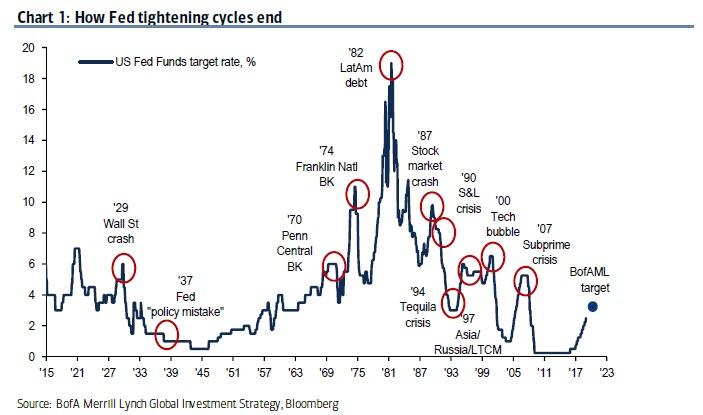
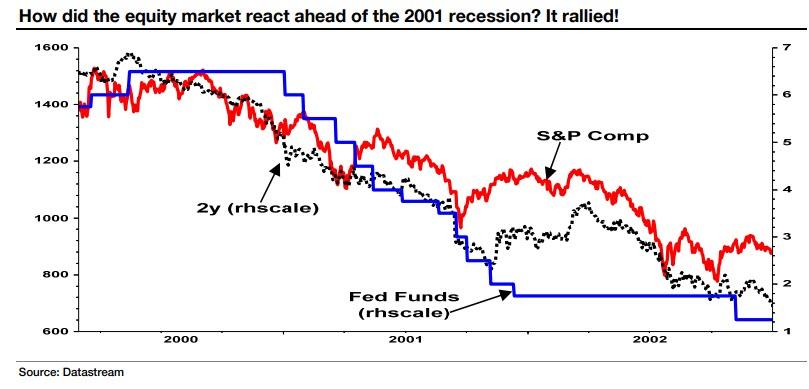
First, the SocGen strategist echoes what we showed several months ago, pointing out that equities always rally after the final Fed tightening, even when it later becomes clear that the Fed has tightened too much and recession looms. That said, the endgame is far less rosy, because despite the equity rally, the odds of a soft landing are not good since the last 13 Fed tightening cycles have ended in 10 recessions and/or financial crises.
As Edwards highlights, the experience of the last two recessions in 2008...

... and 2001..
... shows equities peaking after the end of the tightening cycle.

Edwards next makes a key point that we have repeatedly stated previously when focusing on the hypocrisy of the permabulls who say to always buy... just forget to advise when it's time to sell:
"Traditionally the equity market rallies after the final rate hike and any rally should be sold into if you believe the economy is headed into recession. The problem is that no-one ever forecasts imminent recessions. The closely followed BAML Global Fund Manager Survey shows that in April 70% of investors surveyed expect a global recession to start in H2 2020 or later and most shocking, 86% believe yield curve inversion does not signal an impending recession!
"So are you going to pile into equities along with the ‘dumb money?’ Are you feeling that lucky?" Edwards asks, and then proceeds to muse that if this equity market rally is in fact a head fake, what should we be looking out for aside from the lack of recovery in the real economic data?
One thing that the SocGen strategist believes is worth watching is the technicals within the equity market itself. Here he highlights the work of regular Zero Hedge guest Lance Roberts who several weeks ago "presciently noted that it is entirely plausible the then ongoing equity rally could break record highs, but that this could still be consistent with a bear market starting in Q4 last year. He highlighted that instead of focusing on any record high, we should be keeping a very close eye on the monthly MACDs (Moving Average Convergence Divergence indicator). These combinations of moving averages are used in technical analysis as market timing tools and are momentum indicators highlighting market turning points."
In the chart above, Edwards notes that prior to the two previous bear markets a sell signal was given by the monthly MACDs (shown by the red dotted vertical line). In both cases the equity market (top panel) went on to make new highs but the monthly MACDs did not confirm this as a bullish signal and it was prudent to stay out of the equity market until a ‘buy’ signal was confirmed by the green vertical dotted lines. (We note that sell signals in 2012 and 2015 did not lead to full bear markets, but the indicator recorded a buy re-entry point without missing out on much upside)....MORE
The tragedy of Albert is that his equity analysis is a throwback to a more rational world, a world without negative interest rates or central banks buying equities. His understanding of credit markets is second-to-none but...

Société Générale's Albert Edwards Says "My Reputation For Calling Stocks Is In Tatters"
Well duh. He's been stubbornly fighting the central banks for a decade, a trait he shared with fellow bear David Rosenberg until Rosie flipped a few years ago and caught the last 35% or so of the up move.
But it isn't for the equity calls that Albert gets paid, and they're not why pros still listen to him:
The House Fed has thwarted his House Stark at every turn.
Now he's getting ready to roll but it may be too late for him.
http://www.hollywoodreporter.com/sites/default/files/imagecache/list_landscape_960x541/2016/06/game_of_thrones_quotes_3_h_2016.jpeg
"I fought. I lost. Now I rest. But you, Lord Snow… you'll be fighting their battles forever."
Albert addressing another standing room only investment conference crowd

Last seen in "Société Générale's Albert Edwards: Winter Is Coming".

Albert's twenty-year bullishness on bonds and what declining yields tell us about the underlying economy is why SocGen keeps him around....

"Bayer gets Monsanto profit boost but legal burden mounts"

From Reuters:
German drug and farming supplies company Bayer posted a 45 percent gain in quarterly core earnings thanks to the acquisition of seed maker Monsanto, while the legal burden it took on with the deal mounted.

Adjusted earnings before interest, tax, depreciation and amortization (EBITDA) rose to 4.19 billion euros ($4.67 billion), it said on Thursday, edging past the 4.12 billion euro average analyst forecast in a Reuters poll.

Bayer said 13,400 plaintiffs were seeking damages, alleging that use of the company’s glyphosate-based weedkillers caused their cancer, up from 11,200 in January.

Bayer has seen about 30 billion euros ($34 billion) wiped off its market value since August, when a California jury in that lawsuit found that Monsanto should have warned of the alleged cancer risks.
It will face shareholders’ anger at its annual general meeting on Friday.

“We continue to believe that we have meritorious defense and we intend to defend ourselves vigorously in all of these lawsuits,” the company said.

On Wednesday, Bayer launched an appeal with a California court to throw out the first glyphosate-related judgment for $78 million in damages.

When including Monsanto’s pro-forma 2018 results in the comparison, revenues at Bayer’s Crop Science division from pesticides and seeds were broadly flat at 6.35 billion euros, excluding currency effects...MORE

Thursday, April 25, 2019

"Nuclear reactors on Russia’s floating nuclear plant reach full capacity"

From Bellona, April 25:
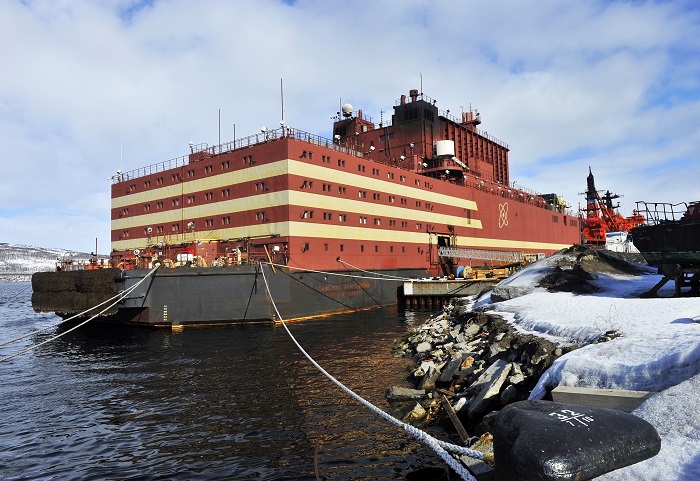
The reactors aboard the Akademik Lomonosov, Russia’s floating nuclear power plant, have been brought to 100 percent capacity and is ready to be commissioned, Rosatom, the state nuclear corporation, announced on Wednesday.

The reactors aboard the Akademik Lomonosov, Russia’s floating nuclear power plant, have been brought to 100 percent capacity and is ready to be commissioned, Rosatom, the state nuclear corporation, announced on Wednesday.

According to a release from Andrei Petrov, the general director of the Rosenergoatom nuclear utility, which will run the Akademik Lomonosov, the plant’s two KLT-40 reactors were brought to full power on March 31. This process, said Petrov, “confirmed the operational stability of the main and auxiliary equipment of the plant, as well as the automatic process control systems”.

The announcement marks the end of ten months worth of tests on the nuclear barge, which were carried out at Atomflot, the Murmansk-based headquarters of Russia’s nuclear icebreaker fleet.
The news is bound to spark fresh concern about the controversial notion of floating two nuclear reactors on a 144 meter-long hull and attaching the whole apparatus to a land-based grid with power lines and mooring rope.

The environmental group Greenpeace has colorfully dubbed the Akademik Lomonosov a “nuclear Titanic” and a “Chernobyl on ice,” in reference to its eventual deployment in frozen Chukotka on the East Siberian Sea.

Bellona itself has long questioned the wisdom of the $480 million project as well, publishing a catalogue of its concerns in a report it released as long ago as 2011.

Despite these criticisms, Rosatom is now expected to tow the Akademik Lomonosov some 5,000 kilometers to the east of Murmansk via the Northern Sea Route to the port city of Pevek. It is expected to depart Atomflot in August or September, when ice conditions in the Arctic are more favorable for the massive tugboat operation.

The power produced by the Akademik Lomonosov will replace electricity supplied by the remote Bilibino nuclear power plant, which until the arrival of the floating plant has been known as the world’s northernmost commercial nuclear facility. Decommissioning operations at Bilibino have already begun, and are expected to finish by 2021.

Since the Akademik Lomonosov’s rocky – and often secretive – beginnings in 2006, Russia has attempted to sell the plant as a cure-all for energy droughts in the world’s more remote regions.
And while the plant has spawned a number of imitation blueprints in other countries such as China, the Akademik Lomonosov has so far failed to generate the rush of foreign orders that Rosatom said would justify its cost. Many Russian nuclear officials have anonymously conceded to the Russian press that the Akademik Lomonosov’s price tag is too high to bring the floating plant, as it is designed now, into serial production....MORE
And the above referenced Rosenergoatom/Rosatom release, April 24:

World’s only floating nuclear power unit to begin commercial operations in Russia

https://www.rosatom.ru/upload/medialibrary/8b4/8b4e0cc8eb687cc90aa17b49d447ac20.jpg