Showing posts sorted by relevance for query protective coloration. Sort by date Show all posts

Saturday, December 15, 2018

Protective Coloration: "The Crucial Moment of Deception"

From Cabinet Magazine:

http://www.cabinetmagazine.org/issues/33/cabinet_033_shell_hanna_rose_001.jpg
Abbott Thayer’s sketch for a textile and uniform design based on disruptive patterning, ca. 1915. 
Courtesy Abbott Henderson Thayer & Thayer Family Papers, Smithsonian Archive of American Art.
On 11 November 1896, an American painter known for his society portraits and demure landscapes made an unusual appearance at the Annual Meeting of the American Ornithologists’ Union in Cambridge, Massachusetts. Abbott Thayer arrived at the Harvard Museum of Comparative Zoology on Oxford Street bearing a sack of sweet potatoes, oil paints, paintbrushes, a roll of wire, and two new principles of invisibility in nature that together formed his “Law Which Underlies Protective Coloration.”1 In his afternoon open-air lecture, Thayer argued that every non-human animal is cloaked in an outfit that has evolved to obliterate visual signs of that animal’s presence in its typical habitat at the “crucial moment” of its utmost vulnerability. According to him, all animal coloration was a function of this need to hide in the environment.

Thayer identified two visual phenomena undergirding this invisibility: “obliterative countershading” and “disruptive patterning.” In the first, animal skins achieve an illusion of monochrome flatness via coloration darkest in sunlit parts and lightest in areas generally bathed in shadows: examples include the light bellies of otherwise dark rabbit coats or the silver undersides of sharks. The resulting visual compression of a three-dimensional form produces an illusion of monochrome flatness. The second principle takes this illusion to the next level of protective concealment: mottled patterns corresponding to the animal’s habitat disrupt the contours of its flat silhouette, resulting in an impression of not being there.2 An example is the coloration of bullfrogs. Natural selection, continued Thayer, favors individuals visually expressing one or both of these traits and constructs a world of momentarily evanescent animal objects.

This protective coloration was, claimed Thayer, related to a notion of concealment specific to a particular instant snapped out of a continuum of time. As he would later write, “At these crucial moments in the lives of animals when they are on the verge of catching or being caught, sight is the indispensable sense. It is for these moments that their coloration is best adapted, and when looked at from the viewpoint of the enemy or prey as the case may be, proves to be obliterative.”3
For the assembled audience of scientists, bird enthusiasts and interested passersby, Thayer introduced his law as a scientific discovery of great importance, uncovered through the workings of an artistic mind. He then used his props to present a disappearing act with painted and posed sweet potatoes, making ones that had been painted lighter on the undersides—“countershaded”—disappear from view.4 Unpainted monochrome specimens, meanwhile, stood out like sore thumbs against the dirt. “The effect was almost magical,” recounted one audience member.5

This game of hide-and-seek was no joke. By 1896, Thayer was increasingly inserting himself into what was a longstanding debate over the origins, effectiveness, and pervasiveness of protective concealment in the natural world. After the publication of Charles Darwin’s Origin of Species in 1859, animal coloration—both its origins and its role in animal behavior—had become a key locus of debate among natural historians, artists, and the lay public. Prior to this period, naturalists had noted instances of animals’ blending in with their backgrounds. It seemed remarkable that God had “dropped” them into place just so—“nature by design.”6 By contrast, in an evolutionary model, there was a gradual “fitting together” over time. Evolutionary theories, both Darwin’s and that of his colleague Alfred Russel Wallace, presented a range of explanations for animal colors. Darwin emphasized interrelations between the sexes as the cause of the showy coloration found in the male of many species; females chose the more colorful males for mating. Wallace, meanwhile, thought color was better understood as the result of strictly environmental pressures. Studying the colors of many insects, he interpreted bright hues and complex patterns alike as either warning signals to potential predators, modes for assimilation in the environment, or mimicry of other, more dangerous, species.

Thayer’s interest in nature’s visual illusions originated in his hobbies as a birdwatcher, hunter, and amateur photographer, as well as in his classical training as a painter. He kept a journal of bird sightings from the woods surrounding his summer home in Dublin, New Hampshire, and collected dead birds to skin for visual analysis and three-dimensional modeling, becoming “an excellent taxidermist through his inborn sense of form and gesture.”7 In the 1880s, he became a reader of Darwin and Wallace, as well as of later biologists inspired by them to focus on the evolution of color.

Within a culture generally fascinated by deceptive visual fields, bird study became a vital link between the concerns of natural science and those of representational art making. Philosopher-psychologist William James, a friend of Thayer’s and a fellow birder, discussed the experience of bird watching in his 1890 Principles of Psychology, describing the study of illusions, or so-called “false perceptions,” as critical to efforts to understand sensations related to depth, color, and movement perception. In the section on illusions, James brings to his readers’ attention the following anecdote recounted by a colleague:
A sportsman, while shooting woodcock in cover, sees a bird with the size and color of a woodcock … but through the foliage, not having time to see more than that it is a bird of such a size and color, he immediately supplies by inference the other qualities of a woodcock, and is afterwards disgusted to find that he has shot a thrush.8
James extended examples drawn from hunting to the world of men at war with enemies within and without: “as with game, so with enemies, ghosts, and the like.”9
...MORE

In the immediate aftermath of the Great Financial Crisis we would often note that banker pinstripes make lousy protective coloration should the mob demand retribution.
As it turned out the U.S. Department of Justice didn't go after anyone.

So maybe pinstripes were perfect coloration.
As noted in one of our 5-year anniversary pieces "Today in the Financial Crisis, Saturday September 20, 2008: Music to Hunt Bankers By" we had settled on the rondo from Mozart's Horn Concerto No. 2 as our theme music:


Wednesday, November 19, 2014

"Top Icelandic banker jailed for role in 2008 financial collapse"

I still find it astounding that Attorney General Holder and his entire 113,000 employee Justice department found not one case they could charge criminally. Not one.
From Euronews:
The former head of the Icelandic bank Landsbanki has been sentenced to a 12-month jail term.

Sigurjon Arnason was on trial for his role in the collapse of the financial sector in 2008.
Two other of the banks executives received nine month sentences.

The Landsbanki three were accused of manipulating the bank’s share price by lending cash to investors on condition they purchase stocks...MORE
Throughout much of 2008 and 2009 we posted the rondo from Mozart's Horn Concerto No. 2 as "Music to Hunt Bankers By" often advising the brethren that outside of a few urban ecosystems, pinstripes make lousy protective coloration:


Monday, June 23, 2008

Gas could fall to $2 if Congress acts, analysts say

Holy downtick, Batman!
From MarketWatch:
The price of retail gasoline could fall by half, to around $2 a gallon, within 30 days of passage of a law to limit speculation in energy-futures markets, four energy analysts told Congress on Monday.

Testifying to the House Energy and Commerce Committee, Michael Masters of Masters Capital Management* said that the price of oil would quickly drop closer to its marginal cost of around $65 to $75 a barrel, about half the current $135.

Fadel Gheit of Oppenheimer & Co., Edward Krapels of Energy Security Analysis and Roger Diwan of PFC Energy Consultants agreed with Masters' assessment at a hearing on proposed legislation to limit speculation in futures markets.

Krapels said that it wouldn't even take 30 days to drive prices lower, as fund managers quickly liquidated their positions in futures markets.

"Record oil prices are inflated by speculation and not justified by market fundamentals," according to Gheit. "Based on supply and demand fundamentals, crude-oil prices should not be above $60 per barrel."

Futures trading in London has not been a major factor in rising oil prices, testified Sir Bob Reid, chairman of the Chairman of London-based ICE Futures Europe. Rising prices are largely a function of fundamental supply and demand, not manipulation or speculation, he said....

...There are two kinds of speculators in the futures markets, Masters said. Traditional speculators are those who need to hedge because they actually take physical possession of the commodities. Index speculators, on the other hand, are merely allocating a portion of their portfolio to commodity futures.

Index speculation damages price-discovery mechanisms provided by futures markets, Masters added...MORE

Compare to this insightful comment (he said modestly)
Responding to MarketBeat's post "On Speculation and Commodities Prices"

There is a real nomenclature problem here.
“Speculators’ is the word we used to use for the guys in the pits who took the other side of a commercial’s hedging activity.
Calling the index fund investors “speculators” is a misnomer.
In commodities speculators perform a societal good. Investors, not so much.
Here’s a simple thought problem:
What would happen to prices if $200 Billion of the estimated $260 Billion that has gone into commodities indexes was taken out?
If your answer is “prices would go down” then you’ve also got the answer to what the INflow of “investment” dollars has done.
.
Re: “…commodity derivatives contracts outstanding could well grow at a rate faster than other derivatives markets…”
Commodities are also underrepresented in the structured product universe.
Collateralized Commodity Backed Obligations anyone?
Commodity SIV’s?
Hybrids?
Synthetics?
Just be sure you’ve got the helicopter gassed up because when the townsfolk come, it won’t be with pitchforks and torches.
And pinstripes make lousy protective coloration. As they used to say in the Brit. nature shows:
“Sadly now, there can be but one outcome…”

Comment by Climateer - June 17, 2008 at 4:47 pm
*Oil Markets, the U.S. Senate and Michael Masters
As some of you suspected, Michael Masters, the hedge fund manager who testified before the Senate a couple weeks ago, was partially talking his book.
Here are the names that would be positively affected by lower oil prices:

AMR- American Airlines
DAL- Delta Airlines
LCC- US Airways
UAUA- UAL Corp.
GM- General Motors

Wednesday, December 17, 2008

Goldman Sachs’s Tax Rate Drops to 1%, or $14 Million

From time to time I reflect on nineteenth century American populism (I know, gotta get out more, etc.) and gentle reader sees headlines like "Go Long Pitchforks: How To Profit From The Coming Populist Backlash." or "American Taxpayer on the Hook for $1 Trillion of Banks Non-, Mis- and Malfeasance. Plus: Music to Hunt Bankers By" where I say stuff like (Sept. '08):
...It appears there will be a decade long wealth transfer from savers to bankers. To reliquify the big banks balance sheets, the powers that be will let the banks borrow cheap from the Fed or at artificially low shorter term rates, then turn around and lend at higher rates to the Treasury. There is probably a carbon trading angle here too. You just watch....
And:

...I've been a close observer of financial behavior for many, many years and while essentially an optimist, sometimes I just want to bitch slap the folks who brought us to this point. A June 17 comment at MarketBeat:

...Just be sure you’ve got the helicopter gassed up because when the townsfolk come, it won’t be with pitchforks and torches.
And pinstripes make lousy protective coloration. As they used to say in the Brit. nature shows:
“Sadly now, there can be but one outcome…”...
Or (Mar. '08): "How Banks Will Make Huge Money On Fed Borrowing (C; JPM; BAC)"
(see also today's post ""Mom, Ben Bernanke Likes Bankers Better than He Likes You")
When I get in these moods I like to listen to "Music to Hunt Bankers By".
(the rondo from Mozart's Horn Concerto No. 2)

Today, Bloomberg informs us:
Goldman Sachs Group Inc., which got $10 billion and debt guarantees from the U.S. government in October, expects to pay $14 million in taxes worldwide for 2008 compared with $6 billion in 2007.

The company’s effective income tax rate dropped to 1 percent from 34.1 percent, New York-based Goldman Sachs said today in a statement. The firm reported a $2.3 billion profit for the year after paying $10.9 billion in employee compensation and benefits.

Goldman Sachs, which today reported its first quarterly loss since going public in 1999, lowered its rate with more tax credits as a percentage of earnings and because of “changes in geographic earnings mix,” the company said.

The rate decline looks “a little extreme,” said Robert Willens, president and chief executive officer of tax and accounting advisory firm Robert Willens LLC.

“I was definitely taken aback,” Willens said. “Clearly they have taken steps to ensure that a lot of their income is earned in lower-tax jurisdictions.”>>>MORE

Meanwhile I shall be doing due diligence on an implement with the light weight of the DuraFork but with the aperture making ability of steel tines.

Wednesday, September 15, 2010

Zeitgeist: Irish Republican Army Threatens to Shoot Bankers (Are you listening Wilbur Ross and Carlyle Group)

Ross and Carlyle will be fine, although this was today's WSJ headline "Wilbur Ross Sees Opportunities In UK, Irish Banks",
They, along with Dublin-based Cardinal Group are buying the Irish Education Savings Bank.

Private Equity firm Carlyle is the 11th largest defense contractor in the U.S. and could probably find a way to ruin some of those IRA fellows' day.
I'm guessing they wouldn't go to portfolio company Combined Systems for their less-than-lethal offerings.

That said, I should remind our City friends that pinstripes are not protective coloration.
From: the Guardian:

Real IRA says it will target UK bankers
Exclusive: Republican terror group vows to resume mainland attacks with banks and bankers now potential targets
The IRA bombed targets in the City during the 1990s 
The IRA bombed targets in the City during the 1990s. 
Now the Real IRA may use the same tactic. 
Photograph: Rex Features 

Banks and bankers are now potential targets for the Real IRA, leaders of the dissident republican terror group have warned in an exclusive interview with the Guardian. Despite having only 100 activists they also said that targets in England remained a high priority.

In an attempt to tap into the intense hostility towards the banks on both sides of the Irish border they branded bankers as "criminals" and said: "We have a track record of attacking high-profile economic targets and financial institutions such as the City of London. The role of bankers and the institutions they serve in financing Britain's colonial and capitalist system has not gone unnoticed.

"Let's not forget that the bankers are the next-door neighbours of the politicians. Most people can see the picture: the bankers grease the politicians' palms, the politicians bail out the bankers with public funds, the bankers pay themselves fat bonuses and loan the money back to the public with interest. It's essentially a crime spree that benefits a social elite at the expense of many millions of victims."

But security sources in Northern Ireland point out say the Real IRA lacks the logistical resources of the Provisional IRA to prosecute a bombing campaign similar to the ones that devastated the City of London in the early 1990s or the Canary Wharf bomb in 1996. Although the Real IRA has access to explosives it has yet to carry out large-scale bombings....MORE
HT: Economic Policy Journal

Previously:
Zeitgeist: London Protesters Threaten Bankers, Evoke Executions

Should the IRA possess a sense of rhythm I suggest the tune I was comforted by during the height of the financial crisis, the rondo from Mozart's Horn Concerto No. 2.
(well that and the Ramones' "I wanna be sedated")

Music to Hunt Bankers By

Monday, March 31, 2008

How Banks Will Make Huge Money On Fed Borrowing (C; JPM; BAC)

A couple days ago in response to an Environmental Capital post:

The Climate on the Street: More Banks Smell Money in Carbon
I made the point:

For the banks, a Trillion-dollar carbon market that they can help set the rules for is a Godsend.There is nothing else that can replace the income lost from the exposure of the CMO, CDO, ABCP, structured finance shell game. Even the Fed’s creation of a Fed Funds/Treasury carry trade would take so long to reliquify the balance sheets that the public would have time reflect on what has been going on, and would start hunting bankers and traders for sport.
Comment by Climateer - March 26, 2008 at 11:37 am
(emph. added)

I was typing too fast, I was actually thinking 'discount window' but the principle is the same (if not the interest).

Today 24/7 Wall Street explains what I was babbling about and says:

Banks are going to the Fed and getting money at 2.5% and putting it onto their balance sheets
What do the big money centers do with the money? They make investments in high-yield instruments. Or, put it into their proprietary trading operations. A bank that takes in $10 billion could make a $1 billion return on that over the course of a year, perhaps more, by "playing the spread" on the dirt cheap cash from Bernanke & Company.

The game the banks are playing at the expense of tax-payers due to inexpensive money from the Fed is outstanding for investors who hold stock in the firms. It could be one of the best money-making opportunities that companies like Citigroup (NYSE:C), JP Morgan (NYSE:JPM), and Bank of America...
MORE

I apologize to our long-suffering readers for the principle/principal play.
Sometimes I can't help myself.

Here's the post with "Music to hunt bankers by".
(pinstripes are not effective 'protective coloration')

Thursday, October 11, 2018

"Goat Meat Could Save Our Food System, But We're Too Afraid To Eat It"

This is not welcome news for the goat community.

From the Huffington Post:

Not only is goat often referred to as the healthiest of red meats, but it's good for the planet, too. And, yes, it actually tastes good.
The rest of the world loves soccer. The rest of the world also loves to eat goat meat. Yet Americans remain lukewarm (at best) to both. Coincidence? Andrew Zimmern doesn’t think so.
The James Beard award-winning television personality and chef is a big fan of goat, and he can’t understand why his fellow citizens are decidedly unaware of the virtues of this under-the-radar animal protein, much in the same way we still cling to our beloved NFL football over actual football (soccer). 
Goat accounts for about 6 percent of red meat consumption worldwide, with the annual per capita consumption for goat weighing in at 1.7 pounds. The highest level of goat meat consumption anywhere in the world is Sudan, where 8.6 pounds of goat is consumed per person annually. The industrialized country with the biggest appetite for goat is China, with 3.5 pounds eaten per capita each year.
Depending on your family’s heritage and the part of the country in which you live, you might have more than a passing familiarity with goat meat. You might have enjoyed celebratory meals of slow-roasted cabrito at your abuela’s house. Perhaps the Jamaican side of the family made the reputed-aphrodisiac Mannish Water (goat’s head soup). Your Greek γιαγιά might have insisted that it wasn’t a proper Easter celebration without a whole roasted goat. But if those culinary traditions are not part of your background, you most likely have never eaten goat....MORE
Although Smithsonian Magazine tells us:
Never Underestimate a Goat; It’s Not As Stupid As It Looks
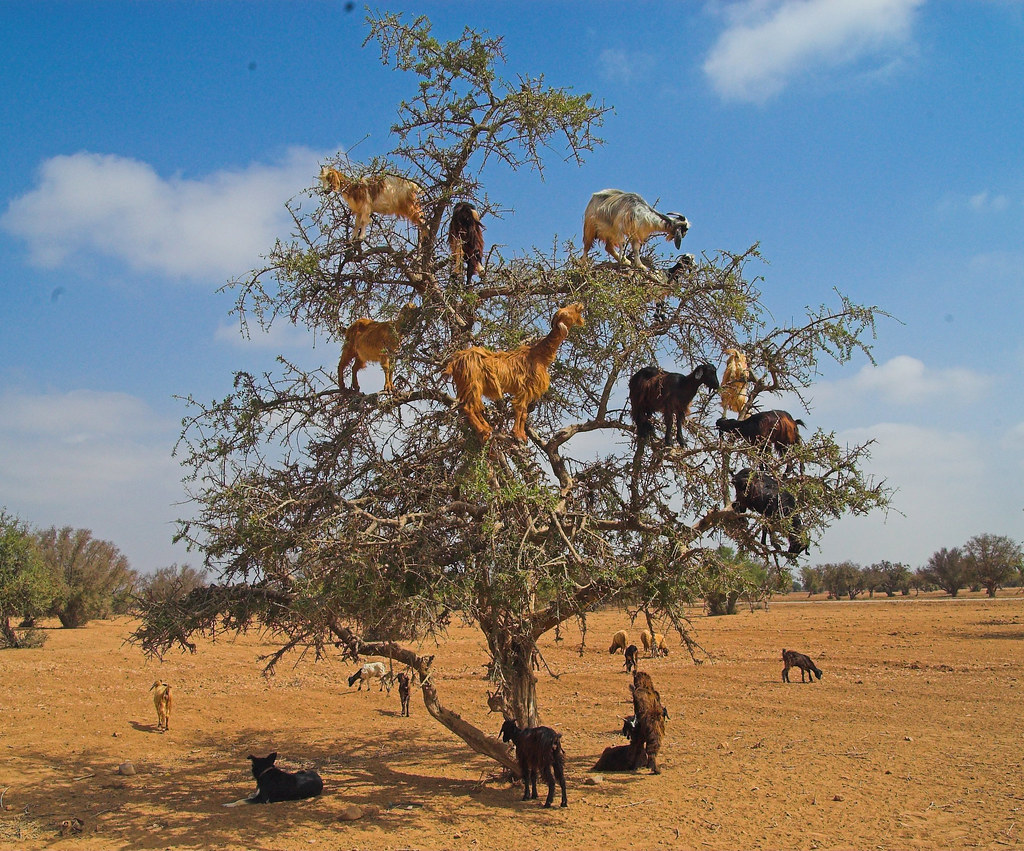
Goats still have things to learn about protective coloration as they hide from the HuffPo writer.

Saturday, September 20, 2008

American Taxpayer on the Hook for $1 Trillion of Banks Non-, Mis- and Malfeasance. Plus: Music to Hunt Bankers By

It appears there will be a decade long wealth transfer from savers to bankers. To reliquify the big banks balance sheets, the powers that be will let the banks borrow cheap from the Fed or at artificially low shorter term rates, then turn around and lend at higher rates to the Treasury. There is probably a carbon trading angle here too*. You just watch.

It wasn't hard to add up how much the taxpayer would be stuck with, even I could do it:
September 7
...The big losers are the American taxpayers who may be on the hook for a Trillion dollars and who may see their government lose its AAA credit rating, with the increased borrowing costs that implies....
From Naked Capitalism:
New Bailout Proposal Costs Estimated at $500 Billion to $1 Trillion
Repeat after me: bye bye the US's AAA rating and the dollar. Although the Paulson's plan is only sketchy, on the surface, it is utterly ridiculous. The authorities propose to save the economy by buying mortgage paper at market prices....
...And the prospect of turning on the spigot has others clamoring for bailouts. There are calls for underwater homeowners to get handouts too.

Pray that this measure does not pass, or better yet, call your Congressman and Senator and raise hell. The importance of these initiatives and the dollars attached says they should not be rushed through in a panic, particularly when the underlying premise is so dubious.

From the New York Times:
The Bush administration, moving to prevent an economic cataclysm, urged Congress on Friday to grant it far-reaching emergency powers to buy hundreds of billions of dollars in distressed mortgages despite many unknowns about how the plan would work.

Henry M. Paulson Jr., the Treasury secretary, made it clear that the upfront cost of the rescue proposal could easily be $500 billion, and outside experts predicted that it could reach $1 trillion....MUCH MORE
From Bloomberg:
Backlash Over Bailouts Grows in Congress, Wall Street
As the U.S. government takes stronger measures to stabilize financial markets, some former Federal Reserve officials, lawmakers and Wall Street executives are saying too much has already been done.

``Every time they intervene, they do more harm than good,'' said Peter Schiff, president of Euro Pacific Capital in Darien, Connecticut, a brokerage that manages $1 billion.

Critics of the rescues agree that government actions, such as those that prevented the failures of Fannie Mae, Freddie Mac and American International Group Inc., can't postpone the inevitable worsening of housing and financial markets. They say the bailouts by the Fed and Treasury also encourage future reckless risk-taking by investors.

``If we don't stop now, there will be no end,'' said Gerald O'Driscoll, a former vice president of the Dallas Fed and now a scholar at the Cato Institute in Washington. He joins Vince Reinhart, former director of the Fed's monetary affairs division, and Marvin Goodfriend, a former official at the Richmond Fed in questioning the market interventions...MORE

I've been a close observer of financial behavior for many, many years and while essentially an optimist, sometimes I just want to bitch slap the folks who brought us to this point. A June 17 comment at MarketBeat:

...Just be sure you’ve got the helicopter gassed up because when the townsfolk come, it won’t be with pitchforks and torches.
And pinstripes make lousy protective coloration. As they used to say in the Brit. nature shows:
“Sadly now, there can be but one outcome…”

Same theme in an open letter to Senator Chris Dodd, Chairman of the Senate Committee on Banking, Housing and Urban Affairs, March 24:

...I understand you need the GSE's to reliquify the system fast, before the public realizes that the emperors actually have no clothes, and start hunting bankers for sport, but when do we say enough is enough?...

Here's the rondo from Mozart's Horn Concerto No. 2.
Music to hunt bankers by.


*Still on the "Hunting Bankers" theme but with a carbon twist from a comment at Environmental Capital:

For the banks, a Trillion-dollar carbon market that they can help set the rules for is a Godsend.There is nothing else that can replace the income lost from the exposure of the CMO, CDO, ABCP, structured finance shell game. Even the Fed’s creation of a Fed Funds/Treasury carry trade would take so long to reliquify the balance sheets that the public would have time reflect on what has been going on, and would start hunting bankers and traders for sport.
Comment by Climateer - March 26, 2008 at 11:37 am
Pardon me, I catharted. Better now. Still trying to fit into Hunting Pink though.

Friday, October 14, 2011

#OccupyWallStreet Proclaims Victory, Announces Plan to Re-launch #OccupyMom'sBasement

This is our third #OWS story of the day, stop me before I post again.
[step away from the keyboard -ed]

Don't get me wrong, I'm as much into anarcho-capitalism as the next guy, I think I'd do pretty well whatever the ground rules.
It's just that #OWS isn't showing the kind of higher-level cognitive abilities you'll find at, say, MI-6 or the initiative of the Navy Seals or even the spirit of Danton [warning: digression ahead! -ed]
"L'audace, l'audace, toujours l'audace!"

("Audacity, audacity — always audacity!")
-incorrect quote incorrectly cited to Frederick the Great
in the movie Patton (see below)

"De l'audace, encore de l'audace, toujours de l'audace..."
(audacity, more audacity, and ever more audacity...)
-Georges Danton
Instead we get pigs in Boston spitting on a female member of the Coast Guard.
It's hard to summon any response other than ridicule.

On the other hand we were warning of what was to come by late 2007.
In March 2008 it was "Dear Senator Dodd...(FNM; FRE)":
As Chairman of the Senate Committee on Banking, Housing and Urban Affairs are you sick unto death of these "capitalists of convenience"?
For example, what the hell is the mis-(mal) capitalized Fannie Mae doing paying out One Billion Four Hundred Million dollars in dividends on common stock?
This idea that it's okay to privatize the profits while socializing the potential losses is incomprehensible.
It seems to me that one of your aides might know the cell phone number of someone with the power and authority to shake some of these B.S. artists up a bit.
How 'bout the OFHEO throwing a ten-year clawback on stock and option grants?

I understand you need the GSE's to reliquify the system fast, before the public realizes that the emperors actually have no clothes, and start hunting bankers for sport, but when do we say enough is enough?....
Here's a comment at MarketBeat in June 2008:
Re: “…commodity derivatives contracts outstanding could well grow at a rate faster than other derivatives markets…”
Commodities are also underrepresented in the structured product universe.
Collateralized Commodity Backed Obligations anyone?
Commodity SIV’s?
Hybrids?
Synthetics?
Just be sure you’ve got the helicopter gassed up because when the townsfolk come, it won’t be with pitchforks and torches.
And pinstripes make lousy protective coloration. As they used to say in the Brit. nature shows:
“Sadly now, there can be but one outcome…”
Comment by Climateer - June 17, 2008 at 4:47 pm
Five days after the fall of Lehman Brothers on Sept. 15, 2008:
American Taxpayer on the Hook for $1 Trillion of Banks Non-, Mis- and Malfeasance. Plus: Music to Hunt Bankers By
It appears there will be a decade long wealth transfer from savers to bankers. To reliquify the big banks balance sheets, the powers that be will let the banks borrow cheap from the Fed or at artificially low shorter term rates, then turn around and lend at higher rates to the Treasury. There is probably a carbon trading angle here too*. You just watch.

It wasn't hard to add up how much the taxpayer would be stuck with, even I could do it:
September 7
...The big losers are the American taxpayers who may be on the hook for a Trillion dollars and who may see their government lose its AAA credit rating, with the increased borrowing costs that implies....
We were planning action directe* a month after Fannie and Freddie were nationalized, Lehman filed bankruptcy, AIG became a subsidiary of the U.S. Treasury, Merrill, Washington Mutual etc, etc.:
Go Long Pitchforks: How To Profit From The Coming Populist Backlash.

*(From the French version of Wikipedia: Action directe (AD) est un groupe clandestin (aux influences anarchistes et communistes...)
From Wikipedia: Action Directe was a French Maoist/Marxist-Leninist militant group which committed a series of assassinations and violent attacks in France between 1979 and 1987. )

In December 2008 I announced a research initiative:
Goldman Sachs’s Tax Rate Drops to 1%, or $14 Million
...Meanwhile I shall be doing due diligence on an implement with the light weight of the DuraFork but with the aperture making ability of steel tines.
By March 2009 we thought the idea was catching on: 
Zeitgeist: London Protesters Threaten Bankers, Evoke Executions

In April '09 I reported back on the due diligence:
...Most of the pitchfork manufacturers are smaller, privately held companies*. You run into the same problem with tree shredder manufacturers:
This is not your average rotary mulcher. Watch as the "SLASHBUSTER"® HD 480B brush cutters chew through 10-14 inch diameter trees with ease. No auxiliary engine is necessary. Horsepower-for-horsepower this is the highest performance tree shredder available....
Last November it was "Zeitgeist: Irish Republican Army Threatens to Shoot Bankers (Are you listening Wilbur Ross and Carlyle Group)".

So I hope the Best and the Brightest folks in the park understand why we post:

Some Thoughts on the OccupySesameStreet Protests
Breaking--From the OccupySesameStreet Protests: "Three Die After The Electric Company Privatized"--Breaking
Today in OccupyWallStreet News: "I'm a F***ing Journalist, You Motherf***er!
Smackdown: Hacktivists "Anonymous" Call Out MoveOn.org Over #OccupyWallStreet
#OccupyWallStreet: "You can have sex with animals."
Ayatollah Khamenei says Occupy Wall Street could mark the fall of the west
#Occupy(insert your cause here)

It's not because we hate you.
Or don't understand you.

It's because you're.......boring.
And three years late.

Now where'd I put that wood chipper?

Should the IRA possess a sense of rhythm I suggest the tune I was comforted by during the height of the financial crisis, the rondo from Mozart's Horn Concerto No. 2.
(well that and the Ramones' "I wanna be sedated")

Music to Hunt Bankers By

Tuesday, March 22, 2011

"Sleaze Watch: NY Fed Official Responsible for AIG Loans Joins AIG As AIG Pushes Sweetheart Repurchase to NY Fed"

The Fed has received multiple bids for the assets so AIG may not get them on the cheat cheap:
AIG May Face Rivals in $15.7 Billion Bid for Assets Held by Fed.

From naked capitaism:
The corruption in high places is getting more and more brazen with every passing day. The only thing that separates the US from conventional banana republic status is that no one leaves keys to new luxury cars on the desks of officials to secure their cooperation. It’s just not enough of an inducement to get anyone to take action.

Masaccio at FireDogLake was suitably outraged at this spectacle of a regulator getting a job with the biggest lobbying group in the industry he regulates…..and staying in his current oversight role:
The Washington Post reports that David H. Stevens will be taking over as head of the Mortgage Bankers Association. Stevens currently serves as Assistant Secretary for Housing in the Department of Housing and Urban Development, and as the Commissioner of the Federal Housing Administration. He has a conflict of interest so deep that he should be fired at once…MORE
Back in March 2008 I decided the rondo from Mozart's Horn Concerto No. 2 was lovely "Music to Hunt Bankers By":


Pinstripes are not protective coloration, even in the City.

Monday, November 29, 2010

Just a Reminder: "Zeitgeist: Irish Republican Army Threatens to Shoot Bankers (Are you listening Wilbur Ross and Carlyle Group)"

A repost from September 15, 2010:

Ross and Carlyle will be fine, although this was today's WSJ headline "Wilbur Ross Sees Opportunities In UK, Irish Banks",
They, along with Dublin-based Cardinal Group are buying the Irish Education Savings Bank.

Private Equity firm Carlyle is the 11th largest defense contractor in the U.S. and could probably find a way to ruin some of those IRA fellows' day.
I'm guessing they wouldn't go to portfolio company Combined Systems for their less-than-lethal offerings.

That said, I should remind our City friends that pinstripes are not protective coloration. 
From: the Guardian:

Real IRA says it will target UK bankers

Exclusive: Republican terror group vows to resume mainland attacks with banks and bankers now potential targets
The IRA bombed targets in the City during the 1990s 
The IRA bombed targets in the City during the 1990s. 
Now the Real IRA may use the same tactic. 
Photograph: Rex Features 

Banks and bankers are now potential targets for the Real IRA, leaders of the dissident republican terror group have warned in an exclusive interview with the Guardian. Despite having only 100 activists they also said that targets in England remained a high priority.

In an attempt to tap into the intense hostility towards the banks on both sides of the Irish border they branded bankers as "criminals" and said: "We have a track record of attacking high-profile economic targets and financial institutions such as the City of London. The role of bankers and the institutions they serve in financing Britain's colonial and capitalist system has not gone unnoticed.

"Let's not forget that the bankers are the next-door neighbours of the politicians. Most people can see the picture: the bankers grease the politicians' palms, the politicians bail out the bankers with public funds, the bankers pay themselves fat bonuses and loan the money back to the public with interest. It's essentially a crime spree that benefits a social elite at the expense of many millions of victims."

But security sources in Northern Ireland point out say the Real IRA lacks the logistical resources of the Provisional IRA to prosecute a bombing campaign similar to the ones that devastated the City of London in the early 1990s or the Canary Wharf bomb in 1996. Although the Real IRA has access to explosives it has yet to carry out large-scale bombings....MORE
HT: Economic Policy Journal