Showing posts sorted by relevance for query military Keynesianism. Sort by date Show all posts

Sunday, July 27, 2025

“It’s Military Keynesianism” On Germany's Role In The Arms Business

From German Foreign Policy,

LONDON german-foreign-policy.com spoke with Andrew Feinstein about the role of German arms manufacturers in the international arms trade, about the new wave of militarisation in Europe and about German arms exports to Israel. A former Member of Parliament for the African National Congress (ANC) in South Africa, Feinstein is Executive Director of Shadow World Investigations, a non-profit organisation which undertakes investigations into grand corruption, corporate malfeasance and militarism with a special focus on the global arms trade. Feinstein has authored or edited books like “The Shadow World: Inside the Global Arms Trade” (London 2011), “Indefensible: The Seven Myths That Sustain the Global Arms Trade” (London 2017) and “Monstrous Anger of the Guns. How the Global Arms Trade is Ruining the World and What We Can Do About It” (together with Rhona Michie and Paul Rogers, London 2024).

german-foreign-policy.com: The German arms industry doesn’t have those huge and internationally very well known arms companies like Lockheed Martin, BAE Systems or Dassault. Nevertheless, Germany has been one of the top five arms exporters worldwide for many years. How would you describe the global importance of the German arms industry?

Andrew Feinstein: The German arms industry is important for two primary reasons. The first is that some companies are significant producers. Rheinmetall, ThyssenKrupp – they are big players in the global arms trade. There is no doubt about that. The second reason is obviously Germany’s role in Europe. Germany is such a dominant force in the EU that its approach to the military, to the arms trade, to defence spending is extremely important for the EU as a whole and for the position the EU is going to take.

In addition to this it is important to understand the way in which the arms trade has evolved after the Second World War. Obviously, the United States has been the biggest producer in the world. The US has what we call an economies of scale advantage over European companies because any American company, Lockheed Martin or others, know that the Pentagon is going to buy the vast majority of whatever they produce. So, their foreign sales are incidental and over and above what is the biggest purchaser of weaponry on the planet: the Pentagon. Whereas through the 1950s, 60s, 70s, even the early 80s to an extent, the Americans would be corrupt in the arms trade, that stopped with the Foreign Corrupt Practices Act. Trump now has done away with it; it will certainly be interesting to see what impact that has.

gfp.com: European arms manufacturers are in a different position…

Feinstein: Indeed. Because the Europeans have not had the same quality of equipment as the Americans and because they have not had the economies of scale advantages the Americans had, European manufacturers have been prone to bribery and corruption. The German arms industry is really indicative of that. Even in my own country, South Africa, German companies were involved in a hugely corrupt deal. That was the point at which our young democracy was corrupted. German manufacturers have for a variety of reasons been key suppliers for Israel. Arms deals with Israel don’t happen without corruption. Saudi Arabia, another huge customer which demands massive bribes on arms transactions, is a big customer of Rheinmetall. Rheinmetall has even gone a step further than most other companies in that they have been helping the Saudis and in particular SAMI, the Saudi Arabian Military Industries, to build factories so that they can produce arms themselves. This means that Germany has effectively been helping countries like Saudi Arabia which has been involved in the war in Yemen for many years to bypass any sort of export control regulations. This has made the trade of weapons more and more lawless.

gfp.com: If you look at the arms build-up the EU is currently planning, or if you look at the fact that Germany wants to transform the Bundeswehr into the strongest conventional armed forces in Europe – what does that mean for the German arms industry?

Feinstein: It’s a huge boon for the German arms industry. The whole thing of militarisation – let’s start at the beginning. Me and my colleagues have published a book with the title “Indefensible”. If you read it you will see: 1. Higher defence spending doesn’t make us safer. In fact, it can have exactly the opposite impact. 2. Higher defence spending is a drag on our economies – not only on growth but also on job creation because it’s such an incredibly expensive way to create relatively few jobs. So, the impact of this rearmament or militarisation is going to be negative economically.

In terms of our national security and defence the current militarisation is not going to make much difference as well. Why do I say that? Well, let’s look at just one example, the F-35 jet, the most expensive weapons system ever built. The American tax payer has spent over three trillion dollars on producing this ridiculous plane. According to aerospace design engineers, according to the Inspector General of the Department of Defence in the US, it’s a bad plane. So, we’re spending billions and billions of our new defence expenditure on equipment like the F-35 which is actually making us less safe because the equipment is so bad. I think that this whole militarisation is happening because our Western governments have no idea how to grow our economies anymore. Our economies are in terminal decline. I would argue that is because neoliberal capitalism is based on false assumptions and now useless. What Western governments are now trying to grow our economies is effectively Military Keynesianism....

....MUCH MORE 

Related:

June 18 - As Russia Continues Its Advance Toward Berlin...

July 6 - Germany To Buy 1000 Main Battle Tanks, Russia Targets 3000 Per Year Production 

As noted in the intro to March 5's "As Germany Positions To Be The World's Liquidity Pump...."

"The world's" may be a bit of hyperbole but combined with what China will have to do to achieve the 5% growth figure that was reaffirmed yesterday, we are looking at potentially maybe $2 trillion in deficit spending over the next six years between the two economies and though not enough to offset the shrinkage of the U.S. deficit—which shrinkage must happen to delay slow-motion but inevitable worldwide disaster—it looks like the global party could continue until sunrise and/or 2030.

The fact much of the German deficit spending will go toward armaments is all the better—it is the most inflationary bang-for-the-buck, so to speak, spending a government can do; you make stuff, you blow it up, you make more stuff. It may not add to a country's real national wealth but boy-oh-boy does it boost nominal GDP growth.

This is a really big deal. If you don't believe me, believe the German bond market....

The only thing that has changed over the ensuing four months it the U.S. passed and enacted the budget bill which was transformed from a putative traditional deficit reduction attempt to a "grow our way out of disaster" attempt. Bringing to mind the thoughts of former Gazprom head and former Prime Minister of Russia, Viktor Chernomyrdin:

On Russia's unstable party system:  

"Whatever party we establish, it always turns out to be the Soviet Communist Party." 

and  on economic reform:

"We meant to do better, but it came out as always"

If interested see also May 18's:

"Rearmament: The Charade and the Game of Chicken"

 “nervi belli pecunia infinita” — the sinews of war are infinite money. 

July 6 - Defense stock surge triggers one of the hottest ETF launches in European history

July 18 - "Can the Developed World Grow Its Way Out of Stagnation?"

July 26 - "Spy cockroaches and AI robots: Germany plots the future of warfare"

Saturday, October 18, 2025

"The War Over Defense Tech" (Anduril, Palantir et al.)

From the New York Review of Books, October 4:

Silicon Valley firms like Palantir and Anduril are threatening the foundations of US industrial policy even as they call for reenergizing it. What made their current bid for power possible?  

1.

Last October, on a Martin Luther–inspired website called www.18theses.com, a software executive named Shyam Sankar published a four-thousand-word polemic with the title “The Defense Reformation.” “As a nation, we are in an undeclared state of emergency,” it begins. There follows a litany of provocations: Chinese escalation in the South China Sea, Iranian attacks on US military bases, the October 7 attacks in Israel, “an estimated 1 million casualties in brutal combat in Ukraine.” All this, Sankar writes, amounts to “a hot Cold War II.”

It is a war, he argues, for which the US is catastrophically underprepared: “In the current environment, American industries can’t produce a minimum line of ships, subs, munitions, aircraft, and more.” The problem lies with American capitalism in its present form, which—as Sankar lamented last year on a military podcast called The Merge—has left legacy defense firms like Lockheed Martin dominated by “fifth-generation MBA cadre[s]” who care more “about cash flow and buybacks and dividends than…about the honest hard work of engineering innovation.” Under these conditions the defense department’s subsidies for private business, he writes in “The Defense Reformation,” have neither “the supposed advantages of a planned economy nor the (far superior) advantages of a free market.”

Sankar is the CTO and executive vice-president of Palantir, the start-up cofounded in 2003 by Peter Thiel that specializes in a peculiar hybrid of big-data manipulation and McKinsey-style consulting work. Many of Sankar’s Palantir colleagues and peers at other Thielworld start-ups—notably Anduril, which bills itself as a pioneering disruptor in software-heavy military hardware—have advanced a similar criticism of the neoliberal state, bemoaning its declining interventions in manufacturing and research and lambasting the legacy defense firms, often nicknamed “primes,” for their sclerosis, inefficiency, and alleged monopolistic behavior. The innovative, capitalist spirit and manly vitalism that defined the defense department through the cold war is, for this group, long gone. The task of the hour, as Sankar writes in “The Defense Reformation,” is therefore nothing less than “to resurrect the American Industrial Base.”

You might think this would mean something like what, under the previous administration, went by the name Bidenomics: initiatives such as the CHIPS Act or the Inflation Reduction Act, which paled in comparison to total federal defense spending—the combined estimated cost of those two bills, which would be spread over a number of years, was about half the annual defense bill—but nonetheless aimed to bring high-tech manufacturing back to US shores. You would be wrong. “The most important and malleable weapons system,” Sankar writes, is not missiles or other military hardware but software, by which he presumably means technologies like large-scale data manipulation, narrow forms of computerized optimization applied to “smart” weapons systems and robotics, sensors, autonomous weapons systems, and artificial intelligence.

Investing lavishly in such technology and teaching “our warriors…to wield the software industrial base to maximize lethality” will catalyze what Sankar has elsewhere called a “software-driven reindustrialization” akin to previous industrial revolutions based around water, steam, coal, or oil. For a range of figures in the emergent defense-tech sector to which Palantir and Anduril belong, this will require wrenching guaranteed contracts from the bloated primes and promoting competition by having branches of the armed services bid against one another, not to mention allowing even more sales elsewhere. It will also require binding the state closer to a range of tech giants—especially firms like Meta, Amazon, and Microsoft­—that have thus far, on this view, neglected their patriotic duty to engage in defense work and profited from feminized “ad-tech” instead.

These arguments have found a broad and receptive audience. In recent years a range of politicians have aligned themselves with the priorities of defense-tech firms, especially as successive White Houses worry about a belligerent Russia, a rising China, and the vulnerabilities exposed by Covid-induced supply shocks—all of which have reenergized a longstanding criticism of Reagan-era political-economic shifts that hobbled productive industries. The Obama and Biden administrations both empowered tech companies at the expense of the primes; Biden, skeptical of free trade and hawkish on China, courted Silicon Valley firms that promised to bring back domestic manufacturing and reindustrialize the rust belt and former defense hubs. But in recent years talk about “software-driven reindustrialization” has become especially widespread on a faction of the new right. That the Trump adviser and conspiracy theorist Laura Loomer could rail on X against Lockheed Martin, with its “woke agenda,” for “delivering F-35 fighter jets that are simply not ready for combat”—and that Elon Musk could respond to her that, in any case, “crewed aircraft will be destroyed instantly by cheap drone swarms”—owes much to the rhetoric of Sankar and his peers.

This new Silicon Valley defense-tech and finance group—their grievances, ideology, and policy visions—has become central to Trump’s second term. Several defense-tech boosters have assumed powerful positions in the administration, most notably one of Anduril’s former senior directors, Michael Obadal, who was just confirmed as Army under secretary, the second-highest ranking civilian official in the Army. Since January Palantir and Anduril have received many billions in contracts, with more on the way. ICE has contracted Palantir since 2011 for software it uses to enforce sanctions and make arrests, and in April signed a new $30 million contract with the company to, in The New York Times’s words, “build a platform to track migrant movements in real time.” Presumably the deal will help ICE’s director, Todd Lyons, realize a vision he laid out that same month at the Border Security Expo in Phoenix, where he said that he wants his agency to run like Amazon Prime, “but with human beings.”

These trends show no signs of stopping. Defense Secretary Pete Hegseth has directed the Department of Defense—now calling itself the Department of War—to increase its spending on software, which, he stresses, is “at the core of every weapon and supporting system we field to remain the strongest, most lethal fighting force in the world.” Trump has signed executive orders designed to ease restrictions on defense exports and speed up and reduce oversight of the DoD’s acquisition process. In September the army announced a new venture-capital-style model for procurement called “Fuze.” Firms like Palantir and their new constellation of Silicon Valley funders stand to benefit handsomely from these developments. “We’re moving to a software-driven, autonomous…battlefield,” the managing director for a prominent private equity firm said at a defense summit earlier this year. “Well, if you want daily software upgrades, you gotta pay software margins.” 

*

Few would contest that the political economy of American defense is troubled. Defense monopolies have stifled competition; companies have slowed their investment in production and concentrated instead on payouts to themselves and shareholders; costs and schedules have spun out of control. By now, as the scholar William Hartung has written, the federal government’s ballooning defense budget goes increasingly to “costly, dysfunctional weapons systems that are ill-suited to addressing current challenges.” Yet venture-funded defense-tech firms like Palantir and Anduril have positioned themselves as the solution to these ills without any clear evidence that they can deliver on that promise. The problem, put simply, is that they don’t have expertise in building things. Because they are above all instruments of financialization, designed to bring future values into the present, they tend to be better at generating short-term profits and juicing shareholder value than at creating durable, high-performing software or hardware systems.

Anduril and other companies that offer “autonomous,” AI-enhanced hardware, for instance, have by now attracted criticism from a range of commentators: the evidence indicates that, despite their claims to the contrary, Silicon Valley drones and counterdrones have underperformed in Ukraine, where fighters have tended to prefer cheaper, hardier Chinese and homegrown drones instead. Adopting Palantir’s signature data-organizing software, too, could have significant problems for companies and government agencies in the long term. The software’s code is closed-source and privately hosted by Palantir, which retains the power—subject to the terms of its contracts and to the extent they prove enforceable—to change, update, or terminate it. Using it as the “data backbone” for a vast and complicated system makes it distinctly costly and burdensome to switch software in the future, not to mention to train and retrain its users.

Meanwhile, as several critics have argued, the user loses a significant measure of control over the system itself. “The single fundamental problem with the Palantir contract is that the government is outsourcing all of the work to one company in one go,” a data expert told the New Statesman earlier this year, “and what you get is vendor lock-in. The state doesn’t understand the work, they can’t see the work…. You develop no knowledge, no understanding of it.” On the podcast Second Breakfast, the lawyer and former Army officer Eric Robinson related that, when he used Palantir’s software in the 2010s, “they would recode your data ingest so you couldn’t export it again,” with the result that “you had to pay for their tech to effectively be part of your order of battle…. It often seems like a form of long-term rent seeking.”

In the telling of companies like Palantir and Anduril, their innovation, efficiency, and software expertise qualify them to jump-start a new era of American industrial policy. But not only do they seem ill-suited for such a task, they have publicly backed the Trump administration as it destroys the foundations of what industrial policy the country has. Alex Karp, the CEO of Palantir, has, for instance, denounced “wokeness” for “corrupting and corroding our institutions,” echoing the rhetoric that Trump and other Republicans have used to attack measures like the CHIPS Act for including some redistributive initiatives and giving workers benefits like child care. We are now in a situation, in other words, where an array of right-wing firms and think tanks perversely extol the virtues of industrial policy and American renewal even as they support politicians and financial institutions that are currently dismantling the infrastructure to actually do industrial policy.

How did we get here? The answer lies, in part, in the fact that defense-related industries like the semiconductor sector have themselves long obscured their real relationship to industrial policy. It is a central tragedy of the long US century that military Keynesianism—the use of military spending to spur economic growth and enable spending on welfare and other public goods—has been the organizing principle for the country’s economy and social life since World War II. The defense budget—last year’s allocation was close to $900 billion—goes not just to weapons construction but also to a welfare state within a state: housing, health care, and social services. It funds a great deal of civilian industry, from wooden pallets to satellites and smartphones, not to mention research fundamental to the US economy and some degree of economic redistribution. Because of its sheer scale and reach, defense spending is unique in its ability to facilitate regional coalitions across party lines by directing funding to specific geographical targets: state-specific projects, bases, consortia, and so on....

....MUCH MORE 

Monday, August 11, 2025

Why Russia Plotted To Kill The Rheinmetall CEO Arming Ukraine.

Asked and answered.

From BloombergBusinessweek, August 4:

Russia’s Secret War and the Plot to Kill a German CEO 
Armin Papperger runs a German defense company arming Ukraine. The efforts have brought the weapons supplier unprecedented riches, and put a target on his back. 

On a clear night at the end of April 2024, arsonists slipped into a tidy residential neighborhood in Hermannsburg, a German village of about 8,000 people surrounded by flat farm fields, heathland nature reserves and military bases. Under the cover of darkness, they arrived at a large redbrick home, where they set fire to a clapboard garden house and a towering beech tree out front. They escaped undetected before the fire brigade arrived. Neighbors awoke the next morning to the smell of still-smoldering wood.

The home belonged to Armin Papperger, the chief executive officer of Rheinmetall AG, Germany’s largest defense company. Papperger, a stocky, white-haired 62-year-old engineer, wasn’t home at the time. In fact, he hadn’t been there since 2022, when Russia launched its full-scale invasion of Ukraine, local residents say. The war had made Papperger a busy man: He was turning a sleeping industrial giant into an international defense juggernaut on track to bring in almost €10 billion ($11.6 billion) in revenue that year. Rheinmetall had already provided Ukraine with armored vehicles, military trucks and ammunition, and Papperger had recently announced plans to set up four weapons production sites inside the country.

An anonymous letter soon surfaced on a left-wing internet platform claiming responsibility for the arson attack. The letter lambasted Rheinmetall for profiting from Russia’s invasion and ended with a curious demand: to free from jail a former member of the Red Army Faction, or RAF, a militant group that murdered prominent German businesspeople and public figures in the 1970s and 1980s, including the CEO of Deutsche Bank in 1989. “His place of retreat is not safe,” the anonymous perpetrators wrote of Papperger.

A few months later, CNN revealed that US intelligence agencies had warned Germany earlier in the year that Russia was preparing to kill Papperger, the most advanced of a series of plans to kill defense industry executives across Europe. The story did not mention the arson attack—which appeared to be an act of intimidation rather than an actual targeting of the CEO—but people familiar with the situation said the assassination plot involving Russian proxies was active at the time it occurred. The arsonists were never caught, leaving their possible involvement in the wider scheme a mystery.

This January, James Appathurai, who headed NATO’s response to hybrid warfare, publicly confirmed during a session of the European Parliament that Russia was plotting to kill Papperger. “All indications are that the Russians have a much higher appetite to risk the lives of our citizens, and a very substantial response from us, to achieve their aims,” Appathurai told Bloomberg Businessweek before becoming interim managing director of the alliance’s defense innovation accelerator in July.

The targeting of Papperger represented a new frontier, even when compared with Russia’s long-established and well-documented history of violence against enemies living on foreign soil. Before the war, Moscow had focused attacks on its “near abroad”—Baltic states and former members of the Soviet bloc—or on Russians it viewed as traitors. The attempted poisoning in 2018 of Sergei Skripal in England showed Russia’s willingness to use a banned chemical in a NATO country, risking civilian casualties. But Skripal was a Russian colonel who’d spied for the UK—not the CEO of a major Western defense company.

After the invasion of Ukraine, Russian hybrid warfare—not just assassinations but also sabotage, disinformation and covert attacks on critical infrastructure—accelerated sharply, reaching a fever pitch last year. During the Cold War, these techniques were known as “active measures.” Analysts say the volume and intensity of the tactics was greater during the Ukraine war’s first three years than in the heyday of the Soviet Union, though the pace has slowed in 2025.

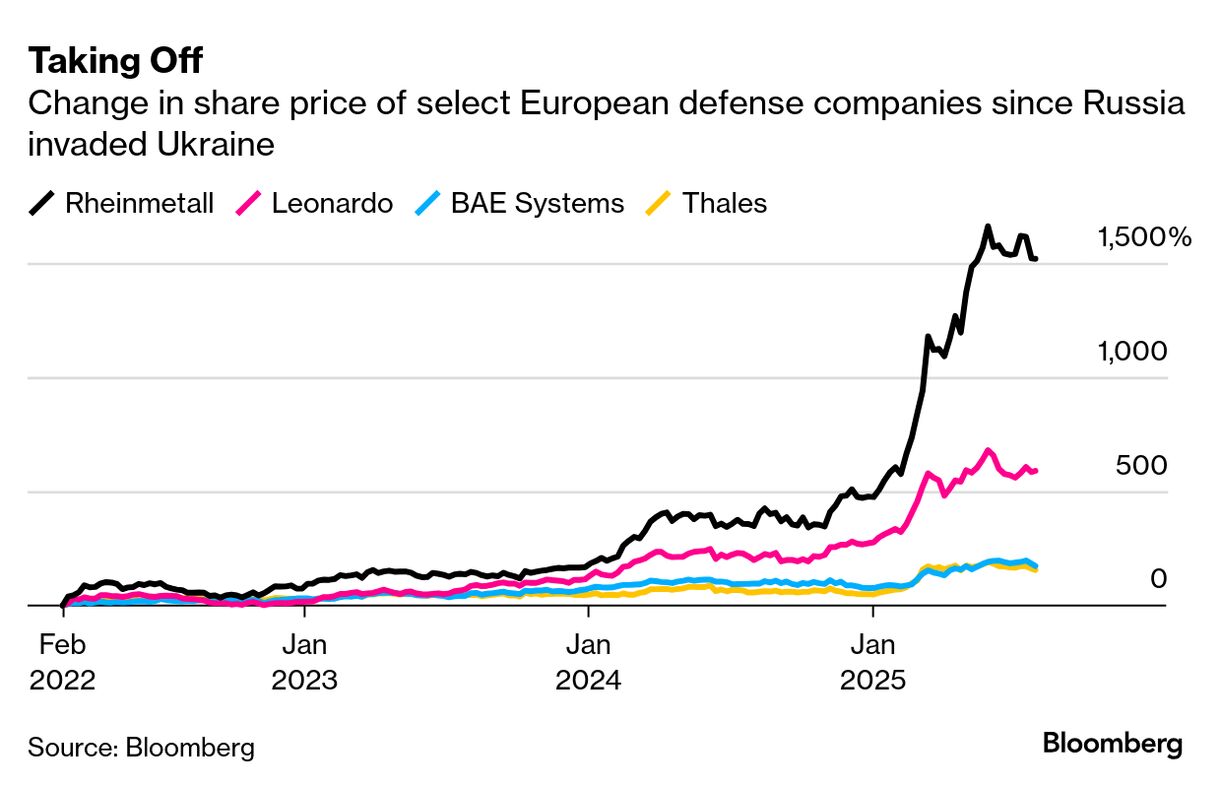
Papperger is by far the most prominent known target of this new era. He’s also central to Europe’s efforts to arm Ukraine and is a major beneficiary of the continent’s biggest investment in defense in decades. While rival executives have kept their heads below the parapet, he’s been noisily leading the charge for European rearmament, buying up competitors, ramping up production and even glad-handing Ukrainian President Volodymyr Zelenskiy in Kyiv. This, combined with the German government’s recent announcement that it will dramatically increase defense spending, has resulted in an investor frenzy. Rheinmetall’s stock has risen more than 18-fold since the war began. It’s now Europe’s most valuable defense company, with a market capitalization of about €81 billion.

https://assets.bwbx.io/images/users/iqjWHBFdfxIU/ibdmTgGLzN0U/v3/pidjEfPlU1QWZop3vfGKsrX.ke8XuWirGYh1PKgEw44kE/-1x-1.png 

Papperger has lamented that investors “ostracized” the defense industry for years. “Now we are a key player in the global defence supercycle,” Papperger said in an email in response to questions from Businessweek. ”We were always prepared, and that is now paying off.” Over the past two years, Rheinmetall, Europe’s top ammunition producer, has invested more than €8 billion in deals and new production. Papperger said Rheinmetall is building or significantly expanding 10 plants....

....MUCH MORE 

 We've had a few mentions of the big dog since Russia invaded Ukraine:

March 2024 - "Arms Maker Rheinmetall Forecasts Record Sales, Profit Growth Amid Rising Geopolitical Tensions" (RHM.de)

It was just a throwaway line in a March 7 post about possible Chinese yuan weakness but there must have been something in the air: 

The last time we saw this sort of stockpiling behavior the yuan was under 7-to-the-dollar and our guess was that the order had gone out to importers to convert currency into storable commodities ahead of a devaluation in the yuan....
*****
....So who knows? But if I was long the German export industry I would be concerned that further weakening in the yuan would make Chinese exporters even more competitive than they already are.
Except maybe for Rheinmetall. The armaments industry seems pretty well insulated from currency fluctuations. RHM.de 437.40 +1.18%

Getting a bit of that 'ol "Arms of Krupp" vibe.*

April 2024 - RWE Says ‘Significant Structural Demand Destruction’ Means Germany Will Never Fully Recover From Energy Crisis

Those companies that shut down or moved production are not coming back.

There's always Rheinmetall though. €543.20 last.

March 2025 - "Europe’s defense-tech startups launch into new era of growth"

— U.S. Marine Corps Major General Smedley Butler*

*Butler was received the nation's highest award for valor, the Medal of Honor, twice for separate actions. 

March 2025 - "As Germany Positions To Be The World's Liquidity Pump...."

"The world's" may be a bit of hyperbole but combined with what China will have to do to achieve the 5% growth figure that was reaffirmed yesterday, we are looking at potentially maybe $2 trillion in deficit spending over the next six years between the two economies and though not enough to offset the shrinkage of the U.S. deficit—which shrinkage must happen to delay slow-motion but inevitable worldwide disaster—it looks like the global party could continue until sunrise and/or 2030.

The fact much of the German deficit spending will go toward armaments is all the better—it is the most inflationary bang-for-the-buck, so to speak, spending a government can do; you make stuff, you blow it up, you make more stuff. It may not add to a country's real national wealth but boy-oh-boy does it boost nominal GDP growth.

This is a really big deal. If you don't believe me, believe the German bond market....

June 2025 - "Rheinmetall partners with Anduril to build military drones for Europe"

RHM.de closed at  1,741.00 up 12.50 (+0.72%) 

July 2025 - “It’s Military Keynesianism” On Germany's Role In The Arms Business

July 6 - Defense stock surge triggers one of the hottest ETF launches in European history

July 18 - "Can the Developed World Grow Its Way Out of Stagnation?"

July 26 - "Spy cockroaches and AI robots: Germany plots the future of warfare"

Monday, August 25, 2025

"German Economy Shows No Signs Of Emerging From Recession"

Stimulus baby, stimulus!
(not quite as mellifluous as Vegas baby, Vegas! but similar sentiment)

From ZeroHedge, August 24:

Germany’s Mittelstand Collapses as “Investment Booster” Flops

The German economy shows no signs of emerging from recession. The monthly Mittelstand index, compiled by the consulting firm DATEV, confirms that the downturn continues unabated. The crisis has spread across virtually all sectors of the economy.

The recovery announced by the German government remains a summer fantasy. Data collected in July through DATEV’s monthly survey of small and medium-sized enterprises (SMEs) describes the economic situation as extremely fragile—with no upturn in sight. SMEs saw revenues fall by 1.7 percent year-on-year in July. The corresponding business cycle index dropped, seasonally and calendar adjusted, to 91.9 points—firmly anchored in recession territory.

No Sector Spared
Sectors traditionally dominated by the Mittelstand, such as hospitality, have been hit especially hard. Revenues in the sector fell 4 percent, while construction contracted again by 2 percent. “With the absence of a summer revival, the situation in the hospitality industry continues to deteriorate,” said Prof. Dr. Robert Mayr, CEO of DATEV eG. “Hopes now rest on a more positive August.” Hope, however, is no substitute for strategy—and no good advisor amid the worsening conditions for SMEs.

Only retail managed a slight reprieve, posting a meager 0.1 percent revenue increase. That uptick likely reflects sharply rising wages, up 4 percent. But this brings little relief. Businesses are caught in a squeeze: a deteriorating business environment on one side and rising wage costs in a broader economic setting marked by stagnating or slightly declining productivity.

Investment Drought and Capital Flight
Germany is underinvested, losing foreign direct investment while labor costs rise. The consequence is job cuts. DATEV data confirm this trend, especially among small firms, which reduced headcount by 3.4 percent year-on-year. Overall employment declined by 0.3 percent, translating into about 125,000 jobs lost over the past 12 months—70,000 of them in industry, the backbone of Germany’s economy.

The DATEV index offers a granular, real-time look into the engine room of the German economy. The data are not government estimates or Bundesbank approximations but anonymized, aggregated real-time figures drawn from VAT filings and payroll accounts, covering over one million companies and eight million employees.

A Realistic Look at a Deep Recession
The numbers confirm that after contracting by 0.9 percent in 2023 and 0.5 percent last year, the German economy is set to slip even deeper this year. To assess the real trajectory, one must strip out the artificial boost from government spending. With a 3.5 percent deficit and a public-sector share of 50 percent of GDP, the private-sector recession looks dramatically worse—somewhere between –4 and –5 percent. Hospitality’s 4 percent drop lines up almost perfectly with this estimate.

Consumers, meanwhile, remain deeply unsettled. Despite rising wages, they are holding back on spending. Everyone seems to sense that this is just the beginning of a recession, one that could end with a full-blown employment crisis.

The “Investment Booster” Is a Dud
Germany’s structural problems are well known and now manifest. The old business model—cheap energy (much of it from Russia), export-driven growth fueled by the weak euro—belongs to the past. The government’s much-publicized “investment booster” will not jolt the country out of its economic paralysis.

The planned relief amounts to just €7 billion per year—spread across accelerated depreciation rules for machinery and buildings, and token tax cuts that won’t even take effect until 2028. Compare that with the over €100 billion German firms pay annually in corporate and trade taxes—before counting social charges and bureaucracy costs in the hundreds of billions....

....MORE 

If peace breaks out in Ukraine the urgency rationale of Germany's military Keynesianism withers away. And the problem with a collapse of the Mittelstand is that they support everything else:

The German concern for their small and medium sized enterprises goes back quite a ways. Here's an old-timey pic via Wikipedia:

https://upload.wikimedia.org/wikipedia/commons/f/fb/Mittelstand.jpg
Representation of the supporting
role of the Mittelstand in Walter Wilhelms
„Mission des Mittelstandes“ (Mission of the Mittelstand, 1925)
Without the Mittelstand you are without Germany's export engine and without exports (and with Mutti's recent comments on free speech, yikes!) you are left with a Teutonic Belarus.
But without the charm.
[November 2019] last seen in:

—Meanwhile In Germany: "We don't need startups, we need Digital-Mittelstand"

Related December 2024: "How China burned German industry: Nationalism will rise from the ashes" 

Thursday, March 10, 2022

Capital Markets: "ECB, EU, and US CPI"

From Marc to Market:

Overview: Strong US equity gains yesterday helped lift Asia Pacific markets today. Tokyo led the move with a nearly 4% gain in the Nikkei. Taiwan and Korea rose more than 2%, while most other bourses gained more than 1%. However, the US warning that Russia may use chemical or biological weapons after Moscow accused Ukraine of the same has seen risk retreat in Europe. After surging 4.7% yesterday, the Stoxx 600 is off around 1.1%, benchmark yields are off 2-3 bp, and the euro has been pushed lower after approaching $1.11 yesterday in its biggest gain since March 2020. US futures are around 0.5-0.8% lower, while the 10-year Treasury yield is off two basis points to around 1.93%. Several Asia Pacific benchmark yields, including China, Australia, and South Korea are at new highs for the year. The Australian and New Zealand dollars are proving resilient, while most of the other major currencies are softer. Emerging market currencies are mixed. Central European currencies are mostly lower, including the Hungarian forint despite a 50 bp increase in the one-week deposit rate (now 5.85%). The JP Morgan Emerging Market Currency Index is firmer for the third consecutive session, though still lower on the week. 

Gold peaked near $2070 on Tuesday and approached $1970 today before finding support and returning to $2000. April WTI surged to $130 on Monday and hit a low near $103 yesterday. It is trading near $113 near midday in Europe. US natural gas is posting its first gain this week and is up about 1.5%. Europe's benchmark tumbled almost 30% yesterday. An attempt to recover in early dealings today faltered, leaving it little changed. Iron ore slipped for a third session as it pares Monday's nearly 6% jump. Copper is up small for the first time this week. The US Department of Agriculture boosted its assessment of the wheat supply (helped by Australia and India). May wheat is off nearly 1% today after a 6.6% fall yesterday. It could be wheat's first weekly loss since early February.

Asia Pacific
China has widened the band for the yuan-rouble exchange rate.
The band was doubled to 10% from 5%. The US dollar is allowed to trade in a 2% band around the reference rate and rarely moves outside of a 1% band. There is much talk about how sanctions on the Russia's central bank will encourage a move to the yuan as a reserve asset. Some also have argued that the introduction of a digital yuan will also boost its reserve status. Maybe, but it seems unlikely. Of course, Russia may increase it yuan holdings, but it had appeared to largely have done so already. The lack of convertibility and transparency, and limited depth of the central government bond market seem to be significant hurdles.

Foreign investors sold JPY910 bln of Japanese equities last week, the most since the middle of last September. Offshore investors have been large sellers of Taiwan and South Korean shares this year. Today was only the second day that foreign investors did not sell Taiwanese shares in three weeks. They have sold as much this year already as they did all of last year (~$15.6 bln). Foreign investors bought about $3.6 bln of Indian shares last year and have sold about $14.2 bln this year through Tuesday. Even news that conservative candidate Yoon was elected as South Korea's new president was unable to deter foreign selling of local shares today. The $354 mln sale today brings this year's divesture to $5.5 bln. Last year foreign investors sold almost $23 bln of South Korean equities. 

There had been some ideas that with the pandemic easing, fiscal deficit would be reduced. This may still happen but a new bout of military Keynesianism may blunt it. Australia announced a A$38 bln (~$28 bln) increase in defense spending. Separately, note that Debelle, Deputy Governor of the Reserve Bank of Australia unexpectedly tendered his resignation, effective next week. Debelle was thought to be a possible successor to Governor Lowe, whose term ends in September 2023. Some suspect Lowe will be offered a second term....

....MUCH MORE

Monday, August 18, 2025

"China to continue stimulating consumption, premier says" (Party Time in Asset Markets)

From Reuters, August 18:

China will continue to boost consumption and protect people's livelihoods, expanding the country's positive growth trend, Premier Li Qiang told a State Council plenary meeting on Monday.
 
Li, whose comments were broadcast by China's state broadcaster China Central Television, said authorities would strive to achieve the full year economic growth target set at roughly 5%.
 
China would "remain calm and actively respond to various uncertainties", Li said, noting a "severe and complex external environment."....
....MUCH MORE 
 
This, combined with India's stimulative policies, The extraordinary American budget deficits and Germany's military Keynesianism means there is a an almost absurd amount of liquidity sloshing around.
 
And as our old pal Mssr. Cantillon pointed out all those years ago, the people who get the new money first don't buy things with it, thy buy assets.
 
Partay! 

Saturday, November 26, 2022

Minsky, Inflation, And The Deflationary Bloc

From Phenomenal World:

“An effective way to write the history of the last thirty years of the twentieth century,” economist Albert Hirschman wrote in 1985, “may well be to focus on the distinctive reactions of various countries to the identical issue of worldwide inflation.” Writing just as the global “great inflation” of the 1970s was abating, Hirschman couldn’t have foreseen how right he was. As Claudia Sahm recently wrote in the New York Times, fear of the great inflation of the 1970s still dominates the thinking of the Federal Reserve, even as its recent messages indicate changing winds. (In recent comments, Larry Summers’s warning that two-thousand-dollar checks would cause the economy to run too “hot” and generate inflation betrayed an almost generational blindness on the topic.)

Economists lack a good understanding of what causes inflation. In introductory macroeconomics curricula, the mantra of Milton Friedman remains central: “inflation is always a monetary phenomenon.” By this, Friedman meant that excessive price growth happens when a state loosens the supply of money, thus over-expanding the monetary base. But recent research has brought this popular doctrine into question. While expanding the money supply seems to be a necessary condition for uncontrolled inflation to occur, it is not sufficient: increases of the monetary base have occurred without any inflationary episodes, and inflationary episodes have happened with only very small increases in the monetary base.

Contra Friedman, Hirschman suggested that uncontrolled inflation is primarily a political phenomenon that occurs when groups compete over resources. The rapid increase of the price level is a signal that the state can no longer control this competition. What exactly happened in the waning decades of the twentieth century, and why do the ghosts of inflation still haunt our economic and political reality?

Hyman Minsky’s writings on the collapse of the so-called golden age of capitalism offer some insight by forcing us to engage with how distributive struggles have driven the inflationary and deflationary cycles of the past fifty years. In doing so, we can construct an account of the political economy underpinning the “deflationary coalition” that rules the common sense of our economic policymakers and the policy they write—and the path to a new one.

Hyman Minsky’s moment
Minsky became posthumously famous as a prophet of the inherent instability of financial markets. The term “Minsky moment”—the point where a bubble caused by the accumulation of private debt bursts—was coined by PIMCO’s Paul McCauley in the context of the 1998 Russian financial crisis and has become ubiquitous in the financial media. But Minsky’s Financial Instability Hypothesis (FIH), the idea that capitalism has a tendency toward financial crisis, was part of a more elaborate theory of advanced capitalist economies. Minsky believed that as a financial system, capitalism was best defined by the fact that all economic units, including individuals and households, must survive by making cash inflows and matching commitments. This is what he called a “survival constraint”: everyone from industrial firms to individual workers must have cash on hand to pay their debts or else find credit to roll their liabilities over to some future date when they will have cash flows. The ways that societies arrange for the extension and management of these cash flows and credit is a function of their institutions. For Minsky, changes in capitalist distribution and price dynamics can be understood by studying the evolution of these regimes in historical time.

In his first book-length work, John Maynard Keynes, Minsky analyzed what he called “big government” capitalism. His goal was two-fold. First, he sought to re-interpret Keynes by distinguishing the so-called hydraulic Keynesianism of the postwar era from the author’s actual written work. He argued that postwar governments which boosted inflation through private profits contradicted Keynes’ original system. Keynes believed that the state should facilitate long term economic development by directly planning economic activity, including the distribution of investment over the long run. Postwar American policymakers, however, created a policy that protected private sector profits during downturns. The United States government did not create the structures which could sustain the production of a baseline basket of goods and services from market instability during upswings. Instead, it pumped up aggregate demand via employment in the military-industrial complex and its attendant investment goods.

The second goal of the book was to warn about the inflationary tendencies of this approach. Government was forcing “overinvestment” in capital intensive industries like auto manufacturing and aerospace. While this created good jobs, it also meant that workers would have more money to spend on things made by less capital intensive, nondurable consumer goods industries. Wage inequality between these two sectors caused increasing industrial conflict. In the United States and Western Europe, a pattern emerged in which managers made wage concessions to the most highly productive workers to keep at bay demands for greater union participation in company decisions, thereby further increasing the demand for consumer goods.

Because returns to capital intensive goods were high, the investment capital needed to expand capacity in consumer goods was scarce. With rapidly increasing demand, the price of these goods began to rise, leading to a wage-price spiral. In industries with no anticipated profits, capitalists had no incentive to expand capacity. Consequently, output remained stable while prices rose. In the labor market, some workers held on to their jobs while others were relegated to chronic underemployment.

Minsky’s account differs significantly from those we see in most textbooks....

....MUCH MORE

Tuesday, November 18, 2025

Rabobank: The Polycene and the Monocene

From Rabobank's Michael Every via ZeroHedge, November 18: 

The Boundaries Dividing Political, Monetary, Fiscal, Trade And Other Policies Are Gone 

For over a decade our global strategy has warned the ‘liberal world order’ would collapse. Now, the New York Times’ Tom Friedman, in ‘Welcome to Our New Era. What Do We Call It?’, shares that “For the past few years, I have had to ask myself a question I never asked before in my life: What should we call the era we’re living in today?” He’s running with ‘The Polycene’, which in Greek means “There’s so much going on that a ‘Monocene’ focus on data won’t help.”

In markets stocks, tech, crypto, and even gold are down. Japanese 20-year JGB yields just hit the highest since 1999, prompting a meeting at 15:30 Japan time today between PM Takaichi and BOJ Governor Ueda – but what can be done endogenously that doesn’t smash either the JGB market or JPY? There are also warnings over private credit - yet we also continue to see circular-investing / vendor-financing mega deals in the AI space.

In geopolitics, the USS Ford has arrived in the Caribbean: what does that mean for Venezuela, as Chile is expected to see a US-friendly shift in its presidential election? In Asia, the US pulled a missile system from Japan as the Beijing–Tokyo row over Taiwan deepens despite the latter’s attempts to deescalate. In Europe, Berlin and Paris may scrap a planned joint fighter as France plans to supply Ukraine with 100 Rafales, upping the ante with Russia; Brussels warns the EU’s proposed €140bn Ukraine loan could have a “knock-on” impact on financial markets; Poland says a rail explosion there was an “unprecedented act of sabotage”; and the FT warns ‘The scramble for Europe is just beginning’, where “as the EU struggles to defend its interests, outside powers play divide and rule,” putting a new spin on ‘DM = EM’. In the Mid-East, the UN Security Council backed Trump’s plan for postwar Gaza, as the US intends to sell F-35 fighter jets to Saudi Arabia, whose more cash-strapped MBS will visit the White House today for arm twisting on expanding the Abraham Accords.

As military spending surges, the fiscal picture is worrying. Russia is raising VAT by 2 percentage points. The US is talking $2,000 cheques for working families paid for by tariffs. France still hasn’t agreed a budget. Germany is about to splurge on arms. Canada is borrowing far more, but not for that. The UK just saw market volatility over suggestions taxes wouldn’t be raised when the market had previously disliked the idea that they would. China is rolling out stimulus. Japan’s PM also wants fiscal stimulus… to lower inflation.

Supply chains are geopolitically squeezed. Both GM and Tesla say they won’t use Chinese parts in the US. German is freezing out Huawei and will bring in new tech controls aimed at China. The Dutch-Chinese Nexperia row rumbles on, and a new row has started. The US still hasn’t formally secured the China rare earths deal it wants. Positively, India says a US trade deal is closer after agreeing to take much more US LNG. Negatively, the US just warned Europe over trade foot-dragging, and the Chair of UBS has talked to Scott Bessent about moving the bank to the States.

Affordability remains a key issue in the West: there’s a Trump summit on it today. The situation is similar in other DM – and worse in EM. House prices are sky high: the average age of a US home buyer has risen to 59(!) A top Aussie banker says housing heat is raising concerns and calls to ‘Put the brakes on’ follow a record A$40bn investor blitz into property as everyone --but the central bank-- predicted would follow RBA rate cuts. Moreover, the AFR warns ‘China’s debt shock is coming. Our high house prices won’t protect us’, and “Australia’s economy isn’t ready.”

The threat of AI job losses is soaring. That’s as MAGA politicians are demanding transparency on AI job losses, where “Protecting US workers collides with need to outpace China”, and ‘Notices of Impending Layoffs by US Companies Surged in October’ (Bloomberg). Yet Elon Musk states his robots could end poverty and provide universal high incomes. So, what’s next: mass unemployment or ‘abundance’ or both? Which central bank has either in their models?

Political populism keeps rising. Mamdani won in New York. Trump has been forced to agree to release the Epstein files, as a far-right (and libertarian) ‘America First’ faction challenges MAGA. In Australia, the Nats/Libs Coalition is down sharply in the polls after it dropped a commitment to net zero and says it wants much lower immigration, as populist One Nation surges. In the UK, the Reform party says it would cut off benefits for EU citizens and slash overseas aid to save £25bn: the UK press says the police are preparing for civil war. On Friday, PM Takaichi announced she may change the corporate code to force Japanese firms to invest more or pay higher wages rather than return profits to shareholders. In Nepal, Indonesia, and Mexico Gen-Z protests just tried to bring down their governments. Again, central banks can’t capture this – but may be captured.

Indeed, D.L. Jacobs argues the Fed’s Miran aims to challenge the foundations of US monetary policy “because the world [Fed] forecasts are trying to measure no longer exists.” Keynesianism emerged in the Great Depression of the 1930s; monetarism with the Great Stagflation of the 1970s; hyper-neoliberalism in the post-Cold War 1990s; central bank QE in the post-GFC 2000s; and Miran argues the Treasury and Fed de facto merged in the 2020s so “The pretence of central bank independence has collapsed. Monetary policy is now politics conducted by other means.” And the US faces a panoply of (geo)political challenges....

....MUCH MORE 

As the philosopher said:

Well, I woke up this morning
And I got myself a beer
Well, I woke up this morning
And I got myself a beer 

The future's uncertain and the end is always near 

—Roadhouse Blues, Morrison, Densmore, Manzarek, Krieger, 1970