Showing posts sorted by relevance for query cobalt. Sort by date Show all posts

Wednesday, July 5, 2017

"Psst...wanna buy some cobalt? Just don't tell the auto guys!" (KBLT: Canadian venture exchange)

On a real-world basis the Norilsk-BASF deal is probably more important to the cobalt trade but Cobalt27 is interesting, if for nothing more than as a barometer of psychology.

We refrained from commenting on this IPO last month as we simply don't entertain new offerings.
That's not to say this won't have an impact, $200 million into a small market is going to shake things up a bit and if the rare earths frenzy of a few years ago (or uranium on the Salt Lake exchange in the '50's) is any indication there's some upside before a new battery technology or an innovative manufacturing technique causes the hot money herd to move on.

As always, as far as speculative vehicles go, we prefer futures where available, and on the blog, directional bets.
If you get those right the rest of the financial engineering stuff is a bit easier.

From Reuters:
(The opinions expressed here are those of the author, a columnist for Reuters.)
By Andy Home
Wanna buy into one of the hottest commodities in town?

No, it's not lithium. That's so much last year's thing. We're talking about cobalt. And this one's really hot.

On the London Metal Exchange (LME) the price for three-month cobalt has leapt from $32,750 per tonne at the start of January to a current $58,500.

This stellar near 80-percent price surge mirrors what happened to lithium prices a year or so ago.
The linkage is both metals' evolution from niche applications to mainstream usage in the batteries that are now powering the green technology revolution.

If a minimum $58,500 bet is a bit too much for you, some bright hedge fund guys have come up with a cheaper option.

For just nine Canadian dollars you can now buy a share in Cobalt 27 Capital Corp, which made its C$200 million ($150.7 million) debut on Canada's Venture Exchange last month.
Cobalt 27 describes itself as a "pure-play cobalt investment vehicle", an alternative to investing in producers such as Glencore, for whom cobalt is one small part of a much wider portfolio. 
Just don't tell the automotive guys. Because if Cobalt 27 is right in its assessment there is much more upside to the cobalt price, there's going to be some sort of reaction to a bunch of investors holding physical stocks of a strategic metal in short supply.

GETTING PHYSICAL
Cobalt 27 has used a sizeable chunk of its IPO proceeds to exercise options to buy a total 2,157.50 tonnes of physical cobalt. To put that figure into perspective, the United States Geological Survey (USGS) estimates global production of refined cobalt was 97,400 tonnes in 2015.

The metal will be stored in LME warehouses operated by C. Steinweg (Baltimore, Rotterdam and Antwerp) and the Vollers Group (Rotterdam).

A smaller part of the proceeds will be used to purchase royalties and cobalt streaming agreements from eight exploration-stage properties.

Seven are prospects in Canada, three of them operated by Palisade Resources Corp, and one in Vietnam, operated by Asian Mineral Resources.

The company's ambition is to add to this list.

In essence, Cobalt 27 will offer capital appreciation, assuming the price of cobalt does indeed rise, and cash flow from royalties.

The whole thing is the brain-child of Pala Investments, which describes itself as "a multi-strategy investment company focused on the mining and metals value chain".
Cobalt 27 Chairman and Chief Executive Anthony Milewski is also a managing director of the Pala team.

Pala is the largest shareholder with 19.64 percent at the time of the IPO, although the stake may have fallen slightly as an over-allotment option has since been partially declared. 
Part of Pala's holding represents payment for the supply of 626 tonnes of cobalt under one of the physical supply options.

Pala was one of several funds to have scooped up physical cobalt last year, which was when the metal first emerged from the specialist shadows into the investment limelight.

Another was Green Energy Metals Fund, part of the Portal Capital investment group, which is the second-largest shareholder in the new public entity having also supplied physical metal. 
Not all of the cobalt sellers chose to convert to Cobalt 27 shares. According to the company's final prospectus, "a total of 961.9 metric tonnes of cobalt are being acquired for cash".

But Pala and Portal evidently think there is more to come from the cobalt story.

THE ONLY WAY IS UP?
Or to quote Cobalt 27's prospectus, "the company believes strong cobalt demand, coupled with challenged supply due to a lack of primary cobalt mines and political instability in the Democratic Republic of Congo, which is the largest supplier of mined cobalt, creates an attractive proposition for cobalt price appreciation."

This is a market that is widely viewed by analysts as being in transition from a state of supply surplus to one of shortfall.

And as Cobalt 27 is happy to remind us, "in 2008, during the last multi-year cobalt supply deficit, the price of cobalt exceeded US$50/lb". That's equivalent to just over $110,000 per tonne.
There are any number of uncertainties in trying to forecast the price in such a fast-evolving market as cobalt, or lithium for that matter.

Everyone agrees that the electric vehicle revolution has arrived but beyond that there is no consensus as to how fast it might evolve.

And what sort of batteries will those vehicles use?...MUCH MORE
Our most recent post on the blue stuff was June 29's:

The Cobalt Trade Worked Out, On To Ruthenium

FT Alphaville's Kadhim Shubber took over the Further Reading chores today and linked to a story in this month’s American Economic Review on the violence that often accompanies the mining biz.
Here's "A “dark side” to the commodity boom in Africa" which, of course reminded me of something, in this case Presidential Executive Order 13712 of November 2015, which begins, in part:
I, BARACK OBAMA, President of the United States of America, find that the situation in Burundi, which has been marked by the killing of and violence against civilians, unrest, the incitement of imminent violence, and significant political repression, and which threatens the peace, security, and stability of Burundi, constitutes an unusual and extraordinary threat to the national security and foreign policy of the United States, and I hereby declare a national emergency to deal with that threat. I hereby order:...
Bet you didn't know about that one huh?

Anyway, in 2015-2016 we had a series of posts on a trade to capitalize on Tesla's battery ambitions that we hoped would go beyond the "common knowledge" lithium action (which we had covered here on the blog for the prior ten years):

Why the CIA Reads The Financial Times (and you should too) Tesla and Cobalt
"Freeport Sinks On Sale of Africa Copper Mine To Chinese" (FCX; LUN.TO)
DR Congo’s State Mining Company Submitted An Offer to Buy Freeport McMoRan's Stake In Tenke Fungurume Copper, Cobalt Mine (FCX; LUN.to)
"Electric-car makers on battery alert as hedge funds stockpile cobalt"

Here is the last couple years of price action for U.S. cobalt:
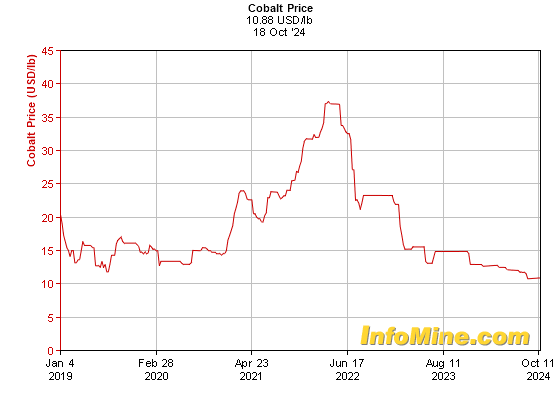
http://www.infomine.com/ChartsAndData/GraphEngine.ashx?z=f&gf=110572.USD.lb&dr=5y
Oops, gotta run, we'll be back to this in July. 

Tuesday, February 13, 2018

"There’s a Global Race to Control Batteries—and China Is Winning"

From the Wall Street Journal, Feb 11:
Companies from China now dominate the lithium-ion battery production process, which starts in Congo and ends up in a phone or electric car. Says one executive: ‘We’re realizing that the Congo is to [electric vehicles] what Saudi Arabia is to the internal combustion engine.’
KOLWEZI, Democratic Republic of Congo—Miners push bicycles piled high with bags of a grayish-blue ore along a dusty road to a makeshift market. There, they line up at wholesalers with nicknames such as Crazy Jack and Boss Lee.

Most of the buyers are Chinese. Those buyers then sell to Chinese companies that ship the bags, filled with cobalt, to China for processing into rechargeable, lithium-ion batteries that power laptops and smartphones and electric cars.

There is a world-wide race to lock up the supply chain for cobalt, which will likely be in even greater demand as electric-car production rises. So far, China is way ahead.

China is by far the biggest consumer of cobalt from Congo, the world’s biggest producer. Chinese refiners import about 94% of their cobalt from the West African nation, according to Darton Commodities.

“We’re realizing that the Congo is to [electric vehicles] what Saudi Arabia is to the internal combustion engine,” says Trent Mell, chief executive of exploration company First Cobalt Corp. , based in Toronto. Chinese firms are keenly aware of Congo’s importance to electric vehicles, he says, and “trying to control the whole ecosystem…from cobalt mining to battery production.”

China already is the world’s largest electric-car market. In 2011, Beijing listed electric vehicles as one of seven “strategic emerging industries.” Developing a homegrown battery industry became a vital part of the government-sponsored push. The Chinese government provides subsidies to domestic battery makers, essentially locking out foreign companies.

Companies from China now dominate the first steps in the lithium-ion battery production process. Such firms produce about 77% of refined cobalt chemicals, up from 67% in 2012, according to commodities researcher CRU Group . George Heppel, a consultant at CRU, says Chinese companies could soon have more than 90% of the market.

About 54% of the global cobalt supply comes from Congo. Chinese companies dominate the network of middlemen who buy cobalt from freelance miners such as those lining up at the market in Kolwezi.

Few commodities have had more dramatic increases in demand than cobalt, primarily a byproduct of copper and nickel mining. Global cobalt production has quadrupled since 2000 to about 123,000 metric tons a year, according to the U.S. Geological Survey.

Demand is growing even faster and is expected to reach more than 200,000 tons by 2025, according to researcher Wood Mackenzie. Electric cars are a big reason why. About 1,300 metric tons of cobalt were used in electric vehicles in 2014, Morgan Stanley estimates. The total is expected to rise to 11,320 tons this year and 62,940 tons by 2025.

Such expectations have caused cobalt prices to more than double in the past year in London trading. Cobalt prices are up more than 230% since the end of 2015, according to Thomson Reuters.
“If our projections for electric vehicles are anywhere near close, there are going to be some serious issues in the cobalt market” after 2020, says Jack Bedder, an analyst who follows cobalt for the London market-intelligence firm Roskill. Tight supply would give China yet another advantage because of its strength in the cobalt supply chain.

Swiss miner Glencore PLC is the world’s largest cobalt producer, including 27,400 tons from Congo last year. Glencore expects its output to more than double in the next few years.
Much of the remaining 30,000 tons to 40,000 tons of Congolese cobalt comes from freelancers known as creuseurs, the French word for diggers, or Chinese companies such as China Molybdenum Co. and Zhejiang Huayou Cobalt Co. and small industrial producers, according to traders.

Freelancers unearth cobalt with picks and shovels, earning about roughly $300 per ton of ore, up from $200 a year ago. U.S. and European companies have grown wary of cobalt suppliers who buy from creuseurs, partly because some of the miners are children. They rarely wear masks or other safety equipment. Crippling injuries are common. Industry researcher Darton Commodities estimates they produce as much as 14% of the cobalt output in the central African nation.

Tesla Inc. said last year its cobalt supplier in Congo is “very reputable,” without identifying the supplier. The auto maker sent a team to the country to make sure its supply chain doesn’t include child labor or cobalt mined by creuseurs. Tesla hasn’t said if it made any changes as a result.
For years, traders who bought cobalt from freelance miners often sold it to Congo DongFang International Mining, a unit of Chinese giant Zhejiang Huayou, according to human-rights group Amnesty International and other people familiar with Congo’s cobalt market.

Contemporary Amperex Technology Co., based in China’s coastal Fujian province, is one of the country’s largest makers of electric-vehicle batteries.Photo: Qilai Shen/Bloomberg News
A Zhejiang Huayou spokesman says it stopped buying last April from wholesalers who cater to creuseurs and is trying to buy more from industrial miners that have greater control over the production process. The company is making the changes with help from a nongovernmental organization called Pact, the Zhejiang Huayou spokesman adds.

China Molybdenum in 2016 agreed to purchase a giant copper and cobalt mine in Congo from U.S. mining giant Freeport-McMoRan Inc. The mine supplies a Freeport facility in Finland that produces about 20% of the processed cobalt sulfate used to make batteries. Analysts say the rest of global cobalt sulfate production is done in China....MUCH MORE

Wednesday, June 13, 2018

"Tesla leads electric vehicle race to cut cobalt dependency" (TSLA)

One of the reasons cobalt prices are rolling over, the other being supply coaxed onto the market by the quadruple in prices. it was a good run, funny how this commodity stuff works, what with the supply and the demand and the substitutions and the....

First some background. From last year's "Electric Vehicles: An Old Pro On Battery Technology and Policy and China" (cobalt percentage in blue, naturally):
Let’s look at the critical natural resources necessary for producing lithium ion batteries that can give a one to two ton motor vehicle a range of 300 km or more; these would be of the of the NCA, nickel-cobalt-aluminum cathode type such as is used by the Tesla corporation.... 
https://electrek.files.wordpress.com/2016/11/nattery-raw-materials.png?w=1500&h=1000#038;h=383

Don't worry if you can't read the graphic, it's from a dandy piece that Visual Capitalist did in 2016, click through for the whole thing.
The point is that the chemistry of the Tesla/Panasonic lithium-ion batteries was already on the low end of cobalt use compared to the cathodes in, say, the iPhone.

But, because the Chinese pretty much locked up supply* from current producers, prices were heading up fast and even worse, it is tough to get the stuff regardless of the price you are willing to pay. Which is why last August we were posting "Batteries: Manufacturers Are Reducing the Amount of Cobalt Used In Electric Vehicles".

https://cdn.teslarati.com/wp-content/uploads/2018/05/Teslas-Cobalt-Evolution-Benchmark-Mineral-Intelligence-1.jpg
The evolution of Tesla’s cobalt use over time. [Credit: Benchmark Mineral Intelligence]

So, with that in mind, here's the latest from Reuters, June 6:
If Elon Musk had his way, there would be no cobalt in any of the batteries powering the next generation of Tesla.

At the very least, “we think we can get the cobalt to almost nothing”, he told analysts on the company’s first quarter results call.

Panasonic, which supplies the batteries for Tesla’s electric cars, is “aiming to achieve zero usage in the near future and development is under way”, according to Kenji Tamura, who is in charge of the Japanese firm’s automotive battery business.

The two companies are leading an industry race to reduce exposure to the metal even before the electric vehicle (EV)revolution truly builds momentum.
It’s not difficult to see why.

The London Metal Exchange price of the battery input has already rocketed from under $30,000 per tonne at the end of 2016 to a current $86,750.
It could go even higher.

Cobalt supply is dominated by Democratic Republic of Congo, presenting a volatile cocktail of political, operational and ethical risk.

And cobalt from Congo is dominated by China, which has locked down supply chains to secure its own fast-growing battery sector.

For relative newcomers, which means much of the European automotive sector, cobalt is the most problematic of all the ingredients in the metallic alchemy of an EV battery pack.

But given cobalt is one of the single most important determinants of a battery’s stability and performance, can the problem be engineered away?
Graphic on LME cobalt price: tmsnrt.rs/2LpswXW

DRIVING OUT COBALT
Tesla and Panasonic are leading the EV field when it comes to minimising cobalt usage.
That’s primarily because from inception they took a different chemical road to build batteries with the capacity and stability to power an electric vehicle.

Panasonic’s nickel-cobalt-aluminium (NCA) technology has always used less cobalt than the nickel-cobalt-manganese (NCM) formula used by just about everyone else.

And the company has had 10 years experience since the 2008 launch of the original Tesla Roadster to work on its battery chemistry. ...MUCH MORE
*...China Molybdenum Co. bought a stake in one of Congo’s biggest copper and cobalt mine, Tenke Fungurume, as part of a $3.8 billion deal last year, and Freeport-McMoRan has left the country. China’s Zhejiang Huayou Cobalt Co. is developing a copper mine near Kolwezi in the country’s southeast. In March, Glencore agreed to sell about a third of its cobalt output to GEM Co., a Chinese supplier of battery chemicals....
— Bloomberg, June 12, 2018
Related:
June 12, 2018 
Batteries: VALE Sells Forward $690 Million of Cobalt Production as the Market Rolls Over (VALE; KBLT)

May 4, 2018
"BNEF Brief: Elon Musk's Warning on Cobalt Use"

May 2016
Why the CIA Reads The Financial Times (and you should too) Tesla and Cobalt
A couple weeks ago we posted a seemingly innocuous piece with a boring headline: "'Freeport Sinks On Sale of Africa Copper Mine To Chinese' (FCX; LUN.TO)".
I figured there were at best two thousand people in the whole world who knew or cared about the back story and real import of what was going on so I'd just drop it as an Easter egg for the cognoscenti and other assorted electric vehicle/conflict mineral/African warlord/Elon Musk/extractive industry/Génocidaire hunter/U.S. political corruption watchers to find.
Well now that cat's out of the bag.
Big kudos to the FT's Henry Sanderson for recognizing one hell of a story and a small request for the Financial Times: Can you tell us what the old ENRC is up to these days?
From The Financial Times, May 25:
China plays long game on cobalt and electric batteries...
May 2016
"Freeport Sinks On Sale of Africa Copper Mine To Chinese" (FCX; LUN.TO)

Sept. 2016
DR Congo’s State Mining Company Submitted An Offer to Buy Freeport McMoRan's Stake In Tenke Fungurume Copper, Cobalt Mine (FCX; LUN.to)

Sept. 2016 
Lundin Mining Granted Second Extension To Bid For Giant DR Congo Cobalt/Copper Mine
So waddya think?
Is Tesla going to stick with current battery technology and use cobalt or will one of the competing approaches prove so superior that the value of Tenke Fungurume falls 60%.

Follow one road and all Europe may be free and the life of the world may move forward into broad, sunlit uplands. But if we fail, then the whole world, including the United States, including all that we have known and cared for, will sink into the abyss of a new Dark Age made more sinister, and perhaps more protracted, by the lights of perverted science.

No pressure.
And no idea why Churchill is showing up in the intro to a mining story.

It may be as simple as always thinking it would be nice to walk into the Monday morning meeting and, just once, have someone acknowledge last week's performance with "This was their finest hour".
Just once....

Thursday, August 24, 2017

Cobalt, Cobalt, Cobalt

We'll be looking at possible futures for battery technology later in the year but for the nonce the far-and-away tech of choice is lithium ion which means cobalt, albeit in decreasing amounts as the big manufacturers tweak their recipes.

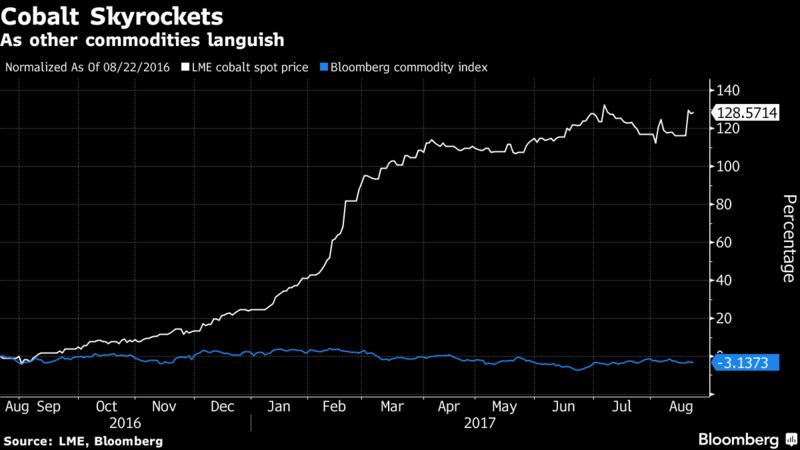
And for today (actually Aug 22) we have Bloomberg weighing in on the physical commodity front:

Hunt for Next Electric-Car Commodity Quickens as Prices Soar
  • Cobalt demand expected to increase 34% a year through 2026
  • Top copper miner Chile looking to restart cobalt production
Niche metal cobalt is leaving bigger names like copper and lithium in its dust, triggering a hunt for new deposits from Idaho to Chile.

As one of the key components in the new breed of rechargeable batteries and with supply dominated by the Democratic Republic of Congo, prices have surged at four times the pace of major metals in the past year. That’s caught the attention of governments, explorers and money managers, with annual demand set to increase 34 percent until 2026 as electric cars gain a bigger share of the global auto fleet, according to CRU Group.
https://assets.bwbx.io/images/users/iqjWHBFdfxIU/iGbTURJU4wN0/v2/800x-1.png
Authorities in Chile, the top copper-producing nation, are embarking on a fact-finding mission with a view to restart cobalt production after a more than seven-decade hiatus. First Cobalt Corp. is merging with two other firms to create what it calls the world’s largest explorer of the mineral. A bet on the cobalt industry has helped make a Commodity Capital fund the best performer in the commodities market, while legendary Australian prospector Mark Creasy has cobalt on his latest list of targets.
“Cobalt is the next big thing,” Commodity Capital co-founder Dana Kallasch said by telephone on Tuesday. The firm’s Global Mining Fund has returned about 70 percent this year, beating 213 peers, according to data compiled by Bloomberg.

The mineral once used to dye pottery dark blue is now in demand from car and phone makers from Tesla Inc. to Apple Inc.

More than half of global production comes from Congo. The African country produced 66,000 tons last year, compared with 7,700 in China, the second-biggest producer. In Congo, cobalt is mined mostly informally in precarious conditions that sometimes involve child labor.

“We are seeing companies being more careful about where cobalt comes from and asking for providers to have the right paperwork," Rebecca Gordon, head of technology metals at CRU Group, said by telephone from London. "But there’s not much happening elsewhere."

The cobalt market is in a 5,500-ton deficit, according to CRU, with global supply contracting 3.9 percent in 2016. Glencore Plc.-owned Katanga’s whole ore leach and Eurasian Resources Group’s roan tailings reclamation projects -- both ramping up this year in Congo -- should help ease the deficit. Rising prices are encouraging operators in Asia and elsewhere to produce cobalt as a byproduct of other metals such as nickel and copper.

Chile also wants to get in on the act. Development agency Corfo met with companies including Samsung SDI and Umicore SA in Europe during a recent roadshow on lithium, another key component of electric-car batteries. Some made inquiries about Chilean cobalt, Eduardo Bitran, executive vice president of Corfo, said an interview Monday....MORE
Prior posts:
Aug. 3
Batteries: Manufacturers Are Reducing the Amount of Cobalt Used In Electric Vehicles
July 5
"Psst...wanna buy some cobalt? Just don't tell the auto guys!" (KBLT: Canadian venture exchange)
June 29
The Cobalt Trade Worked Out, On To Ruthenium
Feb. 2017 
"Electric-car makers on battery alert as hedge funds stockpile cobalt"
May 2016
Why the CIA Reads The Financial Times (and you should too) Tesla and Cobalt
A couple weeks ago we posted a seemingly innocuous piece with a boring headline: "'Freeport Sinks On Sale of Africa Copper Mine To Chinese' (FCX; LUN.TO)".
I figured there were at best two thousand people in the whole world who knew or cared about the back story and real import of what was going on so I'd just drop it as an Easter egg for the cognoscenti and other assorted electric vehicle/conflict mineral/African warlord/Elon Musk/extractive industry/Génocidaire hunter/U.S. political corruption watchers to find.
Well now that cat's out of the bag.
Big kudos to the FT's Henry Sanderson for recognizing one hell of a story and a small request for the Financial Times: Can you tell us what the old ENRC is up to these days?
From The Financial Times, May 25:
China plays long game on cobalt and electric batteries....
May 2016
"Freeport Sinks On Sale of Africa Copper Mine To Chinese" (FCX; LUN.TO)
Sept. 2016

DR Congo’s State Mining Company Submitted An Offer to Buy Freeport McMoRan's Stake In Tenke Fungurume Copper, Cobalt Mine (FCX; LUN.to)  
Sept. 2016
Lundin Mining Granted Second Extension To Bid For Giant DR Congo Cobalt/Copper Mine
So waddya think?
Is Tesla going to stick with current battery technology and use cobalt or will one of the competing approaches prove so superior that the value of Tenke Fungurume falls 60%.

Follow one road and all Europe may be free and the life of the world may move forward into broad, sunlit uplands. But if we fail, then the whole world, including the United States, including all that we have known and cared for, will sink into the abyss of a new Dark Age made more sinister, and perhaps more protracted, by the lights of perverted science.

No pressure.
And no idea why Churchill is showing up in the intro to a mining story.

It may be as simple as always thinking it would be nice to walk into the Monday morning meeting and, just once, have someone acknowledge last week's performance with "This was their finest hour".
Just once.... 

Thursday, August 3, 2017

Batteries: Manufacturers Are Reducing the Amount of Cobalt Used In Electric Vehicles

This isn't the disruption that Mr. Musk fears will make obsolete his Gigafactory approach but it does point up a couple realities:

1) There will be a lot of companies making batteries for electric vehicles.
2) As the old-timers say about commodities: "The cure for high prices are high prices." After a 150% run like cobalt just had you will see substitution as in this story or increased supply as with Glencore spending a half billion to un-mothball a mine in DR Congo, or both.

More after the jump.

From Reuters via CNBC August 3:

UPDATE 1-Asian battery makers eye nickel top-up as cobalt price bites
* Cobalt prices double on demand, supply shortage
* Battery makers turn to cheaper nickel to cut costs
* Electric vehicle batteries to drive market growth (Updates to add graphic)

SEOUL, Aug 3 (Reuters) - Soaring cobalt prices are prompting Asia's top battery makers to tweak the recipe for lithium-ion batteries used to power electric cars and mobile phones - reducing the amount of cobalt and adding more nickel.

With forecasts for electric vehicle (EV) battery demand to jump 20-fold over the decade to 2025, manufacturers are looking to cut back on more expensive components. Cobalt has more than doubled in price over the past year on strong demand and a supply shortage.

Popular nickel, manganese and cobalt (NMC) lithium-ion batteries typically employ a ratio of 60 percent nickel to 20 percent cobalt and 20 percent manganese, or 6:2:2, said South Korea's SK Innovation, which aims to change the composition of these cathode materials to 80 percent nickel, 10 percent cobalt and 10 percent manganese.

"We are trying to change the ratio to 8:1:1, from 6:2:2. This is not producing a completely new product, rather it's part of efforts to respond to changing market conditions," a spokesman said.
Cobalt prices spiked to average $58,549 a tonne in July - about six times the cost of nickel.
The price hike has been driven by higher demand and a supply shortage sparked by conflict in the Democratic Republic of Congo, which provides nearly 60 percent of the world's cobalt, also raising issues of security of supply.

Surging demand for EV batteries could add some 10 percent to 40 percent to current nickel demand by 2025, depending on the success of efforts to replace cobalt with nickel, UBS said in a recent report.

Asia dominates global EV battery shipments. Japan's Panasonic Corp accounted for nearly 30 percent of shipments in the first five months of this year, while South Korea's two top producers - Samsung SDI and LG Chem - made up more than 20 percent, according to SNE Research. China's BYD Co had just over 8 percent of the market.

HALVING COBALT USE
Samsung SDI said it expected the amount of cobalt per battery unit to decrease in the long term to about half of current levels across the industry....MUCH MORE
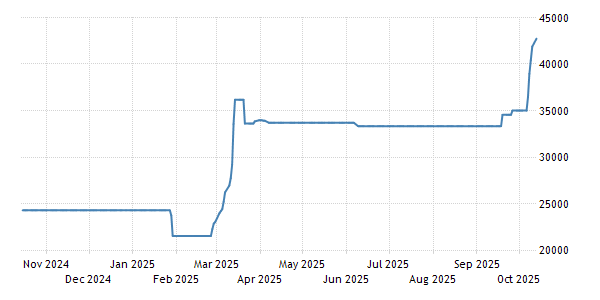
On the LME prices are rolling over:


source: tradingeconomics.com

And in fact both the bid and offer curves are in backwardation.
We were fortunate to catch most of the move but for now it looks like cat videos are the play du jour.
Because cobalt is associated with both copper and nickel mining there are some interesting dynamics—with the recent leg higher in copper ($2.50 to $2.85) and the battery guys looking for more nickel, there should be more byproduct supply.

Previously:
July 5
"Psst...wanna buy some cobalt? Just don't tell the auto guys!" (KBLT: Canadian venture exchange)
June 29
The Cobalt Trade Worked Out, On To Ruthenium
Feb. 2017 
"Electric-car makers on battery alert as hedge funds stockpile cobalt"
May 2016
Why the CIA Reads The Financial Times (and you should too) Tesla and Cobalt
A couple weeks ago we posted a seemingly innocuous piece with a boring headline: "'Freeport Sinks On Sale of Africa Copper Mine To Chinese' (FCX; LUN.TO)".
I figured there were at best two thousand people in the whole world who knew or cared about the back story and real import of what was going on so I'd just drop it as an Easter egg for the cognoscenti and other assorted electric vehicle/conflict mineral/African warlord/Elon Musk/extractive industry/Génocidaire hunter/U.S. political corruption watchers to find.
Well now that cat's out of the bag.
Big kudos to the FT's Henry Sanderson for recognizing one hell of a story and a small request for the Financial Times: Can you tell us what the old ENRC is up to these days?
From The Financial Times, May 25:
China plays long game on cobalt and electric batteries...
 May 2016
"Freeport Sinks On Sale of Africa Copper Mine To Chinese" (FCX; LUN.TO)
Sept. 2016

DR Congo’s State Mining Company Submitted An Offer to Buy Freeport McMoRan's Stake In Tenke Fungurume Copper, Cobalt Mine (FCX; LUN.to) 
Sept. 2016
Lundin Mining Granted Second Extension To Bid For Giant DR Congo Cobalt/Copper Mine
So waddya think?
Is Tesla going to stick with current battery technology and use cobalt or will one of the competing approaches prove so superior that the value of Tenke Fungurume falls 60%.

Follow one road and all Europe may be free and the life of the world may move forward into broad, sunlit uplands. But if we fail, then the whole world, including the United States, including all that we have known and cared for, will sink into the abyss of a new Dark Age made more sinister, and perhaps more protracted, by the lights of perverted science.

No pressure.
And no idea why Churchill is showing up in the intro to a mining story.

It may be as simple as always thinking it would be nice to walk into the Monday morning meeting and, just once, have someone acknowledge last week's performance with "This was their finest hour".
Just once.... 

Wednesday, November 6, 2024

"World's Biggest Cobalt Miner Is Gloomy on the EV Metal's Future"

Yes.*
(I've been asked to not use the "Well duh" locution.)

From Bloomberg via Canada's Financial Post, November 6:

The world’s No. 1 cobalt miner is sounding the alarm over the shrinking role of the metal in electric vehicle batteries.

Chinese company CMOC Group Ltd., which has been churning out cobalt much faster than rivals like Glencore Plc, said the importance of the raw material in the energy transition is declining rapidly.

The adoption of cobalt-free lithium iron phosphate, or LFP, batteries has gained momentum in recent years, due to them being cheaper to manufacture. The proportion of EV batteries in China containing cobalt will drop to 31% in 2024, from 44% two years ago, according to consultancy CRU Group.

“We predict that EV batteries will never return to the era that relies on cobalt,” Zhou Xing, a spokesman for CMOC, said in an emailed response to questions. “Cobalt is far less important than imagined” and the proportion of batteries containing the metal may eventually drop to less than a tenth, he said.

CMOC’s bearish view of the market comes amid a glut of the metal that’s been largely created by the Chinese firm’s expansion of two huge copper-cobalt mines in the Democratic Republic of Congo. It smashed through its full-year output target in the first nine months of the year, helping to push down cobalt prices to the lowest level since 2016. 

While the Chinese miner has been ramping up production, Glencore, which CMOC overtook as the biggest cobalt supplier last year, has cut output at its Mutanda asset in DRC.

Cobalt, which is also used in aerospace alloys and in the petrochemical industry, is often extracted as a by-product of digging up copper, and CMOC has been eager to mine more of the red metal as it’s bullish on it in the longer term. Hoarding cobalt to stem a decline in prices would be pricey due to the increase in expenses, such as for warehousing, according to Zhou.

“The global cobalt outlook looks bearish for next year: new, cheap metal refining capacity has come online in China and Indonesia,” said Thomas Matthews, battery materials analyst at CRU. Prices should be lower on average next year and will take a few years to recover, he said.... 

*If interested see also: 
June 2018 - "Tesla leads electric vehicle race to cut cobalt dependency" (TSLA)
One of the reasons cobalt prices are rolling over, the other being supply coaxed onto the market by the quadruple in prices. it was a good run, funny how this commodity stuff works, what with the supply and the demand and the substitutions and the....
 
February 2023 - "Cobalt’s battery-powered boom has turned to bust"
Oh we had fun with the blue one 2016 2018, but then Elon Musk started making noise about the cost of cobalt and the writing was on the wall. Some links below....

October 2024 - "China is Winning The Race for Ultra-Fast Charging EV Batteries"

Previously on iron batteries:

Deep Dive: Iron Batteries Crushed The Demand For Cobalt, Reduced The Demand For Nickel
Watch Out Elon, Here Come The Iron Batteries (TSLA)

Tesla's Pivotal Move In Battery Chemistry (TSLA)

"What Tesla’s bet on iron-based batteries means for manufacturers" (TSLA)

 "Tesla will only use iron-based batteries for standard model EVs" (TSLA)

 Batteries: Lithium-Iron may be Competitive With Lithium-Cobalt

Platts' "Commodity Tracker: 5 charts to watch this week"

Batteries: ...The Race to Build Europe’s First Lithium-Iron-Phosphate Battery Gigafactory
Lithium-Iron, it's all anyone is talking about....

"Tesla in talks with China's EVE for low-cost battery supply deal -sources" TSLA)
Well I guess Tony Stark Elon Musk is now officially Iron Man.

October 2023 - "Cobalt's Unexpected Plunge Shocks Global Market"

June 2024 - Morgan Stanley Analyst Adam Jonas Writes A Love Letter To Tesla (TSLA)
A confession of bullish bias up front, from April 24's "Tesla Q1 2024 Earnings Call Transcript (TSLA)":

In pre-market action the stock is up $17.47 (+12.07%) at $162.15.

Below are the words that are adding billions ($50+) to the company's valuation. 

Personally I think Musk is going to pull it off, but that's just me—perhaps informed by posting on the company and its stock since before the June 2010 share flotation (which, adjusted for the 5:1 and 3:1 stock splits gives a $1.133 IPO price)—however, there are plenty of other opinions to choose from if one doesn't care for that one....

And many, many more. If interested use the 'search blog' box, upper left. 
For now, as we related in reference to the Chinese government/Party attempts at stimulus:

....Quite a few speculators greet each attempt by the Chinese government to pump liquidity into the economy as a reason to drag out the 2010 playbook.
But things change and if your thinking doesn't also change, you can get terribly surprised. 

More succinctly (and more rhyme-y) the old Turkish proverb:

it ürür, kervan yürür

  1. (literally) The dog barks, but the caravan goes by.

—Wiktionary

Tuesday, October 31, 2023

"Cobalt's Unexpected Plunge Shocks Global Market"

We had some fun with this one 2015 - 2018 but now the game has changed. For the last five years Elon Musk has been doing everything he can do to get cobalt out of his battery chemistry and the rest of the big battery players are working toward the same goal (think CATL).

From OilPrice, October 30:

  • Cobalt prices reached record lows due to an oversupply, primarily stemming from a stockpile created during a lengthy ownership dispute in the DRC.
  • The demand for cobalt has decreased with falling EV sales in Europe and China, and as battery production shifts to cobalt-free chemistries.
  • Analysts are divided on the future of cobalt, weighing its benefits in extending battery life against the appeal of cheaper, cobalt-free alternatives.

Via Metal Miner

Analysts once hailed cobalt as a commodity whose price would rise forever. Used in the cathodes of many lithium-ion batteries to extend the life of the battery cell, investors and mine operators eagerly anticipated high returns on all cobalt investments. However, cobalt prices recently dropped to record lows amid global oversupply and a widespread slowdown in the battery market. Suddenly, those same traders and mine companies are scratching their heads.

Most of the world’s cobalt supply originates from the Democratic Republic of the Congo, an impoverished sub-Saharan African country. The people there widely believe cobalt mining is the key to a better future. As a result, they will risk their lives to mine it. Indeed, a quarter of the cobalt mined in the DRC comes from “artisanal mining” where miners use their hands and simple tools to extract the metal from the Earth. In turn, mine collapses that trap miners underground are common. Those who survive the mining process often go on to sell the metal ore they collect to Chinese brokers who siphon off most of the profit.

DRC Behind the Cobalt Surplus...

....MUCH MORE

We happened to catch the DRC stockpile story back on March 1:

"A $1.5 billion hoard of copper and cobalt is piling up in Congo"
Okay, here's the plan. We're going to need a truck....

And from the LME via Investing.com (also on blogroll at right) three years of price action:

https://tvc-invdn-com.investing.com/data/tvc_37d387820cce7154c28d0ccc507382ae.png

Thursday, July 26, 2018

"Ten years left to redesign lithium-ion batteries"

This time frame is not too restrictive.
Tesla and their battery partner, Panasonic, have removed a lot of the cobalt (60%) from their battery recipe and are on their way to zero cobalt over the next couple years.

So, more interesting than any time pressure is the potential spur to creativity on the question of alternative chemistries.

From the journal Nature, July 25:

Reserves of cobalt and nickel used in electric-vehicle cells will not meet future demand. Refocus research to find new electrodes based on common elements such as iron and silicon, urge Kostiantyn Turcheniuk and colleagues.
Electric vehicles need powerful, light and affordable batteries. The best bet is commercial lithium-ion cells — they are relatively compact and stable. But they are still too bulky and expensive for widespread use.

The performance of rechargeable lithium-ion batteries has improved steadily for two decades. The amount of energy stored in a litre-sized pack has more than tripled, from around 200 watt hours per litre (Wh l–1) to more than 700 Wh l–1. Costs have fallen by 30 times, to around US$150 per kilowatt hour (kWh). But that still exceeds the $100 per kWh goal for affordability set by the US Department of Energy. And batteries that are powerful enough for an electric car (50–100 kWh) still weigh around 600 kilograms and take up 500 litres of space.

The pace of advance is slowing as conventional technology approaches fundamental limits. The amount of charge that can be stored in gaps within the crystalline structures of electrode materials is nearing the theoretical maximum. Projected market growth will not lower prices substantially — the markets are already large.

Worse, the materials used in electrodes, notably rare metals such as cobalt and nickel, are scarce and expensive. Surging battery production has almost quadrupled wholesale prices of cobalt over the past two years, from $22 to $81 per kilogram.

High demand and prices are already encouraging some producers to cut corners and violate environmental and safety regulations. For example, in China, dust released from graphite mines has damaged crops and polluted villages and drinking water1. In Africa, some mine owners exploit child workers and skimp on protective equipment such as respirators. Small artisanal mines, where ores are extracted by hand, often flout laws. Some companies, including BMW, follow strict policies to verify their cobalt suppliers2. Many do not.

Alternative types of electrode based on cheap, common metals such as iron and copper need to be developed urgently. In our view, the most promising candidates involve ‘conversion materials’, such as copper or iron fluorides and silicon. These store lithium ions by bonding chemically with them. But the technology is still at an early stage. Problems with stability, charging speed and manufacture must be overcome.

We call on materials scientists, engineers and funding agencies to prioritize the research and development of electrodes based on abundant elements. Otherwise, the roll-out of electric cars will stall within a decade. 

Scarce and expensive
Lithium-ion batteries work by shuffling lithium ions between two electrodes. Ions flowing from the anode to the cathode discharge a current, which powers the car. The lithium ions flow back when the battery is recharged.

In commercial cells used today for electric vehicles, the lithium ions are held in tiny voids within the crystals that make up the electrodes (these are known as intercalation electrodes). The anodes are typically made from graphite and the cathodes from metal oxides. Common oxides include lithium nickel cobalt aluminium oxide (NCA, commonly LiNi0.8Co0.15Al0.05O2) or lithium nickel cobalt manganese oxide (NCM, often LiNi0.6Co0.2Mn0.2O2 or LiNi0.8Co0.1Mn0.1O2). A lithium-ion car battery with a 100 kg cathode requires 6–12 kg of cobalt and 36–48 kg of nickel.

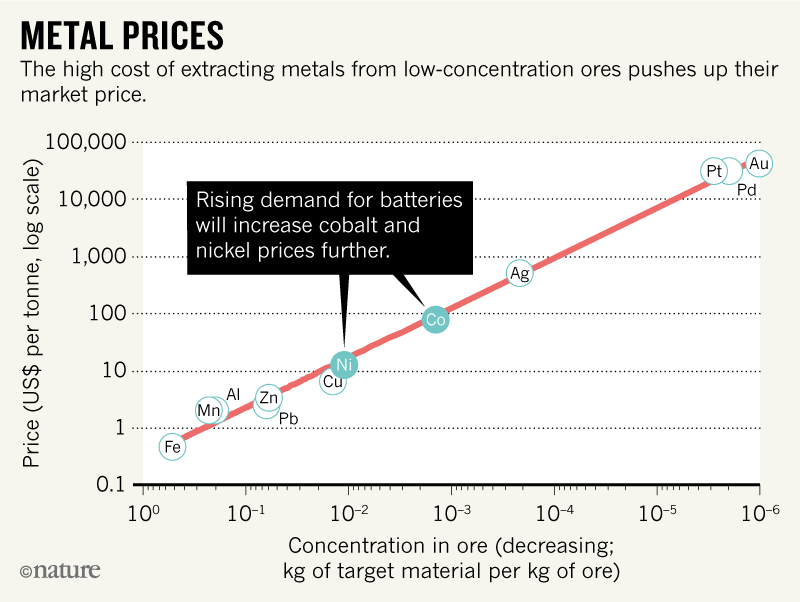
The prices of metals reflect demand, supply and the costs of extracting them from ores. Cobalt is pricey because it is rare and highly sought after. It requires capital-intensive processes to produce it, involving roasting, flash smelting and the consumption of poisonous gases3. Cobalt is often a by-product of copper and nickel mining, and can also need separating from other metals.
Few cobalt mineral deposits are concentrated enough to be worth mining. Most deposits contain just 0.003% of the metal; more than 0.1% is needed to achieve prices of $100 to $150 per kg (ref. 4). Production costs jump for poor ores because more rock must be processed (see ‘Metal prices’). Thus, only 107 tonnes of cobalt out of 1015 tonnes potentially available in Earth’s crust are profitable to extract5. Similarly, only 108 of 1015 tonnes of nickel reserves are commercially viable5. 
Source: London Metal Exchange

Cobalt-rich minerals are found in just a few places6. The Democratic Republic of the Congo (DRC) supplied more than half (56%) of the 148,000 tonnes of the metal mined worldwide in 2015 (ref. 6). Most of this goes to China, which holds stockpiles of 200,000 to 400,000 tonnes6. Australia hosts 14% of the world’s cobalt reserves but has yet to exploit them fully. Cobalt has been extracted from the deep sea floor, but mining here would be too expensive, ecologically and economically....MORE

Monday, February 11, 2019

ICYMI: Cobalt Trades at Two-Year Lows

Here's five years of the U.S. cash price:

http://www.infomine.com/ChartsAndData/GraphEngine.ashx?z=f&gf=110572.USD.lb&dr=5y
And from Warrior Trading:
Cobalt Prices Reach 2-Year Lows as Congo Increases Supply
Car manufacturers rely on a number of different precious metals in the production process. Between key battery materials like Lithium, which is under a tight supply and seeing prices rise, other minerals are facing a different economic situations. Cobalt, a key battery metal, has fallen over 40 percent since mid-November, trading between $18.75 and $20.35 a pound. This decrease marks the lowest the commodity has reached in over two years.

Cobalt has seen a drastic drop in price just over the past year. Back in April 2018, the metal reached a 10-year peak of over $40 a pound, which compelled many battery makers to invest in lower-cobalt battery designs. However, the massive drop in prices will likely ease fears for current battery technology and help ease a swifter rollout of electric cars. At the same time, many companies could be tempted to lock in prices in long term contracts with miners.

“Not only will this enable [carmakers] to feel more secure about future pricing and act more aggressively on their electric vehicle production ramp-up plans, but longer-term deals may also sustain higher levels of cobalt use in [battery] cathode technology,” said Benchmark Mineral Intelligence analyst Caspar Rawles, according to The Financial Times.

Many companies in the battery supply chain already have stockpiles of cobalt saved up, with the market not likely to be low in supply going forward into 2019. The Democratic Republic of Congo produces two-thirds of the world’s cobalt, with an estimated $24 trillion in untapped mineral deposits in the country at the moment.

However, low prices won’t last forever, and are expected to return in the coming years. “The upward price movement is likely to be achieved through a combination of restocking, improved investor sentiment, supply disruptions and, last but not least, a strong underlying demand for electric vehicles,” said Benedikt Sobotka, chief executive at Eurasian Resources Group. “New energy vehicles remain the most potent driver for cobalt demand, and it is forecast that 2019 will see even strong growth rates than 2018.”

At the same time, however, many auto manufacturers are finding themselves in a tricky situation. Worried about fluctuations in supply as well as relying almost exclusively on an African country that has been unstable in the past, many carmakers are considering investing directly in cobalt mines to secure their own supplies in the coming future....MORE
Most of our adventures in cobalt, and then the pivot to ruthenium are linked in this piece from July 2018:
Lithium Is Dead For Now: What's Next?
...Well, cobalt futures quadrupled on the LME and in fact the blue stuff was the best performing portfolio commodity in 2017.


August 2017
Eighteen months ago we went with cobalt over lithium as the battery material that would be in shortest supply and think that is still a correct assessment. However, if long-suffering reader is interested the 'search blog' box has quite a few hits for 'lithium'....

But all good things come to an end:
(LME cobalt)

 source: tradingeconomics.com
And even though we didn't have an interest in lithium we kept track of it:...

Wednesday, March 1, 2023

"A $1.5 billion hoard of copper and cobalt is piling up in Congo"

Okay, here's the plan. We're going to need a truck.

From Bloomberg via Mining.com, February 27:

A growing pile of copper and cobalt worth about $1.5 billion is stranded in the Democratic Republic of Congo, caught up in a standoff over the future of one of the world’s biggest battery-metal mines.

The huge stash of metal is owned by China’s CMOC Group Ltd, which is locked in a dispute with its Congolese state-owned partner over royalty payments. While its exports were blocked in mid-July, CMOC’s Tenke Fungurume mine has kept running at close to full capacity, simply stockpiling the extra metal until it can resume shipments, according to people familiar with the matter.

The logjam is a stark reminder of the vulnerabilities in electric-vehicle supply chains, which rely heavily on a small clutch of mines in a handful of countries — in the case of cobalt, Congo is by far the largest supplier. Battery metal prices have become increasingly volatile as producers struggle to match output to demand, creating headaches for automakers on the upswings, and miners on the way down. The Tenke Fungurume stockpile raises the threat of more sharp swings to come.

By now, there are about 120,000 tons of copper and around 12,500 tons of cobalt stuck waiting to leave the country, according to people familiar with the matter and Bloomberg calculations. The copper accounts for the bulk of the value, at about $1.1 billion at spot prices, but it only represents about 7% of total global monthly production, and is unlikely to affect international prices when it does hit the market.

For cobalt, however, the implications could be seismic....

....MUCH MORE

There was a time, during the Great Cobalt Run of 2016 that we were very interested in the Tenke Fungurume:

September 2016
Lundin Mining Granted Second Extension To Bid For Giant DR Congo Cobalt/Copper Mine
So waddya think?
Is Tesla going to stick with current battery technology and use cobalt or will one of the competing approaches prove so superior that the value of Tenke Fungurume falls 60%.

Follow one road and all Europe may be free and the life of the world may move forward into broad, sunlit uplands. But if we fail, then the whole world, including the United States, including all that we have known and cared for, will sink into the abyss of a new Dark Age made more sinister, and perhaps more protracted, by the lights of perverted science.

No pressure.
And no idea why Churchill is showing up in the intro to a mining story.

It may be as simple as always thinking it would be nice to walk into the Monday morning meeting and, just once, have someone acknowledge last week's performance with "This was their finest hour".
Just once.

Sept. 8, 2016
DR Congo’s State Mining Company Submitted An Offer to Buy Freeport McMoRan's Stake In Tenke Fungurume Copper, Cobalt Mine (FCX; LUN.to)
May 20, 2016
Why the CIA Reads The Financial Times (and you should too) Tesla and Cobalt
May 9, 2016
"Freeport Sinks On Sale of Africa Copper Mine To Chinese" (FCX; LUN.TO) 

And more recently:

March 2018
"A Little-Known Cobalt Miner Wants to Out-Produce Everyone Except Glencore"
November 2021
NYT: "How Hunter Biden’s Firm Helped Secure Cobalt for the Chinese"
July 2022
Copper and Cobalt: "CMOC’s Congo mine suspends copper and cobalt exports"

On the LME prices are rolling over:


source: tradingeconomics.com

I wonder if the Chinese will ask Biden the Younger for their money back.