The markets moved very fast and made this a textbook "If you snooze, you lose" situation.
From Bloomberg, March 5:
A third of global fertilizer supply passes through the Strait of Hormuz, while gas from the region is crucial to production of nutrients for global agriculture.
Chet Edinger had already bought most of the fertilizer for his corn and soybean farm last year, but on Monday morning, with war breaking out in the Middle East, he rushed to secure a last few truckloads of urea for the tens of thousands of acres he cultivates near Mitchell, South Dakota.
“We grabbed what we needed,” he said by phone. It cost 22% more than late last year — “the highest price I ever had to pay.”
The US and Israel’s attacks on Iran, and Tehran’s retaliation across the Middle East, have disrupted supplies of fertilizer, and farmers worldwide are rushing to secure critical nutrients. Around a third of global fertilizer supply passes through the Strait of Hormuz, a nautical passage between the Persian Gulf and the Arabian Sea, which Iran has promised to shut to shipping. Prices of natural gas — a crucial element in fertilizer production — are soaring globally.
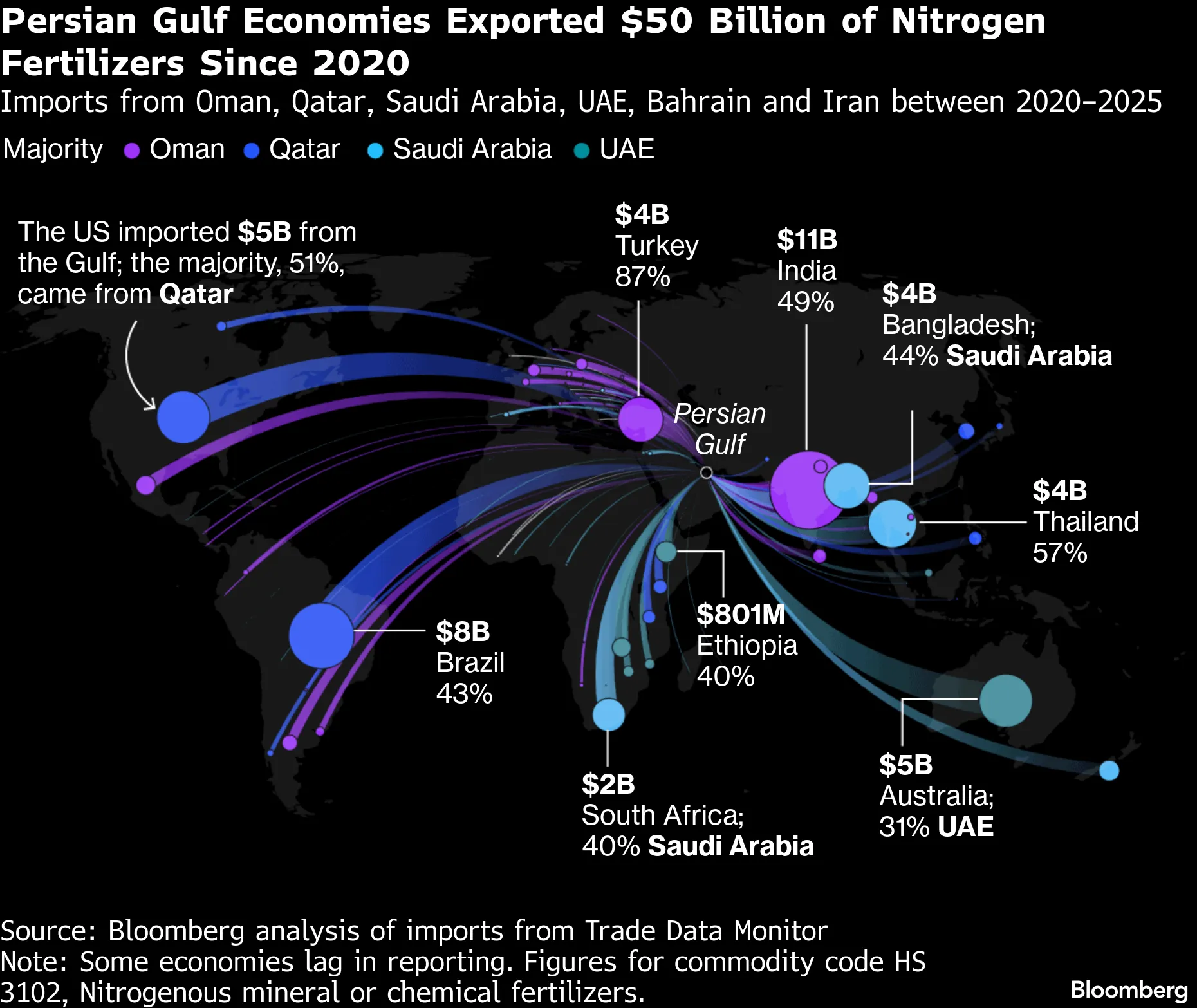
The conflict has come at a sensitive moment for global agriculture. The cost of fertilizers is already high. Farmers in the northern hemisphere are about to begin fertilizing their fields, while winter-crop planting is approaching in the southern hemisphere.
The disruption is particularly frustrating for farmers in the US, who have been suffering for years from low crop prices and high input costs, as well as trade volatility since President Donald Trump took office.
“I don’t want to say it’s catastrophic, but it could not come at a worse time,” said Bloomberg Intelligence analyst Alexis Maxwell. “Escalating attacks in the Middle East are creating a global chokepoint for farmers.”
If the disruption continues, it could add to inflationary pressures, just as the world is slowly recovering from a period of prolonged rising food prices caused by the Covid-19 pandemic, the war in Ukraine and extreme weather shocks.
“Without fertilizer your yields go down. If your yields go down, then there’s less grain or rice or any food on the market,” said Philip Sunderland, a fertilizer trader at Aquifert. “There might be a lag of between six to nine months between getting the greens out of the ground and putting the food on your table. But you can expect inflation going through the roof around Christmas time.”
The market reaction to the war has been quick and dramatic. US prices for urea, which is widely used on corn crops, rose $70 from the prior week’s high to $550 a short ton, with some American suppliers pulling offers, Bloomberg Green Markets reported Tuesday. Egyptian granular urea prices jumped nearly 27% to $620 per metric ton. Price estimates also increased sharply in Russia, one of the world's top fertilizer producers.
In many cases, offers of products have been pulled and buyers are similarly waiting before committing, said Peter Harrisson, an analyst with researcher CRU Group. “Much of the fertilizer market is waiting to assess the impact of the conflict on availability,” he said.
Indian manufacturers of urea have started to curb output after Qatar suspended supplies of liquefied natural gas due to an attack, according to people familiar with the matter, who asked not to be identified. In Pakistan, fertilizer company Agritech said on Wednesday that its supplies of gas were being suspended.
In Europe, which is dependent on gas for much of its energy, the fertilizer industry has been suffering in recent years from rising costs, production cutbacks and cheap imports from Russia. Soaring gas prices due to the new conflict in the Middle East are likely to add to the pressure. Poland’s state-run fertilizer producer, Grupa Azoty SA — one of the largest in the European Union — temporarily stopped taking orders for its fertilizers, citing higher gas prices that inflated their production costs.
The threat of shortages has put farmers worldwide in a state of anxiety.
Rafal Derlukiewicz, who owns an organic farm in eastern Poland, told Bloomberg he got a phone call from his neighbor about any excess horse and sheep manure, which he typically applies instead of synthetic products. “There is some panic here in Lubenka,” he said. “People cannot buy fertilizers.”
In Queensland, northeastern Australia, wheat and barley farmer Richard Golden got a call from his supplier earlier this week, urging him to pick up previously-booked supplies of imported nitrogen fertilizer — or risk it being snapped up by other increasingly nervous farmers. Some two-thirds of the country’s urea imports come from the Middle East...
....MUCH MORE

