And in the U.S. major producer CF Industries is being accused of price gouging on a 30% uptick in the price of another nitrogen carrier, urea.*
From S&P Global, March 12
The Omani port of Salalah on the Arabian Sea has been closed "until further notice," according to a customer advisory from the port, suggesting no ammonia can be exported from the Middle East, the world's largest export region.
"All terminal operations have been temporarily suspended until further notice," the advisory, issued March 11, said.
The closure comes after a drone strike on fuel tanks at the port on March 11, according to Oman state media.
OQ Trading uses Salalah port to export ammonia from the Salalah Methanol Company, most recently to Jordan.
The 26,000-metric ton gas carrier Gas Ammon, chartered by OQ Trading, is due at Salalah on March 15, according to S&P Global Energy shipping data.
A source familiar with the market told Platts on March 12 that the ship's loading appeared to have been canceled, and it would now only load bunker fuel upon arrival at the port.
Ammonia market participants say Salalah is the only loading port that could theoretically lift a cargo since the outbreak of the war in the Middle East, with other major export hubs behind the Strait of Hormuz.
Salalah Port and OQ Trading did not respond to requests for comment.
Even if the port can load ammonia, it remains within the high-risk area and thus ships calling to the port would be subject to higher insurance premiums. Market sources have said shipowners have been reluctant to sail ships through the area to load ammonia, a highly toxic pressurized gas.
Three ammonia carriers -- two of which were loaded -- remain stuck inside the Strait of Hormuz after loading in Saudi Arabia and Qatar prior to the war.
A fourth ship, returning from a regular delivery to Asia, will stop and wait outside the high-risk area rather than sail to reload in Saudi Arabia, a shipping market participant told Platts March 11.
Major supply region
The Middle East, including Bahrain, Iran, Oman, Qatar and Saudi Arabia, exported 4.28 million mt of ammonia in 2025, from a global trade of 17.73 million mt, according to S&P Global Energy CERA analysts. Most came from Saudi Arabia, Iran and Qatar.Qatar Energy halted ammonia production following a drone strike on March 4, while Saudi Arabia's Maaden was reported to be running at reduced rates.
Production at Saudi Arabia's Sabic is unclear. The company has not responded to requests for comment.
No ammonia ships linked to Iran have been seen to have left the region since the war began, according to data from S&P Global Commodities at Sea data....
As noted March 8:
"Crop Prices Jump as War Snarls Trade and Risks Tightening Supply"We will see a double whammy in the ag sector. Fertilizer prices, including ammonia which is made from natural gas, are rising fast. Additionally, with the Northern Hemisphere planting season approaching, the cost of diesel fuel for the tractors and later this year for combines and other harvesting implements will of necessity pass through, eventually, to the end user....
And back in 2020:
"Turning air into bread"
Since I have been, and will be, going on about ammonia as a carrier for hydrogen,NH3 - ammonia - three hydrogens attached to a nitrogen:
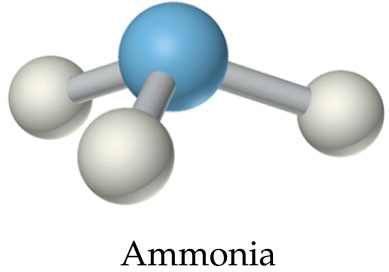
Credit: This Condensed Life
about fertilizer and guano, about Yara and Norsk Hydro and
Birkeland and explosives, I thought it time to add another post to our
nitrogen mini-library.
From the cheerfully optimistic The Roots of Progress....

