This is bad but isn't The Big Risk.
From SciTechDaily, March 12:
Researchers analyzing two decades of seismic data have uncovered a striking eastward migration of earthquakes along the Main Marmara Fault.
In April 2025, the Main Marmara Fault beneath the Sea of Marmara in northwestern Türkiye experienced its strongest earthquake in more than sixty years. Researchers have now examined the event in detail using nearly two decades of seismic observations.
Their findings, published in Science, come from a team led by Prof. Dr. Patricia Martínez-Garzón of the GFZ Helmholtz Centre for Geosciences in Potsdam, Germany. By studying rupture behavior and aftershock activity across multiple time scales, the scientists identified a sequence of earthquakes greater than magnitude 5 that has steadily progressed eastward along the fault during roughly the past fifteen years. These earthquakes have affected both slowly moving creeping sections and tightly stuck locked sections of the fault.
The results help clarify how stress has been building across the region. Because the remaining locked portion of the fault near Istanbul could produce an even stronger earthquake, potentially threatening the megacity of about 18 million people, the researchers emphasize the need for continuous real time monitoring in the area.
Historical earthquake cycles along the Main Marmara Fault
The Main Marmara Fault (MMF) is considered the most hazardous fault zone in the broader European region. It is the only section of the plate boundary along the North Anatolian Fault Zone between the Eurasian and Anatolian plates that has not produced a large earthquake greater than magnitude 7 since 1766.
Historical records that extend back more than two thousand years show that major earthquakes in the region occur on average every 250 years. Based on this pattern, scientists believe the Main Marmara Fault is already late in its seismic cycle and may be approaching another major rupture.
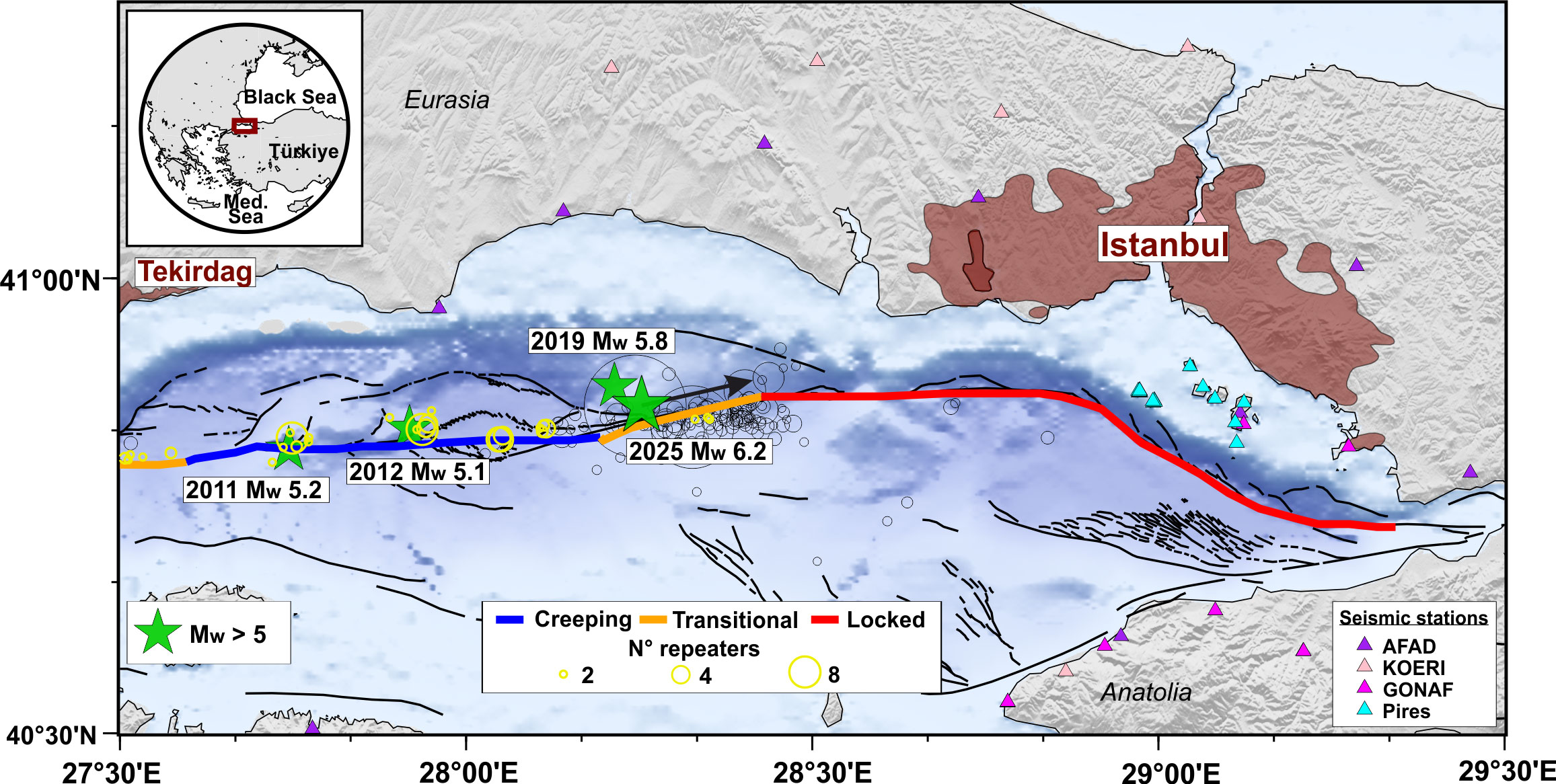
Analyzed earthquake sequence along the Marmara fault in the Sea of Marmara off the megacity of Istanbul: Green stars mark moderate earthquakes with a magnitude of M>5, circles of various sizes mark the aftershocks. The chronological sequence shows the eastward movement. The different sections of the fault are marked in color: blue is the creeping segment, orange is the transition zone and red is the currently locked segment where a major earthquake could occur. Credit: Patricia Martínez-GarzónEarlier research by GFZ scientists showed that the Main Marmara Fault is divided into several distinct segments. In the western portion, known as the creeping section, as much as about half of the tectonic energy is released gradually through slow fault movement that does not produce noticeable earthquakes. This process has been identified through the study of small earthquakes that repeatedly occur in the same locations, known as repeaters. Moving eastward along the fault, creeping activity decreases in what researchers call a transitional section....
....MUCH MORE
The big risk is further north, the NAF.
July 30, 2017An Istanbul Earthquake: Since 1939 The Magnitude 7+ Quakes Are Moving Progressively Closer To Istanbul
In July 20's "Risk:Today's 6.7-Magnitude Turkish Earthquake Was Not The 'Big One'" we noted:
"The epicenter is just offshore southwestern Turkey while the 'big one' is expected in Istanbul's backyard...." and mentioned the North Anatolian Fault (NAF):

Here's the problem. The strong earthquakes along the NAF, pictured inside the red crescent in the small map below, have been steadily moving west toward Istanbul, population 14.6 million:
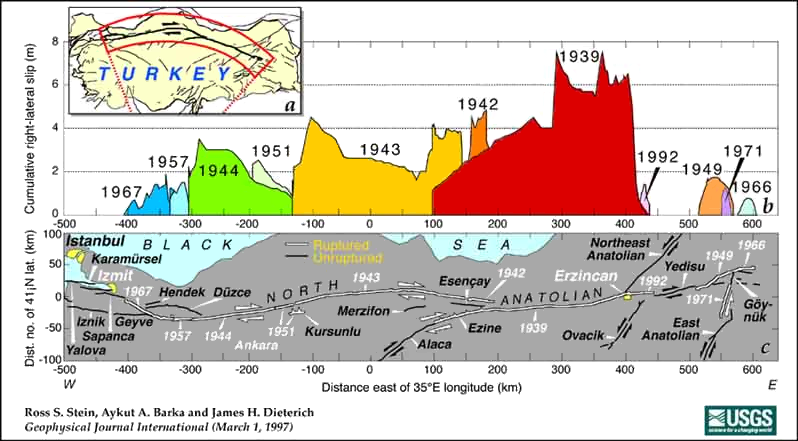
The 1939 earthquake was a 7.8 magnitude and killed 32,000.
The 1942 quake, epicenter 200 km further west was a magnitude 7.0 and killed ~3000.
The 1943 and 1944 earthquakes were both measured at 7.2 and killed 2800 and 3900 respectively.
The 1957 quake, a 7.1, killed 52 people and the 1967 quake also a 7.1 killed 86.
As can be seen in the top panel both of the latter earthquakes resulted in much less lateral slippage of the land compared to the earlier quakes, meaning the stresses were still building.
Finally the 1999 Izmet earthquake—not shown on this 1997 representation—was another 150 km closer to Istanbul. It measured 7.6 and killed over 17,000 people. The lateral slippage was 5.7 meters.
So don't be surprised if one morning in the next 5 to 10 years you wake up and there is some very bad news coming out of Istanbul.
*Our octa- and nona- genarian readers may recall Joe Granville.
From a 2008 post:
Joseph Granville doesn't use the word ''forecasting.'' He prefers to say that he applies to the stock market a ''theory'' that he declines to reveal but whose results he communicates to clients in a weekly investment newsletter.From the New York Times:
Last week, as his latest bullish issue was still in the mails, Mr. Granville's theory suddenly turned bearish and advised selling. That advice, transmitted to about 3,000 clients in emergency telephone calls, triggered a selloff that drove the Dow Jones industrial average down 23.80 points and resulted in a new one-day volume record on the New York Stock Exchange. The next day, Mr. Granville predicted an earthquake of Richter magnitude 8.3 would hit Los Angeles in May.
NOTES ON PEOPLE; As a Seismologist, He's a Good Stock Analyst
By ALBIN KREBS AND ROBERT MCG. THOMAS (NYT); Metropolitan DeskAlways remember that earthquakes can be tricky for equity analysts.
April 11, 1981, Saturday
Late City Final Edition, Section 1, Page 16, Column 3, 224 words
When Joseph Granville, the Wall Street analyst, told the 3,000 subscribers to his Granville Market Letter to ''sell everything,'' they had enough faith in him to trigger the Dow Jones industrial Average into tumbling 23.8 points Jan. 8. It was the heaviest trading day in the history of the ...

