From The New Atlantis, No. 83, Winter 2026:
The planners dreamed of gleaming cities. Instead they brought three generations of hollowed-out downtowns and flight to the suburbs.
Think of what the typical American city looks like today: its hollowed-out core dotted with parking lots, its run-down inner-city neighborhoods, its sprawl.
How did this happen? Cities weren’t like this a hundred years ago. They were real cities in the sense in which most people would understand the word, with jobs, businesses, houses, churches, and every other institution related to daily life concentrated around a dense center. Today, cities are almost the inverse of that, with a large population settled out in sprawl, and a hollowed-out center where far fewer people live.
Conversations about this transformation typically collapse into a focus on attitudes about cars. On one extreme, urbanists blame an American fetish for SUVs and highway construction for our lack of charming walkable neighborhoods and the destruction of areas that might have developed into such places. On the other extreme, suburbanists view urbanists as anti-car fanatics who want to use government policy to choke off the low-density single-family housing development that has characterized America since World War II.
What they both tend to overlook is that almost all Americans today have spent their entire lives under a set of federal laws and rules that have helped hollow out the cores of our cities. Uncle Sam played a decisive role in creating the distinctive sprawling pattern we all now take for granted.
Yes, the rise of mass-produced cars is a big reason cities today sprawl. But it can’t explain why European cities developed so differently, given that their residents adopted the automobile around the same time as Americans.
The explanation lies elsewhere: in the unintended consequences of a set of well-meaning choices by federal lawmakers in the 1930s and 1940s.
The first choice was an ambitious, even utopian, initiative meant to transform American cities for the age of the automobile and suburbanization. An example of a kind of central planning rarely seen in the United States, these bills were meant to make housing in the city affordable, clean, and safe, and to limit urban blight.
The second legislative choice was a series of bills initially passed to meet the needs of home borrowers during the Great Depression and the aftermath of World War II. Those subsidies, granted at the individual level and thus decentralized, would help build out the suburbs, and come to be the defining characteristic of U.S. housing policy.
Within a generation, the first of the two — the urban renewal and public housing effort — would be abandoned. But the second one — the subsidies for mortgages and private housing — would remain in place.
Americans are now three generations into a set of policies that, on the one hand, provide open-ended subsidies for sprawl and, on the other, do little to ameliorate the problems of the urban core — and maybe even aggravate them. Over time, this has come to seem like an unalterable fact of life and the work of the invisible hand of the market. But in this case, the hand is being nudged by Uncle Sam.
Photos of St. Louis comparing how the city looked in the 1920s to how it looks today show a dramatically different layout.
In 1926, St. Louis was a dense city, not so different from its European counterparts, packed with tenements and factory buildings right up to the Mississippi River. It had neighborhoods with rowhouses made with bricks from the red clay taken from the nearby river valley, neighborhoods anchored by immigrant churches, and a system of streetcars. The city then was not so different from older East Coast cities like Boston or Philadelphia, and by extension like European cities of the time.

Missouri Historical Society
Today, St. Louis has a totally different look. It’s been hollowed out to a shocking extent. The population of the city proper has dropped from nearly 900,000 in 1950 to 300,000 today.

iStock
True, there are some notable landmarks downtown, such as sports stadiums and, of course, the Gateway Arch. But the most noticeable change is that much of what was previously neighborhoods — full of houses, shops, and businesses, which, whatever their shortcomings, represented urban living — is now unlivable space. Much of it is occupied by superhighways that connect the downtown to the sprawling suburbs, where most of the population resides. More of the space is accounted for by parking lots, which take up over a quarter of the downtown land. And a large amount of downtown St. Louis today is simply open unused land.
St. Louis is like many other U.S. cities. Its urban form is one that most Americans, over the decades, have gotten used to — a core with some big buildings surrounded by sparse, rundown, and unsafe neighborhoods, connected via highways to spread-out suburbs containing the majority of the population.
It didn’t have to be this way. It isn’t in Europe. As a point of comparison, St. Louis’s metro population — that is, the population of the entire built-up area of St. Louis city and the surrounding suburbs and exurbs — is roughly 2.2 million, similar to that of the Cologne and Bonn region in Germany, but it is spread out over an area three times the size.
Something happened to St. Louis between the 1920s and today that diminished its downtown and led its population out to the suburbs and exurbs — something that Cologne escaped even though almost three quarters of it was destroyed by Allied bombing in World War II.
A crucial part of that something is federal government policy.
The prewar development of St. Louis was mostly guided by the free market. As historian Mark Gelfand writes in A Nation of Cities, in 1920 “not a single dollar of federal expenditures” was spent on municipal affairs.
But two long-term trends converged to produce a sea change in American cities that would lead to a federal role in urban development.
The first trend was demographic. In 1920, the urban population outnumbered the rural for the first time. American cities had become the industrial engines of growth, drawing millions of workers not only from the countryside but also from Europe and beyond.
The second trend was indeed the rise of the automobile. As with horses, streetcars, and commuter rail before, cars altered the urban form when they became economically obtainable for the middle class. They allowed workers to live in suburbs twenty miles or more out of town, connected only by highway.
Fearful of the living conditions of people crowded into tenements in these booming cities, Congress passed the Housing Act of 1937, which would be refined and broadened in 1949, the product of years of lobbying by progressive reformers and housing advocates.
Ironically, the aim of the progressive reformers who shaped this New Deal–era legislation was to save cities, by building new, gleaming, modernist urban cores with spacious, clean, well-lit housing for the broader middle class. But when all was said and done, they instead hastened the rise of the suburbs and the exurbs and the decline of the inner city.
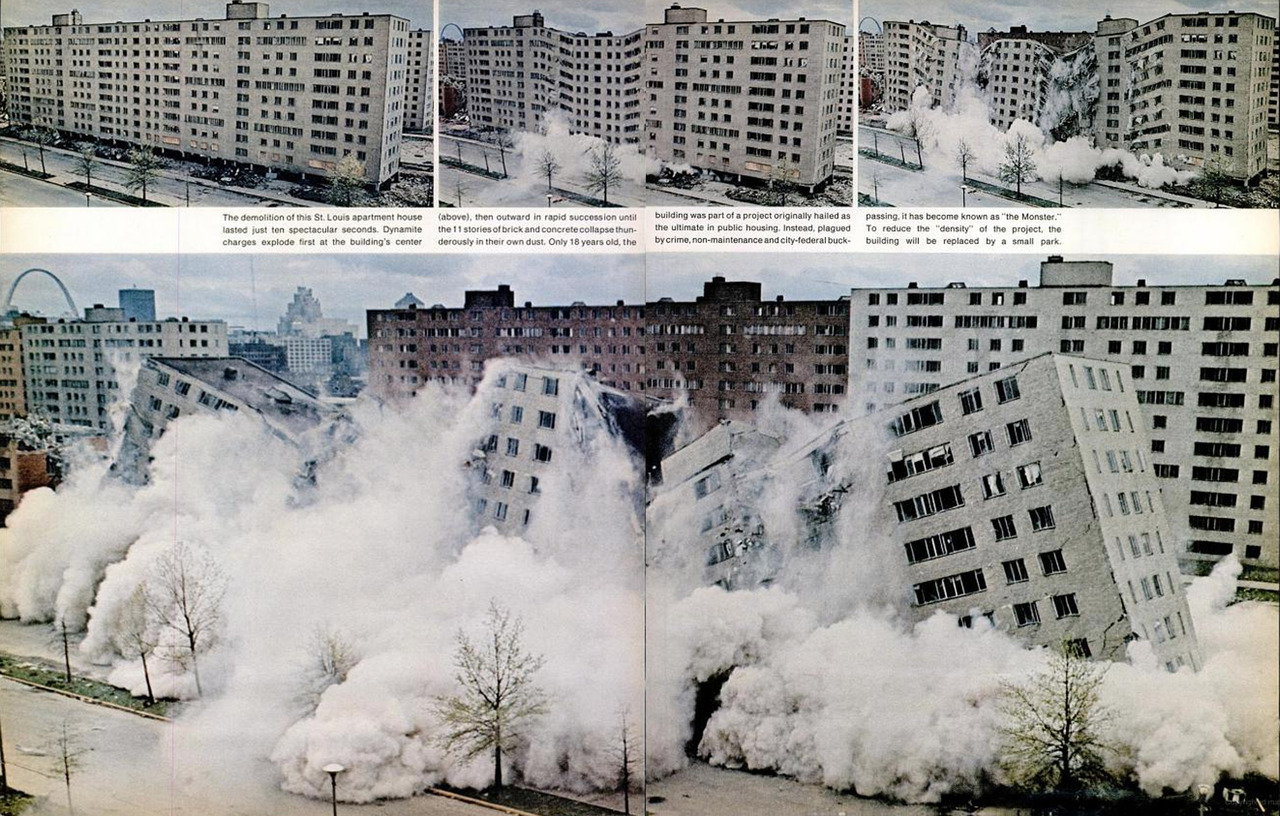
For example, the 1949 law would facilitate the razing of St. Louis’s Desoto Park and Carr Square neighborhoods — and similar immigrant and black neighborhoods around the country — as well as the construction in their place of Pruitt–Igoe, a project so ill-fated that it was torn down within 20 years.

Wikimedia Commons
For anyone familiar with the history of American cities, Pruitt–Igoe stands out as the archetype of the ghettoization, dysfunction, and undesirability associated with federal projects. It was envisioned as revitalizing the heart of the city and upgrading the existing neighborhoods, which were deemed to have substandard and backward housing stock. A series of towers, it was planned by leading architects according to the latest thinking from the social engineers of the day. In the end, they not only failed to improve the inner-city neighborhoods but ultimately destroyed the possibility of any neighborhood in the area.

Wikimedia Commons
The problem, in the eyes of the progressives, was slums.
In her 1934 book Modern Housing, considered the intellectual impetus for the federal legislation to follow, public housing advocate Catherine Bauer condemned the urban neighborhoods of the day, which were filled with migrants from abroad and, increasingly, the black South. The first order of business, she wrote, was to stop the construction of new slums. The second was to set “an entirely new standard of urban environment” via public housing, one that had no place for a Boston triple-decker or a New York tenement but instead ensured that all housing was built to a standard that would eliminate overcrowding and promote social hygiene.
In fact, New York City, which as a modern megacity was at the vanguard of urban trends, had already enacted several major building code laws — a legal novelty — meant to regulate tenements. But Bauer and her progressive allies blamed the ubiquitous dumbbell-shaped apartments for crime, disease, and political corruption. And she and her allies viewed code enforcement, the preferred route of private industry for rejuvenating run-down neighborhoods, as insufficient.
For that reason, the progressive housing movement entailed not just a refurbishing or upgrading of the housing already present in the years before the Great Depression, but a wholesale replacement along modernist lines.
At the time, urban modernism was gaining intellectual currency thanks in large part to a group of planners and designers led most prominently by the French-Swiss architect known as Le Corbusier. Le Corbusier envisioned cities totally remade along scientific-rationalist lines, and even called for tearing down much of Paris and replacing it with modernist structures. His idea of the “Ville Radieuse,” a blueprint for a city built with wide boulevards and tall apartment blocks spaced out to allow for ample green spaces, inspired plans for cities all over the world, including Brasília and Chandigarh. The modernist vision would be the intellectual scaffolding that progressives used for remaking American cities through law.
At the heart of the progressive criticism of the neighborhoods of the day was the idea that slums caused social ills such as disease, crime, and poverty. This was a faulty pathologization — the slums may have been associated with those problems, but they did not cause them — that lives on in popular mythology today.
It is true that the neighborhoods of East Coast cities were disease-ridden by today’s standards, on top of being plagued by crime and political corruption. But the far bigger factor than crowding in accounting for the ill health of the early-20th-century slums was the lack of access to clean water. And the recent experience of Covid, which hit rural areas just as hard as cities, indicates that it is not density per se — in the sense that city planners use the term, to mean the number of people in a given unit of land area — that facilitates the spread of airborne disease (although it does suggest that the poor ventilation of tenement buildings was a problem).
Similarly, it is not density that breeds crime. The success of New York City, America’s one true megacity, in the Giuliani and Bloomberg eras demonstrated that.
Nevertheless, the eradication of slums and reworking of the city was the goal of the progressive reformer. Edith Elmer Wood, a housing reformer who would, like Catherine Bauer, go on to influence the 1937 bill and serve in the United States Housing Authority it created, was motivated in part by the fact that she had experience seeing tuberculosis while living in Puerto Rico. As a response, she wrote a building code for San Juan.
For Wood, the goal was to turn all housing into a public utility, to allow central planners to control the standards for workers....
....MUCH MORE
Related:
February 2023 - "‘Streets in the Sky’: Post-war Housing Estates in Britain and France" with this outro:
I'm reminded of the response of the residents to queries about what to do with the Le Corbusier-style Pruitt-Igoe housing projects in St. Louis:
Blow it up.
And before that, November 2013.

