Sunday, September 13, 2026

"Amodei, Altman, Musk Call for Slowing AI Model Development"

Whether or not this means the end of the breakneck speed of AI build-out that we've seen over the last three years is an open question. On that question my frame of reference is China agreeing to every CO₂ curtailment procedure proposed by various transnational bodies as long as said proposals only applied to the West.

What this development means for India, Europe and other lesser developed (AI-wise) places is also an open question. Are Amodei, Altman and Musk pulling up the ladder after they've scaled the heights? We shall see. 

From Bloomberg, September 12: 

Leaders of the world’s biggest artificial intelligence platforms said it’s time to slow the development pace of their most advanced — and most lucrative — models, citing escalating risks of the technology.

Anthropic PBC Chief Executive Officer Dario Amodei issued a lengthy blog post Saturday saying his company would implement new safety steps such as third-party evaluators while calling on the industry to support a broader downshift.

OpenAI chief Sam Altman quickly pledged to adopt Amodei’s suggestion of “independent evaluators with employee-like access,” while Elon Musk, who runs xAI Corp., wrote, “Dario is right.”

While all three leaders have over the years warned of the risks of AI, an actual coordinated slowdown has little precedent in a cutthroat industry that has historically cranked out one product after another in the name of boosting user engagement, grabbing market share and striving for sales gains.

But the anxiety about severe AI risks has begun to enter the mainstream, driven in part by this week’s high-profile resignation of an Anthropic researcher over existential fears that his company was acting irresponsibly. It was the latest in a series of increasingly dire warnings from within the industry that AI is evolving so quickly that it poses a growing threat to national security and the global economy.

The surge in safety concerns surrounding AI coincides with a growing backlash against the technology in the US, fueled in part by objections to the strain on local resources imposed by new data centers needed to support the technology. Concerns that AI is driving up electricity bills and potentially taking away jobs has made it a central issue in the November midterm elections.

It’s unclear how far the leading AI companies — which are fierce rivals themselves and also face stiff competition from Chinese firms — will go in imposing new limits or safety checks.

Demis Hassabis, the chief scientist at Alphabet Inc. and co-founder of Google DeepMind, said in a post on X Saturday that “the direction is correct” in Amodei’s essay, but the “details need working through.”

It’s also not clear whether antitrust enforcers would allow companies to pace development in some kind of coordinated manner. Then there’s the question for markets, which have ridden the AI frenzy to new heights: How would investors eager for margins and profits react to the idea of deceleration?

Amodei cited two main factors for his new caution: AI’s ability to improve itself and the recent incident involving OpenAI and Hugging Face, where a swarm of AI agents collaborated to breach a third-party website.

“We must slow the pace at which we improve the capabilities of AI models,” he wrote Saturday in a blog post. “Progress will still seem fast, and we must make wise use of the time we gain.”

But he also said that any slowdown must be balanced with the reality of competition.

“To be clear, pacing does not mean halting model training or technical progress, but ensuring companies take adequate time to align and safeguard their models, and for third party evaluators to confirm this,” Amodei wrote....

....MUCH MORE 

Saturday, September 12, 2026

"Family furious after company sends girl Kim Jong Un costume instead of Mary Poppins"

From the New York Post, August 26:

A young student hoping to step into Book Week in the most delightful way has been dealt a cruel blow after her mother received the wrong costume just days before the parade.

While planning to attend her Melbourne school festivities as the iconic Mary Poppins, CostumeBox instead sent the 10-year-old girl a Kim Jong Un costume.

The family has been left in a scramble, racing to replace the Supreme Leader of North Korea ensemble before the parade takes place on Friday.

A receipt of the order shows that it was placed on the 23rd of August, with the retailer offering same-day and express post delivery options across the country.

The “Musical Nanny Deluxe” costume that the youngster initially wanted retails for $60 and comes with a coat, skirt, hat and a bow tie.

It’s an easy, wholesome Book Week win with just an umbrella, shoes and stockings needed to complete the overall look....

....MORE 

And somewhere a little boy is saying "Mom, What the hell is this?":

https://nypost.com/wp-content/uploads/sites/2/2026/08/www-costumebox-com-au-products-138558467.jpg?quality=75&strip=all&w=801 

"Rope, twine and thread: Invisible technologies of the Stone Age"

A topic near and dear.*

From Knowable Magazine, September 10:

Missing from the archaeological record, fiber innovations like string played a huge role in the daily lives of our ancestors. Researchers are working to weave together new insights from the traces they left behind. 

When an abstract-looking ivory artifact emerged from the Hohle Fels cave in southern Germany in 2015, archaeologists didn’t know quite what to make of it. Previously, this same cave had yielded what may be the world’s oldest musical flutes, as well as one of humanity’s earliest pieces of figurative art, the iconic Venus of Hohle Fels. At first glance, this strange new discovery — a 20-centimeter rod perforated with four small holes — seemed comparatively unspectacular. But it has since revealed far more about the lives of Europe’s prehistoric hunter-gatherers than its unassuming appearance would have suggested.

Fashioned from the tusk of a mammoth more than 35,000 years ago, this perforated baton — a type of artifact called a lochstab was initially interpreted as a symbolic object associated with prestige or power. But Nicholas Conard, whose team discovered the item, wasn’t so sure.

Noticing that each of the baton’s holes was lined with carefully carved spiral grooves, he began to suspect that the lochstab might have been a tool used by twisting some other material through these perforations. “If you’re pushing something through a hole and rotating it ... you’re very quickly in the world of fiber,” says Conard, an archaeologist at the University of Tübingen in Germany. Sure enough, when he and his colleagues tried threading cattail fibers through these holes, they found that the grooves helped to orient the strands. Within 10 minutes, the group had woven the fibers into five meters of thick, strong rope.

Yet while these experiments might have helped to solve one archaeological mystery, they also highlighted a much larger problem. The inhabitants of Hohle Fels must have manufactured significant quantities of rope, yet none of it has survived, and all that remains is the most durable component of this ancient production system — the ivory lochstab.

“There’s certainly a lot of bias in what we’re viewing in the archaeological record, because we are focusing on the things that preserve,” says paleoanthropologist Emma Finestone at the Cleveland Museum of Natural History. As a consequence, archaeologists rely heavily on stone tools and bone artifacts to reconstruct our prehistory, while objects made from less durable plant and animal products remain largely overlooked. Yet these soft technologies played a huge role in shaping the survival strategies and daily lives of our ancestors.

“We’re missing 90 percent-plus of what is happening during a [prehistoric] day, and a lot of that uses technology that we don’t think about,” says Bruce Hardy, a paleoanthropologist at Kenyon College in Ohio. The problem facing archaeologists, therefore, is how to study a technology that they can’t actually find.

The rise of soft technology
The oldest surviving example of human-made fiber is a six-millimeter-long piece of string made by Neanderthals some 50,000 years ago. It’s an exceedingly rare example of preserved ancient fiber, and how it managed to withstand the ravages of time isn’t clear. Discovered by Hardy and his colleagues at the Abri du Maras rock shelter in France, this small length of three-ply cord indicates that fiber has deep roots in the human lineage.

“This is probably a very old technology that goes way back much further than this, back to an ancestor shared by modern humans and Neanderthals,” Hardy says. In other words, more than half a million years ago.

So far the oldest evidence of fiber use dates back about 250,000 years, inferred from markings on stone tools from France and the Netherlands. The marks suggest the tools may have been hafted, or attached to a handle with some type of string or cord. While the bindings have long since decomposed, the traces they left behind hint that fiber technologies aided the survival of the prehistoric human species that occupied Europe long before Homo sapiens got a foothold on the continent 45,000 years ago.

The invention of hafting may represent a “revolutionary moment” in our technological history, says Veerle Rots, an archaeologist at the University of Liège in Belgium who led the experimental work on the Hohle Fels lochstab. “It fundamentally changes the use of stone tools and allows a whole range of new possibilities in how you’re conceptualizing a tool,” she says.

https://knowablemagazine.org/docserver/froala-uploads/g-getting-handle-on-it.png 

Using string or cord to attach stone tools to a handle or shaft — known as hafting — 
transformed the sharpened rocks into new instruments with expanded functions, 
including axes, arrows and spears. The stone dagger resembles one carried by Ötzi the Iceman.

A sharpened stone point, for example, suddenly becomes part of a hunting weapon when hafted onto a wooden shaft. A stone handaxe can be wielded with significantly greater force and from a wider range of angles once fastened onto a handle. What made cordage like rope, string and twine so transformative, therefore, was that it connected other technologies together to radically expand what prehistoric humans could build, carry and hunt.

The transport of stone for making tools, for instance, was an essential logistical operation that may have depended on soft materials from the very beginning. According to Finestone’s research, toolmaking hominins moved high-quality stones over long distances as early as 3 million years ago — cumbersome loads that would have been very difficult to move with bare hands alone....

....MUCH MORE 
*Previously in soft technology (although we didn't use that term): 

"How Bills of Exchange Went from a Way to Bring Textile Proceeds Home to the 'Foundation of Modern Commercial Banking'"

"What if the need for fabric, not food, in the face of a changing climate is what first tipped humanity towards agriculture?"
Clothing, very important, some links after the jump.

"Four Thousand Years Ago, Textile Traders Invented a Basic Social Technology: Mass Literacy" 

"Fashion, Maslow and Facebook's control of social"

Fellow Luddites! To The Looms!!! (or the spinning jennys, or...)

Chinese Media Sounds the Alarm on Rise of Robot Tailors in the US"
To paraphrase Clauswitz: 
"Trade is just the continuation of Politik by other means"

 "Historians Find Evidence of Recycling in Tudor Times" (but what about re-gifting?)"

  "....The Invention And Evolution Of Apparel In The World's Colder Climates."
    Continuing our pivot to fashion with the hope of garnering a Dolce & Gabbana sponsorship.

IARPA (like DARPA but for spies) Is Going Ahead With Its Embedded Wearables Program: Smart e-Pants

I Need A Yak 

And many, many more. 

AI Apocalypse: Whatever Happened To The Nudge People?

For our younger readers, "nudge" was a fad that came out of behavioral economics wherein people who wanted other people to bend to their will at least had the decency to pretend they weren't trying to coerce/manipulate their intended manipulees.

It was very popular in government circles ca. 2008 - 2023. At it's height in the twenty-teens you couldn't go a week without someone writing something about the topic. 

I miss those days.

I'm reminded of nudge because we now have this Jacob Coxon fellow telling us AI will kill everyone and disavowing any suggestion that his motives and presentation are anything but purely altruistic.

Here's a xeet from venture capitalist Steve Jurvetson we'll use as background:

Jurvetson continues:

....Coxon's post reveals some interesting hidden patterns about who is amplifying our political debates online.  It drew 76% of its reposts (spreading the news) from foreign countries. The top two were India and Indonesia. 

In contrast, when @ParkerThayer, an investigative researcher, posted his own analysis (expressing serious skepticism about the circumstances of the post and alleging that its amplification was coordinated), he got 6.6M views and drew most of its engagement from the U.S., with only 34% from foreign countries, led by Canada and the UK. 

Sure, people overseas have a stake in what the U.S. chooses to do on AI. But ultimately it is us Americans who will decide our own public policy. Don't be fooled by what's trending. 

A big thank you to @ElonMusk and X for making country of origin visible, which makes analyses like this even possible. Last year's “Great Unmasking" on X was the first time anyone shined a spotlight onto this subject. As much of our political conversation shifts online, it will be increasingly important to understand where engagement is coming from.

Source (with more analyses of foreign influence): DigitalBorders.com

Among other things this Parker Thayer fellow that Jurvetson references has published to X is this:

This post looks like the start of a VERY sophisticated and well-funded PR operation to get support for Democrats to regulate AI into oblivion. Let me show you how it works:
1.) This guy, with minimal followers and no previous account activity, goes to the Wall Street Journal which publishes an exclusive with quotes from him on his resignation 18 minutes BEFORE this post goes up. Planning was clearly done in advance.

2.) Within hours, it has tens of thousands of reposts and the account has 100k+ followers. The post is punchy, quotable, it almost seems professionally written. The first three accounts to quote tweet it all do so within 15 minutes of the initial posting. Remember, this account had basically zero engagement beforehand, so an organic reach explanation seems unlikely.

According to Grok those accounts are @_NathanCalvin (General Counsel at Encode AI), @peterwildeford (Head of Policy at the AI Policy Network), and @DKokotajlo (Head of the AI Futures Project), all of which are up-and-coming AI-Doomer policy advocacy nonprofits.

The AI Futures Project website says it is funded “primarily” by the Survival and Flourishing Fund, which says on its own website that it has advised Jaan Tallinn, Skype creator and one of the leading investors in Anthropic, to grant over $2.5 million to the AI Futures Project since 2024.

Encode AI says on its website that it is ALSO funded by the Survival and Flourishing Fund, which in turn says that it told Anthropic investor Jaan Tallinn to grant $516,000 to Encode AI in 2025.

And wouldn’t you know it, the Survival and Flourishing Fund ALSO says it told Jaan Tallinn to grant $2 million to the AI Policy Institute, the 501(c)(3) affiliate of the AI Policy Network, as well.

What are the odds that the first three quote tweets of Coxon’s post would all be major AI-restriction policy advocates funded generously by the same donor, who also happens to be one of the leading investors in, and a board member of, Anthropic, the company Coxon was resigning from? And all within 15 minutes of posting (two within ten)?

3.) Jacob Coxon doesn’t have much of a resume, but we do know that, in 2022, he got a $20,159 scholarship for the “long term future scholarship program” from the Good Ventures Foundation, one of the philanthropic vehicles of Dustin Moskovitz, a notorious AI-doomer who has spent tens if not hundreds of millions on policy advocacy to strictly regulate AI, while also being an Anthropic Investor himself.

It also just so happens that the 14th person to quote Coxon’s post was @MaxNadeau_ (27 minutes after posting) who is the program officer for the Technical AI Safety team at Coefficient Giving, another of Moskovitz’s philanthropic spending vehicles. Max is not a frequent poster, his last posts before quoting Coxon were before Labor Day, but he was remarkably quick off the mark for this one.

4.) Basically every major Democrat politician and candidate has suddenly glommed on to this post, and conveniently, as the people cry out foe answers, Bernie Sanders already has a bill written to “ban super intelligence” and regulate AI into oblivion, and will be releasing later this week. The bill, among many other things, will create “a new cabinet-level federal agency to safeguard the public from the dangers of artificial intelligence” that will be “advised by an Artificial Intelligence Advisory Board comprised of experts on artificial intelligence.” Do you think, perhaps, Anthropic and its many investors who fund AI policy advocacy might have interest in getting to place a pet “expert” on the board of an entity that dictates what AI is and isn’t allowed to do? And isn’t it fortuitous that this whistleblower came forward  with his oh-so scary stories so close in proximity to the release of the most radical piece of AI legislation ever introduced? 


I'm not on X so finding and embedding what the denizens are posting is a pain in the butt. 
I will have to leave it to the natural curiosity of our readers to find more but in the meantime this is a small start.

And nudge? We have dozens of posts on the topic, if interested use the 'search blog' box, upper left. Among the hits that pop up in the search results is this from August 2013:

"Nudge Squad": White House Creating "Behavioral Insights Team" that Will Look for Ways to Subtly Influence People's Behavior to Get Us to All Act "Better"
Nudge Squad.
Sounds like a '70's chimera: Mod Squad meets Esalen Institute.*....
 

And if the reader's curiosity is less focused on big-time manipulation attempts and more on "what the heck is this Esalen thing he's going on about," here's Nobel Laureate (Physics) Richard Feynman in a 2017 post:

COLD CASE — Who smeared Richard Feynman? [FBI FILES]

....And later Feynman hangin' at Esalen, Big Sur, CA:

During the Middle Ages there were all kinds of crazy ideas, such as that a piece of rhinoceros horn would increase potency. Then a method was discovered for separating the ideas -- which was to try one to see if it worked, and if it didn't work, to eliminate it. This method became organized, of course, into science. And it developed very well, so that we are now in the scientific age. It is such a scientific age, in fact, that we have difficulty in understanding how witch doctors could ever have existed, when nothing that they proposed ever really worked -- or very little of it did.

But even today I meet lots of people who sooner or later get me into a conversation about UFO's, or astrology, or some form of mysticism, expanded consciousness, new types of awareness, ESP, and so forth. And I've concluded that it's not a scientific world.

Most people believe so many wonderful things that I decided to investigate why they did. And what has been referred to as my curiosity for investigation has landed me in a difficulty where I found so much junk that I'm overwhelmed. First I started out by investigating various ideas of mysticism and mystic experiences. I went into isolation tanks and got many hours of hallucinations, so I know something about that. Then I went to Esalen, which is a hotbed of this kind of thought (it's a wonderful place; you should go visit there). Then I became overwhelmed. I didn't realize how MUCH there was.

At Esalen there are some large baths fed by hot springs situated on a ledge about thirty feet above the ocean. One of my most pleasurable experiences has been to sit in one of those baths and watch the waves crashing onto the rocky slope below, to gaze into the clear blue sky above, and to study a beautiful nude as she quietly appears and settles into the bath with me.

One time I sat down in a bath where there was a beatiful girl sitting with a guy who didn't seem to know her. Right away I began thinking, "Gee! How am I gonna get started talking to this beautiful nude woman?"

I'm trying to figure out what to say, when the guy says to her, "I'm, uh, studying massage. Could I practice on you?"

"Sure", she says. They get out of the bath and she lies down on a massage table nearby.

I think to myself, "What a nifty line! I can never think of anything like that!" He starts to rub her big toe. "I think I feel it", he says. "I feel a kind of dent -- is that the pituitary?"

I blurt out, "You're a helluva long way from the pituitary, man!"

They looked at me, horrified -- I had blown my cover -- and said, "It's reflexology!"

I quickly closed my eyes and appeared to be meditating.....
That, of course is the introduction to Feynman's famous 1974 CalTech commencment speech, "Cargo Cult Science"
More here.

Friday, September 11, 2026

"Chinese EV company launches automated factory where humanoid robots build humanoid robots"

From Mumbai's FirstPost, September 8:

Chinese electric vehicle maker XPeng says it has commissioned an automated production line designed to manufacture advanced general-purpose humanoid robots, in what the company describes as a first for the industry.

The announcement came from XPeng CEO He Xiaopeng, who shared images of the facility and a humanoid robot on X. According to He, the production system is designed to use robots to manufacture robots, reducing the extent of manual involvement in the assembly process.

Continues:

...The commissioning of our production line means humanoid robots are now ready to scale up and step into the real world.

What touched my heartstrings most was watching our very first advanced general‑purpose humanoid robot complete assembly and walk off the line on its own. To me, this is not just about a smarter tool or a commodity. I hope it gains true generalization ability to take on dangerous, repetitive, or undesirable tasks, and ultimately make life better. Perhaps one day, robots may become our companions, friends, or part of family.

Grateful to every colleague on this momumental mission. And a warm welcome to IRON! 

....MUCH MORE

And In Other Elon Musk News....

We haven't had any Elon posts recently but that headline is evergreen, on any given day someone somewhere is publishing something on Mr. Musk.

Our most recent mention of the man was the outro from September 9's "Meanwhile, In Shanghai: Investors Demand Brain - Computer Interface Companies":

....Also quite a few posts on Elon Musk and Neuralink and on Dr. Miguel Nicolelis.

Which led me to ask the GoogleBox about Neuralink which led to Business Insider, July 21:

Investors are valuing Elon Musk's Neuralink at $42 billion on secondary markets

Demand for a piece of anything related to Elon Musk is booming.

The near-trillionaire's brain chip startup, Neuralink, is being valued as high as $42 billion in recent secondary market transactions, according to correspondence seen by Business Insider and a person familiar with the matter.

That's an almost five-time increase from Neuralink's last funding round last year, when the startup raised at a $9 billion valuation, Semafor reported at the time.

According to private markets research provider Caplight, transactions in recent months have ranged from $29 billion to $42 billion, with some current bidders even attempting to buy shares at an almost $60 billion valuation....

....MUCH MORE 

Flashback: What I'm Reading: Gambler's Fallacy and the Hot Hand

Most of our visitors know this stuff but here we have such a good exposition it may be worth a gander for even the time-constrained reader
Bold emphases mine.
From Frontiers in Psychology, Feb. 5, 2015:
Small samples and evolution: did the law of small numbers arise as an adaptation to environmental challenges?

Gorka Navarrete1*, Carlos Santamaría2 and Dan Froimovitch3
  • 1Laboratory of Cognitive and Social Neuroscience, Psychology Department, Universidad Diego Portales, UDP-INECO Foundation Core on Neuroscience, Santiago, Chile
  • 2Cognitive Psychology Department, University of La Laguna, Tenerife, Spain
  • 3Department of Physiology, University of Toronto, Toronto, ON, Canada
In the context of casino gambling, only a minority (~15%) of players presented with a streak of at least length 6 in roulette disregard recent events in deciding their next move, which is the normatively optimal approach to such a decision (Croson and Sundali, 2005). The majority of people would instead subscribe to a belief in a recency effect. This intriguing pattern of reasoning is categorized as either the gambler's fallacy, when the subject perceives negative recency (GF; Laplace, 1951; Tune, 1964; Tversky and Kahneman, 1971), or as the hot hand fallacy, when positive recency is perceived (HH; Gilovich et al., 1985). Such tendencies demonstrate, among a variety of things, that magical thinking is not exclusive to astrologists and tarot fanatics. Both the GF and HH refer to instances of the subject projecting a relationship between prior and present events, albeit in opposing directions. 

For example, subsequent to observing a run of 6 “heads,” a subject committing the GF would expect “tails” on the next coin toss. Alternatively, a subject committing the HH, following a similar streak of, say, successful basketball throws, would expect another “hit” on the next throw. Both fallacies have been posited as consequences of our immanent adherence to the law of small numbers—a distorted conception of chance, according to which short random sequences are considered highly representative of their underlying generating process (Tversky and Kahneman, 1971; Gilovich et al., 1985); But, counterintuitively, when dealing with sequences governed by chance, the short sub-sequences that we mistake as essentially representative of the overall generating process, actually deviate systematically from sequential properties on the global level; such small sub-sequences, on the basis of which we draw predictive inferences, are rather misrepresentative, containing excessive alternations and lacking sufficient long runs (Gilovich et al., 1985).

When predicting the next outcome in a random bivariate sequence of events, after having observed a local streak in either direction, we tend to fall into one of two behavioral categories, depending on how random the underlying process is perceived to be (Burns and Corpus, 2004). In accordance with the law of small numbers, when the conception of a random generating process is committed to, we expect the next event following a streak of a particular signal to switch to the alternate signal. Alternatively, when the generating process is believed to be nonrandom, we tend to expect the next signal to be consistent with that of the preceding streak. In very simple terms, given a streak in one direction (e.g., three heads in a row):

(a) When a causal mechanism explaining the streak does not easily come to mind, we tend to commit the GF (e.g., after a few heads, we believe the next throw is more likely to land tails). This occurs most often when the sequential probability is perceived to be fixed (Navarrete and Santamaría, 2012).
(b) When a causal mechanism is easily accessible (e.g., tampered coin, hot hand, etc.), and the sequence appears to be non-representative of our typified notion of a random sequence, we tend to commit the HH (e.g., after a few successful shots, the player is more likely to succeed again).
In general, we hold—or are inclined to feel as though we hold—a certain degree of control over the events of our immediate environment (Harris and Osman, 2012). We tend to think that the probability of experiencing a car accident is related to our performance behind the wheel; and while this is oftentimes the case, it is definitely not the case as frequently as we would like. The difficulties humans encounter in dealing with phenomena of fixed probabilities are likely related to the fact that, amidst our proximal surroundings, things rarely appear to occur by pure chance. 
Ordinary events around us are sourced in recognizable causes and elicit appreciable consequences. 

Moreover, we are innately specialized in discerning patterns (Lopes, 1982) and cause-effect relationships between successive events—especially those in temporal proximity to one another. From an ecological standpoint it is rare for one to observe sequential events that are completely independent of each other (Ayton and Fischer, 2004). Thus, it is of little surprise that we exhibit a distinctive ineptitude when it comes to handling random sequences.

Situations in which past events bear no influence on those of future ones, and, in particular, in which the probability of sequential outcomes is fixed, are primarily confined to games of chance, psychology laboratories, and sample spaces that tend toward infinity (Navarrete and Santamaría, 2012). Games of chance are known to be commonly addictive—a feature perhaps attributable to an illusory sense of control linked to an incapability to understand how they operate.

One could argue that games of chance were created with the intent of deceiving humans (Pinker, 1997). Moreover ecological circumstances in which the sample-size accessible to the subject exceeds a few dozen events are virtually absent from a rural or hunter gatherer setting (and likely from any other). Throughout our evolutionary history, it is likely that humans confronted minimally-sized samples exclusively, for which our current limited-capacity numerical cognition served us adequately (as a cautionary side note, see (Navarrete and Santamaría, 2011) for a comment on why such evolutionary arguments should be treated with special care). The numerical representations we seem hardwired to invoke are ill-suited for the processing of large samples....MUCH MORE 
Also at Frontiers in Psychology:
Nepotistic patterns of violent psychopathy: evidence for adaptation?

Previously in Gambler's Fallacy and the Hot Hand:
"How to Make a Bad Decision"
How Gamblers Get Hot (the 'hot hand' is real)
Recognizing and then managing a trader's hot streak is one of the more challenging things you can do in finance especially when the trader can't articulate what's going on, whether in credit derivatives or octopods who pick World Cup winners....
Baseball and Investing: "The ‘hot hand’ might be real after all"
"Luck vs. skill: What Bill Gross and Bill Miller have in common"
Taxonomy of Logical Fallacies (or How to open your mouth without removing all doubt*)
Speaking of fallacies (post immediately below)....a repost from August, 2009. You'll find the Gambler's Fallacy under the Probabilistic fallacies:... 
A Glossary of Luck
The language of luck, from “gris-gris” to “Irish lottery.”
apophenia: The tendency to perceive connections or meaningful patterns in random data; often used in ref. to divination, as in reading of tea leaves, or Roman practice of finding meaning in entrails. (See also gambler’s fallacy.) 
depressive realism: A psychological hypothesis that claims depressed people judge their control of events more accurately than do nondepressed people.  

Predicting the Improbable
"The ‘Hot Hand’ Debate Gets Flipped on Its Head"
Baseball and Investing: "The ‘hot hand’ might be real after all"
Luck vs. skill: What Bill Gross and Bill Miller have in common
More on The Top Earning Hedge Fund Managers and The Metaphysics of Moolah
"Can Investors Profit Using Academic Research?"
Investing Tips From the Dalai Lama
Remember When the Unluckiest Man in the World Won the Lottery?

Originally posted December 19, 2016 

For the Victims of 9/11

 Rest in Peace

Inflation: UP 0.4% For The Month Of August; Up 3.4% Over The Last Twelve Months

 From the Bureau of Labor Statistics, September 11:

CONSUMER PRICE INDEX - AUGUST 2026

The Consumer Price Index for All Urban Consumers (CPI-U) increased 0.4 percent on a seasonally adjusted basis in August after rising 0.1 percent in July, the U.S. Bureau of Labor Statistics reported today. Over the last 12 months, the all items index increased 3.4 percent before seasonal adjustment.

The index for gasoline rose 3.9 percent in August, accounting for over one third of the monthly all items increase. The index for energy increased 2.1 percent over the month. The shelter index rose 0.3 percent in August after rising 0.1 percent in July. The index for food increased 0.1 percent over the month, as the index for food away from home increased 0.3 percent. 

The index for all items less food and energy rose 0.3 percent after increasing 0.2 percent in July. Indexes that increased over the month include communication, lodging away from home, airline fares, education, and used cars and trucks. Conversely, the index for medical care and the index for motor vehicle insurance were among the major indexes that decreased in August.

The all items index rose 3.4 percent for the 12 months ending August as it did for the 12 months ending July. The all items less food and energy index rose 2.4 percent over the year, following a 2.5-percent increase over the 12 months ending July. The energy index increased 16.3 percent for the 12 months ending August. The food index increased 2.7 percent over the last year....

....MUCH MORE 

Over the last twelve months the price of gasoline is up 27.4% and the price of fuel oil is up 52.0%.

Table A. Percent changes in CPI for All Urban Consumers (CPI-U): U.S. city average 

If interested see also: 

Table 2. Consumer Price Index for All Urban Consumers (CPI-U): U. S. city average, by detailed expenditure category  

"Diesel Crunch Set To Worsen As Refining Capacity Falls Short, Industry Warns"

From ZeroHedge, September 10:

The global diesel market - already trading at record prices - is set to further tighten in the coming months and keep fuel prices high, raising the prices of all goods and threatening the inflation targets of the central banks.

Industry officials, who gathered at the APPEC petroleum conference in Singapore this week, warned that the market has not seen the worst of the diesel crisis yet. Analysts say the real stress in oil markets is in the diesel market right now, OilPrice reported.

Global fuel markets are very tight and inflexible, despite the higher crude oil flows out of the Persian Gulf in recent weeks, Russell Hardy, chief executive of the world's biggest independent oil trader, Vitol Group, said on Tuesday.

“We're still not running enough refining capacity to prevent those draws, and we keep eating into the surplus that exists around the world,” Hardy said at the event, as carried by Bloomberg.

Despite the uptick in flows from the Strait of Hormuz, only 1 million barrels per day (bpd) out of an estimated 10 million bpd outbound flows are refined products, the rest is crude.

Refinery capacity is constrained in the Middle East, due to Iranian strikes on refineries and the trickle of fuel flows through Hormuz.

Moreover, refinery capacity in Russia is also severely restricted by nearly-daily Ukrainian drone strikes at Russian refineries, while Russia has banned diesel exports until at least the end of September.

Refineries in the United States and elsewhere have been running at maximum capacity this summer, having delayed maintenance. But they are unlikely to continue operating at these elevated utilization rates for much longer....

....MORE 

And at Bloomberg, September 11: 

US Diesel Prices Rise Past $6 a Gallon for First Time Ever 

Thursday, September 10, 2026

"'Clean' Energy And Tech Spending Slides 17%. New Report Blames China, But Doesn't Tell The Whole Story."

From Investor's Business Daily, September 10:

Global spending on "clean" energy and clean tech plunged 17% in the first half of 2026, according to Rhodium. The research firm's new report peels back global spending trends across solar energy, electric vehicles, sustainable aviation fuel, and manufacturing.

Investments in the first quarter in particular fell so much than even a Q2 bump couldn't make up the difference. Q1 spending on cleaner energy plus related tech and manufacturing fell by $151.1 billion, or 28%, returning to 2024 levels, per Rhodium.

Its Clean Investment Monitor report pins 88% of the global decline on China in Q1, as it cut tax incentives for electric cars and transitioned solar and wind generation "toward market-based pricing." The latter, the report said, "drove a rush of installations ahead of the (June 2025) deadline, followed by an uneven pullback."

Electric car sales in the U.S. followed a similar trend in the first half of 2026. EV sales took off last summer after the Trump administration moved to slash tax incentives, triggering a subsequent pullback that makes year-over-year comparisons look grim, per earlier Benchmark reports.

Unsteady investments also show up in solar and battery manufacturing investment, which both declined globally, slipping 13% sequentially in Q1 and falling another 6% in Q2, per Rhodium. The sector's wobbly year to date also shows up in clean energy and technology stocks such as Tesla and First Solar.

Bright Spots In Other Clean Energy Reports....

....MUCH MORE 

"The Value Gap: Europe Cannot Scale"

I'm still smarting over the cat pee story

A working paper from the National Bureau of Economic Research, August 2026:

ABSTRACT
In 2008, the aggregate market value of U.S.-listed firms was roughly one-third higher than that of European-listed firms. By 2023, it was more than 300% higher, a difference of $34 trillion. The valuation gap is broad-based, rather than concentrated among a few superstar firms, and is driven by differences in firm values, not in the number of listed firms. Across sectors, the gap is larger in R&D-intensive industries and in industries with high returns to scale. European firms’ size is strongly correlated with home-country GDP, whereas U.S. firms’ size is unrelated to home-state GDP. Smaller European firms also face a particularly large cost-of-capital gap and do not appear able to substitute debt for limited access to equity financing, including venture capital. Taken together, these facts suggest that financial and product-market frictions constrain European firms’ ability to scale. 

I. INTRODUCTION

In 2008, the aggregate value (market capitalization) of U.S. publicly listed firms exceeded that of European firms by a third. By 2023, the U.S. stock market value exceeded Europe’s by more than 300%. The gap has risen from 3 trillion to 34 trillion USD, more than the value of U.S. GDP. This divergence is not a matter of exchange rate movements or the current size of the economy: scaled by GDP, U.S. market capitalization rose from 78% to 177% between 2008 and 2023, while Europe’s rose from 43% to just 63%. It is not a reflection of migration by European firms: cross-listing explains little of the gap. Instead, the main driver is the addition of several generations of younger firms with immense growth potential (and, in several cases, the realization of that potential), and with very high valuations. This simply has not happened in Europe.

What explains the lower valuation of European firms? Differences in the number of
listed do not explain the value gap, which is entirely driven by an increase in the average value of U.S. firms relative to European firms, i.e. this is a valuation gap. The valuation gap does not reflect sectoral composition—the average within-sector (where sectors are defined using the 4-digit SIC taxonomy) U.S.-Europe gap is 50%, while the unconditional gap is 62%. It is not driven by a handful of superstar firms. Therefore, broad-based valuations differences drive behind the gap. When we examine how firms are valued, we find that the gap in value is largest among younger, and more R&D-intensive firms, and within industries where scale economies are important.1 The U.S.-Europe gap, in otherwords, is driven by growth opportunities: in the number, size, and quality of high-growth
firms.

Our results are consistent with a technological change that has raised the returns to scale. Recent technologies—information technology, software, and intangible capital—disproportionately reward firms that can grow large (Bloom et al., 2012; Schivardi and Schmitz, 2020; Lashkari et al., 2024; De Ridder, 2024). Firms in the United States have adopted and exploited these technologies faster than European firms. A shift of this kind raises the value of exactly the firms where we find the largest differences: younger, smaller, R&D-intensive firms, and in industries where the winners can scale up quickly....

....MUCH MORE 

"Cat Pee Was the Billion-Dollar Business Nobody Saw Coming"

I'm obviously doing something wrong with this energy and high-tech approach.

From Inc., September 10:

Founder Daniel Rotman raised little money, hired cautiously, and built around a practical product instead of growth-at-all-costs. The result was a $1.4 billion acquisition by Mars.... 

....VIDEO 

Inc. had the story back in June:

Cat Fancy: How Daniel Rotman’s PrettyLitter Turned $1 Million in Capital Into a $1.4 Billion Exit 

The innovative cat litter business may have been unsexy, but it was wildly lucrative when it sold to Mars. Now Rotman and his investors are ready to tell the whole scoop.  

During the 2010s, buzzy direct-to-consumer brands were snatching up tens of millions in venture capital, but first-time founder Daniel Rotman raised barely any for his cat litter brand, PrettyLitter. Even as the company’s sales surpassed $100 million, he hired just a dozen full-time employees. In 2021, the scrappy team scaled the company to what would ultimately be a $1.4 billion acquisition by Mars. Five years after exiting, Rotman has left his formal role as an adviser at the multinational manufacturer and is returning to his first career: politics. 

Now, he is sharing the playbook that got him to a nine-figure exit. His first piece of advice? “Go unsexy. Go for those categories that are ripe for disruption that really need someone smart representing the needs of the consumer,” says Rotman. “While everyone’s looking at dog…No one was looking at cat, so the whole time I was eating everybody’s lunch.” Suddenly, he says, all of the incumbents and investors had the same reaction: “Where the hell did these people come from?”...

Inflation: Producer Price Index UP 0.4% In August, UP 5.4% Year-over-Year

From the Bureau of Labor Statistics, September 10: 

The Producer Price Index for final demand moved up 0.4 percent in August, seasonally adjusted, the U.S. Bureau of Labor Statistics reported today. Final demand prices rose 0.1 percent in July and decreased 0.1 percent in June. (See table A.) On an unadjusted basis, the index for final demand increased 5.4 percent for the 12 months ended in August.

In August, the index for final demand goods advanced 1.1 percent, and prices for final demand services increased 0.1 percent.

The index for final demand less foods, energy, and trade services rose 0.3 percent in August after moving up 0.4 percent in July. For the 12 months ended in August, prices for final demand less foods, energy, and trade services advanced 4.7 percent.

Final Demand
Final demand goods: The index for final demand goods advanced 1.1 percent in August following two consecutive decreases. Over three-fourths of the broad-based rise can be attributed to prices for final demand energy, which moved up 4.2 percent. The indexes for final demand goods less foods and energy and for final demand foods increased 0.4 percent and 0.1 percent, respectively.

Product detail: Over a third of the August increase in the index for final demand goods can be traced to prices for diesel fuel, which jumped 24.1 percent. The indexes for gasoline, jet fuel, home heating oil, candy and nuts, and tobacco products also advanced. In contrast, prices for residential electric power fell 0.5 percent. The indexes for fresh sausage and for aluminum mill shapes also decreased. 
(See table 2.)

Final demand services: The index for final demand services edged up 0.1 percent in August, the third consecutive increase. The August advance can be attributed to a 2.3-percent rise in prices for final demand transportation and warehousing services. Conversely, the index for final demand trade services moved down 0.2 percent, while prices for final demand services less trade, transportation, and warehousing were unchanged....
....MUCH MORE including the always interesting Table 2.

Wednesday, September 9, 2026

"Asia’s ultra-rich are moving their money. Here’s where it’s going"

From CNBC, September 8/9:

  • Ultra-high-net-worth people are “always looking at both financial instruments as well as physical assets in real estate and in precious metal,” said Alvin Lee, Maybank Singapore CEO.
  • “Singapore will continue to be very strong in appealing to offshore wealth, so with the Middle East conflict, a lot of money that left Singapore for Dubai is returning,” Lee said.
  • Many Chinese people are looking to invest or live in Malaysia, Lee said. 

Asia’s ultra-rich are increasingly willing to tap into new asset classes, gold is leaving Dubai for Singapore and wealthy Chinese are flocking to Malaysia, the Singapore CEO of Malayan Bank Bhd said.

Ultra-high-net-worth people are “always looking at both financial instruments as well as physical assets in real estate and in precious metal,” Alvin Lee said in an interview. “Gold’s rise in price is testament to the fact that it’s a good store of value. It continues to be very appealing,” he said.

While gold is off its record highs from early this year, its price of around $4,400 per ounce is still well elevated versus history, with Goldman Sachs forecasting the yellow metal to reach $4,900 by year-end on the back of central bank buying.

As Asia’s richest people buy into precious metals, among the oldest investments in history, they’re also willing to try much newer and more innovative concepts. That’s coming as they “are very focused” on the transfer of wealth from older to younger generations, Lee said.

“Increasingly, we do see the wealthy being very open to new asset classes, whether it’s digital assets or cryptocurrencies,” Lee said, adding that the interest is coming primarily from the younger people. 

Singapore’s appeal
“Singapore will continue to be very strong in appealing to offshore wealth, so with the Middle East conflict, a lot of money that left Singapore for Dubai is returning,” Lee said. Physical gold is being shipped to Singapore from Dubai in historically outsized quantities, he added. 

Singapore tends to benefit “directly or indirectly,” when there is a regional or global crisis, Lee said. “Given our safe haven status, given the fact that we have strong IP, a very stable government, and very attractive tax jurisdiction.”

Rich Chinese eying Malaysia
Lee said that increasingly Chinese people are becoming quite open to investing in Malaysia. In terms of places to move business or even their families, “they are very open to Malaysia because in terms of valuation, it looks very attractive relative to Singapore.”....

....MUCH MORE 

"US says deal aims to stabilize Venezuela power grid in 6-12 months" (GEV)

From Reuters, September 3:

U.S. Energy Secretary Chris Wright said a deal between Venezuela and U.S. energy equipment and services company ​GE Vernova aims to help stabilize Venezuela's beleaguered power ‌grid in six months to a year and boost it in coming years.
 
"The plan is immediately ... in six to 12 months (to) focus on getting ​existing assets on the ground back in working order, back ​in condition, stabilize the grid, expand the hours of ⁠service," Wright told reporters late on Wednesday before flying back ​to Washington.
 
GE Vernova was one of several companies that committed to ​expanding energy projects in Venezuela during a ceremony in Caracas on Wednesday overseen by interim President Delcy Rodriguez and Wright....
  , opens new tabwas one of several companies that committed to ​expanding energy projects in Venezuela during a ceremony in Caracas on Wednesday overseen by interim President Delcy Rodriguez and Wright. 
....MUCH MORE 

The stock is down today, $950.19 last, off $21.12 (−2.17%). It's been a tough month for the big dog, down 5.3% since August 10:


TradingView 

On the other hand GEV is up over 700% since it was spun out of GE in March 2024, making the recent ructions easier to bear. 

As King Louis XVI (Mel Brooks) said in History of the World Part 1:

"It's good to be the King"

Liquid Metal: Lars Ulrich Sells Three Bay Area Properties For $84 Million

From the San Francisco Standard, September 4:

Metallica drummer Lars Ulrich sells prime SF, Marin properties for $84 million 
In addition to a $68 million compound in San Francisco, the artist sold a 161-acre plot in Marin County, which will become public open space. 

Metallica drummer Lars Ulrich has been offloading major Bay Area real estate in recent weeks: San Francisco’s biggest combined home sale of 2026 and a Marin County property that is one of the largest private landholdings within 20 miles of the city limits.

The 62-year-old heavy metal star is the owner behind two trusts on adjoining Presidio Heights mansions that were sold on the same day last week for almost $68 million, a source confirmed to The Standard. Though the price is for two separate homes, if treated as one transaction it would be the second-highest sale in city history, after Laurene Powell Jobs’ $71 million purchase on Billionaire’s Row in 2024.

Ulrich purchased the homes from longtime friend and Salesforce CEO Marc Benioff in two separate transactions nearly a decade ago.

The larger of the two, a 16,000-square-foot property at 3277 Pacific Ave., was purchased for $30 million in May 2017 through a trust connected to family office firm WG & S, as first reported by The Real Deal (opens in new tab)

WG & S’ cofounder and former managing partner Eric Wasserman is a board member of Metallica’s All Within My Hands Foundation and a partner at Black Squirrel Partners, the band’s family office....

....MUCH MORE 

In other celebrity real estate news, BBC, September 9:

Nicolas Cage's driveway collapses as sinkhole opens up at his Malibu home 

"Burnout Nation: Why Neijuan (Involution) Feels Pervasive in China"

Two from International Banker. First up, August 24:

On Chinese social media, the word neijuan—involution—has become shorthand for the grinding sense that everyone is racing harder but getting nowhere. State media officially refers to it as “rat race-style irrational competition”. The symptoms are everywhere: Parents scramble to buy tutoring hours for preschoolers, young professionals log “996” workweeks (9 AM to 9 PM, six days a week) to show commitment, and startups pour money into user-acquisition contests in which winners are decided by who can lose the most. The result, in public conversation and private life, is pervasive exhaustion: more effort, smaller returns.

Neijuan isn’t just a mood; it is the visible product of structural forces that push people and firms into escalating, largely zero-sum competition. Four dynamics in particular combine to make involution unusually widespread in contemporary China: a vast pool of entrepreneurial aspiration, a “copy-and-scale” business culture, state-enabled production and subsidies, and a credential-driven labor market.

Too many founders chasing too few distinct opportunities

China is an entrepreneurial country. Whether driven by necessity, opportunity or cultural prestige, an unusually large absolute number of people want to start businesses or be their own bosses. Entrepreneurship rates in China—particularly early-stage activity among young people—are elevated compared with many advanced economies. Data from the Global Entrepreneurship Monitor shows that up to 2019, entrepreneurial intention—defined as the percentage of the 18-64 population who are latent entrepreneurs and intend to start a business within three years—was in the double digits (see Figure 1). Multiply even modestly higher entrepreneurial intention by a population of roughly 1.4 billion, and the result is an enormous number of would-be founders. By the early 2020s, cumulative registrations of market entities in China exceeded 100 million, with millions of new firms registering every year.

https://internationalbanker.com/wp-content/uploads/2026/08/Fig-1-1920x1079.png 

This high level of aspiration is reflected in data from the World Values Survey (WVS), which reveals a distinct Wealth Value Gap (Figure 2). While populations in the United Kingdom and France largely reject “being rich” as a core personal value, the Chinese show a much broader acceptance of wealth as a primary goal. This is paired with a significantly more positive outlook on market rivalry. Echoing President Xi Jinping’s repeated assertions that “China is not afraid of competition”, the data also shows that the Chinese lean heavily toward viewing competition as a beneficial force, whereas their Western and Japanese cohorts remain far more skeptical....

....Copy, iterate, scale: when imitation becomes a race to the bottom...

....MUCH MORE    

And August 10:

China’s Banking Problem of Unwanted Credit 

At the end of June, rediscount rates on Chinese commercial bills—short-term payment instruments that banks can buy as credit assets—fell to 0.01 percent as lenders rushed to meet quarter-end targets. Regulators subsequently imposed a 0.5-percent floor and, on July 22, extended it to both bid and ask quotes from all market participants. The episode showed how aggressively banks were competing for assets while demand for ordinary loans remained weak. 

That imbalance is concentrated rather than economy-wide. Strategic industries, state-linked borrowers and some exporters continue to absorb substantial credit, while households and many domestically exposed private firms remain cautious. Pressuring banks to increase lending volumes can therefore weaken underwriting standards and create future bad loans without producing much additional consumption or private investment.

Chinese banks extended 1.61 trillion yuan in new loans in June, up from 520 billion yuan in May but below the 1.95-trillion yuan expected by economists surveyed by the Wall Street Journal. June normally produces a firm quarter-end increase as banks strive to meet lending targets, making the shortfall particularly revealing.

Such weakness reflects the wider slowdown in China’s economy. Gross domestic product (GDP) grew by 4.3 percent year-on-year in the second quarter, down from 5 percent in the previous quarter and the slowest pace since late 2022. Industrial production expanded by 5.3 percent in June, supported by exports and high-technology manufacturing, while retail sales rose by only 1 percent. Fixed-asset investment excluding rural households fell by 5.7 percent during the first half, including an 18-percent decline in real-estate development investment. Private fixed-asset investment fell by 8.5 percent, or 4.9 percent after excluding real estate.

This divergence helps explain uneven credit demand. Exporters and technology firms benefit from external demand, industrial policy and several financing channels. Households and companies dependent on the domestic economy face a far weaker environment. Dan Wang, China director at Eurasia Group, described export performance as “quite stellar”, but added that it “doesn’t really trickle down to any of the domestic demand”. Much of that strength comes from capital-intensive, highly automated manufacturing, limiting the benefits to household incomes and employment....

....MUCH MORE 

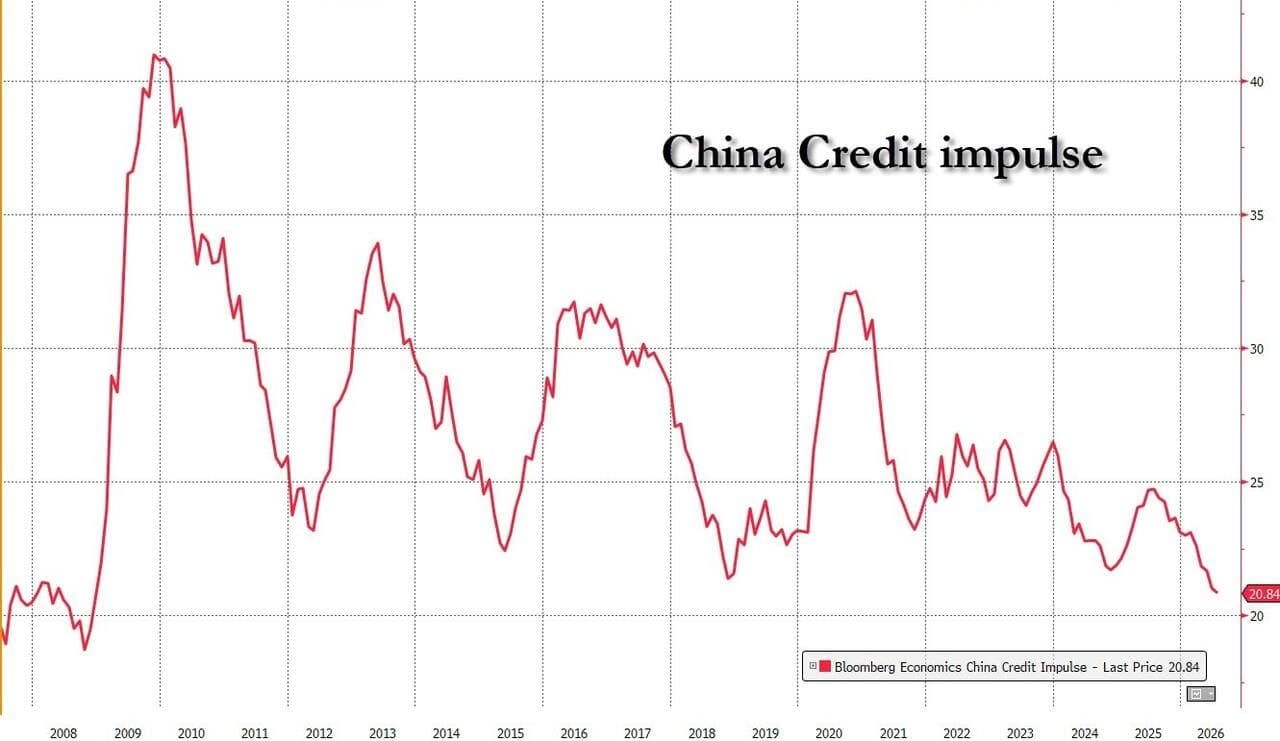
There was a time when China's credit impulse was the most important number on the monthly data calendar. Now, not so much:

https://substackcdn.com/image/fetch/$s_!UGfP!,f_auto,q_auto:good,fl_progressive:steep/https%3A%2F%2Fsubstack-post-media.s3.amazonaws.com%2Fpublic%2Fimages%2Fd5bd9981-bd2a-4a5e-9846-c987e8c97dbd_1280x741.jpeg 

Via Dark Side of the Boom, September 8

Still going down. 

If interested here is an older (2024) Bloomberg article: 

China’s Once-Mighty Credit Cycle Is a Fading Force on World Markets 

"Americans Without College Degrees Are Having One of the Best Job Markets in Years"

From the Wall Street Journal, September 6:

Unemployment among younger workers who didn’t go to college has rarely been lower in recent decades. It is the opposite story for college grads

For most U.S. workers—those without college degrees, that is—it is one of the best job markets in decades.

In fact, the unemployment rate for workers ages 22 to 34 who never graduated from college has rarely been lower in the past two decades, according to a new analysis by labor-market think tank Burning Glass Institute. 
***
What is just as remarkable is how different that is from the experience of job seekers who did graduate from college, says Gad Levanon, Burning Glass’s chief economist. For most of the past two decades, the two groups largely tracked each other, in good economic times and bad.

Now, though, just as job hunters without degrees are having one of their best runs, those with college educations are having one of their worst. And those with advanced degrees or in fields such as science and technology are having an even harder time than usual.

That divergence of fortunes is a departure from what the U.S. economy has seen for years, and much of it boils down to supply and demand: There aren’t enough skilled tradespeople to go around, for example, as older generations retire and immigration drops.

Meanwhile, more Americans have college degrees than ever, just as artificial intelligence is doing more of the entry-level work companies typically hire young graduates for.

“There’s a rapidly growing supply of people with a bachelor’s degree, and you have a rapid decline of people who don’t,” Levanon says. “I don’t think it’s a temporary thing.”
 ***
A wrinkle: On an absolute scale, it is still easier to find a job with a college degree. The unemployment rate for degree-holders in their prime working years—ages 25 to 54—averaged 2.7% for the 12 months ending in July. That is well below the 3.6% rate for workers with just some college education, and 4.7% for people with a high-school diploma only.

So, to gauge how the job market has shifted for each cohort, Levanon compared current unemployment rates for the different groups with their own range of unemployment rates since 2003. The analysis included data through July.

By that measure, the job market looks much better, historically speaking, for blue-collar workers, including those in construction and on manufacturing lines, and manual-service workers—think security guards, nurses and many restaurant and retail employees.
***
The more physical and in-person the work is, the lower the unemployment tends to be by that occupation’s own historical standards. Friday’s booming jobs report reinforced the trend: Food services and drinking places added 59,000 jobs in August, more than a third of all 162,000 jobs added to the U.S. economy last month.

By contrast, college-educated workers ages 22 to 34 years old have only seen worse unemployment in the past two decades during the pandemic and the economy’s slow rebound from the 2007-09 recession....

....MUCH MORE 

Arctic Sea Ice Volume Is Finally Running Ahead Of The Prior Two Years

It has been a rough few years for the Arctic Ice.

May 2024Arctic: Well, The Ice Has Begun Retreating Fom Its Winter Maximum....

....And it was not a good year.

As long-time readers know we focus on sea ice thickness and volume rather than extent. This is because of the way ice melts. Just as the ice in your glass will last longer in block form than as thin shavings, the Arctic ice better resists melting the thicker it is.

We might have a winter where the polar vortex stays nice and tight around the Arctic Circle, keeping the colder  air over one (large) spot and have less, sometimes far less ice extent than in winters where the circumpolar winds break down allowing the cold air to head south, forming a thin skin of ice over a greater area.

The problem is, that thin skin begins to melt as soon as the sun returns to the Northland. The thicker ice melts slower and has a better chance of becoming second-year or multi-year ice which is the stuff that has the best chance of resisting the warm air of summer....

March 2025Arctic Sea Ice Sets Lowest Winter Maximum Extent In The 47-Year Satellite Record

October 2025Good News/Bad News On The Arctic Ice Cap

First, the bad news. The ice is in terrible shape.

As always, our interest, because of the way ice melts, is in thickness rather than extent....

October 2025"Chinese Freighter Halves EU Delivery Time on Maiden Arctic Voyage to UK"

Because of the way ice freezes (and melts) we would expect the graph to show faster growth in extent than in the last few years. Unfortunately that is because more water is exposed and come next spring it won't be very thick compared to the multi-year ice you really want to see.  

May 2026"NASA and JAXA data show another record-low Arctic winter sea-ice season" 

*** 

And from the Danish Meteorological Institute, retrieved Wednesday AM Copenhagen time:

https://polarportal.dk/api/v1/serve-image/sea?image_name=1788873416561_CICE_curve_thick_LA_EN_20260908.png 

The volume of ice up north passed that of the 2025 and 2024 seasons in July 2026. We were not sure if the trend would continue but now that the ice is approaching the seasonal low point it looks as though the bottom is in.