Showing posts sorted by relevance for query google quantum. Sort by date Show all posts

Thursday, October 3, 2019

"Quantum gold rush: the private funding pouring into quantum start-ups"

Following up on Sept. 23's "Ghost post! Google creates world’s most powerful computer, NASA ‘accidentally reveals’ ...and then publication vanishes
—and a hundred other posts, some links after the jump.

From the journal Nature, October 2:

A Nature analysis explores the investors betting on quantum technology. 
Robert Schoelkopf spent more than 15 years studying the building blocks of quantum computers until, in 2015, he decided it was time to start constructing one. The physicist and his colleagues at Yale University began pitching their start-up firm Quantum Circuits, Inc. to investors, hoping to persuade venture capitalists that the time was ripe to pour cash into a quantum-computing company. Within two years, the team had secured US$18 million. That was enough to build a specialist laboratory — which opened this January — in a science park near the university in New Haven, Connecticut, and to employ around 20 scientists and engineers.
For Schoelkopf, venture capital (VC) investing was unfamiliar territory. But he’s not the only quantum physicist to make a successful sales pitch. Governments and large technology firms have long nurtured quantum research, and in the past few years have announced billions of dollars for the field. As their support has ramped up, outside investors have looked to get in early on a fledgling industry.

By the start of this year, according to an analysis by Nature, private investors had funded at least 52 quantum-technology companies globally since 2012 — many of them spin-outs from university departments. (Academics have founded many more start-ups that have yet to close deals.) Although the value of some of the cash infusions remains secret, Nature’s analysis captures the scale of recent activity. It finds that, in 2017 and 2018, companies received at least $450 million in private funding — more than four times the $104 million disclosed over the previous two years (see ‘Cash for qubits’). VC makes up the bulk of this cash. Many firms in the VC hub of California’s Silicon Valley have already plunged in, and among the rest, “most are keeping a close eye on quantum”, says Christopher Monroe, a physicist at the University of Maryland in College Park who co-founded the quantum-computing firm IonQ in 2015. 
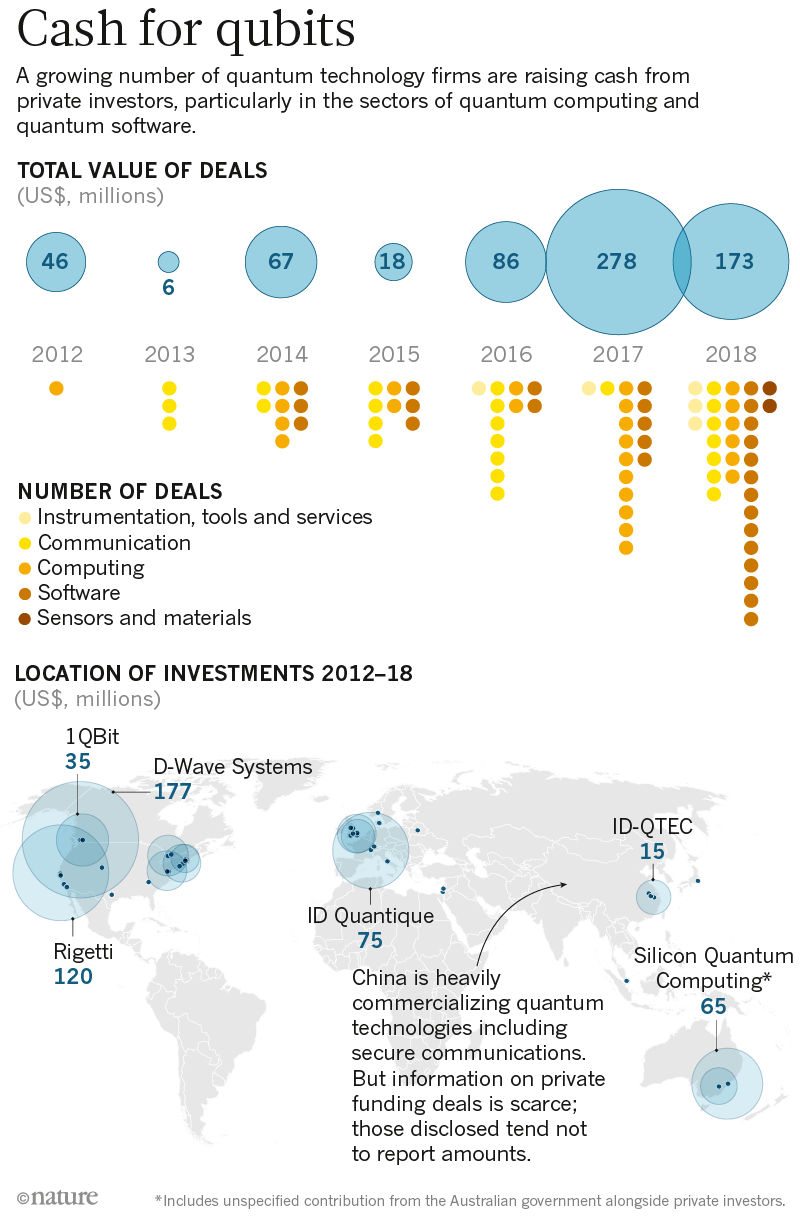
Source: Nature analysis, including data from Quantum Computing Report, Boston Consulting Group, PitchBook and Crunchbase
Few doubt that quantum technologies will eventually yield useful and potentially revolutionary products. Alongside government investments, hundreds of firms are rushing to invest in the field, with big names such as IBM, Google, Alibaba, Hewlett Packard, Tencent, Baidu and Huawei all doing their own research. Google has reportedly now created a quantum computer that can solve specialized problems that would stump even the best classical computer — a landmark known as ‘quantum supremacy’. Secure encryption using quantum technology is already a commercial product, as are some quantum-enabled technologies that sense, image or measure at exquisitely precise scales. One firm, D-Wave Systems in Burnaby, Canada, even sells computers that exploit quantum effects, although these machines specialize in particular tasks known as optimization problems.

But venture capitalists tend to invest in what they hope will be game-changers, such as a multipurpose quantum computer that could handle many kinds of otherwise-unfeasible calculations. From the perspective of investors, the cash pumped into the field annually represents a small outlay so far — on a par with VC investments in artificial-intelligence (AI) firms before 2010, for instance. (By 2018, US VC investments in AI had boomed to $9.3 billion.) Still, these numbers are substantial for an immature field that doesn’t yet have much to sell. Despite this, some software firms are already marketing their work on quantum algorithms, which are written for hardware that does not yet exist....
....MUCH MORE

Also at Nature, Oct. 2:
Beyond quantum supremacy: the hunt for useful quantum computers

Way back in 2017 Nature was posting (and we were linking): "Google's Quantum AI Laboratory set out investment opportunities on the road to the ultimate quantum machines" (GOOG).

And some other links:
March 2019
"Inside the high-stakes race to make quantum computers work"
March 2019
Quantum Computing That Is Actually Useful Gets A Bit Closer to Reality
October 2018
Computing: "D-Wave Launches Free Quantum Cloud Service"
October 2018
"10 Quantum Computing Startups Getting Funded in 2018"
Keeping in mind that Google is pretty fired up on D-Wave's architecture while Rigetti and Alibaba are developing proprietary systems....
September 2018
Cloud-Based Quantum Computing Is Almost Ready For Business
Thus sayeth Rigetti:...
March 2018
TASS: A multi-qubit quantum computer could be created in Russia within a year
March 2018
Quantum Computing: "Volkswagen Refining Machine Learning on D-Wave System"

"Google and VW partner on quantum computing to improve electric car batteries"

Volkswagen Using D-Wave Quantum Computer To Fight Beijing Traffic (plus the VW Level 5 autonomous vehicle)
February 2018
"The Argument Against Quantum Computers"
February 2018
Supremecy—Quantum Algorithms Struggle Against Old Foe: Clever Computers
January 2018
Breaking Bitcoin With a Quantum Computer

And the 2017 series:
Questions America Wants Answered: "Is Quantum Computing an Existential Threat to Blockchain Technology?"
Yeah, I Got Your Bitcoin Right Here: "‘Quantum Checks’ to Replace Cryptocurrencies in the Future?"
Computing: Will Quantum Devices Outperform Classical Computers by Year-end 2017? (thus achieving 'quantum supremecy')
The route to high-speed quantum computing is paved with error
"Google's Quantum AI Laboratory set out investment opportunities on the road to the ultimate quantum machines" (GOOG).

And many, many more.

Including 2015's
"Google says it has now proven that D-Wave’s quantum computer really works" (GOOG)
We have quite a few posts on D-Wave, links below, and through most of them our attitude was a dubious "Show me".
It appears they may have. 

Monday, September 23, 2019

"Ghost post! Google creates world’s most powerful computer, NASA ‘accidentally reveals’ ...and then publication vanishes"

A little conspiracy theorizing from RT on what was otherwise pretty straightforward news.
Quantum 'puters and AI are two areas that President Putin has directed Russia to focus on so whatever the boss wants RT delivers.

We've been following the D-Wave, Google, NSA quantum computer adventure for a while, more after the jump.
From the folks formerly known as Russia Today:
Google’s new quantum computer reportedly spends mere minutes on the tasks the world’s top supercomputers would need several millennia to perform. The media found out about this after NASA “accidentally” shared the firm’s research. 
 
The software engineers at Google have built the world’s most powerful computer, the Financial Times and Fortune magazine reported on Friday, citing the company’s now-removed research paper. The paper is said to have been posted on a website hosted by NASA, which partners with Google, but later quietly taken down, without explanation.

Google and NASA have refused to comment on the matter. A source within the IT giant, however, told Fortune that NASA had “accidentally” published the paper before its team could verify its findings.

In the research, Google reportedly claimed that it takes their new quantum processor just around 200 seconds to make calculations that existing supercomputers would require around 10,000 years to perform. They also said the processor requires mere 30 seconds to complete a task the Google Cloud server would need 50 trillion hours to do....MORE
I'm thinking the announcement was Google's to make not NASA's., so they pulled it.
Previously:
March 2019
"Inside the high-stakes race to make quantum computers work"
March 2019 
Quantum Computing That Is Actually Useful Gets A Bit Closer to Reality
October 2018
Computing: "D-Wave Launches Free Quantum Cloud Service"
October 2018
"10 Quantum Computing Startups Getting Funded in 2018"
Keeping in mind that Google is pretty fired up on D-Wave's architecture while Rigetti and Alibaba are developing proprietary systems.... 
September 2018
Cloud-Based Quantum Computing Is Almost Ready For Business
Thus sayeth Rigetti:...
March 2018 
TASS: A multi-qubit quantum computer could be created in Russia within a year
March 2018
Quantum Computing: "Volkswagen Refining Machine Learning on D-Wave System"
"Google and VW partner on quantum computing to improve electric car batteries"
Volkswagen Using D-Wave Quantum Computer To Fight Beijing Traffic (plus the VW Level 5 autonomous vehicle)
February 2018 
"The Argument Against Quantum Computers"
February 2018 
Supremecy—Quantum Algorithms Struggle Against Old Foe: Clever Computers
January 2018 
Breaking Bitcoin With a Quantum Computer
And the 2017 series:
Questions America Wants Answered: "Is Quantum Computing an Existential Threat to Blockchain Technology?"
Yeah, I Got Your Bitcoin Right Here: "‘Quantum Checks’ to Replace Cryptocurrencies in the Future?"
Computing: Will Quantum Devices Outperform Classical Computers by Year-end 2017? (thus achieving 'quantum supremecy')
The route to high-speed quantum computing is paved with error
"Google's Quantum AI Laboratory set out investment opportunities on the road to the ultimate quantum machines" (GOOG).

And many, many more. 

Including 2015's
"Google says it has now proven that D-Wave’s quantum computer really works" (GOOG) 
We have quite a few posts on D-Wave, links below, and through most of them our attitude was a dubious "Show me".
It appears they may have.

Friday, March 9, 2018

"Google Chases Quantum Supremacy with 72 Qubit Processor"

This may be important. For quite a few years the point at which quantum computers would surpass conventional was assumed to be 54 qubits.
Then late last year it became apparent that conventional computers were still superior to quantum 'puters in most respects at the 54 qubit level. More after the jump.

From the high performance computing gurus at HPCwire:
March 7, 2018
Google pulled ahead of the pack this week in the race toward “quantum supremacy,” with the introduction of a new 72-qubit quantum processor called Bristlecone. The gate-based superconducting system will be instrumental in Google’s efforts to demonstrate the first quantum technology to show advantage over today’s leading classical machines.

Bristlecone (so nicknamed due to the qubits being arranged in a pinecone pattern) will be employed as a testbed for researching system error rates and boosting scalability of Google’s qubit technology and for exploring near-term applications in quantum simulation, optimization, and machine learning.
The Mountain View, Calif.-based research team created Bristlecone by scaling up its previous 9-qubit array. Announced by the Google team last year, that (smaller) system “demonstrated low error rates for readout (1%), single-qubit gates (0.1%) and most importantly two-qubit gates (0.6%),” according to Julian Kelly, Research Scientist, Quantum AI Lab, who shared details of the new processor in a blog post.
Bristlecone is Google’s newest quantum processor (left). On the right is a cartoon of the device: each “X” represents a qubit, with nearest neighbor connectivity. Source: Google
Bristlecone is Google’s newest quantum processor (left). On the right is a cartoon of the device: each “X” represents a qubit, with nearest neighbor connectivity. Source: Google “This device uses the same scheme for coupling, control, and readout, but is scaled to a square array of 72 qubits,” stated Kelly. “We chose a device of this size to be able to demonstrate quantum supremacy in the future, investigate first and second order error-correction using the surface code, and to facilitate quantum algorithm development on actual hardware.”

Google’s goal is to achieve similar performance to the best error rates of the 9-qubit device, but do so across all 72 qubits of Bristlecone. It’s essentially a recipe for achieving quantum supremacy, which according to the Google team’s calculations “can be comfortably demonstrated with 49 qubits, a circuit depth exceeding 40, and a two-qubit error below 0.5%.”

Circuit depth refers to how many logical operations a quantum processor can carry out before coherence decays....MORE
Quite a flurry of activity the last few months:
March 2017
"Google's Quantum AI Laboratory set out investment opportunities on the road to the ultimate quantum machines" (GOOG).

July 2017
Computing: Will Quantum Devices Outperform Classical Computers by Year-end 2017? (thus achieving 'quantum supremecy')

July 2017
Yeah, I Got Your Bitcoin Right Here: "‘Quantum Checks’ to Replace Cryptocurrencies in the Future?"
One of Mr. Keohane's Further Reading links is to a Bloomberg article that asks in its headline "Why Can’t Americans Ditch Checks?".

Why? I'll tell you why. If the rest of the world wants to go with Venmo or cryptocrap that's just fine.

We're roughly nine months from real—honest-to-goodness—quantum supremecy, the moment when quantum computers show they actually are superior to classical 'puters.

And with three of the top five quantum co's. in the U.S. it's a pretty good bet that it will be American thieves emptying those supposedly hack-proof wallets around the world and the American companies will be using the Indian guy's idea (below) to move beyond old-fashioned crypto.

And Deluxe Corp. (and maybe De La Rue too) will be going all Schrödinger on the fanboys and the kids will be saying "Ehereum? That's sooo 2017."

Or not.
Predicting is hard.  
Nov. 2017
Questions America Wants Answered: "Is Quantum Computing an Existential Threat to Blockchain Technology?"


January 2018
One More Reason Cryptography May Not Stand Up to Quantum Computers

February 2018
Supremecy—Quantum Algorithms Struggle Against Old Foe: Clever Computers

Thursday, October 23, 2025

"Google claims ‘quantum advantage’ again — but researchers are sceptical" (GOOG)

From the journal Nature, October 22: 

The firm says it has solved a problem on a quantum processor faster than a classical computer, and is optimistic about future scientific applications.  

Google researchers have made a fresh claim of quantum advantage — the ability of quantum computers to radically speed up calculations compared with their classical counterparts.
This is not the company’s first such claim. But the researchers say their latest algorithm — dubbed quantum echoes — has the potential to solve scientific problems, including deriving the structures of molecules. It could also, in theory, be replicated on another quantum computer.
“This algorithm offers the opportunity for real-world applications,” said Hartmut Neven, who heads Google’s quantum-computing lab, in Santa Barbara, California, at a briefing for journalists ahead of the announcement. The firm is optimistic that in five years there will be practical uses for quantum computers, he added.
But some researchers are cautious of the claim of quantum advantage, published in Nature on 22 October1. “The burden of proof should be high,” says Dries Sels, a quantum physicist at New York University in New York City. And although the paper does a “serious job” of testing various classical algorithms, there is no proof that an efficient one doesn’t exist. “Personally I don’t think that’s enough to make such a big claim,” he says.
Others say that the promise of practical use so soon is premature. The technical advance is impressive, says James Whitfield, a quantum physicist at Dartmouth College in Hanover, New Hampshire, but it is “a bit of a stretch to think how this is going to suddenly solve some economically viable problem”.
Google researchers and their collaborators fleshed out how they could apply the algorithm to simple molecules in a preprint study that they have submitted to arXiv. They were able to predict certain features of the molecules’ structures using quantum simulations, and confirm their findings with nuclear magnetic resonance (NMR) measurements. But so far, they can only apply the method to molecules that can already be efficiently simulated classically, such as the aromatic liquid toluene....
....MUCH MORE 

Way back in 2017 Nature was posting (and we were linking): "Google's Quantum AI Laboratory set out investment opportunities on the road to the ultimate quantum machines" (GOOG). 

And in 2018 -  "Google Chases Quantum Supremacy with 72 Qubit Processor"

This may be important. For quite a few years the point at which quantum computers would surpass conventional was assumed to be 54 qubits.
Then late last year it became apparent that conventional computers were still superior to quantum 'puters in most respects at the 54 qubit level. More after the jump.
November 2021 - "Math may have caught up with Google’s quantum-supremacy claims" 
 
And December 2024 - "Quantum Computing Inches Closer to Reality After Another Google Breakthrough" (GOOG) 
 
March 2025 - "As NVIDIA’s Quantum Day Nears, Analysts Suggest Event is More Than a Gesture" (NVDA)
 
Related October 2019 - "A new era of computing could bring about a 'quantum apocalypse'" 
 
"'Our modern systems of finance, commerce, communication, transportation, manufacturing, energy, 
government, and healthcare will for all intents and purposes cease to function,' cyber security expert warns"
 
And many, many more.

Monday, January 1, 2018

One More Reason Cryptography May Not Stand Up to Quantum Computers

Twelve weeks ago we were reading "Google Just Revealed How They’ll Build Quantum Computers":
... A quantum computer with a mere 50 qubits would outclass the most powerful supercomputers in the world today. Surpassing the limits set by conventional computing, known as achieving quantum supremacy, has been a difficult road. Now, a team of physicists at the University of California Santa Barbara (UCSB) and Google have demonstrated a proof-of-principle for a quantum computer that may mean quantum supremacy is only months away....
Two weeks after that piece in Futurism we saw this at New Scientist:

Google’s quantum computing plans threatened by IBM curveball
...IBM has come up with a way to simulate quantum computers that have 56 quantum bits, or qubits, on a non-quantum supercomputer – a task previously thought to be impossible. The feat moves the goalposts in the fight for quantum supremacy, the effort to outstrip classical computers using quantum ones.

It used to be widely accepted that a classical computer cannot simulate more than 49 qubits because of memory limitations. The memory required for simulations increases exponentially with each additional qubit.

The closest anyone had come to putting the 49-qubit limit to a test was a 45-qubit simulation at the Swiss Federal Institute of Technology in Zurich, which needed 500 terabytes of memory. IBM’s new simulation upends the assumption by simulating 56 qubits with only 4.5 terabytes....
Well, at ten weeks old that's ancient history.

From Next Big Future, December 30:

Progress to turning silicon transistors into qubits which could enable billion qubit quantum computers
Japanese RIKEN researchers are trying to adapt existing the silicon metal–oxide–semiconductor field-effect transistors (MOSFETs) to integrate qubits with current electronics, offering the potential for scaling up quantum devices and bringing quantum computing closer to becoming a reality.

Keiji Ono and colleagues from the RIKEN Center for Emergent Matter Science and the Toshiba Corporation in Japan, in collaboration with researchers from the United States, are investigating the properties of qubits produced by imperfections or defects in silicon MOSFETs. In particular, they are exploring their potential for developing quantum computing devices that are compatible with current manufacturing technologies.

“Companies like IBM and Google are developing quantum computers that use superconductors,” explains Ono. “In contrast, we are attempting to develop a quantum computer based on the silicon manufacturing techniques currently used to make computers and smart phones. The advantage of this approach is that it can leverage existing industrial knowledge and technology.”

After cooling a silicon MOSFET to 1.6 kelvin (−271.6 degrees Celsius), the researchers measured its electrical properties while applying a magnetic field and a microwave field. They found that when the silicon MOSFET was neither fully turned on nor off, a pair of defects in the silicon MOSFET formed two quantum dots in close vicinity to each other. This ‘double quantum dot’ generated qubits from the spin of electrons in the dots. It also produced quantum effects that can be used to control these qubits....MORE 
Of course, with that "having been reported over x days ago"..... which partly explains our lead-in to Saturday's "Cryptography and Quantum Computers":
The author seems optimistic - note headline - but I'm not so sure....

From Nautil.us:
How Classical Cryptography Will Survive Quantum Computers
Some of last year's more popular Quantum computing posts:
Nov. 5
Questions America Wants Answered: "Is Quantum Computing an Existential Threat to Blockchain Technology?"

July 26
Yeah, I Got Your Bitcoin Right Here: "‘Quantum Checks’ to Replace Cryptocurrencies in the Future?"

July 11
Computing: Will Quantum Devices Outperform Classical Computers by Year-end 2017? (thus achieving 'quantum supremecy')

April 6
The route to high-speed quantum computing is paved with error

March 8
"Google's Quantum AI Laboratory set out investment opportunities on the road to the ultimate quantum machines" (GOOG).

Tuesday, December 8, 2015

"Google says it has now proven that D-Wave’s quantum computer really works" (GOOG)

We have quite a few posts on D-Wave, links below, and through most of them our attitude was a dubious "Show me".
It appears they may have.

From 9 to 5 Google:
Last month we reported on Google planning a “watershed” quantum computing announcement, which the company and NASA delivered jointly today. Google’s Quantum AI team announced the results of its latest test in understanding the physics governing quantum annealers, which shows that quantum annealing can outperform simulated annealing by more than 108 times – yes that’s 100,000,000x faster.

Google achieved these results by running problems involving “nearly 1000 binary variables” into the D-Wave 2X quantum annealer. The results could potentially end the longstanding debate about whether or not D-Wave’s technology is performing true quantum annealing instead of performing classical simulated annealing without using any quantum effect.

D-Wave is a quantum computing firm based in Canada. The company made important strides in the field and attracted an impressive list of investors including the CIA’s investment arm In-Q-Tel and Amazon founder Jeff Bezos....MORE
HT: MetaFilter who put together a mini-linkfest.

Our most recent post was back in January, "Venture Capital: "Quantum" Computing Co. D-Wave Raises $29 Mil From Goldman, Bezos, CIA" with the quantum in quote marks.

Prior to that, in September 2014's "Quantum Computing: 'Three Questions with the CEO of D-Wave'", I attempted some lame quantum mechanics jokes:

I'm still not sure if D-Wave has a quantum computer or not, some links to previous posts below. 

Also, the interviewer does not ask what the advantages of this approach are for fanciers of cat videos
.

Regarding the quantum, this is not Schrödinger's Cat

From MIT's Technology Review:
The CEO of quantum computing startup D-Wave says its machines are helping companies analyze Wall Street data and search for new cancer drugs.

Ever since D-Wave Systems unveiled what it called the world’s first quantum computer in 2007, the small Canadian company has attracted controversy.

Computers capable of exploiting quantum physics for computation on a large scale promise to solve in mere seconds problems that would take conventional machines millions of years. But whether D-Wave’s machine uses quantum tricks to process data more efficiently is still an open question. Nonetheless, the company has attracted significant investment funding, and it has struck deals to supply its hardware to companies including Google and Lockheed Martin for research (see “The CIA and Jeff Bezos Bet on Quantum Computing”).
D-Wave’s CEO, Vern Brownell, met recently with Tom Simonite, MIT Technology Review’s San Francisco bureau chief, and said the company now has customers using its computers to tackle real problems.

By now you have built a few generations of your quantum processors. Are they ready to be used to solve problems yet?
We have 12 machines running now. A few of them are online; we have customers who can access a machine over the Internet. It’s not a product or something that’s available to everyone, but we have customers doing real things with the computer today that have huge business impact. We have seen results that are better than classical systems. Customers have their application and integrate quantum computing into it and it performs better.

Over the next few years we will be offering more and more of that capability to the world. We see us eventually making quantum cloud services available to the world. But we don’t have a tool set yet that allows us to do that. It requires a lot of hand-holding with even the most sophisticated customers.

Can you give some examples of what those customers are using D-Wave’s machines for?
[A company called] 1Qbit was started to use our quantum computer for financial services. They have 20 PhDs developing algorithms in portfolio optimization and things like that. We provide them with some training and expertise, but they are by and large doing this work themselves. If they find the amazing algorithm that is going to make tons of money for Wall Street traders, it’s their intellectual property, not ours....MORE
HT: FT Alphaville's Further Reading post.

Sept. 2014
"The Man Who Will Build Google’s Elusive Quantum Computer" (GOOG)
April 2014
"Why Nobody Can Tell Whether the World’s Biggest Quantum Computer is a Quantum Computer"
May 2013
Google Launches the Quantum Artificial Intelligence Lab (GOOG)
March 2013
Does Lockheed Have a Quantum Computer or Doesn't It? (LK)
Nov. 2012
Quantum Computing: CIA and Bezos Invest in D-Wave Systems In.

If I had to do it all over again I'd probably go with this revision of an old joke:
Heisenberg and Schrödinger get pulled over for speeding.
The cop asks Heisenberg "Do you know how fast you were going?"
Heisenberg replies, "No, but we know exactly where we are!"
The officer looks at him confused and says "you were going 108 miles per hour!"
Heisenberg throws his arms up and cries, "Great! Now we're lost!"

The officer looks over the car and asks Schrödinger if the two men have anything in the trunk.
"A cat," Schrödinger replies.
The cop opens the trunk and yells "Hey! This cat is dead."
Schrödinger angrily replies, "Well he is now."

Wednesday, March 8, 2017

"Google's Quantum AI Laboratory set out investment opportunities on the road to the ultimate quantum machines" (GOOG).

From the journal Nature:

Commercialize quantum technologies in five years
Masoud Mohseni, Peter Read, Hartmut Neven and colleagues at Google's Quantum AI Laboratory set out investment opportunities on the road to the ultimate quantum machines.

http://www.nature.com/polopoly_fs/7.42777.1488538790!/image/Image3_GoogleCryostat_ErikLucero-copy.jpg_gen/derivatives/landscape_630/Image3_GoogleCryostat_ErikLucero-copy.jpg
Google's cryostats reach temperatures of 10 millikelvin to run its quantum processors.
From aspects of quantum entanglement to chemical reactions with large molecules, many features of the world cannot be described efficiently with conventional computers based on binary logic. The solution, as physicist Richard Feynman realized three decades ago1, is to use quantum processors that adopt a blend of classical states simultaneously, as matter does. Many technical hurdles must be overcome for such quantum machines to be practical, however. These include noise control and improving the fidelity of operations acting on the quantum states that encode the information.

The quantum-computing community is channelling most of its efforts towards building the ultimate machine: a digital quantum computer that tolerates noise and errors, and that in principle can be applied to any problem. In theory, such a machine — which will need large processors comprising many quantum bits, or qubits — should be able to calculate faster than a conventional computer. Such capability is at least a decade away2.
Correcting for errors requires redundancy, and the number of qubits needed quickly mounts. For example, factorizing a 2,000-bit number in one day, a task believed to be intractable using classical computers3, would take 100 million qubits, even if individual quantum operations failed just once in every 10,000 operations. We have yet to assemble digital quantum processors with tens of qubits.

This conservative view of quantum computing gives the impression that investors will benefit only in the long term. We contend that short-term returns are possible with the small devices that will emerge within the next five years, even though these will lack full error correction.

A lack of theoretical guarantees need not preclude success. Heuristic 'hybrid' methods that blend quantum and classical approaches could be the foundation for powerful future applications. The recent success of neural networks in machine learning is a good example. In the 1990s, when the computing power required to train deep neural networks was unavailable, it was fashionable in the field to focus on 'convex' methods (based on functions with a clear minimum solution) that had a strong theoretical basis. Today, these methods are no match for deep learning. The underlying algorithms of neural networks have hardly changed, yet impressive new performance milestones are being reached, thanks to 'Moore's law'.

Similarly, although there is no proof today that imperfect quantum machines can compute fast enough to solve practical problems, that may change. The scale, fidelity and controllability of analog and digital quantum hardware are improving steadily. We anticipate that, within a few years, well-controlled quantum systems may be able to perform certain tasks much faster than conventional computers based on CMOS (complementary metal oxide–semiconductor) technology.
Here we highlight three commercially viable uses for early quantum-computing devices: quantum simulation, quantum-assisted optimization and quantum sampling. Faster computing speeds in these areas would be commercially advantageous in sectors from artificial intelligence to finance and health care.

Capitalizing on imminent advances in quantum technologies requires that the discipline broadens its focus and that scientists work more closely with entrepreneurs. Hardware improvements are needed to make devices reliable and controllable enough to be commercialized. Heuristic quantum algorithms need to be developed that address practical problems within the current hardware limitations. As researchers working on quantum computing at Google, we plan to provide access to our quantum processors through cloud services to facilitate the development and benchmarking of quantum algorithms and applications across industries, delivering real benefit to society.

Three priorities
If certain feasible technological improvements are achieved, we believe that emerging quantum processors have a good chance of carrying out the following classes of computational tasks and could become commercially valuable within a few years.

Quantum simulation.
Modelling chemical reactions and materials is one of the most anticipated applications of quantum computing. Instead of spending years, and hundreds of millions of dollars, making and characterizing a handful of materials, researchers could study millions of candidates in silico. Whether the aim is stronger polymers for aeroplanes, more-effective catalytic converters for cars, more-efficient materials for solar cells, better pharmaceuticals or more-breathable fabrics, faster discovery pipelines will bring enormous value.

Computational materials discovery is already a large industry. Quantum computers promise a radical transition: from the qualitative and descriptive to the quantitative and predictive. Chemical-reaction rates are extremely sensitive to molecular energies and span a range wider than classical methods can handle. If robust algorithms are developed, it might be possible to simulate important materials without the overhead of full quantum error correction4. For example, algorithms are already known (such as the 'quantum variational eigensolver' approach) that seem to be immune to qubit control errors.

A variety of business models could supply quantum simulators. Laboratories might pay a subscription for access. Computing companies could act as consultants. Some businesses might exchange equity in return for quantum-assisted breakthroughs that lead to innovative material developments....MUCH MORE

Friday, December 11, 2015

So You Think Your Computer Is Fast? Update on Google, D-Wave and the Quantum Computer

Following up on Tuesday's "Google says it has now proven that D-Wave’s quantum computer really works (GOOG)".
From MIT's Technology Review:

Google Says It Has Proved Its Controversial Quantum Computer Really Works
Inside this box is a superconducting chip, cooled to within a fraction of a degree of 
absolute zero, that might put new power behind artificial-intelligence software.
Researchers from Google’s AI Lab say a controversial quantum machine that it and NASA have been testing since 2013 resoundingly beat a conventional computer in a series of tests.  

Google says it has proof that a controversial machine it bought in 2013 really can use quantum physics to work through a type of math that’s crucial to artificial intelligence much faster than a conventional computer.

Governments and leading computing companies such as Microsoft, IBM, and Google are trying to develop what are called quantum computers because using the weirdness of quantum mechanics to represent data should unlock immense data-crunching powers. Computing giants believe quantum computers could make their artificial-intelligence software much more powerful and unlock scientific leaps in areas like materials science. NASA hopes quantum computers could help schedule rocket launches and simulate future missions and spacecraft. “It is a truly disruptive technology that could change how we do everything,” said Rupak Biswas, director of exploration technology at NASA’s Ames Research Center in Mountain View, California.

Biswas spoke at a media briefing at the research center about the agency’s work with Google on a machine the search giant bought in 2013 from Canadian startup D-Wave systems, which is marketed as “the world’s first commercial quantum computer.” The computer is installed at NASA’s Ames Research Center in Mountain View, California, and operates on data using a superconducting chip called a quantum annealer. A quantum annealer is hard-coded with an algorithm suited to what are called “optimization problems,” which are common in machine-learning and artificial-intelligence software.

However, D-Wave’s chips are controversial among quantum physicists. Researchers inside and outside the company have been unable to conclusively prove that the devices can tap into quantum physics to beat out conventional computers.

Hartmut Neven, leader of Google’s Quantum AI Lab in Los Angeles, said today that his researchers have delivered some firm proof of that. They set up a series of races between the D-Wave computer installed at NASA against a conventional computer with a single processor. “For a specific, carefully crafted proof-of-concept problem we achieve a 100-million-fold speed-up,” said Neven.
Google posted a research paper describing its results online last night, but it has not been formally peer-reviewed. Neven said that journal publications would be forthcoming.

Google’s results are striking—but even if verified, they would only represent partial vindication for D-Wave. The computer that lost in the contest with the quantum machine was running code that had it solve the problem at hand using an algorithm similar to the one baked into the D-Wave chip. An alternative algorithm is known that could have let the conventional computer be more competitive, or even win, by exploiting what Neven called a “bug” in D-Wave’s design. Neven said the test his group staged is still important because that shortcut won’t be available to regular computers when they compete with future quantum annealers capable of working on larger amounts of data.

Matthias Troyer, a physics professor at the Swiss Federal Institute of Technology, Zurich, said making that come true is crucial if chips like D-Wave’s are to become useful. “It will be important to explore if there are problems where quantum annealing has advantages over even the best classical algorithms, and to find if there are classes of application problems where such advantages can be realized,” he said, in a statement with two colleagues. 

Last year Troyer’s group published a high-profile study of an earlier D-Wave chip that concluded it didn’t offer advantages over conventional machines. That question has now been partially resolved, they say. “Google’s results indeed show a huge advantage on these carefully chosen instances.”...MORE
HT: Victor Niederhoffer's Daily Speculation's who asks:
How will this change the trading business?
Good question. 
It means nothing at the moment, it's only annealing, but this is a big step.

Here's the Google paper at arXive:

What is the Computational Value of Finite Range Tunneling?

Monday, December 9, 2024

"Quantum Computing Inches Closer to Reality After Another Google Breakthrough" (GOOG)

From the New York Times, December 9:

Google unveiled an experimental machine capable of tasks that a traditional supercomputer could not master in 10 septillion years. (That’s older than the universe.)

In 2019, a team of Google researchers said they had built a machine capable of performing tasks that were not possible with traditional supercomputers. They described this machine, called a quantum computer, as a turning point in the evolution of information technology.

Some scientists disputed the claim. In the years since, as traditional supercomputers grew more powerful, they matched the feats of Google’s quantum computer.

On Monday, Google unveiled a new quantum computer that may end this back-and-forth race with traditional machines and that points to a future in which quantum computers could drive advances in areas like drug discovery and artificial intelligence.

Google said its quantum computer, based on a computer chip called Willow, needed less than five minutes to perform a mathematical calculation that one of the world’s most powerful supercomputers could not complete in 10 septillion years, a length of time that exceeds the age of the known universe.

Quantum computing — the result of decades of research into a type of physics called quantum mechanics — is still an experimental technology. But Google’s achievement shows that scientists are steadily improving techniques that could allow quantum computing to live up to the enormous expectations that have surrounded this big idea for decades.

“When quantum computing was originally envisioned, many people — including many leaders in the field — felt that it would never be a practical thing,” said Mikhail Lukin, a professor of physics at Harvard and a co-founder of the quantum computing start-up QuEra. “What has happened over the last year shows that it is no longer science fiction.”

Many other tech giants, including Microsoft, Intel and IBM, are building similar technology as the United States jockeys with China for supremacy in this increasingly important field. As the United States has pushed forward, primarily through corporate giants and start-up companies, the Chinese government has said it is pumping more than $15.2 billion into quantum research.

The mathematical calculation performed by Google’s machine was a test designed solely to gauge the progress of quantum computing — not a task that could be useful in other fields, like medicine. Though researchers believe that quantum computers will one day make today’s classical machines look archaic, the technology still makes too many mistakes to be truly useful.

Google’s quantum computer also uses a form of error correction — a way of reducing mistakes — that could allow this kind of machine to reach its potential. In a research paper published on Monday in the science journal Nature, Google said its machine had surpassed the “error correction threshold,” a milestone that scientists have been working toward for decades.

That means quantum computers are on a path to a moment, still well into the future, when they can overcome their mistakes and perform calculations that could accelerate the progress of drug discovery. They could also break the encryption that protects computers vital to national security....

....MUCH MORE

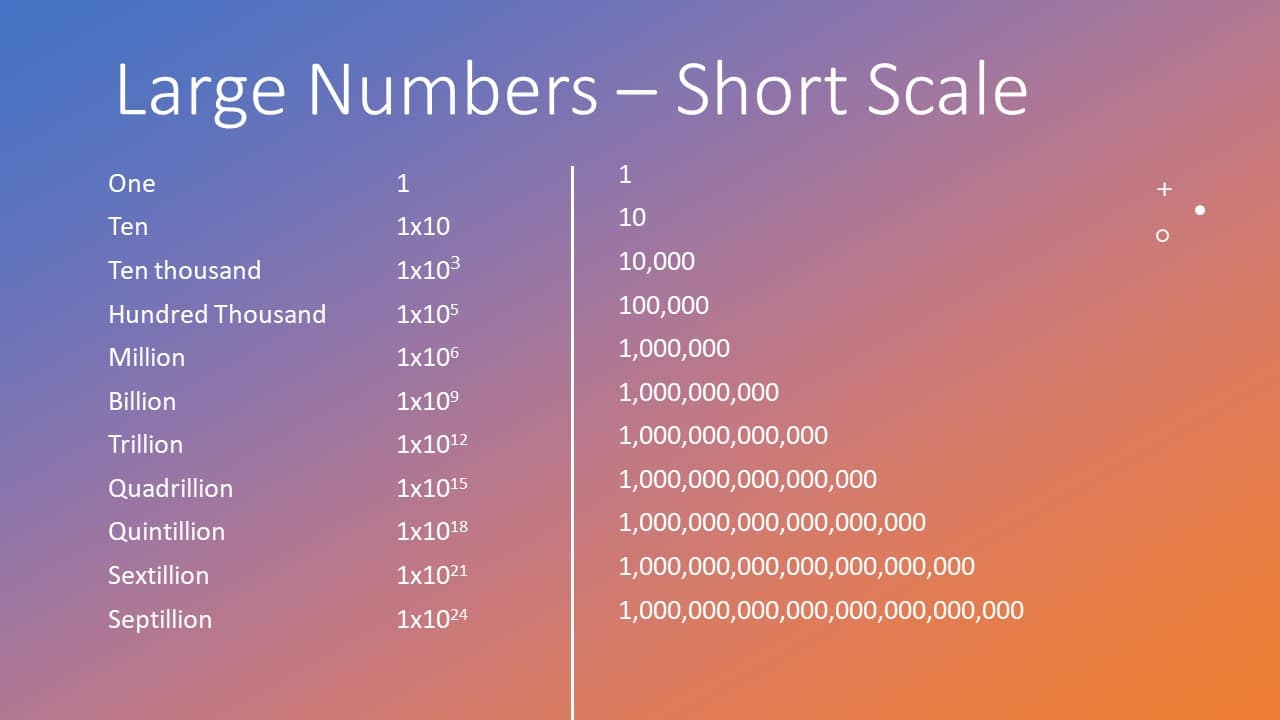
And thank you for pointing out the difference between billion and septillion. Oh wait, you didn't. From Civil's Guide:

https://civilsguide.com/wp-content/uploads/2021/05/Large-Numbers-%E2%80%93-Short-Scale.jpg


Phys.org, July 13, 2023:

New research puts age of universe at 26.7 billion years, nearly twice as old as previously believed

That is a very long way from a septillion. I wonder why the NYT included that Department of Duh factoid in the story. 

Saturday, September 6, 2014

"The Man Who Will Build Google’s Elusive Quantum Computer" (GOOG)

From Wired:

John Martinis is one of the world’s foremost experts on quantum computing, a growing field of science that aims to process information at super high speeds using strange physics of very tiny particles such as electrons and photons. And now, after years as a physics professor at the University of California Santa Barbara, he’s headed for Google.

This week, the Google Quantum A.I. Lab announced that it hired Martinis and his Santa Barbara team to build a new breed of quantum computing hardware. Though Martinis will maintain his affiliation with UC Santa Barbara and continue to mentor his PhD students there, he will spend most of his time on his research at Google. The move proves that Google is serious about quantum computing, and given the company’s vast influence and deep pockets, it could provide a serious shot in the arm for quantum computer research as a whole.
Google launched its Quantum A.I. Lab last year to test a machine called the D-Wave Two, an intriguing but controversial system that its makers bill as a quantum computer, and it believes quantum computing could play a key role in so many of its future ambitions, from self-driving cars and other robots to better predictive analytics systems for products like Google Now to things we haven’t even dreamed up yet. Thanks to what’s called the superposition principle of quantum mechanics, it could process data for such projects at speeds that are exponentially faster than what you get from today’s machines.

But the scientific community has greeted the D-Wave machine with skepticism, questioning whether the machine is actually a quantum computer at all, and whether it can actually provide something you can’t get from conventional machines. In joining Google, Martinis lends new weight to the company’s quantum ambitions.

Beyond the D-Wave
Martinis is among those questioning D-Wave’s claims. Last June, Science published a paper co-authored by Martinis and several other scientists concluding that D-Wave’s machines aren’t actually faster than normal laptops and desktops. But he’s no D-Wave hater. Martinis has been working with D-Wave’s machines for a few years now and says he has long been impressed with the work the company has done.

The general consensus now, he says, is that the D-Wave computers do exhibit some quantum behavior. The real question, he explains, is whether this behavior actually speeds up the D-Wave computers. And although his team will be working separately from D-Wave at Google, he thinks their work may eventually help D-Wave take better of advantage of that quantum behavior. “We’re taking some of the basic ideas of D-Wave and combining that with what the [Google] Quantum AI team has learned operating the machine,” he says....MORE

Friday, October 11, 2019

"A new era of computing could bring about a 'quantum apocalypse'"

"'Our modern systems of finance, commerce, communication, transportation, manufacturing, energy, 
government, and healthcare will for all intents and purposes cease to function,' cyber security expert warns"
Huh.
From The Independent:

‘Quantum apocalypse’: How ultra-powerful computers could cripple governments and effectively break the internet
A new era of unfathomably fast computers is just a few years away, with quantum computers set to transform the way we communicate, cure disease, and even solve problems previously thought impossible.

But some computing experts fear functional quantum computers could also effectively break the internet as we know it.

Recent progress made by Google means their arrival could be sooner than expected. A leaked research paper suggests the company has achieved what is known as quantum supremacy, whereby a quantum computer performed a calculation that was far beyond the reach of today’s most powerful supercomputers.

First theorised by the physicist Richard Feynman in 1982, quantum computers combine the peculiar properties of quantum physics with computer science to achieve processing power that is exponentially more powerful than traditional computers.

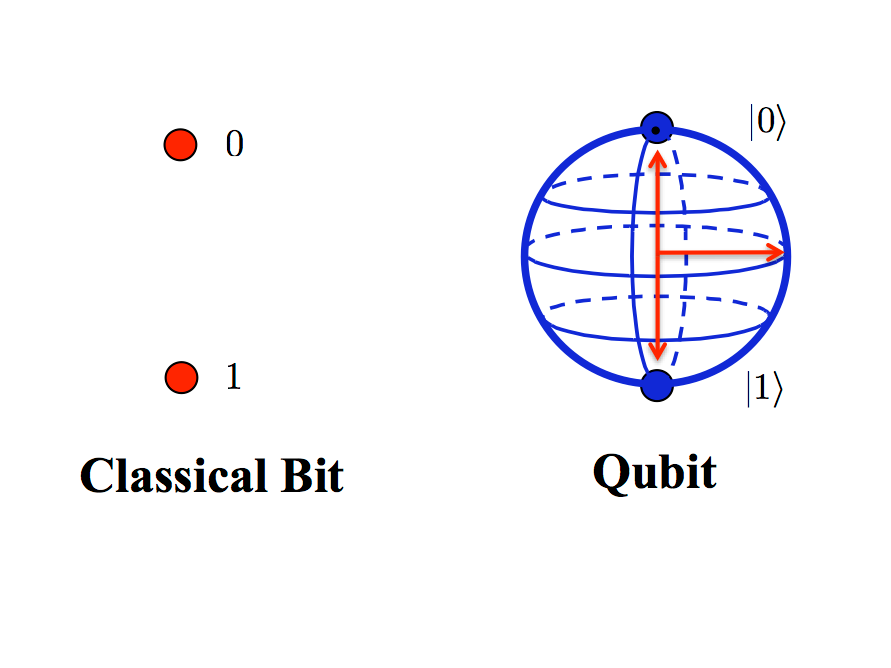
Instead of using traditional bits – the ‘1’s’ and ‘0’s’ used to store and transfer data – quantum computers use quantum bits or qubits. These exist in a state of superposition, meaning they can act as both a ‘1’ and a ‘0’ at the same time.

By not being restricted by a single binary state, each new qubit added to a quantum computing system makes it exponentially more powerful than its traditional counterpart.
In order to function, qubits need to be kept in extremely cold temperatures – close to Absolute Zero (-273C). This makes them both impractical and extremely costly to develop, but the potential advances that could be made mean the likes of Google, Nasa and the CIA are all attempting to build one.

If Google’s leaked paper is to be believed, the technology giant may be leading the race to build this revolutionary new form of computer. A calculation that would take a traditional supercomputer approximately 10,000 years to perform, took Google’s 72-qubit computer just 200 seconds.
The paper stated: “This dramatic speed-up relative to all known classical algorithms provides an experimental realisation of quantum supremacy on a computational task and heralds the advent of a much-anticipated computing paradigm.”

But such power may come at a huge price. Tim Callan, a senior fellow at cybersecurity firm Sectigo, warns that the advent of these era-defining machines could result in what he refers to as a “quantum apocalypse”.

At threat are the current encryption technologies used in everything from popular messaging apps like WhatsApp, to online banking transactions. These RSA and ECC encryption systems are what prevent all of our data from being exposed to cyber criminals, hackers and spy agencies....
....MUCH MORE

Previously:
October 2019 
"Quantum gold rush: the private funding pouring into quantum start-ups"
September 2019 
"Ghost post! Google creates world’s most powerful computer, NASA ‘accidentally reveals’ ...and then publication vanishes"
March 2018
TASS: A multi-qubit quantum computer could be created in Russia within a year
February 2018
"The Argument Against Quantum Computers"
January 2018
Breaking Bitcoin With a Quantum Computer

And the 2017 series:
Questions America Wants Answered: "Is Quantum Computing an Existential Threat to Blockchain Technology?"
Yeah, I Got Your Bitcoin Right Here: "‘Quantum Checks’ to Replace Cryptocurrencies in the Future?"
Computing: Will Quantum Devices Outperform Classical Computers by Year-end 2017? (thus achieving 'quantum supremecy')
The route to high-speed quantum computing is paved with error
"Google's Quantum AI Laboratory set out investment opportunities on the road to the ultimate quantum machines" (GOOG).

And many, many more. 

Tuesday, November 23, 2021

"Math may have caught up with Google’s quantum-supremacy claims"

From Ars Technica, November 23:

But, given the rapidly evolving quantum computing landscape, that may not matter.

In 2019, word filtered out that a quantum computer built by Google had performed calculations that the company claimed would be effectively impossible to replicate on supercomputing hardware. That turned out to not be entirely correct, since Google had neglected to consider the storage available to supercomputers; if that were included, the quantum computer's lead shrank to just a matter of days.

Adding just a handful of additional qubits, however, would re-establish the quantum computer's vast lead. Recently, however, a draft manuscript was placed on the arXiv that points out a critical fact: Google's claims relied on comparisons to a very specific approach to performing the calculation on standard computing hardware. There are other ways to perform the calculation, and the paper suggests one of those would allow a supercomputer to actually pull ahead of its quantum competitor.

More than one road to random

The calculation Google performed was specifically designed to be difficult to simulate on a normal computer. It set the 54 qubits of its Sycamore processor in a random state, then let quantum interference among neighboring qubits influence how the system evolves over time. After a short interval, the hardware started repeatedly measuring the state of the qubits. Each individual measurement produced a string of random bits, making Sycamore into a very expensive random-number generator. But if enough measurements are made, certain patterns generated by the quantum interference become apparent.

Because the rules of this quantum interference are understood, it's also possible to calculate the patterns we should see in the random numbers generated by Sycamore. But doing those calculations is very computationally expensive and gets more expensive with each additional qubit in the system. Google estimated that it would take an unrealistically long time to perform these calculations on the world's most advanced supercomputers.

The one flaw with this argument that was pointed out early in the process was that Google neglected to consider the storage attached to the world's then-largest supercomputer, which would significantly cut into Sycamore's lead. But the reality remained that these computations were very difficult for classical computing hardware.

The new manuscript focuses on a key aspect of that phrase: these computations. Google chose a very specific method of computing the expected behavior of its processor, but there are other ways of doing equivalent computations. Over the intervening time, a few options have been explored that do perform better. Now, Feng Pan, Keyang Chen, and Pan Zhang are describing a specific method that allows a GPU-based cluster to produce an equivalent output in only 15 hours. Run it on a leading supercomputer, and they estimate that it would outperform the Sycamore quantum processor.....

....MUCH MORE

Previously:

May 2020
"Inside big tech’s high-stakes race for quantum supremacy"
Not into quantum computers? Then you've made the decision to be a peasant, working for those who are.
And the rich get richer.
See: How to Think About Companies: "Advantage Flywheels".

November 2021

"Two of World’s Biggest Quantum Computers Made in China"

October 2020
The Market for Quantum Technology: Early Revenue-Generating Applications

Sept 2019
"Ghost post! Google creates world’s most powerful computer, NASA ‘accidentally reveals’ ...and then publication vanishes"

March 2018

"Google Chases Quantum Supremacy with 72 Qubit Processor"

October 2019

"A new era of computing could bring about a 'quantum apocalypse'"
"'Our modern systems of finance, commerce, communication, transportation, manufacturing, energy, 
government, and healthcare will for all intents and purposes cease to function,' cyber security expert warns"
Huh.

And dozens and dozens more

Sunday, January 7, 2018

Breaking Bitcoin With a Quantum Computer

From Fortune:
Alex Beath, a Toronto-based physicist and pension fund analyst, is skeptical about Bitcoin but sees one useful purpose for the crypto-currency: It may detect when someone creates a working quantum computer.

“The second someone creates a viable quantum computer, the NP-complete math problems at the heart of Bitcoin mining tech become instantly solvable,” Beath notes. “In other words, one answer to the question ‘what's the first thing you'd do with a quantum computer?’ is ‘mine all of the remaining Bitcoin instantly.’ Until that happens, nobody has a quantum computer.”

Beath’s off-the-cuff observation, which he made in response to a Fortune query about the security of bitcoin, is amusing. But it also underscores a serious problem: Namely, a new era of computing is fast-approaching and when it arrives, the system that gave rise to many crypto-currency fortunes will collapse.

This threat to Bitcoin and other software systems that use the same underlying encryption technique--a technique likely to crumble in the face of a quantum-based attack--is not new. Indeed, it was predicted decades ago, and Ethereum founder (and former journalist) Vitalik Buterin wrote about how to defend it in 2013.

The difference today, though, is that companies like Microsoft, Google and IBM are making rapid breakthroughs that could make quantum computing viable in less than 10 years.
Right now, engineers are stymied over how to deploy enough “qubits” (a quantum version of the binary bit system used in traditional computers that lets a unit be a 0 and 1 simultaneously) in a stable fashion.

According to CEO Louis Parks of SecureRF, which is developing quantum-resistant security systems, the number of qubits in a machine has recently soared from 16 to 50. This is far from the 4,000 to 10,000 that would likely be needed to crack Bitcoin’s cryptography but, at this point, Parks says quantum computing is now at stage akin to when the Wright brothers began showing airplanes were viable....MORE
Recently (January 3rd):

One More Reason Cryptography May Not Stand Up to Quantum Computers
Twelve weeks ago we were reading "Google Just Revealed How They’ll Build Quantum Computers":
... A quantum computer with a mere 50 qubits would outclass the most powerful supercomputers in the world today. Surpassing the limits set by conventional computing, known as achieving quantum supremacy, has been a difficult road. Now, a team of physicists at the University of California Santa Barbara (UCSB) and Google have demonstrated a proof-of-principle for a quantum computer that may mean quantum supremacy is only months away....
Two weeks after that piece in Futurism we saw this at New Scientist:

Google’s quantum computing plans threatened by IBM curveball
...IBM has come up with a way to simulate quantum computers that have 56 quantum bits, or qubits, on a non-quantum supercomputer – a task previously thought to be impossible. The feat moves the goalposts in the fight for quantum supremacy, the effort to outstrip classical computers using quantum ones.

It used to be widely accepted that a classical computer cannot simulate more than 49 qubits because of memory limitations. The memory required for simulations increases exponentially with each additional qubit.

The closest anyone had come to putting the 49-qubit limit to a test was a 45-qubit simulation at the Swiss Federal Institute of Technology in Zurich, which needed 500 terabytes of memory. IBM’s new simulation upends the assumption by simulating 56 qubits with only 4.5 terabytes....
Well, at ten weeks old that's ancient history.
From Next Big Future, December 30:

Progress to turning silicon transistors into qubits which could enable billion qubit quantum computers....

....MORE

Saturday, December 19, 2015

Qubits: "Race to vastly better annealers, powerful universal quantum computers which will transform machine learning into quantum learning" (GOOG; IBM; MSFT)

From Next Big Future:
Google has a team led by John Martinis to develop better quantum computers. They will be competing not only with whatever improvements D-Wave can make, but also with Microsoft and IBM, which have substantial quantum computing projects of their own. But IBM and Microsoft are focused on designs much further from becoming practically useful. Indeed, a rough internal time line for Google’s project estimates that Martinis’s group can make a quantum annealer with 100 qubits as soon as 2017. D-Wave’s latest chip already has 1,097 qubits, but Neven says a high-quality chip with fewer qubits will probably be useful for some tasks nonetheless. A quantum annealer can run only one particular algorithm, but it happens to be one well suited to the areas Google most cares about.

The applications that could particularly benefit include pattern recognition and machine learning, says William Oliver, a senior staff member at MIT Lincoln Laboratory who has studied the potential of quantum computing.

Google Neven says. “There’s a list of shortcomings that need to be overcome in order to arrive at a real technology.” He says the qubits on D-Wave’s chip are too unreliable and aren’t wired together thickly enough. (D-Wave’s CEO, Vern Brownell, responds that he’s not worried about competition from Google.)

Martinis and his team have to be adept at many things because qubits are fickle. They can be made in various ways—Martinis uses aluminum loops chilled with tiny currents until they become superconductors—but all represent data by means of delicate quantum states that are easily distorted or destroyed by heat and electromagnetic noise, potentially ruining a calculation.

Qubits use their fragile physics to do the same thing that transistors use electricity to do on a conventional chip: represent binary bits of information, either 0 or 1. But qubits can also attain a state, called a superposition, that is effectively both 0 and 1 at the same time. Qubits in a superposition can become linked by a phenomenon known as entanglement, which means an action performed on one has instant effects on the other. Those effects allow a single operation in a quantum computer to do the work of many, many more operations in a conventional computer. In some cases, a quantum computer’s advantage over a conventional one should grow exponentially with the amount of data to be worked on.

The coherence time of Martinis qubits, or the length of time they can maintain a superposition, is tens of microseconds—about 10,000 times the figure for those on D-Wave’s chip.
“Machine-learning algorithms are really kind of stupid,”...“They need so many examples to learn.”
Martinis’s confidence in his team’s hardware even has him thinking he can build Google an alternative to a quantum annealer that would be even more powerful. A universal quantum computer, as it would be called, could be programmed to take on any kind of problem, not just one kind of math. The theory behind that approach is actually better understood than the one for annealers, in part because most of the time and money in quantum computing research have been devoted to universal quantum computing. But qubits have not been reliable enough to translate the theory into a working universal quantum computer....MORE 
Recently:

"Quantum Computers Entice Wall Street Vowing Higher Returns"
So You Think Your Computer Is Fast? Update on Google, D-Wave and the Quantum Computer
"Google says it has now proven that D-Wave’s quantum computer really works" (GOOG)

And many more over the years, use the Search Blog box if interested.