Showing posts sorted by date for query facebook monopoly. Sort by relevance Show all posts

Sunday, August 9, 2026

SemiAnalysis Looks At SpaceX (SPCX; MSFT; NVDA)

Talk about your "big if true"/"big if, true". The numbers are just so mindbending. 

From SemiAnalysis, August 7:

SpaceX 10GW in 2027 – Why It’s Real, Will Drive $300B ARR for SpaceX, and Why Microsoft Will Be the Largest Offtaker
Inference at 100B/GW/year, SpaceX's stellar pace, Microsoft's 10GW 2026 Awakening, Azure Can Grow Triple-Digits

Elon Musk shocked the world, once again, when he announced on SpaceX’s first earnings his Gigawatt ambitions for next year. He “conservatively” aims to build & deliver an incremental 6-8GW in 2027 alone, with potential for that number to be well above +10GW. At 50B per GW, that’s $300-500B in capex in 2027, on par with what we expect from AWS and Google – an unbelievable number for a company significantly less profitable than rival hyperscalers.

Yet, we believe that the number is real. We see SpaceX on track to build about 10GW by year-end 2027. We’ve evaluated all sites suitable for SpaceX and provided the list to our Datacenter Model subscribers. Our Energy Model subscribers also have the precise list of gas generation equipment available, quarter by quarter, by 30+ turbine, engine, fuel cell suppliers. We provided much of this data, before the market woke up to it. Below, we discuss how Elon bypasses typical datacenter construction constraints.

As explained in our Meta Compute deep dive, large-scale + near-term compute is a remarkably scarce combination, and it’s priced at a huge premium – up to $50B/GW/year. However, AI labs can handle it and make a good living off it.

Our Tokenomics Model and our Inference Simulator demonstrate that at realistic performance levels (e.g. tokens/sec per GPU), both OpenAI and Anthropic can generate over $100B/GW/year of revenue when selling API inference on a GB300 cluster. This is significantly more than the costs of renting a GB300 cluster for a year at current neocloud prices.

Serving inference tokens is unbelievably profitable for the frontier model companies.
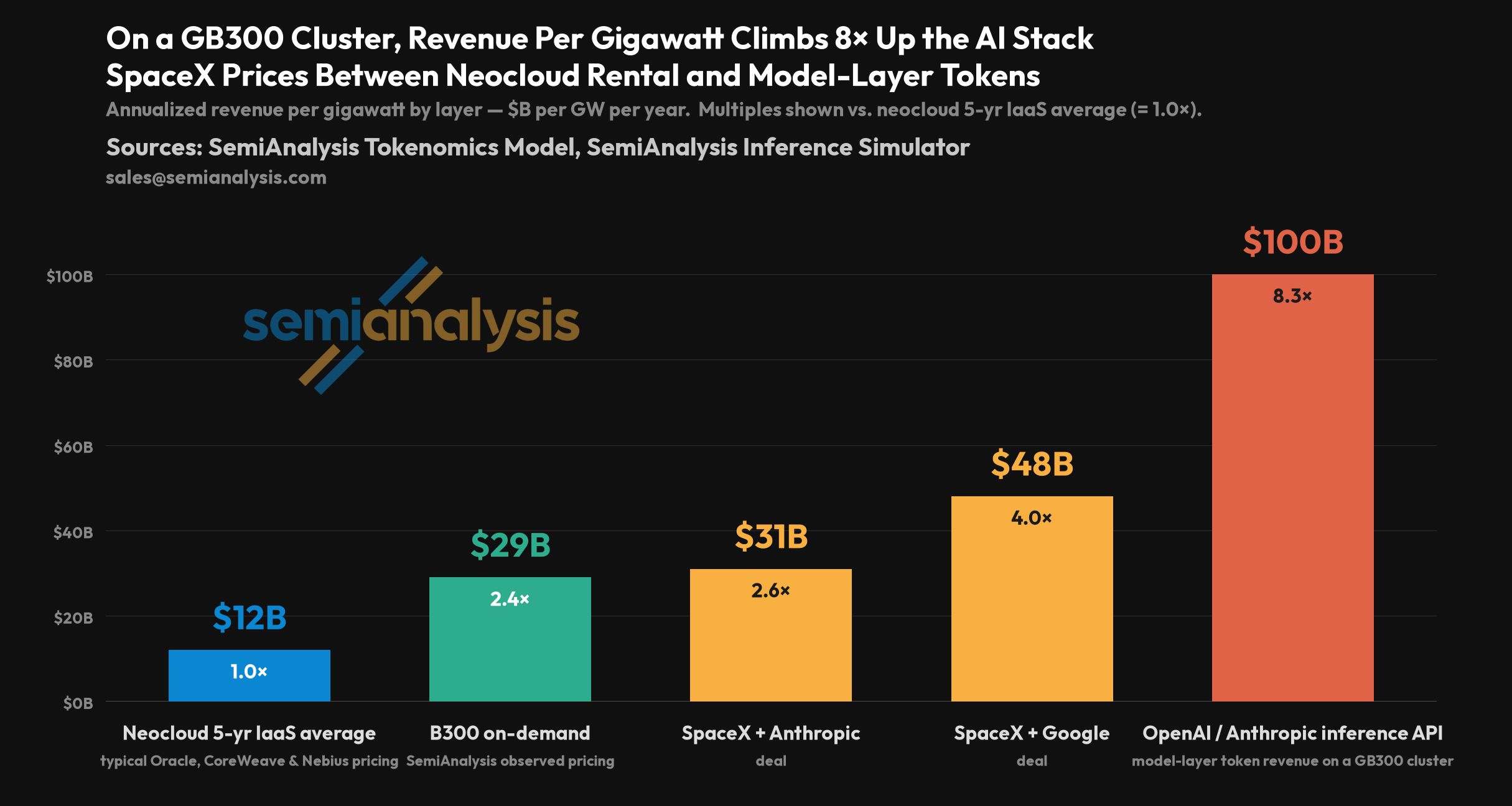
 

Source: SemiAnalysis Tokenomics Model, SemiAnalysis Inference Simulator

We assume around $12B/GW/year of cost per year, using a conservative rental pricing rate of $3/GPU-hr, and make a token production estimate using our Inference Simulator with a frontier-class model architecture and our agentic coding benchmark, AgentX (part of InferenceX), which is built by collecting real production coding traces. We blend that token production rate between input, cache-read, cache-write, and output token costs at our real workload ratios, and produce the final estimate, exceeding $100B/GW/year.

For background, our Inference Simulator is built from the ground up with a fundamental understanding of how modern AI accelerators work. We build a roofline and realistic performance model for how frontier models work during inference, with timings for every operation and a real trace output. It is an end-to-end simulation of the actual workload executing on the actual silicon. We have validated the simulators fidelity on a wide range of accelerators and workloads and continue to improve its ability to accurately forecast performance of future accelerators based on design specifications....

***** 

...Please reach out to sales@semianalysis.com for more information on how we apply the Inference Simulator for custom research and analysis.

Beyond OpenAI and Anthropic, there is actually a third company in the world capable of printing such economics per GW: Microsoft. Having full access to OpenAI models, they can generate the exact same revenue and margin per MW, while paying none of the training costs. Satya nailed the negotiations with OpenAI: the deal reworked in April 2026 dropped the old 20% revenue share from the equation. Put simply, Microsoft has a giant incentive to procure as many MWs as possible, as fast as possible. While much of their datacenter capacity currently goes to OpenAI at ~14M/MW/year, they have the opportunity to improve that mix. The potential impact is Microsoft Azure accelerating revenue growth from ~42% to over 100% by next year. A once-in-a-generation opportunity, that SpaceX is incredibly well positioned to serve.
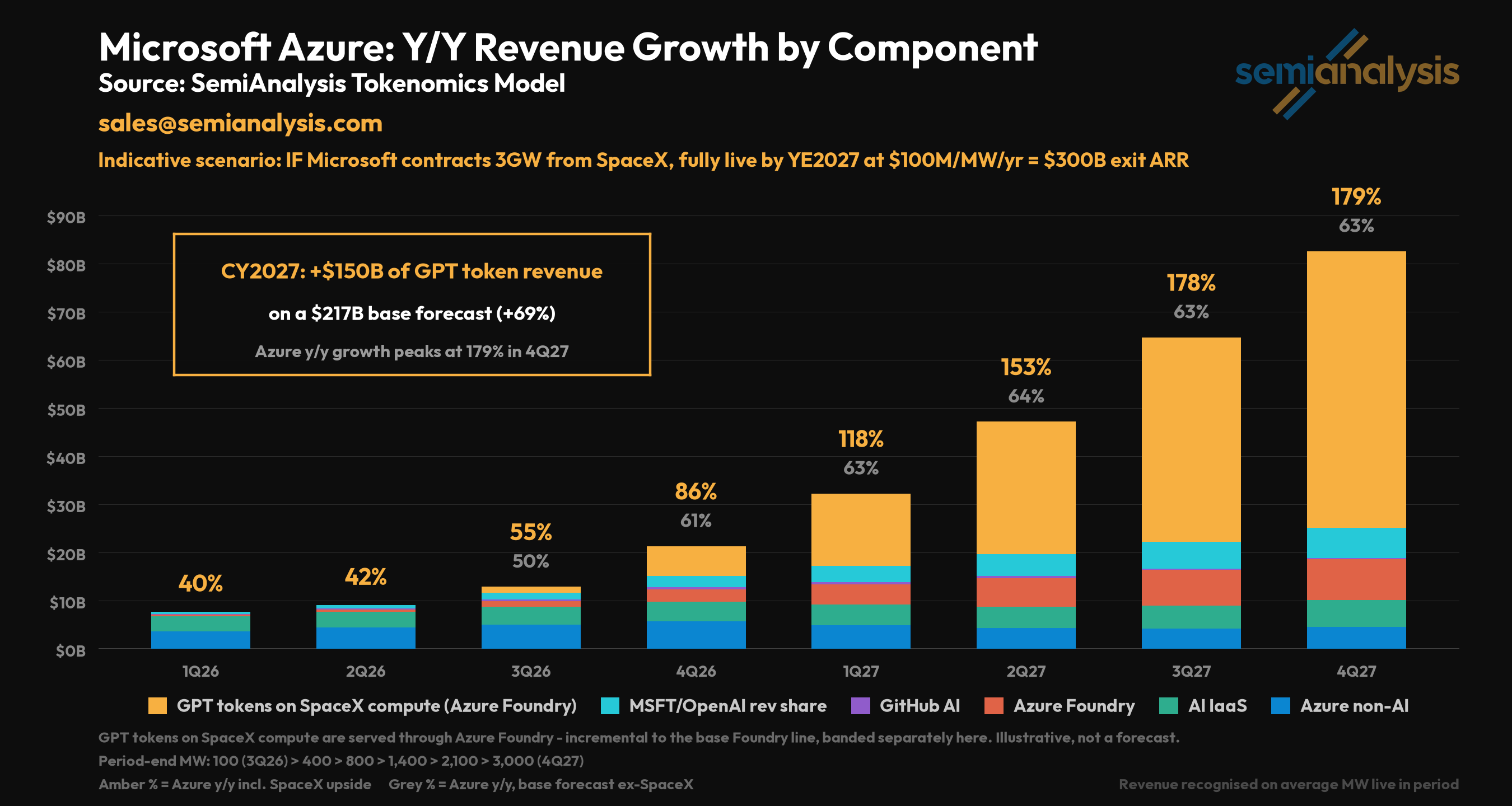
 

Source: SemiAnalysis Tokenomics Model

While Microsoft signing 3GW with SpaceX for 50B/GW/year sounds insane, we view it as possible for two reasons:

  • 1/ Microsoft is already preparing for an epic datacenter ramp. As discussed below, they’ve signed 10GW of contracts year-to-date, for over $300B of total contract value (not including the GPU cost). We expect much more to be signed. Caveat: these contracts contribute to late 2027 and 2028 capacity. There is a near-term gap to fill.

  • 2/ With a 90-day cancellation policy, akin to the SpaceX deals with Anthropic and Google, there is zero balance sheet risk. This is remarkably easy for Amy Hood to sign off, given the revenue opportunity.

For SpaceX, the next natural question is financing. How can Elon afford to pay so much CapEx without the balance sheet of the leading hyperscalers? We expect a combination of the two following items:

  • 1/ Support from Nvidia, in the form of vendor financing to lower the upfront cash cost. This is likely why Elon declared to be Nvidia exclusive on the earnings call! As our Accelerator Model has repeatedly explained, xAI/SpaceX have actively evaluated alternatives like TPU and AMD – so the financial argument likely made them abandon these and focus on Nvidia.

  • 2/ Operating cash-flow financing led by industry-high pricing, enabled by fastest timelines: SpaceX will continue to sell large-scale compute with 3-5 months lead time, an unbeatable offering, and price it accordingly at 30-50M/MW/year. That pays back the capex in less than a year. We dived into this in our Meta Compute article.

The implications of this are a path to $300B of ARR by the end of 2027 for SpaceX. This assumes only 50% of their 2027 incremental compute is monetized, the reminder being for the Grok & Cursor teams for training (no inference revenue modelled)....

....MUCH MORE 

We've chronicled much of the Elon - Jensen frenemy relationship in real-time for over a decade. On August 4 Musk said SPCX would use NVDA's platforms exclusively.

It wasn't always apparent that this is how things would turn out but the two centi-billionaires seem to get along. From a July 2023 post, "CORRECTED—Earnings - Tesla Reports, Stock Slides, Elon's Buying A Supercomputer (TSLA)":

....For some background on Tesla and AI here is our introduction to June 9's "Elon Musk Predicts Nvidia’s Monopoly in A.I. Chips Won’t Last" (NVDA; TSLA)":

Before we get to the headline story, some background. Tesla and Nvidia have a history.

In 2015 - 2016 when everyone thought that autonomous driving was just around the corner, the challenge was seen as both a sensor issue, for example: LIDAR vs cameras, and a machine learning/artificial intelligence problem which boils down to training the AI 'puters with as much data as you can so that out in the real world the autonomous vehicle can say to itself: "Yeah, I've seen this situation before, here's the response that worked best. Both the training and the on-the-road-recall, if they are to be anywhere near efficient, require the fastest chips you can find. Tesla had a whole bunch of data from a few billion miles of actual driving for computers to train on, and, combined with Nvidia's fastest-in-the-world GPU chips, it was a match made in heaven.

Except it wasn't.

The challenge of autonomous driving on open roads alongside non-autonomous vehicles was bigger than anyone in that simple, optimistic time ever envisioned, even in their nightmares. Here's one example about Waymo from a 2017 post:

"When Google was training its self-driving car on the streets of Mountain View, California, the car rounded a corner and  encountered a woman in a wheelchair, waving a broom, chasing a duck. The car hadn’t encountered this before so it stopped and waited."

In May 2015 we were posting " Nvidia Wants to Be the Brains Of Your Autonomous Car (NVDA)" and seven months later the more declarative "Class Act: Nvidia Will Be The Brains Of Your Autonomous Car (NVDA)"

Then in October 2016, what was probably the high-water mark for the relationship "Nvidia Could Make $1B From Tesla's Self-Driving Decree: Analyst (TSLA, NVDA)"

Sadly, the task was just too difficult but Mr. Musk thought it was doable if only he could get even faster chips than Nvidia had on offer:

NVIDIA Partner Tesla Reportedly Developing Chip With AMD (TSLA; NVDA; AMD) 
Today in leveraged WTFs....

"During a talk at a private party, Elon Musk said Tesla is developing specialized AI hardware "'That we think will be the best in the world;" (TSLA)  

"Tesla says it’s dumping Nvidia chips for a homebrew alternative" (TSLA)
The only reason for Tesla to do this is that NVIDIA's chips are general purpose whereas specialized chips are making inroads in stuff like crypto mining (ASICs), Google's Tensor Processing Units (TPUs) for machine learning and Facebook's hardware efforts. 
 
 Watch Out NVIDIA: "Google Details Tensor Chip Powers" (GOOG; NVDA)
We've said NVIDIA probably has a couple year head start but this bears watching, so to speak....

Culminating in August 2018's
"Nvidia CEO is 'more than happy to help' if Tesla's A.I. chip doesn't pan out" (NVDA; TSLA)

And now on to the headliner, from Observer, June 8:
Elon Musk Predicts Nvidia’s Monopoly in A.I. Chips Won’t Last....

And possibly related July 13:
Elon Musk's x.AI Launches
The company was formed in March so it's valuation is probably around a hundred billion or so.

Just kidding. I have no idea what sort of valuation it has been assigned. x.AI is a Nevada corporation which, as our corporate attorney readers well know, is handy as hell for a privately-held stealth company. As part of the company's coming-out I think they dropped the period in the name on the original incorporation papers.

Mr. Musk was one of the founder/funders ($100 million gift not equity) of ChatGPT parent OpenAI when it was a .org (non-profit) and seemed a bit miffed when Sam Alman hooked up with Microsoft to the tune of $10 billion.

So Elon went out and bought a garage-full of GPUs.

Here's a twofer, first up TechCrunch, July 12:....

Wednesday, June 25, 2025

"Nvidia Ruffles Tech Giants With Move Into Cloud Computing" (NVDA; AMZN; GOOG; MSFT)

The cloud companies are designing their own chips, so hey, welcome to competitive capitalism.

Or maybe it's vertical integration monopoly. They're all guilty of it and ripe for getting dismembered.

From the Wall Street Journal, June 25:

Things are getting awkward for cloud incumbents as the AI chip giant eyes their turf 

What’s Next for Nvidia

Cloud computing generates big profits for Amazon.com, Microsoft and Google. Now that cash cow faces a nascent threat with the rise of artificial-intelligence cloud specialists and a new industry power broker: Nvidia. MMNVDAMM

AI-chip maker Nvidia launched its own cloud-computing service two years ago called DGX Cloud. It has also nurtured upstarts competing with the big cloud companies, investing in AI cloud players CoreWeave MMCRWVMM and Lambda.

Those moves have yet to make an enormous dent, but a competitive shift is easy to imagine if computing demand continues to shift toward AI and Nvidia remains the sector’s principal arms dealer.

DGX Cloud is already growing fast. UBS analysts estimated when it launched that it could grow into a more than $10 billion annual revenue business. And CoreWeave, which listed shares on the Nasdaq in March, is forecasting around $5 billion of revenue this year.

Those businesses are limited by their narrow focus on AI computing, and they pale in comparison to the more than $107 billion of sales Amazon’s market-leading cloud business generated last year.

Yet any challenge in cloud computing would be worrying for Amazon: While the company’s cloud division accounted for 29% of its revenue in its latest quarter, it accounted for more than 60% of its operating income thanks to its high margins.

Microsoft and Alphabet’s Google, the next two largest cloud companies, have a lot to lose if the cloud-computing landscape shifts, too. Growing macroeconomic concerns are raising caution about IT spending. Google is under antitrust scrutiny in the U.S., and its golden goose—the search engine—is being challenged by OpenAI.

All the big cloud companies effectively offer AI chips for rent, many of them made by Nvidia, which has a market share estimated at around 80%. In what is perhaps a testament to Nvidia’s market power, though, the cloud companies are helping Nvidia grow its own cloud business.

Under DGX Cloud’s unusual arrangement, the cloud giants buy and manage equipment—including Nvidia’s chips—that forms the backbone of the service. Then Nvidia leases back that equipment from them and rents it out to corporate clients. It also offers access to its AI experts and software as part of the package.

That has left cloud-computing giants in an uncomfortable position. While they make money through the arrangement, they are also being asked to help a service that could compete with them. Some of them haven’t rushed to participate, even if they do eventually join up; Google was notably absent from a roster of companies participating in a DGX Cloud chip-rental marketplace announced in May....

....MUCH MORE 

Facebook Meta would also be susceptible to antitrust action based on vertical integration analysis. 

Tuesday, March 11, 2025

"Understanding The European Union’s Facade Democracy"

 A repost from May 2023 that seems more pertinent now than it was two years ago.

I don't know who is more insufferable, American politicians with their pretend solidarity with non-elites or the Eurocrats who skip all that and just ignore the peasants as they spout platitudes.

From deep in the link-vault, Social Europe, April 14, 2015:

It is quite amazing that the European Commission has never really addressed the question of European democracy. Neither a White Paper nor a Green Paper has been issued to reflect upon the concept of supranational democracy that has been under discussion since the very foundations of the European Community/Union. The issue of a democratic deficit pops up regularly but is never worked on consistently. The same observation is true for the European Parliament (EP) which seems to be much more interested in the matter of its twin location (Strasbourg/Brussels) than in the question how to push for more European democracy.

In the end, the crisis has swept away the discussions on European democracy like a hurricane. “The cost of non-Europe” may have been calculated but nobody has yet estimated the cost of non-democracy that is already helping to undermine public support for European integration.

Pressure to increase genuine democracy at a European level regularly emanates from outside the European institutions, through active citizens but also NGOs, intellectuals, philosophers, political scientists and other forces within civil society. So, in recent years, ideas have popped up such as the proposal to choose the Commission president through general elections, to abolish the Commission’s monopoly on the right to legislate by extending it to the EP, to establish a Eurozone Parliament, to adopt a European Constitution etc. At the European elections of 2014, mainstream political parties campaigned under a European ‘top candidate’ (Spitzenkandidat) and the Council had to give way by nominating the winner of the elections as Commission president. The hope that this enhanced personalisation would lead to higher turnout was, however, dashed.

It’s no coincidence that the Commission tends to favour technocratic solutions. The ECB works without any clear democratic control or supervision; the same goes for most of the European (regulatory) agencies. Even inside the legislative process the Commission pushes for technocratic methods involving so called experts chosen by itself, relying on the so called “comitology” process, hundreds of expert groups and advisory committees, most of them not very transparent. Sometimes, even the EP admits that this trend goes too far and tries to keep it under control.

But, for some years now, the Parliament – the so-called heartbeat of European democracy that should always side with those forces pushing for more democracy – has changed sides and voluntarily accepts quite undemocratic procedures: the habit of adopting European legislation in a single reading, in a trialogue between Commission, EP and Council behind closed doors – without taking into account comments from outside the European institutions. This is a clear setback for democracy....

....MUCH MORE, the link goes to the Internet Archive, I couldn't find the article via our stashed URL: https://www.socialeurope.eu/2015/04/understanding-the-european-unions-facade-democracy/ - that link now redirects to the home page of Social Europe.

And from Scientific American, again hoisted from deep down in the link-vault, February 25, 2017:

Will Democracy Survive Big Data and Artificial Intelligence?

We are in the middle of a technological upheaval that will transform the way society is organized. We must make the right decisions now

Editor’s Note: This article first appeared in Spektrum der Wissenschaft, Scientific American’s sister publication, as “Digitale Demokratie statt Datendiktatur.”
 
“Enlightenment is man’s emergence from his self-imposed immaturity. Immaturity is the inability to use one’s understanding without guidance from another.”
—Immanuel Kant, “What is Enlightenment?” (1784)

The digital revolution is in full swing. How will it change our world? The amount of data we produce doubles every year. In other words: in 2016 we produced as much data as in the entire history of humankind through 2015. Every minute we produce hundreds of thousands of Google searches and Facebook posts. These contain information that reveals how we think and feel. Soon, the things around us, possibly even our clothing, also will be connected with the Internet. It is estimated that in 10 years’ time there will be 150 billion networked measuring sensors, 20 times more than people on Earth. Then, the amount of data will double every 12 hours. Many companies are already trying to turn this Big Data into Big Money.

Everything will become intelligent; soon we will not only have smart phones, but also smart homes, smart factories and smart cities. Should we also expect these developments to result in smart nations and a smarter planet?

The field of artificial intelligence is, indeed, making breathtaking advances. In particular, it is contributing to the automation of data analysis. Artificial intelligence is no longer programmed line by line, but is now capable of learning, thereby continuously developing itself. Recently, Google's DeepMind algorithm taught itself how to win 49 Atari games. Algorithms can now recognize handwritten language and patterns almost as well as humans and even complete some tasks better than them. They are able to describe the contents of photos and videos. Today 70% of all financial transactions are performed by algorithms. News content is, in part, automatically generated. This all has radical economic consequences: in the coming 10 to 20 years around half of today's jobs will be threatened by algorithms. 40% of today's top 500 companies will have vanished in a decade.

It can be expected that supercomputers will soon surpass human capabilities in almost all areas—somewhere between 2020 and 2060. Experts are starting to ring alarm bells. Technology visionaries, such as Elon Musk from Tesla Motors, Bill Gates from Microsoft and Apple co-founder Steve Wozniak, are warning that super-intelligence is a serious danger for humanity, possibly even more dangerous than nuclear weapons. Is this alarmism?

One thing is clear: the way in which we organize the economy and society will change fundamentally. We are experiencing the largest transformation since the end of the Second World War; after the automation of production and the creation of self-driving cars the automation of society is next. With this, society is at a crossroads, which promises great opportunities, but also considerable risks. If we take the wrong decisions it could threaten our greatest historical achievements.

In the 1940s, the American mathematician Norbert Wiener (1894–1964) invented cybernetics. According to him, the behavior of systems could be controlled by the means of suitable feedbacks. Very soon, some researchers imagined controlling the economy and society according to this basic principle, but the necessary technology was not available at that time.

Today, Singapore is seen as a perfect example of a data-controlled society. What started as a program to protect its citizens from terrorism has ended up influencing economic and immigration policy, the property market and school curricula. China is taking a similar route. Recently, Baidu, the Chinese equivalent of Google, invited the military to take part in the China Brain Project. It involves running so-called deep learning algorithms over the search engine data collected about its users. Beyond this, a kind of social control is also planned. According to recent reports, every Chinese citizen will receive a so-called ”Citizen Score”, which will determine under what conditions they may get loans, jobs, or travel visa to other countries. This kind of individual monitoring would include people’s Internet surfing and the behavior of their social contacts (see ”Spotlight on China”).

With consumers facing increasingly frequent credit checks and some online shops experimenting with personalized prices, we are on a similar path in the West. It is also increasingly clear that we are all in the focus of institutional surveillance. This was revealed in 2015 when details of the British secret service's "Karma Police" program became public, showing the comprehensive screening of everyone's Internet use. Is Big Brother now becoming a reality? Programmed society, programmed citizens

Everything started quite harmlessly. Search engines and recommendation platforms began to offer us personalised suggestions for products and services. This information is based on personal and meta-data that has been gathered from previous searches, purchases and mobility behaviour, as well as social interactions. While officially, the identity of the user is protected, it can, in practice, be inferred quite easily. Today, algorithms know pretty well what we do, what we think and how we feel—possibly even better than our friends and family or even ourselves. Often the recommendations we are offered fit so well that the resulting decisions feel as if they were our own, even though they are actually not our decisions. In fact, we are being remotely controlled ever more successfully in this manner. The more is known about us, the less likely our choices are to be free and not predetermined by others.

But it won't stop there. Some software platforms are moving towards “persuasive computing.” In the future, using sophisticated manipulation technologies, these platforms will be able to steer us through entire courses of action, be it for the execution of complex work processes or to generate free content for Internet platforms, from which corporations earn billions. The trend goes from programming computers to programming people.

These technologies are also becoming increasingly popular in the world of politics. Under the label of “nudging,” and on massive scale, governments are trying to steer citizens towards healthier or more environmentally friendly behaviour by means of a "nudge"—a modern form of paternalism. The new, caring government is not only interested in what we do, but also wants to make sure that we do the things that it considers to be right. The magic phrase is "big nudging", which is the combination of big data with nudging. To many, this appears to be a sort of digital scepter that allows one to govern the masses efficiently, without having to involve citizens in democratic processes. Could this overcome vested interests and optimize the course of the world? If so, then citizens could be governed by a data-empowered “wise king”, who would be able to produce desired economic and social outcomes almost as if with a digital magic wand.

Pre-programmed catastrophes
But one look at the relevant scientific literature shows that attempts to control opinions, in the sense of their "optimization", are doomed to fail because of the complexity of the problem. The dynamics of the formation of opinions are full of surprises. Nobody knows how the digital magic wand, that is to say the manipulative nudging technique, should best be used. What would have been the right or wrong measure often is apparent only afterwards. During the German swine flu epidemic in 2009, for example, everybody was encouraged to go for vaccination. However, we now know that a certain percentage of those who received the immunization were affected by an unusual disease, narcolepsy. Fortunately, there were not more people who chose to get vaccinated!

Another example is the recent attempt of health insurance providers to encourage increased exercise by handing out smart fitness bracelets, with the aim of reducing the amount of cardiovascular disease in the population; but in the end, this might result in more hip operations. In a complex system, such as society, an improvement in one area almost inevitably leads to deterioration in another. Thus, large-scale interventions can sometimes prove to be massive mistakes.

Regardless of this, criminals, terrorists and extremists will try and manage to take control of the digital magic wand sooner or later—perhaps even without us noticing. Almost all companies and institutions have already been hacked, even the Pentagon, the White House, and the NSA.

A further problem arises when adequate transparency and democratic control are lacking: the erosion of the system from the inside. Search algorithms and recommendation systems can be influenced. Companies can bid on certain combinations of words to gain more favourable results. Governments are probably able to influence the outcomes too. During elections, they might nudge undecided voters towards supporting them—a manipulation that would be hard to detect. Therefore, whoever controls this technology can win elections—by nudging themselves to power....

....MUCH MORE

Probably related, April 22, 2023:
"The digital euro could usher in total state control"
Oh man, can you imagine if Stalin or the Stasi had computers?*

As the kids say "Real socialism feudalism totalitarianism has never actually been tried"...

https://blogger.googleusercontent.com/img/b/R29vZ2xl/AVvXsEiZvTP1EgtV_PLkKNSZ7vjonmIiz6ghysosfhXBKSIQ-ejqfCbVsO3Hqa3aFgicSvZy3-jm40yABjwxLPe_6_jV1EliZ2Ygd1MB93CrAFXxoqaTxTtq2D1DlMz2DuWWnDimcQduVOIW090F/s320/euro.png

Sunday, March 2, 2025

"Mercedes-Benz and Nvidia are testing autonomous vehicles in San Francisco" (NVDA; MBG.de)

 From the San Francisco Business Times, February 28:

A Mercedes-Benz autonomous test vehicle spotted Friday in San Francisco's Marina district appears to be a partnership between the German car maker and Nvidia (NASDAQ: NVDA).

The vehicle, an all-electric EQS 580 with sensors similar to those found on Waymo cars, had a sticker on the driver's side door saying "Nvidia Corporation | Mercedes-Benz test vehicle."

Neither company responded to a request for comment asking for more details about the project.

While Nvidia and Mercedes-Benz have previously announced a partnership to use Nvidia's chips and AI software in its vehicles, they have not made any formal announcement related to testing fully autonomous vehicles on U.S. roads.

Nvidia currently has a permit with California's DMV to test autonomous vehicles with a safety driver, while Mercedes-Benz holds a more advanced permit with the DMV, allowing it to deploy AVs without a human driver in certain areas...

....MORE

Related at Yahoo Finance, also February 28:

Nvidia's auto business doubled last quarter. Here's why CEO Jensen Huang believes it's just the beginning.

Nvidia’s foray into the automotive sector is nothing new, but the drumbeat of news coming from the business has picked up recently.

Take CES last month, for example, where the company highlighted the business.

"In order to build a self-driving car, you need to train a mountain of data, video data," Nvidia CEO Jensen Huang said in an interview with Yahoo Finance from CES, explaining that Nvidia's graphics chips can be used not just for video games, but for simulations to train autonomous vehicles.

"If just right now where the self-driving car business is, if it's already a $5 billion business for us, imagine how big it's going to be when we have a hundred million new cars per year. A trillion miles driven per year. This is likely going to be one of the largest robotics industries in the world and one of the largest computing industries in the world," Huang said.

The company made a slew of news this quarter and at CES on the automotive front.

Nvidia announced that Toyota (TM) — the world’s largest automaker — will begin using the company’s DRIVE AGX Orin chip and the Nvidia DriveOS operating system to power advanced driver assistance features in its next-generation vehicles.

Nvidia said German tire and auto supplier Continental and self-driving truck company Aurora (AUR) would also use Nvidia’s DRIVE hardware and DriveOS software in Aurora’s level 4 autonomous driving system, Aurora Driver. Continental and Aurora plan to bring autonomous trucks hauling freight to roads beginning in 2027.

And Korea’s Hyundai Motor Group announced it would use Nvidia technologies to accelerate AV and robotics development, as well as smart factory initiatives....

....MUCH MORE

Look at that, all grown up now. Our introduction to a June 2023 post:
"Elon Musk Predicts Nvidia’s Monopoly in A.I. Chips Won’t Last" (NVDA; TSLA)

Before we get to the headline story, some background. Tesla and Nvidia have a history.

In 2015 - 2016 when everyone thought that autonomous driving was just around the corner, the challenge was seen as both a sensor issue, for example: LIDAR vs cameras, and a machine learning/artificial intelligence problem which boils down to training the AI 'puters with as much data as you can so that out in the real world the autonomous vehicle can say to itself: "Yeah, I've seen this situation before, here's the response that worked best. Both the training and the on-the-road-recall, if they are to be anywhere near efficient, require the fastest chips you can find. Tesla had a whole bunch of data from a few billion miles of actual driving for computers to train on, and, combined with Nvidia's fastest-in-the-world GPU chips, it was a match made in heaven.

Except it wasn't.

The challenge of autonomous driving on open roads alongside non-autonomous vehicles was bigger than anyone in that simple, optimistic time ever envisioned, even in their nightmares. Here's one example about Waymo from a 2017 post:

"When Google was training its self-driving car on the streets of Mountain View, California, the car rounded a corner and  encountered a woman in a wheelchair, waving a broom, chasing a duck. The car hadn’t encountered this before so it stopped and waited."

In May 2015 we were posting " Nvidia Wants to Be the Brains Of Your Autonomous Car (NVDA)" and seven months later the more declarative "Class Act: Nvidia Will Be The Brains Of Your Autonomous Car (NVDA)"

Then in October 2016, what was probably the high-water mark for the relationship "Nvidia Could Make $1B From Tesla's Self-Driving Decree: Analyst (TSLA, NVDA)"

Sadly, the task was just too difficult but Mr. Musk thought it was doable if only he could get even faster chips than Nvidia had on offer:

NVIDIA Partner Tesla Reportedly Developing Chip With AMD (TSLA; NVDA; AMD) 
Today in leveraged WTFs....

"During a talk at a private party, Elon Musk said Tesla is developing specialized AI hardware "'That we think will be the best in the world;" (TSLA)  

"Tesla says it’s dumping Nvidia chips for a homebrew alternative" (TSLA)
The only reason for Tesla to do this is that NVIDIA's chips are general purpose whereas specialized chips are making inroads in stuff like crypto mining (ASICs), Google's Tensor Processing Units (TPUs) for machine learning and Facebook's hardware efforts. 
 
 Watch Out NVIDIA: "Google Details Tensor Chip Powers" (GOOG; NVDA)
We've said NVIDIA probably has a couple year head start but this bears watching, so to speak....

Culminating in August 2018's
"Nvidia CEO is 'more than happy to help' if Tesla's A.I. chip doesn't pan out" (NVDA; TSLA)

And now on to the headliner, from Observer, June 8....

Monday, November 18, 2024

Antitrust: Department of Justice Will Recommend Judge Force Google To Divest Chrome Browser (GOOG)

From Investing.com, November 18:

DOJ to recommend Google sell off Chrome- Bloomberg

Investing.com-- The U.S. The Department of Justice plans to ask a judge to force Google owner Alphabet Inc (NASDAQ:GOOGL) to sell off its Chrome browser as part of its antitrust probe into the tech giant, Bloomberg reported on Monday.

The department plans to ask Judge Amit Mehta of the District of Columbia, who had earlier this year ruled Google had an illegal monopoly in the search engine market, to make the ruling, Bloomberg reported.

DOJ officials also plan to ask Mehta to impose data licensing requirements on Alphabet and to address its plans for artificial intelligence and the Android operating system, the report showed. 

Chrome represents a key point of focus for antitrust officials because it usually serves as a means of access for many to Google’s search. The browser is by far the most-used in the world, with data from web traffic analyst Statcounter showing Chrome with a 66.65% market share as of October 2024....

....MORE

Even if the government's suggestion is agreed to by the judge it may not be enough.
From October's "US Weighs Google Breakup in Historic Big Tech Antitrust Case" (GOOG)":
I would like YouTube please, there's an entire non-literate addressable market for Climateer Investing to conquer.

And September's "What Is an Effective Remedy in the Google Search Case? (GOOG; EVIL)":

Dismemberment.

And then, when you're done with the officers and directors... 

Okay, just kidding. The most logical remedy is to regulate search as a public utility. And if they push back against that, dismemberment.

I have to stop reading medieval history before going to sleep at night.

How's about we rip the company's index from the still-living beast and...

That's it, from now on it's Pollyanna with her 'glad game.' And Candide. And maybe Leibniz.

We've mellowed since 2019's "In Court, Facebook Blames Users for Destroying Their Own Right to Privacy"

Don't regulate FB
Dismember it
Then disembowel it.
Then kill it....

...The intro is a variation on old-school European torture-execution, "Hanged, drawn, and quartered."
I used to get nightmares reading medieval history. 

Friday, September 20, 2024

What Is an Effective Remedy in the Google Search Case? (GOOG; EVIL)

Dismemberment.

And then, when you're done with the officers and directors... 

Okay, just kidding. The most logical remedy is to regulate search as a public utility. And if they push back against that, dismemberment.

I have to stop reading medieval history before going to sleep at night.

How's about we rip the company's index from the still-living beast and...

That's it, from now on it's Pollyanna with her 'glad game.' And Candide. And maybe Leibniz.

In the meantime here is ProMarket from the University of Chicago's Stigler Center, September 6:

For more than a decade, Google has paid firms such as Apple and Mozilla to set Google Search as the default search engine on their web browsers. The company has also required mobile phone developers who use Google’s Android operating system to pre-install Google’s products, including Google Chrome and Search. On August 5, Judge Amit Mehta found this behavior violated Section 2 of the Sherman Act as constituting exclusionary conduct to maintain monopoly power. Judge Mehta now must investigate and mandate a remedy to restore competition. This will be a daunting endeavor because his performance in setting the remedy will be remembered for a long time. Consider Judges Harold Greene in AT&T and Thomas Penfield Jackson in Microsoft. I do not envy the pressure on him. In this short note, I analyze some of the alternatives that Judge Mehta can choose along with my comments and recommendations. 

Legal and Policy Considerations

In U.S. v. Microsoft Corp., the court stated four objectives: unfetter a market from anticompetitive conduct; terminate the illegal monopoly; deny to the defendant the fruits of its statutory violation; and ensure that there remain no practices likely to result in monopolization in the future. In this monopoly maintenance case (including where the conduct enhanced the defendant’s monopoly power), the goals are similar. However, the strength of a reasonable remedy for the anticompetitive conduct depends on the degree to which the actual and potential rivals disadvantaged by the anticompetitive exclusionary conduct would have substantially reduced or eliminated the monopoly power of the defendant.

Stated slightly differently, the remedy in the Google Search case must restore the intensity of the competitive process that would have occurred but for the years of anticompetitive conduct. Judge Mehta will need to decide if an effective remedy requires affirmative efforts that go beyond simply enjoining the specific illegal conduct. To this end, Judge Mehta will surely look to the formative Microsoft case settled at the turn of the century, as he did in his ruling finding Google in breach of Section 2.

In his analysis and critique of the Microsoft remedy some years after testifying for the states on remedy, Professor Carl Shapiro explained his remedial framework that “[r]estoring competition requires taking affirmative steps to lower the barriers to entry” to prevent the monopolist from continuing to profit from its anticompetitive conduct. He further explained that “lowering entry barriers does not mean picking winners or engineering the market; it means imposing conditions that make it easier for potential entrants to overcome those barriers.” Shapiro’s article also notes that Professor Kevin Murphy (testifying on behalf of Microsoft) made a similar point, stating there that “[t]o the extent that past illegal acts have injured competition, the remedies should work to restore the prospects for consumer welfare to the level that would have existed absent the illegal acts.” Craig Romaine and I framed this remedial approach in our analysis of Microsoft as “jump starting” competition.

In short, the remedy must go beyond simply enjoining the anticompetitive conduct. It should include provisions to reignite the competitive process sufficiently to more quickly and surely restore effective competition. It also is important to recognize that there are degrees of monopoly power. And if he finds that the long duration of Google’s conduct increased its monopoly power over time, that fact calls for an even stronger remedy.

To conceptualize this relationship with a simple hypothetical example, suppose that a monopolist has maintained and enhanced its monopoly power with exclusionary conduct that has created and maintained prohibitive barriers to entry over (say) a ten-year period. Suppose further that absent the exclusionary conduct, there would have been (say) a 10% independent probability in each year that there would have been entry which would have successfully substantially reduced or eliminated the monopoly power. Given this 10% probability, the likelihood there would have been such successful entry within 10 years is about 65%. Thus, the likelihood that the monopolist would still have had monopoly power by the tenth year is only about 35% absent the conduct....

....MUCH MORE

Or a five year-old post: 

August 2019
What Alphabet Really Fears: Why Google Won't Make Google Search the Default in Android For Europe
This is a half-measure that will do nothing to curb the GOOG's power. It almost looks like regulatory capture. After the jump, the proposal that would work....

*****
... And from Dr. Robert Epstein, former editor-in-chief at Psychology Today, search-engine researcher, Huffington Post contributor etc. writing at BloombergBusinessweek, July 15: 

To Break Google’s Monopoly on Search, Make Its Index Public
The tech giant doesn’t have to be dismantled. Sharing its crown jewel might reshape the internet.
Recognition is growing worldwide that something big needs to be done about Big Tech, and fast.
More than $8 billion in fines have been levied against Google by the European Union since 2017. Facebook Inc., facing an onslaught of investigations, has dropped in reputation to almost rock bottom among the 100 most visible companies in the U.S. Former employees of Google and Facebook have warned that these companies are “ripping apart the social fabric” and can “hijack the mind.”
Adding substance to the concerns, documents and videos have been leaking from Big Tech companies, supporting fears—most often expressed by conservatives—about political manipulations and even aspirations to engineer human values.

Fixes on the table include forcing the tech titans to divest themselves of some of the companies they’ve bought (more than 250 by Google and Facebook alone) and guaranteeing that user data are transportable.

But these and a dozen other proposals never get to the heart of the problem, and that is that Google’s search engine and Facebook’s social network platform have value only if they are intact. Breaking up Google’s search engine would give us a smattering of search engines that yield inferior results (the larger the search engine, the wider the range of results it can give you), and breaking up Facebook’s platform would be like building an immensely long Berlin Wall that would splinter millions of relationships.

With those basic platforms intact, the three biggest threats that Google and Facebook pose to societies worldwide are barely affected by almost any intervention: the aggressive surveillance, the suppression of content, and the subtle manipulation of the thinking and behavior of more than 2.5 billion people.

Different tech companies pose different kinds of threats. I’m focused here on Google, which I’ve been studying for more than six years through both experimental research and monitoring projects. (Google is well aware of my work and not entirely happy with me. The company did not respond to requests for comment.) Google is especially worrisome because it has maintained an unopposed monopoly on search worldwide for nearly a decade. It controls 92 percent of search, with the next largest competitor, Microsoft’s Bing, drawing only 2.5%.

Fortunately, there is a simple way to end the company’s monopoly without breaking up its search engine, and that is to turn its “index”—the mammoth and ever-growing database it maintains of internet content—into a kind of public commons.

There is precedent for this both in law and in Google’s business practices. When private ownership of essential resources and services—water, electricity, telecommunications, and so on—no longer serves the public interest, governments often step in to control them. One particular government intervention is especially relevant to the Big Tech dilemma: the 1956 consent decree in the U.S. in which AT&T agreed to share all its patents with other companies free of charge. As tech investor Roger McNamee and others have pointed out, that sharing reverberated around the world, leading to a significant increase in technological competition and innovation.
Doesn’t Google already share its index with everyone in the world? Yes, but only for single searches. I’m talking about requiring Google to share its entire index with outside entities—businesses, nonprofit organizations, even individuals—through what programmers call an application programming interface, or API.

Google already allows this kind of sharing with a chosen few, most notably a small but ingenious company called Startpage, which is based in the Netherlands. In 2009, Google granted Startpage access to its index in return for fees generated by ads placed near Startpage search results.
With access to Google’s index—the most extensive in the world, by far—Startpage gives you great search results, but with a difference. Google tracks your searches and also monitors you in other ways, so it gives you personalized results. Startpage doesn’t track you—it respects and guarantees your privacy—so it gives you generic results. Some people like customized results; others treasure their privacy. (You might have heard of another privacy-oriented alternative to Google.com called DuckDuckGo, which aggregates information obtained from 400 other non-Google sources, including its own modest crawler.)

If entities worldwide were given unlimited access to Google’s index, dozens of Startpage variants would turn up within months; within a year or two, thousands of new search platforms might emerge, each with different strengths and weaknesses....

....MUCH MORE

And: 
"Google to Donate Its Search Engine to the American Public" (GOOG)

Or at the Huffington Post:

Google Critic Killed in “Ironic” Car Accident: Struck by Google Street View Vehicle

By Camille Johnson, San Diego Union-Tribune
San Diego, CA. Prominent research psychologist and author Dr. Robert Epstein, age 60, was killed yesterday afternoon by a Google Street View vehicle while crossing Front Street in San Diego, where he has long resided. Although foul play is not suspected, Epstein’s friends are calling the accident “ironic.”
According to Daryn Thompson, a 30-year friend of Epstein’s who also lives in San Diego, “We all know that Google isn’t evil, so there’s no chance this was deliberate, but it’s troubling and ironic that it just happened to be an outspoken critic of Google who was hit. I’m sure it was just a coincidence, though.”...MORE

Maybe "Warped sense of humour could be ‘sign of impending dementia’"

Following last week's "Long-winded speech could be early sign of Alzheimer's disease, says study" a "friend" sent this along.
I can't catch a freaking break this month....

Wednesday, September 4, 2024

Nvidia And Antitrust (NVDA; DoJ)

Yesterday, ahead of Bloomberg's scoop on the U.S. Department of Justice issuing subpoenas to Nvidia and others as they investigate possible antitrust violations, we had a post on the coming shift in the use of AI chips from training Large Language Models to inference, actually getting something useful out of the LLMs, "Chips: The Pivot From Training To Inference (where Nvidia's dominance isn't as strong)."

The primary link in that post was to an IEEE Spectrum article on recent performance tests of various chips in inference mode. Our post then veered off to look at Cerebras Systems' very competitive offering for inference chores.

Which ended up with a cryptic/borderline coy (only borderline, I've never been accused of being coy) outro:

...Nvidia is well aware of Cerebras and has been quietly working their inference speeds but should all else fail, NVDA has $34.8 billion in cash and equivalents, friendly bankers and stock that seems pretty darn fungible with U.S. dollars. 

If you catch my drift.

That obscurity was deliberate. Even without knowledge of the subpoenas, it is widely known that one of the subjects of the antitrust probe is Nvidia's $700 million purchase of Run:ai in April. (the other area of interest is whether Nvidia was illegally bundling various products and/or giving disparate treatment to customers who would or wouldn't buy the packages, including longer wait-times for chips etc., or differential pricing for customers who bought exclusively from Nvidia)

There are many ways that the acquisition of a non-competitor can be restraint-of-trade in violation of the antitrust rules and regs. The most egregious examples were committed by Facebook.*

Fortunately for those of us looking at these issues from the outside, the antitrust/competition mavens at the University of Chicago's Stigler Center just had a symposium on this very topic and put together a few articles for their in-house publication, ProMarket:

August 30
The Case for Vigilance in AI Markets
Stacey Dogan writes that antitrust regulators in the United States and Europe are right to investigate Big Tech-AI partnerships. Even if AI markets remain competitive today, history and economics show that the Big Tech companies will push to monopolize segments of the AI market if given the opportunity. The investigations serve as a deterrent against anticompetitive behavior and give the regulators access to the knowledge and information that will be necessary to detect anticompetitive patterns as the AI market matures.

Editor’s Note: This article is part of a symposium which asks experts to evaluate the anticompetitive harms of Big Tech investments in AI startups in light of recent investigations from antitrust agencies on both sides of the Atlantic. See here to read the other contributions from Matt Perault, Vivek Ghosal, and John Kirkwood.


Antitrust authorities in the United States and around the world have expressed keen interest in the growing web of relationships between dominant tech firms and artificial intelligence (AI) developers. The relationships have come fast and furiously, accompanied by hefty price tags and dressed up in a variety of transactional forms. The firms present the deals as innovation and efficiency-enhancing and characterize the AI marketplace as highly competitive....

....MUCH MORE

August 29
How Big Tech’s AI Startup Alliances Could Harm Competition

John B. Kirkwood explains six ways in which Big Tech’s alliances with AI startups could harm competition, making clear that the antitrust agencies have good reason to monitor and investigate them....

....MUCH MORE

August 27
Big Tech Investments in AI Startups Do Not Raise Competitive Red Flags

Vivek Ghosal reviews the data, economics, and market conditions of the growing artificial intelligence market and finds that it is quite dynamic in terms of evolving partnerships and firms, and is relatively competitive. Thus, Big Tech investments into AI startups do not warrant investigation by the government at this time....

....MUCH MORE

August 26
The Deals That Will Hamper Competition in AI Markets

Matt Perault writes that there is little indication that Big Tech investments in artificial intelligence startups are harming competition. In fact, the opposite is likely true. Antitrust regulators should instead focus their attention on the real threat to AI competition: rules and regulations that will make it harder for startups that to compete with large tech companies....

....MUCH MORE
*
Regarding Facebook, some prior posts: 

Antitrust: "FTC Considering Steps to Block Facebook from Merging With Instagram and Whatsapp: Report" (FB; GOOG)

Now do Google.
Back in August we posted "Facebook Antitrust: Restraint of Trade (FB)" which referenced. a drum yours truly has been beating for a couple years
We've mentioned a few times that Google and in particular Facebook are susceptible to old-school antitrust analysis because of their use of the John D. Rockefeller "Buy 'em, Copy 'em, or Crush 'em" approach to competition:
"FTC probes Facebook's acquisition practices - WSJ" (FB)
which links back to some earlier posts, see (waaay) below.
For the moment this link is a placeholder but I'm pretty sure we'll be refering back to it.

Facebook Antitrust: Restraint of Trade (FB) 
72 Facebook Acquisitions – The Complete List (2019)!   

FTC Head Says He’s Willing to Dismember Big Tech Platforms BY UNDOING PAST MERGERS (FB; GOOG; TWTR)

U.S. DOJ Antitrust Division "Reviewing the Practices of Market-Leading Online Platforms" ( FB; GOOG; AMZN; AAPL)  

The symbols in the headline are in rank order of probable exposure to old-school antitrust sanctions. Twitter if it were included would appear in the middle.
Facebook and Google have an especially egregious pattern of acquiring, crushing or copying nascent competition, the type of behavior most amenable to classical antitrust analysis. See:

I've been told I'm a blast at parties.

Thursday, July 4, 2024

"Google.gov"

 From The New Atlantis, Spring 2018 edition:

Google exists to answer our small questions. But how will we answer larger questions about Google itself? Is it a monopoly? Does it exert too much power over our lives? Should the government regulate it as a public utility — or even break it up?

In recent months, public concerns about Google have become more pronounced. This February, the New York Times Magazine published “The Case Against Google,” a blistering account of how “the search giant is squelching competition before it begins.” The Wall Street Journal published a similar article in January on the “antitrust case” against Google, along with Facebook and Amazon, whose market shares it compared to Standard Oil and AT&T at their peaks. Here and elsewhere, a wide array of reporters and commentators have reflected on Google’s immense power — not only over its competitors, but over each of us and the information we access — and suggested that the traditional antitrust remedies of regulation or breakup may be necessary to rein Google in.

Dreams of war between Google and government, however, obscure a much different relationship that may emerge between them — particularly between Google and progressive government. For eight years, Google and the Obama administration forged a uniquely close relationship. Their special bond is best ascribed not to the revolving door, although hundreds of meetings were held between the two; nor to crony capitalism, although hundreds of people have switched jobs from Google to the Obama administration or vice versa; nor to lobbying prowess, although Google is one of the top corporate lobbyists.

Rather, the ultimate source of the special bond between Google and the Obama White House — and modern progressive government more broadly — has been their common ethos. Both view society’s challenges today as social-engineering problems, whose resolutions depend mainly on facts and objective reasoning. Both view information as being at once ruthlessly value-free and yet, when properly grasped, a powerful force for ideological and social reform. And so both aspire to reshape Americans’ informational context, ensuring that we make choices based only upon what they consider the right kinds of facts — while denying that there would be any values or politics embedded in the effort.

Addressing an M.I.T. sports-analytics conference in February, former President Obama said that Google, Facebook, and prominent Internet services are “not just an invisible platform, but they are shaping our culture in powerful ways.” Focusing specifically on recent outcries over “fake news,” he warned that if Google and other platforms enable every American to personalize his or her own news sources, it is “very difficult to figure out how democracy works over the long term.” But instead of treating these tech companies as public threats to be regulated or broken up, Obama offered a much more conciliatory resolution, calling for them to be treated as public goods:

I do think that the large platforms — Google and Facebook being the most obvious, but Twitter and others as well that are part of that ecosystem — have to have a conversation about their business model that recognizes they are a public good as well as a commercial enterprise.

This approach, if Google were to accept it, could be immensely consequential. As we will see, during the Obama years, Google became aligned with progressive politics on a number of issues — net neutrality, intellectual property, payday loans, and others. If Google were to think of itself as a genuine public good in a manner calling upon it to give users not only the results they want but the results that Google thinks they need, the results that informed consumers and democratic citizens ought to have, then it will become an indispensable adjunct to progressive government. The future might not be U.S. v. Google but Google.gov.

“To Organize the World’s Information”

Before thinking about why Google might begin to embrace a role of actively shaping the informational landscape, we must treat seriously Google’s stated ethos to the contrary, which presents the company’s services as merely helping people find the information they’re looking for using objective tools and metrics. From the start, Google had the highest aspirations for its search engine: “A perfect search engine will process and understand all the information in the world,” co-founder Sergey Brin announced in a 1999 press release. “Google’s mission is to organize the world’s information, making it universally accessible and useful.”

Google’s beginning is a story of two idealistic programmers, Brin and Larry Page, trying to impose order on a chaotic young World Wide Web, not through an imposed hierarchy but lists of search results ranked algorithmically by their relevance. In 1995, five years after an English computer scientist created the first web site, Page arrived at Stanford, entering the computer science department’s graduate program and needing a dissertation topic. Focusing on the nascent Web, and inspired by modern academia’s obsession with scholars’ citations to other scholars’ papers, Page devised BackRub, a search engine that rated the relevance of a web page based on how often other pages link back to it.

Because a web page does not itself identify the sites that link back to it, BackRub required a database of the Web’s links. It also required an algorithm to rank the relevance of a given page on the basis of all the links to it — to quantify the intuition that “important pages tend to link to important pages,” as Page’s collaborator Brin put it. Page and Brin called their ranking algorithm PageRank. The name PageRank “was a sly vanity,” Steven Levy later observed in his 2011 book In the Plex — “many people assumed the name referred to web pages, not a surname.”

Page and Brin quickly realized that their project’s real value was in ranking not web pages but results for searches of those pages. They had developed a search engine that was far superior to AltaVista, Excite, Infoseek, and all the other now-forgotten rivals that preceded it, which could search for words on pages but did not have effective ways of determining the inherent importance of a page. Coupled with PageRank, BackRub — which would soon be renamed Google — was immensely useful at helping people find what they wanted. When combined with other signals of web page quality, PageRank generated “mind-blowing results,” writes Levy.

Wary of the fate of Nikola Tesla — who created world-changing innovations but failed to capitalize on them — Page and Brin incorporated Google in September 1998, and quickly attracted investors. Instead of adopting the once-ubiquitous “banner ad” model, Google created AdWords, which places relevant advertisements next to search results, and AdSense, which supplies ads to other web sites with precisely calibrated content. Google would find its fortune in these techniques — which were major innovations in their own right — with $1.4 billion in ad revenue in 2003, ballooning to $95 billion last year. Google — recently reorganized under a new parent company, Alphabet — has continued to develop or acquire a vast array of products focused on its original mission of organizing information, including Gmail, Google Books, Google Maps, Chrome, the Android operating system, YouTube, and Nest.

In Google We Trust

Page and Brin’s original bet on search has proved world-changing. At the outset, in 1999, Google was serving roughly a billion searches per year. Today, the figure runs to several billion per day. But even more stark than the absolute number of searches is Google’s market share: According to the January Wall Street Journal article calling for antitrust action against Google, the company now conducts 89 percent of all Internet searches, a figure that rivals Standard Oil’s market share in the early 1900s and AT&T’s in the early 1980s.

But Google’s success ironically brought about challenges to its credibility, as companies eager to improve their ranking in search results went to great lengths to game the system. Because Google relied on “objective” metrics, to some extent they could be reverse-engineered by web developers keen to optimize their sites to increase their ranking. “The more Google revealed about its ranking algorithms, the easier it was to manipulate them,” writes Frank Pasquale in The Black Box Society (2015). “Thus began the endless cat-and-mouse game of ‘search engine optimization,’ and with it the rush to methodological secrecy that makes search the black box business that it is.”

While the original PageRank framework was explained in Google’s patent application, Google soon needed to protect the workings of its algorithms “with utmost confidentiality” to prevent deterioration of the quality of its search results, writes Steven Levy.

But Google’s approach had its cost. As the company gained a dominant market share in search … critics would be increasingly uncomfortable with the idea that they had to take Google’s word that it wasn’t manipulating its algorithm for business or competitive purposes. To defend itself, Google would characteristically invoke logic: any variance from the best possible results for its searchers would make the product less useful and drive people away, it argued. But it withheld the data that would prove that it was playing fair. Google was ultimately betting on maintaining the public trust. If you didn’t trust Google, how could you trust the world it presented in its results?

Google’s neutrality was critical to its success. But that neutrality had to be accepted on trust. And today — even as Google continues to reiterate its original mission “to organize the world’s information, making it universally accessible and useful” — that trust is steadily eroding.

Google has often stressed that its search results are superior precisely because they are based upon neutral algorithms, not human judgment. As Ken Auletta recounts in his 2009 book Googled, Brin and then-CEO Eric Schmidt “explained that Google was a digital Switzerland, a ‘neutral’ search engine that favored no content company and no advertisers.” Or, as Page and Brin wrote in the 2004 Founders Letter that accompanied their initial public offering,

Google users trust our systems to help them with important decisions: medical, financial, and many others. Our search results are the best we know how to produce. They are unbiased and objective, and we do not accept payment for them or for inclusion or more frequent updating.

But Google’s own standard of neutrality in presenting the world’s information is only part of the story, and there is reason not to take it at face value. The standard of neutrality is itself not value-neutral but a moral standard of its own, suggesting a deeper ethos and aspiration about information. Google has always understood its ultimate project not as one of rote descriptive recall but of informativeness in the fullest sense. Google, that is, has long aspired not merely to provide people the information they ask for but to guide them toward informed choices about what information they’re seeking.

Put more simply, Google aims to give people not just the information they do want but the information Google thinks they should want. As we will see, the potential political ramifications of this aspiration are broad and profound....

....MUCH MORE

Good headline. There is something a bit jarring about a .gov top-level domain appended to a corporation. Maybe not as evocative as Orwell's "It was a bright cold day in April, and the clocks were striking thirteen," but definitely signaling something is not quite right with this place into which we are entering.

Thursday, May 23, 2024

Nvidia CEO Jensen Huang explains why Tesla's use of AI is 'revolutionary' (NVDA; TSLA)

These two companies have had a relationship that goes back almost a decade and we've been fortunate to have a ringside seat to follow the twists and turns. One of the reasons we ended yesterday's post, "Tesla’s in China – It’s just a question of how long" (TSLA) with:

....Mr. Musk has his blind spots but China sneaking up on Tesla probably isn't one of them. He knows that Western companies will eventually lose the battle for electric vehicle dominance and something that he saw sometime in the last couple years seems to have scared him into action on the fronts where Tesla has a competitive advantage: access to some truly brilliant people; artificial intelligence facilitated by a long history with Nvidia and autonomous vehicles.

So again, we wish him luck, and think he'll succeed but this stuff is serious business.  

More on TSLA - NVDA after the jump, including the time Tesla fired Nvidia.

And from Yahoo Finance May 23:

Nvidia's (NVDA) first quarter results beat analyst expectations, with revenue rising 262% to $26.0 billion. The company also announced a 10-for-1 stock split and that it is raising its dividend.

In a Yahoo Finance exclusive interview, Nvidia founder and CEO Jensen Huang spoke about the results and how the demand for his company's products is "just so strong." He also weighed in on how companies like Meta (META) and Tesla (TSLA) are pushing AI technology forward.

Jensen says Meta's Llama large language models are "really, really important" given how they are "activating large language models and generative AI work all over the world."

On Tesla, Jensen describes how the company's latest Full Self-Driving technology is "an end-to-end generative model," saying it "learns from watching videos, surround video, and it learns about how to drive... using generative AI [to] predict the path... how to understand and how to steer the car. And so the technology is really revolutionary."....
*****
....Video Transcript

.....Uh You also saw uh uh Elon talking about uh the incredible infrastructure that he's building and, and um one of the things that's, that's really revolutionary about, about the, the version 12 of, of Tesla's uh full self driving is that it's an end to end generative model.

And it learns from watching videos, surround video and it, it learns about how to drive uh end to end and generate using generative A I uh uh predict the next, the path and the and the uh how to steer the uh how to understand and how to steer the car.

And so the the technology is really revolutionary and the work that they're doing is incredible.

So I gave you two examples, a start up company that we work with called recursion has built up a supercomputer for generating molecules, understanding proteins and generating molecules, molecules for drug discovery.

The list goes on, I mean, we can go on all afternoon and, and just so many different areas of people who are, who are now recognizing that we now have a software and A I model that can understand and be learned, learn almost any language, the language of English of course, but the language of images and video and chemicals and protein and even physics and to be able to generate almost anything.

And so it's basically like machine translation and uh that capability is now being deployed at scale in so many different industries, Jensen.

Just one more quick.

Last question.

I'm glad you talked about um the auto business and, and what you're seeing there, you mentioned that automotive is now the largest vertical enterprise vertical within data center.

You talked about the Tesla business.

But what is that all about?

Is it, is it self driving among other automakers too?

Are there other functions that automakers are using um within data center?

Help us understand that a little bit better.

Well, Tesla is far ahead in self driving cars.

Um but every single car someday will have to have autonomous capability.

Uh It's, it's safer, it's more convenient, it's more, more fun to drive and in order to do that, uh it is now very well known, very well understood that learning from video directly is the most effective way to train these models.

We used to train based on images that are labeled.

We would say this is a, this is a car, you know, this is a car, this is a sign, this is a road and we would label that manually.

It's incredible.

And now we just put video right into the car and let the car figure it out by itself.

And and this technology is very similar to the technology of large language models, but it requires just an enormous training facility.

And the reason for that is because there's videos, the data rate of video, the amount of data of video is so so high.

Well, the, the same approach that's used for learning physics, the physical world um from videos that is used for self driving cars is essentially the same um A I technology used for grounding large language models to understand the world of physics.....

....MUCH MORE, the transcript doesn't really do justice to what Mr. Huang is saying, if interested follow the link and take a look at the video, something of a coup for Yahoo Finance 

And TSLA - NVDA. From August 2023's Elon Got Himself A Supercomputer: "Tesla's $300 Million AI Cluster Is Going Live Today" (TSLA):

....Before we get to the headline story, some background. Tesla and Nvidia have a history.

In 2015 - 2016 when everyone thought that autonomous driving was just around the corner, the challenge was seen as both a sensor issue, for example: LIDAR vs cameras, and a machine learning/artificial intelligence problem which boils down to training the AI 'puters with as much data as you can so that out in the real world the autonomous vehicle can say to itself: "Yeah, I've seen this situation before, here's the response that worked best. Both the training and the on-the-road-recall, if they are to be anywhere near efficient, require the fastest chips you can find. Tesla had a whole bunch of data from a few billion miles of actual driving for computers to train on, and, combined with Nvidia's fastest-in-the-world GPU chips, it was a match made in heaven.

Except it wasn't.

The challenge of autonomous driving on open roads alongside non-autonomous vehicles was bigger than anyone in that simple, optimistic time ever envisioned, even in their nightmares. Here's one example about Waymo from a 2017 post:

"When Google was training its self-driving car on the streets of Mountain View, California, the car rounded a corner and  encountered a woman in a wheelchair, waving a broom, chasing a duck. The car hadn’t encountered this before so it stopped and waited."

In May 2015 we were posting " Nvidia Wants to Be the Brains Of Your Autonomous Car (NVDA)" and seven months later the more declarative "Class Act: Nvidia Will Be The Brains Of Your Autonomous Car (NVDA)"

Then in October 2016, what was probably the high-water mark for the relationship "Nvidia Could Make $1B From Tesla's Self-Driving Decree: Analyst (TSLA, NVDA)"

Sadly, the task was just too difficult but Mr. Musk thought it was doable if only he could get even faster chips than Nvidia had on offer:

NVIDIA Partner Tesla Reportedly Developing Chip With AMD (TSLA; NVDA; AMD) 
Today in leveraged WTFs....

"During a talk at a private party, Elon Musk said Tesla is developing specialized AI hardware "'That we think will be the best in the world;" (TSLA)  

"Tesla says it’s dumping Nvidia chips for a homebrew alternative" (TSLA)
The only reason for Tesla to do this is that NVIDIA's chips are general purpose whereas specialized chips are making inroads in stuff like crypto mining (ASICs), Google's Tensor Processing Units (TPUs) for machine learning and Facebook's hardware efforts. 
 
 Watch Out NVIDIA: "Google Details Tensor Chip Powers" (GOOG; NVDA)
We've said NVIDIA probably has a couple year head start but this bears watching, so to speak....

Culminating in August 2018's
"Nvidia CEO is 'more than happy to help' if Tesla's A.I. chip doesn't pan out" (NVDA; TSLA)

And now on to the headliner, from Observer, June 8:
Elon Musk Predicts Nvidia’s Monopoly in A.I. Chips Won’t Last....

And possibly related July 13:
Elon Musk's x.AI Launches
The company was formed in March so it's valuation is probably around a hundred billion or so.

Just kidding. I have no idea what sort of valuation it has been assigned. x.AI is a Nevada corporation which, as our corporate attorney readers well know, is handy as hell for a privately-held stealth company. As part of the company's coming-out I think they dropped the period in the name on the original incorporation papers.

Mr. Musk was one of the founder/funders ($100 million gift not equity) of ChatGPT parent OpenAI when it was a .org (non-profit) and seemed a bit miffed when Sam Alman hooked up with Microsoft to the tune of $10 billion.

So Elon went out and bought a garage-full of GPUs....

I just love that 2018 story ""Nvidia CEO is 'more than happy to help' if Tesla's A.I. chip doesn't pan out" (NVDA; TSLA)".