Showing posts sorted by relevance for query facebook monopoly. Sort by date Show all posts

Saturday, December 29, 2018

"How Google and Amazon Got Away With Not Being Regulated"

From Wired, November 13:
Once upon a time, in the 1990s and 2000s, the web and the internet were new and everything was going to be different forever. The web formed its own special exception to just about everything humanity had faced before. Personal relationships, private identity, and communication styles were all different “in cyberspace.” Logically, this also suggested the demise of the usual principles of business and economics.

What else could one conclude when, in the 2000s, a tiny blog could outdo an established media outlet? When startups seemed to come from nowhere, gain millions of users overnight, and make their founders and employees wealthier than old-school tycoons? The man who described the mood was author John Perry Barlow, who in the 1990s implored those interested in cyberspace to “imagine a place where trespassers leave no footprints, where goods can be stolen an infinite number of times and yet remain in the possession of their original owners, where businesses you never heard of can own the history of your personal affairs, where only children feel completely at home, where the physics is that of thought rather than things, and where everyone is as virtual as the shadows in Plato’s cave.”

Excerpted from "The Curse of Bigness: Antitrust in the New Gilded Age" by Tim Wu
Tim Wu is a policy advocate, a professor at Columbia Law School, and a contributing opinion writer for The New York Times. He is best known for coining the phrase "net neutrality." He worked on competition policy in the Obama White House and the Federal Trade Commission and served as senior enforcement counsel at the New York Office of the Attorney General.

Everything was fast and chaotic; no position was lasting. One day, AOL was dominant and all-powerful; the next, it was the subject of business books laughing at its many failures. Netscape rose and fell like a rocket that failed to achieve orbit (though Microsoft had something to do with that). MySpace, the social media pioneer, was everywhere and then nowhere. Search engines and social media sites seemed to come and go: AltaVista, Bigfoot, and Friendster were household names one moment and gone the next.

The chaos made it easy to think that bigness—the economics of scale—no longer really mattered in the new economy. If anything, it seemed that being big, like being old, was just a disadvantage. Being big meant being hierarchical, industrial, dinosaur-like in an age of fleet-footed mammals. Better maybe to stay small and stay young, to move fast and break things.
All this suggested that in cyberspace, there could be no such thing as a lasting monopoly. The internet would never stand for it. Business was now moving at internet speed: A three-year-old firm was middle-aged; a five-year-old firm almost certainly near death. “Barriers to entry” was a 20th-century concept. Now, competition was always just “one click away.”

Even if a firm did manage to gain temporary dominance, there was nothing to be afraid of. We were not speaking of the evil monopolists of old. The new firms were instead devoted to spreading sweetness and light, goodwill toward all men—whether access to information (Google), good books for cheap (Amazon), or the building of a global community (Facebook).
Not only did they not charge high prices, sometimes they didn’t even charge at all. Google would give you free email, free map apps, free cloud storage. Hence, businesses like Facebook or Google needed to be seen as more akin to charities. Who would sue the Red Cross for its “monopoly” on disaster relief? In these heady times, only a malcontent would dare suggest that just maybe, business and economics had not quite been reinvented forever. Or that what was taken to be a new order might, in fact, just be a phase that was destined to come to an end as firms better understood the market and its new technologies. The good times were on.
After a decade of open chaos and easy market entry, something surprising did happen. A few firms—Google, Facebook, and Amazon—did not disappear. They hit that five-year mark of obsolescence with no signs of impending collapse or retirement. Instead, the major firms seemed to be sticking, even growing in their dominance. Suddenly, there weren’t a dozen search engines, each with a different idea, but one search engine. There were no longer hundreds of stores that everyone went to, but one “everything store.” And to avoid Facebook was to make yourself a digital hermit. There stopped being a next new thing, or at least, a new thing that was a serious challenge to the old thing.

Unfortunately, antitrust law failed to notice that the 1990s were over. Instead, for a decade and counting, it gave the major tech players a pass—even when confronting fairly obvious dangers and anticompetitive mergers. That is best exemplified by the Facebook story. Launched in 2004, Facebook quickly dispatched its rival, MySpace, which had been a rare Los Angeles tech-success story but had become a mess of intrusive advertising, fake users, and trolls. In just a few years, Facebook achieved an early dominance over general-purpose social networking.
But by the 2010s, Facebook faced one of its most serious challengers, a startup named Instagram. Instagram combined a camera app with a social network on which it was easy and fast to share photos on mobile. It was popular with younger people, and it was not long before some of its advantages over Facebook were noticed. As business writer Nicholas Carlson said at the time, Instagram “allows people to do what they like to do on Facebook easier and faster.”
Having already gained 30 million users in just 18 months of existence, Instagram was poised to become a leading challenger to Facebook based on its strength on mobile platforms, where Facebook was weak. By the doctrine of internet time, Facebook, then eight years old, was supposed to be heading into retirement.

But the disruption narrative was rudely interrupted. Instead of surrendering to the inevitable, Facebook realized it could just buy out the new. For just $1 billion, Facebook eliminated its existential problem and reassured its investors. As Time would put it, “Buying Instagram conveyed to investors that the company was serious about dominating the mobile ecosystem while also neutralizing a nascent competitor.”
When a dominant firm buys its a nascent challenger, alarm bells are supposed to ring. Yet both American and European regulators found themselves unable to find anything wrong with the takeover. The American analysis remains secret, but we have the United Kingdom’s report. Its analysis, such as it was, went as follows: Facebook did not have an important photo-taking app, meaning that Facebook was not competing with Instagram for consumers. Instagram did not have advertising revenue, so it did not compete with Facebook either. Hence, the report was able to reach the extraordinary conclusion that Facebook and Instagram were not competitors.

It takes many years of training to reach conclusions this absurd. A teenager could have told you that Facebook and Instagram were competitors—after all, teenagers were the ones who were switching platforms. With this level of insight, the world’s governments in the 2010s did nothing to stop the largest firms from buying everyone and anyone who might be a potential threat, in a buying spree worthy of John D. Rockefeller himself. And nothing was learned from the Instagram failure: Facebook was able to buy its next greatest challenger, WhatsApp, which offered a more privacy-protective and messaging-centered competitive threat. The $19 billion buyout—as suspicious as J. P. Morgan’s bribe of Andrew Carnegie—somehow failed to raise any alarm. At the time, many were shocked at the price. But when one is actually agreeing to split a monopoly as lucrative as generalized social media, with over $50 billion in annual revenue, the price suddenly makes sense.

In total, Facebook managed to string together 67 unchallenged acquisitions, which seems impressive, unless you consider that Amazon undertook 91 and Google got away with 214 (a few of which were conditioned). In this way, the tech industry became essentially composed of just a few giant trusts: Google for search and related industries, Facebook for social media, Amazon for online commerce.... 
...MUCH MORE

We've had a few mentions of Professor Wu over the years:
Sept. 2014 
Brookings Institution: "Our Cyborg Future"
December 2017 
"The Right to Attention in an Age of Distraction"
March 2018 
Saaay...Has Anyone Mentioned The Circular Resemblance Of Apple's Headquarters To A Panopticon? (The New Surveillance Capitalism)
but nothing since his book, "The Curse of Bigness: Antitrust in the New Gilded Age" came out.
(and no, when we hyperlink a book we don't send you to Amazon. that's your call)

Friday, September 20, 2024

What Is an Effective Remedy in the Google Search Case? (GOOG; EVIL)

Dismemberment.

And then, when you're done with the officers and directors... 

Okay, just kidding. The most logical remedy is to regulate search as a public utility. And if they push back against that, dismemberment.

I have to stop reading medieval history before going to sleep at night.

How's about we rip the company's index from the still-living beast and...

That's it, from now on it's Pollyanna with her 'glad game.' And Candide. And maybe Leibniz.

In the meantime here is ProMarket from the University of Chicago's Stigler Center, September 6:

For more than a decade, Google has paid firms such as Apple and Mozilla to set Google Search as the default search engine on their web browsers. The company has also required mobile phone developers who use Google’s Android operating system to pre-install Google’s products, including Google Chrome and Search. On August 5, Judge Amit Mehta found this behavior violated Section 2 of the Sherman Act as constituting exclusionary conduct to maintain monopoly power. Judge Mehta now must investigate and mandate a remedy to restore competition. This will be a daunting endeavor because his performance in setting the remedy will be remembered for a long time. Consider Judges Harold Greene in AT&T and Thomas Penfield Jackson in Microsoft. I do not envy the pressure on him. In this short note, I analyze some of the alternatives that Judge Mehta can choose along with my comments and recommendations. 

Legal and Policy Considerations

In U.S. v. Microsoft Corp., the court stated four objectives: unfetter a market from anticompetitive conduct; terminate the illegal monopoly; deny to the defendant the fruits of its statutory violation; and ensure that there remain no practices likely to result in monopolization in the future. In this monopoly maintenance case (including where the conduct enhanced the defendant’s monopoly power), the goals are similar. However, the strength of a reasonable remedy for the anticompetitive conduct depends on the degree to which the actual and potential rivals disadvantaged by the anticompetitive exclusionary conduct would have substantially reduced or eliminated the monopoly power of the defendant.

Stated slightly differently, the remedy in the Google Search case must restore the intensity of the competitive process that would have occurred but for the years of anticompetitive conduct. Judge Mehta will need to decide if an effective remedy requires affirmative efforts that go beyond simply enjoining the specific illegal conduct. To this end, Judge Mehta will surely look to the formative Microsoft case settled at the turn of the century, as he did in his ruling finding Google in breach of Section 2.

In his analysis and critique of the Microsoft remedy some years after testifying for the states on remedy, Professor Carl Shapiro explained his remedial framework that “[r]estoring competition requires taking affirmative steps to lower the barriers to entry” to prevent the monopolist from continuing to profit from its anticompetitive conduct. He further explained that “lowering entry barriers does not mean picking winners or engineering the market; it means imposing conditions that make it easier for potential entrants to overcome those barriers.” Shapiro’s article also notes that Professor Kevin Murphy (testifying on behalf of Microsoft) made a similar point, stating there that “[t]o the extent that past illegal acts have injured competition, the remedies should work to restore the prospects for consumer welfare to the level that would have existed absent the illegal acts.” Craig Romaine and I framed this remedial approach in our analysis of Microsoft as “jump starting” competition.

In short, the remedy must go beyond simply enjoining the anticompetitive conduct. It should include provisions to reignite the competitive process sufficiently to more quickly and surely restore effective competition. It also is important to recognize that there are degrees of monopoly power. And if he finds that the long duration of Google’s conduct increased its monopoly power over time, that fact calls for an even stronger remedy.

To conceptualize this relationship with a simple hypothetical example, suppose that a monopolist has maintained and enhanced its monopoly power with exclusionary conduct that has created and maintained prohibitive barriers to entry over (say) a ten-year period. Suppose further that absent the exclusionary conduct, there would have been (say) a 10% independent probability in each year that there would have been entry which would have successfully substantially reduced or eliminated the monopoly power. Given this 10% probability, the likelihood there would have been such successful entry within 10 years is about 65%. Thus, the likelihood that the monopolist would still have had monopoly power by the tenth year is only about 35% absent the conduct....

....MUCH MORE

Or a five year-old post: 

August 2019
What Alphabet Really Fears: Why Google Won't Make Google Search the Default in Android For Europe
This is a half-measure that will do nothing to curb the GOOG's power. It almost looks like regulatory capture. After the jump, the proposal that would work....

*****
... And from Dr. Robert Epstein, former editor-in-chief at Psychology Today, search-engine researcher, Huffington Post contributor etc. writing at BloombergBusinessweek, July 15: 

To Break Google’s Monopoly on Search, Make Its Index Public
The tech giant doesn’t have to be dismantled. Sharing its crown jewel might reshape the internet.
Recognition is growing worldwide that something big needs to be done about Big Tech, and fast.
More than $8 billion in fines have been levied against Google by the European Union since 2017. Facebook Inc., facing an onslaught of investigations, has dropped in reputation to almost rock bottom among the 100 most visible companies in the U.S. Former employees of Google and Facebook have warned that these companies are “ripping apart the social fabric” and can “hijack the mind.”
Adding substance to the concerns, documents and videos have been leaking from Big Tech companies, supporting fears—most often expressed by conservatives—about political manipulations and even aspirations to engineer human values.

Fixes on the table include forcing the tech titans to divest themselves of some of the companies they’ve bought (more than 250 by Google and Facebook alone) and guaranteeing that user data are transportable.

But these and a dozen other proposals never get to the heart of the problem, and that is that Google’s search engine and Facebook’s social network platform have value only if they are intact. Breaking up Google’s search engine would give us a smattering of search engines that yield inferior results (the larger the search engine, the wider the range of results it can give you), and breaking up Facebook’s platform would be like building an immensely long Berlin Wall that would splinter millions of relationships.

With those basic platforms intact, the three biggest threats that Google and Facebook pose to societies worldwide are barely affected by almost any intervention: the aggressive surveillance, the suppression of content, and the subtle manipulation of the thinking and behavior of more than 2.5 billion people.

Different tech companies pose different kinds of threats. I’m focused here on Google, which I’ve been studying for more than six years through both experimental research and monitoring projects. (Google is well aware of my work and not entirely happy with me. The company did not respond to requests for comment.) Google is especially worrisome because it has maintained an unopposed monopoly on search worldwide for nearly a decade. It controls 92 percent of search, with the next largest competitor, Microsoft’s Bing, drawing only 2.5%.

Fortunately, there is a simple way to end the company’s monopoly without breaking up its search engine, and that is to turn its “index”—the mammoth and ever-growing database it maintains of internet content—into a kind of public commons.

There is precedent for this both in law and in Google’s business practices. When private ownership of essential resources and services—water, electricity, telecommunications, and so on—no longer serves the public interest, governments often step in to control them. One particular government intervention is especially relevant to the Big Tech dilemma: the 1956 consent decree in the U.S. in which AT&T agreed to share all its patents with other companies free of charge. As tech investor Roger McNamee and others have pointed out, that sharing reverberated around the world, leading to a significant increase in technological competition and innovation.
Doesn’t Google already share its index with everyone in the world? Yes, but only for single searches. I’m talking about requiring Google to share its entire index with outside entities—businesses, nonprofit organizations, even individuals—through what programmers call an application programming interface, or API.

Google already allows this kind of sharing with a chosen few, most notably a small but ingenious company called Startpage, which is based in the Netherlands. In 2009, Google granted Startpage access to its index in return for fees generated by ads placed near Startpage search results.
With access to Google’s index—the most extensive in the world, by far—Startpage gives you great search results, but with a difference. Google tracks your searches and also monitors you in other ways, so it gives you personalized results. Startpage doesn’t track you—it respects and guarantees your privacy—so it gives you generic results. Some people like customized results; others treasure their privacy. (You might have heard of another privacy-oriented alternative to Google.com called DuckDuckGo, which aggregates information obtained from 400 other non-Google sources, including its own modest crawler.)

If entities worldwide were given unlimited access to Google’s index, dozens of Startpage variants would turn up within months; within a year or two, thousands of new search platforms might emerge, each with different strengths and weaknesses....

....MUCH MORE

And: 
"Google to Donate Its Search Engine to the American Public" (GOOG)

Or at the Huffington Post:

Google Critic Killed in “Ironic” Car Accident: Struck by Google Street View Vehicle

By Camille Johnson, San Diego Union-Tribune
San Diego, CA. Prominent research psychologist and author Dr. Robert Epstein, age 60, was killed yesterday afternoon by a Google Street View vehicle while crossing Front Street in San Diego, where he has long resided. Although foul play is not suspected, Epstein’s friends are calling the accident “ironic.”
According to Daryn Thompson, a 30-year friend of Epstein’s who also lives in San Diego, “We all know that Google isn’t evil, so there’s no chance this was deliberate, but it’s troubling and ironic that it just happened to be an outspoken critic of Google who was hit. I’m sure it was just a coincidence, though.”...MORE

Maybe "Warped sense of humour could be ‘sign of impending dementia’"

Following last week's "Long-winded speech could be early sign of Alzheimer's disease, says study" a "friend" sent this along.
I can't catch a freaking break this month....

Sunday, November 6, 2016

Google, Facebook And a Deep Dive Into The Future of the Future (GOOG; FB)

From Institutional Investor's Banking and Capital Markets, Oct. 17, 2016;

Facebook and Google Wage War on Advertising

The social media and search engine giants have come to dominate the world of Internet advertising — taking over our lives and turning the traditional ad industry upside down in the process.
Page 1 of 4
An early morning in Greenwich Village sparks an epiphany about the growing chasm between the old and new worlds of advertising. My television displays the outdated stationary, scattershot approach to selling products: The talk show I’m watching is interrupted by a commercial for feminine incontinence pads. Wow, did they ever get my profile wrong!

Minutes later, out on the street, I step into the new era of mobile digital advertising. When I search my smartphone for running shoes on sale, Google instantly locates me and suggests a nearby Skechers store. But Facebook waylays me. As I pass a Starbucks, a hard-to-resist two-for-one promotion for lattes pops up alongside the news feed on my phone screen.

Over the past decade the traditional advertising market has been shattered by a high-tech earthquake. Internet advertising — dominated by Facebook and Google — has devastated print publication revenue and is now devouring the main income source of the TV broadcasting and cable industry. By the end of next year, digital ad spending will probably exceed TV revenue from commercials.

The two Internet giants use different strategies to capture ad revenue: Google depends on its search engine, whereas Facebook uses its vast social network. Eventually, marketers may be forced to decide which strategy best suits their products. But the advertising market is so large that the two companies have thus far avoided confrontations. “I don’t think they are headed for a showdown,” says Paul Greene, portfolio manager of the T. Rowe Price Media & Telecommunications Fund, which holds both Facebook and Alphabet, Google’s parent, among its $3.6 billion in assets. “There are still enormous pockets of revenue out there for Google and Facebook without attacking each other.”

Google, headquartered in Mountain View, California, makes headlines with its projects for driverless cars, cloud computing and smart-home devices. Facebook, just ten miles away in Menlo Park, has become the mightiest source in the news industry. But above all, the two Silicon Valley giants are advertising platforms — the most effective and pervasive the world has ever known. Ads provide more than 90 percent of their revenue and profits.

Google enjoys a near-monopoly of online searches. As its chief executive officer, Sundar Pichai, tirelessly proclaims, “Google’s mission is to organize the world’s information and make it universally accessible and useful.” Facebook has a stranglehold on social networking. Its mantra, cited at every company presentation by co-founder and CEO Mark Zuckerberg, is “to give everyone in the world the power to share anything with anyone.”

Investors wax enthusiastic over both approaches to advertising. Google is unbeatable for consumers who have already decided to purchase a product and are searching for a favored brand at the cheapest price. “Per unit of time spent, search monetizes dramatically better than any other form of advertising, and it always will,” says Gavin Baker, who manages the Fidelity OTC Portfolio, whose $13.3 billion in assets include Alphabet and Facebook.

But there is a whole advertising market that search cannot address: the ability to offer products to consumers based on the interests and preferences they have shared in their Internet communications with friends and family. And Facebook, which pioneered social networking, is virtually unchallenged in this market. “Advertisers increasingly view Facebook as a platform where you can reach very large audiences and target people down to the micro, individual level,” says Eric Sheridan, a New York –based media analyst for UBS Securities.

For now, Google parent Alphabet is the much larger company, with a market cap that is almost 50 percent higher than Facebook’s and revenue last year that was four times greater than its rival’s. But Facebook’s earnings grew more than three times faster than Google’s in the first half of 2016. And Facebook keeps users glued to its apps twice as long as Google does. More “eyeball” time eventually translates into higher ad revenue.

Google is obviously concerned by its competitor’s rapid gains. A spokesman said it was company policy not to make Google executives available for a story that would include interviews with Facebook executives. By contrast, Facebook offered interviews without preconditions with two of its leading advertising managers: Will Platt-Higgins, vice president for global client partnerships, and Patrick Harris, global director of agency development.

Both Alphabet and Facebook bask in Wall Street’s admiration. They are rated buys and strong buys by an overwhelming consensus of equity analysts; not a single analyst has a sell or underperform rating on either one. Both companies have gross profit margins that are almost without historical precedent: 62.4 percent for Alphabet’s Google and 84 percent for Facebook last year.

Margins like these are obliterating any remaining trace of the Mad Men era of advertising. The slow, costly face-to-face pitches to clients by Don Draper have given way to cheaper, faster computer-generated ads on five-inch iPhone and Samsung Galaxy screens. An oft-repeated maxim on Madison Avenue is that agencies must deliver the right ad to the right person at the right time. “But increasingly, the right person at the right time of that equation is being handled by machines,” says Ian Schafer, chairman of Deep Focus, a New York–based ad agency. “And while machines may not yet be responsible for creating the right ad, it also gets chosen by machines.”

No companies have smarter machines — armed with the latest artificial intelligence — than Google and Facebook. After claiming two thirds of the $59 billion in U.S. online advertising revenue last year, the pair stand to increase their market shares in 2016 thanks to their mastery of the two foremost media trends: the shift from desktop computers to mobile phones and the increasing use of video rather than words in advertisements.

“The most intimate device in our lives is the smartphone,” says Rich Greenfield, a New York–based media analyst at global brokerage BTIG. “So the whole media world is trying to go mobile.” Facebook is the leader. Only four years ago desktop computers accounted for almost all ad revenue at Facebook; today 84 percent of this income is generated on smartphones. At Google mobile ads account for slightly more than half of revenue.

But Google is far ahead of Facebook in video because of the explosive growth of YouTube, which Google bought ten years ago for $1.65 billion. In the coveted 18- to 34-year-old market, YouTube reigns supreme, even over broadcast and cable television. “While TV networks are losing audiences, we are growing in every region and across every screen,” YouTube CEO Susan Wojcicki boasted to an audience of some 20,000 ad executives at VidCon, an annual online-video conference held in Anaheim, California, in June. “Today more Millennials tune into YouTube on mobile alone during prime time than to cable or broadcast TV networks.” According to investors, the future looks ever brighter.

“If anything, everybody is underestimating YouTube’s potential,” says T. Rowe Price’s Greene.
Even before Google and Facebook fully exploit their video potential, both companies are hard at work on competing devices for augmented and virtual reality. Zuckerberg believes VR can someday supplant the smartphone as the main connection to the Internet and as a platform for advertising. The headset by Oculus, a company Facebook purchased two years ago for $2 billion, is considered the most advanced VR device on the market. “Clearly, Facebook is further along in virtual reality thanks to Oculus,” says Ben Schachter, a New York–based media analyst for Macquarie Capital. “But Google is making a lot of investments.”

Given the extraordinary speed of Internet developments, there is no assurance that Google and Facebook can stave off future threats. Amazon.com, for example, could leverage its e-commerce might into advertising. Snapchat, a five-year-old messaging and photo-sharing service with enormous appeal among younger people, is growing at a Facebook-like pace.

But for now the most serious problems facing Google and Facebook are linked to the fear their mammoth size provokes around the globe. In Europe, Google stands accused of abusing its dominant position to ward off smaller rivals and as a result is battling several suits that could cost it billions of dollars. In the U.S., Facebook has aroused suspicions among conservatives that its news coverage is slanted toward liberals. Meanwhile, news publications of every political stripe are becoming beholden to Facebook as a vehicle for wider exposure of their content and a source of ad revenue.
Some investors are wary of the new shareholding class created by Google’s and Facebook’s founders to ensure they will continue to guide their companies without pressure from Wall Street (see “Facebook and Google Embrace Innovation, Not Corporate Governance,”). “Some founders seem to feel that just because shareholders supply capital doesn’t mean they should enjoy corresponding rights,” says Brian Wieser, a senior analyst at New York–based Pivotal Research Group, an equity research firm.

Such hubris is understandable when geniuses in their 20s build enterprises that within a few years soar to the pinnacle of the business world. Sergey Brin, a Russian immigrant, and Larry Page were Ph.D. students in computer science at Stanford University when they created a search engine as a research project in 1996. A year later they registered it as a web domain, Google.com, and in 1998 they formally incorporated it as Google. By then it was already vaulting past more-established search engines, like Yahoo! and Lycos.

In 2000, Google began to display text-based ads on its web pages. The business accelerated so rapidly that in 2001, on the advice of investors, Brin and Page hired Eric Schmidt, a seasoned software executive who had headed Novell for four years, as Google’s first CEO. Three years later came an IPO, which valued Google at more than $23 billion. Today Brin and Page, both only 43, are worth more than $37 billion apiece. Schmidt, 61, is now executive chairman of Alphabet, with an $11.3 billion fortune of his own.

Facebook’s ascent has been even more spectacular. The hit 2010 film The Social Network chronicled Zuckerberg’s sharp-elbowed sprint to create Facebook with several college classmates in 2004 before dropping out of Harvard University and moving to Silicon Valley. A key step in managing Facebook’s fast growth was the hiring of Sheryl Sandberg as chief operating officer in 2008. She had spent the previous seven years at Google, in charge of global online ad sales. Numerous other talented Google alumni also flocked to Facebook, which gained a reputation as the Internet’s hottest company.
In the four years after its 2012 IPO, Facebook reached a $300 billion market cap faster than any business in history. And today Zuckerberg, 32, is the sixth-richest human on the planet, with a personal worth of more than $55 billion....
...MUCH MORE

Monday, January 8, 2018

"Facebook Can’t Be Fixed" (FB)

Coincidentally  there is a very long piece at Washington Monthly entitled "How to Fix Facebook" which is basically the extended play version of  Elevation Partners' Managing Director Roger McNamee's thinking that we had in November's "Climateer Line of the Day: Bono's Guy Talks Regulating Facebook and Google" and "Early Facebook investor compares the social network to Nazi propaganda, likens its workers to Goebbels and claims it is creating a climate of 'fear and anger'"

This time, in addition to pointing out some of the issues surrounding the giant platforms, Mr. McNamee has a list of eight suggestions for addressing them, a couple of which I'll highlight:
...Sixth, we need a limit on the commercial exploitation of consumer data by internet platforms. Customers understand that their “free” use of platforms like Facebook and Google gives the platforms license to exploit personal data. The problem is that platforms are using that data in ways consumers do not understand, and might not accept if they did. For example, Google bought a huge trove of credit card data earlier this year. Facebook uses image-recognition software and third-party tags to identify users in contexts without their involvement and where they might prefer to be anonymous. Not only do the platforms use your data on their own sites, but they also lease it to third parties to use all over the internet. And they will use that data forever, unless someone tells them to stop.
There should be a statute of limitations on the use of consumer data by a platform and its customers. Perhaps that limit should be ninety days, perhaps a year. But at some point, users must have the right to renegotiate the terms of how their data is used.

Seventh, consumers, not the platforms, should own their own data. In the case of Facebook, this includes posts, friends, and events—in short, the entire social graph. Users created this data, so they should have the right to export it to other social networks. Given inertia and the convenience of Facebook, I wouldn’t expect this reform to trigger a mass flight of users. Instead, the likely outcome would be an explosion of innovation and entrepreneurship. Facebook is so powerful that most new entrants would avoid head-on competition in favor of creating sustainable differentiation. Start-ups and established players would build new products that incorporate people’s existing social graphs, forcing Facebook to compete again. It would be analogous to the regulation of the AT&T monopoly’s long-distance business, which led to lower prices and better service for consumers....
FT Alphaville's Kadhim Shubber has the link and our hat tip.

Now on to the headline story from NewCo Media:

Facebook’s fundamental problem is not foreign interference, spam bots, trolls, or fame mongers. It’s the company’s core business model, and abandoning it is not an option. 
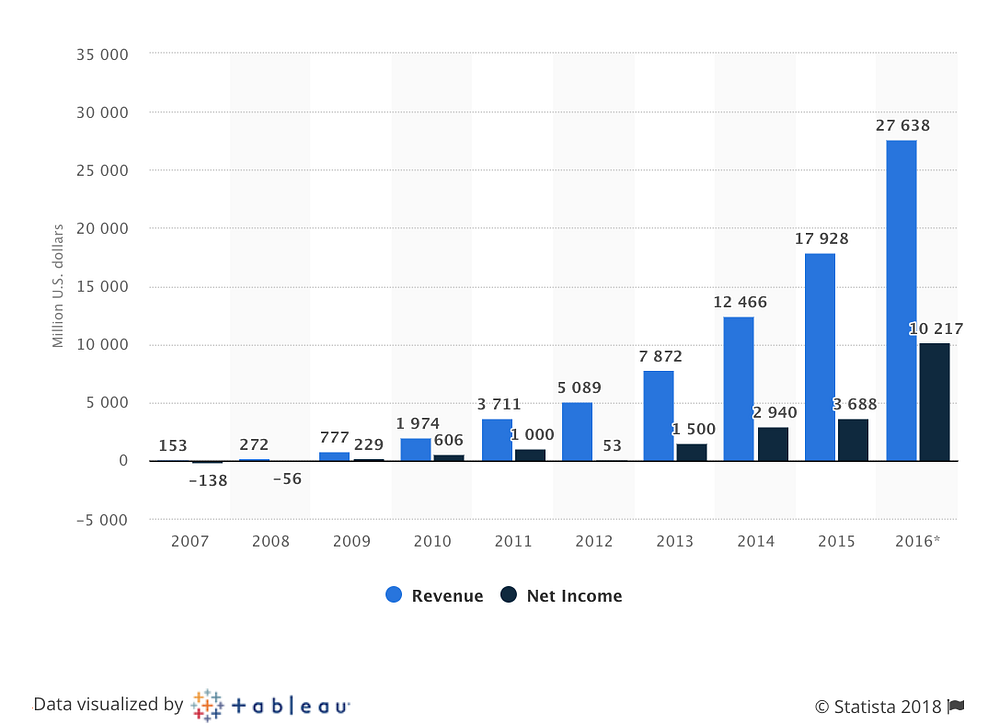
Facebook's annual revenue and net income from 2007 to 2016 (in million U.S. dollars)
https://cdn-images-1.medium.com/max/1000/1*RqSX78sd1NnVgy_yl4LcCQ.png
Mark Zuckerberg has announced his annual “personal challenge,” which in the past has ranged from eating meat he personally kills to learning Mandarin.

This year, his personal challenge isn’t personal at all. It’s all business: He plans to fix Facebook.
In his short but impactful post, Zuckerberg notes that when he started doing personal challenges in 2009, Facebook did not have “a sustainable business model,” so his first pledge was to wear a tie all year, so as to focus himself on finding that model.
He sure as hell did find that model: data-driven audience-based advertising, but more on that in a minute. In his post, Zuckerberg notes that 2018 feels “a lot like that first year,” adding “Facebook has a lot of work to do — whether it’s protecting our community from abuse and hate, defending against interference by nation states, or making sure that time spent on Facebook is time well spent….My personal challenge for 2018 is to focus on fixing these important issues.”

The post is worthy of a doctoral dissertation. I’ve read it over and over, and would love, at some point, to break it down paragraph by paragraph. Maybe I’ll get to that someday, but first I want to emphatically state something it seems no one else is saying (at least not in mainstream press coverage of the post):

You cannot fix Facebook without completely gutting its advertising-driven business model.
And because he is required by Wall Street to put his shareholders above all else, there’s no way in hell Zuckerberg will do that.
Put another way, Facebook has gotten too big to pivot to a new, more “sustainable” business model. The company is on track to earn at least $16 billion in profits in 2017. Wherever the number lands (earnings for the year come out later this month), it’s at least 50 percent growth on the year before. As a stock, Facebook is breaking out in a massive way — it’s priced at roughly 36 times earnings — a healthy premium to the S&P’s average of around 25....MORE

Tuesday, August 6, 2019

Facebook Antitrust: Restraint of Trade (FB)

We've mentioned a few times that Google and in particular Facebook are susceptible to old-school antitrust analysis because of their use of the John D. Rockefeller "Buy 'em, Copy 'em, or Crush 'em" approach to competition:
August 1
"FTC probes Facebook's acquisition practices - WSJ" (FB)
which links back to some earlier posts, see (waaay) below.
For the moment this link is a placeholder but I'm pretty sure we'll be refering back to it.

From Techwyse, June 17, 2019

72 Facebook Acquisitions – The Complete List (2019)!
[INFOGRAPHIC]
By Ramzeen A V
Facebook or should we say, “The Facebook,” was created by Mark Zuckerberg in February 2004. Initially created solely for college students attending specific schools, Facebook reached one million users in just 10 short months after its inception. Fourteen years later in 2019, Facebook has nearly 2 billion users! And this doesn’t include its other properties like WhatsApp, Instagram, and Facebook Messenger just to name a few.

During this wave of extreme growth, Mark Zuckerberg has acquired 72 companies till date. Facebook’s largest acquisition so far has been WhatsApp Messenger, which they purchased for $19 billion in February 2015. Other notable acquisitions include Instagram ($1 billion in April 2012) and Oculus Virtual Reality ($2 billion in March 2014)....MUCH MORE
Techwyse home

Facebook Acquisitions - companies acquired by Facebook


July 23
U.S. DOJ Antitrust Division "Reviewing the Practices of Market-Leading Online Platforms" ( FB; GOOG; AMZN; AAPL)  
The symbols in the headline are in rank order of probable exposure to old-school antitrust sanctions. Twitter if it were included would appear in the middle. 
Facebook and Google have an especially egregious pattern of acquiring, crushing or copying nascent competition, the type of behavior most amenable to classical antitrust analysis. See:

Tuesday, August 13, 2019

FTC Head Says He’s Willing to Dismember Big Tech Platforms BY UNDOING PAST MERGERS (FB; GOOG; TWTR)

Huh.
I guess yesterday's intro line:
There is going to be a reckoning and the data mongers, the tech companies and the centralized repositories will not believe what is going to happen to them.
was borderline prescient. Or maybe just borderline.

From Bloomberg, August 13:
The head of the US Federal Trade Commission (FTC) said he's prepared to break up major technology platforms if necessary by undoing their past mergers as his agency investigates whether companies including Facebook Inc are harming competition.

FTC chairman Joe Simons, who is leading a broad review of the technology sector, said in an interview Tuesday that breaking up a company is challenging, but could be the right remedy to rein in dominant companies and restore competition.

"If you have to, you do it," Mr Simons said about breaking up tech companies. "It's not ideal because it's very messy. But if you have to you have to."

Mr Simons is overseeing a tech task force to examine conduct in the industry and could move to unwind mergers if investigators find the deals were anticompetitive. The agency has opened a broad investigation into Facebook, including whether the company acquired startups to thwart competition, according to people familiar with the matter.

Antitrust experts and lawmakers argue that giant tech companies have used a wave of takeovers of startups to shut down competition by buying - and eliminating - emerging rivals.

Facebook bought photo-sharing site Instagram in 2012 and WhatsApp, a messaging service, in 2014. The FTC approved both acquisitions at the time. Critics including Facebook co-founder Chris Hughes have called for antitrust enforcers to unwind those deals.

US antitrust officials could move to undo the acquisitions even though they previously won approval, Mr Simons said. The FTC could say "we made a mistake," he said. A breakup would require court approval.

Facebook declined to comment.

Facebook CEO Mark Zuckerberg has said he welcomes regulation, but that breaking up the company wouldn't address legislators' privacy and data concerns. In fact, Facebook argues that its size actually enables it to do the things that regulators want to see, such as better policing of content, which would be much harder if Instagram or WhatsApp were separate companies.....MUCH MORE
If interested see also this month's:
August 6
Facebook Antitrust: Restraint of Trade (FB) 
72 Facebook Acquisitions – The Complete List (2019)! 
August 1 
"Facebook: FTC Antitrust Probe of Facebook Scrutinizes Its Acquisitions--3rd Update" (FB)

And previously:
July 23
U.S. DOJ Antitrust Division "Reviewing the Practices of Market-Leading Online Platforms" ( FB; GOOG; AMZN; AAPL)  
 The symbols in the headline are in rank order of probable exposure to old-school antitrust sanctions. Twitter if it were included would appear in the middle. 
Facebook and Google have an especially egregious pattern of acquiring, crushing or copying nascent competition, the type of behavior most amenable to classical antitrust analysis. See:

Thursday, September 30, 2021

University of Chicago's Luigi Zingales: "Break Up Big Tech? A conversation about the future of the industry"

This interviewer, Allison Schrager is very good. Zingales seems to know his stuff as well.
(just kidding Professor Z.)

From City Journal, September 21:

Luigi Zingales, the Robert C. McCormack Professor of Entrepreneurship and Finance at the University of Chicago’s Booth School of Business and a contributing editor of City Journal, joined Allison Schrager, a senior fellow at the Manhattan Institute and contributing editor of City Journal, for a conversation about the tech industry, its effects on politics, and the possibility of reform.

Allison Schrager: The FAANGs—Facebook, Amazon, Apple, Netflix, and Google—as well as Twitter have faced rising political scrutiny, which has led to to calls to regulate them. Such calls have come both from the Left, which points to their size and potential market power, and the Right, which notes their ability to control information in a way that’s biased against conservatives. In economics, these properties are hallmarks of a monopoly—a firm with too much market power. Are these companies really monopolies? If so, is their monopoly power durable? Can we expect them to stay monopolies without government intervention to break them up?

Luigi Zingales: I am going to disappoint you by giving the typical economist’s answer: it depends. It depends on how you define monopoly, the time horizon you are considering, and which company you are talking about.

Do the FAANGs have a very large market share? The answer is yes, and not by coincidence. In this sector, there are large network externalities or big economies of scale (or both). We value Facebook and Twitter because a lot of other people are on Facebook and Twitter. Google’s value comes from its superior search engine, which gets better with use. These are markets subject to tipping—i.e., when a company starts to become dominant, it quickly takes over the entire market.

More difficult is to determine whether these companies have enough market power to be considered monopolies. That’s harder to answer, especially when it comes to a market in which companies don’t charge consumers for their services. To prove that a company is a monopoly you have to show that it delivers excessively low quality. The best paper I’ve seen on this topic shows that Facebook weakened privacy standards after Myspace disappeared. This is clear evidence of Facebook abusing its monopoly power.

Given that there are many alternative social media, where does Facebook’s market power come from? A combination of inertia and network externalities. Let me explain it with an example. My high-school friends and I are in a WhatsApp chat. In late January, when WhatsApp announced its new privacy settings, many participants (myself included) wanted to switch to Signal. Most of us did it, while a few did not (mostly for inertia). As a result, for a little while there were two parallel chats. Eventually, however, everybody went back to the original one.

Schrager: What if there were a better alternative to Signal? Would that have made a difference?

Zingales: It is unlikely, because you still would have had to convince everyone to switch platforms. Major events, like Elon Musk telling everyone to use Signal, are helpful, but often not sufficient (as in this case). This is the reason why an inferior technology like VHS was able to displace a superior one like Betamax.

Schrager: Yes, but eventually VHS gave way to DVDs, then to Blu-Ray, and then to streaming.

Zingales: Now you’re getting to the next part, which is time horizon. How long will these companies’ dominant position last? It’s a good question. If they don’t get subsidies or government intervention, eventually a better technology will come along. But the important question is: how long will “eventually” take, and how much damage will be done in between?

Schrager: Traditionally, monopolies were considered worthy of regulation because they harm consumers—specifically, they charge very high prices. But many of the services we consume from the FAANGs and Twitter are free. Are there other ways besides cost in which they pose harm?

Zingales: Again, it depends—on where and how long you look. We can distinguish between potential harm and active harm. Do these companies have the potential to do harm? Absolutely. Take Google: the way it ranks news sources and search results has a big impact on what you buy and perhaps even whom you vote for. From the case against Google in Europe, we know that when the firm started its own shopping service, it de-ranked its competitors in Google search results.

Sometimes, just the threat of changing the search algorithm is enough to cause harm. If I am a politician in a competitive district, do I really want to go after Google when Google can make my life more difficult? This isn’t just an issue in the U.S. It’s true all over the world. If I am the Sri Lankan prime minister, do I want to attack Google? I think this is going on right now; we see politicians holding back.

Schrager: It hasn’t held back Elizabeth Warren from criticizing these companies, though. She has been a very vocal opponent.

Zingales: It depends on how secure your district is. In Massachusetts, it’s hard for a Democrat to lose. But take Mike Lee, a Utah Republican who changed his mind on Google and antitrust issues—I wonder why.

Schrager: Do these companies influence elections?

Zingales: I am not saying they do, but they could. If I search for “Biden” and news about Hunter Biden comes up first, I may not vote for his father. By contrast, if the bad news about Biden only shows up on the second page of search results, I might happily vote for Biden. Do you know the jokes that all the skeletons are buried in page two of the search results, because you can be sure that nobody would find them?

Then there’s the political issue. What we saw on January 10, with Facebook and Twitter’s banning of Trump, was that a few people have a disproportionate power to block the circulation of certain ideas. I do believe that businesses have the right to choose what they diffuse. But this right is compatible with a free society only if the service is provided in a competitive way. If I am the only inn in a desert, my freedom to refuse to serve you must be restricted, because it becomes my freedom to kill you.

Finally, we, the consumers, pay the cost of advertising. If the FAANGs influence the price of advertising, this will show up in the final price of goods. There’s no evidence yet that they do, but it’s not out of the question. It’s something we should pay attention to.

Schrager: So what can be done? Do you suggest breaking the FAANGs up?....

....MUCH MORE

Thursday, December 12, 2019

Antitrust: "FTC Considering Steps to Block Facebook from Merging With Instagram and Whatsapp: Report" (FB; GOOG)

Now do Google.
Back in August we posted "Facebook Antitrust: Restraint of Trade (FB)" which referenced. a drum yours truly has been beating for a couple years
We've mentioned a few times that Google and in particular Facebook are susceptible to old-school antitrust analysis because of their use of the John D. Rockefeller "Buy 'em, Copy 'em, or Crush 'em" approach to competition:
"FTC probes Facebook's acquisition practices - WSJ" (FB)
which links back to some earlier posts, see (waaay) below.
For the moment this link is a placeholder but I'm pretty sure we'll be refering back to it.
That post had an infographic showing 72 of Facebook's acquisitions.
Here's the latest from Gizmodo:
The Federal Trade Commission is considering asking the courts to put a halt to Facebook CEO Mark Zuckerberg’s plan to merge the technical backends of Facebook, WhatsApp, and Instagram on antitrust grounds, the Wall Street Journal reports.

The plan in question was touted by Zuckerberg and crew as a way to increase the ease of interactions across services and increase security by implementing end-to-end encryption, but it also conveniently comes at a time when pressure is growing on federal antitrust authorities to do something about the social media giant’s dominance of multiple tech markets. Merging the three services could give Facebook an opening to argue that they are now so interdependent it would be impossible, or at least unduly difficult, to break them up into separate companies.

The FTC and the Department of Justice are already investigating Facebook as part of a broader federal review of whether huge firms like it, Google, Amazon, and Apple act in an anticompetitive manner. Earlier this year it slapped the company with a five billion fine for prior violations of user privacy, a move opposed by the two Democratic commissioners on the FTC board as grossly inadequate. The newer investigation could hurt Facebook much harder, with talk of examining acquisitions like Instagram and WhatsApp—but only if the FTC is willing to take a harder swing at the company this time around....MORE
The restraint of trade line of attack is much simpler than some of the approaches being floated to rein in the platforms. Here are some related posts:
July 23
U.S. DOJ Antitrust Division "Reviewing the Practices of Market-Leading Online Platforms" ( FB; GOOG; AMZN; AAPL)  
The symbols in the headline are in rank order of probable exposure to old-school antitrust sanctions. Twitter if it were included would appear in the middle. 
Facebook and Google have an especially egregious pattern of acquiring, crushing or copying nascent competition, the type of behavior most amenable to classical antitrust analysis. See:
In Google's case, Crunchbase lists 237 companies acquired by either the GOOG or by Alphabet.
Wikipedia lists 231 "mergers and acquisitions", both up to and including FitBit, announced November 1.

And here's some of the concern circling around Mountain View via CNBC, August 19:
Google’s acquisitions are in the spotlight 15 years after it went public

Monday, September 23, 2013

How to Beat Facebook: Anti-viral, Anti-social Networks (FB)

From PandO Daily:
Screw virality! Antisocial networks are on the rise
mean-girls-cafeteria-scene copy
I’ve compared Mark Zuckerberg to Bill Gates before. It’s both a flattering and unflattering comparison.

The parallels aren’t perfect, but both men have built huge and defensible businesses by commanding monopoly-like positions in our digital lives. Microsoft controlled the desktop, and Facebook, like it or not, is the world’s best social graph. It won social the way Google won search. Google+ isn’t pulling an Android-like spoiler. It’s done.

But as we all know, just because it’s comprehensive, doesn’t mean Facebook is the best place to have every connection and conversation. And now we’re starting to see a fascinating new trend: the rise of the anti-viral, anti-social network.
An anti-social network isn’t as simple as being a mere Facebook alternative, or a niche social network. Those have both been tried in spades, and have failed along the way, even when Facebook was weaker.  As much as people had issues with Facebook’s loosey-goosey privacy policies, the alternatives haven’t generated much more than headlines. Niche social networks for, say, Baby Boomers, moms, and dog lovers haven’t taken off either.
Turns out if you want to have conversations with people you know, plan events, and share photos, Facebook is the place to go. It’s too hard to compete with that. It’s similar to how I recently wrote that the Instagram for video wound up being… well, Instagram.
How do you succeed against Facebook? The same way that desktop and small business software companies have always managed to succeed against Microsoft: By finding “white space.” In Microsoft’s most powerful days, that was the first question the press or a VC would ask: Does Microsoft compete with you now, and, if not, how do you know they won’t?

When it comes to  building a consumer Web company around human relationships, the smartest entrepreneurs aren’t thinking niche. They are thinking orthogonal. There’s a difference.

Niche means that Facebook could do it, but you think you could do it better. That’s what loses. What seems to win, so far, are the approaches that do what Facebook couldn’t do, by design.

Look at the core things Facebook does well: photos, connecting you with everyone you know, providing a permanent record, and real identity. These are the exact four things that have made Facebook a powerful company with users and advertisers; these are the four things it can’t betray and hope to succeed.

So among the threats to Facebook, you’ve got Snapchat, which is inherently temporary; Whisper, which is inherently anonymous; and Nextdoor or Life360 (the sponsor of this series), where you can only connect with neighbors or family. Nextdoor is particularly extreme, making you verify residence before you can connect to a network. Many of these are inherently non-viral. Nextdoor at one point relied more on stickers – physical, not virtual, stickers that you put up around the neighborhood – for marketing than on spamming address books....MORE

Sunday, September 22, 2019

"Facebook and Google are currently playing their toxic Endgame" (FB; GOOG; TWTR)

From theChive:
By taking it all, the Duopoly actually wins twice. Not only do they kill publishers and take their money, what’s left of the publishers who hang on will have no choice but to attach their skeleton crew to Facebook and Google for life support. Facebook will actually have the balls to play savior by creating, say, a ‘preferred publisher program’, anointing a handful of publishers as partners who will get traffic from FB and just enough ad revenue to survive. Then Facebook’s algorithm will only show you articles from those publishers that their algorithm thinks you want to see. Your entire internet consumption, as well as how you think and feel, will be dictated to you.....
....MUCH MORE

I'm not sure if the facts of the story live up to the headline but on September 20 RT said: 
"Not a free speech platform: Facebook declares it’s a ‘publisher’ & can censor whomever it wants, walking into legal trap"
For years the companies have had it both ways, platform when that furthered their goals, publisher when that suited their rapacious lust for money and power.
Of course in 2018 The Guardian reported the same thing in a different lawsuit:
Is Facebook a publisher? In public it says no, but in court it says yes
But now it seems people are taking notice of the duplicity these companies are founded on. 

Wednesday, December 20, 2017

"...Germany slaps Facebook in its abusive little face for 'limitlessly amassing data'" (FB)

From Das Register:

Monopoly watchdog nicht glücklich about Zuck's info suck

Batman. Credit: DC Comics.
Germany's competition authority has accused Facebook of abusing its market dominance to "limitlessly amass every kind of data" on people.

The Bundeskartellamt informed the American social media giant on Tuesday of its "preliminary legal assessment" that by forcing third-party websites and apps – including WhatsApp, Instagram and those using embedded Facebook APIs – to share their data with Facebook, it was abusing its position.
"We are mostly concerned about the collection of data outside Facebook's social network and the merging of this data into a user's Facebook account," said Bundeskartellamt president Andreas Mundt.

He noted that this data gathering "even happens when, for example, a user does not press a 'like button' but has called up a site into which such a button is embedded." Visiting a webpage with a Facebook 'like' button on it phones homes some info about the netizen to the Mark-Zuckerberg-run business, in other words.

Users are not aware that all their information is being scooped up and sent to the mothership, Mundt noted, and concluded: "We are not convinced that users have given their effective consent to Facebook's data tracking and the merging of data."

As a result, the Zuckerberg Express "violates mandatory European data protection principles."
The finding is based on a determination [PDF] that Facebook effectively owns the social media landscape. "The authority assumes that Facebook is dominant on the German market for social networks," a statement from the authority read. It says that Facebook has around 30 million users per month in Germany of which 23 million use the service on a daily basis.

Google+? Ha! Ha! Ha!
While it noted the existence of other services like Google+, the authority argued that "on account of direct network effects, the substitutability of their products with Facebook is limited, despite the fundamental comparability of the products."...MORE
Also at The Register:

HMS Queen Elizabeth has sprung a leak and everyone's all a-tizzy  

Note: that's HMS not M/S Queen Elizabeth which is parked in Lisbon looking at some tiny boat in front of  her:


Cunard Queen Elizabeth

Live! Cunard's Queen ELIZABETH Bridge CAM

Tuesday, July 22, 2014

Ya Baby! "The hunt for a monopoly position in business"

Having the Holy Roman Empire postal monopoly worked out pretty well for the Thurn und Taxis fam who Wikipedia describe as "well known as owners of breweries and builders of many castles."

From Simon Taylor's blog:
Economics students learn early in their microeconomics course that there is a desirable market condition called perfect competition, which consists of large numbers of more or less identical firms competing aggressively to meet the customer’s wants. The competition is so fierce that no firm has any ability to charge a price above the absolute minimum needed to stay in business. So the customer is assured of a low price and the economy makes efficient use of resources, since only the most cost effective companies can survive.
They then learn about how bad monopoly is. That is the opposite type of market in which there is a single supplier who naturally charges whatever the market will bear and has little incentive to be cost efficient or to be attentive to customer needs. A market with monopoly will be inefficient (*), will charge customers more than in perfect competition and probably won’t be innovative or offer a decent service.

The problem with this picture is that very few actual industries are like either case. Perfect competition is a fiction, an “ideal type”. The nearest we get to it is in agriculture and some other basic commodities, where the product is identical and firms have no market power or ability to add any sort of value or service that would merit a higher price. Many markets are competitive but with only a few companies, and the product is usually slightly differentiated.

Take coffee shops. There are plenty of choices for a customer in Cambridge looking for a coffee. There are the three big chains (Costa, Nero and Starbucks) plus various independents. All offer broadly the same product (though for my taste the brown milk that you get in Costa or Starbucks barely rates the name coffee) but they each have subtle differences in ambience, style, service and location. They compete on these features, not on price, but their products are broadly priced the same, which suggests some degree of restraint from competition.

That type of market is called monopolistic competition in economics textbooks because the product or service is not identical and each firm has some degree of influence over demand. Innovation is encouraged in that type of market because a small enhancement can cause customers to switch. But other customers are loyal or just conservative, which means that the coffee shops aren’t relentlessly trying to retain every single customer each day, which is the miserable fate of a company in a perfectly competitive market.

Pure monopoly in the sense of a single supplier is rare except in the natural monopolies of network utilities, where there is a strong cost argument for a single electricity transmission wire or water pipe. Competition would be wasteful and no new entrant would expect to make money. So these industries are inevitably monopolistic and are usually regulated as such.

But quasi-monopolies, in the sense of a dominant supplier, are quite common. And the goal of many businesses is precisely to try to establish such a position. Peter Thiel, the co-founder of Paypal and an early investor in Facebook, taught a course on start-ups at Stanford University in 2012 and this blog provides some notes on the course (it’s written by Blake Masters, Thiel’s co-author of the new book Zero to One so the notes are likely to be a reliable guide to what Theil said). One thing that struck me was his argument that successful capitalism and monopoly are not opposites, as the textbook view of economics might suggest. On the contrary, he argues that a start up should be intending to find or build a monopoly or at least dominant position that it can completely own. Unless a start up has that ambition or potential it’s not worth investing in or working for.

So monopoly is both the goal of a dynamic business and an outcome that reflects success. Perfect competition is neither a good guide to what most business looks like, nor a desirable goal that any business should accept.

Successful examples of quasi-monopolies would include Google, Facebook, LinkedIn and for a while Apple and Microsoft. None of these is or was a 100% monopolist, though Microsoft came very close with the dominance of Windows for a while. And none of them has an unassailable position, because technological change makes new disruptive entrants a possibility, which is why so few companies keep their monopoly position....MORE

Monday, August 14, 2017

Chicago Booth: “Google Is as Close to a Natural Monopoly as the Bell System Was in 1956″ (GOOG, FB)

From the University of Chicago's ProMarket blog, May 9, 2017:

Media scholar Jonathan Taplin, author of the new book Move Fast and Break Things, on the rent-seeking and regulatory capture of digital platforms.
In 2014, Silicon Valley venture capitalist Peter Thiel famously proclaimed that “competition is for losers” in an essay published in the Wall Street Journal and in his book (also published in 2014) Zero to One. “If you want to create and capture lasting value, look to build a monopoly,” he advised entrepreneurs, expounding on his view that monopolies are good for innovation and, ultimately, for society at large. 

Thiel’s proclamation has received a lot of attention since he made it, not just because it seemingly goes against the very notion of a competitive capitalism, but also because in the eyes of many, it perfectly captured the underlying philosophy behind the rise of digital platforms like Google, Facebook (whom Thiel was the first outside investor in), and Amazon. 

In terms of market share and profit margins, the big digital platforms, particularly Google and Facebook, enjoy an astounding level of dominance. Google, in effect the world’s largest media company, has an 88 percent market share in search advertising. Facebook (including Instagram, Messenger, and WhatsApp) controls over 70 percent of social media on mobile devices. Together, the two firms received 85 cents of every new dollar spent in online advertising in the first quarter of 2016. Amazon has an over 70 percent share in the e-book market. Along with Apple and Microsoft, they are now the most valuable companies (in terms of market capitalization) in the world.

The rise of digital platforms has had profound political, economic, and social effects, not least of which on the creators of content. While the internet brought immense benefits to consumers of content, the so-called “creative class”—authors, journalists, filmmakers, musicians, artists—has been particularly ravaged by the digital economy.

This ravaging, and its roots in the monopolization of content delivery and data in the hands of a few digital giants, are at the heart of the new book Move Fast and Break Things: How Facebook, Google, and Amazon Cornered Culture and Undermined Democracy by media scholar Jonathan Taplin. In the book, Taplin explores the way in which the internet came to be dominated by a handful of monopoly platforms, and the subsequent capturing of regulators that has since all but ensured their dominance would not be challenged in court.

Taplin, the Director Emeritus of the Annenberg Innovation Lab at the University of Southern California, is well versed in both the creative and the business side of media. Before he became an academic, he worked as tour manager for Bob Dylan and The Band and was a film producer who worked with Martin Scorsese and Gus Van Sant. As such, he has seen first-hand the damage that the internet economy has wrought on working artists like his friend, legendary drummer Levon Helm, who was forced to put on a series of concerts at his home at the age of 70, while dying from throat cancer, in order to pay his medical bills.

Taplin, a former vice president of media mergers and acquisitions at Merrill Lynch, also experienced first-hand how easily entrenched incumbents can stifle innovation in the entertainment industry (it also helps that his father was an antitrust lawyer). In 1996, he co-founded an early video-on-demand company named Intertainer that was forced to fold after one of its shareholders, Sony, partnered with three other major entertainment companies to copy its idea for a rival service. (Intertainer later filed an antitrust lawsuit against the studios and the sides eventually reached an out-of-court settlement).

In his book, part memoir and part manifesto calling for content creators to embrace antimonopoly, Taplin examines the contradictions embedded in today’s digital economyin which YouTube makes $9 billion in annual revenues, but artists earn more from the sales of vinyl records than online streaming—through the lens of antitrust and the history of monopoly in the U.S.

“The deeper you delve into the reasons artists are struggling in the digital age, the more you see that internet monopolies are at the heart of the problem and that the problem is no longer just for artists,” he writes. “Monopoly control of our data and corporate lobbying are at the heart of this story.”

In an interview with ProMarket,1) Taplin discussed the rise of monopoly platforms and the part that rent-seeking and regulatory capture play in the digital economy today.

Q: How did you become interested in antimonopoly?

It was a very personal story. Levon Helm, who was the drummer for The Band, got throat cancer in 2000. He’d been making a decent living off of royalties from past records that he had made 15 years before, then Napster happened and that just ended. It just so happened that he got throat cancer at that very point. He had to pay for medical bills and he couldn’t go on the road because he could hardly sing....MUCH MORE
HT: FT Alphaville's Further Reading post, 10.Mai.17