Showing posts sorted by relevance for query groq. Sort by date Show all posts

Monday, August 24, 2026

"Nvidia’s $20 billion bet on Groq’s LPU tech sure looks like it was a good one."

 From The Register, August 24:

What Nvidia's first Groq 3 LPU benchmarks tell us about its $20B gamble
Gemma 4 31B performance tests offer a best-case scenario for next-gen dataflow accelerators 

Nvidia’s $20 billion bet on Groq’s LPU tech sure looks like it was a good one. On Monday, the GPU giant offered the first glimpse of just how big a speedup its Groq 3-based LPX racks will provide.

In an independent benchmark conducted by Artificial Analysis, Nvidia’s LPX rack systems managed to churn out 3,400 tokens a second (tok/s) with a 100,000-token input sequence in Google’s Gemma 4 31B model.

According to Nvidia, this makes it 4x faster than the nearest alternative platform, which going off Artificial Analysis’ leaderboard would be a direct dig at Cerebras, which managed a still impressive 882 tok/s under the same conditions.

Acquihired by Nvidia in late December, Groq has LPUs that feature an SRAM-heavy dataflow architecture designed specifically for high-performance inference serving. Unlike traditional datacenter GPUs, which rely on high-speed DRAM memory tech like GDDR7 and HBM4, Groq’s chips rely entirely on a large pool of on-die SRAM orders of magnitude faster than even the best HBM stacks (around 2.75 TB/s each) available today. And when it comes to inference, memory bandwidth is the bottleneck to beat....

....MUCH MORE  

Previously:

September 17, 2025 - Chips: Nvidia Challenger AI Inference Co., Groq, Raises $750 Million At Post-Money $6.9 Billion Valuation

We don't have much posted on Groq, only a half-dozen mentions in general articles on inference companies including SambaNova and Cerebras. One reason we do have it flagged is that the CIA's venture arm In-Q-Tel was an early investor. Another investor is Disruptive who seem to have an eye for pre-public companies:

...Palantir, Airbnb, Spotify, Shield AI, Hims, Databricks, Stripe, Slack...

That's from Groq's September 17 press release, "Groq Raises $750 Million as Inference Demand Surges".

We have quite a bit more on the company in the link-vault, including this piece from The Technologist substack, February 13: Deep Dive 4: Groq (Private)

December 26, 2025 - "Nvidia Licenses Groq's AI Chip Tech, Grabs Top Execs In Not-Quite Takeover" (NVDA)

December 27, 2025 - "NVIDIA’s Christmas Eve 'Hackquisition' Miracle" (NVDA; GOOG)

December 28, 2025 - "Nvidia's Groq deal underscores how the AI chip giant uses its massive balance sheet to 'maintain dominance'" (NVDA)  

March 21, 2026 - "Nvidia Finally Admits Why It Shelled Out $20 Billion For Groq" (and Senator Warren swings by) NVDA

Friday, December 26, 2025

"Nvidia Licenses Groq's AI Chip Tech, Grabs Top Execs In Not-Quite Takeover" (NVDA)

From Investor's Business Daily, December 25:

Nvidia (NVDA) will license key technology from AI chip maker Groq and bring over key personnel from the startup, Groq announced Wednesday afternoon. That followed a report that the Dow tech giant would pay $20 billion for Groq. Nvidia stock was indicated fractionally higher Thursday night.

Groq has entered into a non-exclusive licensing deal with Nvidia for the startup's inference technology, the company said in a press release. As part of the agreement, Groq founder and CEO Jonathan Ross, President Sunny Madra and some other Groq employees will join Nvidia.

Groq will remain an independent company, with CFO Simon Edwards becoming CEO. Specifically, Groq's cloud business is not part of the deal. But most assets may be going to Nvidia.

Earlier, CNBC had reported that Nvidia would pay about $20 billion to buy Groq outright.

Financial terms of Nvidia's licensing and hiring deal were not given. Nvidia itself has said nothing as of Christmas morning.

There is some speculation that the not-quite takeover structure is an effort to avoid antitrust objections.

Media reports still are touting a $20 billion figure, though if true it's unclear if that would be a lump sum or include some future milestone payments.

Groq Founded By Google TPU Creators....

....MORE 

We had this story in the link-vault before the Groq story came out, it is still accurate. From CNBC December 4: 

Nvidia has a cash problem — too much of it

In early pre-market trading NVDA is up $1.08 (+0.57%) at $189.69  

Saturday, March 21, 2026

"Nvidia Finally Admits Why It Shelled Out $20 Billion For Groq" (and Senator Warren swings by) NVDA

From The Next Platform, March 17:

Back in late December, Nvidia did a $20 billion “acquihire” of most of the development team at Groq and licensed the technology underlying its LPU dataflow engines for doing AI inference. We expected for Nvidia to move fast to deploy the tensor streaming processors created by Jonathan Ross, the ex-Googler who created a fully-scheduled, programmable tensor processing unit after he left the search engine giant. When the GenAI boom took off, these were renamed Language Processing Units, but the architecture did not change. Now, Nvidia is working with Samsung to bring the third generation LP30 chips to market, which Nvidia co-founder and chief executive officer Jensen Huang said in his opening keynote presentation at the GTC 2026 conference would happen in the second half of this year, and very likely in the third quarter.

Nvidia is not wasting any time, and that is because it does not have time to waste. Groq was going to start getting traction in low latency inference, just as Cerebras Systems has and that SambaNova Systems can do given their focus on ultra-high bandwidth SRAM memory against more modest compute to have zippy inference across a large number of compute engines. Where speed matters, these system makers and the dozens of upstarts who are trying to tackle inference at scale are so many piranhas swarming towards a fat cow standing in the Amazon (the river, not the bookseller and cloud utility). So Nvidia had to moooooooove. . . . 

Hence, the dramatic $20 billion acquihire of Groq, which could not be an outright acquisition because that might take a year or two and might not pass muster with the world’s antitrust regulators. And hence its immediate absorption into the Vera-Rubin platform. Which arguably should be called the Vera-Rubin-Groq platform, given that Huang said during his keynote that low latency, premium priced token generation should represent somewhere on the order of 25 percent of the compute in an AI cluster.

Remember that Rubin CPX large context compute engine that Nvidia preview back in September 2025? The one based on a variant of the Rubin architecture and equipped with cheaper and more available GDDR7 graphics memory?

“We discovered a great idea,” Ian Buck, vice president of AI and HPC at Nvidia, said on a call ahead of GTC 2026 going over the systems announcements. “Integrating the LPU and LPX into our Rubin platform to optimize the decode. That's where we're focused right now, and we're excited to be bringing that to market.”

In other words, scratch Rubin CPX.

Huang stacked up what we presume is the “Rubin” R200 GPU accelerator beside what we presume was called the “Alan-3” Groq LP30 inference accelerator. One is a general purpose, dynamically scheduled compute engine that is pretty good at batching up lots of inferences and pipelining them through HBM stacked memory with reasonable latency and supporting many concurrent users. (That would be the GPU.) And the other is a rack or more of fairly modest, inference-specific, statically scheduled, deterministic compute engines that work in concert to support a small number of users – that number is likely one most of the time – and distribute model weights (not data) across their aggregate SRAM in such a way that the response time for token generation scales down as you add more machines. The GPU is a thresher, the LPU is a speed demon. They can work together with the Dynamo inference stack to provide a more balanced pareto curve for inference performance across a range of throughout and latency.

Here are the feeds and speeds of the R200 and the LP30 chips:....

....MUCH MORE 

 And from the office of Senator Elizabeth Warren, March 19:

Jensen Huang
President and Chief Executive Officer
NVIDIA Corporation
2788 San Tomas Expressway
Santa Clara, CA 95051 

Dear Mr. Huang: 

We write to request additional information regarding the terms of NVIDIA’s recent deal with Groq, an artificial intelligence (AI) chip startup and NVIDIA competitor, to assess the agreement’s implications for competition in the AI chip sector. On December 24, 2025, NVIDIA and Groq announced an agreement under which NVIDIA will pay Groq $20 billion to acquire a non-exclusive license for Groq’s inference chip design technology and hire many of Groq’s key employees, including its CEO and president.1 The deal will give NVIDIA “all of Groq’s assets,”2 and appears to be structured to evade scrutiny by antitrust regulators.3 We are concerned that this takeover could stifle competition, further entrenching NVIDIA’s dominance in the AI chip industry and ceding our technological leadership to China.

NVIDIA currently dominates the market for the powerful graphics processing units (GPUs) used for developing and deploying advanced AI models.4 NVIDIA controls roughly 90% of the market for high-end data center GPUs, with buyers forced to wait for supplies because enterprise demand far exceeds supply.5 As of the end of Q3 2025, NVIDIA also controlled 92% of the market for personal computer (PC) GPUs used for computationally-intensive tasks such as video games and hosting smaller AI models, with Advanced Micro Devices (AMD) controlling 7% and Intel possessing just 1% market share.6  

And competition in the narketplace has shrunk over time. AMD controlled 12% of the PC GPU market at the end of Q1 2024, 7 8% at the end of Q1 2025, 8 and just 7% as of the most recent quarter. 9 Because GPUs are essential for advanced AI development, NVIDIA effectively controls which companies can compete in AI, and the entire AI industry is held hostage to NVIDIA’s product decisions and priorities. This market dominance, combined with the recent explosion of interest and investment in AI, has seen NVIDIA reach a market capitalization of $5 trillion, making it the most valuable company in history.10....

....MUCH MORE (6 page PDF) 

Thursday, March 19, 2026

Comments On Nvidia From Some Fans (NVDA)

As GTC, San Jose, 2026 wraps up, some commentary.

First up, Yahoo Finance, March 19:

Nvidia's changing its strategic approach to AI, going all in on inferencing and agents 

Jensen Huang took the stage at Nvidia’s (NVDA) GTC event in San Jose, Calif., on Monday, clad in his usual leather jacket, to provide the world with an update about what the world’s most valuable company has been cooking up over the last few months.

Huang was as indefatigable as ever as he ran through his roughly two-and-a-half-hour keynote in front of some 30,000 attendees. But what’s come to be known as the Super Bowl of AI featured a noticeable shift in Nvidia’s overall AI strategy — a deeper focus on inferencing, or powering AI models, and agents.

Nvidia’s chips are traditionally known for their general-purpose use. They can train and run AI models, power robots, and serve as the backbone of self-driving cars.

And while Nvidia’s offerings are still the industry standard, upstart chip companies like Cerebras and Groq have begun designing and rolling out processors geared specifically toward running AI models, creating a potential threat to Nvidia’s formidable AI moat.

Huang and company answered that at GTC with a slew of announcements meant to prove Nvidia is the inferencing leader to beat, including the debut of its Groq 3 chip and rack system.

Nvidia didn’t just go further with its inferencing capabilities, though. The company also showed off its addition to the much-hyped world of OpenClaw high-powered AI agents.

OpenClaw, which debuted as Clawd in November 2025 before being renamed Moltbot and finally OpenClaw in January, has taken off thanks to its ability to run AI agents powered by different AI models on users’ machines via apps like WhatsApp, Discord, Slack, and others.

Now, Nvidia is getting in on the buzz with its NemoClaw platform designed to improve the security and privacy of the agents.

“They are evolving in a big way, not only in inference, agentic, too,” TECHnalysis Research founder and chief analyst Bob O’Donnell told Yahoo Finance.

“The switch to OpenClaw, and now NemoClaw, to me, is even more indicative of this. It just shows how quickly they are reacting to the market.”

Nvidia moves further into inferencing 
Nvidia’s decision to include Groq 3 as one of the seven chip platforms that make up Vera Rubin is part of its effort to stay ahead of the broader industry.

Nvidia signed a $20 billion deal with Groq in December, hiring founder Jonathan Ross, president Sunny Madra, and other members of the Groq team and giving Nvidia access to Groq’s intellectual property.

The results of the deal are Nvidia’s new Groq 3 language processing unit (LPU) and Groq 3 LPX server rack. That’s right, Nvidia now has graphics processing units (GPUs), LPUs, and central processing units (CPUs). It’s a lot of units....

....MUCH MORE 

And at Barron's March 19:

Nvidia Is Giving Apple Vibes. Why That Spells Big Things for the Stock.

The artificial-intelligence revolution has entered a new phase, one in which running AI models, known as inference, is taking over as the main source of demand for AI computing. Nvidia was the winner of round one when training the AI models drove chip sales. But things change quickly in tech, and the company still has to convince the market and customers that it remains indispensable.

CEO Jensen Huang devoted his keynote address at Nvidia’s GTC conference this past week to make the case. He reminded everyone that Nvidia had spent two decades building an ecosystem of hardware and software that makes its platform the least costly for AI. By the end of his speech, Huang had delivered a vision of Nvidia that reminded me of just one other company: Apple.

For years, Wall Street didn’t appreciate that Apple was more than just a hardware firm. Apple’s version of consumer technology provides a carefully thought-out bundle. The hardware is expensive, but it comes with a lot of free software and services that bring everything together seamlessly. In the end, the platform is sticky and full of value.

This is sometimes called Apple’s “walled garden.” iPhones, Macs, and Watches work like one because Apple controls the entire technology stack: the chips, the devices, the operating systems, the applications, and the cloud services. It’s all developed together, so it all just works together.

You’re free to leave the garden through a well-hidden gate, but the flowers are nice and the sun is shining, so why would you?

Nvidia is employing that Apple model of full control in an entirely different market: AI computing. More and more, Nvidia is moving toward being a full platform with an ecosystem of hardware, software, and partnerships that could be sticky like Apple’s, notwithstanding growing competition in the AI chip market.

It begins with Nvidia controlling as many layers of data center infrastructure as it can, what CEO Jensen Huang calls “extreme codesign.” A lot of attention is paid to Nvidia GPU chips, the workhorses of AI data centers, but there are five other Nvidia chips inside its coming Vera Rubin AI server, each with a crucial role in making a product that can’t be matched. The chips work better because they are designed together to work together.

Nvidia also makes data center network switches that alleviate a key computing bottleneck. In the last quarter, networking sales were responsible for 16% of Nvidia revenue, up from 8% the year before. It’s now the fastest-growing unit in Nvidia’s reporting.

This year, Nvidia will integrate a new server design built around AI inference chips from start-up Groq. Vera Rubin will work in concert with Groq on demanding inference tasks. Creating a data center with mixed servers that collaborate with each other is a thorny problem that Nvidia solved with software called Dynamo. Nvidia’s hardware still leads the industry, but the deepest part of the company’s moat is all the software it’s created to run on its hardware.

Huang began his GTC keynote by talking about the 20th anniversary of Nvidia’s most important software known as CUDA, or Compute Unified Device Architecture. In 2004, Nvidia hired Ian Buck, an engineer fresh out of Stanford University, to create a way for programmers to use Nvidia GPUs for a lot more than just computer graphics and gaming. Two years later, CUDA was born.

Nvidia kept developing the software, and by 2012, AI researchers had made Nvidia’s platform their preferred kit. A whole generation of researchers grew up on it. When ChatGPT triggered the generative AI craze in 2022, no one was more prepared for it than Nvidia.

Buck remains a Nvidia employee.

Nvidia has continued to build the ecosystem on top of the GPU-CUDA combination. The company’s online code portfolio has 700 repositories, including specialized software for engineering, physics, weather, and medical science, along with tools for AI training, inference, and agents. These are active projects with new versions rolling out all the time. Over a third of the repositories have received updates in the past month.

Nvidia is also the world’s largest contributor to open-source AI models with 715 of them available for download....

....MUCH MORE 

Also at Barron's, March 18:

Sure, Nvidia Stock Is Stuck. But Don’t Ignore Its Huge Cash Returns

The stock is down $2.45 (-1.36%) at $177.95.

This week:

Sadly, I don't think we'll see anything as insightful as 2024's "Nvidia CEO Jensen Huang debuts new $8,990 lizard-embossed leather jacket, also says something about AI GPUs: (NVDA)

Although....looking back to 2016's "Huh, This NVIDIA Company May Be On To Something (NVDA)" it's possible I''ll come up with something.

After a series of all-time highs last week the stock looks set to open up a couple pennies at $44.35.
From the Wall Street Journal:

New Chips Propel Machine Learning  

Divide by 40 to account for the stock splits and we see $1.11 on the old stock. 

Saturday, December 27, 2025

"NVIDIA’s Christmas Eve 'Hackquisition' Miracle" (NVDA; GOOG)

From Spyglass, December 25:

NVIDIA gets a creator of the TPU, access to inference tech & IP, and stops anyone else from getting such things. All for a mere $20B...  

Twas the night before Christmas and all through the house, not a creature was stirring, not even a... wait. What's that? Is that Jensen Huang scurrying around doing deals over the holidays?!

It sure is!

Well, presumably he had been working on the deal with the specialized AI chip startup Groq before the holidays started. But I also wouldn't rule out that this deal came together in a hurry given what we know about how he's operated in the past with some mega deals, such as the um, (up to) $100B investment in OpenAI. A deal which came together quickly, perhaps on a trip with a certain President, and perhaps right after the rumors of OpenAI potentially looking at a deal with Google to use their TPUs – we'll come back to that. It was also a deal which was announced three months ago but apparently still has not been finalized, by the way, so there's that.

Anyway, you can't help but wonder if the real key for the timing here may have been to bury it under the spirit of Christmas. Because boy is it a doozy.

CNBC first broke the news with the headline: "Nvidia buying AI chip startup Groq for about $20 billion in its largest acquisition on record". But as it turns out, that wasn't quite right. And actually, it was NVIDIA that wanted to make that clear. They weren't buying Groq, they were merely paying Groq that $20B for a "non-exclusive licensing agreement".

Oh, you've heard that terminology before? Of course you have. It's the magical incantation one must cite in order to summon the spirits of the "hackquisition".

With this deal, NVIDIA is following their Big Tech brethren down this now well-trodden path. Microsoft, Amazon, Google, Meta, and NVIDIA have done deals which aren't technically acquisitions, but effectively are. Because they allow the acquiring – sorry, non-acquiring – company to sort of pick and choose what they want from the acquired – sorry, non-acquired – company in exchange for considerations that can go to... well, sort of anyone they choose. Certainly the investors to get them to sign off on such deals, and often the key employees at those companies. Sometimes the other employees of the companies too, but that's mainly so they don't feel bad and/or raise a stink about the faux-deal. Because when they do that, all hell tends to break loose, at least from a PR-perspective.

Anyway, the first wave of "hackquisitions" were almost more like "hackquihires" because they were simply a way to get access to key talent at those companies and any licensing agreements were seemingly an excuse to make it all a little less blatant. But as such deals have grown in size, they've grown to look even more like actual acquisitions. For example, Meta's nearly-$15B deal with Scale.ai bought them 49% of that company alongside their key talent, namely CEO Alexandr Wang. Why? Presumably Meta wanted more for that amount of money and they thought Scale, a hot company at the time, might still give them some upside. Of course, they were also effectively gutting said company and it seems decidedly less hot now – especially since many of their customers were Meta competitors who no longer wanted to send their data to Scale – shocking, I know. Still, Meta also likely believed they could use Scale's service to help with their future model training – efforts which were rebooting alongside bringing Wang on board.

NVIDIA's Groq deal seemingly has similarities. Namely, the key was clearly to bring CEO Jonathan Ross on board. And every story also points to company president Sunny Madra being crucial as well. But beyond that, it sounds like NVIDIA may actually care about some of the IP rights here (which they're presumably getting a license to with their "non-exclusive licensing agreement"), to be able to leverage Groq's techniques in would-be future chips.

In that way, "non-exclusive" feels less important here – that's another framing to make it seem less like an acquisition, but is anyone else really getting access to this IP now? Regardless, NVIDIA probably feels confident that with Ross and Madra – not to mention their own in-house prowess – they'll be able to implement it and execute upon it far better than anyone else. And they're undoubtedly not wrong.

And that points to another layer to this as well. Ross is not just a co-founder of Groq, he's also the creator of the TPU – something which he cites in his own bio. You may recall the TPU was last a part of a major news cycle when Jensen Huang was "delighted" about Google's success with their AI chips. How do I know that NVIDIA is actually not so "delighted" about Google's success here and is in fact sweating the rise of the TPU? Well, this deal, for one!....

....MUCH MORE 

Recently:

And on the TPU:

November 25 - CHIPS: Google's Tensor Processing Unit (Finally) A Viable Competitor For Nvidia (GOOG; NVDA)

....While we've been tracking the GOOG's TPU progress for a decade, this morning Zerohedge found a dandy little write-up on the chips that we'll go with rather than use back-links.... 

Friday, December 26, 2025

"Nvidia's Groq deal underscores how the AI chip giant uses its massive balance sheet to 'maintain dominance'" (NVDA)

From Yahoo Finance, December 26: 

Nvidia’s (NVDA) licensing deal with chip startup Groq (GROQ.PVT) shows how the tech giant is leveraging its massive cash pile to sustain its preeminence in the AI market.

Nvidia this week said it struck a non-exclusive deal with Groq to license its technology and hired the startup’s founder and CEO Jonathan Ross, its president, and other employees. CNBC reported the agreement to be worth $20 billion, marking Nvidia’s largest-ever deal. (The company declined a request for comment on the figure.)

Bernstein analyst Stacy Rasgon said in a note to clients Thursday that the Nvidia-Groq deal “appears strategic in nature for NVDA as they leverage their increasingly powerful balance sheet to maintain dominance in key areas.” Nvidia’s cash inflow climbed more than 30% from the previous year to $22 billion in its most recent quarter.

"This transaction is ... essentially an acquisition of Groq without being labeled one (to avoid the regulators' scrutiny)," added Hedgeye Risk Management analysts in a note Friday....

....MUCH MORE 

Earlier today:
"The economic divide between big and small companies is growing"

"Nvidia Licenses Groq's AI Chip Tech, Grabs Top Execs In Not-Quite Takeover" (NVDA)

It's something unpredictable, but in the end is right
I hope you had the time of your life...

—Billie Joe Armstrong

Wednesday, September 17, 2025

Chips: Nvidia Challenger AI Inference Co., Groq, Raises $750 Million At Post-Money $6.9 Billion Valuation

We don't have much posted on Groq, only a half-dozen mentions in general articles on inference companies including SambaNova and Cerebras. One reason we do have it flagged is that the CIA's venture arm In-Q-Tel was an early investor. Another investor is Disruptive who seem to have an eye for pre-public companies:

...Palantir, Airbnb, Spotify, Shield AI, Hims, Databricks, Stripe, Slack...

That's from Groq's September 17 press release, "Groq Raises $750 Million as Inference Demand Surges".

We have quite a bit more on the company in the link-vault, including this piece from The Technologist substack, February 13: Deep Dive 4: Groq (Private)

Tuesday, March 17, 2026

Transcript: Analyst Q&A, Nvidia GTC, March 17, 2026 (NVDA)

From Investing.com, March 17:

On Tuesday, 17 March 2026, NVIDIA (NASDAQ:NVDA) presented at the Conference GTC Financial Analyst Q&A, highlighting its strategic advancements in AI and financial outlook. The company showcased strong growth prospects, driven by innovative AI systems and robust demand for its architectures. However, challenges in maintaining margins and competition were also discussed.

Key Takeaways

  • NVIDIA anticipates over $1 trillion in demand for its Blackwell and Rubin architectures by the end of 2027.
  • The company plans to allocate 50% of its free cash flow to stock repurchases and dividends.
  • NVIDIA is expanding its AI solutions, integrating CPUs and storage to enhance its AI factory platform.
  • The shift towards token-based models is reshaping the IT industry, with NVIDIA positioning itself as a leader in this transition.
  • NVIDIA’s customer base is diversifying beyond hyperscalers to include regional clouds and enterprises.

Financial Results

  • NVIDIA projects strong visibility in demand, with over $1 trillion expected for Blackwell and Rubin architectures through 2027.
  • Excluding other products like Feynman and Groq, the company sees potential for additional business growth.
  • Approximately 50% of free cash flow will be directed towards stock repurchases and dividends, with potential increases based on future growth.

Operational Updates

  • The rise of agentic systems marks a new inflection point in AI, enhancing NVIDIA’s growth trajectory.
  • NVIDIA’s AI coverage has expanded, adding platforms like Anthropic and Meta AI.
  • The company is focusing on optimizing AI inference with architectures like Groq, catering to diverse performance needs.

Future Outlook

  • NVIDIA plans to ship Vera Rubin before Groq, enhancing throughput with NVLink 72 and Vera Rubin Ultra NVLink 144.
  • The company aims to increase throughput and pricing, potentially boosting demand to $1.25 trillion if Groq is fully integrated.
  • Jensen envisions 99% of global compute focusing on inference, positioning NVIDIA at the forefront of AI innovation.

Q&A Highlights

  • Non-public AI companies are reportedly seeing revenue increases of $1 to $2 billion per week.
  • The IT industry, valued at $2 trillion, is expected to grow to $8 trillion, integrating OpenAI and Anthropic models.
  • Jensen emphasized NVIDIA’s value proposition, highlighting the importance of integrated hardware and software solutions.

For a detailed understanding, readers are encouraged to refer to the full transcript below.

Full transcript - Conference GTC Financial Analyst Q&A:

: Good morning, everyone. As we quiet the back room, I have a very important job. As a reminder, the content of this presentation may contain forward-looking statements, and investors are advised to read our reports filed with the SEC for information related to risks and uncertainties facing our business. With that, I will turn it over to Jensen and Colette.

Colette: All right. Good morning, everybody. I hope you enjoyed the presentation yesterday. Went a little bit longer, but I think it was an absolutely great summary for us. We’re gonna take this time to focus on your needs and some of the additional kind of questions you are. We’re gonna start with a couple, maybe the first slide or so, and then we’ll open it up for questions, and I’m gonna turn this over to Jensen with that.

Jensen: As I was saying yesterday, there were three inflection points in recent AI. The first one was generative AI, the second was reasoning, and we’re at the third inflection point now, and each one builds on the others. There’s a lot of technical reasons why each one of them built on the others, but here we are with the third inflection point, which is agentic systems. Agentic systems that are able to operate autonomously, that’s why they call them agentic, because they have agency. You can give them goals, and instead of just answering questions, they can now perform tasks. Tasks could be anything. Of course, one of the most popular applications of agentic systems is write software.

You know, engineers in your company, I’m sure, and engineers in my company for sure are using agentic systems all day long. What used to be a thing for engineers is, you know, when you come to work, they give you a laptop. Now when you come to work, they give you a laptop and tokens. Token budget is now a real thing. Every engineer is gonna have a token budget. You know, the idea that you would hire a $300,000 engineer and they spend no tokens in doing their job, you gotta ask the question, what are they doing?

It is very, very clear now that every engineer will have a lot of tokens that they will have to consume, and those tokens are going to be produced. Now, I just said something a second ago. If you just connected the dots, we used to be, when an engineer comes to work, software programmer, somebody comes to work, give them a laptop. That’s a tool. Today, we give them a laptop and tokens. Those tokens have to be manufactured. A computer used to be just a tool. A computer of the future is a manufacturing equipment. These computers, as you see, they’re no different than ASML manufacturing equipment of the future. They’re producing something that is sold. Just, it’s no different than a dynamo machine a long time ago that produced electricity.

These are manufacturing systems, and the energy efficiency of it, the production efficiency of it matters everything because it drives your revenues, okay? The third inflection point is here. As you know, OpenClaw. Oh, many of these things when they first drop, these open source projects, they seem like toys. You take a step back and just analyze what is OpenClaw on first principles, and I explained that yesterday. OpenClaw on first principles is really a computer, the operating system of an AI computer, a personal AI computer. It has all of the properties of a computing system. It has all the properties of an operating system of this new computer. You know, it manages resources, it schedules, it does IO, and, you know, it networks.

All of the properties of a fundamental computer it has, okay? You could see the red line is actually not the y-axis. The red line is its growth. That’s just the extraordinary thing. Every company in the world will now need to have it. What is your OpenClaw strategy? Every single software company, every single company needs to have an OpenClaw strategy. Just as we all had our Linux strategy, just as we all had to have an internet strategy, just what is your mobile cloud strategy? Now, the question is what’s your OpenClaw strategy? Okay? This is a very big deal. I wanted to answer the questions about what I said here a little bit more.

First of all, a year ago, I said that we had strong visibility of our Blackwell and Rubin shipments of $500 billion through 2026. I was standing in 2025, right? GTC 2025 was around, what was it? Was it March? April?

Colette: October.

Jensen: It was October?

Colette: October.

Jensen: Okay. October. I was standing there. You sure? It was October?

Colette: I’m sure.

Jensen: GTC DC or GTC. I said it twice, though. The first time I said it was GTC here, right?

Colette: I think you’ve been saying it twice.

Jensen: Yeah.

Colette: I don’t think all the way back.

Jensen: I see. Yeah. Okay. Anyways. Anyhow, in 2025, one of those months, I said that we have strong visibility of Blackwell plus Rubin demand, purchase orders and demand, okay? Very firm demand of $500 billion. There were a lot of questions from many of you that, you know, so where are we now? You wanted an update on where we are now, and I thought I’d give you guys an update. Where we’re standing right now and what month are we? Just for the record. March. Here we are in March. The end of 2027, as you know, is many more months away. I just wanna first let you guys know that.

However, because we’re building infrastructure and factories and the lead times for everyone is long, they wanna make sure they give us firm demand or give us purchase orders and firm demand as early as they can to secure their supply. Okay? We have strong confidence and visibility of $1 trillion plus. You know, it’s not a floating point number, you guys. Okay? It is also not 94 digits of accuracy, okay? We’re not counting cents. You can keep your cents. However, we have strong visibility of $1 trillion plus of Blackwell plus Rubin. The reason why it’s only Blackwell plus Rubin and not all of the other things that we sell is because I referenced it from the last year when I was only talking about Blackwell and Rubin. Does that make sense?

Last year we didn’t have Groq. Last year, we weren’t selling standalone CPUs. Last year, we didn’t have many of the things that we have to sell now, and it wouldn’t have made sense for me to include those today and not because we didn’t have those things yesterday. Does that make sense? Somebody nod, then I can continue. Okay? A couple of things. It’s only Blackwell and Rubin. It’s not Feynman. It’s not Rubin you know, Rubin Ultra. It’s not Vera standalone. It’s not Groq. Blackwell plus Rubin, we have high confidence, strong visibility, demand, forecast, purchase orders of $1 trillion+. We close businesses that we ship oftentimes, and we expect to close and ship more business between now and the end of 2027.

We expect to close, book, and ship more business on top of this between now and 2027. The reason for that is because we expect to be coming to work between now and the end of 2027. Now, unlike other businesses, because we build and complete systems of this quality, we can actually win, book, ship new business in the same quarter. Of course, you can’t do that if you have to build an ASIC or you know, obviously. If you don’t see it now, you’re not shipping it by the end of 2027. That’s not true for us. We build inventory. We have a pipeline of supply that.

We have to take care of customers who come out of the blue because they’re desperate for more compute. Does that make sense? When they’re desperate for more compute, and all of a sudden in the last day, they say, "You know, goodness gracious, I could use more," I would like to be able to say, and we are always in a position to say, "We’d be more than happy to help you." We’re also working on new customers, new markets, new regions that we haven’t put in here yet because we still have, well, about 21 months to go. Okay? I want you guys to understand what that $1 trillion is. It’s, by definition, going to keep growing. By definition, because what I compared it against, it will keep growing, and it’ll be larger than that.

A couple of things that I wanted to say, also, that last year was a really good year because 2025 was our year of inference, and I think we helped everybody understand that the price of the computer and the cost of the token, the price of the computer and the cost of the token are only marginally related. The price of the computer and the cost of the token. Remember, people are buying these computers to produce tokens. The effectiveness of the production of those tokens matter greatly. They’re not reselling the computer. If you bought a computer and it’s expensive, if you resold it, and that’s it, then it’s expensive. But you bought a computer, and it’s expensive because the technology’s incredible, but it produces tokens at such incredible rates.

You had simultaneously have purchased the most expensive computer and produced the lowest cost tokens. Does that make sense? This is what we do every day. This is our job. It is the reason why we deliver the value that we deliver. The value discrepancy that we deliver here, the two numbers that I just described, is how we’re able to secure our gross margins. We have to deliver, and we consistently deliver so much more value, which is tokens per second, which is tokens per second per watt. We deliver so much more value every single generation that customers would prefer to buy our next generation product at a higher price than our current generation product at a lower price. They prefer instantaneously to convert. The moment that Vera Rubin comes, it is smarter to install Vera Rubins than to continue to buy Grace Blackwells.

Are you guys following me? Somebody nod. Okay. The value is better even though the price is higher. I’m comparing these two systems because these are the two de facto systems in the world. Until you can beat these two systems, there’s no point buying something else. These two systems are incredibly hard to beat because Moore’s Law doesn’t give you 35x. Moore’s Law alone won’t do it. Building a faster chip won’t do it. You’re gonna have to build a faster lots of chips. 2025 was year in inference, and I think we demonstrated our inference leadership. Training to post-training to now inference. Then some of the other things that we did last year that was really great is we expanded the reach.

We expanded the number of AIs that now support our platform. Last year, 2025, we added Anthropic to our platform, which is net new. We added Meta AI, which is net new. We’re still working with Meta on all of the other stuff. Meta AI is a net new entity, and they have net new computing requirements. We can all acknowledge that last year, open source software, open source models really took off to the point where API inference service providers now see that open models probably represent, approximately represent the second most popular AI model. Meaning the first one, of course, is OpenAI into total number of tokens generated. In aggregate, open models represent number two. As you know, NVIDIA is the best platform for open models in the world. We are the standard for open models everywhere. Number one, OpenAI.

Number two, all the open models. Number three, Anthropic. Number four, xAI. Just take your list, keep working. I think NVIDIA’s coverage of models last year increased substantially, which explains our accelerating growth at a very large number. We are already a very large company, as you know, and we’re now accelerating. Our rate of growth is actually accelerating. Anyways, that’s I think about it. Oh, one last point. We love our hyperscaler partners, and we work very, very closely with them, but it’s important to understand that our relationship with hyperscalers is we’re not just selling to them. We attract customers for them. Having CUDA in their cloud brings all of the CUDA developers, all the AI natives, all the large companies that we work with.

Whenever we accelerate those large or small companies, we bring them, we train them, we have them hosted in the world’s CSPs. We are one of the best sales forces of the world’s CSPs. It is the reason why if you go down to the show floor, they have all of the largest booths. AWS has the largest booth here. Google Cloud has the largest booth here. Azure has the largest booth here. Oracle, giant booth here. CoreWeave, big booth here. Does that make sense? Because we bring customers to them. Why are they here? To sell to my developers. All of our developers only know how to program one thing. They only know how to program CUDA, and they only use CUDA-X libraries.

when we win and when we help those developers integrate NVIDIA, they land on one of our CSP partners. We are one of the CSP’s best sales forces. All right. However, we’re also seeing tremendous customer diversity outside of the CSPs. Regional clouds, industrial, enterprise on-prem, when Dell and Lenovo and HP, they’re all growing so fast and all the ODMs are growing so fast. A lot of that business go towards the right-hand side of that chart, the 40%. Most people see our business in the left 60%. The right 40% without NVIDIA’s full stack, the fact that we can build you the entire AI factory and the fact that all of the world’s open platforms run on top of NVIDIA, you have no hope addressing the 40%.

The net of this chart is this, a big part of that 60% is NVIDIA developers landing in the cloud. 100% of the 40% is impossible without full stack, without end-to-end. Was I successful in communicating that? It’s important to understand our business. We aggregate that whole thing into what is called accelerated computing, and it’s probably a disservice to you. Next year, we’re gonna separate it out a little differently. Well, in the future, we’re gonna separate it out a little differently, and it’s gonna look probably like this chart. You’ll see something like hyperscalers or something like that in 60% of it. Even when you see that, remember, a lot of those customers, we brought to the clouds.

On the right-hand side, that 40% is completely impossible if you just build a chip because they don’t buy chips. They buy platforms. Three messages all in one slide, which probably made your brain blew up, and therefore, I did it again. Was that helpful? You know what I should have done? I should have made three panels or three slides. It would’ve been a seven-hour keynote. But it would’ve been worth it. Okay. That’s it. Thank you. Questions?

: We’re opening it up for questions now.

Ben Reitzes, Melius Research: Hi, it’s Ben Reitzes, Melius Research. Thanks for having us here at this event. It’s amazing access that you guys provide. Congrats to you and the team for that. This is great. Jensen, last night, when we took a picture. By the way, you all can still like that picture. I need to beat last year’s record.

Jensen: What, what picture?

Ben Reitzes, Melius Research: Well, we took a quick picture, and I posted it.

Jensen: Uh-huh.

Ben Reitzes, Melius Research: I’m trying to beat last year’s likes.

Jensen: Oh, okay. All right.

Ben Reitzes, Melius Research: Yeah. Anyway.

Jensen: Was I in some vulnerable position or anything?

Ben Reitzes, Melius Research: Let’s put it this way. The camera added 10 pounds to me, but not to you. I don’t know how that works.

Jensen: Thank you.

Ben Reitzes, Melius Research: You look great. So, I promised I’d ask you an inference question, and this is related, is, you know. This is great. Like, I think a lot of people here get this. I think the main pushback we get is the juice worth the squeeze, and will the hyperscalers have upside to their revenues for API and cloud that justify all the spend, and what is Jensen seeing? Because, you know, I have estimates for the hyperscalers, and I’ve said there’s upside to the revenues. For now, the CapEx is 20% above their cloud/API revenue, and I’m wondering what you’re seeing. You’ve said in the past that there’s this massive upside to these cash flows and from your customers, particularly hyperscalers and those that are serving Anthropic and OpenAI. When do we adjust those higher?

I know this is a tough question for you because you got to guide for five other companies. If we see that upside, I think your stock will behave a lot better because then we’ll realize this build can keep going. When is this inflection? I mean, we’re seeing the inflection, but when is it, you know, what is the upside to their revenues, and how do we feel better about it?

Jensen: I wish those companies were public, and the reason for that is because then you’ll see what I see. No companies in history has ever grown as a startup company, non-public company. As a startup company, increased revenues by $1 billion or $2 billion a week. That’s what they’re experiencing right now. Now, remember, I just said a week. The entire IT software industry is, call it $2 trillion. That $2 trillion industry, I don’t believe is gonna be disrupted. I think it’s going to be transformed.

I believe that $2 trillion IT industry is going to integrate a combination of OpenAI, Anthropic, and open models and connect it with an open source software called OpenClaw that we turned into an enterprise-ready version called NemoClaw, and you have instantly an agent. 1.5 million people downloaded OpenClaw and built themselves an agent. It’s one line of code. Then you tell the agent to finish building itself. Oh, you don’t know this thing? Go learn it. It goes off and learn it, you know. In the future, those agents will be integrated into the IT industry. This IT industry is $2 trillion of software licenses today.

It’s probably going to be, let me just pick a random number, $8 trillion that also resells an enormous amount of tokens. 100% of the world’s IT industry will become resellers of OpenAI and Anthropic. Are you guys following me? No?

Ben Reitzes, Melius Research: Take your estimates up for OpenAI and Anthropic.

Jensen: I believe that Anthropic and OpenAI and of course all of the IT company will also modify and customize their own software, their own models with open models, and that’s what Nemotron’s for, and that’s what Nemo’s for and we’ve created all the tools, and that’s why we’re working with all of them. They’re all going to create agents that integrate these three components. I believe they’re gonna grow incredibly. The time is gonna come, it’s gonna come soon. The reason for that is you could see it in Anthropic’s numbers, you could see it in OpenAI’s numbers. They’re growing an entire IT company in a month. The revenues of these AI companies, their AI will be used by enterprise directly, but it’s also going to be resold through IT companies, integrated into IT companies. Does that make sense?

Ben Reitzes, Melius Research: Yep.

Jensen: Because just think of it, that AI is just software. Their software is gonna be offered directly to enterprises, but it’s also going to be integrated and become domain-specific and specialized, governed, secured, easily provisioned, connected to their system of records, so on and so forth. There’s gonna be a whole, you know, and that agentic system will be rented to customers, but they still would have to consume tokens through factories. If it comes down through OpenAI, that’s terrific. It comes down through Anthropic, that’s terrific. If it comes down through open models, that’s terrific. They all have to have tokens generated. The net-net is IT companies of the past license software. IT companies of the future will rent tokens, will generate tokens. Are you guys following me? Their business models will change. The companies will become bigger. Their gross margins will change.

Gross margin profile will change because they have COGS in their business model now. They offer greater, much, much more value. This is exciting for them. Super exciting for them.

Ben Reitzes, Melius Research: Okay, great. Passing this $8 trillion microphone.

C.J. Muse, Cantor Fitzgerald: Thank you. Good morning. C.J. Muse, Cantor Fitzgerald. Thank you for hosting this event. Really appreciate it.

Jensen: Yes, C.J.

C.J. Muse, Cantor Fitzgerald: Wanted to, I guess, maybe follow up on Ben’s question, and think about the evolution of this chart of 60/40. You know, you talked about NemoClaw, and then you announced yesterday the Vera Rubin DGX AI factory reference design, essentially, providing the blueprint for your non-hyperscale customers to compete with the hyperscalers. I’m curious, you know, as you put it all together, you see, you know, massive spike in token generation, how you’re expecting, you know, pretty much this chart to evolve over time, and how we should be thinking about the different players inside there, as to their relative kinda growth vectors....

....MUCH MORE 

Highlights Of Jensen Huang's GTC Keynote Speech, March 16, 2026 (NVDA)

From 36Kr, European Central Station:

Jensen Huang's 10,000-word speech at GTC 2026: In the era of AI factories, 80% of applications will disappear. Why is OpenClaw the next Linux?

Every company now needs to develop an "OpenClaw Strategy".

"Welcome to GTC!"

When Jensen Huang stepped onto the stage in his iconic leather jacket, the entire venue erupted. But this time, he did not just launch a new chip—he painted a vision of an entirely new world: a future built by AI factories, token economy, and intelligent agents. In this future, most traditional applications will disappear, data centers will transform into token production factories, and the open-source project OpenClaw is emerging as the operating system of this new world.

Let's recap this nearly three-hour keynote and break down the technology blueprint Jensen Huang laid out for 2026 and beyond.

1. 20 Years of CUDA: Flywheel Effect Accelerates Growth

At the start of the keynote, Huang looked back at NVIDIA's foundation—CUDA. This year marks the 20th anniversary of CUDA. What began as an architecture few initially believed in now boasts hundreds of millions of installations. From programmable shaders to RTX, to the AI explosion, CUDA's flywheel effect continues to accelerate: a massive user base attracts developers, developers create breakthrough algorithms, algorithms spawn new markets, and new markets expand the user base further.

"Downloads of NVIDIA libraries are growing at an astonishing rate, larger than ever before," Huang emphasized. It is this flywheel effect that gives NVIDIA GPUs an extremely long lifespan and broad applicability, covering the entire AI lifecycle from data processing to scientific computing, from training to inference.

2. The Inference Turning Point: AI Begins to Think

"Computing demand has increased 1 million times in the past two years," Huang shared a staggering figure. The reason lies in the leap of AI capability: from ChatGPT opening the era of generative AI, to the O1 model gaining reasoning ability, to Claude Code becoming the first agent model capable of working autonomously. Every advancement means exponential growth in computing volume during the inference stage.

"AI needs to think now." Huang pointed out that thinking requires inference, and inference requires generating a large number of tokens. Compared to training, the computing demand for inference has increased by around 100,000 times. This is exactly the inference turning point—AI has moved from "perception" to "generation", and from "reasoning" to "action".

This turning point has brought staggering market demand: in 2026, NVIDIA's Blackwell and Rubin product lines have already secured $500 billion in orders, and by 2027, this figure will reach at least $1 trillion.

3. New Hardware Launch: Vera Rubin and Groq Integration

On the hardware front, Huang launched the new-generation AI supercomputing platform Vera Rubin. The platform includes the Vera CPU, Rubin GPU, NVLink-72 interconnect, and all-new storage and networking systems. Compared to Hopper, Vera Rubin delivers a 35x improvement in token throughput at the same power consumption.

What is even more notable is that NVIDIA announced a deep partnership with the Groq team, integrating Groq's LPU (Language Processing Unit) into the Vera Rubin system. Groq chips use a deterministic data flow architecture and a massive SRAM design, optimized specifically for ultra-low latency inference. The combination delivers another 35x performance improvement for inference at the highest value tier.

"We are building a Kyber rack housing 144 GPUs, connected via copper cables, delivering unprecedented scaling density," Huang demonstrated the Rubin Ultra compute node on site. Its size is so large that it required stage machinery to assist with lifting it into place.

4. AI Factories: From Data Centers to Token Factories

Huang put forward a core concept: Future data centers will no longer be places to store and process data—they will be "AI factories", and their product is token. Every AI factory is constrained by power: a 1-gigawatt factory can never become a 2-gigawatt factory, so the number of tokens produced per watt has become the key metric.

"This is your future revenue curve," he said as he presented a 2D chart, with token throughput on the vertical axis and inference speed (interactivity) on the horizontal axis. Different tiers of service correspond to different pricing: free tier, mid-tier service, premium research service. By optimizing co-design of hardware and software, NVIDIA can shift the entire curve upward, allowing customers to generate more than 5x the revenue with the same amount of power.

To this end, NVIDIA launched Dynamo, an operating system designed specifically for AI factories, and the DSX platform, a digital twin blueprint for designing and operating AI factories that integrates a full toolchain from mechanical simulation to power grid optimization.

5. OpenClaw: Open-Source Operating System for Agent Systems 

During the keynote, Huang dedicated a large portion of his talk to an open-source project: OpenClaw. This personal AI agent, developed by Peter Steinberger, became the most popular open-source project in human history in just a few weeks, surpassing 30 years of growth for Linux.

"What is OpenClaw? It is an agent system that can call large models, access tools and file systems, break down tasks, spawn sub-agents, and interact with you in a variety of ways," Huang explained. He believes OpenClaw is essentially an "operating system for intelligent computers": just as Windows ushered in the PC era, OpenClaw will usher in the era of personal agents.

Every company now needs to develop a "OpenClaw Strategy". To support this, NVIDIA launched the NemoClaw reference design, which integrates enterprise-grade security, privacy protection, and policy engines, allowing enterprises to deploy agent systems securely. At the same time, NVIDIA released multiple cutting-edge open models, including Nemotron, Kosmos, ALPAMIO, GROOT, and more, covering fields including language, vision, physical AI, autonomous driving, and others.

"Every SaaS company will become an Agent-as-a-Service company," Huang predicted, that every engineer will have an annual token budget in the future, using AI to amplify their capabilities.

6. Physical AI: Robotics and Autonomous Driving....

....MUCH MORE

And more to come as yours truly attempts to digest Day 1 before Day 2 gets going.

Thursday, August 27, 2026

"Earnings call transcript: NVIDIA beats Q2 2026 estimates as AI demand stays hot" (NVDA)

First up, from Barron's Adam Levine who is obviously not a member of the NVDA obsessive-compulsive club, August 26:

These Two Sentences May Have Just Fixed Nvidia’s Stock 

As usual, the Nvidia earnings call was a discursive affair, touching on many different subjects. But the only thing that mattered in the end came right near the beginning of the call.

The stock was down after the earnings release showed that Nvidia's vaunted 75% gross margin would slip a bit in the second half of the year due to spiraling memory chip costs That outlook overshadowed another stellar second quarter. The stock was roughly flat as the call began at 5 p.m. ET.

But moments later Chief Financial Officer Colette Kress said the magic words: "We expect to grow revenue by approximately 70% in fiscal 2028. This is a supply-constrained outlook." Nvidia shares instantly surged 4%.

Fiscal 2028 begins in late January, so it encompasses 11 months of calendar 2027. Wall Street was expecting 45% growth next year, a big slowdown from what looks to be a doubling of sales this year.

Later in the call, CEO Jensen Huang said that were the company not supply-constrained, sales would double again next year, and that the company was working on opening up some of the bottlenecks holding them back.

There was another hour of talking on the call, but none of it mattered as much as those two sentences spoken by Kress. 

And for those of us who are obsessive about the company and its stock, Investing.com has the fix, August 26: 

NVIDIA said fiscal second-quarter revenue more than doubled from a year earlier to $96.2 billion and adjusted earnings topped Wall Street expectations, underscoring how the company remains at the center of the global AI spending boom. The chip maker reported adjusted earnings of $2.22 a share, above the $2.08 forecast, and said revenue exceeded the $91.9 billion consensus. Shares rose 3.98% after hours to $218, after closing the regular session at $209.66, down 1.59%.

Key Takeaways

  • Revenue rose to a record $96.2 billion, more than doubling from a year earlier.
  • Adjusted EPS of $2.22 beat expectations by 6.73%.
  • Data center revenue reached $89 billion, or 92.7% of total sales.
  • NVIDIA said demand is broadening beyond hyperscalers to sovereign AI, NeoClouds and enterprises.
  • The company guided for $108 billion in revenue in the current quarter, above the latest consensus.

Company Performance

NVIDIA’s latest quarter showed that the AI infrastructure build-out remains in full force. Revenue growth accelerated for a fourth straight quarter, driven mainly by data center demand. The company said data center sales rose 18% from the previous quarter to $89 billion, with hyperscale revenue at $49 billion and its ACIE business — which includes sovereign AI, regional cloud providers and enterprises — at $40 billion.

The results reinforce NVIDIA’s position as the dominant supplier of AI computing systems. Management said the company’s architecture now supports the full AI life cycle, from data preparation and training to post-training and agentic inference. That broadening use case has helped NVIDIA expand beyond the original wave of large cloud customers into a wider customer base.

Gross margin remained 75%, but management warned that margins are likely to come under pressure in the near term because of memory pricing. Even so, the company said demand remains stronger than supply and that its products are fully utilized across every cloud it serves.

Financial Highlights

  • Revenue: $96.2 billion, more than double year over year.
  • Adjusted EPS: $2.22, up from a forecast of $2.08.
  • Data center revenue: $89 billion, up 18% sequentially.
  • Hyperscale revenue: $49 billion, up 13% sequentially.
  • ACIE revenue: $40 billion, up 25% sequentially and 138% year over year.
  • Gross margin: 75%, unchanged from the prior quarter.
  • Return on equity: 114%, reflecting exceptional profitability.
  • Market capitalization: $5.08 trillion, maintaining its position as one of the world’s most valuable companies.
  • Operating expenses: up 10% on a GAAP basis and 11% on a non-GAAP basis sequentially.
  • Inventory: $32 billion, higher as the company prepares for the Vera Rubin launch.
  • Days sales outstanding: 60 days, reflecting longer payment terms for large investment-grade customers.
  • Shareholder returns: $26 billion, including $20 billion in buybacks and $6 billion in dividends.

Earnings vs. Forecast

NVIDIA beat expectations on both earnings and revenue. Adjusted EPS of $2.22 came in $0.14 above the $2.08 forecast, a surprise of 6.73%. Revenue of $96.2 billion beat the $91.9 billion estimate by $4.3 billion, or 4.68%.

The size of the beat was solid, though not unusual for NVIDIA in the current AI cycle. Investors have come to expect strong outperformance from the company, so the market reaction likely reflected not only the beat itself but also the strength of the outlook and the continued scale of demand. The revenue beat was larger in dollar terms than the EPS surprise, which suggests that sales momentum remains the main story.

Market Reaction

The stock moved higher in after-hours trading, rising 3.98% to $218, or $8.34 above the regular-session close. The shares had finished the day at $209.66, down 1.59% from the previous close of $213.05, so the post-earnings move reversed part of that decline.

At $218, the stock traded near the upper end of its 52-week range of $164.07 to $236.54. The reaction was positive, but not extreme, which may reflect the market’s view that NVIDIA’s results were strong but broadly in line with the company’s powerful recent run. No unusual trading volume data was provided.

Outlook & Guidance

NVIDIA said it expects fiscal third-quarter revenue of $108 billion, plus or minus 2%, which implies a range of about $106 billion to $110 billion. The company also guided for gross margins of 74%, plus or minus 50 basis points, and operating expenses of $9.2 billion on a GAAP basis and $9.0 billion on a non-GAAP basis.

Management said Vera Rubin shipments began in August and that the new platform is already seeing purchase orders from major hyperscalers, AI cloud providers and system makers. The company said Vera Rubin should account for about 20% of data center revenue in the current quarter.

Looking further ahead, NVIDIA said revenue growth in fiscal 2028 should be about 70%, though management stressed that demand would be higher if supply were not constrained. The company also said CPU revenue is expected to more than double in fiscal 2028. InvestingPro Tips highlight that 10 analysts have revised their earnings upwards for the upcoming period, reinforcing the bullish outlook. For investors seeking deeper insights, NVIDIA is one of 1,400+ US equities covered by comprehensive Pro Research Reports, which transform complex Wall Street data into clear, actionable intelligence through intuitive visuals and expert analysis.

Executive Commentary

Chief Executive Jensen Huang said the company is seeing a shift toward agentic AI, which he said requires far more computing power than human-driven use. “The amount of compute necessary for an agent versus a human using it is probably 15 to 100 times,” he said.

Huang also argued that NVIDIA’s advantage comes from offering a full-stack platform rather than just chips. “We are the only company in the world that creates and builds, offers an entire AI factory platform, a full stack system,” he said.

Chief Financial Officer Colette Kress said the company’s business is broadening across customer groups. “Non-hyperscaler growth, our ACIE segment spanning sovereign regional NeoClouds, enterprise edge, and air gap data centers will represent roughly half of our data center business,” she said.

Risks and Challenges

  • Margin pressure: NVIDIA said memory scarcity is pushing costs higher and could weigh on gross margins in coming quarters.
  • Supply limits: Management said demand exceeds supply, which means the company may not be able to capture all available demand immediately.
  • China exposure: The company said it did not include China data center compute revenue in forward guidance because of geopolitical uncertainty.
  • Heavy customer concentration: Hyperscalers remain a large share of the business, even as the customer mix broadens.
  • Execution risk on new products: Vera Rubin is only beginning to ramp, and any delay could affect growth expectations.

Q&A

Analysts focused on three main issues: the sustainability of 70% growth, the scale of future demand from agentic AI, and the impact of open-source models and custom chips.

Questions also centered on supply-chain bottlenecks, especially memory, power and data-center capacity. Huang said the company has supply for 70% growth but that demand is much higher. He added that the entire supply chain is under strain and that NVIDIA is working closely with suppliers to add capacity.

Another theme was competition from custom chips developed by major AI labs. Huang said NVIDIA is not just selling chips, but a full platform that can run across clouds and workloads worldwide. He said the company expects to remain a long-term partner to those customers.

Analysts also asked about open-source models. Huang said both open and closed models are growing quickly and that nearly all open models run on NVIDIA’s platform. He said the rise of open models is not a threat, but another source of demand.

Full transcript - NVIDIA Corporation (NVDA) Q2 2027....

***boilerplate*** 

....Colette Kress, Executive Vice President and Chief Financial Officer, NVIDIA: Thanks, Toshiya. We delivered another outstanding quarter with record revenue, operating income, and EPS. Total revenue of $96 billion more than doubled year-over-year as growth accelerated for the fourth consecutive quarter. The surge in AI demand is driving a global infrastructure build-out, supported by an expanding and diverse set of growth opportunities, spanning hyperscalers, AI labs, AI natives, enterprises, and sovereign customers. We expect to grow revenue by approximately 70% in fiscal 2028. This is a supply-constrained outlook. Q2 data center revenue increased 18% quarter-over-quarter to $89 billion, with strong contributions from both sub-segments, hyperscale and ACIE, which includes our NeoCloud, industrial, and enterprise customers. Hyperscale revenue of $49 billion grew 13% sequentially, driven by sustained strength in Blackwell.

Reinforcing that more compute drives more revenue as new GPU capacity comes online, our hyperscale customers delivered strong financial results in the quarter, with accelerating revenue growth and expanding margins. With cloud industry backlog now greater than $2 trillion, CapEx by the top five hyperscalers is expected to reach nearly $800 billion in 2026 and $1.3 trillion in 2027. Today, we are delighted to announce an expansion of our partnership with AWS. Building on its already vast installed base of NVIDIA Compute, AWS is deploying an additional 2 million GPUs starting this quarter through the second quarter of fiscal 2029, along with Vera CPUs, some integrated with Rubin, others standalone. AWS will serve NVIDIA Nemotron family of open models on Amazon Bedrock and SageMaker. Amazon will also adopt our full physical AI stack, Omniverse, Cosmos, Isaac, and Jetson to power its fleet of warehouse robots.

ACIE revenue of $40 billion increased 25% sequentially and 138% year-over-year. Growth was driven by NeoCloud capacity additions to meet the rising demand from enterprises, AI startups, and sovereigns, as well as hyperscalers purchasing capacity to supplement their own build-outs. Using NVIDIA DSX reference designs, our NeoCloud partners are bringing capacity online faster and at lower token cost. They are expected to exit the year with 8 gigawatts in total installed capacity, up from approximately 3 gigawatts at the end of 2025. Incredibly, we are seeing demand acceleration even at our scale. Customers’ forecasts point to our growth doubling next year. However, as I mentioned earlier, we expect to grow approximately 70% as we are supply-constrained. NVIDIA Compute is fully utilized across every cloud we serve. The economic value it generates for our hyperscale, NeoCloud, and AI lab partners keeps rising.

Besides building the best AI computing technologies and the most capable supply chain, NVIDIA has three unique capabilities that are engines powering our growth. First, NVIDIA’s architecture runs every model, and we’re growing share as closed and open model adoption grow. Closed and open models alike, adoption is skyrocketing. NVIDIA runs the leading closed models, OpenAI, Anthropic, Groq, Meta, Gemini, and the leading open models, Thinking Machines Lab, Mistral AI, Qwen, Kimi, GLM, DeepSeek, MiniMax, and Nemotron. We’re great at small models and giant ones, large or video, auto, regressive or diffusion, in the cloud or in the edge. NVIDIA is great at training, great at inference, great at agentic workloads. One platform, fungible for every model and workload. Durable for the entire life cycle of AI. That combination of performance, fungibility, and durability is what makes NVIDIA the productive and financiable compute infrastructure.

Our second unique capability is our full stack AI factory platform that is expanding our share of the data center TAM. Since Hopper, our revenue opportunity has grown from roughly $18 billion per gigawatt to $25 billion with Blackwell, to $40 billion with Vera Rubin, which now spans Vera CPU, Rubin GPU, NVLink, InfiniBand or Ethernet, and Groq LPU, announced earlier this week. Our ability to extreme co-design across GPU, CPU, NVLink scale-up networking, scale-out networking, systems, algorithms, and software enables us to deliver X factor performance gain every generation. Vera Rubin exemplifies this, delivering 30x higher throughput per megawatt and 35x lower token cost relative to Grace Blackwell Ultra. We commenced production shipments of Vera Rubin earlier this month. Having already received purchase orders from every major hyperscaler, AI cloud, and system OEM, we expect Vera Rubin to mark the fastest product ramp in NVIDIA’s history.

Our networking business had another record quarter, with revenue growing 18% on a sequential basis. Spectrum-X Ethernet, which grew 2.6x on a year-over-year basis, is already helping us become the largest and fastest-growing network company in the world. Rising adoption of agentic AI is driving an acceleration in demand for data center CPUs. Our Grace CPU, introduced in 2021, has been a great success, with revenue on a trailing 12-month basis exceeding $5 billion. Today, we are in full production of our next generation Vera CPU. As a standalone product, Vera expands our TAM even further. Vera completes agentic tasks 1.8x faster on the spec benchmark and provides five times the bandwidth per watt than any other data center CPU.

We expect Vera to be deployed by every major hyperscaler, NeoCloud, AI lab, and system OEM, with shipments already underway to our lead partners, including Oracle Cloud Infrastructure, SpaceX AI, and starting this quarter, AWS. We continue to see demand for approximately $20 billion in total server CPUs. Based on our customer demand and improving supply outlook, our preliminary expectation is for CPU revenue to more than double in fiscal 2028, positioning us as one of the world’s leading server CPU suppliers. Since the announcement of our Groq partnership last year, we’ve been working to unite NVIDIA’s high throughput and Groq’s high interactivity architectures. At Hot Chips earlier this week, we announced that Groq 3 LPX, our first rack-scale LPU system, is in full production and already setting records, demonstrating nearly 4x the number of tokens per second against the next best alternative on our Artificial Analysis benchmark....

....MUCH MORE 

In pre-market trade the stock is changing hands at $221.89 up $12.23 (+5.83%)

If interested Yahoo Finance has a truncated version of the call transcript. 

Monday, March 16, 2026

As Nvidia's Developer Confab Kicks Off, Some Hard-Won Insight (NVDA)

Now that the GTC (GPU Technology Conference) has become much ballyhooed in the general media we don't see as much lift for the stock as in days of yore. Going into one of the conferences, either San Jose or Teipei it struck me that unless Mr. Huang can levitate into the auditorium, the media reaction is often "meh."

And so it goes.

Where we have seen some action is in the secondary and tertiary names. When they turned the spotlight (literally) on Michael Dell last year it was, not quite a sign from God but a pretty good tell on the action:


TradingView, 1-year

Up 61% over the twelve months.

And from Investor's Business Daily, March 16: 

AI Stocks: Nvidia GTC News Could Jolt Broadcom, Dell, CoreWeave, Arista, Lumentum  

As volatility in artificial intelligence stocks plays out in 2026, Nvidia's (NVDA) GTC this week could jolt a wide range of companies beyond the chip giant itself. Many of the leading AI stocks last year have turned into laggards. But there are bright spots, such as memory chip makers.

Further, Nvidia's updated AI chip roadmap at GTC will be closely watched by rivals such as Broadcom (AVGO). Its data-center networking strategy could influence suppliers like Arista Networks (ANET), while Nvidia's push into optical interconnects has implications for component makers such as Lumentum Holdings (LITE).

AI computer server makers such as Dell Technologies (DELL) and Hewlett Packard Enterprise (HPE) could react to updates on Nvidia's next-generation GPU systems. Cloud computing partners including CoreWeave (CRWV) and Nebius Group (NBIS) may see volatility tied to demand signals for AI infrastructure.

Nvidia GTC: Huang Keynote 
Nvidia Chief Executive Jensen Huang will deliver a keynote presentation on Monday at 11 a.m. PT. Aside from Nvidia technology, he's expected to highlight developments in the AI ecosystem, including open software models and agentic systems. OpenClaw, an open-source AI agent that can write code and surf the web to complete tasks on behalf of users, could be as big a game-changer as ChatGPT.

While Nvidia is ramping up production of  "Vera Rubin" AI accelerators, this year's GTC is expected to bring news related to Nvidia's $20 billion technology licensing agreement with Groq announced in December. One change in the AI accelerator market is that demand will shift from training AI models to "inferencing," or running AI applications. At GTC, Nvidia is expected to unveil a new AI inferencing chip using Groq's technology.

AI Stocks: Hyperscalers Retreat 
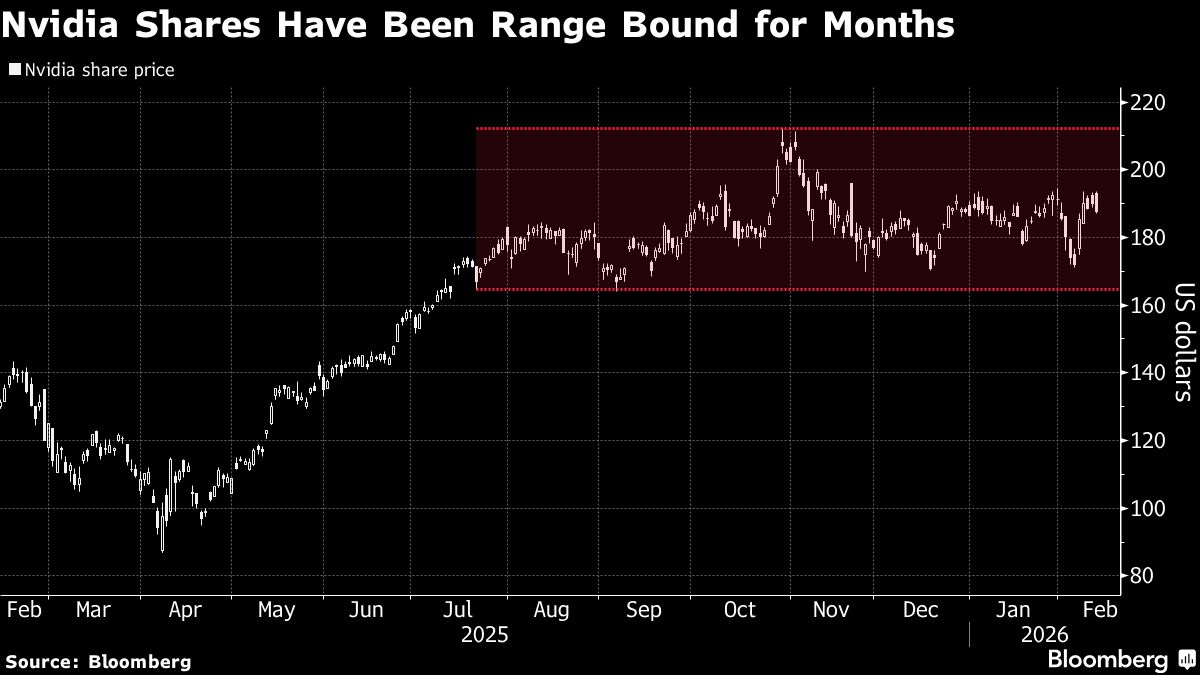
Nvidia stock has retreated 3% in 2026. Further, Nvidia stock has been in a trading range since mid-2025. One view is that investors are focusing on the sustainability of hyperscaler capital spending growth and the longevity of the AI business cycle. In other words, investors are focused on the duration of the AI boom, not the magnitude.

Meanwhile, investors are scrutinizing capital spending hikes by hyperscalers — cloud computing giants that build massive data centers.  Shares in all the hyperscalers have under-performed in 2026 amid worries that they're building too much AI infrastructure, too fast.

Four hyperscalers — Alphabet's (GOOGL) Google, Amazon.com (AMZN), Meta Platforms (META) and Microsoft (MSFT) — are now expected to spend $645 billion in 2026, representing growth of 56% or $230 billion on a dollar basis. Google stock is down 3% this year while Meta has retreated 7%. Amazon stock has pulled back 10%. Microsoft stock is down 18%.

In 2026, investors prefer some data center plays over AI chip suppliers amid intensified semiconductor competition. Among the top-performing AI stocks this year have been Lumentum, Ciena (CIEN), Applied Optoelectronics (AAOI), and Vertiv HoldingsVRT.....

....MUCH MORE 

In pre-market trade the big dog's stock is up $2.92 (+1.62%) to $183.17 making up Friday's $2.91 drop.

Friday, February 13, 2026

"Nvidia Shares Go Cold Even as Big Tech Spending on AI Balloons" (NVDA)

This is true.

It is also true that come October - November, after the boys of summer have gone, Nvidia will still be with us. It is sometimes difficult to comprehend just how truly awesome the company is, technologically or financially or just about any dimension you care to examine.

As just one example, after a decade of watching Google and their Tensor Processing Unit slowly catch up to, and then surpass, Nvidia's GPU's on the inference side of things, Nvidia did a $20 billion acquihire of Groq's wunderkinder CEO and licensed their inference technology.

For most any other company on earth that would be a tectonic move. For Nvidia it was just another step on the journey. And truth be told,  Groq's CEO isn't really a kid any more. While he was at Google he invented the TPU. 

From Bloomberg via Advisor Perspectives, February 13: 

Big Tech keeps raising its spending plans for artificial intelligence infrastructure, yet shares of Nvidia Corp., one of the biggest beneficiaries of that flood of cash, have been largely stagnant for months.

The stock is up less than 1% since the beginning of the fourth quarter and has been largely range bound despite hitting a record high in late October. It’s also barely beating the S&P 500 Index to start 2026, a slowdown from Nvidia’s nearly 40% leap in 2025 following two consecutive years of triple-digit percentage gains.

Even ballooning capital spending from Meta Platforms Inc., Alphabet Inc., Microsoft Corp. and Amazon.com Inc. — estimated to exceed $600 billion in 2026 — hasn’t been enough to meaningfully boost the stock amid increasing anxieties about returns on those investments.

https://www.advisorperspectives.com/images/content_image/data/5f/5fc06395a11f9435723c4be6d4384a3d.jpg 

“There is perhaps growing concern that the ultimate revenue from AI will simply not keep up with the capex spend that’s been announced,” said JoAnne Feeney at Advisors Capital Management, adding that more spending now raises the probability that the market will reach satiation faster. It’s “going to move up the date at which they pause and let the new compute be digested.”

The cyclical nature of the chip industry is baked into Nvidia’s valuation, which has compressed as revenue growth is expected to slow in the coming years. Sales are projected to expand 58% in the current calendar year and 28% in 2027, according to data compiled by Bloomberg.

Nvidia shares trade around 24 times profit estimates, roughly in-line with the Nasdaq 100 index and a slight premium to the S&P 500. Even though this price-to-earnings ratio is far below the five-year average for the stock at 38 times, investors aren’t counting it as a discount....

....MUCH MORE 

$183.03 down $3.91 (-2.09) last. 

Our judgement: If you want to own the future, own this company. That is not a new opinion.