From Quanta Magazine,
The artist had no formal math education, yet as a new exhibition shows, the insights revealed in his artwork became an enduring inspiration to mathematicians.
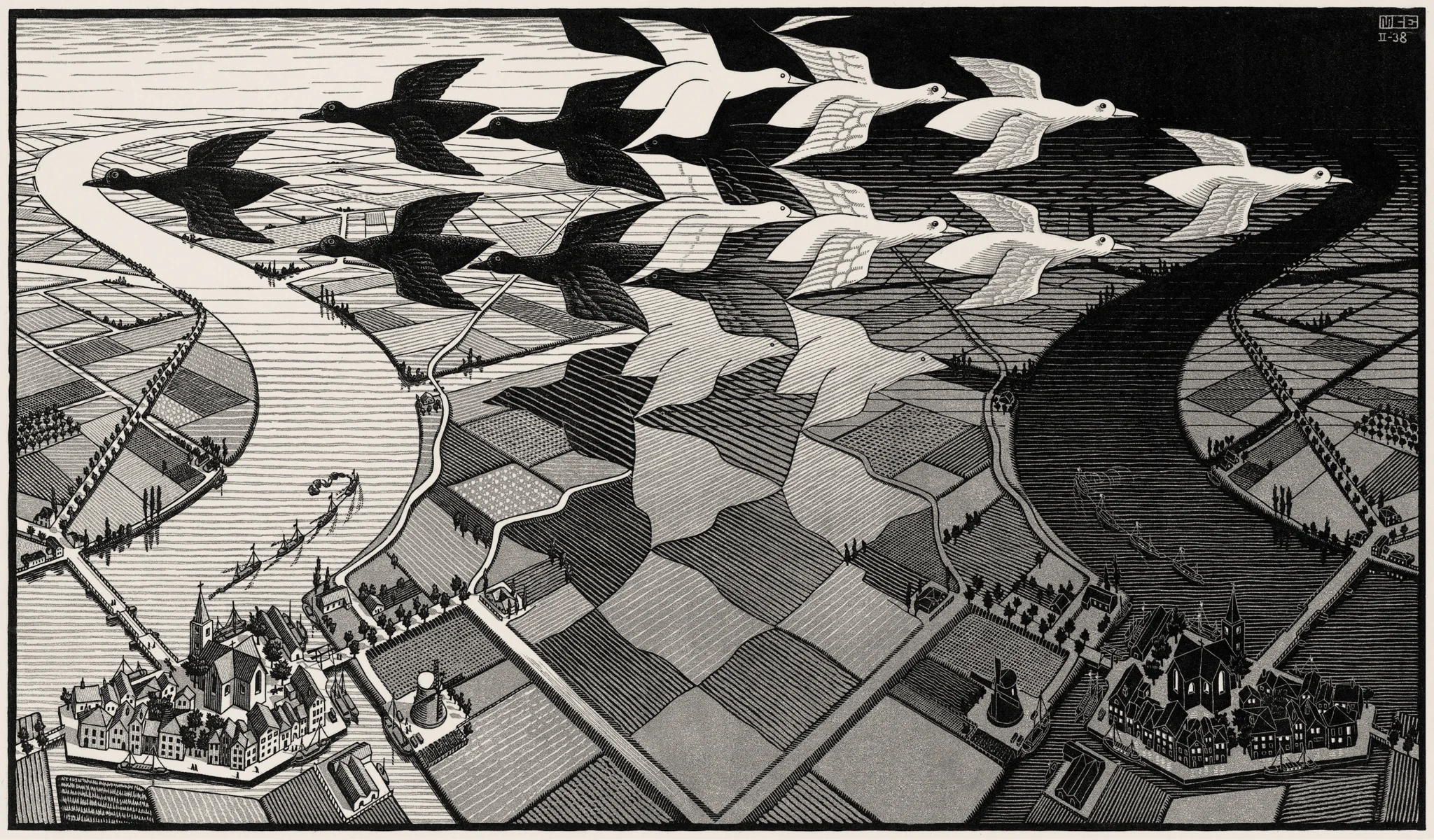
Day and Night, February 1938, woodcut printed from two blocks, 15 3/8 x 26 5/8 in
Maurits Cornelis Escher didn’t plan on becoming the darling of mathematicians. Born in 1898 in the canal-lined city of Leeuwarden in the Netherlands, Escher struggled with mathematics as a student, once remarking that he “never got a pass mark.” He ended up studying decorative arts and printmaking, and he used his artwork to explore the strange rules of nature that he found operating around him.
Escher saw that nature can sometimes produce impossible-seeming images. All around him, he saw distorted reflections, odd perspectives, and superimposed worlds, like the surface of a pond where you can see images of both the fish below and the trees reflected from above.
In rendering these and other visions, his artwork took on unmistakably mathematical qualities. “By keenly confronting the enigmas that surround us, and by considering and analyzing the observations that I had made, I ended up in the domain of mathematics,” he wrote in his introduction to the book M.C. Escher: The Graphic Work.
His journey among these enigmas is the subject of an exhibition entitled Mathematics and the Art of M.C. Escher (opens a new tab) at the National Museum of Mathematics (MoMath) in New York City....
....MUCH MORE, many of the prints, some famous, some that may be new to the reader.
Related:
August 2014 - The Advantages of Dyslexia
February 2014 - "Why strange loops could be an argument for artificial intelligence"
Previously on the Strange Loops Channel (Feb. 2012):
Climateer Headline of the Day: Strange Loops Edition
First, a quick definition from Wolfram Math World:
A strange loop is a phenomenon in which, whenever movement is made upwards or downwards through the levels of some hierarchical system, the system unexpectedly arrives back where it started. Hofstadter (1989) uses the strange loop as a paradigm in which to interpret paradoxes in logic (such as Grelling's paradox, the liar's paradox, and Russell's paradox) and calls a system in which a strange loop appears a tangled hierarchy....Here's a graphic example of a strange loop:
Drawing Hands M.C. Escher, 1948

....MUCH MORE
And February 2026:
From the Concurrent substack, September 11, 2025:
On circles, misconceptions, deep infrastructure, founder archetypes, state's role, memes, AGI. A conversation about the topology of China’s AI world for you.
H is an AI engineer at one of China's largest tech companies, leading an open-source project. A few weeks ago, I met him in Shenzhen during a self-organized "China AI/tech tour" with several US tech writers.1 After peppering him with questions—the most obvious one being "What's Silicon Valley's biggest misunderstanding about China's AI?"—I discovered someone so thoughtful and genuinely bilingual.
His daily routine reveals the paradox: wake up, doomscroll X, debate on LessWrong, drive his NIO to work, then use English more heavily than when he studied in California. He loves watching Westworld and treats Gödel, Escher, Bach as AI scripture. Apart from geography, H could be any engineer at Anthropic or Google....

