Showing posts sorted by relevance for query Google index. Sort by date Show all posts

Thursday, October 1, 2020

"Report: US could sue Google for search, advertising dominance" (GOOG)

There is a solution for search, see after the jump.
From Android Authority, September 30:
  • The US Department of Justice is expected to sue Google as soon as next week.
  • It’s believed that the lawsuit accuses Google of putting search rivals at a disadvantage.
  • The department is also said to be investigating search advertising under Google’s search box.

Google has faced several legal challenges in recent years regarding its search and advertising business, and it looks like the US is next in line to take aim at the company.

According to Reuters, citing three sources familiar with the matter, the US Department of Justice is set to file a lawsuit against Google as soon as next week. It’s alleged that the department is also calling on state attorneys general to sign onto the suit.

The lawsuit reportedly accuses Google of trying to put search rivals such as Bing at a disadvantage. More specifically, it’s claimed that Google deprives rivals of “the data about users and user preferences” that these rivals need to improve their services and advertising.

Reuters says the Department of Justice is also focusing on search advertising that appears under Google’s search box, noting that Google controls these search boxes and the associated tools.

Recent actions against Google
This wouldn’t be the first time Google came under fire for its search and advertising practices, as the European Commission levied a €1.49 billion (~$1.7 billion) fine against Google last year for online advertising abuse.... 
....MORE

August 2019
What Alphabet Really Fears: Why Google Won't Make Google Search the Default in Android For Europe
This is a half-measure that will do nothing to curb the GOOG's power. It almost looks like regulatory capture. After the jump, the proposal that would work....
*****
... And from Dr. Robert Epstein, former editor-in-chief at Psychology Today, search-engine researcher, Huffington Post contributor etc. writing at BloombergBusinessweek, July 15: 

To Break Google’s Monopoly on Search, Make Its Index Public
The tech giant doesn’t have to be dismantled. Sharing its crown jewel might reshape the internet.

Recognition is growing worldwide that something big needs to be done about Big Tech, and fast.
More than $8 billion in fines have been levied against Google by the European Union since 2017. Facebook Inc., facing an onslaught of investigations, has dropped in reputation to almost rock bottom among the 100 most visible companies in the U.S. Former employees of Google and Facebook have warned that these companies are “ripping apart the social fabric” and can “hijack the mind.”
Adding substance to the concerns, documents and videos have been leaking from Big Tech companies, supporting fears—most often expressed by conservatives—about political manipulations and even aspirations to engineer human values.

Fixes on the table include forcing the tech titans to divest themselves of some of the companies they’ve bought (more than 250 by Google and Facebook alone) and guaranteeing that user data are transportable.

But these and a dozen other proposals never get to the heart of the problem, and that is that Google’s search engine and Facebook’s social network platform have value only if they are intact. Breaking up Google’s search engine would give us a smattering of search engines that yield inferior results (the larger the search engine, the wider the range of results it can give you), and breaking up Facebook’s platform would be like building an immensely long Berlin Wall that would splinter millions of relationships.

With those basic platforms intact, the three biggest threats that Google and Facebook pose to societies worldwide are barely affected by almost any intervention: the aggressive surveillance, the suppression of content, and the subtle manipulation of the thinking and behavior of more than 2.5 billion people.

Different tech companies pose different kinds of threats. I’m focused here on Google, which I’ve been studying for more than six years through both experimental research and monitoring projects. (Google is well aware of my work and not entirely happy with me. The company did not respond to requests for comment.) Google is especially worrisome because it has maintained an unopposed monopoly on search worldwide for nearly a decade. It controls 92 percent of search, with the next largest competitor, Microsoft’s Bing, drawing only 2.5%.

Fortunately, there is a simple way to end the company’s monopoly without breaking up its search engine, and that is to turn its “index”—the mammoth and ever-growing database it maintains of internet content—into a kind of public commons.

There is precedent for this both in law and in Google’s business practices. When private ownership of essential resources and services—water, electricity, telecommunications, and so on—no longer serves the public interest, governments often step in to control them. One particular government intervention is especially relevant to the Big Tech dilemma: the 1956 consent decree in the U.S. in which AT&T agreed to share all its patents with other companies free of charge. As tech investor Roger McNamee and others have pointed out, that sharing reverberated around the world, leading to a significant increase in technological competition and innovation.
Doesn’t Google already share its index with everyone in the world? Yes, but only for single searches. I’m talking about requiring Google to share its entire index with outside entities—businesses, nonprofit organizations, even individuals—through what programmers call an application programming interface, or API.

Google already allows this kind of sharing with a chosen few, most notably a small but ingenious company called Startpage, which is based in the Netherlands. In 2009, Google granted Startpage access to its index in return for fees generated by ads placed near Startpage search results.
With access to Google’s index—the most extensive in the world, by far—Startpage gives you great search results, but with a difference. Google tracks your searches and also monitors you in other ways, so it gives you personalized results. Startpage doesn’t track you—it respects and guarantees your privacy—so it gives you generic results. Some people like customized results; others treasure their privacy. (You might have heard of another privacy-oriented alternative to Google.com called DuckDuckGo, which aggregates information obtained from 400 other non-Google sources, including its own modest crawler.)

If entities worldwide were given unlimited access to Google’s index, dozens of Startpage variants would turn up within months; within a year or two, thousands of new search platforms might emerge, each with different strengths and weaknesses....
....MUCH MORE

And: 
"Google to Donate Its Search Engine to the American Public" (GOOG)

Saturday, August 3, 2019

What Alphabet Really Fears: Why Google Won't Make Google Search the Default in Android For Europe

This is a half-measure that will do nothing to curb the GOOG's power. It almost looks like regulatory capture. After the jump, the proposal that would work.
From c|net:

Google won't be default search engine for Android users in EU next year
The tech titan shows off changes it's making to Android to comply with an EU antitrust decision.
Google will prompt Android owners in Europe to choose their own search engine starting next year, according to announcement made by the company on Friday in a blog post. When setting up an Android, you'll instead be presented with a screen where you'll be asked to select a search engine from a range of options.

The introduction of the search engine engine selection screen follows a landmark antitrust decision by the European Commission last year that determined Google could be hampering consumer choice by stipulating its own apps and services must be the pre-installed, default options on Android phones. The decision resulted in a record 4.34 billion euros ($5 billion) fine. Google is appealing the fine, but is making changes to Android regardless.

European Competition Commissioner Margrethe Vestager, who led the investigation into Google's Android abuses, has been clear that it's up to Google to work out how to make changes to Android to comply with the decision....
....MORE

And from Dr. Robert Epstein, former editor-in-chief at Psychology Today, search-engine researcher, Huffington Post contributor etc. writing at BloombergBusinessweek, July 15: 

To Break Google’s Monopoly on Search, Make Its Index Public
The tech giant doesn’t have to be dismantled. Sharing its crown jewel might reshape the internet.
Recognition is growing worldwide that something big needs to be done about Big Tech, and fast.
More than $8 billion in fines have been levied against Google by the European Union since 2017. Facebook Inc., facing an onslaught of investigations, has dropped in reputation to almost rock bottom among the 100 most visible companies in the U.S. Former employees of Google and Facebook have warned that these companies are “ripping apart the social fabric” and can “hijack the mind.”
Adding substance to the concerns, documents and videos have been leaking from Big Tech companies, supporting fears—most often expressed by conservatives—about political manipulations and even aspirations to engineer human values.

Fixes on the table include forcing the tech titans to divest themselves of some of the companies they’ve bought (more than 250 by Google and Facebook alone) and guaranteeing that user data are transportable.

But these and a dozen other proposals never get to the heart of the problem, and that is that Google’s search engine and Facebook’s social network platform have value only if they are intact. Breaking up Google’s search engine would give us a smattering of search engines that yield inferior results (the larger the search engine, the wider the range of results it can give you), and breaking up Facebook’s platform would be like building an immensely long Berlin Wall that would splinter millions of relationships.

With those basic platforms intact, the three biggest threats that Google and Facebook pose to societies worldwide are barely affected by almost any intervention: the aggressive surveillance, the suppression of content, and the subtle manipulation of the thinking and behavior of more than 2.5 billion people.

Different tech companies pose different kinds of threats. I’m focused here on Google, which I’ve been studying for more than six years through both experimental research and monitoring projects. (Google is well aware of my work and not entirely happy with me. The company did not respond to requests for comment.) Google is especially worrisome because it has maintained an unopposed monopoly on search worldwide for nearly a decade. It controls 92 percent of search, with the next largest competitor, Microsoft’s Bing, drawing only 2.5%.

Fortunately, there is a simple way to end the company’s monopoly without breaking up its search engine, and that is to turn its “index”—the mammoth and ever-growing database it maintains of internet content—into a kind of public commons.

There is precedent for this both in law and in Google’s business practices. When private ownership of essential resources and services—water, electricity, telecommunications, and so on—no longer serves the public interest, governments often step in to control them. One particular government intervention is especially relevant to the Big Tech dilemma: the 1956 consent decree in the U.S. in which AT&T agreed to share all its patents with other companies free of charge. As tech investor Roger McNamee and others have pointed out, that sharing reverberated around the world, leading to a significant increase in technological competition and innovation.
Doesn’t Google already share its index with everyone in the world? Yes, but only for single searches. I’m talking about requiring Google to share its entire index with outside entities—businesses, nonprofit organizations, even individuals—through what programmers call an application programming interface, or API.

Google already allows this kind of sharing with a chosen few, most notably a small but ingenious company called Startpage, which is based in the Netherlands. In 2009, Google granted Startpage access to its index in return for fees generated by ads placed near Startpage search results.

With access to Google’s index—the most extensive in the world, by far—Startpage gives you great search results, but with a difference. Google tracks your searches and also monitors you in other ways, so it gives you personalized results. Startpage doesn’t track you—it respects and guarantees your privacy—so it gives you generic results. Some people like customized results; others treasure their privacy. (You might have heard of another privacy-oriented alternative to Google.com called DuckDuckGo, which aggregates information obtained from 400 other non-Google sources, including its own modest crawler.)

If entities worldwide were given unlimited access to Google’s index, dozens of Startpage variants would turn up within months; within a year or two, thousands of new search platforms might emerge, each with different strengths and weaknesses....
....MUCH MORE

At the Huffington Post:

Google Critic Killed in “Ironic” Car Accident: Struck by Google Street View Vehicle
By Camille Johnson, San Diego Union-Tribune
San Diego, CA. Prominent research psychologist and author Dr. Robert Epstein, age 60, was killed yesterday afternoon by a Google Street View vehicle while crossing Front Street in San Diego, where he has long resided. Although foul play is not suspected, Epstein’s friends are calling the accident “ironic.”
According to Daryn Thompson, a 30-year friend of Epstein’s who also lives in San Diego, “We all know that Google isn’t evil, so there’s no chance this was deliberate, but it’s troubling and ironic that it just happened to be an outspoken critic of Google who was hit. I’m sure it was just a coincidence, though.”...MORE

Monday, October 19, 2020

"To Break Google’s Monopoly on Search, Make Its Index Public" (GOOG)

 Treat them like the utilities they are.

The author,  Dr. Robert Epstein is the former editor-in-chief at Psychology Today, search-engine researcher, Huffington Post contributor etc.

From Bloomberg Businessweek, July 15, 2019:

The tech giant doesn’t have to be dismantled. Sharing its crown jewel might reshape the internet.

Recognition is growing worldwide that something big needs to be done about Big Tech, and fast.
More than $8 billion in fines have been levied against Google by the European Union since 2017. Facebook Inc., facing an onslaught of investigations, has dropped in reputation to almost rock bottom among the 100 most visible companies in the U.S. Former employees of Google and Facebook have warned that these companies are “ripping apart the social fabric” and can “hijack the mind.”
Adding substance to the concerns, documents and videos have been leaking from Big Tech companies, supporting fears—most often expressed by conservatives—about political manipulations and even aspirations to engineer human values.

Fixes on the table include forcing the tech titans to divest themselves of some of the companies they’ve bought (more than 250 by Google and Facebook alone) and guaranteeing that user data are transportable.

But these and a dozen other proposals never get to the heart of the problem, and that is that Google’s search engine and Facebook’s social network platform have value only if they are intact. Breaking up Google’s search engine would give us a smattering of search engines that yield inferior results (the larger the search engine, the wider the range of results it can give you), and breaking up Facebook’s platform would be like building an immensely long Berlin Wall that would splinter millions of relationships.

With those basic platforms intact, the three biggest threats that Google and Facebook pose to societies worldwide are barely affected by almost any intervention: the aggressive surveillance, the suppression of content, and the subtle manipulation of the thinking and behavior of more than 2.5 billion people.

Different tech companies pose different kinds of threats. I’m focused here on Google, which I’ve been studying for more than six years through both experimental research and monitoring projects. (Google is well aware of my work and not entirely happy with me. The company did not respond to requests for comment.) Google is especially worrisome because it has maintained an unopposed monopoly on search worldwide for nearly a decade. It controls 92 percent of search, with the next largest competitor, Microsoft’s Bing, drawing only 2.5%.

Fortunately, there is a simple way to end the company’s monopoly without breaking up its search engine, and that is to turn its “index”—the mammoth and ever-growing database it maintains of internet content—into a kind of public commons.

There is precedent for this both in law and in Google’s business practices. When private ownership of essential resources and services—water, electricity, telecommunications, and so on—no longer serves the public interest, governments often step in to control them. One particular government intervention is especially relevant to the Big Tech dilemma: the 1956 consent decree in the U.S. in which AT&T agreed to share all its patents with other companies free of charge. As tech investor Roger McNamee and others have pointed out, that sharing reverberated around the world, leading to a significant increase in technological competition and innovation.
Doesn’t Google already share its index with everyone in the world? Yes, but only for single searches. I’m talking about requiring Google to share its entire index with outside entities—businesses, nonprofit organizations, even individuals—through what programmers call an application programming interface, or API.

Google already allows this kind of sharing with a chosen few, most notably a small but ingenious company called Startpage, which is based in the Netherlands. In 2009, Google granted Startpage access to its index in return for fees generated by ads placed near Startpage search results.

With access to Google’s index—the most extensive in the world, by far—Startpage gives you great search results, but with a difference. Google tracks your searches and also monitors you in other ways, so it gives you personalized results. Startpage doesn’t track you—it respects and guarantees your privacy—so it gives you generic results. Some people like customized results; others treasure their privacy. (You might have heard of another privacy-oriented alternative to Google.com called DuckDuckGo, which aggregates information obtained from 400 other non-Google sources, including its own modest crawler.)

If entities worldwide were given unlimited access to Google’s index, dozens of Startpage variants would turn up within months; within a year or two, thousands of new search platforms might emerge, each with different strengths and weaknesses....
....MUCH MORE

At the Huffington Post:

Google Critic Killed in “Ironic” Car Accident: Struck by Google Street View Vehicle
By Camille Johnson, San Diego Union-Tribune
San Diego, CA. Prominent research psychologist and author Dr. Robert Epstein, age 60, was killed yesterday afternoon by a Google Street View vehicle while crossing Front Street in San Diego, where he has long resided. Although foul play is not suspected, Epstein’s friends are calling the accident “ironic.”
According to Daryn Thompson, a 30-year friend of Epstein’s who also lives in San Diego, “We all know that Google isn’t evil, so there’s no chance this was deliberate, but it’s troubling and ironic that it just happened to be an outspoken critic of Google who was hit. I’m sure it was just a coincidence, though.”...MORE

Coming up, Al-Qaeda's tips for hiding from drones

Friday, September 20, 2024

What Is an Effective Remedy in the Google Search Case? (GOOG; EVIL)

Dismemberment.

And then, when you're done with the officers and directors... 

Okay, just kidding. The most logical remedy is to regulate search as a public utility. And if they push back against that, dismemberment.

I have to stop reading medieval history before going to sleep at night.

How's about we rip the company's index from the still-living beast and...

That's it, from now on it's Pollyanna with her 'glad game.' And Candide. And maybe Leibniz.

In the meantime here is ProMarket from the University of Chicago's Stigler Center, September 6:

For more than a decade, Google has paid firms such as Apple and Mozilla to set Google Search as the default search engine on their web browsers. The company has also required mobile phone developers who use Google’s Android operating system to pre-install Google’s products, including Google Chrome and Search. On August 5, Judge Amit Mehta found this behavior violated Section 2 of the Sherman Act as constituting exclusionary conduct to maintain monopoly power. Judge Mehta now must investigate and mandate a remedy to restore competition. This will be a daunting endeavor because his performance in setting the remedy will be remembered for a long time. Consider Judges Harold Greene in AT&T and Thomas Penfield Jackson in Microsoft. I do not envy the pressure on him. In this short note, I analyze some of the alternatives that Judge Mehta can choose along with my comments and recommendations. 

Legal and Policy Considerations

In U.S. v. Microsoft Corp., the court stated four objectives: unfetter a market from anticompetitive conduct; terminate the illegal monopoly; deny to the defendant the fruits of its statutory violation; and ensure that there remain no practices likely to result in monopolization in the future. In this monopoly maintenance case (including where the conduct enhanced the defendant’s monopoly power), the goals are similar. However, the strength of a reasonable remedy for the anticompetitive conduct depends on the degree to which the actual and potential rivals disadvantaged by the anticompetitive exclusionary conduct would have substantially reduced or eliminated the monopoly power of the defendant.

Stated slightly differently, the remedy in the Google Search case must restore the intensity of the competitive process that would have occurred but for the years of anticompetitive conduct. Judge Mehta will need to decide if an effective remedy requires affirmative efforts that go beyond simply enjoining the specific illegal conduct. To this end, Judge Mehta will surely look to the formative Microsoft case settled at the turn of the century, as he did in his ruling finding Google in breach of Section 2.

In his analysis and critique of the Microsoft remedy some years after testifying for the states on remedy, Professor Carl Shapiro explained his remedial framework that “[r]estoring competition requires taking affirmative steps to lower the barriers to entry” to prevent the monopolist from continuing to profit from its anticompetitive conduct. He further explained that “lowering entry barriers does not mean picking winners or engineering the market; it means imposing conditions that make it easier for potential entrants to overcome those barriers.” Shapiro’s article also notes that Professor Kevin Murphy (testifying on behalf of Microsoft) made a similar point, stating there that “[t]o the extent that past illegal acts have injured competition, the remedies should work to restore the prospects for consumer welfare to the level that would have existed absent the illegal acts.” Craig Romaine and I framed this remedial approach in our analysis of Microsoft as “jump starting” competition.

In short, the remedy must go beyond simply enjoining the anticompetitive conduct. It should include provisions to reignite the competitive process sufficiently to more quickly and surely restore effective competition. It also is important to recognize that there are degrees of monopoly power. And if he finds that the long duration of Google’s conduct increased its monopoly power over time, that fact calls for an even stronger remedy.

To conceptualize this relationship with a simple hypothetical example, suppose that a monopolist has maintained and enhanced its monopoly power with exclusionary conduct that has created and maintained prohibitive barriers to entry over (say) a ten-year period. Suppose further that absent the exclusionary conduct, there would have been (say) a 10% independent probability in each year that there would have been entry which would have successfully substantially reduced or eliminated the monopoly power. Given this 10% probability, the likelihood there would have been such successful entry within 10 years is about 65%. Thus, the likelihood that the monopolist would still have had monopoly power by the tenth year is only about 35% absent the conduct....

....MUCH MORE

Or a five year-old post: 

August 2019
What Alphabet Really Fears: Why Google Won't Make Google Search the Default in Android For Europe
This is a half-measure that will do nothing to curb the GOOG's power. It almost looks like regulatory capture. After the jump, the proposal that would work....

*****
... And from Dr. Robert Epstein, former editor-in-chief at Psychology Today, search-engine researcher, Huffington Post contributor etc. writing at BloombergBusinessweek, July 15: 

To Break Google’s Monopoly on Search, Make Its Index Public
The tech giant doesn’t have to be dismantled. Sharing its crown jewel might reshape the internet.
Recognition is growing worldwide that something big needs to be done about Big Tech, and fast.
More than $8 billion in fines have been levied against Google by the European Union since 2017. Facebook Inc., facing an onslaught of investigations, has dropped in reputation to almost rock bottom among the 100 most visible companies in the U.S. Former employees of Google and Facebook have warned that these companies are “ripping apart the social fabric” and can “hijack the mind.”
Adding substance to the concerns, documents and videos have been leaking from Big Tech companies, supporting fears—most often expressed by conservatives—about political manipulations and even aspirations to engineer human values.

Fixes on the table include forcing the tech titans to divest themselves of some of the companies they’ve bought (more than 250 by Google and Facebook alone) and guaranteeing that user data are transportable.

But these and a dozen other proposals never get to the heart of the problem, and that is that Google’s search engine and Facebook’s social network platform have value only if they are intact. Breaking up Google’s search engine would give us a smattering of search engines that yield inferior results (the larger the search engine, the wider the range of results it can give you), and breaking up Facebook’s platform would be like building an immensely long Berlin Wall that would splinter millions of relationships.

With those basic platforms intact, the three biggest threats that Google and Facebook pose to societies worldwide are barely affected by almost any intervention: the aggressive surveillance, the suppression of content, and the subtle manipulation of the thinking and behavior of more than 2.5 billion people.

Different tech companies pose different kinds of threats. I’m focused here on Google, which I’ve been studying for more than six years through both experimental research and monitoring projects. (Google is well aware of my work and not entirely happy with me. The company did not respond to requests for comment.) Google is especially worrisome because it has maintained an unopposed monopoly on search worldwide for nearly a decade. It controls 92 percent of search, with the next largest competitor, Microsoft’s Bing, drawing only 2.5%.

Fortunately, there is a simple way to end the company’s monopoly without breaking up its search engine, and that is to turn its “index”—the mammoth and ever-growing database it maintains of internet content—into a kind of public commons.

There is precedent for this both in law and in Google’s business practices. When private ownership of essential resources and services—water, electricity, telecommunications, and so on—no longer serves the public interest, governments often step in to control them. One particular government intervention is especially relevant to the Big Tech dilemma: the 1956 consent decree in the U.S. in which AT&T agreed to share all its patents with other companies free of charge. As tech investor Roger McNamee and others have pointed out, that sharing reverberated around the world, leading to a significant increase in technological competition and innovation.
Doesn’t Google already share its index with everyone in the world? Yes, but only for single searches. I’m talking about requiring Google to share its entire index with outside entities—businesses, nonprofit organizations, even individuals—through what programmers call an application programming interface, or API.

Google already allows this kind of sharing with a chosen few, most notably a small but ingenious company called Startpage, which is based in the Netherlands. In 2009, Google granted Startpage access to its index in return for fees generated by ads placed near Startpage search results.
With access to Google’s index—the most extensive in the world, by far—Startpage gives you great search results, but with a difference. Google tracks your searches and also monitors you in other ways, so it gives you personalized results. Startpage doesn’t track you—it respects and guarantees your privacy—so it gives you generic results. Some people like customized results; others treasure their privacy. (You might have heard of another privacy-oriented alternative to Google.com called DuckDuckGo, which aggregates information obtained from 400 other non-Google sources, including its own modest crawler.)

If entities worldwide were given unlimited access to Google’s index, dozens of Startpage variants would turn up within months; within a year or two, thousands of new search platforms might emerge, each with different strengths and weaknesses....

....MUCH MORE

And: 
"Google to Donate Its Search Engine to the American Public" (GOOG)

Or at the Huffington Post:

Google Critic Killed in “Ironic” Car Accident: Struck by Google Street View Vehicle

By Camille Johnson, San Diego Union-Tribune
San Diego, CA. Prominent research psychologist and author Dr. Robert Epstein, age 60, was killed yesterday afternoon by a Google Street View vehicle while crossing Front Street in San Diego, where he has long resided. Although foul play is not suspected, Epstein’s friends are calling the accident “ironic.”
According to Daryn Thompson, a 30-year friend of Epstein’s who also lives in San Diego, “We all know that Google isn’t evil, so there’s no chance this was deliberate, but it’s troubling and ironic that it just happened to be an outspoken critic of Google who was hit. I’m sure it was just a coincidence, though.”...MORE

Maybe "Warped sense of humour could be ‘sign of impending dementia’"

Following last week's "Long-winded speech could be early sign of Alzheimer's disease, says study" a "friend" sent this along.
I can't catch a freaking break this month....

Sunday, October 16, 2016

"Not OK, Google" (GOOG)

There are two ways to say a command.
  • With newer Android devices, just say "OK Google," followed by a question or task. For example, if I wanted to know the weather, I could say "OK Google, what's the weather like today?" and a few seconds later Google Now would provide the forecast....--c|net's "The complete list of 'OK, Google' commands"

From TechCrunch, Oct. 5:

Not OK, Google

Not OK, Google
At its hardware launch event in San Francisco yesterday, Alphabet showed the sweeping breadth of its ambition to own consumers’ personal data, as computing continues to accelerate away from static desktops and screens, coalescing into a cloud of connected devices with the potential to generate far more data — and data of a far more intimate nature — than ever before.

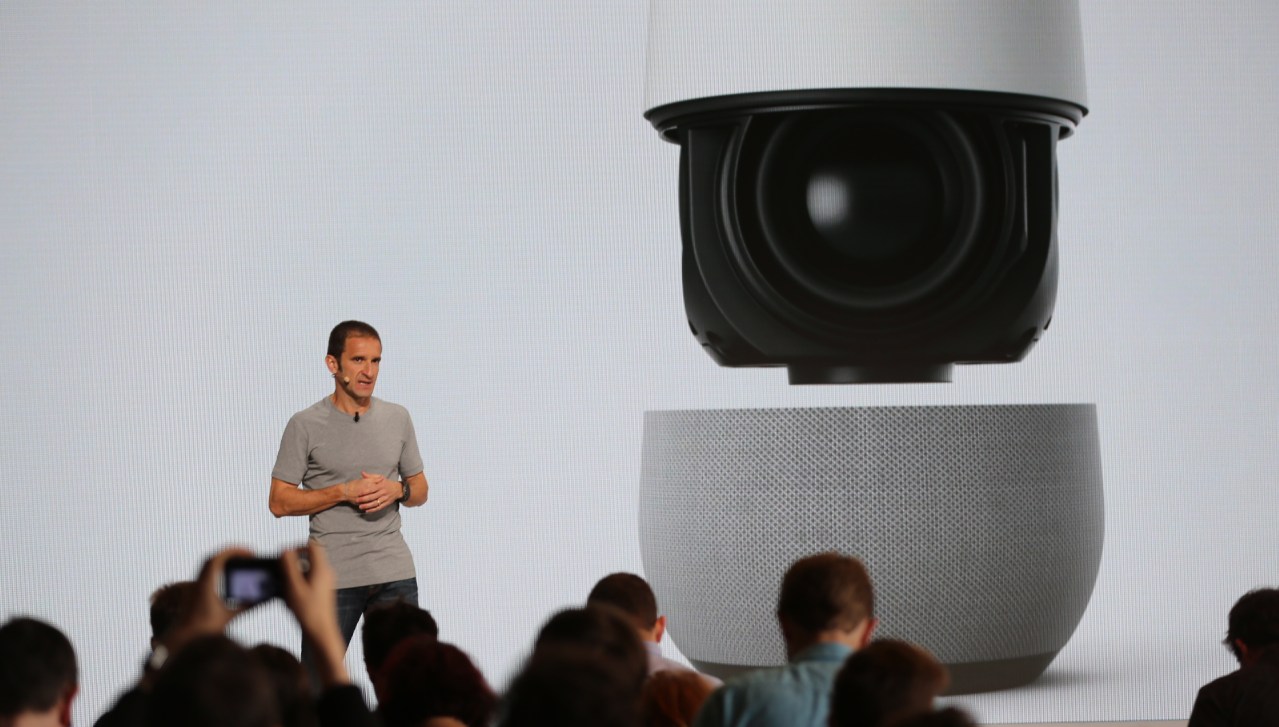
Along with two new “Google designed” flagship Android smartphones (called Pixel), the first Androids to be preloaded with the company’s AI assistant (the Google Assistant) and also including fully unlimited cloud storage to suck users’ photos and videos into Google’s cloud, there were Google Wifi routers, designed to be bought in bundles to plug all those pesky in-home internet blackspots; the Google Home always listening connected speaker, which is voice-controlled via the Google Assistant and has limited support for third-party IoT devices (such as Philips Hue lightbulbs); an updated Chromecast (the Ultra) to ensure any legacy TV panels are internet-enabled; and Google’s less disposable mobile VR play, aka the soft-touch Daydream View headset — just in case consumer eyeballs seek to stray outside the data-mined smart home by escaping into virtual reality.

The scope of Alphabet’s ambition for the Google brand is clear: It wants Google’s information organizing brain to be embedded right at the domestic center — i.e. where it’s all but impossible for consumers not to feed it with a steady stream of highly personal data. (Sure, there’s a mute button on the Google Home, but the fact you have to push a button to shut off the ear speaks volumes… )
In other words, your daily business is Google’s business.

“We’re moving from a mobile-first world to an AI-first world,” said CEO Sundar Pichai kicking off yesterday’s event. And AI, of course, has an appetite for data like no other technology before it. Machine learning needs information to mold its utility. It’s a data-powered circle that can’t function in the dark.

The Alphabet vision for hardware “Made by Google” is thus to sell the pledge of convenience to consumers. And through this sales pitch, and its accompanying suite of connect-it-all devices, to transform personal spaces into rich repositories of user intel that can continue to fuel its ad-targeting engines for decades to come.

We’ve very far beyond the moment in the modern information age when most of the queries and curiosities of digital consumers could be funneled into a single, Google-branded search engine. Hence, the company (formerly also wearing the Google brand name) working so long and hard to push Android’s reach as far and wide as possible, beyond phones to a huge range of hardware.
And now Alphabet is seeking to accelerate that process with a consumer-facing, AI-powered service layer that works to make Google just as hard to avoid as it used to be, back in the days of the simpler desktop web.

So yesterday’s big connected hardware unboxing is really about reinvigorating and repositioning the Google brand as the go-to keyword for the Internet of Things era, too.

Notably, and unlike rival virtual assistant technologies such as Amazon’s Alexa and Apple’s Siri, Alphabet is firmly retaining the Google brand name here at the consumer-facing end of the AI pipe — requiring those who buy into its smart home and AI assistant to give literal voice to the Google brand, day after day, hour after hour.

“OK Google, turn off the lights in the kids’ bedroom… ”

Ugh.

That’s icky enough in my view. But what’s really not OK, Google is the seismic privacy trade-offs involved here. And the way in which Alphabet works to skate over the surface of these concerns.
“We want to help you get things done in your world,” was Pichai’s pitch for the Google-branded smart home — and Google’s AI generally.

“We are excited about building a personal Google for everyone, everywhere,” was another of his marketing soundbites, putting a few threads on this sharp-elbowed rush for AI.
Yes — he literally said that…

What he does not say is far more interesting, i.e. that in order to offer its promise of “custom convenience” — with predictions about restaurants you might like to eat at, say, or suggestions for how bad the traffic might be on your commute to work — it is continuously harvesting and data-mining your personal information, preferences, predilections, peccadilloes, prejudices…  and so on and on and on.
AI never stops needing data. Not where fickle humans are concerned.
So the actual price for building a “personal Google for everyone, everywhere” would in fact be zero privacy for everyone, everywhere.

Doesn’t sound quite so OK, Google, now does it?

(One colleague tells how he previously switched off the antecedent to Google Assistant, Google Now, after it started telling him about traffic times to get to a bar he sometimes goes to on Sunday nights, with the complaint that: “I don’t want you to know about this.”)

So while we should not be surprised to find zero mention of security and privacy in Pichai’s pitch for a “personal Google,” nor should we give Google a pass for failing to be transparent with consumers about the massive trade-off they are making when they pay for its hardware with their privacy (and their cash!).

There’s even very little of substance as to what massive “benefits” consumers should expect in exchange for having an increasingly intimate relationship with Google.

“It’s still early days, but when all of that works together, the Google Assistant allows you to get things done, bringing you the information you need, when you need it, wherever you are,” writes Pichai, in a caveated phrase that scores extremely high on the underwhelming/vague promises index....MORE

Thursday, December 22, 2022

What Google Search Isn’t Showing You (GOOG; EVIL)

Following on yesterday's "WTF? Google Search Has Implemented "Infinite Scroll" In the U.S. (GOOG; EVIL)".

I have since been informed that a) infinite scroll had already been rolled out for mobile and b) that even prior to infinite scroll Google had been limiting the number of results you would get to see for a general search—as opposed to something specific such as The Blind Spot, where the GOOG will deliver you to Izzy's domain as the second result.

Not using Google search for either work or non-work (though sometimes for news) I was unaware of the two changes that had already been thrust upon the intrepid searcher of truth and/or cat videos.

I was aware that prior to the numerical limitation Google had been skewing results toward whatever suited their ideological fancy, links after the jump.

From The New Yorker, March 10 2022:

The search engine has made up so much of our online experience for so long that it can be hard to imagine something better.

When I recently Googled “best toaster” on my phone, thinking about replacing the appliance in my apartment kitchen, the search immediately yielded a carrousel of images of products from various high-design brands: Balmuda, Hay, Smeg. (Guilty: I had definitely searched for the Japanese Balmuda’s steam-enabled toasters before.) Lower down on the results page were ads for online retailers such as Amazon and Wayfair, then another carrousel of “Popular Toasters” with user-review metrics, then a list of suggested queries under the heading “People also ask.” (“Is it worth buying an expensive toaster?” “You can’t gain much beyond the $100 models,” an answer pulled from CNET reads.) Swiping down further, I reached aggregated listicles clearly designed to exploit Google’s search algorithm and profit from affiliate marketing: toaster tips from Good Housekeeping, the “4 best toaster ovens of 2022” from Wirecutter. Further down still was a map of toasters that could be purchased in physical proximity to my apartment. I felt lost among the suggestions, awash in information and yet compelled by none of it.

This kind of cluttered onslaught of homogenous e-commerce options is what recently prompted Dmitri Brereton, a twenty-six-year-old engineer at a recruiting-software company in San Francisco, to publish a blog post titled “Google Search Is Dying.” When it comes to product reviews or recipes, Brereton argued, results from Google’s search engine “have gone to shit.” Rather than settling for the default, those who want to know what a “genuine real-life human being” thinks of a certain product have learned work-arounds, such as adding “Reddit” to their searches to bring up relevant threads on that platform. On Reddit’s “Buy It for Life” forum, for instance, they’ll find users showing off a Soviet-era toaster, a restored vintage Sunbeam, and other toasters to “grow old with,” as one put it. Brereton’s post–which ended “Google is dead. Long live Google + ‘site:reddit.com’ ”—became the No. 10 most upvoted link ever on the tech-industry discussion board Hacker News. No. 11 is a complaint about Google’s search results looking too similar to its ads, while No. 12 is a link to an alternative, indie search engine. Clearly, others share Brereton’s sense of search-engine discontentment.

Brereton told me recently that his frustration began in late 2020. “I was browsing the Internet one day, and I began to feel like something was just off,” he said. “A lot of the content doesn’t feel authentic—it doesn’t feel real.” He sounded bemused by the runaway popularity of his post, which was part of a personal research project on how information is organized online. Better information could be found on social media, discussion boards, and small-scale personal blogs, but Google Search was deprioritizing those platforms in favor of corporate Web sites, which could afford the money and effort it takes to optimize for Google’s search algorithm. “The authentic Web” seemed hidden, Brereton said. “The algorithms tell us what to read.”

Google Search accounts for around eighty-five per cent of the global search-engine market. It has made up so much of our online experience for so long that it can be hard to envision anything different. The Google Search page today looks largely the same as it did when it first launched, in 1998: blue links against an austere white background. From the beginning, the company’s founders, Sergey Brin and Larry Page, recognized the tension between useful search results and profitable ones. “The goals of the advertising business model do not always correspond to providing quality search to users,” they wrote as Stanford students, in a 1998 paper. Yet ads were introduced in 2000 and have proliferated ever since. Links to Web sites have fallen down search-result pages, replaced by Google’s “Quick Answers,” which borrow bits of text from sites so that users don’t even need to click. Decades of search-engine optimization have resulted in content that is formulated not to inform readers but to rank prominently on Google pages. That might be one reason that my toaster results felt so redundant: each site is attempting to solve the same algorithmic equation.

Gabriel Weinberg, the C.E.O. of the privacy-focussed search-engine company DuckDuckGo, cited three other sources of dissatisfaction with Google Search. The first is the company’s practice of tracking user behavior, which drives the kind of creepy, chasing-you-around-the-Internet advertising that Google profits from. The second is Google prioritizing its own services in search results, by, for instance, answering a travel query with Quick Answers pulled from Google Places instead of from a richer, more social source such as Tripadvisor. Lastly, Weinberg argued, users are simply tired of Google’s dominance over their experience of the Internet. Google is reportedly paying Apple upward of fifteen billion dollars a year to remain the default search engine on iPhones. On Google’s own Android phone, changing one’s preferred search engine requires a cumbersome settings adjustment, and pop-up messages along the way urge the user to switch back to Google. “Most people have never chosen their search engine,” Weinberg said.

DuckDuckGo, which doesn’t engage in any user tracking, has in the past year doubled both its estimated user count, from fifty million to a hundred million, and its search traffic, from 1.5 billion to three billion queries a month. It serves ads based only on users’ search terms rather than on their past behavioral patterns. According to Weinberg, each time you search on DuckDuckGo, “it’s as if you’re there for the first time.” In reality, though, choosing among existing search engines has only a modest impact on one’s results, because all of the major engines operate based on a template established by Google’s original web crawler and PageRank technologies. DuckDuckGo, for instance, largely leverages the search algorithm of Microsoft’s product Bing. A DuckDuckGo search for “best toaster” surfaces more or less the same results on my phone as Google, with ads, sale alerts, and affiliate-marketing listicles. (The Times recently reported that DuckDuckGo has become popular among conspiracy theorists who believe that Google’s results are censored, but DuckDuckGo disputes that it turns up any more controversial content than Google.)

Viktor Lofgren, a Swedish software developer and consultant who created his own indie search engine called Marginalia, told me, “One part of the sameyness is that recommendation and prediction algorithms often seem to work almost too well.” Marginalia, which Lofgren started working on a year ago, is a bare-bones Web site run entirely from a computer in his living room. The search engine’s stated mission is to “show you sites you perhaps weren’t aware of.”...

....MUCH MORE

If interested see "To Break Google’s Monopoly on Search, Make Its Index Public" (GOOG)":
Treat them like the utilities they are.
The author, Dr. Robert Epstein is the former editor-in-chief at Psychology Today, search-engine researcher, Huffington Post contributor etc.
From Bloomberg Businessweek, July 15, 2019:....

And: "If You Liked Big Brother, Meet Google's Big MUM"

As we said earlier, Google is an ad-monger.
And the idea that a business that hustles ads can choose what I, you, anyone gets to see on the internet is getting a bit old. Let them continue to sell ads but make the index that underlies the search engine a public utility.....

Also:

Friday, August 9, 2024

"All the possible ways to destroy Google’s monopoly in search" (GOOG)

Following on August 5's "Google loses antitrust trial in major blow to tech giant" (GOOG).

From Ars Technica, August 7:

What the future of search could look like as DOJ seeks to end Google's monopoly.

After US District Judge Amit Mehta ruled that Google has a monopoly in two markets—general search services and general text advertising—everybody is wondering how Google might be forced to change its search business.

Specifically, the judge ruled that Google's exclusive deals with browser and device developers secured Google's monopoly. These so-called default agreements funneled the majority of online searches to Google search engine result pages (SERPs), where results could be found among text ads that have long generated the bulk of Google's revenue.

At trial, Mehta's ruling noted, it was estimated that if Google lost its most important default deal with Apple, Google "would lose around 65 percent of its revenue, even assuming that it could retain some users without the Safari default."

Experts told Ars that disrupting these default deals is the most obvious remedy that the US Department of Justice will seek to restore competition in online search. Other remedies that may be sought range from least painful for Google (mandating choice screens in browsers and devices) to most painful (requiring Google to divest from either Chrome or Android, where it was found to be self-preferencing).

But the remedies phase of litigation may have to wait until after Google's appeal, which experts said could take years to litigate before any remedies are ever proposed in court. Whether Google could be successful in appealing the ruling is currently being debated, with anti-monopoly advocates backing Mehta's ruling as "rock solid" and critics suggesting that the ruling's fresh takes on antitrust law are open to attack.

Google declined Ars' request to comment on appropriate remedies or its plan to appeal.

Previously, Google's president of global affairs, Kent Walker, confirmed in a statement that the tech giant would be appealing the ruling because the court found that "Google is 'the industry’s highest quality search engine, which has earned Google the trust of hundreds of millions of daily users,' that Google 'has long been the best search engine, particularly on mobile devices,' 'has continued to innovate in search,' and that 'Apple and Mozilla occasionally assess Google’s search quality relative to its rivals and find Google’s to be superior.'"

"Given this, and that people are increasingly looking for information in more and more ways, we plan to appeal," Walker said. "As this process continues, we will remain focused on making products that people find helpful and easy to use."

But Mehta found that Google was wielding its outsize influence in the search industry to block rivals from competing by locking browsers and devices into agreements ensuring that all searches went to Google SERPs. None of the pro-competitive benefits that Google claimed justified the exclusive deals persuaded Mehta, who ruled that "importantly," Google "exercised its monopoly power by charging supra-competitive prices for general search text ads"—and thus earned "monopoly profits."....

....MUCH MORE

If the Federales play hardball it will look something like this:

"To Break Google’s Monopoly on Search, Make Its Index Public" (GOOG)
Treat them like the utilities they are....

Also: Valuing, Disaggregating (and perhaps dismembering) Alphabet (GOOG)

Wednesday, October 26, 2022

"If You Liked Big Brother, Meet Google's Big MUM"

 As we said earlier, Google is an ad-monger.

And the idea that a business that hustles ads can choose what I, you, anyone gets to see on the internet is getting a bit old. Let them continue to sell ads but make the index that underlies the search engine a public utility. If interested see after the jump.

From The Gatestone Institute. October 25:

  • Google first unleashed MUM to fight what it considered COVID "misinformation" by making sure that everyone saw "high quality and timely information from trusted health authorities like the World Health Organization". By reducing the number of sources to only those that agree with its agenda, Google is able to deliver fast results while getting rid of different points of view.

  • Google long ago ceased being a way to find different answers and its search results are deliberately repetitive. Search is an illusion. The user thinks that he's browsing the internet when he's actually spinning his wheels in Google's walled garden.

  • Or as Pandu Nayak, VP of search at Google, wrote in a recent post, "By using our latest AI model, Multitask Unified Model (MUM), our systems can now understand the notion of consensus, which is when multiple high-quality sources on the web all agree on the same fact."

  • Google disagrees with many of its users about what "reliable sources" or "high-quality sources" entail.

  • In 2022, Google's search is hopelessly broken because the company no longer has any interest in providing the search service that made it a monopoly, giving a ranked list of diverse results, but wants everyone to speak into their phones and receive a single answer. The consensus.

  • If you own an advanced Android phone, you may find that Google Assistant will interrupt conversations to offer its own "insights". Google is also pursuing "prebunking" of what it considers "misinformation" with preemptive propaganda campaigns.

  • Jigsaw, the company's most explicitly political arm, is researching what it calls "prebunking" or attacking views it opposes before they can even gain traction. Prebunking is currently being experimentally tested by Google's Jigsaw to fight "misinformation" in Poland and other Eastern European countries....

  • Google's YouTube already has a broad set of bans covering everything from questioning global warming, contradicting medical experts, and debating 2020 election results. These are a window into the company's political agendas and how it seeks to enforce political conformity.

  • While it seeks to narrow the sphere of acceptable information in its platforms, Google is working with the leftist Poynter Institute, one of the most notoriously biased fact check spammers.... The company claims to have spent $75 million on efforts to fight "misinformation." And who determines what misinformation is? He who controls the algorithms.

  • As the midterm elections approach, YouTube spokeswoman, Ivy Choi, promised that the video site's recommendations are "continuously and prominently surfacing midterms-related content from authoritative news sources and limiting the spread of harmful midterms-related misinformation." The technical term for this is mass propaganda. That's what Big Tech does.

  • The internet was revolutionary because it upended the central systems of mass propaganda which allowed a government and a handful of men to enforce their consensus on a helpless public.....

  • Conservatives are one of the cultural barriers because their existence is a marked reminder that Big Tech does not control everything..... [Big Tech] manage systems that extend around the country and the world. When they encounter different points of view, they seek to wipe them out.

  • MUM is yet another tool for enforcing a totalitarian conformity on the diversity of the internet.

  • Google doesn't want you to think differently or to think for yourself. What it wants users to do is to shut up and listen to Big MUM.

 ....MUCH MORE

As I said, it's getting old. And it actually is within the power of the American people to do something about it.

More on the GOOG:

Saturday, November 2, 2019

Valuing, Disaggregating (and perhaps dismembering) Alphabet (GOOG)

The first step for regulators is to address search, and the thing to do is make Google's index public.
More, if interested after the jump.

But first, a deep dive from FT Alphaville, Nov 1:

Jeff Henriksen is the co-founder and CEO of Thorpe Abbotts Capital, a value-oriented hedge fund based out of Charlottesville, Virginia, and Associate Fellow at the University of Oxford’s Saïd Business School where he teaches financial modelling and valuation for executive education. In this post Henriksen explores how Google has grown to dominate the digital advertising business, and what impending regulation might mean for its core assets.
Valuing Alphabet, Google’s holding company, requires multiple hats. There are many moving parts to consider as well as a lot of negative headlines.

My preferred method of analysing Alphabet’s stock price is to place a reasonable value on all of the company’s non-advertising-related businesses (such as its infamous Other Bets, YouTube and cloud-computing offering) adding to that figure its net cash and long-term investments, before finally subtracting this total from the its current market capitalisation. In effect what your left with is the implied market value of Google’s core advertising business. From this point one only has to decide what multiple they are willing to pay for the ad business’s operating earnings to see if Mr. Market is offering up a fair price for the equity.

While I am not going to go through that calculation in this article (although if you do you will find the core advertising business to be attractively valued), I want to discuss what the antitrust investigation into Google’s advertising business might mean for Alphabet’s crown jewel.

Understanding Google’s advertising business
Google’s advertising business reports ad revenue through two channels: Google property revenues and Google network members’ properties revenues.

On the surface the businesses seem simple enough — it sells targeted advertising. However, its value is a little more complicated than that. The power of its economic moat lies in the way Google is connected to the larger digital ad ecosystem.
Let’s start with the basics.

When you search for something on Google — say, a new bike — you will immediately see ads for the bike next to your search results. You might also see similar ads in YouTube videos you watch, or ads that come up when you use Gmail or Google Maps. These are Google property revenues — targeted ads that the company sells on its own web properties.

Google makes the most on these ads as it doesn’t have to pay to have them hosted on a third-party site. The chart below shows the gross profitability on these ads over the past six years:
After you have spent some time searching for a new bike, you might also notice that the ads start following you around the internet. Maybe you also went to a site to look for cycling trips in the French Alps, and then those ads start following you around as well. You may wonder why this has happened. Well, Google has collected this data on you and served it up to advertisers who place the ads on third-party websites. These are Google Network Members’ properties revenues. Google makes less gross profit on these ads given it incurs costs to deliver the ad on someone else’s internet property. Here’s the chart for that business line:....
....MUCH MORE

*What Alphabet Really Fears: Why Google Won't Make Google Search the Default in Android For Europe

Tuesday, November 25, 2025

CHIPS: Google's Tensor Processing Unit (Finally) A Viable Competitor For Nvidia (GOOG; NVDA)

First up, from Bloomberg, November 25:

Alphabet AI Chips, Gemini Model Position It to Rival Nvidia 

A rally in Alphabet Inc. shares is poised to shake up the ranking of the world’s most valuable companies, amid signs the search giant is making headway in efforts to rival Nvidia Corp.’s bestselling AI accelerator.

That’s prompting investors to reassess the technology landscape and the potential changes in stock market leadership, as rave reviews for Alphabet’s new Gemini artificial intelligence model and demand for AI chips pushes its shares higher.

Shares in the Mountain View, California-based firm rallied 2% to hit a $3.9 trillion market value. Its 37% rally since mid-October has added about $1 trillion in value over that time. Gains this year have left the Google parent about $300 billion away from Nvidia’s $4.2 trillion market cap.

Meta Platforms Inc. is in discussions to use Google chips — known as tensor processing units, or TPUs — in data centers in 2027, The Information reported, citing an unidentified person familiar with the talks. Meta also may rent chips from Google’s cloud division next year, the news outlet said.

“Nvidia is expected to have phenomenal growth and now it will be very natural to see a market that is much more wary of competition,” said Alexandra Morris, an investment director at Skagen AS. “The narrative that Nvidia is the only one that will provide chips to this buildup of data centers — that narrative has changed.”

An agreement with Meta would help establish TPUs as an alternative to Nvidia’s chips, the gold standard for big tech firms and startups from Meta to OpenAI that need computing power to develop and run AI models.

Read More: Nvidia Shares Drop on Report of Google Challenge in AI Chips

Nvidia slipped 5.1%, while shares in smaller-rival Advanced Micro Devices Inc., which also makes AI chips, fell 7.8%.

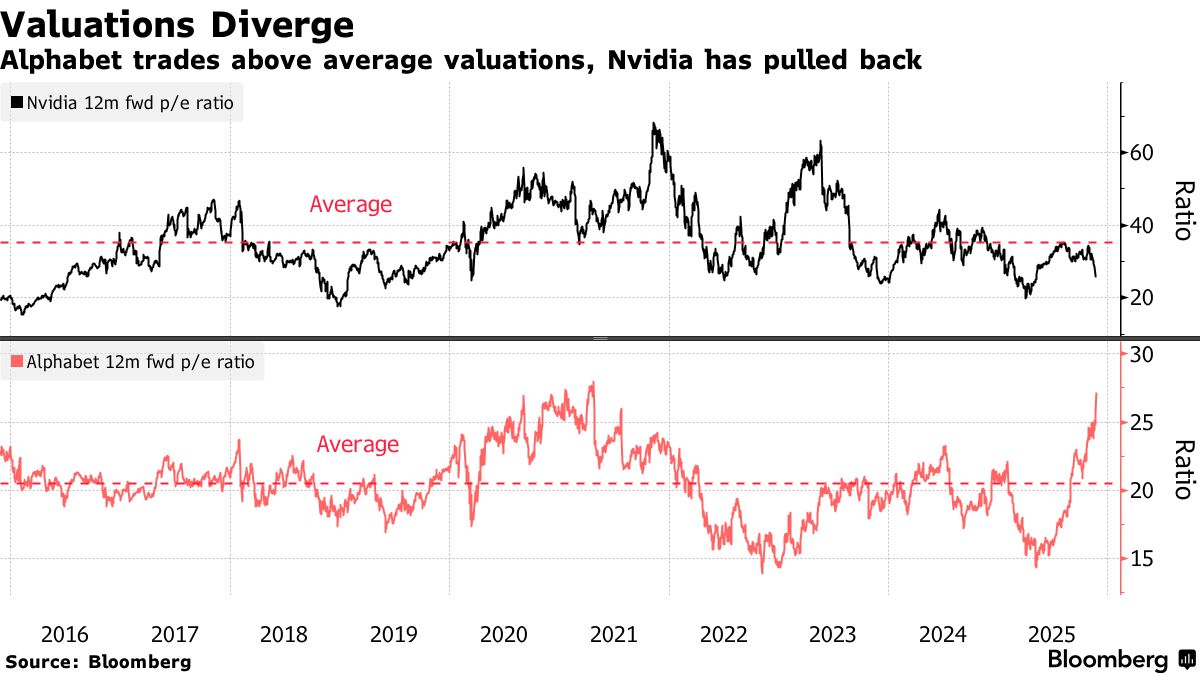
Nvidia’s valuations have pulled back, trading at 26 times forward earnings, well below its average over the past decade of 35 times. Alphabet’s has shot up to trade at 27 times forward earnings compared to an average of 20 times.

https://assets.bwbx.io/images/users/iqjWHBFdfxIU/iZlup1xX5m4Y/v2/pidjEfPlU1QWZop3vfGKsrX.ke8XuWirGYh1PKgEw44kE/-1x-1.png

While a possible deal with Meta — one of the biggest spenders globally on data centers and AI development — draws attention to the potential for long-term challenges to Nvidia’s dominant market position, much depends on whether the tensor chips can demonstrate the power efficiency and computing muscle necessary to become a viable option in the long run.

This frenzy is causing Alphabet stock’s 14-day relative strength index to about 75, over the level of 70 that signals to some technical analysts that a stock is overbought...

....MORE 

While we've been tracking the GOOG's TPU progress for a decade, this morning Zerohedge found a dandy little write-up on the chips that we'll go with rather than use back-links.

From UncoverAlpha, November 24:

The chip made for the AI inference era – the Google TPU 

Hey everyone,

As I find the topic of Google TPUs extremely important, I am publishing a comprehensive deep dive, not just a technical overview, but also strategic and financial coverage of the Google TPU.

Topics covered:

  • The history of the TPU and why it all even started?

  • The difference between a TPU and a GPU?

  • Performance numbers TPU vs GPU?

  • Where are the problems for the wider adoption of TPUs

  • Google’s TPU is the biggest competitive advantage of its cloud business for the next 10 years

  • How many TPUs does Google produce today, and how big can that get?

  • Gemini 3 and the aftermath of Gemini 3 on the whole chip industry

Let’s dive into it.

The history of the TPU and why it all even started?

The story of the Google Tensor Processing Unit (TPU) begins not with a breakthrough in chip manufacturing, but with a realization about math and logistics. Around 2013, Google’s leadership—specifically Jeff Dean, Jonathan Ross (the CEO of Groq), and the Google Brain team—ran a projection that alarmed them. They calculated that if every Android user utilized Google’s new voice search feature for just three minutes a day, the company would need to double its global data center capacity just to handle the compute load.

At the time, Google was relying on standard CPUs and GPUs for these tasks. While powerful, these general-purpose chips were inefficient for the specific heavy lifting required by Deep Learning: massive matrix multiplications. Scaling up with existing hardware would have been a financial and logistical nightmare.

This sparked a new project. Google decided to do something rare for a software company: build its own custom silicon. The goal was to create an ASIC (Application-Specific Integrated Circuit) designed for one job only: running TensorFlow neural networks.

Key Historical Milestones:

  • 2013-2014: The project moved really fast as Google both hired a very capable team and, to be honest, had some luck in their first steps. The team went from design concept to deploying silicon in data centers in just 15 months—a very short cycle for hardware engineering.

  • 2015: Before the world knew they existed, TPUs were already powering Google’s most popular products. They were silently accelerating Google Maps navigation, Google Photos, and Google Translate.

  • 2016: Google officially unveiled the TPU at Google I/O 2016.

This urgency to solve the “data center doubling” problem is why the TPU exists. It wasn’t built to sell to gamers or render video; it was built to save Google from its own AI success. With that in mind, Google has been thinking about the »costly« AI inference problems for over a decade now. This is also one of the main reasons why the TPU is so good today compared to other ASIC projects.

The difference between a TPU and a GPU?

To understand the difference, it helps to look at what each chip was originally built to do. A GPU is a “general-purpose” parallel processor, while a TPU is a “domain-specific” architecture.

The GPUs were designed for graphics. They excel at parallel processing (doing many things at once), which is great for AI. However, because they are designed to handle everything from video game textures to scientific simulations, they carry “architectural baggage.” They spend significant energy and chip area on complex tasks like caching, branch prediction, and managing independent threads.

A TPU, on the other hand, strips away all that baggage. It has no hardware for rasterization or texture mapping. Instead, it uses a unique architecture called a Systolic Array.

The “Systolic Array” is the key differentiator. In a standard CPU or GPU, the chip moves data back and forth between the memory and the computing units for every calculation. This constant shuffling creates a bottleneck (the Von Neumann bottleneck).

In a TPU’s systolic array, data flows through the chip like blood through a heart (hence “systolic”).

  1. It loads data (weights) once.

  2. It passes inputs through a massive grid of multipliers.

  3. The data is passed directly to the next unit in the array without writing back to memory.

What this means, in essence, is that a TPU, because of its systolic array, drastically reduces the number of memory reads and writes required from HBM. As a result, the TPU can spend its cycles computing rather than waiting for data.

Google’s new TPU design, also called Ironwood also addressed some of the key areas where a TPU was lacking:

  • They enhanced the SparseCore for efficiently handling large embeddings (good for recommendation systems and LLMs)

  • It increased HBM capacity and bandwidth (up to 192 GB per chip). For a better understanding, Nvidia’s Blackwell B200 has 192GB per chip, while Blackwell Ultra, also known as the B300, has 288 GB per chip.

  • Improved the Inter-Chip Interconnect (ICI) for linking thousands of chips into massive clusters, also called TPU Pods (needed for AI training as well as some time test compute inference workloads). When it comes to ICI, it is important to note that it is very performant with a Peak Bandwidth of 1.2 TB/s vs Blackwell NVLink 5 at 1.8 TB/s. But Google’s ICI, together with its specialized compiler and software stack, still delivers superior performance on some specific AI tasks.

The key thing to understand is that because the TPU doesn’t need to decode complex instructions or constantly access memory, it can deliver significantly higher Operations Per Joule.

For scale-out, Google uses Optical Circuit Switch (OCS) and its 3D torus network, which compete with Nvidia’s InfiniBand and Spectrum-X Ethernet. The main difference is that OCS is extremely cost-effective and power-efficient as it eliminates electrical switches and O-E-O conversions, but because of this, it is not as flexible as the other two. So again, the Google stack is extremely specialized for the task at hand and doesn’t offer the flexibility that GPUs do.

Performance numbers TPU vs GPU?

As we defined the differences, let’s look at real numbers showing how the TPU performs compared to the GPU. Since Google isn’t revealing these numbers, it is really hard to get details on performance. I studied many articles and alternative data sources, including interviews with industry insiders, and here are some of the key takeaways.

The first important thing is that there is very limited information on Google’s newest TPUv7 (Ironwood), as Google introduced it in April 2025 and is just now starting to become available to external clients (internally, it is said that Google has already been using Ironwood since April, possibly even for Gemini 3.0.). And why is this important if we, for example, compare TPUv7 with an older but still widely used version of TPUv5p based on Semianalysis data:

  • TPUv7 produces 4,614 TFLOPS(BF16) vs 459 TFLOPS for TPUv5p

  • TPUv7 has 192GB of memory capacity vs TPUv5p 96GB

  • TPUv7 memory Bandwidth is 7,370 GB/s vs 2,765 for v5p

We can see that the performance leaps between v5 and v7 are very significant. To put that in context, most of the comments that we will look at are more focused on TPUv6 or TPUv5 than v7.

Based on analyzing a ton of interviews with Former Google employees, customers, and competitors (people from AMD, NVDA & others), the summary of the results is as follows.....

....MUCH MORE 

Nvidia is getting whacked for $10.62 (-5.82%) to $171.93 while GOOG is up another1.99% (+$6.33) 

Related, November 24 - Trouble In Altman's World: "I’m Not Going Back To ChatGPT After Using Google’s Gemini 3: Salesforce CEO Marc Benioff"