Any forced unwind of those positions could cause some serious ructions.
From the blog of the U.S. Treasury's Office of Financial Research, August 19:
Views and opinions expressed are those of the authors and do not necessarily represent official positions or policy of the Office of Financial Research or the U.S. Department of the Treasury.1
Hedge funds have reemerged as significant participants in the U.S. Treasury market. As of year-end 2025, their cash Treasury holdings reached $2 trillion, nearly three times the level from five years earlier. In comparison, marketable Treasury debt outstanding increased 29% to $28.9 trillion over the same period. As a result, hedge funds’ share of the cash Treasury market reached a record 7% (Figure 1).
Figure 1. Hedge Funds’ Long Cash Treasury Holdings as a Share of Marketable Treasury Debt Outstanding (percent)
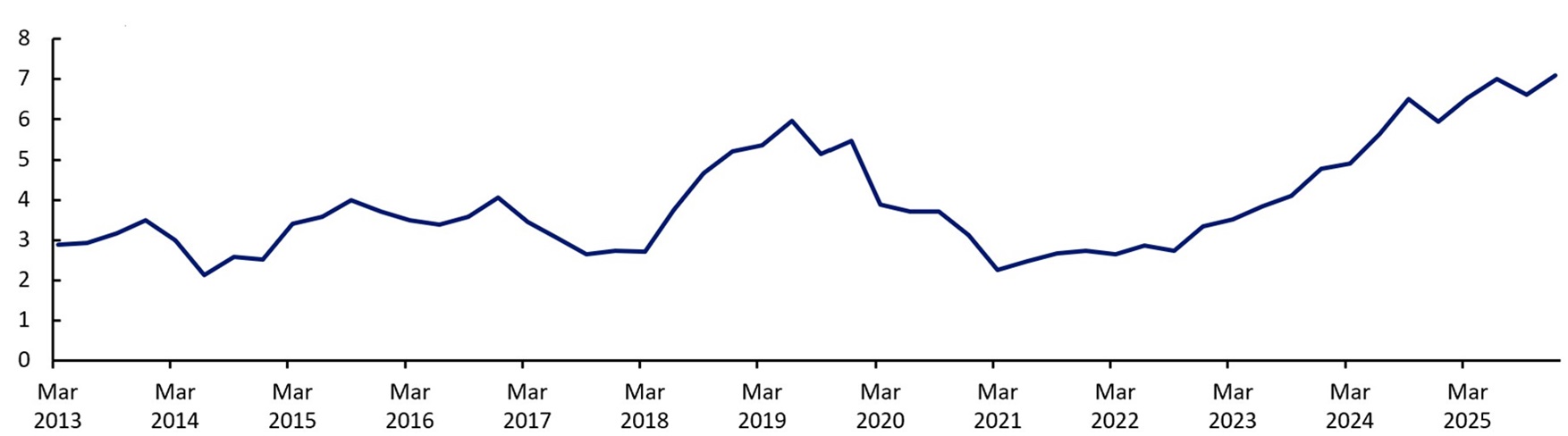
Note: Data as of Q4 2025. Numerator is the sum of long Treasury exposures (cash + derivatives) reported on SEC Form PF less the notional value of leveraged funds’ long and spreading positions in Treasury futures and options. Denominator is total marketable Treasury debt outstanding at market value.
Sources: Federal Reserve Bank of Dallas, Commodity Futures Trading Commission (CFTC), Office of Financial Research Hedge Fund Monitor, Authors’ estimate
A major driver of this trend may be the cash futures basis trade, or, simply, the basis trade, which is a relative value strategy where hedge funds take offsetting positions in Treasury securities and Treasury futures. Because profits for this trade are small, hedge funds scale positions by relying heavily on leverage through repo financing and futures margining. This leverage allows hedge funds to absorb more Treasury issuance at a time when primary dealers face balance sheet constraints.
Rising Hedge Funds’ Share of the Treasury Market
Primary dealers have traditionally served as a backstop for new Treasury issuance. However, in part resulting from post 2007-09 financial crisis capital regulation, dealers face balance sheet constraints that limit their capacity to hold Treasuries. Hedge funds, by contrast, are not subject to such constraints.
Also, some asset managers, such as mutual funds, separately managed accounts, and insurers have recently preferred Treasury futures rather than cash Treasuries for duration exposure.2 In recent years, asset manager demand for futures has grown sharply as the weighting of Treasuries increased in popular U.S. fixed income benchmark indices (Figure 2). Hedge funds are often on the other side, as shown below by the mirror increase in short futures.
Figure 2. Treasury Futures Notional Outstanding ($ billions)
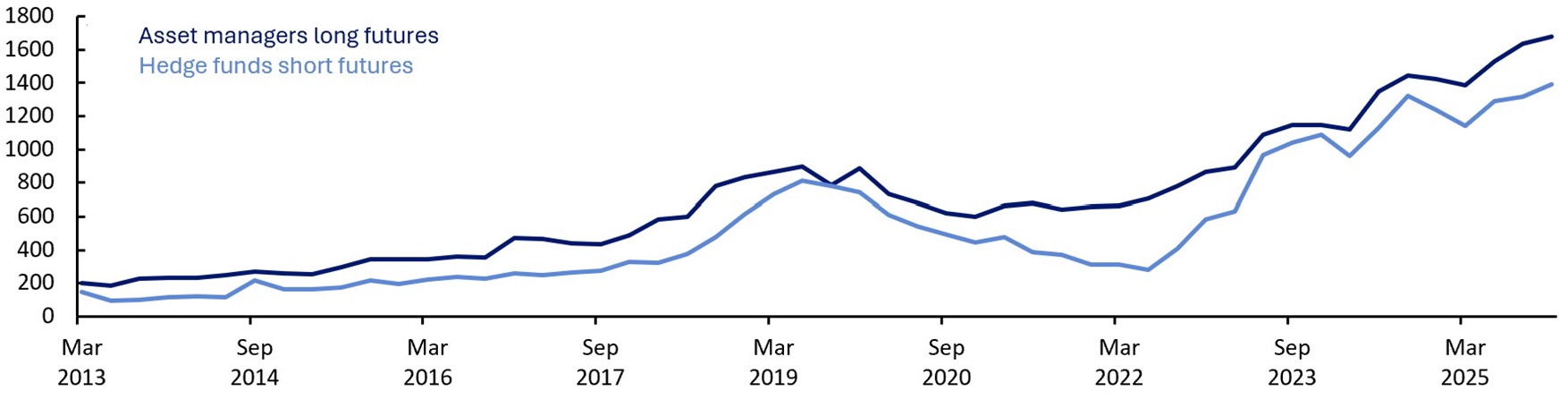
Note: Data as of Q4 2025.
Sources: Office of Financial Research Hedge Fund Monitor, Authors’ analysis.
Measuring Hedge Funds’ Cash Treasury Positions
Hedge funds’ cash Treasury holdings are not specifically reported. However, various methods approximate these holdings using a combination of SEC Form PF, which captures long Treasury exposures (cash plus derivatives), and Traders in Financial Futures data from the Commodity Futures Trading Commission (CFTC), which report long Treasury futures positions (see OFR Hedge Fund Monitor).
We estimate hedge funds’ long cash Treasury holdings at $2.0 trillion by subtracting long futures and futures‑spread positions from long Treasury exposures in SEC Form PF. In comparison, hedge funds’ short futures positions totaled $1.4 trillion. A significant share of this position is likely the basis trade; hedge funds do not separately report cash Treasury securities and derivatives on SEC Form PF. Research published in recent years by the CFTC, the Bank for International Settlements, the Federal Reserve, and sell-side firms has estimated the size of the trade to be from $350 billion to $1.5 trillion.3
The Basis Trade: A Small Profit, High‑Leverage Strategy....
....MUCH MORE

