Following on the post immediately below, "Would There Be an AI Revolution If There Were No Nvidia?" (NVDA).
From the Deutsche Bank Research Institute via Beijing's 36Kr-European Central Station, August 18:
Deutsche Bank sorts out the 70-year development trajectory of AI and sums up 14 historical takeaways. AI is witnessing exponential non-linear growth, and falling costs will spur even greater demand. However, technical routes see frequent iterations, with bottlenecks emerging in hardware and supply chains. While AI has gained rapid popularity among consumers, its commercial application in the enterprise segment is still in the early stage. Current market valuations are nearing historically high levels, and investors need to stay alert to risks brought by technological iteration and supply chain disruptions.Deutsche Bank's latest research report sorts out the development context of artificial intelligence since its birth in 1956, extracts 14 key insights from historical patterns, and provides a reference for investors to judge the trend of the current AI boom.
This August marks exactly 70 years since the 1956 Dartmouth Summer Research Project on Artificial Intelligence, the birthplace of AI. Adrian Cox, Thematic Strategist at Deutsche Bank Research, points out in the latest report that the 70-year history of AI has been filled with alternating booms and busts, and the current round of investment and valuation frenzy is repeating the paradigm of technological revolutions that have appeared many times in history.
The report argues that "context" is critical to understanding the future direction of AI. From non-linear growth and infrastructure bottlenecks to the expansion and bursting of valuation bubbles, historical signals are clearly identifiable. The report states directly that some people may claim that "this time is different", but the data from the past 70 years provides another frame of reference — for investors betting on the AI track, these insights are directly related to asset allocation logic and risk judgment.
01 Growth is not linear, and is often severely underestimated
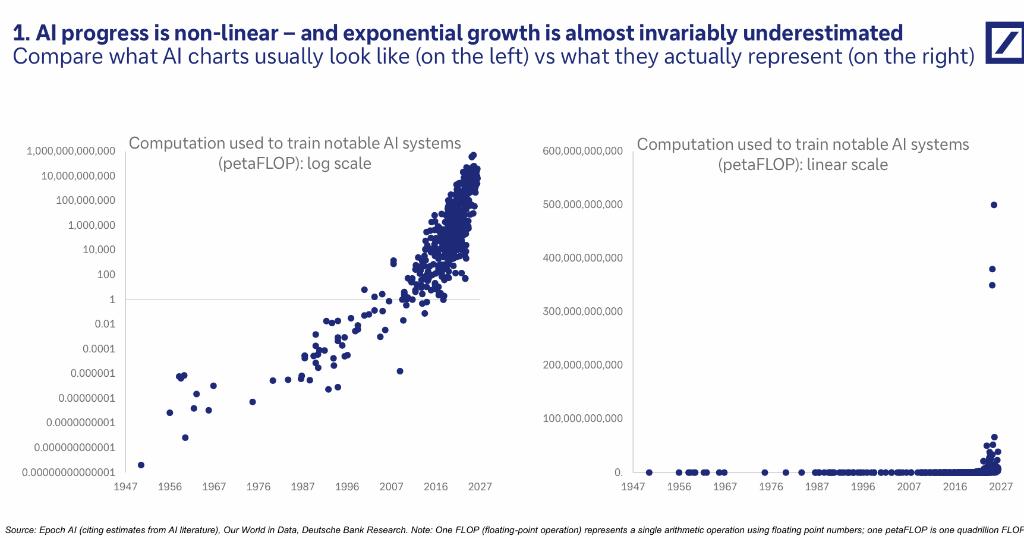
The report highlights the core feature of AI progress at the beginning: non-linearity. Presenting the historical data of training computing power on a logarithmic scale, it can be clearly seen that since 1956, the growth of computing power used to train major AI systems has spanned dozens of orders of magnitude, while the visual presentation of linear charts almost completely obscures this trend. Exponential growth is intuitively very easy to underestimate, which is the first cognitive threshold for understanding the AI wave.
Closely related to this, the progress speed of AI has surpassed Moore's Law. Traditional computing power doubles every 18 to 24 months, but after entering the era of deep learning, the average annual growth rate of computing power has reached about 4 times, far higher than the annual growth rate of about 1.4 times before the deep learning era. The reason lies in the simultaneous improvement of multiple factors such as system scale expansion, memory enhancement, and algorithm optimization, forming a superposition effect.
02 Technical routes continue to iterate, today's leader is not necessarily tomorrow's winner
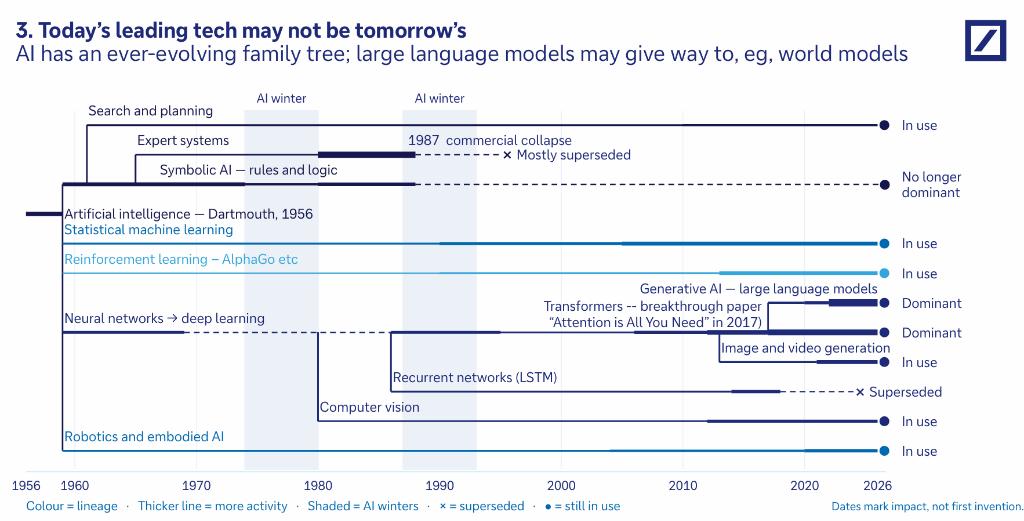
The report presents the 70-year evolution of routes through the AI technology spectrum: from symbolic logic and expert systems to statistical machine learning, deep learning, and then to the currently dominant large language models. Each generation of mainstream technology has gone through a cycle from rise to replacement. Some routes (such as recurrent neural networks) have been surpassed, while others are still evolving in parallel. The report points out that large language models may give way to new paradigms such as "world models" in the future, and the intergenerational replacement of technologies does not depend on the will of current leaders.
Historical changes in market share also confirm this point. Internet Explorer once outperformed Netscape, but was later replaced by Chrome. In the current competitive landscape of generative AI platforms, ChatGPT leads in monthly visits, but Google Gemini, DeepSeek and Claude are all catching up rapidly. Early advantages do not equal long-term moats.
03 R&D accumulation determines the competitive landscape, and the rise of DeepSeek is no accident
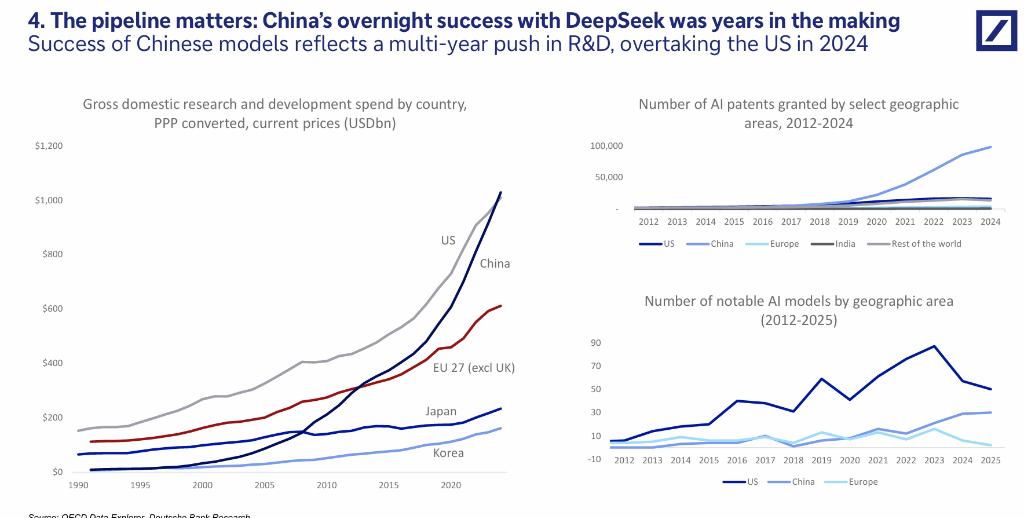
The sudden rise of Chinese AI models, represented by DeepSeek, seems to be "overnight success" on the surface, but it is actually the result of years of R&D investment accumulation. Data shows that China has surpassed the United States in total R&D expenditure in 2024, and its catching-up speed in the number of major AI models is also remarkable. In terms of the number of AI patent grants, China's growth curve is also far ahead of other economies. For investors, this means that changes in the competitive landscape often accumulate at the underlying level for many years before they are visible on the surface.
04 Cost reduction will not compress demand, but will instead expand demand
The report cites the "Jevons Paradox" to illustrate that the sharp drop in the cost of AI use will not lead to a reduction in total expenditure, but will instead stimulate a surge in demand. Since 2006, the cost of GPU computing power has dropped by more than 99%, but according to the forecast of the International Energy Agency (IEA), global data center power consumption will double from 2024 to 2030. Lower marginal cost means more application scenarios and higher total demand....
....MUCH MORE
Here's the original at DB, 17 page PDF, downloadable.
If interested see also the RAND Corporation's relationship with AI:
RAND: "Artificial Intelligence and Biotechnology: Risks and Opportunities"
RAND has a very deep history in artificial intelligence. From Jeremy Norman's History of Information:
Newell, Simon & Shaw Develop the First Artificial Intelligence Program
During 1955 and 1956 computer scientist and cognitive psychologist Allen Newell, political scientist, economist and sociologist Herbert A. Simon, and systems programmer John Clifford Shaw, all working at the Rand Corporation in Santa Monica, California, developed the Logic Theorist, the first program deliberately engineered to mimic the problem solving skills of a human being. They decided to write a program that could prove theorems in the propositional calculus like those in Principia Mathematica by Alfred North Whitehead and Bertrand Russell. As Simon later wrote,
"LT was based on the system of Principia mathematica, largely because a copy of that work happened to sit in my bookshelf. There was no intention of making a contribution to symbolic logic, and the system of Principia was sufficiently outmoded by that time as to be inappropriate for that purpose. For us, the important consideration was not the precise task, but its suitability for demonstrating that a computer could discover problem solutions in a complex nonnumerical domain by heuristic search that used humanoid heuristics" (Simon,"Allen Newell: 1927-1992," Annals of the History of Computing 20 [1998] 68).
The collaborators wrote the first version of the program by hand on 3 x 5 inch cards. As Simon recalled....
For a bit more on Mr. Simon here's the introduction to 2016's "Interview: Manuela Veloso Head of Machine Learning, Carnegie Mellon University":
Our readers probably know Carnegie Mellon more for the top-ranked financial engineering program (Master of Science in Computational Finance) but artificial intelligence was pretty much invented at CMU by Herbert Simon and Allen Newell. Simon received the Nobel in Economics but it actually could have been for any of four or five subjects, he was quite the polymath.
Newell had to settle for the Turing award (along with Simon) from the Association for Computing Machinery, probably the root'in-tootin high-falootinest tchotchke in the computer biz.
The Association for the Advancement of Artificial Intelligence along with the ACM subsequently named an award in Newell's honor. Ditto for CMU.
The University's machine learning department was the first in the world to offer a doctorate and as far as I know is still the largest.
A department, for one branch of AI.
Carnegie-Mellon used to have a world class robotics Institute but Uber gutted it with a combination of cash and stock options leaving a Dean and a couple robots to rebuild.
One of the robots is said to be in advanced negotiations with the Ube-sters.

