Thursday, August 27, 2026

"Michael Burry Says Nvidia Is ‘Wildly Undervalued,’ Buys Calls as ‘Hedge’" (NVDA)

From TipRanks, August 26: 

Ahead of Nvidia’s NVDA -1.59% ▼ Q2 results, Big Short investor Michael Burry added to his short position despite expecting the AI chipmaker to report strong earnings. According to his Substack, Burry also bought December call options, describing the calls as a hedge rather than a bullish bet. He wrote, “On the face of it, the stock is wildly undervalued. Low PE for a big grower that currently commands monopoly rents.” 

Burry Remains Bearish on Nvidia 

Burry said his theoretical value for Nvidia is “much lower than today’s market value,” arguing that the company’s current valuation does not fully reflect the potential risks to its AI-driven growth. He believes Nvidia’s competitive advantage, AI dominance, and high margins could prove less durable than investors expect, potentially making the stock’s current valuation too high.

Burry maintained his bearish stance despite expecting Nvidia’s upcoming results to be very strong. He had previously said the company could deliver a “lights out” quarter, while warning that concerns around AI spending and circular financing remain.

Why Is Burry Buying Calls? 

Burry purchased December Nvidia call options with strikes in the mid-to-high $200s, paying a single-digit premium. However, he stressed that the calls are intended to protect his bearish position if Nvidia shares surge following earnings. 

Burry said he is “not playing for gains here” with the calls and that he would not have made the trade without his much larger short and put exposure. His puts represent roughly 3.5%-4% of his portfolio, while his overall short stock exposure has risen above 21%, excluding puts. Burry has used similar hedging strategies around earnings in the past, although he acknowledged that his track record with this approach has been mixed. 

Notably, after markets closed on August 26....

....MORE 

Capital Markets: "Greenback Edges Higher"

From Marc to Market:

In the relatively quiet conditions that have prevailed this week, the US dollar is trading with a mostly firmer bias. Rising US rates amid the technically oversold short-term market are lending the greenback support.  The dollar remains firm against the yen, even though the Deputy Governor of the BOJ seemed to support speculation of a rate hike next month. US rates seem to fit better with changes in the exchange rate than Japanese rates. 

It appears, unsurprisingly, that Russia and China have formally rejected adhering to the US economic chokehold on Iran.  Without their participation in “Operation Economic Outcast”, the US policy seems to be a way to disengage with making such a declaration.  If the it is retreating from the war in Iran, it is threatening to escalate the trade war with Canada. Trade Representative Greer has threatened banning some Canadian imports to the US.  Given the asymmetries, the Canadian dollar has held its own so far this week. It is off about 0.25%, a middling performer in the G10....

....MUCH MORE  

Wednesday, August 26, 2026

The S.E.C. Would Like To Know Just What Was Going On At Situational Awareness

A diagnosis-and-prognosis are usually more helpful than an autopsy but you take what you can get.

From United Press International, August 25:

SEC investigating AI-focused hedge fund Situational Awareness 

The Securities and Exchange Commission is investigating Situational Awareness, the Artificial Intelligence-focused hedge fund run by a 24-year-old.

The fund nearly collapsed last month when it dipped from about $45 billion to $10 billion in a late-July tech sell-off.

The SEC sent subpoenas to banks that provided loans for leveraged trading, The New York Times reported. The subpoenas wanted details on the timing of the trades and communications with lenders. They also told the banks to save any information about Situational Awareness.

The SEC investigates any fund that has large losses, and Situational Awareness has not been accused of any wrongdoing....

....MUCH MORE 

Inflation: PCE Price Index Up 0.2% In July; Up 3.7% Year-over-Year

From the Bureau of Economic Analysis, August 26: 

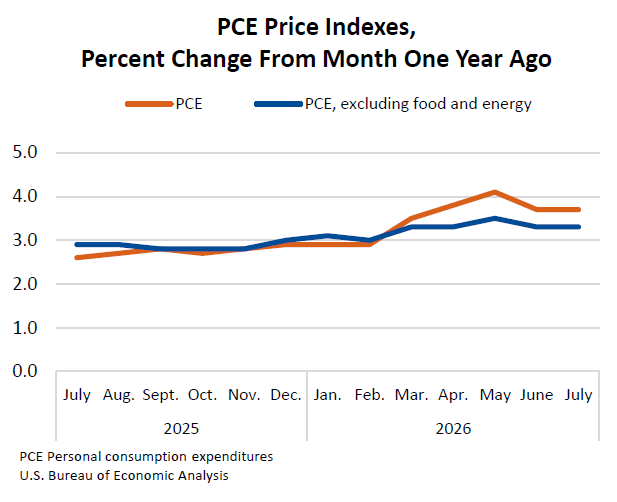
....From the preceding month, the PCE price index for July increased 0.2 percent. Excluding food and energy, the PCE price index also increased 0.2 percent.

From the same month one year ago, the PCE price index for July increased 3.7 percent. Excluding food and energy, the PCE price index increased 3.3 percent from one year ago.

PCE Price Indexes, Percent Change From Month One Year Ago 

Personal Income and Related Measures
[Percent change from preceding month]
 JuneJuly
Current-dollar personal income0.20.4
Current-dollar DPI0.20.5
Real DPI0.30.4
Current-dollar PCE0.30.2
Real PCE0.40.0
PCE price index-0.10.2
PCE price index excluding food and energy0.10.2

....MUCH MORE 

Again, everyone's favorite table:

Table 2.8.7. Percent Change From Preceding Period in Prices for Personal Consumption Expenditures by Major Type of Product, Monthly

"Citi raises corn, soybean, wheat price targets on El Niño risks"

They note, almost as a throwaway line, that coffee and cocoa have historically been affected when in fact that is where the action has been. 

From Investing.com via Hellenic Shipping News, August 26: 

Citi raised its price targets for corn, soybeans, and wheat on Tuesday, citing a strengthening Super El Niño as its highest-conviction agricultural risk heading into late 2026 and early 2027.

NOAA now assigns a greater than 90% probability of a very strong event and a 69% probability that the event exceeds the strength of all El Niño episodes since 1950 during October-December, according to the agency’s August 2026 update.

The bank raised its 3-month corn price target to $5.40 per bushel and its 12-month target to $5.90 per bushel. Citi raised its 3-month soybean price forecast to $12.75 per bushel as the previous target was reached, while the 12-month target is $13.25 per bushel. The bank also revised up its 3-month wheat forecast to $7.25 per bushel and 12-month target of $7.75 per bushel.

Citi said current market pricing appears to reflect only a portion of the potential downside risks to global agricultural production based on its new Production-at-Risk framework. The largest weather-exposed commodities remain palm oil, robusta coffee, rice, sugar, cocoa, and Australian wheat, while risks are concentrated geographically across Australia, India, Southeast Asia, and parts of Brazil....

....MUCH MORE 

Recently:

Capital Markets: "Consolidation Persists in the FX Market"

From Marc Chandler at Bannockburn Global Forex:

The US dollar is enjoying a slightly firmer tone against most of the G10 currencies. However, for the most part, ranges tend to be narrow, and the consolidative one seen this week persists. Oil prices have extended their pullback amid reports that Iran and Oman are discussing an “interim framework” to re-open the Strait of Hormuz. The US is reportedly preparing for its diplomats to return to embassies in the region, which is seen as a sign that the administration does not anticipate renewed full-scale hostilities. 

The US has threatened more retaliation against Canada as the trade war broke out when trade talks failed has pushed the Canadian dollar to a new low for the week. The US dollar is trading near CAD1.3870 after it settled last week near CAD1.3760. More broadly speaking, backed by firmer US rates, we see scope for additional dollar gains in North America....

....MUCH MORE 

Mo' Money: "SoftBank mulls up to US$20 bil bond sale for OpenAI financing"

From Bloomberg via The Edge, Singapore, August 26:

SoftBank Group Corp is talking with investment banks about a potential US$10 billion to US$20 billion bond offering to help refinance a loan for its investment in US tech giant OpenAI, according to people familiar with the matter.

The offering could be denominated in dollars and euros and could come as early as September, said the people, who asked not to be identified discussing private matters. The talks are still ongoing and details could change, the people added.

Proceeds from the sale would partly be used to repay a US$40 billion bridge loan secured earlier this year for its OpenAI investment, the people said. Junk-rated SoftBank, founded and led by billionaire Masayoshi Son, is slated to invest close to US$65 billion in OpenAI by October, funded in part by loans.

The bond sale would add to a slew of fundraising by companies looking to deepen their reach into artificial intelligence, despite concerns about growing credit risks and whether these investments will actually pay off. Some firms are turning to junk bond investors for AI-related funding, even for debt that is investment-grade, as competition for capital heats up.

US tech firms, meanwhile, are planning to pour trillions of dollars into data centres and other AI infrastructure in the coming years. Companies have already borrowed more than US$410 billion so far this year for such facilities and other AI investments in the bond markets alone, according to data compiled by Bloomberg News....

https://myassets.theedgemalaysia.com/pics/2026/465646791-SoftBank-table_20260826142239_yidvui.jpg 

....MUCH MORE 

My favorite Son quote was his advice to Adam Neumann of WeWork (Softbank's investment in WeWork eventually totaled $16 billion):

“I told Adam not to be proud that WeWork was growing organically without a large sales force or spending big marketing dollars,” Softbank boss Masayoshi Son told Forbes after Softbank’s first investment in 2017. “Make it ten times bigger than your original plan. If you think in that manner, the valuation is cheap.” He added, “It can be worth a few hundred billion dollars.”

That may be some of the worst career advice ever. But probably not the worst: 

Tuesday, August 25, 2026

"Anthropic Expected to Tell Investors It Sees Over $30 Trillion in Potential Revenue"

For comparison the IMF is forecasting the world's Gross Domestic Product for 2026 at $126 trillion so ~24% of global GDP or 92.6% of the U.S. GDP forecast for 2026, $32.38 trillion.

Of course those are static measures. Using dynamic scoring Mr. Amodei would tell you AI will triple world GDP so his company's piece of the pie is only around an 8% share. 

An exclusive from the Wall Street Journal, August 25:

The AI startup is likely to top SpaceX’s eye-popping potential revenue estimate

SpaceX’s record-breaking IPO tested the limits of an obscure financial metric. Anthropic’s could push it even further.

The maker of Claude is likely to tell investors its potential revenue opportunities are above $30 trillion, topping SpaceX’s $28.5 trillion estimate, according to people familiar with the matter.

Tech startups or other growing companies going public often estimate their “total addressable markets,” or TAMs, to show investors they have ample room to grow. Such figures estimate the amount of annual revenue a company could theoretically capture if it achieved 100% market-share using inputs ranging from industry data to bankers’ models.

While they have always involved a bit of guesswork, these estimates are especially squishy when it comes to trying to predict how the rapid adoption of artificial intelligence will upend entire industries.

Elon Musk’s rocket maker called its TAM “the largest actionable” market in “human history” when it revealed the figure in a May filing. Most of the figure, $26.5 trillion, was attributed to opportunities in AI.

The number was astronomic compared with those featured in previous IPOs, prompting some skepticism on Wall Street. When Uber went public in 2019, it described its market opportunity as $6 trillion, citing the mileage value of all personal cars and public transportation services globally. WeWork cited a $3 trillion market opportunity in its ultimately abandoned IPO.

New York University’s Aswath Damodaran, a finance known as “the Dean of Valuation” told The Wall Street Journal ahead of SpaceX’s June offering that the TAM the company saw in AI was “reaching the end of what’s plausible and pushing beyond.”

To quantify its TAM, Anthropic is looking at the full scope of work that could be completed with AI models, the people said.

Anthropic more than doubled its revenue to $11.6 billion in the second quarter. To put its more than $30 trillion vision in context, the 191 technology companies in the S&P 1500 brought in $2.4 trillion in revenue last year, according to FactSet....

....MORE 

 Also at the Journal:

Trump Threatens to Rename Lake Ontario as Spat With Canada Escalates

BondVigilantes: "Of Anchovies and Blueberries – why El Niño matters"

From M&G's Bond Vigilantes, August 17:

Why aren’t we talking more about El Niño?

After an exceptionally hot, dry summer in Western Europe and elsewhere, climate discussions proliferate. But neither mainstream media nor markets seem to be seriously discussing the risks and opportunities presented by what scientists appear to agree will be a “super El Niño”.  

In a world where food supplies have already been curtailed by the Russia-Ukraine conflict (especially wheat and sunflower oil), and where next year’s crop yields could be hit by the high price and/or scarcity of fertiliser due to the closure of the Strait of Hormuz – through which 30% of global nitrogen and 50% of sulphur traditionally flow – a particularly strong El Niño seems bound to have a substantial impact on the economies of various South Pacific nations, and food-price inflation globally.  

It will also increase the price of logistics. As quoted in the FT on 11th August, raising the cost and decreasing the frequency of transits of the Panama Canal (whose water levels have already dropped dangerously low) will also be inflationary. As food-price inflation has a significant effect on emerging markets, these circumstances should lead to rising rates and currency volatility. We would anticipate plenty of investment opportunities for fixed-income, currency and (agricultural) commodity investors. 

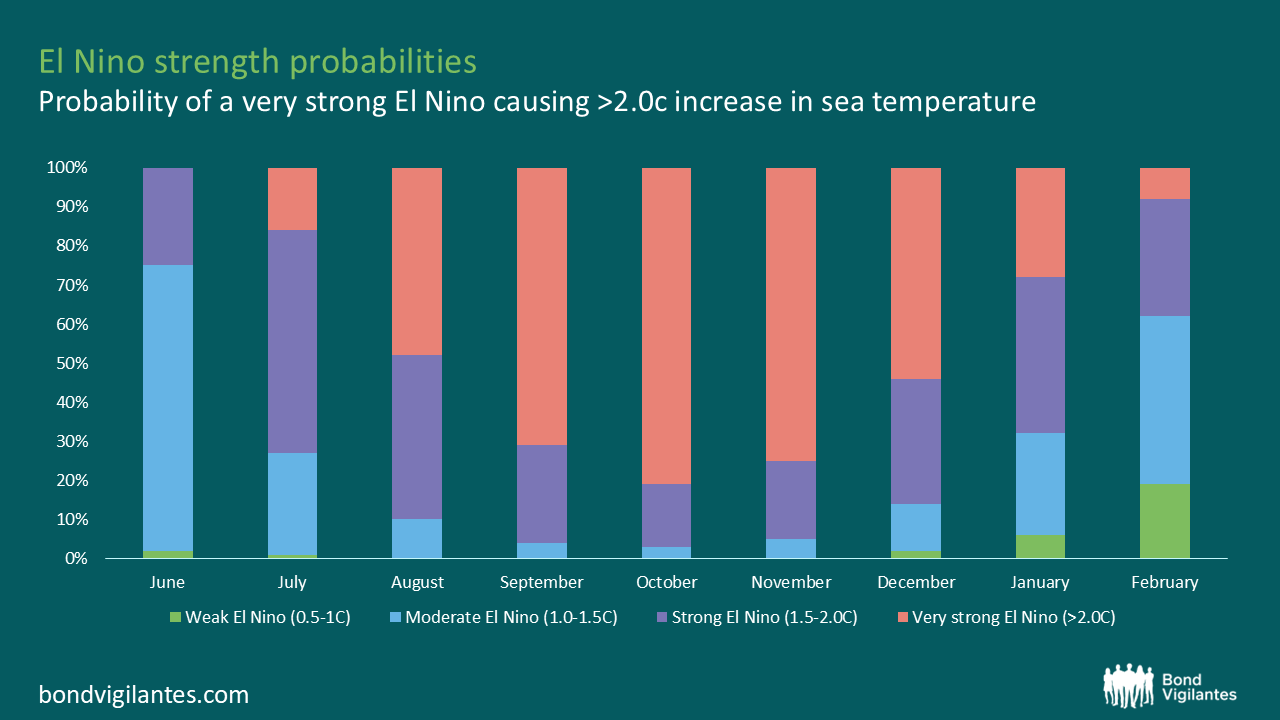
The first point to make is that we are facing – yet again – a climate event of historic proportions. The US National Oceanic and Atmospheric Administration (NOAA) forecasts an 81% likelihood of a “very strong El Niño” (see graph), defined as one where the Pacific warms more than 2°C above the seasonal average and the highest classification they use. This event, however, seems set to be particularly dramatic. Australia’s Bureau of Meteorology predicts temperatures rising to 3.5°C above average. Considering that the previous peak in November 2015 came in at +2.6°C, we seem set for a profound climate event that smashes all previous records. 


Source: US National Oceanic and Atmospheric Administration (NOAA) July 2026

One of the countries most heavily affected by El Niño is Peru, whose GDP growth can be reduced by over one percentage point by its impact. Extreme weather causes disruption, whether by flooding roads, impacting supply chains or affecting crop yields. Knowing El Niño is coming often deters economic activity and investment as people hunker down for a tough year. But it is quite amazing how the effect of El Niño on even a relatively small country like Peru can have a global impact in certain areas. For instance, Peru is the world’s largest exporter of blueberries (over $2.5bn in 2025), so a substantial reduction in blueberry production will affect the availability and price of this fruit globally. Next, consider the humble anchovy, which is fished for in great numbers off Peru’s shores. In fact, Peru’s anchovy fishery is considered the largest in the world by volume. During El Niño, the warm waters stress the fish and render them infertile, driving them deeper down to find cooler currents. Peru therefore seems likely to miss out on at least one of its two fishing seasons, with obvious implications for the local fishing industry. What is less well known is that Peruvian anchovies are used to produce 20% of the world’s fishmeal, which is fed to farmed fish, other aquaculture and livestock. It therefore seems likely that people across the globe will notice the cost of fish rising in supermarkets next year. 

Those are just a couple of examples of local effects rippling across the world. But of course the warming of the Pacific Ocean will have a tremendous impact on crop production everywhere. The table below shows the scale of what may well hit us next year. To highlight a few stark examples, Australian wheat yields could collapse by up to 60%, global cocoa and coffee output could fall by 15% and we could see 10% declines in Brazilian corn....

 The value of investments will fluctuate, which will cause prices to fall as 
well as rise and you may not get back the original amount you invested. 
Past performance is not a guide to future performance.

....MUCH MORE 

Earlier today:

El Niño—"ENSO Forecast: August 2026 Quick Look"

El Niño—"ENSO Forecast: August 2026 Quick Look"

This site, the International Research Institute for Climate and Society at Columbia University is one of our go-to info sources on the El Niño/Southern Oscillation; along with the Japan Agency for Marine-Earth Science and Technology (JAMSTEC) and Australia's  Bureau of Meteorology (BoM).

From IRI/Columbia, August 19:

A monthly summary of the status of El Niño, La Niña, and the Southern Oscillation, or ENSO, based on the NINO3.4 index (120-170W, 5S-5N)

The 2026 El Niño event continues to intensify across the central-eastern equatorial Pacific. The traditional Niño 3.4 index shows a clear and sustained increase, with the most recent seasonal mean reaching +1.51 °C during May–July 2026 and the July monthly value increasing to +2.03 °C. The latest weekly Niño 3.4 index, centered on August 12, 2026, reached +2.7 °C. Together, these observations indicate that El Niño is strengthening further and evolving toward a very strong event....

....MUCH MORE 

And the plume of predictions generated by both statistical and dynamic models:

CCSR/IRI ENSO Predictions Plume

Published: August 19, 2026

Note on interpreting model forecasts

The following graph and table show forecasts made by dynamical and statistical models for SST in the Nino 3.4 region for nine overlapping 3-month periods. Note that the expected skills of the models, based on historical performance, are not equal to one another. The skills also generally decrease as the lead time increases. Thirdly, forecasts made at some times of the year generally have higher skill than forecasts made at other times of the year--namely, they are better when made between June and December than when they are made between February and May. Differences among the forecasts of the models reflect both differences in model design, and actual uncertainty in the forecast of the possible future SST scenario.

CCSR/IRI Model Predictions of ENSO 

....MUCH MORE, additional graphs and narrative. 

"VCs are starting to rely on AI to predict the future."

From Beijing's 36Kr European Central Station, August 24:

In July, DigClaw's forecasting framework Rhizome v1 secured three spots at #1, #3, #7 on the FutureX evaluation platform.

The three spots come from three different base models, including Kimi-K3, DeepSeek-V4-Pro, etc. The same set of frameworks enabled all of them to enter the Top 7 simultaneously, and DigClaw is the only participant that has achieved this.

There are 59 real-event forecasting questions covering the political, economic, and technological fields, with no possibility of training data leakage.

This set of results supports the judgment that DigClaw is verifying:

Forecasting capabilities can be precipitated outside the base model.

As the base model advances, the system can gain capability dividends; forecasting trajectories, settlement feedback, calibration experience, and the continuously evolving workflow are continuously precipitated inside the system.

This is not an accidental competition result, it is the first external verification that DigClaw has given to the question of "how forecasting should be done".

Forecasting is the Most Underestimated Capability of AI

As forecasting tasks gradually move towards standardization and engineering, AI is also expected to handle complex forecasting problems at scale.

But there is a fundamental problem: large language models are inherently not good at forecasting.

What LLMs learn is correlation, not causation. They extract patterns from past corpora, but "learning the past" and "forecasting the future" are two essentially different things.

This brings three fatal problems:

Blind Spot in Causal Direction. The model knows that A and B often appear together, but does not know whether A causes B, B causes A, or there is a common cause C.

Failure of Intervention Reasoning. You cannot ask the model "what impact will the Fed's interest rate cut have on Southeast Asian tech stocks" — because it has only learned historical co-occurrence, and there is no causal graph to support intervention calculation.

Lack of Calibration. The "70% probability" output by the model has not been calibrated in any probabilistic sense, and is essentially just a by-product of the token distribution.

So far, existing solutions have their own limitations: human collective intelligence (prediction markets) requires liquidity, and prices are not credible for niche problems;

LLM pattern matching has no causal structure; end-to-end training has outcome-oriented bias — a reasoning process with strict logic but "wrong answer" will be punished, while a rough judgment that happens to "guess correctly" will be reinforced instead.

This is exactly why DigClaw exists.

DigClaw builds a forecasting infrastructure with causal structure as the skeleton, probability calculation as the engine, and search intelligence as the data pipeline.

The core assumption is: forecasting should not be completed by a single model end-to-end.

Search, causal reasoning, and probabilistic inference are three orthogonal capabilities that should be solved by three dedicated systems separately and then combined structurally.

Three Top 10 Spots Verify the Cross-Base-Model Migration of Forecasting Capabilities

FutureX is currently the most challenging real-time forecasting leaderboard: real-world event forecasting questions are released every week, the standard answers have not yet been generated when forecasts are submitted, and settlement is conducted afterwards.

The dataset is hosted on HuggingFace, the evaluation framework is open source on GitHub, and the results are reproducible and verifiable....

....MUCH MORE 

Monday, August 24, 2026

Trading The British Bicycle Bubble

From The Journal of Economic History,
Published online by Cambridge University Press: 10 July 2025

Who Wins and Loses in a Bubble? Evidence from the British Bicycle Mania 

Abstract 
How do different types of investors perform during financial bubbles? Using a rich archival source, we explore investor performance during the British bicycle mania of the 1890s. We find that directors and employees of cycle companies reduced their holdings substantially during the crash. Those holding shares after the crash were generally not from groups stereotypically thought of as naïve, but gentlemen living near a stock exchange, who had sufficient time, money, and opportunity to engage in speculation. Our findings suggest that the investors most at risk of losing during a bubble are those prone to familiarity and overconfidence biases.

Who are the winners and losers in an asset price bubble? In the case where markets are efficient and prices follow an unbiased and unpredictable random walk, then it is unlikely that any group will significantly outperform any other (Malkiel Reference Malkiel2003). However, this can be changed by the presence of heterogeneous information, which might allow informed or well-connected investors to “ride” the bubble (Abreu and Brunnermeier Reference Abreu and Brunnermeier2002, Reference Abreu and Brunnermeier2003; Temin and Voth Reference Temin and Voth2004). Groups that tend to lose out might simply be noise traders, but it could also be vulnerable demographics, those with the least experience or information, or those with a strong preference for risky assets. Alternatively, the biggest losers could be those most vulnerable to behavioral biases, such as overconfidence or familiarity bias (Barber and Odean Reference Barber and Odean2001; Seasholes and Zhu Reference Seasholes and Zhu2010).

This paper investigates this question using a new dataset of inves- tors during and after an asset price reversal in British bicycle companies in 1895–1900. Cycle company shares experienced a substantial price reversal in this period, almost trebling in value in the early months of 1896 before losing 73 percent of their peak value by the end of 1898. The scale of these price movements is similar to other infamous stock market reversals: the dot-com boom saw the NASDAQ index rise 110 percent between December 1996 and its peak in March 2000, before losing 77 percent of its value by October 2002 (Quinn and Turner Reference Quinn and Turner2020, pp. 157–59). Like the dot-com era, the cycle mania was accompanied by a promotion boom: between January 1896 and June 1897, 601 new cycle corporations were established (Quinn Reference Quinn2019, p. 276).

The key advantage of studying the bicycle mania is that companies in this era were legally required to publish annually the names, occupations, addresses, and number of shares held by each shareholder. This makes our dataset complementary to other studies of shareholder clientele changes during an asset price bubble, which typically have much more frequent observations, but much less detail on shareholder identities. For example, Brunnermeier and Nagel (2004) limit their study to hedge funds, Temin and Voth (Reference Temin and Voth2004) investigate the holdings of one private bank, and Greenwood and Nagel (Reference Greenwood and Nagel2009) study mutual fund managers with age used as a proxy for experience. Griffin et al. (Reference Griffin, Harris, Shu and Topaloglu2011) study a broad range of investors but can only distinguish between individuals and various types of institutional investors. For the cycle mania, we have detailed data on the occupations and addresses of all investors in each company in our sample. This allows for a much more granular observation of investor identities, especially at the less experienced end of the spectrum.

We found shareholder registers from the U.K.’s National Archives for 25 cycles, tube and tyre companies at two distinct points in time during the asset price reversal. The first time period chosen is prior to the crash, when the prices of cycle shares had not yet peaked. The second time period was during the crash, when share prices had peaked and were falling. Since all 25 of the companies in the sample were disbanded on unfavorable terms to shareholders within a decade, investors holding shares at this stage are almost certain to have lost money on their investments. There is therefore little risk of capturing investors who successfully “bargain hunted” at the nadir of a cycle. Conversely, investors who held shares prior to the crash, but were absent from the register when prices were falling are much more likely to have profited from the bubble. From each shareholder register, we record the occupation, address, and number of shares held by each investor. We also record whether the investor was a director of the company by checking their names against those listed in the Stock Exchange Yearbook and Birch’s Manual of Cycle Companies (1897).

A large minority of cycle company shareholder registers included all share transfer information over the previous year. These registers recorded the date on which any shares were sold from one investor to another, the number of shares sold, and the name, occupation, and address of the seller (but no information on the buyer). Such registers were found for 10 of these companies, resulting in a dataset of 1,996 transfers.

In order to identify the extent to which changes in ownership can plau- sibly be attributed to the bubble, we also collect this data for a control group. This control group consists of 11 companies that were established between 1895 and 1898, categorized as miscellaneous by Investor’s Monthly Manual, and had not experienced a share price crash at the time of their second surviving shareholder register. The aforementioned data on occupation, address, directorship, and transfers of shares was also collected for the control group firms. This sample provides some indica- tion of how ownership of new companies at this time might be expected to change in the absence of an asset price reversal or crash.

Our data is first used to establish the characteristics of investors during the initial stage of the cycle boom. Relative to the control group, we find that cycle shares attracted a high level of investment from manufacturers, financiers, institutional investors, and professional middle classes, and a low level of investment from gentlemen (i.e., a social class in Britain at the time consisting of men sufficiently wealthy that they did not need an occupation) and women. This suggests that cycle investors came from groups that previous research has associated with a preference for riskier investments, but not from groups associated with a low level of invest- ment experience (Acheson, Campbell, and Turner Reference Acheson, Campbell and Turner2017; Rutterford et al. Reference Rutterford, Green, Maltby and Owens2011)....

....MUCH MORE 

Related:

November 30, 2025 - Reminder: We believe AI is a bubble and have made the decision to ride the bubble. (bubblelicious since July 1, 2023)
Not one of these bubble-come-lately types, no siree. 

Which includes a fresh link to a snappy little paper that has been one of our guiding lights since 2012 [link rotted] and repeated every few years e.g. 2023's On Bubbles

....Here's the version hosted at MIT: 

Riding the South Sea Bubble
By PETER TEMIN AND HANS-JOACHIM VOTH
This paper presents a case study of a well-informed investor in the South Sea bubble. We argue that Hoare’s Bank, a fledgling West End London bank, knew that a bubble was in progress and nonetheless invested in the stock: it was profitable to “ride the bubble.” Using a unique dataset on daily trades, we show that this sophisticated investor was not constrained by such institutional factors as restrictions on short sales or agency problems...

The two most important parts of the paper "II. Hoare’s Trading Performance" and "III. Causes of Success" are definitely worth a couple minutes....

Keep An Eye On Norway's Next Oil Production Report

Two from OilPrice. First up, August 20: 

  • Norway’s crude output fell nearly 10% year-over-year to 1.776 million bpd in July, while total liquids dropped 9.1%.
  • The decline comes at a sensitive time, with 8.3 million bpd of Gulf production shut in and markets increasingly reliant on secure non-Gulf supplies.
  • The weakness may be temporary, reflecting summer maintenance and a strong 2025 comparison, making Norway’s next production report particularly important. 

Norway’s crude oil production averaged 1.776 million barrels per day in July, according to preliminary figures from the Norwegian Offshore Directorate.

The country also produced 183,000 barrels per day of natural gas liquids and 17,000 barrels per day of condensate, bringing total liquids production to 1.976 million barrels per day.

The year-over-year comparison is striking. Norway produced 1.971 million barrels per day of crude in July 2025, according to the Directorate’s latest revised figures. Crude output was therefore down by approximately 195,000 barrels per day, or nearly 10%.... 

....MUCH MORE

Norway's Oil Output Falls Nearly 200,000 Bpd as Gulf Supply Crisis Drags On 

And August 24:

Norway Vows to Keep Drilling for Oil and Gas in the Arctic

Norway plans to continue exploring for oil and gas in its Arctic waters in the Barents Sea regardless of whether the European Union supports or lifts a moratorium on Arctic drilling, Norway’s Energy Minister Terje Aasland told Reuters.

Norway, not an EU member but a close ally and the single biggest gas supplier to Europe, pursues increasing its oil and gas supply to meet demand in Europe, which has had to contend with the bans on Russian oil and gas imports amid two energy crises in four years.

The EU, for its part, currently has a moratorium on drilling for oil and gas in the Arctic.

The EU’s moratorium on Arctic drilling was enacted in 2021 due to the bloc’s climate commitments and environmental concerns. The ban does not allow drilling in Norway’s northern parts of the Barents Sea, which is estimated to contain most of the remaining Norwegian oil and gas resources....

....MUCH MORE 

 Economics is the study of choice.

"Nvidia’s $20 billion bet on Groq’s LPU tech sure looks like it was a good one."

 From The Register, August 24:

What Nvidia's first Groq 3 LPU benchmarks tell us about its $20B gamble
Gemma 4 31B performance tests offer a best-case scenario for next-gen dataflow accelerators 

Nvidia’s $20 billion bet on Groq’s LPU tech sure looks like it was a good one. On Monday, the GPU giant offered the first glimpse of just how big a speedup its Groq 3-based LPX racks will provide.

In an independent benchmark conducted by Artificial Analysis, Nvidia’s LPX rack systems managed to churn out 3,400 tokens a second (tok/s) with a 100,000-token input sequence in Google’s Gemma 4 31B model.

According to Nvidia, this makes it 4x faster than the nearest alternative platform, which going off Artificial Analysis’ leaderboard would be a direct dig at Cerebras, which managed a still impressive 882 tok/s under the same conditions.

Acquihired by Nvidia in late December, Groq has LPUs that feature an SRAM-heavy dataflow architecture designed specifically for high-performance inference serving. Unlike traditional datacenter GPUs, which rely on high-speed DRAM memory tech like GDDR7 and HBM4, Groq’s chips rely entirely on a large pool of on-die SRAM orders of magnitude faster than even the best HBM stacks (around 2.75 TB/s each) available today. And when it comes to inference, memory bandwidth is the bottleneck to beat....

....MUCH MORE  

Previously:

September 17, 2025 - Chips: Nvidia Challenger AI Inference Co., Groq, Raises $750 Million At Post-Money $6.9 Billion Valuation

We don't have much posted on Groq, only a half-dozen mentions in general articles on inference companies including SambaNova and Cerebras. One reason we do have it flagged is that the CIA's venture arm In-Q-Tel was an early investor. Another investor is Disruptive who seem to have an eye for pre-public companies:

...Palantir, Airbnb, Spotify, Shield AI, Hims, Databricks, Stripe, Slack...

That's from Groq's September 17 press release, "Groq Raises $750 Million as Inference Demand Surges".

We have quite a bit more on the company in the link-vault, including this piece from The Technologist substack, February 13: Deep Dive 4: Groq (Private)

December 26, 2025 - "Nvidia Licenses Groq's AI Chip Tech, Grabs Top Execs In Not-Quite Takeover" (NVDA)

December 27, 2025 - "NVIDIA’s Christmas Eve 'Hackquisition' Miracle" (NVDA; GOOG)

December 28, 2025 - "Nvidia's Groq deal underscores how the AI chip giant uses its massive balance sheet to 'maintain dominance'" (NVDA)  

March 21, 2026 - "Nvidia Finally Admits Why It Shelled Out $20 Billion For Groq" (and Senator Warren swings by) NVDA

"Broadcom Credit Risk Soars on Mega AI Debt Financing Backstops" (AVGO)

From Bloomberg, August 24:

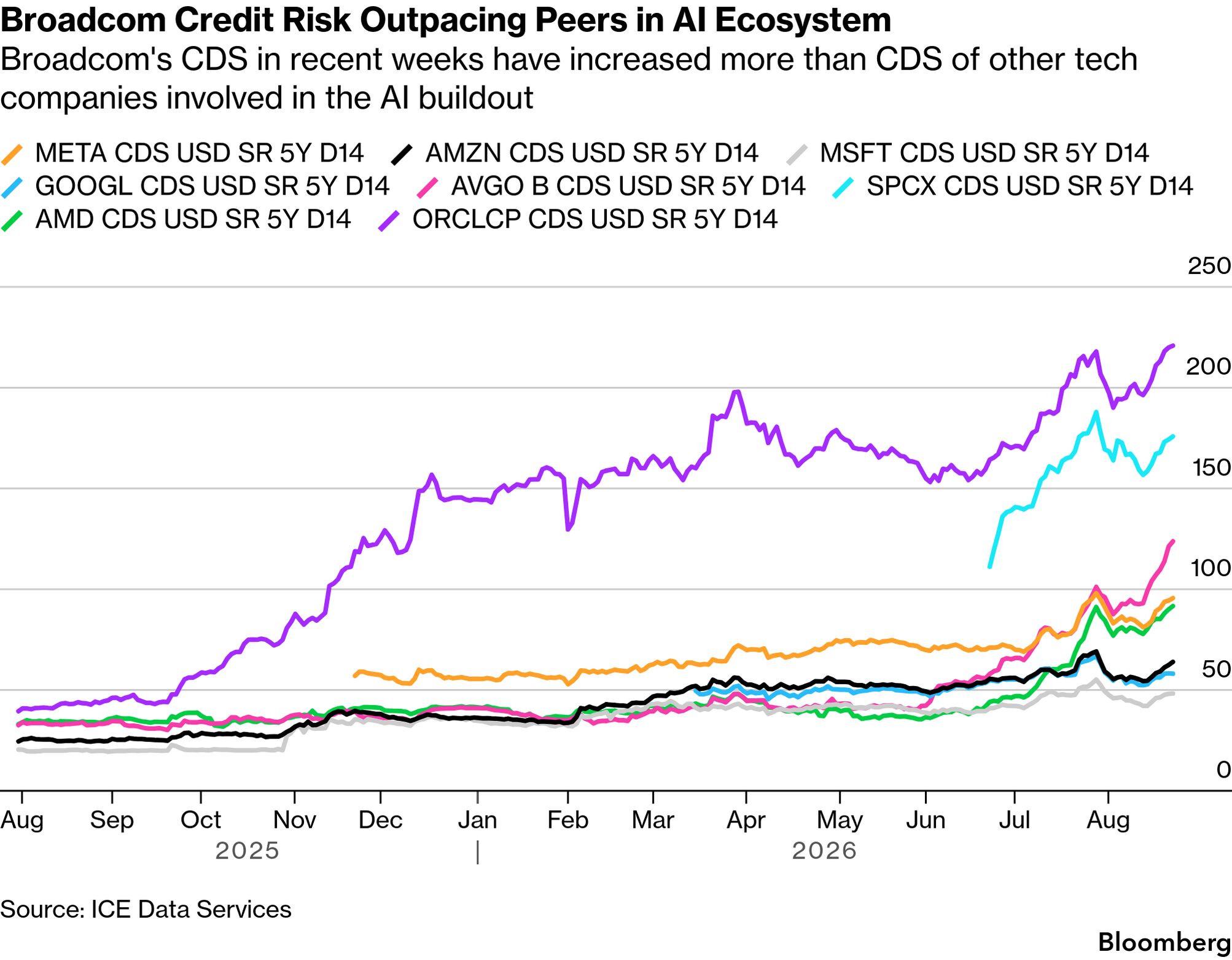
Bond traders have ramped up measures of credit risk associated with Broadcom Inc. as it backstops mega financing packages for the buildout of artificial intelligence.

The yields on Broadcom’s 5.15% bonds that mature in 2031 rose about 14 basis points so far in August. The price of its five-year credit default swaps, meanwhile, climbed 28 basis points over the same period — a larger amount than both Oracle Corp. and SpaceX.

Broadcom is in talks to raise more than $60 billion in debt for an AI chip financing deal that is expected to benefit Anthropic PBC and other companies. While the proposal is still being ironed out, Broadcom could potentially guarantee a portion of a senior-secured tranche.

That’s after it struck an agreement earlier this year to backstop most of a $35 billion debt package while investors including Apollo Global Management Inc. and Blackstone Inc. financed the purchase of custom AI chips to lease to Anthropic.

“The rise in Broadcom’s CDS seems to me is more specific to their balance sheet than overall angst over AI investment,” said Tony Trzcinka, investment grade portfolio manager at Impax Asset Management, adding it was likely related to expectations of additional financial guarantees by Broadcom for chip-financing deals.

 https://assets.bwbx.io/images/users/iqjWHBFdfxIU/i7MkCqnw8SMs/v3/pidjEfPlU1QWZop3vfGKsrX.ke8XuWirGYh1PKgEw44kE/-1x-1.png

The use of guarantees and other forms of financial support have gained pace this year as tech companies invest billions to expand cloud-computing capacity. Under these agreements, chipmakers like Broadcom or Nvidia Corp. are effectively lending the strength of their balance sheets to their clients to boost their purchasing ability....

....MORE 

"Hedge Funds’ Cash Treasury Holdings Reach $2 Trillion"

Any forced unwind of those positions could cause some serious ructions.

From the blog of the U.S. Treasury's Office of Financial Research, August 19: 

Views and opinions expressed are those of the authors and do not necessarily represent official positions or policy of the Office of Financial Research or the U.S. Department of the Treasury.1

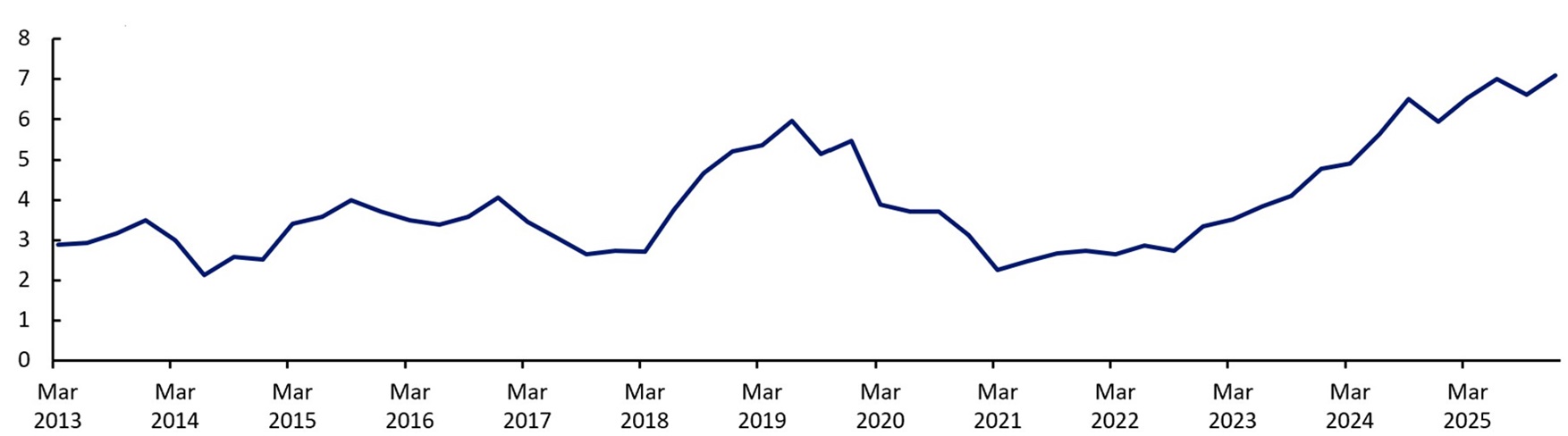
Hedge funds have reemerged as significant participants in the U.S. Treasury market. As of year-end 2025, their cash Treasury holdings reached $2 trillion, nearly three times the level from five years earlier. In comparison, marketable Treasury debt outstanding increased 29% to $28.9 trillion over the same period. As a result, hedge funds’ share of the cash Treasury market reached a record 7% (Figure 1).

Figure 1. Hedge Funds’ Long Cash Treasury Holdings as a Share of Marketable Treasury Debt Outstanding (percent)

Line chart of hedge funds' long cash Treasury holdings as a share of marketable Treasury debt outstanding, quarterly from March 2013 to Q4 2025. The share ranges between roughly 2.5 and 6 percent through 2022, then climbs steadily from about 3 percent in late 2022 to roughly 7 percent by Q4 2025 — a series high.

Note: Data as of Q4 2025. Numerator is the sum of long Treasury exposures (cash + derivatives) reported on SEC Form PF less the notional value of leveraged funds’ long and spreading positions in Treasury futures and options. Denominator is total marketable Treasury debt outstanding at market value.

Sources: Federal Reserve Bank of Dallas, Commodity Futures Trading Commission (CFTC), Office of Financial Research Hedge Fund Monitor, Authors’ estimate

A major driver of this trend may be the cash futures basis trade, or, simply, the basis trade, which is a relative value strategy where hedge funds take offsetting positions in Treasury securities and Treasury futures. Because profits for this trade are small, hedge funds scale positions by relying heavily on leverage through repo financing and futures margining. This leverage allows hedge funds to absorb more Treasury issuance at a time when primary dealers face balance sheet constraints.

Rising Hedge Funds’ Share of the Treasury Market

Primary dealers have traditionally served as a backstop for new Treasury issuance. However, in part resulting from post 2007-09 financial crisis capital regulation, dealers face balance sheet constraints that limit their capacity to hold Treasuries. Hedge funds, by contrast, are not subject to such constraints.

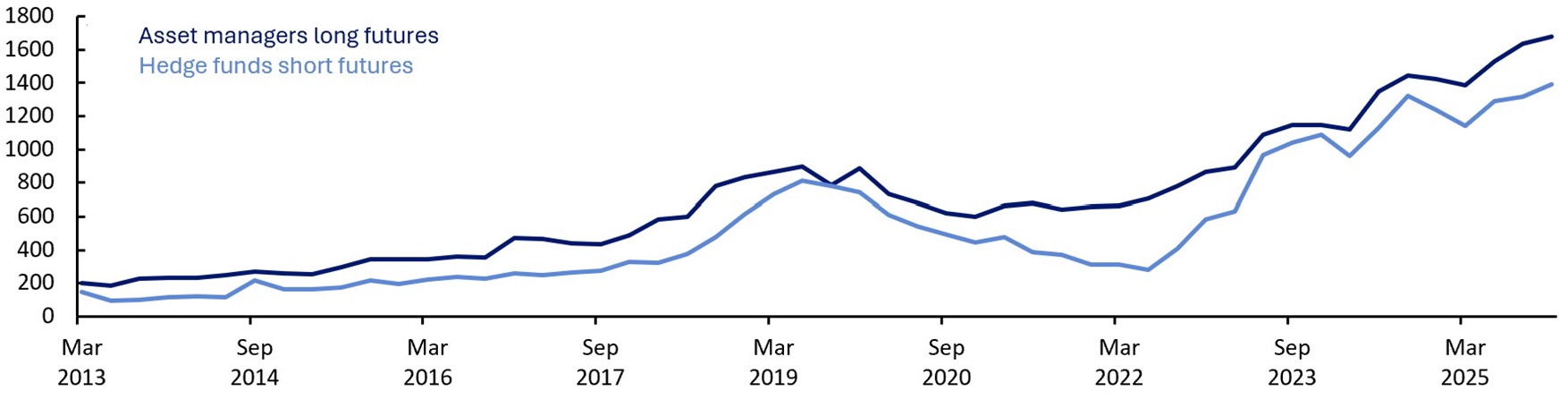
Also, some asset managers, such as mutual funds, separately managed accounts, and insurers have recently preferred Treasury futures rather than cash Treasuries for duration exposure.2 In recent years, asset manager demand for futures has grown sharply as the weighting of Treasuries increased in popular U.S. fixed income benchmark indices (Figure 2). Hedge funds are often on the other side, as shown below by the mirror increase in short futures.

Figure 2. Treasury Futures Notional Outstanding ($ billions)

Line chart of Treasury futures notional outstanding in billions of dollars, quarterly from March 2013 to Q4 2025, showing asset managers' long futures (dark blue) and hedge funds' short futures (light blue). Both series move together, rising to roughly $800 billion by early 2020, falling to about $300 billion in 2022, then climbing to new highs near $1,700 billion (asset managers) and $1,400 billion (hedge funds) by Q4 2025.

Note: Data as of Q4 2025.

Sources: Office of Financial Research Hedge Fund Monitor, Authors’ analysis.

Measuring Hedge Funds’ Cash Treasury Positions

Hedge funds’ cash Treasury holdings are not specifically reported. However, various methods approximate these holdings using a combination of SEC Form PF, which captures long Treasury exposures (cash plus derivatives), and Traders in Financial Futures data from the Commodity Futures Trading Commission (CFTC), which report long Treasury futures positions (see OFR Hedge Fund Monitor).

We estimate hedge funds’ long cash Treasury holdings at $2.0 trillion by subtracting long futures and futures‑spread positions from long Treasury exposures in SEC Form PF. In comparison, hedge funds’ short futures positions totaled $1.4 trillion. A significant share of this position is likely the basis trade; hedge funds do not separately report cash Treasury securities and derivatives on SEC Form PF. Research published in recent years by the CFTC, the Bank for International Settlements, the Federal Reserve, and sell-side firms has estimated the size of the trade to be from $350 billion to $1.5 trillion.3

The Basis Trade: A Small Profit, High‑Leverage Strategy....

....MUCH MORE 

"Yields decline on CNBC report Treasury could use General Account to fund buybacks"

From CNBC, August 24: 

Treasury yields were lower on Monday after CNBC reported, citing two Treasury officials, that the department could use its $1 trillion General Account to fund its plans to ramp up government bond purchases.

The 10-year Treasury note yield was last down 4 basis points at 4.7%. The 30-year yield, which last week hit levels not seen since 2007, lost 4 basis points to trade at 5.23%.

One basis point equals 0.01%, or 1/100th of 1%, and yields and prices move inversely to one another.

The officials did not say how much of the the TGA would be used, however....

....MUCH MORE 

"Volkswagen warns Germany's car-making industry is in jeopardy"

Lifted in toto from France24, August 24:

Volkswagen warns Germany's car-making industry is in jeopardy 

The CEO of the German car-making group Volkswagen is warning that the situation at the company is "more than critical". Oliver Blume is saying that ahead of meetings with the car giant's staff. He says  

Volkswagen and the rest of Germany's car industry are facing "the biggest upheaval in their history" due to global headwinds and Chinese competition.

France24 home

Capital Markets: "US -Canada Trade War Escalates, while US Seek to Choke the Iranian Economy"

From Marc Chandler at Bannockburn Global Forex:

The US dollar is trading higher against nearly all the currencies. Equity markets are mixed and bond yields are lower alongside oil prices. There are two major developments.  First, the US and Canada trade talks broke down, and the risk is further escalation. Last week, President Trump has granted Canada a three-day grace period from the 50% tariffs on $20 bln of Canadian goods, even those that were protected by the USMCA saying a deal was struck. Canadian Prime Minister Carney was less sanguine and acknowledged that while progress was made, there were many unresolved issues. 

The second development is that US economic sanctions on Iran are intensifying.
  Treasury Secretary Bessent has an editorial in today’s Financial Times and will hold a press conference later today to explain what the US economic operation will entail. There are not very thinly veiled threats against those who violate the US sanctions.  A key question is China’s response, a month before President Xi is to visit Washington and meet with President Trump....  

....MUCH MORE 

"China sets up shop next to key Spanish naval base"

They are relentless. 
Someone should have spanked Xi and said "no" when he was young, it's probably too late now. 

From Euractiv, 

Fears that state-owned car giant’s hub will be used by China to spy on NATO

MADRID –  Chinese automotive manufacturer SAIC is one step closer to establishing a foothold at the heart of Spain’s defence industry as the state-backed firm prepares to build a major factory next to a naval port.

One of the bases for the future assembly plant is the outer port of Ferrol, a dual military-civil harbour, located in the northwestern region of Galicia, close to a naval shipyard.

In July, SAIC sent a logistics vessel to assess the port’s infrastructure readiness ahead of the company’s arrival amid a growing debate over the site of the Chinese firm’s first European electric vehicle assembly hub.

Ferrol’s natural bay is home to one of the key headquarters of the Spanish Navy and the national shipbuilder Navantia.

Spanish media reported this week that internal defence and intelligence reports warned of potential “threats” arising from the operation.

Still, Digital Minister Óscar López defended the Chinese investment, dismissing claims it could be rejected by the Council of Ministers, whose approval is required for such foreign investments.

“These investments are analysed, and it may be the case that a series of recommendations are made –  from an economic or security perspective – which are taken into account and make the operation viable,” he told the press on Monday, arguing that such security risk analyses “are normal”.

The potential military and intelligence use of commercial infrastructure by Beijing has drawn the attention of EU institutions, as security experts warn of risks spanning from economic reliance, data security vulnerabilities, surveillance of vessel movements, and restricted military mobility.

A military ecosystem

While SAIC prepares its landing in Ferrol – with construction expected to run from 2027 to 2028 – Navantia is preparing its latest-generation corvettes just a few kilometres away in the inner bay.

The new F-110 frigates are set to become one of the most advanced frigates in Europe, with one vessel expected to be delivered yearly to the armed forces until 2032, according to official data.

The first F-111 Bonifaz vessel will be ready to sail as soon as 2028.

“This ship will give us a decisive strategic advantage and act as a deterrent…it represents our firm commitment to anticipating the challenges of the future,” said Antonio Piñeiro, chief of the Naval Staff, last year.

The harbour also hosts a Spanish Navy headquarters, home to five F-100 frigates which regularly take part in NATO operations. The SAIC complex in the area is being built right at the entry point of the bay, along the path military vessels take when heading to the Atlantic Ocean....

....MUCH MORE 

If interested we've been tracking China's real estate excursions in Morocco at the approaches to the Strait of Gibralter, at the tip of South America, the approaches to the Bab el-Mandeb/Red Sea, the Panama Canal and some twenty European ports including Hamburg and Rotterdam.