Wednesday, June 24, 2015

Bloomberg On the Sharing Economy

Bloomberg Brief, June 15, 2015:

The Sharing Economy: Friend or Foe?
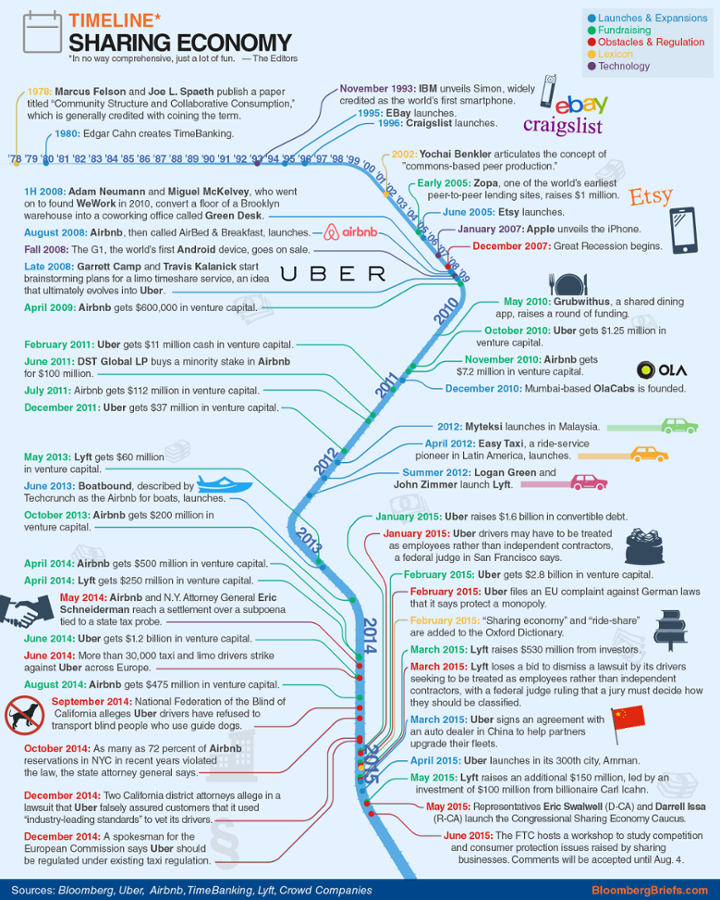
“The sharing economy” is a sobriquet to warm hearts. Think of it as a claim that while grubbier businesspeople sell, buy and rent, the ones in the sharing economy collaborate, facilitate, build trust. Or so they say. 

Sharing-economy flag-bearers like Uber, Airbnb and Homejoy give people easy, cheap access to products and services that would otherwise go unused, free of the burdens of ownership. Their fans say this brings social benefits like community building and diminished inequality. Skeptics predict that it’s more likely to lower wages, raise housing costs, undermine health and safety rules, and expose women to harassment and assault. A 2015 Harvard Business Review headline had this to say: “The Sharing Economy Isn’t About Sharing at All.”

The notion that sharing constitutes a distinct economy has been emerging at least since publication of a 1978 academic paper called “Community Structure and Collaborative Consumption,” about car sharing. So what’s new? Smartphones. Today’s sharing economy got its start in 2008, when Apple introduced its App Store. Suddenly, it was easy to summon a business partner in minutes. Expansion has been aided by innovations like cloud computing and by economic circumstances, notably more people looking for work in weak economies since the financial crisis.

Nowadays, it’s hard to find more exuberant sharing-economy enthusiasts than investors. Uber, the ride-hailing company, is raising $1.5 billion at a valuation of $50 billion — theoretically making the six-year-old business the equal of Target and Kraft Foods. Airbnb, for home sharing, is valued at $20 billion. Uber competitor Lyft is valued

Uber is reportedly raising money at a $50 billion valuation, which would put it among the largest 500 companies by market cap globally. Airbnb, meanwhile, would be almost as big as Marriott if it raises money at the $20 billion valuation it is reportedly seeking.
 
at $2.5 billion. Instacart, for grocery delivery, is valued at $2 billion and Postmates, another delivery service, is valued at $150 million to $200 million. 

Companies say rapid growth supports the valuations. Airbnb claims more than 35 million guests since it launched in 2008 and 1.2 million listings; more than 600 are castles. Dogs can share homes too, on DogVacay, with 20,000 sitters on its platform. It's hard to figure out if revenue is growing as rapidly at these closely held companies, but a leaked Lyft fundraising document showed that the company took in about $140 million in 2014.

Ideological opponents say the sharing economy creates employee-serfs who go without benefits like health insurance and job security, and that peer-to-peer transactions aggravate inequality. In big cities, for example, apartments used for “sharing” become unavailable to long-term renters, worsening housing shortages and driving up rents. Cities and countries around the world are having to decide whether to treat sharing companies as innovators or scofflaws. 

As sharing companies adjust to regulators, they become more like other businesses. Houston makes Uber drivers pass a background check and provide disability access. What makes car-sharing there different from cab services? We explore this and other questions throughout this supplement....
...MUCH MORE

click for ginormous graphic
68221


HT: The Big Picture

"City trader in Libor scandal branded an ‘unimpressive total wide boy’"

From CityWire's Wealth Manager:
A City trader accused of helping rig Libor rates was described in court today as ‘unimpressive’ and a ‘total wide boy’.

Tom Hayes, who traded yen derivatives for UBS, was also branded ‘arrogant’ after he turned up ‘scruffy and unshaven’ for a tour round Citigroup’s offices in October, ahead of joining the investment bank’s Tokyo branch, according to Court News UK.

ADVERTISING
Southwark Crown Court heard that he began rigging rates after initially failing to impress colleagues in his new role. Hayes was said to have netted UBS massive profits, earning ‘millions’ in the process....MORE

HBR: "The Hand Signals That Drove Business in Renaissance Europe"

From the Harvard Business Review:
hands-1
The textbook in which these hand signals appeared was written by Girolamo Tagliente in Venice in about 1515. According to one scholar, Tagliente’s book was printed throughout the 16th century and did much to shape the teaching of math—a vital discipline for merchants and tradesmen. 
The marketplaces of Renaissance Europe were polyglot bazaars, attracting traders from across the Continent and beyond, who spoke different languages and carried different currencies. How did businessmen communicate? And how did they stay abreast of exchange rates?...MORE

Tuesday, June 23, 2015

"...Blythe Masters Is the Devil Incarnate"

From the International Business Times, June 19:
Max Keiser, founder of VC fund Bitcoin Capital, seeding currency startcoin, and the presenter of the Keiser Report, does not mince his words.

Bitcoin completely challenged the banking world leaving banks and card issuers to play catch up, and this has led to a divide in the community: some think that banks are going to basically end up controlling the space and others believe that they will not.

Keiser told IBTimes UK in no uncertain terms that the most prominent force attempting to wrestle back a proprietary fiefdom for banks is the former global head of commodities at JP Morgan, Blythe Masters.

Masters joined blockchain-focussed company Digital Asset Holdings in March of this year. She is by far the biggest fish from Wall Street to enter the space – something which mainstream media sources generally reported as a huge vote of confidence for cryptocurrencies.

Keiser sees it differently: "Yes, I can tell you the evil cult leader is Blythe Masters....MORE
Well there you go.

I knew there was something missing from "Institutional Investor Interviews Blythe Masters On Her Digital Asset Holdings"

How to Overthrow a Martian Dictatorship

From the BBC:

The governments we create on other worlds might turn nasty. Richard Hollingham meets a group plotting revolution in space. 
Two short blocks from the London headquarters of Britain’s security service, MI6, a group of 30 men and women is plotting to overthrow the government.

Not – and I should make this abundantly clear for any spooks reading this – the British government, nor any government on Earth, but a tyrannical administration on an alien world in the future.

This is not a game. The scientists, engineers, social scientists, philosophers and writers gathered at the British Interplanetary Society in London are taking their task seriously – studying, with academic rigour, the problem of toppling despotic extraterrestrial regimes.

This is the third annual conference on extraterrestrial liberty. Last year the event tackled the challenge of writing a constitution for an alien settlement, concluding that successful space colonies should base laws and liberties on the US Constitution and Bill of Rights.

“This year we’re discussing what happens if you don’t like the government you’ve created and want to overthrow it,” says conference organiser Charles Cockell, a professor of astrobiology at the University of Edinburgh.

Conclusions from these meetings will be published as essays, designed to serve as manuals for future spacefarers.

“We hope the discussions we have will constitute the first ideas on extraterrestrial liberty,” Cockell says.

“We’ve got a chance to think about what the problems might be in outer space before we go there.”
The scenarios the group is contemplating are easiest to imagine if you think about what a space colony might be like. Perhaps a domed settlement with a few hundred residents, beneath a thin dusty Martian sky. A fragile and isolated outpost of humanity 225 million kilometres from the home world. With a brutal dictator and his cronies in charge of the oxygen generators, for instance....MORE

The California Uber Ruling Means NOTHING To Sharing Economy Valuations

I exaggerate for emphasis.
My best guess is that a business model that depends on an uneven playing field for its competitive advantage-- in dollar terms, estimated at 30% over taxis--is inherently risky, expecially in California.
No matter how many lobbyists you can muster.

From FT Alphaville:

Who cares about cost when chasing unicorns
A Monday story from Reuters catches the eye. Investors don’t think a California ruling which classed a former Uber contractor as an employee will affect valuations, either for the taxi supplying start-up or others operating in the so-called “sharing economy”.

There are a couple of ways those optimistic investors might be right, but the sentiment suggests more about the nature of hope and dream-based valuations than any real consideration of business prospects.
We’ll get the obvious argument out the way first: the ruling was a one-off, which Uber will appeal, so lets assume companies which connect consumers with contractors who want to share their labour for a price can continue to treat those contractors as independent mini-corporations, not people. 

Essentially, nothing has really changed. The problem with this line of argument is the large number of people who are walking and quacking like
ducksemployees.

As the Californian Labour Commission has said before, in the ruling cited in the Uber case, “their work is the basis for [Defendant's] business”.

The point here isn’t to debate Californian legalities, however. Here is an investor consulted by Reuters:
Smaller companies need more flexible work forces and contractors solve that problem. Larger companies with more predictable demand for their products or services can benefit from having employees scheduled to work regular shifts.
“If they had to change (to) that, it would be just fine,” said an Uber investor who declined to be identified due to sensitivity around the ruling.
The expenses that would stem from classifying drivers as employees, including paying workers’ compensation, Social Security and other costs, could be offset to a large extent by the lower wages Uber could pay to drivers compared with contractors, the investor argued.
The article also repeats an Uber claim to have 22,000 drivers in the San Francisco area alone, which suggests it could have started to employ them already, if it was in fact cheaper. In any sort of traditional valuation analysis, a permanent rise in costs associated with higher taxes or regulation is a bad thing. Everything else being equal, there will be less money left at the end to reinvest in the business or pay dividends to the owners, unless those costs can all be passed on to consumers....MUCH MORE

Also of interest: Uberlawsuit.com

Meet the Lawyer Taking on Uber and the Rest Of the On-demand Economy

Inventory As A Service: Haircare By Andreessen-Horowitz Edition

From Venture Capital Dispatch:

Andreessen Horowitz Leads $10 Million Investment in Mayvenn 
An Oakland, Calif., startup called Mayvenn Inc. has raised $10 million in venture funding to help beauticians sell hair extensions and other products to their clients without having to purchase, store or ship any inventory themselves.

Andreessen Horowitz led the Series A investment joined by Trinity Ventures, Core Innovation Capital, Troy Carter’s Cross Culture Ventures, Impact America, and noteworthy individual investors including Jimmy Iovine, Serena Williams and Steve Stoute, CEO of ad agency Translation.

General Partner Ben Horowitz, now a board observer at Mayvenn, says the startup was profitable and “didn’t need” the Series A capital but raised it to accelerate growth.

The startup has “come up with an ingenious way to fix one of the worst consumer buying experiences” said Mr. Horowitz, citing the reason the firm invested. Currently, to get hair extensions put in, “You have to go to a weird, not very well organized store and buy hair products where you have no idea if they’re right for you, from a person who also has no idea. Then you take it to your [stylist], and if it’s not the right one you can’t get your money back.”...MORE
cnet-mag-marc-andreessen.jpg
No comment from Mr. Horowitz's partner.

Australia's Bureau of Meteorology: "El Nino strengthens with models predicting it will last well into 2016"

From the Sydney Morning Herald:
The El Nino weather pattern continues to consolidate in the Pacific with most climate models indicating it will extend well into next year, the Bureau of Meteorology said.

The event, which typically boosts global surface temperatures and leads to warmer and drier than average conditions for much of Australia, may also be a strong one, the bureau said in its fortnightly update.
Sea-surface temperatures in the equatorial Pacific - stretching from just west of the international dateline all the way eastwards to the South American coast - are at least one degree warmer than normal.

"It is unusual to have such a broad extent of warmth across the tropical Pacific," the bureau said. "The last time this occurred was during the [super] 1997-98 El Nino."...MORE
Sea Surface Temperature anomalies via Unisys Weather:

http://weather.unisys.com/surface/sst_anom.gif

Monday, June 22, 2015

"Saudi deputy crown prince seeks Russia deals"

The Saudis are not happy with the U.S. administration's relationship with Iran and have been quite pointed about it.

From Al-Monitor:
Deputy Crown Prince and Minister of Defense Mohammed bin Salman visited St. Petersburg in the last week and signed several agreements with the Russians concerning cooperation on oil, space and peaceful nuclear energy, as well as nuclear technology sharing. It is another high-profile mission for the 29-year-old son of King Salman bin Abdul-Aziz Al Saud, but it won't resolve the king's Yemen adventure.

Prince Mohammed was accompanied by Foreign Minister Adel al-Jubeir, Minister of Petroleum Ali al-Naimi and senior military and intelligence officials. Details on the agreements are few. The Saudis and Russians discussed cooperation on energy issues, investment and the global oil market. The two agreed to cooperate to achieve stability in the global energy market. It is unlikely the Saudis will reduce production, however, to raise prices.

Mohammed chairs the Saudi interagency super committee that oversees the oil and gas industry in the kingdom. This trip to St. Petersburg marks the first time the prince has engaged publicly on oil issues. It's likely his profile will rise on oil matters over time.

Russian President Vladimir Putin and Mohammed also discussed the war in Yemen. The Saudis want Russia to endorse their hard-line stand against the Houthi rebels. Moscow earlier abstained in the vote on UN Security Council Resolution 2216 that calls for the Houthis to withdraw from Sanaa. Putin and Mohammed also reportedly discussed the nuclear negotiations between Iran and the P5+1 (the five permanent members of the UN Security Council pus Germany)....MORE

Sunday, June 21, 2015

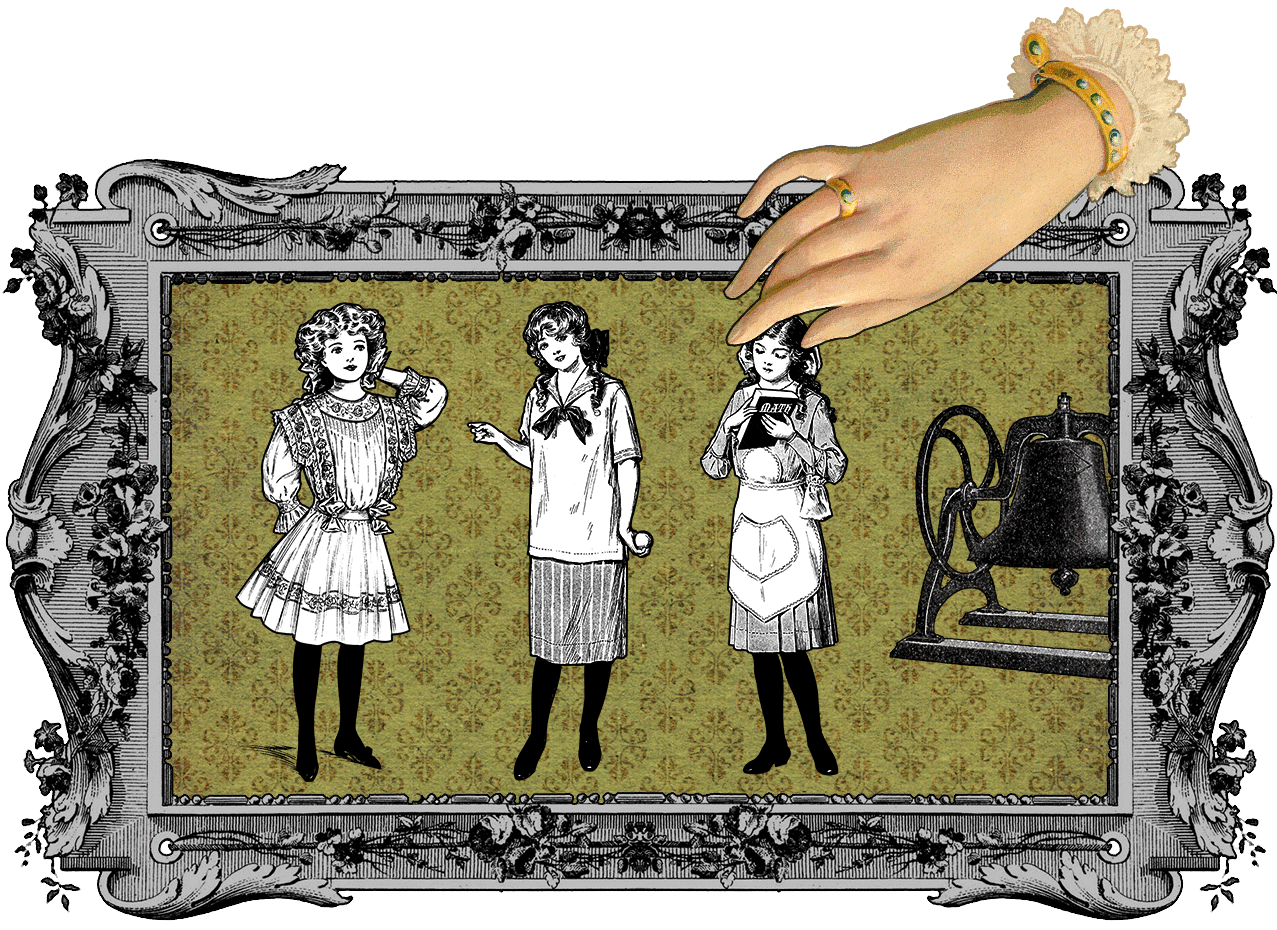
"The Nine Schoolgirls Challenge"

From Quanta (the Marilyn & Jim--yes that Jim--Simons Foundation):

A Design Dilemma Solved, Minus Designs
https://www.quantamagazine.org/wp-content/uploads/2015/06/SchoolGirls.png
A 150-year-old conundrum about how to group people has been solved, but many puzzles remain.
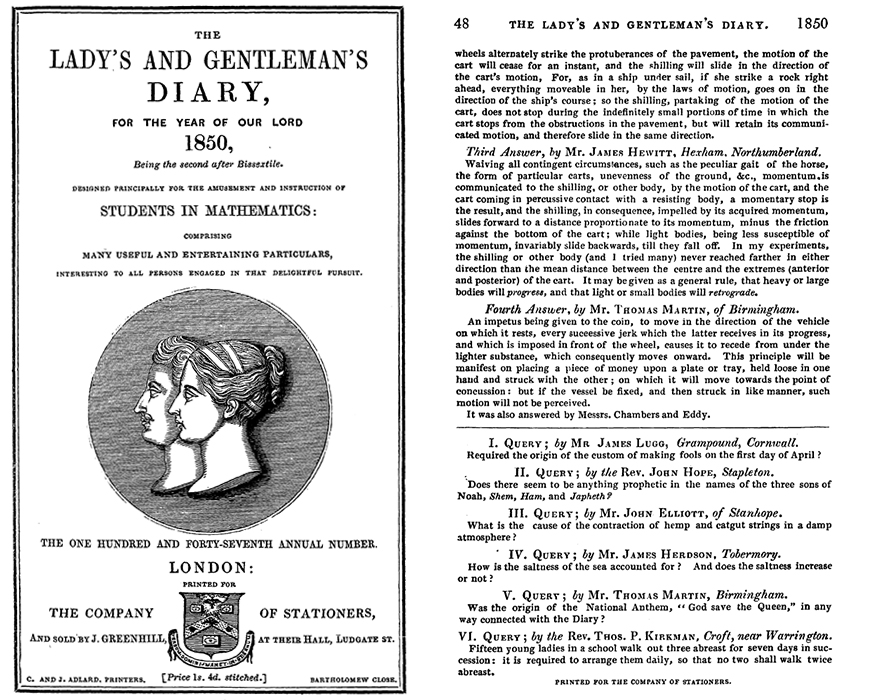
In 1850, the Reverend Thomas Kirkman, rector of the parish of Croft-with-Southworth in Lancashire, England, posed an innocent-looking puzzle in the Lady’s and Gentleman’s Diary, a recreational mathematics journal:

“Fifteen young ladies in a school walk out three abreast for seven days in succession: it is required to arrange them daily, so that no two shall walk twice abreast.” (By “abreast,” Kirkman meant “in a group,” so the girls are walking out in groups of three, and each pair of girls should be in the same group just once.)

The Nine Schoolgirls Challenge:

Solve a variation of Thomas Kirkman’s puzzle by arranging nine girls in walking groups. And think fast — the clock is ticking.
Pull out a pencil and paper, and you’ll quickly find that the problem is harder than it looks: After arranging the schoolgirls for the first two or three days, you’ll almost inevitably have painted yourself into a corner, and have to undo your work.
The puzzle tantalized readers with its simplicity, and in the years following its publication it went viral, in a slow, modestly Victorian sort of way. It generated solutions from amateurs (here’s one of seven solutions) and papers by distinguished mathematicians, and was even turned into a verse by “a lady,” that begins:

A governess of great renown,
Young ladies had fifteen,
Who promenaded near the town,
Along the meadows green.

While Kirkman later bemoaned the fact that his weightier mathematical contributions had been eclipsed by the popularity of this humble brainteaser, he was quick to defend his territory when another prominent mathematician, James Joseph Sylvester, claimed to have created the problem “which has since become so well-known, and fluttered so many a gentle bosom.”
"Design theory may even have been used by betting cartels that made millions of dollars off of Massachusetts’ poorly designed Cash WinFall lottery between 2005 and 2011. That lottery involved choosing six numbers out of 46 choices; tickets won a jackpot if they matched all six numbers, and smaller prizes if they matched five out of six numbers."
The puzzle may seem like an amusing game (try a simpler version here), but its publication helped launch a field of mathematics called combinatorial design theory that now fills gigantic handbooks. What started as an assortment of conundrums about how to arrange people into groups — or “designs,” as these arrangements came to be called — has since found applications in experiment design, error-correcting codes, cryptography, tournament brackets and even the lottery.
Thomas Kirkman’s popular math puzzle was first published in the 1850 edition of the Lady’s and Gentleman’s Diary.

Thomas Kirkman’s popular math puzzle was first published in the 1850 edition of the Lady’s and Gentleman’s Diary.
Yet for more than 150 years after Kirkman circulated his schoolgirl problem, the most fundamental question in the field remained unanswered: Do such puzzles usually have solutions? Kirkman’s puzzle is a prototype for a more general problem: If you have n schoolgirls, can you create groups of size k such that each smaller set of size t appears in just one of the larger groups? Such an arrangement is called an (n, k, t) design. (Kirkman’s setup has the additional wrinkle that the groups must be sortable into “days.”)

It’s easy to see that not all choices of n, k and t will work. If you have six schoolgirls, for instance, you can’t make a collection of schoolgirl triples in which every possible pair appears exactly once: Each triple that included “Annabel” would contain two pairs involving her, but Annabel belongs to five pairs, and five is not divisible by two. Many combinations of n, k and t are instantly ruled out by these sorts of divisibility obstacles.

For the parameters that aren’t ruled out, there’s no royal road to finding designs. In many cases, mathematicians have found designs, through a combination of brute force and algebraic methods. But design theorists have also found examples of parameters, such as (43, 7, 2), that have no designs even though all the divisibility requirements check out. Are such cases the exception, mathematicians wondered, or the rule? “It was one of the most famous problems in combinatorics,” said Gil Kalai, a mathematician at the Hebrew University of Jerusalem. He recalls debating the question with a colleague a year and a half ago, and concluding that “we’ll never know the answer, because it’s clearly too hard.”...MORE
Interactive
The Nine Schoolgirls Challenge

"The Weed Funding Bubble"

You knew this was coming as soon as you saw the always-fashion-forward chameleons of the pink sheets make their move: "Junior Gold Miners Consider Cashing Out, Pursuing Medicinal Marijuana Opportunities".

From the WSJ's The Accelerators blog:
ED ZIMMERMAN: “Businessmen they drink my wine,

Plowmen dig my herb.”

For years I listened to Jimi Hedrix’s version of Bob Dylan’s song “All Along the Watchtower,” convinced I heard those lyrics (according to BobDylan.com, the actual line is “Plowmen dig my earth”). But then again, I’ve had another misconception related to marijuana — I didn’t think that, during my career, I would see a venture capital conference dedicated to startups pitching their weed-based businesses to investors. Yet, that’s exactly what cannabis startups will be doing at a conference next week (in Colorado, naturally), and there are even sponsorship opportunities.

A number of weed-based startups have reached out to me with investment opportunities, and I have friends who have invested or have considered investmenting in these companies. I’ve seen weed tea, micro-loans to weed-based business and the concept of a seed weed fund (no pun intended?) to invest in early stage weed-based startups. Two years ago, VentureBeat wrote an article detailing some web-based startups capitalizing on these opportunities, and even a private equity-style roll-up (acquisitions) in the medical marijuana sector. That was, of course, long before Peter Thiel’s Founders Fund invested in that group, Privateer, which has subsequently raised over $80 million. And following the trends of startup capital flowing into marijuana-based businesses from traditional venture and the ‘Uberification’ of everything, Eaze reportedly raised a $10 million Series A venture round last month from credible funds. I believe we’ll see many more venture dollars fanning the flame of weed-based startups.

Despite my belief that this sector is on fire, I’ve not invested in cannabis-related startups, nor have I taken a deep dive into the businesses. Forget, for a moment, the moral issues on both sides (I believe I understand the moral arguments articulated by people on both sides of the legalization issue, including why taking an underground market and regulating it is game-changing from a safety and tax perspective). I’m not investing in weed because I try to invest in sectors where I feel like I have an advantage, whether it’s because I have visibility into the market, care deeply about the product/service, have meaningful experience in the sector or connections that will be helpful. For me, those just don’t apply to weed-based companies. Of course, I have to know and like the founders too, and that may well apply to some weed-based startups.

When I say “care about” the product or service, I refer to a standard far short of being passionate about the product or service. Sometimes, we get to be passionate about what a startup is doing (Flatiron Health, in which I invested, is a good example – they’re using data to fight cancer), but that doesn’t always apply. For instance, I can’t say that I’ve ever felt truly passionate about advertising technology, but before I made my first investments in ad tech startups, I spent a slew of time representing them, doing deals with the funds that backed them and seeing how they grew or didn’t grow. I lack that experience base with weed startups.

I’m not judging those who pursue the sector, nor do I doubt the credentials and skills of a number of the executives and investors in the industry. They’re placing an educated bet on broader legalization of marijuana and if that bet bears fruit, they will not only be well-positioned to make money on the current investments, but they will be viewed as pioneering investors in that sector. I’ve repeatedly seen pioneering investors and executives in successful sectors get (and arguably deserve) great deal flow. That axiom should apply to early investors in a post-legalized marijuana market....MORE
Here's the Playing for Change | Song Around the World version of Mr. Marley's One Love:


Previously on the ganja channel:

"Peter Thiel's Founders Fund becomes first institutional investor in marijuana"
Frontrun the Dopers: "These 4 States Will Reform Their Marijuana Laws in 2013"
"Is Monsanto Ready to Enter The Medical Marijuana War?" (MON)
In the Wake of Colorado and Washington State Legalization, Time to Think About Pot-enomics
Here Comes Crop Insurance For Your Dope
The Audacity of Dope: "Oakland ready to approve four marijuana factories"
6% of all power produced by BC Hydro is used to grow marijuana.
If Farm Investing Conference Agenda Is Any Indication, Marijuana Prices Are Going to Zero
Bread and Circuses: Chicago City Council Votes to Decriminalize Marijuana, 43-2
"The Coming Age of Corporate Cannabis"
"Hedge Fund Managers Smoking Out Opportunities In Emerging Market Of Legalized Weed "
As soon as one 'Uber for weed' startup gets cut down, another grows in its place
"The Geography of Pot Prices"
Attention Homeless Dopers: New Berkeley Ordinance Requires Dispensaries to Hand Out Freebies
Considering the co-morbidity of schizophrenia and pot use and schizophrenia and homelessness this is probably a good idea.
For Berkeley
.

And many more. Use the search blog box if interested.

Apartment Rent Inflation and the Federal Reserve

New Deal democrat at the Bonddad blog:

The Fed vs. Millenials: inflation and the apartment boom 
Should the Fed raise rates when inflation is being driven exclusively by a necessity, and demand for that necessity is being driven by demographics?

Just as with Boomers 50 years ago, the Millennials have reached the age where they are moving into their first residences.  This has created a boom 
in multi-unit dwellings:

 and has driven median asking rents to record inflation-adjusted highs.

At the same time, the CPI less shelter is the most negative it has been in 60 years (-1.3%) excluding the bottoms of the 1950 and 2009 recessions.  In other words, the only important driver of inflation right now is Owner's Equivalent Rent, as shown in this graph comparing CPI for housing (red) with CPI for everything else (blue):
Notice what happened from the late 1960s through the early 1980s as the Boomer generation reached initial apartment/home buying age. The same contrast is appearing now....MORE
Previously:

Aug. 2014
Owner-Equivalent-Rent Inflation is Probably Not a Blip
Feb. 2015
The Rent Is (Going to Be) Too Damn High 
April 2015 
Housing Prices Begin To Feed Into Official Inflation Figures

Lawrence Summers: "Greece is Europe’s failed state in waiting"

From the Financial Times:
When, as now appears likely, Greece financially separates from Europe it will at one level be no one’s fault.
The Greek leaders will rightly explain that having imposed more austerity on themselves than any industrialised country has suffered since the Depression, they could not have done more without light at the end of tunnel in the form of a clear commitment to debt relief. European leaders will rightly explain that they adjusted their positions repeatedly to accommodate the Greeks. They will stress that their citizens would not permit Greece to play by different rules to the rest of Europe. And the IMF will rightly explain that it would have blessed any plan agreed by Greece and Europe that added up.

The trouble is that all the parties are going to get much more of what they fear from a breakdown than they would even from what they regard as an unacceptable compromise. Historians understand how the first world war was allowed to start but are still, a century later, incredulous that it happened. Financial historians may look back at the events of next week and wonder how Europe’s financial unravelling was permitted.

Make no mistake about the consequence of a breakdown. With an end to European support and consequent bank closures and credit problems, austerity in Greece will get far worse than it is today and it will probably become a failed state to the great detriment of all its people and their leadership.

When Greece fails as a state, Europe will collect far less debt than it would with an orderly debt restructuring. And a massive northern out-migration of Greeks will strain national budgets throughout Europe — not to mention the challenges that will, come as Russia achieves a presence in Greece....MORE

Saturday, June 20, 2015

The Leadership Gene: DAT1

We take dopamine very seriously, some links below.
From ScienceDaily:

Genes may influence leadership in the workplace
Date: May 19, 2015
Source: Kansas State University
The right genes may help you become an organization's next president or CEO. But the same genes may also hinder your leadership path, according to Kansas State University psychological sciences research.

Wendong Li, assistant professor of psychological sciences, and collaborators have found a "mixed blessing" for workers who hold workplace leadership positions, from the formal leader of a CEO to an informal group leader. Their study focused on the dopamine transporter gene DAT1, which can influence leadership and is important for reward and motivation systems in humans.

"It's like a mixed blessing -- this gene can have both positive and negative effects on leadership," Li said. "An implication is that it really depends on environmental factors to determine if overall it is a positive or negative."...MORE
HT: The Next Web's "What makes a good leader great?".

Previously:

New York Fed On "Anxiety, Overconfidence, and Excessive Risk Taking" (pathological gambling and self-manipulation with booze and blow)
"New research suggests link between genetics, Wall Street success"
Your genes affect your betting behavior
Your Brain and Financial Bubbles
Berlusconi Blames Stock Market Volatility On Cocaine (and a look at neurotransmitters) 
The Internet, Deflation and Depression
...Further, the newspapers likened the changes to those seen in cocaine abusers but went on to describe something quite different from my understanding of what blow does to the reward pathways, overexciting the dopamine cascade until the various D receptors no longer react to dopamine and eventually leading to anhedonia. The big A is often concurrent with and like anxiety, may even kindle for, depression.
Don't worry, be happy.
See also "Pleasure Dissociative Orgasmic Disorder"

JP Morgan On Greece: The Collateral Has Run Out

Watch for queues at the banks.

Way back in September 2007 we noted that some lunatic at FT Alphaville was posting at 11:22 pm:
All Chauffeur Alert! Bank of England Court convenes
and thought this might be a story to keep an eye on.

The next day, Friday the 14th, it was:
Northern Rock: Customers line up to withdraw funds
This is a bit more interesting than the "Move along, nothing to see here" that we got from the Bank of England last night....

On Saturday:
Northern Rock (LON: NRK) Updates
...When I read that The City's Stockbrokers and Fund Managers were queuing up to withdraw their deposits, well, it gets your attention....

By then I had sort of lost it:
Panic on the streets of Britain: Northern rocked, City shocked

Rock, Paper, Scissored
Sorry.
I seem to be channeling the Post.

 
So yes, watch for lines at the banks.

From ZeroHedge:

"The Collateral Has Run Out" - JPM Warns ECB Will Use Greek "Nuclear Option" If No Monday Deal
In Athens on Friday, the ATM lines began to form in earnest.

Although estimates vary, Kathimerini, citing Greek banking officials, puts Friday’s deposit outflow at €1.7 billion. If true, that would mark a serious step up from the estimated €1.2 billion that left the banking system on Thursday and serves to underscore just how critical the ECB’s emergency decision to lift the ELA cap by €1.8 billion truly was. “Banks expressed relief following Frankfurt’s reaction, acknowledging that Friday could have ended very differently without a new cash injection,” the Greek daily said, adding that the ECB’s expectation of “a positive outcome in Monday’s meeting”, suggests ELA could be frozen if the stalemate remains after leaders convene the ad hoc summit. Bloomberg has more on the summit:
Dorothea Lambros stood outside an HSBC branch in central Athens on Friday afternoon, an envelope stuffed with cash in one hand and a 38,000 euro ($43,000) cashier’s check in the other.

She was a few minutes too late to make her deposit at the London-based bank. She was too scared to take her life-savings back to her Greek bank. She worried it wouldn’t survive the weekend.

“I don’t know what happens on Monday,” said Lambros, a 58-year-old government employee.

Nobody does. Every shifting deadline, every last-gasp effort has built up to this: a nation that went to sleep on Friday not knowing what Monday will bring. A deal, or more brinkmanship. Shuttered banks and empty cash machines, or a few more days of euros in their pockets and drachmas in their past - - and maybe their future....
...MORE

Yesterday at ZeroHedge:
"Bank Holiday" Preparations Begin In Greece, Lines Form At Athens ATMs

The Rise and Fall of New York's Private Clubs

From Curbed, NY:


yaleclubinterior.jpg
[The interior of the Yale Club. Photo by the Wurts Brothers, courtesy of the New York Public Library.]

In 1915, the Yale Club opened a giant, 22-story facility on Vanderbilt Avenue—making it then, as now, the largest private club in the world. Celebrated at the time as a sign of Yale's dominance (both in the club world and over Harvard), the new clubhouse was the high water mark for such clubs in New York's business and social life. The 1902 edition of Club Men of New York detailed 38,000 memberships in 157 clubs, and it reads like a Who's Who of the city's elite, from well-known names like Vanderbilt, Astor, and Morgan to then-famous families who have all but faded from view. In terms of status, no club was more powerful than the city's first, the Union Club, founded in 1836. It, like the Yale Club and many other such organizations, still has an active membership roster today. But from the moment the Yale Club opened its doors a century ago, the role of these clubs for the city's power brokers began to wane.

Modern private social clubs (which are usually seen as distinct from fraternal organizations such as the Masons or the Revolutionary War-era Society of Cincinnati) trace their origins back to the coffeehouses of 17th-century London. Coffee was introduced to London society in 1652 and took the city by storm. Coffeehouses became the place to meet and discuss current events. Soon, coffeehouses took on distinct political affiliations (and branched out to serve more than coffee); Mrs. White's Chocolate House on Chesterfield Street became both a Tory bastion and—in a move to limit who could take part in the conversation—instituted a members-only policy. While coffeehouses continued to thrive in the 18th century (and were exported to New York, where Tontine's on Wall Street was central to city life and an early home of the New York Stock Exchange), establishments such as Mrs. White's—by the early 1700s shortened just to White's—began to dominate the social scene. Club life took off in London after the Napoleonic Wars and it wasn't long until New Yorkers began to see the appeal of a private club's exclusivity.
 tontinecoffeehouse.jpg
[Tontine Coffee House by Francis Guy. Image via Wikimedia Commons.]
In the summer of 1836, a number of leading New Yorkers, including ex-mayor Philip Hone, invited two hundred and fifty "gentlemen of social distinction" to join the new Union Club. As Hone noted in his diary, the club would "be similar in its plan and regulations to the great clubs of London, which give a tone and character to the society of the London metropolis." After offering admission to the initial cohort of 250, the club's membership would then be expanded to 400—large enough to accommodate enough socially distinct gentlemen while still remaining exclusive. It's intriguing (and, perhaps, not a coincidence) that 400 members not only became the standard for other city clubs, but also was the capacity of Caroline Schermerhorn Astor's ballroom in her Fifth Avenue mansion. Evidently, throughout the nineteenth century, the number of people in New York City worth knowing was capped at 400—the hard part was figuring out which ones....MUCH MORE

Smart Talk On Uber and the Sharing Economy

From the Financial Times:

Uber driver case poses questions for ‘sharing economy’
A tremor passed through the foundations of the “sharing economy” this week after it emerged that ride-hailing app Uber had lost a case before California’s Labor Commissioner’s Office.
For the venture capitalists who have rushed to back them, a big attraction of such companies has been their ability to act as simple middlemen in a market that matches people looking to buy a service with others who are providing it

But the labour commissioner in Uber’s home state had other ideas. In a case involving a single driver seeking reimbursement of expenses, it ruled that the company should have taken on the full responsibilities of an employer.

The ruling highlighted a potential Achilles heel in the business models of the internet companies which have sought to become marketplaces for independent contractors. From delivery start-ups such as Instacart to odd-job service TaskRabbit, they have pitched themselves as simple internet platforms, taking a slice of the transactions they help arrange.

If Uber were forced to grant full employee status to the burgeoning army of freelance workers who look to its mobile app for work, the higher costs would put a dent in one of the consumer internet’s most profitable new business models.

It could also alter the pay and job security prospects of millions of workers. Their ranks could be significant: ten years from now, 200m unemployed or part-time workers are likely to be making extra cash by taking piecemeal work through online services like this, according to McKinsey, the professional services firm.
Uber sought to brush off the decision as an isolated case that would not have any standing as a precedent in the California legal system. It also pointed out that decisions in five similar cases elsewhere had gone in its favour — though it also lost a sixth, in Florida. But labour law experts said it would not be so easy to distance itself from the consequences of the decision.

Jonathan Handel, a lecturer at USC Gould law school, said the company’s reaction was “a little bit like whistling past the graveyard”. The decision “doesn’t set a precedent that binds the courts, but it does indicate the way the labour commissioner would go if it received further cases from Uber drivers”....MORE
I particularly like the last sentence of the article:
...“I’d be nervous if I was one of the last investors in,” Mr King said, referring to a previous investment round earlier this year.
Similar to the monomaniacal thinkingt in our intro to "Mathematical Model Explains Why All Hipsters Look the Same":
This and the rabbit post below are an attempt to distract Uber's late investors, the currently-being-raised series F and February's series E Uber investors, from the earlier news out of California.
The series A guys, First Round, Benchmark et al. should still be okay.  
(they ponied up $11 million at a $60 million valuation)
See also:
"Why Uber's $50 Billion Valuation Could Burst the Tech Bubble"

"Fistfight breaks out at Yemen peace talks"

Probably not auspicious.
From France 24:

 © AFP / Fabrice Coffrini I A representative of South Yemen throws a shoe at members of a rebel delegation during clashes at a press conference on Yemen peace talks in Geneva on June 18, 2015 
A fistfight erupted on the sidelines of peace talks in Geneva Thursday between supporters of different warring factions in Yemen, underlining the divisions that have thwarted United Nations efforts to broker a truce in the near three-month conflict.

Yemeni opponents of the Houthi forces that drove the government into exile interrupted a news conference by Houthi officials, throwing shoes and insulting them as “criminals” and “dogs” who were “killing the children of south Yemen”....MORE

Friday, June 19, 2015

Crowdfunding Equity: "New rules mean you, too, can be a startup owner"

From cnet:

Beginning Friday, crowdfunding sites like Kickstarter and Indiegogo can give the public the chance to be startup owners, not just donors.
So you want to be the next Marc Andreessen? Friday could be the day when you start trying.
New federal rules will allow the American public to go online and buy shares in startups that up to now hadn't even been a legal option for all but the richest 3.5 percent of US households, including Silicon Valley venture capitalists like Andreessen.

But the changes made by the Securities and Exchange Commission that open investment opportunities to the masses could also give startup founders a reason to bypass Silicon Valley's all-powerful venture capital firms.
Since it went into effect in 2012, the JOBS Act, or the Jumpstart Our Business Startups Act, has eased up the Depression-era federal rules governing how companies raise funds and sell shares, providing a shot in the arm for crowdfunding.

But the law's effect has been blunted by rules that, among other things, have restricted the buying and selling of shares in private, non-publicly traded companies to accredited investors -- that is, individuals whose annual income is greater than $200,000 or a household whose net assets (excluding their homes) exceed $1 million.

Although Kickstarter and Indiegogo have been increasingly valuable avenues for tech entrepreneurs to raise cash, those crowdfunding platforms have only offered the digital masses the chance to be donors, not owners. Give $10 to a boutique yarn store in Pennsylvania you found on Kickstarter, expect a tote bag, not a share.

And while other crowdfunding sites like Wefunder have allowed tech entrepreneurs to sell pieces of their startups online, circumventing the traditional venture capital route, the SEC has effectively kept 96.5 percent of American households (that is, the non-accredited investor population) from being able to buy, sell, or even look at, the investment opportunities on their sites.

"Unless you're a rich person, you can't participate in the next Facebook or Apple or Tesla," says Ron Miller, CEO of StartEngine. "Friday opens that up."...MORE
HT: the Mercury-Times' SiliconBeat blog.
Also at SiliconBeat:
Quoted: Robots are coming. Get used to it

IMF's Capital Markets Head Says Central Banks May Have to Be "Market Makers"

From Reuters:
(Adds reaction from Hong Kong regulator, background)
Central banks may need to become "market makers of last resort" if there is not enough
liquidity during volatile sell-offs, a senior International Monetary Fund official said on Thursday.
Regulators worry that when interest rates begin rising from their prolonged low levels there will be a stampede for the exits by bond investors and that markets won't have the liquidity or capacity to deal with it smoothly.
The prospect that the Federal Reserve may start raising rates later this year has already prompted "taper tantrums" or severe volatility in global financial markets.
Jose Vinals, director of the IMF's capital markets department, said market liquidity has shrunk as capital requirements on banks have increased but that there was no simple relationship between the two. 
Central banks buying bonds to conduct unprecedented stimulus programmes over the last three years -- most recently the European Central Bank -- have also been blamed for sucking volume out of the market, making it less liquid.

Vinals said it was unclear whether markets were simply more volatile or whether there were systemic consequences, but it would take time to find a solution,

"The time it takes for the global regulatory community and central banking world to find a solution this time may be longer than the time where one episode of big illiquidity happens," Vinals told a meeting of the International Organization of Securities Commission (IOSCO) in London....MORE