Showing posts sorted by relevance for query memory. Sort by date Show all posts

Sunday, August 23, 2026

Hot Chips 2026 Has Kicked Off With Micron Warning The Memory Shortage Is Getting Worse (Mandy Rice-Davies moment ahead) MU

Well they would wouldn't they?* 

The big get together at Stanford's Memorial Auditorium always sells out and this year we'll be visiting a few media outlets for their on-the-ground takes on what's being said.

The article below is based on Micron's Sunday tutorial, here's the rest of the schedule of events:

https://hotchips.org/

From WccfTech, August 23:

Micron Says AI’s Memory Wall is Worsening as Compute outruns HBM Bandwidth by 3x every Two Years, Advanced Packaging & Process To Tackle Rising Thermal Constraints

Micron explores what High Bandwidth Memory (HBM) is, why it is essential, how it compares to traditional DDR, and the key challenges that demand further innovation to sustain AI’s growing demands.

Micron Reveals HBM Failures Caused 17% of Meta's Llama 3 Training Interruptions as the Memory Wall Deepens

As AI LLMs continue to evolve, the need for advanced memory technologies has become vital for the continuous scaling and improvement of these models. But memory is now becoming a major bottleneck that is limiting the performance of AI systems. 

HBM is currently the leading DRAM type used in leading AI accelerators. To attain maximum operations on a typical AI system, a large portion of the work is bound by memory as compute processors wait for more data to arrive. Once the work is complete, the system enters a compute-bound phase in which data is delivered to it fast enough to keep the processors busy. With HBM, the memory bandwidth ceiling is elevated, allowing memory-intensive AI workloads to achieve higher performance before hitting memory limits.

Micron's HBM Design Architecture Fellow, Raghu Sreeramaneni, shed light on this "Memory Well" during its Hot Chips 2026 presentation. The company states that while compute capabilities are advancing at a rate of 3x every two years, memory is only advancing at <2x every two years. Currently, there are three types of memory architectures: 2.5D attached memory, 2.5D advanced memory, and Processing-in-memory DRAM....

*****

...The key takeaways of the Hot Chips 2026 talk include:

  • Memory is central to scaling LLM performance (more compute, larger datasets, more parameters).
  • Compute scales ~3× every two years; HBM bandwidth scales only ~2× every two years → the memory wall persists and may be worsening.
  • In a typical GPU SIP with four 12-high HBM stacks, memory silicon accounts for ~90% of the total silicon (8× the GPU silicon).
  • HBM is the most cross-functionally complex memory solution (packaging + process + design) in a form factor the size of a postage stamp.
  • AI workloads are often memory-bound; higher HBM bandwidth shifts the roofline upward and unlocks more of the processor’s peak performance.
  • Stack heights have grown from 4-high to 16-high (path to 20-high exists but faces major thermal/mechanical hurdles).
  • Meta’s Llama 3 training paper attributed 17% of unintended interruptions to HBM.
.....MUCH MORE 
*
Mandy Rice-Davies was a former model and showgirl known for her role in the Profumo affair.

When informed by the prosecuting attorney that Lord Astor disputed her version of events and denied having an affair she responded:

"Well, he would, wouldn't he?"

Although Many died in 2014 we are keepers of her memory

Mandy Rice-Davies Alert: Christina Romer Says Maximum Tax Revenue at 84% Marginal Rate
She would, wouldn't she.*

*For British politicians of a certain age [often referred to as octo or nona-genarians -ed] the scandal surrounding Secretary of State for War John Profumo's affair with the alleged mistress of a Russian spy was highlighted by the testimony of Miss Rice-Davies, a friend of the alleged mistress, Christine Keeler.
From Wikipedia:

While giving evidence at the trial of Stephen Ward, charged with living off the immoral earnings of Keeler and Rice-Davies, the latter made a famous riposte. When the prosecuting counsel pointed out that Lord Astor denied an affair or having even met her, she replied, "Well, he would, wouldn't he?"
We've tried to keep the phrase alive, using it about once per year:

2007
Gore Says Markets are Key in Battle to Combat Climate Change
"Well, he would, wouldn't he?"
Mandy Rice Davies*
2007
ICE, Skating on Thin
TESTIMONY OF JEFFREY C. SPRECHER CHAIRMAN AND CHIEF EXECUTIVE OFFICER, INTERCONTINENTALEXCHANGE, INC.

Warning: Mandy Rice-Davies moment ahead.
"...we do not believe that a complete overhaul of the current regulatory structure is either warranted or advisable."
2008
UN Can Regulate Emissions Trading Without Conflict of Interest
All together now: A Mandy Rice-Davies Moment!*
2009
Major Problems at California's Public Pension Fund, CalPERS And: A Mandy Rice-Davies Moment!
One of these days I'll have to tell the story of how CalPERS got to this point. It is an ugly tale. For now we'll just post the slow motion train wreck.
On a positive note: Mandy Rice-Davies* moment ahead!  
One of my favorite usages:
Lord McIntosh of Haringey:  My Lords, I am proud of many things that this Government have done. I pause to anticipate the interjection—"He would say that, wouldn't he?"...
Lords Hansard text for 6 Feb 2002

And many more over the years. 

Sunday, March 29, 2026

"Who Breaks First in the Memory Supercycle?" (AI infrastructure and servers/industrial, automotive, and telecom/consumer and cost‑driven electronics)

From EE Times, March 27:

An elasticity lens for 2026–2028 

The semiconductor memory market is once again in an up‑cycle, but it doesn’t look like the familiar boom‑and‑bust pattern veterans expect. Prices for DRAM and NAND have surged on tight wafers, capital discipline, and the gravitational pull of AI infrastructure.

Unlike prior cycles, price escalation in DRAM and NAND no longer spreads uniformly across end markets. What we’re witnessing is a structurally asymmetric supercycle in which memory’s share of the bill of materials (BOM) and an application’s reliance on capacity and bandwidth now determine who absorbs price shocks and who blinks first. In other words, elasticity has become an application‑level variable, not a commodity‑level constant.

By early 2026, DRAM pricing had climbed approximately 80% quarter‑on‑quarter, while NAND and storage pricing rose by roughly 50%. These moves were fueled by supply constraints, cautious capex from suppliers, and sustained demand from AI accelerators and data‑centric workloads. But the “rising tide” hasn’t lifted all boats equally. The divergence across segments exposes the limits of traditional commodity analysis and makes a strong case for a BOM‑centric elasticity framework to forecast behavior through 2028.

From commodity lens to BOMcentric elasticity

The core of the framework is straightforward: quantify the memory share of system BOM, gauge performance sensitivity to memory capacity or bandwidth, and assess the room to modify specs without breaking the product’s value proposition or qualification envelope.

These three axes sort applications into low-, medium-, and high-elasticity tiers—each with distinct pricing tolerance, redesign timelines, and cancellation risks.

Low elasticity: AI infrastructure and servers

AI and enterprise servers, along with select high‑end platforms, such as advanced medical imaging, sit at the inelastic end. Here, memory is architecturally inseparable from performance and monetization: High-bandwidth memory (HBM) stacks and large DDR5 footprints directly dictate throughput, latency, and accelerator utilization. Even when memory exceeds 40–50% of the BOM, cutting capacity undermines platform economics more than it saves cost.

Typical 2026 AI nodes deploy between 192 GB and 288 GB of HBM per system, with additional DDR5 and 20–30 TB of NVMe, pushing memory content into five‑digit dollars per system. Yet elasticity remains low because any reduction directly degrades accelerator utilization and total cost of ownership. Through 2026–2028, availability rather than price is expected to remain the dominant constraint.

Medium elasticity: industrial, automotive, and telecom

Industrial automation, automotive domain controllers, and telecom RAN compute live in the middle. Memory is important, but not singularly defining. These markets are governed by long qualification cycles, safety cases, and reliability regimes.

These systems operate under long qualification cycles and strict reliability constraints, limiting rapid redesign but allowing gradual adaptation. At the same time, this allows measured adaptation: capacity right‑sizing, phased rollouts, and targeted platform delays.

Typical configurations range from 32GB to 64GB of DDR4 or DDR5 memory paired with moderate storage capacities. Under continued price pressure, OEMs pursue capacity right-sizing, staggered deployments, and selective platform delays rather than immediate cancellation.

High elasticity: consumer and costdriven electronics

Consumer platforms, such as TVs, set-top boxes, and home gateways, treat memory as a cost line. While memory has a meaningful share of BOM, it provides limited differentiation payoff.

Typical configurations include 1GB–2 GB DRAM and 8–32 GB NAND or eMMC storage. Even modest memory price increases trigger immediate de‑contenting, launch delays, or program cancellations. These are the segments that break first when memory inflation exceeds perceived end‑user value.

What the elasticity lens changes in practice...

....MUCH MORE

Also at EE Times:

AI’s Booming Demand Meets a Semiconductor Reality Check

The Great Memory Stockpile

The Memory Supercycle: How Allocation Is Creating New Infrastructure Bottlenecks

Friday, January 30, 2026

Memory: "Do It Now: Industry Insiders Urge Consumers To Front-Run PC, TV, Smartphone Purchases As 'Memory Crunch' Will Intensify"

The reason we exited January 3's "AI data centers are swallowing the world's memory and storage supply, setting the stage for a pricing apocalypse that could last a decade" saying:
With the Consumer Electronics Show kicking off in Las Vegas this might be of interest. 

From ZeroHedge, January 29:

A global shortage of high-bandwidth memory (HBM) has emerged in recent months, and some of the first casualties of the "great memory crunch" were flagged by Goldman in December, starting with consumer electronics companies such as Nintendo.

The list of victims has continued to expand. Last week, we noted that smartphones, PCs, and other consumer electronics dependent on HBM were set to come under pressure. Goldman then followed with another note, warning that it had slashed global PC shipment forecasts due to soaring memory prices. Now the list of victims is expanding yet again, and we suspect this memory price shock will persist through the year.

Bloomberg Opinion's US technology columnist Dave Lee opined that, "One frustrating characteristic of the AI boom seems to be that everyone must pay for it, regardless of any interest in using it. For some, it will be through rising utility bills as data centers strain the grid."

Lee pointed out, "For even more of us, it will be increasing costs of just about every electronic product you can think of: laptops, smartphones, televisions — perhaps even cars."

The columnist is correct about exploding prices tied to the AI-driven supercycle, as massive data center buildouts are soaking up the world's HBM supply. A look at the Amazon price-tracking site CamelCamelCamel shows a parabolic surge in the price of Crucial Pro DDR5 64GB RAM, which has jumped from $145 to $790 in just six months.

Expanding the list of victims of the great memory crunch of our time is a new report this week from Nikkei Asia, which warns that entry-level consumer electronics devices, such as smart TVs, set-top boxes, home routers, budget tablets, smartphones, and PCs, will be among the hardest-hit segments. Automobiles are also expected to be heavily affected, as they require longer verification cycles. The analysis is based on commentary from numerous industry executives deeply embedded in the memory supply chain.

Those same industry executives warned that the memory shortage will persist through this year and into 2027. So if you are planning to build a gaming PC for a new trading desk or just for gaming, or if you are thinking about upgrading to a new AI-equipped PC, be warned: prices are expected to soar further. That is why Goldman's Allen Chang revised down his global PC shipment forecasts for 2026 to 2028, citing a sharp spike in memory prices as data centers worldwide soak up the supply of HBM.

"Demand from servers and AI is extremely strong, and we expect NAND flash prices to continue rising sharply through 2026," P.S. Pua, CEO of Phison Electronics, a major developer of NAND flash memory controller chips, told Nikkei Asia.

Pua said, "But many consumer electronics makers may not be able to absorb that kind of price increase. TVs will be seriously affected, and products like set-top boxes will be hit very hard as well. The total shipment volume will definitely go down. Many of them simply can't afford those prices."....

....For those who are wondering whether it's time to upgrade the PC before memory prices soars even more, an executive at one Japanese component supplier summed it up perfectly: "If you want to buy any consumer goods, PCs, or smartphones ... do it now, as it is for sure all the prices will be increased. Take an average PC, for example. The ratio of memory chips in the BoM [bill of materials] cost has increased from some 15% to almost 40%.".... 

....MUCH MORE 

If interested many of our recent posts are back-linked in "Memory: Samsung’s profit triples, beating estimates...".

Monday, January 12, 2026

Chips: "While you pay through the nose for memory, Samsung expects to triple its profits in Q4"

From The Register, January 8:

Memory pricing expected to surge another 60% in Q1 with relief years away 

While end customers grapple with crushing memory prices, we imagine Samsung execs are breaking out the Champagne. This week the memory titan forecast fourth-quarter operating profit would roughly triple as the South Korean electronics cabal rides the AI wave into the New Year.

In a financial disclosure published Thursday, Samsung predicted Q4 operating profits would come in at $13.77 billion (20 trillion won), up from $4.4 billion (6.49 trillion won) a year ago. Meanwhile, Samsung expects revenues to grow by approximately 23 percent year over year to $64 billion (93 trillion won).

Samsung is one of the leading producers of NAND flash and DRAM memory, prices for which have exploded over the past few months as inventory levels have been strained by intense demand for AI accelerators and servers.

Memory prices are expected to continue climbing sharply over the next few quarters. This is bad news for consumers but great news for memory vendors like Samsung, SK Hynix, and Micron's bottom lines.

Earlier this week, it was revealed that Samsung and SK Hynix could hike prices by as much as 70 percent in the first quarter of 2026 alone. Combined with a 50 percent price hike in the latter half of 2025, that means buyers can expect to pay more than twice what they did for the same memory a year ago.....

....MUCH MORE 

On the consumer side iPhones and laptops need those memory chips which is why we exited one of last week's memory posts with:

"AI data centers are swallowing the world's memory and storage supply, setting the stage for a pricing apocalypse that could last a decade"
With the Consumer Electronics Show kicking off in Las Vegas this might be of interest.  

That was followed by:

It's a real problem. 

Monday, April 6, 2026

Memory: "Samsung flags eightfold jump in Q1 profit as AI chip demand drives up prices"

From Reuters, April 7:

  • Samsung estimates 57.2 trillion won in Q1 operating profit vs 6.7 trillion won year earlier
  • Analysts estimate 40.6 trillion won in Q1 operating profit
  • Chipmakers struggle to keep ​up with demand from AI data centres

SEOUL, April 7 (Reuters) - Samsung Electronics (005930.KS), on Tuesday projected a record-high first-quarter profit, up more than eightfold from a year earlier and well above expectations as booming demand for artificial intelligence infrastructure ​caused supply bottlenecks and drove chip prices higher.

The world's largest memory chipmaker ​estimated an operating profit of 57.2 trillion won ($37.92 billion) for the ⁠January to March period, compared with an LSEG SmartEstimate of 40.6 trillion ​won and a more than eight-fold jump from 6.69 trillion won a year earlier. 

The ​preliminary results nearly triple Samsung's previous record quarterly operating profit of 20 trillion won, reached in the fourth quarter last year....

....MUCH MORE 

If interested see also: 

January 3 - "AI data centers are swallowing the world's memory and storage supply, setting the stage for a pricing apocalypse that could last a decade" 

January 5 - "Memory chipmakers rise as global supply shortage whets investor appetite"

January 7 -  Memory: "Samsung bulls bet record earnings will extend US$350b rally" (005930:Korea)

January 12 - Chips: "While you pay through the nose for memory, Samsung expects to triple its profits in Q4"

January 28 - Memory: Samsung’s profit triples, beating estimates...

January 30 - Memory: "Do It Now: Industry Insiders Urge Consumers To Front-Run PC, TV, Smartphone Purchases As 'Memory Crunch' Will Intensify"

February 24 - Chips: "Samsung, SK Hynix Drive Korea Benchmark’s Breakthrough Past 6000"

February 27 - Inflation: "Smartphone market set for biggest-ever decline in 2026 on memory price surge, IDC says"

March 2 - Memory: "The inflation spark that could become a deflation shock?" 

March 2 - “'Entry-Level PC Segment Will Disappear by 2028,' Says Gartner, as Soaring Memory Costs Start to Cripple Manufacturers"

March 3 - Thanks for the Memories: "South Korea’s Kospi plunges 12% amid broader declines in Asia markets as Iran conflict rages" 
The index, which has been driven by the memory chip makers, Samsung Electronics Co. and SK Hynix Inc. et al., up over 145% from March 2025 to the February 25, 2026 peak is now down 10% on the day, March 4th.

March 18 - Memory: Shortage Could Last Five Years, It's The Wafers

Tuesday, October 18, 2016

Artificial Intelligence: Google's DeepMind No Longer Needs Humans to Help It Learn

And so it begins.
From the DeepMind blog:

Differentiable neural computers
In a recent study in Nature, we introduce a form of memory-augmented neural network called a differentiable neural computer, and show that it can learn to use its memory to answer questions about complex, structured data, including artificially generated stories, family trees, and even a map of the London Underground. We also show that it can solve a block puzzle game using reinforcement learning.
Plato likened memory to a wax tablet on which an impression, imposed on it once, would remain fixed. He expressed in metaphor the modern notion of plasticity – that our minds can be shaped and reshaped by experience. But the wax of our memories does not just form impressions, it also forms connections, from one memory to the next. Philosophers like John Locke believed that memories connected if they were formed nearby in time and space. Instead of wax, the most potent metaphor expressing this is Marcel Proust’s madeleine cake; for Proust, one taste of the confection as an adult undammed a torrent of associations from his childhood. These episodic memories (event memories) are known to depend on the hippocampus in the human brain. 
Today, our metaphors for memory have been refined. We no longer think of memory as a wax tablet but as a reconstructive process, whereby experiences are reassembled from their constituent parts. And instead of a simple association between stimuli and behavioural responses, the relationship between memories and action is variable, conditioned on context and priorities. A simple article of memorised knowledge, for example a memory of the layout of the London Underground, can be used to answer the question, “How do you get from Piccadilly Circus to Moorgate?” as well as the question, “What is directly adjacent to Moorgate, going north on the Northern Line?”. It all depends on the question; the contents of memory and their use can be separated. Another view holds that memories can be organised in order to perform computation. More like lego than wax, memories can be recombined depending on the problem at hand. 
Neural networks excel at pattern recognition and quick, reactive decision-making, but we are only just beginning to build neural networks that can think slowly – that is, deliberate or reason using knowledge. For example, how could a neural network store memories for facts like the connections in a transport network and then logically reason about its pieces of knowledge to answer questions? In a recent paper, we showed how neural networks and memory systems can be combined to make learning machines that can store knowledge quickly and reason about it flexibly. These models, which we call differentiable neural computers (DNCs), can learn from examples like neural networks, but they can also store complex data like computers.

In a normal computer, the processor can read and write information from and to random access memory (RAM). RAM gives the processor much more space to organise the intermediate results of computations. Temporary placeholders for information are called variables and are stored in memory. In a computer, it is a trivial operation to form a variable that holds a numerical value. And it is also simple to make data structures – variables in memory that contain links that can be followed to get to other variables. One of the simplest data structures is a list – a sequence of variables that can be read item by item. For example, one could store a list of players’ names on a sports team and then read each name one by one. A more complicated data structure is a tree. In a family tree for instance, links from children to parents can be followed to read out a line of ancestry. One of the most complex and general data structures is a graph, like the London Underground network.
When we designed DNCs, we wanted machines that could learn to form and navigate complex data structures on their own. At the heart of a DNC is a neural network called a controller, which is analogous to the processor in a computer. A controller is responsible for taking input in, reading from and writing to memory, and producing output that can be interpreted as an answer. The memory is a set of locations that can each store a vector of information....MUCH MORE
HT: The Next Web's "Google’s ‘DeepMind’ AI platform can now learn without human input"

I blame the human enablers for what's coming:

AI software should be able to register its own patents, law prof argues

Tieto appoints bot to leadership team
Sandinavian tech firm Tieto has appointed an artificical intelligence agent to the leadership team of a new data-driven business unit, giving the bot the opportunity to participate in team meetings and cast a vote on business direction....

Friday, February 6, 2026

Memory: "Nvidia may skip new GPU release in stunning break" (NVDA)

It's a gameing chip rather than a $30K AI beauty but still, if Nvidia is being hampered in its quest for world domination, the memory/storage bottleneck is affecting everyone.

From TheStreet, February 6:

A subtle change raises new questions about Nvidia’s next move. 

In a stunning blow for gamers, it seems that for the first time in decades, Nvidia (NVDA) might look to skip launching a fresh gaming GPU this year.

The tech behemoth is looking to forgo a 2026 gaming release due to the ongoing memory supply crunch, according to The Information.

Unsurprisingly, it’s the regular consumer who takes the hit here, as Nvidia prioritizes memory for its hot, in-demand AI accelerators.

To be fair, it was in the cards that the big AI giants would come first, not us regular consumers.

For some context, I covered memory giant Micron’s (MU) decision to exit its consumer memory business through Crucial, winding down Crucial-branded SSDs and memory modules.

On top of that, Micron CEO Sanjay Mehrotra acknowledged that memory markets will likely “remain tight past 2026.”

Moreover, AI’s insatiable demand for memory is only going to grow, as Mehrotra touched on at Davos.

You need more memory, you need faster memory. That's exactly what is happening in AI accelerators. As large language models evolve, as training and then inference go across the edge, you know, and continue to broaden, they all need more memory.

This isn’t exactly about waning demand for gaming, however. Rather, Nvidia is reallocating resources toward AI chips, delivering far higher margins and strategic value....

....MUCH MORE 

You will also see Apple and Samsung focus on high-end, higher margin phones as they try to squeeze every available penny of profit from those memory chips they are able to acquire. 

Saturday, January 2, 2021

"Coming Soon: Meds And Techniques To Erase Memories"

 I think the Scots have already invented something that seems to do that.

From Canada's National Post:

The 60 souls that signed on for Dr. Alain Brunet’s memory manipulation study were united by something they would rather not remember. The trauma of betrayal.

For some, it was infidelity and for others, a brutal, unanticipated abandonment. “It was like, ‘I’m leaving you. Goodbye,” the McGill University associate professor of psychiatry says.
In cold, clinical terms, his patients were suffering from an “adjustment disorder” due to the termination (not of their choosing) of a romantic relationship. The goal of Brunet and other researchers is to help people like this — the scorned, the betrayed, the traumatized — lose their total recall. To deliberately forget.

Over four to six sessions, volunteers read aloud from a typed script they had composed themselves — a first-person account of their breakup, with as many emotional details as possible — while under the influence of propranolol, a common and inexpensive blood pressure pill. The idea was to purposely reactivate the memory and bring the experience and the stinging emotions it aroused to life again. “How did you feel about that?” they were asked. How do you feel right now? And, most importantly: Has your memory changed since last week?

The investigators had hypothesized that four to six sessions of memory reactivation under propranolol would be sufficient to dramatically blunt the memories associated with their “attachment injury.” Decrease the strength of the memory, Brunet says, and you decrease the strength of the pain.

The study is now complete, and Brunet is hesitant to discuss the results, which have been submitted to a journal for peer review and publication. However, the participants “just couldn’t believe that we could do so much in such a small amount of time,” he confides.
“They were able to turn the page. That’s what they would tell us — ‘I feel like I’ve turned the page. I’m no longer obsessed by this person, or this relationship.’”

Brunet insists he isn’t interested in deleting or scrubbing painful memories out entirely. The idea of memory erasure, of finding the cellular imprint of a specific, discreet memory in the brain, of isolating and inactivating the brain cells behind that memory, unnerves him. ‘It’s not going to come from my lab,” he says, although others are certainly working on it. Memories are part of who we are, what forms our identity, what makes us authentic, “and as long as only one choice exists right now, and it’s toning down a memory, we feel on very solid and comfortable ground,” ethically speaking, Brunet says.
“However, if one day you had two options — I can tone down your memory, or I can remove it altogether, from your head, from your mind — what would you choose?”

The choice might soon be yours.

“If you could erase the memory of the worst day of your life, would you,” Elizabeth Phelps and Stefan Hofmann write in the journal, Nature. “How about your memory of a person who has caused you pain?”

What was once purely science fiction is moving ever closer to clinical reality. Researchers are working on techniques and drugs that might enable us to edit our memories or at least seriously dull their impact — to make the intolerable bearable — by, say, swallowing a pill to block the synaptic changes needed for a memory to solidify. A pill that could be taken hours, even months or years after the event....MORE

Wednesday, March 18, 2026

Memory: Shortage Could Last Five Years, It's The Wafers

One of the first sources to relay the concern that the memory chip shortage would not be over quickly was Tom's Hardware in October 2025, linked here on the blog on January 3:

"AI data centers are swallowing the world's memory and storage supply, setting the stage for a pricing apocalypse that could last a decade" 

Now we return to Tom's to see what the head honcho at #2 memory chip maker SK Hynix has to say, March 18:

SK Group chairman says memory chip shortage will last until 2030 — wafer supply trails demand by 20% 

SK Hynix's CEO is expected to announce price stabilization measures soon. 

SK Group chairman Chey Tae-won told reporters at Nvidia's GTC conference in San Jose on Monday that the global memory chip shortage is likely to persist for another four to five years, with industry-wide wafer supply lagging demand by more than 20%, Bloomberg reported. Chey, whose conglomerate controls SK Hynix, said leading memory makers are expanding capacity but are unlikely to fully meet demand until around 2030 because securing additional wafers takes at least four to five years, according to The Korea Times

SK Hynix holds roughly 57% of the global HBM market and 32% of overall DRAM, and the company is currently building a $13 billion HBM packaging and testing facility at its Cheongju complex in South Korea, with construction scheduled to begin next month and completion targeted for the end of 2027.

Article continues below...

....MUCH MORE  

And it's not just silicon wafers for memory chips.

From SemiAnalysis, March 12:

The Great AI Silicon Shortage
TSMC N3 Wafer Shortages, Memory Constraints, Datacenter Bottlenecks, Supply Chain Wars Winner 

Token demand is skyrocketing and the need for AI compute continues to accelerate. The improvement in model capabilities combined with the rapid emergence of agentic workflows has driven a surge in user adoption and aggregate token demand. Anthropic added a staggering $6B of ARR in the single month of February alone driven by broad adoption of agentic coding platform Claude Code, and if Anthropic had more compute they would have added more. Despite a huge AI infrastructure buildout over the past few years, available compute is scarce. On-demand GPU prices continue to go up even for Hoppers which are almost 2 generations old.

From our own experiences, we have reached out to every neocloud we know asking if they have small clusters available, but everything is already firmly locked up. This tight supply environment explains the sharp reset in hyperscaler capex plans. Consensus estimates have moved materially higher across the board, with Google standing out as the most extreme example, where 2026 capex expectations have roughly doubled versus prior expectations, primarily driven by datacenter and server spend.


Source: Company Earnings, Bloomberg

This is a tremendous level of spending, and hyperscalers would deploy even more capital if they could, but they are constrained by one critical factor: silicon supply. There is simply not enough advanced logic and memory fabrication capacity to support the pace of compute deployments. While the AD (After Da launch of ChatGPT) era has been riddled with various constraints such as CoWoS packaging and datacenter power, we are now firmly in the silicon shortage phase.


Source: SemiAnalysis Accelerator Model

The TSMC N3 Shortage

One of, if not the, biggest constraints is TSMC’s N3 logic wafer capacity. TSMC’s N3 family started shipping for revenue in 2023, with demand initially driven primarily by smartphones and PCs. N3 got off to a shaky start, with the first variant “N3B” having yield issues and being too expensive relative to the density improvement. Greater adoption came with the refined N3E process, a relaxed variant with far fewer EUV layers and therefore lower cost. Key smartphone and PC customers include Apple, which uses N3 variants for its M3 to M5 Mac chips and A17 to A19 iPhone processors, Qualcomm for its Snapdragon 8 Elite series, MediaTek for its Dimensity smartphone SoCs as well as select automotive and PC chips, and Intel for its Lunar Lake and Arrow Lake client processors.


Source: SemiAnalysis Foundry Model

Up until today, N3 demand has been driven primarily by consumer electronics. In 2026, all the main AI accelerator families are transitioning to N3, and AI will account for the majority of N3 demand before transitioning to N2 and beyond.

We can see in the table below the industry-wide convergence toward TSMC’s N3 family as the leading process node for AI accelerators heading into 2026. NVIDIA transitions from 4NP with Blackwell to 3NP with Rubin. AMD, typically the earlier adopter of new nodes, has already adopted N3 for MI350X and will stay on N3 for the AID and MID tiles for MI400 (XCD is N2). Google’s TPU roadmap shifts fully to N3E starting with TPU v7, with TPU seeing a huge upsize in program volumes this year. AWS also transitions to N3P with Trainium3. Meta’s MTIA follows a similar path, though it will be at much lower volumes.


Source: SemiAnalysis Accelerator Model

This shift is not limited to XPU silicon. The Vera CPU used in VR racks uses N3P for all its silicon. There is also networking silicon in the form of the NVLink 6 switch, as well as scale out switches like Tomahawk 6 and Spectrum 6. With Rubin offering 1.6T of scale out network per GPU, Rubin kicks off the adoption of 3nm 200G optical DSPs.

This sudden convergence of N3 adoption coupled with the continued growth of AI compute demand has resulted in a huge demand shock for N3 wafer capacity. TSMC has been caught flat-footed, with wafer capacity expansion failing to keep pace with surging AI demand. How did this happen? Although the greatest compute buildout in history began in late 2022, TSMC’s capex only exceeded its previous peak in 2025. This year, TSMC is going to smash through last year’s record Capex, because they have realized how far customer demand is exceeding their capacity....

....MUCH MORE 

It's a pretty big deal. If interested see:

Memory: "The inflation spark that could become a deflation shock?"

From M&G's Bond Vigilantes, February 27:
Memory chips have quietly become the most important commodities in the global economy.

 “'Entry-Level PC Segment Will Disappear by 2028,' Says Gartner, as Soaring Memory Costs Start to Cripple Manufacturers"

"....Micron, SanDisk & Memory Stocks Are Crashing Today"

 Thanks for the Memories: "South Korea’s Kospi plunges 12% amid broader declines in Asia markets as Iran conflict rages"
The index, which has been driven by the memory chip makers, Samsung Electronics Co. and SK Hynix Inc. et al., up over 145% from March 2025 to the February 25, 2026 peak is now down 10% on the day, March 4th....

Tuesday, February 10, 2026

"Memory Mania: How a Once-in-Four-Decades Shortage Is Fueling a Memory Boom "

From SemiAnalysis, February 6:

Prices are doubling again, Supercycle is bigger, and could last longer than you think 

Prices of memory are going crazy. SemiAnalysis has been calling this out for over a year since late 2024. The scariest thing is that we aren't even close to the peak. We go through fab by fab production and expansion versus detailed end market demand by memory type to forecast memory revenue, pricing, and margin better than anyone else. This has all been detailed in the SemiAnalysis memory model for a while, but we will share it more publicly today. First some background.

The Inevitability of Memory Cycles: A History of Booms and Busts
Since its commercial introduction in the 1970s, DRAM has benefited from the two scaling laws that defined the semiconductor industry: Moore’s Law and Dennard scaling. The 1T1C DRAM cell, with one access transistor and one storage capacitor, scaled for decades. Shrinking transistors reduced cost per bit, while clever capacitor engineering preserved sufficient charge to maintain signal integrity.

For much of the industry’s history, DRAM density scaled faster than logic, doubling roughly every 18 months instead of 24 months and driving dramatic cost reductions. As a commoditized product, manufacturers needed to sustain cost-per-bit declines to stay competitive. Suppliers who couldn’t compete on cost fell into a downward spiral: low sales left them short on cash to finance next-generation nodes, which in turn left them further behind on cost-per-bit. Many DRAM producers fell victim and went into bankruptcy, resulting in consolidation to just a few major players today.

For more details on the industry and DRAM basics, check out our technical deep dive:

The Memory Wall: Past, Present, and Future of DRAM
September 2, 2024

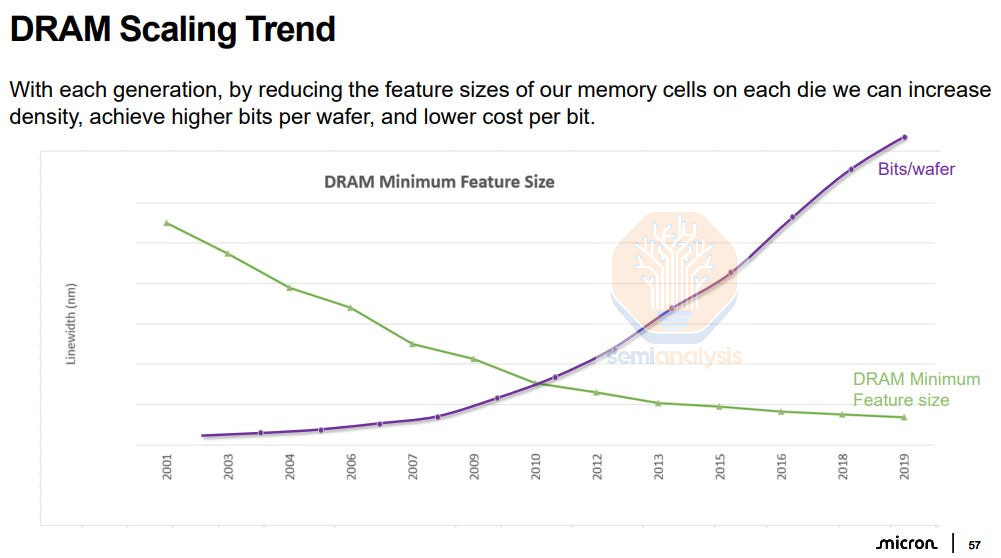
Yet DRAM scaling has slowed significantly over the past few decades, and density gains over time have shrunk. Over the past decade, DRAM density has increased by only ~2× in total, versus roughly ~100× per decade during the industry’s peak scaling era. Capacitors are now extreme three-dimensional structures with aspect ratios approaching 100:1, storing just tens of thousands of electrons. For comparison, a small static shock when you touch a metal doorknob might involve the transfer of billions of electrons. The static charge on just a speck of dust might be 10,000x what is stored in a modern DRAM cell.

Bitlines and sense amplifiers, once secondary concerns, are now dominant constraints. Every incremental shrink reduces signal margin, increases variability, and raises cost.


Source: Micron

An easy way to understand the technical challenge in DRAM scaling is to think of a DRAM cell as a tiny bucket that holds electricity instead of water. Each bucket stores a bit of data by holding a small electrical charge. Over the years, engineers made these buckets smaller to fit more memory on a chip. At first this worked well. But today, those buckets are not just tall they are tall and narrow, each is like a tiny drinking straw standing upright. Because of the size each bucket now holds very very few electrons.

This is a problem. When the system tries to read the data, it has to detect this very faint electrical signal and distinguish it from noise. The wires that connect these cells (the “bitline”) and the tiny sensors that read them (called sense amplifiers) are now the main bottleneck. The signal is so weak that even small variations in manufacturing or temperature can cause errors.

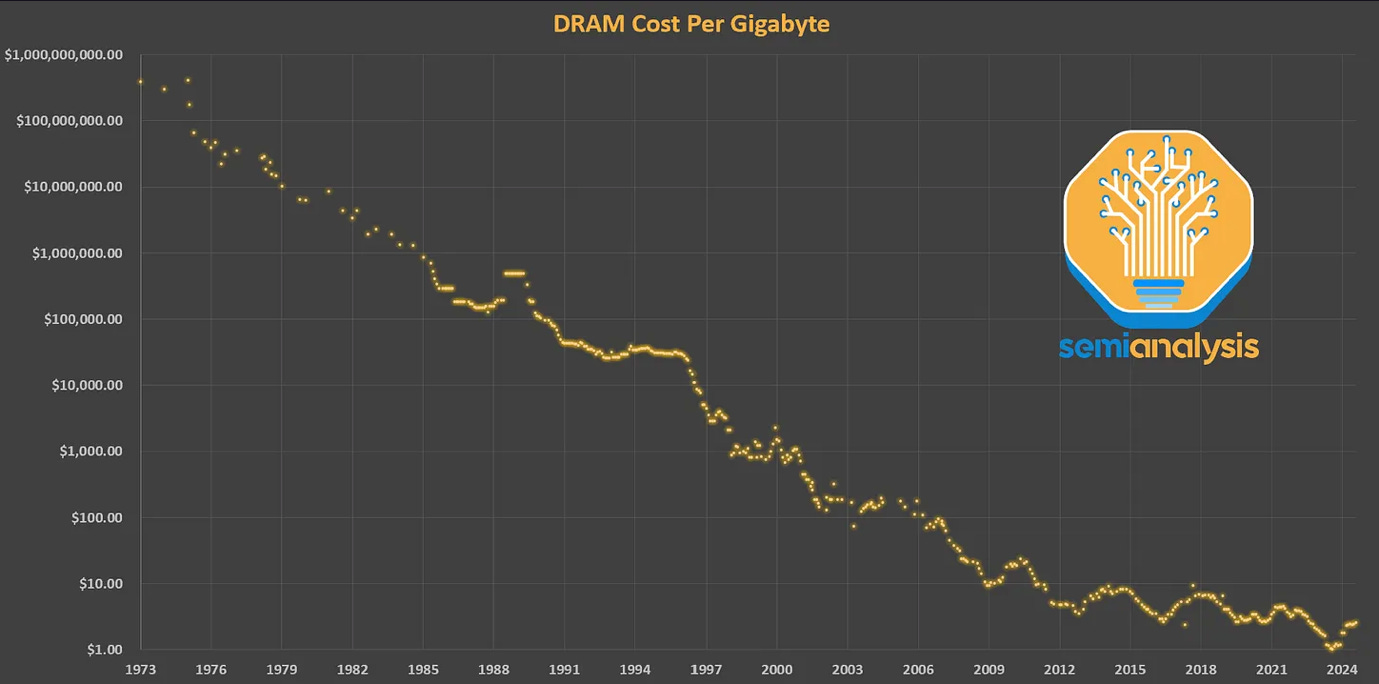
A graph showing a line of gold

Description automatically generated with medium confidence 

Source: SemiAnalysis Memory Model - Sales@SemiAnalysis.com

Together, these constraints explain why DRAM density has stagnated and why DRAM scaling has slowed down significantly over the years. The collapse of DRAM scaling has far-reaching consequences across cost, architecture, and industry structure.

As density gains slow, cost per bit reductions have slowed down. DRAM pricing is now more dependent on capacity additions and cyclical supply-demand dynamics rather than technology-driven cost reductions which have been a powerful deflationary force.

Memory Cycle Part II: Key Features of a Cycle
The memory industry has been defined by commoditization, which comes with cyclicality. This outcome reflects a combination of industry-wide competitive behavior, recurring lapses in capital discipline, and the nature of DRAM scaling we explained earlier.

At its core, memory’s cyclicality is driven by timing mismatches between demand changes and corresponding supply responses. Aside from the buffer of short-term inventories, DRAM supply is not very flexible. It can take years to bring meaningful new DRAM supply online, trying to meet demand that fluctuates daily.

Memory manufacturing, much like logic, is among the most capital-intensive industries in the world. Building leading-edge DRAM and NAND fabs requires multi-billion-dollar investments (which have steadily increased over the past few decades), multi-year construction timelines, extended yield-learning curves across successive process nodes, and lengthy ramp-up periods before meaningful volume production is achieved....

....MUCH MORE 

Previously from SemiAnalysis:

October 8, 2024 - Chips and Data Centers: "AI Neocloud Playbook and Anatomy"

February 7 2025 - SemiAnalysis: "DeepSeek Debates: Chinese Leadership On Cost, True Training Cost, Closed Model Margin Impacts"

March 19 - "NVIDIA GTC 2025 – Built For Reasoning, Vera Rubin, Kyber, CPO, Dynamo Inference, Jensen Math, Feynman" (NVDA)

March 29 - "America Is Missing The New Labor Economy – Robotics Part 1"

July 13 - ZuckAI: "Meta Superintelligence – Leadership Compute, Talent, and Data" (META)

September 22 - Elon Musk's "xAI’s Colossus 2 – First Gigawatt Datacenter In The World, Unique RL Methodology, Capital Raise"

November 14 - "Microsoft's AI Strategy Deconstructed - From Energy to Tokens" (MSFT)

December 14 - Chips: "AWS Trainium3 Deep Dive | A Potential Challenger Approaching" (AMZN; NVDA)

January 4, 2026 - Electricity: "How AI Labs Are Solving the Power Crisis: The Onsite Gas Deep Dive"

Friday, November 7, 2014

Flavanols Found In Cocoa Reverse Age-Related Memory Decline

Almost forgot to post this.
From Nature Neuroscience:
Enhancing dentate gyrus function with dietary flavanols improves cognition in older adults
HT: Columbia University Medical Center:
Dietary cocoa flavanols
Dietary cocoa flavanols—naturally occurring bioactives found in cocoa—reversed age-related memory decline in healthy older adults, according to a study led by Columbia University Medical Center scientists. A cocoa flavanol-containing test drink prepared specifically for research purposes was produced by the food company Mars, Incorporated, which also supported the research, using a proprietary process to extract flavanols from cocoa beans. Most methods of processing cocoa remove many of the flavanols found in the raw plant. (Credit: Mars, Incorporated)

Dietary cocoa flavanols—naturally occurring bioactives found in cocoa—reversed age-related memory decline in healthy older adults, according to a study led by Columbia University Medical Center (CUMC) scientists. The study, published today in the advance online issue of Nature Neuroscience, provides the first direct evidence that one component of age-related memory decline in humans is caused by changes in a specific region of the brain and that this form of memory decline can be improved by a dietary intervention.

As people age, they typically show some decline in cognitive abilities, including learning and remembering such things as the names of new acquaintances or where they parked the car or placed their keys. This normal age-related memory decline starts in early adulthood but usually does not have any noticeable impact on quality of life until people reach their fifties or sixties. Age-related memory decline is different from the often-devastating memory impairment that occurs with Alzheimer’s, in which a disease process damages and destroys neurons in various parts of the brain, including the memory circuits.

Previous work, including by the laboratory of senior author Scott A. Small, MD, had shown that changes in a specific part of the brain—the dentate gyrus—are associated with age-related memory decline. Until now, however, the evidence in humans showed only a correlational link, not a causal one. To see if the dentate gyrus is the source of age-related memory decline in humans, Dr. Small and his colleagues tested whether compounds called cocoa flavanols can improve the function of this brain region and improve memory. Flavanols extracted from cocoa beans had previously been found to improve neuronal connections in the dentate gyrus of mice....MORE
See also the National Institutes of Health:

Sunday, January 18, 2026

"The Chinese Company Taking On the World’s Memory-Chip Giants"

From The Wall Street Journal, January 11:

As AI demand drives prices up, CXMT overcomes Washington’s curbs to vie with Micron and South Korean leaders 

China’s national champion in memory-chip manufacturing is preparing a $4 billion share offering after making significant technical advances, upending an industry dominated by South Korean and U.S. companies.

The offering by ChangXin Memory Technologies, known as CXMT, is one of the biggest by a chip maker this century and would normally be great news for tech companies starved of memory chips during the artificial-intelligence boom. AI data centers have been grabbing chip capacity that would otherwise serve the makers of computers, videogame consoles and smartphones, driving up prices for American consumers.

But even though CXMT intends to boost production and says it wants more international business, the geopolitical walls are high. Successive U.S. administrations have tightened curbs on Chinese chip makers.

And prosecutors in South Korea, home to memory-chip leaders Samsung Electronics  and SK Hynix, are alleging that some of CXMT’s rise comes from theft of trade secrets obtained from former Samsung employees. 

Memory chips are like the fuel lines feeding the engines of computing machines. As AI engines made by Nvidia of the U.S. and others get more powerful, they need more memory, both the traditional kind and an advanced type called high-bandwidth memory.

A single AI server now uses more dynamic random-access memory than entire fleets of laptops, and the price of conventional DRAM is forecast to surge more than 50% this quarter compared with the previous quarter, according to research firm TrendForce.

Until recently, the global DRAM market was dominated by three companies—Samsung, SK Hynix and U.S.-based Micron Technology. Those makers have pivoted toward higher-margin AI memory chips, and Micron is retreating from parts of the consumer market.

That opens the door for CXMT. The company was formed a decade ago after a bid by a state-backed Chinese company to acquire Micron failed. A local government in the eastern city of Hefei decided it should create its own DRAM maker.

The company, now led by U.S.-trained chip engineer Zhu Yiming, garnered support from a national tech fund and a who’s-who list of Chinese tech companies including Alibaba and Xiaomi.

CXMT said in late December that it had submitted plans to list on Shanghai’s Nasdaq-like tech board, aiming to raise the equivalent of $4 billion. Recent capital injections have valued the company at more than $20 billion, analysts said.

CXMT is among the stars in a roster of Chinese companies across the semiconductor industry that the government hopes will lift the country’s self-sufficiency during its trade war with the U.S. From manufacturing specialist SMIC to equipment maker AMEC, Beijing is pushing the industry to develop local alternatives to everything the U.S. and its allies produce.

CXMT’s prospectus shows the company has rapidly advanced from prototypes to mass production in just a few years. Revenue nearly tripled over two years to more than $3 billion in 2024. Analysts said its process technology has come within a generation or two of the industry leaders, and the company’s global DRAM market share has risen to around 5% by revenue.   

The progress comes despite U.S. curbs on China’s access to advanced chip-making equipment.

“The progress CXMT has made in the face of U.S. end-use controls on memory has surprised the industry,” said Paul Triolo, technology policy lead at consulting firm DGA-Albright Stonebridge Group.

Triolo said U.S. concerns would be heightened if CXMT could supply high-bandwidth memory chips to Huawei, whose AI processors represent China’s closest domestic alternative to Nvidia’s AI accelerators.

According to DSET, a think tank backed by the Taiwanese government, CXMT built its foundation on the ruins of others, acquiring patents from the bankrupt German chip maker Qimonda and raiding Taiwan’s talent pool.

In December, Korean prosecutors said they had indicted 10 people including a former Samsung executive and employees on charges of transferring secrets to CXMT including technology to help CXMT mass-produce advanced DRAM chips. 

The suspects allegedly worked systematically to avoid detection, joining CXMT through shell companies, shifting offices and disguising travel to China by routing trips through other locations. They exchanged a coded warning using four heart emojis to warn each other in case South Korea tried to bar their travel or arrest them, prosecutors said.

The prosecutors said the leak of trade secrets caused billions of dollars in losses to Samsung and South Korea’s semiconductor-driven economy....

....MUCH MORE 

Wednesday, January 28, 2026

Memory: Samsung’s profit triples, beating estimates...

From CNBC, January 28:

  • Samsung posts record quarterly profit as AI-driven memory demand tightens supply.
  • Results beat estimates and top Samsung’s own guidance for the quarter.
  • Samsung’s memory business fuels earnings, driven by market price surge and HBM demand. 

Samsung Electronics reported an over threefold surge in fourth-quarter profits on Thursday, hitting a new record and beating analysts’ estimates, as a memory chip shortage and strong demand for artificial intelligence servers lifted earnings.

Shares of Samsung Electronics rose 2.58% at the open on Thursday before reversing course, falling 1.54% in morning trade.

Here are Samsung’s fourth-quarter results compared with LSEG SmartEstimate, which is weighted toward forecasts from analysts who are more consistently accurate:

  • Revenue: 93.8 trillion Korean won ($65.58 billion) vs. 93.318 trillion won expected
  • Operating profit: 20.1 trillion won vs. 20.018 trillion won expected

The South Korean technology giant’s quarterly revenue rose about 24% from a year earlier to hit a new record. Meanwhile, its operating profit climbed over 200% year over year.... 

....MUCH MORE 

Previously:

January 3 - "AI data centers are swallowing the world's memory and storage supply, setting the stage for a pricing apocalypse that could last a decade" 

January 5 - "Memory chipmakers rise as global supply shortage whets investor appetite"

January 7 -  Memory: "Samsung bulls bet record earnings will extend US$350b rally" (005930:Korea)

January 12 - Chips: "While you pay through the nose for memory, Samsung expects to triple its profits in Q4"

And related:

With More U.S. Tariff Clarity Big Money Into Korean Domestic Investment (hundreds of billions USD equiv.)

"Samsung building facility with 50,000 Nvidia GPUs to automate chip manufacturing"

"Nvidia to supply more than 260,000 Blackwell AI chips to South Korea"

Memory: "Micron closed a key part of its business and warned that, as a result, DRAM shortages may persist for several years."

Big Money: "Micron commits $24B to Singapore as AI memory crunch bites" (MU)

"The Chinese Company Taking On the World’s Memory-Chip Giants"

Wednesday, March 25, 2026

Memory: "Google Breakthrough Spurs Chip Selloff Despite Analyst Doubt" (GOOG)

 From Bloomberg, March 25:

Shares of computer memory and storage makers slumped on concerns over demand after Google researchers touted a new compression technique. But it may be a hiccup rather than an existential threat.

SK Hynix Inc., a key maker of memory chips for artificial intelligence applications, fell as much as 6.4% on the Korea Exchange. Flash memory manufacturer Kioxia Holdings Corp. dropped by a similar measure in Tokyo. That followed losses by Micron Technology Inc. and Sandisk Corp. Wednesday in New York.

Alphabet Inc.’s Google said its new TurboQuant technology can limit the amount of memory required to run large language models by at least a factor of six, reducing the overall cost of training artificial intelligence. Memory forms a vital part of Nvidia Corp.’s accelerators and demand has surged during the AI boom.

The Google news spurred some caution that memory needs may be reduced. Bulls tracking the blistering rally in global memory shares say that improved efficiency will actually increase rather than reduce demand, however, pointing to a theory known as the Jevons Paradox.

The 19th century premise was cited in a note from the trading desk at JPMorgan Chase & Co. Its analysts said that investors may take profits on the news, but there’s no near-term threat to memory consumption.

TurboQuant is positive for hyperscalers given the return on investment opportunity, Morgan Stanley analyst Shawn Kim wrote in a note. It also may be beneficial for memory makers longer term he added, as “a lower cost per token can also lead to higher product adoption demand.”....

....MUCH MORE 

Korea's KOSPI is down  181.75 (-3.22%) at 5,460.46.

As noted exiting from January 2025's "ASML CEO Says DeepSeek’s Emergence Is ‘Good News’ for AI": 

Time was when even mentioning Jevons was anachronistic/borderline fuddy-duddy, e.g.

And he's brought his paradox.

And going back to 2009 because Jevons, like myself, tried to figure out a way to make some money off of Herschel's sunspot observations but (like myself) couldn't. Backlinks in April 2020's "Sunspots and Agricultural Production (William Herschel does a driveby)": including his (Jevons') 1879 submission to the journal Nature.

Monday, July 6, 2026

Thunder Out Of Korea: Samsung Will Be Releasing Their Preliminary Earnings Estimates

From Reuters, July 5/6:

Samsung likely to post 18-fold jump in profit on surging AI demand for memory 

  • Q2 profit seen hitting third straight record high
  • Memory shortage expected to persist into next year
  • Workers' bonuses could come in higher than expected, analysts say
  • Potential AI infrastructure delays pose biggest risk, analysts say
  • Rising memory prices squeeze mobile business margin 

Samsung Electronics (005930.KS), is likely to estimate that its operating profit jumped about 18-fold ​to another record high from a year earlier in the second quarter, as AI growth continues to strain memory supply and push chip prices ‌higher.

On Tuesday, the world's largest memory chipmaker by sales is likely to flag an operating profit of 86 trillion won ($56.35 billion) for the April to June quarter, according to an LSEG SmartEstimate based on forecasts from 30 analysts, weighted toward those with the best track records. 

Up from 4.7 trillion won a year earlier, this would mark a third consecutive quarter of record operating profit for ​Samsung, reflecting a prolonged memory shortage, as booming demand for AI inference infrastructure continues to outpace supply growth from global memory manufacturers.
 
Analysts expect the memory ​market to remain undersupplied at least through next year.
The robust growth has been driven not only by high-bandwidth memory (HBM), but also by ⁠stronger demand for conventional DRAM and NAND products as AI applications, particularly agentic AI, expand into a broader range of computing workloads.
 
Unlike earlier AI applications focused mainly ​on training large models, agentic AI systems perform more complex, multi-step tasks that require additional memory for server processors and greater storage capacity to retain and retrieve data during ​inference, analysts said....
....MUCH MORE 

Thursday, June 4, 2026

"2026 Smartphone Shipments to Post Worst Annual Decline on Record as Memory Crisis and Geopolitical Shocks Converge"

These folks were among those who flagged how serious the memory chip shortage actually was and would be. See after the jump. 

From Counterpoint Research May 31: 

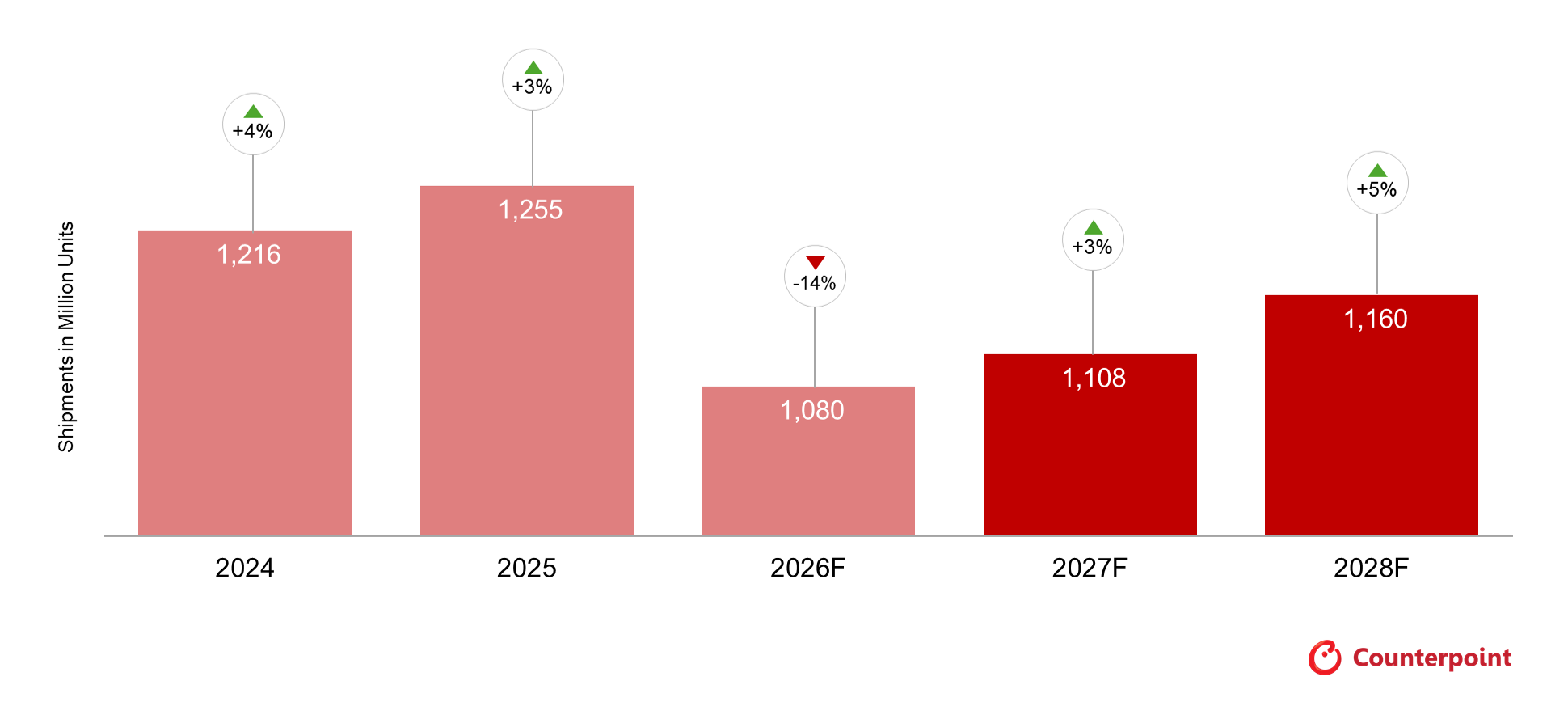
  • Global smartphone shipments are now forecast to fall 13.9% YoY in 2026, dropping to 1.08 billion units, the lowest annual volume since 2013, and a steeper contraction than our February forecast of 12.4%.
  • A memory supply crisis, driven by capacity reallocation toward AI-focused HBM and server DRAM, is the primary driver of the downturn, with LPDDR4/5 prices expected to treble in Q2 2026 relative to Q4 2025, per Counterpoint’s Memory Service.
  • Lower-end OEMs and Emerging Markets face the sharpest pressure, with LPDDR4 memory supply tracking to a decline of over 40% in 2026; the sub-$150 segment faces an effective permanent removal in some markets.
  • Apple and Samsung are the most insulated OEMs, while Huawei is the only Chinese brand expected to grow shipments in 2026.
  • The Iran conflict and the closure of the Strait of Hormuz add a geopolitical dimension to the downturn, though macroeconomic headwinds are expected to be materially less severe than the post-Ukraine inflationary shock. 
Seoul, Beijing, Berlin, Buenos Aires, Fort Collins, Hong Kong, London, New Delhi, Taipei, Tokyo – June 1, 2026

The global smartphone market has entered its deepest period of contraction on record, according to Counterpoint Research's latest Smartphone Market Outlook Tracker, with full-year 2026 shipments now forecast to decline 13.9% YoY to 1.08 billion units, a downward revision from the 12.4% decline projected in February. The trigger is a worsening memory supply crisis that has accelerated sharply in recent weeks, compounded by the outbreak of the Iran conflict.

Global Smartphone Forecast, May 2026 Edition
Source: Counterpoint Research Smartphone Market Monitor and Market Outlook, May 2026 Update 
Memory crisis deepens the 2026–2027 downturn

The Q1 2026 smartphone market retreated 3.1% YoY, marking the first decline after nine consecutive quarters of growth. The performance was nonetheless better than expected, as OEMs moved to front-load shipments and clear pre-shock inventory ahead of expected price increases. However, the deterioration since has been sharp. Counterpoint Research's Memory Service indicates that mobile LPDDR4/5 prices in Q2 2026 are on track to treble relative to Q4 2025 levels, with the squeeze expected to persist through H2 2027 given the capital intensity and lead times inherent to semiconductor manufacturing.

The damage is falling disproportionately on lower-end devices. LPDDR4 supply is expected to decline more than 40% in 2026 as fabs reallocate capacity toward AI-driven HBM and server DRAM, making it increasingly uneconomical to supply entry-level products. Globally, smartphone wholesale prices rose 14% in Q1, and the pace will sustain as pre-shock inventory is exhausted. Certain sub-$150 price tiers face effective permanent ejection from the market.

Principal Analyst Yang Wang commented, “The memory crisis is the most disruptive supply-side event the smartphone industry has ever faced. Unlike demand-driven slowdowns, such as seen during COVID and 2022-23, the current contraction will not respond to pricing, channel and product planning adjustments. OEMs in the low- and mid-tier are caught between unabsorbable cost increases and consumers with hard affordability ceilings. The narrative around the smartphone market is no longer how to grow shipments or market share, but whether to remain in the market at all.”

Premium resilience, OEM divergence, and the road to recovery

....MUCH MORE 

So the question becomes: Will the increase in average selling price brought about by the shift to more expensive phones be large enough to offset the decline in unit volume?

Previously from Counterpoint:

January 2026 - Chips: "2026 Smartphone Shipment Forecasts Revised Down as Memory Shortage Drives BoM Costs Up"

February 2026 - Electric Vehicles: "Ford Looks for Model-T Redux with UEV Plan" (F)

May 2026 -  Computex 2026: Agentic AI & Physical AI Reshaping the Computing Landscape