Saturday, March 5, 2016

"Axel Springer Report Gives Peek at Business Insider Finances"

From Ad Age:

Net Loss of €1.1 million From Oct. 30 Through Dec. 31
 Business Insider was acquired by Axel Springer last year.
Axel Springer's 2015 Annual Report on Thursday shed light on the financial progress of Business Insider, the New York-based digital media site it purchased in October.

From Oct. 30 through Dec. 31, B.I. generated revenue of €9.4 million (about $10.2 million based on average exchange rates for that period) and a net loss of €1.1 million (about $1.2 million), the report said.

According to the report, had B.I. been part of Axel Springer since the beginning of 2015, it would have lost the company €10.8 million (about $12.0 million based on average exchange rates in 2015) in consolidated net income on consolidated revenue of €38.5 million (about $42.8 million).
An accompanying presentation said B.I.'s revenue increased 41% in 2015.

Germany's Axel Springer, which has invested in several U.S.-based digital media companies, including NowThis and Thrillist Media Group, sees B.I. as a great growth opportunity.
"The medium-term planning of Business Insider is based on the assumption that the revenues will grow significantly," Axel Springer said in the report. "This growth shall predominantly be triggered by the further development of the Business Insider brand portfolio (e.g. Tech Insider, Insider), the extension of the fee-based market research offering ('BI Intelligence') and the expansion into new international markets."

B.I. has long been expected to begin licensing more of its content, beyond the company's BI Intelligence service, in an effort to generate additional revenue. It's not clear yet what form that will take, and when it will be implemented....MORE

Friday, March 4, 2016

(Possibly) Identifying The Next Amazon

From FiveThirtyEight:

The Next Amazon (Or Apple, Or GE) Is Probably Failing Right Now
When Jeff Bezos founded an online bookstore in 1994, no one could have guessed that in less than 15 years, Amazon would fundamentally reshape the U.S. retail landscape. No one, that is, except Bezos himself: As Brad Stone’s book about Amazon, “The Everything Store,” makes clear, Bezos’s goal from the start was to change the way Americans shop. 
Amazon’s remarkable rise carries two important lessons for economists: First, one ambitious, innovative company can have a huge impact not only on an industry but also on the economy as a whole. Today, Amazon employs more than 230,000 workers, a figure that doesn’t count thousands more who work as contractors in the company warehouses, sell products on its marketplace and rent out their labor on its “Amazon Mechanical Turk” platform. Amazon has contributed to the decline of entire industries — department stores, bookstores, movie rentals — while helping to create whole new ones. 
The second lesson: Amazon’s success was almost completely unpredictable, at least from the outside. To an economist looking at data on new ventures, Amazon was merely a bookseller, hardly a business known for its breakout growth even before the Internet upended the industry. And even if someone had looked more closely, what distinguished Amazon from Pets.com or Kozmo.com or any of the other high-flying startups that came crashing down to earth when the tech bubble burst in 2000? 
As a result of those lessons, policymakers concerned with entrepreneurship at both the local and national level have long favored what economist Robert Litan dubbed a “shots on goal” approach: Try to encourage as many startups as possible. Most of those companies will fail. Of the survivors, most will never grow into major economic engines. But statistically, a few will turn out to be the next Amazon, with huge rewards for their local economies. 
In research set to be published on Monday, however, a team of researchers at MIT argues that Amazon’s rise wasn’t so unpredictable after all. The researchers believe they have found a set of characteristics that can identify which companies have a shot at success. That could allow cities and states to move beyond the shots-on-goal approach and instead try to foster the specific types of companies that are most likely to create jobs and drive innovation. 
“The shots-on-goal approach, really, I think was the best that could be done based on the information that was available before,” said Catherine Fazio, who is studying the policy implications of the new research. “But if you have further insight into the entrepreneurial potential … then you can start to experiment with programs and have a more tailored approach.” 
The new research comes amid a three-decade-long slump in U.S. entrepreneurship. In 1980, Americans started more than 450,000 new companies, according to data from the Census Bureau; in 2013, the most recent year for which data is available, there were just over 400,000 new companies even though the U.S. population is nearly 40 percent larger. The startup drop-off has corresponded with a decline in other measures of economic dynamism — Americans are changing jobs less often, for example, and are moving across the country less frequently — leading economists to worry that the U.S. as a whole has become more risk-averse. 
The new research, led by economists Scott Stern and Jorge Guzman, calls that narrative into question. Startups as a whole may be declining, they find, but the kind of entrepreneurship that economists care the most about — fast-growing, innovative companies like Amazon — hasn’t shown the same downward trend; in fact, in the past few years, those kinds of startups have surged in number....MORE
HT: Ritholtz@BloombergView

"February jobs report: solid headlines, decidedly mixed internals"

From the Bonddad blog:
- by New Deal democrat
HEADLINES:
  • +242,000 jobs added to the economy
  • U3 unemployment rate unchanged at 4.9%
With the expansion firmly established, the focus has shifted to wages and the chronic heightened unemployment.  Here's the headlines on those:
Wages and participation rates
  • Not in Labor Force, but Want a Job Now: down  -103,000 from 5.973 million to 5.870 million
  • Part time for economic reasons: unchanged at 5.988
  • Employment/population ratio ages 25-54: up +0.1% from 77.7% to 77.8% 
  • Average Weekly Earnings for Production and Nonsupervisory Personnel: unchanged at $21.32,  up +2.4%YoY. (Note: you may be reading different information about wages elsewhere. They are citing average wages for all private workers. I use wages for nonsupervisory personnel, to come closer to the situation for ordinary workers.)
December and January were revised upward by +9,000 and +22,000, for a net change of +31,000. 
The more leading numbers in the report tell us about where the economy is likely to be a few months from now. These were neutral to negative.
  • the average manufacturing workweek was unchanged at 41.8 hours (but last month was revised up +0.1.  This is one of the 10 components of the LEI, the net will be a posittive.
  • construction jobs increased.by +19,000.  YoY construction jobs are up +253,000.  
  • manufacturing jobs decreased by -16,000, and are up +25,000 YoY.
  • Professional and business employment (generally higher-paying jobs) increased by +23,000 and are up 604,000 YoY.
  • temporary jobs - a leading indicator for jobs overall decreased by -9,800.
  • the number of people unemployed for 5 weeks or less - a better leading indicator than initial jobless claims - increased by +48,000 from 2,249,000 to 2.297,000.  The post-recession low was set 6 months ago at 2,095,000.
Other important coincident indicators help us paint a more complete picture of the present:...MORE

The trouble with food and energy

An ongoing series showing off the capabilities of the bank's databases.
From the Federal Reserve Bank of St. Louis' FRED blog:


There are many ways to measure inflation. One popular method used for monetary policy purposes is to look at the price index for personal consumption expenditures excluding food and energy. Why exclude food and energy? Aren’t those important items that matter a great deal to households? The reason is straightforward: These price categories are considered to be excessively volatile, and including them would make it more difficult for policymakers to pin down the inflation trend. The graph above makes this point visually by comparing the PCE inflation rates with and without food and energy.

Usually when you add items to an index, you reduce the volatility of that index. This same premise is at work when you add assets to an investment portfolio—i.e., when you diversify to reduce volatility. But this does not happen when the item you add is excessively volatile. And, again, food and energy are excessively volatile. Food is subject to large price variations due to external shocks, mostly on the supply side, such as weather. Energy is subject to shocks as well: supply shocks such as discoveries, wars, political risk, and infrastructure issues and demand shocks such as climate events. This happens with food and energy much more than it does for other items included in personal consumption expenditures....MORE
Also at the FRED blog:

Two shades of coffee

Money and Barter: Did Money Come First?

From Real World Economic Review:

fig_7
In the beginning, there was barter. Then, and forever after, there was money
That’s the myth every student of economics learns, that money grows out of barter. The idea is that monetary exchange solves the problem of the double coincidence of wants—that a person who is interested in trading needs to find someone who wants what they have and has what they want. Money makes trade much easier, so the story goes, and thus becomes a remarkable example of both human ingenuity and economic progress.
The fact is, as Ilana E. Strauss [ht: ja] explains, the story is false. Human beings did not invent money to solve the difficulties of barter exchange. Barter turns out to be a historical myth.
various anthropologists have pointed out that this barter economy has never been witnessed as researchers have traveled to undeveloped parts of the globe. “No example of a barter economy, pure and simple, has ever been described, let alone the emergence from it of money,” wrote the Cambridge anthropology professor Caroline Humphrey in a 1985 paper. “All available ethnography suggests that there never has been such a thing.”
Humphrey isn’t alone. Other academics, including the French sociologist Marcel Mauss, and the Cambridge political economist Geoffrey Ingham have long espoused similar arguments.
When barter has appeared, it wasn’t as part of a purely barter economy, and money didn’t emerge from it—rather, it emerged from money. After Rome fell, for instance, Europeans used barter as a substitute for the Roman currency people had gotten used to. “In most of the cases we know about, [barter] takes place between people who are familiar with the use of money, but for one reason or another, don’t have a lot of it around,” explains David Graeber, an anthropology professor at the London School of Economics.
A good example is the kind of exchange described by Fibonacci in his Liber Abbaci. He devoted the ninth chapter to “barter of merchandise and similar things.” But it wasn’t pre-monetary barter. Instead, as Randy K. Schwartz explains,
A barter was often recorded as such in a register or account book, as if actual coins had been exchanged, when in fact no coins at all were involved.
Because coins were still scarce, the widespread custom among merchants was to set the barter price for a commodity by “marking up” the cash price by a certain percentage. The two barterers had to agree on the markup rate ahead of time, or else one would feel cheated.
In other words, this was exchange that took money as the unit of account but, because coins were scarce, it took the form of the direct exchange of goods—say, wool for cloth.
And there are many other examples in the historical and anthropological record of forms of exchange that precluded money—centralization and redistribution, gifts, potlatch, trade at the edges of and between non-monetary societies, and so on. But there was no original barter economy, which was then surpassed by the use of money.
That’s a myth that began with Adam Smith:...MORE

Thursday, March 3, 2016

Stephen Wolfram On Artificial Intelligence & The Future Of Civilization

If Wolfram and AI isn't your cuppa we have other Edge selections after the jump.
From Edge:
STEPHEN WOLFRAM, distinguished scientist, inventor, author, and business leader, is Founder & CEO, Wolfram Research; Creator, Mathematica, Wolfram|Alpha & the Wolfram Language; Author, A New Kind of Science. Stephen Wolfram's Edge Bio Page
 
THE REALITY CLUB: Nicholas Carr, Ed Regis

What makes us different from all these things? What makes us different is the particulars of our history, which gives us our notions of purpose and goals. That's a long way of saying when we have the box on the desk that thinks as well as any brain does, the thing it doesn't have, intrinsically, is the goals and purposes that we have. Those are defined by our particulars—our particular biology, our particular psychology, our particular cultural history.

The thing we have to think about as we think about the future of these things is the goals. That's what humans contribute, that's what our civilization contributes—execution of those goals; that's what we can increasingly automate. We've been automating it for thousands of years. We will succeed in having very good automation of those goals. I've spent some significant part of my life building technology to essentially go from a human concept of a goal to something that gets done in the world.
There are many questions that come from this. For example, we've got these great AIs and they're able to execute goals, how do we tell them what to do?...

AI & THE FUTURE OF CIVILIZATION
Some tough questions. One of them is about the future of the human condition. That's a big question. I've spent some part of my life figuring out how to make machines automate stuff. It's pretty obvious that we can automate many of the things that we humans have been proud of for a long time. What's the future of the human condition in that situation?

More particularly, I see technology as taking human goals and making them able to be automatically executed by machines. The human goals that we've had in the past have been things like moving objects from here to there and using a forklift rather than our own hands. Now, the things that we can do automatically are more intellectual kinds of things that have traditionally been the professions' work, so to speak. These are things that we are going to be able to do by machine. The machine is able to execute things, but something or someone has to define what its goals should be and what it's trying to execute.

People talk about the future of the intelligent machines, and whether intelligent machines are going to take over and decide what to do for themselves. What one has to figure out, while given a goal, how to execute it into something that can meaningfully be automated, the actual inventing of the goal is not something that in some sense has a path to automation.

How do we figure out goals for ourselves? How are goals defined? They tend to be defined for a given human by their own personal history, their cultural environment, the history of our civilization. Goals are something that are uniquely human. It's something that almost doesn't make any sense. We ask, what's the goal of our machine? We might have given it a goal when we built the machine.

The thing that makes this more poignant for me is that I've spent a lot of time studying basic science about computation, and I've realized something from that. It's a little bit of a longer story, but basically, if we think about intelligence and things that might have goals, things that might have purposes, what kinds of things can have intelligence or purpose? Right now, we know one great example of things with intelligence and purpose and that's us, and our brains, and our own human intelligence. What else is like that? The answer, I had at first assumed, is that there are the systems of nature. They do what they do, but human intelligence is far beyond anything that exists naturally in the world. It's something that's the result of all of this elaborate process of evolution. It's a thing that stands apart from the rest of what exists in the universe. What I realized, as a result of a whole bunch of science that I did, was that is not the case.

My children always give me a hard time for this particular quote: "The weather has a mind of its own." Well, that's an animistic type of statement, and it seems like it has no place in modern scientific thinking. But that statement is not as silly as it first seems. What that's representing is, if we think about a brain—what is a brain doing? A brain is taking certain input, it's computing things, it's causing certain actions to happen; it's effectively generating a certain output.

We can think about all sorts of systems as effectively doing computations, whether it's a brain, whether it's a cloud responding to the different thermal environment that it finds itself in. We can ask ourselves, are our brains doing vastly more sophisticated computations than happens in these fluids in the atmosphere?

I had first assumed that the answer to that was, yes, we are carefully evolved, we're doing much more sophisticated stuff than any of these systems in nature. But it turns out that's not the case. It turns out that there's this very broad equivalence between the kinds of computations that different kinds of systems do. That realization makes the question of the human condition a little bit more poignant, because where we might say, "There's one thing we've got—we're special, we've got all this intelligence and all these things which nothing else can have." But that's not true. There are all these different systems of nature that are pretty much equivalent in terms of their computational, or for that matter, intellectual, capabilities....MUCH MORE including audio, video, pop-up books...
Um, no pop-up books actually, I seem to be regressing, rapidly.

Previously on the Edge channel:
"The Man Who Runs The World's Smartest Website"
Edge Magazine's Master Class In Forecasting With Phillip Tetlock
Edge.org Conversation on the Work of Daniel Kahneman
"187 Big Thinkers Answer the Question: What Do You Think About Machines That Think?"
J. CRAIG VENTER: THE BIOLOGICAL-DIGITAL CONVERTER, OR, BIOLOGY AT THE SPEED OF LIGHT @ THE EDGE DINNER IN TURIN
Science/Not Science: Crusading Against Multiple Regression Analysis
Brian Eno: "Just A New Fractal Detail In The Big Picture"

Inflation: TIPS Breakevens Start to Rise as Economic Data Improves

From Barron's Income Investing, March 2:

With Treasury yields rising (and yields move inversely to prices) while some stronger economic numbers are posted, some market strategists are starting to like Treasury Inflation-Protected Securities (TIPS) over Treasuries.
Barron’s noted that TIPS were “Cheap and Contrarian” in a Feb. 6 Current Yield column. Since then, the benchmark-tracking iShares TIPS Bond (TIP), has climbed in price about $1 to $112.39 as of mid-day Wednesday.
Fiera Capital’s Chief Investment Officer Jonathan Lewis commented Wednesday:
The continued firmness in oil, the better-than-expected economic reports, and the buoyancy of commodity currencies are all signaling a positive future for TIPS relative performance vs. nominal Treasuries. In the past few days we have seen data that confirms the economy is not slipping into recession, and in the days ahead we have a series of central bank meetings that are likely to add fuel to the “risk on” fire. Not only is oil up meaningfully since its bottom but so are the Canadian dollar, New Zealand Dollar, Norwegian Krone, the Mexican Peso and the Chilean Peso. These currencies are signaling that the dollar rally is fading, growth expectations are shifting into higher gear, and the outlook for China is brightening.
TIPS are getting this message loud and clear. While nominal Treasuries are down for the day, TIPS are down by a smaller amount. The market is saying inflation protection is valuable. While 5-Year TIPS break-evens are up from their low, they are only at 1.33 and still way down from the 2.40 level they reached in 2013. Given the acceleration of price pressures in yesterday’s ISM report, TIPS are still cheap and likely to outperform.
Manning & Napier’s Marc Bushallow is also lately a fan. He wrote a primer on TIPS last week... 
...MORE

Recently:
No Inflation? Look At This (#3 will shock you)
"The Treasury Market Raises Its Inflation Outlook" (buy TIPS)
The Velocity of M1 Money Stock May Have Stopped Declining
A Look At The Consumer Inflation Numbers
You Want Inflation, "Why doesn’t the ECB just buy oil?"

No Inflation? Look At This (#3 will shock you)

That's my feeble attempt at clickbait.

And before some grammar cop goes all pedantic semantic, I know these charts don't describe inflation, just a price rise in a limited subset of producer prices that may or may not feed into a type of cost-push inflation somewhere down the road.
Or not.

And as for the clickbait, they're charts of base metals. I mean, I don't have a lot to work with here.
Thank you.

From Polemics Pains:

Metals - The path to inflation. 
Many folk are debating whether the bounce in stocks is just a bounce or if a base is in. Many more are also in fevered debate over the intricacies of whether there are hints of slowdowns in deflation in country data. Meanwhile an elephant is lumbering around the room unnoticed, helping itself to their sandwiches. Metals. The rise in the price of metals has been continuing quietly for a while now, but for those of you who haven't been watching here's a charty catch up...MORE
Iron
https://blogger.googleusercontent.com/img/b/R29vZ2xl/AVvXsEggY7WndQDsP-PTuzgEMyrMX7deSpxsLIHfh9dic60-0U0b_o2HCYXHZ5k6z1_d2tN9mYP8WFkO-sbTq0RNLxUN5B9agCQQbbabbDDrkhMkOpBCdlvVTZ6tZ9q1r8MW_dJ3MYTHmjvVRyRJ/s1600/Screen+Shot+2016-03-02+at+21.03.36.png
Nickel
https://blogger.googleusercontent.com/img/b/R29vZ2xl/AVvXsEhYgRZdSsEOb4sKqLQc2sA0xG_vJgV2dkOhFml816Y6tnDf6dvqbW8S27kKr_oXS1pILjEp4S5dsxxP8VwOorDpOgls0U3CY02-JKIYOKvlkE-06BXpjwWMGsOy4ah8rYdt0nlCWygekKmX/s1600/Screen+Shot+2016-03-02+at+21.02.47.png
Zinc 
https://blogger.googleusercontent.com/img/b/R29vZ2xl/AVvXsEifY5vmrg5ggM9OSInuc0Rn1vXqjZWFTSxqanlWh4fFsRJNLUXVD7ASeLHPEzsOnSpe7pb4KXeCZpCCCYG2grinkotNZWvjiR9P4mQoP579OeeHhvVf-8SGBTNA5DMETQcbID137dJLKHPw/s1600/Screen+Shot+2016-03-02+at+21.04.48.png
HT: Mr. Keohane's Further Reading post.

Previously in the clickbait series:

This Machine Writes Better Clickbait Than You: How it works will shock you
"Before You Say You've Never Discriminated Against Someone, Listen To This Battlecry From A Model"
Clicking On Clickbait WILL Lower Your IQ
Why Is FT Alphaville Obsessed With North Korea's Kim Jong-Un?
Bloomberg: Goldman Sachs, Sex, Viagra, Tiger Woods, and Barack Obama
The New Trend In Apps: Content Blockers

And In Today's SunEdison News... (SUNE)

From Bloomberg: 

SunEdison Drops After Suspending Preferred Dividend, Downgrades
SunEdison Inc. fell after suspending its preferred dividend in an effort to conserve cash and two analysts reduced their ratings on the world’s largest renewable energy developer.

SunEdison fell 13 percent to $1.55 at 9:30 a.m. in New York. The Maryland Heights, Missouri-based company has slumped 93 percent in the past year as it loaded up on debt in a global acquisition spree.

Analysts at Macquarie Group and Needham & Co. cut their ratings to the equivalent of hold after SunEdison said after the close of trading Wednesday that it had suspended dividends on preferred shares....MORE
$1.61 down 10.34%.

Syria's Electric Grid Is Down And The Entire Country Is Without Electricty

Lifted in toto from Reuters:

Electricity supply cut across Syria, Internet partly down: state media
Electricity was cut across Syria on Thursday and Internet connections were also party down, state media said.
"The electricity network has been cut in all governorates," SANA news agency said, citing a source in the Electricity Ministry. "Attempts to find the cause of the outage have begun."

A Reuters witness confirmed that electricity had been cut in Damascus, and the Syrian Observatory for Human Rights, which monitors the five-year-old conflict in Syria, said that power had been cut in the "vast majority of governorates".

SANA reported the Syria Telecommunications Company as saying Internet services were partially halted "as a result of sudden damage to one of the network hubs and repair teams have been sent to fix it".

A Handy Guide To Getting Your Money Out of China

From FT Alphaville:

So you want to get your money out of China? Cut out and keep edition
You’re a rich Party official go-getter on the Chinese mainland, with an eye on how much the renminbi might fall over the next year.

You know there’s a very decent chance that capital controls are going to be tightened up soon.
You know that at the moment you can still get your capital out of China — even if it’s a bit more than the annually permitted $50,000 per person — and that it’s probably going to cost you to do so.
But you don’t want to pay over the odds. After all, you didn’t get wealthy paying more for services than you had to.

Well… Good news. Bernstein’s Michael Parker and team have your back:
http://ftalphaville.ft.com/files/2016/03/Screen-Shot-2016-03-03-at-13.54.37.png
Bernstein are here to help you learn “how to turn a small fortune in China into a (slightly) smaller fortune elsewhere”. Click chart to enlarge....
...MUCH MORE, including some interesting accounting entries.

Markets: It's Quiet Out There, Too Quiet

From Marc to Market:


The global capital markets are quiet today, as investors await fresh impetus which could come in the form of tomorrow's US national employment figures.  There is also next week's ECB meeting that looms large for investors.  
The euro is trading quietly.  In fact, through the European morning, the euro has been confined to a little more than a third of a cent above $1.0850.   It has not been above $1.09 since Monday, and despite contrasting economic signals, and the anticipation of more easing by the ECB, the single currency has not been pushed through $1.08.  
The dollar is straddling the JPY114.00 range, inside yesterday’s range. With a little more effort to test the nearby cap in the JPY114.55-JPY114.85 range, the five-day moving average could cross above the 20-day average for the first time since early February.  
Sterling extended yesterday's recovery to poke briefly through $1.4100 and reached its highest level since February 23.  The $1.4125 area corresponds to a retracement objective since EU Summit that struck the agreement with Prime Minister Cameron, which was shortly followed by London Mayor Johnson's decision to campaign for Brexit.   
Although sterling's advance is mostly about market positioning and the unwinding of some momentum trades, including on the crosses, macro considerations have stalled its recovery. The service sector PMI today completed the trifecta of disappointing reports. All three--manufacturing, construction, and services--all came in below expectations.  The service PMI was expected to soften a little from the January 55.6 reading.  It actually fell to 52.7, the lowest in about three years.   
The surveys warn that the UK economy may be losing some momentum prior to whatever disruptions the Brexit uncertainty generates.   However, positioning is still key and sterling may prove resilient to the disappointing economic news after the knee-jerk reaction as it has done in recent days.
In contrast, the eurozone service PMI was better than expected.  Recall that flash reading was 53.0.  This has been improved to 53.3 but is still down from the 53.6 reading in January and the 54.2 December results.  Germany saw its flash revised upwards (55.3 vs. 55.1) while France was revised down (49.2 vs. 49.8).  Both Italy and Spain came in a little better than expected.  The composite PMI was lifted to 53.3 from 53.0 in the flash report; it is still the lowest reading since January 2015.  The euro was not impacted by the service PMI reports.  
Given how the year began, with steep stock market losses, new lows in oil, and uncertainty but weak impulses from China, it is hardly a surprise that sentiment measures, in general, were undermined.  Investors need to be sensitive to the potential that the survey are weaker than the actual macro data.  The hypothesis then would be that sentiment can recover provided the markets continue to stabilize.  Another way to think about it is that if the tightening of financial conditions are relaxed, the real economic impact could be modest...
 
...Previously, the resilience of the service sector had been seen as a function of the transition in China away from manufacturing and toward services.  As we noted previously, falling producer prices may have exaggerated the transition away from manufacturing.  Chinese stocks were narrowly mixed while the yuan strengthened slightly.
Oil prices remain firm near eight-week highs.  The market appears to be putting more emphasis on US output than inventory accumulation.  While Saudi Arabia, Russia, and a few others have agreed to freeze output at the elevated January levels, US output has fallen.  With yesterday's government report, the cut in output has extended for the sixth week and now is at its lowest level since November 2014.  
At the same time, the government reported that inventories rose by a dramatic 10.4 mln barrels.  This is more than a day's output (roughly 9.08 mln barrels a day).  Inventories in Cushing rose for the fifth week and are at new record highs.
One of the consequences of the recovery in oil prices is rising 10-year break-even measure of inflation expectations.  The difference between the 10-year conventional yield and the inflation-linked securities is thought of a handy metric of inflation expectations, even though it is among the worst forecasting tools for CPI that the San Fransico Fed looked at within 48 hours of the September 2015 FOMC statement that explicitly cited market-based measures of inflation expectations. 
Recall the 10-year breakeven had dipped below 1.20% on February 10.   The 10-year break-even has risen nine consecutive sessions coming into today.  Pushing through 1.52%, it is at its highest level since January 11.  If it continues to recover, look for the Federal Reserve to recognize this in its statement in a couple of weeks....MORE

Wednesday, March 2, 2016

Using Science To Improve the Lives of the Rich (alt-headline: Ms Kaminska cares, cares deeply, about the travails of the wealthiest among us)

The first part of the headline is based on the mission statement of LoS Capital:
At Long or Short Capital LLC, we leverage our superior intellect and extensive investing experience to recommend explicit Long or Short positions and related abstract trades, which may or may not be possible with real world financial derivatives. We use science to improve the lives of the rich....
I was reminded of LoS when I saw this piece on the plight of the Ultra High Net Worth denizens of ce mond.
From FT Alphaville:

UHNWI contraction *alert*
 We’re calling it an upcoming billionaire crisis. And we’re linking it to the reversal of global capital flows, tax-haven agreements and the drawdown of the world’s mega surpluses on the back of the petrodollar slump.
We’re on watch, as a result, for all indications of crisis in billionaire and UHNWI land.
Exhibit two to suggest something is definitely up, Knight Frank’s 2016 Wealth Report, as released on Wednesday:
One of the most interesting findings is that a significant proportion of respondents – leading wealth advisors and private bankers from around the world – expect their clients’ wealth to increase at a slower rate over the next 10 years than the past decade. Succession and inheritance issues, wealth taxes and the global economy were identified as the main threats to future growth.
And with respect to 2015:
Despite this long-term growth trend, data from 2015 shows the first annual dip in ultra-wealthy populations since the global financial crisis began in 2008. Last year only 34 of the 91 countries for which individual data is compiled saw a rise in UHNWIs. Almost 6,000 people dropped out of the UHNWI wealth bracket in 2015 – a 3% slide....
...MORE

On Sunday you may have seen this at the Financial Times:
Saudi Arabia seeks US investment to plug gap in oil revenues
Truth be told, things are even tighter in the Gulf than the proud Saudis are willing to let on.

This morning the Emirates did the walk of shame in this Bloomberg story: 
Biggest U.A.E. Bank Says Dollar Supply Tight After Oil Drop
Do you understand? They...don't...have...enough...dollars.
And their need is being broadcast for all the world to see.

As if to mock the fallen even further, the Hurun Rich List 2016 announced (24Feb'16) that the very pinnacle of the UHNW hierarchy is still growing:
DESPITE GLOBAL SLOWDOWN, 2188 BILLIONAIRES IN WORLD, UP 99 TO NEW RECORD
Finally, for folks interested in learning more about LoS, this is as good a place to start as any.
During the 2008 debacle of the ratings agencies we featured some LoS improvements to the less-than-nuanced approach favored by the fraudsters.
And a few months after the market turned and the survivors had staggered out into the sunlight, we passed on some LoS tips on fortune recovery.

"El NIño’s Long-Awaited Grand Performance Is On Its Way to California
"

From Wunderblog:
After a crushingly dry February, it looks as if early to mid-March is likely to bring California some of the serious moisture it needs from the 2015-16 El Niño event--and perhaps some unwanted flooding and mudslides. Long-range models are increasingly confident that the low-latitude jet stream that’s been dodging the California coast for weeks will finally plow into the state over the next 10 to 15 days, hauling copious amounts of Pacific moisture inland with it. The last few runs of the GFS and ECMWF models have become especially bullish on the development of one or two atmospheric rivers (ARs) heading into California over the next week or two. Roughly 30% to 50% of annual precipitation in the West Coast states occurs from just a few AR events per year. 
The first significant storm should plow into northern and central California this coming weekend, followed by a stronger series of storms affecting most of the state during the following week. The 0Z Wednesday operational run of the GFS model doused parts of the central and northern California and Sierra Nevada with 10” to 20” of precipitation over the ten-day period ending at 7:00 pm EST Friday, March 11. The GEFS and ECMWF ensembles, though less dramatic than individual runs, still paint a very wet picture for the state. It remains unclear how far into southern California the biggest rains and mountain snows will extend. The outlook for very heavy precipitation is a bit more confident from central California all the way north to Washington. Already, some California reservoirs arereleasing water: though this may seem odd while the region is still in drought, it’s a long-employed strategy to help reduce the odds of flooding when torrential rains are predicted....MUCH MORE

Ex-Chesapeake CEO McClendon Dies In High Speed Crash Day After Indictment (CHK)

From CNBC:

Police: McClendon crashed traveling at 'high rate of speed'
Aubrey McClendon, a founder and former chief executive of Chesapeake Energy, died in a car crash Wednesday at age 56, a day after he was charged with conspiring to rig bids for oil and natural gas leases. 
McClendon crashed into an embankment while traveling at a "high rate of speed" in Oklahoma City on Wednesday morning, said Capt. Paco Balderrama of the Oklahoma City Police Department. McClendon's vehicle was engulfed in flame, he said. 
"He pretty much drove straight into the wall," Balderrama said....MORE
The car crash site where Aubrey McClendon, former CEO of Chesapeake Energy, died in Oklahoma City on March 2, 2016.

ISIS Earns Millions Skimming Forex, Trading Equities

From The Telegraph:

Group using cash looted from banks in Mosul to speculate on international currency markets
Playing the stock market: Islamic State leader Abu Bakr al-Baghdadi
Chief Investment Officer Al Baghdadi on the squawkbox
Isil is making millions of dollars for its war chest by playing foreign currency markets under the noses of bank chiefs, it was revealed today.

The terror group is earning up to $20m (£14.29m) a month by funnelling dollars looted from banks during its takeover of the Iraqi city of Mosul into legitimate currency markets in the Middle East.

It then makes huge returns on currency speculation, which are then wired back via unsuspecting financial authorities in Iraq and Jordan, a parliamentary committee was told on Wednesday.

Islamic State of Iraq and the Levant's (Isil) extraordinary venture into white collar crime is now a major source of income, along with oil smuggling and extortion from people living in Isil-controlled areas. 
Details of the scam emerged during a hearing of a specially-convened Foreign Affairs sub-committee set up to examine Britain's role in Isil financing.

The hearing was told that Isil finance chiefs would play the international stock markets using cash looted during their 2014 take over of Mosul, in which the group got its hands on an estimated $429m from the city's central bank.

They also used money "siphoned off" from pension payments that are still being made by the Iraqi government to civil servants living in the city.

The details were revealed to the hearing by John Baron, the sub-committee's chair, who demanded to know whether the British government - which has pledged to help cut off Isil's finance networks - was taking proper action against it.

"The cash that Isil has looted, along with siphoned off pension payments, is routed into Jordanian banks and brought back into the system via Baghdad," he said. "That allows the system to be exploited by Isil, in that they take a turn (profit) on the foreign currency actions and siphon that cash back."...MORE
Back in 2014 the Financial Times said the central bank rip-off was fiction:

Biggest bank robbery that ‘never happened’ – $400m Isis heist
By Borzou Daragahi in Cairo
It was described as one the biggest heists in the history of bank robbery: more than $400m reportedly stolen from Mosul financial institutions by the Islamic State of Iraq and Levant, known as Isis, as it seized control of Iraq’s second-largest city of Mosul last month. 
But Iraqi bankers in Mosul and the capital, Baghdad, are saying the robbery never took place and that the cash remains inside the vaults of the city’s banks.
“We have been following up on this question of the stolen money since the beginning of the crisis,” Abdul-Aziz Hassoun, executive director of the Iraqi Private Banks League, told the Financial Times during a recent meeting in Baghdad. 
“We speak to the banks there all the time. We have been informed that all are guarded from the outside by their own guards and that nothing has been removed from the premises of any banks, not even a piece of paper.” 
Reports that Isis had stolen 500bn Iraqi dinars ($430m) from Mosul financial institutions as the Islamist group and its Sunni insurgent allies seized control of the city more than a month ago raised alarm bells in the west and throughout the region, amid concern over the ambitions and growing capacity of extremist Islamists. 
Iraq officials, including one-time CIA asset and lawmaker Ahmed Chalabi, described the alleged bank heist in comments cited by Iraqi and international media.But Atheel al-Nujaifi, governor of Nineveh province, which includes Mosul, rejects the stories of vast sums of money being taken away by militants....MORE
So now I don't know what to believe.
I so wanted ISIS Investments Ltd. to be outperforming the average long/short global macro/FX guy.

EIA Reports Giant Inventory Build, Oil Trades UP

This is what I was trying to get at in last night's "Based On Supply, Oil Is Trading Much Higher Than One Would Expect".

From MarketWatch:
Oil extends losses as EIA reports 10.4 million-barrel jump in U.S. crude supplies
Oil futures lost more ground on Wednesday after the U.S. Energy Information Administration reported a 10.4 million-barrel climb in crude-oil supplies for the week ended Feb. 26. That was above the 9.9 million-barrel increase reported by the American Petroleum Institute, and more than four times higher than the rise of 2.5 million barrels expected by analysts polled by Platts. Gasoline supplies fell by 1.5 million barrels, while distillate stockpiles climbed by 2.9 million barrels last week...
...MORE

ForeXlive notes:

EIA Weekly US oil storage +10,374K vs +3400K expected
Weekly US oil storage data:
  • Largest build since April 2015
  • Gasoline -1468K vs -1500K exp
  • Distillates +2882K vs -1150K exp
The 'consensus' underestimates what the market was looking for. API reported a 9.9 million barrel build so that's likely close to what was expected in the market.API data:
  • US crude stock inventory build of 9.9 million barrels
  • Cushing build of 1.8 million
  • Gasoline draw of 2.2 million barrels
  • Distillate +2.7 million barrels
The only moderately bullish news was the gasoline build. Everything else is a screaming sell....MORE
April futures $34.83 +0.43 after trading as high as $35.17, the first time the front futures have cleared the $34.82 spike high from January 28.

It's action like this that makes the agricultural futures attractive at the moment.

"The Treasury Market Raises Its Inflation Outlook" (buy TIPS)

As well it should.
From Capital Spectator:
The US Treasury market’s implied inflation forecast has surged in recent days, albeit after reaching unusually low levels last month. Nonetheless, the rollercoaster of revising expectations rolls on, and this time there’s an upside bias bubbling. The spread between the nominal 10-year yield and its inflation-indexed counterpart reached 1.48% yesterday (Mar. 1), based on daily data from Treasury.gov. That’s still a low rate relative to the roughly 1.5%-2.5% range in recent years. But the latest pop marks a sharp increase from mid-February, when the market’s inflation forecast at one point dipped to 1.18%.

The upward bias of late looks reasonable in the wake of last week’s January report on personal income and spending, which revealed a firmer inflation trend. The personal consumption expenditures (PCE) price index increased 1.3% for the year through January, the strongest annual gain since Oct. 2014. Meanwhile, the Fed’s preferred inflation benchmark—core PCE, which excludes food and energy—ticked up to a 1.7% year-over-year increase, which marks the biggest advance since July 2014.
The upward repricing of inflation expectations can be seen as a correction after weeks of anticipating weaker economic growth via bearish signals pouring forth from the equity and bond markets. But the January macro profile suggests that the US macro trend is stronger than the previously assumed. Slow growth continues to be the working assumption for the near-term future, but the case is still unconvincing for arguing that a new recession has started, or is about to start. Indeed, the Atlanta Fed’s GDPNow model is currently projecting a 1.9% gain (seasonally adjusted annual rate) for US output in this year’s first quarter (as of Mar. 1). That’s a modest increase, but it’s conspicuously above the 1.0% GDP rise for last year’s fourth quarter. 
Perhaps, then, it’s no surprise that the market is again repricing yields to reflect expectations for a modest growth trend. The 2-year Treasury yield, which is considered the most sensitive to rate expectations, has rebounded to 0.85% as of yesterday (Mar. 1)—the highest since late-January....MORE
Amey Stone at Barron's Income Investing has been on a Buy TIPS kick for the last month.
First off it was Feb. 6's "TIPS: Cheap and Contrarian" which came out before the consumer inflation uptick came out on the 19th:
With inflation expectations moribund, buying a hedge against markets getting it wrong may be worthwhile. But it can be a complicated strategy....
She followed up on the 25th with "Goldman Disagrees With What TIPS Are Saying About Inflation":
Economists at Goldman Sachs pointed out in a research note Tuesday that inflation rates forecast by Treasury Inflation-Protected Securities (TIPS) don’t make a heck of a lot of sense. Even as the core Consumer Price Index has risen lately, TIPS breakevens are at all-time lows — just 1.37%.
The securities have priced in average inflation of just 1.5% for the next 10 years. Goldman’sElad Pashtan writes in the report:
Following today’s market close, the 10-year breakeven traded at 1.37%, implying that headline CPI will, on average, be 88bps below the Fed’s inflation target in CPI terms over the next ten years (the gap between headline CPI and headline PCE has averaged roughly 25bps). Forward breakeven rates paint a similarly stark picture: headline CPI is not priced to average more than 1.5% during any one-year period over the next ten years.
Goldman thinks inflation will run higher than that. Pashtan writes:
Looking ahead, we expect headline CPI to average 1.3% in 2016, and to accelerate to 2.4% in 2017. Both levels are well above forward rates implied by TIPS. Despite our inherent disagreement with inflation markets on breakeven levels, we—along with other economists responding to the Philadelphia Fed’s Survey of Professional Forecasters—do agree with TIPS and assign a very low probability for outright deflation in the coming year.
Why are TIPS breakevens so low if prominent economists disagree? Pashtan sees three possible explanations:...MORE
Recently:
Feb. 24
The Velocity of M1 Money Stock May Have Stopped Declining
Feb. 19
A Look At The Consumer Inflation Numbers
Feb. 8
You Want Inflation, "Why doesn’t the ECB just buy oil?"

"A gang of idiots somehow managed to steal $80 million of rare artifacts from English museums"

From Quartz:
You would think all everyone in England does is sit around the pub and plan ludicrous, elaborate heists.

Fourteen British men have been convicted of stealing artifacts worth up to £57 million ($79 million) from museums and art houses across England in 2011-12. The cultural objects they stole included a rhino horn and Chinese jade, which are very lucrative when sold due to the huge demand for Chinese artifacts at auction.

It comes soon after the largest burglary in English legal history—the Hatton Gardens heist in London where burglars left no forensic evidence after they cleaned out a vault, stealing some £14 million in jewels, gold, and cash. They were dubbed as criminal masterminds—until their capture.
“If you think the Hatton Gardens break-in was big, this will blow that out of the water,” lead investigator Adrian Green, of Durham Police, said, according to the BBC.

While the loot was far greater than the Hatton Gardens heist, the museum gang’s level of criminal expertise was not nearly as impressive.
  • In the first attempted raid in January 2012, the gang hired a man to steal a Ming dynasty sculpture at the Oriental Museum in Durham. The hired accomplice didn’t get far—staff at the museum caught him after he stuffed the sculpture in his rucksack.
  • A month later, in what the court described as a “fiasco,” four hired accomplices attempted to steal a rhino horn from the Castle Museum in Norwich. The men didn’t apparently take into account how heavy the rhino horn—valued at up to £500,000—would be and dropped it as a result. The men fled, but the police later caught one after the gang left behind a car number plate with an incriminating fingerprint.
  • The gang’s luck doesn’t improve in March 2012. They hire another group of criminals to steal a rhino horn libation cup worth about £60,000 at an auction house but the public foiled them—again. Three were arrested nearby, but a separate group of robbers did end up stealing a bamboo cup worth £20,000.
  • Things finally start to get better in April 2012; the gang has their most successful robbery yet. Hired criminals are used to rob the Oriental Museum in Durham again. After smashing through the wall, the men steal a 1769 jade bowl and a porcelain figurine worth up to £2 million.
  • But the good times don’t last long....
...MORE

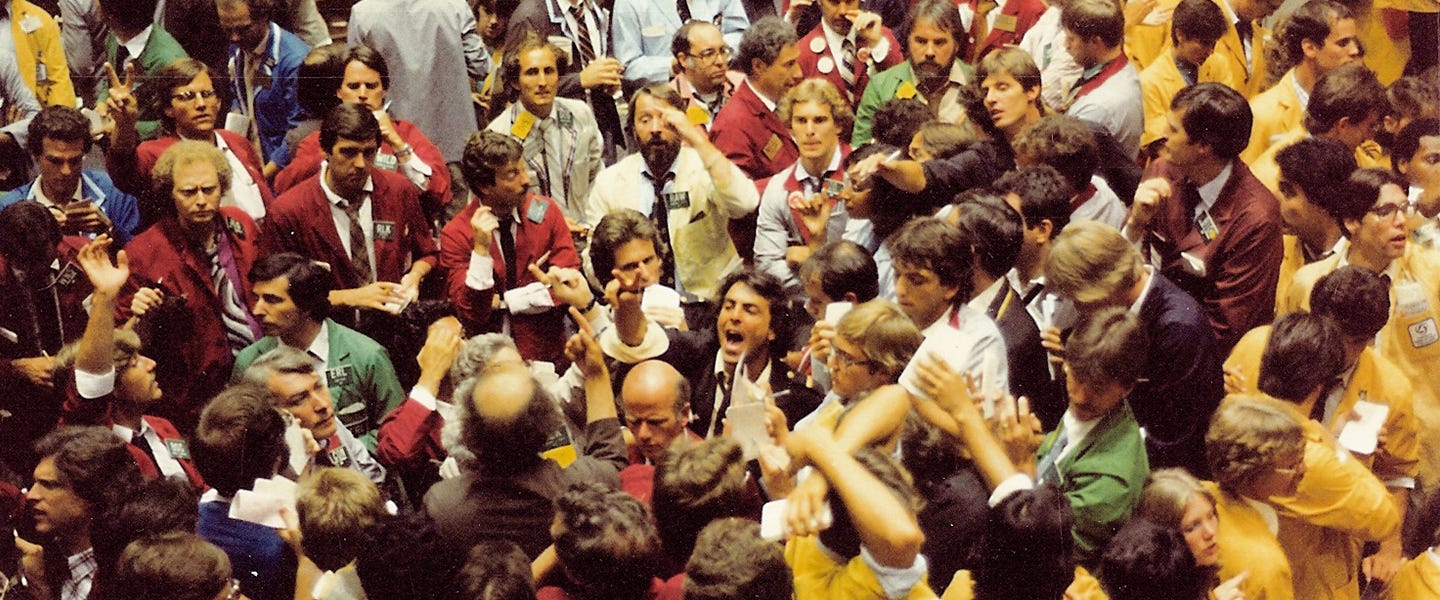
"A Eulogy for the Pit Trader"

For some reason this was rising at Digg and now its #1 with a bullet at Climateer Investing.
From MEL Magazine at Medium:

An oral history about work life in Chicago’s notoriously high-stress, hard-partying commodity futures “pits”
This past July, the Chicago Mercantile Exchange (CME) (known more simply as “the Merc”) shuttered nearly all its trading pits after 167 years of operation. And with it died the pit trader — an infamously lucrative, stressful job characterized by ruthless competition, fraternal camaraderie and the frenzied screaming and hand signaling among men (and a few select women) exchanging billions of dollars worth of commodities per day.

The pits dated back to 1848 when the Chicago Board of Trade (CBOT) established what would become the world’s first futures exchange. So-called “futures” contracts derived their name from their function — they were agreements between grain farmers and merchants to exchange a certain amount of grain at a future date for a particular price. Futures allowed grain farmers to know how much they could earn from their crops prior to harvesting, while merchants were able to lock in prices months in advance. Most importantly, it brought “price discovery” to the grain farming industry. Previously, grain farmers sold their crop yields independently and with little idea as to their actual value. The CBOT established a market rate for a bushel of grain, and a place where financial speculators could buy and sell futures contracts based on how they thought the price of grain — and later, other commodities — would fluctuate.

The CBOT diversified into other agrarian markets throughout the 20th century — in 1936, it began trading soybeans, and in 1968 it added its first non-grain-related commodity: chickens. Meanwhile the CME — previously called the Chicago Butter and Egg Board until it changed its name in 1919 — dealt in frozen pork bellies and live cattle, and later foreign currencies such as Deutsch marks and Swiss francs.

The 1980s saw the introduction of “options,” contracts derived of futures. Options differed from futures in that they were not as binding: A futures contract stipulated you were going to buy the commodity for the given price at the given date, whereas options were binding to only one party. The buyer would pay a small premium for the option on a contract, meaning he retained the sole right to buy the contract at the agreed-upon price over a given period of time. If the buyer thought it advantageous, he would “exercise his option” on the contract, and the seller was obligated to sell it to him. If the option wasn’t exercised by the end of designated time period, the contract expired and no money changed hands (although the contract holder kept the premium).

Options drastically increased the complexity of the trading conducted on the floor and was the beginning of the end of a unique work culture (a trend exacerbated by automated trading).
Because unlike in New York, the financial epicenter of the world, the culture at the Merc and CBOT was decidedly blue collar. The prevailing image of a finance worker in the 1980s and 1990s was a WASP-y, East Coast Ivy leaguer from a prestigious family. Now it’s a computer science genius whose software executes thousands of trades in a fraction of a second. But many pit traders were from working class Irish, Italian and Jewish communities and were correspondingly hardscrabble.

They hailed from the city’s South Side Irish-Catholic enclaves such as Beverly and Mount Greenwood; North Side Jewish neighborhoods (e.g. Northbrook, Highland Park); and bougie nearby suburbs (namely, Evanston and Oak Park). The ethnic-religious makeup of the pits was reflected in the names of the largest firms that traded there: Rosenthal & Co., Lee B. Stern & Co. and The Goldberg Association; Hennessy & Associates, O’Connor & Co. and Cunningham Commodities. The joke was that the CBOT was predominantly Irish- and Italian-Catholic while the CME attracted more Jewish workers.
 
They were drawn to the pit not just because it offered the opportunity to make hundred of thousands (if not millions) of dollars, but because one didn’t need a college degree to get a job and excel there. The pits were distinctly American in this way — simultaneously professional and crude; cutthroat and convivial; an insular meritocracy governed by both greed and interpersonal relationships.

The death of the pit trader, then, is about more than the loss of a “work hard, play hard” culture, it’s emblematic of a troubling shift in the labor market at large: With jobs rapidly disappearing due to automation and a growing emphasis on computer programming skills, it’s increasingly difficult for high school (and many college) graduates to earn a middle class income....MORE