Wednesday, January 4, 2023

Man Group Interview: Vaclav Smil

Man Group is one of the larger active managers, assets under management around $140 billion last time I looked, probably lower with the recent market unpleasantness.

From the Man Institute, December 2022. The interviewer is Head of Responsible Investment Research, Man Group.

A Sustainable Future: Vaclav Smil, author of How the World Really Works

What does the data say about our net zero ambitions? Listen to Jason Mitchell discuss with Vaclav Smil, academic and author of the New York Times bestseller How the World Really Works, what the energy transition by 2050 realistically means; how energy transitions have evolved historically; and what are the real implications when people talk of a climate ‘earthshot’

Recording date: 22 September 2022

Vaclav Smil

Vaclav is Distinguished Professor Emeritus at the University of Manitoba. Regarded as being among the most important thought leaders of our time, he’s the author of forty-five books and over 500 papers, including the New York Times bestsellers How the World Really Works and Energy and Civilization: A History. One of Bill Gates’ favourite authors, Vaclav has spent his career exploring new ground in the fields of energy, environmental and population change, food production and nutrition, technical innovation, risk assessment and public policy. He’s been named by Foreign Policy as one of the Top 100 Global Thinkers.

 Episode Transcript
Note: This transcription was generated using a combination of speech recognition software and human transcribers and may contain errors. As a part of this process, this transcript has also been edited for clarity.
Jason Mitchell:
I'm Jason Mitchell, head of Responsible Investment Research at Man Group. You're listening to A Sustainable Future, a podcast about what we're doing today to build a more sustainable world tomorrow.

Hi, everyone. Welcome back to the podcast and I hope everyone is staying well. Here's a special holiday present to you from the team behind A Sustainable Future podcast. For context, I've been after Vaclav Smil for several years now to get him on the podcast. As one of the preeminent thinkers and authors on historical development and transitions, Vaclav has long been a go-to research source for me. I finally managed to interview him at a Man Group conference this past September, and I can confirm that he is indeed a force of nature. Frankly, that probably comes across best in his prolific body of work, rather than a live interview, which, at least in my experience, is always a bit challenging.

Add to the fact that I was almost surreally interviewing a 12-foot image of his disembodied head via Zoom, and you'll get what I mean. But because Vaclav does so few interviews, it's an immense privilege to be able to have this conversation with one of the leading thinkers of the energy transition. And I think his data-driven approach and his sometimes sobering candidness about the challenges we face are obvious in this episode. But I don't see this as pessimism. I read his message as a voice of uncomfortable but necessary truths.

With more than 10 books on energy, Vaclav's work is important because he brings a clear-eyed perspective on the implications of the energy transition. We talk about what the energy transition by 2050 realistically means. How energy transitions have evolved historically and why the analogy of a climate earthshot is fundamentally different from that of a moonshot.

Vaclav is distinguished professor emeritus at the University of Manitoba, regarded as among the most important thought leaders of our time. He's the author of 45 books and over 500 papers, including the New York Times bestseller, How the World Really Works and Energy and Civilization. Vaclav has spent his career exploring new ground in the fields of energy, environmental and population change, food production and nutrition, technical innovation, risk assessment, and public policy. He's been named by foreign policy as one of the top 100 global thinkers. Welcome, Vaclav.

Vaclav Smil:
Hello.

Jason Mitchell:
Excellent. You have the books. The one thing I would say if you're not familiar with his work... My favorite quote is from Bill Gates. It's actually a tweet that he sent and he said that he looks forward to Vaclav books like some people look forward to Star Wars movies. So, it's sort of a testament to his influence.

Vaclav, let's start with some scene setting. There are a number of pervasive topics in your research. Two of them specifically. First, you talk about the almost incomprehensible immensity of the primary energy system, the fact that it's still 85% fossil-fuel based. And you also talk about the fact that energy transitions are nothing new. You've written about the fact that we've transitioned from wood to coal, from coal to oil, oil to natural gas. What does history teach us about these transitions? And I also want to be a little bit more provocative. Are we naive in thinking that we can compress and accelerate this current energy transition all while cutting carbon emissions 50% by 2030?

Vaclav Smil:
Some very simple calculations here so you could judge for yourself. Suppose you know nothing at all about the world energy system or energy consumption, you have never had a single course in engineering, you don't know any mark beyond simple algebra. But just think of these numbers. Basically, now people say by 2050 people... like these zero and five endings. So, 2050 there'll be zero carbon in the world. So, we have 28 years to get a zero carbon.

So, let's back 28 years back to 1994. In 1994, the global primary energy consumption, all fuels, all primary electricity was 86% fossil fuel. 1994, 86% fossil. 2022 is 82% fossil. So, we've gone down 4% relatively, but in absolute terms actually we have massively increased fossil fuel consumption because of the rise of China and rise of India, actually. But relatively speaking, we've gone down 4% in last 28 years. Now I ask simple question, how likely it is that we will go down 82% in next 28 years, right?

As simple as that. We can go home basically after this statement, right? Because the acceleration needed in still going 4% down in 28 years to 82% down in 28 years, I just don't know any historical parallel to that. As you noted, I never start telling people how massive the system is... And we could spend the rest of the day reciting the numbers. More than eight billion, all these tons... 10 to nine, 10 to... more than eight billion tons of coal, more than 4 billion tons of crude oil, more than 4 trillion cubic meters of natural gas, and so, down the road.

When you do these numbers like that, you cannot just simply say like an old telephone, a new mobile. Well, billions and trillions necessarily the infrastructure, simply the material behind it, steel, concrete, copper behind it, you just simply cannot say by 2030 or 2035. Maybe just one example of which we have been largely deprived in past two years, and has been flying. By 2019 we reach this [inaudible 00:05:57], eight trillion revenue passenger kilometers. Eight trillion.

More than eight billion people traveled. Basically every person statistically speaking, traveled on a jetliner. These are massive machines which can get 300, 400, 500 people and they can fly also for 17 hours, thanks to what? Thanks to fossil fuel. Because the energy density of kerosine, which has this airplane is 12,000 watt hours per kilogram. The best better is today at 300 watt hours per kilogram. That's 40 times more in kerosine. So, how can you change this massive things rapidly? It's just simply impossible. So little bit of basic engineering, scientific literacy would go a long way to say that we just cannot do it that rapidly. Just it's easy to say 2035, 2050, but to accomplish that practically, not so easy....

....MUCH MORE

One of My Favorite Stories From 2020

Wednesday, April 22, 2020 

ICYMI: Retirement Gift Gone Bad—Man Gets Ride In Jet Fighter, Man Accidently Triggers Ejector Seat at 2500 Feet

From The Register:

French pensioner ejected from fighter jet after accidentally grabbing bang seat* handle
That's a retirement day present he won't forget
An elderly and reluctant Frenchman was ejected from a French Air Force fighter during a retirement day jolly – and narrowly missed taking the pilot with him, an investigation report littered with unintentional howlers has revealed.

The unnamed 64-year-old was éjecté from the two-seat Rafale-B from a height of 2,500ft in March last year after grabbing his ejection seat handle to steady himself, France's BEA-E aviation investigator concluded.

Although the BEA's full report is in French [PDF], aviation news website Aerotime Hub translated and summarised its contents, revealing the full comedy of errors triggered by a group of enthusiastic colleagues hoping to give their workmate a send-off to remember.

As he was an employee of a defence contractor, the pensioner's bosses had no difficulties asking the French Air Force to let him into the back seat of one of its Dassault Rafale fighter jets as a surprise retirement gift. Nonetheless, the unfortunate Frenchman had "never expressed a desire to carry out this type of flight and in particular on Rafale", which didn't stop his colleagues luring him to Saint-Dizier air base anyway.

The flight itself was a routine military training sortie for three Rafales, carried out in perfect weather. Our pensioner, heart pounding at "between 136 and 142 beats per minute" (as recorded by his smartwatch), underwent a quick medical exam from a doctor four hours before being shown by the pilot how to put on his safety gear. Unfortunately, no one properly checked him as he clambered into the cockpit – meaning "his [helmet] visor was up, his anti-g pants were not worn properly, his helmet and oxygen mask were both unattached, and his seat straps were not tight enough."

Nonetheless, a mechanic gave them both a cursory check, strapped a Go-Pro to an approved bulkhead mounting point so the hapless passenger's gurning would be preserved for all time, and nodded to the pilot to close the transparent cockpit canopies.

Things got worse when the pilot took off from northeastern France's Saint-Dizier Robinson airbase. Rather than the gentle ascent at 10°-15° that airline passengers experience, the Frenchman at the Rafale's controls carried out a typical fighter jet departure and "climbed at 47°, generating a load factor of around +4G. Then, as he levelled off, he subjected his passenger to a negative load factor of about -0.6G".

Forces exerted by Britain's most G-force-intensive roller coaster, Alton Towers' Rita, max out at +4.7G – or four times the normal force of gravity.
Our pensioner, loose in his straps, not really wanting to be there and totally unused to being flung around like a rag doll, reached out to grab something and hang on for dear life. He picked the worst possible handhold: the trigger handle for the ejection seat. After the customary loud bang and whoosh he ceased to be part of the jet's payload, with the force of the ejection tearing his unsecured helmet and mask from his face....MORE
"Hi honey, how was the retirement party?"

Fortunately the man's buddies were able to film the event for posterity (and the official report):

https://i.dailymail.co.uk/1s/2020/04/12/16/27103396-8212305-Then_he_shot_out_at_high_speed_losing_his_helmet_that_had_not_be-m-66_1586705211247.jpg

Ionosphere-Exciting HAARP Array Fired Up December 27

Well, I guess the cat is out of the bag. 

"Sardonicus" has sussed out the action by way of old-fashioned empirical observation.

Using the cover story that they were exploring an asteroid, HAARP became active and the airspace around the Gulkana/Gokana Alaska site was closed to all air traffic.

This is the latest in a series of "experiments" that began in October.

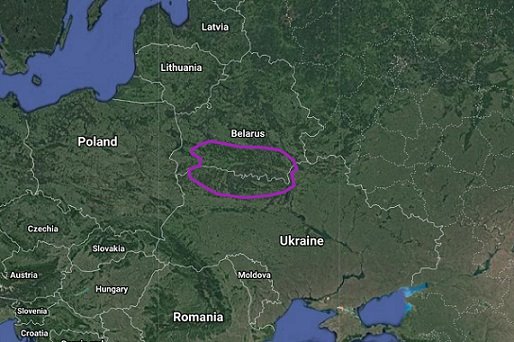
The actual target of the ionospheric tweaking/twerking appears to be the Pripyat/Pripet/Pinsk marshes in southern Belarus/northern Ukraine. At 98,400 km square, 38,000 square miles, it is one of the largest wetlands in Europe and when unfrozen is an almost impassable barrier, making an armored/infantry attack on a direct Pinsk-Kyiv or Mazyr-Kyiv line very difficult.


Although dismissed by those with things to hide as "conspiracy theory" HAARPs capbility is what it is.

And temperatures in Pinsk have been running above normal, in fact above freezing. and look to be doing so for at least another week. 

If interested see also:  

Here's the Notice to Airmen, December 19:

NOTAM Number : FDC 2/7793 Download shapefiles
Issue Date : December 19, 2022 at 1840 UTC
Location : GULKANA, Alaska near GULKANA VOR/DME (GKN)
Beginning Date and Time : December 27, 2022 at 1000 UTC
Ending Date and Time : December 27, 2022 at 2300 UTC
Reason for NOTAM : Temporary flight restrictions
Type : Hazards
Replaced NOTAM(s) : N/A

Jump To:       Affected Areas
Operating Restrictions and Requirements
Other Information

Affected Area(s) Top

Airspace Definition:


Center: On the GULKANA VOR/DME (GKN) 007 degree radial at 16.6 nautical miles. (Latitude: 62º23'33"N, Longitude: 145º09'02"W)


Radius: 2.5 nautical miles


Altitude: From the surface up to and including FL(250)
Effective Date(s):


From December 27, 2022 at 1000 UTC


To December 27, 2022 at 2300 UTC

2/7793
 
Click for Sectional
NOTAM Text

Operating Restrictions and Requirements Top

No pilots may operate an aircraft in the areas covered by this NOTAM (except as described).

Tuesday, January 3, 2023

IEEE Spectrum: Top Tech 2023

From IEEE Spectrum Magazine, January 2023 edition:

Top Tech 2023: A Special Report 
These two dozen technical projects should make significant advances in the coming year

Australia Goes All-in on Green Hydrogen
Juggernaut or boondoggle—it’s too soon to tell

They could also make weapons-grade plutonium

Is Worldcoin a Crypto-currency for the Masses or Your Digital ID?
The project aims to scan all the world’s eyeballs

Europe Gets an Exascale Supercomputer
Germany will host JUPITER, Europe’s entry into the exascale realm

....MUCH MORE

"Tesla: Wall Street reacts to Q4 delivery miss" (TSLA; ALB)

Well, for one thing, the lithium miners continue their descent. Here's the largest, Albemarle, via BigCharts:


Down $5.71 (-2.63%) at $211.15.

Tesla itself is getting whacked, down $17.86 (14.50%) at $105.32.

And from Yahoo Finance:

Tesla stock is starting 2023 on the wrong foot after the automaker reported a delivery miss for the fourth quarter.

Tesla delivered 405,278 vehicles globally for the quarter, missing analyst expectations of 420,760 as compiled by Bloomberg. For the quarter, Tesla produced 439,701 vehicles, a number that exceeded deliveries by 34,423 vehicles.

Tesla explained the rising difference between deliveries and units produced, claiming it “continued to transition towards a more even regional mix of vehicle builds which again led to a further increase in cars in transit at the end of the quarter.”

For the year, Tesla deliveries climbed 40% to 1.31 million units, representing an all-time high for the company, though shy of its 50% growth rate the company has targeted, though last quarter the company hinted it may fall short of that goal.

Nevertheless, Wall Street analysts are weighing in on the quarterly miss, and some are concerned about demand.

“Although the soft Q4 outcome isn’t entirely shocking given recent China COVID developments, the delivery miss (vs reduced estimates and post recent price actions) will likely escalate concerns over [near term] macro/competitive demand pressures at a time when Tesla is adding significant capacity on existing products,” Citi analyst Itay Michaeli said in a note today. “Until gross margin visibility improves (Q4 results on Jan 25th), the stock might struggle to regain meaningful ground, and it doesn’t help that U.S. IRA guidelines appear to limit the $80k price cap to just the three-row Model Y variants.”

Wedbush’s Dan Ives, once a noted Tesla bull, has grown sour in recent months over Tesla’s stock performance. He is still concerned following the Q4 delivery report....

....MUCH MORE

Hurdles To Rehabbing Office Buildings For Residential Housing

Sounds great at first but....

You just know this is something the politicians and developers and the whole ecosystem of NGO's and lobbyists and other forward-looking folk will be spending large money (not their own) on.

From The Anti-Planner, December 30:

Let Cities Be What They Want to Be

An on-line site called the Dumber, er, I mean Intelligancer says that, for cities to survive, developers must be allowed to convert office buildings into housing. There are a lot of problems with this recommendation.

There are a lot of problems with this recommendation. First, both people and jobs are moving away from the cities, so who is going to want to live in former office buildings anyway? Second, office buildings are not designed for human habitation, so converting them will be expensive, probably far more expensive than the single-family homes people are moving to. Third, if cities allow such conversions, and they don’t happen, you know what the next step will be: cities will begin subsidizing such conversions....

....MUCH MORE

How to trade it: start donating cash money to city council members, especially those with planning and zoning oversight. This is classic "My little crony" territory and the action will of course be at the local level.

Read up on Tammany Hall. Here's a good start for our purposes, via the Cambridge University Press' Journal of the Gilded Age and Progressive Era

POLITICAL CAPITALISM IN THE GILDED AGE: THE TAMMANY BANK RUN OF 1871

Abstract
The Tweed Ring spawned a vibrant financial sector that was integral to its brief success but has never been previously examined. William “Boss” Tweed and his allies employed banks controlled or comanaged by Tammany politicians to embezzle funds, build political alliances, and invest in a wide array of business ventures. The capital of these savings and commercial banks—city money, deposits from Catholic charities, and the savings of immigrant laborers—was accumulated through political channels. During their operation between 1867 and 1871, politician-bankers engaged in a mix of patronage deals and profit-driven financial speculation. In effect, Tammany banks were ground zero for the Ring's conversion of political hegemony into a windfall of economic capital that fueled party activities and buoyed personal fortunes. Importantly, the anti-Ring mobilization by upper-class reformers was more than a revolt of wealthy taxpayers concerned with abstract goals of good government or rescuing city credit; it was also a reaction by old-line bankers in direct competition with Tammany upstarts. A dramatic bank run catalyzed by reformers in November 1871 drove them into bankruptcy, bringing this novel experiment in political capitalism to an end.

Be aware of both the opportunity and the risks of this sort of venture, especially the potential for winds of change to spring up before you have a chance to establish/exit positions (see above on so-called reformers). 

Heed the words of our first inductee into the Climateer Hall of Fame. The 26th Secretary of War, the Democrat and Republican (!) Senator from Pennsylvania Simon Cameron:

Our Hero
Simon Cameron

"The honest politician is one who when he is bought, 
will stay bought."
 
Good luck, not all rent-seeking/corruption pays off, your mileage may vary.

Music To Read Izabella Kaminska's Latest "In The Blind Spot..." By

“You better stop
Look around
Here it comes, here it comes, here it comes, here it comes..."

Jagger/Richards

...Here comes your 19th market meltdown.

Of necessity, I have to stay as au courant as I can but it is humbling/terrifying how much I don't see/hear/know. 

From The Blind Spot web site, January 2:

In the Blind Spot (What You Missed While You Were Holidaying)

This back-to-work edition of the Blind Spot Wrap offers a compilation of the most important stories you may have missed while you were holidaying, plus a review of the top news events that failed to get the media traction they deserved in 2022. We’ve also got a hindsight capital analysis from Ben Munster in Rome on why everyone, bar the Italians, failed to spot the rise of Meloni.

....Non-Western central banks bought up gold in a big way. 

Phil Pilkington argued the trend was reminiscent of that seen just before Bretton Woods collapsed.
The World Gold Council first reported on the outsized buying phenomenonat the start of November. As they noted at the time: “Global central bank purchases leapt to almost 400t in Q3 (+115% q-o-q)....

....MUCH MORE

Why are central banks still buying gold?

In size.

And why wasn't I informed.

And can I still get one of those bad-times billionaire bunkers that Izzy links to? 

This could be some seriously troubling foreshadowing by the powers-that-be

That Time The CIA Bought The Film Rights To George Orwell's "Animal Farm" So They Could Produce The Animation And Change The Ending

From Wikipedia: 

Animal Farm (1954 film) - Wikipedia

Animal Farm is a 1954 animated film directed by animators John Halas and Joy Batchelor.It was produced by Halas and Batchelor and funded in part by the Central Intelligence Agency (CIA), who also made changes to the original movie script. It was based on the 1945 novel of the same name by George Orwell.Although the film was a financial failure and took 15 years to generate a profit, it quickly ...
....MORE
 
HT: Reddit's TIL subreddit who link to a NYT story. 
 
Recently tipped from the TIL subreddit: 

Former Fed Vice-Chair Alan Blinder Talks FedTalk, Interest Rates, Inflation and Fiscal Policy

Although this is a very plain vanilla, powers-that-be representation of where we are and where we're going, what comes through is the fact Blinder really knows this stuff. And he is very facile, which is a bit scary if juxtaposed with a dollop of Voltaire 

"Ils ne se servent de la pensée que pour autoriser leurs injustices,
et emploient les paroles que pour déguiser leurs pensées"

François-Marie Arouet--'Voltaire', Dialogue xiv. Le Chapon et la Poularde (1766).
"Men use thought only to justify their wrong doings,
and employ speech only to conceal their thoughts"

From Neue Zürcher Zeitung's TheMarket.ch, December 20: 

«This Is Not Looking Like a Replay of 1982»

Fears of a recession are rising. Alan Blinder, former Vice Chairman of the Federal Reserve, compares the current environment to the big inflation surge in the early Eighties and the economic downturn at the time. He says what’s different today and what’s next for interest rates.

Deutsche Version

Inflation was the big topic for markets this past year. Looking ahead to 2023, concerns about the economy are increasingly coming into focus. In the United States and Europe, a recession seems all but certain. The question is how bad the downturn will be.

The Market NZZ talked about these developments with Alan Blinder. The Professor of Economics and Public Affairs at Princeton University and former Vice Chair of the Federal Reserve Board has recently published a new book on modern U.S. economic history which tackles the shifting relationship between fiscal and monetary policy from John F. Kennedy to Joe Biden.

«The recession that we are probably going to have looks likely to be mild,» Mr. Blinder says. «This is not looking like a replay of 2008 or anything remotely close, or, going back to Volcker, a replay of 1982».

In this in-depth interview which has which has been lightly edited, Blinder draws parallels, but also cites differences between today’s environment and the early 1980s, when then Fed Chairman Paul Volcker fought inflation relentlessly and pushed the U.S. economy into recession. He explains why the current situation is less difficult for Fed Chair Jerome Powell. And he says what’s next for interest rates and monetary policy.

«Today, I think Keynesian theory is on the rise again, but not so much in the rhetoric but in the actions»: Alan Blinder.

Professor Blinder, your new book chronicles the history of fiscal and monetary policy in the U.S. from 1961 to 2021. Why did you choose those sixty years as time frame?
Well, the endpoint was easy because that was as far as I could go. The beginning point was also easy in two senses. First, 1960 was where Friedman and Schwartz’ «Monetary History of the United States» ended. Second, it was also the beginning of Keynesianism in America; not in the intellectual world, but in the policy world with the Kennedy administration coming in in 1961. So it was a natural starting point.

How did this change economic policy?
Essentially, there was nothing that we would call fiscal policy prior to that time. Of course, there was a budget, government spending and taxing, and that goes back to the beginnings of the Republic. But people in Washington were very rarely, if ever, thinking of using those instruments of fiscal policy – taxation or spending – to make the economy either grow slower or faster. That’s what we mean by fiscal policy these days. It’s a common place now. But if you went back to the time before Kennedy, there was hardly any thinking of that nature in the US. A number of European countries were ahead of us. For instance, the Swedes had been doing it since the Thirties, but not the Americans.

And what were the consequences of this?
As I said, Keynesianism came to Washington with JFK, and when he was assassinated, this transformation was really completed by his successor Lyndon B. Johnson. In those days, it was thought that stabilization policy was mostly fiscal policy, and that monetary policy was kind of a passive partner. The term «accommodative monetary policy» comes from that period.

So monetary was just playing second fiddle?
If the fiscal authorities wanted to cut taxes, they didn’t want that to push interest rates way up, so the people at the Federal Reserve were supposed to accommodate fiscal policy by stabilizing interest rates. But they were not the active participants. During the research for my book, I even dug up an amazing quote from the 1968 Economic Report of the President stating: «The control of inflation is the responsibility of fiscal policy, not monetary policy.» Just imagine that! Nobody would say something like that today.

Already at the time of the World War II, the Federal Reserve was de facto demoted to an extension of the Treasury. In the recent past, however, it has mostly been up to monetary policy to support the economy in periods of weakness. How did this happen?
I’m skipping over a lot of episodes, but after the huge Reagan tax cuts in 1982-84, fiscal stabilization policy basically disappeared for over twenty years. Sure, there was fiscal policy, there were budgets, there were taxes, there was spending. But the people in authority were not looking to fiscal policy to manage the economy. For twenty years, the job of fiscal policy was basically to «get the budget deficit down», so much so that we had a recession in 1991 during the presidency of George H.W. Bush and not a soul advocated for fiscal stimulus to help shorten the recession. Everyone looked at the Fed.

In the financial crisis of 2008/09, but especially with the massive stimulus packages following the outbreak of the pandemic, fiscal and monetary policy have again increasingly worked together. Are we currently experiencing some sort of revival of the 1960s?
Absolutely. The belief in Keynesian economics has had peaks and valleys over the past sixty years. Today, I think Keynesian theory is on the rise again – not so much in rhetoric but in actions. If you look at how the world reacted to the crisis in 2008 and 2020, that was Keynesianism big time. No country said «I’m going Keynesian here». But they did go Keynesian again in a big way....

....MUCH MORE

Monday, January 2, 2023

"Apple has notified several suppliers to build fewer components for AirPods, the Apple Watch and MacBooks..." (AAPL)

From Nikkei Asia, January 2:

China's tech supply chain reels as infections soar, demand sours 
Silver lining: Dealing with COVID wave now 'could pave way for recovery'

China's tech supply chain is heading into the new year facing the twin challenges of slumping demand and staffing chaos caused by Beijing's abrupt U-turn on COVID controls.

In a sign of the gloomy outlook for consumer electronics, Apple has notified several suppliers to build fewer components for AirPods, the Apple Watch and MacBooks for the first quarter, citing weakening demand, according to Nikkei Asia's supply chain checks with several component suppliers. 

"Apple has alerted us to lower orders for almost all product lines actually since the quarter ending December, partly because the demand is not that strong," a manager at an Apple supplier told Nikkei Asia. "The supply chain in China is still trying to cope with the latest abrupt policy turns, which brought a shortage of laborers because of the sharp COVID surges."

That policy change came in early December when China started to dismantle the world's most stringent COVID regime, which included mass testing and quarantines, to kick-start the flagging economy.

Tech manufacturers initially welcomed the turnaround after years of fighting to maintain operations under the strict COVID measures. But now they face the challenge of embracing a new normal of rising infections and looser controls.

"It's very chaotic," an executive at an electronic component maker that supplies Samsung, Apple and several Chinese smartphone makers told Nikkei Asia. "The new wave of COVID surges spread super fast, and most companies found it already makes no sense to quarantine their employees."

An employee at smartphone maker Honor described how workers now are largely resigned to catching the virus....

....MUCH MORE

The lockdowns were never about the disease.

Follow-up: Commercial and Industrial Loans Are Still Rising Quickly

Following on the point made by Joe Carson in "Inverted Yield Curve Not A Sufficient Condition For Recession-Credit Growth & Rate Levels Matter Too" I thought I'd look at large bank lending and damn, things still look loosey-goosey.

From the Federal Reserve Bank of St. Louis' FRED database, here's 27 years of data, covering the last three recessions:


Astute reader will note that C&I lending turned down prior to what was later determined to be the start date of two of the recessions and in the third case didn't turn down until the mid-point of the 2008 recession.

Takeaway? If we seen a decrease in loan volume we are either approaching or in a recession.

And just so you know the intent is not to cherry-pick using the large bank data, here's the chart for all banks. The angle of ascent is even steeper.

"Why Liberica, a Rare Type of Coffee, Could Lead the Market by 2100"

For the investor with a longer-term time horizon.

From RealClearScience, December 19:

For the past century, the coffee market has been dominated by two species: Arabica and Robusta, respectively comprising 55% and 45% of global production. Pricier, sweeter Arabica beans are more typically used in fancier beverages over the more bitter Robusta beans, which pack twice the caffeine. But as the climate changes, a rare species could push these two mainstays to the minority.

As a group of plant scientists from the UK and Uganda described in a comment published Thursday in Nature Plants, Coffea liberica, more simply known as Liberica, wasn’t always the relative unknown that it is today. At the dawn of the 20th century, it was the second most traded species, behind the ever popular Arabica. Robust and high-yielding, with resistance to pests and disease as well as an ability to tolerate warmer temperatures, Liberica flourished, particularly in southern Asia.

But it had one glaring drawback that led to its decline into obscurity: it didn’t taste very good.

“The flavor issues and low quality were largely the result of difficulties in post-harvest processing… due to the large size of the fruit, its thick rather tough skin and thick pulp,” the authors wrote.

Long live Liberica?

But now, a confluence of factors could bring Liberica coffee back, they argue....

....MUCH MORE

"Police in Central China's Wuhan arrested 8 people spreading rumors about local outbreak of unidentifiable #pneumonia"

Although ZeroHedge and others had been posting on the rumors and stories coming out of China in late 2019, this was the tweet and the story that got me to start paying attention.

Global Times being the Communist Party's outward-facing propaganda organ.

And the article to which it linked:

Seafood market closed after outbreak of ‘unidentified’ pneumonia

Source:Global Times Published: 2020/1/1 15:33:30 
A seafood wholesale market in Central China's Hubei Province was shut down Wednesday after 27 people were hospitalized in December with an unidentified pneumonia.

Seven remained in critical condition, two are recovering and the others were in stable condition, the People's Daily reported on Tuesday, noting that most of them were vendors at Huanan seafood market in Wuhan, capital of Hubei.

Tests, quarantine and treatment were being conducted, the paper said.

The market will be closed for environmental and sanitation control according to public health regulations on pneumonia epidemic controls, the Wuhan Evening News reported, citing a notice posted outside the market by health authorities on Wednesday.

The notice asked vendors to cooperate, saying another notice would indicate when the market will reopen.

Vendors were busy preparing for the closure and began to leave early Wednesday morning, the paper said.

Chinese internet speculations on Tuesday suggested a return of the severe acute respiratory syndrome (SARS) virus, but the People's Daily cited doctors saying that was unlikely. 

If it was SARS, China possesses a mature prevention and treatment system, the newspaper noted, and urged people not to panic....
....MORE
...Late December 2019 – Early January 2020

Authorities report no new infections or deaths. “. . . in Wuhan, local cadres were focused on a days-long Communist Party conclave that was scheduled to run from Jan. 11 to Jan. 17. During that time, the Wuhan Health Commission each day claimed there were no new infections or deaths,” the Washington Post‘s Gerry Shih, Emily Rauhala, and Lena H. Sun would later report from Beijing. (They would later be banned for their reporting.)

January 1, 2020

Doctors are investigated and punished. Chinese state media report that eight people in Wuhan are investigated for spreading “misinformation” about the virus and “exaggerating” the seriousness of the outbreak. Wuhan officials say they punished eight people for “publishing or forwarding false information on the internet without verification.” All eight people are physicians.

Dr Li is accused of spreading false stories. Other reports later confirm that the eight included Dr. Li, who were accused of “spreading rumors.”

Regime warns others not to spread doctors’ warnings. “The police followed up in the state-run Xinhua gency with a chilling warning. ‘The police call on all netizens to not fabricate rumors, not spread rumors, not believe rumors,’ the Wuhan authorities said, adding that they encouraged Web users to ‘jointly build a harmonious, clear and bright cyberspace,'” the Washington Post reports from Beijing.

Lab ordered to stop testing and to destroy samples. Official at the Hubei Provincial Health Commission orders a laboratory to stop testing samples of the new virus from Wuhan, to destroy all existing samples, and “to immediately cease releasing test results and information about the tests.”

Early January

Hashtag censorship. CCP officials censor the hashtag #WuhanSARS and investigate eight Wuhan residents who spread “misleading information” about the virus on social media.

January 3

Dr Li is forced to sign a confession that he made false statements. Dr. Li Wenliang, who had warned fellow physicians at the Wuhan Central Hospital about the virus, is brought before the Public Security Bureau and forced to sign a letter that accused him of “making false statements” that “severely disturbed the social order.”

The Public Security Bureau warns Dr. Li in the letter he is forced to sign, “We solemnly warn you: If you keep being stubborn, with such impertinence, and continue this illegal activity, you will be brought to justice – is that understood?” Dr. Li writes underneath, “Yes, I do.”

Chinese government health leaders issue orders for censorship and forensic destruction. China’s National Health Commission, a cabinet-level institution in Beijing and the regime’s top health organization, “ordered institutions not to publish any information” relating to the Wuhan virus, and “ordered labs to transfer any samples they had to designated testing institutions, or to destroy them.”

Chinese regime rejects US offers of immediate assistance. The Chinese central government officially rejects US government offers to send medical assistance to China.

Foreign Ministry in Beijing creates false narrative starting on this date. January 3 becomes a date on which the Chinese government starts the narrative that it was open with the US quickly, as of that date. Later, foreign ministry spokesperson Hua Chunying will criticize US State Department spokesperson Morgan Ortagus, in the following Twitter exchange:

  • PRC: “China has been updating the US on the coronavirus and its response since Jan. 3. On Jan. 15 the US State Department notified Americans in China US CDC’s warning about the coronavirus. And now blame China for delay? Seriously?”
  • USA: “By Jan. 3, Chinese authorities had already ordered #COVID19 virus samples destroyed, silenced Wuhan doctors, and censored public concerns online. @SpokespersonCHN is right: This is a timeline the world must absolutely scrutinize.”....

"US Treasury signals opening for foreign carmakers on EV subsidy"

There is a lot of loot in the pot o'gold that Mr. Podesta is spreading around.

A serious look from Bloomberg via Mining.com, December 30: 

The US Treasury Department signaled some imported cars will qualify for electric-vehicle tax credits in the Inflation Reduction Act, a move that could assuage Asian and European allies’ concerns about the sweeping climate legislation.

The Treasury sketched out its interpretation of content requirements for electric-vehicle tax credits Thursday, while delaying final rules until March so officials have more time to address the complexities of the law.

In a list of frequently asked questions, Treasury officials indicated that imported EVs can qualify for a consumer tax credit of up to $7,500 through a commercial-vehicle clause in the law by leasing them. That ruling will help foreign carmakers like Hyundai Motor Co., which has complained that their electric models were excluded from the subsidy because they don’t currently manufacture them in North America.

Making leased cars eligible as commercial vehicles triggered an immediate and angry response from West Virginia Senator Joe Manchin.

Interpretation ‘inconsistent’
In a statement Thursday, Manchin criticized the Treasury’s interpretation and urged officials to pause implementation of both the commercial and consumer electric-vehicle tax credits until the department issued “the appropriate guidance.”

Manchin said the Treasury’s interpretation “bends to the desires of the companies looking for loopholes and is clearly inconsistent with the intent of the law.”....

....MUCH MORE

Sunday, January 1, 2023

"Banks Keep European CLO Market Alive by Buying Their Own Product"

This is not usually considered an optimal solution.

We saw it in 2008 in venture capital where there would be a "topping off" round to set price before an IPO. we saw it last year in NFT's with the wash trading and the marking-the-close trades and we see it currently in Private Equity with daisy-chain purchases running "valuation" higher and higher.

In fact, it is such a tell on the market that it is probably worth figuring out how to bet against, at minimum, the CLO packagers (their revenue stream dries up) if not the whole ecosystem.

From Bloomberg via Yahoo Finance, December 5:

European banks are snapping up large pieces of their own collateralized loan obligations, keeping the market for CLOs afloat in the absence of the US and Japanese banks that traditionally make up the bulk of the buyer base.

French bank Societe Generale SA arranged its first CLOs since the Global Financial Crisis in November, and then following an example by Deutsche Bank AG earlier in the year, it also played a key role in getting the deals out the door by purchasing a chunk of the AAA -- or safest -- bonds. In doing so, these banks are hoping they can keep the wheels turning until more takers materialize.

Europe’s CLO markets screeched to a halt earlier this year after global sentiment soured in the wake of the US Federal Reserve’s first 75 basis point hike. Concerns about downgrades and defaults are growing as the loans that act as collateral for CLO bonds are issued by heavily indebted companies that are especially exposed to higher costs and interest-rate rises. There have been other shocks as well, such as the fire sale by UK pension funds during the recent gilt crisis.

Major global banks have historically been the biggest customers for CLOs, but the ones that put the deals together didn’t use to be significant investors in their own vehicles....

....MUCH MORE

Bear in mind that CLO's are not CDO's and wouldn't have the same systemic dynamics but there is an opportunity in here somewhere. 

"Meet the man who may decide the fate of German industry"

From The Economist, December 1:

Klaus Müller should have been an anonymous bureaucrat, but he’s become a celebrity

When Klaus Müller accepted the job as boss of the Federal Network Agency, Germany’s regulator for electricity, natural gas, telecommunications, post and railway markets, he hoped he would spend his time on expanding renewables and laying fibre-optic cables. A former state minister for the environment and agriculture in Schleswig-Holstein, he is close to Robert Habeck, the federal economy minister and a fellow Green. He cares deeply about the Greens’ favourite causes, such as a rapid shift to carbon-neutrality, which make captains of German industry uneasy.

Those priorities will have to wait, Mr Müller admits to The Economist at his office in Bonn. He took over a few days after Russia attacked Ukraine. From day one he has spent the bulk of his time thinking about the supply and distribution of natural gas—the lifeblood of Germany’s industrial economy, the flow of which has been staunched by Russia in response to Western sanctions. “We are in significantly better shape than everyone forecast this summer,” he says reassuringly. But, he quickly adds, it is not an all-clear.

The war in Ukraine has turned Mr Müller from an anonymous bureaucrat into a celebrity. He is a frequent guest of popular tv talk shows and has tens of thousands of followers on Twitter. His agency’s detailed updates every weekday on the state of gas supply are read by millions. When he strikes an optimistic note, the nation breathes a collective sigh of relief. When he sends a note of caution, as he did in a tweet on November 28th warning that the temperature in Germany for the next seven days would be 2°C below the average for the period over the past four years, it shudders.

The reason Germans—and German industrialists in particular—hang on Mr Müller’s every word is that he could yet be in charge of rationing gas for the country. Were the government to take the unprecedented step of declaring a gas emergency, his agency is ready to mobilise 75 staff working in shifts around the clock from a windowless room in one of the agency’s nondescript 1960s office blocks, equipped with huge communication terminals, its own diesel-powered generator for electricity, a water tank, showers, around 20 camp beds and stocks of freeze-dried food....

....MUCH MORE

The Journalist Who Broke The Story Pope Benedict Was Stepping Down: How She Got It And Why She Panicked

From CNA (Catholic News Agency):

Journalist who broke news of resignation recalls her 'panic'

Vatican journalist Giovanna Chirri remembers her shock at Benedict XVI's resignation last year, and how she broke the news before he finished his announcement because she could understand Latin.

"He said it in Latin and I was panicking. I was short of breath, my legs were trembling. I was sitting and my legs trembled like this…it was a very violent reaction. It was a reaction to shock," Chirri told CNA in a Feb. 10 interview.

Chirri is a journalist for Italian news agency Ansa and was sitting in the Holy See press office listening to a consistory meeting between the former Pope and the cardinals on her computer. Her sole aim was to publish the canonization date of martyrs that are highly venerated in Puglia, a region of Southern Italy.

"It was a calm day with hardly anyone around because there was an event of little importance taking place without much media attention," she explained, noting that the only reason she was present was because of the strong devotion to the martyrs of Puglia.

"So I was listening with just one ear. But what helped me was that when the consistory was over, the Pope was supposed to leave but he stayed seated and continued to talk in Latin."

Chirri noted that at that moment "I must have thought 'what is going on? Why isn't he leaving?' and I became more alert," observing that "he spoke in Latin and I was lucky with that, too," because she could understand the language perfectly.

"The first two things he said shocked me because he told the cardinals that he had gathered them for the consistory, but that he had something important to tell them for the Church," she said....

....MUCH MORE

She knew Latin, but couldn't be sure what she had just heard.

HT: Reddit's TIL

It's like I told ya:
"The Hittites Lived in Interesting Times"
You never know when the flight attendant is going to get on the speaker and ask "Does anyone onboard know anything about the Hittites?"
And should that time come, you will be ready....

And finally:
June 2017
Yesterday I Learned About ATMs
It started with Paul Murphy at Alphaville's Markets Live:...

...Which of course lead to the question "Do the Vatican Bank ATM's really have instructions in Latin?"
(I had heard that from a less-than-reliable-source)....
 

Inverted Yield Curve Not A Sufficient Condition For Recession-Credit Growth & Rate Levels Matter Too

From economist Joe Carson's The Carson Report, January 1:

The inverted Treasury yield curve has raised concern over the risk of recession in 2023, and for a good reason. An inverted yield curve has occurred before the past eight recessions. Yet, something is awry. Banks are not restricting credit as they typically would with an inverted yield curve, and businesses and consumers are borrowing at banks at the fastest rate in fifteen years. What's up?

The thinking behind the inverted yield curve is that banks slow and eventually stop lending when bank funding costs exceed what banks can earn by lending. Yet, bank credit has been accelerating throughout 2022. The latest data for November shows bank lending to businesses, real estate, and consumers rising 11.8% over the comparable period one year earlier. That's the fastest annual growth since 2007....

....MUCH MORE

We will be referring back to this rather astute observation after the next CPI report (or five).

Some previous visits to The Carson Report:

December 2
A "Pain-Free" Tightening Cycle For Companies Is Not How Fed Tightening Cycles End
Our boilerplate introduction:The author, Joe Carson is the former Chief Economist & Director of Global Economic Research at Alliance Bernstein. Prior to that he was Chief Economist at Chemical Bank and at Dean Witter, firms he left in such rough shape they were forced to merge with JPM and MS respectively. (Just Kidding Mr. C.)...
September 30
"Is Deflation A Risk, Or Are These Prognostications A Spurious Call For A Fed Pivot?"
June 22
"Peak Inflation Is Hollow: It Provides No Context To Reduction in Speed or Duration of Cycle"

I Think This Guy Likes France And The French

Ed West at his Wrong Side of History substack, December 9:

The Frenchest things in the world… Part Deux
There is no country on earth like France

‘When, after their victory at Salamis, the generals of the various Greek states voted the prizes for distinguished individual merit, each assigned the first place of excellence to himself, but they all concurred in giving their second votes to Themistocles,’ wrote the great 19th-century historian Edward Creasy. ‘This was looked on as a decisive proof that Themistocles ought to be ranked first of all. If we were to endeavour, by a similar test, to ascertain which European nation has contributed the most to the progress of European civilization, we should find Italy, Germany, England, and Spain, each claiming the first degree, but each also naming France as clearly next in merit. It is impossible to deny her paramount importance in history.’

France is central to the story of Europe, and indeed of Britain. It is almost impossible to understand England’s history without appreciating the relationship with its closest continental neighbour. It is a love-hate affair originating in a grand inferiority complex, a long rivalry that continues tomorrow when England meet France in the World Cup quarter-finals.

In a piece last year I cited some of the most endearing/maddening things about the French, all of which contributed to a sense of amused frustration on our part:

Only in France would football fans protest that a local restaurant had lost a Michelin Star, as happened in Lyon two years ago. Only in France would an expedition to the Himalayas — of huge national importance — fail because it was weighed down by eight tonnes of supplies, including 36 bottles of champagne and “countless” tins of foie gras. And only in France would you get actual wine terrorists, the Comité Régional d’Action Viticole, who have bombed shops, wineries and other things responsible for importing foreign produce.  This is a country which only reluctantly in the 1950s stopped giving school children a nutritious drink for their health, by which the French meant not milk but cider.

This is a country where mistresses are so much part of life that they can legally inherit, and where murder doesn’t really count if it’s done for love. One of France’s most famous socialites, Henriette Caillaux, shot dead the editor of Le Figaro just before the First World War and received just four months in jail because it was a crime passionnel. So that’s all right then.

But there are so many other things to love about our strange neighbours…

The Anglo-French relationship is a difficult one, reflected in the troubled history of royal marriages. Charles I’s Catholic wife Henrietta Maria was a drag on his popularity among excitable Protestant radicals, and turned out to be the last French consort; in the 14th century Edward II’s wife Isabella overthrew him and, perhaps, conspired to have him killed, after a rocky marriage that began badly when he brought his lover to the coronation and acted inappropriately affectionate towards him. But then, as Edith Cresson pointed out, this is to be expected when you marry an Englishman.

In 1514 Louis XII married an English bride, Henry VIII’s sister Mary; she was 18, he was 53, and had syphilis, so she must have been delighted about the whole thing; however, within weeks she had ‘danced him to death’, the sex apparently proving too exciting for his nervous system. Francesco Vettori, Florence’s ambassador to Rome, wrote that King Louis had a lady ‘so young, so beautiful and so swift that she had ridden him right out of the world’. 

***

Perhaps not a terrible way for a Frenchman to go, and not the last French head of state to die in a similar manner. President Félix Faure expired in 1899 while with his mistress, after which his funeral featured this very understated carriage.

....MUCH MORE

Huh. I know a bit of French history but was not aware of the reason for the departure of Louis XII from his earthly realm.

President Faure's funeral carriage on the other hand...well, I first saw it when very young and thought there was an elephant under all that.

Our last visit with Mr. West was in "The 20 Countries Whose Populations Will Disappear First".

UPDATE: saw the picture of Faure's funeral carriage, not the carriage itself, I'm not that old.

Izabella Kaminska Draws Attention To The Meridonal Flow Of The Jet Stream (plus her comments on Zoltan's latest)

There are so many factors that go into what makes weather that it is possibly the quintessential example of a complex-chaotic system. And things get to be just plain fun when you overlay it with another complex-chaotic system, markets, as in carbon, but that's a story for another day—or 15 years ago when emissions trading schemes were all the rage and the carbon traders of the International Emissions Trading Association were the single largest contingent at the Bali climate confab, fully 336 of the 4483 NGO gadflies. (use search box if interested). Here's Izzy:

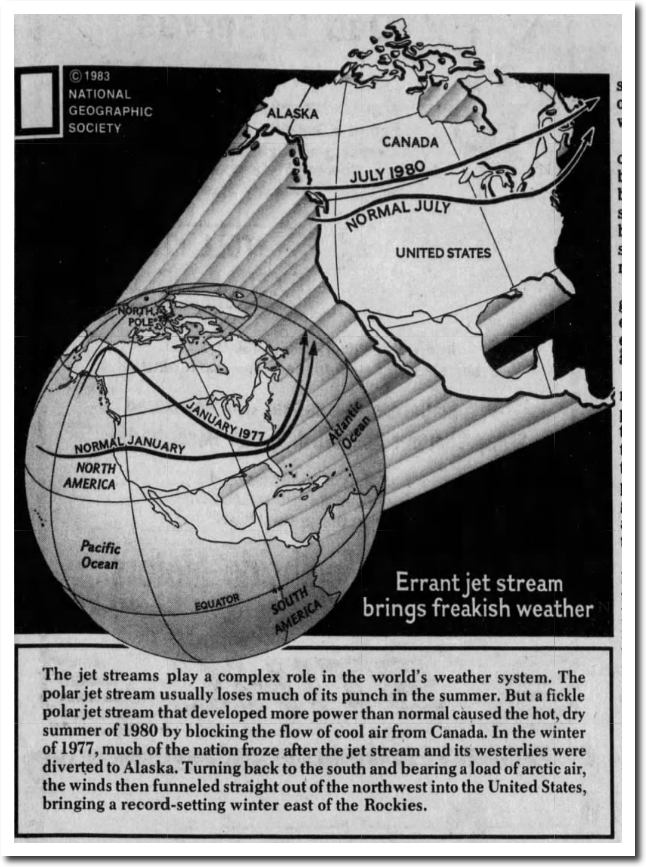
Among the many things that influence weather at any point in time at any spot on earth, the configuration of the jet stream is always interesting. Here's a snip of a 2019 post that uses a famous (in certain circles) map of the jet stream in 1977 to make the point:

....Two wildcards:
1) The current jet stream flow is meridonal (north - south), similar to 1977:

https://realclimatescience.com/wp-content/uploads/2018/10/2018-10-16075733_shadow.png

which was a very cold year in natural gas burning areas of the U.S..

2) There are signs the arctic may be setting up for a Sudden Stratospheric Warming event that would push polar air down to lower latitudes.

The question, should the SSW occur, is does the cold air go to North America or Europe/Eurasia.

The situation and questions are almost exactly the same at this very moment. Here's the current jet stream via netweather:

https://max.nwstatic.co.uk/gfsimages/gfs.20230101/12/00/hgt300.png

Here's netweather's interactive jet stream forecaster
And the Daily Mirror is talking about a Sudden Stratospheric Warming event:

....Exacta Weather forecaster James Madden said: "A Sudden Stratospheric Warming event is now looking even more likely to occur this winter and this could happen as soon as in the next 10 days or so.

"This will mean that the cold air over the Arctic will be given a route to cross our shores."

"If an SSW does set in icy weather could hit Brits around the middle of January.....

"...a route to cross our shores"

"We come from the land of the ice and snow
and the midnight sun where the hot springs flow." 
*****
"On we sweep with threshing oar
Our only goal will be the western shore."

—Page/Plant WX, Ltd.

and with that we turn from weather to business:

....MUCH MORE (thread)

Another Late-December Dispatch From Zoltan Pozsar: "War and Currency Statecraft" December 29

Last week: Zoltan Pozsar, December 27: "War and Commodity Encumbrance"

From Credit Suisse, December 29 (many hyperlinks and emphasis omitted but available at original):

War cuts new financial channels.

What are G7 policymakers, rates traders, and strategists to do when threats to the unipolar world order are coming from every angle. They should definitely not ignore the threats, but they still do. How could they not? For two generations, we did not have to discount geopolitical risks. Since the end of WWII, the only Great Power conflict investors really had to deal with was the Cold War, and since the conclusion of the Cold War, the world enjoyed a unipolar “moment” – the U.S. was the undisputed hegemon, globalization was the economic order, and the U.S. dollar was the currency of choice. But today, geopolitics has reared its ugly head again: for the first time since WWII, there is a formidable challenger to the existing world order, and for the first time in its young history, the U.S. is facing off against an economically equal or, by some measures, superior adversary.

China is proactively writing a new set of rules as it replays the “Great Game” (see here), creating a new type of globalization with new institutions like the Belt and Road Initiative, BRICS+, and the SCO. Global warming is helping Russia add an “artic suspender” (see here) to China’s Belt and Road vision, and China, while under lockdown, forged a special relationship not just with Russia but all of OPEC+ (see here). And as Pippa Malmgren recently noted, commodity-rich Africa is now also a frontier in what I called the quest for “commodity encumbrance”.

One Belt, One Road (and an Artic[sic] Suspender) means...

...One World, Two Systems. Maybe not in these words, but I am sure you have heard these themes before and that you are aware of them. And if you are...

...you should stop pretending that this means nothing for the U.S. dollar or demand for Treasury securities. If the world is going from unipolar to multipolar; if the world is gradually drifting from “one world, one system” (globalization) to “one world, two systems” (friendshoring and Belt and Road); and if the G20 is seemingly splitting into the “G7 + Australia”, “BRICS+”, and “the non-aligned”, it’s impossible that this split won’t affect the international monetary system...

Indeed, “G7 + Australia” is being challenged by the “original” BRICS plus the “+” – Turkey, Saudi Arabia, and Argentina. Recently, the first two of these countries started to apply to become members of BRICS, and the “non-aligned countries” of Indonesia, Mexico, and South Korea matter for different reasons: first, Indonesia wants a “lithium OPEC”, Mexico nationalized lithium mining, and South Korea – snubbed by AUKUS – was “told” to uphold the “Three Nos” policy.

The G20 is becoming the “G7 + Australia” = 8 countries on one side, and “BRICS + new applicants + the thematically aligned” = 11 countries on the other. 8 + 11 = 19. The remaining member, the European Union (EU), is perhaps the most directly affected by this global “split”. Indeed, we’ve come quite a long way from the family photo of the 2017 G20 Summit (see here): Chancellor Merkel, dressed in red and grey, is flanked by BRICS heads of state on both sides – President Jacob Zuma and President Jair Bolsonaro on her right and President Xi Jinping and President Vladimir Putin on her left – strikingly, President Trump and President Macron on the outer edge of the family picture.

Back then, the big deal about the G20 Summit was President Trump’s one hour, off-the-record conversation with President Putin and the seating arrangement at the dinner table (see here), but in retrospect, and in light of this year’s events, the significance of that G20 family photo was those surrounding the chancellor.

Since then, the EU crashed out of Russia’s “gas orbit” but remains in China’s economic orbit, and the BRICS embarked on “BRICSpansion” in other directions:

Argentina and Iran applied already, as did Algeria (see here, here, and here), and as noted above, Saudi Arabia and Turkey are planning to apply, while Egypt – a neighbor of Saudi Arabia across the Gulf of Aqaba and neighbor of MBS’s signature city of NEOM project – is also planning to apply next year (see here).

Based on this list of attendees from the Ministry of Foreign Affairs of the PRC, many attendees of this year’s dialogue of foreign ministers between BRICS and emerging markets and developing countries have either formally applied or are in the process of applying to BRICS+. We have yet to hear from Indonesia, Thailand, Kazakhstan, the UAE, Nigeria, or Senegal (all attendees), but as I noted here, 2023 will be pivotal for BRICS: after a Covid-induced hiatus, China plans to host the third Belt and Road Forum (the “WEF” of the East) in March or April 2023 (see here). I expect formal applications to come in by then.

The map in this article is quite important to “internalize” because it is a map that Zbigniew Brzezinski specifically warned against in his classic foreign policy booklet, The Grand Chessboard. Therein, on page 32 of the first edition, Brzezinski shows a map that shows the world upside down (the Southern Hemisphere atop and the Northern Hemisphere at the bottom), and Brzezinski notes the following:

“how the U.S. manages Eurasia is critical. Eurasia is the globe’s largest continent and is geopolitically axial. A power that dominates Eurasia would control two of the world’s three most advanced and economically productive regions. A mere glance at the map also suggests that control over Eurasia would almost automatically entail Africa’s subordination, rendering the Western Hemisphere and Oceania geopolitically peripheral [to Eurasia]. [...] Eurasia is thus the chessboard on which the struggle for global primacy continues to be played...”

So that’s that: when “BRICSpansion” is understood from the perspective of Brzezinski’s framework, you’ll then have a good idea as to why Great Power conflict matters for your portfolio. Because paraphrasing Sir Halford Mackinder:

“whoever encumbers commodities and controls the factories rules inflation, whoever rules inflation controls interest rates, and whoever controls interest rates controls the level of the stock market and financial wealth more generally”... 

....MUCH MORE (7 page PDF)

HT: Izabella Kaminska at The Blind Spot, who has been known to drop a Brzezinski or two into casual geopolitical conversation.

Whereas I just visited Mackinder a few weeks ago.

"Will Complexity Kill the Circular Economy?"

The concept of a steady-state or no-growth or circular economy is the basis for all the U.N.'s and the WEF's year 2030 plans.

From Real Clear Science, December 28:

The notion of the Circular Economy envisions a world where the waste streams from industrial society replace the raw material inputs that now come from nature. A more down to earth assessment reveals that this belief overstates the prospect of finding unrealized stores of sustainable value in a large majority of contemporary waste streams. Despite moderate successes, efforts to close the recycling loop face fundamental challenges due to embedded social and technical forces that contribute to the growing complexity of material waste streams. As products require more complex material compositions, employ more intricate spatial configurations, and require more digital integration, they get harder to recycle. To achieve success, a functioning Circular Economy must reverse, or finesse, the consequences of a culture that inevitably draws more, more varied, and more processed materials into the economic system. Yet, the continued increases in the quality and variety of products available to consumers makes the extensive recycling on any real grand scale more unlikely.  

Materials recovered after their use in the economy fetch the highest value when they are separated from mixed waste streams, but separation has costs. Separating materials from mixed waste into highly concentrated streams means reversing disorder and creating order. Reversing material disorder can take many forms, for example sorting out steel and copper scrap from demolished buildings, separating PET plastics from municipal solid waste, or removing CO2 from industrial flue gases. Frequently, the initial stages of separation must be followed by the removal of residual contaminants to ensure that the recycled material meets the strict tolerances dictated by the market. Because reversing material disorder will always require energy, the economic sustainability of material recovery depends on the value of the recovered material exceeding the energy (and capital and labor) costs of recovery. In the long run, the market for recovered materials competes with alternatives from natural deposits that can be more uniform and easier to process.  

As newer generations of industrial and consumer products grow in both sophistication and variety, their embedded information value increasingly dominates their material value. Electronic products contain the most embedded information value and have exploded in popularity since the discovery of the transistor in the early 1950s, with billions of devices manufactured and discarded annually by the 2020s. Over this period, products have gotten smaller but have also grown far more complex in material terms. Current electronics from smartphones to laptop computers include a wide variety of highly engineered materials that require extensive global supply chains to manufacture. Recovering the rare metals that play an outsized role in making these products work remains elusive because of the effort involved in isolating these dilute materials and then extracting them. Thus, despite the ubiquity of indium and lanthanum in electronic devices, little to none is recovered from the hundreds of millions of smartphones discarded annually. Also elusive is the recovery of silicon chips from discarded computers and photovoltaic cells, or any capture of the metal dopants that they contain. Even for precious metals, greater precision has allowed producers to reduce the amount used in each device, raising the costs of recovery.  Because the value of the material engineering far surpasses the value of the material, products are designed to meet new performance targets, not to be recycled....

....MUCH MORE

It's not just in materials science and advanced recycling that things get complicated.

From July 2022's "Sri Lanka As A Testing Ground For Some Of The WEF's Ideas": 

Here's an interesting paragraph:

"....Sri Lanka’s situation exposes the true cost of living and the cost of ownership. In a 
performance economy, which encompasses one of the economic principles of a circular 
economy, a smaller number of asset owners will take custodianship of assets to keep 
them in use and provide services to many users based on consumption....."

That's from "How a circular economy could help tackle Sri Lanka's economic crisis", World Economic Forum, July 5, 2022.

Related via Climateer Investing, July 26:
From The World Economic Forum.....
There is a lot going on here and for now I will leave it to interested reader to do the higher level analysis.
3 circular economy approaches to reduce demand for critical metals

Possibly also of interest:
"Complexity and Armageddon, or… the Story of the Hemp Microphone"
The scale of change being contemplated for energy use simply will not allow for the lifestyles people enjoy today. Period. That is the whole point of the post immediately below: "Green economic growth is an article of ‘faith’ devoid of scientific evidence" and anyone telling you different is either a liar or a fool.

And if they deceitfully don't mention the scale of change individuals will face, they are possibly a varlet. And a scoundrel. More than likely a charlatan as well.

The most concise statement of the reality is the abstract of  one of the papers cited in the below essay:

Decoupling environmental ‘bads’ from economic ‘goods’ is a key part of policies such as green growth and circular economy that see economic growth as desirable or necessary, and also see that current use of natural resources and its environmental impacts is unsustainable. We estimate what a ‘successful decoupling’ (2% annual GDP growth and a decline in resource use by 2050 to a level that could be sustainable and compatible with a maximum 2°C global warming) would mean in terms of its type, timeline and size. Compared to 2017, ‘successful’ decoupling has to result in 2.6 times more GDP out of every ton of material use, including in-use material stocks. There are no realistic scenarios for such an increase in resource productivity.

Can't cut back and maintain current ways of being. Not going to happen. The math doesn't work. And it doesn't matter if you understand the math, or not.

To paraphrase an old Russian line: In reality, you don't do math, math do you.

And the energy transition will affect everything. If you think there are a lot of people without skills the market will pay for now, just wait.....MUCH MORE

We've also looked at:

And many, many more.