Monday, December 27, 2021

"EU Weighs Sweeping New Powers to Maintain Supplies During Crises"

From Bloomberg via gCaptain:

The European Union is weighing a broad set of new powers, including possible export controls, that would give it the ability to protect the bloc’s supply chain during periods of crisis. 

The European Commission, the EU’s executive arm, will unveil the proposal as soon as the spring, according to an EU official familiar with the plan.

The new rules will be part of the so-called Single Market Emergency Instrument, a proposal designed to address some of the challenges the EU experienced during the Covid-19 pandemic, when countries struggled to secure vaccines and protective equipment.

The commission will propose new measures to quantify, anticipate and counteract any disruptions to the single market, including on industrial supply chains, said the official, who asked not to be identified because the plans are private. 

Johannes Bahrke, a spokesman for the commission, decline to comment on the details of the proposal. He added that the pandemic “has shown that some of the current rules and tools for the single market are insufficiently adapted to crises and emergencies” and that the new proposal would help to ensure “greater transparency and coordination when a critical situation emerges.” 

Export Controls

“We need structural solutions in place for the next crisis which, whatever its nature, can trigger major shocks in demand or supply that affect our industries and can fragment our single market,” the EU’s internal markets chief, Thierry Breton, wrote in a Dec. 22 letter to his staff seen by Bloomberg.

One of the ideas being discussed would be for the commission to monitor supplies to third countries in periods of distress, replicating the vaccine export control system. Under that program, which expires at the end of the month, companies would need to obtain national and EU authorization before shipping Covid-19 doses outside of the bloc. 

The proposal would also allow the EU to request information from companies on industrial production capacity, inventory and lead time, and in some cases it would facilitate the joint procurement of critical goods, according to the official. 

The rules may also include a bigger role for the commission in reviewing national restrictions on the flow of goods in the single market, to avoid unilateral measures by member states as seen in the early days of the pandemic....

....MUCH MORE

This ain't your grandpa's European Coal and Steel Community  

14 European Agritech Startups

Another article from "FT backed" Sifted:

By 2050, our food system will need to provide for an estimated 9.7bn people. Add to that the threat that climate change poses to our food security, and it’s clear that agriculture needs to adapt, fast.

Despite this urgency, agritech has largely remained a niche focus, with VC investment into European agritech startups at $726m this year. That dwindles in comparison to a sector like healthtech, which brought in $15.5bn this year.

And yet, early successes are stoking investors’ attention. These include the sector’s first unicorn, vertical farming startup Infarm, as well as insect farming startup InnovaFeed, which raised a €140m Series C last year.

With the sector picking up steam, Sifted asked four agritech-focused VCs which startups are on their radar. The only catch: they couldn’t nominate companies from their portfolios.  

Laetitia de Panafieu, investment principal at Astanor Ventures

Belgium-based Astanor Ventures launched its $325m fund last year, Europe’s largest focused on agriculture and food. They support startups in Europe and North America. Portfolio companies include Ynsect, Infarm and Notpla.

Neofarm — France

Neofarm provides “turnkey farms” to partners, which are based on principles of regenerative agriculture to produce local, organic vegetables. The startup takes care of the farms’ installation and maintenance and provides software to manage and partially automate farming processes. CEO and cofounder Alexia is a role model for female entrepreneurship in the agritech sector and part of the Sista association, which promotes female entrepreneurship.

Neoplants — France

Although 90% of our time is spent indoors, indoor air pollution is 5x higher than outdoor air pollution due to volatile organic compounds (VOCs). Neoplants is developing plants that are bioengineered to eliminate air pollution at dramatically increased levels. The duo of founders has a strong technical and business background and an ambitious vision for growth in a category that they are building themselves. We love how the company is finding elegant ways to solve a significant problem via “plants with a purpose”.

FA Bio — UK

Currently, 2.5% of global greenhouse gas emissions can be directly attributed to synthetic fertilisers. FA Bio uses a unique targeted sampling strategy to collect microbial isolates from agricultural fields and investigate their potential to be developed into superior bioproducts. In this way, the startup helps discover microbial biofertilisers and biofungicides that could increase agricultural productivity whilst improving soil health. FA Bio founders Àngela and Kerry are extremely impact-driven, and creatively improve our understanding of the relationships between microbes and plants to contribute to the protection of our natural ecosystems.

EV Biotech — Netherlands

EV Biotech creates microbial cell factories (MCFs) for the industrial production of high-value chemicals and proteins. Using digital modelling, the startup determines ideal genetic changes with the highest compound yield for greater development efficiency. All of this is made possible by an exceptionally interdisciplinary and diverse team with different technical backgrounds working together towards a common goal.

Daniëlla Vellinga, associate director at Rabo Food & Agri Innovation Fund

The Rabo Food & Agri Innovation Fund was launched by Rabobank to invest in food and agriculture startups in Western Europe, Israel and the US from seed to Series B. The fund has invested in startups such as 30MHz, Saga Robotics and InnovoPro.

The companies listed with an * are not portfolio companies of the Rabo Food & Agri Innovation Fund, but have partnerships with the fund through other initiatives including its Carbon Farming initiative and Foodbytes! Pitch 2021 programme.....

....MUCH MORE

Most recently from Sifted: 

"Fashion And The Metaverse: Why Ralph Lauren Wants To Sell You Digital Clothing"

Isn't Ralph passé? I mean in the same way that families that were formerly dressed by Balenciaga or Givenchy would say "Who?" if you mentioned them today. They're still around but the caravan has moved on.

From Forbes, December 25:

In December, Ralph Lauren opened its newest stores, passing over sprawling metropolitan cities like Milan, Tokyo and New York for an enticing new location: the online world of Roblox, with 47 million daily active users. It stocked its virtual stores, open 24/7 and accessible to anyone in the world in just a few clicks, with virtual puffer jackets, checkered beanies and other retro skiwear for the winter season, priced under $5.

It’s just the latest example of how the fashion industry is beginning to delve into the so-called metaverse, with Ralph Lauren, Gucci, Balenciaga and others charging real money for digital-only clothing and accessories. As silly as it may sound, it’s being heralded as a potential new goldmine, with Morgan Stanley predicting that the metaverse could present a $50 billion-plus opportunity for the luxury industry in the next decade.

Here’s a quick guide to get up to speed on what the metaverse is, and why fashion brands are racing to set up shop in it: 

Wait. Remind me what the metaverse is, again?

Frankly, that is still being figured out. But the idea is that it could be the next version of the internet, offering a more immersive and three-dimensional experience. In the metaverse, you have a digital persona called an avatar that can seek out experiences that are similar to what you might do in the real world — you can shop, eat at restaurants and attend concerts. While it has begun to take shape in various online gaming platforms, like Roblox, it remains largely theoretical.

 Is this really a new idea?

Not exactly. People have spent time immersed in online video games for years, and brands got involved there too. Adidas, Armani and Calvin Klein experimented with digital fashion on Second Life, an online virtual world that had some one million members at its peak in 2007. In 2012, Diesel began selling clothing and furniture on The Sims. In 2019, Louis Vuitton developed ‘skins’ — an in-game purchase that changes a player’s appearance— for players in League of Legends....

....MUCH MORE

On the other hand, maybe I should get a storefront, sell some merch. 
"Join the cult, get the handbag half off."

"VC Investment in French Startups Doubles in 2021 to Hit $11.3B Despite Funding Gap Between Regions"

This is the PYMNTS story I was going for when the monstrosity below popped up.

From Pymnts.com, December 27:

Recent data from Dealroom, supported by France’s startup movement La French Tech, has revealed that the combined enterprise value of French startups founded since 2000 was €179 billion in 2021 — up 17.7x since 2010.

With 31 homegrown unicorns — firms with a valuation of over $1 billion — France has also now surpassed Sweden and the Netherlands (24 each) for the number of unicorns created, coming only second to Germany (53).

According to the report, venture capital (VC) investment in French startups doubled in the past year alone, from €5.1 billion ($5.8 billion) to over €10 billion ($11.3 billion) in 2021.

The top three VC funding rounds this year were the $680 million Series B raised by soccer non-fungible token (NTF) trading platform Sorare, the $555 million Series E by Software-as-a-service (SaaS) firm Mirakl and a $400 million Series D by French neobank Qonto.

Overall, 2021 was a record year for megarounds — fundraising of at least $200 million — in France, with 11 out of the 15 rounds since 2016 taking place this year alone.

Commenting on the achievement, Clara Chappaz, director of La French Tech, said the country is “finally attracting the means to match its ambitions,” with foreign investors at the source of the most of those funds....

....MUCH MORE

China Created an AI ‘Prosecutor’ That Can Charge People with Crimes

From Futurism:

It's been trained to identify Shanghai's eight most common crimes.  

Machine-Learning Justice

In a scenario that’s part “Robocop” and part “Minority Report,” researchers in China have created an AI that can reportedly identify crimes and file charges against criminals. 

The AI was developed and tested by the Shanghai Pudong People’s Procratorate, the country’s largest district public prosecution office, South China Morning Post reports. It can file a charge with more than 97 percent accuracy based on a description of a suspected criminal case.

“The system can replace prosecutors in the decision-making process to a certain extent,” the researchers said in a paper published in Management Review seen by SCMP.  

System 206, Esq.

The team built the machine off of an existing AI tool ominously called System 206. Prosecutors in China were already using the system to help assess evidence and determine whether or not a suspected criminal was dangerous to the public at large....

....MORE

Ummm, Is This A Fraud: "New Smart-contract based Crypto Platform Begins Global Operations"

It seems sort of fraudy.

Via somebody called NewsDirect:

Miami, Florida, United States | December 27, 2021 07:50 AM Eastern Standard Time

BNBXMAS, a smart contract-based Dapp built on the Binance Smart Chain that allows users to invest in cryptocurrencies, on Monday claimed that with deposits in BNBXMAS, users can expect to earn reliable daily returns ranging from 7.8 per cent to 17 per cent daily.

The smart contract allows users to start with as little as 0.01 BNB to get their profits up. Launching this XMAS season, BNBXMAS has been built to get the most out of the Binance Smart Chain without investing excessive amounts of time and resources into it.

"The Binance Smart Chain (BSC) has experienced a surge in its blockchain activity, including token swaps, decentralised applications, non-financial tokens, and decentralised currency markets. One of the most beneficial aspects of the BSC is that it allows for cross-chain atomic exchanges while charging gas prices that are over 20 times cheaper than those charged by other chains," the firm said in a statement.

Because of its Proof-of-stake Authority (PoSA), consensus may be used as a high-speed infrastructure, beneficial for DeFi applications. As a result, it is ideal for widespread adoption. Moreover, BEP-20 tokens provide borderless DeFi prospects because once a token is released on the Binance Smart Chain, it may be readily transferred between several blockchains. It also contributes to the simplification of interoperability across the whole ecosystem.

BNBXMAS is conscientious about the security of the smart contract. It has been confirmed to be completely secure, with no flaws, backdoors, or fraud scripts discovered, as reported by the audit report prepared by Haze Crypto.

With revolutionary growth experienced in similar offerings, BNBXMAS is positioned to become one of the most profitable yield farming Dapps on the BSC. The users can generate a return of 119 to 234 per cent on their money within the deposit period of 7 and 30 days.

To make profits with BNBXMAS a user just needs to visit BNBXMAS.com and familiarise with the UI and FAQs. Select the deposit period that a user wants to use for investment. Enter the amount of BNB to deposit, click 'Invest'.

Following deposit, one will be presented with a referral link to share with others. Forward this to your friends to get a percentage of the money they deposit in the smart contract.

BNBXMAS provides investors with a referral programme that is divided into five categories. This makes up for 11.5 per cent in commission. A referral link is given to the user once they have invested in the smart contract. Users who spread the word about this link to their friends will get extra rewards on each deposit their referrals make.....

....MORE

So, combining the best features of Multi-Level-Marketing with a Ponzi scheme? 

7.8 to 17% per day is higher than the risk free rate of return  as represented by the 30-day U.S. treasury bill's annualized 0.04% yield and mom always said "If you are receiving above the risk-free rate, you are taking on risk somewhere in the investment."

HT, I think: PYMNTS.com.

And, here's a pitch that has been around in various forms for going on a couple thousand years:

"A Thorn from Christ's Crown of Thorns - Now an NFT"

Via the same PYMNTS.com page.

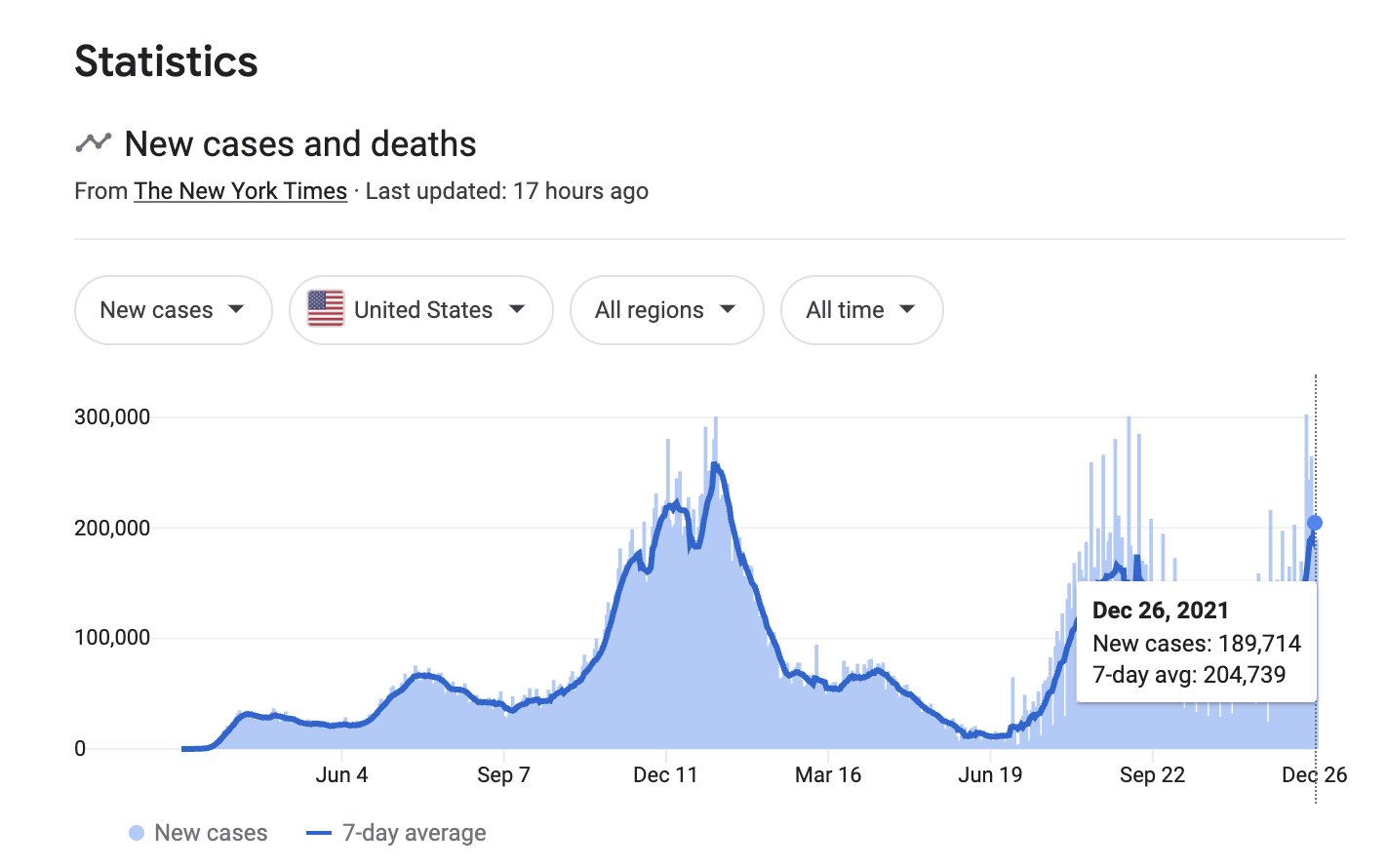
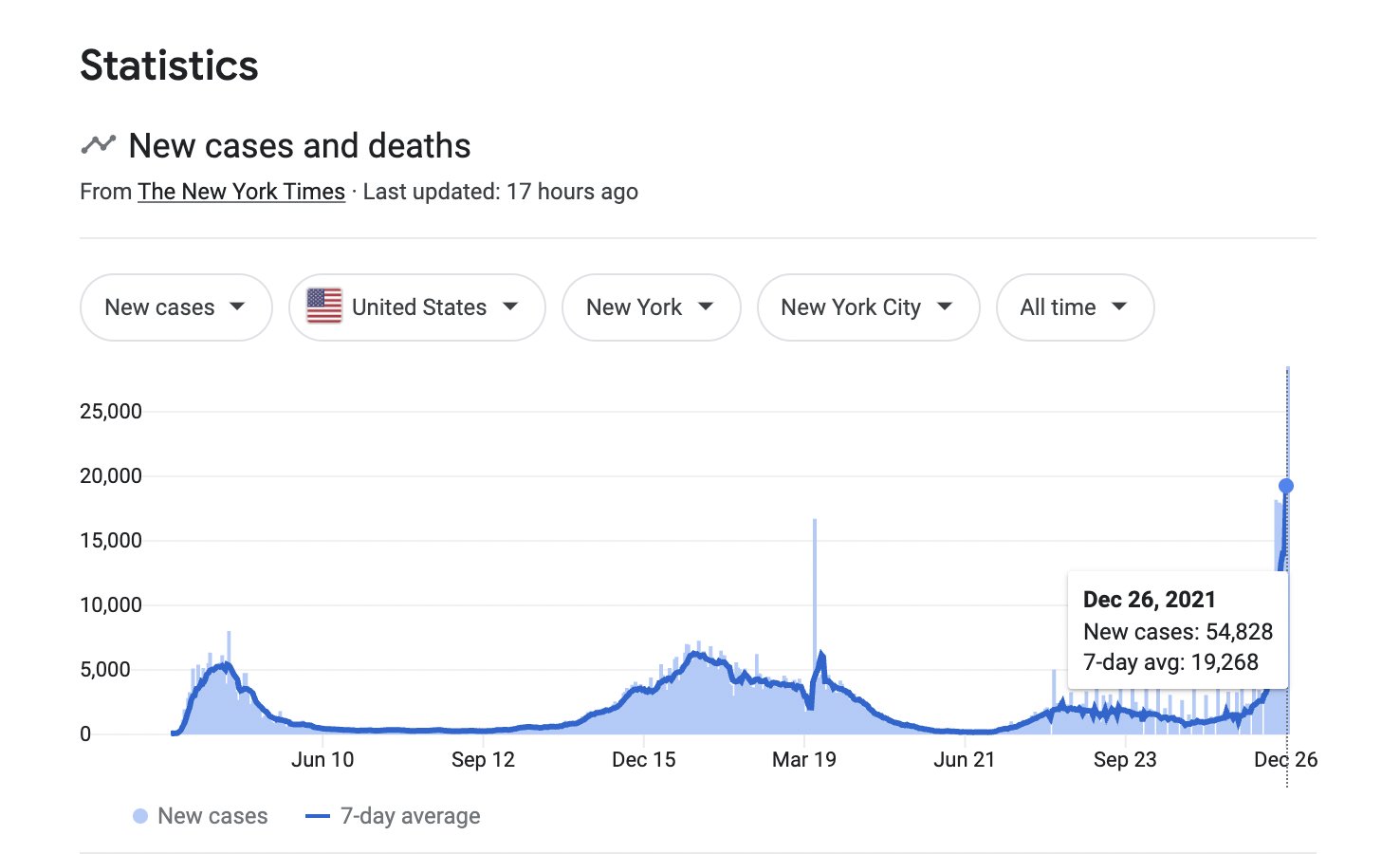
189,714 New Cases Of Covid-19 Were Reported For the U.S. Yesterday, 28.9% Were In New York City

From the New York Times via the New York Post's Karol Markowicz:

Image

Image

One of the commenters wrote, "we are probably looking at two days worth of cases as the day before was Christmas." That doesn't affect the percentages though.

As we asked when all of twitter seemed to be humpin' Cuomo the LuvGov's leg back when he was giving Covid press conferences (he won an Emmy® Award for them, right?): 

"What Is Going On In New York?"

"Autonomous Truck Software Platforms Advance"

 From ElectricalEngineering Times, December 27:

Among my favorite topics is presenting pictorial views of autonomous vehicles (AV) software platforms and their partners, customer and related relationships. I often get update requests, and will therefore begin with the status of autonomous truck platform.

AVs for goods delivery have become a major focus for many software platform developers since the pandemic reordered human activities. Goods AVs include multiple autonomous truck use cases and several last-mile delivery scenarios. I’ll cover only autonomous trucks, excluding last-mile use cases such as sidewalk AVs and Nuro-type dedicated goods AVs.

There are at least four factors in determining the status of autonomous truck platforms—key investors along with truck OEM, trucking and logistics and retailer partners.

The chart below lists nine autonomous truck software platforms for each of the four categories organized as one row of information for each category. In some cases, blocks are empty.

Other AV software platforms are likely to be added to future versions of this chart. For instance, GM Cruise and Argo.ai are planning to enter some goods AV segments, but there is limited data to classify their activities.

https://www.eetimes.com/wp-content/uploads/AV_trucks.png

The AV software platforms are listed first in shades of red with the hardware platform in blue where available.

Key investors mostly include auto and transportation-related companies. Venture capitalists and other investors are also very important, but are not included here. Three AV software companies went public in 2021—Aurora, Embark and TuSimple.....

....MUCH MORE, an absolutely first rate overview

Elon Musk Says Neuralink Will Begin Testing Human Brain Implants In 2022

From Observer—who we used to know for their real estate coverage*, December 7:

Neuralink Aims to Begin Testing Brain Chips in Humans in 2022, Elon Musk Says
Musk is confident the FDA will approve human testing because Neuralink's "standards for implanting the device are higher than what the FDA requires."

In April, Elon Musk’s neurotech startup Neuralink demonstrated a controversial experiment where a macaque monkey with two “Link” devices implanted in his brain was seen playing a simple video game solely with his mind. The same type of brain implant could be experimented in humans as soon as next year, the CEO said.

“We have a chance with Neuralink to restore full-body functionality to someone who has a spinal cord injury,” Musk, who is also the CEO of SpaceX and Tesla, said in a video interview during The Wall Street Journal’s CEO Council Conference on Monday.

Neuralink’s ultimate goal is to create a brain-machine interface where human consciousness and machine intelligence converge into one. But early use cases will focus on helping people with paralysis and other neurological disorders regain control over their lives.

“I think we have a chance—and I emphasize a chance—to be able to allow someone who cannot walk or use their arms to be able to walk again naturally,” Musk said during Monday’s conference, adding, “I don’t want to raise hopes unreasonably, but I’m increasingly convinced that this could be done.”

Reiterating his cautious optimism, he later clarified on Twitter, “I am definitely not saying that we can for sure do this, but I am increasingly confident that it is possible.”

In any case, Neuralink’s first challenge is to get the FDA on board with experimenting with such a device in humans. Confident that regulatory approval won’t be an issue, Musk said Neuralink’s “standards for implanting the device are higher than what the FDA requires.”....

....MUCH MORE

*Observer Media's real estate site is Commercial Observer

On Neuralink, if interested we have on offer "More Than You Might Want To Know About Elon Musk's Neuralink".

And many, many more:
Musk's Mind-Machine Interface, Neuralink, Reports Progress: Monkeys Now Playing Pong
Professor Cowen Has Questions After Watching Monkey Pong
"Elon Musk Says Neuralink Will Stream Music Straight Into Your Brain"

A Deep Dive Into What Elon Musk Is Up To With His Neuralink Company
....MUCH, MUCH MORE
You won't believe how much more
"5 Neuroscience Experts Weigh in on Elon Musk's Mysterious "Neural Lace" Company"
Questions America Wants Answered: Would Elon Musk's Neuralink Solve All of Accounting’s Problems?
"Elon Musk launches Neuralink, a venture to merge the human brain with AI" UPDATED
"Too Funny: Reporting On Elon Musk's New Brain Implant Company, The Nerds at Boy Genius Report..."

In other news...

Related:  
But what about rockets? For the asteroid mining cancer cures? 

Business Opportunities Are Everywhere: "High-Profile L.A. Crimes Spark Rush for Bullet-Proof Cars, Rolex Replicas and Safe Rooms"

From The Hollywood Reporter:

Security agencies say wealthy clients are increasing protective measures: "They want someone who knows how to get them out of any situation."

Private security contractors report that a recent string of high-profile retail robberies and home burglaries in upscale Los Angeles neighborhoods has caused a dramatic uptick in requests for their services and prompted many of their wealthy clients to change their routines out of a mix of caution and fear.

Recent high-profile crimes involving the entertainment community include the Oct. 27 robbery of the Encino home of Real Housewives of Beverly Hills star Dorit Kemsley, resulting in the theft of $1 million in luxury handbags, jewelry, watches and other goods. Actor and former BET host Terrence Jenkins escaped a robbery attempt by a masked crew near his Sherman Oaks home on Nov. 10. Then Hollywood was shaken by the fatal shooting of 81-year-old philanthropist Jacqueline Avant (wife of legendary music exec Clarence Avant and mother-in-law to Netflix’s Ted Sarandos) during an attempted burglary at her Trousdale Estates home on Dec. 1; the perpetrator, recently paroled from state prison, was charged with her murder on Dec. 6.

High-profile heists have also occurred in the Fairfax district, where suspects in police-like uniforms followed victims from a restaurant, and in Hancock Park, where two men robbed a mother with her baby. Armed robbers crashed a holiday party in Pacific Palisades on Dec. 3 to strip revelers of jewelry, iPhones and an Apple watch. On Dec. 7, thieves heisted about $100,000 worth of jewelry and goods from guests held at gunpoint outside the InterContinental Los Angeles Downtown. And on the evening of Dec. 20, a man was arrested for attempting to burglarize a Bel Air mansion.

According to the LAPD, nonviolent property crimes, including burglary and car theft are up slightly (3.7 percent) from last year, and down 5.8 percent from 2019. However, violent crime — a category that includes homicide, robbery and aggravated assault — is up 6.2 percent so far this year and up 4.4 percent compared to 2019. Robbery itself is up 5.2 percent from this time last year, though down 12.7 percent compared to 2019. Homicide is up 13 percent since last year and a dramatic 52.2 percent compared to 2019. In Beverly Hills, total violent crimes are up 25 percent over the past 12 months, according to the city’s police department.

According to agencies who provide private security — as well as others who work with Hollywood’s A-List (including an estate manager, a business manager and a top Beverly Hills real estate agent) — clients are seeing the headlines and taking increased precautions.

“Almost immediately after the Avant shooting, it’s been crazy busy. We have increased operations in that [Trousdale Estates] area tremendously,” says Aaron Jones, president and CEO of Malibu-based International Protective Security, which caters to upscale neighborhoods throughout greater L.A. “I have a lot of regular VIPs; when people call, I get on the phone with them. We understand the urgency of what’s going on. It’s nonstop. People are looking for individual plans and co-op plans, where we provide security to a group of houses in a neighborhood. Business has quadrupled.”

With a majority of clients in Bel Air, Beverly Hills, Pacific Palisades and Brentwood, ACS Security has seen an uptick of “about 50 percent” in calls and special patrol services in the past few weeks, says field marketing manager, Elizabeth Chyr. Many clients of SSA Security Group (which services the Palisades, Holmby Hills, Brentwood, Santa Monica and Westwood) are “asking for extra patrol,” says executive senior vice president Terry Segraves, adding that the rate of new client intake is up significantly — “we already have 12 new clients in December.”

Coldwell Banker real estate agent Joyce Rey tells THR that she has joined with neighbors in her Beverly Hills Post Office neighborhood to hire private patrols. “They drive by my house every few minutes, so I feel quite safe,” she says. “I’ve already received a call from a client stating an interest in gated communities, and I definitely see a trend moving back toward the security of condominium life, which frankly languished during COVID because people have looked for more space and outdoor space.”

Since late August, Rising S Company has completed risk assessments for multiple high-end clients in L.A. and installed 13 safe rooms, nine safe doors, two underground bunker shelters, and two window fortifications in Brentwood Park, Beverly Park and Paradise Cove, says general manager Gary Lynch. This compares to their installation of seven safe rooms in California in the 2.5 years prior.....

....MUCH MORE

In the late 1990's murder, carjackings and murderous carjackings got so bad in  Johannesburg, South Africa that entrepreneurs began offering both passive defenses such as bulletproof glass you could shoot through from one side and more aggressive deterrents like flamethrowers:


From what I understand, both of these automotive aftermarket add-ons surprised those with evil intent.

"Biden Turns to Antitrust Enforcers to Combat Inflation"

A fascinating look at the thinking in the West Wing. Either they, and Senator Warren (and others) truly believe that corporations are at the root of the inflation the country (and to a lesser extent, the world) is experiencing or they don't believe it but have decided to go with the story anyway. Last week's talk about "big grocery" from Senator Warren would point in the latter direction. From her letter to Kroger, Publix, and Albertson's:

"While many Americans faced the loss of jobs, homes, and loved ones during the COVID-19 pandemic, 
grocery companies like yours saw immense gains through record sales and profits," 

Many, many years ago I was counseled not to ever waste a minute analyzing low-margin businesses, and the grocery stores with their ~2% profit margins were the example used. 

So the questions become: Is this blame-shifting? An attempt to jawbone businesses into eating any cost increases from their suppliers, government mandates and employee wage and benefit increases? Is it a soft version of Diocletian's Maximum Price Edict? So many questions.

From the New York Times via MSN:

WASHINGTON — As rising inflation threatens his presidency, President Biden is turning to the federal government’s antitrust authorities to try to tame red-hot price increases that his administration believes are partly driven by a lack of corporate competition.

Mr. Biden has prodded the Agriculture Department to investigate large meatpackers that control a significant share of poultry and pork markets, accusing them of raising prices, underpaying farmers — and tripling their profit margins during the pandemic. As gas prices surged, he publicly encouraged the Federal Trade Commission to investigate accusations that large oil companies had artificially inflated prices, behavior that the administration says continued even after global oil prices began to fall in recent weeks.

The push has extended to little-known agencies, like the Federal Maritime Commission, which the president has urged to search for price gouging by large shipping companies at the heart of the supply chain.

The turn to antitrust levers stems from Mr. Biden’s belief that rising levels of corporate concentration in the U.S. economy have empowered a few large players in each industry to raise prices higher than a more competitive market would allow.

Corporate culpability for rising prices remains unclear. Inflation is at a 40-year high because of pandemic-related factors such as broken supply chains and high demand for goods from consumers still flush with government-provided cash. But as the price increases have spread across sectors, including food and gasoline, the administration has come under increasing pressure to find ways to respond.

White House officials concede that their antitrust moves are unlikely to reduce costs for U.S. businesses or consumers immediately. The efforts, they say, will be more effective down the road. But the rise of inflation has given the White House an opportunity to take action that Democrats have long encouraged, and that Mr. Biden made an early focus of his tenure: using the power of government to break up monopolies and promote economic competition.

In July, before the recent run-up in prices, Mr. Biden issued an executive order that included 72 directives for cabinet and independent agencies to more vigorously enforce antitrust laws and to pursue specific actions to promote competition, such as eliminating noncompete agreements for workers and forcing tech companies like Apple to allow consumers to repair their own products.

He has also tapped antitrust crusaders for key roles, including Lina Khan to be chairwoman of the Federal Trade Commission, and Jonathan Kanter, an adversary of Facebook and Google, to lead the antitrust division of the Justice Department. Tim Wu, a proponent of breaking up Facebook and other large companies, was brought on as a special White House adviser to Mr. Biden on competition issues.

White House officials say fighting inflation was not the initial motivation for Mr. Biden’s competition agenda. But, they say, the push has given the president some of his most powerful tools to take action against rising prices, and it will play a central role in federal efforts to reduce costs for consumers over the long term.

That role could grow even more prominent if Democrats lose control of the House or Senate in next year’s midterm elections and Mr. Biden is forced to rely on executive actions to advance his economic agenda.

The administration’s focus on increasing competition “will spawn more innovation, more disruption, more start-up businesses in the U.S.,” said Brian Deese, who heads the White House’s National Economic Council. And, he added, it “will deliver lower prices for Americans right away.”

The president’s efforts to promote competition and potentially break up large players have rattled big companies and angered prominent industry groups in Washington, at a time when businesses are already grappling with supply chain problems, higher input costs and labor shortages.

The U.S. Chamber of Commerce has accused the Biden administration of interfering with the work of independent agencies even as it threatened litigation against the Federal Trade Commission, an independent consumer protection agency.

Neil Bradley, the executive vice president and chief policy officer for the chamber, said in an interview that the measures would do little to blunt inflation.

“It’s a fundamental misunderstanding of inflation and frankly a poorly dressed-up political argument,” Mr. Bradley said, adding that inflation had been very low in the last decade during a period of corporate consolidation. “Did they get soft concentration all of a sudden and in nine months it produced rampant inflation? Of course not.”....

....MUCH MORE

The simplest explanation for the price increases we have seen is the fact that the lockdowns smashed both supply and supply lines at the same time stimulus was shoveled into the hands of the populace and political cronies, including incentivizing and making whole - Federalizing the costs - those states and municipalities, school districts etc. that went with the most draconian lockdowns. 

More money chasing fewer goods and services is, well, you know.

If interested here is an English translation of the Edict on Maximum Prices.

TL;dr: it didn't work.

Sunday, December 26, 2021

"Farmed fish breeding with wild fish is changing the life cycle of wild fish"

This is exactly what you don't want and the reason this blog gets borderline hysterical when discussing farming genetically altered fish.

From PhysOrg, December 23:

A team of researchers from the Norwegian Institute for Nature Research and Rådgivende Biologer, has found that interbreeding between farmed salmon and wild salmon is changing the life cycle of the wild salmon. In their paper published in the journal Science Advances, the group describes their study of scale growth patterns in thousands of salmon taken from rivers in Norway over the years 2010 to 2017. 

In this effort, the researchers looked at the impact of escaped farmed breeding with wild salmon. To that end, they collected and studied scales obtained from 6,900 adult wild Atlantic salmon living in 105 rivers in Norway over a seven-year period. They analyzed each of the sample patterns and compared them with other fish. The researchers also conducted genetic tests on the scales to learn the genetic history of the fish that donated them.

The researchers found that the biggest impact on the came early in life, when they were in the process of adapting themselves to live in saltwater. The researchers found it happened in fish with farmed ancestors earlier than in wild fish with no farmed ancestry. The researchers also found that the salmon with farmed fish backgrounds aged at a faster pace and also returned to rivers earlier to lay their eggs. Taken as a whole, the researchers found that female salmon with farmed ancestors grew to maturity 0.29 years earlier than native wild , and the number for males was 0.43 years.....

....MUCH MORE

And it is accelerated maturation—also known as the egg-to-cash-in-the-bank-cucle—where the loudest proponent of genetically engineered salmon is focusing.

Previously on this point:  

You Know Big Oil and Big Pharma But Are You Familiar With Big Salmon?
AquaBounty’s first commercial harvest of its GE salmon will be this month"
I'm not sure that this is the best way for me to get my omega-3 fatty acids. The genetic engineering was not focused on nutrition but rather on getting our finny friends to grow faster....

Genetically Modified Salmon Producer, AquaBounty to Sell Shares as Losses Deepen
AquaBounty’s Genetically Engineered Salmon is Coming
AquaBounty Is Now Selling Their Indiana-Raised Atlantic Salmon (but not the genetically modified fish, yet)
FrankenFish: "AquaBounty unveils 50,000 tonne target"
Here Come the Frankenfish: GMO Salmon Coming to a Store Near You

They absolutely must not allow these things to get anywhere near ocean salmon (or Great Lakes salmon for that matter).
And though the writer takes a blithely upbeat look at this development, we are posting it for information purposes only....
And in completely unrelated news, from the journal Nature:
Transgenic Aedes aegypti Mosquitoes Transfer Genes into a Natural Population 

Batteries: ...The Race to Build Europe’s Frst Lithium-Iron-Phosphate Battery Gigafactory

 Lithium-Iron, it's all anyone is talking about.

From Sifted (FT backed tech site), Dec 20: 

What Europe’s first LFP gigafactory will mean for the impact sector

In October, electric vehicle company Tesla announced it was switching up the chemistry of its batteries for their standard range models — from nickel-cobalt-aluminium to lithium-iron-phosphate (LFP). It might not seem as dramatic as Elon Musk’s other ideas like ultra-fast trains or (un)breakable windows, but it follows the trend of EV manufacturers moving towards the more affordable, climate-friendly battery option. 

According to one market research company, the LFP batteries market is expected to reach $10.6bn by 2024. The only problem? China gets 70% of the production pie because Europe doesn’t have an LFP battery factory… yet.

In October, Serbian energy company ElevenEs announced it’s building the first LFP gigafactory in Europe, funded in part by EIT InnoEnergy, which is supported by the European Institute of Innovation and Technology (EIT), a body of the EU. 

Why these batteries?

“ElevenEs is Europe’s first LFP gigafactory, which is basically a different chemistry used for lithium-ion batteries compared to most announced gigafactories in Europe,” Nemanja Mikac, ElevenEs’ chief executive tells Sifted, adding that it’s the most used technology in China and is about to come to Europe as well. 

According to Mikac, LFP batteries are more affordable and more sustainable than other solutions because the raw materials used to produce them are more freely available. This, he says, is a major draw to the technology.

“The LFP batteries have no nickel and no cobalt, so they’re very sustainable,” he says. “Therefore they are also more affordable.” 

While they don’t have as long a range as other batteries, Mikac says this is compensated by new “cell-to-pack” designs which increase the energy density....

....MUCH MORE

 The "impact sector"?

Previously:
"Tesla in talks with China's EVE for low-cost battery supply deal -sources" TSLA)
Well I guess Tony Stark Elon Musk is now officially Iron Man.
*****
Back in 2018 we posted "Batteries: Lithium-Iron may be Competitive With Lithium-Cobalt" but with so many technologies that failed to scale-up over the years we are a little bit jaundiced about wasting the reader's time chasing every rabbit that pops up.

However, if this works, Elon may have found the chemistry for the next generation of Powerwalls.

Also from 2018:
"Ten years left to redesign lithium-ion batteries"
This time frame is not too restrictive.
Tesla and their battery partner, Panasonic, have removed a lot of the cobalt (60%) from their battery recipe and are on their way to zero cobalt over the next couple years.

So, more interesting than any time pressure is the potential spur to creativity on the question of alternative chemistries.

From the journal Nature, July 25:...

One more from 2018—apparently a great year for Iron Age types while I kept writing Bronze Age on my checks. ("Dad, what's a check?"):

Twenty Month Payback for Tesla 100-MW Utility Scale Battery Storage System
Elon (and Panasonic) may have just found another multi-billion dollar business.
Going forward the chemistry probably won't be Lithium ion, maybe molten-salt or iron based, but the fact TSLA can now pitch this kind of payback probably heralds the beginnings of lithium rush 3.0, or at least the promotion thereof....

And just so you know how long it can take to go from lab bench to production, this post is from 2008!

Lithium-Ion Batteries for Less

From MIT's Technology Review:
Researchers show a low-cost route to making materials for advanced batteries in electric cars and hybrids.

A new way to make advanced lithium-ion battery materials addresses one of their chief remaining problems: cost. Arumugam Manthiram, a professor of materials engineering at the University of Texas at Austin, has demonstrated that a microwave-based method for making lithium iron phosphate takes less time and uses lower temperatures than conventional methods, which could translate into lower costs.

Lithium iron phosphate is an alternative to the lithium cobalt oxide used in most lithium-ion batteries in laptop computers . It promises to be much cheaper because it uses iron rather than the much more expensive metal cobalt. Although it stores less energy than some other lithium-ion materials, lithium iron phosphate is safer and can be made in ways that allow the material to deliver large bursts of power, properties that make it particularly useful in hybrid vehicles.

ndeed, lithium iron phosphate has become one of the hottest new battery materials. For example, A123 Systems, a startup based in Watertown, MA, that has developed one form of the material, has raised more than $148 million and commercialized batteries for rechargeable power tools that can outperform conventional plug-in tools....MORE

Maersk Goes Big On Warehouses: Buy's Li & Fung's Logistics Unit For $3.6B

A deep dive from SupplyChainDive, December 22:

The deal will grow Maersk's global warehouse footprint to more than 100 million square feet.

A.P. Moller - Maersk made one of its biggest deals to date on Wednesday with a $3.6 billion purchase of Li & Fung's Asia-Pacific logistics subsidiary, LF Logistics.

The all-cash deal comes with its usual bells and whistles. Maersk will purchase a 100% stake in LF Logistics, taking control of the Hong Kong-based company's in-country logistics and global freight management business units. The deal is expected to close in 2022, pending regulatory approvals.

But it also comes with a twist: After the deal closes, Li & Fung plans to acquire the global freight management unit back, in order to retain and grow it on its own terms.

Both Maersk and Li & Fung aim to be leaders in the end-to-end supply chain management space. But they have different capabilities, a fact which the two companies leaned into to make a deal work. In addition to the acquisition of LF Logistics, the two companies signed a "long-term strategic partnership" to work together on supply chain services for customers.

"With Li & Fung’s upstream digital and sourcing expertise and Maersk’s downstream logistics capabilities, we will begin to offer our respective customers the opportunity to take advantage of this unique end-to-end value chain proposition anchored upon operations excellence, technology, and sustainability," Spencer Fung, group executive chairman of Li & Fung, said in a statement.

For Li & Fung, it was more of a cash-rich divestment. The deal allows the company to shed logistics assets to grow its freight management and supply chain finance portfolio.

But for Maersk, documents disclosed to investors show it's a growth milestone that caps a year of acquisitions....

....MUCH MORE

Recently:
Big Money Still Buying Warehouse Assets: Canada Pension Plan Investment Board Enters Into $1.1 Billion J.V.
Logistics/Shipping: "Shipping giant MSC offers to buy Africa unit of Bolloré Logistics"

Kai-Fu Lee on Artificial Intelligence: "Why Computers Don’t Need to Match Human Intelligence"

In May 2018 we thumbnailed Mr. Lee as "Sometimes the competition is just plain intimidating/scary/resistance-is-futile, smart."

Followed by his mini-bio from Edge.org:
"KAI-FU LEE, the founder of the Beijing-based Sinovation Ventures, is ranked #1 in technology in China by Forbes. Educated as a computer scientist at Columbia and Carnegie Mellon, his distinguished career includes working as a research scientist at Apple; Vice President of the Web Products Division at Silicon Graphics; Corporate Vice President at Microsoft and founder of Microsoft Research Asia in Beijing, one of the world’s top research labs; and then Google Corporate President and President of Google Greater China. As an Internet celebrity, he has fifty million+ followers on the Chinese micro-blogging website Weibo. As an author, among his seven bestsellers in the Chinese language, two have sold more than one million copies each. His first book in English is AI Superpowers: China, Silicon Valley, and the New World Order (forthcoming, September)

And here he is at Wired, December 16:

With continuing advances in machine learning, it makes less and less sense to compare AI to the human mind.

Speech and language are central to human intelligence, communication, and cognitive processes. Understanding natural language is often viewed as the greatest AI challenge—one that, if solved, could take machines much closer to human intelligence. 

In 2019, Microsoft and Alibaba announced that they had built enhancements to a Google technology that beat humans in a natural language processing (NLP) task called reading comprehension.  This news was somewhat obscure, but I considered this a major breakthrough because I remembered what had happened four years earlier.

In 2015, researchers from Microsoft and Google developed systems based on Geoff Hinton’s and Yann Lecun’s inventions that beat humans in image recognition.  I predicted at the time that computer vision applications would blossom, and my firm made investments in about a dozen companies building computer-vision applications or products. Today, these products are being deployed in retail, manufacturing, logistics, health care, and transportation. Those investments are now worth over $20 billion.

So in 2019, when I saw the same eclipse of human capabilities in NLP, I anticipated that NLP algorithms would give rise to incredibly accurate speech recognition and machine translation, that will one day power a “universal translator” as depicted in Star Trek.  NLP will also enable brand-new applications, such as a precise question-answering search engine (Larry Page’s grand vision for Google) and targeted content synthesis (making today’s targeted advertising child’s play).  These could be used in financial, health care, marketing, and consumer applications. Since then, we’ve been busy investing in NLP companies. I believe we may see a greater impact from NLP than computer vision.

What is the nature of this NLP breakthrough?  It’s a technology called self-supervised learning.  Prior NLP algorithms required gathering data and painstaking tuning for each domain (like Amazon Alexa, or a customer service chatbot for a bank), which is costly and error-prone. But self-supervised training works on essentially all the data in the world, creating a giant model that may have up to several trillion parameters.  

This giant model is trained without human supervision—an AI “self-trains” by figuring out the structure of the language all by itself. Then, when you have some data for a particular domain, you can fine-tune the giant model to that domain and use it for things like machine translation, question answering, and natural dialog. The fine-tuning will selectively take parts of the giant model, and it requires very little adjustment.  This is somewhat akin to how humans first learn a language and then, on that basis, learn specific knowledge or courses. ...

....MUCH MORE

Today's introduction was used in AI VC: "We Are Here To Create" and then in "If You Read Only One Column On Artificial Intelligence This Month...".

If interested see also:

"China's rapid advances in artificial intelligence"
AI: "Kai-Fu Lee"

The Hallelujah Chorus In Japan (plus, How Handel Played the Markets)

First up, Do-it-yourself 'Messiah's' are performed around the world. 
And often result in some horrible sounds.

Not always though.
Here's a do-it-yourself version of the big Chorus done at a small college in Japan.
Sensei Jiro Tomonaga, music director, conducting first the choir and then the audience and orchestra:


And some of our previous posts on Handel the investor.

From the Bank of England's Bank Underground blog:

Handel and the Bank of England

Ellen T. Harris

This guest post is the third of an occasional series of guest posts by external researchers who have used the Bank of England’s archives for their work on subjects outside traditional central banking topics. 
George Frideric Handel was a master musician — an internationally renowned composer, virtuoso performer, and music director of London’s Royal Academy of Music, one of Europe’s most prestigious opera houses. For musicologists, studying his life and works typically means engaging with his compositional manuscripts at The British Library, as well as the documents, letters, and newspapers that describe his interaction with royalty, relationships to others, and contemporary reaction to his music. But when I began to explore Handel’s personal accounts at the Bank of England twenty years ago, I was often asked why. For me the answer was always ‘follow the money’. Handel’s financial records provide a unique window on his career, musical environments, income, and even his health.

His early career
Inculcated with business savvy by his father (a courtier, barber surgeon, and wine dealer), Handel had already made a name for himself in Germany and Italy when he arrived in London in 1710. Earlier that year, at the age of twenty-five, he had been appointed Master of Music at the court of Hanover, but he was given leave to reside for long periods in England. A blip in his employment relating to Hanoverian displeasure with the Peace of Utrecht in 1713, and Handel’s celebration of it in the Utrecht Te Deum and Jubilate, allowed the composer to slip into the service of Queen Anne. She provided him with an annual pension of £200 (£25,000 at today’s prices), a handsome benefit George I immediately continued following the Hanoverian Succession.

The bursting of the South Sea Bubble
By at least mid-1715, Handel had the wherewithal to purchase £500 of South Sea Company shares, as we know from a note signed by him and dated 13 March 1715/16 that asks his dividend, being ‘Fifteen pounds on Five Hundred pounds, which is all my Stock in the South Sea Company books & for half a Year due at Christmas last’ (that is, Christmas 1715), be paid to a Mr Phillip Cooke’ (see Documents 1: 334). Thereafter the shares climbed sharply in value, before crashing in 1720 in one of the famous bubble episodes in financial history – the South Sea Bubble. Three years later, in a final resolution of the crisis, South Sea shareholders saw their accounts split 50/50 between equity shares in the company and annuity stock held by the Bank of England....
....MUCH MORE

The writer, MIT Professor Emeritus Ellen Harris is the authority on Handel's financial doings. Way back on December 23, 2012 we posted "Hallelujah!: How Handel Orchestrated a Classic Financial Portfolio" :

Transcript
....F.M. SCHERER: And the composers competed as freelances to have their -- compositions chosen to be operas.

PAUL SOLMAN: Handel, on royal retainer in London, jumped into the game, according to MIT musicologist Ellen Harris.

ELLEN HARRIS, MIT: His first opera is "Rinaldo," 1711, and it was a huge hit. He probably would have gotten a flat fee for writing the opera. And that probably was about 200 pounds. And he would have had a benefit night, so he could take the box office from that one night, could have brought in 500, 600 pounds....
Professor Harris wrote the definitive paper on Handel's finances, Handel the Investor, definitive that is until a BBC reporter made a startling find:
A chance discovery in a ledger at the Bank of England suggests the composer Handel may have been a smart financial operator.
How Handel played the markets.... 
Professor Harris came back with the new definitive paper:
Courting Gentility: Handel at the Bank of England
(23 page PDF)
And since then it's been a Holiday tradition:

Hallelujah: How Handel played the markets
Hallelujah: "Why Handel Never Went Baroque"
"Musicnomics Part II: Decline and Fall"

Media: "The inside story of backstabbing, feuds and intrigue at the Daily Mail"

From Prospect Magazine, December 9:

Jane Martinson investigates why Geordie Grieg was sacked—and why Boris Johnson will be mightily relieved

Since this article went to press, one of the main characters in the story, Martin Clarke, has announced that he is quitting his post as editor of MailOnline. In a statement on 3rd December, Clarke said he was leaving “to pursue new challenges” but will “remain available to the company until the end of 2022.”

When Jonathan Harmsworth, fourth Viscount Rothermere and hereditary newspaper proprietor, called Geordie Greig to his sixth-floor office  in mid-November, a month before the company’s planned 125th birthday party, few people knew what was coming, least of all the editor of the Daily Mail. After a meeting described as “brusque,” the man who had turned the Mail into Britain’s bestselling title, and won three newspaper of the year awards during his three years in charge, was ousted. 

When Rothermere announced the defenestration in an email to staff at 5.35pm the next day, the shock was audible. Greig—a favourite among many, from the lowliest trainee to the proprietor’s wife—had been appointed as the Mail’s third editor in 47 years in 2018. And now he had days to clear his desk. One seasoned Mail staffer called the decision “uncharacteristically brutal,” while another said the reaction as journalists opened his lordship’s email was “lots of people whispering ‘Fuck!’—nobody seems to have known.” 

Yet Paul Dacre, Greig’s predecessor, was almost certainly on the inside track. On the day Greig was sacked, Dacre was not only seen in Northcliffe House, the South Kensington base of the Mail, but later “grinning from ear to ear” at a book launch for Conservative peer Michael Ashcroft. According to one source, he was overheard saying: “the Lord works in mysterious ways.” It was unclear if he meant Rothermere or a higher deity.

There was more mystery to come. Just weeks before, Dacre had reportedly vacated his office along with a largely honorific role chairing the  Mail’s parent company, and had apparently lost his chauffeur. Some saw this as clearing potential conflicts of interest in the path of his (doomed, as it turned out) bid to become the next chair of media regulator Ofcom. Greig’s departure left Dacre’s protégés fully in the ascendent—Mail on Sunday editor Ted Verity became the new head of a seven-day print operation and MailOnline’s Martin Clarke was effectively put in charge of the digital future. Then another marmalade-dropping email arrived: Dacre was to be reinstated as editor-in-chief of DMG Media, advising not only Rothermere but the two editors on the challenges ahead. 

Just two working days after Greig left the building for the final time, Dacre, who is now 73 and who infamously has his emails printed out, was to be found in his office taking calls into the evening. 

In hindsight, there had been signs: not only Dacre’s jolly presence in the building but the fact Clarke’s right-hand man at MailOnline, Rich Caccappolo, had been appointed chief executive of the publishing company on the day that Greig was called into Rothermere’s office. 

Few inside the building, perhaps mindful of the expected job cuts, would comment publicly. But privately, many expressed confusion. One insider said: “You need a degree in Kremlinology to work out what’s going on.” Another messaged to say: “The newsroom mood is at an all-time low. Everyone feels last three years were just a wonderful dream and now it’s cold morning… No one understands.”

With most media companies, a reshuffle at the top would be the bread-and-butter stuff of trade magazines and nothing more. The Mail is different. For a sign of its influence, look no further than the shockwaves in Downing Street when Greig’s front page on 4th November boomed: “SHAMELESS MPs SINK BACK INTO SLEAZE.”  That same day two other Tory papers, the Daily Telegraph and Daily Express, put a positive spin on the Owen Paterson story and splashed on vaccines for NHS staff and Christmas respectively. Within hours of the Mail hitting the streets, Johnson knew his bid to back the disgraced Paterson was scuppered. 

So the news that Greig had been unceremoniously dumped will not have displeased a struggling prime minister. The so-called legacy press still has the power to set the political mood—and none, in recent years, more so than the dominant mid-market title that strained every sinew to shove Brexit over the line.  

But Mail underlings could be forgiven their confusion over the sudden decapitation of a popular editor. It had been widely reported that Rothermere and his wife, Claudia, had been increasingly unhappy with the stridency of late Dacre. The appointment of the socially smoother Greig—a centrist Remainer—seemed to signal a wish for the Mail to play a less pungent role in British political life.

Why the change of heart? With most publicly listed companies, the boss would have to offer up some public comments, but Rothermere—who is in the middle of trying to take DMG into private ownership—maintains a de haut en bas disinclination to explain himself. If we exclude Lord Lebedev of Hampton and Siberia, Rothermere is the last in a tradition of press barons who wield power through print....

....MUCH MORE

Prospect did have to add a correction after publication:

Correction: This essay originally stated that Geordie Greig and Martin Clarke went shooting on the Duke of Northumberland’s estate. While they did go shooting with the Duke of Northumberland, it was not on his land. The piece has been amended accordingly.

"The Peculiar Economics of 3D Printing"

During the Great 3D Fascination of 2012 - 2013 it became apparent very quickly that the then highest use of the additive manufacturing concept was metalworking, Which led to the Swedish company Arcam which led to a nice investment. Some links below.

From Quillette:

Klaus Schwab, the executive director and founder of the World Economic Forum, forecasts that, as part of the Fourth Industrial Revolution, smart manufacturing will converge with synthetic biology and AI to have a transformational impact on the economy and our daily lives. Smart manufacturing is a form of advanced industrial manufacturing that integrates innovative technologies such as 3D printing, robotics, and the Internet of Things (IoT) to provide data analytics in real time.

In traditional manufacturing, large corporations and conglomerates rely on expensive production equipment to mass-produce standardized parts and products—a business model that typically utilizes offshore production and extensive supply chains. Traditional manufacturing systems have high fixed costs and low variable costs, but mass-production enables economies of scale. Although robotics and data analytics are used more frequently today in manufacturing to increase efficiency, despite all of the hype surrounding 3D printing it has yet to replace traditional manufacturing.

The role of smart manufacturing and 3D printing in future economies and wider societies could evolve in a number of possible ways. Will smart manufacturing become disruptive? Or will another type of smart factory prevail?

3D printing and the maker movement

3D printing is the process by which a three-dimensional solid object is made from a digital file. In fabrication laboratories (fablabs), do-it-yourself individuals and small independent companies use software such as CAD-CAM to print 3D customized products. Computer-aided design (CAD) assists with product design and documents the design process through creation, modification, and optimization, while computer-aided manufacturing (CAM) is the computer-controlled machinery that automates the manufacturing process.

Fablabs are already springing up across the US. In my hometown of Durham, NC, the city library system has leased several spaces to sell used books and hold maker classes. At Duke University, fablabs are strategically placed around campus to enable students to make their own products. The medical school even has a 3D printer capable of using three different materials to produce human body parts that medical students can use for training during cadaver shortages.

This trend has gained international momentum, too. According to Sherry Lassiter, who runs the Fab Foundation at MIT, since 2003, the number of fablabs globally has doubled every year-and-a-half in line with Moore’s Law—the principle that computers will double their speed and capacity every couple of years. Neil Gershenfeld of MIT argues that the next big step within the maker movement will be self-assembly based on biological processes.

3D printing is referred to as “additive manufacturing” because it applies successive layers of material to form a predesigned shape. Traditional manufacturing, on the other hand, uses a subtractive process which involves cutting materials away from a solid block. Using recycled materials and creating less waste, 3D printing is perceived as more sustainable, but that is somewhat misleading—depending on the product, 3D printing does produce waste materials that require disposal or recycling.

On-demand printing offers businesses numerous advantages. It prevents the build-up of unwanted inventory and the cost of storage in warehouses, and custom orders can eliminate the middleman and reduce shipping costs and energy consumption. Designers also have a higher degree of creative flexibility and can accommodate last minute modifications, and in economies of scope, printing on-demand can build value because its range of products can be more flexible.

But while the maker movement fills a niche for customized products, it is not a solution for all business models. Fablabs and 3D printing shops are only able to produce items in small quantities and are not able to compete with faster and more efficient mass production. 

3D printing and smart manufacturing

In 2010, China surpassed the United States as the largest manufacturing country. But neither China nor the United States is currently leading the way in advanced manufacturing. According to a 2012 report by the US National Science and Technology Council, the top three countries were Germany, South Korea, and Japan, which all maintain intensive R&D manufacturing sectors and positive trade balances. The United States is fourth, followed by the United Kingdom, Canada, and Australia.

In 2012, Germany began its own smart manufacturing initiative referred to as Industry 4.0. Built on the past three industrial revolutions, Industry 4.0 utilizes cyberphysical systems to create physical objects from digital technologies such as 3D printing, data analytics, and robotics. Germany’s success is attributed to former Chancellor Angela Merkel’s full support for Industry 4.0 applications and the hundreds of German companies—especially those in the automotive industry—which have invested billions of dollars in R&D.....

....MUCH MORE

Although we've seen thing like 3D printed meat, most of the things that early adopters were doing created what were basically junk. On the other hand: 

Swedish 3D Printer Arcam AB: Small Company with Big Growth Projections (AMAVF) 

What's Moving: 3D Printer Arcam AB Up 10.72% (AMAVF) 

Another Use for 3D Printing: Building A Beak for a Bald Eagle

Because the technology is only now ramping up (after a twenty year gestation) the results are still a bit crude.
As advances are made in sintering there will eventually be stuff made, not prototypes but actual stuff, from steel or copper or...

Two European companies — EOS of Germany and Arcam of Sweden are ahead of the pack in the metalworking part of the biz....
Despite my concern about the share price the company itself is a little gem, one of the leaders in 3D metalworking as opposed to the plastic tchotchkes that you get out of a MakerBot.
And not just any kind of metalworking either, this is bleeding edge....
 

And on what Quillette quotes as 'pan-industrials':

Richard D’Aveni, a business strategist at Dartmouth’s Tuck School of Business, argues that new platforms built around additive manufacturing—“pan-industrials” with new ways to create value—will eventually dominate the global economy because they can provide the advantages of both traditional manufacturing and 3D printing—economies of scale and scope....

The talk in 2013 was that Bezos would be there when the time was ripe: 

Amazon Will Seize 3D Printing (AMZN)

And when Credit Suisse picked up coverage on the group in September 2013 our thoughts were:

...CS sounds like a religious convert or a reformed smoker.
They go on to say that the most rapid expansion will come from personal use but the folks who are serious about making money have moved far beyond that technology and are working on bioprinting. CS can keep the at-home stuff, I wish 'em all the best.
I've mentioned that I first passed on Stratasys in the '90's at a couple bucks, it closed at $99.49 on Friday.
These are wonderful businesses but for now they have a lot of work to do to grow into their stock prices.
We have quite a few posts on the industry and the companies, here's the Google search of the blog:
https://www.google.com/search?q=site%3Aclimateerinvest.blogspot.com+3d
The list of posts is pretty eclectic, for example:
 UPDATED-- Dita Von Teese Models 'World First' Articulated 3D Printed Dress Based On Fibonacci Sequence
From HuffPo UK:

Dita Von Teese has unveiled the world's first fully articulated dress produced with a 3D printer.
The gown was designed by Michael Schmidt and Francis Bitonti and revealed at the the Ace Hotel in New York.

Created with the help of Shapeways, a company which lets designers sell objects which are printed on demand with industrial-scale 3D printers, the dress is based on the Fibonacci sequence of numbers.
Shapeways said:

"The gown was assembled from 17 pieces, dyed black, lacquered and adorned with over 13,000 Swarovski crystals to create a sensual flowing form."...MORE
DVICE is reporting:
Contrary to other reports, this 3D-printed dress is not the first of its kind. (Freedom of Creation made one back in 2006.) However, it is the first one to be designed on an iPad and sport over 13,000 Swarovski crystals.* It's also specifically made for Burlesque dancer Dita Von Teese, meaning it won't fit your body no matter how hard you try to squeeze into it....MORE
I'm betting it is the first 3D printed dress based on the Fibonacci sequence.
There is a very large opportunity for a smart engineer (or dress designer) to take on the standalone players, as I said in a prior Arcam post:
This is the kind of thing a guy wishes he had taken private.