Wednesday, February 27, 2019

China's Plan For Global Media Dominance

That was the original headline for this December 2018 piece at The Guardian.
https://www.theguardian.com/news/2018/dec/07/china-plan-for-global-media-dominance-propaganda-xi-jinping
Now known as "Inside China's audacious global propaganda campaign":
Beijing is buying up media outlets and training scores of foreign journalists to ‘tell China’s story well’ – as part of a worldwide propaganda campaign of astonishing scope and ambition. 

As they sifted through resumes, the team recruiting for the new London hub of China’s state-run broadcaster had an enviable problem: far, far too many candidates. Almost 6,000 people were applying for just 90 jobs “reporting the news from a Chinese perspective”. Even the simple task of reading through the heap of applications would take almost two months.

For western journalists, demoralised by endless budget cuts, China Global Television Network presents an enticing prospect, offering competitive salaries to work in state-of-the-art purpose-built studios in Chiswick, west London. CGTN – as the international arm of China Central Television (CCTV) was rebranded in 2016 – is the most high-profile component of China’s rapid media expansion across the world, whose goal, in the words of President Xi Jinping, is to “tell China’s story well”. In practice, telling China’s story well looks a lot like serving the ideological aims of the state.

For decades, Beijing’s approach to shaping its image has been defensive, reactive and largely aimed at a domestic audience. The most visible manifestation of these efforts was the literal disappearance of content inside China: foreign magazines with pages ripped out, or the BBC news flickering to black when it aired stories on sensitive issues such as Tibet, Taiwan or the Tiananmen killings of 1989. Beijing’s crude tools were domestic censorship, official complaints to news organisations’ headquarters and expelling correspondents from China.

But over the past decade or so, China has rolled out a more sophisticated and assertive strategy, which is increasingly aimed at international audiences. China is trying to reshape the global information environment with massive infusions of money – funding paid-for advertorials, sponsored journalistic coverage and heavily massaged positive messages from boosters. While within China the press is increasingly tightly controlled, abroad Beijing has sought to exploit the vulnerabilities of the free press to its advantage.

In its simplest form, this involves paying for Chinese propaganda supplements to appear in dozens of respected international publications such as the Washington Post. The strategy can also take more insidious forms, such as planting content from the state-run radio station, China Radio International (CRI), on to the airwaves of ostensibly independent broadcasters across the world, from Australia to Turkey.
Meanwhile, in the US, lobbyists paid by Chinese-backed institutions are cultivating vocal supporters known as “third-party spokespeople” to deliver Beijing’s message, and working to sway popular perceptions of Chinese rule in Tibet. China is also wooing journalists from around the world with all-expenses-paid tours and, perhaps most ambitiously of all, free graduate degrees in communication, training scores of foreign reporters each year to “tell China’s story well”.

Since 2003, when revisions were made to an official document outlining the political goals of the People’s Liberation Army, so-called “media warfare” has been an explicit part of Beijing’s military strategy. The aim is to influence public opinion overseas in order to nudge foreign governments into making policies favourable towards China’s Communist party. “Their view of national security involves pre-emption in the world of ideas,” says former CIA analyst Peter Mattis, who is now a fellow in the China programme at the Jamestown Foundation, a security-focused Washington thinktank. “The whole point of pushing that kind of propaganda out is to preclude or preempt decisions that would go against the People’s Republic of China.”

Sometimes this involves traditional censorship: intimidating those with dissenting opinions, cracking down on platforms that might carry them, or simply acquiring those outlets. Beijing has also been patiently increasing its control over the global digital infrastructure through private Chinese companies, which are dominating the switchover from analogue to digital television in parts of Africa, launching television satellites and building networks of fibre-optic cables and data centres – a “digital silk road” – to carry information around the world. In this way, Beijing is increasing its grip, not only over news producers and the means of production of the news, but also over the means of transmission.

Though Beijing’s propaganda offensive is often shrugged off as clumsy and downright dull, our five-month investigation underlines the granular nature and ambitious scale of its aggressive drive to redraw the global information order. This is not just a battle for clicks. It is above all an ideological and political struggle, with China determined to increase its “discourse power” to combat what it sees as decades of unchallenged western media imperialism....MUCH MORE 
See also:
Control: "Beijing Eyes Stake In Every Influential Chinese Media Company"
In Xi We Trust: Inwardly Directed Chinese Propaganda (now with more elephants)
China Will Not Intervene Or Supply Aid Should Texas Decide To Secede
"China Wants a New World Order. At the U.N, NGOs Are Secretly Paid Cash to Promote Beijing’s Vision"

NY Fed EVP: "Models Only Get You So Far" (now with more Superforecasting)

From the Federal Reserve Bank of New York:

February 22, 2019 
Models Only Get You So Far
Simon Potter, Executive Vice President
Remarks for the Federal Reserve Banks of Atlanta and New York's First Annual Joint Research Day on Quantitative Tools for Monitoring Macroeconomic and Financial Conditions, Federal Reserve Bank of New York, New York City As prepared for delivery
 
It is a pleasure to deliver the lunchtime address during the Atlanta and New York Fed's first annual research day on quantitative tools for monitoring macroeconomic and financial conditions.1 My remarks will focus on some insights from the book Superforecasting by Philip Tetlock and Dan Gardner, with respect to how we interpret, use, and evaluate the results from our quantitative tools.2 If you have read the book, subtitled "The Art and Science of Prediction," you will probably be aware that it is much less mathematical than the discussions we have been having today, but at the same time is more complex in how it articulates the role of forecasting in good decision-making. Before I continue, I should note that these remarks reflect my own personal views and not necessarily those of the New York Fed or the Federal Reserve System.

The insights in Superforecasting grew out of a forecasting tournament sponsored by the Intelligence Advanced Research Projects Activity (IARPA). In the wake of the controversy surrounding the intelligence community's assessment of the existence of weapons of mass destruction in Iraq, IARPA set out to enhance the accuracy, precision, and timeliness of intelligence forecasts.3 The Federal Reserve and the broader economics and financial community have, of course, had to face similarly humbling shortcomings in our failure to forecast the Great Recession, despite the numerous signals that were available to forecasters and policymakers prior to 2008. On this issue, it is useful to recall a quote from an unusual source on economic forecasting, the Queen of the United Kingdom, who in November 2008 asked, "Why did nobody notice it?" We should not treat this as a rhetorical question. What are some of the underlying reasons individuals and organizations fail to predict? What should we change about our mindsets and practices to improve the chances that we "notice it" next time, whenever that may be?

At the New York Fed, we've made investments in response to these critical questions. We've created a team that is raising awareness of the challenges that make it so difficult to "notice," innovating on how we approach analysis and decision-making, and making these approaches an essential part of what it means to work at the Bank. This is much in the spirit of what IARPA sought to do by sponsoring their tournament.

To compete in the IARPA tournament, Tetlock recruited participants online from outside the intelligence community. A small number of these participants quickly separated themselves from the pack and consistently maintained their exceptional performance. Tetlock dubbed these individuals "superforecasters" and subsequently focused his team on aggregating the forecasts of these standout performers—a strategy that draws from the "wisdom of the crowd." As you well know, this strategy relies on some degree of independence in the information, approaches, and insights producing the forecasts. We often think of independence in a very statistical sense, but Superforecasting conveys a useful framing of independence as how one assembles diverse teams and how team dynamics can be established to maintain this diversity.4 This approach won the IARPA tournament by a substantial margin with the use of one subtle but important tweak. Tetlock extremized the aggregated prediction probabilities—so, for example, a probability of 70 percent became 85 percent....MORE

Elon Musk Apologises for Calling Man Who Criticised his Middle East Peace Solution Machine a “Fucking Cocksucker Nazi”

That headline is fāke™ news from the Pan-Arabia Enquirer.

This, even more bizarre Elon story, from FT Alphaville is true:
Meanwhile, just past midnight on the West Coast...

And I will leave it to the reader to judge the:

a) possibility of
b) veracity of

this story at the Pan-Arabia Enquirer:
ISIS Sacks Abu Bakr al-Baghdadi as Head of Terror Group Over Historic Offensive Tweets
The ISIS board said the tweets were “indefensible”...

Elaine: What We Need Is Communism That Scales

Elaine Ou had been away for a while but now has three blog posts in the month of February. Here's one of them.
From Elaine's Idle Mind - and Devil's Workshop:

Scalable Communism 
Monday, February 4th 8:55pm
Why do people knock communism? It’s not a bad idea! From each his ability, to each his needs. It works great among my family and friends. We don’t keep tabs on who bought the last round of drinks, nor do we charge each other for rides to the airport. It. Just. Works.

Funny how it always seems to end in disaster when employed at a national level. I think it’s fair to say that communism is a perfectly reasonable economic system; it just hasn’t gotten over some scaling challenges.

Communism, but on the blockchain.

Kidding. Intra-family/friends transactions aren’t really communist — they’re governed by an informal accounting system with reputation as currency.

This was common in elite circles throughout antiquity. The economy of the Roman Republic revolved around amicitia, or mutual serviceability. It’s how the wealthy maintained business interests all over the Mediterranean despite living in a state of quasi-perpetual war. Existimatio, or reputation, dictated whether a person was worthy of receiving beneficia. Reputation was earned by engaging in liberalitas, or generosity, gratia, or gratitude, fides, or trust, and benevolentia, or benevolence.
Anthropologists sometimes refer to this as a moral economy; a system governed by customs and social pressure in the absence of formal regulation.

The number of participants in a reputation-based moral economy tops out at our ability to maintain persistent social relationships, also known as Dunbar’s number.

Or does it?...
...MORE

"First (standalone 144A) terrorism risk cat bond oversubscribed"

From Artemis:
Pool Re, the UK government-backed mutual terrorism reinsurance facility, has now successfully completed the issuance of its first terrorism risk catastrophe bond, the £75 million ($97m) Baltic PCC Limited (Series 2019) with the placement said to have been oversubscribed thanks to ILS investor support.

The insurance-linked securities (ILS) market has seen terrorism risk before, of course. As long ago as 2003, the cat bond market saw a transaction called Golden Goal Finance Ltd. which provided event cancellation protection against risks including terror attacks.

There have also been a number of repeated and renewed collateralized reinsurance or private ILS transactions that transfer terror risks to the capital markets, with a number of triggers and structures employed over the year.

But Pool Re’s successful transaction is the first standalone terror risk Rule 144A cat bond transaction, so brings a new diversifying and man-made peril to the insurance-linked securities (ILS) market.
Pool Re said today that the transaction was oversubscribed thanks to investor demand.
The £75 million transaction did see its pricing rise during the period it was marketed, having been launched to investors offering a coupon price guidance in a range from 5.4% to 5.9%. At pricing the coupon was fixed at the top-end of that range, offering an initial interest spread of 5.9%, in order to garner the necessary ILS investor support, which was clearly successful.

Commenting on the completion of the Baltic PCC terrorism cat bond, CEO of Pool Re Julian Enoizi said, “This is the first stand-alone terrorism risk catastrophe bond. We have been working towards this placement for several years and are excited to bring an entirely new source of capital to the terrorism risk market for the first time. It diversifies the funding of our retrocession programme, complementing the capital of traditional reinsurers to spread terrorism risk even more broadly.
“In addition, it further protects HM Treasury, and helps us towards our ultimate goal of returning as much risk as possible to private markets.”

The catastrophe bond covers physical damage risks from terror attacks in the mainland UK, including covering attacks characterised as nuclear, chemical, biological or radiological, as well as providing Pool Re with coverage for any losses triggered by a terror-related cyber attack.
The £75 million catastrophe bond will now provide a small component of the £8.9 billion of protection that the UK taxpayer benefits from thanks to Pool Re and its reinsurance and retrocession arrangements....MUCH MORE

Tuesday, February 26, 2019

Shipping: China's Iron Ore Inventory Is Getting Large x Large

From World Maritime News:

Drewry: Iron Ore Inventories Threaten Capesize Demand
Demand for Capesizes is being threatened by high iron ore inventories at Chinese ports and looming uncertainty in the global economy, according to shipping consultancy Drewry.
“We believe demand for Capesizes in 2019 will be proportional to iron ore inventories at Chinese ports. Even though China’s steel production will rise in 2019, a further drawdown in iron ore inventories could adversely affect the demand for dry bulk vessels,” Drewry said.

In 2018, China’s iron ore imports fell 1.8% year on year even though the country’s steel production increased at a robust pace during the same period. While the country’s consumption of imported iron ore was higher in 2018 compared with 2017, imports declined as steel mills preferred to drawdown on port inventories.

Drewry believes that the Chinese government’s push for infrastructure and easing in monetary policy will continue to drive up the demand for steel in the country. Also, since the government is still committed to the clean air initiative, the country’s steel sector will remain under scrutiny for emissions. In turn this will support the demand for high quality ore, primarily met by imports. This will be positive for the dry bulk sector and will help underpin imports....MORE
See also supply and demand in a weird balance with the bulk carriers hardest hit.
And VALE
And the 310 people dead in the mud, 169 confirmed deaths, and 141 "missing":
The Impact of the VALE Dam Disaster on Shipping

"16 Tankers Are Stuck With 8.36 Million Barrels Of Crude That Nobody Wants"

Last week it was "12 empty Supertankers..." sailing around without cargoes and this week there are 16 tankers with a half-billion dollars worth o'goo that can't find a taker.

From Bloomberg via gCaptain:
Venezuela is running out of space to store its sanction-stained crude that few dare to buy, forcing it to reduce output at a time when the world is thirsty for heavy, sulfurous oil.
Tankers holding 8.36 million barrels of Venezuelan crude worth upwards of a half-billion dollars are floating off the country’s coast as the nation struggles to find buyers for its oil following new U.S. sanctions in January. An armada of 16 ships holds cargoes belonging to state oil company Petroleos de Venezuela SA, Chevron Corp., Valero Energy Corp. and Rosneft Oil Co PJSC, according to shipping reports and ship-tracking data compiled by Bloomberg.

Oil ventures owned by PDVSA with Rosneft, Chevron, Total SA and Equinor ASA, whose upgraders convert tar-like Venezuelan crude into oil that refineries can process, reduced rates this week because they ran out of space to store crude, according to people with knowledge of situation. With few buyers willing to take PDVSA’s oil, the alternative was to put some of that oil onto tankers to clear space and continue to operate at lower rates.

The backlog of ships and growing difficulty in keeping its oil upgraders running underscore the impact U.S. sanctions are having on PDVSA. Shipments to the America, once Venezuela’s largest customer, have dried up. Without access to the U.S. financial system, on which many refiners and trading houses rely on to finance purchases, PDVSA is having trouble finding buyers outside of countries such as India and China, to whom it owes oil in payment for past loans.

The PDVSA-Rosneft joint-venture Petromonagas upgrader isn’t processing oil after running out of space to store their production, a person with knowledge of the situation said. PDVSA-Chevron’s Petropiar venture has reduced output for the same reason, other people said....MORE

"Top-Rated Chipmaker Xilinx Gets Big Price-Target Hike On 5G Prospects" (XLNX; NVDA)

Although the stock is more extended than NVIDIA was at a similar stage of development, XLNX is clearly the new "It Girl" of the chip world. (sorry NVDA):

https://www.finviz.com/chart.ashx?t=XLNX&ty=c&ta=1&p=d&s=l
This is part of the trend away form generalist chips such as NVIDIA's toward more targeted approaches, in this case field programmable gate arrays which as the name implies can be fine-tuned by the end user. We saw a similar specialization begin a couple years ago in the cryptocurrency mining rigs when they moved to less versatile ASIC's versus AMD and NVIDIA graphics processors.
From Investor's Business Daily:
A Wall Street brokerage on Tuesday raised its price target on Xilinx (XLNX), saying the chipmaker is poised to benefit in a big way from the transition to 5G wireless. However, the report didn't help Xilinx stock, which fell on Tuesday.

Despite all the hype about fifth-generation wireless technology, consumer demand is an open question, KeyBanc Capital Markets said in a note to clients. So, the best way for investors to play the 5G transition is to bet on companies building the network infrastructure.

"At this point, we believe the most compelling way to benefit from the 5G upgrade cycle is on the infrastructure side, for which we recommend investors buy XLNX," KeyBanc said. It said Xilinx has "outsized positioning in 5G."

KeyBanc analyst John Vinh reiterated his overweight rating on Xilinx stock and raised his price target to 140 from 110.

Xilinx Stock Retreats After Hitting Record High
Xilinx stock dropped 1% to 122.78 on the stock market today. On Monday, Xilinx stock notched a record high of 126.29. Xilinx currently ranks No. 35 on the IBD 50 list of top-performing growth stocks.

At MWC Barcelona, formerly Mobile World Congress, smartphone vendors showed off their first 5G handsets. Samsung, LG, Huawei and others unveiled 5G smartphones at the trade show this week....MORE
IBD has been cheerleading the stock for a while now and we have a few posts as well:
Feb 6
Watch Out NVIDIA: "Amazon, Huawei efforts show move to AI-centric chips continues"
This move toward specialized chips is something the cognoscenti have been talking about for a few years, see after the jump if interested....
Jan 29 
A Look At the Components Of the PHLX Semiconductor Index (SOX)
Jan. 24
Watch Out Nvidia, Xilinx Is Performing (reports, beats, pops) XLNX; NVDA
Xilinx with their field-programmable gate array approach versus Nvidia's more generalist chips is an example of the type of competition experts were predicting NVDA would be facing, some over two years ago, links after the jump...
Sept 2018 
Hot Chips 2018 Symposium on High Performance Chips
Sept 2018 
Chips: "A Rogues Gallery of Post-Moore’s Law Options"
Aug 18
Ahead of NVIDIA Earnings: The Last of the "Easy" Comparisons (NVDA)
Beating that Q3 2017 EPS, 90 cents, by double i.e. $1.80 or more, is doable but AI and data centers will have to pick up the slack from the Q1 and Q2 cryptocurrency bump that started declining with Bitmain and other miners use of ASICs rather than GPU's.

Going forward the trend toward specialist proprietary chips, see Tesla's development of their own chips etc, etc will leave NVIDIA with a couple holes in the potential addressable markets they will want to fill.

Additionally, the smaller pups, some still in stealth, are nipping at the big dog's heels, making it more expensive for NVIDIA to maintain their edge in architecture....
Aug 2018
Artificial Intelligence Chips: Past, Present and Future
May 2018
Chipmakers Battle To Power Artificial Intelligence In Cloud Data Centers" (AMD; NVDA; XLNX; INTC)
May 2018 
"Xilinx Analyst Day Plays Heavy on AI" (XLNX)
May 2018
"Intel vs. Nvidia: Future of AI Chips Still Evolving" (INTC; NVDA)
Dec. 2017
“'The Ultimate Trading Machine' from Penguin Computing sets Record for Low Latency" 

"The Anticompetitive Effects of Low Interest Rates"

From ProMarket:

A new study argues that declining interest rates are in fact the cause of the recent decline in competition.
Corporate profits in the United States have been steadily increasing since the early 1980s. Academic researchers and nobel laureates, the Council of Economic Advisers, media outlets like The New York Times, The Economist and The New Republic, and elected officials have recently written about the negative consequences of rising profits and declining competition. Despite the obvious importance of the rise in corporate profits, we know very little about its underlying causes. 

In a recent study with Seth Benzell, I presented aggregate measures of profits for the US corporate sector over the past 70 years. The data clearly show low profits in periods of high interest rates (e.g. early 1980s) and high profits in periods of low interest rates (e.g. late 1940s and today). Some have suggested that mechanical errors in the calculation of profits are responsible for this striking fact. However, this pattern of high profits in periods of low interest rates appears in measures of corporate profits that are calculated from different data sources using vastly different techniques. Motivated by these aggregate facts, two recent papers argue for an economic relationship in which an increase in market power causes an equilibrium decline in the interest rate.

A new study by Ernest Liu, Atif Mian, and Amir Sufi presents a theoretical model and empirical evidence arguing that the declining interest rate is in fact the cause of the recent decline in competition. The richness of the model allows the authors to simultaneously explain many important features of the macro-economy over the past 30 years.

I will try to lay out the main features of the model and empirical results. The paper is very rich and offers nice results that go beyond what I describe. I have tried to limit myself to the essential points and I strongly recommend reading the paper. At the end, I will discuss two underlying mechanisms in the model that I would like better understand and that perhaps could be explored in future work.
 Low Interest Rates and Monopolized Industries
The model (with minor alterations for illustrative purposes) features firms that compete with one another to gain market share and profits. The only way for a firm to gain market share is to produce a better product at a lower cost than its competitor. So long as no particular firm in the industry has a decisive edge, all firms will invest heavily in the design of better products and better methods of production. So long as markets remain competitive, these gains in the form of better products and lower costs are passed on to consumers. The prospect of gaining an edge over competitors and monopolizing the industry at some point in the future incentivizes investment today and grows the economy.

While the promise of future monopolization spurs economic growth and gains to consumers, monopolized industries provide no such benefit. Once a single firm manages to gain a sufficiently large competitive edge, other firms understand that they stand very little chance of clawing back significant market share and essentially give up. After competitors drop out, the leading firm no longer has any incentive to produce better products or offer consumers lower prices. The only concern of a leader in a monopolized industry is to maintain its market position.

At a lower interest rate, future cash flows are more valuable and as a result, the benefit of future monopolization increases. The increased value of future monopolization has three effects. First, it causes firms to compete more intensely in competitive industries. Second, it re-introduces competition into industries where trailing firms had given up hope of overtaking the current leader. The internal calculations of trailing firms now make them view the same investment as more attractive. Lastly, it gives market leaders an even greater incentive to ward off competition. Losing market share becomes far more costly at low interest rates and competitors have a greater incentive to stay active. If industry leaders are comfortable with being three steps ahead of their competitors when interest rates are high, they will try to remain four steps ahead when interest rates decline.

While the first two incentives induced by lower interest rates (increasing competition in competitive industries and re-introducing competition in some monopolized industries) are pro-competitive, the third effect (industry leaders having a greater incentive to ward off competition) is anticompetitive. Which of these effects do we expect should dominate?

Perhaps the key insight of the paper is that we should expect the anticompetitive effects of lower interest rates to dominate the pro-competitive effects. The intuition is as follows. At any point in time, some industries will be competitive and others monopolized. The amount of time that a given industry remains dominated by a single firm determines the (steady state) fraction of industries that are monopolized. When interest rates are very high, dominant firms are unwilling to invest heavily today to prevent the loss of future market share. This unwillingness results in monopolized industries that revert back to competitive industries quickly. As interest rates decline, dominant firms invest more and more to prevent future loss of market share. These actions on the part of dominant firms result in monopolized industries that stay monopolized for longer....
...MUCH MORE 

Summon the Demon: How AI Will Go Out Of Control According To 52 Experts

From CB Insights:
'Summoning the demon.' 'The new tools of our oppression.' 'Children playing with a bomb.' These are just a few ways the world's top researchers and industry leaders have described the threat that artificial intelligence poses to mankind. Will AI enhance our lives or completely upend them?

There’s no way around it — artificial intelligence is changing human civilization, from how we work to how we travel to how we enforce laws.
As AI technology advances and seeps deeper into our daily lives, its potential to create dangerous situations is becoming more apparent. A Tesla Model 3 owner in California died while using the car’s Autopilot feature. In Arizona, a self-driving Uber vehicle hit and killed a pedestrian (though there was a driver behind the wheel).

Other instances have been more insidious. For example, when IBM’s Watson was tasked with helping physicians diagnose cancer patients, it gave numerous “unsafe and incorrect treatment recommendations.”
Some of the world’s top researchers and industry leaders believe these issues are just the tip of the iceberg. What if AI advances to the point where its creators can no longer control it? How might that redefine humanity’s place in the world?
Below, 52 experts weigh in on the threat that AI poses to the future of humanity, and what we can do to ensure that AI is an aid to the human race rather than a destructive force.

Table of contents
Unpredictable behavior

1. Stephen Hawking
AI technology could be impossible to control

The late Stephen Hawking, world-renowned astrophysicist and author of A Brief History of Time, believed that artificial intelligence would be impossible to control in the long term, and could quickly surpass humanity if given an opportunity:
“One can imagine such technology outsmarting financial markets, out-inventing human researchers, out-manipulating human leaders, and developing weapons we cannot even understand. Whereas the short-term impact of AI depends on who controls it, the long-term impact depends on whether it can be controlled at all.”
2. Elon Musk
Regulation will be essential

Few technologists have been as outspoken about the perils of AI as the prolific founder of Tesla Inc, Elon Musk.
“I think we should be very careful about artificial intelligence. If I were to guess like what our biggest existential threat is, it’s probably that. So we need to be very careful with the artificial intelligence. Increasingly scientists think there should be some regulatory oversight maybe at the national and international level, just to make sure that we don’t do something very foolish. With artificial intelligence we are summoning the demon. In all those stories where there’s the guy with the pentagram and the holy water, it’s like yeah he’s sure he can control the demon. Didn’t work out.”
Musk believes that proper regulatory oversight will be crucial to safeguarding humanity’s future as AI networks become increasingly sophisticated and are entrusted with mission-critical responsibilities:
“Got to regulate AI/robotics like we do food, drugs, aircraft & cars. Public risks require public oversight. Getting rid of the FAA won’t make flying safer. They’re there for good reason.”
Musk has compared the destructive potential of AI networks to the risks of global nuclear conflict posed by North Korea:
“If you’re not concerned about AI safety, you should be. Vastly more risk than North Korea.”
He has also pointed out that AI doesn’t necessarily have to be malevolent to threaten humanity’s future. To Musk, the cold, immutable efficiency of machine logic is as dangerous as any evil science-fiction construct:
“AI doesn’t have to be evil to destroy humanity — if AI has a goal and humanity just happens in the way, it will destroy humanity as a matter of course without even thinking about it, no hard feelings.”
3. Tim Urban
We cannot regulate technology that we cannot predict

Tim Urban, blogger and creator of Wait But Why, believes the real danger of AI and ASI is the fact that it is inherently unknowable. According to Urban, there’s simply no way we can predict the behavior of AI:
“And since we just established that it’s a hopeless activity to try to understand the power of a machine only two steps above us, let’s very concretely state once and for all that there is no way to know what ASI will do or what the consequences will be for us. Anyone who pretends otherwise doesn’t understand what superintelligence means.”
4. Oren Etzioni
Deep learning programs lack common sense

Considerable problems of bias and neutrality aside, one of the most significant challenges facing AI researchers is how to give neural networks the kind of decision-making and rationalization skills we learn as children.

According to Dr. Oren Etzioni, chief executive of the Allen Institute for Artificial Intelligence, common sense is even less common in AI systems than it is in most human beings — a drawback that could create additional difficulties with future AI networks:
“A huge problem on the horizon is endowing AI programs with common sense. Even little kids have it, but no deep learning program does.”...
...MUCH MORE

Remember Just Mayo? They Rebranded to Just and Raised Another $200 Million

Mr. Tetrick is one tech bro I would not trust with anything.
And what's with all the rebranding going on? Snapchat becomes Snap, WeWork is now We and Google became Goo Alphabet.

From PitchBook:

Just Inc. raising $200M amid controversial past
Plant-based food maker Just Inc. is raising $200 million in growth funding, according to Bloomberg. CLSA, the international affiliate of Beijing-based Citic Securities, is reportedly participating in the round, as Just Inc. is said to be gauging preliminary interest from Chinese investors.

The news of the fundraise comes despite a history colored by a string of scandals, and it marks Just Inc.'s first raise since 2017, when it was said to be targeting a $150 million Series D. The San Francisco-based company, then known as Hampton Creek, reportedly struggled to raise the funds two years ago, following months of food safety concerns and an alleged buyback scheme.

The US Food and Drug Administration issued a formal warning in August 2015 demanding Hampton Creek alter its labels over inaccurate health and nutrition claims. This letter came after numerous anonymous employees accused the company of ignoring the science around its products, misrepresenting the scientific research it cited, retroactively changing employee agreements and even that CEO Josh Tetrick's dog was used to test products for shelf life, per Business Insider. In a blog post, Tetrick denied deliberately changing worker contracts or exaggerating research findings, and said his dog wasn't allowed in the facility. The FDA complaint was resolved in December 2015, when the company agreed to make changes to labeling while keeping the "Just Mayo" branding intact.

More controversial was a product buyback scheme reportedly concocted in 2014. Hampton Creek allegedly paid workers to visit grocery stores, buy the company's products in bulk and generate awareness by asking store management about the brand. The efforts would reportedly lead to artificially higher sales numbers and ultimately better chances for securing venture funding. According to a 2016 Bloomberg investigation, Tetrick said the buyback plan did exist, but for the purpose of quality control—not to inflate sales figures. Bloomberg reporters argued the company emails and employee accounts of the matter contradicted these claims, but with the joint Justice Department and SEC investigation reportedly closed, the matter remains inconclusive.

Hampton Creek appears to have ultimately raised its sought-after Series D, reaching a valuation of $1.25 billion in 2017. The company rebranded as "Just Inc." in June of that year, presumably in an attempt to distance itself from its checkered past....MORE
Previously:
Hampton Creek, Attempting the 2 1/2 Twisting Reverse Uber, Sticks the Faceplant Landing! Entire Board Leaves, CEO Remains!
And the Valley is going crazy!
But seriously, we would have expected nothing less. What a performance! 


Target Corp. Cuts Ties With Hampton Creek: Just Say No to Just Mayo
Hampton Creek (Just Mayo) Reports an Attempted Employee Coup
"Mayo-scandal firm Hampton Creek from San Francisco going whole hog for Frankenmeat: report"
Just Mayo Guy, Hampton Creek's Josh Tetrick, Pivots to Industrial Scale Ingredient Supply Biz
Hampton Creek: Remember All Our Vegetarian Talk? Never Mind 

Can Planet Earth Feed 10 Billion People?"
Sure.
We might have to go lower down on the protein chain though.
I hear crickets are yummy but haven't yet verified this claim..
May 8, 2017
Bro Culture Apparently Works Best With An Unending Supply of Other People's Money: Hampton Creek Edition
“Leveraging our Hampton Creek Instagram channel through condiment launches for our Just Mayo and Just Dressings allows us to showcase our condiments in a playful, creative way and allows us to connect with different consumer demographics across the country. We also leverage Hampton Creek fan reposts and user-generated content...."
That is Hampton Creek's brand marketing director quoted in Progressive Grocer.
As the man said when told his Chinese takeaway was cultural appropriation:
When you talk like that you are self-identifying as an idiot.
Ahem.

Last Wednesday the Financial Times' David Keohane pointed us to a Hampton Creek article that reminded me of nothing so much as Christopher Isherwood's sad stories of the he-whores and she-whores who overstayed the great Weimar Berlin party of the 1920's.

All I could think of was "Dude, the rave's over, go home"....
Hampton Creek CEO Fires Top Execs After Fundraising Struggle

"How an AI ‘Motherbrain’ helps venture capitalists pick investments"

From Tiernan Ray at ZD Net:

Swedish VC firm EQT Ventures, a division of the larger private equity firm of the same name, uses a neural network program called Motherbrain to identify and prioritize investments. The technology has seriously improved its ability to scope out deals early in the pipeline, says partner Henrik Landgren.
In a venture capital firm, you want different talents that will enrich the investing team, such as a person from industry, say, mixed with people from the finance world, and perhaps people with a legal or public policy background.

You may even want an automaton that crunches numbers.
"Motherbrain" is the name that Henrik Landgren, operating partner, and his colleagues at venture capital firm EQT Ventures have given to the computer program that they increasingly turn to in order to get an early read on potential investments. 

Motherbrain uses convolutional neural networks, or CNNs, the most popular form of machine learning, to review time-series data about companies to help guide where the firm should invest. The technology has seriously improved EQT Ventures's ability to scope out deals early in the pipeline, Landgren said in an interview with ZDNet.

"Much of it is just learning what is the best process we should pursue, what should we assess and in what order," he explains, "to increase the capacity of how many companies we can look at." 
EQT Ventures is part of a much larger organization, the 25-year-old private equity firm EQT, which is run as a partnership and based in Sweden. The Ventures arm has raised €566 million in funds to invest. EQT, which has raised roughly $50 billion for investments over the years, is rumored to be contemplating a listing on the Swedish stock exchange, according to a recent Reuters report.

Being a young outfit -- EQT Ventures was only formed three years ago -- the team is expressly focused on sourcing deals. There are millions of companies the world over, explains Landgren. With just thirty team members, and even with access to EQT's broader workforce of 540 people, the search for prospects can be a daunting task.

With Motherbrain, the firm has assessed 10,000 companies. Much of the leverage is just knowing what firms a human should look at.

"Of all the 'Nays' we do," he says, referring to the deals ultimately passed on, "99% of the cases, we could cut out that time earlier and assess a new company instead."

While it's too soon to speak of how Motherbrain has improved the investment "yield" for EQT Ventures, Landgren is convinced the program is helping to avoid his team missing opportunities.

"There are companies we would not have found, and companies we would not have prioritized, without Motherbrain," says Landgren, who speaks of the computer program at times as if it is a new associate on the team. Landgren himself joined in 2016 from Spotify, the streaming music company, where he was vice president of analytics. He started computer programming when he was six, but at some point realized, "I was not going to be a coder all my life; I'm more interested in the uses of technology."...
...MUCH MORE

Related:
GV (né Google Ventures) Uses An Algorithm to Decide on Venture Investments
Money, Murder and Sadomasochism: A Look At the L.A. Tech Scene
Watch Out Sand Hill Road: Amazon As Venture Capitalist (AMZN)

Pray for FT Alphaville's Bryce Elder

The Markets Live ringmaster has proven himself psychologically resilient in the face of the market's bi-polar swings. He has suffered the slings, arrows and  comments of the rabble. He observes without being coarsened the ravings of equity analysts and P.R. flacks. "Through many dangers, toils and snares he has already come,"

But Britain's exit from the EU appears to have pushed him over the edge.
BE Good brexit.
BE Welcome to Brexit Brexit, FT Brexitville's brexity brexit with the brexit.

BE When do you think it'll stop? Never? I'm thinking never.

...MORE

Earlier, Marc to Market:
Europe 
There is one story in Europe today and that is Brexit.... 
I'm not sure how Captain Newton's Amazing Grace sneaked into the introduction, his slaving was based out of Liverpool, not London.
Additionally, the Financial Times has a statement on slavery, the FT is against it.
Pray for Bryce.

Capital Markets Generally Mournful and Reflective, Equities Fall Like Cherry Blossoms In Gentle Spring Rain

From Marc to Market:

Brexit Dilution Lifts Sterling, while Yesterday's Equity Rally Fades, Powell Awaited
Overview: The increased likelihood that Brexit is delayed and the possibility of a second referendum is helping lift sterling. As has been the case for most of the time since the June 2016 referendum, the prospects of a softer and/or later Brexit is understood as sterling positive. The other key focus is US-Chinese trade. The delay of the tariff escalation and the prospects for a deal helped lift equity markets yesterday, but profit-taking is cutting those gains today. The MSCI Asia Pacific Index ended a six-day advance today with nearly all the regional markets lower. The Dow Jones Stoxx 600 in Europe is giving back all of yesterday's gains. US shares are trading lower in Europe, and the early call looks like a 0.25% lower for the S&P 500. Asia Pacific bonds reacted to higher rates in the US yesterday, but European bond yields are softer with the exception of UK Gilts. Outside of sterling, the yen and Swiss franc are firm as the use of funding is unwound on the margins. The dollar-bloc currencies and Scandis are lower. Oil prices are consolidating yesterday's losses, which appear to have been sparked by a presidential tweet.

Asia Pacific
The euphoric response to the extension of the tariff-freeze between the US and China was not sustained. Yesterday's rally was exaggerated. The CSI 300, which was up 6% yesterday fell 1.2% today. The dramatic rise spooked officials. Today they warned an increase in unregulated margin debt. There are two other considerations. First, China's Banking and Insurance Regulatory Commission (CBIRC) has called for 30% of new lending to be targeted to the private sector. Second, a Politburo meeting at the end of the week will reportedly focus on financial market reforms.

Economic reports from the region are mixed. Industrial output rose in Singapore by 0.9% in January, though the year-over-year pace slumped to -3.1% from +1.7% in December. In Taiwan, industrial production was 1.86% lower than a year ago, a bit worse than expected. The market had expected Hong Kong's January exports to have fallen by 2.8% after December's -5.8% year-over-year decline. Instead, they slipped 0.4%, the smallest decline in three months. Consumer confidence in South Korea rose for the fourth consecutive month in February. The takeaway is that weakness from the end of last year has carried over into 2019, but the stage appears to be being set for better economic traction in the coming months.

The dollar firmed to a marginal new high for the year against the yen yesterday near JPY111.25. It stopped a little shy of the high from December 26 and the 100-day moving average, both found near JPY111.40-JPY111.45. The dollar has found support on the pullback near JPY110.75 and yesterday's low was around JPY110.60. There are three sets of expiring options to note today. The first is a $420 mln option at JPY110.70. The second is for $1.2 bln at JPY111.00. The third is JPY111.30 and JPY111.50 options for a total notional amount of $1.54 bln. The Australian dollar is pushing back after reaching about $0.7185 yesterday. We anticipated the recovery from the China embargo story that saw the Aussie drop hard last Thursday. We suggested selling into the corrective upticks that could run toward $0.7200. Expiring options are struck at $0.7200 and $0.7175 today (A$516 mln and A$782 mln, respectively). Initial support is seen near $0.7140 and then $0.7125. We note that India's airstrike on a reported terrorist camp in Pakistan is weighing on the rupee. Note that these are two nuclear-armed powers using conventional weapons.

Europe
There is one story in Europe today and that is Brexit....

...MUCH MORE

Credit The Onion and the innocence of February 2008 for the headline. 
Mr. Chandler and Brown Brothers Harriman & Co are not to blame. 

Monday, February 25, 2019

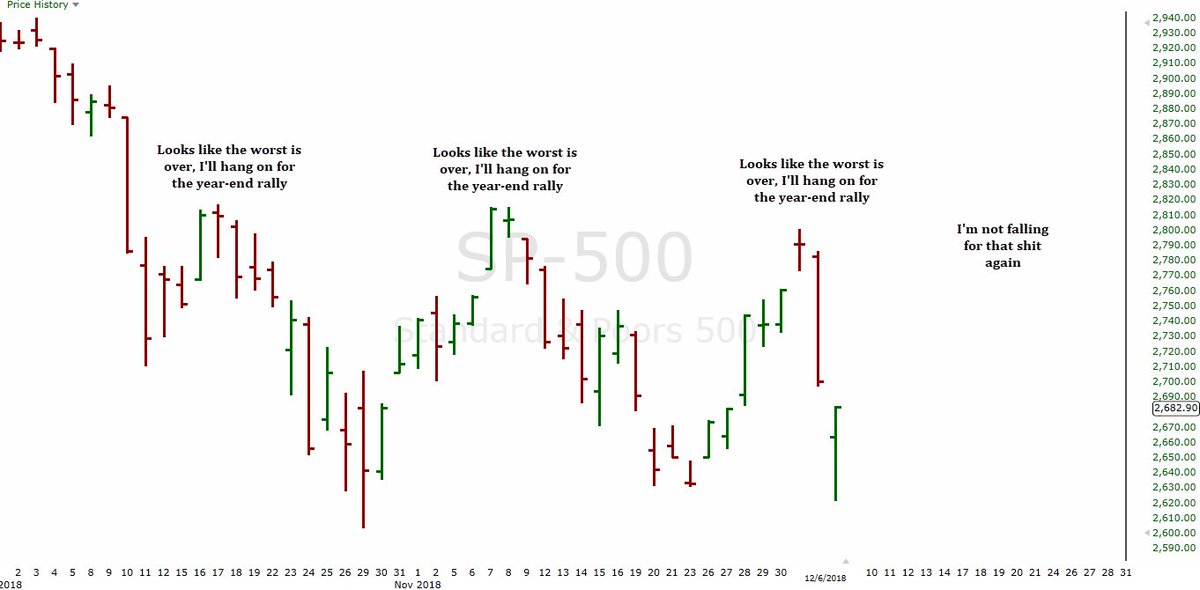
S&P 500 Chartology: Well Here We Are Again

S&P 500 index 2,809.89
up 17.22 (+0.62%)


As StockCats said:
Oops, wrong tweet, here's the one we linked to on December 7 (still 2 1/2 weeks before the Christmas Eve bottom):

Chartology: Well It Does Have A Sort Of Symmetry
and red/green Christmas-y!

From StockCats

https://pbs.twimg.com/media/DtwzZuWX4AAfGPJ.jpg


And here he is last week:
It appears the resistance must be overcome, their fields salted so nothing grows for one thousand years.

To crush your enemies, see them driven before you, 
and to hear the lamentation of their women! 
-Conan the Barbarian, 1982
Or something.

As we've been babbling for a couple years we were in agreement with Jeremy Grantham when he, in a fit of (for him) uncharacteristic bullishness suggested a target of 3000 on the S&P.

And as noted when the October - December decline was really gaining momentum:
Sunday, Dec. 2
2:21pm
Yuan Surges In Early Trading, Signals 2800 Open For The S&P
We cautiously caution, be cautious.
The real action in equities, and probable all time highs for the indices will come in the first quarter of 2019....

and 40 minutes later
Sunday, Dec. 2
3:01 PM
Trade Talks: Grains and Beans
More chance of an extended move here, over the next few weeks, here than in equities, see after the jump....

Repeated in December 4's "Markets: What Triggered the Latest Whack":
At least I have my soybeans....
DJIA down 602.39 (-2.33%) at 25,224.04
S&P 500 down 66.00 (2.37%) at 2,724.37...


Followed a few days later by:December 7, 2018
"Fed’s QE Unwind Reaches $374 Billion"
...As it turned out the Board directed the New York Fed's Open Market Desk to begin the roll-off operations in October 2017 rather than December but because we had marked our calendars and we dramatically scaled back our equity rah-rah which allowed a semi-sanguine view of, first the February, and then October-December volatility.

We're still looking for equities to set their ultimate highs for this go-round somewhere above 3000 on the S&P but fully aware this transition by the Fed is a definite headwind and uncharted territory for pundits and participants and pundit-participants....
...And readers, we meant every word of last Sunday's pair of posts after the G20 news but before Monday's big gap open:...
Which itself was followed by the whole Santa is coming schtick
Dec. 20 
Hulbert: "Santa Claus is coming to Wall Street — after Christmas"
This piece was published ~45 hours—i.e. ~1000 DJIA points—ago. Some say Santa has left the building or, even worse, that there is no Santa but that question was answered, in the affirmative, by the New York Sun long ago (1897):...
Dec. 26
Equities: Thank You Santa
I received the options on the S&P futures and I have to say, earlier this morning I thought XXL was far too big
And on top of that I was a bit nervous about having gone public with December 20's Hulbert: "Santa Claus is coming to Wall Street — after Christmas", reiterated as the first sentence in Dec. 23's Equities: "Nothing Goes to Hell in a Straight Line, Not Even Stocks".
If you hadn't come through all those young people on the internet might have lost faith and stopped believing,
But you delivered Santa, you did!
Right down to the minute!....
So yes, here we are again.
And I've got five weeks for that "probable all time highs for the indices will come in the first quarter of 2019.... " to pan out.

Société Générale's Albert Edwards Is Worried

And not just the usual worries either.

"...most surprising was the pungent smell of skunk 
that pervaded the streets almost everywhere."
From FT Alphaville:
From Socgen's Albert Edwards this Friday:
I was shocked to see the latest data showing US pedestrian fatalities have soared some 25% since 2012! Very few stats surprise me, but this is one of them (see chart below, H/T to Nick Glydon at Redburn). But why has this happened?
One's instinct is to blame the spike in pedestrian deaths on mobile phones. But no, this turns out not to be the most compelling answer at all.

As Edwards discovers after consulting the annual Spotlight on Pedestrian Traffic Fatalitiesreport, a much more convincing explanation comes in the legalisation of recreational marijuana.
From the report (via Edwards):
The seven states (Alaska, Colorado, Maine, Massachusetts, Nevada, Oregon, Washington) and DC that legalised recreational use of marijuana between since 2012 reported a collective 16.4% yoy rise in pedestrian fatalities, whereas all other states reported a collective 5.8% yoy decrease in pedestrian fatalities.
Which, as Edwards sums up, implies the US may be gripped by an epidemic of stoned pedestrians stepping into traffic.

Edwards' personal experience of San Francisco last year supports the thesis. He says he was really quite shocked by the sheer quantities of men who were clearly off their heads on drugs and drink, and by the pungent smell of cannabis skunk almost everywhere.
But what does it all mean for society and the markets?...
...MORE

Guess Who's No Longer In a Drought?

California!!!

Six days ago the Los Angeles Times headline was "18 trillion gallons of rain in California in February — and more on the way" but we wanted to see the University of Nebraska Drought maps, published each Thursday to make sure.
Data as of  a week ago:

Drought Monitor for usdm

And the four week change:

Chartology: Canola Oil

Not quite sure what to make of this:


Here's  the one year chart

The World’s Largest Battery To Power The Permian

Following up on Saturday's "Electricity: Here Come The Big Batteries".

From OilPrice:

Borden County, Texas, is set to become the home of the world’s largest battery storage system in 2021.
IP Juno, a unit of Intersect Power LLC, has recently outlined plans to build a 495-MW storage system together with a solar farm of the same size in Borden County, a small community in West Texas in the very heart of the most important U.S. oil field, the Permian.

It’s hard to miss the ironic interrelation between the booming Texas oil production and the rise of renewables in the most prolific U.S. shale basin. As the West Texas electricity grid strains under surging demand to power oil and gas operations, some of the new capacity installations in the coming years, including the world’s biggest battery according to Bloomberg, will help provide more electricity to the grid from solar power.

Soaring oil production is set to help the case for renewables in Texas, while wind and solar are set to help meet growing electricity demand for oil and gas drilling.

According to the Electric Reliability Council of Texas (ERCOT), the operator of most of the Texas grid, the planned 495-MW solar plus storage system will boost the Texas cumulative battery capacity from 89 MW currently to 584 MW in 2021, when the project is expected to be ready.

The new solar-and-storage facility could help raise the Texas capacity and ease the pressure on the grid at a time when booming oil production continues to drive power demand in the oil patch.  
Permian oil producers need a lot more electricity to power well production than they did just a few years ago. And the West Texas electricity grid—which wasn’t planned for so heavy a load—is straining to catch up with power demand. While drillers have flocked again to the hottest U.S. shale play, electricity infrastructure and transmission grids in West Texas need years to expand to keep reliable power supply on.

“Significant oil and gas development in far West Texas continues to drive increasing electricity demand in Texas. The annual growth rate in peak demand in West Texas is forecasted to be around 8 percent through 2023, whereas ERCOT’s annual system-wide load growth rate is 2 percent during the same time,” ERCOT said at the end of last year....
...MORE

Creighton U's Rural Mainstreet Index Falls for February: Almost Two-Thirds of Banks Raised Farm Loan Collateral Requirements

From Creighton's Heider College of Business, Feb. 21:
February Survey Results at a Glance:
  • Overall index remains above growth neutral for the 11th time in past 12 months.   
  • Bank CEOs project a 6.1 percent decline in farm equipment sales over the next year compared to a 6.9 percent reduction last February.
  • Weak farm income has pushed almost two-thirds of banks to increase collateral requirements on farm loans.
  • Almost one-third of banks have increased the farm loan rejection rate due to anemic farm income.
OMAHA, Neb. (Feb. 21, 2019) - The Creighton University Rural Mainstreet Index for February fell, but remained above growth neutral, according to the monthly survey of bank CEOs in rural areas of a 10-state region dependent on agriculture and/or energy

Overall: The overall index sank to 50.2 from January's 51.5. This was the 11th time in the past 12 months the index has remained above growth neutral. The index ranges between 0 and 100 with 50.0 representing growth neutral.

"Our surveys over the last several months indicate the Rural Mainstreet economy is expanding outside of agriculture. However, the negative impacts of tariffs and low agriculture commodity prices continue to weaken the farm sector," said Ernie Goss, PhD, Jack A. MacAllister Chair in Regional Economics at Creighton University, Heider College of Business.   

Don Reynolds, chairman of Regional Missouri Bank in Columbia, Missouri, reported that, "2018 was not a great year for farmers in our area, but for the most part they have done better than we anticipated. Cash flow projections for 2019 look very tight." 

Farming and ranching: The farmland and ranchland-price index for January increased to 42.2 from 37.9 in January. This is the 63rd straight month the index has fallen below growth neutral 50.0. 
The January farm equipment-sales index slumped to 32.8 from January's 40.9. This marks the 66th consecutive month that the reading has remained below growth neutral 50.0.
Bankers were asked to estimate the change in agriculture equipment sales in their area for the next year. On average, bankers expect another 6.1 percent decline in farm equipment sales over the next year. This is an improvement from last year at this time when a 6.9 percent decline was expected.

Banking: Borrowing by farmers for February was strong as the borrowing index soared to 71.3 from January's 55.8. The checking-deposit index plummeted to 40.9 from January's 67.6, while the index for certificates of deposit and other savings instruments slipped to 47.0 from 47.1 in January.    
James Brown, CEO of Hardin County Savings Bank in Eldora, Iowa, reported, "(Weak farm income has produced) more restructuring with ag loans to shore up working capital and reduce term payments if possible while commodity prices remain low." 

This month bankers were asked to identify their bank's response to weak farm income. Almost two-thirds, or 62.6 percent, indicated collateral requirements have been raised on farm loans. This compares to 45.2 percent for February 2018. 

Almost one-third, or 30.3 percent of bankers, reported that a higher percentage of farm loan applications had been rejected. This compares to 21.4 percent of banks in February 2018 that reported they had rejected a higher percentage of farm loans. 

Hiring: The employment gauge climbed to a healthy; 60.6 from January's 55.7. Despite weak farm commodity prices and farm income, Rural Mainstreet businesses continue to hire at an improved rate. Over the past 12 months, the Rural Mainstreet economy added jobs at a 1.1 percent pace compared to a higher 1.6 percent for urban areas of the same 10 states.   
   
Confidence: The confidence index, which reflects bank CEO expectations for the economy six months out, climbed to a still anemic 48.5 from January's 45.7, indicating a pessimistic economic outlook among bankers. 

"Tariffs, trade tensions, weak agriculture commodity prices and anemic farm income negatively influenced the economic outlook of bank CEOs," said Goss. 

Home and retail sales: The home-sales index increased to 50.0 from 45.7 in January. Retail sales sank to 48.5 from January's 52.9....MUCH MORE