From CNBC, November 21:
I'm waving a metal detector over piles of rocks. I'm hot. I'm covered in orange dust. I don't even know exactly where I am, only that it's somewhere in Mariposa, California, an old mining town about 165 miles east of San Francisco.
I'm skeptical that I'm actually going to find gold. I stick out my arm, offering the detector back to its owner.
Gold's ascent is, at least partially, why I'm here. It often climbs in value during periods of economic uncertainty, and reached an all-time high closing price of $5,416 per ounce in January. It's down to $3,532 as of Friday afternoon, which still considerably outpaces the expense of mining it: Gold producers spend an average of $1,785 per ounce, according to international trade association World Gold Council. The jump has caused a surge of interest in gold and its production, sending tourists and aspiring miners out west.
To understand this modern-day gold rush, I spent time with three small-scale mining operations: Thomas and his partner Kayla Orcutt's scrappy startup, a 6-year-old venture with outside investors, and a family-run business spanning multiple generations. They're all based near Mariposa, a town at the center of America's centuries-long gold obsession, and some are succeeding in ways they couldn't have just five years ago.
But their jobs aren't easy, and they're not getting rich quick. Mining gold takes a lot of physical effort, money and luck. Miners can go six months without finding a valuable nugget, which isn't ideal for paying bills or growing a business. Many of them have built additional gold-related revenue streams, including wholesale, selling mining claims and hosting tourists.
"I reference poker all the time when it comes to this," says Orcutt, 36, Thomas' business partner and girlfriend. "You can go on dry spells and sometimes you get skunked. But sometimes you get those big, big, big wins."....
....MUCH MORE
Related, June 2019:
"A settler forgot where he buried $100,000 in gold around the Bay Area. It might still be out there"
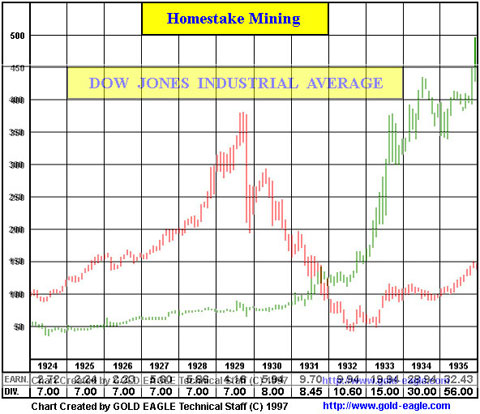
So after Barrick bought Homestake, I procured an Indiana Jones hat and ventured out to South Dakota to visit HM H.Q. in Lead (long 'e'), get to know the librarians at the Deadwood Public Library and tramp around the Black Hills. I was probably the last person to look at HM's records from the 1930's, I was there as the archivists were boxing the stuff up.
The short version of the stock action—and the dividends, look at that bottom panel in the chart, $56 in 1935, basically what the stock sold for a decade earlier, is:
There were three contributors to the move in the share price.
1) A high-grading mining strategy proposed by a young engineer, Don McLaughlin in the late '20's began bearing fruit in the form of higher recoveries. Mr. McLaughlin went on to the presidency of the company.
2) A flight to safety after the October 1929 stock market crash.
3) The Gold Reserve Act of January 30, 1934 raised the price of gold 69%, from $20.67 to $35.00 (conversely devaluing the dollar by 41%).
3a) Homestake was thus paying salaries and other expenses in devalued dollars.
This combination of more gold produced, higher price per ounce and lowered expenses (in real terms) was what moved the stock, not some inherent magic in gold.
(that's me quoting myself)
Which left me a lot of time to think about the hundreds of mines in the neighborhood, the lack of secure storage facilities, the dangerous nature of working in an area of steep gradients, heavy drinking and gunplay.
(see Wild Bill Hickock in Deadwood's Saloon #10, August 2, 1876.)
and I realized "Holy crap, there must be a lot of gold buried here by miners who went to town and never came back or fell down a shaft or just forgot where they buried it."
Apparently this was also true in the earlier California Gold Rush (and for that matter every other rush.)
From the San Francisco Chronicle....

