From the Times Literary Supplement, June 12:
Mainstream economic theory assumes that agents have stable, well-defined preferences and make rational choices consistent with those preferences. Behavioural economics, which introduces a social and psychological dimension to describe how people really behave, has long challenged such assumptions.
At first glance, this upstart discipline appears to have enjoyed considerable success. Three of its leading exponents – Daniel Kahneman (1934–2024), Robert Shiller and Richard H. Thaler – have received Nobel prizes in economics, and each has written a bestselling book popularizing his work. Behavioural psychology has also influenced public policymaking across the western world. Yet, as two new books reveal, this discipline has had little impact on how economics is taught. At the same time, the success of so-called “nudge” policies appears to have been overstated. More troublingly, during the pandemic they served as a propaganda tool for installing widespread fear in the populace, with little or no consideration for the harmful side effects.
Thaler’s The Winner’s Curse (1992), a landmark publication of behavioural economics, has been reissued in a new edition co-authored with Thaler’s colleague at the Chicago Booth School of Business, Alex O. Imas. The original book identified a number of “anomalies” that are at odds with the assumptions of modern economic theory, most of which are republished here with updates. For instance, economists teach that agents act rationally to maximize expected gains. Yet Thaler showed that winners in competitive auctions have a systematic tendency to overpay. The original finding related to successful bidders for oil leases and was confirmed in classroom experiments. The “curse” was later found to hold for winners in contests for corporate control and publishers’ bidding wars for new books.
Another anomaly revealed that people favour co-operation and are willing to experience losses in order to ensure a fair outcome. This contradicts the notion that economic agents are driven by selfish rationality. A further famous anomaly discovered by Thaler involved him handing out mugs to some of the students in his class. The students who received the mugs turned out to value them more highly than those who didn’t. This finding he called the “endowment effect”. Then there is the question of the price of time. Economists assume that people employ the same discount rate to benefits (or costs) that accrue over different periods of time (what is known as the “exponential discount model”). But Thaler and his one-time collaborator George Loewenstein showed that actual behaviour is often not time-consistent: we tend to be more impatient for, and thus to overvalue, immediate rewards compared to deferred ones (what is called “quasi- hyperbolic discounting”).
Economists also teach that money is fungible – that one dollar is exactly the same as another. But Thaler showed that decisions about spending or saving can be influenced by where the money comes from: earned income and dividends are more likely to be consumed than capital gains and other windfalls. “Mental accounting” explains why some people keep money earning little interest in a savings account while borrowing at usurious rates on their credit cards.
In the first edition of The Winner’s Curse, Thaler expressed the hope that his collection of anomalies would result in a “new improved version of economic theory”. But no paradigm shift occurred. This new edition laments that “mainstream economics textbooks remain firmly anchored in the standard neoclassical framework”. The reason for this lack of change is partly because, as Thaler and Imas suggest, conventional economics, which assumes consistency and optimization by economic agents, is mathematically tractable and provides clear predictions, while behavioural anomalies are difficult to model.
But that’s not the whole story. The legal scholar Richard Posner long ago dismissed behavioural economics as mere “cognitive quirks”. In the grand scheme of things, he argued, their significance is easily overstated. For example, while Thaler’s students may exhibit an endowment effect when handed a mug in the classroom, this finding doesn’t hold for professional traders. An oil company that persistently pays too much for drilling leases will eventually be driven out of business. Publishers compensate for the winner’s curse in their bidding wars by paying out a miserly share of sales receipts to their other authors. Companies that appear to overpay for acquisitions often use their own overpriced shares in payment, as was the case when the internet high-flyer America Online acquired the media giant Time Warner in 2000.
As the behavioural economists well understand, apparent violations of economic theory can arise because of the difficulty of exploiting market mispricings. Until five years ago, the energy company Shell was listed under different corporate entities in Holland and the UK. The Dutch and British shares often traded at different prices despite having the same fundamental value. This was a clear violation of the law of one price, says Thaler. In principle, traders should have been able to turn a quick profit by selling the higher-priced shares and buying the cheaper ones. In practice, the risk that the mispricing might become more extreme made them cautious. Such “limits to arbitrage” are relatively common in financial markets, but aren’t sufficient to justify a complete overhaul of modern finance theory. If anomalies can be traded profitably, they will be.
Thaler’s claim that behavioural quirks are systematic and persistent is doubtful. Exponents of market efficiency maintain that share prices contain all available information and that their future movements are unpredictable. The Winner’s Curse, on the other hand, pointed out that stocks are, in fact, mean-reverting: outperforming shares tend to do less well in the medium term, while underperformers tend to recoup their losses. In other words, their future performance is somewhat predictable. The book drew attention to another finding showing that shares that had historically traded cheaply relative to their earnings or book value (known as value stocks) tended to deliver above- average returns.
These observations were actionable and have been acted on. Today, trillions of dollars are invested in value and other quantitative “factors”. (Thaler himself is involved in an investment firm that adopts this approach.) Yet, as shown by the latest edition of UBS’s Global Investment Returns Yearbook (2026), the excess returns delivered by factor-based investing have diminished in recent years as more and more dollars have pursued a limited opportunity set. This appears to support the “adaptive market hypothesis” of the MIT economist Andrew Lo, which asserts that market inefficiencies, behavioural or otherwise, do not persist indefinitely. Value stocks have delivered their greatest returns when they were abnormally cheap. Behavioural economists, who assume that human irrationality is unchanging, overlook this important detail.
Thaler and Imas admit that behavioural economics has produced no standard overarching general theory. There is nothing in the new book about macroeconomics because Thaler says he couldn’t come up with a sharp anomaly in that field. What this means is that behavioural economics has nothing to say about the most significant economic questions of the day, such as the collapse of productivity growth across the developed world, the credit crunch of 2008 or the recent return of inflation.
Because Thaler confines his research to individual behavioural quirks, he wasn’t among the few behavioural economists who anticipated the dangers posed by the technology bubble of the late 1990s or the credit boom and bust that followed. Shiller, the author of Irrational Exuberance (2000), which was published as the tech bubble peaked, has a better record in this respect. But behavioural economists in general failed to recognize the role that falling interest rates, in particular, play in stimulating bubbles. They resemble the doctor who mistakes the sweat on the patient’s brow for the disease and has no knowledge of the real source of the fever.
In 2008, Thaler and Cass Sunstein published Nudge: Improving decisions about health, wealth, and happiness. The book set out to show that behavioural insights could be used to improve public policy outcomes. The aim was to influence people’s behaviour by changing the context in which decisions are made, the nudge being defined as “any aspect of choice architecture that alters people’s behaviour in a predictable way without forbidding any options”. The book sold millions and attracted the attention of the incoming British prime minister David Cameron. In 2010, Cameron set up a Behavioural Insights Team (familiarly known as the Nudge Unit) in the Cabinet Office. Shortly before entering office, the prime minister had proclaimed in a TED Talk that “behavioural economics can transform people’s behaviour in a way that all the bullying and all the information and badgering from a government cannot possibly achieve”. Nudges were seen as elegant solutions to human shortcomings; they suited the prevailing individualistic ethos, were inexpensive to implement and politically uncontroversial.
It was not surprising that the “libertarian paternalism” of nudging appealed to the Eton-educated One Nation Tory. Before becoming an MP, Cameron had served as the head of communications for the British media company Carlton Television. Many of the insights of behavioural economics – such as inertia, present bias, peer pressure, risk aversion and the influence of context on decision-making – are well known in the world of marketing and public relations. (Robert Cialdini, the American marketing guru and author of the bestselling Influence, 1984, attended Nudge Unit seminars, along with Kahneman and Thaler.)....
....MUCH MORE
Previous visits with Chancellor:
September 2020 - Edward Chancellor: «Prudent Investing is Impossible These Days»We like Edward Chancellor.
May 2016
Lessons From the Mississippi Bubble--Edward Chancellor
Whenever emerging markets felt a little too frothy this last decade we'd trot out a bit of Chancellor profundity:

And from The Market.ch, September 11:....
July 2022 - Interest Rates: William J. Bernstein Reviews Edward Chancellor's "The Price of Time"
Two very sharp people.
September 2022 - Someone Who Really Understands Interest Rates: Edward Chancellor On "The Price of Time"
January 2024 - Edward Chancellor Reviews Friedrich Hayek
And many more.
Ah, I see I have. More below
Cass Sunstein via the Social Science Research Network:
Misconceptions About Nudges
SSRN download pageAbstractSome people believe that nudges are an insult to human agency; that nudges are based on excessive trust in government; that nudges are covert; that nudges are manipulative; that nudges exploit behavioral biases; that nudges depend on a belief that human beings are irrational; and that nudges work only at the margins and cannot accomplish much. These are misconceptions. Nudges always respect, and often promote, human agency; because nudges insist on preserving freedom of choice, they do not put excessive trust in government; nudges are generally transparent rather than covert or forms of manipulation; many nudges are educative, and even when they are not, they tend to make life simpler and more navigable; and some nudges have quite large impacts.
Previously on Nudge:
June 2017
"The Limits Of Persuasive Realities: Hacking The Brain Stem With VR Marketing Technologies"
I should probably state my biases right up front, I don't much care for the "nudge' people.
August 2013
"Nudge Squad": White House Creating "Behavioral Insights Team" that Will Look for Ways to Subtly Influence People's Behavior to Get Us to All Act "Better"
Nudge Squad.
Sounds like a '70's chimera: Mod Squad meets Esalen Institute.*
September 2015
Updated--Cass Sunstein: Score! Presidential Executive Order -- "Using Behavioral Science Insights to Better Serve the American People"
Possibly also of interest:
Nudge This: "The Internet of Things Will Be a Giant Persuasion Machine"
March 2015
Nudge This: "The Algorithmic Self"
And, on the off chance Bloomberg View's Matt Levine should see this, 38 footnotes!
September 2014
Behavior: We Are More Rational Than Those who Try To 'Nudge' Us
I don't care much for manipulators.
For a time however I tried to work the word into every conversation. I knew a finance guy who, for whatever reason, could not say the word, when he tried it came out as 'nipulators.'I loved it when he'd go on a rant about the nipulators and nipulation, I'd egg him on and just melt when he got going.
Good times....
And most artfully:
October 2022 - Behavioral Economics: "We don’t have a hundred biases, we have the wrong model"
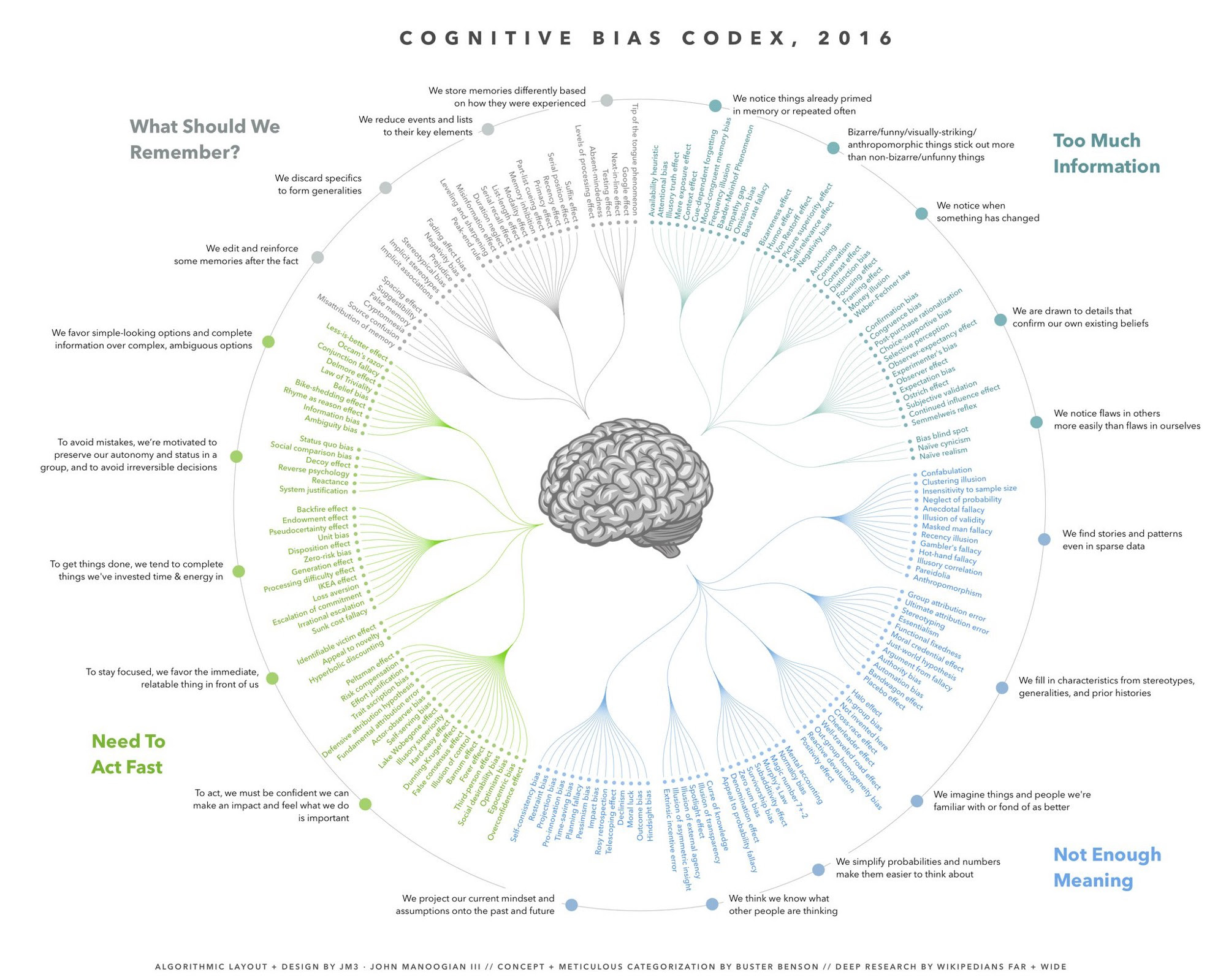
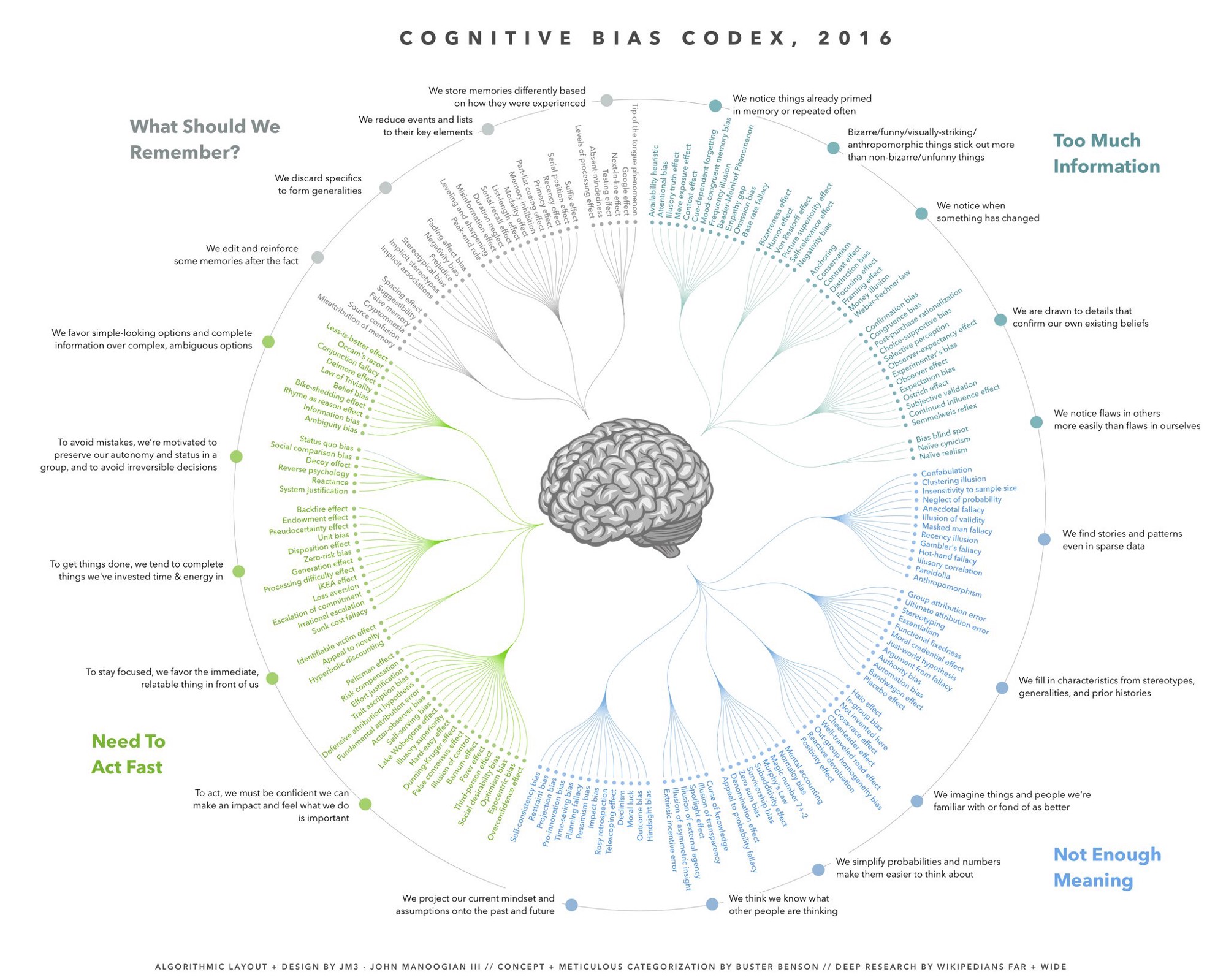
November 2016All the Cognitive Biases In One Chart
Via the Incidental Economist: