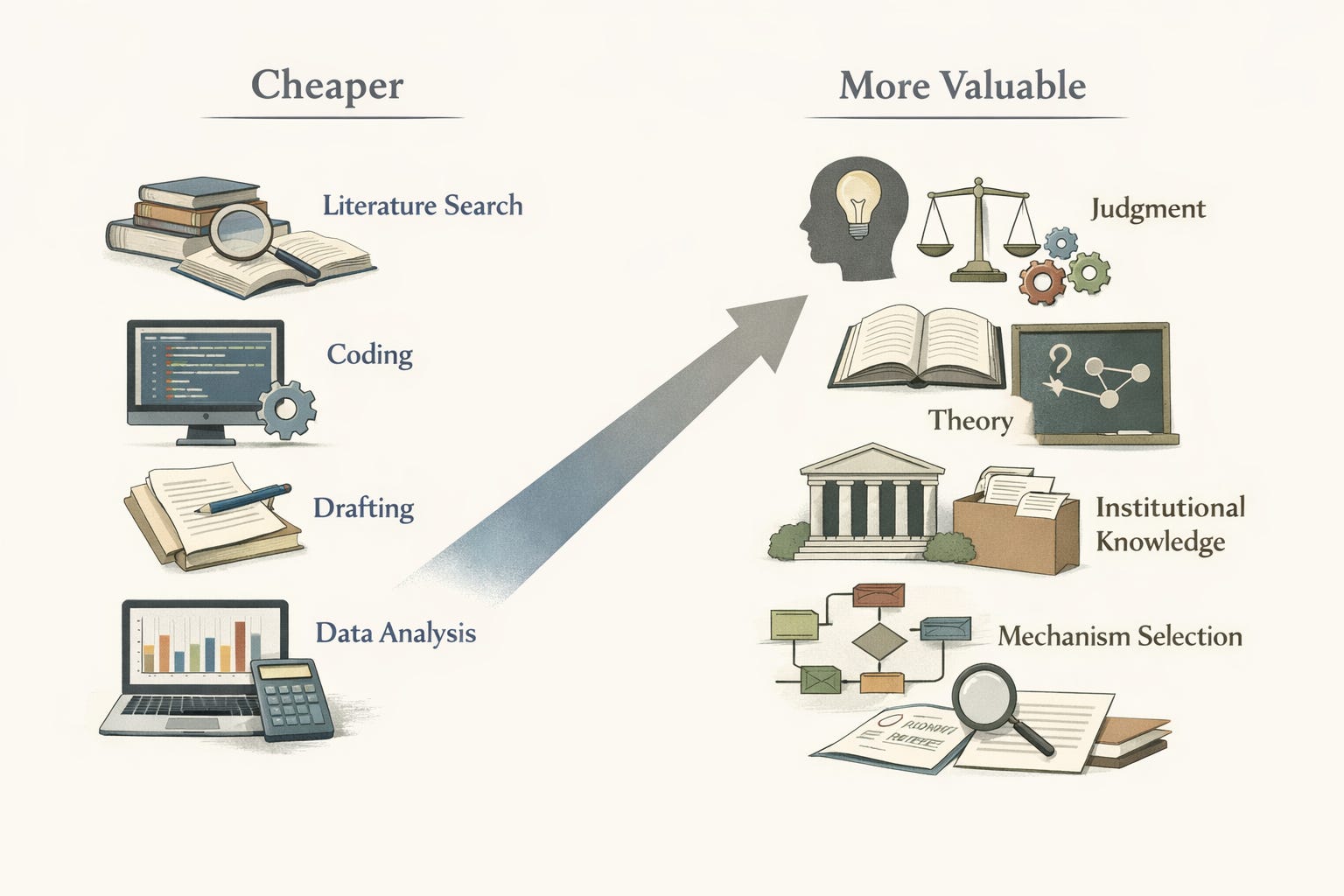
"How AI changes relative value in the academic knowledge economy"
From Lynne Kiesling's Knowledge Problem substack (Economics of organizations, regulation, and information. Technology, electricity, transactive energy, plus some market epistemology and 18th century political economy.), April 2:
AI, Price Theory, and the Future of Economics Research
Source: ChatGPT upon reading this article
Economists
spend their lives studying how people respond when circumstances
change. It would be odd if we failed to apply the same logic to
ourselves.
Artificial intelligence is not just another research
tool. It is a technology shock to the academic knowledge economy. It
lowers the cost of some inputs into research, raises the relative value
of others, and begins to change what the profession rewards. That shift
matters not only for how economists work, but also for which skills and
forms of judgment are likely to become more valuable.
The old equilibrium For the past several decades, economics has been shaped by a particular methodological equilibrium. The profession rewarded scholars who could assemble large datasets, digitize new sources of information, and use increasingly sophisticated econometric tools to extract credible causal estimates. This development improved economics in important ways by imposing discipline, raising standards of evidence, and moving the field away from loose speculation untethered from the world.
But tradeoffs are everywhere, including in research methods.
While
also raising standards, the causal-inference era changed the kind of
questions economists asked. Because credible identification strategies
usually require narrow treatments, clean variation, tractable settings,
and measurable outcomes, the profession gradually tilted toward
questions that fit the available empirical machinery. The result has
been a great deal of technically impressive work, but also, too often, a
narrowing of intellectual ambition. Economics became more a field of
data analysis and less a field of deeper inquiry into institutions,
governance, organizational form, and the structure of human choice.
AI may now disrupt that equilibrium.
A growing number of economists have begun thinking seriously about what AI means for research. Anton Korinek
has traced the progression from AI assistance on research micro-tasks
to semi-autonomous agents that can work across multi-step workflows (JEL 2023, JEL 2025). Matthew Kahn emphasizes the fall in the fixed costs of pursuing ideas, Kevin Munger
the rising importance of evaluation when production becomes cheap, and
others have begun to map the broader consequences (for example, Alex Kustov, Scott Cunningham, and Chris Blattman’s Claude Blattman). I agree with much of that discussion. But the best way to understand what is happening is through price theory.
Yesterday was F.A. Hayek’s 112th birthday, and as Hayek’s
work inspired the name of this blog, and continues to inspire my work
every day, I encourage you all to celebrate this anniversary by reading
(or re-reading, I hope!) his seminal Use of Knowledge in Society (1945):
The peculiar character of the problem of a rational
economic order is determined precisely by the fact that the knowledge of
the circumstances of which we must make use never exists in
concentrated or integrated form but solely as the dispersed bits of
incomplete and frequently contradictory knowledge which all the separate
individuals possess. The economic problem of society is thus not
merely a problem of how to allocate “given” resources—if “given” is
taken to mean given to a single mind which deliberately solves the
problem set by these “data.” It is rather a problem of how to secure
the best use of resources known to any of the members of society, for
ends whose relative importance only these individuals know. Or, to put
it briefly, it is a problem of the utilization of knowledge which is
not given to anyone in its totality.