Following on April 5's "Inside China’s robotics revolution".
We have no interest in IPOs as vehicles to invest/speculate/gamble with, but do pore over offering documents to glean whatever insight might be publicly proffered.
From Irene Zhang at ChinaTalk substack, April 2:
Unitree Goes Public
robotics diffusion, AGI for the real world, and US-China entanglement
In 2017, Hangzhou-based robotics firm Unitree 宇树科技 launched its first quadruped, Laikago. Laika was the name of the Soviet space dog onboard Sputnik 2, and the American English pronunciation of “go” is similar to that of the Chinese word for dogs, 狗 gǒu. Unitree’s battery-powered tribute to Laika wasn’t fuzzy, but walked on four feet and navigated through basic obstacles.
Unitree founder Wang Xingxing 王兴兴 has long held faith in the potential of robotic canines. Since 2020, when Unitree started gaining media attention, he has insisted in multiple interviews that humans are drawn to four-legged creatures and will have a natural fondness for their artificial counterparts.
Fast forward to 2026, and Unitree has just filed for a $610-million IPO on the Shanghai Stock Exchange. The company is a household name in China after its humanoid robots performed dances at the CCTV Spring Festival Gala for two consecutive years and counting. Through their IPO disclosures (investor prospectus and response letter to the Shanghai Stock Exchange’s inquiries), we get some answers to important questions about the development of embodied AI.
How is Unitree profitable?
Where is diffusion happening inside China, aside from dancing on TV?
Are Chinese robotics companies content to lead in hardware and applications, or do they also see themselves as pursuing some kind of generalized “frontier”?
And finally, what does this all mean for US-China dynamics in robotics?
***video***
What’s the money maker?
One of the most notable things about Unitree is the fact that it actually makes money. Unprofitability is a near-universal challenge because AI robotics, despite massive advances in the past few years, is still an early-stage technology. Mass adoption has not yet arrived; pathways out of bottlenecks like data are uncertain; and important safety standards have not caught up. Even shipping products consistently can be a challenge for some companies in the space, let alone manufacturing at scale and booking reliable customers.This context is why observers have found Unitree’s ability to turn a profit remarkable. Not only has the company’s net profit been positive since 2024, but from 2024 to 2025, its net profit grew by 204.29%. A look at its growth, broken down by product category, reveals the most significant source of this revenue explosion: humanoids.
....MUCH MORE
Previously:
- While You Were Busy Living Your Life: "Nvidia Announces GR00T, a Foundation Model for Humanoids"
- Embodied Intelligence: China's Whole-of-Nation Push into Robotics
- China: There Might Be Something To This Humanoid Robot Stuff
- "America Is Missing The New Labor Economy – Robotics Part 1"
- Barron's: "Move Over, BigDog. Humanoid Robots Are Finally Here. How to Invest."
- "Founder of China’s Unitree sees lack of advanced AI as biggest roadblock to mass robot use"
- One Of Unitree's New Robots
January 29, 2026 - "Gartner Predicts Fewer Than 20 Companies Will Scale Humanoid Robots for Manufacturing and Supply Chain to Production Stage by 2028"
So it looks like 2027 will be a very important year for Unitree, Tesla and the other 90 wannabe players. We shall see.
Here's Gartner's Hype Cycle for emerging technologies. Humanoids are bottom left and tagged by Gartner with an expected ten years to the Plateau of Productivity:
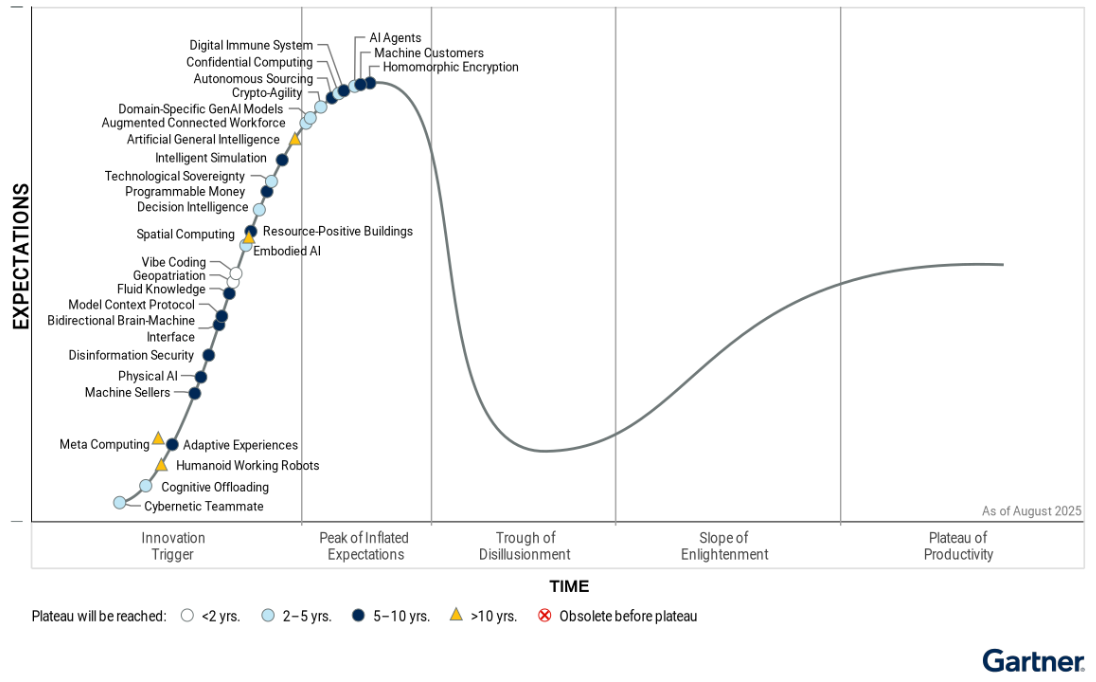
Of course that also implies we are quite a ways from the Trough of Disillusionment as well.
And of course, your mileage may vary:
September 13, 2022 - Gartner Outlines Six Trends Driving Near-Term Adoption of Metaverse Technologies
There are many, many more. If interested use the search blog box, upper left.
