Malacca Strait: How one volcano could trigger world chaos
From the BBC, 17 January 2023:
It's
only a few hundred miles long, but when a natural disaster strikes near
the Malacca Strait, the consequences could be global, writes Tom Ough.
Every year, approximately 90,000 ships
pass through the narrow sea lane of the Malacca Strait, which links the
Indian Ocean to the Pacific. Their cargo – grain, crude oil, and every
other commodity under the Sun – comprises an estimated 40% of global trade.
Above these ships is one of the busiest air routes in the world, and
below them, running along the seabed, is a dense array of submarine
internet cables that keep the world online.
Together,
these factors make the Malacca Strait one of the most vital arteries of
the global economy. It has been classified as a trade choke point in
reports by the World Trade Organization, the US Energy Information Administration and Chatham House, the London-based foreign affairs think-tank.
All of which is to say: nice strait you've got there. Be a shame if something… happened to it.
Researchers
are warning that it's only a matter of time before a natural disaster
like an earthquake or volcano strikes the region – and when it does, we
can expect global consequences.
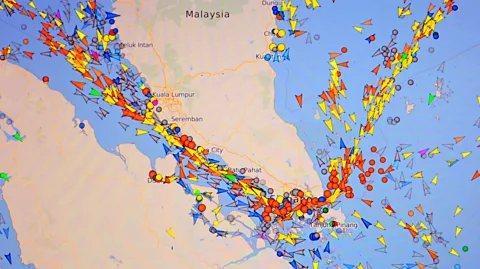
Ship-tracking technology reveals just how many travel through the Malacca Strait (Credit: Alamy)
Disruption
of key trade routes is a well-established problem, due to crime or
human error. Piracy has long bedevilled the area, but the strait,
cooperatively policed by Indonesia, Malaysia, Singapore, and Thailand,
is generally under control. Still, it is not uncommon for ships to collide here: 10 American sailors died as a result of the USS John McCain running into a Liberian-flagged tanker in 2017. But at 1.7 miles (2.7 km) at its narrowest,
the strait is not slender enough to be blocked by an errant container
ship in the way that the Suez Canal was by the 400m (1,312ft) Ever Given in 2021.
The
greatest menaces to the Malacca Strait, which separates the Malay
Peninsula from the Indonesian island of Sumatra, lie in the natural
world. Of the many intriguing maps of activity in the region, the most
arresting is the one that collates the world's active volcanoes and recent earthquakes.
Along the coast of Sumatra and the more southerly part of Java,
following the course of the Sunda Trench, is a band of earthquake
activity, and several volcanoes.
On
Java, two volcanoes, Semeru and Merapi, have recently erupted. In the
Sunda Strait, which separates Java from Sumatra, is Krakatau, and to the
east is Tambora, whose eruption in 1815 caused crop failure as far
afield as in Europe and the eastern United States.
The
Tambora eruption was magnitude VEI7 in the Volcanic Explosivity Index
(VEI), on a logarithmic scale going up to VEI8. An event like 1815 might
occur once or twice per millennium. But an eruption need not be of
quite so high a magnitude to cause severe problems at a global choke
point, especially if it happened at one of the volcanoes closer to the
Malacca Strait.
In 2018, researchers at the University of Cambridge's Centre for Risk Studies envisaged the effects of scenarios including a VEI6 eruption at Marapi.
The eruption, they suggested, might produce ash clouds and fine tephra –
fragments of rock ejected into the air – that waft across the Malacca
Strait towards Singapore and Malaysia. The resultant damage to local
infrastructure and supply chains, with aviation particularly badly
affected, would combine with a global temperature drop of 1C to wipe an
estimated $2.51tn (£2tn/€2.3tn) off global GDP over a five-year period.
That figure dwarfs the estimated $5bn (£4bn/€4.6bn) that the VEI4
eruption of Eyjafjallajökull, in Iceland, wiped from the global economy.
Marapi's last VEI4 eruption was 2010. A VEI6 eruption at Marapi is lower-probability: its return period,
which is the estimated average time between eruptions, is 750 years.
Yet the stakes are high enough to merit taking the prospect seriously,
says Lara Mani, a volcanologist at the University of Cambridge's Centre
for the Study of Existential Risk. And Marapi is one of several active
volcanoes in the region. VEI4, VEI5 and VEI6 eruptions, says Mani, "can
still really disrupt the strait. And the thing is, when a volcano
starts, it doesn't tell you when it's going to stop."....