Friday, July 6, 2012

EIA Weekly Natural Gas Storage Report Up 39 BCF

This report covers the first week of the heatwave and is the lowest June injection I can recall over years of watching this stuff. The futures are nonetheless down 9.3 cents at $2.852.
From the EIA:

Released: July 6, 2012 at 10:30 a.m. (eastern time) for the Week Ending June 29, 2012.
Next Release: July 12, 2012

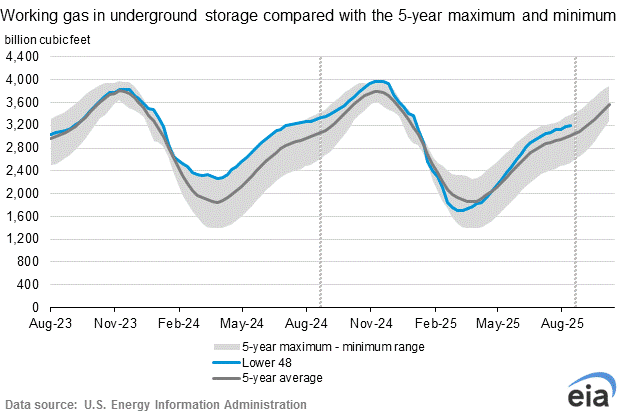
Working Gas in Underground Storage, Lower 48
Region Stocks in billion cubic feet (Bcf) Historical Comparisons
06/29/12 06/22/12 Change Year Ago (06/29/11) 5-Year (2007-2011) Average
Stocks (Bcf) % Change Stocks (Bcf) % Change
East
West
Producing
Total


Warren Buffett Removes Hydro Dams, Salmon Return, Leap Into Fishermen's Arms (BRK)

 Is there nothing the man can't do?

Okay, the leaping bit may be a stretch.
And it wasn't Warren personally blowing the tunnel and dismantling the dams, it was Pacificorp.
And they're a sub of MidAmerican which is the entity owned by Berkshire.
And he did ignore the Klamath krew when they showed up for the 2008 and 2009 BRK annual meetings.
But still, credit where credit...will be taken.
(you watch)

From NATURE:
Fish return to undammed Elwha River
First hope for salmon and trout restoration in biggest dam-removal project in US history.

A project to remove two hydroelectric dams from the Elwha River in Washington state is bringing benefits for local wildlife. In June, only months after the removal of the first dam was completed, salmon and steelhead spawned in two tributaries that had been inaccessible for more than 100 years.

But the fish are not home free yet. Massive amounts of sediment that had accumulated behind the dam have now been released, and could clog the gills of young and adult alike, killing them. The sediment will muddy the waters for at least three years before spreading out and rebuilding downstream river beds and coastal beaches; until then, the fish must navigate treacherous waters to breed.

The 72-kilometre Elwha River runs through Olympic National Park before spilling into the Strait of Juan de Fuca, on part of the reservation of the Lower Elwha Klallam Tribe, whose people once relied on the river’s bounty. Before the construction of first the 33-metre-high Elwha Dam and then the 64-metre-high Glines Canyon Dam in the early twentieth century, the Elwha River boasted abundant populations of all five Pacific Northwest salmon species, as well as steelhead trout (Oncorhynchus mykiss), native char (species of Salvelinus) and coastal cutthroat trout (Oncorhynchus clarkii clarkii)....MORE
The Oregonian has some video of the drainage tunnel being blasted open, it's pretty dramatic.
The action starts at the 02:00 mark:

Get the Stock Picks Newsletter!

Another one for Hulbert's database.
From Dilbert.com:

The Official Dilbert Website featuring Scott Adams Dilbert strips, animations and more

Dogbert is, of course, a sociopath but that's his charm.
That and his little tail when is is especially pleased with a scam.

United Nations Proposes Billionaire Tax

If a sovereign nation decides to institute a tax on net worth, that's their call.
When a bunch of self-appointed pleasure seekers (see: Rio +20 Ipanema Beach pics) wants to do it, you almost yearn for the simple corruption of the Oil-for-Food programme.
From AFP via Yahoo Canada:
UN calls for 'billionaires tax' to help world's poor
The United Nations on Thursday called for a tax on billionaires to help raise more than $400 billion a year for poor countries.

An annual lump sum payment by the super-rich is one of a host of measures including a tax on carbon dioxide emissions, currency exchanges or financial transactions proposed in a UN report that accuses wealthy nations of breaking promises to step up aid for the less fortunate.

The annual World Economic and Social Survey says it is critical to find new ways to help the world's poor as pledged cash fails to flow.

The report estimates that the number of people around the globe worth at least $1 billion rose to 1,226 in 2012.

There are an estimated 425 billionaires in the United States, 315 in the Asia-Pacific region, 310 in Europe, 90 in other North and South American countries and 86 in Africa and the Middle East.
Together they own an estimated $4.6 trillion so a one percent tax on their wealth would raise more than $46 billion, according to the report.

"Would this hurt them?" it questioned.

"The 'average' billionaire would own $3.7 billion after paying the tax. If that billionaire spent $1,000 per day, it would take him or her over 10,000 years to spend all his or her wealth," the report says....MORE

Where's the Inflation? Housing

Of all places.

Keep in mind that the Bureau of Labor Statistics measures price increases of residential real estate owned via an econometric measure, Owners Equivalent Rent which tends to underestimate price moves. The BLS gives this measure an ~32% weighting in the "core" Consumer Price Index. For folks who rent their homes the BLS uses Rental of Primary Residence, again run through an econometric model but is more responsive to price.

RPR has an ~8% weight in the core CPI, giving housing a total of ~40%.
(something I've never understood is why, with around 1/3 of the population renting, RPR only 20% of the housing weight is rentals.)

With these measures rising and energy prices declining I would look for Professor Krugman to abandon core and begin using headline inflation (where housing has a total 32% weight) as his new preferred metric.
Here's a twofer, first up the Wall Street Journal:

Rents Increase as Vacancies Dry Up 
Landlords boosted apartment rents to record levels in the second quarter as demand from tenants sitting out the home-buying market pushed vacancy rates to their lowest point in more than a decade, according to a report to be released Thursday.

Despite the sluggish economy, average rents increased in all 82 markets tracked by Reis Inc., a real estate data firm. Average rents are now at record levels in 74 of those markets and now top $1,000 a month on average in 27 of them, including Miami, Seattle, San Diego, Chicago and Baltimore.

The biggest rent boost of the second quarter was in New York City, where the average rose to $2,935 per month, up 1.7% from the first quarter. Apartment rents also increased in markets that have been hard hit by the economic downturn such as Las Vegas and Phoenix, where they rose 0.9% and 1% respectively in the second quarter. The lowest average rent among the markets surveyed was Wichita, Kan., where the average was $510 a month.

"The market is in a very tight position," Reis said in a research report. "There is a paucity of available units."
The nation's vacancy rate fell during the quarter to 4.7%, its lowest level since the end of 2001, Reis said. That's down from 4.9% in the first quarter of this year and from 8% in 2009, when millions of would-be renters were doubling up or living with family....MORE
And from History Squared the nub of the argument (and the headline):

U.S. Real Estate is Booming; Inflation is Here
Since at least April, I’ve been tweeting how real estate has not just bottomed, but is booming. Check out these prices and supporting stats below the picture.
image
1. Rental yields are positive in 98 of 100 major markets
2. Rental prices rose the most since 2007, with Manhattan rents up 7.1%.
3. Tom Shapiro of GTIS says his proprietary sales growth figures show 20% sales growth, adds government stats based on closings and lag
4. Wells Fargo boosted mortgage loans 30.1%(!) in 1Q, 33.9% of the $385 billion of mortgages originate $WFC ~ Bloomberg; BB&T 20%
...MORE, including a warning

Thursday, July 5, 2012

"Seduce Her With Bacon"

Men's Health, June 2012:


HT: Knowledge@Wharton, seriously

Obituary: Count Robert de La Rochefoucauld

From the Telegraph:
Count Robert de La Rochefoucauld, who has died aged 88, escaped from Occupied France to join the Special Operations Executive (SOE); parachuted back on sabotage missions, he twice faced execution, only to escape on both occasions, once dressed as a Nazi guard.

Other disguises also came in useful. On the run in occupied Bordeaux he dressed as a nun. In later life he helped Maurice Papon to flee to Switzerland.
Robert Jean-Marie de La Rochefoucauld was born in Paris on September 16 1923, one of 10 children of an aristocratic family which lived in old-fashioned splendour on Avenue de la Bourdonnais, in the shadow of the Eiffel Tower. An ancestor was François de La Rochefoucauld, famous for his maxims. Robert’s mother (née Wendel) was daughter of the Duke of Maillé. His father’s family retained a private carriage which was hitched on to trains during rail journeys.
Considered a sickly child, Robert was sent to a succession of private schools for the jeunesse dorée in Switzerland and Austria where, in 1938, he was taken on a school trip to Berchtesgaden, Hitler’s Alpine retreat. When Hitler’s convoy drew up, the Fuhrer approached and patted Robert on the cheek affectionately. It was, La Rochefoucauld later recalled, a dream come true for his 15 year-old self. Hitler was then the great statesman of Europe; young Robert and his schoolmates had attached swastikas to their bicycles in admiration.

La Rochefoucauld was back in France when the Nazis invaded. His father was taken prisoner; the rest of the family took refuge in the Chateau de Villeneuve, east of Paris. Furious at the Occupation, La Rochefoucauld protested long and loud until he was warned to keep quiet by a friendly postman, who had intercepted a letter denouncing the young man to the Nazis.
La Rochefoucauld made contact with the Resistance in the spring of 1942, keen to find a route to join Free French forces in England. He took the pseudonym René Lallier and travelled, via Vichy and Perpignan, to the Pyrenees, where he accompanied two British airmen over the Col de Perthuis into Spain. Immediately arrested, the three spent two months in jail before Major Eric Piquet-Wicks, head of recruiting French nationals for SOE, arrived from the British embassy in Madrid and arranged for the three to be released.
It was at the embassy that La Rochefoucauld was invited to join SOE. “The courage and skill of British agents is without equal,” he recalled the ambassador noting. “It is just that their French accents are appalling.”...MUCH MORE
As they say, You can't make this stuff up. 

HT: Execupundit

Our Favorite Federal Reserve Bank Paper, "In Which the Downfall of a Prominent Speculator Rocks the Financial System, and a Prominent Millionaire Saves the Day"

 On October 14, 1907, the stock of United Copper Company soared past $62 a share. Two days later it closed at $15, and one F. Augustus Heinze was well on his way to financial ruin....
Back in 2007 we wanted to note the anniversary of the Panic of 1907 and found that the Federal Reserve Bank of Boston had done it better, backwards and in heels:

April 9, 2007
Global Warming and Venture Capital
We're coming up on the 100th anniversary of the Panic of 1907 (Join our cult, get the calendar free!). The Boston Fed. did a great paper on the panic that should have gotten a wider audience.

It's not that often you see a sub-head like "In Which the Downfall of a Prominent Speculator Rocks the Financial System, and a Prominent Millionaire Saves the Day" in a Fed. Bank Publication.

Rereading this got me thinking about the difference between J.P. Morgan (Our Hero), and the current crop of VC's flogging their new-found green credentials. Where were they six years ago? Oh, that's right: Webvan and Pets.com and Boo.com and Askme.com. Even Queer Company blew through $5 mil.

Compare that to Morgan six years prior to the Panic, during the Northern Pacific squeeze of ought-one. J.J. Hill flying across the country in a commandeered train, counting on one of the few guys on the planet who knew as much about railroads and financial markets as Hill himself (or for that matter as much as Hill's nemesis Ed Harriman- E.H., famous for saying "I can distribute more stock on upticks than I can on down"); some things never go out of style....
Here's the paper:
Panic of 1907
Federal Reserve Bank of Boston

Crash, Crash, Crash
Boston Post-October 19, 1907

Although the headline referred to events in New York, Boston Post readers knew exactly what it meant. Effects of the financial crisis were certain to reach beyond Wall Street....MORE

Climateer Line of the Day: Predicting Investment Manager Fraud Edition

...We find no evidence that investors receive compensation for fraud risk through superior performance or lower fees....

Yuh think? 

From the Networks Financial Institute Working Paper No. 2011-WP-09 "Predicting Fraud by Investment Managers" via the SSRN


Gumshoe Reporting "The Jobs House: Under Construction" (AAPL)

Mr. Savitz, formerly a Murdochian vassal, now does his tech his thing at Forbes. He lives in Palo Alto.
From Forbes:
Looks like there is a major overhaul going on at the Palo Alto home owned by the family of the late Apple CEO Steve Jobs.

It is isn’t entirely clear what’s happening, but a quick drive-by yesterday showed a massive construction project underway, including changes in the roofline; the extensive nature of the work on the house would suggest that Laurene Powell Jobs and her children are not currently living there.

Here are a few pictures from the house shot on July 4. (Taken with my iPhone, naturally.)

Note the scaffolding on the side of the house, fencing around the trees and yellow caution tape.
...MORE

The 50 Machines You Will Need to Rebuild Civilization (should it come to that)

We post this when things look gloomy. It's been an average of thirteen months between posts.
From Open Source Ecology: the Global Village Construction Set:
The Global Village Construction Set (GVCS) is an open technological platform that allows for the easy fabrication of the 50 different Industrial Machines that it takes to build a small civilization with modern comforts.

Key Features of the GVCS:

Open Source - Low-Cost - Modular - User-Serviceable - DIY - Closed-Loop Manufacturing - High Performance - Heirloom Design - Flexible Fabrication

A modern, comfortable lifestyle relies on a variety of efficient Industrial Machines. If you eat bread, you rely on an Agricultural Combine. If you live in a wood house, you rely on a Sawmill. Each of these machines relies on other machines in order for it to exist. If you distill this complex web of interdependent machines into a reproduceable, simple, closed-loop system, you get these:

The GVCS 50:


3d Printer

an additive manufacturing technology where a three dimensional object is printed by laying down successive layers of material, just like a printer except in 3D.

3d Scanner

a device that can generate a 3D digital scan from a real-life object, where the file can be used to reproduce the object in 3D with a device such as the 3D printer or CNC Precision Multimachine.

50 kW Wind Turbine

a device that produces electrical power from wind energy, scalable in units of 50 kW.

Aluminum Extractor from Clay

a device that produces aluminum from clay by dissolving the aluminum from aluminosilicate (clay), and then electrolyzing the resulting compound to form pure aluminum.

Backhoe

a piece of excavating equipment or digger consisting of a digging bucket on the end of a two-part articulated arm for digging trenches or large holes.

Bakery Oven

device for heating various forms of dough into breads and other baked goods.
.

CNC Circuit Mill

a computer-controlled device that can produce electrical circuits by milling and drilling on copper-clad circuit boards.

CNC Precision Multimachine

a multipurpose, precision CNC machining and metal cutting device for milling, lathing, drilling to make precision parts; includes surface grinding and cold-cut metal sawing.

CNC Torch/Router Table

a computer-controlled cutting table for metal where a moving torch head is used to produce precision metal parts in a fraction of the time that it takes to do so manually....

...MORE

HT: No Tech Magazine:

Macro: Asian Refineries Will Cut July throughput on Weak Demand

From Reuters:
Asian refiners to pare output on poor margins, low demand

* Poor margins, low demand force refiners to reduce runs
* Steepest prediction is for fall to 70 percent of capacity
* Most cite surprise China slowdown as key factor for run cuts


Asian refiners are set to lower operations further in the second half of the year as a slowdown in demand from China slashes profits from processing a barrel of crude into fuels in a market already suffering from sliding consumption in the West.

Paring runs would put further pressure on oil prices, which have already slumped more than a quarter to $98 a barrel on Wednesday since their highs of over $128 in March.

Investors had bet on China to drive oil demand growth as the faltering economic outlook in the West reduces energy usage. But a surprise slowdown in the world's second-largest oil consumer has forced many to temper this expectation.

A Reuters poll of 10 refiners, banks and analysts showed that all forecast a fall in refinery runs in Asia in the second half. The steepest prediction is for operations to slide to an average 70 percent of capacity, with most others expecting them to be around 80 percent from about 85 percent now.

"The economic slowdown has prompted refiners to cut runs in all regions," said David Wech, head of research at JBC Energy in Vienna. "We see Asian refinery utilisation averaging at just above 80 percent in 2012, down by almost 2 percentage points year on year."

A majority of those polled cite the impact a widening debt crisis in Europe is having on China's economy, saying the situation is worse than what most had expected.

China's slowing consumption is barely expected to offset falling demand in developed economies, lowering global oil demand growth to the slowest pace this year since the financial crisis, a separate poll by Reuters last week showed....MORE

Frackers: Sterne, Agee & Leach on the Oilfield Service Stocks (SLB; CAM; OIS; HAL)

Something to remember: All of the natural gas wells that were fracked over the last couple years will have to be re-fracked as the production rates decline, some wells will get fracked three or four times over their expected lives. It's like an annuity for the service companies, something I've not heard any analysts talk about.
From Barron's Investors' Soapbox PM (July 3):

Favorites in Oil-Service Stocks
Sterne Agee likes Schlumberger, Cameron and Oil States International.
We believe the underperformance in the oil-service sector has been related to weak oil prices, a greater-than-expected drop in U.S. natural-gas drilling and downward earnings-per-share estimate revisions.
We are cutting estimates and adjusting price targets for Baker Hughes (ticker: BHI), Halliburton (HAL), Schlumberger (SLB), Superior Energy Services (SPN) and Weatherford International (WFT). Our favorite names include Schlumberger, Cameron International (CAM) and Oil States International (OIS).

We are reducing estimates on several names on our universe owing mainly to a more cautious approach to North American margins over the next several quarters. We are trimming our U.S. rig count forecast for 2012 by 100 rigs to 1,950, but believe activity holds up well as customers' hedged positions coupled with leasehold drilling in liquid-rich areas create an activity buffer....MORE
S, A&L price targets: SLB-$89; HAL-$46; BHI-$47

Back in June Investors' Soapbox AM had Barclays' thoughts:
4 Cheap Oil Service Stocks 
Barclays says these names – all down this year -- offer deep value.
Given the current macroeconomic uncertainty (coupled with falling oil prices), recent price declines in the North American pressure pumping market, and even potential shortages of guar, investors have had many reasons to avoid the "Big Four" oil service companies of late.

However, we think consensus earnings revisions have largely bottomed and, as a number of near-term transitory issues begin to show signs of resolution, we think investors (particularly deep value-minded ones) are revisiting the group given the low historical valuations.

The Big Four oil service providers  -- Baker Hughes International (ticker: BHI), Schlumberger (SLB), Halliburton (HAL) and Weatherford International (WFT) -- are trading at a 26% discount to their three-year average on a price-to-tangible book value basis, their lowest level in two years.

On a five-year basis, the group is trading at a 38% discount to historical levels. While much of the oil services, equipment and drilling sector is trading at a modest discount to its historical averages, the large-cap diversifieds appear to be experiencing the largest disconnect.

As the European crisis unfolded in 2011, the shares of the Big Four began decoupling from oil prices and traded instead with the broader market.

When those fears abated around year end, oil service stocks rallied and began to close the gap. As Euro concerns and "risk off" trades have returned of late, both oil service and energy as a whole have unperformed the broader market year-to-date.

A recoupling at current levels would imply a nearly 50% rise even after the recent correction in oil prices. As earnings revisions find a bottom and investors return to the relatively strong oil service fundamentals, we expect this multiple to expand back toward historical levels.

At roughly 1.9 times price-to-tangible book value, Weatherford is currently the cheapest, while Baker Hughes and Halliburton trade around two times and 2.25 times, respectively. Schlumberger currently commands a healthy premium multiple of about 6.2 times tangible book value....MORE

The Guy Who Discovered Black-Scholes Before Mssrs. Black and Scholes

Okay, not all of B-S but enough that if anyone had been paying attention they could have made money off the young man's work.

I was going to do a post on the King of 19th century put and call brokers but you may find this more interesting.
From Bloomberg:
Wall Street Quants Owe a Debt to Obscure French Student
The 21st century began with a major correction on Wall Street and a long period of volatility in global financial markets. The VIX, sometimes called the fear index, soared, and congressional hearings explored why major investment banks couldn’t better hedge market risk. Traders sought reprieve, and risk management became elevated from prudent practice to a tool for financial survival.

Risk is most efficiently managed through the purchase of options and other derivatives. Many investors know that the economists Fischer Black and Myron Scholes are considered the pioneers of derivatives pricing through their options-pricing theory. Their Black-Scholes formula and its variations remain the primary tools in the optimal pricing and determination of derivatives hedges.

Most don’t know that options-pricing theory actually began at the very start the 20th century, in Paris. The innovation, by an obscure graduate student named Louis Bachelier, introduced sophisticated mathematics to finance theory and eventually gave rise to quantitative analysis. It took us almost 70 years to appreciate Bachelier’s contribution -- but he should go down as the father of modern finance.

In his early 20s, following a stint in the French army, Bachelier found himself working at the Paris Stock Exchange. There he tried to understand how options on French government perpetual bonds, or rentes, could be priced.

Brilliant Idea
He enrolled at the Sorbonne to study mathematical physics under one of France’s top mathematicians, Henri Poincare. His supervisor was a bit perplexed when Bachelier chose to study French bond options for his doctoral thesis, but soon agreed that his idea was brilliant.

In just a few pages, Bachelier demonstrated that the volatility of the price of an underlying security affects both the put and call price of its option. He began by postulating that the price of perpetual bonds followed what we now call a “random walk.” He then showed that the range of plausible prices of such an option diffuses, or spreads out, as the time to settlement increases, just as smoke might disperse from a chimney in a manner proportional to distance. By then, the mathematics of such “diffusion processes” were well understood, but they were about to be applied in most novel ways.

Bachelier had hit upon two of the most important concepts of modern finance -- the random walk of securities prices and the pricing of market volatility over time. Five years later in 1905, Albert Einstein used the same diffusion equation to show that the random walk of small particles colliding with even smaller particles helps explain the atomic structure. Einstein was almost universally credited with a mathematical methodology that Bachelier had developed in his thesis and applied to derivatives markets....MORE
Heckuva job, Brownian.

See also:
"Über die von der molekularkinetischen Theorie der Wärme geforderte Bewegung von in ruhenden Flüssigkeiten suspendierten Teilchen"
at Austria's Zentralbibliothek für Physik

And:
Marian Smoluchowski 
(missed it by that much)

Anyone Who Has EVER Bought Wal*Mart is Profitable (WMT)

That's the thing about new all-time highs.
The stock is trading at $70.99 having eclipsed the Dec. 31, 1999 high on Tuesday.
In this series:

June 4 
Say What You Will About Wal*Mart (WMT)
June 4 
Breakout! "Wal-Mart Shares Jump As Broad Market Struggles" (WMT)
The old time chartists had a rule of thumb that the target of the upmove was as high as the plateau under the breakout was long.
Of course it mattered what the ratio of your X and your Y was and whether you used a log or arithmetic presentation but you get the point....
June 8 
The Wal*Mart Breakout Appears to Be For Real (WMT)
June 20
Wal*Mart Approaching All-time High (WMT)

 The size of the rise...

You tel me where this thing is going, I don't trust my slide rule (dug out in memory of the oldtimers):

Chart forWal-Mart Stores Inc. (WMT)

More (cheaper) Natural Gas for New York City (SE)

Spectra Energy has been pushing this for a while.
From Reuters, June 29:
Spectra to begin work on NJ-NY natgas line "in weeks"

Spectra Energy has received final approval to build a $1.2 billion natural gas pipeline that will connect New York City to the New Jersey network and producing regions across the country, it said on Friday.

The Houston-based company will begin construction on the 20-mile (32-km) extension "in the coming weeks", it said in a statement, after receiving the go-ahead from the Federal Energy Regulatory Commission.
The 800-million-cubic-feet-per-day pipeline, which will be the first in 40 years to connect New York City to the wider U.S. gas grid, is expected to be completed in the fourth quarter of 2013, Spectra said.

It will tie into Spectra's Texas Eastern Transmission and Algonquin pipelines, giving New York new access to producing regions in Pennsylvania, the Rockies and the southern Gulf region.

The line has received stiff opposition from locals concerned about the effect that increased natural gas drilling has on the environment. But it fits with New York City's plan to reduce harmful emissions by burning more natural gas than dirtier oil-based fuels....MORE
From Spectra via the EIA:
New pipeline project could lower natural gas transportation costs to New York City

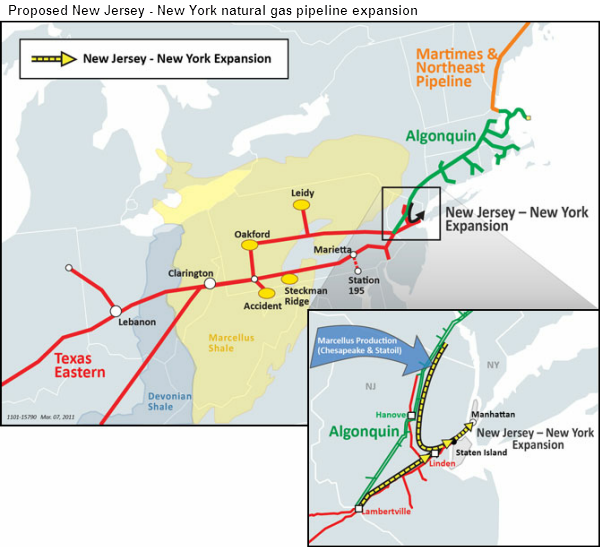
map of Proposed New Jersey - New York natural gas pipeline expansion, as described in the article text
Source: Spectra Energy Corp.
Note: In the map, the white squares are compressor stations, the yellow circles are natural gas storage fields, and the white circles indicate interconnections with pipelines.


Future natural gas transportation costs to New York City could be reduced with the expansion of the existing Texas Eastern Transmission pipeline from Linden, New Jersey to Manhattan, New York (see map above). On May 22, 2012, the Federal Energy Regulatory Commission (FERC)—the main jurisdictional authority over the construction of interstate natural gas pipelines in the United States—approved an 800,000 million British thermal unit (MMBtu) per day, or 800,000 dekatherms per day, expansion of the pipeline.
This project is slated to begin service in November 2013 and represents one of the biggest transportation service expansions in the Northeast during the past two decades. The project could have the following effects on the New York City market: reduce reliance on oil-fired generators, enhance the reliability of natural gas supplies, and lower transportation costs—especially in the winter. Spectra Energy secured firm transportation agreements for this expansion with these customers: Consolidated Edison (170,000 MMBtu per day); Chesapeake Energy Marketing, Inc. (425,250 MMBtu per day); and Statoil Natural Gas LLC (204,750 MMBtu per day).

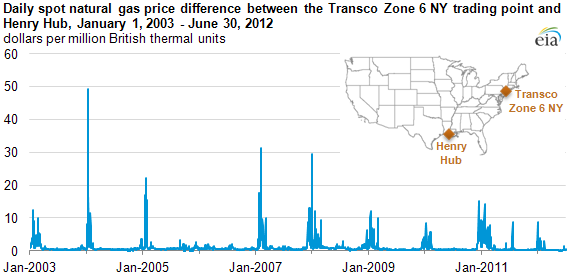
The spread between the price of natural gas at a supply location like the Henry Hub in Erath, Louisiana and a delivery market such as New York City can be quite high on congested parts of the natural gas grid, especially in the winter. For example, on a peak winter day in January 2004, the spread peaked at about $50/MMBtu—meaning the Transco Zone 6 NY price was more than nine times the Henry Hub price—as pipelines into the New York market area were highly constrained. As shown in the graph below, spreads in the $5/MMBtu-to-$15/MMBtu range have occurred frequently during December and January.

graph of Daily spot natural gas price difference between the Tranco Zone 6 NY trading point and Henry Hub, January 2, 2003 - June 30, 2012, as described in the article text
Source: U.S. Energy Information Administration, based on Bloomberg.
Note: This chart reflects the differences for physical natural gas reported at the Henry Hub and Transco Zone 6 NY trading points.


The New York City market reflects one of three major constrained areas on the natural gas grid in the Northeast United States....MORE

GAO: Will JOBS Act Increase Number of Reg A Offerings?

I have a mental problem.

When the conversation turns to Reg A I can't get Bunny Wailer/Bob Marley out of my head.
Specifically, "Lively up Yourself".

Folks at the table might think I smile because I like the deal when what's really going on is I'm seeing the attorneys with dreads, easy skankin' a spliff and talking that crazy Rasta talk “Burn the Pope. Burn the Pope man….The Pope is a vampire, wants our blood. Selassie I is the head", singing backup while Bob and Bunny do "Lively..." as live theme music.

Anyhoo...
From Security Law Prof:
The GAO issued a report on Factors That May Affect Trends in Regulation A Offerings (GAO-12-839, Jul 3, 2012), a timely topic since the JOBS Act increased the cap for Reg A offerings from $5 million to $50 million.  This is what the GAO found:

The number of Regulation A offerings filed and qualified (that is, cleared) by the Securities and Exchange Commission (SEC) has declined significantly after peaking in fiscal years 1997 and 1998, respectively. In particular, offerings filed since 1997 decreased from 116 in 1997 to 19 in 2011. Similarly, the number of qualified offerings dropped from 57 in 1998 to 1 in 2011. Securities attorneys GAO interviewed suggested that the decrease in filings after 1997 could be attributed to a number of factors, including the increased attractiveness of Regulation D. The National Securities Markets Improvement Act of 1996 preempted state registration requirements for other categories of securities including certain Regulation D offerings, which are also exempt from SEC registration. In contrast, Regulation A offerings are generally subject to state securities laws and must go through a federal filing and review process. In recent years, businesses have used Regulation D and registered public offerings to a greater extent than Regulation A....MORE

"Graphene Can Improve Desalination Efficiency by Several Orders of Magnitude, Can Do Pretty Much Anything"

 As I said in "The 2010 Nobel prizes: Physics--Graphene Researchers Geim and Novoselov Win":
Unlike the Peace Prize, you have to actually do something to win this one.
Materials science, yeah baby...
This really is a BFD.
Today's graphene story comes to us via Geekosystem:
Graphene. It can be stronger than steel and thinner than paper. It can generate electricity when struck by light. It can be used in thin, flexible supercapacitors that are up to 20 times more powerful than the ones we use right now and can be made in a DVD burner. It’s already got an impressive track record, but does it have any more tricks up its sleeve? Apparently, yes. According to researchers at MIT, graphene could also increase the efficicency of desalination by two or three orders of magnitude. Seriously, what can’t this stuff do?...MORE
HT: naked capitalism

Previously:
Andre Geim First in History to Win Both the Nobel and the IgNobel Prizes
The folks at Improbable Research (on blogroll at left) must be saying "We're so proud".
They recognized Mr. Geim's genius back in 2000 for his pioneering work in in the field of frog levitataion.
The awards celebrate achievements that "cannot or should not be reproduced."
Here is the ref. for other scholars who wish to follow his path...
Nobelprize.org interviews Physics Laureate Geim about his Ig Nobel
Climateer Line of the Day: Gecko Tape Edition
"The Future of Building Materials"
Bigger, Stretchier Graphene
"10 Companies Reinventing Our Energy Infrastructure"
Optoelectronics: Graphene shows its colours


Fun With Enron Emails II (ENE, JPM)

Hot on the heels of JPM's shenanigans (FT: JPMorgan in US Power Probe) FT Alphaville's The Closer post directed us to a data visualization of one day's emails (Dec. 26, 2000; 11 months before the bankruptcy) between various Enron executives.

Those boys were a chatty bunch.

Back in 2009 we posted "Fun With Enron Emails" (I):
... Anyhoo, I was at Trampoline's Enron email database and remembered some of the finds that other people had unearthed:
RE: Lunch
From:
randy.g.kruger.jr@us.andersen.com
To:
Sent:
09/01/2002 at 16:49

Email metadata


The message

This week is not good. I have too large a pile of documents to shred.
Next week is better. I suggest Wednesday, Thursday or Friday.
To: dgiron@enron.com, Randy G. Kruger Jr.@ANDERSEN WO,
mikeshaw@andrews-kurth.com, todd.w.taylor@bakernet.com
cc:
Date: 01/09/2002 10:26 AM
From: SSCHROED@us.ca-indosuez.com
Subject: Lunch
OK you slackers (excluding Shaw), I'll give you another chance to respond.
Lunch this week or next, let me know what's good. If meeting after work is
better for you, let me know. Certainly all of you can stop shredding
documents for 5 minutes to respond.
Schroeder
*******************Internet Email Confidentiality Footer*******************
The database is just wonderful that way. Unfortunately it does not contain the most interesting (among the cognoscenti) Enron email, which John Palmisano infamously wrote from Kyoto:

If implemented [the Kyoto Protocol] will do more to promote Enron’s business than will almost any other regulatory initiative outside of restructuring of the [electricity] and natural gas industries in Europe and the United States…. The endorsement of emissions trading was another victory for us…. This agreement will be good for Enron stock!!
It was time to turn deeds into dollars, he added:
Enron now has excellent credentials with many ‘green’ interests including Greenpeace, WWF [World Wildlife Fund], NRDC [Natural Resources Defense Council], GermanWatch, The US Climate Action Network, the European Climate Action Network, Ozone Action, WRI [World Resources Institute], and Worldwatch [Institute],” reported Palmisano. “This position should be increasingly cultivated and capitalized on (monetized).
Good times, good times at the Crooked E.

If you're interested 2008's "California's cap-and-trade won't work" has some links:
Here at Climateer Investing the comparison between California electricity deregulation and carbon trading seemed self-evident, based, if for no other reason, on the fact that the pals and alumni of Enron are the ones pushing the trade. Now the media is picking up on where the trade part of cap-and-trade is going. The LA Times gets it....
Blackout: Enron and the California Power Crisis (Transcript)...

...And scariest of all, here's a meeting on cap-and-trade where the man from Enron is the smartest guy in the room:


That leads me to one of my favorite links in the vault, the transcript of a March 3, 2000 (21 months to the really big bankruptcy filing) roundtable discussion "Domestic Emissions Trading of Greenhouse Gas Credits". Batting lead-off, the Senator from GE's home state, Joltin' Joe Lieberman. More interestingly though (sorry, Joe it's true), batting cleanup, the Enron representative really does come across as "The Smartest Guy in the Room" (that ENE link is kinda funny, in a morbid sort of way)
  • II. Opening Remarks

  • Senator Joseph Lieberman (D-CT)

  • III. Presentations by Panelists

  • Dan Lashof, Natural Resources Defense Council

  • Joe Goffman, Environmental Defense

  • John Palmisano, Enron Corporation

  • Jon Naimon, Light Green Advisors

  • Ray Kopp, Resources for the Future

  • Sue Gander, Center for Clean Air Policy
  • Good times.

    Tuesday, July 3, 2012

    Happy 4th of July!

     Genius from Jib-Jab.
    The Star Spangled Banner as performed by the last 13 Presidents (plus Teddy):

    Personalize funny videos and birthday eCards at JibJab!

    Have fun, be safe, back on Thursday.

    Kim Jong Un puts the party back in Workers' Party (North Korea Enters the 70's)

    From Foreign Policy's Passport blog:

    Want some fries with your Juche?
    Attempting to forge a new image for himself and his country, North Korea's youthful supreme leader Kim Jong Un is allowing women to wear pants, platform shoes and earrings, making more mobile phones available, endorsing previously banned foods like pizza, French fries and hamburgers — and he's giving kids free trips to zoos and amusement parks.[...]
    Kim, educated in Switzerland during his early teens, has initiated numerous policy changes to allow people more freedom and entertainment in their daily lives. North Korean state TV last month showed an image of Kim in a straw hat with a huge smile paying a visit to Mangyongdae Amusement Park and pointing at its roller coaster.
    North Korea specialist Dong Yong-Sueng tells ABC news that lifting the ban on women wearing pants and platform shoes has ushered in a "fashion revolution" in the country....MORE

    Monday, July 2, 2012

    Natural Gas Liquids: Ethane Prices Collapse (what do the E&P's do now?) CHK; RRC; EOG; DVN

    So where does Chesapeake go to fill their their cash-flow shortfall?
    From Energy Bulletin:
    According to the Energy Information Administration, in March the United States produced a "total oil supply" of 10.8 million barrels per day, which was 2.1 mb/d more than in January 2005. But if you just rely on those aggregate numbers, you'll miss some very important trends.

    The EIA's definition of total oil supply represents the sum of a number of different components. The core is field production of crude oil and lease condensates, the latter being hydrocarbons that are a gas at reservoir temperatures and pressures but that can be separated into liquids at wellhead surface facilities. This core production is represented by the blue region in the graph below. Another category is the refinery processing gain, which results from the fact that the refined products occupy a larger volume than the original crude oil. These two components represented about 3/4 of the total in 2005, but account for only 40% of the 2.1 mb/d increase in the U.S. total supply figure since 2005. A bigger factor in the U.S. increase since 2005 has been natural gas plant liquids (hydrocarbons with a higher energy content than methane which can be separated out from methane at natural gas processing facilities) and other liquids (chiefly biofuels)....MUCH MORE
    ...No major companies have stopped drilling for natural-gas liquids altogether, but Occidental Petroleum Corp (OXY) Chief Executive Stephen Chazen recently warned that the drop in prices was "troubling" and approaching levels where further production at those rates may not be economically viable.

    "If the current low NGL prices continue, cutbacks in liquids-rich wells or gas-rich wells may be necessary," Mr. Chazen said in a call last month.

    Price of ethane. Source: ino.com
    ethane_jul_12.jpg

    Oxford Analytica: Top 10 Geopolitical Risks

    From Econ Matters:
    Top 10 Warning Signs of a Global End Game 
    What a difference a year has made!  About this time last year, the dollar seemed on the brink of disaster amid the debt ceiling debate at U.S. Congress.  U.S. CDS spiked 430% in three months, and S&P downgraded the U.S. sovereign debt credit rating for the first time in history.  At the time, Euro crisis looked could be contained, and China's growth story was largely intact to still fuel the world GDP.  So it was of little surprise that the dollar collapse was ranked as the top global risk last year (See Table Below) by consultancy Oxford Analytica that could put the world into a tailspin. 

    Now, one year later, while conflicts within and with the Middle East region are still among the top global risks, the paradigm has definitively shifted to China and Europe (See Table and Chart Below). Among the top 10 global risks this year, we see 'Sharp Slowdown in China' as the most clear and present danger to the world.      
    Further Reading - 20 Warnings Signs of a Global Doomsday (2011)

    Data Source: Oxford Analytica, July 1, 2012

    Graphic Source: Oxford Analytica, July 1, 2012
    With the simultaneous slowdown in U.S. and Europe, China has become a major market for business and corporations to rely on for revenue and growth.  However, economic data coming out of China has gone from bad to worse as Europe's crisis seriously hurt China's heavy export-reliant economy....MORE

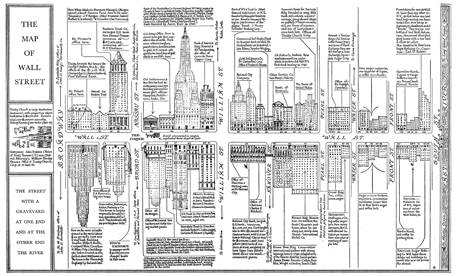
    Map: Skyscrapers of Wall Street,1930; Broadway to the River

    If interested do click through, this is quite amazing.

    From the Skyscraper Museum's "The Rise of Wall Street" exhibition:

    WALL STREET IN 1930 

    fortune 1930

    This mural is an enlargement of a drawing published in Fortune in March 1930-- the first year of publication of that magazine --as part of a five-article series on skyscrapers.  The unnamed artist with the initials "CE" depicted the full length of Wall Street from Broadway to South Street, as the artist of the Lowenstrom panorama had done eighty years earlier. The major changes were all in the western end, where skyscrapers of 40 to 70 stories now climaxed most blocks. Between Water and Front streets, there remained many buildings of four to six stories that still functioned, as they did in the mid-19th century, as the offices and exchanges for commodities brokers of sugar, molasses, coffee, and cocoa.


    fortune 1930
    Click on the map to zoom and pan in a new window

    Fortune's focus on business and finance guided the amusing and informative captions that emphasized the various buildings' resident bankers, executives, and substantial gold reserves.

    The whole exhibition may be of interest to denizens and former denizens (and maybe a few ghosts)

    Insider Trading: Chesapeake Energy Directors Buying Size (CHK)

    The stock is at $18.69, up 9 cents on a sideways to down day.
    When looking at insider buying the hierarchy of insiders is:

    #1 CFO's--if the money guy is buying, pay the offer.
    #2 CEO's--because they are the company's ambassador they often buy stock just for show, pay attention.
    #3 Directors--newly elected directors often buy as a show of support, others because they buy what they know. Look for decent-sized additions to existing positions.

    It's not the only piece of the puzzle, especially in Chesapeake's case but this is definitely a positive.

    From SEC Form4:

    Common stock purchase or sale:
    Transaction
    & Date
    Reported
    Date
    Company Symbol Insider
    Relationship
    Shares
    Traded
    Average
    Price
    Total
    Amount
    Shares
    Ownership
    Filing
    2012-06-27
    Purchase
    2012-06-29
    4:54 pm
    CHESAPEAKE ENERGY CORP CHK MILLER MERRILL A JR
    (Director)
    27,700 $18 $498,462 159,017
    (Direct)
    View
    2012-06-28
    Purchase
    2012-06-29
    4:51 pm
    CHESAPEAKE ENERGY CORP CHK MARTIN R BRAD
    (Director)
    20,000 $17.75 $355,000 55,000
    (Direct)
    View
    2012-06-12
    Purchase
    2012-06-14
    6:35 pm
    CHESAPEAKE ENERGY CORP CHK DIXON STEVEN C
    (EVP - Operations and COO)
    860 $17.5 $15,054 860
    (Indirect)
    View
    2012-06-07-
    -2012-06-08
    Sale
    2012-06-11
    5:41 pm
    CHESAPEAKE ENERGY CORP CHK MAXWELL CHARLEST
    (Director)
    5,193 $18.34 $95,224 111,591
    (Indirect)
    View

    Those Deadbeat Germans

    Ja, ja I know the Germans made their final (adjusted) reparations for WWI payments in 2010 but as we saw in "The Debt Jubilee That Gave Birth to Modern Germany" they caught a pretty big break on the costs of their WWII nastiness.
    (we also dispelled the notion of the Devil-may-care German in "Study Finds Germans Incapable of Enjoying Life" but that's a different story)

    Here's more on Germany and it's creditors, from Bloomberg's Echoes blog:

    Germans Taking the Wrong Lessons From History of Default
    Echoes:  6/28
    A poster declares Germany's intention to honor the interest on its war bonds, ca. 1919. 
    Source: Library of Congress Prints and Photographs Division 

    Germans complaining about how Greeks, Italians and Spaniards aren’t paying their debts is a recurring feature of Europe’s debt crisis.

    In May, German Finance Minister Wolfgang Schaeuble declared in a radio interview that “We Germans show that it’s possible to have solid fiscal policy and generate growth at the same time. We have the lowest unemployment. Those recipes that work for us must be applied in other countries and not the opposite.” A month later, he complained that Greece’s crisis was due to “decades of economic mismanagement.” And this week, he said U.S. President Barack Obama “should, above all, deal with the reduction of the American deficit.”

    An earlier generation of investors would be shaking their heads. Germany in the 1920s was synonymous with default. After suffering serious hyperinflation following World War I, Germans received the kinds of loans and debt- restructuring plans from the U.S. that Schaeuble and the German parliament are furious about offering to Greece and others today. Germans were considered the unhealthiest borrowers in the world, though that didn’t stop American companies such as National City Bank and Dillon, Read & Co from lending in what historians call “the great bond boom” of the 1920s.

    German Recipes
    Herbert Hoover, then the U.S. secretary of commerce, was troubled by what seemed like reckless lending to German municipalities. But, perhaps believing in German “recipes” for sound fiscal policy, he gave official consent to more than $1 billion a year in foreign, high-yield, dollar- denominated loans from 1924 to 1928. Hoover’s office even issued a covering letter for these risky loans, asserting that since they didn’t affect government policy, the U.S. government had no objection to them.

    Most of these loans went to fund construction projects throughout Germany. They ended the hyperinflation, and U.S. savings banks quickly snatched up the high-yield bonds, confident that thrifty Germans would repay their debts. Repayment plans were left sketchy at best.

    Meanwhile, the German government still resented the costly reparations imposed on it for World War I. In October 1927, Seymour Parker Gilbert, the U.S. official charged with extracting reparations, complained to the German government that in taking on billions of dollars in municipal loans while still owing so much money, Germany was “living beyond its means.” Gilbert criticized Germany’s system of tax payouts to its states, and warned that the loans might never be repaid.

    German political parties quickly dismissed Gilbert as ignorant and disrespectful, and then used his report to attack one another. The burghers of 1920s Germany would be shocked today at Schaeuble’s demand for Italy to install a technocratic government or for Greece to postpone its elections.

    But Gilbert was right; the Germans couldn’t repay their loans. By late March 1928, German Finance Minister Heinrich Koehler publicly confirmed what Gilbert had guessed the year before....MORE

    Not Only is China's Broad Group Planning to Assemble the World's Tallest Building in 90 Days, They Are Planning TO CAPTURE 30% OF THE WORLD's Construction Market (and cut energy costs by 50%)

    Talk about thinking big.
    Following up on "UPDATED--China Plans to Build World's Tallest Building in Just 90 Days" and "China's Plan for the World's Tallest Building: The Rest of the Story".

    From Metal Buildings and Steel Structures (India):

    China’s Broad Group aims for rapid growth
    It hit the headlines last year with its sensational YouTube videos that showcased construction of a 15-storey hotel in six days and a 30-storey one in nine days. Now, China’s Changsha-based Broad Group’s construction subsidiary, Broad Sustainable Buildings (BSB), has recently received a go ahead from the district government and is awaiting a similar sanction from the central government for a 220-storey tower that will be, at 838m, the tallest building in the world. It plans to complete the erection in a record seven months.

    The rapid speed with which Broad manages to erect buildings on site has been made possible by the fact that 93% of the materials are pre-fabricated in a factory. The company says that the technology lowers costs by three to ten times, making it feasible to have larger and taller buildings. Currently the system is 20-30% lower on costs than competing Chinese companies, but much more significantly below construction costs in developed countries.

    With plans underway to establish a global network of franchisees, the company has also announced its aim of capturing 30% of the world’s construction industry in the next few years. Given the rapid pace of urabnisation in China, observers believe that this feat can be achieved by emerging as the dominant player in the construction industry in China alone.

    Set up in 1988, Broad has a well established presence in manufacturing and selling central air conditioning non-electric absorption chillers that are powered by natural gas and waste heat to over 70 countries worldwide. It diversified into the pre-fabricated construction business in 2009.

    BSB focuses on high energy efficiency and carbon reduction primarily through thermal insulation. Its building’s have 150mm exterior insulated walls, triple-paned windows, exterior solar shading, interior window insulation and heat recovery fresh air; and are, therefore,  80% more energy efficient than conventional buildings. Further, adopting a “distributed energy system”, where turbines provide power independently, exhaust from turbines is the source for cooling, heating and sanitary hot water, the building is 50% more energy efficient than one linked to a power grid....MORE
    Got that?
    Dramatically more Energy Efficient.
    Faster
    Cheaper.
    And boy can it catch fish

    They are the freakin' 4 Non Blondes of the construction biz:

    Bigger, Better, Faster, More!

    Sunday, July 1, 2012

    The Real Problem With Stimulus

    I've mentioned a few times that Keynes was all about the countercyclical thing.
    In the U.S. we have devolved to perma-stimulus, every dollar of deficit spending being stimulus, and have no plans to ever stop. Anyone who argues that stimulus isn't stimulus unless it is labeled stimulus is being sillier than I felt when I typed this sentence.
    Deficit spending is stimulus whether you call it ARRA, sweet, sweet Biden love or Democracy's flaw.
    From RealCleaMarkets:
    The Marginal Economics of the Welfare State
    The recent news that Fed Chairman Ben Bernanke is launching a second Operation Twist, yet another round of monetary stimulus, raises two related questions: Why do they keep trying this even though it doesn't work, and why doesn't it work?
    I am not the first to note that we are living in an era of "permanent stimulus," and it's not just monetary. In fact, you can look at the whole welfare state as a permanent, standing "stimulus" program, since it borrows trillions of dollars that are continually pumped into the economy by increasing the consumption spending of those who otherwise could not afford it. The Supreme Court just removed a major obstacle to a new expansion of that permanent stimulus state-which makes the question of why stimulus fails all the more urgent.

    A big clue to the answer is that stimulus fails because it always becomes permanent. The original Keynesian theory of stimulus was that the government would borrow and spend during an economic downturn in order to stimulate economic growth, and then once that growth took off, government would stop stimulating, cut its expenses, and pay down its loans. At least, that is how the idea is generally sold. The stimulators tell us that a recession is the wrong time to cut back spending, as if they ever thought that there might be a good time.
    But they never do, and there is an inexorable logic to this. If economic growth is based on government stimulus, if that is what gets the economy going, then we would never dare to remove the stimulus, for fear of stopping the government's engine of growth. Keynes himself agonized that cutting back on the World War II defense buildup, which supposedly ended the Great Depression, would plunge the economy back into a decline. It did the opposite, of course, but our great economists never learned the lesson. And so we see the pattern of the current Stimulus Depression. Every time one round of stimulus begins to wear off, as is happening now, the Fed injects another.

    It reminds me of an interview I saw once with a former methamphetamines addict who described how, as always happens, his body became accustomed to the drug. It became the "new normal," and he needed larger doses to have the same effect. By the end, the drug he once took to experience a high of superabundant energy he now took just to be able to get out of bed in the morning. That pretty much describes the function of Operation Twist, Part Two. The economy is hooked on stimulus, and it keeps needing just one more fix, not to thrive, but to keep from crashing.

    Addicts are known for having their "lost decades," years that they spend searching for short-term highs instead of dealing with their deeper problems. So it should be no surprise that our addicted economy is halfway through a lost decade of its own.

    And it's not just that stimulus is permanent. It also becomes all-encompassing. Consider the pattern of the growth of the welfare state-again, this is a permanent, standing form of stimulus spending-to encompass every economic need experience by everyone. James DeLong has a good summary of this process.
    "[T]he concept of 'welfare' has become an open, bottomless vessel into which every desire can be poured: Government takeover of the entire health and retirement systems; detailed regulation of employment; manipulation of money; subsidies for housing, education, energy, food; or anything else that strikes the fancy of some segment of the public.

    "The 'some segment' part is crucial, because today's welfare has ceased to be limited to that of the public generally, or to the welfare of any group that has a serious claim to special deserts. Instead, it is the welfare of some special interest that is able to capture the policy process."

    Hence the political resistance of public employees' unions against any attempt to make their own portion of the modern welfare state a little less comfortable....MORE
    A couple days ago OfTwoMinds had a piece on how little bang for the buck we get for each dollar of debt  versus the impact in prior decades, another point we've harped on:

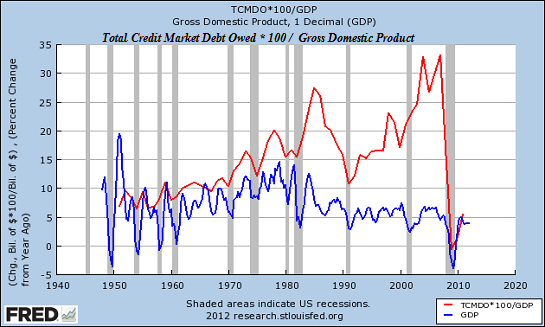
    Why The Debt-Dependent Status Quo Is Doomed in One Chart
    The global economy is now addicted to debt. Once debt stops expanding, the economy shrivels. But expanding debt forever is unsustainable. Welcome to the endgame. Regardless of whether you call it debt saturation or diminishing return on new debt, the notion that taking on more debt will magically enable us to "grow our way out of debt" is not supported by data. Correspondent David P. recently shared this chart of Total Credit Market Debt Owed and GDP and this explanation:

    The purpose of this chart is to examine the relationship of total debt to GDP. Since Debt is not factored into GDP, just exactly how much debt is being used to create growth, and over what time periods. But absolute numbers don't work so well, since they don't let you examine particular years, seeing what the 1950s look like vs the 2000s, for example. Red Line: Annual Change in TCMDO (Total Credit Market Debt Owed) * 100/ That year's total GDP, showing that year's % increase in TCMDO/GDP.
    Blue line: % change in GDP over last year.
    Any gap between the red line and the blue line is what I would call the creation of debt in excess of income. And that gap is the ANNUAL gap, not a cumulative gap. As an example, in 2008 TCMDO grew by an average of 30% of that year's GDP, while GDP itself grew by around 5%. Ouch.

    So projecting forward, how much debt growth do you think we'd need to get back to business as usual? 50s was 8%, 60s about 12%, 70s 15%, 80s maybe 20%, 90s back down to 15%, and 00s probably 25-30% per year. We'd probably need a surge of 35% or more, per year, to bring back those exciting bubble years. But who could possibly have the income to support that? To quote the parable of the Little Red Hen: "Not I", said the goose.
    Thank you, David. Note what happened to GDP the moment debt ceased expanding in 2008: it tanked. This is the chart of debt addiction: the moment the expansion of debt is withdrawn, the economy implodes....MORE

    Iran Threatens To Wipe Israel "Off the Face of the Earth". In Other News...77% of JP Morgan’s Net Income Comes from Government Subsidies

    From Reuters:

    Iran threatens Israel; new EU sanctions take force
    Iran announced missile tests on Sunday and threatened to wipe Israel "off the face of the earth" if the Jewish state attacked it, brandishing some of its starkest threats on the day Europe began enforcing an oil embargo and harsh new sanctions....MORE
    Some things never change.
    Until they Do

    If you're a masochist here's the JPM story.