From the U.S. Drought Monitor at the University of Nebraska-Lincoln. First up, the current (published October 8) map:
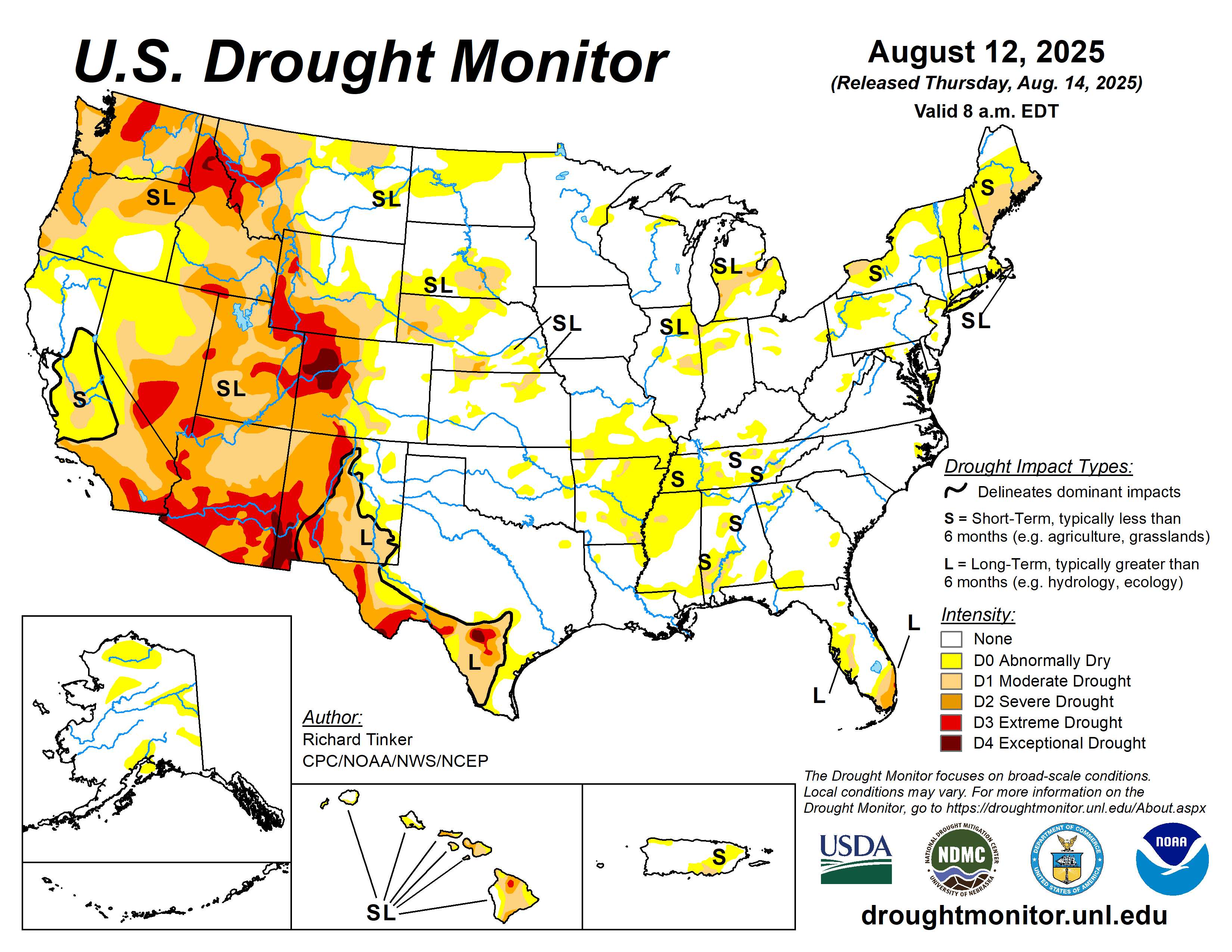
The improvement via the National Drought Mitigation Center:

Data Tables: Percent Area in U.S. Drought Monitor Categories (back to April 21)
Week | None | D0-D4 | D1-D4 | D2-D4 | D3-D4 | D4 | |
|---|---|---|---|---|---|---|---|
| 2026-10-06 | 24.17 | 75.83 | 55.21 | 31.45 | 9.87 | 1.15 | 174 |
| 2026-09-29 | 21.64 | 78.36 | 59.38 | 33.78 | 11.53 | 1.59 | 185 |
| 2026-09-22 | 21.12 | 78.88 | 59.24 | 33.58 | 12.17 | 2.11 | 186 |
| 2026-09-15 | 19.03 | 80.97 | 59.37 | 33.82 | 12.54 | 2.02 | 189 |
This is exactly what we were thinking of back in May—"seems to be an El Niño developing" was decidedly tongue in cheek, everybody and his brother was solemnly proclaiming "We're all going to die."
May 14, 2026
Drought:Intensifying, Spreading Across The U.S.
This is the first time this year we've posted the Drought Monitor map.
There seems to be an El Niño developing off the coast of South America which would mitigate some of the dryness in the southern and central U.S. Meaning that as all around you are losing their heads shouting "drought, drought" there would be wetter weather just over the horizon which would ruin any long futures one had on corn, beans or wheat.
However! If the arrival of the moisture is delayed much past July 1 it could be just awful for the farmers. So this is a heads-up but not actionable. Yet.
Layering one complex/chaotic system, financial derivatives, on top of another complex/chaotic system, weather can get interesting in ways even the best supercomputers haven't quite figured out....
The moisture is not a direct result of El Niño but rather from the Pacific storms (which are partly the result of the El Niño) including two hurricanes that have landed in Mexico and moved on to the Southwest United States.
And here is another, via The Watchers, October 10:

Tropical Storm Rachel brings flash-flood threat to Southern California and U.S. Southwest
Now we have to determine if the rain came early enough and heavy enough to aid the 2027 planting season.

