Saturday, November 21, 2026

Goldman Sachs Brian Garret: The 2018 Playbook Returns—And Nobody Knows How It Ends

In 2018 it ended on Christmas Eve and things became very jolly indeed.

From The Dark Side of the Boom substack, November 20:

Wall Street has developed an uncomfortable fascination with the fourth quarter of 2018, and after another brutal session across global equities, it is becoming increasingly difficult to dismiss the comparison. A Federal Reserve still determined to tighten monetary policy, collapsing technical support, deteriorating liquidity and systematic selling have produced a market that looks increasingly familiar to anyone who spent that Christmas on a trading desk.

Takeaways by The Dark Side of the Boom™ 

• Goldman Sachs’ derivatives desk is revisiting the December 2018 liquidation, when a hawkish Fed, collapsing technical support and systematic selling produced a market that even seasoned traders struggled to explain.

• Technology has already absorbed much of the damage experienced during the 2018 correction, but credit markets and the front end of the rates curve have barely begun to respond.

• Volatility markets are signalling extreme stress, yet the absence of a broader credit shock leaves open an uncomfortable question about whether the equity correction has further to run....

....MUCH MORE 

Some of our memories of that five-week downturn and the subsequent reversal: 

December 20, 2018 - Hulbert: "Santa Claus is coming to Wall Street — after Christmas"

This piece was published ~45 hours—i.e. ~1000 DJIA points—ago. Some say Santa has left the building or, even worse, that there is no Santa but that question was answered, in the affirmative, by the New York Sun long ago (1897):
DEAR EDITOR: I am 8 years old.
Some of my little friends say there is no Santa Claus.
Papa says, ‘If you see it in THE SUN it’s so.’
Please tell me the truth; is there a Santa Claus?
VIRGINIA O’HANLON.
115 WEST NINETY-FIFTH STREET.

VIRGINIA, your little friends are wrong....
***
...Virginia, the DJIA may be down 453.22 (-1.94%) at 22,870.44 but Santa is coming, so ask him for some OTM calls on the ES. Or get your name on some triple leveraged long ETFs. He's on his way.

And I will drop Mr. Hulbert a line re: the 1914 shutdown and reopening and remind him he knows the details and could have taken another paragraph to explain index construction. 
Dec. 26, 2018 - Equities: Thank You Santa
I received the options on the S&P futures and I have to say, earlier this morning I thought XXL was far too big
And on top of that I was a bit nervous about having gone public with December 20's Hulbert: "Santa Claus is coming to Wall Street — after Christmas", reiterated as the first sentence in Dec. 23's Equities: "Nothing Goes to Hell in a Straight Line, Not Even Stocks".
If you hadn't come through all those young people on the internet might have lost faith and stopped believing,
But you delivered Santa, you did!
Right down to the minute!....
January 20, 2019— Equities: Dear Santa,
Thank you for The Best Christmas Ever......scratch that: Thank you for the best Christmas in a long, long time:

January 23, 2019 - IBD: "Dow Jones Rises 3,100 Points From Dec. 26 Low; 6 Top Stocks Break Out"

Yeah, yeah. We've already thanked Santa and cut the risk profile, letting-go of the triple-leveraged index stuff and figuring basis on the S&P e-mini options. On to the individual issues and maybe a sinkhole of a Broadway production.

Not So Effective: "How Sam Bankman-Fried Lost Out on a $35 Billion Jackpot From Anthropic" (ANT)

The outro from a November 14 post, "Claim That Anthropic Wants To Be The Only Private Company In The World Draws CEO Dario Amodei To X With Clarification":

Speaking of Sam Bankman-Fried I just saw that had he not been taken down for the frauds and conspiracies, the Anthropic stake, at FTX Trading or Alameda Research, I've forgotten which, would be worth $40 billion. 

From the New York Times, November 16: 

The founder of the collapsed FTX crypto exchange, who is serving prison time for fraud, would have made a windfall from a $500 million investment in Anthropic. 

Sam Bankman-Fried, the convicted cryptocurrency fraudster, lives in a 30-person unit at the federal prison in Lompoc, Calif., a barbed-wire compound about a million miles away from his former life as a technology billionaire in the Bahamas.

For the most part, Mr. Bankman-Fried, 34, tries not to think about all the “could-have-beens,” he said on a recent call. But one has become difficult to ignore.

In late 2021, the heyday of his FTX crypto exchange, Mr. Bankman-Fried spent $500 million on a 13.5 percent stake in a little-known artificial intelligence start-up called Anthropic. This week, Anthropic is set for an initial public offering that is expected to value the company at $1.4 trillion, potentially one of the largest Wall Street debuts in history.

At that valuation, Mr. Bankman-Fried’s investment, diluted over several years, would now be worth an eye-watering $35 billion — about the size of FTX’s entire business at its peak.

But the shares are gone. They were tied up in bankruptcy court until 2024, when executives overseeing the scattered remains of FTX sold the Anthropic stake for $1.34 billion — a tiny fraction of its current value.

For Anthropic, the fate of those shares is an odd quirk of history. For Mr. Bankman-Fried, it’s a source of extreme frustration and resentment. Even after a fraud conviction, a failed appeal and a succession of public humiliations, he is still trying to prove his innocence, arguing that FTX had sufficient resources to avoid bankruptcy.

“There’s no point in obsessing over regrets,” he said. “But it’s certainly something that I’ve spent, despite that, a fair bit of time thinking through.”

In September, Mr. Bankman-Fried submitted the longest of long-shot appeals to the Supreme Court, where he cited the Anthropic investment. He claimed that the judge in his trial had improperly prevented him from arguing that FTX had enough money to repay its users.

But none of his arguments was ever likely to overcome the basic facts of FTX’s collapse, an epic financial fraud that drew instant comparisons to Bernie Madoff’s Ponzi scheme. Mr. Bankman-Fried gave up control of FTX in November 2022, after a run on deposits exposed an $8 billion hole in customer accounts. A year later, he was convicted on seven counts of fraud and conspiracy. He had used the missing money to buy luxury real estate, donate to political campaigns and invest in start-ups like Anthropic.

Ultimately, the return on those investments proved irrelevant, as far as guilt and innocence were concerned. In U.S. District Court for the Southern District of New York, Judge Lewis A. Kaplan memorably compared Mr. Bankman-Fried to a “thief who takes his loot to Las Vegas and successfully bets the stolen money.” He sentenced him to 25 years in prison.

“Mr. Bankman-Fried conveniently skips over the fact that he misappropriated and gambled with customer monies,” John J. Ray III, a corporate turnaround expert who oversaw the bankruptcy, said in a statement. “We are proud of the integrity and impact of the work we have done with our large team of committed professionals.”

A spokeswoman for Anthropic declined to comment.

Before FTX filed for bankruptcy, Mr. Bankman-Fried was worth an estimated $24 billion, giving him tremendous influence in business and politics. His company was one of the world’s largest crypto exchanges, a venue where customers could buy, sell and store digital coins.

Mr. Bankman-Fried was also a leading practitioner of “effective altruism,” a philanthropic movement that focuses on combating threats that might emerge decades or centuries in the future. Like many effective altruists, Mr. Bankman-Fried was concerned about the dangers of out-of-control A.I. long before it became a major talking point in American politics.

Those views aligned him with Dario Amodei, the chief executive of Anthropic, who moved in the same effective altruist circles. Dr. Amodei started the A.I. company after leaving a rival, OpenAI, in late 2020 amid disagreements over how to make the technology safer.

Mr. Bankman-Fried said he spoke with Dr. Amodei not long after that, when FTX was based in Hong Kong. “I was one degree removed and knew a number of people who knew him,” Mr. Bankman-Fried recalled. Dr. Amodei struck him as “really intelligent, dedicated, very knowledgeable.”

In April 2022, Anthropic announced the investment from Mr. Bankman-Fried and two of his FTX colleagues, drawing little notice at the time.

“We cared about A.I. companies being responsible, and preparing for A.I. to help rather than hurt society,” Mr. Bankman-Fried said on the phone from prison. “Anthropic seemed far more committed to that than the other major companies.”....

....MUCH MORE 

Probably related: 

April 2023 - Exclusive: Effective Altruist Leaders Were Repeatedly Warned About Sam Bankman-Fried Years Before FTX Collapsed  

Friday, November 20, 2026

"Trump is trying to stop Big Tech’s push to build data centers outside the U.S."

From MarketWatch, November 20:

Candidates rode opposition to data centers to wins in the midterms, making company leaders and investors wary of the industry’s future here 

The companies behind the artificial-intelligence buildout have been working to build their next frontier abroad, amid growing wariness of data centers from politicians and ordinary Americans.

Now, President Donald Trump may be trying to upend their plans, citing fears that locating data centers outside the U.S. could give China an edge in the AI race.

“We’re not going to allow companies to build data centers in other countries,” Trump told reporters Friday. “If they do that, they can. But we’re going to put a tremendous tax on them.”

Midterm wins by some Democratic candidates who ran on opposition to data centers have had tech leaders and investors worried about the future of the industry in America. Even before the election, competition for suitable land in the U.S. was fierce. 

“The availability of good sites that can access power quickly in the U.S. is shrinking by the day,” said Ben Alingh, co-founder and CEO of data-center developer Monarch Energy.

A number of companies are looking at new places to position their assets somewhere that might offer “a smoother path,” and also as part of a natural business process of looking outside the U.S. for the next market, he said.

From software and cloud-computing giant Oracle to relative newcomers such as CoreWeave, several U.S. companies have shared plans to expand abroad in recent days....

....MUCH MORE 

After the U.S. midterm elections on November 3, the talking-head consensus was that existing data centers just became more valuable with the slowing of permitting in some jurisdictions and the outright banning of data centers in others.

However, watching and hearing the utterances of the incoming legislators and administrators regarding packing the Supreme Court as a way to re-write the Constitution without all that amendment or convention bother, means one should probably be very cautious about making such a claim.

Having the Court do political bidding in this manner would open up all those sections and clauses of Article I that kids used to learn about in grade school: compacts without the consent of Congress, bills of attainder, ex post facto laws etc., etc.

We are definitely in uncharted territory. 

"U.S. SEC Probes NVIDIA's Accounting in Depth, Piling on Export-Control and Antitrust Woes" (NVDA)

From The Financial News (Korea), November 21:

The U.S. Securities and Exchange Commission (SEC) has launched an investigation into NVIDIA's accounting practices, putting changes to its regional revenue calculation criteria and financing arrangements under scrutiny.

Reuters reported on the 20th local time, citing multiple sources, that the SEC's investigative team is closely examining potential accounting issues at NVIDIA. The Wall Street Journal (WSJ) first reported on the 17th that the SEC had launched an investigation into NVIDIA; the focus has since narrowed to its “accounting practices.”

The exact timing of the investigation's launch and the details of the allegations have not been confirmed. An SEC spokesperson declined to comment, and NVIDIA did not immediately state its position.

Markets and foreign media are focusing on the change NVIDIA made last year to its regional revenue disclosure criteria, amid news of the SEC's accounting investigation. During the last fiscal year, NVIDIA changed how it calculated regional revenue, switching from the “billing address” to the “location of the customer's headquarters.” After the change, revenue from Singapore, which had previously been disclosed as a separate line item, was excluded from its disclosures.

Singapore is where Megaspeed International, a major NVIDIA customer, is based. Alice Huang, with whom former CEO Jensen Huang acknowledged having an extramarital relationship, served as an executive at the company. Given Singapore's sizeable share of total revenue, questions have persisted about why NVIDIA changed its disclosure method midway through the fiscal year. At the time, NVIDIA said the change was intended to more accurately reflect the actual geographic composition of its revenue....

....MUCH MORE 

Also at The Financial News:

NVIDIA Corporation Plunges 46% in Seven Weeks... Longest Losing Streak Since 2008 Financial Crisis 

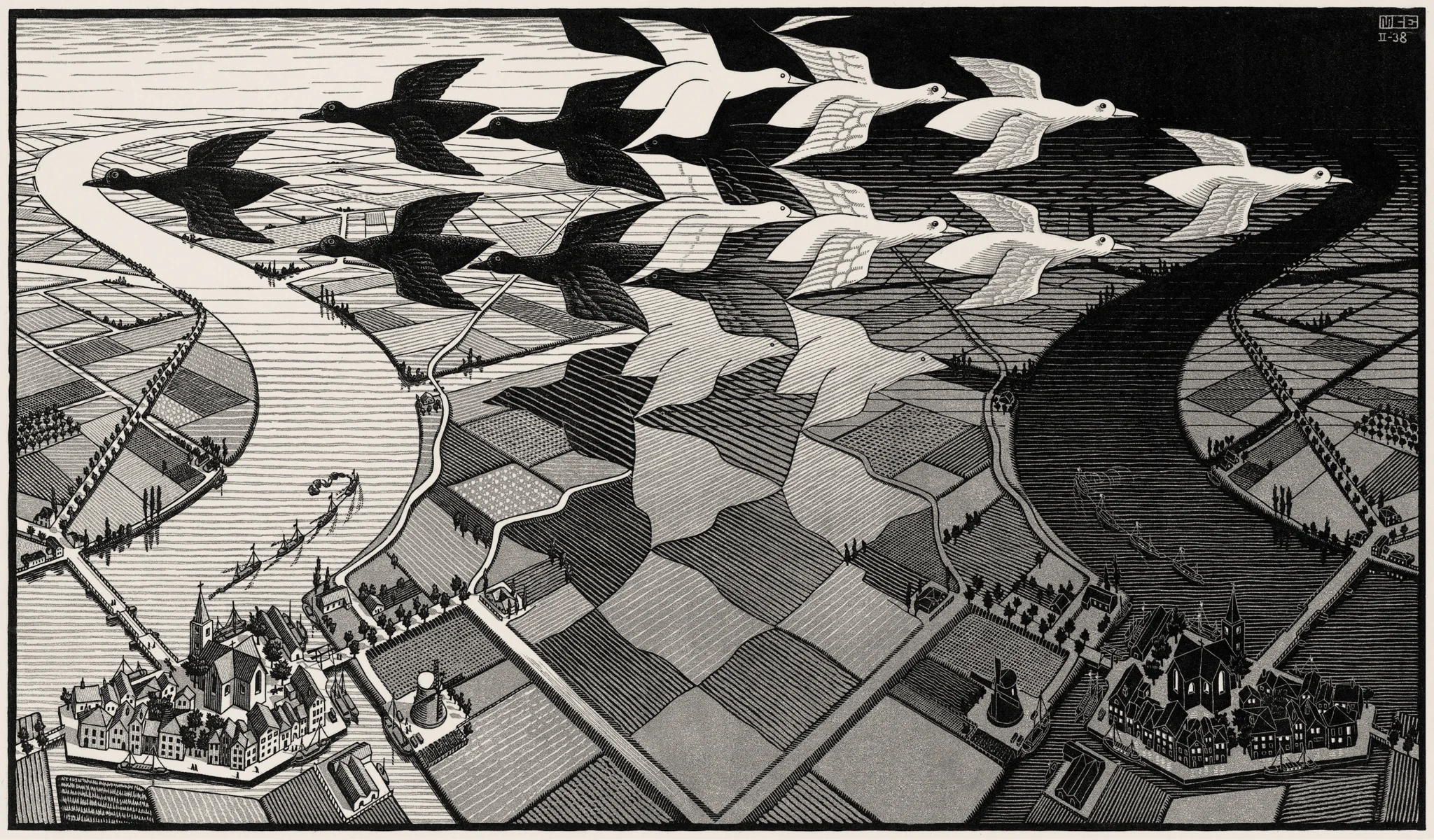
"How M.C. Escher’s Art Creates Bizarre Mathematical Worlds"

From Quanta Magazine, 

The artist had no formal math education, yet as a new exhibition shows, the insights revealed in his artwork became an enduring inspiration to mathematicians.  

https://www.quantamagazine.org/wp-content/uploads/2042/11/ImageGallery_EscherMath-crSEENOTES-Lede-v2-2048x1200.webp 

 Day and Night, February 1938, woodcut printed from two blocks, 15 3/8 x 26 5/8 in

Maurits Cornelis Escher didn’t plan on becoming the darling of mathematicians. Born in 1898 in the canal-lined city of Leeuwarden in the Netherlands, Escher struggled with mathematics as a student, once remarking that he “never got a pass mark.” He ended up studying decorative arts and printmaking, and he used his artwork to explore the strange rules of nature that he found operating around him.

Escher saw that nature can sometimes produce impossible-seeming images. All around him, he saw distorted reflections, odd perspectives, and superimposed worlds, like the surface of a pond where you can see images of both the fish below and the trees reflected from above.

In rendering these and other visions, his artwork took on unmistakably mathematical qualities. “By keenly confronting the enigmas that surround us, and by considering and analyzing the observations that I had made, I ended up in the domain of mathematics,” he wrote in his introduction to the book M.C. Escher: The Graphic Work.

His journey among these enigmas is the subject of an exhibition entitled Mathematics and the Art of M.C. Escher (opens a new tab) at the National Museum of Mathematics (MoMath) in New York City....

....MUCH MORE, many of the prints, some famous, some that may be new to the reader.

Related:

August 2014 - The Advantages of Dyslexia

February 2014 - "Why strange loops could be an argument for artificial intelligence"  

Previously on the Strange Loops Channel (Feb. 2012):

Climateer Headline of the Day: Strange Loops Edition

First, a quick definition from Wolfram Math World:
A strange loop is a phenomenon in which, whenever movement is made upwards or downwards through the levels of some hierarchical system, the system unexpectedly arrives back where it started. Hofstadter (1989) uses the strange loop as a paradigm in which to interpret paradoxes in logic (such as Grelling's paradox, the liar's paradox, and Russell's paradox) and calls a system in which a strange loop appears a tangled hierarchy.... 
Here's a graphic example of a strange loop:

Drawing Hands M.C. Escher, 1948

....MUCH MORE 

And February 2026:

"Topology of 'China AI'"

From the Concurrent substack, September 11, 2025:

On circles, misconceptions, deep infrastructure, founder archetypes, state's role, memes, AGI. A conversation about the topology of China’s AI world for you.  

H is an AI engineer at one of China's largest tech companies, leading an open-source project. A few weeks ago, I met him in Shenzhen during a self-organized "China AI/tech tour" with several US tech writers.1 After peppering him with questions—the most obvious one being "What's Silicon Valley's biggest misunderstanding about China's AI?"—I discovered someone so thoughtful and genuinely bilingual.

His daily routine reveals the paradox: wake up, doomscroll X, debate on LessWrong, drive his NIO to work, then use English more heavily than when he studied in California. He loves watching Westworld and treats Gödel, Escher, Bach as AI scripture. Apart from geography, H could be any engineer at Anthropic or Google....

Record-breaking rain lashes California’s Bay area as ‘atmospheric river’ arrives (plus: The ARkstorm scenario)

From the Guardian, November 18:

Storm expected to move into southern California, with LA residents warned of potential evacuation orders 

Heavy rain pounded California’s Bay area, with record rainfall in downtown San Francisco and flooding and power outages across the region, as an “atmospheric river” arrived on Wednesday and dumped precipitation across the state.

The storm was expected to move into southern California on Wednesday night and Thursday, with Los Angeles warning residents in mudslide-prone areas of potential evacuation orders to come. Southern Californians were also warned of potential coastal flooding, heavy surf, wave damage to coastal piers and parking lots and beach sand erosion. Heavy snow warnings were issued for higher elevations of the Sierra Mountains, including in the Greater Lake Tahoe area.

Downtown San Francisco saw the most rainfall before noon in 76 years, at 2.11in, surpassing a record from 1950, the San Francisco Chronicle reported. By 3pm, Wednesday’s daily total of 2.28in had broken the record for the most rainfall on 18 November, which was previously set in 1918, the National Weather Service reported. South of San Francisco, in Santa Clara, there was flooding and standing water on several highways....

...MUCH MORE

If interested see also:

El Niño: "The ARkStorm Scenario Could Flood California's Central Valley like a Bathtub and Cost $725 Billion"

Capital Markets: "Oil and Stocks Drive Rates Lower, and Take Some Shine Off the US Dollar"

From Marc Chandler at Bannockburn Global Forex:

The US dollar is mixed today but ahead of the North American open, it is mostly softer. The Japanese yen and Swiss franc are the strongest, which is used to buttress the safe haven narrative. The focus is the continued equity sell-off. Neither Nvidia’s strong earnings nor Anthropic’s record IPO managed to bolster sentiment. 

The equity meltdown and the drop in oil prices (January WTI is off nearly 6% this week) has spurred a bond market rally. The 10-year US Treasury yield is off nearly 15 bp this week, and despite hawkish comments from several Fed officials, the two-year yield is off nearly 12 bp. The softer yields seem to be lessening the greenback’s appeal.... 

....MUCH MORE 

Thursday, November 19, 2026

"An analyst explains the ‘trigger’ that prompted him to sell every stock he owns on Anthropic IPO day"

From CNBC, November 19:

  • Panmure Liberum’s Joachim Klement said Thursday he planned to sell all of his stocks.
  • His team said in a note that investors should “go fully defensive.”
  • They outlined why they’re anticipating the AI bubble will soon burst, and which pockets of the market offer “the best hiding place.” 


Our first mention of Mr. Klement on the blog was on May Day, 2015 when he was working in Zurich.

Since then we've linked to him either at Reuters where he wears a columnist hat or at his personal substack.

April 2021 - Follow-up: Inside The Secretive World Of Chinese Foreign Infrastructure Loans 

September 2024 -"Germans are bad at investing"

February 2026 - "Why investors are getting the US debasement trade all wrong"   

A Reuters mini-essay from Joachim Klement whose substack tagline is:

Thoughts on financial markets by a grumpy, middle-aged German. What more do you want? Click to read Klement on Investing, by Joachim Klement, a Substack publication with tens of thousands of subscribers. 

And on IPOs marking a top:

February 2026 - "OpenAI, SpaceX and other IPOs could break the S&P 500, Jeremy Grantham says"
Ummm, yes.*

——— 

*Subjects near and dear: supply, demand, liquidity etc. 

October 2008 - IPOs Produce Smallest Gains Since 1995 as Offerings Increase

Supply and demand. The one effect I can guarantee is the sopping up of billions of dollars and yuan* that would otherwise go into currently trading issues. IPO exits are not only a sign of a top but actually help bring them on by removing some liquidity....

December 2018 - "Nasdaq, 'Tech,' & IPOs are in for Gut-Wrencher"

The Fed's interest rate moves are not that big a deal.
I know that runs counter to a lot of commentary but the upticks are not a problem. Yet.
The bigger headwind facing the market is the Fed's balance sheet unwind sucking up liquidity.
And next year's planned mega-IPOs threatening to do the same....

September 2025 - "US IPO Activity On Track For Best Quarter Since Q1 2022"

This is what we were referring to introducing August 6's "Blackstone prepares portfolio companies for IPOs":

One of the reasons markets trend higher is a lack of new shares coming on to the market.

Over the last few months the IPO window has been opening and the offerings absorb buying power that would otherwise go into issues already trading.

See also: supply/demand.

The Wall Street marketeers are nothing if not opportunistic.

And depending on how much stuff they are primping, packaging, and pushing, this is why stock offerings tend to mark the short/intermediate-term tops in markets.

Just something to be aware of, not a hard and fast rule.

Regarding Mr. Grantham, though he is historically early—keeping in mind that if you are too early, you're not early, you're wrong, I think he is right about the market direction later this year, if not the exact trigger we will point back to.

Anyhoo, we've been keeping track of the G-man's prognostications for a very long time. Here's the outro from a December 2022 post:

....Grantham's problem, shared by moi, is that just because one sees an anomaly, there really isn't any reason to think the market will act on it in the time frame that you think it might.

May 2026 - "Elon Musk’s SpaceX accelerates timeline for blockbuster Nasdaq IPO" 
That giant sucking sound? It's liquidity leaving currently tradable stocks to fund this season's IPOs.*

June 2026 - Deutsche Bank: "Will the IPO wave derail equities?" 

June 2026 - Who Will Buy These Giant IPOs After They Begin Trading? You Will (SpaceX; OpenAI; Anthropic et al.)
Or, more accurately, the index funds in your retirement account will.

California Attorney General Serves Investigative Subpoena on Nvidia (NVDA)

There is no reason for him to do this other than that he can, New York Law (Martin Act*) and the SEC cover the disclosure issues and the chips questions will be investigated at the Federal level starting with the upcoming Congressional testimony of Mr. Huang and Commerce Secretary Lutnick.

And as mentioned introducing November 14's "Munchau: "Beware the Jensen Huang propaganda" (NVDA)":

....My best guess is that Huang and Nvidia thought they were working within the parameters established by the U.S. Commerce department[**} which would point the finger of responsibility at Howard Lutnick in his role as Secretary of Commerce for clearing any potential violations.

There is also the possibility that regulatory responsibility extends back to the previous U.S. administration.

From the office of the Attorney General of California, November 19:

OAKLAND — California Attorney General Rob Bonta today served an investigative subpoena on Nvidia related to the news of former Nvidia CEO Jensen Huang’s affair with an alleged Chinese spy. The California Department of Justice is asking Nvidia whether its advanced chips or confidential information may have gone to China and whether Nvidia misled investors and the public. The information received through the subpoena will help the California Department of Justice evaluate whether Nvidia’s actions violated California law.  

“The conduct of Nvidia and its former CEO raises bright red flags, including about the ways in which the company may have misled investors. My office is investigating whether Nvidia or Jensen Huang’s actions resulted in China obtaining advanced chips or confidential information — and if Nvidia misled investors and the public about this risk, in violation of the law,” said Attorney General Bonta. “Nvidia is in a messy, transnational situation but the underlying principle of our corporate securities law is clear: Companies cannot mislead their investors.”

**Commerce approved sales of more than 879,000 AI chips to Chinese companies, Rep. Mast says - CNBC, November 19 

Of course that's just one angle, there are Malaysian (and other) cloud/neocloud setups, the data centers being used by Chinese companies and possible outright diversions of chips but the fact that Commerce was approving billions of dollars worth of chips gives us a feel for the zeitgeist.

Anyhoo, it is a good thing Nvidia and Mr. Huang have a lot of money, this is going to get very expensive.

Related:

November 18 - Nvidia Delays Filing 10Q With SEC (NVDA)

November 16 - A Quick Comment On Nvidia (NVDA)

Regarding tomorrow's earnings report, if I were running the company I would pull all forward guidance. And I would do it today to give the market time to react rather than waiting until the report, commentary, and conference call after the close on November 17.

These are uncharted waters and far too many people are making pronouncements about one thing or another. No one knows the permutations and possible outcomes.

Possibly related: someone has apparently gained unauthorized access to Japan's fastest supercomputer, Fugaku. I'm guessing it's Masayoshi Son modeling SoftBank's demise but it might also be a bunch of gamers getting ready for GTA6.

*The Martin Act is the statute that all other state blue sky laws bow down to for it's power and because of the securities markets, for its near-universal jurisdiction.  

Iran: "IRGC outlet makes case for defying US blockade with tanker convoy to China"

From Iran International, November 19:

Iran should send a convoy of oil tankers to China and make it too costly for Washington to enforce its naval blockade, the Revolutionary Guards-affiliated Fars news agency argued Thursday, as TankerTrackers reported that a tanker was loading Iranian crude in the Persian Gulf.

Fars said that if even “one bullet” struck an Iranian tanker, oil terminals in the UAE, Saudi Arabia and Qatar could become targets for retaliation....

....MUCH MORE 

Also at Iran International, November 19: 

Tanker loads Iranian crude in Persian Gulf as Tehran weighs resuming exports 

Cybersecurity: "Palo Alto Networks CEO just dropped a truth bomb on the network outages sweeping through major companies"

From Yahoo Finance, November 19:

A cybersecurity CEO offers plain talk on the outages sweeping through major companies and disrupting everything from your email to your flight.

"I want to be clear, there are two distinct parallel effects that are driving this environment. The first effect is a massive surge in vulnerabilities and patches being deployed. We're seeing critical and severe vulnerabilities discovered nearly seven times the monthly average of last year. These discoveries are happening at a speed and intensity which is hard for IT teams to cope with," Palo Alto Networks (PANW) CEO Nikesh Arora said on his earnings call Wednesday evening.

Added Arora, "We believe many of the major disruptions of the last few weeks, including outages across major enterprises and governments, were partially due to unintended consequences of patching and configuration changes, as IT teams simply cannot patch these vulnerabilities fast enough without compromising their production environments. The second effect is the rise of AI-assisted cyberattacks. Bad actors are using open-weight models and new agentic frameworks to find and exploit vulnerabilities at unprecedented speed and scale. New agentic frameworks like ARTEX are enabling bad actors to turn simple instructions into autonomous, multi-stage attacks, allowing a handful of operators to compromise dozens of targets simultaneously. As we look ahead, we anticipate an elevated threat environment."....

....MORE 

Celebrity News: "The major A-list star set for billionaire status thanks to Anthropic IPO"

From Page Six (please don't judge me), November 18: 

Ashton Kutcher could become one of the few actors to achieve billionaire status if AI giant Anthropic, the company behind AI assistant Claude, goes public today with a proposed $1.4 trillion IPO valuation.

The Hollywood actor, 48, would likely become a big winner from the business move thanks to his venture capital firm Sound Ventures’ $435 million investment in Anthropic — which is now worth about $7 billion, according to Newsweek.

It would be another major financial win for the “That ’70s Show” star, whose savvy investments in Airbnb, Uber and Bitcoin have paid off big over the years.

While musicians such as Taylor Swift, Beyoncé, and Dr. Dre have become billionaires thanks to their music careers and business ventures, it is far less common for actors to achieve the same financial success....

....MUCH MORE 

Capital Markets: "Greenback Consolidates Gains, while Disappointing Australian Jobs Data Brings Forward Speculation of a Cut"

From Marc to Market: 

The US dollar is mostly softer ahead of the North American session. The notable exceptions among the G10 currencies are the Australian dollar, which is recovering after being sent to new lows for the year on the back of disappointing employment data that saw the market bring forward the likelihood of a rate cut.  The Japanese yen is the weakest of the G10 currencies. The dollar is approaching JPY160, where verbal intervention last week helped cap it. Japanese investors reported took around $2 bln of Anthropic’ s IPO. 

The Nasdaq Composite looks poised to gap higher today. The Nasdaq 100 futures are up about 2%, while the S&P 500 futures are around 1% better. After falling to its lowest level since September yesterday, January WTI has steadied amid press reports that the US is considering fresh attacks against Iran. US data today is of secondary importance and the six Fed officials are scheduled to speak today. The Fed funds futures discount slightly less than a 10% chance of a 50 bp hike next month, even though it appears there is another official sympathetic to Governor Waller’s call, but that is still a minority view....

....MUCH MORE 

"Inside the AI surveillance state: LLMs are snooping on you"

If you thought Flock license plate recognition cameras were intrusive?

"Welcome to the party, pal."

—John McClane, Die Hard (1988) 

From UnHerd, November 18:

The founder’s letter accompanying Anthropic’s recent IPO filing includes a rather unsettling forecast: “Authoritarian governments may use AI to create high-tech surveillance states, deepen repression, and make themselves much more difficult to dislodge.” The letter moves on, leaving this statement unexplained. One of the most valuable companies ever to list publicly is telling us that their product might entrench centralized forms of power, and yet public discussion of the eventual outcome implied by this risk is limited.

Anthropic’s business is built on one of the most powerful forms of information processing to have ever existed. Our own human capacity for information processing is arguably the main reason for our dominance of the planet. It enabled our early ancestors to hunt in groups, and it formed the basis of the layered social hierarchies at the foundation of early civilization. Language, writing, and accounting are all types of information processing that allowed us to design better strategies for achieving our goals and started us on the path toward our current technological acceleration. An entity’s ability to gather and process information is a large part of its success or its failure — in many cases, it is a matter of life and death.

When it comes to the game of power, information processing is existential. Knowing more than an enemy knows — gaining an advantage in awareness and knowledge over rivals — is critical for staying in power. It reduces the risk of being outmaneuvered, assassinated, or overwhelmed by complexity or decay. The means to uncover plots against a ruling elite has been a common pursuit of power throughout history. By the 16th century, the strategic advantage of one-sided knowledge had become an obvious prerequisite to the maintenance of power, and organized forms of surveillance were established as an instrument of statecraft. When Venice fell to Napoleon’s forces in 1797, it marked the end of a sovereign state that had persisted unbroken for more than a thousand years, maintained by one of the earliest centrally organized intelligence operations. In England, Elizabeth I died peacefully after a 45-year reign, secured by a network of merchants, couriers, and double-agents that foiled successive Catholic plots to replace her with Mary, Queen of Scots. In both cases, power rested in part on the information gathered about adversaries’ plans. History demonstrates that a strategic advantage in information matters to those with something to lose.

But spies are expensive. At the peak of the Cold War in 1969, the National Security Agency employed almost 100,000 Americans to sift through intercepts and analyze surveillance data. A decade later, the KGB was operating close to half a million people in its network of informants and analysts. Since then, there has been exponential growth in the amount of data gathered by microphones, cameras, and a growing range of technologies that watch the world, its inhabitants and their activities. There is no number of spies you could hire to make sense of it all.  Now, we live in an interconnected web of advanced sensors that expands and deepens by the day, penetrating all aspects of reality at ever finer resolution. 

When the Doge’s Palace in medieval Venice was dispatching agents as far afield as Persia, it was still necessary to be in close physical proximity to a target in order to extract information. This constraint is now a thing of the past. Thousands of satellites are launched each year, and we are close to persistent pattern-of-life tracking of individuals at sub-30cm resolution from space. The next generation of 6G mobile networks will enable what is called refraction analysis in urban environments, using wifi signals bouncing off our bodies to match location and gait analysis to facial recognition data. As these capabilities become increasingly linked across smart-city infrastructures, we will have built the datastreams necessary to know who people are, where they are, and what they are doing at all times....

....MUCH MORE  

If interested see April 2018's "NVIDIA Wants to Run Your City: Smart City Control Centers (NVDA)": 

First off, let's make something crystal clear. From The Register, September 7, 2017:
Smart cities? Tell it like it is, they're surveillance cities....

Or November 2019's Knowledge@Wharton: "What’s Fueling the Smart City Backlash?":

I know, I know!!!
The oppressive boot of corporate tyranny smashing into the face of humanity. Forever?
[apologies to the Orwell literary estate]
No?...

Or any one of a couple hundred other posts. If interested the "search blog" box upper left is handy. 

Wednesday, November 18, 2026

"JD Vance abruptly cancels summit to attend urgent meetings in Washington amid cyber blackout"

From the Daily Mail, Nov 18: 

|  

JD Vance abruptly pulled out of a conference in New York on Wednesday, minutes before he was due on stage, after he was called into urgent meetings in Washington amid the wave of tech outages hitting banks, airports and the NSA.

Host Andrew Ross Sorkin broke the news in his opening remarks at the New York Times DealBook Summit at Columbus Circle, Manhattan, telling the audience the vice president had been asked to stay in DC.

'We were going to be joined by the vice president, but I am sad to report that we got a call literally probably now 20 or 30 minutes ago that he is not going to be able to join us today,' Sorkin said.

'He was called to stay back in Washington. He was supposed to be wheels up this morning. As you know, Secret Service, because you lived through the lines, has been here all night, readying for his entrance here at DealBook.

'All of this comes, of course, amid a series of outages from Microsoft, the NSA, the airline ground stop, JPMorgan, and Zelle, and I am told that he is needed in Washington to deal with a series of meetings that are taking place as we speak.'

Vance was left holding the fort in Washington as Donald Trump touched down in China ahead of a historic summit with Xi Jinping and Vladimir Putin on the sidelines of the Asia-Pacific Economic Cooperation summit on Thursday.

Trump shrugged off the outages on Tuesday, telling reporters in Manila: 'It's life.'

'When you're big and powerful and you have all the money, things like that happen. It's fine,' Trump said, adding that he had spoken to the banks affected.

Vance's office confirmed he was attending meetings in Washington, but has not said who is in the room or which failures are on the agenda.

The most sensitive failure hit NSANet, the classified network the National Security Agency uses for internal communications, which went down on Tuesday. The agency closed its campus to all but essential personnel that night.

A senior administration official told reporters on Wednesday that patching to restore the network was going 'slower than expected,' but said there was no sign of a cyberattack or any coordinated action.....

....MUCH MORE 

Matt Stoller: Anyone who can raise money can do what Elon Musk did (SPCX; TSLA) Paul Graham has some thoughts

From Paul Graham's Xitter feed:

We've linked to Mr. Stoller's thinking, off and on since a couple posts in 2007 but when you combine the above and another of his beliefs earlier this year, that the tattoo the Maine candidate for the U.S. Senate Graham Plattner was wearing wasn't a Nazi symbol and we are re-thinking the linking:

Not only was Platner's tattoo the Totenkopf - Death's Head - worn by fashion-forward SS members, here modeled by ReichsfĂĽhrer SS, Heinrich Himmler on the front of his cap

https://upload.wikimedia.org/wikipedia/commons/4/43/Heinrich_Himmler_Portrait_%283x4_cropped%29.jpg?utm_source=en.wikipedia.org&utm_campaign=index&utm_content=thumbnail_unscaled 

but it was the official symbol of the Nazi extermination camp (not just the concentration camp) guards. 

Had Stoller complained when Elon Musk did this....

https://blogger.googleusercontent.com/img/b/R29vZ2xl/AVvXsEiuUXffjfkSfYXxLvok-5huwGGLlRFPTquuOaSmI5z5xciYOc2UNoapcLEhwzQe163GLnPTrvxOLRdim1FfVXVKAITpnQR2soXMHS2_KP5N4oTj2YHg4ozhjoQNqNQwgWVnmzUOkX-5bMios3JVzRO4-ityEqxq2ik8d4KPX2us2rPfJeqtXqlbMJGmbPY/s1600-rw/Elon-Musk-Sprung.jpg 

Just kidding, Musk didn't do that. 

And neither did he give a Nazi salute despite what Timothy Snyder and others who know better, said.

The salute to his audience that Mr. Musk gave, fist to heart then raised arm thrown out to the side is not to be found in the archival footage. This on the other hand was repeated hundreds of millions of times by the Seig Heil gang:

https://thumb.wikimedia.org/wikipedia/commons/thumb/a/a6/Bundesarchiv_Bild_183-B02092%2C_Hanna_Reitsch_b.jpg/500px-Bundesarchiv_Bild_183-B02092%2C_Hanna_Reitsch_b.jpg?utm_source=en.wikipedia.org&utm_campaign=parser&utm_content=thumbnail 

note Iron Cross medal, she knew how to do he salute. 

As I've said elsewhere:

I know some 20th century European history and unfortunately for sleep hygiene, about half of my knowledge of those 100 years is focused on the 12 nightmare years 1933 - 1945.... 

Here's more from Mr. Graham: 

Nvidia Delays Filing 10Q With SEC (NVDA)

Here's one take, from InvestingLive, November 17:

Nvidia’s missing 10-Q: three reasons to be alert, not alarmed

Nvidia has not yet filed its 10-Q with its results, unlike in recent quarters. It has until early December. The reported figures stand, but the filing will be watched for new legal and risk disclosures after Jensen Huang’s exit as CEO. 

A delayed 10-Q keeps the governance overhang alive but does not undermine the reported numbers. A missed deadline or new legal disclosures would be the real trigger for selling.

---

So far:

---

Nvidia’s late paperwork is worth watching, but it says nothing bad about the numbers.

Summary:

  • Nvidia did not file its 10-Q with its results, breaking with recent practice
  • Its own release flagged the 10-Q in forward-looking statements
  • The deadline is around 4 December
  • A missed deadline or new control or legal disclosures would be the real warning signs

Nvidia has not filed its quarterly 10-Q alongside its third-quarter results, breaking with recent practice. Social media posts claim this makes the numbers meaningless. That goes too far, but three points are well worth watching. Let's briefly highlight these:

1. Late against habit, not the law
Nvidia filed its last two 10-Qs on results day. Large companies have 40 days after quarter end, giving Nvidia until around 4 December.

2. Nvidia flagged it
Its release today listed the 10-Q among forward-looking statements, alongside the CEO search and the board investigation, suggesting the delay was expected.

3. The figures stand for now
Results are unaudited at this stage anyway. Real warning signs would be a missed deadline, a control weakness or new legal disclosures on Asia sales, with interim chief Colette Kress now personally certifying the filing....

....MORE 

This is the reason for the little post on Monday November 16:

A Quick Comment On Nvidia (NVDA)

Regarding tomorrow's earnings report, if I were running the company I would pull all forward guidance. And I would do it today to give the market time to react rather than waiting until the report, commentary, and conference call after the close on November 17.

These are uncharted waters and far too many people are making pronouncements about one thing or another. No one knows the permutations and possible outcomes.

Possibly related: someone has apparently gained unauthorized access to Japan's fastest supercomputer, Fugaku. I'm guessing it's Masayoshi Son modeling SoftBank's demise but it might also be a bunch of gamers getting ready for GTA6.

If interested see also November 17's "Nvidia Earnings Call Highlights and Complete Transcript - November 17, 2026 (NVDA)". 

Capital Markets: "The Dollar Rises to New Highs for the Year Against Half of the G10 Currencies"

Mr. Chandler has returned. 

From Marc Chandler at Bannockburn Global Forex: 

The dollar’s ascent continues today. It has reached new highs for the year against half the G10 currencies (euro, Danish krone, Canadian dollar, Swiss franc, and the Swedish krona). The dollar’s resilience in the face of the equity market slide is unexpected. Both the S&P 500 and Nasdaq Composite settled below their 200-day moving averages yesterday, before Nvidia’s earnings. It appears that the better-than-expected October jobs growth reported November 6 and the hotter than expected inflation gauges have offset the initial concerns about the weakening of the equity market. However, the two-year Treasury yield has begun taking notice and is lower for the fourth consecutive session today. 

Separately, the US new restrictions on Chinese companies using data centers in Singapore, Malaysia, Thailand, Indonesia, and Brazil, which run on US high-end chips is seen as an escalation by Beijing on the eve of the APEC summit
.  The US argues that the move closes a loophole and is not a new restriction. Lastly, Canada and China announced an extension of their trade deal, and this will surely irk the Trump Administration. This could put the USMCA at greater risk....

....MUCH MORE 

Tuesday, November 17, 2026

Nvidia Earnings Call Highlights and Complete Transcript - November 17, 2026 (NVDA)

The stock is up $7.27 (+4.68%) in after-hours trade, $162.73 last.

From Investing.com (Canada) November 17: 

Earnings call transcript: NVIDIA tops Q3 2026 estimates and lifts outlook 

NVIDIA reported fiscal third-quarter results that beat Wall Street expectations, with earnings per share of $2.68 versus a forecast of $2.47 and revenue of $115.8 billion versus $108.85 billion expected. The company said revenue doubled from a year earlier, while after-hours trading sent the stock up 4.57% to $162.56 after it closed the regular session at $155.46, down 0.48%.

Key Takeaways

  • NVIDIA posted record quarterly revenue of $115.8 billion, up 100% from a year earlier and 20% from the prior quarter.
  • Data center revenue reached $108 billion, underscoring the company’s dependence on AI infrastructure demand.
  • The company raised its fiscal 2028 revenue growth outlook to about 75% from 70%.
  • Gross margins remained strong, though management said Q4 would mark the low point before margins improve in fiscal 2028.
  • The board approved an additional $150 billion share repurchase authorization, the largest in company history.

Company Performance

NVIDIA said the quarter was the strongest in its history, driven by continued demand for AI chips, networking gear and related infrastructure. Revenue more than doubled from a year earlier, while gross margins stayed near 75%, a level that many semiconductor companies would consider exceptional.

The company’s data center business remained the main engine of growth. Revenue from that segment reached $108 billion in the quarter, up 21% sequentially. Management said demand continued to exceed supply across hyperscalers, neoclouds, frontier labs, enterprises and governments.

The results also reflected the rapid ramp of the Vera Rubin platform, which generated nearly $20 billion in its first quarter of production shipments. Management said the transition from Grace Blackwell to Vera Rubin was smooth and faster than previous product cycles.

Financial Highlights

  • Revenue: $115.8 billion, up 100% year over year and 20% sequentially.
  • Earnings per share: $2.68, above the $2.47 forecast.
  • Revenue beat: $6.95 billion, or 6.38%, above expectations.
  • EPS beat: $0.21, or 8.5%, above expectations.
  • Data center revenue: $108 billion, up 21% sequentially.
  • GAAP gross margin: 74.8%.
  • Return on equity: 117%, reflecting exceptional capital efficiency.
  • Market capitalization: $3.77 trillion.
  • Non-GAAP gross margin: 74.9%.
  • Non-GAAP effective tax rate: 17%.
  • Shareholder returns: $28 billion, including $22 billion in buybacks and $6 billion in dividends.
  • Share repurchase authorization remaining: $227 billion after the new approval.

Earnings vs. Forecast

NVIDIA beat analyst expectations on both earnings and revenue. EPS came in at $2.68, compared with the $2.47 forecast, a surprise of 8.5%. Revenue reached $115.8 billion, above the $108.85 billion estimate by $6.95 billion, or 6.38%.

The size of the beat was meaningful, especially given the company’s already elevated expectations. For a company of NVIDIA’s scale, a revenue surprise of nearly $7 billion is large and suggests demand remained stronger than analysts had modeled. The result also reinforced the company’s message that supply, not demand, remains the main constraint.

Market Reaction

The stock rose in after-hours trading after a weak regular session. Shares closed at $155.46, down 0.48% on the day, then climbed to $162.56 after the report, a gain of $7.10, or 4.57%, from the close. Relative to the previous close of $156.14, the after-hours price represented a gain of about 4.11%.

Even after the rebound, the stock remained well below its 52-week high of $243.37 and only modestly above the low end of the range at $148.8. According to InvestingPro data, the stock is trading near its 52-week low, with the RSI suggesting oversold territory. Despite these concerns, InvestingPro’s Fair Value analysis indicates the stock is significantly undervalued at current levels, placing it among opportunities on the platform’s Most Undervalued stocks list. The company trades at a P/E ratio of just 19.36 with a PEG ratio of 0.16, remarkably low for a company posting 83% revenue growth. Investors can access 18 additional ProTips and comprehensive valuation metrics through the detailed Pro Research Report available for NVDA, one of 1,400+ US equities covered with expert analysis and actionable intelligence.

Outlook & Guidance

For the current quarter, NVIDIA guided for revenue of $130 billion, plus or minus 3%. The company said gross margin should be 71% to 72%, which it described as the low point before margins improve to 72% to 73% in fiscal 2028.

Management also raised its fiscal 2028 revenue growth outlook to about 75% year over year, up from 70%. The company said the higher outlook reflects durable demand, stronger supply support and improved customer access to capital.

Other forward-looking points included:

  • Vera Rubin Ultra is on track for next year.
  • Feynman remains scheduled for 2028.
  • CPU revenue is expected to more than double in fiscal 2028.
  • Enterprise revenue is also expected to more than double in fiscal 2028.
  • The company plans to execute the new $150 billion buyback authorization by the end of fiscal 2028.

Executive Commentary

Colette Kress, the company’s interim CEO and chief financial officer, said: “Demand far exceeds supply.” The line captured the central theme of the call and helped explain why NVIDIA continues to see pricing power and strong utilization across its customer base.

She also said: “We are raising our fiscal year 2028 outlook. We expect revenue to grow approximately 75% year-over-year, up from 70%.” That guidance increase was one of the clearest signals of confidence in the company’s near-term and medium-term growth path.

On the product side, Kress said Vera Rubin was “off to an extraordinary start,” noting that the platform generated nearly $20 billion in its first quarter of production shipments. That helped reinforce the idea that NVIDIA’s product cycle remains a major growth driver.

Chairman Harvey Jones said the company’s strength comes from “extraordinary people, groundbreaking technology, and exemplary track record of execution.” He added that the board and leadership team remain focused on driving the company forward.

Risks and Challenges

  • Leadership transition: Jensen Huang resigned, and the company is searching for a permanent CEO. That may create uncertainty even if operations remain stable.
  • Export controls: New U.S. Commerce Department rules could affect future sales patterns, especially in China.
  • Margin pressure: Q4 gross margin guidance of 71% to 72% suggests some near-term compression.
  • Supply-chain execution: The company depends on partners for wafers, substrates, packaging and other components.
  • Demand concentration: Much of the growth still comes from a small number of large AI customers, which can increase volatility if spending patterns change.

Q&A

Analysts focused on several key issues during the call. One major topic was the decision to raise fiscal 2028 revenue growth guidance to 75%. Management said the company had studied both demand and supply capacity carefully before making the change.

Questions also centered on the leadership transition. Analysts asked whether the company’s competitive moat and talent base would remain intact. Kress said the business is operating normally and that customers and suppliers remain fully engaged.

Gross margins were another focus. Analysts asked whether NVIDIA could preserve pricing power as customers explore custom chips and efficiency improvements. Management said Q4 should mark the bottom for margins before improvement in fiscal 2028.

Another area of interest was customer financing, especially for neoclouds and AI infrastructure projects. Kress said the company will remain selective and will focus on land, power and shell financing, while keeping shareholder returns as the top capital priority.

Finally, analysts asked whether there was a risk of a slowdown in 2028. Management said demand remains strong across agentic AI, frontier models, open models, enterprise adoption and physical AI, and that customers continue to ask for more supply.

Full transcript - NVIDIA Corporation (NVDA) Q3 2027....

....MUCH MORE

"Arbol launches parametric insurance for gov-imposed data center construction moratoriums"

The premiums are probably higher than they were before the U.S. elections a couple weeks ago.

From the ILS/cat bond/re-insurance mavens at Artemis, October 20:

 Arbol, the technology-led underwriter of parametric risk transfer, climate, and weather re/insurance business, has designed a parametric product that aims to transfer the risk of government-imposed moratoriums on data center construction projects.

The parametric insurance is designed to protect against the regulatory risk of government halting or suspending data center construction as a class, rather than site-specific permit denials.

Arbol believes it to be the first insurance product designed to cover the regulatory risk that traditional insurance products typically miss and it will payout a predetermined amount if a covered action stays in effect past an agreed waiting period, with parametric trigger and settlement based on information from the public record.

Arbol’s new product is named Data Center Regulatory Moratorium Cover and it is seen as a beneficial addition to the data center insurance product complex, in being able to protect the capital already committed to a project and the carrying costs that can accumulate while construction efforts sit idle.

“Data center development has a new and fast-growing risk, and until now there was no way to transfer it,” explained Sid Jha, founder and CEO of Arbol. “A moratorium or construction hold can strand hundreds of millions in committed capital, and standard policies do not respond. We pay objectively when a government action halts a project, which turns an unpredictable regulatory exposure into one developers and their lenders can plan around.”....

....MUCH MORE 

Clinton Labor Secretary Robert Reich: "Lawyer Up, Elon" (SPCX)

 Via Common Dreams, November 17:

You Too Elon Musk: Lawyer Up
No private individual—no matter how wealthy—should have the ability to direct American foreign policy on his own, or to help a nation that poses a major threat to US national security. 

The richest person on Earth has used his wealth to gain unprecedented, unaccountable, and secret power over U.S. foreign and domestic policy.

That’s about to end. One of the most important inquiries Democrats will make when they take over Congress in less than seven weeks is what Elon Musk has been up to, what laws he’s violated along the way, and what actions should be taken to stop his mayhem.

To take but one example, Elon’s Starlink and Starshield satellite services to Ukraine have again been disrupted. (They were first disrupted between October 13 and October 24.) On Sunday, Ukrainian President Volodymyr Zelenskyy said Ukraine was struggling to intercept Russian jet-powered drones because “restrictions on the operating speed of Starshield terminals along the front line and in the temporarily occupied territories are still there.”

The disruptions are helping Russia because Ukraine uses the Starlink service for communications on the battlefield, while Starshield is used for the interception of missiles and drones in Ukrainian airspace.

Who’s responsible for the disruptions?

Musk has already admitted ordering the October disruption. After Ukraine’s drones hit Russian oil refineries, Musk posted on X, “Zelensky has gone too far.” Trump later asked Musk to resume full service to Ukraine, according to The Wall Street Journal.

Why is Musk taking Russia’s side? We don’t know. But we do know that Musk’s Starlink has become a de facto extension of the Defense Department.

We also know that Musk has an effective monopoly on satellites critical for American military and civilian uses. Over 11,175 Starlink satellites are now operational in space—about two-thirds of all working satellites now orbiting Earth.

None of this justifies Musk taking charge of American foreign policy and deciding for himself to disrupt his Starlink and Starshield satellite service to Ukraine — thereby exposing Ukrainians to Russian attacks and helping Vladimir Putin gain an advantage in his war against Ukraine.

No private individual—no matter how wealthy—should have the ability to direct American foreign policy on his own, or to help a nation that poses a major threat to US national security.

America is not helpless to do anything about this. We can break up Musk’s satellite monopoly. We can nationalize his Starlink and Starshield operations. (When I suggested this last month, Musk said I should be imprisoned.)

At the very least, when Democrats take over control of Congress starting January 3, they must find out what Musk has been doing and why, and gather evidence for busting or nationalizing his satellite monopoly.

Democratic senators have already told Musk to preserve all records related to Starlink’s and Starshield’s disruptions of service to Ukraine. In a letter to Musk, Senators Jeanne Shaheen of New Hampshire and Chris Coons of Delaware, who’s expected to become chairman of the Senate Foreign Relations Committee in the next Congress, stated that:

“The October and November restrictions now raise the disturbing possibility that these vulnerabilities persist even within systems on which the U.S. government relies, {raising] serious questions about the control SpaceX has [over national security].”

They criticized Musk’s “opaque decision-making,” asked him whether anyone outside of SpaceX authorized the disruptions, and demanded SpaceX’s records since September 1—including all communications related to Starlink and Starshield in Ukraine, and communications between Musk, SpaceX executives, and the White House and Pentagon.

Democrats will also want to know about Musk’s use of AI systems, including his Grok, and their potential impact on national security.

Last month, Democratic Reps. Robert Garcia of California and Jamie Raskin of Maryland—who will lead congressional investigations starting in January—sent a preservation letter to the White House regarding official use of AI systems, including Grok. They warned the practice “exposes the country to malign influence from unknown and unaccountable third parties.”

In addition, Garcia and other Democratic lawmakers have warned Musk they’ll be investigating his secretive role in the so-called “Department of Government Efficiency” (DOGE). They want to know whether Musk and DOGE exceeded executive authority, eliminated federal programs without congressional consent, disregarded transparency laws, and gained access to sensitive personal and financial data of millions of federal employees without authorization.

I hope Democrats also investigate Musk’s ties to China and to the recently ousted Nvidia Chief Executive Jensen Huang, who US officials believe to have had an affair with a spy for China. In a post on Saturday, Musk defended Huang, writing that “Jensen drove supply chain brilliantly at Nvidia” and that “without Jensen, at least some of those critical deals will be lost.”

Lawyer up, Elon. The Congress of the United States is about to expose your astronomical greed and power — including your willingness to compromise the national security of the United States.

You can’t hide. Their subpoenas can reach Mars.

"US chip curbs, Nvidia uncertainty weigh on Asian data center stocks"

From Nikkei Asia, November 17:

AI-related shares tumble in Malaysia, Singapore and Japan 

From Malaysia to Singapore to Japan, AI-related stocks are being hit as concerns over the data center boom mount following the resignation of Nvidia chief Jensen Huang and newly announced U.S. chip rules.

On Tuesday afternoon, Malaysia's MN Holdings was down around 17%. The company, which constructs power stations for data centers, had ridden the global AI rally this year but has now seen its share price sink around 26% in the last five trading sessions as the AI sell-off accelerates across markets.

Adding to uncertainty surrounding the future of Nvidia, the world's most valuable semiconductor company, Washington on Monday announced a rule aimed at curbing China's access to advanced artificial intelligence chips through overseas data centers.

YTL Power International was also down around 10%, at one point falling to its lowest level since early June. The Malaysian company partnered with Nvidia in 2023 to develop AI infrastructure and operate data centers. Its shares have been declining since the scandal surrounding the U.S. chip giant erupted. Huang has resigned as Nvidia's CEO following revelations about an affair with a woman accused of being a Chinese spy.

Shares in YTL Power have also been weighed down by allegations over its connections to Chinese-linked firms. New York-based short seller Culper Research alleged in May that the company had ties to Megaspeed, a Singapore-based cloud computing services company now at the center of the Nvidia scandal. Megaspeed is accused of obtaining Nvidia chips and diverting them to China in violation of U.S. export controls.

Culper's report quoted a Megaspeed employee as saying that the company was "one of the most important customers for YTL." The employee also said they were surprised by the number of China-based staff working for Megaspeed.

Jefferies, in a report last week, said Huang's departure from Nvidia "suggests rapidly rising geopolitical risks to drive tightening of U.S. AI chip restrictions against China."

The Jefferies analysts noted that Huang had been a prominent opponent of such restrictions, arguing that limiting China's access to U.S. technology would push the country to innovate faster. They added that the Democrats' sweeping midterm election victory could increase pressure for tougher restrictions on China.

Singapore, which has become a data center hub in the Asia-Pacific, saw similar moves in its equity market....

....MUCH MORE 

Also at Nikkei Asia, November 17:

US moves to curb China's remote access to AI chips after Nvidia scandal 

Singapore, Malaysia grapple with US chip curbs targeting Southeast Asia