Wednesday, September 30, 2009

Solar; Wind: China moves to address overcapacity in emerging sectors like wind power (And Polysilicon)

Update, immediately above.
Original post:
First, some talk (Aug. '09) From Xinhua:

China's State Council, the Cabinet, warned Wednesday of overcapacity in emerging sectors such as wind power, saying the country would move to "guide" development troubled by overcapacity and redundant projects.

Overcapacity has persisted in the steel and cement sectors, while redundant projects have surfaced in the emerging sectors of wind power and polysilicon, said a statement issued after an executive meeting of the State Council, presided over by Premier Wen Jiabao.

"Overcapacity and redundant projects remain prominent because of slow progress in industrial restructuring in some of these sectors," the statement said.

"Guidance" would be particularly enhanced on the development of steel, cement, plate glass, coal chemical, poly silicon, and wind power sectors, it said....MORE

Now some action. From Reuters:

China vows to crack down on industrial overcapacity

China's cabinet has laid out detailed plans to curb overcapacity in industries such as steel, aluminum, cement and wind power, warning that the country's economic recovery could otherwise be hampered.

In a reiteration of existing policy targets, the State Council said meeting the government's long-standing goal of reducing overcapacity was urgent because the result of inaction would be factory closures, job losses and rising bad bank loans.

"What especially requires our attention is that it is not only traditional industries such as steel and cement that suffer from productive overcapacity and are still blindly expanding," it said in a notice posted late on Tuesday on www.gov.cn.

While highlighting overcapacity in sectors such as steel and cement -- both energy-guzzling and polluting --, it also aimed at new industries such as wind power equipment and silicon....MORE

HT: for both links, Greentech.

Berkshire Hathaway: "Landmark Agreement to Remove 4 Klamath River Dams " (BRK.A)

Pacificorp is a subsidiary of MidAmerican Energy which is in turn majority owned by BRK. There is a bit of irony in the destruction of this cleanest of energy sources. It will be good for the salmon though.
From the New York Times:

In a development that could herald the largest dam removal in modern history, 29 parties signed a draft agreement today to destroy four dams on the Klamath River to restore salmon and steelhead runs that have been partially blocked for the better part of the past century on the California-Oregon border.

The agreement is the product of years of often bitter negotiations among electric utilities, government officials, commercial fishers, farmers, native tribes and environmental groups. It calls for the breaching and removal of four Klamath River hydroelectric plants owned and operated by PacifiCorp.

PacifiCorp, which is owned by Warren Buffett's Berkshire Hathaway Inc., appears ready to go along with the agreement when -- and if -- officials from Oregon, California and the Interior Department make the pact official through a number of policy measures.

"If the federal government and the states of California and Oregon sign onto this negotiated final settlement, then we will join with them and all the other stakeholder groups that may choose to sign this agreement," said Greg Abel, chairman and CEO of PacifiCorp.

Abel went on to say his company's top priority is "to keep our customers out of legal harm's way and keep their costs and risks as low as possible when compared against the option of relicensing the dams."

Translation: PacifiCorp executives appear ready to remove the dams rather than pursue expensive fish-saving modifications that would have cost the utility more than $300 million. A study by the California Energy Commission determined that dam removal would cost about $100 million less than the modifications....

...Under the agreement, PacifiCorp's ratepayers in Oregon would foot much of the bill, contributing up to $200 million for dam removal and river restoration. The agreement calls for proceedings at the Oregon and California public utilities commissions to raise money for removal through customer surcharges.

Oregon ratepayers would be responsible for up to $184 million of the project's cost. California ratepayers would be on the hook for far less, at no more than $16 million of the total cost.

If the project's costs go higher, the California Legislature would be expected to pass a bond for an additional $250 million, which is no easy feat in Sacramento's budget-constrained environment. Most estimates peg the cost of dam removal at no more than $200 million, making the bond issue unlikely....MORE

Live-blogger Extrordinaire: Maril Hazlett PhD, of the Climate+Energy Project

Update below.
Original post:
We've mentioned Doc Hazlett a few times. In "Everything's Up to Date in Kansas City..." I said:

...as for Topeka, er, you decide. I would lose my mind doing MH's job.

Here's Maril Hazlett, PhD, of the estimable CEP and CEP blog...

...I could not do this task. I could not do it behind a mask. I would Ebonic/Teutonic ax and ask.
("Yes your Honor, I pead guilty to legicide, and if I could ax the Court...)...

...How can you do it, write policy suggestions (demands, diktats, I don't know how far you push them) for a state legislature and then live-blog the results...
...For the proceedings as they - proceed (sorry, my brain’s not in gear yet, late night) - please read more. Once things get started around 9:00 a.m.

Ack! They moved straight to final action! Ack! MH was not ready....
It's a really good thing the post was headlined "Live Blogging: April Fools, a carbon tax proposal! — actually, not a joke " or I'd have thought the Kansas House and Maril were having some fun at my expense.

Nope. That's real, live state-house politics as can be seen at one of fifty-odd (and I mean odd) venues, if not now, coming soon to a Capitol near you .

For some reason I am reminded of this story from the New York Times:

SANG TO AVOID A FIRE PANIC.; Opera Company Members Showed Presence of Mind at Syracuse....
Anyhoo, that long and disjointed intro leads to this, from Kansas City's The Pitch, Best Of Issue:

Best Topeka Correspondent

Maril Hazlett
Climate and Energy Project blog blog.climateandenergy.org

Starting with packed public hearings in 2007, the controversy over new coal-fired power plants in Holcomb galvanized Kansans like no other environmental issue. As the political drama played out in Topeka, outraged citizens followed all the twists and turns like celebrity devotees itching to know who was heading to rehab. Maril Hazlett was Kansas coal's Perez Hilton. On the Land Institute's Climate and Energy Project blog, Hazlett has continued to monitor the pulse of a legislative battle that's still going on, sitting in every public meeting, updating her faithful with live coverage of key votes and committee showdowns. She captures lawmakers' dialogue and translates, into a layperson's terms, all the complicated jargon and institutional wrangling that go into public policy. And unlike her snarky and partisan brethren on the Internet, she plays it straight. Just the facts, from a friend in the know.

Update: It's not just Maril getting a little recognition. From the Columbia Journalism Review:
Journalism in the Heartland

A shout out to the Kansas City Star and the Salina (Kan.) Journal
Good journalism doesn’t just grow on the right and left coasts. Two papers in America’s middle show that good reporting is still possible in this Age of Decline. So we offer another kudos to the Kansas City Star for further exploration of the individual mandate—the requirement that every man, woman, and child in America must carry health insurance....

...This is not the time for editors to say “we’ve already done that story.”

Kudos to the Salina Journal and reporter Duane Schrag for showing that the government’s “more data, more transparency” mantra needs more critical scrutiny. Schrag stumbled on to an important story about the Centers for Medicare and Medicaid Services (CMS), the federal watchdog for the Medicare program and the country’s nursing homes. They may not be doing much watching....

Is Switzerland trading Polanski for banking leniency?

Although it sounds like a DealBreaker headline, it's actually from Foreign Policy's Passport blog:

The L.A. Times' Joanna Neumann has a round-up of speculation that Switzerland's decision to finally arrest director Roman Polanski may have been a bid to earn leniency from U.S. legal authorities, who are currently investigating Swiss Bank UBS in an ongoing tax-evasion investigation.

On Sunday the AP accidently sent out an internal communication between two staffers speculating about the connection. The Swiss Justice minsitry has denied any connection between the arrest and any other issues.

The theory seems a bit unlikely. Despite the L.A. prosecutor's office's protestations, it doesn't really seem like pursuing Polanski has been a major priority for the justice department over the years, certainly not compared to the Obama administration's the high-profile crackdown on tax evasion....MORE

ReneSola Tumbles; Prices Secondary At 10.7% Discount (SOL)

We've said a few times, "Watch the balance sheets". With projections that up to half the solar players will fail in the next 1-2 years, liquidity is crucial.
From Tech Trader Daily:

ReneSola (SOL) shares are taking a hit today after the China-based solar company priced an offering of 15.5 million American depositary shares at $4.75, a discount of 10.7% to yesterday’s close at $5.32. The company has granted underwriters the option to sell another 2,325,000 shares to cover over-allotments....MORE

Financing Heating Up For Solar Industry

From Investor's Business Daily:

Lending is starting to flow a little more freely toward solar-power projects and providers, after a stall.

The industry, still beset by oversupply and reliant on government perks for survival, could use the help.

Financing "is one of the most important issues — maybe the most important," said John Hardy, a Broadpoint AmTech analyst.

It's all some projects need to move forward, he says. "For the most part, the (financing) math makes sense on good-quality projects," with a key tax credit's availability extended through 2016. On the other hand, he says, interest rates for funding solar projects are as much as 2% higher than a couple years ago.

On Tuesday, the top installer of solar power systems for U.S. homes, SolarCity, said it's doubled to $100 million a financing arrangement it has with U.S. Bancorp (USB). The tax-equity plan lets privately held SolarCity provide nothing-down "solar leases" to customers, who pay back over time as their new solar systems save money vs. old electric bills.

While banks remain selective, financing in the solar industry is better than it's been the past year, says Lyndon Rive, CEO of Foster City, Calif.-based SolarCity....MORE

Goldman Sachovia Would’ve Happened If Warren Buffett Hadn’t Stepped In And Pointed Out The Obvious (BRK.A; GS)

From DealBreaker:

The Oracle of Omaha. He’s not just good for marrying folksy business wisdom with aberrant sex fetish. He can also be counted on to bring up the pink elephant in the room (it helps if said elephant has huge cans) when no one else will. According to Andrew Ross Sorkin’s new book on the weeks following Lehman biting the big one, everybody was ready to sign off on a merger between Goldman and Wachovia until Buffett knocked his cane against some foreheads while asking, “Who does Hank Paulson work for? Think, McFly, think!”
Sorkin reports that the deal, which was nearly consummated, would have merged Goldman Sachs and Wachovia. Henry M. Paulson, the Treasury secretary and former C.E.O. of Goldman, was deeply involved in the process, contacting both Lloyd Blankfein, Goldman’s current C.E.O., and a Wachovia board member, and strongly urged both to consider it. Wachovia’s C.E.O., Robert Steel, was a former vice-chairman at Goldman Sachs and Paulson’s former number two at the Treasury Department.

Sorkin reports that Warren Buffett was also contacted about investing in the merged company, but told a banker at Goldman that it would never happen. “By tonight the government will realize they can’t provide capital to a deal that’s being done by the former firm of the Treasury secretary with the company of a former vice-chairman of Goldman Sachs and former deputy Treasury secretary,” Buffett said.

“There is no way. They’ll all wake up and realize, even if it was the best deal in the world, they can’t do it.”

David Bowie’s Role in the Credit Crisis

We touched on this last year in "Grid: Lights Out: Five Years On, Is Another Big Blackout Likely?":

As David Bowie, electrical engineer and financier*, said in TVC15:

Transition
Transmission
Transition
Transmission...
From Minyanville:

The financial crisis that began in August 2007 had relatively little to do with traditional bank lending…Its prime cause was the rise and fall of "securitized lending," which allowed banks to originate loans but then repackage and sell them out.
-- Niall Ferguson, The Ascent Of Money

The dust is still settling from the great market crash of 2008-09, and we still don’t know exactly who or what to blame. It might have been securitization, but it probably wasn’t David Bowie.

Securitization is the process of taking a group of assets and transforming them into a tradable security. By aggregating them into one large pool, investor risk is, in concept at least, distributed more evenly. Asset-backed securities resemble bonds in that they pay a fixed amount of interest over a specific time period.

These securities can be backed by mortgages, credit card debt, car loans, or anything else that will (theoretically) generate future cash flow.

Like song royalties, for instance.

In 1997, a fellow named David Pullman introduced the world to Bowie Bonds.

Bowie Bonds were securities backed by the future revenues from 25 David Bowie albums -- 287 songs in all -- that David Bowie recorded before 1990.

Pullman arranged to sell $55 million worth of 10-year bonds to Prudential, in what was the first high-profile case of securities backed by intellectual property.

What was in it for Bowie?

Oh, just $55 million upfront, as opposed to waiting for the gradual accumulation of his royalty income to reach that level -- plus, the rights reverted back to him after 10 years.

Prudential (PRU), which bought the entire issue, received the revenues generated by those 25 albums until the principal plus 8% interest was repaid. Pullman, of course, got his cut, as well -- about $6 million.

Some in the British press have accused Bowie Bonds of being the catalyst that brought the entire banking sector down.

Come again?

Yes, the London’s Daily Mirror claims the Thin White Duke (and David Pullman, by association) are responsible for the financial doldrums through which the world has been slogging for the past two years by creating the idea of securitization....MORE
*In 1997 Mr. Bowie sold the cash flow from his pre-1990 back-catalogue to Prudential et al via the Pullman Group for $55 million. Here's Fortune in 2003:
Wall Street's Green Genie

David Bowie cashed in at the perfect time. But what's the real story with his bonds now?

...Bowie and his deal were considered cutting-edge at the time (isn't he always?), but in retrospect the Diamond Dog is looking positively clairvoyant! (Bowie declined to speak to Street Life for this article, which is too bad because I had some fantastic ideas for costumes and such....) Think about it. Bowie sells the rights to his catalog in January 1997, before most of humankind had ever heard the little phrase "file sharing." (I call it file stealing.) How smart or lucky was that?...
Here's one of the songs that was included in the deal:

Solar: "Trina Solar Extends Contract; Suntech Completes Utility-Scale Solar Plant; LDK Solar Loses Ground" (TSL, STP, LDK)

Snappy headline eh? It's from 24/7 Wall Street. I'd try to adopt the tempo but there's a real risk it would just degenerate into the Daily News style: "Bar mitzvah perv jailed".

From 24/7:

Chinese solar PV maker Trina Solar Ltd. (TSL) has announced a five-year contract extension with another Chinese company that produces polysilicon and solar wafers. Trina plans to use the materials to produce about 8,500 megawatts of solar modules over the next 13 years.

The original contract began in April 2008 and was to run for eight years. This extension does not change any terms of that contract; it adds five years beginning in 2016 at already agreed-upon volumes and prices, though a price adjustment is possible based on market prices.

Meanwhile, Suntech Power Holdings Co., Ltd. (STP) has completed a 10 megawatt PV solar generation plant in the Nigxia Autonomous Region of China. This is the first utility-scale PV plant in China, and Suntech plans to expand capacity to 50 megawatts by 2011. The newly-started plant will displace about 20,000 tons of carbon dioxide emissions annually...MORE

Jesse Livermore: Lessons From A Legendary Trader

Sorry about the disappearing act, reality, in the form of a 30 minute 1% drop in the markets, intruded.
I told my favorite Livermore story last year during the hubbub of September '08: "Making Money the Jesse Livermore Way"

No, not short selling, that's socially unacceptable at present.
Today, the Jesse Livermore way is: GET LUCKY!...
It went on to relate the story of Jesse shorting Union Pacific during the spring of 1906 and having the stock move against him.

Today's piece is from Investopedia via Yahoo Finance:
Born in 1877, Jesse Livermore is one of the greatest traders that few people know about. While a book on his life written by Edwin Lefèvre, "Reminiscences of a Stock Operator" (1923), is highly regarded as a must-read for all traders, it deserves more than a passing recommendation. Livermore, who is the author of "How to Trade in Stocks"(1940), was one of the greatest traders of all time. At his peak in 1929, Jesse Livermore was worth $100 million, which in today's dollars roughly equates to $1.5-13 billion, depending on the index used....

...Price Patterns
Jesse did not have the convenience of modern-day charts to graph his price patterns. Instead, the patterns were simply prices that he kept track of in a ledger. He only liked trading in stocks that were moving in a trend, and avoided ranging markets. When prices approached a pivotal point, he waited to see how they reacted.

For instance, if a stock made a $50 low, bounced up to $60 and was now heading back down to $50, Jesse's rules stipulated waiting until the pivotal point was in play in order to trade. If that same stock moved to $48, he would enter a trade on the short side. If it bounced up off the $50 level, he would enter long at $52, closely watching the $60 level, which is also a "pivotal point." A rise above $60 would trigger an addition to the position (pyramiding) at $63, for example. Failure to penetrate or hold above $60 would result in a liquidation of the long positions. The $2 buffer on the breakout in this example is not exact; the buffer will differ based on stock price and volatility. We want a buffer between actual breakout and entry that allows us to get into the move early, but will result in fewer false breakouts.

While Jesse did not trade ranges, he did trade breakouts from ranging markets. He used a similar strategy as above, entering on a new high or low but using a buffer to reduce the likelihood of false breakouts.

Price patterns, combined with volume analysis, were also used to determine if the trade would be kept open. Some of the criteria Jesse used to determine if he was in the right position were:

  • Increased volume on breakout.
  • The first few days after the break prices should move in the breakout direction
  • A normal reaction occurs where prices retrace somewhat against the trend, but volume is lower on retracements than it was in the trending direction.
  • As the normal reaction ends, volume increases once again in the direction of the trend.
Deviations from these patterns were warning signals and, if confirmed by price movements back through pivotal points, indicated that exited or unrealized profits should be taken....MORE
Here's an online version of Reminiscences of a Stock Operator.
And how did Jesse's short of UNP work out?

...Then, at 5:12 AM - April 18, 1906- this happened:

San Francisco City Hall after the 1906 Earthquake.

Hurricane Watch: Berkshire, AIG Benefit From Drop in Atlantic Storms (BRK.A)

From Bloomberg:

Insurers including Warren Buffett’sBerkshire Hathaway Inc. and American International Group Inc. benefited from the absence of third-quarter storms this year after paying $12.5 billion in claims on Hurricane Ike in 2008.

The hurricane season has yielded a single U.S. landfall, Tropical Storm Claudette, which struck Florida last month. By this time in 2008, Hurricane Dolly had hit Texas, Gustav came ashore in Louisiana, Tropical Storm Hanna swiped the Carolinas and Ike lashed nine states, killing more than 100 people.

The calmer quarter will boost results for insurers after the recession eroded the value of their holdings and caused customers to reduce spending. The storms last year contributed to the industry’s $9.9 billion net loss in the third quarter, according to Insurance Services Office Inc.

“The insurance companies are going to have just phenomenally good earnings this quarter because of the lack of hurricanes,” said Michael Paisan, an analyst at Stifel Nicolaus & Co. Also, he said, “you are going to get some boost from the financial markets” as insurers’ portfolios recover.

The Atlantic hurricane season lasts from June 1 to Nov. 30, with the greatest activity usually in September, the National Oceanic and Atmospheric Administration said on its Web site. The season has so far defied NOAA’s May prediction of four to seven hurricanes. Bill and Fred have been the only hurricanes to form in the Atlantic this year. Both missed the U.S.

“The last time we had a year that quiet was in 1997,” said Jeff Masters, director of meteorology at Weather Underground Inc., an Internet weather service based in Ann Arbor, Michigan. “As far as damage goes, you can pretty much say coastal erosion from Bill is all we’ve had.”

Wildfires, Tornadoes

The 2008 hurricane season was the most expensive since 2005, when Katrina, Wilma and Rita contributed to more than $60 billion in U.S. catastrophe claims, according to ISO.

The industry also paid out last year after wildfires in California and a record number of tornadoes in the first six months. This year, about 1,057 tornadoes have struck the U.S., down about 34 percent from the first nine months of 2008, according to preliminary data from the National Weather Service. This year’s tally may drop further when the service investigates storm data and compiles official statistics....MORE

Tuesday, September 29, 2009

Options: "Beating the Odds - Susquehanna International - Jeff Yass"

Some after-the-close reading, recommended by Kedrosky. From Philadelphia Magazine:

Jeff Yass was always a little different from his peers — a brilliant young man taken with poker and horse racing and the power of rational decision-making. He’s used all of it to turn his company — Bala Cynwyd’s stealthy and mysterious Susquehanna International — into one of the world’s most lucrative and powerful financial firms

LET'S PLAY A game. Let’s say you’re a contestant on Let’s Make a Deal, Monty Hall’s game show from a generation ago. It’s your moment. There are three doors. Behind one door is a brand-new Camaro. Behind each of the other doors, there’s a goat. If you pick the right door, the Camaro is yours.

Silky-voiced Monty Hall gives you the big question:

“Do you pick door number one, door number two or door number three?”

The studio audience weighs in, and tension builds, as you think. Finally you pick, let’s say, door number one. But Carol Merrill, Monty’s assistant, doesn’t open it, not yet. Instead, Monty Hall directs Carol to open one of the other doors — door number two, say. Behind that door is … a goat. The audience titters nervously — that Camaro, still hidden, might yet be yours.

First, though, Monty is going to give you another choice. He’s going to give you both an option, and a dilemma:

“Would you like to stay with door number one,” he asks, “or would you like to switch to door number three?”

You ponder. But it’s a no-brainer, right? With two doors left, there’s a 50-50 chance the Camaro is behind either one. So you might as well stick with door number one.

Now I’m going to quote a man named Jeff Yass, from a book called The New Market Wizards. These words have made him very rich:

“The correct answer is that you should always switch to door number three. The probability that the prize is behind one of the two doors you did not pick was originally two-thirds. The fact that Monty opens one of those two doors and there is nothing behind it doesn’t change this original probability, because he will always open the wrong door.”

That’s what you didn’t consider: Monty Hall knows exactly where that Camaro is parked, and he wasn’t about to direct Carol to open a door that revealed it — no, he’s going to stretch out the game, to have fun with you, to see if, in your finger-crossed begging of the fates, you’ll switch doors.

And that’s the thing — your intuition is telling you, with two doors left, that the odds have got to be 50-50. But that’s wrong. The door you picked originally had a one-third chance of yielding that Camaro; Monty Hall picking a door he knows doesn’t hide the car won’t make it more likely that your door does.

Back to Jeff Yass:

“Therefore, if the probability of the prize being behind one of those [other] two doors was two-thirds originally, the probability of it being behind the unopened of those two doors must still be two-thirds.”

If this sort of thing makes you cross-eyed, suffice it to say that an empire has been built in Bala Cynwyd by Jeff Yass based not on numbers, but on a philosophy, a certain worldview. A world in which Monty Hall will always open the wrong door, so to speak.

But Jeff Yass isn’t just some numbers-obsessed geek — no, he honed his idea of the way things work playing poker and betting on the horses in college, then spent a year or so at the gaming tables in Vegas before he returned East, got a seat on the Philly stock exchange, and reportedly became the youngest trader there ever to make a million dollars in a year. Those who know him say he’s just about the most brilliant guy they have ever met.

One perspective of brilliance is to take something complicated and break it down to something quite simple. It would seem that Let’s Make a Deal could not possibly be in need of getting simpler. That’s where Jeff Yass sees something the rest of us don’t. He’s now the brains behind Susquehanna International, an options and equity trading company based in Bala that, on any given day, might trade the financial equivalent of three percent of the New York Stock Exchange and Nasdaq. Billions of dollars’ worth.

Yass learned to make utterly rational choices again and again and again and again, in a game fraught with as much desire and crazy behavior and silliness — with as much raw emotion — as rabbit-ear-wearing contestants on Let’s Make a Deal. That’s Jeff Yass’s brilliance. The world according to Yass runs on figuring out which door to open. While the rest of us might think we know the answer, he asks a question. The question is: What’s Monty Hall thinking?


SUSQUEHANNA INTERNATIONAL MIGHT
very well be the biggest privately held options trading company in the world. Over two decades, Jeff Yass and five other founders and many people who work for them — they now employ 1,500, with offices all over the globe — have become very, very rich. Despite the size, secrecy pervades Susquehanna. Stealth is a word that former employees use often in describing the company m.o. A former trader defines it: If you have to choose between fame and fortune, choose fortune. Susquehanna buys and sells options and stocks quickly, in hundreds of thousands of transactions a day, yet it has remained largely below the radar even as it shapes the markets it plays in.....MORE

HT: Infectious Greed whose pitch was:
Stop whatever it is you're pretending to do and read this great new article on Susquehanna International.

GE Revives Indian Wind Business as Subsidies Improve

From Bloomberg:

General Electric Co., the biggest maker of power-generation equipment, is reviving its Indian wind-turbine business after a four-year absence because the government has improved incentives.

Fairfield, Connecticut-based GE said this month it will build wind turbines in south India with an annual capacity to produce 300 machines of 1.5 megawatts each. Customers have been lined up to buy some of these, Steve Bolze, president and chief executive of GE’s Power & Water business, said in an interview.

The Indian government has changed its subsidy program to favor wind-energy generation rather than investment in turbines, aiming to speed development of electricity from clean energy.

“As you shift more to generation-based, customers have greater incentive to produce power or to expand the number of wind turbines on a given farm,” Bolze said last week in New Delhi.

The move for GE is a way to reduce its dependence on the U.S. market, said Keith Hays, director of research at Emerging Energy Research in Barcelona, Spain.

“The U.S. wind market grew very quickly over the past couple of years but as the financial crisis set in, GE was particularly exposed to that regional dependence,” he said. “There’s been a steady shift over the last six to nine months of GE looking more and more at international markets.”>>>MORE

The ‘smoking gun’ in [natural gas]

From FT Alphaville:

Nymex natgas futures rolled from the October to the November contract on Monday. The effect of which was as follows:

Natural Gas - Nymex

Nymex nat gas 3 months

The above move comes despite more than ample supply in the physical prompt market, leading analysts to increasingly speculate that the price action must be linked to fears of very cold weather this winter — something which makes those mysterious January call options at $10, taken out last month by an unknown hedge fund, much easier to rationalise....MORE

We noted the weather angle earlier this morning in "Oil market "teetering on the edge," warns Verleger (44% Drop?!)". Just to emphasize:
Northeast-cold-fuel oil
Midwest-not so cold-natural gas
Stay warm.

Fertilizer Wars Heat Up Again (CF, TRA, AGU, MOO)

From 24/7 Wall Street:

Fertilizer maker CF Industries Holdings, Inc. (CF) said it has purchased 7% of the shares of competitor Terra Industries Inc. (TRA) on the open market. CF has also renewed its offer to purchase the remaining shares of Terra, this time for about $4 billion. The latest offer values Terra at about $40/share and includes a $7.50/share adjustment to pay for a special dividend that Terra proposes to issue to its shareholders.

CF Industries is itself trying to resist a buyout from Canadian fertilizer maker Agrium Inc. (AGU), which last week extended its exchange offer for CF until October 22nd. That offer includes $40/share in cash plus one share of Agrium stock for each share of CF stock.

Fertilizer shares have been climbing slowly since last December, but with the exception of Terra, share prices are either flat or down over the last 52 weeks....MORE

Fannie Mae Serious Delinquency Rate increases Sharply (FNM)

Housing is not out of the woods yet. From Calculated Risk:

Here is a hockey stick graph ...

Fannie Mae Seriously Delinquent Rate Click on graph for larger image in new window.

Fannie Mae reported that the serious delinquency rate for conventional loans in its single-family guarantee business increased to 4.17 percent in July, up from 3.94 percent in June - and up from 1.45% in July 2008....MORE

Carbon Trading: Al Gore No Score "Camco slumps after results; KBC cuts to hold" (CAO.L)

Mr. Gore's Generation Investment Management owns 13.76% of CAO.
From Reuters via Forbes:

Shares in Camco International fall 18 percent after the carbon offset aggregator says in its interim results statement it still expects a full-year loss despite seeing signs of recovery in its key markets.

KBC Peel Hunt cuts its recommendation on the stock to 'Hold' from 'Buy', citing a strong recent performance from the shares and the weak carbon price....

Reuters gave us a heads up three weeks ago:

Camco pursues other business amid uncertainty: CEO
Carbon offset aggregator Camco International (CAMIN.L: Quote, Profile, Research, Stock Buzz) is looking for other ways to make money due to poor market conditions stemming from uncertainties surrounding a new global climate pact, its CEO said on Tuesday.

Jeff Kenna expects a basic framework agreement to be reached at United Nations climate talks in Copenhagen in December, but said the exact details will not follow for at least another year, meaning more uncertainty for firms operating under the Kyoto Protocol, which expires in 2012.

"To hedge against this uncertainty, we're building up a third wing of our business," said Kenna.

UK-based Camco is eyeing investment in clean energy projects to complement its existing business, which includes selling carbon offsets and advisory services.

Kenna said Camco helps project developers raise capital with a view to earning profit from the project's electricity and waste gas sales, as well as through selling offsets.

"Putting money into projects needs a lot of capital, which we don't have, so we work with the project developers to source that capital," Kenna said.

"Particularly in the U.S. there is a lot of activity but also a lot of a project developers who are under-capitalized.">>>MORE
Here's the full Reuters story on Camco's results:
Camco narrows H1 loss, sees signs of recovery
Here are our recent posts on Camco:
Carbon Trading-Al Gore, Score! "Camco says made 'solid' start to year'
Carbon: Al Gore, Score! Camco Int'l posts maiden full-year profit (CAO.L)

Al Gore. No Score: Camco shares fall on delay of '08 results release (CAO.l; CAMIN.L)

Al Gore: Score! Generation Investment Management ups Stake in Camco International (CAMIN.L; CAO.L)

Carbon Trading: Camco cuts 2008 outlook (CAMIN.L)

Hurricane Watch: "Slowest September in the tropics since 1997"

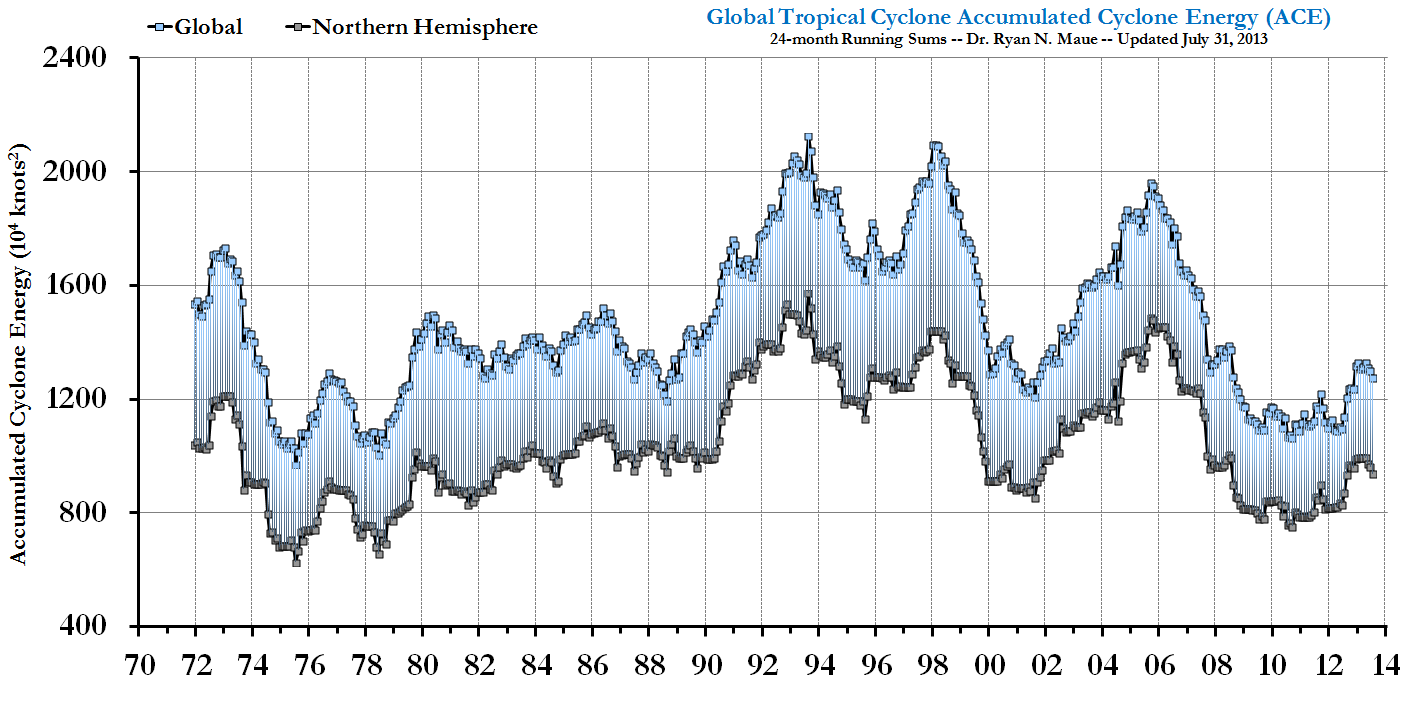
Worldwide, Accumulated Cyclone Energy (ACE) is approaching, and Northern Hemisphere is at, 30-year record lows, see second link*. From Ken Kaye's Storm Center:

Assuming no more storms form by Wednesday, this will be the slowest September, tropically speaking, in 12 years.

That would be since 1997.

Only two named systems have emerged this month, including Tropical Storm Erika and Hurricane Fred.

Pretty incredible, considering September is historically the most active month, seeing on average 4 named storms, including two hurricanes.

Again, the main reason this month – and the season so far – has been relatively calm: El Niño, which has created storm suppressing wind shear.

In September 1997 (another El Niño year, by the way), only one system developed: Hurricane Erika (pictured at right). Like this year’s Fred, it reached Category 3 strength.

All told, only seven named storms formed in 1997. Amazingly, no systems formed at all that August, normally a busy month....MORE

From Ryan N. Maue, Florida State University:
*September 11: After two years (2007-2008) of dramatically below normal Northern Hemisphere and Global hurricane activity, 2009 has actually (year-to-date) managed LESS Accmulated Cyclone Energy! 2009 is currently the second slowest Northern Hemisphere ACE year-to-date behind 1981 in the past 30-years. Here is a text list of the previous September 11 to-date totals for NH ACE. LIST

...Tropical Cyclone ACE Update


Figure: 24-month running sum of tropical cyclone accumulated cyclone energy for the entire globe (top black squares / time series) and the Northern Hemisphere only (bottom green squares / time series). The difference between the two time series is the Southern Hemisphere total. Data is shown from January 1979 - August 15, 2009 mainly because intensity estimates of SH cyclones are often missing in the JTWC best-tracks prior to 1980. See notes.


Figure: 24-month running sums of tropical cyclone ACE for a combination of basins of the Northern Hemisphere. The Western North Pacific, Eastern North Pacific, and the Northern Indian Ocean typically sees more activity than the Eastern Pacific and North Atlantic combined. However, during the strong La Nina event of 1998-1999, the very quiet WPAC TC activity was exceeded by the NATL and EPAC combined. The two time series are correlated at R = 0.56 but of course are not independent....MORE

Oil market "teetering on the edge," warns Verleger (44% Drop?!)

Note on weather below links.
We saw Mr. Verlager quoted at Bloomberg last week, here he is at Platt's The Barrel blog:

Are oil prices about to take a dive? Analyst Philip Verleger thinks so. "The oil market is teetering on the edge," Verleger said in a report. "Prices will fall sharply absent immediate and dramatic action."

Citing poor refinery margins, Verleger argued that producers need to cut crude production. "Some country or combination of countries needs to reduce output two million barrels per day," he said. "The cuts should take effect October 1, 2009."

Because margins are so poor, demand for crude will sink, and prices will not hold in the $65-75/barrel range cited by technicians. "OPEC, the IEA, and the 'experts' cited by the major financial newspapers may see balance in the world crude market. Refiners do not. To be exact, they see nothing but red ink," Verleger said. "In these circumstances they curtail runs."...MORE

HT: Environmental Capital

Here he is in Bloomberg, Sep. 21:

Oil Options Hit Highs as Verleger Predicts 44% Plunge

Oil traders are paying more than ever in the options market to protect against a plunge in crude prices.

The gap between prices of options betting on a decline and those that would profit from a rise in oil widened to a record 10 percentage points, according to five years of data compiled by Banc of America Securities-Merrill Lynch. Crude stockpiles in the U.S. are 14 percent larger than a year ago and OPEC is pumping 600,000 barrels a day more than the world needs, according to the International Energy Agency.

While the recovery from the first global recession since World War II pushed oil up 62 percent this year to $72.04 a barrel in New York, growth alone isn’t likely to erode the glut by the end of next year because production exceeds demand, data from the Paris-based IEA shows. A drop in prices would penalize companies from Exxon Mobil Corp. to BP Plc and exporters Russia and Saudi Arabia.

“If ever there was going to be a retreat below $60 a barrel, it is now,” Stephen Schork, president of consultant Schork Group Inc. in Villanova, Pennsylvania, said in a telephone interview. “It was a very weak summer. We came out with more gasoline than we started.”...

...“There’s all this heating oil with no place to go,” Philip Verleger, a professor at the University of Calgary and head of consultant PKVerleger LLC, said in a phone interview. “I’m fairly certain we’ll see prices in the $30s this year.”>>>MORE
Some smart commodity meteorologists are forecasting the coldest winter in ten years for the U.S. Northeast, and a more moderate winter for the Midwest, which mainly heats with natural gas.

Natural Gas Feint Means Prices Poised to Plummet 19%

The "plummet" in the headline is relative. As the story says, the run-up has been dramatic. The futures were recently trading down a dime. From Bloomberg:

The steepest rally in natural gas prices since 2006 is coming to an end as the 400 salt caverns, depleted oil fields and aquifers used to store the fuel in the U.S. reach capacity for the first time.

Stockpiles may surpass the record of 3.545 trillion cubic feet by as much as 350 billion cubic feet this fall, Energy Department estimates show. Gulf South Pipeline Co. says its fields in Louisiana and Mississippi are so full that customers will have to pay penalties for exceeding their limits. With no place to go, producers will be forced to dump excess fuel on the market.

The worst economic slump since the 1930s will cut demand from chemical plants to carmakers to households by 2.4 percent this year, according to government estimates. The November futures contract will drop about 19 percent to near $4 per million British thermal units, said Stephen Schork, president of consultant Schork Group Inc. in Villanova, Pennsylvania.

“I don’t know where all of this gas is going to go,” said Schork, a former natural gas trader on the New York Mercantile Exchange, who in June forecast inventories would reach near 3.8 trillion cubic feet. “We’re a month away from significant heating demand. Something’s got to give.”

The November contract has climbed 32 percent from its low of $3.662 per million Btu on Sept. 3, after economic reports signaled that the recession is ending and fuel demand will rebound in 2010. October futures, which expired today, gained 49 percent from a seven-year low of $2.508 in the same period....MORE

Monday, September 28, 2009

Earnings Revisions at a Two Year High

This is one of the reasons I said two weeks ago, in "Sign of a top? MarketBeat Asks: "Is the “Bear Market Rally” Theory Dead?":

Nah, not yet. Maybe S&P 1125 (currently 1065), sometime in October. (There! I said it)...
The earnings bar had been set so low that you could just step over it. From Bespoke Investment Group:
While the flow of earnings reports has been slow in recent weeks, analysts have become increasingly bullish on the companies they cover. Our daily tracking of analyst revisions for stocks in the S&P 1500 shows that over the last four weeks, 578 companies in the S&P 1500 have seen their earnings estimates increase, while 389 have seen their numbers cut. This works out to a net of 189, or 12.6% of the index. As shown in the chart below, this is the highest level since at least the start of 2008 (red line), and is a major improvement off of where we were six months ago, when the net earnings revision ratio was closer to "-50%". While analysts are typically thought of as being behind the curve, so far this year they have done a good job of leading the market. When equities bottomed in March (blue line), analyst revisions were already well off their lows of the year....MORE, including a chart of revisions plotted against the S&P (currently 1062.98)

Barclay’s Raises CSCO to Overweight; Target $28 (CSCO)

Long time readers know: we are fans. The stock was recently trading at $23.58, up 4.24%
From Tech Trader Daily:

Raising estimates on expectations of stronger spending by telephone companies, Barclay’s Capital analyst Jeff Kvaal today raised his rating on Cisco Systems (CSCO) to “Overweight” from “Equal Weight” and raised his price target to $28 from $24. Cisco shares are up $1.12, or 5%, at $23.75....MORE
Barclay's overweight/equal weight/underweight rating system gets kinda funny when they talk Weight Watchers, currently at "Underweight".

Solar: "Italy proposes policy changes: New FiT looms" (TSL)

Trina shareholders should keep an eye on this as TSL has an approximate 25% market share in Italy AND is not in the BIPV biz.
From PV-Tech:

Earlier this month, the two main bodies in the Italian renewable energy world, Gruppo Imprese Fotovoltaiche Italiane (GIFI), the Italian Photovoltaic Association, and Federazione Nazionale Imprese Elettrotecniche ed Elettroniche (ANIE), proposed a new set of Feed in Tariffs (FiT) for Italy, which are planned for 2011, according to a Barclays Solar report.

Adding to the list of countries that have recently made changes to PV incentive proposals, Italy has made the decision to lower the FiT rate depending on system size and type. The new proposal separates installations into two segments: Ground Mounted and Rooftop.

Within these two segments, installations are separated into five different categories depending on system size. The proposal lowers FiTs between 5% for the smallest installations and 30% for the largest installations.

The proposal states that the installations for the smallest rooftop and ground-mounted systems (ranging from 1-6kWp) would decline 5% vs 2010 feed in tariffs. For projects ranging from 6-20kWp, tariffs would decline by 7% from 2010 levels, and for 20-200kWp, tariffs would decline by 14%. Ground mounted systems tariffs for projects 200kWp to 1MW would decline by 16% while tariffs for rooftop projects would decline by 22.5%. For projects greater than 1MW, tariffs for ground mounted projects would decline by 30% while tariffs for rooftop projects would decline by 27% from 2010 feed in tariffs.

Similarly to France, Italy is placing emphasis on built in PV, as tariffs for BIPV systems are proposed to be 25% more than a non-BIPV equivalent project. A bonus is also proposed for projects located in non-ideal locations such as landfills. For these projects subsidies are proposed to be 110% of the project equivalent....MORE

A Serious Warning From the Federal Reserve about Interest Rates

From Economic Policy Journal:

This gets a bit technical, but the Federal Reserve is flashing that there could be serious, I am talking major league serious, interest rate hikes down the road.

The first clue to this was last week Thursday's report out of FT that the Fed may use mutual funds as a source to shrink Fed reserves by conducting reverse repurchase agreements with the the funds. When something like this is leaked by the Fed, they are trying to alert the markets so they won't be surprised by such a move when it occurs. As I wrote last week, I saw one reason for this move as the Fed:
...contemplating doing this, if banks start to lend against excess reserves, as a back up to Bernanke's plan to control money growth via the interest rate it pays on excess reserves.
Okay, so the Fed has a back up plan, but now there is an interesting story in WSJ's weekend edition headlined: Official Sees Aggressive Rate Boosts in the Offing....MORE

"Armageddon: Comets vs Asteroids" Plus a Special Bonus: "10 Ways the World Could End and How to Play Them"

From the Physics arXiv blog:

Should we be more worried about Earth-impacting comets than asteroids?

The three largest impact craters on Earth are Vredefort (250km across), Sudbury (200 km across) and Chicxulub (170km). Most astronomers assume that these were created by asteroids roughly 10 kilometers across. But what of the possibility that comets may have been responsible one or more of these impacts?

Today David Minton and Renu Malhotra from the Lunar and Planetary Laboratory at the University of Arizona present some interesting calculations about the rate at which planet smashing asteroids are sent our way.

Contrary to the conventional view, the asteroid belt is a vibrant, dynamic region of the solar system with a complex structure. This is the result of the gravitational interaction of the major planets. This sets up orbital resonances which, over billions of years, have scoured the belt clean in various places. The famous Kirkwood gaps are one result of this process....MORE

From "10 Ways the World Could End and How to Play Them":

  • ...Biblical apocalypse. Hey, over 1 billion people on the planet believe this could happen so we have to take it seriously. News Corp (NWS Quote), which owns the largest bible publisher, Zondervan, would benefit....

Ill Winds: China’s Wind-Power Push Means More Coal

A follow up to the post immediately below, "China becomes world's largest energy producer". I saw the journal story on China wind/coal but spaced it. Here Environmental Capital does the intro:

Strange, but true: China’s explosive growth in wind power seems to be accelerating the construction of coal-fired power plants. The Wall Street Journal reports today:

[O]fficials want enough new coal-fired capacity in reserve so that they can meet demand whenever the wind doesn’t blow…”China will need to add a substantial amount of coal-fired power capacity by 2020 in line with its expanding economy, and the idea is to bring some of the capacity earlier than necessary in order to facilitate the wind-power transmission,” said Shi Pengfei, vice president of the Chinese Wind Power Association.

That doesn’t just mean more coal plants in one part of the country while other parts of the country build massive new wind farms. Coal is still king even in regions that are becoming poster children for China’s clean-energy push, such as Jiuquan. Adds the WSJ:

Wind turbines with a combined capacity of 12.7 gigawatts are due to be installed there by 2015—more than the country’s present nuclear-power capacity. But the Jiuquan government wants to build 9.2 gigawatts of new coal-fired generating capacity as well, for use when the winds aren’t favorable. That’s equivalent to the entire generating capacity of Hungary.

China’s increased use of clean energy wins no shortage of applause. But the reality is still coal-black, as Chinese officials themselves keep stressing. (Oh dear, does that count as panda-thumping too?)...MORE

Meanwhile, at Naked Capitalism, here's Yves Antidote du Jour from Thursday:

Antidote du Jour

Links return on Sept. 30….

Unknown-13

China becomes world's largest energy producer

From Peoples Daily:

In the 60 years since the founding of New China, China's energy supply capacity has developed from weak to strong, and the country has become the world’s largest energy producer. This is according to Zhang Guobao, deputy chairman of the National Development and Reform Commission (NDRC) and director of the National Energy Administration speaking at a press conference held by the State Council Information Office on the morning of September 25.

Zhang said that in terms of energy supply, China has become the world's largest energy producer maintaining an energy self-sufficiency rate of over 90 percent, and safeguarding national energy security....MORE

Stimulus Funds Speed Transformation Toward 'Smart Grid' (CSCO)

From the Wall Street Journal:

After struggling to sell cutting-edge products to utilities, technology companies are sensing better times ahead with the influx of $4.5 billion in federal stimulus funds for so-called smart-grid projects....

...North American utilities are expected to spend $10.75 billion on computer hardware, software and services related to the smart grid this year, up from $7.56 billion in 2008, according to research company IDC Energy Insights.

The smart-grid market "may be bigger than the whole Internet," said John Chambers, chief executive of networking giant Cisco.

Federal assistance "will accelerate the progress of projects [for many utilities] from pilots to full-scaled deployments," said Todd Arnold, senior vice president at Duke Energy Corp.

The Charlotte, N.C., company started installing advanced meters in Ohio last year as part of the utility's five-year, $1 billion smart-grid initiative.

Duke in August requested $200 million in federal funds to cover a quarter of the cost of installing two million advanced meters in Ohio and Indiana. The meters transmit readings wirelessly to utilities and customers and allow the creation of data portals to monitor energy use.

Ambient Corp. of Newton, Mass., started working with Duke in 2005, suggesting ways the utility might use Ambient's communications modules to scoop up data from smart meters to boost grid intelligence. But activity picked up only recently. Ambient last month wrote a letter to the DOE supporting Duke's smart-grid application and this month inked a deal to sell large numbers of modules to the utility, said John Joyce, Ambient's president.

The influx of stimulus dollars "is clearly significant for a firm like Ambient" because it stimulates investment in general and "will make us bigger" as utilities add projects, he said. Ambient had 2008 sales of $15 million but declined to give the value of its deal with Duke.

Competition for the stimulus grants has been fierce. The DOE last month received roughly 570 applications from utilities requesting as much as $14.6 billion in smart-grid funds -- more than three times the amount available. Grants can be as much as $200 million per project and represent as much as half of a project's cost....MORE

Applied Materials: Upgraded to Buy at Citigroup; Added to Top Picks List (AMAT)

The stock is up 3% at $13.50. From Notable Calls:

Citigroup's Semi Equipment team is upgrading Applied Materials (NASDAQ:AMAT) to Buy from Hold and adding it to Top Picks Live (Citi’s focus list) based on significant new SunFab wins, upcoming cost savings and a renewed focus on silicon share....
...Positive Catalysts Align — Based on checks at the Hamburg solar show, Citigroup now believes AMAT is about to sign a significant second wave of SunFab lines including four new lines (~300MW total) in India. While the ultimate success of SunFab remains debatable given how fast pricing is collapsing, the addition of new customers, more clarity on its cost cutting and up to ~$1B savings (mostly focused in sales/service/solar), some undiscovered margin leverage headed into 2010 and its new-found focus on regaining silicon share should be enough to drive the stock higher. Lastly, as the largest equipment provider to the global solar industry, it should benefit from big MW growth in 2010 and simultaneously avoid most of the pricing compression that will continue to plague cell/module makers.....MORE

You Know You're in a Rent-Seeking Business When...

The headline is "Top 5 Tips for Cleantech Startups Headed to Washington" and the first tip is:

Don’t hire a lobbying firm first. Before ever stepping foot in D.C., identify which issues you think you can add value to...

Light Bulbs: "As C.F.L. Sales Fall, More Incentives Urged" (GE)

From the New York Times:

An official at the Department of Energy’s Energy Star program has issued a grim assessment of the market for compact florescent light bulbs, or C.F.L.s, and is urging that funding for utility incentive programs be intensified.

In a September 18 letter to C.F.L. industry stakeholders, Richard Karney, Energy Star products manager, said that national sales of the bulbs have declined 25 percent from their peak in 2007, with sales in some regions such as Vermont and parts of Massachusetts declining 35 to 50 percent. Further, he noted, shipments of C.F.L.s — which are supposed to last far longer than traditional incandescents –are down 49 percent in 2009 over 2007 levels.

“The market for C.F.L.s is far from transformed,” Mr. Karney wrote. “Based on additional data and analysis that D.O.E. has continued to gather, it’s apparent that the market is headed in the wrong direction.”

Even as sales drop, sponsors of incentive programs report they are facing “severe challenges” in getting continued funding for programs for basic C.F.L.s, according to Mr. Karney. “I am concerned, should these programs experience cuts in funding or outright cancellation, many of the gains we have achieved with this market in the last couple of years could be reversed,” he wrote.

Despite more than a decade of costly C.F.L. promotions — including giveaways, discounted prices and rebates — the bulbs have failed to capture the hearts (and sockets) of American consumers. Mr. Karney said that in regions where C.F.L. campaigns have been heaviest, 75 percent of screw-based sockets still contain incandescents. Nationally, about 90 percent of residential sockets are still occupied by incandescents, D.O.E. has reported....MORE
GE and Phillips mounted a huge lobbying campaign to outlaw incandescent bulbs in the U.S. GE is closing all their U.S. light bulb manufacturing and moving the jobs to China:

How many lobbyists does it take to change a light bulb?

Had Thomas Edison employed the same business strategy as his 21st-Century heirs at General Electric, he would have lobbied Congress to outlaw the candle in 1879 when he perfected and patented the light bulb.

He surely could have masked his self-interested lobbying in some public interest claim, such as fire prevention or the need for wax conservation. Today, the mask is environmentalism.

Earlier this month, Thomas Edison’s GE, together with Sylvania and Philips won a legislative victory when Congress passed an energy bill that would outlaw sale of the standard light bulb by 2012.

Sylvania is the leading light bulb maker worldwide, and GE is tops in America. These two companies, together with Dutch-based Royal Phillips Electronics, concede they basically wrote the new light bulb law. It goes without saying that they stand to profit from it — at consumer expense....

G.E. screwing the American worker one light bulb at a time

You probably missed it because these news items got no fanfare in our Jerry Springeresque corporate media's desire to distract us with inane stupidity like the unlovable loser's Mark Sanford and his wife. In small town America in places like Lexington, Kentucky, Winchester, Va. or Niles, Ohio G.E. continued the giant sell out of America by announcing plant closing of light bulb plants in these towns.

Oh its only 203 here or 125 there and besides the incandescent light bulb industry has been declining and by 2014 you won't even be able to use it. We will have to use more energy efficient CFL bulbs by then.

For years in places like Niles, Ohio jobs making light bulbs paid salaries that allowed Middle Class Americans to buy homes, put children through college, and create vibrant communities that taught us all real honest American values, like working hard and playing by the rules. Something lost on our ethically challenged corporate and governmental leadership.

Since 1980 employment at G.E, light bulb plants has been outsourced to the point that 68% of the jobs now are elsewhere. Most of that has gone to China. ...
GE to Ohio: Turn off your light-bulb factories

So much for "These are jobs that can't be outsourced..."

Iran Tests Longest Range Missle

From the BBC:

Iran has successfully test-fired some of the longest range missiles in its arsenal, state media say.

The Revolutionary Guards tested the Shahab-3 and Sajjil rockets, which are believed to have ranges of up to 2,000km (1,240 miles), reports said.

The missiles' range could potentially permit them to reach Israel and US bases in the Gulf, analysts say....MORE

From our July '08 post "Oil: Apparently There's Even More to the Iran Missile Story" (remember that missle test?*):


I may have been premature in posting "Oil: Iran has Photoshop, not afraid to use it"*
From a genius, cowicide, via flickr:

More Cowbell


Don't fear the reaper.


*I swiped that headline from the Waco Tribune. The Guardian asks "Has Iran joined the axis of Photoshop?" As the New York Times put it...

A Better Way to Play Green Stocks?

I'm intrigued by the results, if I don't forget I'll have more next week.
From Tom Konrad at AltEnergyStocks:

My Quick Clean Energy Tracking Portfolio continues to outperform all benchmarks and expectations... is it luck, or did I stumble onto a better way to invest in green energy stocks?

I continue to be stunned at how the portfolio which I intended as an easy way to duplicate green energy mutual fund performance at much lower cost continues to blow those green mutual funds out of the water. I last published an update on this portfolio at the end of May, and was shocked to find that it had beaten the funds it was intended to replicate by over 20% in 3 months. The trend continues... it's now almost 7 months later, and the portfolio has widened its lead over the mutual funds by 30%.

Winners and Losers

In May, I hypothesized that the out performance might have been due to how I constructed the portfolio: I chose five stocks from the top holdings of the mutual funds which had performed worst over the preceding three years. I did this because there is a fairly well-documented winner-loser effect [pdf], that shows systematic price reversals in stocks that show long-term gains or losses. In particular, stocks showing long term losses are more likely to make gains in following years than long term winners.

I tried to test if the out-performance was solely due to winner-loser effects by going back to my original data and seeing how a portfolio constructed with winners rather than losers would fare. To my surprise, the "winners" portfolio also significantly outperformed the mutual funds (by 10% over 3 months). I've updated the performance of the "winners" portfolio as well, and it also has increased it's gains compared to the mutual fund portfolio, and is now outperforming by 15% over 7 months.

Winner-loser effects seem to be playing a role, but at most, they explain about a quarter of the out-performance of the "Losers" portfolio so far. There may be other, as yet unknown, causes of the superior performance of the "Losers" portfolio....MORE

A123: A deeper look (AONE)

From Greentech's Cleantech Investing:

Many cleantech investors were cheered by the successful IPO of A123 this past week.

I noted a very interesting column on PE Hub (sub req'd), by Lawrence Aragon, one of the finer private equity journalists out there.

(We need to caveat all this by acknowledging that it's unlikely much of the VCs' returns have been realized yet, there's typically a lock-up period. So here's hoping the market valuation holds up. Still, Lawrence's approach of using current valuations is still quite useful for our illustrative purposes...)

Lawrence takes a look at estimated investment totals and returns for major VCs in the company, and concludes that these investors didn't produce "a huge return", because the major holders only got like 4x or 5x. But let's look at that a little deeper. One thing that really struck me about Lawrence's column is that his assumption seems to be that these were all venture investments, and that therefore if you don't get a 10x you didn't get a "high voltage charge" for "venture investors".

I would argue that much of the pre-IPO capital that was put into A123 wasn't "venture capital", at least in the sense Lawrence seems to mean it. Let me illustrate what I mean: If you have the chance to make 2x on an investment over 1 year, would you do it? Sure, 100% IRRs are pretty sweet. 2x over 2 years, 3x over 3 years are all pretty attractive returns as well, on an IRR basis. So when Lawrence points to 4x type returns to "venture investors", he seems to be assuming that these were long-term holders, but many weren't. The Series D was in 2007, for example, and was at an approximate pre-money of $300M. Right now, that return looks pretty good on an IRR basis, even after an extra year's delay past the originally intended IPO date. North Bridge, for example, was looking at a much higher multiple on their investment before they had to pump in an extra $10M as part of a May 2009 Series F, and while that very late round yielded a much smaller multiple, it was over just a few months, and probably looks great right now on an IRR basis.

So I don't think Lawrence crystalized the point he was trying to make. However, I think the A123 experience illustrates a couple of important principles at work in cleantech investing today:

1. I continue to have a hard time thinking about pre-IPO equity investments at pre-money valuations in the hundreds of millions as being "venture capital". At very least, we need a new sub-category to describe this type of investing. We have early stage investing, the Series As and Series Bs that are what most outsiders think of when they think of "venture capital" (if at all), typically aiming (read: "hoping") for a 10x return over 5-7 years. Then you have "growth stage" venture capital, which is later-stage VC investing, aiming for a 5x in 3-5 years. But as I noted back in that August 2008 post, much of the Series E (June '08, ~$100M raise, approx. $1B pre-money) appears to have been provided by first-time investors. These investors weren't brought into the raise as "venture capitalists," I guarantee you. Instead, it's probably best to think about that type of investment as a "mezz equity round". In other words, the expectations were probably for a 2x in 1-2 years. That's not necessarily better or worse investing than "venture capital" as Lawrence is referring to. But it's certainly different. It means a simple analysis of returns based on multiples is useless if all these types of investors are bundled together....MORE

Friday, September 25, 2009

The Possibility of Carbon-Trading Fraud Elbows Into Senate Climate Debate

Well duh.
Anyone who says we can legislate against traders acting as traders is either a liar or a fool. Period.

The whole reason for the existence of traders is to make as much money as possible, consistent with what's legal...I lived through this: if you didn't manipulate the market and manipulation was accessible to you, that's when you were yelled at.
-Former Goldman Sachs trader
New York Times, May 8, 2002*
From ClimateWire via the New York Times:
A year after the collapse of Lehman Brothers touched off a global crisis, concern that wild financial speculation and trading abuses would undermine a U.S. greenhouse gas emissions market has put the "trade" part of the proposed national cap-and-trade program on trial.

Distrust of commodity traders and suspicion about the motives behind Wall Street's brassy support for a sprawling global market are fueling skepticism on both the political left and right that trading emissions allowances can curb the economic cost of addressing climate change.

In testimony before the House Agriculture Committee on Tuesday, the chairman of the Commodity Futures Trading Commission sought to allay concern on Capitol Hill that policymakers have been too slow to push unregulated financial trading onto commodity exchanges and under federal oversight.

"The law must cover the entire marketplace, without exception," Gary Gensler assured lawmakers. Agriculture committees in the House and Senate are poring over the Obama administration's plan for regulating over-the-counter (OTC) derivative contracts, such as commodity "swaps" traded by financial brokers.

The freewheeling financial dealing eluded regulators and was blamed for runaway energy prices and unscrupulous trading practices in recent years. From the perspective of the Senate's toughest critics of using a cap-and-trade program to combat global warming, the size and scope of a potential carbon market look too much like those of the market that created mortgage securities and credit default swaps that collapsed the housing bubble....MORE
Related posts:

Climateer Investing on Carbon Trading and Traders
...The carbon markets are an entirely artificial construct, beholden to political paymasters for their very existence. Which may be why so many political types are planning to profit from them.
Directly, think Al Gore's Generation Investment Management's investment in carbon project developer Camco or Lord Nicholas Stern's Vice-Chairmanship of IDEACarbon's parent IDEAGlobal or indirectly as a source of campaign contributions for pols still in office, or an unaccountable slush fund in the case of the U.N.

The word artificial led me to think of it's cousin, artifice. Here's the Oxford Pocket definition:
ar·ti·ficen. clever or cunning devices or expedients, esp. as used to trick or deceive others: artifice and outright fakery.
The securities attorneys among our readers will recognize the word from the common state security law usage "...employ any device, scheme, or artifice to defraud".
Coincidence?...
Enron on Cap-and-Trade

Here Comes Another Bubble: Gigantic Loophole in Europe Carbon Market

Goldman Faces Carbon Market Curbs in Senate Proposals (GS; JPM)

Scrap Cap-and-Trade: Emissions-Trading Inventors Now Leery

Goldman, Morgan Stanley Threatened by CFTC Review (GS; MS)

California's cap-and-trade won't work

Fannie Gears Up for High-Loan-To-Value Refinance Loans, Growing Government-Backed Securitization (FRE; FNM)

Things that make you think "Hmmm...". I'm not a subscriber but the teaser seems to say a lot. From Inside MBS & ABS:

Fannie Mae next week will open a new mortgage-securities program that will be backed by refinance mortgages with loan-to-value ratios as high as 125 percent in an effort to generate more activity in an Obama administration program designed to help performing underwater borrowers. Both Fannie Mae and Freddie Mac announced in July that they would expand their Home Affordable...
In other former-GSE news:

Freddie Mac's Delinquent Loans Rise for 28th Month

Freddie Mac's mortgage delinquency rate for its single family mortgages rose for the 28th straight month in August, reaching a record 3.13 percent of its portfolio 1.11 percent in August 2008.

Freddie's sister company, Fannie Mae, reported a similar increase in delinquent mortgages in June. Its serious delinquency rate for conventional single family loans rose 26 basis points in June to 3.94 percent, higher than Freddie Mac's in August. Fannie Mae has not yet reported July and August delinquencies.

The steadily increasing value of delinquent loans owned Freddie Mac and Fannie Mae is another sign of the toll the housing crisis is taking on the economy. The rising number of foreclosures and homeowners missing payments on loans held by the mortgage giants increasingly puts pressure their financial reserves and overall financial condition.

Freddie Mac also reported today that its mortgage investment portfolio shrank by an annualized 29.5 percent rate in August. The portfolio fell to $779.4 billion, for an annualized 4.7 percent drop year to date. The size of the mortgage portfolio, however, increased on a year-over-year basis. In August 2008, the portfolio was $760.9 billion. Last month Freddie Mac surprised observers by reporting a profit in the second quarter and indicated that it may not need additional federal TARP aid....MORE at UPI

China Backs Market Price for Wind Power

Don't think through the implications, they end up depositing one in a curious mashup of Alice Through the Looking Glass and Cloud Cuckoo Land. From the Wall Street Journal:

A top Chinese energy policy official said Friday the price for wind power and other renewable energy should be set by market forces, rejecting calls for fixed prices, a system used in some countries to promote the use of renewable energy.

As China looks to renewables to fill more of its energy needs, many Chinese power companies are looking to develop wind energy but are worried about profitability and thus looking for price guarantees.

"Calls to set renewable energy prices at a high level through a fixed government price are mainly coming from investors," said Zhang Guobao, vice minister of the National Development and Reform Commission, at a press briefing. "But the result, if prices are fixed too high, would be to impact the widespread use of renewable energy."

Renewable energy prices, and in particular wind power prices, should be set through a competitive market, said Mr. Zhang, who is also the chief of the National Energy Administration.

Current prices for wind power, at around 0.5 yuan to 0.6 yuan per kilowatt hour, are "reasonable," and are higher than coal power prices, Mr. Zhang said. He also referred to incentives for renewable energy already in place in China, such as reduced taxes.

Under policies used in some European countries, regional and national utilities are obligated to buy electricity from renewable sources at higher prices....MORE

"Stupid Investment of the Week: Fannie Mae beckons, but the stock is no buy" FNM

Chuck Jaffee at MarketWatch appears to have an opinion on the larger GOE (Government Owned Entity):

As the Dow Jones Industrial Average approaches 10,000 again, many issues that would have been passed off as toxic waste less than a year ago are now being passed along to investors as bargains, values and trading opportunities.

Nowhere is that more evident than with Fannie Mae, the troubled mortgage-securities company that was a poster child for the market meltdown, going from big-time safe play to risky penny stock...

...That said, you'd have to possess the investment insight of broccoli not to recognize that Fannie Mae has horrible fundamentals and short-term prospects....

...A healthy dose of high inflation would help Fannie Mae. The value of the collateral on their loans (houses) would rise, making the loans less toxic.

"Sure, the government owns the thing," said Gregg Brewer, executive director of research at Value Line. "Sure, the company's bleeding isn't likely to be over. Sure, the stock is probably worthless. But, so long as you aren't putting much money in, a flier on this wouldn't be the end of the world."

He added: "Clearly it is purely speculative and you could wind up with nothing, but, on the other hand, as the economy strengthens, people might just push the price higher without regard for the longer-term logic."

Brewer, however, characterized taking a flier as "more sport than investing," which is precisely why the average investor needs to stay away. While Fannie Mae stock has bounced, it's a trading play that -- no matter if it continues to climb -- is too treacherous to be a long-term investment for the average buyer.

Is The Stock Market Nothing More Than The Fed's Puppet?

A nice catch by DealBreaker:

Based on Rep. Alan Grayson's line of questioning for Federal Reserve General Counsel Scott Alvarez, you'd think the Beard and his troops were using their powers to turn the equity markets into their personal plaything. The game of cat and mouse starts with the question "Has the Federal Reserve Ever Tried to Manipulate the Stock Market?", which leaves Alvarez a bit flat footed. He quickly goes to the 'it's too broad a question' play which is met with an emphatic "I think not". The 4 minutes that follow are highly reminiscent of the Stanford Band Play with Grayson sensing victory multiple times until Alvarez slips right by him, the clock runs out, and Alvarez is in the end zone.

Reuters Names Names: "A123's smash-hit IPO could herald more green debuts" (AONE; HEV)

From Reuters:

..."This is an interesting time for the market because there are several (clean-tech) companies that have been growing very nicely," said Faysal Sohail, managing director of venture fund CMEA Capital, which is an investor in A123.

Sohail declined to comment specifically on A123, but said the whole environment is creating opportunities for clean-tech companies and expects 2010 to be a busy year for green IPOs.

"They are real companies with substantial revenue and growing at a very fast clip," he said.

CMEA Capital also backs companies such as Silicon Valley solar manufacturer Solyndra and biofuel company Codexis, which many see as likely candidates for the IPO market.

Other green companies deemed ripe for an IPO include smart grid network company Silver Spring Networks, electric carmaker Tesla Motors and solar thermal company BrightSource Energy.

Rival lithium-ion battery maker Ener1 Inc also cheered A123's stock performance, which shows how much value there is in the emerging sector.

"It's great for the space. They have done a good job of getting the market excited," Ener1 Chief Executive Charles Gassenheimer told Reuters.

Ener1 went public in 2003, but used a reverse merger with a public shell corporation to do so.

Gassenheimer said the warm reception of the IPO would encourage other clean-tech companies to tap the public markets....MORE

Spain tips into DEPRESSION

People we don't want to emulate. From the Telegraph:

Spain is sliding into a full-blown economic depression with unemployment approaching levels not seen since the Second Republic of the 1930s and little chance of recovery until well into the next decade, according to a clutch of reports over recent days.

The Madrid research group RR de Acuña & Asociados said the collapse of Spain's building industry will cause the economy to contract for the next three years, with a peak to trough loss of over 11pc of GDP. The grim forecast is starkly at odds with claims by premier Jose Luis Zapatero, who still says Spain's recession will be milder than elsewhere in Europe.

RR de Acuña said the overhang of unsold properties on the market, or still being built, has reached 1,623,000 . This dwarfs annual demand of 218,000, and will take six or seven years to clear. The group said Spain's unemployment will peak at around 25pc, comparable to the worst chapter of the Great Depression.

Spanish workers typically receive 50pc to 60pc of their former pay for eighteen months after losing their job. Then the guillotine falls. Spain's parliament has rushed through a law guaranteeing €420 a month for long-term unemployed, but this will not prevent a social crisis if the slump drags on.

Separately, UBS said unemployment will reach 4.8m and may go as high as 5.4m if the job purge in the service sector gathers pace. There is the growing risk of a "Lost Decade" akin to Japan's malaise after the Nikkei bubble.

Roberto Ruiz, the bank's Spain strategist, said salaries must fall by 10pc in real terms to regain lost competitiveness, replicating the sort of wage squeeze seen in Germany after reunification.

There is no sign yet that either Spanish trade unions or the Zapatero government are ready for such draconian measures. Talks between the unions and Spain's industry federation (CEOE) broke down in acrimony in July....

...For the time being, an odd calm prevails across the Iberian peninsular. There are no street riots, even though youth unemployment has reached 38pc. It is hard to imagine anything like the bloody uprising by Asturian miners in 1934, the last time so many people were without jobs. Local communities have started to issue scrip currency known as "moneda social", based on reflation experiments tried by Austrian cantons in 1932 and more recently by Argentina....MORE

Of square roots and economic indicators

Cute.
From FT Alphaville:

Remember when George Soros warned of an inverted square-root recovery?

Something that might look a little bit like this in fact:

square root

Well, we couldn’t help noticing Danske Bank’s chart showing off the Baltic Dry Index as a potential leading indicator on Friday:

Could freight rates be leading commodities at the moment? - Danske Bank

Because a Danske-Soros combination might suggest this...MORE
One must always be aware of the possibility that what we think is pattern recognition is actually just a Rorschach of our own psyches:

Technical Analysis: S&P Black Swan Formation

Lifted from BloggingStocks:


A message board poster has put this hilarious chart showing that S&P 500 could be in for a rough ride. He writes that "The very rare black swan formation - note both feet and neck are complete and the rare vampire tooth variation is in place. This is very bad. Very very bad."...

GE: "Solar business is our 'next wind'" (GE; FSLR)

We have a lot of links on GE solar. The piece I most enjoyed writing was "GE gets grant to install GE solar panels on GE headquarters":

Energy Fund Pays General Electric To Buy GE
General Electric gets state grant to buy GE-made solar panels

The PR flack was quoted as saying:

“It’s a good demonstration project for the technology,” O’Toole said.

Asked why a large, profitable corporation like GE would need financial help from the state, O’Toole said one reason “is to show you have to invest in new technologies. Companies cannot do it alone.”

HartfordBusiness.com

In other GE news, spokesmen did comment on whether PR spin could be harnessed as an inexhaustible and eternal source of power.

GE's 2006 revenues were $168,307,000,000

Among cities its size Hartford's child poverty rate is the second highest in the country. In greater Hartford, 100,000 people receive food from food pantries, soup kitchens and shelters, and 40,000 of them are children.

The grant to GE is funded by an electric bill surcharge, levied on every household in the state....
That, gentle reader, is how business is done!
Here's the headline story from cnet:
General Electric plans to give its solar business a charge within two years by introducing panels with the same solar cell material used by industry cost leader First Solar.

In 2011, the energy giant expects to produce solar panels made with cadmium telluride, a thin-film solar cell material, Michael Idelchik, vice president of advanced technologies at GE Global Research, said here Wednesday at the EmTech conference. The company now sells solar panels that use silicon solar cells, but its long-term bet is on thin-film--and specifically cadmium telluride--because it offers the cheapest cost per watt, he said.

Last year, GE's energy division took a majority stake in Golden, Colo.-based PrimeStar Solar, for its cadmium telluride cell technology. GE is now developing a product around that aimed at utility and commercial customers.

Solar at GE is a relatively small part of its sprawling energy portfolio, which covers everything from nuclear power plants to natural gas turbines. But GE expects that solar has the potential to grow rapidly, as its multibillion-dollar wind business has done over the past five years.

"Solar is definitely the next wind for us. It's not there yet, but it's moving very rapidly," Idelchik said. Solar is more expensive than wind right now, but he said that GE expects renewable energy mandates to help drive growth and bring costs down....MORE

Here are some of our posts on GE solar, oldest to newest:

Solar power edges towards boom time

Transcript: Jeffrey Immelt of GE

GE Global Research Demonstrates Scalable Low Cost, Nano-based Solar Cell

GE shows world’s first printed OLEDs

GE's Immelt reduced to whining after homicidal rant from Jack Welch (GE)

GE sees solar becoming $1 bln business

GE Bets on Solar with Majority Primestar Stake

First Solar, PrimeStar Solar and Cadmium Risks (FSLR; GE)

GE's PrimeStar Reveals Secret Strategy to Kill First Solar (FSLR)

GE's PrimeStar Reveals Secret Strategy to Kill First Solar (FSLR)

Q&A: Mark Little, Head of GE Global Research- "GE is pushing the smart grid and thin-film solar, but don't expect new kinds of nuclear reactors. "

Ridiculous Pitch of the Day: " globenewswire Beacon Equity Issues Technical Trading Overview for A123 Systems Inc" (AONE)

My first thought was "Technical trading overview? Based on over four hours of data? Good grief."
I'm not sure who their copywriter is but this advertorial via Yahoo Finance is pretty funny:

...In the report, the analyst notes:

"The Company priced 28.1 million shares, raising $378 million for its debut on the Nasdaq. The Watertown, Mass.-based firm went public above its already-increased range of $10 to $11.50 a share. In another bullish move, the size of the IPO was increased by 2.4 million shares from its earlier level of 25.7 million shares.

"AONE recently announced that it was awarded a $249 million grant from the U.S. Department of Energy's Electric Drive Vehicle Battery and Component Manufacturing Initiative. ... The grant will be used to help implement the Company's strategy for the construction of world-class lithium ion battery manufacturing facilities in the United States, with the first construction location in Livonia, Michigan."...blah, blah, blah.

Turns out they're not talking technicals, at least in the ad. The CYA starts with:
DO NOT BASE ANY INVESTMENT DECISION UPON ANY MATERIALS FOUND ON THIS REPORT....
So that schmear of cream cheese is not to be trusted. Made my day.

Marc Faber Says Stocks Have Likely Peaked for 2009

Mr. Faber is early, in our humble opinion, but probably not enough to matter in the grand scheme of things. In our September 15 post "Sign of a top? MarketBeat Asks: "Is the “Bear Market Rally” Theory Dead?" I said:

Nah, not yet. Maybe S&P 1125 (currently 1065), sometime in October....
The S&P closed yesterday at 1050 and change.

Back on March 3 we relayed a February 23 prognostication by Marc Faber that we had been sitting on as the market declined: "Marc Faber: Stocks Poised to Rally". It turns out he was early by 14 days. We mentioned this call again on March 10, the day after the market bottomed:
I'll go with Faber on the timeline, at least three, maybe six weeks before we see a change in direction, i.e. more than a one day move.....
and reiterated it that Friday, March 13 in "Markets: Where Do We Go From Here?".
The point of this longer than usual intro is: We listen to Herr Doktor.
From Bloomberg:
Stocks may have already peaked for this year and might drop 20 percent amid renewed deflation fears, said Marc Faber, the publisher of the Gloom, Boom & Doom report.

The dollar is likely to rebound from an “oversold” position, which will be negative for equities, Faber said in an interview with Bloomberg Television on the sidelines of CLSA Ltd.’s annual investor conference in Hong Kong.

“I wouldn’t be surprised if we’d seen the peak of the market for this year because the economic news isn’t going to improve very much,” Faber, 63, said. “The correction in the market has been overdue for quite some time.”

The investor predicted on March 9 in a Bloomberg interview that equities would rally because of government stimulus measures. The Standard & Poor’s 500 Index dropped to a 12-year low that day and has since climbed 55 percent. The MSCI World Index rallied 63 percent in that time.

The S&P reached a high for 2009 of 1,071.66 on Sept. 22, and has since slipped 2 percent amid concerns the rally had outpaced prospects for a recovery in earnings and economic growth. France, Germany and Japan are among economies that have emerged from recession.

The Bank of Japan upgraded its assessment of the economy on Sept. 17 though said it remained concerned about the strength of the recovery. Federal Reserve Chairman Ben S. Bernanke said on Sept. 15 that the U.S. recession is “very likely” over, while warning that growth may not be strong enough to quickly reduce unemployment.

Credit Crisis

In a presentation to investors at the CLSA forum after the interview, Faber reiterated his bearish outlook for Western economies because fiscal and monetary stimulus efforts have only delayed a coming crisis instead of averting it....MORE

Rare earths offer unique investment opportunity

The big dog is Inner Mongolia Baotou Steel Rare-Earth Hi-Tech Company. Down 4% this morning, it trades on the Shanghai exchange under the symbol 600111. There are a few Canadian juniors that are stepping up their exploration efforts. Privately held Molycorp Minerals will be a sizable producer as they bring their California mine back into production. Goldman is one of their backers. Here are our posts on the rare earth metals.
From MarketWatch:

Experts see promise in market growth but urge caution

..."This hot commodity play has some room to run still," said Brent Cook, author of the investment letter Exploration Insights.

Rare earths are a "new thing that no one has actually lost money on yet," he said. "It also helps that there is no way to value these things using the conventional NPV [net present value] metric - hence, the sky's the limit."

Rare earths, comprised of about 17 elements, serve as vital components in everything from lasers and optical fibers to petroleum refining, automotive parts, computer monitors, lighting and televisions.

"This is a near perfect story from a promoter's perspective," said Cook, who is also a geologist. These elements are "a hot new suite of minerals, that no one can say or spell, needed for all the high-tech gadgets the X, Y and Z generations know and love."

Some consumer goods wouldn't even exist without rare earths.

But, said PFGBest senior market analyst Phil Flynn, "many green technologies that seem economically feasible today may not be feasible tomorrow due to shortages of these elements."

"China has been aggressive in controlling the [rare earths] supply that they have and buy what they do not have," he said. "The rest of the world is scrambling to find alternative supply."

With that in mind, it's no wonder that some investors are looking to mimic China's apparent strategy -- to get a foothold in the market and find a way to keep it there. China already controls more than 95% of the world's rare earths market. See in-depth look at market for rare earths.

Misunderstood

But commodities investors need to realize that the term "rare," in this case, is a bit of a misnomer.

"Rare earths are not that rare," said Lawrence Roulston, editor of Resource Opportunities. "The most commonly occurring rare earth metals -- cerium, lanthanum, neodymium and yttrium -- are actually more common in the Earth's crust than lead."

"Once exploration gets underway, it won't be hard to find new deposits that contain rare earths," he said....MORE

Thursday, September 24, 2009

A123 IPO Roundup II (AONE) "A123 in Talks to Settle Lithium Battery Patent Fight "

Roundup I is here. First up we go back to Bloomberg for the headline story:

A123 Systems Inc., a maker of lithium batteries for plug-in cars that first sold stock today, is in talks to end a patent dispute with the University of Texas and Hydro-Quebec over technology underlying its products.

The parties “continue to engage in ongoing settlement discussions that may resolve the issues in dispute in this matter,” A123 said in a Sept. 15 court filing. Shares of the Watertown, Massachusetts-based company soared 50 percent in the first day of trading on optimism A123 will benefit from the U.S. push for battery-powered vehicles.

“We have a strong business model and don’t see this as a major issue,” Ric Fulop, A123’s co-founder and vice president of business development, said in an interview. He declined to discuss the litigation or settlement discussions....MORE

Next up, the Cleantech Group's blog:

Spotlight on A123's executive comp

With Watertown, Mass.-based A123Systems’ IPO bearing the weight of the watchful eyes of the cleantech world today, could this be the start of the boom that boosts the comp for executives in the energy storage space, as it did in the solar sector in 2008? (see Solar boom kicks salaries higher).

Well, it’s too soon to say. But one thing it does do is put the once very private company, which manufactures high-power lithium ion batteries that use its patented nanophosphate technology, into the public spotlight, including how much its executives stand to benefit from the transaction (see A123Systems up and climbing after Nasdaq debut).

According to the company’s S-1 filing, CEO David Vieau has a base salary of $300,000 for 2009, while other top management each have base salaries of $210,000, including: CFO Michael Rubino, Vice President and General Manager of the Energy Solutions Group Robert Johnson, VP of Global Sales Evan Sanders, and Bart Riley, the company’s founder, CTO, and VP of research and development....MORE

Finally, CNN Money has a longish piece with some tidbits:

AONE IPO charges car battery market

...Buzz around the company is running high. "I heard it was standing room only at many of the presentations," before money managers, said one person familiar with the firm.

The company is closely watched for several reasons.

First, its origins and backers give it some credibility in the high tech world.

The company, an outgrowth of the research labs at the Massachusetts Institute of Technology , is based in Watertown, Mass. along the Route 128 technology corridor. It was founded in 2001 with a $100,000 grant from the Department of Energy, and now has facilities in 10 countries. The firm has around 1,700 employees, mostly located abroad.

Analysts give the company credit for developing a very competitive technology that relied on the nanotechnology research from MIT.

Since then then it has raised money from venture capital funds and a few high profile companies, including General Electric (GE) and Motorola (MOT).

The firm recently won a $250 million grant from the federal government to build a production facility outside Detroit - the second largest grant awarded in a recent $2.4 billion round of stimulus-related funding. The factory will complement production facilities the company already has in Asia.

And Asia is probably the biggest reason A123 is so closely watched. The firm is one of just a few American companies that are competing with much larger Asian rivals for the potentially lucrative hybrid and plug-in electric car battery market...MORE

A123 IPO Roundup (AONE)

Update below.
Original post:
The stock closed at $20.29 up $6.79 (50.30%). As I said this morning in "A123 Systems jolts IPO market (AONE)":

I don't have an interest in IPO's in general (all the allocation shenanigans, quid pro quo, etc.) but would be remiss if I didn't at least mention this one...
Don't let my proclivities spoil the fun, here's some of the better first day reporting:
First up, representing the Dow Jones blog empire (Heard on the Runway is must read during Milan Fashion week), Environmental Capital:

Cleaning Up: Is A123 System’s Explosive Stock-Market Debut The Real Deal?

...Is this the beginning of the green tech revolution or a reprise of the tech bubble?

Let’s take a look under the hood, as it were. A123, based in Cambridge, Mass., makes batteries that power hybrid and electric cars, among other things. The market for electric cars could be potentially huge, since the U.S. and other big economies want to wean themselves off oil and curb greenhouse-gas emissions.

How huge is anybody’s guess. Actually, it’s A. T. Kearney’s guess—A123 used to use market forecasts from Lux Research, but those were fairly conservative. So since this summer, A123 has been relying on Kearney forecasts of the market for lithium-ion batteries for electric cars: $32 million today, but poised to grow to $21.8 billion in 2015 and $74 billion in 2020.

That might very well be the case. Or it may not—as A123 points out in its prospectus, the world is a fickle place. Oil and gas prices might get cheap and stay there, eroding demand for electric cars. Political will—so important to support the not-yet-cost-competitive electric-car market—could evaporate. Somebody else might invent the next big thing. And so forth.

Actually, as A123 notes, its real fears are more pedestrian. It does a lot of manufacturing in China, where intellectual-property laws are lax. Its rivals are better-funded, and have deeper relationships with carmakers that plan to use the batteries. Staying competitive on costs will be a challenge, especially since China has jumped into the battery business with both feet....MORE

From Bloomberg:

A123 Surges in First Day on Electric-Vehicle Demand

...The initial public offering came 14 months after A123 filed to sell shares amid the worst market for venture capital-backed startups in nearly 40 years. Investors were enticed by an electric-vehicle market that may expand 700-fold in six years, said Matt Therian, an analyst at Renaissance Capital LLC.

“What’s attracting investors is an end market that’s expected to grow so quickly,” said Therian.

A123 received $13.50 a share in the IPO after raising its sale price twice this month. A123’s offering was initially priced at $8 to $9.50 share. The funds will help build a factory for lithium-ion car batteries in Michigan, the company said today in a securities filing.

The global market for electric and hybrid electric vehicles was forecast to surge to $21.8 billion by 2015 from about $31.9 million this year largely because of government incentives, according to analysis by A.T. Kearney.

Government Aid

“The government is feeding the whole food chain for electric vehicles,” said Theodore O’Neill, an analyst at Kaufman Brothers in New York.

A123 is expanding U.S. manufacturing of automotive batteries in a market dominated by New York-based Ener1 Inc. and Milwaukee-based Johnson Controls Inc., O’Neill said. He has a “buy” rating on Ener1 and doesn’t yet rate Johnson Controls or A123.

A123 last month was awarded $249 million in federal stimulus grants out of $2.4 billion the Obama administration is spending on electric vehicle development. Recipients of the grants agreed to match the federal investments.

“We think Ener1 is way ahead of A123 in that they already have U.S. manufacturing,” O’Neill said.

A123 currently doesn’t get any revenue from the prismatic battery technology that automakers favor, Renaissance’s Therian said. “It’s a highly competitive space and they’re not the only one trying to build a prismatic battery.”

Foreign Competitor...MORE

From the hometown paper, the Boston Globe:

Shares in A123 IPO hit $20.09 in afternoon trading

..."It's going to give us the capital that we need to expand the business and it's going to provide comfort to our customers," said A123 Systyems chief executive David Vieau.

In the past, he added, customers have questioned whether the company had the "firepower we needed to scale up our battery," Vieau said. "And we just demonstrated that we do."

The shares began trading today on the Nasdaq Global Market under the ticker symbol "AONE," the company said in a press release.

The company now will almost certainly exceed the $250 million minimum it was hoping to raise with its first public offering offering of stock. At least a portion of the money raised will be used to match government funding, including a $249.1 million stimulus grant awarded to A123 Systems by the US Department of Energy for a manufacturing plant in Michigan.

A123 Systems has received more attention as interest in advanced battery technology has grown, spurred by last summer's high oil prices, as well as growing concerns about global warming and energy independence.

The company's initial public offering is considered by some as a bellwether for how successful the emerging advanced battery industry will be as companies expand production of lithium ion products meant to power everything from cordless power tools to cars and the electric grid.

Bruce Harrison, an automotive consultant at Lexington forecasting firm IHS Global Insight, said that the industry's success as an alternative power source for cars depends on several factors.

"One, the cost has to come down for these batteries," Harrison said. "Second, the power density has to increase to the point where the application of a battery means the vehicles operate similarly to the way an internal combustion engine does -- meaning, you can get 300 miles out of them [before recharging]."

Update: Here's part II of the roundup:

A123 IPO Roundup II (AONE) "A123 in Talks to Settle Lithium Battery Patent Fight "

Investors need not lose sleep over daylight saving

Where would we be without research? From PhysOrg:

The changeover to and from daylight saving does not have a detrimental effect on financial markets, according to new research.

While previous studies suggested stock markets weakened on the Monday after daylight saving began or finished, possibly due to the effect on investors' sleep patterns, Massey finance specialists and a Dutch research colleague have produced a paper showing there is no discernable impact.

Associate Professor Russell Gregory-Allen, Professor Ben Jacobsen and Wessel Marquering of Erasmus University in the Netherlands found that sharemarket returns in 22 countries were no different from any other day.

“The results reject earlier conclusions that a change in the mood of investors as a result of changes in sleep patterns significantly affects stock returns," Dr Gregory-Allen says....MORE

A123 Systems jolts IPO market (AONE)

I don't have an interest in IPO's in general (all the allocation shenanigans, quid pro quo, etc.) but would be remiss if I didn't at least mention this one. the stock is trading at $19.77, up $6.50 (45.5%). This is not a buy rec. From MarketWatch:

A123 Systems Inc. priced 28.1 million shares at $13.50 each, raising $378 million ahead of its stock-market debut on the Nasdaq on Thursday.

Tapping into growth expectations for electric vehicles and billions in stimulus for the sector from the U.S. government, the Watertown, Mass.-based lithium ion battery maker is going public above its already-increased range of $10 to $11.50 a share...MUCH MORE

Wind/Rare Earth Metals: "China Non-Ferrous Barred From Taking Control of Lynas" And: "China Investment Corp to launch own rare earth mining firm"

First up, Bloomberg:
China Non-Ferrous Metal Mining (Group) Co. was blocked by Australia from buying a majority stake in rare-earth producer Lynas Corp. as the government seeks to preserve local control of the nation’s resources.

Australia’s Foreign Investment Review Board ordered China Non-Ferrous to limit its stake in Lynas to less than 50 percent, the Sydney-based company said today in a statement. China accounts for more than 90 percent of global output of rare earths, used in iPod music players, liquid crystal displays, hybrid cars and wind turbines.

Investments by Chinese companies have faced scrutiny from Australia as the biggest metals consumer accelerates takeovers. Australia blocked a A$2.6 billion ($2.3 billion) bid by state- owned China Minmetals Corp. for OZ Minerals Ltd. in March on national-security concern and review board director Patrick Colmer said today overseas investors should limit proposed stakes in major mining companies to no more than 15 percent.

“What FIRB doesn’t want to see is something as significant as a rare-earths project, where China controls so much of the world’s production, fall under the control of one country,” said Peter Strachan, a Perth-based analyst for independent company StockAnalysis.

Lynas, which says it owns the world’s richest deposit of rare earths, has risen more than threefold since China Non- Ferrous agreed May 1 to pay A$252 million for a 51.6 percent stake. It advanced 3.5 percent today in Sydney trading to 90 cents....MORE

And from Reuters, our old pal*, Inner Mongolia Baotou Steel Rare-Earth Hi-Tech Co trades limit up in Shanghai:

China's CIC may launch domestic rare earth company

China's sovereign wealth fund, fresh from a series of investments in the global commodities sector, may launch its own domestic rare earth firm, a banking source and newspaper report said on Thursday.

China Investment Corp (CIC) could do so through Jianyin Investment, its wholly-owned domestic industrial investment arm, said the source, who is familiar with CIC. The $298 billion sovereign wealth fund's primary focus is on foreign investments.

Rare earths are metals used in high-tech devices and green products. For a factbox, click on [ID:nSYD28850].

CIC and Jianyin are talking with Baotou Steel (600010.SS) and the government of Baotou city in Inner Mongolia about setting up a rare earth company, state-run Economic Information Daily said.

"The talks are in a framework under which the two parties would set up a multi-billion yuan company to specialise in rare earth exploration and stock building," the paper cited an unnamed source with knowledge of the issue as saying.

"It will also help restructure Inner Mongolia's rare earth mining industry and CIC will hold a more than 80 percent stake," the source told the paper.

Shares of Inner Mongolia Baotou Steel Rare-Earth Hi-Tech (600111.SS) soared by the daily limit of 10 percent on the news. The company said in a statement to the Shanghai stock exchange that it had met with CIC officials earlier this month to discuss cooperation, but that no agreement had been reached yet....MORE

*See:

"Why, Just the Other Day I was Talking About Inner Mongolia Baotou Steel Rare Earth Hi-Tech Co." Canadian Solar Gets 500MW Project (600111: Shanghai)

With a Name Like Inner Mongolia Baotou Steel Rare-Earth Hi-Tech Co., it has to be good ( 600111:Shanghai)

or use the search blog box, keywords: rare earth.

Equities: "S & P Put Buyer Yesterday"

Yesterday's drop did not mark the top, that's not how bull runs end. More later.
From Across the Curve:

Via a friend of the blog:

LARGE BUYER ($5.6 BLN NOTIONAL) OF PUTS ON THE S&P YESTERDAY AFTERNOON RESPONSIBLE FOR THE DAY’S ROUND TRIP. ONLY $260MM PREMIUM, SO OUT OF THE MONEY BUT STILL A SEEKER OF PROTECTION…

Jeremy Grantham: "GMO’s 7-Year Asset Class Return Forecast"

From Trader's Narrative:

...Grantham is a long term market timer. He’s not interested in catching short term fluctuations nor would he be able to exploit them since he manages billions in assets as an institutional money manager. With that in mind, here is a chart - released today - of GMO’s most recent 7 year asset class return forecast:

GMO 7 year asset class forecast Sept 2009

Check the free trading resource section for a full size copy (in PDF format). Look in the Reports & Articles folder - files: “GMO 7Yr Forecast”.

To sum up, their predict that:

  • the S&P 500 will return less than 5% annually over the next 7 years.
  • international equities are expected to perform better, but not by that much
  • US government bonds are among the lowest return asset class (1.7%)
  • once again, timber makes an appearance with a 7.5% expected return

In comparison, GMO’s prediction of asset class returns just before the financial markets went into a tailspin in 2007 looked quite different:

  • the S&P 500 forecast was -2%
  • US ‘low quality’stocks were expected to return -10%
  • US government bond returns were forecast at just 3%
  • and timber was still high, at 6.5% annual return...MORE
Here's the larger version of the chart

Fed May Borrow From Money Market Funds, Report Says

From DealBook:

The U.S. Federal Reserve is studying the idea of borrowing from money market mutual funds as part of eventual steps to withdraw stimulus, The Financial Times reported.

The Fed would borrow from the funds via reverse repurchase agreements involving some of the huge portfolio of mortgage-backed securities and U.S. Treasuries that it acquired as it fought the financial crisis, the newspaper reported, without citing any sources.

This would drain liquidity from the financial system, helping to avoid a burst of inflation as the economy recovered.

The Financial Times said Fed officials had in recent days held discussions with market participants on how it might implement such a scheme.

The Fed is considering whether to conduct a pilot scheme, but worries such a test might be seen as a signal that the central bank was about to drain liquidity on a large scale, the newspaper said. In the near term, a big drain remains unlikely, it added.

The central bank held interest rates at close to zero on Wednesday and upgraded its assessment of the U.S. economy, saying growth had returned after a deep recession.

The Fed also said it would slow its purchases of mortgage debt to extend that program’s life until the end of March, in a move toward withdrawing the central bank’s extraordinary support for the economy and markets during the contraction.

The idea of the Fed using reverse repos to help unwind policy is not new; Fed chairman Ben Bernanke identified them as a potential means of soaking up liquidity in July. But the market had previously expected the repos to be done with primary dealers, including former Wall Street investment banks....MORE

Wednesday, September 23, 2009

Wind Technology Trends (GE; VWS.CO)

WARNING: Renewable Energy World has put together a piece that is only suitable for wonks, aficionados or the deranged (there is some overlap). Wow. Via Reuters:

More than 31,000 MW of new wind capacity was added worldwide in 2008, a record that can be described as an absolute milestone in the modern history of wind power development. Fortunately that build up -- and the dip in overall wind market demand that has followed the financial constraints -- did not take place at the expense of wind industry development nor technology innovation.

The past year has seen another raft of developments and announcements. For instance, from Vestas, the world's largest wind turbine manufacturer, comes the new 3-MW V112-3.0 MW. This new turbine, possibly the most important new turbine model introduction since the V90-3.0 MW was launched in 2003, joins the company's existing range of models from 850 kW to 3 MW along with two other new products announced earlier this year.

Among the features of the V112 are a three-point gearbox support, a permanent magnet-type synchronous generator with full converter, and a 112-metre rotor. Interestingly, this gearbox support solution signals a return to the drivetrain technology principles of the former NEG Micon, and is a mechanical layout that is also widely applied elsewhere in the industry. The switch of design concept is widely viewed as a departure from the lightweight V90-3.0 MW turbine model, which features a compact design with a semi-integrated drivetrain system. Also new from Vestas is the V100-1.8 MW, which builds on the mechanical design principles of the V80-2.0 MW series.

Compared with the V90-3.0 MW, the new V112-3.0 MW turbine offers a 55% larger rotor swept area, while compared with the V80-2.0 MW, the new V100-1.8 MW offers a 56% larger swept area. Both of these Vestas products also present a new 2009 corporate nacelle design, featuring a distinct CoolerTop radiator on top.

Finally, an 850-kW model version with an enlarged 60-metre rotor (V60-850 kW) has been introduced, specifically focused on low and medium wind speed sites in markets such as China.

Moving on from Vestas, US giant GE began series production of its 2.5-MW GE 2.5xl turbine in both Salzbergen, Germany, and Noblejas, Spain, in September 2008. The company's focus for this machine is initially European wind markets, but a 60 Hz 2.5xl version will be introduced into the US in 2010.

According to a GE spokesperson, the 2.5xl will offer an alternative to the company's 1.5-MW workhorse series in densely populated US regions with land constraints. There are now more than 13,000 of GE's 1.5-MW machine in operation, a record number that is expected to hit the 20,000 mark by the end of 2010. Despite dominating the 1.5-MW sector, in the 2- to 3.3-MW segment, GE faces stiff competition from suppliers such as Acciona, Clipper, Fuhrlander, Mitsubishi, Nordex, REpower, Siemens and Vestas.

Meanwhile, GE has taken Japan's Mitsubishi to court over a dispute related to rights to variable speed technology, allegedly incorporated into Mitsubishi's 2.4-MW MWT 92 and MWT 95 models, which have been in operation since 2006. This 'patent war' reportedly involves three of GE's patents, and - depending on court rulings - could potentially ban future US imports of these machines. This is but the latest in a series of patent battles. In the early 1990s, a bitter variable speed patent dispute with GE (which lasted until May 2004) left Enercon of Germany banned from the US market. Since 1992 Enercon has marketed variable-speed direct drive turbines with synchronous generators and a full converter, but ownership of the initial 1992 patent during the period to 2004 changed hands from Kenetech, via the one-time Enron Wind, to current holder GE....MUCH MORE

Heresy!!! Caterpillar Breaks With USCAP Dogma (CAT; FDX)

Caterpillar is a member of USCAP whose climate policy manifesto (cap-and-trade with free allocations, more giveaways with "credit for early action", etc.) was embraced by the ineffectual monstrosity that is Waxman-Markey.
Holy schism, Batman! From Bloomberg:

Caterpillar, FedEx Favor Carbon Tax Over Cap-and-Trade Measure

The chief executives of Caterpillar Inc. and FedEx Corp. said they prefer a tax on carbon dioxide emissions and criticized the cap-and-trade measure being debated in Congress.

The legislation approved by the House in June gives certain industries free pollution permits that would distort the market, said Fred Smith, CEO of FedEx, the package-shipping company based in Memphis, Tennessee.

“We very much believe that a straightforward graduated tax on carbon is better than the cap-and-trade,” Smith said in Washington today. He was among a group of executives who participated in an energy conference.

The House passed legislation that would reduce emissions 17 percent from 2005 levels by 2020 by limiting carbon-dioxide pollution and establishing a market for the trading of pollution allowances.

“A year ago carbon tax was dead because it had the word tax in it,” said George David, chairman of Hartford, Connecticut-based United Technologies Corp. It has been revived, “in part because of some of the complexities and loopholes that have worked their way into” the cap-and-trade legislation, he said.

The House passed a measure in June sponsored by Democratic Representatives Henry Waxman of California and Edward Markey of Massachusetts. It would give away about 85 percent of all allowances to emit gases tied to global warming. That measure doesn’t create a direct enough disincentive to pollute, some corporate executives have said.

Certain people backing a carbon tax may be trying to make passage of the cap-and-trade measure more difficult, said Reid Detchon, executive director of the Energy Future Coalition, which is run by Ted Turner’s United Nations Foundation....MORE

So much for "Organic" Growth: "Oil Prices: Crude Plunges Below $70 as Inventories Soar"

I couldn't resist the play on words. It raises a serious point however: The growth that will be reported for the current quarter is entirely dependent on government money. Sustainable, private sector economic activity is stagnant. From Environmental Capital:

Okay, the oil bears have got to have the momentum now. If fundamentals count for anything in the oil market, then the weak demand in the U.S. should help push oil prices back down.

U.S. crude-oil inventories showed an unexpected gain last week, increasing by 2.8 million barrels, sharply wrong-footing analysts expecting a decline of more than 1.4 million barrels.

Even starker was the gasoline picture: A 5.4 million barrel increase last week, the biggest weekly jump in almost a year. Gasoline supplied to consumers fell to 8.79 million barrels, the lowest level since January.

All of that underscores the idea that, even if the U.S. economy is showing signs of recovery, demand for oil and petroleum products is definitely not marching in lockstep....MORE

Goldman Sachs CEO: "We Didn't Realize How Bad Things Would Get" (GS)

As a follow-up to the post immediately below, "Warren Buffett's $3 Billion Goldman Anniversary (BRK.A; GS)" we'll retell a couple favorite Goldman stories and link to this DealBreaker post on CEO Blankfein's interview with Der Spiegel "Only The Salt Of The Earth Work For Goldman Sachs":

Blankfein: I think we all know that greed can drive behavior, but it tends to be short term and ultimately destructive. Our leadership team stands out because most of our people have built their whole career at the firm and stayed through many years and many changes in the market. When our people leave they tend to go on to other positions -- whether in government or other forms of public service -- that no one would do if their were motives were financial. Those characteristics don't make me think of "greed."

SPIEGEL: So only modest, good people work for Goldman Sachs? We hardly believe that....MORE

Speaking of salt o' the earth, Mr Blankfein came up through the commodity trading side at GS crown jewel, J. Aron:

"When Blankfein asked about his title, a boss at J. Aron said, 'You can call yourself contessa if you want.'"
-Fortune, January, 2006
That's from a June '09 post. Here's a tidbit from our March post, "David Viniar, CFO of Goldman Sachs Blows Smoke at Journalists on AIG" on how bad it could get:

...Reading Mr. Viniar's words, I am reminded of his statement on market moves in August, 2007:

“We were seeing things that were 25-standard deviation moves, several days in a row”
Several folks, when they finally quit laughing, pointed out how blatently Mr. V was spinning.
Most however underestimated how infrequent 25SD events are, the most common guess being once in 100,000 years. Tee hee.
In a snappy little eight page paper "How Unlucky is 25 Sigma" we see that at 7 Sigma the odds are:
...The reader will note that as k gets bigger the probabilities of a k-sigma event fall
extremely rapidly:
• a 3-sigma event is to be expected about every 741 days or about 1 trading day
in every three years;

• a 4-sigma event is to be expected about every 31,560 days or about 1 trading
day in 126 years (!);

• a 5-sigma event is to be expected every 3,483,046 days or about 1 day every
13,932 years(!!)

• a 6-sigma event is to be expected every 1,009,976,678 days or about 1 day
every 4,039,906 years;

• a 7-sigma event is to be expected every 7.76e+11 days – the number of zero
digits is so large that Excel now reports the number of days using scientific
notation, and this number is to be interpreted as 7.76 days with decimal point
pushed back 11 places. This frequency corresponds to 1 day in 3,105,395,365
years....
The authors go on to describe the problems involved in computing numbers on the cosmological scales required for 25 standard deviations. A good read, both for the statistically challenged and for pros like Viniar, a very highly paid PR guy, in addition to his CFO duties.

Warren Buffett's $3 Billion Goldman Anniversary (BRK.A; GS)

Update: Goldman potpourri, immediately above.
Original post:
I can't tell you how big a kick I get from this story. On a Sep. 15 MarketBeat post, "Warren Buffett Cell Phone Skills: Did They Doom Lehman?", I ended a comment by saying:

...My absolute fav has to be taking GS for 10% money AND warrents.
essentially repeating my comment on MB's June 19 post, "Gartman: 'Warren Buffett is an Idiot"':

Mr. Gartman is a lightweight.
As donzoab points out, free cash flow is key. It allows you to play in the big leagues.
That and being able to cut opportunistic deals with a single phone call to Charlie or Sokol.
When Gartman takes Goldman as deep as Warren did, 10% money and warrents! (in the money $1.1 Bil.) I’ll pay attention to his comments on BRK.

So yeah, I get a kick out of Omaha insurance salesmen who get the better of Goldman Sachs. Here's the story from CNBC:

It's 12 months later and Warren Buffett's Berkshire Hathaway is $3 billion richer.

One year ago today, on September 23, 2008, with the financial world still reeling from the collapse of Lehman Brothers just days before, Buffett stunned Wall Street with a massive vote of confidence for Goldman Sachs.

In a late-day news release, Goldman announced a private deal to sell Berkshire $5 billion of perpetual preferred stock. In effect, Berkshire was giving Goldman a massive loan. And you don't loan that kind of money to a firm you think could follow Lehman down the drain.

In that release, Buffett called Goldman "an exceptional institution" with an "unrivaled global franchise, a proven and deep management team and the intellectual and financial capital to continue its track record of outperformance."

The next day, in an interview on CNBC, Buffett said, "The price was right, the terms were right, and the people were right." >>>MORE

"Eat your heart out Albert Edwards": Royal Bank of Scotland Calls for 550 S&P (and: "South Sea Bubble Redux")

The analyst quoted had some good calls in 2008-09*. From yesterday's FT Alphaville:

Bob’s back

RBS’s chief strategist Bob, ‘The Bear’, Janjuah has returned from his summer travels and he is as bearish as ever.

In fact his latest missive is at times almost apocalyptic:

I do however think that we are VERY MUCH in the tail end of the correction of the Oct 07 to Mar 09 bear move, where S&P lost nearly 60% from peak to trough, and where the correction from the Mar low would, at 1120, represent the 50% retrace. Once what I assume is a bear mrkt correction finishes, over the next month or so, I expect the Bear to return with vengeance and I retain my call for NEW LOWS in equities. That’s 550 S&P!!

Wow. 550 on the S&P. Eat your heart out Albert Edwards. Bob continues:

The crossroads is only weeks away, and visibility is poor, thus it is extremely difficult to make big calls at this time, esp. when the call is against the growing weight of opinion. Something extra-ordinary MAY be happening and, joking aside, even if its not, precise timing is always difficult. But based on everything I know and see I would be using any further risk asset rallies over the next month or so as an oppose to sell risk/raise cash/get short, and to flip out of high beta risk low quality risk, into low beta high quality risk.

And here why Bob is so bearish:
I have yet to see ANY meaningful evidence of self-sustaining private sector demand, which I have said for many months is the key to a sustained/secular economic recovery and asset price recovery. All I see is growth and asset price gains driven by the willing and reckless destruction of government and central bank balance sheets. This is NOT sustainable IMHO. I continue to see a private sector that wants to pay down debt, increase savings, cut costs, take less risk....MORE
*Previous RBS posts:
August 12, 2009 (just before he went on vacation)

Royal Bank of Scotland uber-bear issues fresh alert on global stock markets

...Britain's Uber-bear is growling again. After predicting a torrid "relief rally" over the early summer, Bob Janjuah at Royal Bank of Scotland is advising clients to take profits in global equity and commodity markets and prepare for another storm as winter nears.

"We are now in the middle of a parabolic spike up," he said in his latest confidential note to clients.

"I expect this risk rally to continue into – and maybe through – a large part of August. What happens after that? The next ugly leg of the bear market begins as we get into the July through September 'tipping zone', driven by the failure of the data to validate the V (shaped recovery) that is now fully priced into markets."...

June 16, 2008

Royal Bank of Scotland: Global Stock and Credit Crash Alert

..."A very nasty period is soon to be upon us - be prepared," said Bob Janjuah, the bank's credit strategist.
A report by the bank's research team warns that the S&P 500 index of Wall Street equities is likely to fall by more than 300 points to around 1050 by September as "all the chickens come home to roost" from the excesses of the global boom, with contagion spreading across Europe and emerging markets.

Such a slide on world bourses would amount to one of the worst bear markets over the last century....MORE
More from the Telegraph:

  • I should point out that he expected inflation to be the proximate cause. That is not however why we had this post in the link-vault:

    South Sea Bubble Survivor Says Dismantle RBS Along With Lloyds

    From Bloomberg:

    Henry Hoare made a 1.6 million- pound ($2.2 million) profit [*] from the South Sea Bubble, a speculative bust that bankrupted thousands of English families in the 1720s.

    His great-, great-, great-, great-, great-, great-grand- nephew boosted the deposits of his family’s bank by 20 percent in the past year to come through one of the worst financial crises since then, which is why people might want to listen to him.

    “Keep it simple, stupid,”[**] Alexander Hoare said in an interview in his drawing room on the first floor of C. Hoare & Co.’s 180-year-old office on London’s Fleet Street. “Get the depositors in, lend to people who can afford to borrow.”

    That’s a lesson Royal Bank of Scotland Group Plc should have learned, said Hoare, 46, whose family-owned firm started in 1672 and now has about 10,000 customers....MORE
    HT: FT Alphaville who headlined their linkpost "Esoteric headline of the day"

    *From deep in the link-vault comes a tiny treasure, an analysis of Hoare's trading during the South Sea bubble (15 page PDF):

    Riding the South Sea Bubble
    By PETER TEMIN AND HANS-JOACHIM VOTH

    This paper presents a case study of a well-informed investor in the South Sea bubble. We argue that Hoare’s Bank, a fledgling West End London bank, knew that a bubble was in progress and nonetheless invested in the stock: it was profitable to “ride the bubble.” Using a unique dataset on daily trades, we show that this sophisticated investor was not constrained by such institutional factors as restrictions on short sales or agency problems....MORE
    **As pointed out in Friday's "Markets: Where Do We Go From Here?", we are firm believers in the low I.Q. approach to business.

    Silicon Valley reinvents the lowly brick

    From Reuters:

    Forget microchips.

    Silicon Valley sees a profitable future in the humble brick thanks to a low-energy production process that illustrates the greening of the U.S. technology capital.

    Brick maker Calstar Products is heavy on PhDs and backed by venture capitalists whose vision is to create buildings less expensively and in a way that saves energy.

    "We think it is time for a second industrial revolution," said Paul Holland, a partner at Foundation Capital, which invested $7 million in Calstar. EnerTech Capital led another round that raised $8 million for the business.

    "We and dozens of others are trying to create green alternatives for all the things that happen in the building industry," Holland said.

    Currently about 40 percent of U.S. energy use goes toward the heating, cooling and general operation of buildings.

    Silicon Valley is finding high-tech ways to make age-old materials, pursuing carbon dioxide-eating concrete, windows that insulate better than walls, and wood substitutes.

    The field is still new. Venture investments in green buildings have waxed and waned with the recession, but involved 45 deals worth about $350 million the past year, according to Cleantech Group LLC.

    3,000-YEAR WAIT

    Bricks have been made pretty much the same way for 3,000 years, until Calstar's scientists came up with their new technique, said Chief Executive Michael Kane....MORE

    Calstar homepage.

    P/E10 and Future Stock Returns

    From CXO Advisory Group:

    A reader asked: "Have you looked at P/E10 as to the value of the markets?" The definitive P/E10 is perhaps that implied by the publicly available Robert Shiller data set, which calculates P/E10 monthly as the ratio of the inflation-adjusted S&P Composite Index level to the average monthly inflation-adjusted 12-month trailing earnings of the index companies over the previous ten years. Inflation adjustments approximately cancel in this calculation. To test the predictive power and usefulness of P/E10, we employ regression, ranking and cumulative value tests. Using the monthly value of P/E10 and the level of the S&P Composite Index as calculated by Robert Shiller over the period January 1881 through August 2009, we find that...

    The following scatter plot relates the 10-year future return for the S&P Composite Index to initial P/E10 using monthly data over the entire sample period (through August 1999 as constrained by the future return calculation). In general, the higher the P/E10, the lower the 10-year future return. The Pearson correlation for the relationship is -0.38, and the R-squared statistic is 0.15, indicating that variation in P/E10 explains 15% of 10-year future returns.

    Given the large number of low and negative 10-year returns at fairly low values of P/E10, it appears that using P/E10 as a valuation indicator does not preclude poor outcomes....MUCH MORE

    Tuesday, September 22, 2009

    AIG Shares: Still Not Worth Anything.

    UPDATES, Wednesday 8:24 a.m. EDT: The AIG story is now on MarketBeat's most popular list, #3 with a bullet. The Environmental Capital story now has 1482 comments.
    Original post:
    I hope you understand that this last post of the day bumped "Osama bin Laden and the Markets" to Wednesday. From those comment** (and hit) addicted sluts*at MarketBeat:

    Frequent MarketBeat readers know we love pointing out that shares of a certain government-controlled insurance giant are likely worth little-to-pretty-much-squat.

    Citigroup said it. Credit Suisse said it. S&P said it.

    Of course, plenty of the people who are buying these shares don’t really care if the company has any value. They care about being able to sell them to someone willing to buy the stock for a higher price. And it seemed like they were having some success earlier today, when AIG was up today by a bit under 5%. Since then however the shares have turned sharply lower. (It seems that some market rumors about a possible new equity offering might be the culprit.)

    Today’s action followed yesterday’s run by AIG which was sparked by news that a powerful House committee is considering a proposal to ease some of the terms of the government’s loans to AIG. The plan was submitted by former AIG Chairman Maurice “Hank” Greenberg, who has been in an Ahabian pursuit of AIG since stepping down as the company was under investigation for its accounting back in 2005....MORE

    *I know it's "whore" when you're paid for your services but what's the term of art when you're barely paid enough to live in NYC?

    **Speaking of comments, what on earth is going on with the Environmental Capital post "Steven Chu: Americans Are Like ‘Teenage Kids’ When It Comes to Energy"?

    As I type this the post has garnered 935 comments!!! That is, I'm quite sure, far-and-away, the record for EC.

    Here's the one I didn't add to the pile, the first thing I thought of when I saw the headline was this quote of Paul Erlich's:

    "Giving society cheap, abundant energy would be the equivalent of giving an idiot child a machine gun."

    Dow Jones Industrial Average: "When a 10K is just a walk in the park"

    Aye lad, there's the rub. As we said in "Gail Dudack on What's Ahead for the Stock Market":

    ...Secular bears don't necessarily lose money in the index, it's the trending sideways while inflation eats away at you that's the killer, especially since we went off the gold standard....
    From MarketWatch:

    Commentary: With inflation in tow, Dow 10,000 isn't what you think
    The Dow Jones Industrial Average is back within spitting distance of 10,000. There's a lot of debate, of course, about what that may mean for the future. But it's pretty good historically, right?

    After all, the index was below 1,000 as recently as the early 1980s. It peaked at 381 just before the great Crash of '29. Despite the turmoil of the past couple of years, it looks like shares still rise over time, yes?

    Not so fast.

    When we look at the Dow, our eyes are playing tricks on us. I'm not just talking about the fact that the index is changed from time to time, as some companies replace others. Over the long term, it's been a pretty decent tracker of share prices.

    What I'm talking about is the hidden role of inflation. It's the great sneak thief of money. Too many investors overlook it. If the Dow doubles in dollar terms, but your dollars halve in value, you may look like you've made progress but you haven't made any.

    What really matters is what you made in "real," or inflation-adjusted, terms. So as everyone talks about Dow 10,000, I decided to ask a rarely asked question:

    Will the real Dow Jones Industrial Average please stand up?

    To find the real Dow, I ran two experiments. And they produced some intriguing findings.

    First, going back to the late 1920s, I converted past levels of the Dow into 2009 dollars. I used the official inflation data, the Consumer Price Index, tracked by the U.S. Department of Labor.

    Figure 1

    You can see the results in Figure 1.

    By this measure, Dow 10,000 doesn't seem that impressive after all. The index got close 6,700 -- in today's dollars -- as long ago as 1966. Indeed it was nearly 5,000 all the way back in 1929, just before the crash. Once you take out inflation, the rise in the index over 80 glorious years of American capitalism seems pretty tame.

    Intriguingly, if you look at the chart through the mid-1990s it's hard to discern much of an upward slope at all. Yes, it's there, but it's very slight. This is hardly the soaring line, from bottom left to top right, that we are used to....MORE

    Pt. III, GE and the Enron Playbook: "Wind-Turbine Makers Press for Green Mandates"

    Here's "Pt. I: GE and the Enron Playbook (ENE; GE)" and "Pt II, GE and the Enron Playbook: "GE, BP Join Industry Demands for Carbon Regulations"" of what will be an irregular and idiosyncratic series.
    From the Wall Street Journal:

    Wind-turbine makers say growth in their industry could dramatically slow unless the federal government requires more electricity come from renewable energy.

    New federal stimulus grants helped restart a stalled wind-power industry, but Vic Abate, a General Electric Co. vice president in charge of its wind-turbine business, said orders for wind turbines to be built in 2012 and thereafter have been "extremely light."

    He is worried that wind-power installation by 2012 could fall back to one-third of last year's construction levels without additional government support, taking the wind industry from "a boom to a bust cycle."

    The biggest impact will be felt by the wind-turbine makers. Last year, GE made 43% of the turbines in the U.S. market. Competitors including Denmark's Vestas Wind Systems A/S, Germany's Siemens AG and India's Suzlon Energy Ltd. each held about 10% of the market, according to trade group American Wind Energy Association.

    Vestas, the second-largest turbine manufacturer in the U.S., recently reported its order backlog in North and South America was down 66.6% from a year earlier. Michael Peck, head of institutional relations at the U.S. unit of Spanish turbine-maker Gamesa Corp., says passing a strong renewable-energy standard is needed to spur renewable-energy growth.

    To head off a bust, the U.S. wind industry has made passage of a national renewable-electricity standard -- a requirement for electric power from sources such as wind, solar and geothermal -- a top priority.

    Their pitch to lawmakers is jobs. A wind turbine "is a big piece of steel with rotating parts," said Andris Cukurs, chief executive of Suzlon's U.S. unit. "It is one of the few industries where you can absorb rust-belt workers." The industry's trade group said wind power added 35,000 jobs in the past year.

    Numerous states already have passed renewable-electricity requirements, including California, where the governor last week signed an order requiring 33% of electricity come from renewable sources by 2020.

    But the wind industry insists that a national policy is needed to spur utilities to sign long-term deals for renewable energy. Without these long-term deals, wind farms can't get financing. And without wind-farm development, the thousands of jobs manufacturing high-tech blades, towers and other turbine parts could be in jeopardy....MORE

    HT: Environmental Capital who writes:

    Wind Power: Turbine Makers Clamor for Renewable Standards Too

    So, as our colleague Russell Gold reports today, makers of wind turbines are—like the rest of the wind-power lobby–clamoring for strong U.S. government mandates to keep demand for their products healthy in coming years. No surprise there—wind power, like the rest of the renewable-energy industry, lives and dies by government support.

    But the focus on the U.S. is revealing. Why wouldn’t China, which has doubled its wind-power capacity every year for the past four, provide the market that would keep General Electric, Vestas, and the rest of the big turbine makers happy?

    For starters, China has shown protectionist tendencies when it comes to wind power. European manufacturers, in particular, have griped that they face discrimination in landing Chinese contracts....MORE

    Pt II, GE and the Enron Playbook: "GE, BP Join Industry Demands for Carbon Regulations"

    We left part I with Mr. Immelt saying:

    The interaction between government and business will change forever. In a reset economy, the government will be a regulator; and also an industry policy champion, a financier, and a key partner […] I think this environment presents an opportunity of a lifetime....
    Here's the headline story from Bloomberg:
    General Electric Co. and BP Plc are demanding governments enact regulations to cut emissions blamed for global warming to create new investment opportunities and stave off the growth in pollution.

    GE, the second-biggest maker of wind turbines, and BP, Europe’s second-largest oil company, joined other multinational manufacturers and service providers demanding leaders agree at UN climate talks to cut emissions 85 percent by 2050, they said in a statement. They also want a global carbon market created.

    “These are difficult and challenging times for the international business community and a poor outcome from the UN climate-change conference in Copenhagen will only make them more so,” the companies said. “Delay is not an option.”

    About 100 heads of state are meeting this week at United Nations headquarters in New York to discuss ways to cope with and slow climate change. The UN is leading negotiations in Copenhagen in December to forge a global treaty to reduce CO2 from coal plants and cars and limit warming to 2 degrees Celsius (3.6 degrees Fahrenheit) by the end of this century.

    “This is the first and only time that world leaders are meeting before a new deal on climate change has to be agreed in December,” Yvo de Boer, head of the UN’s Framework Convention on Climate Change, said yesterday in an interview.

    The companies that signed the statement, which include Siemens AG and Rio Tinto Plc, are also demanding rules to keep developing countries from logging tropical forests and money to help the poor adapt to a warming planet....MORE

    Part III is above. Here's how GE got into the wind biz:

    GE completes Enron Wind acquisition; Launches GE Wind Energy

    ATLANTA, GA (May 10, 2002) - GE Power Systems today officially entered the wind power industry, announcing that its acquisition of certain assets of Enron Wind Corp. has been completed. The new GE business, GE Wind Energy (www.gewindenergy.com), will be headed by Steven Zwolinski, who has been serving as general manager of GE Global Hydro.

    GE announced in February its intent to acquire the global supplier of wind turbine generators. Over the past three months, all bankruptcy court and regulatory approvals required to complete the acquisition have been received.

    "The wind power industry offers tremendous opportunities for growth and continued technology development," said Zwolinski. "There are synergies from several GE businesses, in areas such as plastics, transportation gearing applications and power controls, that can be applied to wind turbine technology. Our Six Sigma quality procedures can drive further improvements in wind turbine generators. And our global sales force can deliver the latest wind power technologies to regions throughout the world."

    Zwolinski continued, "Adding these valuable wind resources to GE Power Systems' line of environmentally friendly power generation options supports our on-going commitment to provide customers with the broadest possible range of clean energy solutions for the 21 st century."

    The wind energy sector is expected to grow about 20 percent a year, with an emphasis on Europe, the U.S. and Latin America. While Europe has been a focus of wind power activity, opportunities remain in places like France and Italy, which have very little wind power at this point. GE also will look for opportunities to expand wind power technology into other regions of the world, such as Japan and China, Zwolinski noted.

    GE has acquired Enron Wind's fully integrated wind power capabilities including power plant design, engineering and site selection, and operation and maintenance services. Enron's line of wind turbine generators includes units with outputs of 750 and 900 kilowatts and 1.5 megawatts, while larger systems of 3.2 and 3.6 megawatts are in development. Existing wind farm assets will remain with Enron....

    Pt. I:: GE and the Enron Playbook (ENE; GE)

    Folks who follow this stuff know how much Enron influenced the U.S. position at the Kyoto negotiations, to the point that Vice-President Gore flew in at the eleventh hour to bolster the pitch for carbon trading (in return giving Europe their much desired 1990 baseline [i.e. pre German unification and pre British 'Dash for Gas']).
    Here is the infamous Palmisano email:

    December 12, 1997
    Implications of the Climate Change Agreement in Kyoto and What Transpired
    It begins:
    ...Implications
    If implemented, this agreement will do more to promote Enron's business than almost any other regulatory initiative outside of restructuring the energy and natural gas industries...
    And ends:
    This agreement will be good for Enron's stock!
    I thought of Enron when looking at the links for the post immediately following this one. Reaching back into the archives, here's Ge's Jeff Immelt, first in our June '09 post "GE: Government Enterprises":
    ...He made several striking comments. One was:
    The customer isn't always right.

    Now, he doesn't mean that in the traditional sense, like GE tells their customers to buzz off if they complain about GE products. He means something more like, if consumers don't demand something that you want them to buy, then you have to kind of create that demand for them. An earlier speaker named Shai Agassi, the founder of a company called "Better Place" that produces clean energy vehicles and infrastructure has a similar view of the importance of creating demand for its products where demand has traditionally been weak.

    So how does a company create demand? You can do that through advertising or propaganda. Another way might be through hiring good lobbyists in Washington to urge Congress to shape laws to benefit your products. Or if you're savvy, you might just be predicting that consumer demand will change.

    You might think that GE focuses primarily on the last of those approaches. According to Immelt, one of these areas is cheaper healthcare equipment. He sees emerging markets like China and India having an enormous demand for such products. As these markets develop, healthcare becomes more important, but they will still be relatively poor and unable to afford much of the expensive equipment found in U.S. hospitals. Here, they foresee future demand, so they're investing in creating the products for it.

    But then Immelt revealed another reason why GE has been so successful over the years. He said:

    It's never been a free market; it's never gonna be a free market. That's just the way it is....MORE
    Here he is in our March 5 post "GE Finance Chief Says Market Fears ‘Overdone’ (GE)":

    Seventeen months into the bear market, I may have lost it.
    I saw that headline and the first thought that pops into my head is the title of Lynda Obst's book,
    "Hello, he lied".

    When GE joined the US Climate Action Partnership, with their bald-faced rent-seeking, I chalked it up to the machinations of folks not creative enough to compete without perverting the political system.

    When GE lobbied for the incandescent light bulb ban (which bulbs were manufactured in the U.S.), their replacement being compact fluorescent bulbs manufactured in China, I thought "these people are scum".

    When they applied for (and received) a grant from the state of Connecticut to install GE solar panels on GE headquarters*, I thought "Okay, lower than scum".

    When I saw this, from Mr. Immelt (via Environmental Capital):

    I believe we are going through more than a cycle. The global economy, and capitalism, will be “reset” in several important ways.

    The interaction between government and business will change forever. In a reset economy, the government will be a regulator; and also an industry policy champion, a financier, and a key partner […] I think this environment presents an opportunity of a lifetime....
    I realized these people are nothing but fascists and it was time to stop being charitable.

    Here's the headline story from the New York Times' DealBook blog.
    Here's another quote that came to mind, we last saw it in our post "10 Ways the World Could End and How to Play Them":
    "He lied like a finance minister on the eve of a devaluation"
    -Warren Buffett
    I'm thinking it might be a good idea to read up on Mussolini for tips on making money off the corporativismo....
    Parts II and III.

    Bullish Today, Marc Faber Is "Highly Confident" the Future Will Be Very Bleak

    Back in the eighties Drexel Burnham came up with the "highly confident" letter for corporate raiders. To entice bank lending for LBO's Drexel would write a letter saying they were highly confident that they could raise the high-yield portion of the financing. The letter had no legal standing.
    Marc Faber was formerly managing director of DBUR's Hong Kong office.
    From Tech Ticker:

    "The future will be a total disaster, with a collapse of our capitalistic system as we know it today, wars, massive government debt defaults and the impoverishment of large segments of Western society," Marc Faber writes in the September issue of The Gloom, Boom & Doom Report.

    A statement like that pretty much speaks for itself, but it's a bit more complicated than appears on first blush.

    Faber has been bullish -- especially on commodities and emerging market stocks -- for some time now and believes the current global recovery trade will last another two-to-three years, as discussed in more detail in a forthcoming clip. But he has major long-term concerns about the dollar's long-term viability given rising U.S. deficits, massive unfunded mandates and the fact "we have a money-printer at the Fed."

    This combination will eventually lead to runaway inflation, wholesale debasement of the dollar, and a major lowering of living standards for most Americans and many Europeans as well, says Faber, who is "highly confident" in this grim prediction.


    A123 Raises I.P.O. Price Range (AONE; GE)

    First up DealBook:

    A123 Systems raised the expected price range for this week’s initial public offering, suggesting strong demand for shares of the maker of lithium-ion batteries.

    The company, which plans to go public on the Nasdaq, said it now expects to sell shares at between $10 to $11.50 each, up from a previous range of $8 to $9.50. At the high end, the offering could be worth nearly $300 million, including shares being sold by current investors....MORE
    Here's the Boston Globe story they link to:

    Raining Checks
    There is no shortage of people writing big checks to A123 Systems Inc., the Watertown battery company. Now public stockholders are about to pile on.

    A123 is expected to go public this week in an initial stock offering worth about $200 million, by far the most important Massachusetts IPO of the year. It’s the stock market’s glitziest offering in a week that may turn out to be the busiest for IPOs since December 2007. Expect the deal to be priced tomorrow.

    If A123 is a new name to your ear, you haven’t been paying attention to the hype over electric cars and hybrid autos. Many people believe A123’s lithium-ion technology is going to be a hit in the auto industry, though the company’s batteries are already used in consumer products such as power tools and have applications in electric power grids.

    A123 originally filed its IPO paperwork in August last year. The stock market was already weak by that time, but it fell off a cliff soon after. The company’s IPO plans were put on the shelf, and it looked as though they could stay there a long while.

    That was a serious problem because A123, for all its promise, was producing red ink by the barrel.

    But money started to rain on A123 from many different directions. Affiliates of General Electric Co. decided to invest $30 million in the company last fall. Venture capital investors, who had been looking forward to the IPO and an investment exit strategy, were writing checks instead by the spring. They ponied up another $30 million in April and May, though half came again from GE....MORE

    N.Y. Natural Gas Set to Decline Below $3: Technical Analysis

    The futures were recently trading up 2% at $3.65.
    From Bloomberg:

    Natural gas futures, which jumped 28 percent last week, may revisit seven-year lows after surging into an “overbought” area of resistance between $3.58 and $3.87 per million British thermal units, according to a technical analysis by Barclays Capital.

    Gas tumbled 82 percent from a high of $13.694 per million Btu in July 2008 to touch $2.409 on Sept. 4. Gas then surged 57 percent through Sept. 18. The futures have entered a resistance zone and the downtrend is likely to resume, MacNeil Curry, a New York-based analyst at Barclays, said in an interview.

    “We’re around the high end of this resistance zone and things are overbought,” Curry said. “This is still an environment where bounces should be sold. I would look for it to” test $2.409 again....MORE

    Thursday, September 17, 2009

    Comfy cows in Norway more productive, more relaxed

    The world is getting all oniony*. From Reuters:

    Comfortable Norwegian cows are producing more milk and have less udder infections since new regulations allowing them to relax for up to half a day on soft rubberized mattresses were introduced....MORE
    *Compare with America's Finest News Source:
    Animal-Rights Activists Release 71,000 Cows Into Wild
    Cows Instinctively Know North
    73 Percent Of U.S. Livestock Show Signs Of Clinical Depression
    Gasoline Still Inexplicably Cheaper Than Milk
    Area Cow Doesn't Suspect A Thing

    MarketBeat on Natural Gas: "Natural Gas: The Bull-Bear Tug of War Continues" And: "Will Natural Gas Producers’ Policy Push Help Bolster Demand?"

    Following up on this morning's "Decoding the Natural Gas Rally" the folks at MB have two more posts on NatGas (it really is a story worthy of the electrons). First up:

    Just to show how wobbly the natural-gas market is: prices soared 8% right after a government report showed a smaller-than-expected build of gas inventories, and gave up all the gains in the next 30 minutes.

    Huge swings are not rare for gas traders. Natural-gas futures dropped to the lowest level in more than seven years in early September, weighed down by concerns over a supply glut and reduced consumption by residential and industrial users. Then market sentiment suddenly turned on Sept. 3, after prices dipped below $2.50 per million British thermal units, and waves of buying and short covering pushed prices up by 50% since then....MORE

    And:

    Top independent natural-gas producers are publicly making the case to Congress that the federal government should work to boost natural gas consumption. If successful, the effort could shore up the market fundamentals of the fuel, which has seen prices surge recently despite lackluster demand and burgeoning supplies....MORE
    In another part of the Dow Jones Empire, Environmental Capital had earlier written their similar post (and a Beatles ref.):

    Natural Gas Industry: All We Need Is Love (From Washington)

    You might think, since people across the political spectrum keep singing the praises of natural gas, that the natural-gas industry would be feeling pretty good about its prospects these days....
    Continuing the liebe-und-musikalisch-motifs, MB's later post is:
    High-Frequency Traders: Looking for Love
    Okay that's enough Dow Jones. This stuff can be a wilderness of mirrors as exemplified by the October '07 post, "What is Going on With the Wall Street Journal and Madonna (off-topic)":
    This morning, in a post at the WSJ's MarketBeat blog we saw "Reading: On Hong Kong and Madonna". Okay, possibly industry shaking development. Unaware that we may have had a pointer to a cult at the heart of the DJ & Co. blog empire, we go blithely about our business.

    Then this is brought to our attention, at the WSJ's Deal Journal "Live Nation’s Breathless Madonna Deal". Hmmm.

    At 1:30 p.m. EDT the extent of the Madonna madness begins to crystalize with a third post, "Madonna Deal: Like a Prayer?"

    Fearing that I was projecting some suppressed Kabbalistic fetish of my own, I checked the Energy Roundup. Praise be to YHWH. It's not me. Two posts from the LiveEarth era, "Gore-a-Palooza" and "...Big Concerts, Small Impact?" turn up with Madonna refs.
    What's going on?

    A Google search reveals this cryptic clue at the Huffington Post:

    ...O.J. Simpson briefly steps on the stage -- only to be abruptly yanked off again by Rupert Murdoch. Madonna and Barbra Streisand come out and do a brief duet rendition of their new song, "George W. Bush is the Anti-Christ" -- and then the stage falls mercifully silent.

    Who would know the secret?


    Murdoch_2

    Solar: Analyst Sees Signs Of Demand Recovery (STP; TSL YGE) And: "Solar-Fabrik adds extra shifts and jobs..."

    From Tech Trader Daily:

    The clouds may be clearing for the solar sector.

    Collins Stewart analyst Dan Ries writes this morning that “for the first time in nearly a year, channel checks point to a demand recovery in the solar market.” He says the recovery has been clear in Germany, the world’s largest solar market, accounting for an expected 36% of the global market in 2009. Ries adds that there has been improvement, as well, in Italy, France and the U.S. And he says that the new government in Japan is likely to “sharply increase” subsidies in that country starting in November.

    According to Ries, “demand is exceeding expectations in Q3, a situation that should carry into Q4.”; He says multiple channel checks indicate that demand has been strong enough to create stock-out conditions for modules from multiple vendors in Germany, including those from Yingli Green Energy (YGE), Suntech (STP) and Trina Solar (TSL)....MORE
    See also PV-Tech:
    German-based c-Si PV module manufacturer, Solar-Fabrik has said that its production lines are at full capacity as its struggles to meet demand for its modules after a successful marketing campaign in Europe and the U.S. promoting “made in Germany”. Solar-Fabrik has recruited a further 100 workers at its Freiburg facility and added additional shifts to meet demand....MORE

    Gas Fund Roll ‘Slaughtered’ Traders, Adds Volatility (UNG)

    See also "Goldman roll" .
    From Bloomberg:

    Speculators trying to profit from the U.S. Natural Gas Fund’s roll of futures contracts got “slaughtered” and helped boost volatility as gas prices surged this week, said Adam Felesky, chief executive officer of BetaPro Management Inc.

    Gas for October delivery rose 27 percent, through yesterday, on the New York Mercantile Exchange, forcing traders to cover bets that the gas fund’s sale of the contract would reduce the price, Felesky said. Volatility jumped to the highest level since Amaranth Advisors LLC collapsed in September 2006.

    Speculators shorted October gas, anticipating that the $4 billion gas fund would push prices down when it began selling its October contracts on Sept. 14, said Felesky, whose C$1 billion ($937.1 million) Horizons BetaPro Nymex Natural Gas Bull Plus ETF rolled around the same time as the larger fund.

    “The ‘smart money’ was positioned ahead of the roll,” Felesky said. “Everyone was on the same side of the trade. The roll was a non-event, and everybody got slaughtered. I think it’s the pros that got killed.”

    The U.S. Natural Gas Fund, which trades under the ticker UNG, began selling, or rolling, its October contracts and buying November contracts on Sept. 14, and will complete the roll into November contracts today, according to its Web site.

    John Hyland, chief investment officer for the Alameda, California-based fund, said anyone betting that the roll would widen the spread between October and November gas contracts had “only a random chance of being right.”>>>MORE

    Enter Gigawatts: Solar Power Comes of Age (FSLR; SPWRA; STP)

    The Journal's Russell Gold waxes philosophic, juxtaposing the classic coming of age story with the (almost) bleeding edge, at Environmental Capital:

    A brief history of solar power.

    In the pre-industrial era, solar power was used pretty much exclusively by plants and cold-blooded amphibians. Then came solar panels – expensive and not particularly efficient – but a way to turn the sun into power. And solar power was embraced by off-the-grid hippies.

    Then a few years ago, something happened. To be exact: feed-in tariffs happened. And solar power began to grow in Germany and Spain and elsewhere in Europe where government policy created predictable profits. Policy begat interest which begat scale which begat lower prices. This was the first growth phase of solar power.

    We are about to enter the “second growth phase of the solar era,” says Vishal Shah, a Barclays analysts in a research note this morning. This phase is driven by utility-scale purchases of solar panels. “We expect the U.S and Chinese solar markets to lead growth during the second growth phase of the solar era, primarily driven by development of large scale solar projects,” he notes.

    In short, our little boy is growing up.

    Earlier this month, First Solar announced a deal to build a two-gigawatt facility in China. Granted, it will take a decade – but how long will it take to build a new nuclear reactor? (By the way, Barclays raised its stock price target for both First Solar and SunPower today, in part arguing that these companies as well as Suntech Power “appear to be best positioned to lead” in the U.S. and Chinese utility markets.)...MORE

    Harry Reid Harshes Panel’s Mellow

    Headline and post from GTM Research (Greentech Media):

    During a panel on carbon-based greentech financing at Always On's Going Green event, Jon Anda, Visiting Fellow, Nicholas Institute for Environmental Policy Solutions, delivered news that harshed everyone's mellow.

    "Washington did not have a Going Green day. My phone has been buzzing all day. It does not look like the Senate is going to pass a climate bill this year. According to Harry Reid, we're not going to have anything till next year," he said.

    According to E&E News, Harry Reid, the Senate Majority Leader (D-Nev.) told the Senate on Tuesday that energy and climate change might have to wait until next year, given the crowded legislative schedule. (Socialism, Communism, death panels, healthcare.)

    There remains the possibility that the energy piece of the bill might be decoupled from from the climate change portion.

    The mood of the cap-and-trade-related entrepreneurs and investors was significantly deflated after this news.

    Wall Street's Biggest Con Is M&A 'Advice'

    From the Wall Street Journal:

    Kraft's quest for Cadbury is the latest episode in the empty pursuit of M&A

    As the market cheers Adobe Systems Inc.'s planned acquisition of Omniture Inc. and Kraft Foods Inc. mulls its next move in its bid to buy Britain's Cadbury PLC, Wall Street is abuzz with the possibility of a new wave of mergers and acquisitions.

    Before we rush headlong into the deal frenzy, let me have my Kanye West moment or, if you prefer, Joe Wilson moment, and offer an alternative view.

    M&A is a mostly empty exercise built on promises of profits and efficiencies that rarely come to fruition. Companies almost always overpay for their targets, hurting their shareholders and enriching few except the CEOs who do deals and the investment bankers who goad them into the next must-have merger.

    The roadside is littered with deals that promised great things and went bust. Is it any surprise that the serial dealmakers of the financial world -- Citigroup Inc., Bank of America Corp. and American International Group Inc. -- are at the center of the nation's financial malaise?

    Bank of America, it should be noted, couldn't contain itself even as the pillars of the financial industry were shaking. It struck a questionable deal for Countrywide Financial Corp. early in 2008 and added Merrill Lynch & Co. -- maybe the biggest botched deal in the last decade -- a few months later.

    Multiple studies have shown no evidence that shareholders of acquisitive companies do better than their stingier counterparts. Some companies are able to wring costs from acquisitions, but usually don't. Close to 90% of European mergers fell short of their objectives in 2007, according to Hay Group.

    [merger fees]

    With so many deals failing to meet expectations, it would seem that corporate boards and CEOs would be skeptical of the practice. They aren't though, not when presented with smooth-talking investment bankers whispering in their ears and financial incentives awaiting them.

    For buyers, the opportunity to pad future earnings and mask a lack of growth is just too tempting. Kraft executives, bogged down in its current markets, need Cadbury to, in the words of one analyst, "fill a gaping strategic hole." That is: Cadbury knows how to innovate and sell in emerging markets, a front where Kraft has conceded defeat.

    The state of affairs at Kraft created a big opportunity for dealmakers....MORE
    HT: The Columbia Journalism Review's The Audit blog who write:

    A
    WSJ Deal Column After The Audit’s Own Heart

    It’s not often you see something like this in the financial press.

    David Weidner writes on The Wall Street Journal Online that mergers and acquisitions suck—or to put in his headline’s words: are “Wall Street’s Biggest Con.”

    This ought to be dropped into every deal story as the boilerplate “to be sure” paragraph:

    M&A is a mostly empty exercise built on promises of profits and efficiencies that rarely come to fruition. Companies almost always overpay for their targets, hurting their shareholders and enriching few except the CEOs who do deals and the investment bankers who goad them into the next must-have merger.

    Ouch. Also: all true....MORE

    Climate Bill Drifts Into a Potomac Fog

    Pretty much what we were getting at yesterday in "What's REALLY Behind Senator Reid's Delay on the Climate Bill?".

    "Climate change is the most critical problem facing humanity"
    -Ban Ki Moon

    Nah, that would be re-election, Mr. Secretary-General.
    From ClimateWire via the NYT:
    A day after Senate Majority Leader Harry Reid (D-Nev.) hinted that climate legislation might be postponed until 2010, some analysts wondered whether that actually could mean 2011.

    Or perhaps that it wouldn't be considered in the Senate at all.

    With congressional midterm elections looming next year, they say the timetable is limited for politicians to act on a major bill before partisan rancor dominates Capitol Hill. That is raising speculation that lawmakers and the Obama administration may go for a "Plan B" next year that involves passage of a general energy bill without its most complex climate elements.

    "The most likely scenario is that we get a more climate-friendly version of the 2005 and 2007 energy bills," said Barry Rabe, a professor of public policy at the University of Michigan. "It would be a half-loaf approach without cap and trade."

    And the further Congress delays into election season, the more likely it is that it may leave emissions limits entirely to U.S. EPA, which is already unleashing climate regulations in the absence of legislation.

    "If EPA regulation gets too far down the road, then Congress will abdicate the space on policy on ... greenhouse gas regulations," said Jim Connaughton, the former lead White House environmental adviser to President George W. Bush. Connaughton now works at Baltimore-based Constellation Energy Inc. "Congress will most often just defer to the regulatory agency and duck the tough political choices.">>>MORE
    As we've said before, soon after they go to Congress, politicians realize that the greatest service they can perform is to get re-elected.

    WFR Climbs On Takeover Chatter

    The stock was up $1.35 yesterday (7.76%) and is down seven cents this morning. From Tech Trader Daily:

    MEMC Electronic Materials (WFR) shares are trading higher today on vague rumors that the company might be a takeover target. The rumors have been picked up by TheFlyOnTheWall.com and Briefing.com, among other places; but there doesn’t seem to be much substance to the chatter. I’d note that WFR is a frequent subject of speculation, sometimes more specific than others: back in March there was talk that the company might be acquired by BASF. The Street was rightly skeptical that time, and of course, no deal ever materialized. I can’t see why you should have any more confidence in the buzz this time.

    WFR today is up $1.17, or 6.7%, to $18.56.

    Study: Iowa farms to benefit from climate bill, others won't

    Picking winners. From the Des Moines Register:

    A new study making the rounds of Capitol Hill shows Iowa farms could potentially benefit from a cap-and-trade bill passed by the House to reduce carbon emissions.

    However, the study shows many types of farms in other areas of the country are likely to lose money under the legislation.

    The study was done by economists at Texas A&M University who analyzed the impact of government policies on representative farms around the country. The finding: Seventy-one of 98 model crop and livestock operations would see their cash reserves decline by 2016 under the House-passed cap-and-trade bill, even with the opportunity for farms to earn money from carbon credits. Virtually all rice, cotton, dairy and cattle farms modeled in the study stand to make little or nothing from the credits and would lose money under the bill.

    On the other hand, most wheat farms and corn and soybean operations would gain. Seventeen of the 25 corn and soybean farms, including two sample farms in Iowa, would be winners under the bill.

    The study has net cash reserves on a model 1,350-acre corn-and-soybean operation in Iowa going from $786,000 to $946,000 under the bill. For a 3,400-acre farm, net cash reserves jump from $1.8 million to $2.2 million....

    Smart grid: "IBM, Cisco Look to Tie Up Smart Grid Partners" (CSCO; IBM)

    Good links for the research minded. From Greentech:

    IBM has launched a broad-based smart grid software platform with utility and vendor partners, and Cisco has formed an ‘Ecosystem’ of IP-ready vendors and a utility advisory board.

    Both IBM and Cisco announced new lists of partners and products for their smart grid integration efforts this week, asserting themselves as standards-setters amidst a sea of startups and utilities under pressure to standardize – and secure – as fast as possible.

    IBM's software platform, announced Wednesday, is meant to tie together its various enterprise products – Tivoli, WebSphere, Lotus, Information Management – in a smart grid-specific formation.

    Utility users of the Solution Architecture for Energy and Utilities Framework, or SAFE, platform include Texas's CenterPoint and unnamed others. A host of vendors including Trilliant, BPL Global, Coulomb Technologies, eMeter, Itron, OSIsoft and PowerSense have been certified or are seeking certification for it, IBM said.

    The SAFE platform builds on IBM's ongoing smart grid work with various utilities, said Drew Clark, director of strategy for IBM's Venture Capital Group (see IBM Snags Another Smart Grid Deal and IBM Brings Smart Meters to Malta).

    "If they have to do this integration piecemeal, it's going to be a lot more expensive," he said. "There's a sense of efficiency, and a sense of quality control," in going with a centralized platform, he said.

    As for Cisco, on Thursday it announced two new partnership groups – a "Smart Grid Ecosystem" including such vendors as General Electric, SAIC, Arcadian Networks, Infosys, CapGemini, Oracle, Itron, Landis+Gyr, Siemens, Schneider Electric and Verizon (see Cisco Wants to be Everywhere in Smart Grid)....MORE

    "California seen lagging behind U.S. recovery" And: "California bets small investors will buy short-term notes"

    From CNN Money:
    World's eighth-largest economy is expected to see unemployment at 10% or higher through late 2011, says UCLA Anderson Forecast group.

    California will lag the United States as the country recovers from a deep recession, with normal growth in the most populous U.S. state not seen resuming until 2011, the UCLA Anderson Forecast group said Wednesday.

    Although there are signs now of a recovery beginning to take hold in California, the state's unemployment rate is expected to stay above 10% until late in 2011, the forecast group said in a report.

    The report comes a day after Federal Reserve Chairman Ben Bernanke said that the worst U.S. recession since the Great Depression was probably over, though he warned that recovery and job creation would be slow.

    California's economy, the world's eighth largest, is suffering record unemployment as it staggers under the combined weight of the recession, a sharp drop in consumer spending, reduced trade flows, financial market turmoil, the mortgage crisis and a prolonged housing slump.

    "Overall, the outlook for the balance of the year is for little to no growth," UCLA Anderson Forecast said in its report. "The economy will begin to pick up some tail winds towards the end of 2010 and by the beginning of 2011 we will get off the tarmac and begin to grow at more normal levels....MORE

    And, from MarketWatch:
    California is betting that a broad marketing campaign and deep bench of bond brokers will help it get a good deal on the $8.8 billion in securities it plans to sell next week in what would be the biggest short-term municipal bond deal on record.

    The state is selling revenue anticipation notes maturing in June 2010 to meet its cash-flow needs throughout its fiscal 2009-2010 year. These notes are considered far less risky than typical municipal bonds because they are so short-term and payable from available money in the state's general fund. Still, the notes are likely to carry yields that are several times higher than recent note issues.

    After a rancorous and highly-publicized budget battle in the legislature and governor's office, investors are likely to continue demanding relatively high yields to hold the state's debt, even for a short period. California carries the lowest ratings on its long-term debt in the nation.

    "They need to do the marketing to garner interest, given the state's recent financial history," said Gary Pollack, head of fixed-income trading at Deutsche Bank's private-wealth management unit....MORE

    Counting on Mom and Pop to bail out the kids in Sacramento is just sad.

    Decoding the Natural Gas Rally

    Natural gas futures are up another penny this morning at $3.77. That's up from $2.409 on September 4. From MarketBeat:

    Natural gas has soared more than 40% in just a few days. Early this afternoon at the New York Mercantile Exchange, natural gas futures were up 9.8% to $3.65 per million British thermal units.

    But it remains a rally in search of a reason, as almost nothing fundamental has changed for the commodity.

    There’s still a glut of gas supply in the U.S., currently 17% more in storage than last year. Temperatures across the country remain mild; with neither cooling nor heating needed. Directed drilling for gas didn’t fall until last week.

    So what does market see in natural gas? Analysts at Barclays Capital and Raymond James & Associates say the driver for the gas rally is coal. As natural-gas prices dropped to the lowest level in seven years in early September, it dethroned “King Coal” to become a cheaper fuel source for power plants. Natural gas is still down about 40% this year.

    Gas-fired electricity generation increased by 1.9% in the first half of this year, despite the 5% decline in overall power demand, according to the Energy Information Administration. Meanwhile, coal-fired electricity generation was down 12.8% through June. Coal prices have fallen, but not nearly as much....MORE

    Wednesday, September 16, 2009

    S&P 500 More Than 20% Above Its 200-DMA; First Time Since 5/83

    From Bespoke Investment Group:

    ln what has been an almost unprecedented move, the S&P 500 closed more than 20% above its 200-day moving average today for the first time since May 1983. This comes just six months after the index traded the furthest below its 200-day since the Great Depression! Not even during the great bull run of the 90s did the index get this far above its 200-DMA. This has happened only a handful of times in the history of the S&P 500, and we just released a report to Premium subscribers highlighting how the market has historically performed going forward when the 20% mark has been eclipsed in the past.

    200daypc

    Solar Stocks Advance as U.S. States Push for Installations

    We like Tickerspy's Swine Flu Index. From TickerSpy via Yahoo:

    Governor Arnold Schwarzenegger wants to pump up California's renewable energy and New York is offering China-like solar subsidies.

    According to the Los Angeles Times, California governor Arnold Schwarzenegger wants 33% of the state's electric utilities to draw on renewable energy sources by the end of the next decade, saying this morning, "With this action, we will ensure that California remains the pioneer in clean energy and clean jobs."

    Meanwhile on the other coast, the New York Power Authority has offered up 50% subsidies for solar installations. Spokeswoman Christine Pritchard said there is an estimated $2 million available, which will probably help fund 50 to 80 solar power systems, according to Newsday....MORE

    Don't forget Tennessee (AP via Forbes):

    Feds OK Tenn. plan to use stimulus money for solar

    Cleantech: Selfishness Sells

    From BusinessWeek:

    To reverse a decline in cleantech investing and deals, entrepreneurs need to cater to our desires for savings, convenience, performance, and being cool

    ...Wake up and smell the recovery, tree huggers. Stock markets are rebounding, growth is on the upswing, and saving the polar bears is so 2008. Nowhere is the impact being felt more clearly than in venture capital. The number of cleantech deals is down roughly 30% this year, and the amount invested is off 60%, according to recent figures from Dow Jones VentureSource. The biggest drubbing is in solar. This year, there have been just nine solar deals done. There were 24 solar deals done in the first half of 2008 alone.

    In the Fast Lane: Tesla, Better Place

    Cleantech would do well to remember what made it finally resonate with the broader public. The cleantech companies that emerge in the best shape from the current trough will be those that learn to play not only to our collective conscience but to our self-serving instincts—specifically, our predilection for what's cool, convenient, money-saving, or superior in performance.

    Some will get bonus points for appealing to more than one of those qualities, but aiming for all four at once is a fool's errand. Companies that do rarely do any one well....MORE

    What's REALLY Behind Senator Reid's Delay on the Climate Bill?

    If you pay attention to this stuff you've seen the headlines:


    2010? Reid's Comments Add Uncertainty to Climate Vote's Timing

    -ClimateWire via NYT

    Is Harry Reid bailing on climate legislation?

    -WSJ Environmental Capital

    Climate change: Senate Democrats may delay legislation

    -The Guardian
    Here are a few headlines that might offer an explanation of what's going on:

    Harry Reid Trails Republican Challengers in 2010 Election
    -Rasmussen Reports

    Harry Reid Not Running Scared in Nevada

    -U.S. News & World Report

    Harry Reid: Health care bill won’t work for Nevada

    -Las Vegas Sun
    No sooner than the Senate Finance Committee's chairman released his long-awaited health care bill today than Senate Majority Leader Harry Reid said it's not good enough for Nevada.

    Lawsuits Coming Over DOE’s Choice of Smart Grid Stimulus Winners?

    From Green Light:

    The hand that giveth may also be the hand that gets slapped with lawsuits.

    That's the view of Frank Ramirez, CEO of Ice Energy. He believes that the Department of Energy might face a rash of lawsuits in the coming months over the applications it approves - and denies - for stimulus grants for smart grid projects.

    That's because the "well-meaning bureaucrats" at DOE have been asked to pick winners and losers among the hosts of different technologies behind the billions of dollars in grant-seeking smart grid projects, Ramirez said Wednesday at the AlwaysOn GoingGreen conference in Sausalito.

    And that means that "the number of lawsuits that will be coming when those announcements are made will be stunning," he said....MORE

    Equities: How Will We Know the Intermediate Top?

    The flippant answer is "the market will tell us". Either we roll over on expanding volume, failing to set new highs or we have a spike up. That's how bull runs end.

    For folks attempting to get a jump on the action, they had better be watching the US Dollar Index. When it turns up you'll have a fighting chance on the short side in equities. As usual, you pays your money and you takes your chances. Here's the buck via Afraid to Trade:

    Weekly Chart:

    The 61.8% ‘closing’ Fibonacci grid retracement line rests at the $78 level, which provided support since last August as price flatlined at this level.

    The $78 zone also provided resistance in December 2007, and according to the “Polarity Principle,” would have been expected to be a support level into the future....MORE

    Sign of a top? MarketBeat Asks: "Is the “Bear Market Rally” Theory Dead?"

    Nah, not yet. Maybe S&P 1125 (currently 1065), sometime in October. (There! I said it) From MarketBeat:

    We’re off to the upside again today, after the Dow and the S&P 500 notched their loftiest closing highs since last Oct. 6 yesterday. The market’s persistent buoyancy is making it more and more difficult for those who maintain that this stock surge is still a so called bear-market rally. After all, the S&P’s close yesterday put it up 55.59% from its twelve-and-a-half year closing low of 676.53 hit on March 9....MORE
    UPDATE: See post immediately above, "Equities: How Will We Know the Intermediate Top?".

    High Frequency Trading in Small and Mid Caps Using First Solar as an Example (FSLR)

    He knows from whence he speaks. From Themis Trading:

    ...The presence of HFT in small and midcap stocks is actually much more obvious than in large cap stocks, by many accounts.

    Typical scenario:

    1. Buyside trading desk receives an order from PM to buy 200,000 FSLR (First Solar).
    2. Trader1 places bid in ECN for 135.20 for 25,000 shares with reserve book showing 200 shares, and discretion, or pehaps an arrival target algorithm, which does something similar.
    3. Trader1 takes 600 shares at 135.30, and bids 135.25 for 24,400 showing 200, with discretion.
    4. HFT1 automatically bids 135.26 and takes 1,000 shares up to 135.31.
    5. HFT2 automatically bids 135.31 and takes 1,300 shares up to 135.35.
    6. HFT3 automatically bids 135.35 with discretion up 3 cents from there.
    7. Trader1’s algorithm floats his bid up to 135.35 and takes 1,300 shares up to 135.40.
    8. Trader2 at another institutional firm, who already had an algo in place to be 15% of the volume, sends in 800 shares to buy at the market; FSLR now ticks 135.55 with a building depth of book on the bidside.
    9. Trader1, frustrated, at his own lack of buying volume, and the fact that the stocks jumped 40 cents on less than 5,000 shares, takes stock up to 135.75 to catch up on volume. He bids 135.60.
    10. HFT1 and HFT2 continue to bid ahead of him and accumulate shares. At some point HFT dumps the shares much higher than their buy price.

    The HFT is not making pennies here. It is making dimes and quarters and more. Is HFT in small caps? A good many of us would answer differently than the WSJ article....MORE

    HT: FT Alphaville who linked to the piece in a post headlined "No HFT in small-caps? Puh-lease…".

    Insight of the Day: Inflation/Deflation, Young/Old Edition

    From the Asia Times' Inner Workings blog:

    ...As I’ve argued in the past, an aging population depends increasingly on savings invested in fixed income. Inflation generally represents an intra-generational wealth transfer because it benefits debtors (who tend to be young) at the expense of creditors (who tend to be old). An aging society has a stronger constituency for deflation....
    -Japan: We Don’t Want to Exclude the US, But…

    Shorting Leveraged ETF Pairs (FAS, FAZ: SPXU, UPRO)

    In our April post "Direxion 3x Financial ETFs Go Certifiably Crazy (FAS; FAZ etc.)" we said:

    One approach is to short both of them, in effect writing an option. Ooops, have I said too much?
    Here's CXO Advisory's take on the strategy:

    Studies of leveraged exchange-traded funds (ETF), such as those summarized in "The Unintended Characteristics of Leveraged and Inverse ETFs" and "The Performance of Leveraged ETFs over Extended Holding Periods", find that the frequent rebalancing actions necessary to maintain targeted leverage substantially affect long-term performance. A reader observed:

    "I've read so many articles about how the leveraged ETFs are screwy, and they chew up both sides of the market due to their rebalancing, etc. So I've been shorting equal amounts of the long and short double ETFs. I'm short the QID and the QLD, short the TWM and UWM, short the UGL and the GLL, and short the DIG and DUG. I figure, if they are bad longs, they must be good shorts. My thinking is that in a STRONGLY trending market, the position may lose some ground, at least temporarily. But in a weakly trending market, or sideways, both will decay nicely. When I look back on the ones that are a few years old, they just melt away (one side more than the other)."

    Does this reverse thinking work? To check, we examine the inception-to-date performance of paired short positions for Ultra S&P500 ProShares (SSO) / UltraShort S&P500 ProShares (SDS) and Ultra QQQ ProShares (QLD) / UltraShort QQQ ProShares (QID). Using daily adjusted closes for these 2X and -2X ETFs for the period 7/13/06 (the first date prices for all four are available) through 9/11/09, we find that...

    First, we focus on the SSO/SDS pair. Over the entire sample period, while the S&P 500 Index declines by 16%, SSO (2X) and SDS (-2X) both underperform their leverage targets over the long term by falling 46% and 23%. The long-run performance of SDS seems especially out of kilter. The following chart compares the evolutions of cumulative returns for the index, SSO and SDS over the entire sample period.

    How does shorting equal dollar amounts of both ETFs at the outset perform?

    The next chart shows the evolution of the cumulative return for equal initial short positions in SSO and SDS established at the close on 7/13/06 and held through 9/11/09. We assume that: (1) there is no rebalancing of the two short positions; and, (2) the returns on the proceeds from the short sales cancel the costs of maintaining the short positions. The cumulative return is mostly negative during the first half of the sample period and mostly positive during the second half, with a large surge since March 2009. The terminal value of an initial $20,000 investment on 7/13/06 ($10,000 in each of SSO and SDS) is $27,362. Again, this evolution assumes zero net cost for shorting....

    ...In summary, shorting pairs of 2X and -2X leveraged ETFs may pay off over long periods as rebalancing effects grind on fund values, but data for guiding inference is skimpy and somewhat "wild."... MUCH MORE

    Warren Buffett's Complete CNBC "One Year Later" Interview - Transcript and Video (BRK.A)

    From CNBC:

    Warren Buffett's interview with Becky Quick marking the one-year anniversary of the height of the financial crisis aired in two parts on CNBC this morning and last night.

    In part one, Buffett described the phone calls he got over that weekend in September, 2008, as Lehman and AIG were trying to avoid collapse. He didn't make any deals and says he has no regrets about what he did, or didn't do.

    In part two, Buffett says he doesn't see a "bounce" in the economy right now, but also doesn't expect a 'double-dip' recession and thinks residential real estate is improving.

    This is the transcript and video of the complete interview, including portions that did not air on TV in either part.

    BECKY QUICK: Welcome everyone. We are here at Fortune's Most Powerful Women conference with Warren Buffet, who is one of just three men who made it into this conference. Warren, thank you very much for joining us today.

    WARREN BUFFETT: That's right. Thank you.

    BECKY: How'd you-- how'd you make it into the women's conference? (LAUGHTER)

    BUFFETT: Nobody knows. I mean-- for a guy that couldn't get a date in high school this is Heaven, I can tell you that. (LAUGHTER)

    BECKY: You know, we've been looking back at a year later. We are one year out from Lehman's and a lot of people are trying to figure out whether it was the right choice, whether it was the wrong choice. There are some people who say if Lehman didn't fail the rest of the-- the capital markets would not have survived. What do you think?

    BUFFETT: Well, I think -- I think Lehman was destined to fail unless the government came in big time. And -- you know, for one reason or another the -- they generally said they didn't have the authority. My experience usually is it that whatever the government wants to do, they find the authority, but if -- if -- listen, if Merrill Lynch hadn't gotten sold on -- on -- on -- on Sunday -- what would have happened Monday would have been off the charts....MORE


    Wells Fargo urges US to boost mortgage market (WFC; WTF)

    Failure IS an option. There is always a market, the question is the clearing price, that's what price discovery is all about. From FT Alphaville:

    The US government should help revive the moribund market for big mortgages by getting Fannie Mae and Freddie Mac to buy large home loans from banks, the chief executive of the lender Wells Fargo urged in an interview with the FT on Tuesday....MORE

    Archbishop of Canterbury Tells Bankers to Repent

    From DealBook.

    Tuesday, September 15, 2009

    "S&P 500 edges above major resistance" And: Sharpest Rise Ever

    Folks, we've just seen history being made. First up Trader's Narrative:
    UPDATE: The bar chart appears to have disappeared from TN. We'll see if we can dig up another copy.
    Sharpest Equity Market Rally During A Recession

    ...The chart below is from economist David Rosenberg who now plies his trade at Gluskin & Sheff. In it he points out that what we’ve seen since the spring of this year is the Sharpest Equity Market Rally Ever in the Context of Pricing Out of the Recession:
    (Click to see a larger graph open in a new window)
    sharpest equity rally during recession SP500 index

    That’s a 54% rise from March 9th 2009 to September 11th, 2009. The closest rally in comparison is 44% in 1929-1933....

    And from MarketWatch:

    ...In fact, the major U.S. benchmarks are consistently pressing the year's best levels, while in the process, the Standard & Poor's 500 Index and the Nasdaq Composite have edged above major resistance as detailed below.

    The S&P 500's hourly chart details the past three weeks.

    After breaking slightly higher last week, the S&P has thus far held the August peak as support.

    Its steep rally from the September low is constructive, improving the chances of further gains.

    From current levels, initial support holds around 1,039 and is followed by a firmer floor spanning from 1,025 to 1,030.


    Meanwhile, the Dow's lagging slightly behind.

    As the chart illustrates, it's struggling with resistance at the August peak of 9,630, matching its closing highs since the market crash...MORE

    Corn Surges by Record on U.S. Freeze Concerns; Soybeans Jump

    You really, really don't want to be short when the market is limit up.
    From Bloomberg:

    Corn prices soared by a record and soybeans jumped on concern that freezing temperatures next week may hurt plants in the U.S, the biggest producer and exporter of the crops.

    Damaging cold weather is possible in the northern Great Plains and Midwest beginning Sept. 23, with the lowest temperatures expected Sept. 25 to Sept. 27, according to the National Weather Service. Freezes may affect fields from South Dakota to Michigan, and frost may occur in parts of Nebraska, Iowa, Illinois and Indiana, World Weather Inc. said.

    “The market is worried that freezing temperatures will reduce yields,” said Gregg Hunt, an analyst at Fox Investments in Chicago. The forecasts may spur purchases by makers of livestock feed, food and ethanol, he said.

    On the Chicago Board of Trade, corn futures for December delivery surged by the exchange’s limit of 30 cents, or 9.4 percent, to $3.4775 a bushel at 12:15 p.m. A close at that price would be the biggest gain for a most-active contract. The increase was the steepest in the Reuters/Jefferies CRB Index of 19 raw materials.

    On Sept. 8, corn touched $3.02, the lowest level since October 2006. Before today, the price fell 22 percent this year.

    Soybean futures for November delivery rose 52.5 cents, or 5.8 percent, to $9.615 a bushel. A close at that level would mark the biggest gain since July 30. Yesterday, the oilseed touched $8.92, the lowest price since July 17. Before today, futures dropped 7.2 percent this year...MORE

    Duran Duran To Record New Global Warming Song With Celebs

    We've debate this crucial point many times: "What should the Climateer Investing theme song be?"
    From Ecorazzi:

    Who doesn’t love their week to start off with a little Duran Duran news? I personally start everyday with their 1982 hit Rio.

    According to AFP, the “Fab Five” have agreed to join more than 55 world celebrities in recording a song to draw attention to the global warming crisis. It’s all part of a mass media campaign on the threats of climate change organized by the Geneva-based Global Humanitarian Forum, headed by former UN secretary general Kofi Annan. Titled, “Beds’r Burnin”, the song is a remake of the 80s hit with a similar name by the Australian group Midnight Oil.

    In a sea of God-awful environmental songs (the most recent exception being one from They Might Be Giants), we’re psyched that this campaign is taking the easy way out with a song that’s already certified classic. It’s got the kind of chorus that’s catchy and inspires a wave of the lighter (or cellphone) into the air.

    According to AFP, some of the other celebrities involved include French ‘Piaf’ actress Marion Cotillard, Senegalese star Youssou N’dour, Irish singer/composer Bob Geldorf, Chinese singer Khalil Fong, and even a Nobel peace laureate, South African archbishop Desmond Tutu. Heavy Metal band Scorpions are also on board.

    The song will be available as a free download October 1st — after a public launch in Paris. Let’s hope it doesn’t suck. Check out the original eco-themed Midnight Oil below:


    Our choice ended up being "I Melt With You" by Modern English:


    The Scorpions "Rock You Like a Hurricane" had a substantial contingent.

    My personal fav was the carbon traders anthem "Southern Cross":

    ...So we cheated and we lied
    And we tested
    And we never failed to fail
    It was the easiest thing to do.
    You will survive being bested.
    Somebody fine
    Will come along
    Make me forget about loving you...

    Joanie Mitchell got a few carbon trader votes for her cameo in "Enron:The Musical (ENE)":


    As Sting once said:
    ...Poets, priests and politicians
    Have words to thank for their positions
    Words that scream for your submission
    And no-one's jamming their transmission
    And when their eloquence escapes you
    Their logic ties you up and rapes you...

    British title 'Baron of Greenan' for sale

    Asking price: £50,000. From the Europe blog:

    The rare and highly important "Camelot Barony", the Barony of Greenan in the Ancient Baronage of the Isles has had only four families as owners for well over half a millennium. The family of the MacDonald Lords of the Isles, the Davidsons, the Kennedys (the Marquess of Ailsa), and now the Alexanders (the Earl of Stirling).

    The only way to acquire by purchase a real recognized title of nobility in the world today, from a nation having an existing monarchy and system of noble titles, is to purchase a Scottish feudal barony (there are perhaps 200 or less still in existence and sales are very rare).
    In ancient times, over 500 years ago, the Scottish King was not the only front of honor in the land. Several senior peers and church leaders could create baronies, the foremost among these being the MacDonald Lord of the Isles...MORE

    How Cleantech Investing Is Different In China

    From the Wall Street Journal's Venture Capital Dispatch blog:

    Venture investors in China’s clean-technology industry are looking at new investment models as fundamental differences appear between the U.S. and Chinese markets.

    While U.S. investors pursue new technologies, investors in China are looking for later stage investments with more mature technologies that can be applied in new markets. Investors said that in China, the structure of the power and utility industries mean distribution partners are necessary to bring the technologies to market.

    Bringing in a partner with distribution channels can make a major difference for a cleantech company, but that may involve the investors giving up some of their equity.

    “The model has to be instead of us owning 40% of a company at the beginning, maybe you sell 20% to the distribution partner,” said Gary Rieschel, founder and managing director of Shanghai-based venture firm Qiming Venture Partners. “The venture community has to realize that we are going to have to give a little more away on the front end to have success on the back end.”

    Rieschel emphasized that investment in Chinese cleantech companies differs from the investment models venture capitalists are accustomed to in the U.S. and Europe.

    Rather than focus on research-heavy technology projects, investments in Asia tend to be more around execution, distribution and business development, he said. China’s research and development centers are coming up with new technologies, but innovation still lags....MORE

    Carbon Trading: JPMorgan to buy EcoSecurities for $204 million (JPM; ECO.L)

    We've been following this for a while, see links below. From Reuters:

    JPMorgan Chase & Co agreed to buy carbon offset aggregator EcoSecurities for 122.9 million pounds ($204 million) on Monday, trumping a bid from the firm's co-founder, to boost its carbon-credit trading business.

    J.P.Morgan Ventures Energy Corp., a subsidiary of the bank, said its 100 pence-a-share bid, made through Carbon Acquisition Company, had the backing of shareholders representing 19.9 percent of the company.

    It said EcoSecurities had successfully realized value from sourcing, developing and trading emission reductions, and it noted the firm had recorded its first period of profitability in the first half.

    The offer represents a 120 percent premium to the group's share price before the start of the offer period on June 4.

    "It looks like JPMorgan is backing the current management to take the business private," said Ken Rumph, an equity analyst at Nomura Code.

    Ireland-based EcoSecurities Group Plc develops clean energy projects under the Kyoto Protocol's Clean Development Mechanism, which allows companies to export cuts in greenhouse gas emissions to emerging countries like China and India, where such reductions are cheaper to make.

    EcoSecurities shares were up 11.5 percent at 101.5 pence by 1411 GMT (10:11 a.m. EDT)....MORE

    Also from Reuters:

    FACTBOX: Investment banks in carbon trading

    Investment banks are chasing opportunities in a $126 billion carbon market as the U.S. Senate considers a federal climate bill that would launch a cap and trade scheme.

    Governments worldwide are also expected to lean heavily on the private sector and carbon markets in particular, as a way to raise finance to fight climate change, at a major U.N.-led meeting in Copenhagen in December.

    Investment banks have three main strategies in carbon: buy and sell emissions rights on behalf of corporate clients to profit from bid-offer spreads; proprietary trade with their own money; investment in carbon offset development under the Kyoto Protocol's clean development mechanism (CDM).

    In the last category, JPMorgan Chase & Co said on Monday it was buying carbon offset company EcoSecurities for an agreed 123 million pounds ($204 million).

    The role of traders in carbon markets is under scrutiny in the United States. One lawmaker guiding the draft climate bill through the Senate, Sen. John Kerry, said the bill should have tough controls on speculation.

    Following is a list of some of the more active banks, and what they do --

    Bank of America Merrill Lynch

    * CDM project originator; structuring CDM deals

    * lender to renewable energy projects, including CDM

    Barclays Capital

    * market maker for clients and through prop desk

    * says has traded 2 billion tons of carbon allowances

    * has no proprietary investment in carbon commodities

    * research and structuring teams

    Citi

    * equity investment in Sindicatum Carbon Capital Continued...

    Our recent posts on ECO:

    Carbon Trading: EcoSecurities co-founder considers bid for company (ECO.L; CAO.L)

    Chart for ECOSECURITIES GROUP (ECO.L)

    For those interested, the WSJ's Jeffrey Ball did an extensive piece in April, '08:

    Two Carbon-Market Millionaires Take a Hit as U.N. Clamps Down (ECO.L)

    The other carbon trader we follow is in Al Gore's GIM portfolio, Camco International:

    Carbon Trader Praises Chinese Carbon Trade (CAO.L)

    Carbon: Al Gore, Score! Camco Int'l posts maiden full-year profit (CAO.L)

    Al Gore. No Score: Camco shares fall on delay of '08 results release (CAO.l; CAMIN.L)

    Al Gore: Score! Generation Investment Management ups Stake in Camco International (CAMIN.L; CAO.L)

    MORE

    Carbon Trading: EcoSecurities Jumps Again, Second Bidder (ECO.L)
    Trading Emissions PLC Ups Stake in Ecosecurities (ECO.L; TRE.L)
    Fresh takeover bids expected for carbon asset firms (ECO.L; CAO.L; TRE.L)
    Carbon Trade: "Swedes swoop on EcoSecurities" (ECO.L)
    Credit Suisse Cuts EcoSecurities Stake as UBS Alumnus Backs Bid (ECO.L)
    And, on Sep. 3, "Carbon Trade: "EcoSecurities says in offer talks with another party" (ECO.L)"

    Natural Gas Up Again; "Schork: 'It's a Bubble"'

    The futures were recently up another $0.185 (5.61%) at $3.482. From FT Alphaville:

    There were some very volatile moves higher in Nymex natural gas futures on Monday.For those who might be interpreting those swings as the makings of a genuine bull market, we thought we’d present some of Tuesday’s commentary on the subject.

    First, our favourite, which comes from Stephen Schork of the Schork Report (our emphasis):

    What we are seeing here is a technical bubble. For example, the underlying to the NYMEX contract at the Henry Hub lost 11 cents yesterday, while Transco Z6 inched up a penny to 3.16. Go that? NYMEX Henry Hub gas futures closed at 3.297 yesterday afternoon, while the physical gas for delivery into New York City traded around 14 cents lower yesterday morning. NYMEX gas is a bubble… but be careful, Lord Keynes has a point.

    He added:

    We stand by our words and our numbers. No doubt, gas is cheap. But, if there is no value, than cheap, in and of itself, is not a reason to own something. Back in the 1980s the Yugo GV was cheap also. The car was cheap for a reason. Its Soviet-bloc engineering (see today’s G.M.) exuded the feeling it was assembled at gunpoint1. Gas today is cheap for a reason.

    There is too damn much of it. Over the weekend Alan Lammey at Natural Gas Week noted that ANR Storage was reported as 97.4% full, Sonat Storage was 97.3% full. Meanwhile, Texas Gas Storage was 96% full, Transco Storage was 83.3% full and Tennessee was estimated at 89% full… and it is only the middle of September for crying out loud.

    Olivier Jakob at Petromatrix, meanwhile, once again reminded to what degree the UNG rollover will be playing havoc with the price...MORE

    Monday, September 14, 2009

    September 14-15 2008 at the Climateer Household

    Okay, it wasn't the household. I was sleeping in the office that week (the better to blog you my dear). Here are some of our headlines in chronological order:

    September 14
    Lehman Brothers: Links A/O 4:00 P.M. EDT
    Lehman to File for Bankruptcy Protection (LEH)
    6:55 p.m. EDT: The Mother of All Mondays (AIG; LEH; MER)
    7:20 p.m. EDT; Bill Gross: "Risk of a Tsunami of Derivatives, Swaps Unwind[ing]" and: ISDA Statement on Lehman Bankruptcy Trades.
    7:29 p.m. EDT; "It’s all about Merrill" (LEH; MER) and "Mean Street: If Lehman Liquidates, Wall Street Gets Set to Make a Killing"
    7:45 p.m. EDT: Derivatives session to reduce risk from Lehman bankruptcy (LEH)
    Rush Is On to Prevent A.I.G. From Failing (AIG)

    In other news:Lindsay Lohan Goes After Palin On Environment, Gay Rights

    8:30 p.m. EDT: Lehman threatens $62 Trillion CDS market (LEH)
    9:15 p.m. EDT: Flight to Safety- U.S. Treasuries Soar as Lehman Brothers May File for Bankruptcy
    9:25 p.m. EDT: Australian Stocks Open Down 1.5%; Central Bank Adds Reserves
    10:45 p.m. EDT: Lehman Brothers Top Holdings (LEH)
    One Way or Another We Will Get Through This

    Bernanke Violates Federal Reserve Act Section 23A
    I Wouldn't be Too Complacent About New York City Real Estate
    BOHICA*-Brace for the Tsunami: Fitch, S&P Downgrade AIG (Updated)
    Federal Reserve Accepting EQUITIES as Collateral
    Which States are Most Populated by Neurotics?
    Things that make you go "Hmmm" (AIG; LEH)

    Watching Lehman crossing on the tape at two bits. The world's largest property casualty insurer in the $5's. Hmmm.

    There's something wrong with our bloody ships today, Chatfield.*
    *Comment of Admiral Beatty after seeing 2200 of his sailors disintegrate. Idiot.
    He was, of course, promoted, appointed First Sea Lord and granted an Earldom.
    We had a couple posts where the Admiral made an appearance:
    The Stock Market and the Battle of Jutland

    Sept 16
    Hey! Some Good News on AIG!
    With the current Dow Jones Industrial Average divisor of 0.122834016 (a $1.00 move = 8.141 DJIA points) AIG could drop from its current $2.40 to zero and it would only knock the Dow down 19.53 points!
    It would of course knock the stuffing out of the world financial system.
    -Reporting from Climateer world headquarters, your Little Ray of Sunshine.
    Lehman's U.K. Landlord Says AIG Insures Rent Payments (AIG; LEH)

    DealBreaker on Record as Calling for "Incoherent and Unpredictable Policy Responses to Financial Meltdowns"

    "Don't panic - just a temporary crash floe problem."
    Overheard on the Titanic.

    Fannie's And Freddie's Last Man Standing (FRE; FNM)

    An excellent piece by Maurna Desmond at Forbes:

    KBW analyst Bose George is the only Wall Street analyst still covering the mortgage giants. He talks to Forbes about their future.

    Before Fannie Mae and Freddie Mac were taken over by the federal government last fall, before they teetered on the verge of collapse, before they gushed quarterly losses of $25 billion apiece, these two mortgage giants were closely monitored by more than a dozen of the sharpest minds on Wall Street. No surprise there. At their peak, they had a combined market capitalization of $138 billion.

    That was then. As government-controlled firms with a $5 trillion balance sheet between them, they are now worth only about $3 billion. The analysts are gone too--except Bose George....

    ...In terms of Fannie and Freddie in their current state, where's the value and where's the liability?

    We feel it's going to be pretty difficult for them to generate money. The companies have significant holes, clearly, in their capital. They owe the government roughly $50 billion each. They are continuing to generate losses, primarily because they are building up their loss reserves to levels in line with expected losses.

    Once you get past that point, you still have entities with no capital. So if you want to run them like banks, you still have a capital hole that needs to be filled. That's really the crux of the problem. They have no capital and this large debt to the government as well.

    What about their stocks?

    It seems like [it] eventually goes to zero, but it could have a lot of ups and downs before it gets there. It could continue to be a trading game for quite a while....MUCH MORE

    Gold investors warned to liquidate after 'buying frenzy'

    Kitco's 24-hour gold is down $5.60 at $999.50. Ambrose Evans-Pritchard reports for the Telegraph (okay, he's their International Business Editor, I just get tired of all the keystrokes):

    London's leading gold forecaster has advised clients to liquidate holdings of gold and silver until the latest speculative fever abates, warning that futures contracts on New York's Comex exchange are flashing warning signals.

    John Reade, an analyst at UBS, said the number of "net long" positions held by speculators reached 29.02m an ounce last week, a record high.

    Investors watch Comex contracts as an indicator of froth in the market. Last week saw a jump of 6.4m ounces in net long contracts, a rare occurrence. When such sudden moves have occurred in the past, gold has fallen 5pc over the subsequent month on average.

    The buying frenzy last week followed Chinese comments on the need for reserve diversification from dollars into euros, yen, and gold, as well as a proposal by the United Nations for a world currency. The dollar fell sharply, propelling gold to $1011 an ounce – tantalizingly close to its all-time high of $1030.

    Mr Reade, a repeat winner of the London Bullion Market Association's forecasting prize, said speculation in silver futures is even more extreme by some measures....MORE

    Natural Gas shoots up 11%

    The futures are up $0.267 (9.02%) at $$3.227. From FT Alphaville:

    Natural gas took on a sudden life of its own on Monday, shooting up more than 11 per cent in London afternoon trade:

    Natgas - FT

    Here’s how that move looks over a longer duration:

    Natgas - FT

    As can be seen that follows a 15 per cent move higher on Thursday and a 9 per cent correction lower on Friday...MORE

    Earlier FTA had said:

    Natural gas comeback not exactly what it seems

    Natural gas staged a small comeback last week, inciting some speculation within the blogosphere that a renewed bull market might be under way in the commodity. Evidence for this, say commenters, is the now heady height of the gas-to-oil ratio above the 20x mark.

    Natural gas - FT

    Be that as it may, we would caution there are still some factors that investors should consider before rushing into in natural gas. Namely, the massively steep contango present in the term structure of the commodity — as can be seen in the chart below from Goldman Sachs:

    Natural Gas forward curve - Goldman Sachs

    While we are certainly no advocate of futures being a forecast of prices, there is no escaping the fact that at over $5/mmBtu for the January contract on September 10, natgas strength is priced in for the 2009/2010 winter. This means that anyone hoping to ride the rally higher by investing in today’s front-month prices — say by investment in an exchange-traded-fund whose methodology depends on that very model — would, even if prices converge a bit, accumulate losses on the ride higher unless prices outperformed $5/mmBtu by January — or the contango abated....MORE

    The hazards of real-time reporting.

    No U.S. Hurricane Landfalls to date: "Catastrophe Bonds Extend Weekly Gains..."

    A twofer. First up, Bloomberg:

    Catastrophe bonds, used by investors to bet against natural disasters, advanced for a record 10th straight week on fewer storms in the U.S. and improved capital markets.

    The Swiss Re Cat Bond Price Return Index rose 1.4 percent to 93.03 on Sept. 11, the biggest increase since September 2004. It’s the longest string of weekly gains since 2002, when Swiss Reinsurance Co. began tracking the data.

    The U.S. has escaped major onshore storms this year after hurricanes Ike and Gustav contributed to $25.2 billion in catastrophe losses in 2008. If there are no major catastrophes, investors stand to benefit. Insurers and reinsurers sell the bonds and use them to cover claims if a disaster strikes.

    “In the middle of hurricane season, prices should be going the other way because people are concerned and scared about taking a loss,” said David Priebe, chairman of global client development for reinsurance broker Guy Carpenter & Co. “It’s unique in the sense you are seeing bond pricing increasing.”

    The bonds fell last year following the collapse of Lehman Brothers Holdings Inc. and after six hurricanes struck the U.S. The National Oceanic and Atmospheric Administration revised its hurricane outlook last month to a near-normal to below-normal season, after previously predicting a near-normal season.

    Lehman’s collapse spurred price declines from September to May as the failed investment bank had sold contracts to protect returns on catastrophe bonds. Lower prices, a higher yield and a separation from other financial markets began to renew investor interest this year, Priebe said.

    Investors Comfortable

    It wasn’t until 2009 that “both sponsors and investors alike were comfortable with the overall cat-bond mechanism,” Priebe said. “The issues that went out so far this year were, from an investor’s perspective, priced very attractively.”

    Investors may earn as much as 17 percentage points above benchmark rates for taking the risk that a disaster could cost them their principal, according to data compiled by Bloomberg....MORE

    And from FT Alphaville:

    Cat bonds and the ‘perfect storm’

    ...Much to the relief of cat bond investors, the US has escaped major onshore storms this year after hurricanes Ike and Gustav contributed to $25.2bn in catastrophe losses in 2008, Bloomberg notes.

    This despite the current hurricane season in the US, when prices could be expected to go the other way amid concerns about weather-related losses.

    But lower bond prices, a higher yield and a separation from other financial markets have driven a revival in investor interest this year, David Priebe, of reinsurer Guy Carpenter & Co told Bloomberg.

    As the FT notes, only two cat bonds were sold in the second half of 2008, comprising a total issuance of just $320m, and nothing was done in the market between September and February this year, according to reinsurance broker Aon Benfield.

    Total annual issuance tumbled from a record $7bn for the 12-month period ending June 30 2007 and $5.8bn in 2007-08 to just $1.7bn in 2008-09.

    But improved capital markets have helped boost cat bond prices, and investors may earn as much as 17 percentage points above benchmark rates, Bloomberg calculates. Already, notes Aon Benfield, cat bond issuance has climbed to $2bn so far this year and could increase to as much as $4bn by year-end.

    In addition, recent cat-bond deals have limited the kind of collateral that can be used to cash, government securities, and government-guaranteed bank debt, or have done away with a swap counterparty completely. The problem with the deals related to Lehman Brothers, according to Aon Benfield, was that “no one anticipated that a swap counterparty backing a cat bond could collapse and the collateral also become impaired at the same time. The collapse of Lehmans showed that it could”.

    But investors eyeing cat bonds should move soon. The bonds face competition from derivatives that can be used to transfer catastrophe risk - both OTC and exchange traded. And, as the FT notes, the OTC market is based on bilateral swaps called Industry Loss Warrants, which pay out if total industry losses from an event breach certain levels.

    First Solar: Downgraded to Sell at Soleil; target lowered to $96 (FSLR)

    As we said in Friday's "Kaufman Brothers: "First Solar Growth Story Over" (FSLR)":

    "Despite Tuesday's pop (up almost $13.00) on the big China announcement the stock is looking sickly. It traded as high as $144.82 on Wednesday. Last I saw was $136.71 down $3.44."
    In early pre-market trade the stock is down another $4.45 at $132.30.
    From Notable Calls:
    Soleil's Princeton Tech Research is out downgrading First Solar (NASDAQ:FSLR) to Sell from Hold while lowering their target to $96 (prev. $170).

    Even the best thin film manufacturer in the world is not immune to the effects of overcapacity and the downward spiral that is occurring in solar module pricing. While the firm believes FSLR will remain the low cost producer of a solar module over the next several years, the company is facing a much more difficult margin environment going forward and it is now done with the high-growth portion of its capacity ramp. With module pricing likely to remain under intense pressure through 2010, and little new capacity likely to come on-line through the end of 2010, they believe the risks to First Solar's earnings are to the downside over the next four to six quarters. They are reducing their price target to $96 - 17X Soleil's $5.65 per share estimate for 2010.

    One Era Has Ended At First Solar; A Newer, More Difficult One is Beginning - The last three years has been characterized by: 1) Large subsidy programs (relative to the industry's production capability); 2) Steady to HIGHER module prices; and 3) Massive increases in FSLR manufacturing capacity (from three 25 MW lines to twenty-three 55 MW lines in a little over three years). Earnings increased explosively in this "best of all world's" environment. Over the next three years, we are going to see almost the polar opposite: 1) Small subsidy programs (relative to the industry's production capability); 2) declining pricing and margins; and 3) Relatively modest growth in FSLR's manufacturing output. With unit margins on each module declining and little capacity growth, Soleil believes the risk to First Solar's earnings are to the downside - the era of continual upside earnings surprises is likely over....MUCH MORE
    Notablecalls: First of all, I'm sorry if I put out too many details. But this call from Priceton Tech Research's Paul Leming is just so good. Excellent job! If you actively invest/trade in the space I suggest you contact these guys.

    Contact : PTLeming (a/t) PrincetonTechResearch.com

    I think this call has the potential to hurt FSLR today to the tune of 5 pts (or more). The stock has bounced 15-20 pts from its current lows and it kind of looks like downside is coming.

    The Street low target is currently $86 from Kaufman but they have messed up their timing badly so I would consider Leming's $96 the true Street low at the moment.