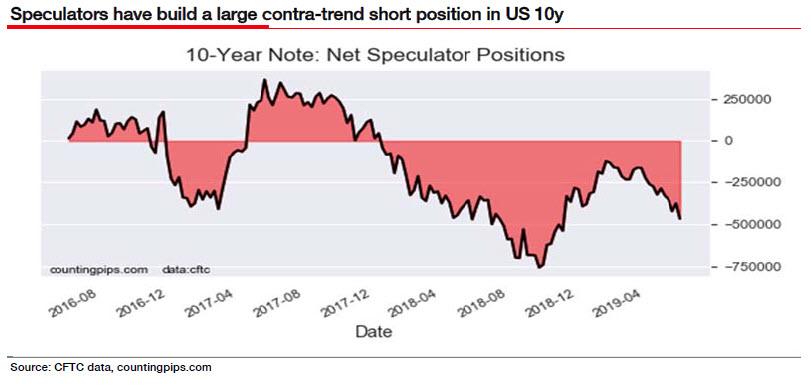
Showing posts sorted by relevance for query financial repression. Sort by date Show all posts

Thursday, January 21, 2016

You Call That Financial Repression? I'll Show You Financial Repression: Chinese Central Bank Explores Cryptocurrency

From Bloomberg: 

China Mulls Answer to Bitcoin With Digital Currency Study
China’s central bank said it is studying the prospects of issuing its own digital currency and aiming to roll out a product as soon as possible, contending that alternative payment systems can improve the efficiency of global transactions.

The People’s Bank of China set up a research team in 2014 to study digital currencies and application scenarios, according to a statement posted on the regulator’s website. The PBOC said it has consulted with experts from Citigroup Inc. and Deloitte LLP, though it didn’t specify what technology it would be using to issue its digital currency or how it would work in relation to the yuan.

Digital currencies have gained prominence with the rise of bitcoin, which is mined with high-powered computers and operates with a distributed ledger that contains the payment history of every circulation. China has become one of the biggest markets for bitcoin and miners, as Chinese regulators have largely taken a hands-off approach with bitcoin exchanges and businesses.

“They’ve recognized the opportunities the digital currencies have,” said Zennon Kapron, managing director of Shanghai-based consulting firm Kapronasia. “If they did have something the government could monitor and use, that could fit into their longer-term plans.”

Capital Flows
An estimated $843 billion of capital flowed out of China in the 11 months through November, according to a Bloomberg estimate, and policy makers are having to add funds to the financial system to prevent interest rates rising amid an economic slowdown....MORE
The IMF is on board.
From the International Monetary Fund, yesterday:

New IMF Staff Paper Looks at How to Reap the Benefits and Curtail the Risks of Virtual Currencies
Press Release No. 16/17
January 20, 2016

Virtual currencies (VCs) and especially their underlying technologies are a potentially important advance for the financial sector that could increase efficiency and financial inclusion, but can also serve as vehicles for money laundering, terrorism financing, and tax evasion. Achieving a balanced regulatory framework that guards against risks without suffocating innovation is a challenge that will require extensive international cooperation, says a new staff paper, “Virtual Currencies and Beyond: Initial Considerations,” released today by the International Monetary Fund (IMF) during the World Economic Forum....MORE
Previously in the Financial Repression series:

Research Affiliates (Rob Arnott) "Financial Repression and Real Rates"
Au Contraire: An Unexpected Fan of Financial Repression
Japan: How Do You Convince People to Buy Your 1% Yield in a 2% Inflation World? (repression baby!)
UPDATED--Talk About Financial Repression: It's Now Illegal to Mention Foreign Currency in Ukraine
Allianz on Repression: "Welcome to a RIGGED Future in a World of Financial Repression "
Rothschild Wealth Management: "Investing in an era of financial repression"
Rabobank on Financial Repression and What Bernanke is Up To
 IMF: "The Good, the Bad and the Ugly: 100 Years of Dealing with Public Debt Overhangs" (Policy Responses to Debt/GDP Over 100%)
"Investing When Fundementals Don't Matter"
 Cyprus: "Beyond financial repression"

And from the big daddy of recent research,  Carmen M. Reinhart and M. Belen Sbrancia's "THE LIQUIDATION OF GOVERNMENT DEBT":
...The pillars of “Financial Repression
The term financial repression was introduced in the literature by the works of
Shaw (1973) and Ronald McKinnon (1973). Subsequently, the term became a way of
describing emerging market financial systems prior to the widespread financial
liberalization that began in the 1980 (see Agenor and Montiel, 2008, for an excellent
discussion of the role of inflation and Giovannini and de Melo, 1993 and Easterly, 1989
for country-specific estimates). However, as we document in this paper, financial
repression was also the norm for advanced economies during the post World War II
and in varying degrees up through the 1980s. We describe here some of its main
features.... 
See also "Financial Repression Phase II: 'Is The IMF Now Recommending Capital Controls...?'"

This focus has led to some obvious signs of mental disturbance:
Financial Cypression: Cypriot Banks to Remain Closed Until Tuesday (at the earliest)
Yes, yes, we know the difference between Cyprus and cypress but if the headline was "Financial Cyprussion..." some folks would think we'd gone all misspelled Teutonic-ebonic and not caught the ref to repression.
Not our long-suffering regular readers but, you know, strangers.... 
"Depositor Repression" May Spread To Switzerland, EURCHF Spikes
I went to bed last night wondering how the Swiss National Bank would defend the ceiling on the franc of 1.20 per euro.
I've got to get a life....

Tuesday, May 7, 2013

Au Contraire: An Unexpected Fan of Financial Repression

From the "About" page:
Marc Chandler is the global head of currency strategy for a Wall Street firm and is an associate professor at NYU's Center for Global Affairs.
From Jacobin:

Radical critique from an unexpected source — the head of currency trading at a major Wall Street firm considers global capital markets.
In response to the end of the credit cycle, policy makers and central bankers in the high-income countries have exponentially increased their presence in the capital markets. Debt issued by governments has soared and central banks are pursuing unorthodox policies — the aim of which varies from country to country.
The purpose of quantitative easing in the US, especially the latest reiteration, is to accelerate employment growth. The European Central Bank’s Outright Market Transactions is to ensure a proper transmission of its monetary policy to countries that agree to EU/IMF conditionality and have access to the capital markets. Japan’s asset purchase program, through which it buys not only government bonds, but also ETFs, REITS and corporate bonds, is to fight deflation.

Initially, the Swiss National Bank bought foreign bonds as a way to arrest the franc’s appreciation that was fueling deflationary forces in Switzerland. When this failed, it moved to formally cap the franc. The SNB now buys sufficient foreign currencies to defend it. The Bank of England’s gilt purchase program seemed aimed at strengthening the economy, though it is much less concerned about the labor market than is the Federal Reserve.

Some economists call this “financial repression.” It occurs, they say, whenever a sovereign interferes with free market activity and the pricing of debt or currency. Of course, such a broad definition means that financial repression has been around forever. For example, it is akin to shaving some precious metal from coins in ancient Rome.

By artificially lowering the cost of debt below what would prevail in a free market, quantitative easing has been called a “stealthy default” by PIMCO, one of the largest bond investors in the world. It also suggests that it is a sneaky form of taxation: “a gentlemanly way for modern countries with fiat currencies to stiff creditors while still ostensibly paying interest and principal in full.”

There are two problems with this narrative despite its widespread acceptance. First, the financial repression thesis (FRT) imagines a state of nature in which the market exists, but the state does not. This view implies that the market is natural and the state artificial. But if this is the case, any action by the state in the financial markets falls under the expansive definition of financial repression.

The factors of production — land, labor and capital — were not always regarded as commodities that can be traded and bought in the market place. Karl Polanyi traces this development in his classic The Great Transformation: The Political and Economic Origins of Our Time. The point is that modernity was co-created by the rise of the modern state and the market economy. The two were inseparable.
A strong state was needed to overturn the reciprocal rights and responsibilities that limited the scope of the markets in traditional societies — think feudalism, for example. Each of the factors of production sought to escape the omnipresent market by organizing. Individual capitalists organized through various forms, like pools, trusts, cartels, and corporations. Labor organized in industrial and trade unions. Farmers organized in cooperatives, collectives, and political parties....MORE
HT: Counterparties 

Previously in the Financial Repression series:
Research Affiliates (Rob Arnott) "Financial Repression and Real Rates"
Financial Repression Phase II: "Is The IMF Now Recommending Capital Controls...?"
UPDATED--Talk About Financial Repression: It's Now Illegal to Mention Foreign Currency in Ukrain
Allianz on Repression: "Welcome to a RIGGED Future in a World of Financial Repression "
Rothschild Wealth Management: "Investing in an era of financial repression"
Rabobank on Financial Repression and What Bernanke is Up To
 IMF: "The Good, the Bad and the Ugly: 100 Years of Dealing with Public Debt Overhangs" (Policy Responses to Debt/GDP Over 100%)
"Investing When Fundementals Don't Matter"
 Cyprus: "Beyond financial repression"

And from the big daddy of recent research,  Carmen M. Reinhart and M. Belen Sbrancia's "THE LIQUIDATION OF GOVERNMENT DEBT":

...The pillars of “Financial Repression

The term financial repression was introduced in the literature by the works of
Shaw (1973) and Ronald McKinnon (1973). Subsequently, the term became a way of
describing emerging market financial systems prior to the widespread financial
liberalization that began in the 1980 (see Agenor and Montiel, 2008, for an excellent
discussion of the role of inflation and Giovannini and de Melo, 1993 and Easterly, 1989
for country-specific estimates). However, as we document in this paper, financial
repression was also the norm for advanced economies during the post World War II
and in varying degrees up through the 1980s. We describe here some of its main
features....

Wednesday, October 10, 2012

Financial Repression Phase II: "Is The IMF Now Recommending Capital Controls...?"

One of the tools in the Central Bank and/or government toolbox, see links below.
Phase I is interest rate supression, Phase II is currency and capital controls.
As Reinhart and  Kirkegaard wrote in their March 2012 VoxEU Op-ed:
Financial repression: Then and now
...As coined by Ronald McKinnon (1973), the term “financial repression” describes various policies that allow governments to “capture” and “under-pay” domestic savers. Such policies include forced lending to governments by pension funds and other domestic financial institutions, interest-rate caps, capital controls, and many more. Governments have typically used a mixture of these to bring down debt levels, but inflation and financial repression typically only work for domestically held debt (the Eurozone is a special hybrid case). In the current policy discussion, financial repression comes under the “macroprudential regulation” rubric....MORE
From ZeroHedge:
It takes all of three seconds on the ground in Spain to realize that this country is hurting. Big time.
I was just here three months ago, eight or nine months before that. Each time it seems worse– more strikes, more homeless, more unemployed, more unrest, more storefront vacancies. It’s amazing what the combination of debt, deceit, and a bona fide banking collapse can do to a nation.

In a most intellectually disingenuous statement, European leaders recently announced that Spain is A-OK and would not require a bailout. I suppose it’s true to a degree. Spain doesn’t really need a bailout. More like an exorcism. Or at least last rites.

After all the debt, austerity, government collapse, riots, etc., there’s a new crisis du jour here: the banking system. Individuals, businesses, and institutions are all predicting a breakup of the eurozone, and nobody wants to have cash in this country on the day they introduce a new currency (and then immediately proceed to devalue it.)

Consequently, depositors are moving money out of the country en masse, often to the tiny principality of Andorra next door– a highly capitalized, low tax banking jurisdiction. This leaves the already thinly-capitalized Spanish banks in an even weaker position.

As you probably know, the way the banking system works in most of the world is a complete fraud. Most banks only hold a tiny percentage of their customers’ deposits in cash. The rest is ‘invested’ (gambled) or loaned to a bankrupt government.

This is a high-risk model that only works well when people have tremendous confidence in the system. The moment there are more than a handful of depositors wanting their money back, the bank has a big problem.
This is happening nationwide in Spain, so the entire banking system has a problem. Nearly every bank here is technically insolvent… and yet they have droves of customers trying to withdraw funds that aren’t there.

As such, the IMF is now recommending that Spain (and other nations in the eurozone periphery) take action “at the national level” to stem this flight of funds and prevent people from moving money abroad....MORE
Is the red ink too, as the Hollywood folks say, on the nose?

Previously:
Allianz on Repression: "Welcome to a RIGGED Future in a World of Financial Repression "
Rothschild Wealth Management: "Investing in an era of financial repression"
Rabobank on Financial Repression and What Bernanke is Up To
 IMF: "The Good, the Bad and the Ugly: 100 Years of Dealing with Public Debt Overhangs" (Policy Responses to Debt/GDP Over 100%)
"Investing When Fundementals Don't Matter"
And from the big daddy of recent research,  Carmen M. Reinhart and M. Belen Sbrancia's "THE LIQUIDATION OF GOVERNMENT DEBT":

...The pillars of “Financial Repression

The term financial repression was introduced in the literature by the works of
Shaw (1973) and Ronald McKinnon (1973). Subsequently, the term became a way of
describing emerging market financial systems prior to the widespread financial
liberalization that began in the 1980 (see Agenor and Montiel, 2008, for an excellent
discussion of the role of inflation and Giovannini and de Melo, 1993 and Easterly, 1989
for country-specific estimates). However, as we document in this paper, financial
repression was also the norm for advanced economies during the post World War II
and in varying degrees up through the 1980s. We describe here some of its main
features.

(i) Explicit or indirect caps or ceilings on interest rates, particularly (but not
exclusively) those on government debts. These interest rate ceilings could be effected
through various means including: (a) explicit government regulation (for instance,
Regulation Q in the United States prohibited banks from paying interest on demand
deposits and capped interest rates on saving deposits). (b) In many cases ceilings on
banks’ lending rates were a direct subsidy to the government in cases where the
government borrowed directly from the banks (via loans rather than securitized debt);
(c) the interest rate cap could be in the context of fixed coupon rate nonmarketable
debt; (d) or it could be maintained through central bank interest rate targets (often at the
directive of the Treasury or Ministry of Finance when central bank independence was
limited or nonexistent). Metzler’s (2003) monumental history of the Federal Reserve
(Volume I) documents the US experience in this regard; Cukierman’s (1992) classic on
central bank independence provides a broader international context.

(ii) Creation and maintenance of a captive domestic audience that facilitated
directed credit to the government. This was achieved through multiple layers of
regulations from very blunt to more subtle measures. (a) Capital account restrictions
and exchange controls orchestrated a “forced home bias” in the portfolio of financial
institutions and individuals under the Bretton Woods arrangements.
(b) High reserve
requirements (usually non-remunerated) as a tax levy on banks (see Brock, 1989, for an
insightful international comparison). (c) Among more subtle measures, “prudential”
regulatory measures requiring that institutions (almost exclusively domestic ones) hold
government debts in their portfolios (pension funds have historically been a primary
target); and (d) transaction taxes on equities (see Campbell and Froot, 1994) also act to
direct investors toward government (and other) types of debt instruments. (e)
prohibitions on gold transactions.

(iii) Other common measures associated with financial repression aside from
the ones discussed above are, direct ownership (China or India) of banks or extensive
management of banks and other financial institutions (i.e. Japan). Restrictions of entry
to the financial industry and directing credit to certain industries are also features of
repressed financial markets (see Beim and Calomiris, 2000)....

Page 8 of  66 (PDF) with many specific examples beginning on page 16.

Tuesday, September 18, 2012

Rothschild Wealth Management: "Investing in an era of financial repression"

Following up on:
Rabobank on Financial Repression and What Bernanke is Up To
Crestmont Research on Inflation, P/E's and Market Returns
Markets Appear to Expect 5% Inflation and IMF: "Inflation Hedging for Long-Term Investors"

As a very sharp (and deranged) analyst said to me when looking at the Philip Morris chart sometime in the late nineties: "A pattern appears to be emerging"*

From Rothschild Wealth Management & Trust:.
Heavily-indebted governments have a clear incentive to depress interest rates and lock-in demand for their bonds. This financial repression has major implications for the economic outlook and future investment returns.

Excessive debt continues to dominate the investment landscape. Since the financial crisis struck in 2007, private debt has been reduced slightly in the advanced economies after thirty years of excess, but remains very high as a percentage of national income. Government debt continues to grow across the developed world, in many cases to dangerously high levels (see figure 1).

For investors, recognising the scale of the debt problem is important, because of its implications for government and central bank policies, particularly the incentives it creates for financial repression.

In the pages below, we set out what we mean by financial repression, what it looks like today, and why we expect it to continue for at least several years. We then assess the economic and investment implications, outlining how we are positioning ourselves to achieve positive real returns.

A broad policy approach
The term financial repression was first coined in the 1970s and applied to developing economies that, at the time, hadn’t embraced economic liberalisation. Over the past 18 months, the concept has been resurrected, with economists such as Carmen Reinhart, Maria Belen Sbrancia and Jacob Kirkegaard re-examining government policies in previous periods of high public debt.

In our usage, financial repression describes a situation where interest rates are kept artificially depressed. This works through governments intervening directly in the market for public debt, and via the knock-on effects of their actions on the monetary authorities. It takes a wide range of forms, including central banks directly buying government bonds (which pushes yields and borrowing costs lower), restrictions on cross-border capital flows (to create a captive home market for bonds), new regulations for banks and insurance companies (to raise the amount of government debt they own) and interference in the management of pension funds’ assets. More extreme forms of financial repression have included punitive taxes on buying and selling securities, the nationalisation of banks and bans on the private ownership of gold.

Financial repression works best when combined with modestly elevated rates of inflation that persist for a number of years. This means headline inflation rates around 1% to 3% above official targets (inflation rates much higher than this tend to be very disruptive to economic and financial activity). Higher inflation makes interest rates negative in real terms, favouring debtors at the expense of creditors: while the nominal stock or face value of outstanding debt may be unchanged, its real value (i.e. its actual purchasing power) is steadily eroded. This liquidation effect can be quite substantial over time and acts as a tax levied on holders of domestic debt....

...The investment implications
In this environment, many investors will need to fundamentally rethink their investment strategies if they are to achieve returns that, at the very least, keep pace with inflation and preserve their purchasing power.

In our view, most traditional ‘low risk’ portfolios – those that are heavily invested in cash and bonds – will produce poor and often negative real returns over the next five years. For example, government bonds issued by countries such as the US, Germany and the UK typically form the backbone of conservative portfolios. Yet these securities no longer offer enough of a premium above cash rates to compensate for the associated risks, even if financial repression succeeds in keeping yields depressed.

What can be done? As a first step, investors need to be prepared to embrace riskier assets, and to tolerate more short-term fluctuations in the value of their portfolios than they would have done before the financial crisis. For conservative investors, more volatility is the price that has to be paid for maintaining positive real returns....MUCH MORE (15 page PDF)
Here's the 42-year chart for MO:
Chart forAltria Group Inc. (MO)


Splits: Jun 3, 1974 [2:1], Jun 1, 1979 [2:1], Apr 11, 1986 [2:1], Oct 11, 1989 [4:1], Apr 11, 1997 [3:1]

The move is approximately a split adjusted 2 cents to today's $33.32

Monday, March 18, 2013

Cyprus: "Beyond financial repression"

From FT Alphaville:
A couple of years back, when Carmen Reinhart and Belen Sbrancia updated the concept whereby governments might deal with a problematic mountain of debt by confiscating the savings of their subjects, the discussion was all about the subtle, sleight of hand solutions that might be employed.

Artificially cheap rates of interest might be forced on the embattled sovereign’s debt, local banks might be obliged to buy mis-priced government paper, exchange controls may be erected, and so on. Ordinary people, it seemed, could be financially repressed without realising they were in fact the victims.
There was no discussion back then of outright expropriation or a “tax”, as insured (and uninsured) depositors at Cypriot banks are now being forced to bear.

Joseph has a detailed discussion here of the peculiar circumstances that made a bailout of Cyprus particularly challenging. Senior bondholders are all but non-existent at Cypriot banks (and therefore not available to share any pain), while PSI at the sovereign level would have pushed local bond holders (local banks) over the edge and/or brought on months of litigation from foreign holders. Meanwhile, we had the spectre of German politics (‘German taxpayers bailing out Russian money launderers’) clashing with Russian strategic interests (owners of the said laundered money)....MORE
Alphaville has been all over this story since the Joseph Cotterill post at 18:37 on Saturday. See:  
The fallout: Cyprus edition
Teaching a lesson, lesson learned
The stupid idea, and the system
The Cyprus depositor pain-distribution ratio
For more on Financial Repression see our series from last year:

UPDATED--Talk About Financial Repression: It's Now Illegal to Mention Foreign Currency in Ukrain
Financial Repression Phase II: "Is The IMF Now Recommending Capital Controls...?"
Research Affiliates (Rob Arnott) "Financial Repression and Real Rates"
Allianz on Repression: "Welcome to a RIGGED Future in a World of Financial Repression "
Rothschild Wealth Management: "Investing in an era of financial repression"
Rabobank on Financial Repression and What Bernanke is Up To
 IMF: "The Good, the Bad and the Ugly: 100 Years of Dealing with Public Debt Overhangs" (Policy Responses to Debt/GDP Over 100%)
"Investing When Fundementals Don't Matter"

And from the big daddy of recent research (ref'd above),  Carmen M. Reinhart and M. Belen Sbrancia's "THE LIQUIDATION OF GOVERNMENT DEBT":

...The pillars of “Financial Repression...

Sunday, October 13, 2013

The Challenge of a Low Return Environment

The first question that current policy raises (besides efficacy) is how much do the various Fed machinations distort the interest rate curve. In an attempt to answer that question we had a whole series of posts on financial repression:
Allianz on Repression: "Welcome to a RIGGED Future in a World of Financial Repression "
Rothschild Wealth Management: "Investing in an era of financial repression"
Rabobank on Financial Repression and What Bernanke is Up To
 IMF: "The Good, the Bad and the Ugly: 100 Years of Dealing with Public Debt Overhangs" (Policy Responses to Debt/GDP Over 100%)
"Investing When Fundementals Don't Matter" 
Research Affiliates (Rob Arnott) "Financial Repression and Real Rates"
And from the big daddy of recent research (ref'd above),  Carmen M. Reinhart and M. Belen Sbrancia's "THE LIQUIDATION OF GOVERNMENT DEBT"...

See also "Financial Repression Phase II: 'Is The IMF Now Recommending Capital Controls...?'"

This focus has led to some obvious signs of mental disturbance:
Financial Cypression: Cypriot Banks to Remain Closed Until Tuesday (at the earliest)
Yes, yes, we know the difference between Cyprus and cypress but if the headline was "Financial Cyprussion..." some folks would think we'd gone all misspelled Teutonic-ebonic and not caught the ref to repression.
Not our long-suffering regular readers but, you know, strangers.... 
"Depositor Repression" May Spread To Switzerland, EURCHF Spikes
I went to bed last night wondering how the Swiss National Bank would defend the ceiling on the franc of 1.20 per euro.
I've got to get a life....
In late September Calafia beach Pundit pointed out:
How Much Higher Should Interest Rates Be?
Most observers seem to believe that interest rates were abnormally low because of the Fed's QE program. But as the chart above shows, interest rates actually rose each time the Fed bought large quantities of bonds...
For at least the last six months Izabella Kaminska, on both her personal blog and at FT Alphaville has been arguing a slightly more esoteric point, that savers do not "deserve" a given interest rate (and more broadly, a given rate of return) when they put their money at risk. Here's one recent post from Dizzynomics:
Benoit Cœuré on why savers are not being penalized
From a recent speech he gave in Geneva:
Specifically, I will maintain that persistently low asset returns or, more generally, poor investment opportunities are simply one of the many manifestations of a deep recession. In such an environment, looser monetary policy conditions are not the result of a desire to favour borrowers, but rather the necessary response to bring the economy back on to a sustainable growth path in an environment of price stability. Far from helping savers, higher monetary policy interest rates would only have depressed the economy further, delayed the recovery and contributed to downside risks to price stability. Asset returns would have been dampened for longer and savers would have suffered for longer.
And:
Lenders in stressed countries as well as savers in all countries have suffered from the consequences of financial fragmentation....MORE
Her thinking is crystalized in this sentence:
...The capital must be reallocated to riskier potentially productive investments for growth to return. Old allocations that are not productive cannot be supported ad infinitum out of fear of creating wasteful resource inefficient zombie companies....
As you can see from the above links a lot of very sharp people are trying to figure this out. In June and July we had Grantham Mayo's James Montier:
Interview With Grantham Mayo's James Montier
What If There's No Mean Reversion? (Grantham Mayo Van Otterloo quarterly letter July 2013)
and:
More on The Purgatory of Low Returns

Last week, in a piece I can't recommend highly enough, "The Paradox of Wealth: William Bernstein on Living in a Low Return World " Bernstein tried to tie it all together especially after page 12 of the PDF: The Paradox of wealth.
Here's one of Bernstein's graphs that should disabuse anyone of the notion that we are witnessing a transient phenomena:
European Interest Rates 1200-1800
 
I should probably do a post on Capital Deepening and maybe one on recent scholarship relating to Adam Smith's (and Ricardo's, and Marx's and...) theory that the general tendency of profit rates is to decline.

Finally, where I come down.
1) There is a lot of money sloshing around, I've referred to the hot money as similar to the herds of animals (read prey) thundering across the African savanna.
2)The size of these pools of funds are exacerbated by the leverage in the system.
3) This condition is going to be with us for an extended period.
4) There is a very real risk that, should the extraordinary measures of central banks fail or even just be insufficient, the world economy as a whole would experience a deflationary contraction and negative interest rates at the same time, a situation in which our only trustworthy guide could end up being Lewis Carroll:
“But I don’t want to go among mad people," Alice remarked.
"Oh, you can’t help that," said the Cat: "we’re all mad here. I’m mad. You’re mad."
"How do you know I’m mad?" said Alice.
"You must be," said the Cat, or you wouldn’t have come here.”

Friday, January 22, 2016

More On China's Cryptocurrency Push and Financial Repression

Following up on yesterday's "You Call That Financial Repression? I'll Show You Financial Repression: Chinese Central Bank Explores Cryptocurrency".

First up, state mouthpiece Xinhua:

China to issue digital currency "as soon as possible"
China's central bank on Wednesday announced that it will try to issue digital currency "as soon as possible."
A team in the central bank is examining domestic and global experiences. Digital currency costs less in circulation than traditional paper, facilitates trade, boosts transparency, and cuts money laundering and tax evasion, according to the People's Bank of China at a conference on digital currency.

They will improve the central bank's control of currency to better support development, and bolster new financial infrastructure and complete payment systems, it added.

The team was set up in 2014 and has made progress on technology, legal issues, and the impact on financial systems. 
HT to The Diplomat who writes:

Move Over, Bitcoin: China Wants to Issue Its Own Digital Currency
China’s central bank plans to issue its own digital currency “as soon as possible,” according to Xinhua. The People’s Bank of China made the announcement at a conference on digital currency in Beijing.  

According to Xinhua, in 2014 the PBOC set up a team to examine the possibility of establishing a digital currency and particularly to study experiences in China and abroad. Two years later, the team “has made progress on technology, legal issues, and the impact on financial systems,” Xinhua said.
Charlie Custer, writing for Tech in Asia, notes that China is still a long way from actually rolling out a digital currency. Plus, he’s skeptical that the idea will take off in the country: “Chinese consumers are historically conservative about their savings, and dumping lots of money into a brand-new wholly-abstract digital currency could be a tough sell, even for China’s Central Bank.”

So why is China pursuing its own digital currency? The PBOC listed a number of practical benefits: a digital currency is cheaper (because it reduces the need to print money), makes trading and financial transactions easier, and also helps cut down on money laundering and tax evasion.

However, the logic behind the move may be even simpler. China’s attitude toward foreign cyber innovations has long been “if you can’t beat ‘em, copy ‘em.” China can avoid the aspects of Western technologies it doesn’t like by coming up with its own home-grown alternatives — with Chinese characteristics, of course. Creating a new, official Chinese digital currency could allow Beijing to finally bid goodbye to its complicated relationship with the current reigning digital currency, Bitcoin.
Bitcoin experienced its Chinese heyday in late 2013, helping to raise the value of a Bitcoin (BTC) over $1,200. The currency’s popularity snowballed in October, when Chinese internet giant Baidu agreed to accept Bitcoin as a payment method for subsidiary services. At first, the Chinese government seemed bullish on the currency, but there were always lingering concerns, given how little control Beijing had over regulation and tracking of Bitcoin transactions.

In December 2013, Beijing moved to curtail the growth of Bitcoin, barring Chinese banks and financial institutions from treating Bitcoins as currency. The bank cited concerns over potential money laundering and financial stability as the rationale for the move. The PBOC also told third-party payment processing companies to stop accepting Bitcoin, leading China’s major BTC exchange to stop accepting deposits using China’s renminbi.

Now, China has announced that it’s rolling out its own alternative to Bitcoin, one that will presumably maintain the convenience of a digital currency while removing the aspects Beijing finds most troubling. As Custer points out, China’s eventual digital currency would be quite different from Bitcoin, in that it will be tailor-made for the Chinese government to easily track transactions, and will be under the aegis of China’s central bank. In fact, the PBOC believes a digital currency will actually improve its ability to control China’s currency....MORE
If wary reader is new to this stuff and wishes some backstory, one of the places we linked to in yesterday's post is the National Bureau of Economic Research:

The Liquidation of Government Debt 
Carmen M. Reinhart and M. Belen Sbrancia
NBER Working Paper No. 16893 March 2011
JEL No. E31,E4,E6,F3,F4,H6,N10
ABSTRACT
 Historically, periods of high indebtedness have been associated with a rising incidence of default or restructuring of public and private debts. A subtle type of debt restructuring takes the form of “financial repression.” Financial repression includes directed lending to government by captive domestic audiences (such as pension funds), explicit or implicit caps on interest rates, regulation of cross-border capital movements, and (generally) a tighter connection between government and banks. In the heavily regulated financial markets of the Bretton Woods system, several restrictions facilitated a sharp and rapid reduction in public debt/GDP ratios from the late 1940s to the 1970s. Low nominal interest rates help reduce debt servicing costs while a high incidence of negative real interest rates liquidates or erodes the real value of government debt. Thus, financial repression is most successful in liquidating debts when accompanied by a steady dose of inflation. Inflation need not take market participants entirely by surprise and, in effect, it need not be very high (by historic standards). For the advanced economies in our sample, real interest rates were negative roughly ½ of the time during 1945-1980. For the United States and the United Kingdom our estimates of the annual liquidation of debt via negative real interest rates amounted on average from 3 to 4 percent of GDP a year. For Australia and Italy, which recorded higher inflation rates, the liquidation effect was larger (around 5 percent per annum). We describe some of the regulatory measures and policy actions that characterized the heyday of the financial repression era

Monday, July 15, 2013

HBR: "The Brighter Side of Decades of Disappointing Investment Returns"

I almost went with the headline "A Link-rich Post on..." because the writer,  Justin Fox, editorial director of the Harvard Business Review Group, hypertexts to some of the best.

Okay truth be told, I like it because he goes over ground we've already plowed and I'm all atingle with confirmation bias.

If you haven't read Authers piece, do it now, this can wait.

It is hard to go wrong with anything from Dimson, Mars and Staunton. We linked to the Credit Suisse report in April and the Dimson et al paper linked at  "Keynes The Stock Market Investor" is the best research into the topic we have right now.
His Reinhart link goes to a Bloomberg opinion piece, the original financial repression paper is linked at "Cyprus: "Beyond financial repression"'

Finally the Arnott, Bernstein paper (and a whole bunch of others) can be found at "Equity Risk Premium: "How much should people get paid for investing in the stockmarket?""
(added bonus DMS do a cameo)

From the Harvard Business Review:
The prospects for investors, be they corporate pensions, sovereign wealth funds, or individuals, appear bleak. John Authers, in Thursday's FT, musters up the evidence (or at least the opinions) that bonds and stocks are both likely to deliver paltry returns for years to come. Sheelah Kolhatkar, in a cover story (and what a classy cover it is) in the new Bloomberg Businessweek, argues that the great alternative to plain-vanilla equity and debt investing — the hedge fund — is more or less over, too. And London Business School's Elroy Dimson, Paul Marsh, and Mike Staunton, in a Credit Suisse report cited by Authers that's a few months old but it is well worth downloading and taking the time to read, make a pretty convincing case that the equity and bond returns that came to be perceived in the U.S. as "normal" in the decades following World War II — and particularly since 1980 — are anything but.

We're all pretty well aware of the negative consequences of low investment returns, although perhaps not of the specifics. Dimson, Marsh, and Staunton calculate that a 25-year-old entering a defined-contribution retirement savings plan — such as a 401(k) in the U.S. — needs to set aside 16% to 20% of her income (!) if she hopes to retire at age 65 at half salary.

Still, where there are losers, there are winners. "While a low-return world imposes stresses on investors and savers in an over-leveraged world recovering from a deep financial crisis," Dimson, Marsh, and Staunton write, "it provides essential relief for borrowers." The biggest borrowers these days are governments, and because governments possess powers that most borrowers don't, they are often able to cut their borrowing costs at the expense of creditors through a variety of techniques that Harvard economist Carmen Reinhart dubs "financial repression."

Financial repression doesn't sound like a good thing, and in some ways it isn't. But the great global recovery after World War II was accomplished in an environment of artificially low interest rates and capital controls — that is, financial repression. So it doesn't have to be bad economic news. Sometimes governments actually use the money they borrow wisely.

Then there are the other tradeoffs inherent in investment returns. Over time, Rob Arnott and Peter Bernstein demonstrated in a great 2002 article in the Financial Analysts Journal, stock market returns should and do trail economic growth. That's because:
Shareholders can expect to participate only in the growth of the enterprises they are investing in. An important engine for economic growth is the creation of new enterprises. The investor in today's enterprises does not own tomorrow's new enterprises — not without making a separate investment in those new enterprises with new investment capital.
So when U.S. stock market returns outpace economic growth, that money has to come from somewhere. It can be taken out of workers' paychecks, creditors' pockets, or government coffers. It can come from overseas, as U.S.-based companies take advantage of faster growth elsewhere. And it can come from the future, as investors bet on faster growth to come....MORE
As I've said more than once, we have so many posts on Arnott that it is probably easiets to do a Google site search:
site:climateerinvest.blogspot.com

Thursday, September 20, 2012

Allianz on Repression: "Welcome to a RIGGED Future in a World of Financial Repression "

Sometimes I forget just how big Allianz is. Then I remember that PIMCO is one of their subsidiaries and PIMCO alone has $1.8 trillion AUM. The Global Investors division has a total of € 1.6 Trillion under management. Not BlackRock but still a behemoth.
Anbd that's just the investment management biz, I hear they're also into insurance.
From Allianz Global Investors:
Neil Dwane, CIO Europe of Allianz Global Investors, believes that financial repression is here to stay and will have a huge long-term impact. He presents its causes and effects—and tells investors how to fight back.

As a European investor—working and living in both the U.K. and Germany, and speaking to our clients around Europe regularly—I continue to be shocked and deeply saddened at both a professional and personal level by the impact of this destructive debt crisis that still rumbles on in Europe and will continue to do so.

Faced by this unprecedented crisis and the deepening rifts appearing between societies protesting against austerity, European leaders are under immense pressure to deliver a quick solution. It must be both constitutional and the most palatable (and preferably painless) way out of the ever-deepening recession—which is hitting the poorest hardest. While facing similar though different issues, the U.S., the U.K. and Japan are not far behind.

The solutions
There are two sides to these more painless "solutions" being sought, in my view. The first, quantitative easing (QE), has been firmly established since the 2008 financial crisis, and is more popular with markets as a method of pouring short-term "oil" on the debt crisis "fire" in an attempt to alleviate slowing growth and cruelly high levels of unemployment in too many Organisation for Economic Co-operation and Development (OECD) countries.

Welcome to the now familiar theme of short-term money action by central banks—which has sprung back to life recently—with further easing by China, Denmark, Brazil and Korea all lowering interest rates, the U.K. undertaking additional QE and the European Central Bank (ECB) lowering rates to a historic level. Sadly the positive effect of these actions lasted only a very short time, with the U.S. Federal Reserve’s recent minutes disappointing those hoping for yet more stimulus in the immediate future.

The second is a much less blatant, far more subtle long-term policy—already written about widely but nevertheless invisible to many in society, and hence so irresistibly attractive to Western governments under extreme pressure to come up with less painful solutions to ease the debt crisis.

Welcome to financial repression and artificially engineered negative interest rate policies (NIRP). Having long since been implemented, it's here to stay for many years (or even decades) to come—as it must if it is to solve the excessive debt burden and entitlements obligation. While far less obvious to the average citizen in the short term, it has a huge long-term impact and brings many challenges with it—which I will endeavour to explain for you below, point by point.

 Welcome to a RIGGED future

The facts

Restrictive and regulated behaviors will impact all participants in the savings industry, as banks are forced to hold more sovereign bonds, insurers are encouraged by Solvency II to remain risk-averse, and pension funds are persuaded to accept increasingly less-volatile returns.
Inflation of real assets and costs are likely to erode nominal cash returns, thereby making savers unable to protect the purchasing power of their money. A premium may emerge for illiquid, high-quality, infrastructure-type assets.
Government policies will tend to squeeze out private capital during this period, thereby dulling the real value-creating part of the economy and highlighting the value of growth companies globally.
Global investment opportunities are expected to remain attractive during a time when many policies seek to de-globalize markets and correct the remaining huge imbalances that remain in Europe and around the world—a process that may take years to undo.
Equities in the past have been able to offset much of the pain of financial repression, especially by (A) offering real inflation-adjusted dividends within high-quality large-cap stocks, but most effectively in small caps both regionally and globally; and (B) accessing the real market growth of the emerging markets.
Disciplined investment skills can optimize the full use of risk in a client's portfolio, implemented in as unconstrained a fashion as possible.
RIGGED it may be ... and the fight to protect the value of your savings has just begun.

...MORE 

Monday, July 16, 2012

Research Affiliates (Rob Arnott) "Financial Repression and Real Rates"

I did a bait-and-switch in the headline. The writer of the June 2012 Research Affiliates' newsletter is not Mr. Arnott, it is his Head of Fixed Income Research, Shane Shepherd.

We are fans of Mr. Arnott since his days as editor of the Financial Analysts Journal.
If interested use the search blog box keyword Arnott.
From RA:
Playing Against the House

...Financial Repression and Real Rates
Financial repression is the easiest, most politically expedient path toward dealing with our global debt problem. Many of the world’s developed economies are on a collision course with insolvency (if not already there!), and the escape routes are not attractive to policymakers. Consider the options: Austerity is a long, painful road that requires a hit to GDP and economic prosperity as debt burdens decrease. This solution has not worked in Greece, and we certainly don’t expect any governments with access to a printing press to go down that path with any sustained vigor. Explicit default may occur in countries, such as those tied to the euro, that cannot print money or influence their market interest rates.

Inflating away the debt is often talked about as an alternative, but in reality inflation on its own will not achieve that goal. Expected inflation is quickly ncorporated into long-term interest rates, so costs of borrowing tend to rise along with inflation. And inflation is only helpful in reducing the value of long term debt, not short-maturity debt. But government regulation to artificially hold interest rates low, along with a steady dose of not-too-high inflation, will work—and is a far stealthier alternative than raising taxes or chopping government spending programs.

We are not arguing for or against the relative merits of the financial repression route. But clearly we are already witnessing a move in that direction. A few examples: in 2009, the United Kingdom increased the required holdings of gilts for its banks and their subsidiaries; the recent Basel III regulations provide preferential treatment for (supposedly) risk-free sovereign debt on a bank’s balance sheet; in 2010, Spain imposed interest-rate ceilings on bank deposits; and Japan reversed its planned privatization of Japan Post, the largest holder of personal savings in the world and a huge captive buyer of Japanese government bonds.
These sorts of regulations, along with the massive purchases of government bonds by the world’s central banks, are starting to have their intended effect. As can be seen in Figure 1, expected real interest rates for several countries around the globe are predominantly negative....MUCH MORE

Monday, September 17, 2012

Rabobank on Financial Repression and What Bernanke is Up To

This report is nine months old but worth the read. The analysts give a straightforward discussion of financial repression with but one failing, they didn't foresee how much emphasis Chairman Bernanke would place on "transparency" i.e. jawboning the market into giving up the low-inflation expectation anchoring that has been assiduously nurtured by the Fed for the last 25 years.

I'm open to the idea that all the jobs talk and jobs targeting is just the magicians favorite tool, misdirection, while the actual trick is being performed in plain sight.We'll see.
In the meantime some very smart people are gaming all this on some very fast computers and coming up with a whole bunch of effects on rates, spreads, swaps and Grandma's savings account.

From Rabobank, December 2011:

Special Report
Risk of financial repression in the West
This article is part of a series of Special Reports that discuss the downside risks to the global economic outlook. In this piece, we take a closer look at the risk of financial repression in the West.

Budget cuts are politically unpalatable Many governments in the industrialised world are stuck between Scylla and Charybdis– the two famous sea monsters in Greek Mythology. If they are to cut their primary budget deficit too quickly to please the market, they risk choking the fragile recovery, if they do it too slowly, they risk falling into the ‘bad’ equilibrium of rising interest rates and lower growth. In both cases, the incumbent government will have difficulty winning the upcoming elections.

History shows that boosting real GDP growth in a period of sluggish domestic and external demand is next to impossible. So how else can a government lower its debt ratio? One solution touted by market participants is making sure the nominal interest rate the government pays on its long-term debt stays lower than the growth of nominal GDP. By keeping the interest rate – growth differential (IRGD) negative, the debt ratio starts to fall, ceteris paribus.

But how can that be achieved? Since boosting real GDP growth is out of the equation, inflation must rise to push nominal GDP growth upwards. Yet if inflation starts to rise, bond vigilantes will rightfully demand an interest- rate premium. Of course, the effective nominal interest rate on the debt is slow to respond to an increase in market yields because the entire debt stock does not roll over every period. But in due time all the debt stock will have to be serviced at higher interest rates. As you can imagine, all the government will achieve is moving from a low inflation/interest rate equilibrium to high inflation/ interest rate equilibrium while the IRGD stays unchanged. This does nothing to improve debt sustainability.

But the study of Escolano et al. (2011) shows that during 1999-2008, IRGDs in the nonadvanced economies, on average, have been deep into the red (below -7%-points). Reinhart and Sbrancia (2011) also find that during 1945-80, governments in the advanced economies managed to significantly liquidate their debt ratios via negative real interest rates. For example, the annual liquidation effect in Australia, Italy, the UK, and the US was estimated to be between 3-5% of GDP (see figure x).....MORE (5 page PDF)
 Here's an executive summary of the Reinhart paper and here is the paper itself (66 page PDF), both via the IMF.

Friday, December 27, 2024

Russell Napier: «We Are Headed Towards a System of National Capitalism»

Geez I hope not.

From Neue Zürcher Zeitung's TheMarket.ch, December 13:

Market strategist and historian Russell Napier outlines a future in which governments mandate where investors should deploy their capital. The global monetary system that has existed since 1994 is being radically restructured. 

Deutsche Version

When Russell Napier speaks, investors around the world listen closely. The long-standing market strategist – formerly with the Hong Kong brokerage CLSA – and author of the Solid Ground Report was one of the earliest warning voices of an impending wave of inflation in the summer of 2020. When The Market NZZ spoke with him two years ago, he predicted a boom in global capital investment.

Napier remains convinced that the global financial system is in the process of fundamental change. «We are talking about nothing less than a collapse of the global monetary system as we have known it for the last three decades», he says.

In an in-depth conversation with The Market NZZ, which has been lightly edited for clarity, Napier explains what this means and how investors should prepare for it.

When we last spoke, you said that governments had found the magic money tree: That by guaranteeing bank loans, they could create money at will, paving the way to financial repression and inflating away their debt. Is that still your view?

In the long term, yes. Financial repression and inflating away bloated debt levels will be with us for years, even decades. But I think we’re experiencing a hiatus first. Governments did exactly what I said in 2021. They created money on a massive scale. Their actions, quite predictably, led to inflation. But then they panicked. So they handed the ball back to the central bankers and said do something about this. In my opinion, central banks have done too much, they hit the brakes too hard. Hence my fear that we might be facing a deflation shock in the short term.

You’re saying central banks have tightened too much?

Yes. We’ve seen a collapse in the growth of broad money in a magnitude that we hadn’t seen since the 1930s. Now, you might say this doesn’t matter since so much broad money was created between 2020 to 2022, and clearly it hasn’t mattered for the past two years. But now it’s starting to bite. That’s my evidence that they have overtightened.

Both in the US and in Europe, M2 growth has picked up again. Central banks have started cutting rates. Why do you still fear a deflation shock?

You’re right, M2 growth has picked up a bit, but it is growing too slowly. It would need to accelerate. The level of M2 growth in relation to the current level of interest rates is just not compatible with what would be needed to sustain economic growth.

Inflation, especially in the US, shows signs of stickiness. Don’t you think another inflationary wave might be in the making?

I can’t reconcile that with the growth rate of broad money. Sure, if we were to suffer a supply shock, then inflation would go up, regardless of what broad money does. But absent that, if broad money is not going up, it suggests that economic activity is going to weaken. I always look at things through a monetary prism. In my view, the next shock is more likely to be deflationary.

Where could that shock come from?

You and I could hypothesise about that all day. It could be a spike in French bond yields. It could be China floating its exchange rate, which would cause the yuan to devalue. It could be the yen carry trade unraveling again. And there’s a fourth possibility, which is the unknown unknown. Somebody somewhere gets into trouble, and we’ll see something break in the financial system.

So basically you are saying that we first might experience a deflation shock before we go back to a world of higher inflation?

Yes, my longer term view of financial repression remains unchanged. That’s the only way I see that will lead us out of the record high levels of debt. Mind you, I use the term deflation shock, but I’m not sure we’ll see outright deflation. Deflation shocks are bad for the economy, they are ugly for equities, and they are very dangerous for high levels of debt. You don’t make money as an investor by trying to predict deflation shocks, you make money by anticipating the government reaction to deflation shocks. And I am convinced that governments will react swiftly by forcing banks to lend, by suppressing interest rates and by using national savings to invest in things they want.

What are the signs that tell you this is happening?

On April 26th, President Emmanuel Macron of France held a speech at the Sorbonne, titled «Europe – It Can Die». Read it. It’s a sea change. In a telling bit of his speech, Macron says that every year, Europeans send 300 billion euros to the US to fund the American government and American corporations. In other words, he's outlining a concept of national savings, and they should be used for the national good. Mario Draghi in his report to the EU Commission also outlines all the things that should be done with new money. The British, meanwhile, are talking about mandation, which posits that pension funds in Britain must invest a certain percentage of their funds domestically. That’s what lies ahead. Governments will tell investors how and where to invest their capital.

And that would conform to your definition of financial repression?

Yes. I say we are headed towards a system of national capitalism. Interestingly, the term ‹national capitalism› has been used before, by a man who used to live in Zurich for a while: his name was Lenin. In a system of national capitalism, governments direct national savings towards national purposes. And our purposes today are investments, as outlined by Macron or Draghi and also by industrial policy initiatives in the US: Investments in energy infrastructure, in defense, in new productive capacity in order to de-risk from China. If we get into a bad Cold War with China, this will have a high national priority.

Do you expect a continuation of the boom in capital expenditures that you outlined two years ago?....

....MUCH MORE

Our most recent visit with Mr. Napier was November 22's Russell Napier: "America, China, and the Death of the International Monetary Non-System" from American Affairs Journal.

We've referenced his capex/construction/infrastructure interview a couple times, here's 

Russell Napier Called It: "The Eyepopping Factory Construction Boom in the US"

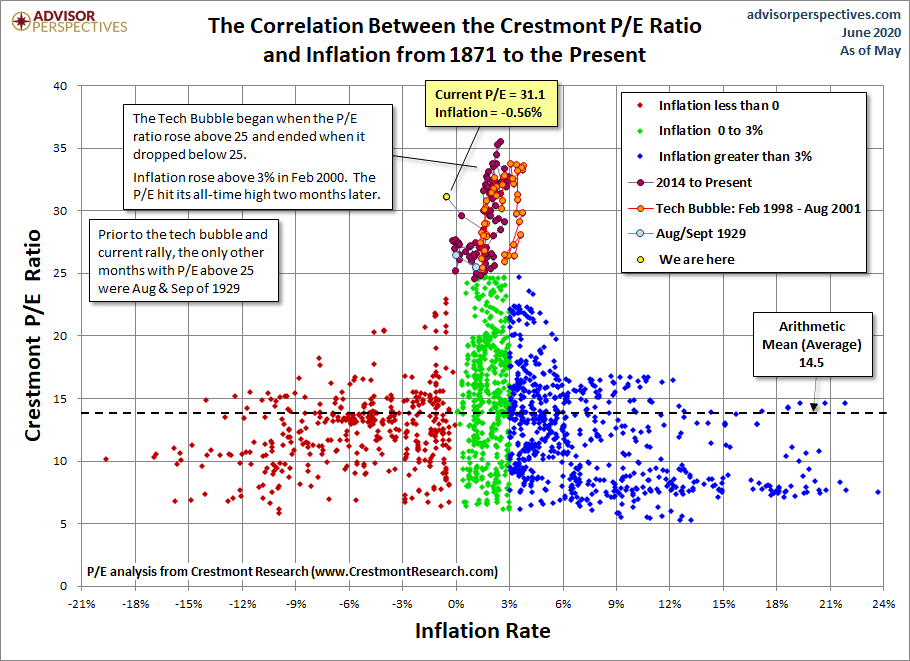
And a reminder from Crestmont Research that inflation is historically (USA, last 100 years) kindest to equity valuations (P/E) at 0% to 4% with 1% to 2% being the the sweet-spot. The sweet spot used to be higher if well enough understood to take advantage of what was transpiring. Back in the day (1914 - 1924) Hugo Stinnes was able to borrow in rapidly depreciating Papiermarks and purchase real assets: plant, property and equipment, that held its value during the WWI inflation and the Weimar hyperinflation. For a while he became the richest person in the world.

That trade seems to have disappeared with the current economy's skew toward asset-light businesses.  

Here's Crestmont:

The Relationships Between Inflation Rates, P/E Multiples, and Expected Future Returns

....Here's another way to look at the relationship between inflation and P/E's. Note that both the highest inflation and deflation rates correspond with the lowest multiples accorded the earnings:
.

And a different way to look at the information:

Crestmont Correlations

....MUCH MORE


Tuesday, May 28, 2013

Japan: How Do You Convice People to Buy Your 1% Yield in a 2% Inflation World? (repression baby!)

That is the essence of the uncertainty over Japanese policy.
If the Japanese government wasn't required to issue debt (structural deficit) there would be no question of eventual success.

But they do have to issue the stuff which means there have to be buyers which means said buyers have to accept a 1% (or more) per year real loss. Hmmm...how ya gonna get 'em to do that?
From ZeroHedge:
BNP Warns On Japanese Repression: Echoes Of The 1940s Fed

In the 1940s, the Fed adopted pegging operations to protect the financial system against rising interest rates and to ensure the smooth financing of the war effort. In effect, the Fed became part of the Treasury’s debt management team; as the budget deficit hit 25% of GDP in WW2, it capped 1Y notes at 87.5bps and 30Y bonds at 2.5%. From the massive bond holdings of its domestic banks to its exploding public debt, Japan today faces a situation very similar to the US in the 1940s.  

With the market becoming dysfunctional as the BoJ’s massive buying operations drain the pool of available bonds, the BoJ’s overriding presence in the market each day has increasingly made the JGB market seem like a government-made market.

But a much bigger problem is Japan’s exploding public debt. With the debt already the largest of the developed nations, it could snowball out of control if an upturn in interest rates causes interest payments to escalate. So, even if 2% inflation is achieved, the BoJ’s zero-rate policy and massive JGB purchases will have to continue until the debt is made more manageable.

When the long-term rate climbs above 2%, the BoJ will probably adopt outright measures to underpin JGB prices to prevent turmoil in the financial system and a fiscal crisis - and just as Kyle Bass noted yesterday, they are going to need a bigger boat as direct financial repression in Japan is unavoidable.

Via BNP,:
With the market becoming dysfunctional as the BoJ’s massive buying operations drain the pool of available bonds, the BoJ’s overriding presence in the market each day has increasingly made the JGB market seem like a government-made market. Those well versed in history may recall that the Fed’s policies in the 1940s to stabilise prices and yields on US government securities – the so-called pegging operations – also resulted in a government-made market. The Fed at the time was deeply entangled in the government’s debt management, so, despite the upturn in inflation, it had to keep long-term rates very low and continue to buy massive amounts of government securities as part of financial repression.

The Fed started down the road towards pegging operations when it intervened in the bond market in the spring of 1935 to prevent rising interest rates from degrading the capital of US banks (more than 50% of assets had to be “safe” government securities) and thereby destabilising the financial system. With the start of WWII, the Fed’s government bond buying morphed into outright support of bond prices (pegging operations), as the shift to a wartime footing necessitated low-cost financing of the war effort. Even when inflation picked up, the policies supporting government bond prices were not allowed to end, causing the Fed to come into repeated conflict with the Treasury Department over policy independence.


Ultimately, the Fed’s bond price-supporting policies enabled banks to reduce their long-term bond holdings substantially, reducing the impact of rising interest rates on the financial system. And after roughly 10 years, the Fed was finally freed from the constraints of this support programme because (a) banks came to favour ending the programme, as they were now in a position to enjoy the merits of widening margins of a steepening yield curve, (b) the US economy and fiscal conditions returned to normal, as public debt was significantly reduced thanks to improved tax receipts from the expanding economy and the “inflation tax” and (c) subsiding concerns about higher interest rates threatening the financial system and state finances allowed inflation to be perceived as the main problem for the economy and society. While the pegging operations may have been inevitable owing to special factors like WWII, the result was the sacrifice of price stability and the destabilisation of the US economy....MUCH MORE

Wednesday, September 19, 2012

"Investing When Fundementals Don't Matter"

This is our second* link to Family Office consultant Greycourt & Co this week:
Virtually everyone in the investment business today grew up in a world where fundamentals dominated the markets. But from the collapse of Lehman Brothers in the fall of 2008 right up until today, markets have been driven not by fundamentals but by geopolitical events and central banker policies. Unless we can somehow get inside the heads of, say Ben Bernanke and Angela Merkel, we can only speculate about what’s going to happen. And one thing investors should never do is speculate about unknowable things.

Investment Fundamentals
By “fundamentals” we mean the common sense ideas that underpin any understanding of the investment world that we can make sense out of:

Investors will demand – and, in general, receive – greater returns to invest in a more risky security than in a less risky security. Yet the riskiest securities – emerging markets stocks, for example – have significantly underperformed less risky securities – US large cap stocks, for example.

Diversification reduces risk, and thoughtful diversification reduces risk faster than it reduces return. Yet as we all know, when markets have melted down virtually all sectors have moved in lockstep, leading investors to complain that “Diversification only works when you don’t need it.”

Finally, hard work distinguishing value from price is how investors add value and outperform other investors. Yet active managers have overwhelmingly underperformed since 2007, and some of the best managers have underperformed the most – especially value investors in 2008.

Investors complain that they have bought assets that seemed clearly undervalued by long-term norms and have been hurt when a geopolitical event came out of nowhere. Meanwhile, other investors are eagerly buying assets that seem clearly overvalued by the same norms, but central banker policies keep prices of those assets rising.

For example, legendary investor Louis M. Bacon, founder of Moore Capital Management, recently decided to return $2 billion to his investors. According to the New York Times, Mr. Bacon “has been stumped by the current debt crisis in Europe.” Said Bacon, “The political involvement [in markets] has been so extreme… What they are doing is trying to thwart natural market outcomes.”

Macro Events
Geopolitical events, sovereign actions and central banker policies have always been important market movers. But rarely – and certainly not in our investment lifetimes – have macro events so completely dominated markets for so long.

The problem arises because the world’s developed economies are not slogging through a typical economic recession, but a full-blown financial crisis, which is a very different animal. As we know from reading Reinhart & Rogoff,2 financial crises arise from different causes than recessions, tend to last much longer and tend to have more repercussions for the economies in crisis. The current crisis, for example, can be said to have started in the US in mid-2007 with the credit crunch, but it’s still raging in Europe five years later, with no end in sight. And if we really want to take a long look back at the distortions and bubbles that led up to the crisis, note that as this paper is being written the S&P Index is hovering around 1330. But the index first hit 1330 in April of 1999, 13 long years – and a lot of breathtaking volatility – ago.

As a result, central banker intervention has been more massive, of much longer duration, and more unconventional (quantitative easing, Operation Twist) than we’ve ever seen before.

Consequences for Investors
One issue to keep firmly in mind is that central bankers and sovereign nations aren’t especially concerned about the plight of investors. They are trying to preserve the global financial system and to stimulate moribund economies, and if investors happen to be in the way, that’s too bad. For example, the Fed has stated baldly that it wishes to create a mini-bubble in assets prices, presumably to increase the “animal spirits” among the public: “Our goal is to try to get the level of asset prices above their intrinsic level.” (Emphasis supplied.) Ultimately, those efforts will be in investors’ interests if they are successful, but in the meantime investors are simply pawns in a very large and momentous chess game.

Sovereign and central banker interventions distort markets in many ways, but let’s focus – just as an example – on the phenomenon known as “financial repression.” Technically, the term “financial repression” encompasses a wide variety of techniques available to sovereign nations that are designed to shift income from citizens to the sovereign. For example Reinhart and Sbrancia identify the following techniques:

Capping or controlling interest rates...MUCH MORE (7 page PDF)
Here's an executive summary of the Reinhart paper and here is the paper itself (66 page PDF), both via the IMF from our post "Rabobank on Financial Repression and What Bernanke is Up To"

*On Monday it was "Big Money: Yale vs. Norway"

Monday, August 12, 2019

"China’s Central Bank ‘Close’ to Releasing Its Own Cryptocurrency – Reports"

Between capital flight encouraged by a depreciating currency and events in Hong Kong - all outgoing flights were cancled about an hour ago - the government/Communist Party will probably impose the death penelty for use of any crypto other than the PBOCcoin.
From Sputnik:
With Facebook pushing to create its own coin, Libra, the Chinese authorities are also entering the game. After several years of reported research amid the world’s bitcoin craze, China could become one of the first major economies to release its own cryptocurrency.
The cryptoсurrency of the People’s Bank of China is “close to being out”, a senior official from the financial institution stated at one of the country’s financial forums, Bloomberg reports. Deputy Director of the PBOC’s payments department Mu Changchun said at an event by China Finance 40 Forum that their researchers have been working since 2018 to create systems but did not elaborate about when the Chinese state digital currency will be released.

He is said to have repeated the PBOC’s plans to replace cash in circulation with digital coins rather than M2, which would generate credit and impact monetary policy. The outlet points out that his remarks signal the Chinese central bank is close to formally introducing its digital coin although the reports about their research have been circulating for about five years.

The PBOC stated earlier in August that it plans to “expedite the research of China’s legal digital tender”...
....MORE

If interested see also:
July 2019
"Facebook’s Libra forcing China to step up plans for its own cryptocurrency, says central bank official"
January 2016
More On China's Cryptocurrency Push and Financial Repression
January 2016
"You Call That Financial Repression? I'll Show You Financial Repression: Chinese Central Bank Explores Cryptocurrency".

Friday, June 14, 2019

Société Générale's Albert Edwards: "There Is An Earthquake Happening In Government Bonds"

We have a couple quibbles with Mr. Edwards' presentation, neither major.

As long-time readers know, we are fans, more after the jump.

Via ZeroHedge:
Albert Edwards, who is traditionally seen on Wall Street as a permabear, has been having one heck of a year.
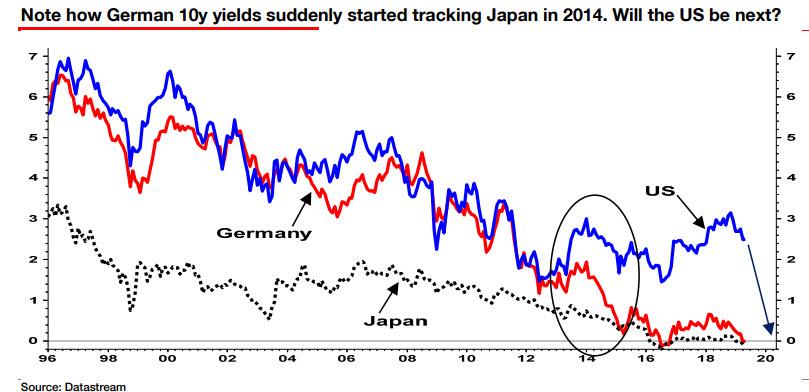
While the financial media peanut gallery takes exorbitant joy of mocking Edwards' gloomy predictions, which it tends to equate with forecasts of crashing equities even if Edwards doesn't actually make equity trade recos, the truth is that Edwards was alone against consensus, predicting months earlier that US bond yields could tumble, chasing both Germany and Japan into sub-zero territory.
And as the deflationary "Ice Age" unexpectedly re-emerged in May with a bang, Edwards was right and everyone else was dead wrong.
This is how Edwards recapped his take on the recent - and future - moves in bond yields:
A key part of the Ice Age has been the prediction that US and European 10y government bond yields would fall to levels never previously seen – replicating Japan’s experience. We were told that this would never happen in the west because policymakers would not make the same mistakes Japan made! But with European yields plunging to new negative lows and the US yield curve giddy with inversion, the sceptics are now seriously contemplating the brave new world in which US 10y bond yields fall below zero.
So in addition to taking a well-deserved victory lap in being the sole strategist to get the move in yields correctly, Edwards instead doubles down, and predicts that it is about to get a lot worse as "there is an earthquake happening in government bonds." What's behind this ongoing tremor? Why central banks, as usual. To wit:
One thing that amazes me about the current cohort of global central bankers is the lack of insight into the fact that their extreme loose monetary policy and financial repression may actually be making deflation in the real economy worse – despite clearly succeeding in creating rampant inflation in financial assets. To be sure some of the major players in the central banking orbit, such as ex-Fed Governor Kevin Warsh, have broken out of the QE group-think that grips the minds of central bankers. Warsh has openly stated that financial repression has exacerbated, rather than cured, our economic ills.
To be sure, the thesis that the Fed is stimulating asset (hyper)inflation while depressing the broader economy and crushing the middle class, is hardly new: we have been preaching just this since 2009, and we are glad that this perspective is finally starting to attract more followers. In fact, none other than the world's largest bond manager recently predicted that the Fed is on the verge of losing control over the markets (for those confused, that's the "game over" phase for the 10 year bull market). Which is why we can commiserate with Edwards, who writes that "the foundering of the current economic cycle and the imminence of its likely end has rammed home to investors the clear failure of financial repression to generate anything other than the most feeble of economic recoveries and no sustainable cyclical upturn in economy-wide inflation - either in wages or in prices."

Of course, another thing we have spent much of the past decade is comparing the Fed to the USSR's centrally planned regime and "five-year plans", and that's what Edwards also touches on today, noting that the Fed's failure to stimulate the economy, "has nurtured the current trend towards even looser monetary policy via the increasing influence of the Modern Monetary Theorists", i.e., helicopter money socialists who promise everything, but can only guarantee currency destruction and hyperinflation.

Edwards also mentions a breath of potential fresh air amid the Fed's ranks in the face of the likely new Fed nominee, Judy Shelton, who "compares the Fed interest rate setting with the USSR’s Gosplan", something we have done for years. We can assure readers that anyone who is willing to call out the Fed and tell the truth about the dogma behind its actions, will never be admitted on the actual Fed, so there little point in discussing Shelton's fate: she will never make it through the nomination process.

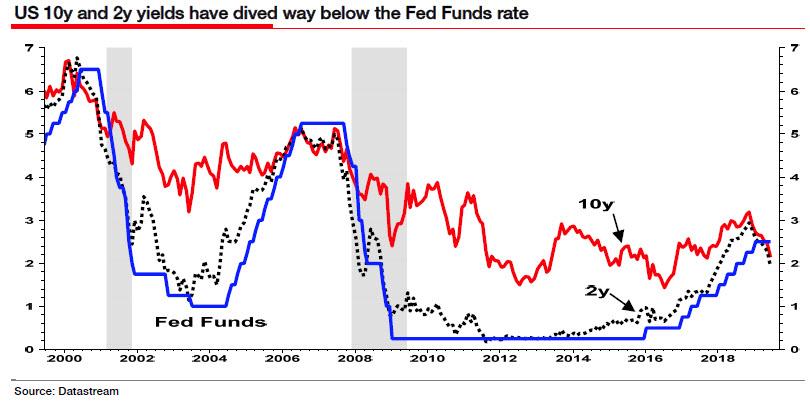
That, however, doesn't mean that one can just stick their head in the sand and pray that the US economy is doing well. It isn't. In fat, as Edwards notes, "the rumblings of the US bond market have now turned into an ear-piercing scream that a recession is close and the Fed needs to start cutting rates quickly" (even if, in an ironic twist, the futures market is already pricing in the next rate hike cycle after the fed cuts rates 3-4 times between now and the end of 2020).
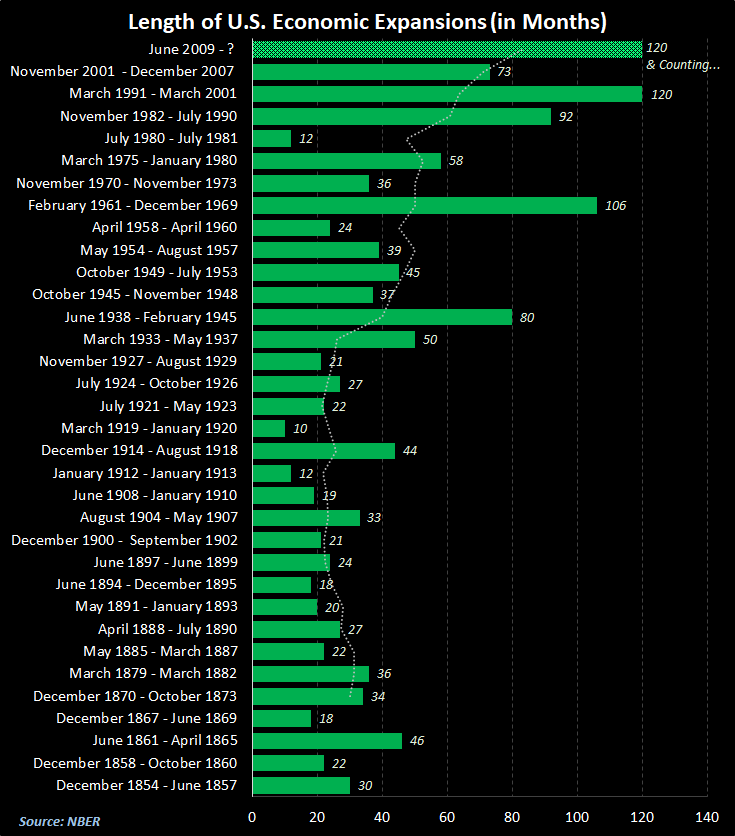
Worse, a recession may not only be close, it may in fact be in the readview mirror; This is notable because with the US economy on the edge of the longest expansion on record - recall that in July, this will become the longest U.S. economic expansion on record at 121 months. (charted below is the length of past expansions 1854-today)...

.....MORE

First quibble: It is very, very dangerous when analysts venture into seismology with Joe Granville being the poster child. See:
Long-time bear joins bulls: Controversial Joe Granville says Dow could rise 800 points
I didn't realize he was still alive. There was a time when he moved markets, then he started predicting earthquakes. Then he called the crash of 2000 within 24 hours of it's March 10 Nasdaq peak of 5048. After the MW piece are a story, a stub and a bit of history.....
That was posted on  August 7, 2008, not a good time to be going bullish.
If interested see also "Joe Granville Predicts Another Earthquake: 'Dow Jones INDU to 8000'"
That was  January 24, 2012 so ditto on the timing, this time going bearish.

Second quibble: Whether you are using the 3 mo./5 yr; the 3mo./ 10 yr. the 2's/10's whatever, the period after the inversion can give you stupendous equity returns so we are faced with the decision whether-or-not to play a dangerous little game, riding the bubble knowing full well it is a bubble or retiring to the sidelines.
We'll have more on the time lags between yield curves going inverted and equity downturns and recessions later this summer but for now one of our favorite economists with one of our favorite stories.

Here's the version hosted at MIT:

By PETER TEMIN AND HANS-JOACHIM VOTH
This paper presents a case study of a well-informed investor in the South Sea bubble. We argue that Hoare’s Bank, a fledgling West End London bank, knew that a bubble was in progress and nonetheless invested in the stock: it was profitable to “ride the bubble.” Using a unique dataset on daily trades, we show that this sophisticated investor was not constrained by such institutional factors as restrictions on short sales or agency problems...
The two most important parts of the paper "II. Hoare’s Trading Performance" and "III. Causes of Success" are definitely worth a couple minutes.