Showing posts sorted by relevance for query deepwater horizon. Sort by date Show all posts

Tuesday, June 29, 2010

Oil Spill: The Worstest Worst Case Scenario- A Sinkhole Swallows Everything (BP)

Yesterday we had the WaPo's Joel Achenbach:

Oil spill: Even worse worst-case scenarios! (BP)
My geology professor from way back sent me his worst-case scenario for the gulf disaster:

Somewhere, you might want to bring in the Lusi mudflow in Indonesia. The Wikipedia entry has the basic story. (There are 6.8 oil barrels in a cubic meter.) Lusi is a blowout that's been going for several years. There is no present hope of containing it....
From bnet:
Apocalypse in the Gulf: Could a Sinkhole Swallow the Deepwater Horizon Well -- And BP?
BP has confirmed that the failed blowout preventer (BOP) on its Deepwater Horizon well in the Gulf of Mexico is tilting sideways at an acute angle 12 to 15 degrees from perpendicular. Geologists and petroleum engineers are now debating the worst case scenario: growing evidence that the Macondo discovery well’s casings beneath the ocean floor have been irreversibly damaged, possibly to such an extent that it may be impossible to cap the well.

The Deepwater Horizon had recently completed promising exploratory drilling — to a vertical depth of about 18,000 feet (3.4 miles as measured from the rig floor), not including vertical depth to canyon floor (about 5,000 feet) — when it exploded as the rig crew prepped a temporary seal for the well on April 20.
BP spokesperson Toby Odone acknowledged to reporters last week that the 45-ton BOP was tilting, which the company attributed to  a shift in the collapsed riser piping (from the rig accident).
Since the failure of last month’s “top-kill” effort to stem the flow, knowledgeable scientists have argued about the potential significance of BP’s inability to maintain enough topside pressure — to “squash” the column of superheated fluids erupting upward — during the plugging efforts. One  popular hypothesis making the rounds online is that the underground well casing is fractured beyond repair. Some geologists and petroleum engineers argue that the top-kill failure could have resulted from too much “kill mud” leaking out of cracked pipe casings into the surrounding rock formation instead of flowing deeper into the well. (Click image for a larger version.)
BP cites a broken disk inside the well as the cause of the top-kill failure. Admiral Thad Allen, the incident commander for the BP oil spill response, has confirmed on recent conference call updates that structural problems in the well casing of the sunken Deepwater Horizon rig cannot be ruled out. Commenting on BP’s decision to halt the top-kill contingency, Allen — President Obama’s point person — said:
There was some discussion at that point about the uncertainty of the — of the condition of the casings in the wellbore which you would want to do is drive so much mud down there and such a pressure that you might cause a problem and the problem was they (scientific summit that included Interior Secretary Ken Salazar and Energy Secretary Steven Chu) didn’t know and they still don’t know the condition of the wellbore.  For that reason, they erred on the side of safety on how much pressure they would exert, and when they got near those pressures without having success in killing the well — killing the well, that’s when they backed off.
We know little about the underlying geology of the spill site since BP has held that information close, claiming that it’s “proprietary” data. Scientists are clamoring for BP to publicly release geological survey data on the underlying “Lower Teriary” formations (rock layer formed 65 million to 250 million years ago). Remotely operated vehicles (ROVs) are streaming video feeds of high pressure columns of oil and gas bubbling up from fissures in the sea floor — flowing from likely stress fractures in the underground piping.
A much talk-about anonymous posting at The Oil Drum, a blog often frequented by petroleum engineers and other oil-industry specialists, captures the fears of many scientists and environmentalists alike:
That the system below the sea floor has serious failures of varying magnitude in the complicated chain, and it is breaking down and it will continue to.
What does this mean? It means they will never cap the gusher after the wellhead. They cannot…the more they try and restrict the oil gushing out the bop [blowout preventer]?…the more it will transfer to the leaks below. Just like a leaky garden hose with a nozzle on it.
Don Van Nieuwenhuise, director of geoscience programs at University of Houston, told New Orleans Times-Picayune reporter Rebecca Mowbray that BP ran out of casing sections before it hit the reservoir of oil, so it switched to an inferior material — something called liner — for the remainder of the well. Consequently, the BP well has several weak spots that the highly pressurized oil could exploit. Specifically, the joints between two sections of liner pipe and the joint where the liner pipe meets the casing could be weak, said Van Nieuwenhuise.

Nieuwenhuise added that efforts by BP to try to stop the oil or gain control of it have been tantamount to repeatedly hitting the well with a hammer and sending shock waves down the pipe. “I don’t think people realize how delicate it is,” he told the paper. Nonetheless, Van Nieuwenhuise believes oil from a blown out well rupturing the casing and bubbling up through the ocean floor is unlikely — a worst-case scenario — as he ’s never actually heard of such an occurrence.

Weak joints, shock waves down the pipe, cracks and fissures in the sea bed – does a down-hole blowout seem such a remote “worst-case scenario?” Oh, and let’s not forget the incessant, abrasive-mixed plume of oil, natural gas, and “itty-bitty” grains of sediment surging through the drill piping at incredible pressures. Anyone care to wager the integrity of the pipe liner ain’t what it used to be after having been effectively sandblasted for the last 70 days?

The late Larry Flak, an engineer recognized the world over for his acumen in containing deepwater well blowouts, presciently warned back in 1997 (before drilling at depths of 30,000+ feet was feasible) of the dangers ultra-deepwater blowouts might pose:...MUCH MORE

Friday, July 2, 2010

"Conspiracy Theories Behind BP Oil Spill in Gulf -- From Dick Cheney To UFOs" (BP; APC; HAL; RIG)

UPDATE: "More BP Gulf Oil Spill Conspiracies Flourish -- From Algae Farms to Armed Dolphins" (APC; BP; HAL; RIG)"

From bnet
Far from the media spotlight, pulled from the “X-Files” of the Internet, are some of the more interesting and conspiratorial narratives on what — or who — triggered BP’s oil-spill disaster, now unfolding more than 18,000 feet below sea level in the Gulf of Mexico.
http://i.bnet.com/blogs/bp_aliens.jpg?tag=content;selector-perfector


What did he know, and when did he know it? Representing the reactionary right, blogger Jerseynut alleges a conspiracy and subsequent coverup direct from the White House: chief of staff Rahm Emanuel, likely acting on orders from President Obama, had operatives blow up the Transocean (RIG) — leased rig and attached wellbore. Implausible?
You never let a serious crisis go to waste. And what I mean by that it’s an opportunity to do things you think you could not do before, Emanuel infamously said in November 2008.
With a runaway spill in the Gulf waters, the Obama administration can now direct effort to the wish list of its partisan base:
  1. A moratorium on deepwater drilling in U.S. waters — right wing radio host Rush Limbaugh opined on the airwaves last month that “environmental whackos” blew up the rig to “head off more drilling”
  2. A renewed legislative push for the previously moribund Kerry-Lieberman cap-and-trade bill, which seeks to address climate warming in the U.S. by regulating industrial carbon dioxide emissions.
With respect toward “fair balance” in the media, those on the opposite end of the political spectrum — the liberal left — see former Vice President Dick Cheney’s fingerprints all over this environmental catastrophe. Alex Pareene blames the former vice-president in an insipid Salon.com post alleging industry pandering during the reign of George Bush II. In particular, the blogger points out that lax oversight permitted BP  to avoid the $500,000 cost of installing a “dead-man switch” on the blow-out preventer, called an acoustic shut-off switch, that could’ve been triggered from the surface (onboard the Deepwater rig) to plug the leak.
In a related story, investigators are examining the role of Cheney’s former employer Halliburton (HAL) in the undersea spill, as the oil-service company was responsible for cementing the drill hole, as reported by the LA Times on May 1. The Internet’s suspicious minds believe Halliburton intentionally triggered the catastrophic blowout (using substandard concrete slurry when cementing the spaces around the piping in the wellbore casing) to adversely affect U.S. oil production — looking to boost oil prices (and profits). The inquisitors reference the current investigation underway by Australian officials on Halliburton’s role in a Timor Sea well blowout in 2005 as proof positive.
Filed away in the “International Intrigue” folder is the report a North Korean submarine fired two torpedoes against the rig, as reported by WRAL.com:
On the night of April 20th the North Korean Mini Submarine manned by these “suicidal” 17th Sniper Corps soldiers attacked the Deepwater Horizon with what are believed to be 2 incendiary torpedoes causing a massive explosion and resulting in 11 workers on this giant oil rig being killed outright.  Barely 48 hours later, on April 22nd , this North Korean Mini Submarine committed its final atrocity by exploding itself directly beneath the Deepwater Horizon causing this $1 Billion oil rig to sink beneath the seas and marking 2010’s celebration of Earth Day with one of the largest environmental catastrophes our World has ever seen.
As if President Obama didn’t already have enough on his plate to worry about, now comes word from the socially conservative WorldNetDaily promulgating a spiritual connection....MORE
 And what about the Hopi's, huh? Doesn't Hopi prophecy say:
"The Fourth World shall end soon, and the Fifth World will begin. This the elders everywhere know. The Signs over many years have been fulfilled, and so few are left. ...

 ..."This is the Seventh Sign: 
You will hear of the sea turning black, and many living things dying because of it."...
[Sir, step away from the keyboard. Sir, I won't say this again, step...away...from...the...keyboard. -ed]

Sunday, October 13, 2019

"The Bias That Can Cause Catastrophe"

From the BBC:
The outcome bias erodes your sense of risk and makes you blind to error, explaining everything from fatal plane crashes to the Columbia crash and the Deepwater Horizon oil spill.

magine a pilot is taking a familiar flight along a known route, during which the weather takes a turn for the worst. She knows that flying through the storm comes with some serious risks – and according to her training, she should take a detour or return. But she has flown the same route before, in similar weather – and she hadn’t experienced any problems then. Should she continue? Or should she turn back?
If you believe that she is safe to fly on, then you have fallen for a cognitive quirk known as the “outcome bias”. Studies have shown that we often judge the quality of a decision or behaviour by its endpoint, while ignoring the many mitigating factors that might have contributed to success or failure – and that this can render us oblivious to potentially catastrophic errors in our thinking.
We often judge the quality of a decision or behaviour by its endpoint, while ignoring
 the many mitigating factors that might have contributed to success or failure
In this example, the decision to take the previous flight was itself very risky – and the pilot may have only avoided an accident through a combination of lucky circumstances. But thanks to the outcome bias, she might ignore this possibility and assume that either the dangers had been overrated, or that it was her extraordinary skill that got her through, leading her to feel even happier taking the risk again in the future. And the more she does it, the less concerned about the danger she becomes.

Besides leading us to become increasingly risky in our decision-making, the outcome bias can lead us to ignore incompetence and unethical behaviour in our colleagues. And the consequences can be truly terrifying, with studies suggesting that it has contributed to many famous catastrophes, including the crash of Nasa’s Columbia shuttle and the Deepwater Horizon oil spill....
...MORE

Sunday, February 25, 2024

"For Captured Carbon, Scientists Plot a Sub-Ocean Tomb"

This approach addresses one of the big risks of just willy-nilly burying CO₂: that the gas will somehow escape and a) re-enter the carbon cycle via the atmosphere or b) create a Lake Nyos (Cameroon, 1986) scenario which released naturally trapped CO₂ and killed over 1700 people and thousands of head of livestock. Solidifying the CO₂ as part of the entombment has had its  attractions since the Al Gore days:

I too have heard the siren song of carbon capture and storage.
There are two ways to use carbon once it is captured (still theoretical because of price but the cost is dropping, see below), either sequester it and remove it from the carbon cycle or reuse it in a closed loop hydrocarbon fuel infrastructure.
From 2007: "Can baking soda curb global warming?":

I have a fascination with calcium carbonate. But, being flexible, I am willing to consider the bicarbonate of various metals.
Some scientists have proposed compressing carbon dioxide and sticking it in underground caves as a way to cut down on greenhouse gases. Joe David Jones wants to make baking soda out of it.
Jones, the founder and CEO of Skyonic, has come up with an industrial process called SkyMine that captures 90 percent of the carbon dioxide coming out of smoke stacks and mixes it with sodium hydroxide to make sodium bicarbonate, or baking soda. The energy required for the reaction to turn the chemicals into baking soda comes from the waste heat from the factory.
"It is cleaner than food-grade (baking soda)," he said.
The system also removes 97 percent of the heavy metals, as well as most of the sulfur and nitrogen compounds, Jones said.
And a few months earlier:
... Right now I'm looking at calcium carbonate. Literally. Got a hunk of limestone. CaCO3. That's sequestered carbon, right?. Hmmm.
Make a green pitch, wrap it in recycled fiberboard; et voila! Return of the Pet Rock, eco-version! And seashells, same stuff, calcite. There's the hook! Mom, you're going to Miami Beach.

And many, many more. Use the 'search blog' box if interested.

The cost of the carbon capture stage is still exorbitant but who knows what advances are ahead?

From UnDark, February 19:

It’s a contentious idea, but advocates say storing CO2 under the seafloor could help address climate change—if it works.

In 2010, as the Deepwater Horizon rig sank and millions of gallons of oil gushed into the Gulf of Mexico, Kate Moran’s phone rang in Washington, D.C. At the time, she was assistant director in President Barack Obama’s Office of Science and Technology Policy, and government officials recognized that she brought years of ocean drilling experience. Within a matter of days, and guided by her understanding of deep ocean geochemistry, the government rapidly deployed resources and experts to manage the crisis, overseeing controlled burns, remote undersea vehicles, even air and sea traffic control systems. “It was remarkable,” Moran said recently of the mobilization. “Unbelievably remarkable.”

That memory looms large as Moran leads a project to mitigate the environmental impacts of fossil fuels on a much larger scale. Now president and CEO of the research institute Ocean Networks Canada, she is also the principal investigator for Solid Carbon, a project overseen by the institute that aims to permanently remove greenhouse gases from the atmosphere by entombing carbon under the seafloor.

“You can do big things in the ocean — the oil industry does,” Moran said, expressing dismay that governments have not marshaled resources like they did for Deepwater Horizon. “So why not look at a system where you could have essentially an independent system offshore that actually removes CO2 from the atmosphere and puts it away forever?”

In addition to transitioning away from fossil fuels, climate science experts are increasingly convinced that greenhouse gases will need to be removed from the atmosphere to avoid cascading impacts of climate change. A new global climate deal from the United Nations climate conference, COP28, doesn’t require countries to completely phase out fossil fuel use, but rather relies on investments in renewable energy and carbon removal techniques to mitigate the impacts of greenhouse gases. National climate plans, too, increasingly depend on carbon removal.

But it’s a gamble: Removing enough carbon dioxide on a large scale hasn’t been fully tested. And the slower the transition away from fossil fuels, the more carbon removal will be needed to reach goals and avoid catastrophes.

“My students always say, ‘But don’t we have to try?’ And the answer is absolutely,” said David Goldberg, a professor at Columbia University’s Climate School who designed the Solid Carbon plan with Moran.

Effective carbon removal is essentially a two-step process: first, remove the carbon dioxide from the air, and then somehow keep it from returning for at least several decades and ideally much longer. Forests and other plant life remove and store carbon dioxide naturally, but it risks returning through decomposition or fires. Solid Carbon would use machinery that filters out carbon dioxide both from sources of emissions, as well as directly from the air. The next step is finding a way to permanently store the trapped carbon dioxide.

Researchers at Solid Carbon are turning to basalt, a volcanic rock that easily reacts with acids like carbon dioxide, to turn the greenhouse gas into a carbonate rock under the seabed. Storing carbon in geologic formations like this is expected to be the most long-lasting method among options to keep carbon dioxide out of the atmosphere. Under the Cascadia Basin off the coast of Vancouver Island lies the most extensively studied ocean basalt. What’s more, it’s colossal: large enough in theory to store carbon from all global annual emissions many times over.

Solid Carbon offers a glimpse into the enormous scale that would be required to impact emissions. In one version of its plan, dozens of floating rigs on the Pacific Ocean would be coupled with many more wind turbines to funnel compressed, carbon dioxide nearly 2 miles under the sea. But that would only remove less than 1 percent of what climate scientists predict will be needed by 2050. If carbon removal techniques are to make any dent in emissions, they will need to scale up multiple magnitudes....

....MUCH MORE

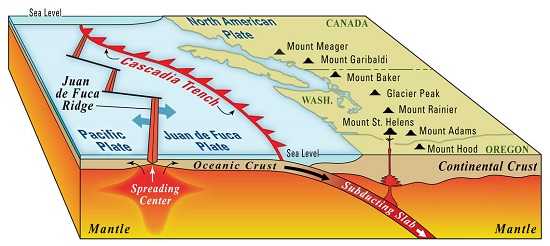
I know Professor Moran is all over the earthquake risk but for readers who are unfamiliar with the area here's a little map of the Cascadia Subduction Zone from Kids Fun Science:

https://www.kids-fun-science.com/images/rf3-cascadia-subduction-zone-usgs.jpg

And more fun via Climateer Investing:
When The Megaquake Hits, The Living Will Envy The Dead
Okay, a bit of hyperbole in the headline but let's go with 10,000 dead, 30,000 injured and 2,000,000 people displaced and dependent on handouts.

We've had three posts on the Cascadia Subduction Zone, a couple links below.
There have been a few cat bonds issued over the years that cover Cascadia, they seem to be underpriced for the risk.*

Tuesday, May 4, 2010

Oil Spill: "Insurers exposed to $1.5bn costs"

We have a backlog of stories in the link-vault, first up some insurance insight. From the Financial Times, May 3:
BP’s Gulf of Mexico oil spill, which is expected to cause the most environmental damage and to be the most expensive to clean up since Exxon Valdez in 1989, is projected to cost insurers up to $1.5bn.
That is before taking into account the liabilities from environmental damage.

The figure might not sound huge compared with the tens of billions lost in US hurricane damage in recent years, but it could hit the price of re-insurance as businesses prepare to renew cover for energy and catastrophe losses.

Reinsurance prices had been falling as the rebound in investment markets from their nadir in March 2009 combined with a lack of big catastrophe losses: there were just two named hurricanes in the Gulf.

This softening followed large rises last year when insurers and reinsurers struggled to recoup the costs of hurricanes Ike and Gustav in 2008, which had caused the third biggest loss on record.

The Deepwater Horizon spill follows big losses for the industry in the first quarter: the earthquake in Chile is set to cost $6bn-$8bn and a winter windstorm in Europe, Xynthia, is likely to cost €1.5bn-€2bn ($2bn-$2.6bn).

“There will likely be a marked effect on upcoming energy insurance renewals,” Stephen Vivian, Managing Director at Guy Carpenter, an industry consultancy. “Drilling contractor business may witness rises of at least 30 per cent and liability programme could potentially attract rises of over 100 per cent if, and it is an ‘if’, the loss ultimately impacts the liability insurers. This loss is unprecedented and is complicated.”

Other reinsurers expected prices to rise – especially for energy related business – but it was too early to put a figure on the amount.

Many energy programmes renew May 1, and market exerts expect insurers to honour prices quoted before the spill. But it is highly unlikely renewals on July 1 will remain unaffected.

Insurers and reinsurers have estimated direct insurance losses from the Deepwater Horizon oil rig explosion will be $1bn-$1.5bn. Some reinsurers have begun to estimate individual exposures; these include Bermuda-based PartnerReat $60m-$70m and Montpelier Re at $20m; Germany’s Hannover Re at €40m ($53m) and Munich Re at $100m; and Transatlantic Holdings, formerly part of AIG, at $15m.

Lloyd’s of London, the insurance market, said some members had exposure to Transocean, the owner of the oil platform, but it was too early to estimate losses. “We are currently reviewing our contracts to ascertain what parties have interest in the platform and oil well other than BP and Transocean.”...MORE

Tuesday, August 3, 2010

Anadarko Trading Up After Earnings, Conference Call Tomorrow (APC)

The stock is up 85 cents (1.6%) at $53.99 in after-hours action.
Here's the press release via MarketWatch (It reads as if it were written by P.R. types aiming to reassure in conjunction with  attorneys aiming to say nothing ):

Anadarko Announces Second-Quarter Results
Raises Sales-Volumes Guidance While Reaffirming Capital Receives Commitments for New Five-Year Credit Facility 

Anadarko Petroleum Corporation (APC 54.00, +0.86, +1.62%) today announced a second-quarter 2010 net loss attributable to common stockholders of $40 million, or $0.08 per share (diluted). These results include certain items typically excluded by the investment community in published estimates. In total, these items decreased net income by approximately $284 million, or $0.57 per share (diluted) on an after-tax basis.(1) Cash flow from operating activities in the second quarter of 2010 was $1.566 billion, and discretionary cash flow totaled $1.278 billion.(2)

SECOND-QUARTER 2010 HIGHLIGHTS
-- Increased quarterly sales volumes by 6 percent over second-quarter 2009
-- Reduced lease operating expenses per unit by 15 percent over second-quarter 2009
-- Announced successful appraisal results in the Gulf of Mexico and Ghana
-- Achieved significant growth in shale programs
-- Continued to advance sanctioned mega projects on time and on budget

"During the second quarter, Anadarko's diverse portfolio continued to deliver upon our operating and strategic objectives with increased sales volumes, improved cost management and margins, continued drilling success onshore and offshore, and significant gains in drilling efficiencies," Anadarko Chairman and CEO Jim Hackett said. "Because of the company's strong and consistent portfolio performance, we are increasing full-year production guidance for the second time this year, while maintaining initial capital guidance. We now expect sales volumes to be in the range of 232 million to 236 million BOE (barrels of oil equivalent), representing an increase of 5 to 7 percent over 2009."...

...DEEPWATER HORIZON EVENT UPDATE
During the second quarter, the Macondo well in the Gulf of Mexico, in which Anadarko holds a 25-percent non-operating interest, discovered hydrocarbon accumulations. During suspension operations, the well blew out, an explosion occurred on the Deepwater Horizon drilling rig and the rig sank, resulting in the deaths of 11 crew members and the release of hydrocarbons into the Gulf. As previously stated, Anadarko believes that, based on the publicly available information, testimonies and investigations to date, this tragedy was preventable and likely the result of the operator's gross negligence and/or willful misconduct. A more detailed description of the potential liabilities related to this event are included in the company's second-quarter 2010 report on Form 10-Q that will be filed with the U.S. Securities and Exchange Commission....MORE 

CONFERENCE CALL TOMORROW AT 9 A.M. CDT, 10 A.M. EDT
Anadarko will host a conference call on Wednesday, Aug. 4, at 9 a.m. Central Daylight Time (10 a.m. Eastern Daylight Time) to discuss second-quarter results, current operations and the company's outlook for the remainder of 2010. The dial-in number is 888.680.0878 in the United States or 617.213.4855 internationally. The confirmation number is 39759023. For complete instructions on how to participate in the conference call, or to listen to the live audio webcast and slide presentation, please visit www.anadarko.com. A replay of the call will also be available on the Web site for approximately 30 days following the conference call.

Friday, June 4, 2010

British Petroleum Patents Blowout Preventer Testing Method and Makes no Promises on Dividends (BP)

No comment.
Two from the Houston Chronicle's NewsWatch: Energy blog:

BP makes no promises on dividends

And:

The Deepwater Horizon accident was just a week old on April 27 when the U.S. Patent Office got around to approving what now seems like a rather ironic piece of work from BP: "A Blowout Preventer Testing System and Method."


BPBOPPatent.JPG
A diagram from BP's approved patent application for a new BOP testing method.
      
Blowout preventers, or BOPs, are a collection of valves that sit atop a well on the sea floor and are used to control the flow of hydrocarbons out of the well. It's also one of the main safety measures against an accident. In the case of the massive oil spill in the Gulf of Mexico the BOP failed. So far records and testimony related to the accident indicates the BOP on Deepwater Horizon was tested as required and passed. But what caused its failure will be a significant issue in the ongoing investigation.
But back to BP's patent....MORE

Tuesday, July 13, 2010

"More BP Gulf Oil Spill Conspiracies Flourish -- From Algae Farms to Armed Dolphins" (APC; BP; HAL; RIG)

We posted ""Conspiracy Theories Behind BP Oil Spill in Gulf -- From Dick Cheney To UFOs" (BP; APC; HAL; RIG)" acouple weeks ago:
Far from the media spotlight, pulled from the “X-Files” of the Internet, are some of the more interesting and conspiratorial narratives on what — or who — triggered BP’s oil-spill disaster, now unfolding more than 18,000 feet below sea level in the Gulf of Mexico.

http://i.bnet.com/blogs/bp_aliens.jpg?tag=content;selector-perfector

Here's the follow-up, from bnet:
BP and the Obama administration have further restricted access to affected oil spill zones in the Gulf of Mexico. Weak approval ratings on handling clean-up efforts and media blackouts have only fanned the flames of conspiracy rumors circulating online. At the heart of it all is the burning question: Was the Deepwater Horizon explosion really an accident?
Of course it was. But that’s not slowing down the conspiratorialists.
In addition to no-fly zones over oil spill waters, reporting on recovery efforts in the Gulf just got more challenging. On July 1, a new Coast Guard order went into effect, stating: “vessels must not come within 20 meters [65 feet] of booming operations, boom, or oil spill response operations under penalty of law.” Violation of a “safety zone” could result in up to a $40,000 civil violation and prosecution for a Class D felony (sentencing from 2-7 years, depending on the state).
As Natural News editor Mike Adams puts it:
With this, the Gulf Coast cleanup operation has now entered a weird Orwellian reality where the news is shaped, censored and controlled by the government in order to prevent the public from learning the truth about what’s really happening in the Gulf.
Does it require much of a stretch of the imagination to conclude, as does Adams, that the federal government is seeking to control our minds? With more questions than answers on the origins of the spill, many Internet bloggers espouse their own theories on the happenings in the depths of the Outer Continental Shelf.
“They (meaning the Obama administration and an industrial consortium ranging from BP to Goldman Sachs) don’t want to clean it up or even try to contain it,” posits conspiratorialist JoAnneMor on her eponymous blog. What’s happening off the Louisiana coast wasn’t from incompetence, but from a purposeful desire to spark growth in a nascent alt-renewable industry — algae:
  • Destroy the offshore oil business in U.S. waters;
  • Turn the entire Gulf Coast and Mississippi Delta into a permanent “dead zone” — certain coastal areas already demonstrate seasonal drops in oxygen levels, fueled by nutrient (fertilizer) runoffs into river tributaries. Excessive levels of oil and dispersant (the solvent Corexit) in spill-affected waters are accelerating hypoxia, permanently altering the ecosystem; and,
  • With an estimated refining cost of $2 per barrel, turning the Gulf ito a giant algae farm would make for a profitable “green” investment.
The plot doesn’t start and end in Gulf waters. Steps have already been mapped out to convert the Great Lakes and Chesapeake Bay into algae farms, too, alleges JoAnneMor.

A new conspiracy plot being bandied about accuses BP of trying to tap the Earth’s molten core for a novel source of geothermal power, using relief well drilling as cover for its real objective. Although heat from our planet’s magma has been successfully harvested as an energy source, spudding through the outer core alone would require boring equipment capable of drilling to depths of 1,900 to 3,100 miles. As if hitting an oil reservoir located just three miles below the sea floor weren’t already cause for concern!
Allgae and lava farms — not all conspiracies theories making the rounds online ascribe the spill to greed and profit motives.To wit:
  • The April 20 explosion aboard the Deepwater Horizon rig was fated to happen, according to Numerology disciples: numbers 9 (total of letters in “BP oil spill in Gulf of Mexico” equals 27, or 2 + 7) and 11 (number of workers killed in the fire) are of metaphysical significance. Unfortunately, as I am still stuck in this three-dimensional world, the Procrustean logic behind this or tarot card reading is beyond my intellectual grasp — would ingesting a bit of mind-altering peyote plant or magic (psilocybin) mushrooms would lead me down the path of enlightenment?
  • In 2005, armed dolphins, trained by the U.S. Navy to fire upon terrorists trying to infiltrate America via submarine, escaped from offshore pens breached during Hurricane Katrina. Some blogsters are convinced one or two of the marine mammals accidentally fired upon the Transocean-leased drilling rig....MORE

Wednesday, November 4, 2015

Partly Thanks to Paywalls, Lobbyists and Insiders Know the Scoop, Citizens Not So Much

Only partly. A much more important reason is, to put it charitably, most of us are idots.
Yes, idots.
There, I said it.
From Washington Monthly:

Confessions of a Paywall Journalist
Thanks to a booming trade press, lobbyists and other insiders know what’s happening in government. The rest of the country, not so much. 
Back in 2009, I had a job with a Washington, D.C.-based newsletter called Water Policy Report. It wasn’t exactly a household name, but I was covering Congress, the federal courts, and the Environmental Protection Agency—a definite step up from the greased-pig-catching contests and crime-blotter stories I had chased at a community newspaper on Maryland’s Eastern Shore, my first job out of college.

One of my responsibilities at the newsletter was to check the Federal Register—the official portal that government agencies use to inform the public about regulatory actions. In December of that year I noticed an item that said that the Environmental Protection Agency had decided that existing pollution controls for offshore oil-drilling platforms in the Gulf of Mexico were adequate, and that there wasn’t enough pollution coming from those platforms to warrant further review or action.
Curious about that finding, I called Richard Charter, an environmentalist, oil-drilling expert, and senior fellow at the Ocean Foundation to ask him what he thought. Charter told me that the use of a general permit to cover discharges over a broad area like the Gulf of Mexico is ridiculous, and, more specifically, that there were ways in which the EPA went about reissuing the old permit that might not be totally legal under the National Environmental Policy Act.

But the more important issue, Charter said, was the hopeless inadequacy of the government’s oversight of offshore oil drilling. Federal oversight agencies had been documenting shortcomings and conflicts of interest at the Minerals Management Service for years, he said, and in 2003 the House Energy and Commerce Committee heard testimony outlining the ways in which response agencies and drilling companies were unprepared to handle a blowout if it got out of hand.
The dangers were not hypothetical, Charter said. The Montara blowout in Western Australia had just that August spilled more than one million gallons of oil into the Timor Sea and took seventy-four days to cap. Closer to home, if not in more recent memory, was the Ixtoc blowout in 1979, which spilled more than three million barrels into the Gulf of Mexico and took almost a year to cap.
I thanked Charter for his time and wrote my story about the EPA permit, ignoring the broader issue of oil platforms or their environmental risks. Five months later, BP’s Deepwater Horizon drilling platform exploded forty miles off the coast of Louisiana, killing eleven people and setting off the biggest environmental disaster in U.S. history.

By any measure, Deepwater Horizon was the most important environmental catastrophe of the decade, and it illustrated deep and profound shortcomings in the U.S. regulatory approach to offshore drilling. And when it happened, I knew that I had been handed a credible lead and had blown it.
But I couldn’t have followed that lead even if I had wanted to. Offshore drilling safety was tangential, at best, to the core issues covered by the newsletter I was writing for. The law firms and companies that subscribed to us paid thousands of dollars each for a subscription, and they paid that much because we helped them stay abreast of every bit of policy minutia that came out of the government in order to identify threats to their existing investments and potential new investments, or to keep their current clients informed and attract new clients. They paid for the story I wrote, not the story I missed.

On some level, I thought that if what Charter was telling me was that big a deal, it would already have been reported in the New York Times, or on 60 Minutes, or—more likely—in one of the regional newspapers like the Houston Chronicle or the New Orleans Times-Picayune, which report on areas where offshore oil drilling is a big part of the local economy and readers have a keener-than-average interest in the possibility of catastrophic oil accidents. I probably would have been right had it been twenty years earlier. But by 2009, newspapers in general, and the big regional papers especially, were in the midst of a colossal wave of downsizing brought about by the collapse of their business model. With internet outlets like Craigslist siphoning away their classified ads, newspapers could no longer afford to subsidize their large D.C. bureaus, with teams of reporters covering Congress and the agencies and writing stories about the intersection of government policy and issues important to their readers back home. According to a 2009 study by the Pew Research Center, the number of newspapers with bureaus in Washington fell by more than half from the mid-1980s to 2008. The number of newspaper reporters accredited to cover Congress fell by 30 percent between 1997 and 2009. The Center is currently working on research to update those numbers.

Political reporting, however, has not declined at all—quite the contrary. Campaigns, scandals, and fights within and between the parties are covered today with an alacrity that borders on obsession. Growing partisanship and divided government have made the stakes of each day’s political news seem immense, as anyone can see by watching the endless flow of scooplets from Politico and Talking Points Memo, or who watch hour after hour of commentary on FOX News or MSNBC. But while political news is everywhere, coverage of the day-to-day inner workings of government—the slow, steady development of policy in Congress, in the administration, and in the independent regulatory agencies, and how those policies are implemented—has become increasingly scarce in the media that average citizens historically have relied upon.

The opposite, however, is true of the “paywall press”—that is, high-subscription, insider-oriented news organizations like the one I worked for in 2009 and the ones I have worked for since. This sector of the Fourth Estate is booming, and its coverage of government has never been more robust. Trade outlets are steadily adding to their staffs in Washington. New entrants like Bloomberg Government and Politico Pro are experimenting with newer and faster ways to get their coverage to consumers. Long-standing trade publications are merging or being bought up for unbelievable prices.

The audiences for these publications are lobbyists, corporate executives, Hill staffers, Wall Street traders, think tank researchers, contractors, regulators, advocacy group and trade association policy wonks, and other insiders who have a professional interest in up-to-the-second news on the policy issues and whose institutions can afford subscription prices that run thousands of dollars per year. That’s not to say that trade journalists are shills for corporate interests. They are typically smart, energetic professionals with the same ethical standards and passion for digging as their mainstream colleagues. Indeed, with the mainstream press’s shrinking attention to government, trade reporters are often the only ones regularly covering important federal beats. But because of the nature of its business model, the trade press encourages its reporters to pursue the stories its elite readers most want, not necessarily the stories the public most needs—as I saw in my own experience covering offshore drilling.

The rise of the paywall press and the decline of mainstream media coverage of government aren’t causally connected. But the two trends coincide with a palpable populist outrage, in which average Americans are suspicious of how their tax dollars are being spent and observe Washington insiders operate at ever-greater levels of power and secrecy. The irony is that policy journalism in Washington is thriving. It’s just not being written for you, and you’re probably never going to read it.
A Senate gallery reporting credential is the gateway to reporting in Washington. Officially, a Senate press pass allows reporters to wander unaccompanied throughout the Capitol complex. Unofficially, it serves as an official press credential at conferences, agencies, and events around town. It is the solid-gold bona fide that separates the bearer from the public.

In pursuing this story, I analyzed the Congressional Directory from the 101st Congress (1989-1991) through the 113th Congress (2013-2015), counted how many reporters were listed in each bureau, and categorized each bureau as either a newspaper, newswire, trade publication, foreign bureau, or online publication.

What I found was that there are roughly the same number of accredited reporters in Washington today as there were twenty-five years ago, but that more of them are working for trade publications and fewer are working for newspapers and newswires....MUCH MORE

Tuesday, June 22, 2010

"BP Bonds Ooze Value" and "BP Bankruptcy Filing Would not Trigger Cross-default of Bonds" (BP)

UPDATE: "BP: "Incompetence, uncertainty and risk" (among securities analysts)"

As I said in the May 27 post "Trading on the ‘Top Kill’: Analyst Thoughts" (BP; RIG):
The stock is up $2.75 at $45.16 and I wouldn't touch it with your money. Fiduciary blah blah, Prudent Man, raw terror etc.
Personally we're partial to the play in "Website Offers Betting on Spill-Related Extinctions of Gulf Species "....
That was repeated on June 8, in "Imagining the Worst in BP’s Future" with the stock at $35.27.
Today it closed down 4.50% at $30.33 and within striking distance of the panic low of $29.00 on June 9.
The debt however...
First up Barron's Current Yield column:

Despoiled BP's bonds are a buy for the brave.
ARE THE BONDS OF EMBATTLED BP A BARGAIN? At current levels, yes -- if you can stomach volatility.
Barron's was -- ahem -- early in making the case for BP's stock, which has lost nearly half its value since the oil starting spilling into the Gulf of Mexico on April 20. (For a more recent valuation of BP shares, see "Other Voices.")

But no less a bond authority than Bill Gross sees opportunity in its debt. A Pimco spokesman confirmed reports that Gross recently bought $100 million of BP's shorter-maturity bonds.

No wonder, given that the oil giant's yield curve has inverted. The yield margin on its 1.55% notes due 2011 blew out to 12.58 percentage points above Treasuries last Wednesday, before a huge victims' escrow fund and BP's dividend cancellation were announced, and as the president and Congress skewered BP's management.

The political risk looked so great that there were fears "the company would take its chances in bankruptcy" instead, says Philip Adams, analyst at Gimme Credit, who has an Outperform rating on BP's debt. "But there was a compelling reason for the president and BP to do business," he adds. It was to give BP the breathing room to help disaster victims by letting it fund $20 billion requested by the White House in escrow over 3½ years.

Not to mention that 23,000 of BP's 80,000 employees are Americans.
The 1.55% notes had improved substantially by Friday, quoted at 5.11 percentage points over Treasuries. Before the spill, however, they traded at 0.05 to 0.09 percentage point below the two-year T-note. That's right, the yields were quoted inside the Treasury benchmark. At the long end, by comparison, BP's 4¾% due 2019 early Friday were at 3.70 percentage points over Treasuries.
BP's credit-default swaps also blew out last week. At their worst, they were quoted at 620.3 basis points, meaning the cost of protecting $10 million of the company's debt annually for five years was $620,300. They were quoted Friday in the mid-400s.

"The continued failure to stop the leak, combined with [BP's] apparent [primary] control of the drilling of the well, substantially increases liability," wrote analysts at independent rating agency Egan-Jones in a note Friday, when it cut its rating on BP two notches to triple-B-minus -- just above junk. Fitch last week spanked the company's rating by six notches, also just above junk. Moody's and S&P piled on.
Yet the company still has admirers.
BP's standby loan has grown from $5.25 billion on June 4 to $7 billion, as friendly lenders sought to provide it shelter against possible claims, Dow Jones Newswires reported Friday.

While its liabilities aren't capped at the $20 billion amount in escrow, the company is a cash cow, notes Egan-Jones. It has cash of $7 billion, interest coverage of more than 25-to-1, and a market capitalization of $93 billion. It has debt of $31 billion. Operating income for the first quarter of this year was $5.3 billion, up from $2.5 billion a year ago, while interest expense fell to $153 million from $257 million.

BP allegedly made some "pretty horrific mistakes" if it indeed cut corners in its operations, says Adams of Gimme Credit, citing a May 27 Wall Street Journal article. "Let it make restitution, but don't kill it.",,,
And from Research Recap:
A bankruptcy filing of BP’s (BP) U.S. entities would not trigger a cross-default under BP’s bonds, according to Covenant Review, an independent credit research firm.  “BP bondholders would wait to collect interest and principal as it becomes due in that case,” says Adam Cohen, Founder of Covenant Review.
Covenant Review recently developed two papers addressing questions about BP’s capital structure, potential criminal and civil liabilities and various bankruptcy scenarios.
Highlights:
  • It seems that BP has unlimited flexibility under its various bond indentures to incur debt to finance civil liabilities, cap ex, acquisitions, and / or future dividends.  Additionally, BP’s various bond indentures do not have any type of liens covenant or negative pledge, so it could incur any incremental debt on a guaranteed and secured basis, which could reduce the value of the existing BP debt.
  • Similarly, BP’s debt agreements do not contain restrictions on selling assets, and thus BP could freely sell assets to finance any of the above obligations.
covenant reviewA bankruptcy filing of BP’s U.S. entities would not trigger a cross-default under BP’s bonds.  BP bondholders would wait to collect interest and principal as it becomes due in that case.
  • We have also included some preliminary thoughts on: (1) Arco, a BP subsidiary that has its own bonds outstanding; (2) Transocean (RIG), the owner of the Deepwater Horizon rig, and its capital structure; and (3) Anadarko (APC), which has a 25% non-operating interest in the Macondo Well where the Deepwater Horizon was located.
For details see BP & Friends: Answering Common Capital Structure and Legal Questions and BP & Friends Follow-up (complimentary).
That's our second link to Research Recap in 24 hours. When he gets on a roll, good stuff.

Finally, from MarketWatch: "Oil major said to be planning $10 billion bond offering"

Previously:
June 16: "A Real Worst-Case Scenario for BP: 20m barrels, $560 Billion Damages" (BP)"
June 16: "BofA Reported to Rein In Its Oil Trades With BP" and BRITISH Analyst Downgrades to Sell (BAC; BP)"
June 15: Barron's Tiernan Ray Gets the Goods on Matt Simmons Thinking Re a BP Bankruptcy (BP)
June 10: "Is BP worth $90 a Share or $0 a Share?" and "10 Thoughts for Those Buying (or Selling) BP"
June 10: "J.P. Morgan on BP Share Price: ‘Has Overshot a Worst Case’" (BP)
June 9: "BP Panic: Relax, Firm Can Cover the Clean-up" (It's the lawsuits that might do 'em in) BP
June 9: "British Petroleum: A Month From Chapter 11? (BP)
See also:

"Years of Internal BP Probes Warned That Neglect Could Lead to Accidents" (BP) 
"Imagining the Worst in BP’s Future" 
British Petroleum Patents Blowout Preventer Testing Method and Makes no Promises on Dividends (BP)"
BP’s would-be takeover scenarios" (BP; PTR; RDS.A; XOM)
  
J.P. Morgan Comments on British Petroleum (BP) 
British Petroleum Stock Spanked on 'Top Kill' Failure. Arbuthnot Securities Questions Survival (BP)

Friday, July 23, 2010

Why we Chose Anadarko over BP as a Rebound Play (APC; BP)

Class.
Just as in horse racing, if you have a match race between Secretariat and Hoof Hearted, the call isn't too tough.
With APC we caught the bounce off the double bottom at $35-and-change June 30, bailed at $47.38 on July 14. The stock is trading at $48.55 today.
Here's a major piece from Bloomberg:
BP Spill Tars Hackett’s Anadarko Deepwater Drilling Success 

James T. Hackett, chief executive officer of Anadarko Petroleum Corp., thought he was making a routine decision when he decided to buy a 25 percent share of BP Plc’s Macondo well last December.
Anadarko was already a partner with BP in the nearby Pompano platform, which would pump the oil to shore, so developing a new field nearby made good economic sense. The well looked relatively simple, and Hackett said he had no reason to doubt the capabilities of BP, one of the world’s most experienced deepwater drillers.

“This is something that, with any kind of reasonable practices, should have been able to be drilled without a problem,” he said in an interview at Houston’s River Oaks Country Club.
But in the oil industry, even the easy jobs are high risk. On April 20, the Deepwater Horizon rig drilling the well was rocked by an explosion and later sank in the Gulf of Mexico. Suddenly, everything changed for Anadarko, Bloomberg Businessweek reports in its July 26 issue.

Under Hackett, the company had grown from a laggard to a star among medium-sized oil and gas players. His strategy: super-charging Anadarko’s reliable oil and gas production on the U.S. mainland with successful wildcat exploration in the deep waters of the Gulf of Mexico, and off West Africa and Brazil. That appetite for risk turned Anadarko into one of the premier oil exploration companies.

Growth Plans
Now Anadarko’s ambitious growth plans and perhaps its existence are threatened. Unless it can find a way out, its share of cleanup costs, fines, and victims’ claims could easily add up to billions of dollars. Analysts said obligations that large are likely to put a crimp on the investment capital needed to meet Hackett’s 7 percent to 9 percent annual production growth targets.

Anadarko, based in The Woodlands, Texas, has a market value of about $23 billion, down more than $13 billion since April 20, and had $3.7 billion in cash as of March 31. Some estimates put total spill-related costs at as much as $60 billion, meaning Anadarko’s share would be $15 billion, assuming it had to pay 25 percent. That sort of tab “would grind the whole company pretty much to a halt for a while,” says Philip Dodge, an analyst at Tuohy Brothers.

Anadarko’s predicament could turn into a watershed event for the oil and gas business. Exploration companies drilling in U.S. waters and elsewhere have assumed their drilling expertise minimized risks. Instead, it has become clear since the well blowout and subsequent spill that BP and its partners face huge liabilities they never anticipated.

West Africa
Companies such as Anadarko have fueled the push into frontier areas from the deepwater of the Gulf of Mexico to offshore West Africa, where Anadarko owns 23.5 percent of the massive Jubilee discovery, estimated to hold as much as a billion barrels of oil. If the consequences of the Gulf spill end up endangering Anadarko’s financial health, however, that could scare away other independent oil companies from pursuing the kind of lucrative-but-risky drilling that led to the BP spill.

Hackett said he still believes deepwater drilling can be done safely. After staying mum for two months, he lashed out on June 18, blaming the accident on BP’s lapses. He said the oil giant’s actions “likely represent gross negligence or willful misconduct.” Anadarko also has refused to pay a charge of $272 million that BP has billed the company for its share of the cleanup costs. The spill had nothing to do with Anadarko, Hackett said, and was “caused by bad decisions on the rig floor and bad adherence to technical advice.”...MUCH MORE
We had the list of postings in our exit post "Anadarko Petroleum Faces High Hurdle in Proving BP Was “Grossly Negligent”" (APC) . It has a chart and everything.

Tuesday, August 10, 2010

More on the FBR Downgrade: "Anadarko Petroleum Engulfed by Uncertainty" (APC)

Yesterday we had the blurb: "Anadarko Raising $1.5 Billion; Downgraded At Friedman Billings on Valuation (APC)" when the stock traded up 67 cents. Today however...
With the S&P 500 down 1.18% APC is off $2.39 (4.24%) at $53.94.
Here's Barron's Hot Research:
FBR Capital downgraded the energy firm to Market Perform from Outperform.
Anadarko Petroleum (APC: NYSE)
By FBR Capital Markets ($55.68, Aug. 9, 2010)
WE ARE DOWNGRADING Anadarko Petroleum (ticker: APC) to a Market Perform from Outperform to reflect our comfort with current valuation.

Our viewpoint reflects a conservative take on continued uncertainty around the Horizon event-related ultimate net liability to Anadarko as well as uncertainty around timing and rules of re-engagement with regard to resumption of Gulf of Mexico (GOM) drilling activity.
We believe investors should wait for reasonable clarity before further reducing event-related liability factored into the current stock price. Clarity on the regulatory front is also needed before credit to exploratory and development potential in GOM is ascribed back to the stock price.
We note we are raising our price target to $60 per share from $55 per share to reflect a reduction in the markets' ascription of event-related liability to $6 billion (primarily because of progress made on containment of leakage from the time of our last note in early June) from $8 billion. Our net asset value (NAV)-based price target assumes zero credit for future GOM discoveries and $6 billion for event liability. We will await developments on these fronts as well as results on key international exploratory drilling activity before revisiting our rating and valuation.
We calculate that the market is pricing in gross $55 billion in total liability associated with the Horizon incident for the joint venture partners of the project. We estimate that 85% of this liability or $46.5 billion has been ascribed by the marketplace to BP (BP), 11% or $6 billion to Anadarko and an implied 4% to Mitsui (MITSY). We note though that this is very different than what would be implied by the working interest (W.I.) ownership of 65% ($36 billion) for BP and 25% ($14 billion) for Anadarko.
Without deepwater GOM, Anadarko to us looks like a combination of Apache (APA) and Nabors Industries (NBL); these two companies trade at an average of 6.5 times 2010 and 5.9 times 2011 total enterprise value (TEV) multiples. On a cash flow basis, assuming an average $6 billion liability for the event, 2010 and 2011 TEV multiples for Anadarko calculate to 6.4 times 2010 and 5.8 times 2011. This approach affirms to us the relative stock price performance-driven calculation of $6 billion net Anadarko share of the liability.
Prior to the event, our 3P (proved, probable and possible) NAV of $175 per share for Anadarko by end of 2012 had assumed about $9 per share in value creation from deepwater U.S. GOM exploratory activities by end of 2012. We had also assumed $15 per share of value creation from development (Caesar Tonga Phase II, Lucius, Shenandoah, and Heidelberg) activities by end of 2012.
Assuming instead no credit due to uncertainty still associated with the future of GOM subsalt drilling, our 3P NAV declines to $110 today. Our price target for such an enterprise today would be 65% the 3P NAV, i.e. $72 per share. Deducting market implied $6 billion in liability from this implies current price of $60 per share NAV-based value.
[b-APC-cht-0809]

We understand Anadarko's argument for gross negligence on BP's part. Also, it seems to make strategic legal sense for BP to purse an out of court settlement with its joint-venture partners. But, we will admit that we are really not qualified to determine if the above-discussed gross and/or company-specific allocation of liability is appropriate or too high/too low. As such, we are willing to presume that the market is correct in its quantification of total and assignment of individual liabilities and instead focus our efforts on fundamental outlook and gut feel with regards to the appropriateness of liability quantification and assignment of it.
We remain fans of the subsalt GOM potential for the industry in general. To us, Anadarko's Lucius project alone could be a billion-barrel field. As such, we believe that all the associated economic ramifications of domestic oil supply sources render reinitiating of drilling in deepwater GOM as an inevitability. But, indeed, rules of engagement need clarity before we give credit to the companies involved.

Material acreage positions and/or proven successes in frontier areas like Brazil, Ghana, Indonesia, Mozambique and New Zealand; need we say more. What we would note is that we are believers that exploratory renaissance is ongoing where countries that typically would not have come to mind are due to improvements in seismic and drilling technology.During the next couple of quarters, the next catalysts on this front are Iron Clad prospect (Mozambique), Wahoo South and Itauna prospects and Itaipu appraisal (Brazil).
The company reported earnings per share/cash flow per share (EPS/CFPS) 49 cents/$2.56 versus the FBR estimate of 59 cents/$3.12 and consensus of 37 cents/$2.75. The company also revised its full-year 2010 production guidance upward by 232 million barrels of oil equivalent (MMBOE) to 256 MMBOE for 2010. The company's diversified and deep portfolio is enabling the company to deliver results despite the deepwater issues.
-- Rehan Rashid
-- Saurabh Lele

Also at Hot Research:

Thursday, June 3, 2010

J.P. Morgan on Halliburton, Schlumberger, Transocean (HAL; SLB; RIG)

From Notable Calls:

Oil Services & Equipment: Dead Cat or Signs of Clarity?
 Following a remarkable two days of trading activity in the oil services sector, investors may be starting to sort out which horse they want to ride once the Gulf of Mexico disaster gets under control. Of course that hasn’t happened yet, but they feel the quick recovery in large cap service stocks sends a signal that investors feel more confident in this group than offshore drillers. Assuming BP’s latest efforts to curtail the oil flow are successful (yes, a big assumption), the firm would expect the group to rally as potential liabilities would then have a “bookend” in their view.

Halliburton leads the way (down and up). The violent decline in shares of HAL and subsequent recovery today highlights several key points: investors remain concerned about potential liability as one of the “spill stocks”, yet the impact from the six month Gulf moratorium is much less than many thought. JPM continues to believe Halliburton will not be found culpable in the Deepwater Horizon tragedy, backed up by managemant’s openness regarding their involvement in today’s conference call. Furthermore, management indicated that deepwater Gulf revenue was only about 4% of total (a bit higher than JPM 3% estimate), likely the reason behind the group’s rally this afternoon, as investors realized that large cap services has less exposure (but still could be material).

Concerned about the fate of offshore drillers. On the other hand, all the signs point negative for offshore drillers and JPM would expect to see more operators follow Cobalt in declaring force majeure. Many operators are looking to use this opportunity to negotiate considerably lower dayrates in the wake of this incident as the 6 month drilling moratorium could easily push into 2011. While they have already made adjustments to costs and utilization rates, they are now looking more closely at dayrates.

Transocean can’t catch a break. The only “spill stock” noticeably down today was RIG—the only cause they can point to are CDS spreads widening along with concerns on free cash flow in light of convertible debt obligations and falling dayrates. Defaulting on debt is highly unlikely in JPM's view, but this is one of the more emotional stocks right now alongside BP. If the leak is largely contained by the weekend, thre would expect shares to materially rally. But even then, they struggle to quantify potential liability … they don’t think it is zero.


Beware of Falling Dayrates
Of the five offshore drillers JPM covers, 17 floaters will be rolling over within the next 6 months without a new contract....MORE
...Notablecalls: Well, this is JPM's view. The market tends to be 2 steps ahead of the analyst community and so we have BP and RIG trading up 2pts+ this morning, seemingly on no news.

That's usually how it happens - Monday was purgatory for BP (& the rest of the offshore drillers) as Top Kill failed & Obama had a field day bashing the sector. Yet, BP is now ~10% higher from these levels.

It was the point from where it could only get better. At least in the short-term.
See also Tuesday's "J.P. Morgan Comments on British Petroleum (BP)"

Thursday, September 4, 2014

Uh Oh: "Judge rules BP was grossly negligent in oil spill" (BP)

Gross Negligence = $4300/bbl in fines.
From the Houston Chronicle's FuelFix blog:
A federal judge on Thursday ruled that BP’s oil spill in the Gulf of Mexico four years ago was the result of gross negligence or willful misconduct by the London oil company.

The decision could cost BP billions of dollars more in fines for fouling the ocean.

The 152-page ruling comes more than four years after a subsea well blowout triggered an explosion at BP’s leased Deepwater Horizon platform on April 20, 2010, killing 11 workers and sending millions of barrels of oil into the ocean, along with the drilling platform that sank a few days later.

It was the biggest oil spill in U.S. history, lasting 86 days and spreading across hundreds of miles of beach in Louisiana, Texas and surrounding states. It spurred thousands of lawsuits and billions in fines and cleanup costs for BP, Transocean and Halliburton.

U.S. District Judge Carl Barbier of New Orleans said in his ruling BP committed a series of negligent acts and omissions that resulted in the discharge of oil, including drilling a final 100 feet in the Macondo well “with little or no margin.”

A ruling of gross negligence is one of the key factors that could lead to the maximum penalty of Clean Water Act fines for BP, $18 billion, if Barbier later sides with U.S. prosecutors that 4.9 million barrels of oil spilled into the Gulf. Barbier has yet to rule on the amount of oil spilled, but could hand down a judgement at any time....MORE

Tuesday, May 11, 2010

Credit Suisse on "Potential Liabilities From Gulf Disaster" (BP; CAM; RIG)

From Barron's Investor's Soapbox:

Credit Suisse says the rig may be considered a ship under maritime law.

Credit Suisse

WE SUMMARIZE TAKEAWAYS from a conference call to review the potential liability issues surrounding the Macondo well [off the Louisiana coast] disaster: We hosted a conference call with Leopold Sher and Peter Hilbert from Sher Garner Cahill Richter Klein and Hilbert to discuss the legal issues around Macondo.

The call raised as many questions as it answered: What follows are the most interesting takeaways (and questions) from the call (we note these attorneys disclosed their firm has been retained to represent aggrieved parties related to the spill).

The Deepwater Horizon is expected to be considered a "ship" and, therefore, subject to liability limitation provisions of maritime law. Liability limitation has various benefits, including that all claims are filed together in a federal court and that as long as Transocean (ticker: RIG) was without privity or knowledge leading to the casualty, Transocean's pollution liability may be limited to the value of the rig after the accident (i.e. $0).

Potential warranty challenges for Cameron International (CAM): The attorneys indicated that maritime law recognizes the right of third parties to file liabilities claims. Liability would be established if the blowout preventer (BOP) could be determined to be defective because of its design, manufacture or warnings (and the same with instructions on proper use). ...MORE

Wednesday, September 22, 2010

Moody's and GimmeCredit on Transocean including Mocondo Liability (RIG)

I don't like copying out whole articles, good writing deserves a visit.
In this case the writing is so tight I couldn't figure out where to make the jump. I'll link to the homepage so you can check it out if you wish.
From the Houston Chronicle's FuelFix:

Thumbs up or Thumbs down?
Mixed reports on Transocean

Credit rating firms GimmeCredit and Moody’s both issued updates on drilling rig operator Transocean today, but the tones of their assessments were quite different.
GimmeCredit says timing of $2 billion in new unsecured notes Transocean issued last week was “shrewd and opportunistic.”

Yes, there are a lot of possible financial liabilities the company might face from the Deepwater Horizon accident. But given Transocean’s $2.9 billion of cash on hand, $2 billion on a revolving credit facility, no looming liquidity needs and some $27.6 billion in new business on tap, GimmeCredit is upbeat on the outlook for the company.
“We’d bet that nearly all of these contingencies will take years to play out, making it highly desirable that the cash cushion be sustained,” GimmeCredit writes. With a strong outlook for the drilling market’s rebound, “There’s still more upside, as the moratorium ends and RIG’s strengths play out.”

Moody’s Investors Service, which dropped its ratingon Tranocean last month due to the Gulf oil spill, notes that the company’s exposure to potential damages from the disaster will likely be limited to $6 billion. That much the firm should be able to handle. “… but any damaged beyond that could force the company to consider other ways to raise capital, including asset sales.”

Moody’s estimates for spill costs (to all parties, not just Transocean) includes $6.1 billion for spill cleanup, between $4.5 billion and $30.2 billion for fines under the Clean Water Act and about $220 million for wrongful death lawsuits (based on an estimated $20 million settlement for each of the 11 workers killed in the blast).

Is Transocean prepared to handle a share of the payouts? Moody’s thinks the indemnification contract between BP and Transocean appears to keep the rig operator off the hook for any damages. However:
“If BP attempts to challenge the indemnification in court, it could conceivably win an interim judgment or fine for which Transocean could be responsible, possibly within the next 12-18 months — particularly if we see pressure from the U.S. government.”
The company has a $1 billion liability insurance policy, strong cash flow and has done well paying off past debt. But its credit facility has Material Adverse Effect that could prevent the company from tapping into it in some instances.

“Transocean should be able to manage the liabilities that emerge from Macondo — provided those liabilities remain within the limits that we expect, and do not exceed about $6 billion. But this cannot be taken for granted. The company’s role in the accident is unclear at the moment, and much depends on what investigations find and what the courts decide in future legal actions, which could conceivably exceed our worst-case expectatio

Friday, July 23, 2010

BP has ordered staff to stop manipulating photographs of its Gulf of Mexico oil spill response, (BP)

Really?
Was it so wrong to do something that showed the company as deceptive, incompetent, manipulative and just plain sloppy?
Sounds like truth-in-advertising.
From the Telegraph:
BP admits it 'Photoshopped' official images as oil spill 'cut and paste' row escalates

The oil giant was forced to issue new guidelines to staff to “refrain from doing (sic) cutting-and-pasting” after several official company images were found to have been doctored.
BP admitted on Thursday that it “Photoshopped” some of its official images that were posted on its website and vowed to stop the embarrassing practice.

For the second time in two days, the company was identified to have doctored images posted on its official website that were supposed to show how it was responding to the oil crisis in America.
In the latest image, a photo taken inside a company helicopter appeared to show it flying off the coast near the damaged Deepwater Horizon rig.
But it was later shown to be faked after internet bloggers identified several problems with the poorly produced image that contradicted the appearance that it was flying.
Among the problems identified included part of a control tower appearing in the top of the top left of the picture, different shades of colours, its pilot holding a pre-flight checklist and its control gauges showing the helicopter’s door and ramp open and its parking brake engaged.
The image was posted on the official BP website but later removed.
An American blog, however, has published a screen grab of the image taken from the official webite.

The image has since been posted to the company's official Flickr account under the heading "BP altered images, which also includes a further two faked pictures.
The image, entitled “View of the MC 252 site from the cockpit of a PHI S-92 helicopter 26 June 2010”, was first identified by Gizmodo, a technology news website, which posted the images on Thursday after a tip-off from a reader.

Another image has also been exposed as faked, which BP admitted appeared to be “cut and pasted”.
BP admitted the image of a meeting in its Houston office, showing a technical team in front of a large projection screen, had been “edited” using colouring tools. This was to ensure the detail on the projection screen could be seen to readers.

The disclosures have created further embarrassment for the oil giant and is the latest blunder to hit the company.

It comes less than a day after the oil giant was criticised for doctoring an image of image of its Gulf Coast oil spill command centre, which indicated that staff were busier than they actually were.
It later acknowledged that it posted on its website an altered photo that exaggerated the level of activity at the centre in Houston....MORE 
Previously:
"BP alters photos for web site" (BP) 
Cringe: The BP Photoshop Story Just Gets Worse (BP)

Friday, April 26, 2024

"What Biden Can and Can’t Do After Declaring a Climate Emergency"

The rumors are once again circulating that the President is planning to issue some sort of Executive Order regarding climate and we happened to have this piece in the link-vault.

Blow a bit of dust off and its good as new. From Bloomberg, July 19, 2022:

Democrats and environmental activists are pushing President Joe Biden to declare a “climate emergency” and unlock sweeping powers to combat global warming after broad legislation stalled in Congress.

Biden has already vowed to “take strong executive action” if Congress doesn’t “tackle the climate crisis.” And White House officials are now weighing

the possibility of an emergency declaration that would empower the president to curtail oil drilling, curb fossil-fuel flows and fund clean-energy construction.

1. How would it work?
An emergency declaration by Biden would trigger powers laid out by a suite of federal laws — including energy statutes, the National Emergencies Act and the Stafford Disaster Relief and Emer­gency Assistance Act — that the president could wield to address the climate crisis.

Biden could curtail or block crude exports thanks to a national security exemption in a 2015 law that would allow him to re-impose licensing requirements and other restrictions on those flows. At the same time, the Aviation and Transportation Security Act — enacted after the Sept. 11, 2001 terror attacks — could empower him to coordinate domestic transportation in ways that limit the movement of fossil fuels.

Under the Outer Continental Shelf Lands Act that governs energy development in US coastal waters, he could also suspend offshore drilling, even on existing leases. That provision was invoked to suspend some activity in the wake of the Deepwater Horizon disaster in 2010.

2. What about clean energy?
A climate emergency would let Biden take advantage of a law typically used after major hurricanes and other natural disasters -- the Stafford Disaster Relief and Emergency Assistance Act -- to direct the Federal Emergency Management Agency to construct renewable energy projects using federal money. FEMA has $19 billion budgeted for fiscal year 2022 to address ongoing disasters, according to the Center for Biological Diversity, an environmental group urging the move.

Biden could also use the Cold War-era Defense Production Act and the federal procurement budget of $650 billion per year to manufacture clean transportation technologies and generate renewable energy, according to a report by the center. Biden has already used the same law to boost production of baby formula amid a national shortage. But the law specifically contemplates power production; the statute uniquely singles out renewable energy and storage as critical materials for national defense.

3. What can’t he do?
Some of the most powerful tools for propelling renewable power projects and advanced energy manufacturing were tax credits — now stymied in Congress — that can’t be easily duplicated through executive order. Any federal funding directed at the sector is finite, and can be quickly ended once a new president is in office....

....MUCH MORE

If one is interested, we saved the proposed Executive Orders prepared by the University of Colorado for President Obama in 2008. It runs to 213 pages and serves as the outro from August 2023's "Ahead Of A Possible Climate Emergency Declaration, Some Interesting Phenomena".