Showing posts sorted by relevance for query Temasek. Sort by date Show all posts

Sunday, June 4, 2023

Temasek Chairman's Statement on FTX Internal Review

Temasek is one of the class acts of the Sovereign Wealth Fund world and their $275 million hit on FTX, despite being tiny in comparison with assets under management, had to sting. 

From The Sovereign Wealth Fund Institute, May 31:

Temasek Chairman Comments on FTX

Temasek’s Chairman Lim Boon Heng is a former politician in the country. He was a member of Parliament between 1980 and 2011, and served in the Cabinet between 2001 and 2011. He also served as Chairman of the People’s Action Party between 2004 and 2011. Temasek suffered a writedown of US$ 275 billion due to the FTX collapse.

In a letter on Temasek’s website, he said: “With FTX, as alleged by prosecutors and as admitted by key executives at FTX and its affiliates, there was fraudulent conduct intentionally hidden from investors, including Temasek. Nevertheless, we are disappointed with the outcome of our investment, and the negative impact on our reputation.”

He also expressed the necessity of investing in “new sectors” and “early stage companies.” Further, “An independent team has conducted an internal review of the investment and the findings were directly presented to the Board Risk & Sustainability Committee and to our Board. Although there was no misconduct by the investment team in reaching their investment recommendation, the investment team and senior management, who are ultimately responsible for investment decisions made, took collective accountability and had their compensation reduced.” The letter concluded with this statement....

....MORE

So no clawbacks, or at least none mentioned. 

Here's Temasek's November 2022 statement on the investment.

The team that made the investment should at least be made subject to some sort of high-water-mark tacked on to their compensation hurdle rates. 

Last I saw the Fund's various portfolios were valued at something like S$400 billion (US$295 billionn)

Temasek has a history of going into early and/or riskier rounds than other SWF's though that may be getting curtailed for a while. Singapore's Business Times:
So S$24 billion or so. 
 
If interested we have dozens and dozens of posts on Temasek including this from 2020:
French Startup ManoMano Raises €125 in Series E Round
Temasek is always woth paying attention to.$230+ billion portfolio, not flashy/splashy, they just make money.  

Wednesday, June 4, 2025

Following Losses "Temasek Slashes Investments in Early-Stage Companies by 88%"

From PYMNTS.com, June 4:

Temasek, which is Singapore’s state-owned investment group and one of the world’s biggest investors, reportedly slashed its investments in early-stage companies by 88% over a three-year period.

The group’s investments in these companies dropped from $4.4 billion in 2021 to $509 million in 2024 as it shifted its focus to more conservative investments, the Financial Times (FT) reported Wednesday (June 4), citing data from Tracxn.

So far this year, Temasek has committed $70 million to early-stage companies, according to the report.

The report attributed the investment group’s change in strategy to rising interest rates, its loss of hundreds of millions of dollars on some collapsed startups, and its belief that it is now harder for high-risk unlisted companies to go public.

Temasek told the FT that it capped its early-stage investments at 6% of its portfolio in 2021, adding that it is “cognizant of the risks and challenges early-stage companies face.”

“We have seen a market pullback in investment flows into early-stage investing since 2022 and, as a result, have adopted a more cautious approach to new investments,” Temasek said, per the report.

The investment group, which has a $300 billion portfolio, now makes bigger commitments to a smaller number of companies that are closer to going public, according to the report.

One of the investments in collapsed startups that sparks the change was Temasek’s write-off of its $275 million investment in the cryptocurrency exchange FTX, which went bankrupt in 2022. Temasek was one of the biggest investors in FTX, per the report....

....MUCH MORE 

Here's one of the investments that we noted:

January 22, 2025 -  SoftBank and Temesek-Backed Aquaculture Unicorn Apparently A Fraud  

Sometimes I wonder if SoftBank actually does due diligence. The poster child for bad SoftBank deals was WeWork but there have been quite a few others.

It wouldn't be much more than a curiosity except for the fact Mr. Son et Cie is going to be heading up the $500 billion American AI thingy, Stargate.

Friday, August 14, 2026

Singapore Sovereign Wealth Fund, Temasek, Plans Further AI Investment Including South Korean Memory Stocks

If I were running some money at Temasek I would not be pleased that someone in South Korea was blabbing to the media. Not at all. Shades of BYD's CEO saying, back in the day, that Berkshire Hathaway was planning to up their stake in his company.*

From Bloomberg, August 11/12:

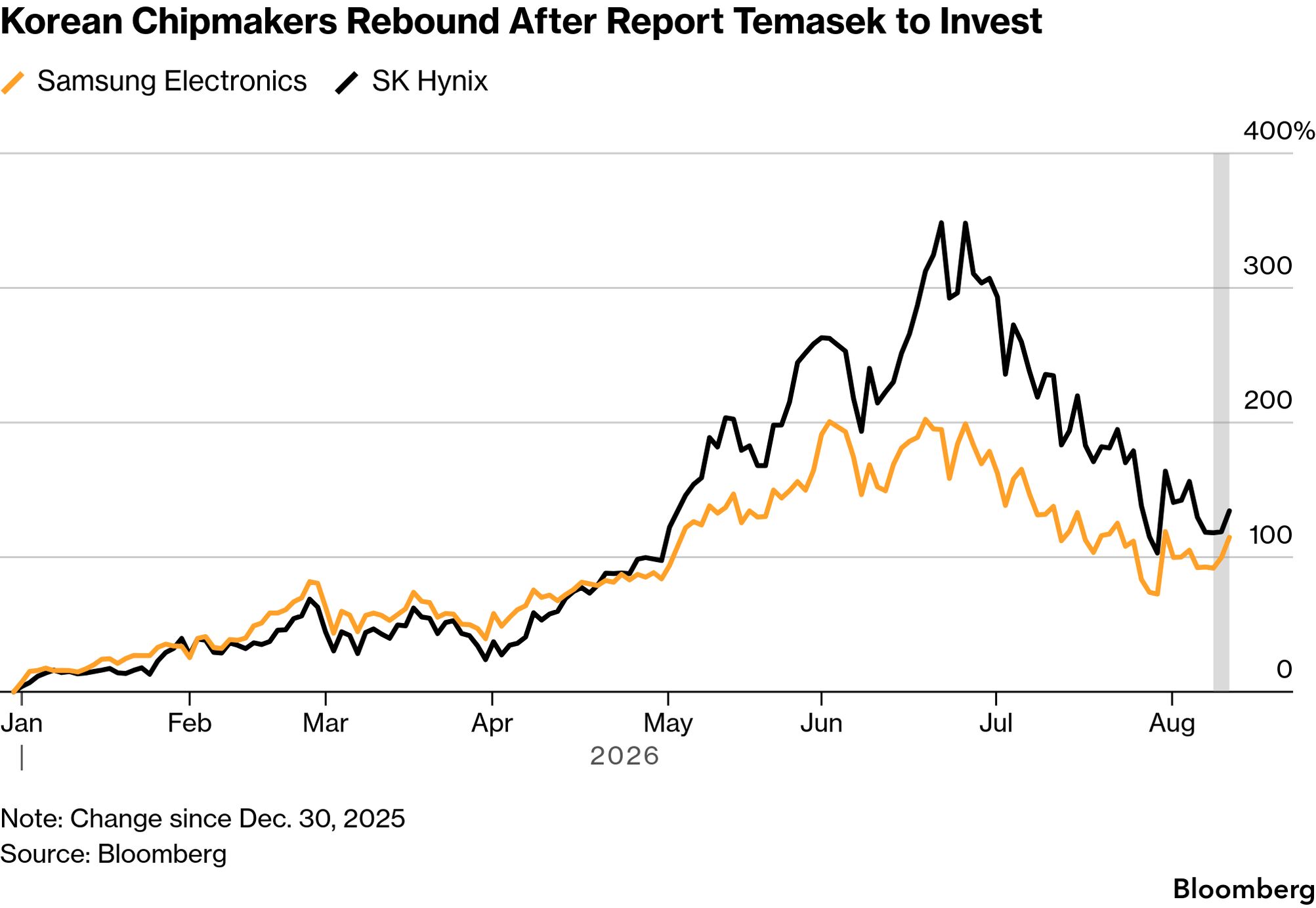
South Korean chipmakers rallied as risk appetite returned after last month’s rout and traders weighed a local media report that Singapore’s Temasek Holdings Pte plans to invest in Samsung Electronics Co. and SK Hynix Inc.

Shares of the chip duo briefly extended gains to more than 8% after Asia Business Daily Temasek Contacts S. Korea to Invest in Samsung, Hynix: Daily that the state fund plans to invest directly in the two chipmakers through its internal investment team, and is mulling timing. Samsung ended the day up 6.7% while SK Hynix rose 5.5%. The benchmark Kospi gained 3.7%.

Temasek said in response to queries from Bloomberg News that it didn’t seek advice from the Korean government on the timing of investments in either SK Hynix or Samsung, and that it first invested in both companies more than two years ago.

The chipmakers saw a brutal selloff in July as doubts grew over the pace of rapid AI infrastructure buildout, leading to an unwinding of leveraged positions. The shares have been rebounding recently, amid growing expectations the companies will bolster shareholder returns with buybacks and more dividends.

“It is a positive confidence signal, but I would not see it as a game changer or the main driver of the Kospi rebound,” said Albert Yong, managing partner at hedge fund Petra Capital Management, referring to the local report. “Samsung and SK Hynix had become technically oversold despite still-strong fundamentals.”....

https://assets.bwbx.io/images/users/iqjWHBFdfxIU/iEN0r1CQ1qIU/v3/pidjEfPlU1QWZop3vfGKsrX.ke8XuWirGYh1PKgEw44kE/-1x-1.png 

....MUCH MORE 

Now back in July the fund said they would double their AI exposure by 2031, noteworthy not because they named names but because they take a fairly conservative approach (growth-at-a-reasonable-price+some moonshots) to investing:

Temasek’s Net Portfolio Value Grows to S$518 billion, up S$49 billion from Last Year 

There are other reports that this would be the big (401 billion USD) fund's first foray into Korea, which seems a bit surprising.**
*August 2009 - China's BYD says Buffett wants to raise stake (BRK.A: 1211.HK)

[this comment did not please Buffet or Munger - Don't be tellin' people to go frontrun our buying] 

**Singapore's other SWF, GIC is even more conservative and has $936 billion AUM.

Thursday, July 9, 2026

"Singaporean sovereign wealth fund Temasek thinks AI is going to pay off"

From The Register, July 9:

Downer for doomers as conservative investor plans to lift portfolio exposure by 150 percent, and even more once it adds electrification ventures 

Singapore’s sovereign wealth fund Temasek, one of the world’s largest investment houses, intends to massively increase its investment in AI over the next five years – both for its own use and across its portfolio.

Temasek holds over $400 billion in assets and around six percent of those are currently tied up in AI companies, including OpenAI.

At its annual review meeting yesterday, the fund announced it intends to increase its exposure to AI until it reaches 15 percent in 2031. Temasek said it will target five areas: energy and data centres, semiconductors, cloud services providers, foundation models, and AI applications & software infrastructure.

Temasek also sees rising demand for AI as one reason to grow its investment in infrastructure from one percent of its portfolio to five percent.

“We see compelling opportunities in ageing infrastructure and grid modernisation, renewable and nuclear energy, energy storage, and breakthrough decarbonisation technologies, underpinned by rising electrification demand and AI-driven data centre growth,” the fund said.

The fund is eating its own dog food, too, by “embedding AI into how we invest and operate, augmenting human decision-making, sharpening workflows, and enhancing productivity across the firm.”....

....MUCH MORE, including sidebars and The Register's take on the scars from Sam Bankman-Fried's FTX 

Thursday, November 6, 2025

Singapore’s Top Real-Estate Asset Managers Mull Merger That Could Create $150 Billion Entity

From the Wall Street Journal, November 2:

The two property developers could start laying the groundwork for the process as early as next year 

Two of Singapore’s biggest real-estate asset managers are exploring a merger that could create one of Asia-Pacific’s top property companies with more than US$150 billion in assets under management, people familiar with the process said.

Temasek-owned Mapletree Investments and Singapore-listed CapitaLand Investment

are considering a potential business combination, people familiar with the matter said. The two property developers are likely to start laying the groundwork for the process as early as next year, the people said.

The plans are in the very initial stages, and a deal may or may not materialize, the people said.

“CapitaLand Investment remains committed to delivering long-term shareholder value and routinely evaluates investment opportunities aligned with its strategy,” a spokesperson said, adding that the company doesn’t comment on rumors or speculation.

Temasek and Mapletree Investments both declined to comment.

One person said the process is part of the recent moves by Temasek-owned entities to evaluate options for growing their businesses into larger, stronger global entities. Temasek owns 100% of Mapletree Investments and 54% of CapitaLand Investment.

In 2023, Temasek portfolio companies Keppel Offshore & Marine and Sembcorp Marine merged to form Seatrium, creating a unified entity that ranks among the world’s leading rig builders. In 2021, CapitaLand announced a comprehensive restructuring plan that brought together its multibillion-dollar fund-management and hospitality businesses.

As of Aug. 13, 2025, CapitaLand Investment had 117 billion Singapore dollars in assets under management, equivalent to around US$90 billion, held via stakes in seven listed real-estate investment trusts and business trusts....

....MUCH MORE 

Wednesday, September 8, 2010

"Sinochem Approaches Temasek on Potash Bid" and "Potash’s CEO Says BHP Unlikely to Be the Only Bidder" (POT)

In early pre-market trade the stock is up another $1.42 at $150.91.
A twofer. First up Reuters via the New York Times:

China's state-owned Sinochem Corp has invited Temasek, the Singapore sovereign wealth fund, to join a consortium that may bid for Canada's Potash Corp, the world's largest fertilizer supplier, sources with knowledge of the matter said on Tuesday.

The move follows an order by Chinese officials for state companies to meet investment bankers to explore ways to block BHP Billiton's $39 billion hostile bid for Potash Corp.
Further raising pressure on BHP to sweeten its bid, Potash Corp said on Tuesday it had contacts with several other parties that had shown interest in possible transactions. It has called the Anglo-Australian miner's $130-a-share offer "grossly inadequate."

"A number of third parties have already expressed interest in alternative transactions, some whom we approached and others, who initiated contact on their own," Potash Corp Chief Executive Bill Doyle said in a video clip posted on the company's website. (www.potashcorp.com)

China, which typically buys about 7 percent of the output of Potash Corp, fears a BHP takeover might jeopardize supplies it will require to feed its huge population in coming years....MORE
And from Bloomberg/BusinessWeek:
Potash Corp. of Saskatchewan Inc. Chief Executive Officer Bill Doyle said BHP Billiton Ltd. is unlikely to be the only bidder for the world’s biggest fertilizer producer as others are interested.


“A number of third parties have already expressed interest in alternative transactions, some who we approached and others who initiated contact on their own,” he said in a video clip on the website of the Saskatoon, Saskatchewan-based company.

Doyle last month rejected BHP’s $130-a-share bid as inadequate, as he forecast a 10 percent gain in consumption of the crop nutrient and pointed to price gains of as much as 40 percent in corn, soybeans and wheat since June. China’s Sinochem Group approached Singapore’s Temasek Holdings Pte. to join a group that may bid for Potash Corp., Reuters reported yesterday, citing unidentified people.

“If there’s another bid, it may mean BHP thinks they have to up their bid and that won’t please its investors at all,” said Michael Heffernan, a client adviser with Austock Securities Ltd. in Melbourne.

Potash Corp. rose 0.7 percent to close at $149.49 in New York Stock Exchange composite trading yesterday. The shares advanced to a high this year of $153.29 on Aug. 23, about a week after Potash Corp. made public BHP’s proposal.

Shares of Melbourne-based BHP Billiton, the world’s biggest mining company, declined 1.4 percent to 1,862 pence by 10:04 a.m. in London. They dropped 1.4 percent to close at A$37.91 in Sydney trading.
BHP Shareholders

Li Qiang, head of the president’s office at state-owned Sinochem, didn’t answer calls in Beijing. Jeffrey Fang, a spokesman at Temasek, Singapore’s state-owned investment company, declined to comment....MORE

Friday, August 14, 2020

Beyond Meat Competitor Impossible Foods Raises $200 Million Series G Round

Raising the question: "How deep into the alphabet can they go?"
(I think the last SpaceX financing was a 'Series R')

From AgFunder:

Coatue leads $200m Impossible Foods round; Temasek, Mirae Asset re-up
Impossible Foods has raised an additional $200 million in Series G funding, with new investor Coatue Management leading the round.

Coatue was joined by fellow New York-based hedge fund XN, which has secured $1 billion in committed capital for its maiden vehicle, while South Korea’s Mirae Asset — which had led Impossible Foods’ $500 million Series F round in March — also participated.

Singapore sovereign fund Temasek, an existing investor, completed the line-up. The company did not share any valuation figures, but confirmed it has raised close to $1.5 billion in total funding since it launched in 2011.

As for how it plans to deploy the capital, Impossible Foods said much the same as it did for its Series F. It’ll use the funds for research and development, product development and commercialization, and to further upscale its manufacturing capacity, the company said in a statement.

Given the smaller size of this round compared to the previous two, some observers may surmise that Impossible Foods is beginning to run out of steam. But by bringing yet another big-name backer on board in Coatue — and with both Mirae Asset and Temasek upping their skin in the game — the plant-based protein maker still has plenty to be happy about....
....MUCH MORE

Tuesday, January 28, 2020

French Startup ManoMano Raises €125 in Series E Round

This one wasn't even on the 10 French startups to watch list from a couple weeks ago.
From EU-Startups, January 28:

Paris-based ManoMano snaps up €125 million to build up its DIY marketplace
French startup ManoMano, a leading European online Marketplace for DIY, home improvement and gardening products, has announced snapping up €125 million Series E fundraising.
The round was led by Temasek, a global investment company headquartered in Singapore, with participation from General Atlantic, Eurazeo, Piton Capital and Bpifrance (through their Large Venture fund), and Kismet Holdings.

ManoMano, founded in 2013, aims to make your DIY, home improvement and gardening projects easier. Its online marketplace includes the best brands and products at competitive and reasonable prices. In addition, it give you tips and ideas for you to do your work from start to finish.

This new fundraising round increases the total funds raised over the past six years to €310 million. 

This will allow ManoMano to further deliver on its growth strategy, with the aim of becoming the European market leader in the DIY, home improvement and gardening space. The startup will continue its international expansion, as well as its tradition of customer-centric innovation with services like Mano Fulfilment, its category-specific logistics service, and Manodvisors, its community of experts and enthusiasts that support the company’s customers with their project and purchase decisions....MORE
Temasek is always woth paying attention to.$230+ billion portfolio, not flashy/splashy, they just make money.

Wednesday, October 2, 2024

Data Center Operator Equinix, Canadian Pension Fund Manager CPPIB and Singapore's GIC Form $15B-Plus US Hyperscale Data Centre JV

GIC is one of the three funds that Singapore's Ministry of Finance uses to manage the country's reserves and other national financial assets, the other two being MAS and Temasek—which gets the bulk of our interest because Temasek tends to swing for the fences whereas GIC is much more conservative, benchmarking growth above the worldwide inflation rate.

That said, GIC is a major sovereign wealth fund with US$847bn in assets.

From Asian real estate mavens Mingtiandi, October 2:

Singapore sovereign giant GIC, the Canada Pension Plan Investment Board (CPPIB), and US-based data centre provider Equinix have formed a joint venture to develop data centre campuses in the US, with the partners targeting to raise over $15 billion to fund the construction of hyperscale facilities that will eventually provide more than 1.5 gigawatts of capacity.

Under the terms of the agreement announced Tuesday, GIC and CPPIB will each hold a 37.5 percent interest in the JV, with Equinix taking the remaining quarter stake. In addition to the partners’ equity commitments, the venture also expects to take on debt to raise its total investable capital to more than $15 billion over time.

The JV marks the latest investment in the digital infrastructure space by Equinix’s partners, with GIC having previously teamed up with the NASDAQ-listed player for data centre ventures in Asia Pacific, Europe, and the Americas. CPPIB last month announced that it had teamed up with Blackstone in the $16 billion acquisition of Australia-based data centre platform AirTrunk....

....MUCH MORE

Tuesday, May 5, 2020

Agriculture: Billionaires Betting Big

From TechCrunch:
With fresh support from its billionaire backers Pivot Bio is ushering in a farming revolution
In the first decade of the twentieth century two German chemists, Fritz Haber and Carl Bosch, invented fertilizer — the nitrogen compound which ushered in modern agriculture and saved the world from potential starvation.

Now, over a century later, a new group of scientists backed by government-owned international investment funds and some of the world’s wealthiest men and women is trying to save the world from their invention.

In the hundred years since companies began manufacturing fertilizer at an industrial scale, the chemical has become one of the main sources of the pollution that’s choking the planet and putting millions of the lives its use has helped to feed at risk from severe droughts, fires, floods, and storms caused by climate change.

That’s why investors including Breakthrough Energy Ventures (the investment fund backed by Mukesh Ambani, Jeff Bezos, Bill Gates and Masayoshi Son) and the Singapore-owned investment fund Temasek along with DCVC; Prelude Ventures; Spruce Capital Partners; Codon Capital; Bunge Ventures; Continental Grain Company; Tekfen Ventures; Pavilion Capital; and individual investors Alan Cohen and Roger Underwood have backed Pivot Bio with a new $100 million investment.

Pivot uses genetically edited microbes to replicate the work that naturally occurring bacteria had done for millions of years to fix nitrogen in the soil, where it could be absorbed through plants’ root structures....MUCH MORE
As far as ag investments go, nine-figure rounds are not that common, a couple salmon farmers and a handful of "plant-based protein" (it's all plant-based) companies and maybe two of the vertical farm companies.

We keep an eye on what Temasek is doing. They aren't as flashy as their Silicon Valley brethren but they have a nose for sniffing out where the money will flow, both in venture and in private equity.

Tuesday, March 30, 2010

Al Gore, No Score: "How a big bet on oil went bust" (GS)

We've had a few posts on Kleiner, Perkins' investment in Terralliance, links below.
From Fortune:
In the summer of 2008, Erlend Olson thought he had finally hit the jackpot.

A bit player in semiconductors for years, the former NASA engineer had made an improbable metamorphosis into a burgeoning oil-exploration kingpin. His company, Terralliance Technologies, a secretive startup in Newport Beach, Calif., had developed an algorithm for telling petroleum engineers where to drill.

Never mind that Olson was an electrical engineer with no background in oil. He had convinced some of the world's most sophisticated investors, including Goldman Sachs (GS, Fortune 500) and Kleiner Perkins, that his unconventional approach was legit. Kleiner would go on to bet a whopping $93 million on Terralliance, a sum that may be the storied firm's largest venture investment ever.

Terralliance hadn't found much oil, but its founder and CEO was so adept at locating cash reserves that he believed he was about to close a deal that would seal his company's future -- and his fortune.

He had come to New York that August to negotiate a financing with Temasek, the sovereign wealth fund of Singapore, which Olson had been romancing for months. The price of oil had recently soared to $145 a barrel, and Temasek planned to invest $1.1 billion, valuing Terralliance at more than $4 billion.

A hulking figure with a glassy-eyed intensity, Olson had assured his investors that an infusion of this magnitude could lead quickly to a public offering worth as much as $60 billion. That would make Olson, as he wistfully recalled later, a "three-comma guy."

Olson wasn't alone in counting commas. Kleiner Perkins thought it was on the threshold of its first mega-win since Google's (GOOG, Fortune 500) IPO in 2004. Goldman Sachs, which had been betting shrewdly on plummeting housing prices, envisioned another killing. Passport Capital, a young San Francisco hedge fund, anticipated burnishing its reputation for energy investments. John Fredriksen, a Norwegian supertanker mogul who had lent Terralliance $50 million only months earlier, stood to score a quick hit.

All told, the investors had sunk nearly half-a-billion dollars into Terralliance, an astounding sum given the audacity of the company's aspirations -- and the paucity of its accomplishments.

Why experienced investors pumped so much capital into such a risky venture is just one mystery in the tale of Terralliance, a saga that has not been comprehensively told despite the high profiles of the players involved.

Kleiner Perkins, a firm that loudly promotes its most promising investments, for years didn't list Terralliance on its website and declined multiple requests to comment for this article. Despite interviews with many of the key people involved, it's also not clear what exactly Terralliance's technology purported to do, or how well its investors understood it....MORE

July '08: "What the hell happened to Kleiner Perkins? (John Doerr et al [Gore])"

April '09: "Venture capital firm Kleiner Perkins feels sting of investing in oil"

Thursday, April 5, 2018

Laboratory Meat Company Impossible Foods Raises Another $114 Million, Approaching $400 Million to Date

Yes, there was a method to the madness when we the adopted analysis of the frankenfood alternative protein purveyors as our own little cottage industry a couple years ago.
Now may be the time to re-purpose the mission statement we use for another emerging sub-industry:
"As the only analysts covering the nascent as-yet-theoretical autonomous electric flying taxi market we intend to be the the go-to source for all things autonomous electric flying taxi and/or theoretical...."
From AgFunder April 4:

UPDATE: Impossible Foods Adds $114m in New Financing, Bringing Total to Nearly $400m
*First Published August 1, 2017. Updated April 4, 2018 to reflect new financing.”
Plant-based burger maker Impossible Foods has added a $114 million convertible note to its ample coffers. The additional financing comes from existing investor Singapore state fund Temasek along with Chinese private equity firm Sailing Capital. 

The company closed $75 million in Series E funding in August 2017, with Temasek leading the round. This marked the fourth agtech investment for the Singaporean state fund and the second investment in a company looking to replace animal products with no-slaughter alternatives.

The startup has now raised roughly $396 million in debt and equity in total, making it the best-funded alternative protein startup to date. Also participating in the August round were existing investors Open Philanthropy Project, Bill Gates, Khosla Ventures, and Horizons Ventures.
Impossible Foods makes a plant-based burger with synthesized heme, the non-protein part of hemoglobin in blood that carries oxygen. This compound ingredient helps Impossible’s burgers cook, taste, and bleed like beef. It obtains heme by genetically modifying yeast and using fermentation to produce a heme protein naturally found in plants, called soy leghemoglobin.

In 2017, Impossible Foods received a patent for its use of leghemoglobin in plant-based meat. The 200-person startup says it has more than 100 additional patents pending....MORE
Previously on the Protein Channel::

"How the Cattle Industry Is Fighting Against #FakeMeat"
"Companies Are Betting on Lab-Grown Meat, but None Know How to Get You to Eat It"
The Largest U.S. Protein Processor (chicken, beef, pork) Is Investing in Lab Grown Meat
Dealflow: "New Investors Flock To Food"
"Silicon Valley and the Search for Meatless Meat"
"Where’s The Beef? China Signs $300 Million Deal with Israel to Import ‘Lab Meat’"
Bill Gates Invests In Another Lab-Grown Meat Company
"Bill Gates headlines an all-star list of investors pumping $75 million into meatless burgers"

Mr. Gates also partnered with Li Ka-Shing and Khosla on Hampton Creek which is attempting to pivot from Just Mayo into laboratory-grown 'meat'.*
"Mayo-scandal firm Hampton Creek from San Francisco going whole hog for Frankenmeat: report"
Just Mayo Guy, Hampton Creek's Josh Tetrick, Pivots to Industrial Scale Ingredient Supply Biz
Hampton Creek: Remember All Our Vegetarian Talk? Never Mind    
Questions America Wants Answered: Is Eating Lab Grown Human Flesh Cannibalism?
"People buying meat from strangers on social media is a serious problem"
Seven Startups Creating Lab-Grown Meat
"Can Planet Earth Feed 10 Billion People?"
Sure.
We might have to go lower down on the protein chain though.
I hear crickets are yummy but haven't yet verified this claim..
"Ancient Nutrition Raises $103 Million From 100+ Investors To Heat The Bone Broth Market"
The 'bone broth' market?
I was not aware.

Monday, November 12, 2018

Ahead of Tomorrow's Q3 Report: "Agricultural Venture Capital at Bayer"

Except for the fact the company bought Monsanto with its top-selling Roundup pesticide brand, for $63 billion, despite the fact Germany itself is going to outlaw the stuff, except for the $289 million initial verdict on a cancer case,* everything is going swimmingly.
From AgFunder, October 29:
bayer growth ventures

Bayer Growth Ventures: What We Don’t Know Yet

**UPDATED October 31, 13:51 ET: Adds Board Seat representation details that Bayer had not disclosed when AgFunderNews first went to press.
If you talk to new Bayer employees, the relief that the long journey to the acquisition of Monsanto is over is slightly overshadowed by the wide-eyed anticipation of the years of integration work yet to come. Details are few and subject to change across the board. 

Venture capital at Bayer Crop Science, which has until now focused mainly on investing in external funds, is just beginning to firm up with the creation of Bayer Growth Ventures (BGV) — a venture capital investment office under the umbrella of Leaps by Bayer, the company’s existing venture outfit. The name is a copy of Monsanto’s well-established venture arm: Monsanto Growth Ventures (MGV).

BGV will invest much like MGV did, which was very similar to a traditional venue office investing smaller check sizes in relatively early rounds, and occasionally leading later-stage rounds. One notable counterexample is Monsanto’s investment in Pairwise, an independent gene-editing startup that the MGV team built internally, though it was not the sole funder. 

We spoke to interim head of BGV Jürgen Eckhardt, a longtime venture capitalist focused on life sciences, to find out more about the company’s new approach to venture capital. But one thing that remains unclear is the fate of MGV’s portfolio. 

Board Seats and Follow-Ons
The potential for BGV to invest in the future funding rounds of its existing MGV portfolio — called follow-ons — was called into question after BGV was noticeably absent from the $70 million Series B round of microbial crop inputs company Pivot Bio earlier this month. Billionaire-backed clean energy fund Breakthrough Energy Ventures led the round alongside Singapore state fund Temasek. Some commentators wondered if Bayer’s microbe-focused joint venture Joyn Bio would create a conflict. Eckhardt responded to say: “We don’t necessarily divulge every detail of our investments. Bayer Growth Ventures supports both Joyn and Pivot, as they each are pursuing important innovation for the agricultural industry.”

There was uncertainty around the uptake of board directorships at MGV portfolio companies after the team of MGV — Kiersten Stead, John Hamer, and Ryan Rakestraw — recently stepped down from their board seats in the wake of the closed deal. When they left MGV a few months ago, the plan was for them to continue to manage the portfolio and retain their seats — often board members will manage out their portfolio to provide continuity for the startups — but the plan clearly changed.
Bayer has now confirmed that replacements have been found for each portfolio company. They are as follows: 
Company Location Board Role BGV Board Representation
Arvegenix St. Louis, MO Director Jak Knowles
Atomwise San Francisco, CA Director Axel Bouchon
Resson Fredrickton, NB, Canada Director Axel Bouchon
Understory Madison, WI Director Axel Bouchon
FarmLead Ottawa, Ontario, Canada Director Juergen Eckhardt
Pairwise RTP, NC Director Juergen Eckhardt
Plant Response Madrid, Spain Director Juergen Eckhardt
AgBiome RTP, NC Observer Lucio Iannone
Pivot Bio Emeryville, CA Observer Jak Knowles
NewLeaf St, Louis, MO Observer Jak Knowles

A notable change is that BGV no longer has a board director role at Pivot Bio, AgBiome or NewLeaf.
Karsten Temme, CEO of PivotBio told AgFunderNews: “We haven’t disclosed the participants of our Series B outside of Breakthrough and Temasek. We did disclose that our board composition changed and does not include a BGV representative.”

DOJ Stipulations
Eckhardt told AgFunderNews that no deal was off the table, which is an important detail since the Final Proposed Judgement regarding the Bayer-Monsanto deal, as released by the US Department of Justice, threw up another uncertainty for the future of MGV’s portfolio. The Judgement made several stipulations that could interfere with existing and future venture investments at the newly-merged company, essentially ordering Bayer, for the next 10 years, to notify the US Department of Justice 30 days in advance if it intends to “directly or indirectly acquire a financial interest … in any company that researches, develops, manufactures, or sells digital agriculture products or soybean, cotton, canola, or corn seeds or traits.”

Eckhardt told AgFunderNews that this fact will not hinder investments in any technology category.
“Obviously we will follow the guidance of the DoJ if and when we invest in such an area. On first sight, it looks like this is absolutely doable… In my 16 years of venture capital, I’ve never seen a round close faster than 30 days,” he said with a laugh. 

Rob Leclerc, CEO of AgFunder, is less sure about what the ruling means.
“Agriculture may not be like other industries and we already saw the DoJ reject the sale of Precision Planting from Monsanto to John Deere last year. It will be interesting to see how the DoJ reacts. If the DoJ restricts Bayer and BGV from investing in and acquiring agtech startups, Bayer could quickly lose its leadership position in digital agriculture.”

What We Do Know
Bayer CropScience CEO Liam Condon said in June that the shape of venture capital in the newly integrated company was a “hotly debated topic” internally, and it wasn’t clear initially which direction the company would take....MUCH MORE
*Roundup "probably" doesn't cause cancer but Monsanto left itself open to lawsuit risk because of the corporate culture that intentionally kept information about glyphosate's potential harms from the public.
Additionally, the initial jury award was reduced by $200 million in October but there is still a lot of exposure for Bayer.
Bayer reports their numbers tomorrow and I'm sure will have some comments:

Tuesday, November 13, 2018
Interim Report Q3 2018
News Conference Call
Investor Conference Call

Thursday, November 11, 2021

Indoor and Vertical Farming Now Rebranded As Novel Farming Systems (who's who and what's what in the investment end of the biz)

From AgFunderNews, November 10, a financing newswrap:

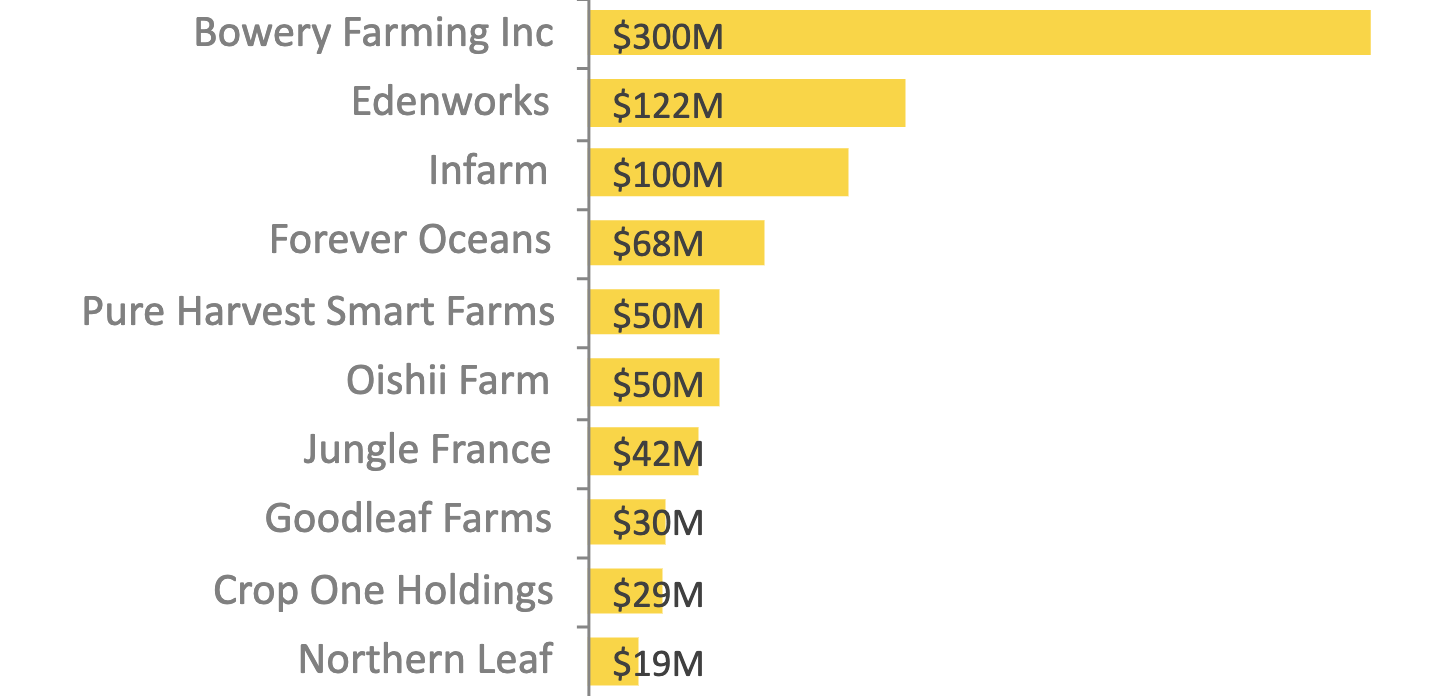
Data Snapshot: Bowery’s $300m round tops H1 2021 Novel Farming Systems deals

Data Snapshot is a regular AFN feature in which we analyze agrifoodtech market investment data provided by our parent company, AgFunder.


AgFunder data confirms that US vertical farming startup Bowery bagged the biggest investment deal in the Novel Farming Systems category in the first half of this year. The New York-based company claimed that its $300 million Series C raise in May – was “the largest private fundraise to date for an indoor farming company.”

Fidelity led the round with participation from Amplo, Gaingels, General Catalyst, GGV Capital, Temasek, Groupe Artémis, and Google affiliate GV.

In second place was New York’s Edenworks — now known as Upward Farms —  which raised $122 million earlier in the year according to a US Securities and Exchange Commission filing. It builds aquaponic farms which raise crops and fish together.

The third-largest deal involved German vertical ag company Infarm, which netted $100 million in an extension to its Series C round from investors including Hanaco and Atomico.

Top 10 Novel Farming Systems funding deals H1 2021

Also of note among the top 10 Novel Farming Systems deals in H1 was the $50 million Series A round raised by New York’s Oishii, which claims to cultivate strawberries in the city using bees and ancient Japanese farming practices; while the Channel Islands’ Northern Leaf scored $19 million from five investors to build a growing facility and extraction plant for medical cannabis.

What are Novel Farming Systems?
Novel Farming Systems is a category created by the AgFunder Research team to cover ventures in controlled environment agriculture (CEA) — including vertical farms and greenhouses — as well as tech-enabled insect, seafood, cannabis, and algae production.

Why are investors interested in Novel Farming Systems?....

....MUCH MORE

 Algae, that brings you back doesn't it?

There was 2009's The Summer Of Algae

From 2010's The Navy Calls for More Algae Fuel
To 2012's Algaen Gothic:

"Yup, I used to raise corn for ethanol. But then the topsoil blew away and I couldn't even get enough juice to run my tractor or get drunk on Saturday. Then this stranger came to town. Ordered something called a 'la-tay' and called himself a 'vee-cee.' Said he'd give me $20 million to come to Californee and herd algae. So we packed up our furniture in his little toy car and came west. Now I've got a regular bonanza of the slimy critters and the kids got shoes. Hain't looked over my shoulder back east since."

Sunday, October 9, 2022

"Fake meat sales are now plunging because of high prices and being too 'woke' for consumers ⁠— here's the 1 timeless takeaway for investors"

From Yahoo Finance:

Just a few years ago, the rise of plant-based meat seemed inevitable. Major grocery stores and fast food joints started adding these faux meat alternatives to their product mix as consumer demand skyrocketed.

Now the boom has ended. The novelty has faded while the fake meat has taken center stage in the ongoing backlash against corporate “wokeness.”

The sudden reversal of this trend highlights several economic factors that impact consumers and investors alike. Here’s a closer look.

The 'wokeness' backlash
While the term “woke” first popped up in the Black American community, it had grown into a global phenomenon as a catch-all term for everything relating to awareness of racial and social justice matters.

Part of the reason the term is so widely used and loosely defined is that corporate entities have embraced it so thoroughly. Organizations like Whole Foods, Pinterest and Adidas adopted the trend to restructure everything from human resources to marketing campaigns — a phenomenon the Harvard Business Review has dubbed “woke washing.”

Plant-based meat companies are closely associated with this phenomenon. Beyond Meat and Impossible Foods mention “climate change” and “animal welfare” several times on their website and in corporate reports.

The marketing strategy worked initially, driving double-digit annual sales for both companies and major brand partnerships. However, the growing cynicism about woke capitalism has upended this strategy. Recent data from Information Resources Inc., or IRI, suggests that fake meat sales are declining in 2022, while analysis from Deloitte Consulting LLP. indicates that the market may already be saturated in the U.S....

....MUCH MORE

The term woke morphed from the "aware" meaning it had in black communities to loudly trumpeting one's wokeness, along the way giving rise to our epigrammatic description:

"The less virtue, the more signaling."

I blame suburban white women.

We've chronicled our adventures in Beyond Meat since the IPO and in particular for the last year, many of the links are gathered in September 20's "Following On The News That Beyond Meat's COO Is Not Just A Carnivore But A Cannibal.... (BYND)":

This has been a fun one: 

Here's the latest on their largest competitor, privately held Impossible Foods, via the San Francisco Chronicle

Impossible Foods to eliminate 6% of staff in second round of layoffs this year

Impossible raised $2+ billion (I think they are up to the "H" or "I" round) from some big-time venture types. Temasek, Bill Gates, Li Ka-shing, Khosla, Google Ventures etc. but in their press releases they highlighted:

Impossible Foods’ existing individual investors include Jay Brown, Common, Kirk Cousins, Paul George, Peter Jackson, Jay-Z, Mindy Kaling, Trevor Noah, Alexis Ohanian, Kal Penn, Katy Perry, Questlove, Ruby Rose, Phil Rosenthal, Jaden Smith, Serena Williams, will.i.am and Zedd.
I am unfamiliar with Zedd's investing track record but with a name like "Z" as in zero you'd have to think his IRR isn't that impressive. Stick to music bub.

Saturday, July 13, 2024

Asian Property Development: Three Data Center Operators And A Warehouser

The Asian data center business is coming on strong. Three from Mingtiandi (Asian real estate intelligence):

July 4
PDG Completes First Phase of 150MW Data Centre Campus in Southern Malaysia 

Princeton Digital Group has delivered the 52-megawatt initial phase of its 150MW JH1 data centre campus, coming less than 14 months after it acquired the development site in Malaysia’s southern Johor state.

The AI-ready project will generate renewable energy through the installation of rooftop solar panels, Warburg Pincus-backed PDG said Wednesday in a release. In May the firm secured a $280 million green loan for JH1, hailing it as a major milestone towards minimising resource consumption and emissions by the region’s artificial intelligence infrastructure....

....MUCH MORE

July 11
Keppel DC REIT Enters Japan With $140M Tokyo Data Centre Buy

Keppel DC REIT has agreed to buy a western Tokyo data centre at a deal value of JPY 23.4 billion ($140 million), taking advantage of low borrowing costs to secure the trust’s first asset in Japan.

The Singapore-listed REIT will hold a 98.47 percent effective interest in the property, known as Tokyo Data Centre 1, while sponsor Keppel Ltd will acquire the remaining 1.53 percent, the trust’s manager said Thursday in a release. The seller is an unrelated third party.

The precise location wasn’t disclosed for the freehold multi-storey property, which was completed in 2019 and offers a net lettable area of 190,166 square feet (17,667 square metres). It is master-leased on a triple-net basis to a Fortune Global 500 company and hyperscaler with a remaining lease term of roughly seven years, according to Temasek-backed Keppel...

....MUCH MORE

July 12
Vnet Founder Gives Up Take-Private Bid as Blackstone-Backed Data Centre Firm Stays Listed

Vnet operates more than 50 data centres across China

Vnet Group founder Josh Chen has withdrawn his long-standing offer to take the Chinese data centre operator private, arguing that the NASDAQ-listed firm would be better served remaining publicly traded.

Beijing-based Vnet confirmed Chen’s decision on Thursday after a Bloomberg report broke the news earlier in the day. Chen, who serves as Vnet’s co-chair and interim CEO, had made a non-binding proposal in September 2022 to acquire all the outstanding ordinary shares of the company, whose backers include private equity giant Blackstone....

....MUCH MORE

Also Mingtiandi, July 11:

Warehouse Developer Panattoni Breaks Ground on First India Project Near Delhi

Panattoni Park NH71 is the first of several planned projects in India

Industrial developer Panattoni broke ground this week on a warehouse park in India’s national capital region as the US company’s first project in the country.

Situated on National Highway 352 within the Jhajjar district of Haryana, some 60 kilometres (37 miles) west of New Delhi, the Grade A park will offer 32,000 square metres (344,445 square feet) of space on a site measuring 66,000 square metres, Panattoni said in a release....

....MUCH MORE

Previous visits to Mingtiandi focused on China property woes:  

2021 China Property: "Kaisa Confirms Default on Offshore Notes, Plans Restructuring of $11.8B in Debt"

2022 China's Real Estate Developer Crisis Has Not Gone Away

....You have to love this rather droll comment: 

Chengdu-Sunac-Cultural-Tourism-City-Water-and-Snow-World

Mega-projects like Chengdu Sunac Cultural Tourism City Water and Snow World in Chengdu might have been ill-advised

Monday, September 20, 2010

"Sinochem seeks government support for Potash bid: report" (POT)

With about a half-hour to go the stock is up $1.11 at $148.39.
Not too hard to see this coming.*
From Reuters:
Chinese chemical conglomerate Sinochem Group has formally asked the government to back a bid for Canada's Potash Corp (POT.TO) (POT.N), a local newspaper reported on Sunday.
The Economic Observer cited sources close to the deal as saying that, according to a preliminary assessment, Sinochem would need $40 billion to $60 billion to trump a $39 billion hostile offer by BHP Billiton (BHP.AX)(BLT.L) for Potash Corp.

The amount would be too much for Sinochem, which reported $25 billion in total assets at the end of 2009, the Beijing-based weekly newspaper cited analysts as saying.

In its application to the government, Sinochem argued that Beijing should back a bid for the Canadian firm because potash is key to China's national food security, the paper said.

The Economic Observer's story chimes with a report last Friday by the Globe and Mail in Toronto that Sinochem was trying to drum up support for a Chinese-led bid for Potash Corp.
Sinochem is the parent of China's largest fertilizer company, Sinofert (0297.HK)...MORE

*Previously:
Potash Corp. Considering Management-led Buyout/Trying to Form China led Group to Beat BHP Bid (POT; BHP) 
"China, 1789 and potash" (POT; BHP) 
"Sinochem Approaches Temasek on Potash Bid" and "Potash’s CEO Says BHP Unlikely to Be the Only Bidder" (POT) 
"How likely is a Chinese bid for Potash Corp?" as Government May Order Firms to Bid (POT) 
China and Potash M&A Mania (POT)

Thursday, May 31, 2018

China's Ant Financial raises $10 billion at $150 billion valuation: sources

Starting to talk real money.
From Reuters, May 28:
Ant Financial Services Group, operator of China’s biggest online payment platform by market share, Alipay, has closed its latest funding round having raised $10 billion from a clutch of global and local investors, five people with direct knowledge of the matter told Reuters.

Ant’s first fundraising targeting global money values the firm at $150 billion, the people said, compared with about $60 billion after its previous fundraising in April 2016.

A number of global sovereign wealth funds and private equity firms joined the fundraising as main investors. They include Singapore’s sovereign fund GIC Pte Ltd [GIC.UL] and state investor Temasek Holdings (Private) Ltd [TEM.UL], as well as U.S. private equity firm Warburg Pincus LLC [WP.UL], the people said.

Malaysian sovereign fund Khazanah Nasional Bhd [KHAZA.UL] has also joined as a major investor, one of the people said.

The funding round also brought in private equity firm Carlyle Group LP and venture capital firm Sequoia Capital, which typically invests in early-stage start-ups, three of the people said.

The amount and investor line-up are finalised and the transfer of funds is underway, the people said....MORE

Wednesday, January 22, 2025

SoftBank and Temesek-Backed Aquaculture Unicorn Apparently A Fraud

Sometimes I wonder if SoftBank actually does due diligence. The poster child for bad SoftBank deals was WeWork but there have been quite a few others.

It wouldn't be much more than a curiosity except for the fact Mr. Son et Cie is going to be heading up the $500 billion American AI thingy, Stargate.

From Singapore's Straits Times, January 22:

Indonesian unicorn eFishery allegedly faked most of its sales

– One of Indonesia’s most prominent start-ups, eFishery, may have inflated its revenue and profit over several years, according to an internal investigation triggered by a whistle-blower’s claim about the company’s accounting.

A preliminary, ongoing probe into the agritech start-up – backed by investors, including Japan’s SoftBank Group and Singapore’s Temasek – estimates that management inflated revenue by almost US$600 million (S$811 million) in the nine months to September in 2024, according to a 52-page draft report circulated among investors and reviewed by Bloomberg News. That would mean more than 75 per cent of the reported figures were fake, the report said. 

The company, which deploys feeders to fish and shrimp farmers in Indonesia, was a darling of the nation’s start-up scene and turned unicorn with a valuation of US$1.4 billion when G42, an artificial intelligence firm controlled by the United Arab Emirates royal, Sheikh Tahnoun bin Zayed Al Nahyan, backed its latest funding round. Unicorns are start-ups that reach a valuation of US$1 billion and are not listed on the stock market.

The start-up has raised hundreds of millions of dollars in an attempt to modernise the country’s fish industry, providing farmers with smart feeding devices as well as feed and then buying their produce to sell into the broader market.

Investors were initially enticed by its profitability at a time when layoffs, chief executive officer resignations and plummeting valuations in the tech sector dominated headlines. It presented a US$16 million profit for the first nine months of 2024 to investors, but the investigation commissioned by the board alleges the firm actually generated a US$35.4 million loss.

Revenue for the period was estimated at US$157 million, rather than the US$752 million investors were told, according to the report. Management also inflated revenue and profit numbers for several previous years, the report said.

The report was initiated after a whistle-blower approached a board member with allegations that the accounts were not accurate, according to people familiar with the matter....

....MUCH MORE

Tuesday, April 17, 2018

ICYMI: The Most Valuable AI Start-up Inthe World Does Facial Recognition

Some thought us mad with our focus on countermeasures to the surveillance state. But there was a method to that madness.

We've looked at responses ranging from simple dazzle camouflage back in 2013's How to Hide From Cameras:

http://static.squarespace.com/static/514f916de4b04c6ad186e00d/514f94d2e4b05df537e5224e/514f94d2e4b05df537e5267d/1231283416153/DAZZLE.jpg/1000w

To hairstyles + makeup that confuse facial recognition algos:

responsivehttps://i.guim.co.uk/img/media/396302866244e3539e54bc5571e27fb512f1e59f/62_0_885_531/master/885.png?w=620&q=55&auto=format&usm=12&fit=max&s=eefd8e09624ac90c3d07802fa5fe591b
...but this raises its own set of problems, not the least of which is 
taking a half hour to apply just so you can go down to the lobby.

To Hyperface clothing with thousands of pseudo-facial "hits" that simply overwhelm the computer:
"Anti-Surveillance Clothing Aims to Hide Wearers From Facial Recognition "

https://i.guim.co.uk/img/media/f28edd54e33cb391aea9f19448b8ff11ecb5fa54/25_0_663_398/master/663.png?w=620&q=55&auto=format&usm=12&fit=max&s=b052101fa6e1777fe2c8bfdf7ff395f7

From the scholarly stuff such as "Fooling The Machine: The Byzantine Science of Deceiving Artificial Intelligence".
To, as noted in ""Magic AI: 'These are the Optical Illusions that Trick, Fool, and Flummox Computers.":
...First though a bit of housekeeping.
Just so you know, I don't actually use the make-up techniques featured in the earlier posts. Despite the fact they have some efficacy at fooling the camera they make you look like a moron to human observers on the street. Better to just put on some glasses and blend into the crowd.
https://hips.hearstapps.com/toc.h-cdn.co/assets/cm/14/37/540fe7c50c224_-_tc-iconic-kennedy-weddings-9.jpg
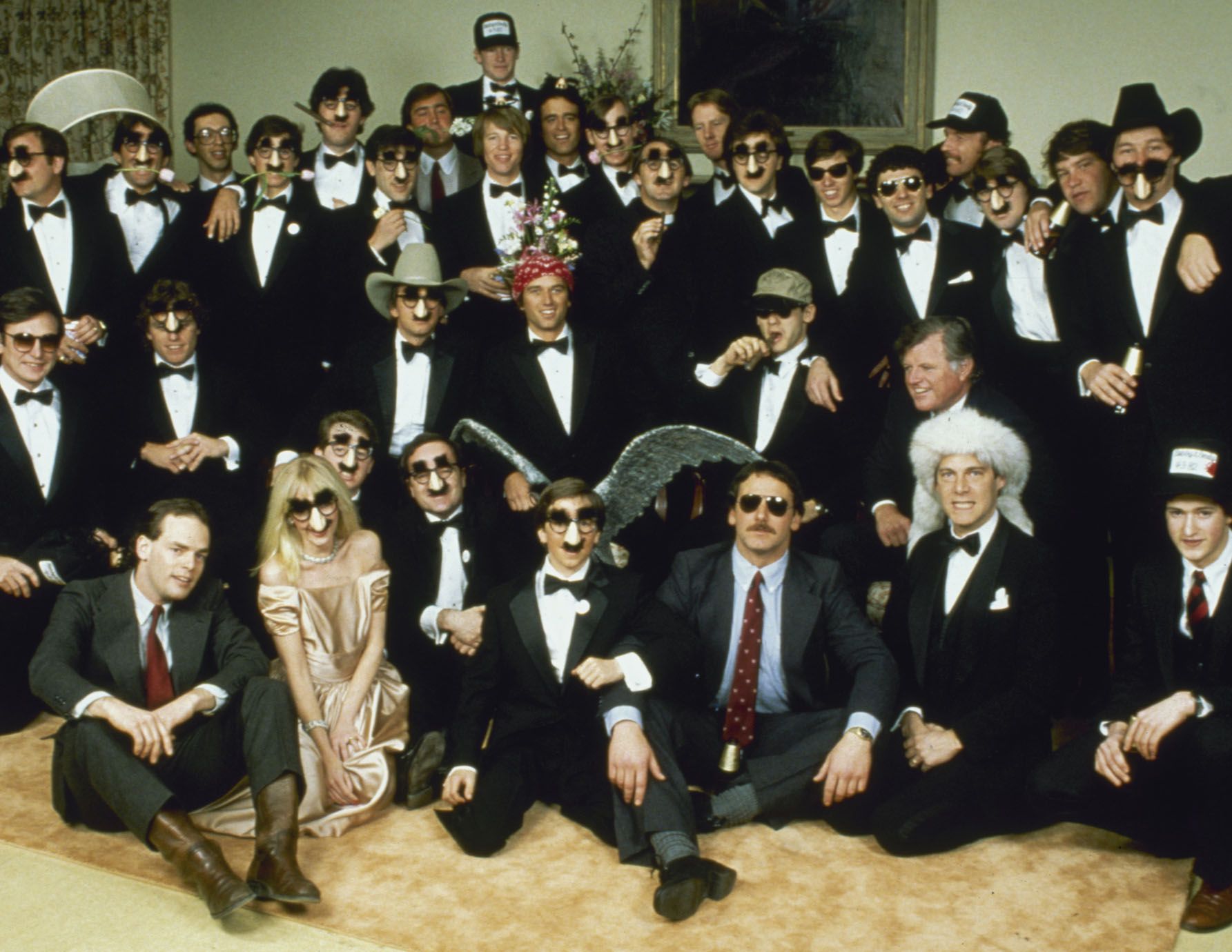
Can you pick out the Kennedys in this photo?

Here's why we cared: There is big money in this stuff!!
From Bloomberg, April 8: 

China Now Has the Most Valuable AI Startup in the World
SenseTime Group Ltd. has raised $600 million from Alibaba Group Holding Ltd. and other investors at a valuation of more than $3 billion, becoming the world’s most valuable artificial intelligence startup.

The company, which specializes in systems that analyze faces and images on an enormous scale, said it closed a Series C round in recent months in which Singaporean state investment firm Temasek Holdings Pte and retailer Suning.com Co. also participated. SenseTime didn’t outline individual investments, but Alibaba was said to have sought the biggest stake in the three-year-old startup.

With the deal, SenseTime has doubled its valuation in a few months. Backed by Qualcomm Inc., it underscores its status as one of a crop of homegrown firms spearheading Beijing’s ambition to become the leader in AI by 2030. And it’s a contributor to the world’s biggest system of surveillance: if you’ve ever been photographed with a Chinese-made phone or walked the streets of a Chinese city, chances are your face has been digitally crunched by SenseTime software built into more than 100 million mobile devices.

The latest financing will bankroll investments in parallel fields such as autonomous driving and augmented reality, cover the growing cost of AI talent and shore up its computing power. It’s developing a service code-named “Viper” to parse data from thousands of live camera feeds -- a platform it hopes will prove invaluable in mass surveillance. And it’s already in talks to raise another round of funds and targeting a valuation of more than $4.5 billion, according to people familiar with the matter.

“We’re going to explore several new strategic directions and that’s why we shall spend more money on building infrastructure,” SenseTime co-founder Xu Li said in an interview. The company turned profitable in 2017 and wants to grow its workforce by a third to 2,000 by the end of this year. “For the past three years the average revenue growth has been 400 percent.”...MUCH MORE
Both Futurism and Quartz zoomed in (CCTV term) on the surveillance bit:
World’s Most Valuable AI Startup Also Happens To Be Part of “the World’s Biggest System of Surveillance”
The billion-dollar, Alibaba-backed AI company that’s quietly watching people in China

Some of our previous posts on various related subjects:
"The selling of facial recognition technology—and the staggering consequences"
Facial recognition In China
We'll be coming back to what has become a bit of an obsession on the blog, and the countermeasures thereto, but for now, just some of the applications. Remember, this isn't the state of the art, this is stuff that is being deployed right now.
The state of the art is really spooky....
 
"Who Owns Your Face?"
"China’s Surveillance State: AI Startups, Tech Giants Are At The Center Of The Government’s Plans"
"Casino ATMs are Using Facial Recognition to Spot Money Launderers in Macau"
DNA Techniques Could Transform Facial Recognition Technology
 Bank Robbers’ Aluminum Invisibility Cloaks Foiled by CCTV
Memo: New York Calling For Face Recognition Cameras At Bridges, Tunnels
Adversarial Images, Or How To Fool Machine Vision
Cargill Invests In Facial Recognition For Cows
And many, many more. Use the 'search blog' box if interested. 

Now, if you'll excuse me for a bit, I have to go out in public for a bite to eat:


https://media.allure.com/photos/58e4005b82145034c5ad10da/master/pass/Untitled-3.jpg