Tuesday, September 5, 2023

Follow-Up To "A Caution For Copper Shorts....": It Was The Commercials, And It's Still Dangerous To Be Short

Following on August 18's "A Caution For Copper Shorts: Surprising Resilience in Futures Prices" the futures are once again showing great resilience. On a day that the dollar index (cash) is up 2/3 of a point to 104.78, knocking silver down almost 3% (down 70 cents to $23.87) copper futures are unfazed, off a fraction of a penny. And look at right-hand side of the Commitment of Traders report in the second panel of the chart:

The commercial hedger's (green line) went from a short position to a long.

As noted in the verbiage from the August 18 post:

Although we think the trend in prices is down, and have since before the China weakness, problems in the wind turbine biz, electric vehicle sales slowdown etc. etc. became widely apparent, in the immediate term the fact the futures did not go much below $3.63 and have popped back to $3.70+ is a tell that something is afoot.  $3.6955 last, after rising from 3.6270 to $3.7195 in a day.

Here's the one-year chart (daily prints) via FinViz:

Our guess is the strength comes from one of two sources: 1) China was buying again as the yuan weakened, essentially turning financial reserves into physical commodities as they have been doing with oil or 2) and potentially more ominously, the commercial hedgers (green line on lower panel of chart) have been closing short positions and may even be going long the futures. We'll have to wait for the next Commitment of Traders report to see the positioning.

A quick note on the COT, it is not a very reliable timing indicator but over longer time frames it proves up the general rule of  futures trading: the large and small traders (the specs) can steal some cheese from the cat, (the commercials) but in the end the cat must win or the whole game stops. And the problem arises from the asymmetry of outcomes: when the cat loses, it loses its cheese. When the mice lose they can lose their lives. Or at minimum get bloodied for their trouble.

Just something to be aware of.

On that go-round the futures went from the 3.6955 at post time to 3.9085 on September 1, before backing off to today's $3.8425. We have some suspicions as to what is going on but for the moment the takeaway is: Be very careful if short, this resilience is an important tell on the market.

Chips: "China to launch new $40 billion state fund to boost chip industry, sources say"

China's failure to launch in the chips biz has been one of the most dramatic failures of their economy. It didn't help that the last two funds were marked by graft and corruption but enough money flowed into actual R & D that you would have expected more progress.

From Reuters vbia Investing.com (also on blogroll at right) September 5:

China is set to launch a new state-backed investment fund that aims to raise about $40 billion for its semiconductor sector, two people familiar with the matter said, as the country ramps up efforts to catch up with the U.S. and other rivals.

It is likely to be the biggest of three funds launched by the China Integrated Circuit Industry Investment Fund, also known as the Big Fund.

Its target of 300 billion yuan ($41 billion) outdoes similar funds in 2014 and 2019, which according to government reports, raised 138.7 billion yuan and 200 billion yuan respectively.

One main area of investment will be equipment for chip manufacturing, said one of the two people and a third person familiar with the matter.

President Xi Jinping has long stressed the need for China to achieve self-sufficiency in semiconductors. That need has become all the more pressing after Washington imposed a series of export control measures over the last couple of years, citing fears that Beijing could use advanced chips to boost its military capabilities.

In October, the U.S. rolled out a sweeping sanctions package that cut China's access to advanced chipmaking equipment and U.S. allies Japan and the Netherlands have taken similar steps.

The new fund was approved by Chinese authorities in recent months, two of the people said.

China's finance ministry is planning to contribute 60 billion yuan, said one person. Other contributors could not be immediately learned.

All the sources declined to be identified as the discussions were confidential.

The State Council Information Office, which handles media queries on behalf of the government, the finance ministry and the Ministry of Industry and Information Technology did not immediately respond to Reuters requests for comment.

The Big Fund also did not immediately respond to requests for comment.

INVESTMENTS TO DATE

The fundraising process will likely take months and it was not immediately clear when the third fund will be launched or if further changes will be made to the plan, said the first two sources.

Backers of the Big Fund's previous two funds include the finance ministry and deep-pocketed state-owned entities such as China Development Bank Capital, China National Tobacco Corporation and China Telecom (NYSE:CHA).

Over the years, the Big Fund has provided financing to China's two biggest chip foundries, Semiconductor Manufacturing International Corporation and Hua Hong Semiconductor, as well as to Yangtze Memory Technologies, a maker of flash memory and a number of smaller companies and funds....

....MUCH MORE

Also at Investing.com:

Dollar rises close to three-month highs after weak Chinese data 

"The US wants to weaponize the USD, Russia and Saudi Arabia will weaponize oil instead."

What the hell did the O'Biden-Harris administration do? 

Seriously, who is pulling the strings that led to this result? It sure ain't President Biden AKA "Joey Mumbles."

From ZeroHedge:

Oil Soars To New 2023 High After Saudis, Russia Shock With Extended, Expanded Production Cut

Just days after we said that Saudi Aramco floating to sell up to $50 billion in new stock meant that oil is about to soar much higher...

... moments ago oil exploded higher after first Saudi Arabia and moments later Russia surprised markets by announcing that the recently implemented production cuts would be extended through year-end, well beyond the 1 month that was widely expected by the market.

Just after 9am ET, Saudi Arabia said it would extend the voluntary cut of 1 million b/d of for another 3 months, from October until the end of December, well beyond the expectation of just 1 more month. Saudi press agency SPA notes that the voluntary cut decision will be reviewed monthly to consider deepening the cut or increasing production. The extension of cuts is meant to reinforce the precautionary efforts made by OPEO countries with the aim of supporting the stability of the oil market.

And then, literally seconds after the Saudi decision, Russian deputy PM Novak said Russia would not only extend its reduction of oil exports until the end of the year, but also add another 300kb/d in voluntary oil cuts until December 2023. The measure is in addition to voluntary reduction previously announced by Russia in April 2023, which will last until of December 2024.

Similar to the Saudis, Russia said that the decision to reduce oil production to be reviewed monthly to consider possibility of deepening reduction or increasing production depending on situation on the world market.

Following this announcement Brent Nov’23 lifted from USD 88.50 to above $90 for the first time in 2023, while WTI Oct’23 rose from USD 85.55/bbl to USD 87.00/bbl, also the highest price of the year, and about to crush the Fed's hopes for a decline in headline inflation.

Bottom line: we now know that a year and a half later, the OPEC+/BRIC+ reaction to Biden's weaponized dollar is weaponized oil; may the least hopeless man win....

After the Maidan coup in 2014 the U.S. military, spies and State Department had eight years to plan what they were going to do.  This is proven by Merkel and Hollande's confessions that the Minsk Agreements were never meant to bring peace to eastern Ukraine but were instead an act of duplicity on the part of the West to buy time for Ukraine. 

Eight years is a lot of "If this, then that."

Beyond destroying the U.S. relationship with the Saudi's, the U.S. opened the world's eyes to the risk of having treasury or central bank assets where they can be seized, and compounded the folly by driving the rest-of-world into accelerating the trend away from U.S. hegemony.

We are governed by idiots.

Or worse. 

WTI futures $87.20 up $1.65; Brent up $1.25 at $90.25

"Myron Scholes on Black–Scholes, Decarbonization, AI, and Parenting"

There's a headline I did not have on my 2023 Bingo card.

From the CFA Institute's Enterprising Investor blog, August 28:

Through his examinations of how uncertainty influences asset prices, Nobel laureate Myron Scholes has helped revolutionize our understanding of the financial markets. His development of the Black–Scholes options pricing model with Fischer Black more than half a century ago redefined how investment professionals do their jobs and opened up a new era in the world of finance.

Even though he is one of the most influential living economists, Scholes is not resting on his laurels. His explorations of the inner workings of the financial markets continue, with a particular focus on both artificial intelligence (AI) and carbon credits and how they compare with options, among other phenomena.

He recently participated in a wide-ranging fireside chat arranged by Janus Henderson,hosted by CFA Society Hong Kong, and moderated by Alvin Ho, PhD, CFA. The conversation, which took place on 3 July 2023 in Hong Kong, covered both the continued relevance of the Black–Scholes model 50 years after its unveiling as well as Scholes’s current research interests. Below is a lightly edited transcript of the discussion.

The Black–Scholes Revolution

CFA Society Hong Kong: It has been 50 years since you published the famous Black–Scholes model, and it remains one of the most popular readings among financial professionals. How did that happen?

Myron Scholes: The model was really about explaining how to price options, but I’m happy that it has changed the banking landscape from an agency-only to a principal business.

Now, if you think about it, uncertainty is the most important thing in your life. The mean is nothing! Having options to deal with uncertainties and risks is so important. If life were unchanging, then options would not be as valuable, but life is always changing, which makes options and the ability to deal with uncertainties very precious.

With the Black–Scholes technology, we can help clients figure out what exactly they want and how to offset the delta and risks associated with it. Essentially, I see the options market as a crowd-sourcing place to determine what level of risk the market is signaling and subsequently help business owners to make decisions.

Decarbonization and Portfolio Construction

Going into your decarbonization and portfolio theory, how does the work that you have done in the options space help here?

I have done a lot of risk–return portfolio theory. To me, understanding constraints is of the utmost importance. You do not need to be a better forecaster than everyone else, but you do need to understand the constraints of others. For example, if people are constrained, if they trust you, they would be willing to pay you to take their constraints off. That’s when your options are valuable. This ability to unconstrain the constrained also happens in parenting and M&A.

If you want to make money in your life, being “boring” is important. You wouldn’t want the choppiness of your life affecting your returns, but you would want to smooth the volatility of returns and cut the tails. If you managed to do that, your compounded return would be so much better. My options theory is really meant to help understand the tail. If you think about decarbonization, we also want to smooth the path to decarbonization, and one way to do that is to create more paths to achieve it, and to some extent, it’s quite like a put option.

Myron, to dive deeper into the same topic, I want to ask a three-part question. First, how should investors determine the fair value of carbon credits?....

....MUCH MORE

"French Services Sector Shrinks More Than First Thought in Aug -PMI"

Not going to become Europe's growth engine at this rate.

From Reuters via US News & World Report, September 5:

France's dominant services sector contracted more than first estimated in August as another fall in new orders weighed on business in the euro zone's second-biggest economy, a survey showed on Tuesday.

The HCOB France final purchasing managers index (PMI) for the services sector, compiled by S&P Global, fell to 46.0 points - its lowest level since February 2021 - from 47.1 points in July. That was below August's flash services PMI reading of 46.7 points.

Any figure below 50 points marks a contraction in activity, while above 50 points shows an expansion. The French services index has now been below that level for the third month in a row....

Chips: "Google TPU v5e AI Chip Debuts after Controversial Origins"

From HPC Wire, August 30:

The dominance of Nvidia GPUs has companies scrambling to find non-GPU alternatives, and another mainstream option has emerged with Google’s TPU v5e AI chip.

The TPU v5e is also Google’s first AI chip being mainstreamed with a suite of software and tools for large-scale orchestration of AI workloads in virtual environments. The AI chip is now available in preview to Google Cloud customers.

The new AI chip succeeds the previous-generation TPUv4, which was used to train the newer PaLM and PaLM 2 large language models used in Google search, mapping, and online productivity applications.

Google has often compared its TPUs to Nvidia’s GPUs but was cautious with the TPU v5e announcement. Google stressed it was focused on offering a variety of AI chips to its customers, with Nvidia’s H100 GPUs in the A3 supercomputer and TPU v5e for inferencing and training.

The Cloud TPU v5e is also the first Google AI chip available outside the US. The TPUv4 was available only in North America. The TPU v5e computers will be installed in the Netherlands for the EMEA (Europe, Middle East, and Africa) markets and in Singapore for the Asia-Pacific markets.

The origins of TPU v5 were mired in controversy. Researchers at Google informally announced TPU-v5 in June 2021 and, in a paper, said AI was used to design the chip. Google claimed that AI agents helped floor-plan the chip in under six hours faster than human experts. There were internal debates on the claims made in the paper, and Google fired one researcher ahead of the paper’s appearance in Nature magazine.

Academic researchers also called out Google’s claims and criticized the company for not opening it up for public scrutiny. A researcher, Andrew B. Kahng, from the University of California, San Diego, later reverse-engineered Google’s chip-design techniques and found that human chip designers and automated tools were sometimes faster than Google’s AI-only technique....

....MUCH MORE

Capital Markets: "US Dollar Punches Higher"

From Marc to Market:

Overview:  Disappointing data in Asia and Europe has sent the greenback broadly higher. The strong gains posted before the weekend were mostly consolidated yesterday when the US and Canadian markets were on holiday. The rally resumed today. The Antipodeans and Scandis have been hit the hardest (-0.7% to -1.25%) but all the G10 currencies are down. The Swiss franc and yen are off the least (-0.35%-0.45%), and the euro and sterling have taken out their recent lows. Emerging market currencies have also fallen. So far, none have been spared.

Most of the large Asia Pacific bourses were under pressure, though Japan, Taiwan, and India posted small gains. The Hang Seng and mainland stocks that trade there suffered the most, with more than a 2% drop. MSCI's Asia Pacific Index snapped a six-day advance. Europe's Stoxx 600 is off by about 0.25% in late morning activity. It has fallen for the past four sessions. US index futures are trading heavier, with the S&P futures off about 0.2% and the NASDAQ futures down by around 0.35%. Bonds are also selling off. European benchmark 10-year yields are 2-3 bp higher and near 4.22%, the 10-year US Treasury yield is up about four basis points. Higher yields and a stronger dollar are pushing gold lower. After testing $1950 at the end of last week, it approached $1930 today. October WTI is steadying after pushing to $86 in early turnover. It is now near $85.50....

....MUCH MORE

Monday, September 4, 2023

"Hong Kong stocks slide as China property default risk stays in focus while Sinopharm slides on Hang Seng index debut"

The Hang Seng is currently down 1.52% (-286.42) at 18,557.74 while the Shanghai Composite Index is down 0.63% (-19.90) at 3,157.16. Shanghai's CSI 300 is down -22.32 (-0.58%) at 3,826.63.

As noted this morning:

"Chinese Property Stocks Soar After Latest Beijing Support, Country Garden Debt Deal"
Once again we cautiously caution be cautious, that support for the group does not mean new construction (and the GDP growth it brings) is about to return to the glory days.

That time has passed, never to return and at best Beijing will keep the world from descending into a depression caused by the Chinese property market....

From the South China Morning Post, September 5:

  • Property default risk stays elevated as Country Garden faces a deadline on two bond coupon payments this week
  • Sinopharm Group slides as the stock joins the Hang Seng Index membership after the latest quarterly review

Hong Kong stocks fell from a three-week high, led by a retreat in property developers as concerns about debt defaults overshadowed Beijing's renewed drive to revive home sales and repair market confidence. Sinopharm Group slumped after becoming a benchmark index member.

The Hang Seng Index slid 1.1 per cent to 18,644.58 at 10.03am local time, after rallying 2.5 per cent on Monday to the highest level since August 11. The Tech Index dropped 1.1 per cent while the Shanghai Composite Index declined 0.5 per cent.

Chinese developers led losers, with China Resources Land sliding 3.6 per cent to HK$35.10 and China Overseas Land and Investment tumbling 2.9 per cent to HK$17.40. Tencent lost 0.9 per cent to HK$330.60 and Alibaba Group shed 0.6 per cent to HK$92.65....

....MUCH MORE

"If you had "scientists discover spooky golden egg at the site of an ancient underwater volcano" on your 2023 bingo card, boy are you in luck."

From Futurism, September 1:

Scientists Find Strange Golden Object at Bottom of Pacific Ocean
"Something tried to get in... or to get out." 

Golden Era

If you had "scientists discover spooky golden egg at the site of an ancient underwater volcano" on your 2023 bingo card, boy are you in luck.

On Wednesday, as The Miami Herald reports, a team of National Oceanic and Atmosphere Administration (NOAA) scientists came across something deeply unusual while exploring an underwater volcano deep off the coast of Alaska: a mysterious golden object.

Found nestled into the side of the undersea structure roughly two miles beneath the Pacific ocean's surface, the strange orb-like discovery has puzzled the ocean researchers, who are currently mapping the Alaskan seafloor via remote-operated vehicle as part of the administration's latest Seascape Alaska mission. (The discovery was actually made live, as NOAA's live-streaming the mission.) And while coming across a spooky egg at the foot of an ancient volcano is eerie enough on its own, the researchers were reportedly extra shocked to discover that the mysterious orb had a torn hole in it — as if something had burrowed its way through.

"Something tried to get in... or to get out," one researcher observed during the live feed, according to the Herald. Zoinks!....

....MUCH MORE

Also at Futurism:

Dead Star Devouring Rival, Using Its Flesh to Shoot "Cosmic Cannonballs" 

Oh, and something about Martha Stewart.

Martha Stewart, The Woman Who Fronted A Weekend-Getaway-To-Svalbard Sweepstakes, Is Being Harassed By Whack-a-Doodles

From Entertainment Weekly, August 29:

Martha Stewart slammed for using iceberg as cocktail garnish amid climate crisis
"Martha the ice caps are melting don't put them in your drink," one Instagram user wrote under a photo of Stewart's Greenland cruise.

Martha Stewart's new, iceberg-flaunting Instagram post generated some titanic pushback from fans.

After the 82-year-old shared a few vacation photos showing her using pieces of an iceberg from Greenland to cool down a cocktail, the businesswoman and TV personality received pointed criticism amid an ongoing global climate crisis.

"End of the first zodiac cruise from @swanhelleniccruises into a very beautiful fjord on the east coast of Greenland," Stewart wrote Monday on the social media site, sharing a photo of herself enjoying a drink laced with bits from an iceberg. "We actually captured a small iceberg for our cocktails tonight....

https://imagesvc.meredithcorp.io/v3/mm/image?url=https%3A%2F%2Fstatic.onecms.io%2Fwp-content%2Fuploads%2Fsites%2F6%2F2023%2F08%2F29%2Fmartha-stewart-iceberg-drink-082923-1.jpg

...Responses to the carousel of images — which also included a shot of a chunk of iceberg resting on a cart — included many calling Stewart out for environmental insensitivity.  

....MUCH MORE

Elsewhere:

....But Martha has been defended by glaciologist Eric Rignot.

The professor in the Earth system science department at the University of California at Irvine told the Washington Post: “It is not like she went to a glacier and carved a piece of ice off it.

“Icebergs float at sea already and slowly melt. Whether they melt in the ocean or in your glass does not make a difference.”....

Previously on the Martha Channel:

June 28, 2013
"Martha Stewart Would Kill Donald Trump, Marry Michael Bloomberg"
From New York Mag's Daily Intel:

NEW YORK, NY - FEBRUARY 12:  Martha Stewart attends the Dennis Basso Fall 2013 fashion show during Mercedes-Benz Fashion Week at The Stage at Lincoln Center on February 12, 2013 in New York City.  (Photo by Andy Kropa/Getty Images for Mercedes-Benz Fashion Week)Ageless Queen of Everything Martha Stewart was recently asked to play a game of "Shag, Marry, Kill" (better known as FMK) with billionaires Donald Trump, Michael Bloomberg, and Bill Gates, and her answer is almost as good as the part of the interview where she talks about rollings joints. Seriously: Someone lock this woman down.
And in 2015:

..Me, I'm going to go think about a leaping and bounding Martha Stewart: 

We last dropped in on Martha (January 2018) when she offered as a sweepstakes prize a weekend with her to visit the Svalbard seed vault.

...In other Svalbard news, I'm not clear on all the details but apparently Martha Stewart is doing some fundraising for Crop Trust with a sweepstakes prize for donating:

The trip is in February so bring your mittens should you win.

"Chinese Property Stocks Soar After Latest Beijing Support, Country Garden Debt Deal"

Once again we cautiously caution be cautious, that support for the group does not mean new construction (and the GDP growth it brings) is about to return to the glory days.

That time has passed, never to return and at best Beijing will keep the world from descending into a depression caused by the Chinese property market.

From ZeroHedge, September 4:

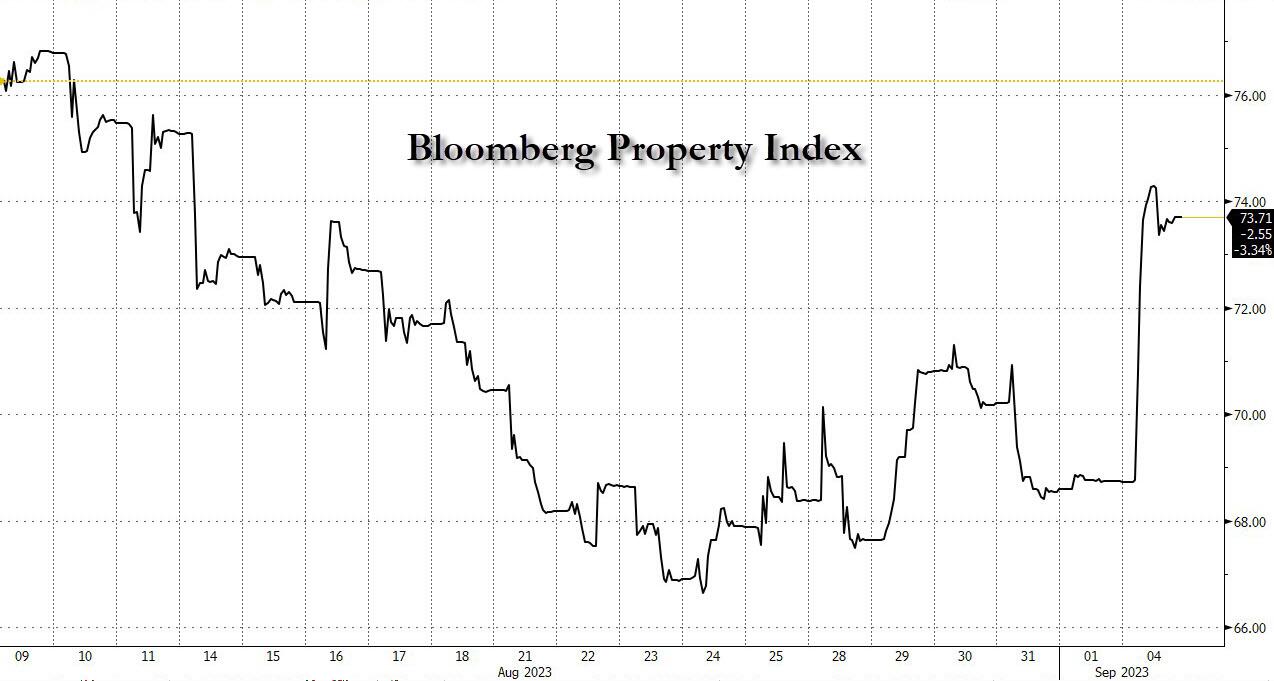
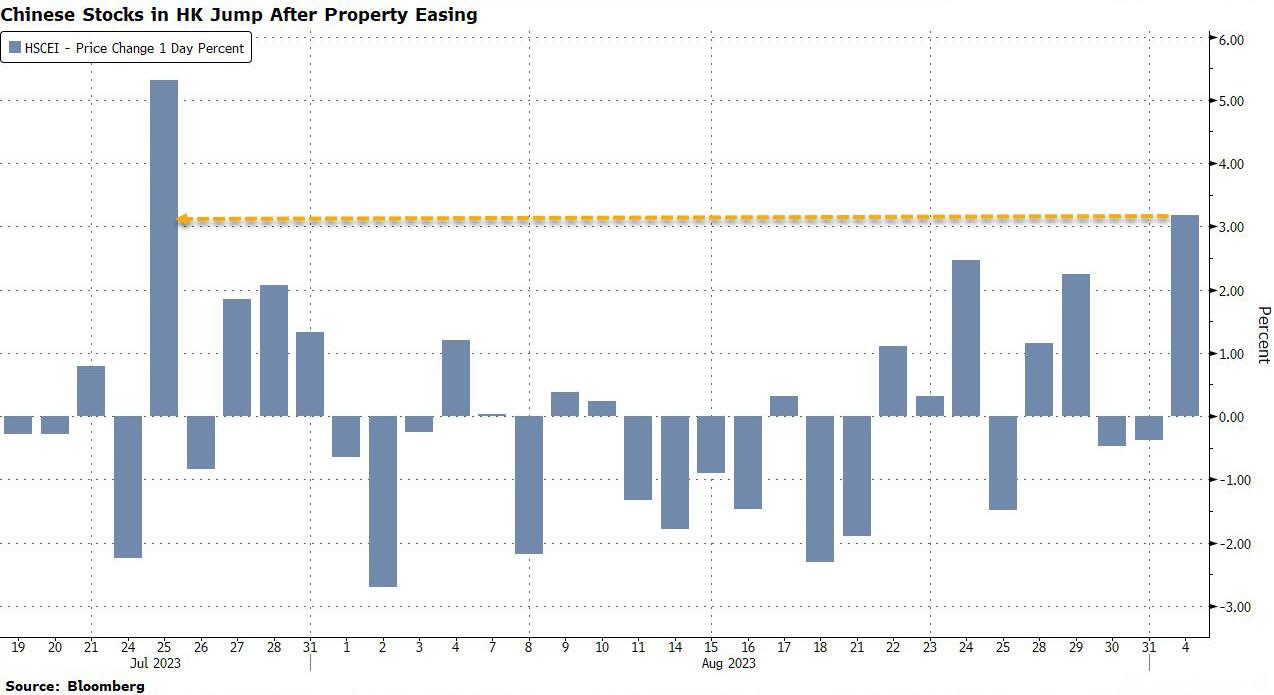
With US markets closed for the day, let's take a quick look at the biggest overnight action which today was in Asia, and specifically China, where the drip-drop of piecemeal stimulus continued and finally triggered some threshold of optimism (at least until Xi fires the big "whatever it takes" bazooka), and on Monday, the Bloomberg Intelligence gauge of Chinese developer shares surged more than 7%, after Beijing and Shanghai lowered mortgage requirements and data over the weekend showed sales jumped, following Friday’s typhoon induced market closure.

The property rebound helped China's CSI 300 Index - which had been left for dead by most hedge funds following the longest selling stretch on record - gain as much as 1.7%, and Asian stocks headed for their best day in a week, boosted by a rally in Hong Kong-listed Chinese shares.

The MSCI Asia Pacific Index rose as much as 1.1%, advancing for a sixth session, aided by gains in Tencent and Alibaba. The Hang Seng China Enterprises Index was the best performing gauge in early trade, lifted by property shares.

In Japan, equities already at the highest level since 1990 continued to gain, boosted by Toyota after Mizuho raised its price target of the world’s No. 1 carmaker, sending its price to a record high.

There were two big reasons for China's property optimism. first, key Chinese metro-areas, including Beijing and Shanghai, eased mortgage requirements for some home buyers late last week, with other cities following suit over the weekend.

First, following the slew of easing announcements in the week prior, policymakers released another batch of easing measures last week. On property policy, the central government lowered the floor for downpayment requirements and mortgage rates. All four tier-1 cities, including Beijing and Shanghai, loosened the definition of "first-time homebuyer" to ease mortgage credit for qualified individuals. Existing mortgage borrowers can refinance into somewhat lower mortgage rates. On fiscal policy, individual income taxpayers are allowed to deduct additional expenses from childcare, children's education and elderly care. On monetary policy, large state-owned banks are reported to start lowering deposit rates. At the same time, the PBOC cut the RRR for onshore FX deposits to help support the RMB. Individually, these easing measures are not large. According to Goldman, the measures "collectively sent a clear signal that policymakers want to stabilize the property market, boost growth and lift sentiment." The bank suspects more piecemeal measures will continue to be introduced until policymakers are satisfied with the result.

As Bloomberg further reports, home sales in Beijing and Shanghai soared in the past two days following mortgage relaxations, an early sign that government efforts to cushion a record housing slowdown are helping. Existing-home sales in the two megapolises doubled over the weekend from the previous one, according to CGS-CIMB Securities. “We were surprised by the strong pick up in Beijing and Shanghai, despite the challenging economy,” said Raymond Cheng, head of China property at CIMB.

The Chinese mega cities — each with a population of more than 20 million — benefited the most from Thursday’s announcement which lowered down-payment thresholds across the nation. Beijing and Shanghai also will no longer disqualify people who’ve previously had a mortgage — even if fully repaid — from being considered a first-time homebuyer, as long as they don’t own a property, according to separate statements from the city governments.

Second, Country Garden, one of China’s most troubled property developers, agreed with creditors to restructure an impending bond repayment. Hong Kong-listed shares of Country Garden - which is facing default and whose collapse would have more adverse consequences than the bankruptcy of Evergrande - soared 14.6% higher after having jumped as much as 19% to their highest level since Aug. 10. Other Chinese property developers also jumped, with Hong Kong-listed Longfor Group climbing over 8% and Seazen Group rising more than 18%.

The worsening financial woes of Country Garden have further highlighted the fragile state of the country's real estate industry, which accounts for roughly a quarter of the economy and whose debt situation has been dire since 2021. Considered financially sound compared to peers, Country Garden, China's top private developer, had not missed a debt payment obligation, onshore or offshore, until it failed to make coupon payments on dollar bonds last month after slowing home demand hurt its cash flow. Despite today's rebound, Country Garden now has just days to avoid default on Dollar Bonds where a grace period ends Sept 5 on $22.5 million in interest. There was some good news: In the deal reached late on Friday, a day before the developer had been due to repay its onshore debt worth $536 million, the company will pay its obligations in instalments over three years.

China’s steps are the latest in a long-running campaign to shore up its real-estate sector. Beijing’s newest measures appeared to be building a critical mass behind the efforts, said Altaf Kassam, head of investment strategy and research for Europe, the Middle East and Africa at State Street Global Advisors.....

....MUCH MORE

If interested see also September 1's: "China's Measures Begin to Find Traction, US Employment Report on Tap"

"Germany is the ‘sick man of Europe’ — and it’s causing a shift to the right, top economist says"

From CNBC, September 4:

  • The “sick man of Europe” moniker has resurfaced in recent weeks as manufacturing output continues to stutter in the region’s largest economy and the country grapples with high energy prices.
  • “It is not a short-term phenomenon,” Sinn said when speaking to CNBC’s Steve Sedgwick at the Ambrosetti Forum in Italy.
  • There are growing signs of public disenchantment in the shift to a more sustainable Europe, with a so-called “greenlash” emerging as people feel the cost impacts.

Germany is once again the “sick man of Europe,” according to Hans-Werner Sinn, president emeritus at the Ifo institute, and the challenges that poses, particularly in terms of the country’s energy strategy, could serve to benefit increasingly popular right-wing parties.

The “sick man of Europe” moniker has resurfaced in recent weeks as manufacturing output continues to stutter in the region’s largest economy and the country grapples with high energy prices. The label was originally used to describe the German economy in 1998 as it navigated the costly challenges of a post-reunification economy....

....MUCH MORE

For years I thought the term was originally used to describe the Ottoman Empire: 

Why was the Ottoman Empire called “the sick man of Europe”?
After the peak of Ottoman rule under Süleyman the Magnificent in the 16th century, the Ottoman Empire struggled to maintain its bloated bureaucracy and decentralized political structure. Several attempts at reform kept the empire afloat but mostly addressed immediate issues, and any success was short-lived. The most far-reaching of these reforms, the Tanzimat, contributed to a debt crisis in the 1870s. Its fragile state left it unable to withstand defeat in World War I, and most of its territories were divided as spoils as the empire disintegrated.  
 
Also Encyclopaedia Britannica 11th Edition (1911), Volume XXVII (Tonalite - Vesuvius) page 460.

UPDATE on Catastrophe Insurance

Following on "Reinsurers to only feel “minimal” impact from hurricane Idalia..." A Tokyo Earthquake On The Other Hand....".

The Washington Post had a very disingenuous, borderline deceitful story yesterday:

Home insurers cut natural disasters from policies as climate risks grow

that looks at the pull-out of  some major property/casualty insurers from the Florida and California markets.

As the paper hangs its story on the climate hook it makes no mention of the extreme inflation in construction/re-construction costs which have far outpaced general inflation.

Additionally you have the state-level issues, as noted in June 25's "Bank of England tells insurers to brace for persistent ‘claims inflation’"

We started seeing inflation considerations in renewal pricing and/or availability for Florida homeowners insurance in 2022 and 2023 and in California homeowners rates/availability this month.

From CityAM, June 23:

    Insurers must rigorously assess the impact on their solvency of the rising cost of settling car, property and other claims and ensure they have sufficient reserves, the Bank of England told the sector on Friday.

    The BoE said that claims inflation due to factors such as rising wage, medical and raw materials costs is expected to affect all general insurers.

    “There is a risk that persistently elevated claims inflation might result in a material deterioration of solvency coverage for some firms unless they take appropriate mitigating actions,” the Bank of England said in a letter to chief actuaries of general insurers....

....MORE

In Florida you also get the the insurance company litigation exposure. Almost 80% of ALL U.S. homeowners insurance litigation is in Florida.  

The WaPo also makes no mention of the great migration of population and construction to the very areas that are at risk. This is a point made by Bloomberg on July 27:

Property Owners Ignore Climate Risk Amid Insurance Meltdown
As major underwriters abandon vulnerable states, people keep moving into danger zones
.

and by the Los Angeles Times on June 18:

RISK: "State Farm is right. California can’t keep building housing in high-risk places"

We follow this stuff pretty closely and try to chronicle, in real time, what the sources say:

And because of that can confidently say: There is a lot more to this story that the Washington Post, apparently deliberately, left out.

Goldman: "How much does a US government shutdown cost the economy?"

From Goldman Sachs Intelligence, September 1:

As discussions in Washington over federal spending continue, the potential for a government shutdown is growing. A shutdown would probably have a modest effect on the economy, which may also make a sustained impasse over spending more likely, according to Goldman Sachs Research.

“Unlike the debt limit, where Congress reached a deal because the potential hit to the economy from an impasse would have been so severe, a shutdown would be much more manageable from a macroeconomic perspective,” Goldman Sachs Chief U.S. Political Economist Alec Phillips writes in the team’s report. “However, compared to the debt limit, the less severe economic effect of a shutdown also makes it more likely that Congress fails to act in time.”

A government-wide shutdown would directly reduce growth by around 0.15 percentage point for each week it lasted, or about 0.2 percentage point per week once private sector effects were included, and growth would rise by the same cumulative amount in the quarter following reopening, Phillips writes. While federal spending is equal to almost a quarter of gross domestic product, the impact of a shutdown is much smaller, for four reasons:

  1. Only discretionary spending would be affected, about a quarter of federal outlays, because mandatory spending (on programs like Medicare and Social Security) runs automatically subject to rules Congress has established.
  2. Only departments that Congress has not funded would shut down; while none of the dozen standard appropriations bills have passed to date, prolonged shutdowns have typically spared agencies such as the Department of Defense.
  3. Shutdowns primarily affect the work of federal employees (federal pay amounts to roughly 2% of GDP), with little impact on investment or purchases of goods and services....

....MUCH MORE

"I try synthetic salmon and enter the 'uncanny valley' of taste"

A topic of endless fascination.* Okay, maybe not endless.

First up, an example of the uncanny valley:

https://cdn.theatlantic.com/thumbor/ur3LplfIrvMCvBJ2qSDqCMvvTj0=/5x51:2354x1284/960x504/media/img/mt/2014/03/render_1/original.png

You know what it is supposed to be but it is not quite there. 

As seen in 

Seinfeld, Virtual Reality and Mild Revulsion
The Uncanny Valley, Interior-Design Edition

The "uncanny valley" usually applies to human aesthetics. It describes that vague sense of revulsion you get when you see a fabricated person—a robot, usually—who looks aaaaalmost human … but not quite....
And from Ars Technica, August 19:
Synthetic fish isn't quite there yet—and may not be worth the effort.

I could count on one thing as I sat down for a multiple-course meal based on something that looked very much like salmon: I would not have to worry about any bones. The plant-based theme ingredient came from a Toronto startup called New School Foods that has been developing a way to construct a salmon substitute with not just the taste but also the texture of the real thing.

New School treated a table’s worth of journalists to a tasting dinner in Toronto in late June—subject to a no-food-photos rule for attendees but with no restrictions on taking notes. That comped meal came hours after CEO Chris Bryson gave his sales pitch for the company during a panel at the Collision conference there, in which he said that New School’s goal was to see its products “enthusiastically adopted by non-vegans.”

New School has given itself a tall order by making salmon its go-to-market product. Salmon both has a distinctive, delicate texture and one of the most identifiable flavor profiles among seafood. And people prepare it with a wider range of techniques than most kinds of meat allow—grilling, poaching, sautéing, smoking, roasting, or even not cooking it at all. For plant-based salmon to pass muster, it has to work across those use cases.

New School says that its “scaffolding” technology, developed at Toronto Metropolitan University, makes that possible. This technique departs from the higher-temperature processes used to generate such plant-based foods as the Impossible Burger because it yields an uncooked product without denatured proteins. As the technical description in New School's press kit says:

New School Foods’ process starts by creating a biopolymer gel. This homogeneous hydrogel is placed in contact with a freezing surface and the gel is directionally frozen, resulting in the formation of thousands of directionally aligned, microscopic ice crystals traveling away from the freezing source.

Once the gel is fully frozen, the ice is removed, leaving behind empty channels. These channels act as a scaffold; the channels are filled with proteins and other ingredients (color, flavors, fats) to form the muscle fibers.

The company claims that the result has the differentiated texture of a cut of meat. Compared to the ground meat in a burger, sausage, or meatball, that’s a much harder thing to imitate with plant parts, though it is also a goal that other food startups have been pursuing.

Four flavors of faux fish....

UPDATED—"Reinsurers to only feel “minimal” impact from hurricane Idalia..." A Tokyo Earthquake On The Other Hand....

Original post:

Three from the cat bond/Reinsurance/ILS mavens at Artemis. First up, the headliner:

The reinsurance sector will likely only feel a “minimal” impact from hurricane Idalia, as its losses are destined to be largely retained by primary insurers, AM Best has said. 

The rating agency actually said that, “Insured losses in Florida related to Hurricane Idalia are unlikely to surpass those from Hurricane Ian last year.”

Given the industry loss estimates now emerging, it actually seems that hurricane Idalia’s insurance industry impact may be less than one-tenth of hurricane Ian’s....

....MUCH MORE

Second, the "now emerging" headline:

Hurricane Idalia private insurance loss estimated just $2.2bn by KCC  

And finally:

Serious Tokyo earthquake could be $130-150bn industry loss: Swiss Re

The global insurance and reinsurance industry could face in the region of $130 billion to as much as $150 billion of losses if a really severe earthquake strikes the Tokyo region of Japan, according to Swiss Re.

“The high concentration of population and wealth in the Tokyo region mean a serious quake could cause insured losses of an estimated USD 130-150bn,” Swiss Re explained.

Adding that, “This would be the highest ever loss globally from one event.”

It is almost one hundred years on from the Great Kanto Earthquake now, an event that killed over 100,000 people and caused economic losses that reached close to one-third of Japan’s GDP....

....MUCH MORE

Sunday, September 3, 2023

"Fossil Fuel Imports Are Already Constrained"

From Gail (@gailtheactuary) Tverberg's Our Finite World blog, August 31: 

For many years, there has been a theory that imports of oil would become a problem before there was an overall shortage of fossil fuels. In fact, when I look at the data, it seems to be clear that oil imports are already constrained.

https://i0.wp.com/ourfiniteworld.com/wp-content/uploads/2023/08/Fossil-Fuel-Trade-Among-Regions-v3.png?resize=1024%2C623&ssl=1

Figure 1. Interregional trade of fossil fuels based on data of the  
2023 Statistical Review of World Energy by the Energy Institute.

As I look at the data, it appears to me that coal and natural gas imports are becoming constrained, as well. There was evidence of this constrained supply in the spiking prices for these fuels in Europe in late 2021 and early 2022, starting well before the Ukraine conflict began.

Oil, coal, and natural gas are different enough from each other that we should expect somewhat different patterns. Oil is inexpensive to transport. It is especially important for the production of food and for transportation. Prices tend to be worldwide prices.

Coal and natural gas are both more expensive to transport than oil. They tend to be used in industry, in the heating and cooling of buildings, and in electricity production. Their prices tend to be local prices, rather than the worldwide price we expect for oil. Prices for importers of these fuels can jump very high if there are shortages.

In this post, I first look at the trends in the overall supply of these fuels, since a big part of the import problem is fossil fuel supply not growing quickly enough to keep pace with world population growth. I also give more background how the three fossil fuels differ.

After this introductory material, I provide charts and some analysis of fossil fuel imports and exports by region, based on data from the 2023 Statistical Review of World Energy. Theoretically, the total of regional imports should be very close to the total of regional exports. This analysis gives a little more insight into what is going wrong and where....

....MUCH MORE

"Empire of dust: what the tiniest specks reveal about the world"

Dust will always be with us.

From The Guardian, August 31:

Nobody normally gives a second thought to dust, but it is inescapable. And if we pay close attention, we can see the biggest things – time, death and life itself – within these tiny floating particles

For two centuries, London’s buildings were black. Blanketed in sulphurous soot from coal fires – the famous London “pea souper” fogs – a thin layer of carbon coated every surface in the city. London was so dirty that there was no memory that it might ever have been any other way. During the restoration of 10 Downing Street in 1954, it was discovered that the familiar dark facade was not actually black at all, but originally yellow brick. The shock was considered too much for the country to take and the newly clean building was painted black to maintain its previous, familiar appearance.

But then, in the late 1980s and early 1990s, there was a great clean-up. For more than a decade, scaffolding surrounded landmarks like St Paul’s Cathedral, as power washers hosed the grime down into the sewers and out of sight. These days the city is russet and pale grey, silver-mirrored and blue green – the colours of brick, limestone and glass. The pollution is now polychrome: the primary residue adhering to buildings is not the black of carbon soot, but a warmer browny-yellow colour from the organic hydrocarbons in petrol and diesel fuel. As sulphate emissions from traffic fall, buildings may yet turn green as mosses and lichens grow back.

Yet you cannot just blast dust and grime off all of London’s landmarks. Westminster Hall is the oldest building in parliament, built about 900 years ago by William Rufus, son of the Norman conqueror. In 2007, architectural conservators found that its walls were being corroded by air pollution and penetrated by moisture. They reckoned it had not been cleaned in 200 years. It was time.

But how to do this while maintaining respect for the building’s fabric? Limestone is porous, soluble stuff, which could dissolve under strain from high-pressure washing. Fortunately, more subtle methods are available. Delicate carving can be cleaned using poulticing, akin to a clay face mask for the stone, which draws out deep-seated salts and staining. Latex films are another option: they are brushed or sprayed on, then left to absorb grime from the stone, before being peeled off, taking the dirt with them.

News of the epic cleaning project at Westminster reached an artist in New York, who got permission to preserve the latex sheets used to clean the stonework. The artist, Jorge Otero-Pailos, subsequently displayed them in an exhibition called The Ethics of Dust. In June 2016, I walked into Westminster Hall and confronted a translucent, glowing curtain, 50 metres long and five metres tall, hung from the ancient hammerbeam roof, a patchwork skin encrusted in the grime of the entire city.

Since modernity began, people have complained about airborne dust – but the measures required to control it have come decades or centuries after, if at all. The coalmines and factories that powered Britain’s Industrial Revolution made a capitalist class very rich, while the cost was borne by their workers in their bodies, lungs and blood. The Ethics of Dust was, for me, about human presence made present – about the building rewritten as not only limestone and glass and a wood-beamed roof, or as big abstract nouns like history and tradition and power, but the material traces of millions of bodies, their labours and their livelihoods. It brings the polis, the people, right into the heart of parliament – and it brings a reckoning with the source of Britain’s historical prosperity, too.

Nobody normally thinks about dust, what it might be doing or where it should go: it is so tiny, so totally, absolutely, mundane, that it slips beneath the limits of vision. But if we pay attention, we can see the world within it.

Before we go any further, I should define my terms. What do I mean by dust? I want to say everything: almost everything can become dust, given time. The orange haze in the sky over Europe in the spring, the pale fur that accumulates on my writing desk and the black grime I wipe from my face in the evening after a day traversing the city. Dust gains its identity not from a singular material origin, but instead through its form (tiny solid particles), its mode of transport (airborne) and, perhaps, a certain loss of context, an inherent formlessness. If we knew precisely what it was made of, we might not call it dust, but instead dander or cement or pollen. “Tiny flying particles,” though, might suffice as a practical starting definition.

In 2015, I found myself driving into a forest fire in the Sierra national park in California. Smoke hung heavy in the sky: the fire behind the hills was one ridge away. The particles in the smoke cloud were the soot and wood ash from a burning pine forest. Today, 8.5m tonnes of this burnt “black carbon” are emitted around the world each year, most not of natural origin, but instead from diesel engines, wood-fuelled cooking stoves and burning to clear land for agriculture. Black carbon is a powerful “climate forcer”, absorbing warmth from the sun and contributing substantially to global heating. It is also a major component of fine particle air pollution, known as PM2.5s (particles under 2.5 micrometres in size).

These tiny particles are easily inhaled deep into the lungs. Their even-smaller cousins, ultrafine PM0.1s, can pass through the air sacs in the lungs into the bloodstream, where they can be transported to every organ and can harm potentially every cell in the human body. Particulate air pollution causes not just respiratory illnesses but heart disease, cancers, infertility, even neurodegenerative diseases such as Alzheimer’s. Altogether, it’s the fifth biggest cause of death in the world, accounting for 4.2m lives lost each year. If London’s air was compliant with World Health Organization (WHO) standards for PM2.5s, its residents would gain on average an extra 2.5 months of life.....

....MUCH MORE

Previously:
“'Mooke, fylthe and other vyle things': Tudor dirt and dung"

An Empire Brought Down By Dust
No, not J.G. Boswell and not some clean room gone awry, this is an honest-to-goodness empire.

"Searching for the Dust That Cooled the Planet"
This is why you want to be careful with the geoengineering proposals. Some links after the jump.

"James Dyson on 5,126 Vacuums That Didn’t Work— and the One That Finally Did"

"Why did Gilded Age mansions lose their luster?"
Because they're drafty.
And drafty means dust and that means hordes of maids dusting but not the kind of maids you'd like to have dusting, oh no.
No, Mrs. Climateer wants the kind of maids that can beat you in arm-wrestling and jump up on the little shelf on the wainscotting and...where was I?
Expense. The cost of running the big old places is large-by-large.

"Ripple Says SEC ‘Rushing to Appeal’ Landmark Crypto Ruling"

Not just that.

From PYMNTS.com, Sept. 3:

Ripple wants to block the SEC from appealing a recent landmark crypto court ruling.

In July, U.S. District Judge Analisa Torres ruled that the blockchain company’s native XRP token is not a security when sold to the public. Last month, Torres gave the Securities and Exchange Commission (SEC) permission to appeal her ruling. 

But in a court filing Friday (Sept. 1), Ripple said the regulator is “now rushing to appeal what it claims is a purely ‘legal question’ applicable to every digital-asset case.”

As PYMNTS has written, Torres’s initial ruling was seen as a victory for the broader crypto sector and for Ripple in its long-running battle with the SEC.

“I have heard from hundreds of people throughout the industry, there’s just broad enthusiasm and excitement, this is the first time the SEC lost a crypto case,” Ripple CEO Brad Garlinghouse said in July. “The SEC has been a bully.”...

....MUCH MORE

As we saw at the Columbia Law School's CLS Blue Sky blog last week:
Coming Up In Crypto: "The Ripple and Terraform Cases Tee Up a Dramatic Showdown over Cryptocurrency Regulation"

The WEIRDest People in the World—A Review

Before getting to the main course, where the reviewed book points up the importance of kinship in explaining social development we'll lift the introduction from a different 2020 post and re-purpose, re-use and re-cycle:

December 26, 2020
Tribalism
The title of this piece was "Is Tribalism a Natural Malfunction?" but that seems an incorrect characterization.

It's all about trust, which is one of the reasons globalists have a problem convincing ordinary people to share their grand dreams and visions. Many of the things globalists have promised turned out not to be true so people go to the population size they feel they can trust.

Can't trust the U.N. after the Oil-for-Food frauds and the Rwandan genocides? Let's try nation-state.

Can't trust nation-states because one part of the populace cheats or shows themselves to be hypocrites? 
(And it is this very point, Orwell's “All animals are equal, but some animals are more equal than others.” where globalists lose the masses)

Let's try states.

And then city-states and if you can't trust your fellow metropolitans we'll go with blood relations, first tribes and if there are schisms there, to immediate family. Consanguinity and all that.

Tribalism isn't a "mal" anything, it's a survival mechanism for when you really, really have to increase the odds that you will be able to trust another person....

And from Quillette, September 8, 2020:

The WEIRDest People in the World—A Review 

A review of The WEIRDest People in the World: How the West Became Psychologically Peculiar and Particularly Prosperous by Joseph Henrich, Farrar, Straus, and Giroux, 704 pages (September, 2020).

A decade ago, researcher and scholar Joseph Henrich, together with psychologists Steven Heine and Ara Norenzayan, published a landmark paper in Behavioral and Brain Sciences titled, “The weirdest people in the world?”1 No, the target of the label “weird” were not the Araweté horticulturalists of lowland South America, where mothers-to-be seek sex with multiple men in the belief that semen from multiple fathers is needed to form the fetus.2 Nor were they the Māori of New Zealand, who have been known to collect and preserve the heads of enemy chiefs they killed in battle as trophies of war, (the mokomokai.) The target of the weird label was Western people. More specifically, Western, Educated, Industrialized, Rich, and Democratic, or WEIRD.

WEIRD was not meant as a pejorative, but as an apt description of this group of psychologically peculiar people, who are distinct from the majority of humanity both now and throughout human history.

Indeed, WEIRD individuals are psychologically peculiar in a number of ways. For instance, if asked the question, “Who are you?” WEIRD people are more likely to describe themselves in terms of their skills, occupation, achievements, and talents rather than by their relationships—they are “a doctor,” “hardworking,” or “a pianist” rather than “Alex’s son” or “Clara’s boyfriend.” Additionally, when judging others, they are typically more likely to assign responsibility to personal characteristics rather than external circumstances. For instance, they are likely to assume that the guy driving recklessly ahead of them on the highway is a complete idiot and terrible driver rather than a worried son rushing his father to the nearest emergency room. While WEIRD people are more individualistic, self-centered, impersonally prosocial, guilt-ridden, and analytical, many non-WEIRD people, from the Chinese to the Ju/’hoansi of the Kalahari Desert, display opposite psychological trends. Non-WEIRD people tend to be more collectivistic, other-focused, more partial to their in-groups, shame-ridden, and holistic thinkers.

The central argument of Henrich and his collaborators is that there has been and continues to be an over-reliance on WEIRD samples in research. And while many of these findings purport to shed light on the human mind and behavior in general, they actually only illuminate the psychology of a small proportion of the human species. WEIRD people make up only around 12 percent of the world’s population and yet over 90 percent of the subjects in psychology research.1 While this methodological critique was and continues to be extremely important for researchers, it left the question of how WEIRD psychology came to be, unresolved. Explaining WEIRD psychology, together with elucidating the key factors that contributed to the scaling-up of small Western societies into large complex states, are the two central focuses of The WEIRDest People in the World. Joseph Henrich addresses them in this sweeping and magisterial book, likely to become as foundational to cultural psychology as the WEIRD acronym he and his colleagues coined a decade ago.

In many ways, The WEIRDest People in the World is a sequel to Henrich’s 2016 book The Secret of Our Success, in which he argues that the distinctly human ability to create, transmit, and acquire evolved cultural systems is the major reason for our success as a species. It also calls to mind similar transdisciplinary books as Jared Diamond’s Guns, Germs and Steel and Steven Pinker’s The Better Angels of Our Nature. All are books that attempt to answer questions as foundational and timeless as that posed by Adam Smith in The Wealth of Nations published in the 18th century—what explains why some countries are poor and others are rich? Such broad foundational questions necessitate bridging the gaps between disciplines since their answers are fragmented across them. Of the many qualities to admire in this book, its interdisciplinary approach is perhaps the most impressive. I imagine that Henrich stands by the contention that the boundaries between disciplines are largely arbitrary and often need to be crossed to make sense of phenomena as complex as the evolutionary history of Homo sapiens. For in arguing his case, he weaves together disciplines as different as evolutionary biology, psychology, and anthropology, among others. This method is altogether befitting of an academic who has not only been a tenured professor in four different academic disciplines, but also has reached across half a dozen or so fields to conduct his cross-cultural research on human evolution.

Henrich takes this approach especially when he argues that the origins of WEIRD psychology began with the fall of the Western Roman Empire and the rise of the branch of Christianity that later evolved into the Roman Catholic Church, which he calls the “Western Church.” During the period between about 400 and 1200 CE, the Western Church began gradually dismantling intensive kin-based institutions such as clans, kindreds, and segmentary lineages, which were typical of most human societies then and throughout human history. With the disbanding of these institutions came the outlawing of norms associated with them such as polygamy and cousin marriage. The Western Church began promulgating a new set of prescriptions dealing with marriage, family, identity, and inheritance, which Henrich collectively refers to as the Marriage and Family Program (MFP). The MFP inadvertently encouraged the creation of associations such as guilds, universities, and confraternities, which bound people together based on shared interests, beliefs, and skills, rather than kinship ties. Henrich argues that the rise of these more non-relational institutions in Europe created a novel environment to which these populations psychologically adapted. This cultural adaptation strongly influenced the psychology typical of WEIRD people today.

The way in which Henrich examines psychological variation through the lens of kinship intensity, meaning the strength of kin-based institutions in one’s society, provides a more direct approach to understanding mind and behavior than more abstract concepts like individualism and collectivism, or tightness and looseness. This is because kin-based institutions and their associated norms are more grounded in our evolved psychology and are primary to human social life. Additionally, the importance of these norms and institutions reverberate through multiple layers of society from the individual to the cultural group.
Henrich presents data that testify to the influence of kinship on human psychology. For example, on average, cultures with high kinship intensity relative to those with low kinship intensity possess psychological trends that are opposite to those in WEIRD societies. These include the prevalence of shame rather than guilt, in-group loyalty rather than universalism, nepotism rather than impartiality, and holistic rather than analytic thinking.

Beyond this, Henrich argues that kinship intensity does not just describe or predict psychological variation, it explains it....
....MUCH MORE
 
If interested see also 2018's "Tribes and States: Human Self-Organization" which casually drops this tidbit:  
....It is only when a tribe is part of a strong state that an independently-enforced hierarchy of chiefs can arise.16 It is at that point that stratification between the elite families and ordinary tribesmen emerges, and a chief can, to some degree, rule tribesmen. The power of the state imposes a hierarchy of authority on a tribe and weakens the tribal organization.
Tribal segmentary lineage systems provide order without a political hierarchy. Edward Evans-Pritchard famously described this arrangement as “ordered anarchy.”17
Social control is imposed through balanced opposition, and deterrence provided by norms of retaliation and vengeance. Every society needs order. Only predictability allows people to gauge the consequences of their acts, and thus to act purposefully. Without order, neither social relations nor the production and exchange required for an economy are feasible. Tribal organization provides that order.....

Arm Holdings IPO: "You cannot be serious, Son"

From A Long Time In Finance via Reaction Magazine, September 1:

It is the most eagerly awaited share offering of the year. There was much wailing and gnashing of teeth when the owners of the UK-based chip designer Arm decided to list in the US in preference to London. The chance to add a stock that would easily make it into the FTSE100 top ten was enough to get Rishi Sunak on the case to try and list the business at home and boost London’s moribund new issue market.

He lost. Arm is being touted as a $64bn stock, and the offer process is underway in New York, with a thumping legal document describing the business. To save you having to read it, the boys at Doomberg (A sort of antidote to Bloomberg) have struggled through its 300 pages and unravelled a distinctly odd transaction which is being used to support talk of that market value.

It would mark an impressive gain on the $32bn that the world’s biggest gambler paid seven years ago to take Arm off the London stock market. Masayoshi Son would prefer to be described as a “Japanese billionaire technology entrepreneur, investor and philanthropist” in charge of Softbank, a world-scale technology group.

Recently Son has been playing with the shareholdings in Arm, moving them at an internally-generated value of $64bn for the business. However, that door-stopping document suggests that Arm could be worth a great deal less when it comes to market. As Reuters pointed out: “Scattered throughout the hundreds of pages of Arm’s prospectus are details of the company’s labyrinthine relationship with China, its second-largest market.”....

....MUCH MORE

Additionally, we saw this in 2021: 

Chips: "ARM China Seizes IP, Relaunches as an ‘Independent’ Company"

Marking the Retirement Of One Of The Great Stock-Pickers

A repost from 2018:

Today In History: Swedish Chimpanzee, Ola, Wraps Up Investing Career

From the Los Angeles Times, Sept. 9, 1993:
STOCKHOLM, Sweden — A newspaper gave five stock analysts and a chimpanzee the equivalent of $1,250 each to make as much money as they could on the stock market. The chimp won. 
After one month, the chimpanzee, Ola, saw the value of his stocks rise $190, the newspaper Expressen reported this week. 
Runner-up was Mats Jonnerhag, publisher of the newsletter Bourse Insight. His stocks rose $130 from Aug. 3 to Sept. 3. 
While the stock experts carefully considered their portfolios, Ola made his choice by throwing darts at names of companies listed on the Stockholm stock exchange. 
One dart hit Forsheda, a small diversified company whose stock rose 44% over the month. That compared to the average 5% rise for all stocks listed on the exchange.
Despite persistent rumors, it was never proven that the "chimp" was actually Burton Malkiel in a monkey* suit.
*(yes, yes taxonomy, my bad)